


Abstract
Background: Male DSD is a rare disorder in which individuals with an XX chromosomal background present as phenotypic males due to the presence of the SRY gene translocation. We present here cytogenetic and molecular characterization of rare phenotypic male patients with primary infertility involving SRY translocation on the X chromosome, resulting in the absence of Y centromeric sequences. Methods: Routine hormonal analysis, scrotal ultrasonography, karyotype and FISH analysis were performed. Results: Normal male appearing patients presented with a long history of primary infertility. Physical examination revealed bilateral small, soft testes but reportedly normal libido and erectile function. Hormonal analysis revealed hypergonadotropic hypogonadism with very low total testosterone, high FSH and LH. Semen analysis consistently revealed azoospermia, and multiple testicular sperm extraction procedures and bilateral varicocelectomy failed to retrieve sperm. Karyotyping and FISH showed 46,X,der(X)t(X;Y)(p22.1;p11.2), and SRY-positivity on the derivative X chromosome, respectively. Conclusions: These findings expand the spectrum of 46,XX male infertility with SRY-positivity and underscore the necessity of lifelong testosterone replacement therapy for the management of hypogonadism. Future efforts should aim to establish regional registries for DSD to document genetic diversity surveillance in underrepresented populations.
1. Introduction (Review of Literature)
Disorders of sex development, also known as DSDs, are a group of congenital conditions characterized by atypical development of chromosomal, gonadal, or anatomic sex [1]. The development of male or female gonads is dependent upon intricate but distinct pro-testis or pro-ovarian genetic and epigenetic networks that promote the differentiation of the bipotential XY and XX gonads into testes and ovaries, respectively [2]. Any gene dosage or expression change will lead to DSDs. In males with XY chromosomes, the SRY gene initiates a cascade of testicular differentiation, inducing the SOX9 gene expression, which ultimately plays a central role in regulating the expression of male sexual differentiation genes and inducing testis development in the genital ridges [3,4]. Deleterious point mutations and copy number changes associated with disorders of testicular differentiation in humans and mice have also been reported, suggesting the role of genetic testing in DSDs [5]. Multiple forms of DSDs with phenotypic and genetic heterogeneity include 46,XY DSD, sex chromosomal DSD and 46,XX DSD, which is further classified into three groups: disorders of androgen excess, unclassified disorders and disorders of gonadal development. 46,XX testicular DSD (T DSD or 46, XX males), or de la Chapelle syndrome is one such disorder of gonadal development wherein individuals with a female karyotype (46,XX) exhibit a male phenotype [6]. Other forms of gonadal development disorders include monogenic forms of primary ovarian insufficiency and syndromic forms [7]. Cytogenetic analyses have revealed mainly two forms of 46,XX males, depending upon the presence or absence of the SRY gene (Y-chromosome positive or negative) [8]. It has been suggested that the 46,XX male phenotype is often caused by aberrant translocation of the SRY gene on the X chromosome during male meiosis, resulting in der (X) or to an autosome [9]. Additionally, 46,XX male phenotype may also be caused by an X-linked or autosomal gene mutation in the testis-determining pathway in SRY negative XX males [10] and Y-chromosome mosaicism limited to the gonad [11]. 46,XX males with SRY positivity usually arise as a result of unequal recombination between the pseudoautosomal regions (PAR1) of the X and Y chromosomes during spermatogenesis. SRY-positivity initiates activation of downstream testis-determining pathways, including SOX9, leading to testicular development. Infertility may result from the absence of AZF regions on the Y chromosome necessary for spermatogenesis, multiple copy alterations in a regulatory region of the SOX3 on chromosome X and the SOX9 gene on chromosome 17 [12,13] and due to mutation in the NR5A1 gene located on chromosome 9 and the NR2F2 gene on chromosome 15 [14,15]. SRY translocation in the absence of the full Y chromosome or the absence of azoospermia factor (AZF) regions in the presence of the long arm of the Y chromosome leads to male infertility in all cases [16,17]. In such situations, the only way to conceive is through assisted reproductive technology using donor sperm.
The individuals with classical 46,XX T-DSD present with normal male phenotype at birth and are diagnosed after puberty in adulthood when they present with normal male adrenarchal hair pattern, normal intelligence, hypergonadotropic hypogonadism, gynecomastia, small testes and infertility due to azoospermia [18,19,20]. The phenotypic impact depends upon the size of the translocated segment of the Y onto the X-chromosome, X inactivation patterns and extent of testicular tissue development [21]. SRY-negative 46,XX T-DSD patients may present with hypospadias, cryptorchidism or genital ambiguity of variable degree [17]. Some 46, XX males present with features similar to Klinefelter’s syndrome but with normal or low height [22]. This phenotypic variability in 46,XX males may be explained by the differential inactivation of the X chromosome carrying SRY [23,24].
The role of genetic factors in gonadal differentiation and in the development of DSDs is evident, and various genomics technologies in DSDs have been in use [25]. Cytogenetic analysis via GTG-banding karyotype and molecular cytogenetics, including fluorescent in situ hybridization (FISH), plays an essential role in the diagnosis of DSDs, particularly in SRY-positive cases; these constitute approximately 90% of 46,XX DSD patients due to Y to X translocation originating from an abnormal recombination during paternal meiosis [26]. Karyotyping is used to detect the der(X) chromosome resulting from the translocation of the SRY region (on Yp) to chromosome X. FISH and PCR are used for confirmatory diagnosis in the localization of SRY, assessment of centromeric Y material, and for the detection of microdeletions in the AZF region [27]. Herein, we report unique cases of phenotypic males with a 46,X,der(X)t(X;Y)(p22.1;p11.2) karyotype, confirmed to be SRY-positive by FISH, reiterating the fact that infertility in SRY-positive 46,XX males is irreversible and may need lifelong testosterone replacement therapy. To our knowledge, this is the first such report from Saudi Arabia.
2. Materials and Methods
Patients and sample collection: Two adult male patients with primary infertility were examined at King Fahad Medical City (KFMC) infertility clinic. Peripheral blood samples were collected after informed consent.
Cytogenetic analysis, Karyotyping: Peripheral blood lymphocytes were cultured for 72 h under conventional phytohemagglutinin (PHA) stimulation. Metaphase chromosomes were produced following hypotonic treatment and fixation. Cytogenetic analysis was carried out utilizing conventional trypsin-Giemsa (G-banding) procedures. At least 20 metaphases of each subject were examined. Chromosome analysis and picture extraction were performed using a Leica DM2500 microscope (Leica Microsystems, Wetzlar, Germany) with Cytovision software version 7.7 build 78 (Leica Microsystems, Wetzlar, Germany). Karyotypes were characterized using the International System for Human Cytogenomic Nomenclature (ISCN 2024).
Fluorescence in situ hybridization (FISH): This was carried out by utilizing the commercially available probes: LSI SRY SpectrumOrange/CEP X SpectrumGreen probe (Abbott Molecular, Des Plaines, IL, USA; Catalog No. 30-191007); SHOX/X/Y probe set (CytoTest Inc., Rockville, MD, USA), targeting SHOX [Xp22.33/Yp11.3], DXZ1, and DYZ3 loci Catalog No. LPU 025. The hybridization, washing, and detection processes were carried out in accordance with the manufacturer’s instructions. Each patient had at least 100 interphase nuclei and 10–20 metaphase spreads evaluated using appropriate florescence filter settings.
3. Case Presentation
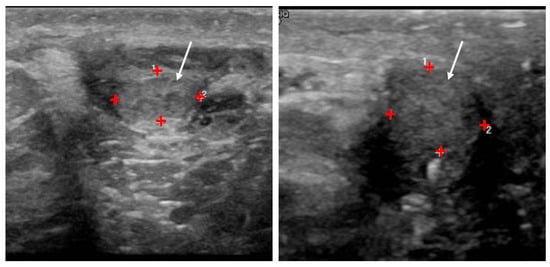
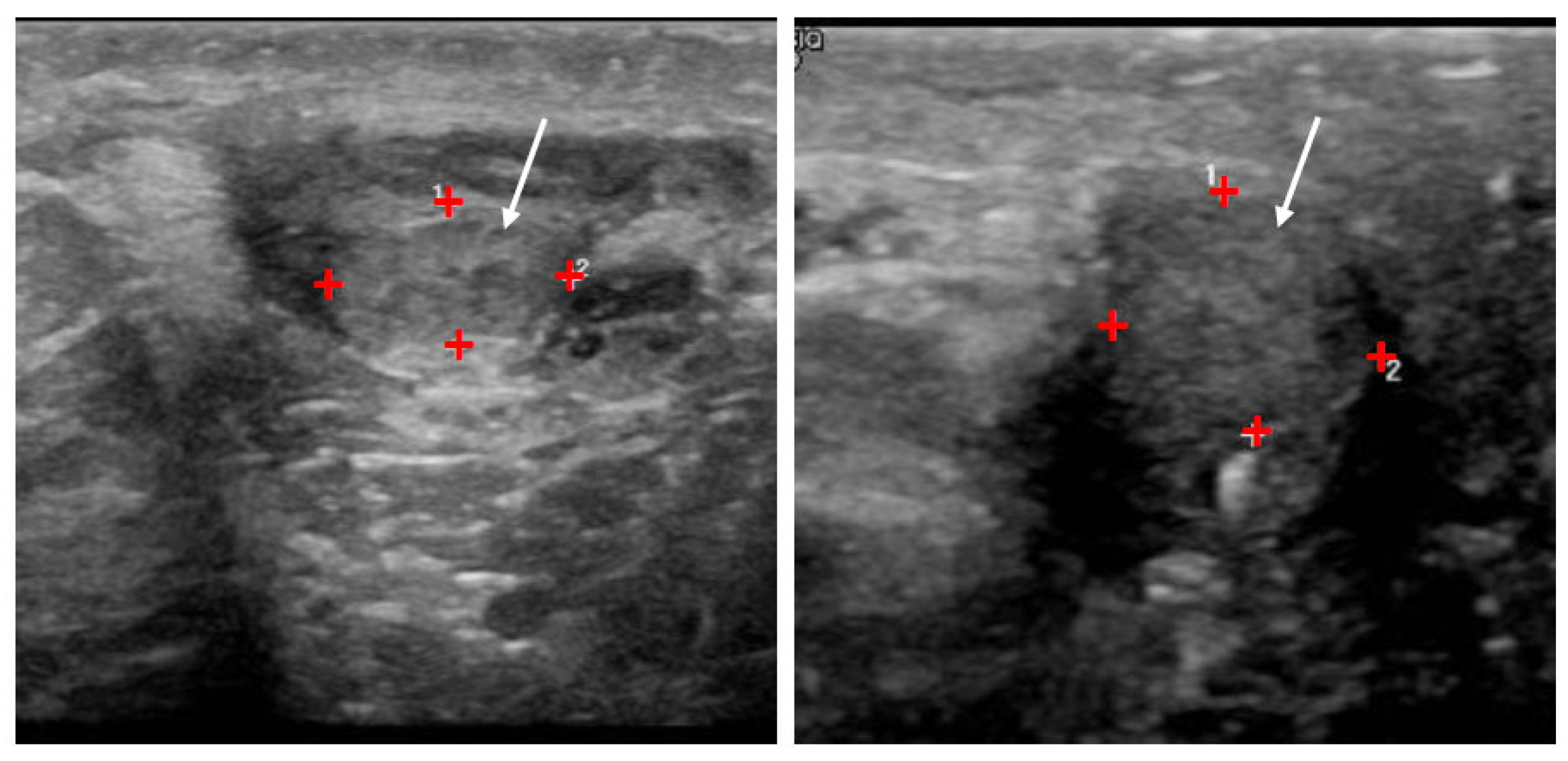
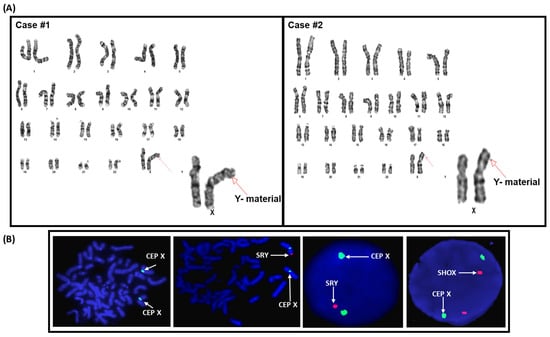
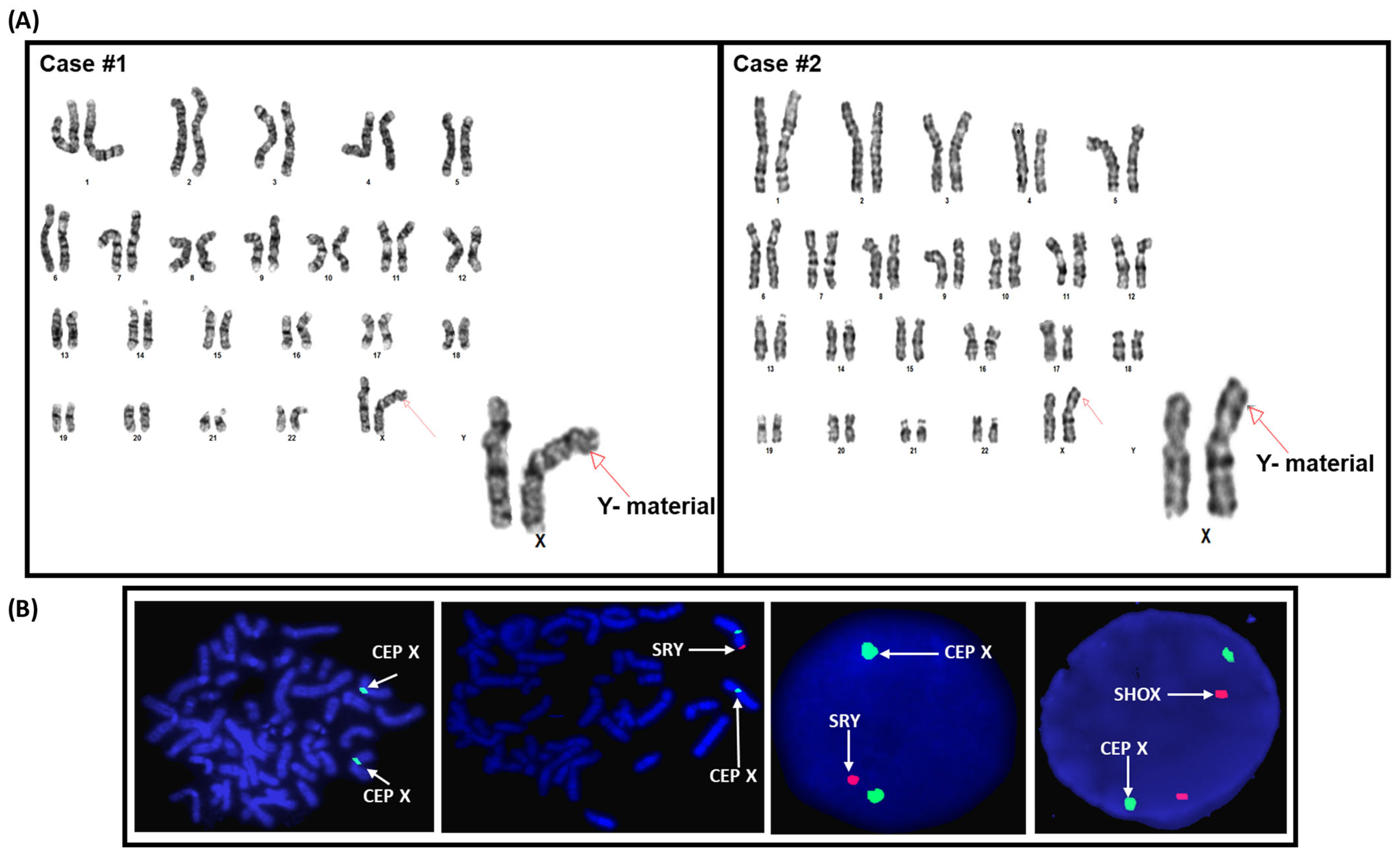
Case #1: A 53-year-old male presented to the infertility clinic at King Fahad Medical City (KFMC) with a 28-year history of primary infertility. He was medically free with a normal male appearance and reported normal libido and erectile function. Physical examination showed small, soft testes without ambiguous genitalia, and growth parameters showed height of 167 cm, weight of 75 kg, and blood pressure 122/77 mmHg. We followed our internal algorithm for the clinical work-up of an infertile male. Scrotal ultrasonography (Figure 1, left and right panels) demonstrated bilaterally small testes (right testicle 0.2 mL, left testicle 0.23 mL) with preserved parenchymal structure and no hydrocele. Hormonal analysis revealed very low total testosterone 1.7 nmol/mL (reference range 4.94–32 nmol/L), high FSH 28 mIU/mL (reference range 0.95–12 mIU/mL), and high LH 15 mIU/mL (reference range 0.6–12.1 mIU/mL), consistent with hypogonadism. Azoospermia was consistently revealed on semen analysis. Multiple testicular sperm extraction (TESE) procedures and bilateral varicocelectomy were unsuccessful for any sperm retrieval. Karyotyping showed 46,X,der(X)t(X;Y)(p22.1;p11.2) (Figure 2, upper left panel), and FISH analysis confirmed the presence of SRY on the derivative X chromosome and absence of an intact Y chromosome (Figure 2, lower panel). Dual SHOX signals were noted.
Figure 1.
Radiological images from ultrasonography. Radiological images from ultrasonography. Scrotal ultrasound image showing small testes with no focal lesions or hydrocele. The testes size is indicated with + symbols and arrows.
Figure 2.
Cytogenetic analysis using Karyotyping and FISH. (A), Upper panel with karyotype analysis showing the absence of the Y chromosome, and (B), lower panel with FISH analysis showing the absence of the Y chromosome and presence of the SRY gene in the metaphase spread and interphase cell; the presence of two SHOX gene signals in the interphase nucleus. Representative data are shown.
Case #2: A medically free man, 47 years old, with 9 years of primary infertility, came to the Infertility clinic within KFMC. He reported regular intercourse with normal libido and ejaculation and no family history of infertility. The clinical examination revealed normal male external genitalia with small testes and no dysmorphic characteristics observed. Hormonal testing showed a low testosterone level of 4.3 ng/mL, significantly high luteinizing hormone (17 IU/L) and follicle-stimulating hormone (36.9 IU/L), indicating hypergonadotropic hypogonadism (Table 1). Two semen analyses in different hospitals confirmed azoospermia. Karyotype analysis revealed 46,X,der(X)t(X;Y)(p22.1;p11.2) (Figure 2, upper right panel) and the presence of the SRY was confirmed by FISH (Figure 2, lower panel). These results indicate non-obstructive azoospermia with a genetic and hormonal profile that is consistent with a derivative-X SRY-positive 46,XX testicular SD. Following the diagnosis of hypergonadotropic hypogonadism, both patients were counseled regarding the potential need for lifelong testosterone replacement therapy to manage androgen deficiency and to preserve the secondary sexual characteristics. Demographic data, hormonal profile and semen analysis results for both cases are shown (Table 1).
Table 1.
Demographic data and hormonal profile in patients with 46,XX male syndrome.
4. Discussion
We present here unique cases of disorders of gonadal development, 46,XX testicular DSD (46, XX males) in phenotypic males with 46,X,der(X)t(X;Y)(p22.1;p11.2) karyotype and SRY-positivity confirmed by FISH. There have been only a few reported cases worldwide that feature a genetic profile similar to our patient’s karyotype [28,29,30] (Table 2), which we report for the first time from Saudi Arabia. Our study adds to the global spectrum of 46,XX male DSD and underscores the importance of karyotyping and FISH as first-line genetic tests to identify such unique cases in patients with azoospermia, thereby helping avoid invasive procedures. These cases reiterate the fact that infertility in SRY-positive 46,XX males is irreversible and may necessitate lifelong testosterone replacement therapy.
Table 2.
Derivative X and SRY positivity in DSD 46,XX male cases.
Our patients presented with a typical male phenotype but reported long years of primary infertility and several unsuccessful micro TESE. The karyotype was 46,XX, indicating testicular disorder of sex development (DSD), also called de la Chapelle syndrome. This syndrome is a rare form of sex reversal in which a predominantly male phenotype exhibits a female genotype 46,XX [6,22]. The overall incidence of DSD is limited and estimated to be 1:4500 to 1:5000 globally and 1:3000 in Egypt [36]. For 46,XX, it is estimated to be 1:20,000 to 1:25,000 phenotypic males globally and accounts for about 2% of male infertility [37]. There is a paucity of data from Saudi Arabia to date on the incidence of DSDs. In one study, Al-Jurayyan reported 203 cases of DSDs with 68.5% genetic females (46,XX) and 31.5 genetic males (46,XY) [38]. The patients in his study presented with congenital adrenal hypoplasia, clitoromegaly, androgen sensitivity, mixed gonadal dysgenesis, hypogondotrophin deficiency and hypospadias, although no detailed chromosomal analysis was reported. Other studies with DSD commonly show small testes, infertility, and lack of secondary sexual development in adolescence [21]. Although our patients presented without ambiguous genitalia, the phenotype impact is clinically heterogeneous, with accompanying infertility. Physical examination and scrotal ultrasonography in our patients showed bilaterally small, soft testes as reported before, but with normal parenchymal structure and no hydrocele. The clinical presentation of our patients is highly consistent with the classical 46,XX male syndrome, with most of them being diagnosed in adulthood as primary infertility when they present with non-obstructive azoospermia, reduced testicular volume and hypergonadotropic hypogonadism in the setting of a normal male phenotype [30,39]. Akinsal et al. reported 46,XX testicular DSD patients presented with azoospermia, small testes and elevated gonadotropins [30]. Gunes et al. and Li et al. reported normal virilization but persistent infertility and absent sperm in semen analyses in SRY-positive 46,XX males [31,40]. These observations suggest 46,XX testicular DSD as a differential diagnosis in males with idiopathic non-obstructive azoospermia and testicular atrophy, even in the presence of normal external genitalia and secondary sexual characteristics. Mechanistically, the loss of the azoospermia factor region through SRY translocation to the X chromosome is consistent with the presence of infertility in all cases of 46,XX male syndrome, including our patients.
The average height of 46,XX males is lower or normal, as in our patients (1.67 cm), than that of normal adult males or men with Klinefelter syndrome [40], commonly attributed to the absence of specific growth genes mapped in the pericentromeric region of the Y chromosome [41]. The levels of testosterone may be normal during adolescence but decreased in adulthood in 46,XX males [42]. leading to hypergonadotropic hypogonadism. Our patients revealed abnormal hormonal profiles, very low total testosterone, high FSH and LH. Yue F and Clement et al. reported elevated LH and FSH levels and low serum testosterone, indicating testicular failure and hypergonadotropic hypogonadism, in DSD [21,27]. Rigola et al. and Terribille et al. reported similar findings with increased FSH and LH and undetectable sperm, indicating Sertoli and Leydig cell dysfunction [29,43]. It is important to mention that hormone profiles can also be used to differentiate between DSD subtypes and for patients with long-term follow-up, and basal and stimulated testosterone levels can also help assess Leydig cell function [44].
Genetic testing plays an important role in the early evaluation of DSDs, with karyotype and FISH as first-tier options [39]. Microarray and NGS-based gene panels, whole exome and genome sequencing remain an alternative [25]. Comparative genomic hybridization (CGH) has been used in DSDs for the detection of deletions and duplications [45]. CGH has revealed novel rearrangements associated with 46,XY and 46,XX DSD [46]. NGS approaches to detect pathogenic mutations in familial cases of both 46,XY and 46,XX DSD, and compound heterozygous GNRHR and a heterozygous FGFR1 mutation in hypogonadotropic hypogonadism have also been reported [47]. Minor et al. and Rigola et al. reported 46,X,der(X)t(X;Y)(p22.3;p11.2) karyotype with SRY positivity [28,29] as found in our patients, which supports male sex development and differentiation regardless of the genotype XX, XY [27]. We observed no centromeric Y signal (CEPY), suggesting that the translocated Y fragment included SRY but not the rest of the Y chromosome, including the AZF loci critical for spermatogenesis. This is consistent with SRY-positive 46,XX males presenting with infertility [21]. Rigola et al. reported testicular DSD and azoospermia in a case with 46,X,der(X)t(X;Y)(p22.3;p11.2) and SRY positivity but absent AZF regions, similar to our finding [29]. The breakpoints are in the distal short arm of the X chromosome, particularly Xp22.3–Xp22.2 [29]. We demonstrate a slightly more proximal breakpoint on the X chromosome (p22.1). We do not know the phenotypic implications of this specific breakpoint at this stage, although syndromic features could be expected with disruption of Xp genes. There is evidence of more proximal or structurally complex configurations, including pseudodicentric X;Y chromosomes and mosaic karyotypes in the literature [27]. Different translocation breakpoints that alter dosage-sensitive loci or long-range regulatory regions affecting genes such as SOX9, SOX3, NR5A1 or NR2F2 add to the broader spectrum of 46,XX DSD phenotypes, including ovotesticular DSD and syndromic presentations [12]. 46,XX testicular DSD is generally not inherited but arises as a result of post-meiotic recombination between X and Y chromosomes [16]. The role of modifier genes and background homozygosity in consanguineous populations such as Saudi Arabia remains an enigma, although novel de novo mutations in a variety of sex development genes have been reported [48].
The diagnosis of a DSD itself, coupled with a definitive diagnosis of irreversible infertility, can have a significant psychological impact. Studies have shown that individuals with DSD may experience lower quality of life and increased psychological distress [49]. Therefore, comprehensive andrological care for these patients must include psychological support and formal counseling. This support should address issues of gender identity, body image, and the implications of a genetic diagnosis and permanent infertility, offering guidance on alternative family-building options such as adoption or the use of donor sperm, which may not be allowed in many countries [50].
In conclusion, these cases highlight the need for early chromosomal investigations in patients with primary infertility to avoid psychological or emotional stress, in addition to the trauma of invasive procedures deemed to be unsuccessful. The findings confirm the irreversible nature of infertility in SRY-positive 46,XX males, precluding any possibility of sperm retrieval, and underscore the necessity of lifelong testosterone replacement therapy for the management of hypogonadism. Future efforts should aim to establish regional registries for DSD to document genetic diversity surveillance in underrepresented populations.
Author Contributions
S.A. is a Clinical Laboratory Cytogeneticist involved in the conceptual design and writing of the manuscript. A.A. (Abdulaziz Alzahrani)., F.A. and B.B. are MD physician fellows in Andrology, Department of Urology, involved in patient management, writing the clinical part and collecting clinical history. A.A. (Abdulrazaq Albohigan). is a medical technologist in a cytogenetic laboratory who performs karyotyping and FISH. S.T. is a Clinical Cytogeneticist involved in FISH and Karyotype analysis and editing of manuscripts. A.A. (Abdullah Alfakhri). is a Consultant Urologist who was involved in the clinical management of the patient. A.A.P.-Z. is a Molecular Geneticist involved in Manuscript writing and editing. All authors have read and agreed to the published version of the manuscript.
Funding
This research received no external funding.
Institutional Review Board Statement
The study was conducted in accordance with the Declaration of Helsinki and approved by the Institutional Review Boardof King Fahad Medical City Research Center (IRB Log No. 25-578, Dated 27 October 2025).
Informed Consent Statement
Written informed consent was obtained from the patients to publish this report in accordance with the journal’s patient consent policy.
Data Availability Statement
The original contributions presented in this study are included in the article. Further inquiries can be directed to the corresponding authors.
Acknowledgments
We thank the KFMC Research Center, Faculty of Medicine, for their support. This study is approved by King Fahad Medical City Institutional Review Board (IRB Log No. 25-578).
Conflicts of Interest
The authors declare that there is no conflict of interest regarding the publication of this article.
List of Abbreviations
DSD: Disorder of sexual development; SRY: sex determining region Y protein; FISH: fluorescent in situ hybridization; FSH: follicle-stimulating hormone; LH: luteinizing hormone; TESE: testicular sperm extraction.
References
- Ahmad, A.; Siddiqui, M.A.; Goyal, A.; Wangnoo, S.K. Is 46XX karyotype always a female? BMJ Case Rep. CP 2012, 2012, bcr2012006223. [Google Scholar] [CrossRef] [Scilit]
- Stévant, I.; Nef, S. Genetic Control of Gonadal Sex Determination and Development. Trends Genet. 2019, 35, 346–358. [Google Scholar] [CrossRef] [Scilit]
- Hanley, N.A.; Hagan, D.M.; Clement-Jones, M.; Ball, S.G.; Strachan, T.; Salas-Cortés, L.; McElreavey, K.; Lindsay, S.; Robson, S.; Bullen, P.; et al. SRY, SOX9, and DAX1 Expression Patterns during Human Sex Determination and Gonadal Development. Mech. Dev. 2000, 91, 403–407. [Google Scholar] [CrossRef] [Scilit]
- Jameson, S.A.; Lin, Y.T.; Capel, B. Testis Development Requires the Repression of Wnt4 by Fgf Signaling. Dev. Biol. 2012, 370, 24–32. [Google Scholar] [CrossRef] [Scilit]
- Ono, M.; Harley, V.R. Disorders of Sex Development: New Genes, New Concepts. Nat. Rev. Endocrinol. 2013, 9, 79–91. [Google Scholar] [CrossRef] [Scilit] [PubMed]
- de la Chapelle, A. The Etiology of Maleness in XX Men. Hum. Genet. 1981, 58, 105–116. [Google Scholar] [CrossRef] [Scilit] [PubMed]
- Cools, M.; Nordenström, A.; Robeva, R.; Hall, J.; Westerveld, P.; Flück, C.; Köhler, B.; Berra, M.; Springer, A.; Schweizer, K.; et al. Caring for Individuals with a Difference of Sex Development (DSD): A Consensus Statement. Nat. Rev. Endocrinol. 2018, 14, 415–429. [Google Scholar] [CrossRef] [Scilit]
- Sinclair, A.H.; Berta, P.; Palmer, M.S.; Hawkins, J.R.; Griffiths, B.L.; Smith, M.J.; Foster, J.W.; Frischauf, A.M.; Lovell-Badge, R.; Goodfellow, P.N. A Gene from the Human Sex-Determining Region Encodes a Protein with Homology to a Conserved DNA-Binding Motif. Nature 1990, 346, 240–244. [Google Scholar] [CrossRef] [Scilit]
- Ferguson-Smith, M.A. X-Y Chromosomal Interchange in the Aetiology of True Hermaphroditism and of XX Klinefelter’s Syndrome. Lancet 1966, 2, 475–476. [Google Scholar] [CrossRef] [Scilit] [PubMed]
- Vernole, P.; Terrinoni, A.; Didona, B.; De Laurenzi, V.; Rossi, P.; Melino, G.; Grimaldi, P. An SRY-Negative XX Male with Huriez Syndrome. Clin. Genet. 2000, 57, 61–66. [Google Scholar] [CrossRef] [Scilit]
- Fechner, P.Y.; Smith, K.D.; Jabs, E.W.; Migeon, C.J.; Berkovitz, G.D. Partial Gonadal Dysgenesis in a Patient with a Marker Y Chromosome. Am. J. Med. Genet. 1992, 42, 807–812. [Google Scholar] [CrossRef] [Scilit] [PubMed]
- Benko, S.; Gordon, C.T.; Mallet, D.; Sreenivasan, R.; Thauvin-Robinet, C.; Brendehaug, A.; Thomas, S.; Bruland, O.; David, M.; Nicolino, M.; et al. Disruption of a Long Distance Regulatory Region Upstream of SOX9 in Isolated Disorders of Sex Development. J. Med. Genet. 2011, 48, 825–830. [Google Scholar] [CrossRef] [Scilit] [PubMed]
- Wei, J.; Liu, C.; Zhang, M.; Liu, S.; Fu, J.; Lin, P. Duplication of SOX3 in an SRY-Negative 46,XX Male with Prostatic Utricle: Case Report and Literature Review. BMC Med. Genom. 2022, 15, 188. [Google Scholar] [CrossRef] [Scilit]
- Baetens, D.; Stoop, H.; Peelman, F.; Todeschini, A.L.; Rosseel, T.; Coppieters, F.; Veitia, R.A.; Looijenga, L.H.J.; De Baere, E.; Cools, M. NR5A1 Is a Novel Disease Gene for 46,XX Testicular and Ovotesticular Disorders of Sex Development. Genet. Med. 2017, 19, 367–376. [Google Scholar] [CrossRef] [Scilit]
- Carvalheira, G.; Malinverni, A.M.; Moysés-Oliveira, M.; Ueta, R.; Cardili, L.; Monteagudo, P.; Mathez, A.L.G.; Verreschi, I.T.; Maluf, M.A.; Shida, M.E.F.; et al. The Natural History of a Man with Ovotesticular 46,XX DSD Caused by a Novel 3-Mb 15q26.2 Deletion Containing NR2F2 Gene. J. Endocr. Soc. 2019, 3, 2107. [Google Scholar] [CrossRef] [Scilit]
- Chen, T.; Tian, L.; Wu, F.; Xuan, X.; Ma, G.; Tang, R.; Lu, J. Clinical and Genetic Analysis in Males with 46,XX Disorders of Sex Development: A Reproductive Centre Experience of 144 Cases. Andrologia 2019, 51, e13232. [Google Scholar] [CrossRef] [Scilit] [PubMed]
- Ergun-Longmire, B.; Vinci, G.; Alonso, L.; Matthew, S.; Tansil, S.; Lin-Su, K.; McElreavey, K.; New, M.I. Clinical, Hormonal and Cytogenetic Evaluation of 46,XX Males and Review of the Literature. J. Pediatr. Endocrinol. Metab. 2005, 18, 739–748. [Google Scholar] [CrossRef] [Scilit]
- Butler, M.G.; Walzak, M.P.; Sanger, W.G.; Todd, C.T. A Possible Etiology of the Infertile 46XX Male Subject. J. Urol. 1983, 130, 154–156. [Google Scholar] [CrossRef] [Scilit]
- Abusheikha, N.; Lass, A.; Brinsden, P. XX Males without SRY Gene and with Infertility. Hum. Reprod. 2001, 16, 717–718. [Google Scholar] [CrossRef] [Scilit]
- Castiñeyra, G.; Copelli, S.; Levalle, O. 46,XX Male: Clinical, Hormonal/Genetic Findings. Arch. Androl. 2002, 48, 251–257. [Google Scholar] [CrossRef] [Scilit]
- Yue, F.; Zhang, H.; Xi, Q.; Jiang, Y.; Li, L.; Liu, R.; Wang, R. Molecular Cytogenetic Analysis and Genetic Counseling: A Case Report of Eight 46,XX Males and a Literature Review. Mol. Cytogenet. 2019, 12, 44. [Google Scholar] [CrossRef] [Scilit]
- de la Chapelle, A. Analytic Review: Nature and Origin of Males with XX Sex Chromosomes. Am. J. Hum. Genet. 1972, 24, 71–105. [Google Scholar]
- Kusz, K.; Kotecki, M.; Wojda, A.; Szarras-Czapnik, M.; Latos-Bielenska, A.; Warenik-Szymankiewicz, A.; Ruszczynska-Wolska, A.; Jaruzelska, J. Incomplete Masculinisation of XX Subjects Carrying the SRY Gene on an Inactive X Chromosome. J. Med. Genet. 1999, 36, 452. [Google Scholar] [CrossRef] [Scilit]
- Abdelmoula, N.B.; Portnoi, M.F.; Keskes, L.; Recan, D.; Bahloul, A.; Boudawara, T.; Saad, A.; Rebai, T. Skewed X-Chromosome Inactivation Pattern in SRY Positive XX Maleness: A Case Report and Review of Literature. Ann. Genet. 2003, 46, 11–18. [Google Scholar] [CrossRef] [Scilit]
- Bashamboo, A.; Ledig, S.; Wieacker, P.; Achermann, J.C.; McElreavey, K. New Technologies for the Identification of Novel Genetic Markers of Disorders of Sex Development (DSD). Sex. Dev. 2010, 4, 213–224. [Google Scholar] [CrossRef] [Scilit]
- Boucekkine, C.; Toublanc, J.E.; Abbas, N.; Chaabouni, S.; Ouahid, S.; Semrouni, M.; Jaubert, F.; Toublanc, M.; McElreavey, K.; Vilain, E.; et al. Clinical and Anatomical Spectrum in XX Sex Reversed Patients. Relationship to the Presence of Y Specific DNA-Sequences. Clin. Endocrinol. 1994, 40, 733–742. [Google Scholar] [CrossRef] [Scilit]
- Clement, A.; Dominot, T.; Chammas, J.; Montagnon, M.; Delcroix, M.; Pfeffer, J.; Dupont, J.M.; Lebbar, A.; Clement, P.; Vialard, F. A Rare Chromosome Rearrangement Leading to de La Chapelle Syndrome with a Mosaic 45,X Cell Line: (46,X,Psu Dic(X;Y)(P22.13;Q11.221)/45,X/45,Psu Dic(X;Y)(P22.13;Q11.221). Genes 2022, 14, 81. [Google Scholar] [CrossRef] [Scilit]
- Minor, A.; Mohammed, F.; Farouk, A.; Hatakeyama, C.; Johnson, K.; Chow, V.; Ma, S. Genetic Characterization of Two 46,XX Males without Gonadal Ambiguities. J. Assist. Reprod. Genet. 2008, 25, 547. [Google Scholar] [CrossRef] [Scilit] [PubMed]
- Rigola, M.A.; Carrera, M.; Ribas, I.; Egozcue, J.; Miró, R.; Fuster, C. A Comparative Genomic Hybridization Study in a 46,XX Male. Fertil. Steril. 2002, 78, 186–188. [Google Scholar] [CrossRef] [Scilit] [PubMed]
- Akinsal, E.C.; Baydilli, N.; Demirtas, A.; Saatci, C.; Ekmekcioglu, O. Ten Cases with 46,XX Testicular Disorder of Sex Development: Single Center Experience. Int. Braz. J. Urol. 2017, 43, 770–775. [Google Scholar] [CrossRef] [Scilit] [PubMed]
- Gunes, S.; Asci, R.; Okten, G.; Atac, F.; Onat, O.E.; Ogur, G.; Aydin, O.; Ozcelik, T.; Bagci, H. Two Males with SRY-Positive 46,XX Testicular Disorder of Sex Development. Syst. Biol. Reprod. Med. 2013, 59, 42–47. [Google Scholar] [CrossRef] [Scilit] [PubMed]
- Nakashima, S.; Ohishi, A.; Takada, F.; Kawamura, H.; Igarashi, M.; Fukami, M.; Ogata, T. Clinical and Molecular Studies in Four Patients with SRY-Positive 46,XX Testicular Disorders of Sex Development: Implications for Variable Sex Development and Genomic Rearrangements. J. Hum. Genet. 2014, 59, 549–553. [Google Scholar] [CrossRef] [Scilit]
- Batmunkh, G.; Myagmartseren, P.; Bayarsaikhan, T.; Dalkh, T.; Tumurkhuu, M. A Rare Case of 46, XX (SRY+) with Normal Male Stature and Unilateral Absence of the Vas Deferens. J. Fam. Reprod. Health 2021, 15, 266. [Google Scholar] [CrossRef] [Scilit]
- Rizvi, A.A. 46, XX Man with SRY Gene Translocation: Cytogenetic Characteristics, Clinical Features and Management. Am. J. Med. Sci. 2008, 335, 307–309. [Google Scholar] [CrossRef] [Scilit]
- Wu, Q.Y.; Li, N.; Li, W.W.; Li, T.F.; Zhang, C.; Cui, Y.X.; Xia, X.Y.; Zhai, J.S. Clinical, Molecular and Cytogenetic Analysis of 46, XX Testicular Disorder of Sex Development with SRY-Positive. BMC Urol. 2014, 14, 70. [Google Scholar] [CrossRef] [Scilit] [PubMed]
- Abdelghaffar, S.; AbdelMoneam, E.N.; Hassanein, S.A.; Radwan, N.A.; Mira, M.F. Categorization of Differences of Sex Development among Egyptian Children and the Role of Antimullerian Hormone and Inhibin B. Front. Endocrinol. 2023, 13, 1072399. [Google Scholar] [CrossRef] [Scilit]
- Ferrari, M.T.M.; Silva, E.S.d.N.; Nishi, M.Y.; Batista, R.L.; Mendonca, B.B.; Domenice, S. Testicular Differentiation in 46,XX DSD: An Overview of Genetic Causes. Front. Endocrinol. 2024, 15, 1385901. [Google Scholar] [CrossRef] [Scilit]
- Al-Jurayyan, N.A.M.; Al Issa, S.D.A.; Al Nemri, A.M.H.; Al Otaibi, H.M.N.; Babiker, A.M.I. The Spectrum of 46XY Disorders of Sex Development in a University Centre in Saudi Arabia. J. Pediatr. Endocrinol. Metab. 2015, 28, 1123–1127. [Google Scholar] [CrossRef] [Scilit]
- Ahmed, S.F.; Achermann, J.; Alderson, J.; Crouch, N.S.; Elford, S.; Hughes, I.A.; Krone, N.; McGowan, R.; Mushtaq, T.; O’Toole, S.; et al. Society for Endocrinology UK Guidance on the Initial Evaluation of a Suspected Difference or Disorder of Sex Development (Revised 2021). Clin. Endocrinol. 2021, 95, 818–840. [Google Scholar] [CrossRef] [Scilit] [PubMed]
- Li, H.; He, J.; Leong, I. A Rare Case of 46, XX (SRY Positive) Testicular Disorder of Sex Development with Growth Hormone Deficiency: Case Report. Medicine 2021, 100, E24641. [Google Scholar] [CrossRef] [Scilit]
- Majzoub, A.; Arafa, M.; Clemens, H.; Imperial, J.; Leisegang, K.; Khalafalla, K.; Agarwal, A.; Henkel, R.; Elbardisi, H. A Systemic Review and Meta-Analysis Exploring the Predictors of Sperm Retrieval in Patients with Non-Obstructive Azoospermia and Chromosomal Abnormalities. Andrologia 2022, 54, e14303. [Google Scholar] [CrossRef] [Scilit]
- Velasco, G.; Savarese, V.; Sandorfi, N.; Jimenez, S.A.; Jabbour, S. 46, XX SRY-Positive Male Syndrome Presenting with Primary Hypogonadism in the Setting of Scleroderma. Endocr. Pract. 2011, 17, 95–98. [Google Scholar] [CrossRef] [Scilit] [PubMed]
- Terribile, M.; Stizzo, M.; Manfredi, C.; Quattrone, C.; Bottone, F.; Giordano, D.R.; Bellastella, G.; Arcaniolo, D.; De Sio, M. 46,XX Testicular Disorder of Sex Development (DSD): A Case Report and Systematic Review. Medicina 2019, 55, 371. [Google Scholar] [CrossRef] [Scilit]
- Hughes, I.A.; Houk, C.; Ahmed, S.F.; Lee, P.A. Consensus Statement on Management of Intersex Disorders. Arch. Dis. Child. 2006, 91, 554–563. [Google Scholar] [CrossRef] [Scilit] [PubMed]
- Seeherunvong, T.; Perera, E.M.; Bao, Y.; Benke, P.J.; Benigno, A.; Donahue, R.P.; Berkovitz, G.D. 46,XX Sex Reversal with Partial Duplication of Chromosome Arm 22q. Am. J. Med. Genet. A 2004, 127A, 149–151. [Google Scholar] [CrossRef] [Scilit]
- Refai, O.; Friedman, A.; Terry, L.; Jewett, T.; Pearlman, A.; Perle, M.A.; Ostrer, H. De Novo 12;17 Translocation Upstream of SOX9 Resulting in 46,XX Testicular Disorder of Sex Development. Am. J. Med. Genet. A 2010, 152A, 422–426. [Google Scholar] [CrossRef] [Scilit]
- Pitteloud, N.; Quinton, R.; Pearce, S.; Raivio, T.; Acierno, J.; Dwyer, A.; Plummer, L.; Hughes, V.; Seminara, S.; Cheng, Y.Z.; et al. Digenic Mutations Account for Variable Phenotypes in Idiopathic Hypogonadotropic Hypogonadism. J. Clin. Investig. 2007, 117, 457–463. [Google Scholar] [CrossRef] [Scilit] [PubMed]
- Alswailem, M.; Alsagheir, A.; Ben Abbas, B.; Alzahrani, O.; Alzahrani, A.S. Molecular Genetics of Disorders of Sex Development in a Highly Consanguineous Population. J. Steroid Biochem. Mol. Biol. 2021, 208, 105736. [Google Scholar] [CrossRef] [Scilit]
- Grouthier, V.; Bachelot, A. Long-Term Outcomes in Non-CAH 46,XX DSD. Front. Endocrinol. 2024, 15, 1372887. [Google Scholar] [CrossRef] [Scilit]
- Chakraborty, P.P.; Bhattacharjee, R.; Roy, A.; Mukhopadhyay, S.; Chowdhury, S. Male Factor Infertility: Clues to Diagnose 46, XX Male. J. Obstet. Gynaecol. India 2015, 66, 662. [Google Scholar] [CrossRef] [Scilit]

Disclaimer/Publisher’s Note: The statements, opinions and data contained in all publications are solely those of the individual author(s) and contributor(s) and not of MDPI and/or the editor(s). MDPI and/or the editor(s) disclaim responsibility for any injury to people or property resulting from any ideas, methods, instructions or products referred to in the content. |
© 2026 by the authors. Licensee MDPI, Basel, Switzerland. This article is an open access article distributed under the terms and conditions of the Creative Commons Attribution (CC BY) license.