1. Introduction
Infertility is a major global health concern, affecting an estimated 10–15% of reproductive-age couples worldwide and imposing a substantial burden on individuals, families, and healthcare systems [
1,
2]. Across Europe, delayed childbearing, the rising prevalence of endocrine and metabolic disorders, and environmental exposures have contributed to a steady increase in demand for assisted reproductive technologies (ART) [
3,
4]. In vitro fertilization (IVF) and intracytoplasmic sperm injection (ICSI) are the most widely used ART modalities, and their outcomes depend on a complex interplay of biological, clinical, and socioeconomic factors [
5,
6].
The biological determinants of ART success are well established. Maternal age has the strongest and most consistent negative effect on oocyte quality and live birth rates, with a pronounced nonlinear decline beyond age 38 years [
7,
8]. Anti-Müllerian hormone (AMH), a glycoprotein secreted by pre-antral and small antral follicles, is the most reliable quantitative marker of ovarian reserve, predicting oocyte yield after controlled ovarian stimulation and, in combination with age, the likelihood of achieving a live birth [
9,
10]. Additional robust predictors include basal follicle-stimulating hormone (FSH), the number of retrieved oocytes, embryo quality, and—most proximally—the number of embryos transferred per cycle [
11,
12]. A comprehensive understanding of these factors is essential for individualized patient counseling and for identifying modifiable determinants of ART success [
7].
Beyond biological parameters, a growing body of evidence implicates ethnic background and social vulnerability as independent influences on ART access and outcomes [
13,
14]. Large registry-based analyses in the United States, primarily using the Society for Assisted Reproductive Technology (SART) reporting system, have consistently shown lower clinical pregnancy and live birth rates among Black, Asian, and Hispanic women compared with White non-Hispanic women, with disparities persisting after adjustment for age, body mass index, infertility diagnosis, and embryo-transfer parameters [
15,
16,
17]. Proposed mechanisms include differential prevalence of uterine pathology and chronic inflammation, socioeconomic barriers to timely access, and delayed presentation for fertility evaluation [
18,
19]. A common theme across this literature is that ethnicity per se rarely serves as a direct biological determinant of ART failure; rather, it functions as a proxy for upstream social, economic, and healthcare system inequities that collectively reduce the probability of successful treatment [
13,
20].
In marked contrast to these relatively well-characterized groups, the Roma population remains strikingly underrepresented in the reproductive medicine literature. The Roma are one of the largest ethnic minorities in Europe, with an estimated 10–12 million individuals, most of whom live in Central and Eastern Europe [
21]. Roma communities are disproportionately affected by poverty, social exclusion, and discriminatory treatment in healthcare settings [
22,
23]. Studies from Serbia and across the region have documented that Roma are more than twice as likely as non-Roma to report unmet health needs, even after adjusting for income, education, and insurance status—indicating that structural, not merely socioeconomic, barriers are at play [
24]. In reproductive health specifically, Roma women show substantially lower utilization of gynecological services, cancer screening, and antenatal care, and report experiences of overt discrimination in maternity settings [
25,
26,
27].
Despite this well-documented pattern of healthcare disadvantage, empirical data on infertility, ovarian reserve, and ART outcomes among Roma women are virtually absent from the scientific literature. This gap reflects both systemic barriers that prevent Roma women from accessing tertiary fertility services and broader scientific neglect of marginalized communities in reproductive medicine research [
22,
28]. Clinicians currently lack evidence-based guidance on whether Roma ethnic status is independently associated with differences in ART outcomes, and, if so, whether any such differences are attributable to biological, socioeconomic, or healthcare system factors. Another clinical concern is that Roma women who do seek fertility evaluation often present after prolonged periods of spontaneous attempts, with delayed or incomplete diagnostic workups, which may affect ovarian reserve markers at the time of treatment initiation [
23,
29].
The present study addresses this gap by providing the first structured evaluation of IVF/ICSI outcomes among Roma women at a tertiary fertility center. We compared baseline demographic, hormonal, and embryological characteristics between Roma and non-Roma patients and assessed group differences in clinical pregnancy and live birth rates. To determine whether Roma ethnic status independently predicted treatment success, we constructed three multivariable logistic regression models, adjusting for age, AMH, and embryo-transfer count. To maximize analytical rigor and provide model-agnostic validation of the primary findings, the regression analysis was complemented by a machine learning pipeline comprising logistic regression, random forest, and XGBoost classifiers, evaluated via stratified 5-fold cross-validation. SHAP (SHapley Additive exPlanations) interpretability analysis was used to quantify the contribution of ethnic status relative to established biological predictors. Additional analyses included Spearman rank correlation matrices, receiver operating characteristic curve analysis, stimulation protocol subgroup analyses, propensity score matching (1:4, age and AMH), and a pre-specified sensitivity analysis restricted to first-cycle-only patients.
2. Materials and Methods
2.1. Study Design and Setting
This was an exploratory, retrospective, observational cohort study conducted at a single tertiary fertility center—the Clinic for Gynecology and Obstetrics, University Clinical Center Niš, Niš, Serbia. The design is observational, and the analyses are pre-specified yet exploratory. The multivariable models adjust for the included predictors but do not support causal inference regarding ethnicity-specific biological effects. The study period spanned from May 2010 to September 2015. All consecutive women who underwent IVF or ICSI treatment during this period were eligible for inclusion. The study was conducted in accordance with the Declaration of Helsinki and approved by the Ethics Committee of the University Clinical Center Niš (11620/3 from 23 April 2025).
2.2. Patient Selection and Ethnic Classification
Each patient was classified as Roma or non-Roma based on self-reported ethnicity documented in the clinical medical record at first presentation. Self-report is the recommended and most widely used method for ethnic classification in health disparities research because it reflects individuals’ identities and aligns with approaches used in comparable studies [
14,
30]. Women with incomplete medical documentation, missing primary outcome data, or canceled cycles before oocyte retrieval were excluded from analysis. The current analysis includes all eligible cycles per patient (not limited to the first cycle), except for the pre-specified sensitivity analysis described in
Section 2.5, which was restricted to first-cycle patients (VTO = 1) to address potential repeated-measures bias.
2.3. Data Extraction and Variable Definitions
Clinical, hormonal, and embryological data were extracted from the electronic medical record system using a standardized protocol. Baseline variables included patient age (years), duration of infertility (years), routine hormonal assessment on cycle days 2–3—comprising basal follicle-stimulating hormone (FSH, IU/L), basal luteinizing hormone (LH, IU/L), and anti-Müllerian hormone (AMH, ng/mL)—the total number of prior ART cycles (VTO), and the total duration of controlled ovarian stimulation (days). Embryological parameters comprised the total number of oocytes retrieved at oocyte pick-up, the number of fertilized embryos obtained (day 2–3 or day 5, per clinic protocol), and the number of embryos transferred in the fresh cycle (ET).
Pregnancy outcomes were coded using standard clinical definitions. A clinical pregnancy was defined as a positive serum human chorionic gonadotropin (hCG) test result obtained approximately 14 days after embryo transfer. Live birth was defined as delivery of a liveborn infant beyond the accepted threshold of fetal viability (≥22 weeks of gestation). Multiple birth outcomes were further classified as singleton (TBH = 1), twin (TBH = 2), or triplet (TBH = 3) based on the number of liveborn infants delivered.
2.4. Primary and Secondary Outcomes
The primary outcome of interest was clinical pregnancy (positive serum hCG). The secondary outcome was live birth. The twin birth rate was examined as an exploratory outcome. All outcome definitions were applied uniformly across both ethnic groups.
2.5. Statistical Analyses
All statistical analyses were conducted in Python 3.12 using scipy (v1.11), statsmodels (v0.14), scikit-learn (v1.4), XGBoost (v2.0), and SHAP (v0.45). Statistical significance was set at p < 0.05 for all analyses. Given the non-normal distributions of all continuous variables (confirmed by visual inspection and the expected non-normality of clinical ART data), group comparisons were performed using the Mann–Whitney U test. Categorical variables were compared using the chi-square test or Fisher’s exact test, as appropriate, based on expected cell frequencies.
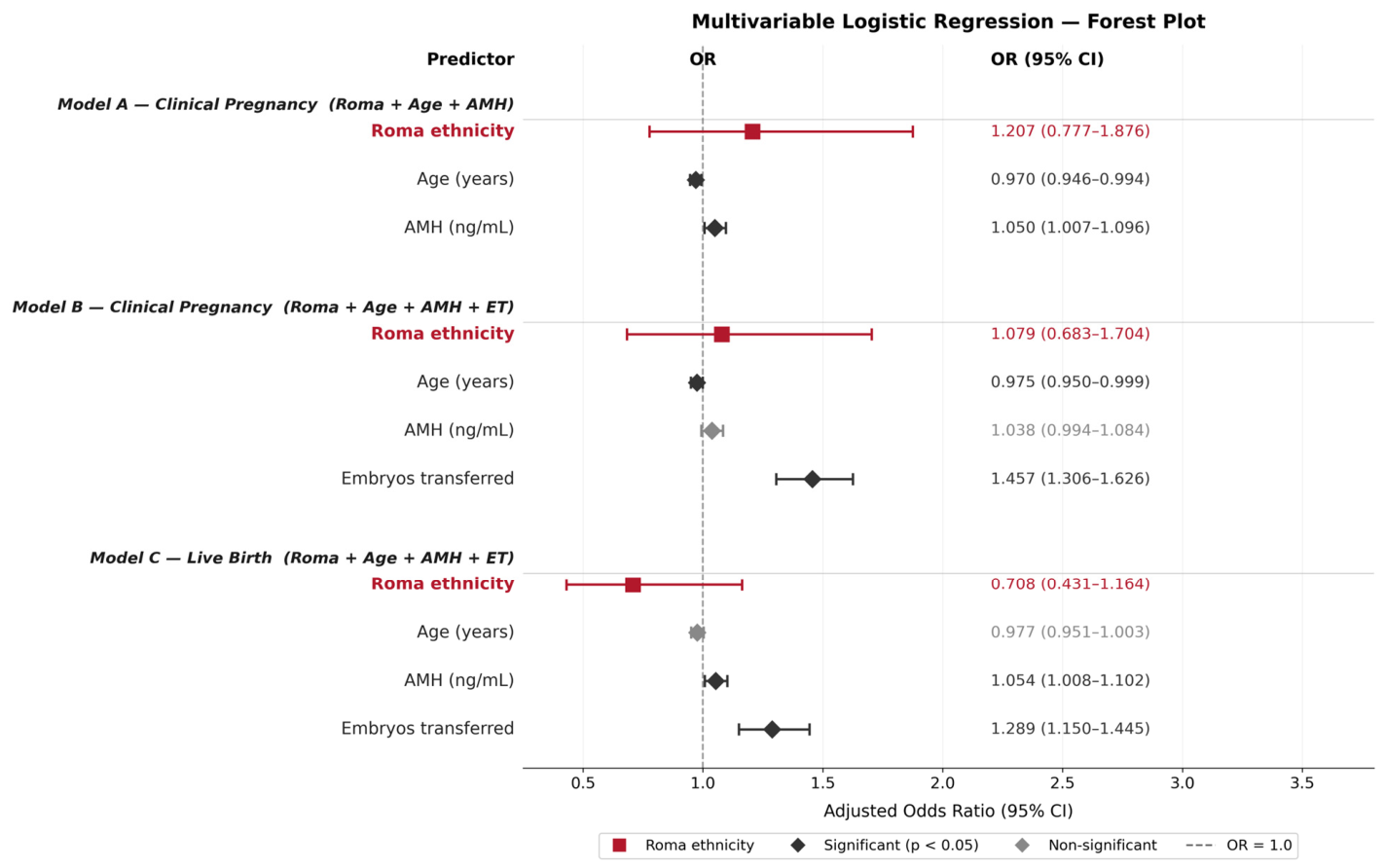
Three multivariable binary logistic regression models were constructed to assess whether Roma ethnic status independently predicted clinical pregnancy (Models A and B) or live birth (Model C). Covariates were selected a priori based on established clinical relevance in the ART literature. Model A included Roma ethnicity, age, and AMH as predictors of clinical pregnancy. Model B added the number of embryos transferred. Model C used the same predictors as Model B, with live birth as the dependent variable. Effect sizes were reported as adjusted odds ratios (OR) with 95% confidence intervals (CI). All regression models were estimated using complete-case analysis.
Spearman rank correlations were computed for all pairs of continuous predictors and outcome variables, stratified by ethnic group, to assess the consistency of biological associations across cohorts. The area under the receiver operating characteristic (ROC) curve (AUC) was calculated for each predictor as a measure of single-variable discriminative ability for clinical pregnancy and live birth; 95% bootstrap confidence intervals were derived from 1000 resampling iterations.
A subgroup analysis stratified by ovarian stimulation protocol (long GnRH agonist, short GnRH agonist, or GnRH antagonist) was conducted to assess whether the distribution of stimulation protocols confounded the primary outcome comparisons.
A propensity score matching analysis was conducted to address confounding by age and ovarian reserve. Propensity scores were estimated using logistic regression with age and AMH as covariates, and each Roma patient was matched to up to 4 non-Roma controls using nearest-neighbor matching without replacement. Post-matching covariate balance was assessed using standardized mean differences (SMDs), with SMDs < 0.10 considered indicative of adequate balance. Outcome comparisons in the matched cohort were performed using Fisher’s exact test.
A pre-specified sensitivity analysis was conducted by restricting the dataset to patients undergoing only their first IVF/ICSI cycle (VTO = 1) to address potential bias from including multiple treatment cycles per patient. Logistic regression models identical to those used in the primary analysis were applied to this restricted dataset.
To contextualize the precision of the comparative analyses, the minimum detectable effect size (MDES) for the Roma versus non-Roma comparison was estimated using conventional parameters (α = 0.05, power = 0.80, observed control-group event rates of 41.3% for clinical pregnancy and 30.9% for live birth). At the observed sample sizes (Roma n = 88; non-Roma n = 1197), the analysis was powered to detect adjusted odds ratios of at least 1.78 for clinical pregnancy and 1.71 for live birth. Effect sizes below these thresholds—including potentially clinically meaningful differences of 8–12 absolute percentage points—could not be reliably detected in the current cohort.
2.6. Machine Learning Analysis
Three supervised binary classification algorithms were applied to the combined dataset (n = 1285) with eleven predictor variables: Roma ethnicity (binary-coded), age, AMH, FSH, LH, embryos transferred, oocytes retrieved, embryos obtained, number of prior ART cycles, stimulation duration, and infertility duration. Logistic regression (LR) served as an interpretable parametric baseline; random forest (RF) served as a nonparametric ensemble comparator; and extreme gradient boosting (XGBoost) served as a regularized boosting model.
Pre-processing. Continuous features were standardized to zero mean and unit variance using StandardScaler to support coefficient interpretability and convergence in the logistic regression pipeline; tree-based models (RF and XGBoost) are scale-invariant and were trained on raw values. Roma ethnicity was encoded as binary (0/1). No imputation was performed; analyses used complete-case data. Class imbalance was addressed with balanced class weighting (class_weight = “balanced”) for logistic regression and random forest, and with scale_pos_weight (the ratio of negative to positive class frequencies) for XGBoost.
Hyperparameter specification. Hyperparameters for RF (n_estimators = 500, max_depth = 6, min_samples_leaf = 10, balanced class weights) and XGBoost (n_estimators = 300, max_depth = 4, learning_rate = 0.05, subsample = 0.8, colsample_bytree = 0.8) were specified a priori based on published recommendations for clinical datasets of comparable size [
31,
32]. A priori specification was deliberately preferred over data-driven tuning to avoid the optimistic bias that nested cross-validation may introduce in moderate-size cohorts and to preserve all 5-fold out-of-fold predictions as an unbiased estimate of generalization.
Overfitting control. Several measures limited overfitting: stratified 5-fold cross-validation ensured that no observation contributed to both training and evaluation folds; tree depth was constrained (max_depth = 4 for XGBoost, 6 for RF); minimum samples per leaf were set (min_samples_leaf = 10 for RF); and the learning rate was reduced to 0.05 with column subsampling of 0.8 for XGBoost to enforce regularization. The convergence of out-of-fold AUC values across the three models (0.652 LR, 0.686 RF, 0.714 XGBoost) with the conservative published benchmark of AUC ≈ 0.71 for center-specific XGBoost models trained on pre-treatment ART variables [
33] supports the validity of the estimates and argues against substantial overfitting.
Interpretability. SHAP (SHapley Additive exPlanations) values were computed with TreeExplainer for the XGBoost model trained on the full dataset [
34]. TreeExplainer provides exact Shapley value attributions for tree ensembles in polynomial time. SHAP decomposes each prediction into additive per-feature contributions grounded in cooperative game theory, yielding model-agnostic, unbiased feature importance estimates that satisfy the local accuracy, missingness, and consistency axioms. Mean absolute SHAP values were used to rank predictors by their average contribution to the model output, enabling direct quantification of the marginal contribution of Roma ethnicity relative to established biological predictors. Bar charts (mean absolute SHAP values) and beeswarm plots (directional individual SHAP values) were generated to characterize feature importance.
By applying this multi-method framework to a dataset spanning more than a decade of clinical practice at a single tertiary center, this study aims to provide an evidence-based foundation for understanding the role of Roma ethnicity in ART outcomes, inform equitable fertility care pathways, and support targeted interventions to address the profound underutilization of reproductive health services among this population.
4. Discussion
This study provides the first structured evaluation of IVF/ICSI treatment outcomes among Roma women attending a tertiary fertility center, addressing a substantial and long-standing gap in reproductive medicine research. Across a combined cohort of 1285 patients (Roma
n = 88, Non-Roma
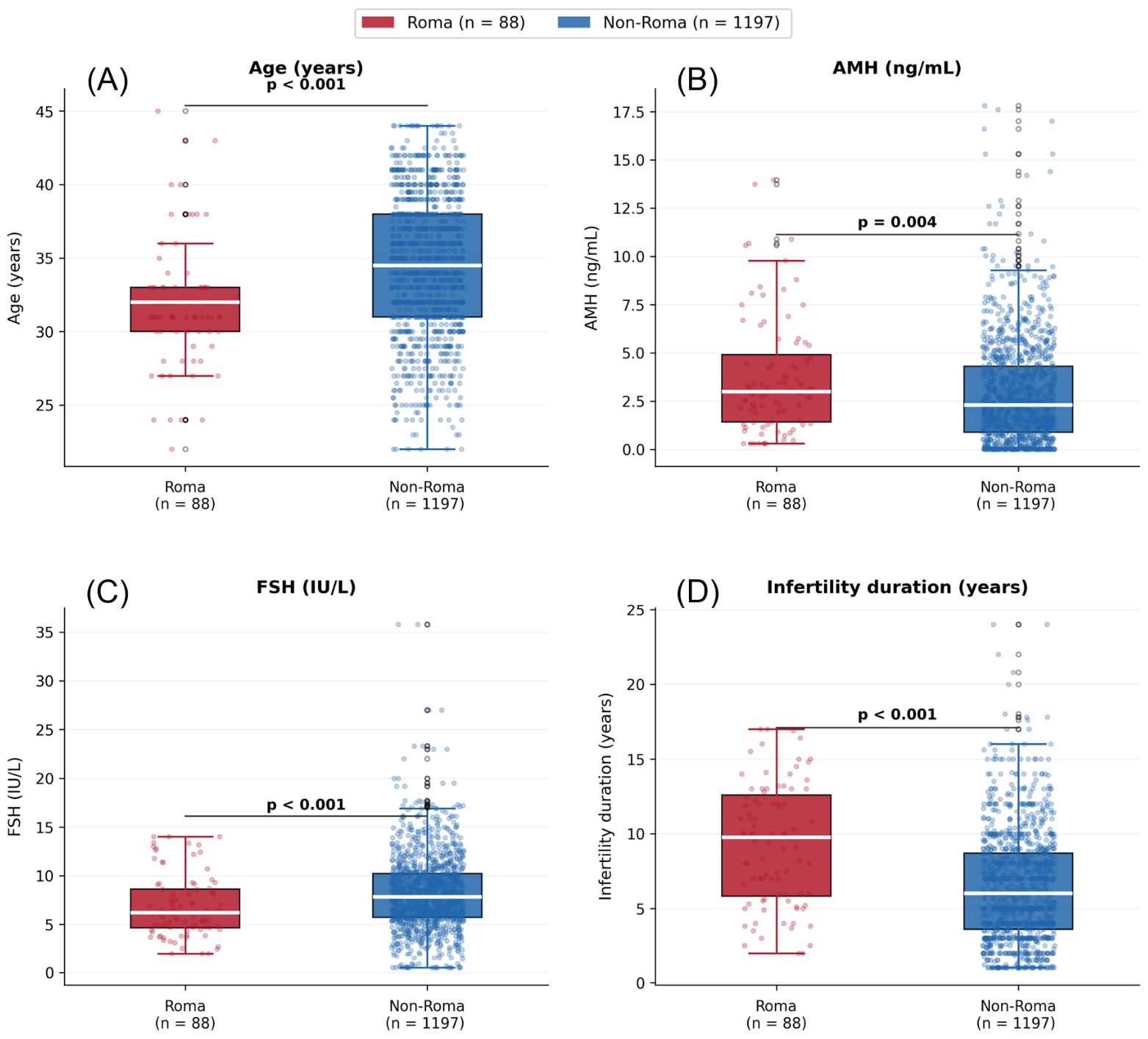
n = 1197), three principal observations emerged. First, Roma women presented with a significantly more favorable hormonal profile at treatment initiation: basal FSH levels were lower (6.87 ± 3.23 vs. 8.23 ± 3.90 IU/L;
p < 0.001) and AMH concentrations were higher (3.78 ± 3.07 vs. 2.90 ± 2.65 ng/mL;
p = 0.004), and they were also meaningfully younger (31.9 ± 4.0 vs. 34.5 ± 4.7 years;
p < 0.001). Second, despite this favorable ovarian reserve profile, Roma women had a substantially longer duration of infertility before accessing specialist care (9.3 ± 4.0 vs. 6.3 ± 3.6 years;
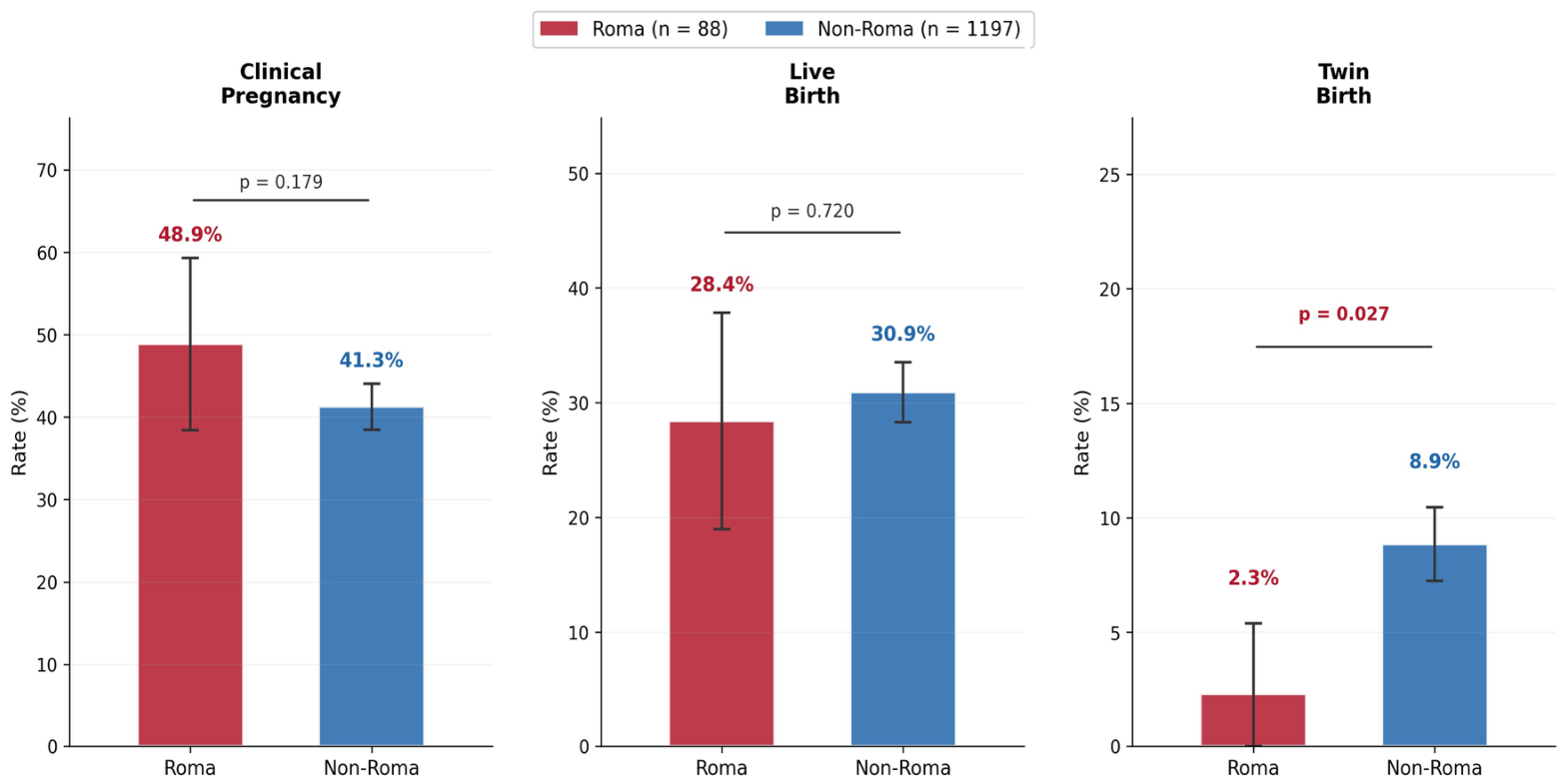
p < 0.001), consistent with barriers to early engagement with reproductive health services. Third, and most importantly, clinical pregnancy rates (48.9% vs. 41.3%;
p = 0.179) and live birth rates (28.4% vs. 30.9%;
p = 0.720) were statistically comparable between groups, and Roma ethnic status was not an independent predictor of either outcome in any multivariable logistic regression model or machine learning framework applied in this analysis. The dominant determinants of ART success were embryo-transfer count, maternal age, and AMH—biological predictors that are fully consistent with the established reproductive medicine literature [
1,
32,
35].
The observation that Roma women in our cohort had lower basal FSH and higher AMH concentrations than their non-Roma counterparts, despite a substantially longer duration of infertility, warrants careful consideration. Anti-Müllerian hormone is the most reliable quantitative marker of ovarian reserve currently available, reflecting the size of the primordial follicle pool and predicting both the quantitative ovarian response to gonadotropin stimulation and, to a lesser extent, the likelihood of achieving a live birth [
9,
36,
37].
In our study, higher AMH levels in Roma women were associated with greater oocyte yields (10.7 ± 7.0 vs. 8.4 ± 6.1;
p = 0.002) and a higher number of embryos per cycle (5.9 ± 4.3 vs. 4.8 ± 3.7;
p = 0.023). This pattern is biologically plausible: higher AMH reflects a larger follicular cohort available for recruitment, and a greater oocyte yield increases the likelihood of obtaining transferable embryos of adequate quality. The near-identical oocyte-to-embryo correlation observed in both groups (Spearman r = 0.886–0.887) further confirms that fertilization efficiency was consistent across ethnic groups, indicating that the embryological performance of IVF/ICSI was not influenced by ethnicity per se [
11,
33].
The favorable ovarian reserve profile in Roma women, paradoxically coexisting with longer infertility duration, may reflect several interacting factors. Younger age at treatment—a direct consequence of earlier reproductive initiation, which is culturally normative in Roma communities—is a major protective factor for ovarian reserve. Additionally, lower rates of conditions associated with accelerated ovarian aging, such as endometriosis (absent in the Roma group in our dataset) and advanced-age-related diminished reserve (also absent), may partially explain the preserved AMH. Whether this reflects genuine biological preservation, differential diagnostic workup, or selection bias favoring Roma women with better underlying reproductive health cannot be determined from the current data and remains an important question for future prospective research [
38,
39].
The markedly longer duration of infertility before ART initiation among Roma women (9.3 vs. 6.3 years) is one of the most clinically meaningful findings of this study, independent of treatment outcomes. This approximately three-year gap is not biological but systemic, reflecting delayed engagement with reproductive health services. Roma women in Serbia and across Central and Eastern Europe face well-documented structural barriers to accessing specialist healthcare, including financial constraints, geographic inaccessibility, lack of health insurance coverage, limited health literacy, and sociocultural attitudes toward formal medical care [
21,
22,
40].
Studies specifically examining Roma women’s use of reproductive healthcare confirm that gynecological services—including preventive screenings, antenatal care, and specialist referrals—are used at substantially lower rates than in the general population. Usera-Clavero et al. documented persistent inequality gaps in gynecological visits and cancer screening among Roma women in Spain across two national surveys conducted eight years apart [
25].
Usera-Clavero et al.’s mixed-methods systematic review confirmed that Romani women in Europe commonly encounter both passive barriers—financial, logistical, and informational—and active barriers, including discriminatory mistreatment by healthcare providers, when seeking maternity and gynecological care. Qualitative work by Janevic et al. in the Balkans documented that Roma women experienced overt racism and disrespect in healthcare encounters, which contributed to avoidance of preventive and specialist services [
26,
27].
In Serbia, Roma populations face compounded disadvantages. Blagojević et al. documented significantly higher excess winter mortality among Roma than among non-Roma populations in Serbia [
41]. Studies on primary healthcare access found that 18% of Roma lack health insurance cards, compared with 5.6% of the general population—a legal-administrative barrier that effectively excludes many from specialist referral pathways [
29].
The clinical implication is clear: had Roma women in our cohort accessed fertility evaluation at intervals comparable to those of non-Roma women, their younger age and superior hormonal profiles at the time of treatment would have been even more pronounced, potentially translating into more favorable ART outcomes than those observed. The current findings should therefore be interpreted not as evidence of adequate access, but as a demonstration that—when access is ultimately achieved—biological potential is preserved [
23].
The absence of a statistically significant difference in clinical pregnancy (48.9% vs. 41.3%; crude OR = 1.36; 95% CI 0.88–2.10;
p = 0.179) and live birth rates (28.4% vs. 30.9%; OR = 0.89; 95% CI 0.55–1.43;
p = 0.720) between Roma and non-Roma women contrasts notably with findings from studies examining ART outcomes in other minority ethnic groups, particularly those from North American and Western European settings [
17,
42].
Large registry-based analyses in the United States, primarily using the Society for Assisted Reproductive Technology (SART) Clinical Outcome Reporting System, have consistently documented lower clinical pregnancy and live birth rates among Black, Asian, and, to a lesser extent, Hispanic women compared with White non-Hispanic women. McQueen et al. reported adjusted odds ratios for live birth of 0.50 (95% CI 0.33–0.72) and 0.64 (95% CI 0.51–0.80) for Black and Asian women, respectively, relative to White women, after controlling for age, parity, infertility diagnosis, and embryos transferred [
15].
Similarly, Kotlyar et al., using SART data from 2014 to 2016, demonstrated that Hispanic and Asian women had significantly lower cumulative live birth rates than White non-Hispanic women (adjusted ORs 0.86 and 0.69, respectively), and these disparities persisted after multivariate adjustment for established biological and treatment-related confounders [
16]. Beroukhim and Seifer’s comprehensive review further confirmed that racial and ethnic disparities in ART outcomes are pervasive in the United States healthcare system, with Black women showing approximately twofold higher infertility rates yet substantially lower treatment utilization and outcomes [
14].
The apparent absence of such disparities in the Roma cohort of the present study is likely attributable to several convergent factors. Most importantly, the standardized treatment environment of a single tertiary center, with uniform stimulation protocols, laboratory procedures, and embryo transfer practices, effectively eliminates the differential access and quality-of-care gradients thought to drive much of the disparity observed in multi-center registry studies. When ART is delivered uniformly—as is structurally the case in Serbia’s state healthcare system—the dominant determinants of outcome revert to biology: ovarian reserve, age, and embryo transfer parameters. Under these conditions, the relatively favorable biological profile of Roma women in our cohort—younger age and higher AMH—may have offset other potential disadvantages [
13,
20].
A potential selection effect must also be acknowledged. The 88 Roma women who reached tertiary fertility care over a decade-long study period constitute a highly selected subset of Roma women with infertility in the Niš region. Multiple socioeconomic and logistical barriers exclude women with lower health-seeking capacity, less stable social support, or more severe comorbidities. Those who ultimately access ART may therefore constitute a biologically and socially advantaged subgroup relative to the broader Roma population with infertility—a phenomenon well recognized in studies of underrepresented minorities accessing specialized care [
43,
44].
The logistic regression models in this study consistently identified embryo-transfer count, AMH, and maternal age as the primary and statistically significant predictors of both clinical pregnancy and live birth, a finding that aligns with a broad and robust evidence base in reproductive medicine [
7,
8,
9].
AMH’s role as a positive predictor of clinical pregnancy (adjusted OR = 1.050 in Model A;
p = 0.023) and live birth (adjusted OR = 1.054;
p = 0.021) aligns with its established function as a quantitative marker of the follicular pool. Meta-analytic evidence from Li et al. (27,029 women across 27 studies) confirms that AMH is significantly associated with live birth outcomes, with the diagnostic odds ratio particularly pronounced in women of advanced reproductive age (DOR = 2.50; 95% CI 1.87–2.60), consistent with the age-modulating effect on AMH’s predictive utility [
36].
The number of embryos transferred emerged as the single strongest predictor across all models, with adjusted ORs of 1.457 for clinical pregnancy and 1.289 for live birth, consistent with decades of literature establishing embryo-transfer count as the most proximal determinant of implantation probability and cumulative ART success [
12,
45].
Machine learning analyses extended and reinforced these findings, lending them particular methodological force. XGBoost, the highest-performing classifier, achieved an AUC of 0.714 for clinical pregnancy prediction and 0.699 for live birth in 5-fold stratified cross-validation—values consistent with published benchmarks for ART outcome prediction models based on pre-treatment clinical variables. Cai et al. demonstrated in a validation study of major UK/US-derived IVF prediction models that center-specific XGBoost models achieved an AUC of approximately 0.71 for live birth, further contextualizing our performance within an expected range [
33].
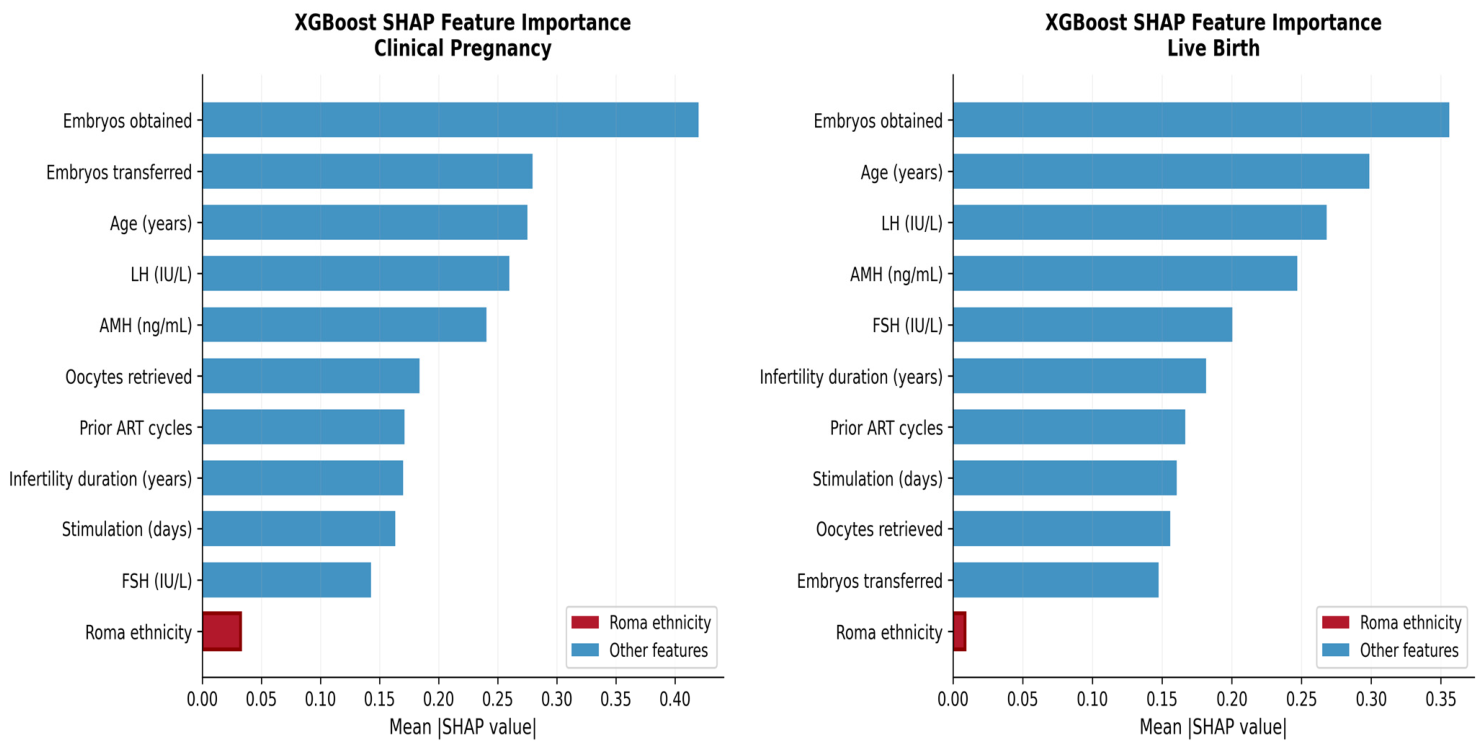
Critically, SHAP analysis showed that Roma ethnicity ranked last (11th of 11) in mean absolute feature importance across both outcome models. The mean absolute SHAP values for Roma ethnicity were 0.033 for clinical pregnancy and 0.009 for live birth—approximately 13- and 40-fold lower, respectively, than the top-ranked predictor (embryos obtained). This quantitative ranking provides the most direct, model-agnostic evidence that ethnic status contributes negligibly to outcome prediction once biological and treatment parameters are included—a finding that does not depend on distributional assumptions, linearity, or any specific statistical paradigm [
31,
46].
The convergence of parametric (logistic regression), non-parametric ensemble (random forest), and boosting (XGBoost) approaches, all yielding the same conclusion regarding Roma ethnicity, substantially strengthens the robustness of this inference. Sensitivity analyses restricting the dataset to first-cycle-only patients further confirmed the non-significance of ethnicity for clinical pregnancy; however, a statistically significant adjusted OR of 0.478 (95% CI 0.249–0.920;
p = 0.027) for live birth in the first-cycle subset warrants careful attention and is discussed below [
5].
The propensity score matching analysis, in which each Roma patient was matched 1:4 to non-Roma controls on age and AMH, yielded excellent covariate balance (SMD = 0.012 for age; SMD = 0.047 for AMH) and produced a matched cohort of 88 Roma and 352 non-Roma women. Within this matched sample, clinical pregnancy rates (48.9% vs. 43.5%; p = 0.402) and live birth rates (28.4% vs. 34.4%; p = 0.313) remained comparable, providing additional evidence that the primary findings are not attributable to confounding by age and ovarian reserve differences between groups.
The first-cycle sensitivity analysis yielded a finding that warrants explicit and cautious interpretation. Among women undergoing their first IVF/ICSI attempt (Roma
n = 57, Non-Roma
n = 809), the adjusted OR for Roma ethnicity as a predictor of live birth was 0.478 (95% CI 0.249–0.920;
p = 0.027), in contrast to the non-significant primary multi-cycle and propensity-score-matched analyses. Several considerations argue against interpreting this as a confirmed effect. The Roma first-cycle subgroup of 57 patients provides limited statistical power and is sensitive to individual outliers. The 95% CI is wide, spanning effect sizes from substantial to limited practical significance at its upper bound. The signal was not replicated in any of the parallel analytical frameworks (primary regression, propensity score matching, machine learning pipeline). Contextually, recent large first-cycle ART cohorts provide useful comparative benchmarks: Vale-Fernandes et al., analyzing first-cycle outcomes in over 5000 couples across public fertility centers in Portugal, identified a cumulative live birth rate of approximately 26% and confirmed female age as the dominant predictor of success [
47]; Toftager et al., in a randomized comparison of GnRH protocols, emphasized the determining role of first-cycle ovarian response on subsequent cumulative live birth probability [
48]; and Law et al., across 221,221 cycles, established age-stratified curves for oocyte yield and live birth that frame first-cycle outcomes in biological rather than ethnic terms [
49]. We therefore interpret the first-cycle Roma signal as hypothesis-generating, potentially reflecting unmeasured confounders that exert detectable effects in the most biologically vulnerable initial cycle window. Prospective validation in larger multicenter cohorts with capture of BMI, smoking, nutritional status, and socioeconomic indicators is required before any clinical implications can be drawn.
Identifying only 88 Roma women accessing ART at a tertiary fertility center over more than a decade is one of the most significant findings of this study from a public health perspective. The Niš metropolitan area has a Roma population estimated at several thousand individuals, and infertility prevalence in the general population is approximately 10–15% among reproductive-age couples [
50,
51].
This profound underrepresentation cannot be explained by a lower biological prevalence of infertility among Roma women. Rather, it reflects the well-documented underutilization of specialist reproductive services in this population, driven by a convergence of financial barriers, geographic inaccessibility, fragmented engagement with primary care, reduced health insurance coverage, low health literacy about ART options, and, in some documented cases, discriminatory experiences in healthcare settings that create a lasting aversion to formal medical care [
23,
27,
29,
40].
Studies from Serbia have shown that Roma are more than twice as likely as non-Roma in neighboring communities to report unmet health needs, and that this disparity persists even after adjusting for income, employment, education, health insurance status, and geographic proximity to providers—suggesting that socioeconomic barriers alone do not fully explain the access gap [
52].
Reproductive health is an area of compounded vulnerability. Janevic et al. documented that Roma women in the Balkans report overt racism, verbal abuse, and segregation in maternity wards, creating a pattern of avoidance that extends to all specialist gynecological services. In a qualitative study across Albania, Bulgaria, and Macedonia, Colombini et al. identified financial barriers, informal payments, lack of insurance, and geographic obstacles as the most frequently cited factors preventing Roma from accessing sexual and reproductive health services [
26,
40].
From a policy perspective, the profound underutilization of ART services among Roma women observed in this study justifies targeted intervention research and structural reform. The findings support a multi-component approach: (i) community-level engagement through trained Roma health mediators who can bridge gaps in health literacy and trust in formal medical institutions; (ii) reducing financial barriers through expanded health insurance enrollment and dedicated state-funded ART quotas for underserved populations; (iii) earlier referral pathways from primary care, including standardized triggers for infertility evaluation and integration of gynecological screening; (iv) culturally adapted patient information materials in Romani and regional languages; and (v) workforce training to address documented discriminatory practices in maternity and gynecological settings [
27,
53]. The present study provides quantitative evidence that, when access barriers are overcome and care is delivered under standardized conditions, Roma women do not exhibit a detectable disadvantage in ART outcomes—a finding that should directly inform policy arguments for equitable fertility care.
The distribution of primary infertility diagnoses differed significantly between groups (χ2 = 40.95; p < 0.001), primarily because advanced maternal age was not a standalone indication (14.5% in non-Roma vs. 0% in Roma), reflecting the age difference between the cohorts. Tubal factor was the most prevalent diagnosis among Roma women (33.0%), consistent with potentially higher rates of sexually transmitted infections and delayed gynecological care in this population, though this hypothesis cannot be confirmed with the available retrospective data.
The markedly different distribution of stimulation protocols—long GnRH agonist protocols predominating among Roma women (53.4%) versus short agonist protocols among non-Roma (45.5%)—likely reflects the evolution of clinical practice over the study period rather than ethnicity-specific protocol selection, as the long agonist was the standard approach in the earlier years of the study period in Serbia. The subgroup analysis by protocol confirmed that outcomes were comparable between Roma and non-Roma women within each protocol category, ruling out the stimulation regimen as a confounding factor in the primary outcome comparison.
Statistical power considerations merit particular attention. The Roma subgroup of 88 patients provided approximately 80% power to detect odds ratios of ≥1.78 for clinical pregnancy and ≥1.71 for live birth at α = 0.05, given the observed event rates in the non-Roma comparator group. Effect sizes below these thresholds—including potentially clinically meaningful absolute differences of 8–12 percentage points—cannot be confidently ruled out. This limitation is particularly relevant for the sensitivity analyses, where the first-cycle Roma subgroup (n = 57) provides even less power and is more susceptible to both Type II errors in the direction of equivalence and Type I errors in the direction of difference. The principal analyses should therefore be interpreted as failing to detect ethnic differences in ART outcomes, rather than confirming their absence.
This study has several notable strengths. It is the first systematic, quantitative evaluation of IVF/ICSI outcomes among Roma women, addressing a critical, long-standing gap in the reproductive medicine literature. The uniform clinical environment of a single tertiary center ensures that treatment protocols, laboratory conditions, and outcome definitions were standardized across all patients, minimizing inter-center variability as a potential confounder. The analytical approach is comprehensive, incorporating univariate and multivariable logistic regression, Spearman correlation analysis, ROC/AUC evaluation, propensity score matching, first-cycle sensitivity analysis, and a full machine learning pipeline with three algorithms and SHAP-based interpretability. The convergence of all analytical approaches toward the same conclusion—Roma ethnicity does not independently predict ART outcomes—substantially strengthens the robustness and credibility of the primary finding. The use of SHAP values from XGBoost models provides a model-agnostic quantification of ethnic contribution that transcends the limitations of any single statistical paradigm [
31,
54].
Several structural limitations of the retrospective single-center design must be emphasized. First, the cohort comprises only women who reached tertiary fertility care during the study period; the 88 Roma women included represent a small, almost certainly biologically and socially advantaged subset of the regional Roma population with infertility, and the analysis cannot speak to the larger Roma population that never accessed specialist services. Second, the Roma cohort of n = 88 has limited statistical power to detect modest effect sizes (see Statistical Power paragraph above), as evidenced by wide confidence intervals in several analyses. Third, the design is observational and the analyses are exploratory; the multivariable models adjust for the predictors captured but cannot, and do not, support causal inference regarding ethnicity-specific biological effects. Fourth, the inclusion of multiple cycles per patient introduces non-independence among observations that the principal regression models do not formally accommodate; the first-cycle sensitivity analysis is reported as a partial mitigation rather than a structural correction.
Several clinically relevant variables were not captured in the electronic medical record system, including body mass index, smoking status, individual-level socioeconomic indicators, nutritional and micronutrient status, endometrial thickness, embryo morphological grade, and detailed lifestyle assessments. These factors are differentially distributed between Roma and non-Roma communities in Serbia—Roma households report higher rates of indoor tobacco smoke exposure, less dietary diversity, lower income-to-needs ratios, and a higher prevalence of micronutrient insufficiency—and each independently influences the ovarian environment, endometrial receptivity, and pregnancy maintenance. Their absence from the model creates a real possibility of residual confounding, which may operate in either direction. Regional and sociodemographic factors have been documented as independent determinants of ART success in well-resourced European settings. Rodrigues-Martins et al. demonstrated at a tertiary center in Northern Portugal that women’s region of residence independently influenced fertilization, miscarriage, and implantation rates, despite similar demographic and infertility characteristics [
55]. Domar et al., in a 12,800-patient lifestyle survey, identified region and insurance coverage as substantial determinants of behavioral risk factors and ART access patterns [
56]. The recent systematic synthesis by Mesfin et al. further emphasizes that healthcare system structure and socioeconomic context are primary determinants of ART utilization and outcomes in resource-constrained settings [
57]. The current analysis captures the biological signal under standardized clinical management but does not, and cannot, exclude socioeconomic and behavioral mediators that would require prospective characterization to model directly.
Generalizability requires further qualification. The findings reflect a single tertiary fertility center in southeastern Serbia and the demographic and healthcare profile of Roma communities in that region. Roma populations across Europe differ substantially in language, occupational structure, healthcare integration, residential stability, and socioeconomic indicators. The structure of ART provision also varies markedly across European healthcare systems—from comprehensive, state-funded provision in some Nordic countries to predominantly private-pay models elsewhere. The conclusions of this study should therefore be considered applicable to populations and healthcare environments structurally comparable to the Niš region and should not be extrapolated without careful contextual qualification to Roma populations elsewhere in Europe or to ART systems organized on substantially different financing and access principles [
57].
Ethnic classification in this study relied on self-report documented at the first clinical contact. While self-reported ethnicity is the recommended standard in health disparities research [
14,
30], it introduces two related sources of uncertainty. First, ethnic misclassification may occur in either direction: individuals who do not self-identify as Roma—a recognized phenomenon driven by historical stigmatization and social desirability bias—would be coded as non-Roma, biasing observed differences toward the null. Conversely, individuals with mixed or intermediate ethnic backgrounds may be classified differently across encounters. Second, the timing of self-report (at first registration) precluded reclassification or sensitivity analysis under alternative ethnic-coding schemes. The most plausible net direction of these biases is attenuation rather than amplification of any true group difference, suggesting that the absence of a detected adjusted association in the principal analyses is unlikely to be an artifact of classification error.
Finally, the dataset includes multiple treatment cycles per patient without formal clustering correction, which may reduce the precision of standard error estimates. However, sensitivity analysis restricted to the first cycles yielded broadly consistent conclusions regarding clinical pregnancy outcomes.
Future research should prioritize prospective, multicenter cohort designs with prespecified capture of ethnicity and sociodemographic indicators (income, education, household composition, insurance status), behavioral exposures (smoking, alcohol, occupational and environmental exposures), nutritional indices, and BMI. Larger multicenter Roma cohorts would substantially increase statistical power to detect or exclude clinically meaningful effect sizes, particularly in the first-cycle window. Parallel qualitative research exploring barriers to ART initiation and treatment adherence, and Roma women’s patient experience within fertility services, would provide complementary insights inaccessible through quantitative analysis [
58,
59]. Mechanistic studies examining whether differences in endometrial receptivity, immune-mediated implantation factors, or pre-pregnancy nutritional status mediate any residual first-cycle effects would also be valuable. Finally, intervention studies testing culturally adapted access programs—particularly those involving Roma health mediators—would translate observational findings into testable public health hypotheses.
From a policy perspective, the profound underutilization of ART services among Roma women observed in this study justifies targeted intervention research. Culturally adapted outreach programs, Roma health mediators’ involvement in fertility counseling, and financial support mechanisms to improve ART access for socioeconomically marginalized populations are priority areas for healthcare system action. The present study provides an evidence-based foundation suggesting that, when access barriers are overcome, Roma women can achieve ART outcomes comparable to those of the general population—a finding that should directly inform policy arguments for equitable fertility care [
27,
60].
5. Conclusions
This study presents the first systematic evaluation of IVF/ICSI outcomes among Roma women, addressing a critical and long-standing gap in the reproductive medicine literature. Across a cohort of 1285 patients followed for a decade at a single tertiary fertility center, three principal conclusions emerge.
First, given the statistical power of the present cohort, no independent association was observed between Roma ethnicity and the likelihood of clinical pregnancy or live birth after accounting for key biological and treatment-related variables. This finding was consistent across parametric logistic regression models adjusted for age, AMH, and embryos transferred; propensity score matching on age and ovarian reserve; and a machine learning pipeline comprising three classification algorithms. SHAP analysis of the XGBoost model—the highest-performing classifier—ranked Roma ethnicity last among all eleven predictors for both clinical pregnancy and live birth, with mean absolute SHAP contributions of 0.033 and 0.009, respectively, compared with 0.420 and 0.356 for the top-ranked predictor (embryos obtained). The convergence of parametric, nonparametric, and boosting approaches on the same non-significant finding strengthens the robustness of this inference, while the limited size of the Roma subgroup (n = 88) precludes confident exclusion of modest effect sizes.
Second, the biological profile of Roma women who accessed ART in this cohort was, in several respects, favorable: they were significantly younger than non-Roma patients (31.9 vs. 34.5 years) and had a more preserved ovarian reserve, as reflected by lower basal FSH and higher AMH concentrations. These characteristics translated into greater oocyte yields and a higher number of embryos per cycle. However, Roma women also reported a substantially longer duration of infertility before initiating specialist treatment (9.3 vs. 6.3 years), a gap of approximately three years that is not biologically determined but reflects systemic barriers to accessing reproductive healthcare. When these barriers are eventually overcome and standardized treatment is delivered, Roma women achieve outcomes that are fully comparable to those of the general population.
Third, and perhaps most clinically significant from a public health perspective, only 88 Roma women accessed ART over a decade at a center serving a population with a substantial Roma minority—a number that almost certainly represents only a fraction of the reproductive-age Roma population with infertility in the catchment area. This profound underutilization does not reflect a lower burden of infertility but rather the cumulative effect of financial barriers, limited health insurance coverage, geographic inaccessibility, low health literacy about ART options, and, in some cases, discriminatory experiences within the healthcare system that lead to lasting avoidance of specialist services. The present study cannot causally disentangle these contributors, but it provides quantitative evidence of their cumulative impact.
A hypothesis-generating signal emerged from the pre-specified sensitivity analysis restricted to first-cycle patients: the adjusted odds ratio for Roma ethnicity as a predictor of live birth was 0.478 (95% CI 0.249–0.920; p = 0.027). This finding was not replicated in the primary multi-cycle analysis, the propensity-score-matched cohort, or any of the machine-learning models. This isolated signal warrants caution—the Roma first-cycle subgroup comprised only 57 patients, the confidence interval is wide, and the result was not corroborated by any of the parallel analytical frameworks. It is plausible that unmeasured confounders, such as body mass index, nutritional and micronutrient status, smoking, or chronic socioeconomic stress—each more prevalent in Roma communities and capable of affecting endometrial receptivity and early pregnancy maintenance—exert detectable influence in the most biologically vulnerable first-cycle window. Prospective multicenter validation with comprehensive sociodemographic and behavioral profiling is required before any clinical implications can be drawn from this exploratory observation.
Taken together, the findings have a clear, actionable implication: the principal barrier to reproductive equity for Roma women is not that ART fails them, but that they rarely reach ART at all. Earlier fertility evaluation, expanded health insurance access, culturally adapted reproductive health outreach through Roma health mediators, and active steps to address discriminatory practices in healthcare settings are priorities for narrowing this disparity. Within the present cohort, women who reached standardized tertiary care did not show a statistically detectable disadvantage in ART outcomes—an observation that, within its acknowledged limits of statistical power, supports the policy argument for equitable fertility care. Larger multicenter prospective studies with comprehensive sociodemographic, behavioral, and nutritional profiling will be essential to confirm or refine these findings, quantify the contribution of unmeasured confounders (particularly in the first-cycle window where an exploratory signal was observed), and provide a rigorous evidence base for policy aimed at reproductive equity for one of Europe’s most marginalized populations.




 ,
,