



Next Issue
Volume 8, June
Previous Issue
Volume 8, April


AgriEngineering, Volume 8, Issue 5 (May 2026) – 40 articles
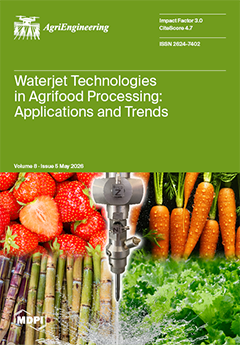
Cover Story (view full-size image): This review explores the application of pure and abrasive waterjet technologies in agriculture and food processing. While pure waterjet is already established for cutting soft food products, abrasive solutions are still under investigation for harder materials such as meat with bone and fibrous crops. The study analyzes system configurations, process parameters, and economic aspects, highlighting key advantages such as cold cutting, reduced contamination, and improved product quality. Applications across plant-based products, animal processing, and in-field operations are discussed, along with emerging technologies like ice abrasive waterjet and future research directions. View this paper
  • Issues are regarded as officially published after their release is announced to the table of contents alert mailing list.
  • You may sign up for e-mail alerts to receive table of contents of newly released issues.
  • PDF is the official format for papers published in both, html and pdf forms. To view the papers in pdf format, click on the "PDF Full-text" link, and use the free Adobe Reader to open them.
Order results
Result details
Section
Select all
Export citation of selected articles as:
30 pages, 1245 KB  
Review
Digital Technologies in Crop Production: A Scoping Review with Transferability Analysis for Central Asia
by Samal Abayeva and Sana Kabdrakhmanova
AgriEngineering 2026, 8(5), 199; https://doi.org/10.3390/agriengineering8050199 - 19 May 2026
Viewed by 1366
Abstract
This scoping review maps 224 empirical studies (205 from a structured Scopus search, 2020–2026, plus 19 from a targeted Central Asia supplement) across four digital technology domains for crop production: IoT and sensor-based systems, UAVs and remote sensing, machine learning and AI, and [...] Read more.
This scoping review maps 224 empirical studies (205 from a structured Scopus search, 2020–2026, plus 19 from a targeted Central Asia supplement) across four digital technology domains for crop production: IoT and sensor-based systems, UAVs and remote sensing, machine learning and AI, and nanostructured agrochemicals. The review follows the PRISMA-ScR framework and pursues three research questions concerning documented effects and validation limitations (RQ1); cross-cutting barriers in human capital, data governance, and infrastructure (RQ2); and the state of empirical evidence from Central Asia and Kazakhstan relative to international findings (RQ3). Across all four domains, the strongest reported effects occur where the data-to-decision-to-action loop is closed and sustained over multiple seasons, yet most published metrics rest on single-season, single-site, or controlled-environment validation that overstates likely field portability. IoT and selected UAV and ML workflows are closest to operational readiness where maintenance, calibration, and advisory support are sustained. Nanostructured materials remain the least mature domain in agronomic terms. For Central Asia, foundational monitoring and salinity-oriented remote sensing are the most immediately transferable elements; intervention-grade ML and integrated digital systems require local calibration, extension infrastructure, and multi-season field validation that are largely still absent. The review identifies the digital skills gap, incomplete data governance, and underreported total cost of ownership as the principal institutional barriers to scaling. Policy priorities include shifting from technical pilots to multi-season agronomic proof, building intermediary service capacity, and establishing transparent data-governance frameworks before large-scale procurement. Full article
Show Figures

Figure 1

37 pages, 19421 KB  
Article
An Improved YOLO11n-Seg Method for RGB-Based Orange Fruit Instance Segmentation Toward Clean ROI Extraction for HSI-Assisted Observation
by Xinyang Li, Jinghao Shi, Chuang Wang, Xin Yue, Weiqi Sun, Zonghui Zhuo and Kezhu Tan
AgriEngineering 2026, 8(5), 198; https://doi.org/10.3390/agriengineering8050198 - 19 May 2026
Viewed by 395
Abstract
Accurate instance segmentation of oranges in complex orchard environments is crucial for obtaining clean regions of interest (ROIs). Coarse region extraction may include non-target pixels from leaves, shadows, background, and adjacent fruits, thereby increasing boundary pixel mixing in subsequent hyperspectral-assisted observation. This study [...] Read more.
Accurate instance segmentation of oranges in complex orchard environments is crucial for obtaining clean regions of interest (ROIs). Coarse region extraction may include non-target pixels from leaves, shadows, background, and adjacent fruits, thereby increasing boundary pixel mixing in subsequent hyperspectral-assisted observation. This study proposes an improved lightweight YOLO11n-Seg method as an RGB-based visual front-end for cleaner single-fruit ROI extraction. Its contribution lies in the task-oriented integration of three complementary components: a Local Deformable Convolution Backbone (LDC-Backbone) for representing irregular and occluded fruit contours, a Boundary-Guided GSConv (BG-GSConv) module for efficiently fusing shallow boundary details with deep semantic features, and an ROI-Purity-Oriented Dice Boundary Loss for constraining mask integrity and boundary adherence. Evaluated on a complex orchard dataset, the improved model achieved a Mask mAP@0.5 of 0.962, a Mask mAP@0.5:0.95 of 0.692, a Box mAP@0.5 of 0.942, and an inference speed of 101 FPS with 3.20 M parameters. Background leakage analysis further showed that the proposed model reduced the inclusion of non-fruit pixels in extracted ROIs, supporting cleaner mask-based single-fruit region extraction. Preliminary ROI-based reflectance observation indicated that the reflectance curves obtained from the improved-model ROIs were closer to those of manually referenced pure ROIs than those obtained from the baseline extraction. These results suggest that the proposed method can serve as a real-time RGB-based front-end for cleaner single-fruit ROI extraction and later hyperspectral-assisted sampling. Complete closed-loop spectral quality modeling with paired RGB–HSI data remains a direction for future work. Full article
(This article belongs to the Special Issue Application of Hyperspectral Technology in Agriculture)
Show Figures

Figure 1

37 pages, 1565 KB  
Systematic Review
Circular Biorefinery Pathways for Pesticide Wastewater Treatment: Technologies and Applications from Farm to District Scale
by Muhammad Waqas, Mohsin Nawaz, Anila Sikandar, Shakeel Ahmad and Andrea Pezzuolo
AgriEngineering 2026, 8(5), 197; https://doi.org/10.3390/agriengineering8050197 - 18 May 2026
Viewed by 490
Abstract
Agricultural pesticide wastewater represents a significant environmental and public health challenge, highlighting the need for scalable and resource-efficient treatment strategies. This review adopted a PRISMA-based methodology using the Scopus and Web of Science databases, leading to the analysis of 176 peer-reviewed studies published [...] Read more.
Agricultural pesticide wastewater represents a significant environmental and public health challenge, highlighting the need for scalable and resource-efficient treatment strategies. This review adopted a PRISMA-based methodology using the Scopus and Web of Science databases, leading to the analysis of 176 peer-reviewed studies published between 2014 and 2025. The selected literature was critically examined to assess pesticide wastewater treatment technologies, including adsorption, membrane filtration (MF), advanced oxidation processes (AOPs), biological treatments, and hybrid configurations. Particular attention was given to their treatment performance, scalability from farm to district level, resource recovery potential, economic feasibility, and life-cycle assessment (LCA) implications. Among the evaluated systems, hybrid configurations combining biological processes with AOPs or MF generally showed higher removal performance, often achieving more than 80% pesticide residue removal, while offering greater adaptability and compatibility with circular biorefinery frameworks. The review identifies key opportunities for resource recovery, including methane and hydrogen production, nutrient recycling, water reuse, and chemical reclamation, thereby supporting circular bioeconomy objectives. Overall, this review proposes an integrated, multiscale circular biorefinery perspective for sustainable pesticide wastewater management and identifies research priorities for developing resilient, safe, and resource-efficient agricultural water treatment systems. Full article
(This article belongs to the Special Issue Recent Advances in Sustainable Bioenergy Production)
Show Figures

Figure 1

16 pages, 455 KB  
Article
Optimizing Nutrient and Water Utilization During Late Gestation and Early Lactation in Beef Cows: The Power of Limit-Feeding a Precision Energy Diet
by Megan A. Wehrbein, Federico Podversich, Hector M. Menendez III, Zachary K. F. Smith, Warren C. Rusche and Ana Clara B. Menezes
AgriEngineering 2026, 8(5), 196; https://doi.org/10.3390/agriengineering8050196 - 16 May 2026
Viewed by 663
Abstract
Winter feeding represents a significant cost in beef production, requiring efficient strategies that maintain productivity while minimizing environmental impact. Forty-six pregnant cows (620 ± 61 kg BW) were used to evaluate an ad libitum hay-based diet (2.02 Mcal/kg ME; HFOR; n = 23) [...] Read more.
Winter feeding represents a significant cost in beef production, requiring efficient strategies that maintain productivity while minimizing environmental impact. Forty-six pregnant cows (620 ± 61 kg BW) were used to evaluate an ad libitum hay-based diet (2.02 Mcal/kg ME; HFOR; n = 23) versus a corn-based diet (2.84 Mcal/kg ME) limit-fed at 1.2% BW (HCON; n = 23) from 50 d pre-calving to 84 d post-calving. Pre- and post-calving, HCON cows consumed less (p < 0.01) dry matter, crude protein, and water than HFOR cows. While CH4 yield per kg DMI was greater (p < 0.01) for HCON cows, total daily CH4 emissions and CH4 per unit of NEm intake were lower (p ≤ 0.03) compared with HFOR cows. Behavioral data showed that HCON cows had fewer (p < 0.01) meals and spent less time eating, but had greater intake per minute. Cow BW differed by treatment over time (p < 0.01), with HCON cows weighing less through early lactation, though no differences were observed from d 84 to weaning. Calf BW remained unaffected (p ≥ 0.76). In conclusion, limit-feeding a corn-based diet improves feed and water use efficiency and reduces enteric CH4 emissions without compromising calf growth, offering a viable alternative to traditional forage-based wintering systems. Full article
(This article belongs to the Special Issue New Technologies in Ruminant Nutrition and Production)
Show Figures

Figure 1

16 pages, 8788 KB  
Article
Development and Evaluation of Motorized Backpack Machine for Oil Palm Ablation and Harvesting Operations
by Sanganamoni Shivashankar, Musunuru Venkata Prasad, Kancherla Suresh, Ravindra Naik and Kesana Manikanta
AgriEngineering 2026, 8(5), 195; https://doi.org/10.3390/agriengineering8050195 - 16 May 2026
Viewed by 899
Abstract
Ablation and harvesting are among the most labor-intensive and physically demanding operations in oil palm cultivation, often resulting in significant drudgery and safety concerns when performed manually through climbing or pole-assisted methods. To overcome these challenges, a motorized backpack-type machine was developed and [...] Read more.
Ablation and harvesting are among the most labor-intensive and physically demanding operations in oil palm cultivation, often resulting in significant drudgery and safety concerns when performed manually through climbing or pole-assisted methods. To overcome these challenges, a motorized backpack-type machine was developed and evaluated for its field performance, ergonomics, and economic feasibility. The machine met required quality standards and exhibited satisfactory performance under field conditions, achieving average ablation and harvesting capacities of 286 inflorescences per day and 4.115 t day−1, with actual field capacities of 0.727 ha h−1 (ablation), 0.516 ha h−1 (sickle), and 0.537 ha h−1 (chisel), and field efficiencies of 81.23%, 76.3%, and 79.91%, respectively. Ergonomic evaluation indicated that operation of the machine falls within a moderate workload category, thereby reducing operator fatigue compared to manual methods. Economic analysis further revealed that the cost of operation was substantially reduced to 3.02 USD t−1 and 60.40 USD ha−1 year−1, resulting in increased harvester earnings of 174.72% and 64.83% compared to climbing and pole harvesting methods, respectively. These findings demonstrate that the motorized backpack machine is a practical, efficient, and economically viable alternative to traditional techniques and minimizes drudgery while improving productivity and profitability in oil palm plantations. Full article
(This article belongs to the Collection Research Progress of Agricultural Machinery Testing)
Show Figures

Graphical abstract

29 pages, 2181 KB  
Article
Geographical Origin Discrimination of Aniseed (Pimpinella anisum) Based on Machine Learning Classification of Agricultural and GC-MS Parameters
by Milica Aćimović, Biljana Lončar, Olja Šovljanski, Ana Tomić, Vanja Travičić, Milada Pezo, Vladimir Filipović, Danijela Šuput, Darko Micić and Lato Pezo
AgriEngineering 2026, 8(5), 194; https://doi.org/10.3390/agriengineering8050194 - 13 May 2026
Viewed by 926
Abstract
The geographical origin of aniseed (Pimpinella anisum L.) represents a key quality determinant, as it directly influences the chemical composition and commercial value of its essential oil. Agronomic traits of aniseed (plant height, umbel diameter, number of umbels per plant), productivity-related traits [...] Read more.
The geographical origin of aniseed (Pimpinella anisum L.) represents a key quality determinant, as it directly influences the chemical composition and commercial value of its essential oil. Agronomic traits of aniseed (plant height, umbel diameter, number of umbels per plant), productivity-related traits (number of seeds, thousand-seed weight, yield per plant, plant biomass, harvest index, yield per hectare, essential oil content and yield), and physiological traits (germination energy and total germination) exhibit variations depending on geographical origin. The study proposes an integrated framework for accurate classification by combining agronomic, productivity, and physiological data with GC-MS profiles and advanced machine learning (ML) techniques. A total of 144 samples were analyzed, based on a factorial design including three locations, six fertilizer treatments, two years, and four replications. trans-Anethole was the dominant compound in all samples (89.508–101.441%). Several classification models, including artificial neural networks, random forests, MARSplines, boosted trees, interactive trees, naïve Bayes, and support vector machines, were evaluated to discriminate samples by geographical origin using agro-meteorological and GC-MS data. The results indicate that AI and ML approaches effectively captured complex non-linear relationships. Overall, the multi-model framework highlights the strong potential of machine learning for agro-food authentication, supporting improved traceability, site-specific decision-making, and quality control. Full article
Show Figures

Figure 1

22 pages, 3289 KB  
Article
Development and Evaluation of a Smart Soil Moisture-Based Irrigation System for Organic Greenhouse Production of High-Value Vegetables in Thailand
by Wannaporn Thepbandit, Daniel Martinez Lacasa, Wilawan Chuaboon and Dusit Athinuwat
AgriEngineering 2026, 8(5), 193; https://doi.org/10.3390/agriengineering8050193 - 13 May 2026
Viewed by 1434
Abstract
This study developed and evaluated a cloud-based smart irrigation platform (DSmart Farming) integrating low-cost sensors and IoT technology for automated irrigation control in community greenhouses of Puen Jai Insee, organic group in Sa Kaeo Province. The system combined soil moisture, air temperature, and [...] Read more.
This study developed and evaluated a cloud-based smart irrigation platform (DSmart Farming) integrating low-cost sensors and IoT technology for automated irrigation control in community greenhouses of Puen Jai Insee, organic group in Sa Kaeo Province. The system combined soil moisture, air temperature, and relative humidity sensors, with a LoRa32-based control unit in each greenhouse and a central web-based management application linked to a MariaDB database on a cloud server. Five vegetable crops, including cherry tomato, broccoli, cabbage, Chinese kale, and kale, were grown over two distinct seasons under four irrigation strategies in a completely randomized design with three replications: three smart irrigation treatments based on soil moisture thresholds (on/off at 40/50%, 45/55%, and 50/60%) and a farmer-managed conventional irrigation control. The smart irrigation system maintained root-zone moisture within the target range (approximately 50–60%) and moderated greenhouse microclimate, preventing daytime temperatures from exceeding 40 °C, in contrast to 40–45 °C peaks in the conventional greenhouses. Across crops, smart irrigation increased yields by 20–29% while reducing water use by 41–60% compared to conventional practice, leading to income increases of 20–56%, depending on the crop. Bacterial soft rot caused by Pectobacterium carotovorum subsp. carotovorum occurred only under conventional irrigation, whereas no soft rot or other major diseases were detected in smart-irrigated greenhouses. These results demonstrate that the DSmart Farming system can enhance water use efficiency, avoid disease incidence, and improve the productivity and profitability of organic greenhouse vegetable production in water-limited smallholder systems. Full article
Show Figures

Figure 1

20 pages, 2813 KB  
Article
Predictive Modelling of Amaranthus hybridus Emergence Under Climate Change: Implications for the Efficiency of Bean and Maize Crop Systems
by Emerson Cristi de Barros, Gefferson Pereira da Paixão, José Augusto Amorim Silva do Sacramento, Paulo Sérgio Taube and João Thiago Rodrigues de Sousa
AgriEngineering 2026, 8(5), 192; https://doi.org/10.3390/agriengineering8050192 - 13 May 2026
Viewed by 828
Abstract
Climate change poses a significant challenge to food security, as it alters crop productivity, distribution patterns, and the overall food supply. This study modelled the emergence of Amaranthus hybridus L. in bean (Phaseolus vulgaris L.) and maize (Zea mays L.) production [...] Read more.
Climate change poses a significant challenge to food security, as it alters crop productivity, distribution patterns, and the overall food supply. This study modelled the emergence of Amaranthus hybridus L. in bean (Phaseolus vulgaris L.) and maize (Zea mays L.) production systems in the Brazilian state of Minas Gerais, in the cities of Coimbra, Paracatu, São João del-Rei, and Uberaba, under the Coupled Model Intercomparison Project Phase 6 (CMIP6) SSP1-2.6 and SSP5-8.5 scenarios. Using Hydrothermal Time (HTT), computational modelling, and nonlinear Weibull regression, weed emergence was simulated under current and future climate scenarios for 2050 and 2070. Although biological triggers such as temperature and base water potential remain constant, higher average temperatures accelerate HTT accumulation. Thus, this results in earlier and more intense emergence flows. The highest and lowest cumulative emergence were observed in Uberaba and Paracatu, respectively. The SSP5-8.5 scenario projects high emergence windows for 2070. This reduces the time available for management interventions. The root-mean-square error (RMSE) associated with the coefficient of determination (R2) of the models validates HTT as an essential tool in computational agriculture. The integration of these models into decision-support systems is essential to mitigating productivity losses and it will increase control efficiency amid future climate uncertainties. Full article
Show Figures

Graphical abstract

16 pages, 2301 KB  
Article
Development of a Low-Cost Real-Time Monitoring System for CO2 and CH4 Emissions from Agricultural Soil
by Kittikun Pituprompan, Teerasak Malasri, Nattapong Miyapan, Onnicha Khainunlai and Vitsanusat Atyotha
AgriEngineering 2026, 8(5), 191; https://doi.org/10.3390/agriengineering8050191 - 12 May 2026
Viewed by 1097
Abstract
Agricultural soils are a major source of greenhouse gas (GHG) emissions, particularly carbon dioxide (CO2) and methane (CH4), highlighting the need for cost-effective and field-applicable monitoring solutions. This study developed and evaluated a low-cost real-time monitoring system for soil [...] Read more.
Agricultural soils are a major source of greenhouse gas (GHG) emissions, particularly carbon dioxide (CO2) and methane (CH4), highlighting the need for cost-effective and field-applicable monitoring solutions. This study developed and evaluated a low-cost real-time monitoring system for soil CO2 and CH4 emissions by integrating surface emission chambers, low-cost gas sensors, a solar-powered energy supply, and IoT-based wireless communication. Three acrylic chambers with different heights (40, 60, and 80 cm) were fabricated to investigate the influence of chamber geometry on measurement performance. System performance was assessed through simultaneous measurements against a Biogas 5000 analyzer under simulated conditions and during field deployment in a sugarcane cultivation area in Khon Kaen Province, Thailand. Relative agreement was used to compare the developed system with the reference instrument. The results showed that relative agreement varied with chamber height for both gases. Under simulated conditions, the 80 cm chamber achieved the highest overall relative agreement for CO2 and CH4, underscoring the importance of sufficient headspace volume in chamber-based measurements. Field experiments confirmed the system’s capability for continuous CO2 monitoring in an agricultural environment. However, CH4 emissions were not detected during the study period, likely due to drought-induced, well-aerated soil conditions. The developed system demonstrated stable autonomous operation, low energy consumption, and ease of installation, making it suitable for long-term field applications. Overall, the proposed platform provides a practical and scalable approach for real-time soil GHG monitoring and offers strong potential for integration into precision agriculture and climate-smart farming systems to support GHG mitigation strategies. Full article
Show Figures

Figure 1

25 pages, 3480 KB  
Article
Spectral Selectivity and Microclimatic Buffering of Semi-Transparent Photovoltaics in Greenhouses: A Comparative Analysis of CdTe and a-Si Technologies for Agrivoltaic Applications
by Alejandro Cruz-Escabias, Jesús Montes-Romero, João Gabriel Bessa, Pedro J. Pérez-Higueras, Eduardo F. Fernández and Florencia Almonacid
AgriEngineering 2026, 8(5), 190; https://doi.org/10.3390/agriengineering8050190 - 12 May 2026
Cited by 1 | Viewed by 970
Abstract
Integrating semi-transparent photovoltaics (STPVs) into greenhouses offers a dual-use solution for land efficiency, although matching electricity generation with crop spectral needs remains a challenge. To address this, this study assesses the optical and microclimatic impact of Cadmium Telluride (CdTe, 50% transparency) and amorphous [...] Read more.
Integrating semi-transparent photovoltaics (STPVs) into greenhouses offers a dual-use solution for land efficiency, although matching electricity generation with crop spectral needs remains a challenge. To address this, this study assesses the optical and microclimatic impact of Cadmium Telluride (CdTe, 50% transparency) and amorphous Silicon (a-Si, 20%) technologies compared to a conventional control in a semi-arid Mediterranean climate. Spectral analysis revealed that CdTe aligned with chlorophyll absorption peaks, preserving a transparency window that yielded a 66% relative gain in biologically useful radiation over the blue-blocking a-Si. Furthermore, while both technologies significantly reduced Photosynthetically Active Radiation (PAR), this shading served as a protective filter against supra-optimal irradiance, stabilizing the internal microclimate. In the control prototype, extreme vapour pressure deficits (VPDs approaching 9.0 kPa) drove maximum reference evapotranspiration (ET0) above 4.6 mm/day. In contrast, the STPV systems effectively capped ET0 at approximately 3.09 mm/day (CdTe) and 1.64 mm/day (a-Si) through their radiative attenuation, despite internal VPDs still reaching 6.5–7.0 kPa during peak summer. This decoupling resulted in drastic average ET0 reductions of 31.4% and 61.3%, respectively, while mitigating soil overheating by up to 17.8%. These findings demonstrate that specific STPV technologies transcend mere shading to function as passive climate resilience tools, naturally enforcing water conservation and physically disarming atmospheric aridity in high-radiation environments. Full article
(This article belongs to the Special Issue Solar Energy Integration into Controlled-Environment Agriculture)
Show Figures

Figure 1

19 pages, 952 KB  
Article
Effect of Temperature and Air Velocity on the Drying Kinetics and Nutritional Properties of Flours from Three Varieties of Sweet Cassava (Manihot esculenta Crantz)
by Karen Margarita Viloria-Benítez, Claudia Denise De Paula, Ricardo David Andrade-Pizarro, Mónica María Simanca-Sotelo, Alba Manuela Durango-Villadiego and José Antonio Rubio-Arrieta
AgriEngineering 2026, 8(5), 189; https://doi.org/10.3390/agriengineering8050189 - 12 May 2026
Viewed by 1397
Abstract
The drying kinetics of three varieties of cassava were evaluated in a tray dryer, using a completely randomized design with a three-factor factorial arrangement: temperature (50, 60, and 70 °C), air velocity (1, 2, and 3 m/s), and variety (“Blanca Mona”, [...] Read more.
The drying kinetics of three varieties of cassava were evaluated in a tray dryer, using a completely randomized design with a three-factor factorial arrangement: temperature (50, 60, and 70 °C), air velocity (1, 2, and 3 m/s), and variety (“Blanca Mona”, “Ica Negrita”, “Venezolana”), with three replicates per treatment. The results obtained were used to construct drying curves, which showed that this process occurred in the decreasing period. The drying curves were adjusted to mathematical models, and the Page model was the best fit to the experimental data with R2adj values closer to 1 and RSS values less than 0.0086. The effective diffusivities (Deff) in cassava flours were represented by the Arrhenius equation with values ranging from 5.24 × 10⁻¹⁰ to 1.58 × 10⁻⁹ m2/s. The activation energy (Ea) recorded values between 20.34 and 28.32 kJ/mol. The flours from the three cassava varieties were obtained under the best drying conditions (70 °C and 3 m/s). The physicochemical characterization of fresh roots and flours from three cassava varieties revealed significant genotype-dependent differences in their proximal composition. Blanca Mona exhibited the highest ash content and the lowest total carbohydrates among fresh roots, while Ica Negrita stood out for its superior crude fiber content in flour. Venezolana flour stood out for its higher protein content (3.86 ± 0.04 g/100 g) and significant fiber content (1.39 ± 0.39 g/100 g), making it the flour with the best nutritional profile and greatest potential for food applications. Therefore, tray drying is recommended as one of the suitable methods for cassava flour production. Full article
(This article belongs to the Section Pre and Post-Harvest Engineering in Agriculture)
Show Figures

Figure 1

27 pages, 6074 KB  
Article
Design and Key Technologies for an Integrated Square Bale Straw Baling and Net-Wrapping Mechanism
by Dongdong Gu, Yuhan Wang, Yang Wang, Botao Zhu, Jie Yang and Jianqun Jing
AgriEngineering 2026, 8(5), 188; https://doi.org/10.3390/agriengineering8050188 - 11 May 2026
Viewed by 534
Abstract
China boasts abundant straw resources but grapples with notable challenges in straw processing: returning straw to fields can lead to soil compaction and aggravated pests/diseases, while baled straw for off-field storage and transportation tends to scatter. Additionally, domestic netting technology for square bales [...] Read more.
China boasts abundant straw resources but grapples with notable challenges in straw processing: returning straw to fields can lead to soil compaction and aggravated pests/diseases, while baled straw for off-field storage and transportation tends to scatter. Additionally, domestic netting technology for square bales remains underdeveloped, and imported equipment is ill-suited for small-scale farmers. To tackle these issues, this study developed an integrated straw baling and netting machine by modifying the 9YFSG-2.2 square straw baler. It integrates a conveying mechanism, an offset crank–connecting rod compression mechanism (300 mm crank, 885 mm connecting rod), a two-stage gear-driven net-wrapping mechanism (with hollowed-out large gears for weight reduction), and a sensor-controlled net-cutting device, forming a complete workflow of “straw pick-up–shredding–conveying–compaction–net wrapping–net cutting”. Via coupled simulation using RecurDyn 2019, EDEM 2020, and ANSYS Workbench 2018, straw particles were modeled as 28-mm-long segments (composed of three 7 mm spheres). Simulations showed straw compaction in 0.48 s, with the compression chamber and plate having equivalent stresses of 0.2767 MPa and 173.44 MPa and maximum deformations of 0.0012 mm and 0.66 mm—both well below structural steel’s yield strength. Field tests in Xinxiang, Henan (straw moisture 30.03%), yielded results exceeding standards: 99.4% bale formation rate, 96% regular bale rate, 93% drop resistance rate, 170 kg/m3 bale density, and 12 s per bale efficiency. Controlling netting time further boosted efficiency and reduced consumption, successfully realizing integrated straw baling and netting. Full article
Show Figures

Figure 1

24 pages, 3507 KB  
Article
A Comparative Study on Rice Diversity Mapping with PlanetScope and Sentinel-2 Red Edge Bands Based on Key Phenological Characteristics
by Yujun Wang, Yating Zhan, Ke Song, Yin Li, Ziqiao Xu, Hui Mu, Yingshi Xu, Yanmei Cui and Liang Hang
AgriEngineering 2026, 8(5), 187; https://doi.org/10.3390/agriengineering8050187 - 10 May 2026
Viewed by 748
Abstract
Precise mapping of rice cultivars is of great significance for crop management and food security evaluation. Nevertheless, differentiating between Indica and Japonica rice remains a formidable task, mainly due to subtle discrepancies in spectral characteristics and scattered planting distributions. This study evaluated the [...] Read more.
Precise mapping of rice cultivars is of great significance for crop management and food security evaluation. Nevertheless, differentiating between Indica and Japonica rice remains a formidable task, mainly due to subtle discrepancies in spectral characteristics and scattered planting distributions. This study evaluated the synergistic effect of spatial resolution and red edge information in rice variety classification using PlanetScope (PS) and Sentinel-2 (S2) images from the Tillering and Jointing stage, Heading and Flowering stage in Huai’an, Jiangsu Province. Multiple feature schemes were constructed, including spectral bands, vegetation indices, and texture features, with and without red-edge variables. A total of eight feature schemes have been constructed, including spectral bands, vegetation index, texture features, and red edge features. The feature scheme division is based on the participation of different sensors, growth periods, and red edges. We fine-tune three classification models, Random Forest (RF), Light Gradient Boosting Machine (LightGBM), and TabNet, to enhance classification performance. Additionally, we employ Shapley Additive Explanations (SHAP) to quantitatively measure the contribution of each feature to the prediction of distinct rice varieties. Results demonstrate that classification accuracy of different sensors reach the highest at the Heading and Flowering stage. The overall accuracy of PS scheme is 98.14%, the F1 scores of Japonica and Indica rice are 97.67% and 98.41%, the overall accuracy of S2 scheme is 97.87%, and the F1 scores of Japonica and Indica rice are 98.62% and 98.68, respectively. Incorporating red-edge features leads to a notable improvement in F1-scores for both Indica and Japonica rice under all experimental configurations. Although PS only has one red edge band set, its classification performance is similar to S2, and the boundaries between different rice variety recognition results and between non rice and rice plots are more refined compared to S2. Feature attribution analysis reveals that red-edge indices exert a dominant influence on the decision-making process of the models, especially during the Heading–Flowering period. These findings suggest that high-accuracy discrimination of rice varieties relies heavily on the synergistic optimization of phenological timing, red-edge spectral information, and spatial resolution, rather than merely increasing spectral dimensionality. The optimization direction for high-precision rice variety mapping in the future should prioritize the collaborative mechanism of phenological period, red edge data, and spatial resolution, rather than being limited to simple stacking in the spectral dimension. Full article
Show Figures

Figure 1

19 pages, 5510 KB  
Article
Mass Flow Sensing and Yield Mapping for Forage Mowing Equipment
by Kevin J. Shinners, Brian M. Huenink, Walter M. Schlesser, Jacob R. Flick and Matthew F. Digman
AgriEngineering 2026, 8(5), 186; https://doi.org/10.3390/agriengineering8050186 - 9 May 2026
Viewed by 1030
Abstract
Yield monitoring in forage production is typically limited to chopping or baling operations, where spatial resolution is often reduced by windrow merging. This study evaluated the feasibility of estimating mass flow rate (MFR) and generating spatial yield maps at the mowing stage using [...] Read more.
Yield monitoring in forage production is typically limited to chopping or baling operations, where spatial resolution is often reduced by windrow merging. This study evaluated the feasibility of estimating mass flow rate (MFR) and generating spatial yield maps at the mowing stage using sensors integrated into a windrower. Conditioning roll speed, swath shield impact force, and the displacement of spring-loaded vanes (fingers) in the crop flow were evaluated during alfalfa harvest and calibrated against measured MFR. Model performance was assessed using cross-validation, and spatial fidelity was evaluated using experimental variograms and kriged yield maps. The average MFR was 19 kg·s−1 with a range of 4 to 55 kg·s−1. Conditioning roll speed provided the most robust and transferable predictor of MFR (R2 = 0.89, RMSE = 3.4 kg·s−1), consistently outperforming impact force (R2 = 0.70, RMSE = 1.9 kg·s−1) and finger displacement (R2 = 0.82, RMSE = 4.3 kg·s−1), which were more sensitive to machine dynamics and sensor placement. Validation of the roll-speed model using an independent dataset resulted in an R2 = 0.87 and RMSE of 2.62 kg·s−1. Yield maps derived from roll-speed-based models exhibited clear spatial structure with correlation lengths of approximately 25–40 m, whereas the finger displacement model exhibited higher nugget effects. Yield mapping with the forage harvester showed reduced spatial fidelity compared to mowing stage estimates, as windrow merging prior to chopping caused spatial averaging that diminished recoverable fine-scale yield variability. These results demonstrate that yield monitoring at the mowing stage enabled yield estimates to complement downstream harvest data and improve characterization of within-field yield variability. Full article
(This article belongs to the Section Sensors Technology and Precision Agriculture)
Show Figures

Figure 1

23 pages, 18872 KB  
Article
Multimodal Sensing to Estimate Soil Organic Carbon Using Limited Samples from Paddy Fields
by Nelundeniyage Sumuduni L. Senevirathne, Parwit Chutichaimaytar and Tofael Ahamed
AgriEngineering 2026, 8(5), 185; https://doi.org/10.3390/agriengineering8050185 - 8 May 2026
Viewed by 779
Abstract
The analysis of soil carbon helps various sectors, including agriculture, in the context of monitoring soil health. In precision agriculture, decisions are made on the basis of site-specific information and thus have the potential to increase crop productivity more than is possible with [...] Read more.
The analysis of soil carbon helps various sectors, including agriculture, in the context of monitoring soil health. In precision agriculture, decisions are made on the basis of site-specific information and thus have the potential to increase crop productivity more than is possible with traditional high-input agriculture. Site-specific information-based nutrition management, pest and disease management, and water management are the main areas of interest in the era of precision agriculture. Soil organic carbon (SOC) is one of the main components of the carbon cycle and impacts soil physical and chemical properties. Soil color is considered an indicator of soil carbon. In relation to soil physical properties, soil color has been used to determine SOC level and classification throughout history in a qualitative manner, and recently, researchers have shown interest in relating soil color data to quantify soil chemical properties. From spectroscopy-based color analysis to image-based color analysis, research has shown strong relationships between SOC and color properties. Therefore, with the improvement of technology to create smaller and portable sensors, the potential exists to automate the processes of soil chemical analysis to use them in precision agriculture. Two of the major limitations of these methodologies in research are the number of known soil samples required to calibrate a model (the majority of the models require more than 100 samples) and the use of expensive spectrometers with complex processes. Thus, the potential of individual farmers to deploy these methods is limited. This research was conducted to develop a methodology with complete guidelines and a set of tools to allow farmers to analyze SOC themselves. Furthermore, by encouraging farmers to analyze their farmland soils for SOC and update the data, the research enables them to potentially use this information to manage their agronomic practices, including the addition of organic fertilizer to reduce soil carbon pool inefficiencies and decisions regarding the mode of tillage and water management. During this research, three sensors and different combinations of sensors were used to capture soil surface color, temperature, and reflectance and were considered for model development. The highest-model-fit equation was obtained from the thermal image and red, green, and blue (RGB) image combinations (R2 = 0.65 and MSE = 0.0335). The variables used for X from the color models were hue values and redness (a), and those from the thermal image minimum and maximum temperature data were used. Finally, using a regression equation along with the image data and SOC data from the chemical analysis, a farmer-feedback-based SOC prediction model was developed. Full article
Show Figures

Figure 1

24 pages, 5471 KB  
Article
Combining Chlorophyll Meter Measurements and Multilayer Perceptron Models to Optimize Nitrogen and Irrigation Management for Sustainable Maize Production
by Éva Horváth, Péter Zagyi, Péter Fejér, Tamás Rátonyi, László Duzs, Balázs Csizi and Adrienn Széles
AgriEngineering 2026, 8(5), 184; https://doi.org/10.3390/agriengineering8050184 - 7 May 2026
Viewed by 759
Abstract
Population growth, climate change, and increasing pressure on water and nitrogen resources pose major challenges for sustainable maize production. Maize yield is highly sensitive to inter-annual weather variability, yet many prediction approaches still rely on simple linear relationships and rarely integrate SPAD (Soil [...] Read more.
Population growth, climate change, and increasing pressure on water and nitrogen resources pose major challenges for sustainable maize production. Maize yield is highly sensitive to inter-annual weather variability, yet many prediction approaches still rely on simple linear relationships and rarely integrate SPAD (Soil Plant Analysis Development)-based crop diagnostics with machine learning in multi-year nitrogen × irrigation experiments. In a three-year field experiment (2018–2020) in Hungary, we evaluated how basal and top-dressing fertilization and supplemental irrigation under contrasting water supply conditions affected the chlorophyll status and grain yield of a maize hybrid. Relative chlorophyll content was monitored using SPAD measurements at key phenological stages (V6, V12, and R1), and a multilayer perceptron (MLP) model was developed to improve yield prediction and to identify informative combinations of input variables. Five alternative scenarios (SC1–SC5) were tested by combining SPAD values with the fertilization rate, irrigation status, and crop year in different configurations, and model performance was assessed using root mean square deviation (RMSD), mean absolute error (MAE), normalized root mean square error (NRMSE), correlation (r, r2), Nash–Sutcliffe efficiency (NSE), Kling–Gupta efficiency (KGE), Kendall’s tau, and the index of agreement (d). Overall, SC4 (SPAD + fertilization + crop year + irrigation) achieved the best agreement with observed yields across most indices (e.g., r ≈ 0.93, NSE ≈ 0.86, KGE ≈ 0.90), whereas SC2 (SPAD + fertilization) produced the lowest prediction error on the independent test subset, indicating the most robust generalization. Basal fertilization with 60 and 120 kg N ha−1 significantly increased yield in 2019 and 2020, while irrigation generally enhanced yield except for the 30 kg N ha−1 top dressing applied at the V6–V12 stages. These results demonstrate that coupling SPAD measurements with MLP modeling and multi-criteria performance evaluation can support more efficient, site-specific nitrogen and irrigation decisions and help stabilize maize yields under variable climatic conditions. Full article
Show Figures

Figure 1

14 pages, 1704 KB  
Article
Spray Application Rates, Adjuvants, and Boron Behavior in Soybean: Insights from Physiological Responses and Remote Sensing in Cerrado
by Fábio Henrique Rojo Baio, Cid Naudi Silva Campos, Larissa Pereira Ribeiro Teodoro, Job Teixeira de Oliveira, Simone Pereira da Silva Baio, Dthenifer Cordeiro Santana, Fernanda Ganassin, Dilier Olivera Viciedo and Paulo Eduardo Teodoro
AgriEngineering 2026, 8(5), 183; https://doi.org/10.3390/agriengineering8050183 - 6 May 2026
Viewed by 815
Abstract
The application of boron in soybeans in Oxisols of the Brazilian Cerrado is frequently integrated into complex tank fertilizer mixtures with multiple components via foliar application. This study investigated the interactive effects of varying spray application rates (40, 70, 100, and 130 L [...] Read more.
The application of boron in soybeans in Oxisols of the Brazilian Cerrado is frequently integrated into complex tank fertilizer mixtures with multiple components via foliar application. This study investigated the interactive effects of varying spray application rates (40, 70, 100, and 130 L ha−1) and adjuvant types (organosilicone surfactant; methylated seed oil; and a water control) on boron deposition and the resulting physiological status. The organosilicone surfactant provided superior technical stability and deposition efficiency, allowing for a reduction in application rates to volumes between 40 and 70 L ha−1 maintaining a stable foliar B status across the evaluated range. In contrast, the performance of the methylated oil was strictly dependent on physical deposition, being effective only at intermediate rates, while the use of water alone represented a high risk of technical failure at reduced volumes. Furthermore, the NDRE index proved to be more responsive and robust than NDVI for monitoring delivery efficiency in high-density canopies, as it avoided signal saturation. Finally, Multivariate Analysis helped to observe that soybean yield in the Cerrado is primarily governed by the mitigation of water and thermal stress (TVDI), with optimized boron application acting as a key facilitator of reproductive success and yield stability under these environmental constraints. Full article
Show Figures

Graphical abstract

22 pages, 3977 KB  
Article
PCE-FL: A Personalized, Clustered, and Communication-Efficient Federated Learning Framework for Robust Tomato Leaf Disease Detection
by Pradeep Gupta, Sonam Gupta, Lipika Goel, Abhay Kumar Agarwal, Arjun Singh, Vijay Shankar Sharma, Chiranji Lal Chowdhary and Ruchita Chowdhary
AgriEngineering 2026, 8(5), 182; https://doi.org/10.3390/agriengineering8050182 - 6 May 2026
Viewed by 998
Abstract
Tomato leaf diseases represent a persistent threat to global food security, causing annual crop losses of 20% to 40%. Although deep learning models achieve accuracies exceeding 95% in centralized settings, their deployment across distributed farms is constrained by data privacy concerns, communication bottlenecks, [...] Read more.
Tomato leaf diseases represent a persistent threat to global food security, causing annual crop losses of 20% to 40%. Although deep learning models achieve accuracies exceeding 95% in centralized settings, their deployment across distributed farms is constrained by data privacy concerns, communication bottlenecks, and heterogeneous data quality. This paper proposes Personalized, Clustered, and Communication-Efficient Federated Learning (PCE-FL), a framework that integrates three synergistic components: (1) server-side client clustering to group farms with similar data distributions for personalized model training; (2) federated knowledge distillation to reduce communication overhead by over 91%; and (3) reputation-based aggregation to ensure robustness against unreliable contributions. Extensive experiments on realistic non-IID simulations of the PlantVillage tomato dataset Dirichlet(α{1.0,0.5,0.1}) demonstrate that PCE-FL achieves 89.1% accuracy under extreme heterogeneity (α=0.1), surpassing FedAvg by 10.9 and IFCA by 4.8 percentage points, while maintaining a 91% reduction in communication cost. All improvements are statistically significant (p<0.001). These results advance the practical deployment of privacy-preserving collaborative AI in resource-constrained agricultural environments. Full article
Show Figures

Figure 1

21 pages, 3282 KB  
Article
2D Kinematic Modelling and Visualisation of Composite-Curve Headland Turns
by Kalin Hristov, Atanas Z. Atanasov, Daniel Lyubenov and Chavdar Vezirov
AgriEngineering 2026, 8(5), 181; https://doi.org/10.3390/agriengineering8050181 - 4 May 2026
Viewed by 747
Abstract
The study addresses the challenge of accurately simulating and visualising the kinematics of agricultural machinery during field operations. The research is motivated by the current lack of comprehensive guidelines for selecting optimal movement and turning modes under varying forward speeds, working widths, and [...] Read more.
The study addresses the challenge of accurately simulating and visualising the kinematics of agricultural machinery during field operations. The research is motivated by the current lack of comprehensive guidelines for selecting optimal movement and turning modes under varying forward speeds, working widths, and field geometries. A spreadsheet-based environment was utilised to perform simultaneous kinematic simulation and trajectory visualisation. Turning manoeuvres were modelled using smooth composite curves, consisting of straight segments, clothoids, and circular arcs, with trajectories represented in a Cartesian coordinate system through geometric transformations including translation, rotation, and mirror symmetry. Continuity between curve elements was ensured by dimensional chains linking abscissas, ordinates, and direction angles at their start and end points. The influence of key operational factors—forward speed, angular turning velocity, working direction, and field boundaries—was evaluated for a range of turn types, including semicircle, pear-shaped, figure-eight, side exit, U-turn, and P-turn manoeuvres. Field experiments conducted on selected patterns confirmed that the proposed approach can reproduce actual trajectories with sufficient practical accuracy. These results demonstrate that spreadsheet-based kinematic modelling is a robust and accessible tool for optimising tractor–implement movement, enhancing operational planning, and providing a reliable framework for further research into machinery performance under complex field conditions. Full article
Show Figures

Figure 1

14 pages, 483 KB  
Article
The Energy Requirements, Productivity and Profitability Effects of Removing Subsoil Compaction in Maize Cropping in the Eastern Pampas of Argentina
by Guido F. Botta, Alejandra Ezquerra Canalejo, David Rivero, Diego G. Ghelfi, Sergio Rodríguez and Diogenes L. Antille
AgriEngineering 2026, 8(5), 180; https://doi.org/10.3390/agriengineering8050180 - 3 May 2026
Cited by 1 | Viewed by 567
Abstract
Removing subsoil compaction caused by agricultural traffic is energy-demanding and therefore expensive. Experimental work was undertaken on a Typic Argiudoll to quantify the energy required to remove subsoil compaction and determine the associated effects on yield and profitability. The following treatments were compared: [...] Read more.
Removing subsoil compaction caused by agricultural traffic is energy-demanding and therefore expensive. Experimental work was undertaken on a Typic Argiudoll to quantify the energy required to remove subsoil compaction and determine the associated effects on yield and profitability. The following treatments were compared: (T1) soil under no-tillage for 20 years, which was used as a control; (T2) deep tillage performed with a paratill on soil that had had no-tillage in the 20 years prior to this study; and (T3) deep tillage performed with a chisel plow on soil that had had no-tillage in the 20 years prior to this study. The paratill and chisel plow were operated at depths of 400 and 250 mm, respectively, and the energy required to perform both (deep tillage) operations was determined. Soil cone index and maize yield were measured over three growing seasons and compared with T1. Results showed that the effect of deep tillage lasted for two years, after which the soil reconsolidated reaching soil strength values comparable to their pre-treatment condition. The reconsolidation of tilled soil over this period was due to both natural settlement and post-treatment (random) machinery traffic. The paratill treatment significantly increased maize yield compared with no-tillage, which therefore improved crop gross margins across all three seasons. The chisel plow treatment increased crop yields compared with no-tillage, but yield differences were small and therefore the average crop gross margins were not significantly different. Deep tillage with paratill costed US$76 per ha and generated an average gross income of US$1134 per ha, whereas deep tillage with chisel plow costed US$29 per ha and generated an average gross income of US$1027 per ha. These results compared with an average gross income of US$1001 per ha obtained under no-tillage. If (strategic) deep tillage needs to be performed on long-term no-tillage soil to remediate compaction, paratill may be preferred to chisel plow, but care should be exercised not to re-compact the soil after the operation has been performed. One effective way to do this is by implementing controlled traffic. Full article
Show Figures

Figure 1

17 pages, 1601 KB  
Article
Effect of Nitrogen Topdressing Associated with Growth-Promoting Rhizobacteria on Yield, Nutrition, and Chlorophyll Index of Rice
by Bruna Miguel Cardoso, João Pedro da Silva Francisco, Nelson Câmara de Souza Júnior, César Henrique Alves Seleguin, Barbara Nairim Ceriani de Luna, Maiara Luzia Grigoli Olivio, Liliane Santos de Camargos and Orivaldo Arf
AgriEngineering 2026, 8(5), 179; https://doi.org/10.3390/agriengineering8050179 - 3 May 2026
Cited by 1 | Viewed by 971
Abstract
Nitrogen (N) is a key nutrient for upland rice (Oryza sativa L.), and plant growth-promoting rhizobacteria (PGPR) have been investigated as a sustainable strategy to improve plant nutrition and crop performance. This study evaluated the effects of N topdressing and PGPR inoculation [...] Read more.
Nitrogen (N) is a key nutrient for upland rice (Oryza sativa L.), and plant growth-promoting rhizobacteria (PGPR) have been investigated as a sustainable strategy to improve plant nutrition and crop performance. This study evaluated the effects of N topdressing and PGPR inoculation on leaf chlorophyll index (LCI), leaf nutrient concentrations, and yield components in upland rice. A field experiment was conducted in a randomized block design (4 × 6 factorial) with four N rates (0, 40, 80, and 120 kg ha−1) and five PGPR strains (Azospirillum brasilense, Nitrospirillum amazonense, Bacillus subtilis, Priestia aryabhattai, and Methylobacterium symbioticum), plus a non-inoculated control. No significant interaction between N rates and PGPR inoculation was observed. Nitrogen increased leaf phosphorus (P), potassium (K), and magnesium (Mg) concentrations and panicle number; however, it also increased unfilled grains, reduced grain weight, and did not affect grain yield. Azospirillum brasilense increased LCI by 25.7%. Bacillus subtilis and A. brasilense increased leaf N, K, Mg, copper (Cu) and manganese (Mn) concentrations. Azospirillum brasilense, B. subtilis, N. amazonense, and P. aryabhattai reduced unfilled grains, increased grain weight and grain yield by up to 10.7%, whereas M. symbioticum did not differ from the control in grain yield. Under the conditions of this study, nitrogen was not limiting for grain yield, and all strains, except M. symbioticum, were associated with increases in grain yield and changes in plant nutritional status. Full article
(This article belongs to the Section Sustainable Bioresource and Bioprocess Engineering)
Show Figures

Figure 1

29 pages, 7346 KB  
Article
Design and Simulation Analysis of a Bionic Weeding and Plant Protection Integrated Vehicle for Sesame
by Dongdong Gu, Jiahan Zhang, Yuhan Wang, Xiaomei Zhang, Xiao Xiao, Jie Yang and Huan Song
AgriEngineering 2026, 8(5), 178; https://doi.org/10.3390/agriengineering8050178 - 3 May 2026
Viewed by 636
Abstract
To address the poor mechanical adaptability of conventional equipment to 40 cm narrow-row sesame cultivation and the high weeding resistance and energy consumption of traditional weeding tools, this study developed an integrated bionic weeding and plant protection vehicle. The vehicle features a modular [...] Read more.
To address the poor mechanical adaptability of conventional equipment to 40 cm narrow-row sesame cultivation and the high weeding resistance and energy consumption of traditional weeding tools, this study developed an integrated bionic weeding and plant protection vehicle. The vehicle features a modular structure capable of three-row weeding and four-row plant protection, coupled with an extended-range hybrid powertrain. Its parallel linkage design enables terrain adaptation, ensuring consistent weeding depth of 3–6 cm and stable spraying height. Combined with an adjustable spraying width and a “detection–feedback–adjustment” mechanism to prevent plant collisions, the vehicle is fully compatible with the agronomic requirements of narrow-row cultivation. Inspired by mole cricket forelegs, the vehicle’s bionic weeding wheel blade model incorporates quantified biological features: quadratically fitted claw toe contours (R2 > 0.97), a toe base height-to-width ratio of 1:2, and a toe groove radius-to-toe height ratio of 1:1. This design achieves a reliable biological-to-engineering translation. EDEM-based Discrete Element Method (DEM) simulations confirm that the bionic wheel outperforms conventional designs: the average torque is 17.4% lower (7.75 vs. 9.38 N·m), the soil disturbance rate is 8.2 percentage points higher (95.2% vs. 87.0%), and soil particle motion is more ordered (average velocity: 0.52 vs. 0.58 m/s), effectively reducing energy waste and improving weeding efficiency. Full article
Show Figures

Figure 1

30 pages, 21327 KB  
Article
UAV-Borne RGB Imagery and Machine Learning for Estimating Soil Properties and Crop Physiological Traits in Peanut (Arachis hypogaea): A Low-Cost Precision Agriculture Approach
by Wilson Saltos-Alcivar, Cristhian Delgado-Marcillo, Ezequiel Zamora-Ledezma, Carlos A. Rivas and Henry Antonio Pacheco Gil
AgriEngineering 2026, 8(5), 177; https://doi.org/10.3390/agriengineering8050177 - 2 May 2026
Cited by 1 | Viewed by 1463
Abstract
Modern agriculture must balance productivity with sustainability. In this context, unmanned aerial vehicles (UAVs) offer flexible, cost-effective tools for crop and soil monitoring in precision agriculture. This study aimed to evaluate the potential of UAV-borne RGB imagery, combined with vegetation indices and machine [...] Read more.
Modern agriculture must balance productivity with sustainability. In this context, unmanned aerial vehicles (UAVs) offer flexible, cost-effective tools for crop and soil monitoring in precision agriculture. This study aimed to evaluate the potential of UAV-borne RGB imagery, combined with vegetation indices and machine learning, to estimate surface soil properties and crop physiological traits in peanut (Arachis hypogaea) cultivation. A factorial field experiment with four varieties, two planting densities, and two tillage systems was monitored using high-resolution RGB orthomosaics acquired at key phenological stages. From these images, 17 RGB-based indices were computed and related to soil variables and crop traits using Spearman correlation and two regression algorithms: Random Forest (RF) and k-Nearest Neighbors (KNN). RF models outperformed KNN, with the Red Chromatic Coordinate (RCC) index achieving an R2 of 0.87 for predicting soil organic matter content. Indices such as visible NDVI and the Green Vegetation Index also provided robust estimates of canopy condition and leaf chlorophyll. Overall, the results demonstrate that UAV RGB imagery, processed through simple vegetation indices and RF models, constitutes an effective, low-cost approach for monitoring key agronomic parameters in peanut farming. Full article
(This article belongs to the Topic Digital Agriculture, Smart Farming and Crop Monitoring)
Show Figures

Figure 1

16 pages, 1699 KB  
Article
Analysis of Human Vibrations Generated During Reduced Tillage That Affect the Operator of an Agricultural Tractor
by Željko Barač, Ivan Plaščak, Tomislav Jurić, Eleonora Desnica, Danijel Jug and Monika Marković
AgriEngineering 2026, 8(5), 176; https://doi.org/10.3390/agriengineering8050176 - 2 May 2026
Viewed by 632
Abstract
This study analyzes whole-body vibration (WBV) exposure of an agricultural tractor operator during three different primary tillage systems: Standard Tillage (ST), Conservation Tillage Deep (CTD), and Conservation Tillage Shallow (CTS). Measurements were conducted in accordance with ISO 2631-1 and ISO 2631-4 along three [...] Read more.
This study analyzes whole-body vibration (WBV) exposure of an agricultural tractor operator during three different primary tillage systems: Standard Tillage (ST), Conservation Tillage Deep (CTD), and Conservation Tillage Shallow (CTS). Measurements were conducted in accordance with ISO 2631-1 and ISO 2631-4 along three orthogonal axes (x, y and z) at the operator’s seat. Descriptive and inferential statistical analyses indicate that while none of the mean vibration values exceeded the regulatory limit value of 1.15 m/s2 defined in Directive 2002/44/EC, several measurements—particularly in the y-axis during ST (0.715 m/s2)—surpassed the exposure action value of 0.5 m/s2. These findings suggest that prolonged daily exposure under similar operational conditions may pose long-term health risks for tractor operators. The highest mean WBV values were recorded in the x- and y-axes during CTS (0.354 m/s2 and 0.446 m/s2, respectively), whereas the z-axis exhibited the highest values during ST (0.426 m/s2). Conservation Tillage Deep (CTD) demonstrated the most favorable vibration profile in the vertical axis (0.344 m/s2), indicating its potential dual benefit for soil structure preservation and operator ergonomics. Although all measured values remained below the regulatory limit, the frequent exceedance of the action value underscores the importance of exposure time management, regular maintenance of suspension systems, and implement selection as practical mitigation strategies. This comparative assessment provides baseline WBV data for reduced-tillage systems on hydromorphic soils and offers axis-specific guidance for optimizing operator comfort in sustainable mechanization practices. Full article
(This article belongs to the Special Issue Utilization and Development of Tractors in Agriculture)
Show Figures

Figure 1

19 pages, 3815 KB  
Article
Effect of Field Drying and Storage Conditions on the Color and Quality of Desiccated Immature (Green and Semi-Green) Soybeans
by Ibukunoluwa Ajayi-Banji, Kenneth Hellevang, Jasper Teboh, Szilvia Yuja and Ewumbua Monono
AgriEngineering 2026, 8(5), 175; https://doi.org/10.3390/agriengineering8050175 - 2 May 2026
Viewed by 461
Abstract
Early frost during the R6 and R7 maturity stages of soybean (Glycine max L.) usually causes immature (green or semi-green) crops to be harvested. These immature soybean seeds have a shrunken appearance, green tone, and high chlorophyll content in the oil, leading [...] Read more.
Early frost during the R6 and R7 maturity stages of soybean (Glycine max L.) usually causes immature (green or semi-green) crops to be harvested. These immature soybean seeds have a shrunken appearance, green tone, and high chlorophyll content in the oil, leading to heavy discounts for farmers at the elevator. Previous lab-scale storage studies have shown that seed color can change under light and warm temperatures; however, light cannot be added to a commercial storage bin. Therefore, this study examined the effect of field drying and storage conditions on immature soybean color and oil quality. Soybean planted in two plots were desiccated at the R6 and R7 maturity stages and then allowed to field dry. The field-dried desiccated soybeans were conditioned to moisture contents (MCs) of 12 and 17% and stored in airtight plastic bags at respective temperatures of 4 °C and 22.5 °C for 24 weeks. Seed color, mold, and oil quality were analyzed at intervals of 0, 4, 8, 16, and 24 weeks. The desiccated R6 seeds’ color “a” value significantly changed during field drying from (−9.75 to +0.19) and (−8.96 to +1.95) for Plot 1 and Plot 2, respectively. This means that the color changed from green to a golden yellow or light greenish-brown color after field drying. The chlorophyll content of the desiccated soybeans after field drying at the two maturity stages for both plots was less than 3 mg kg−1 of oil and was relatively stable throughout storage. During storage, at 17% moisture content and 22.5 °C, mold counts increased significantly for R6, R7, and R8 (frozen) control soybeans between weeks 0 and 4 to 4.36 CFU g−1, 5.93 CFU g−1 and 6.22 CFU g−1, respectively. Peroxide and free fatty acid values were within acceptable limits across all storage temperatures and moisture contents. This study suggests that favorable weather conditions for field drying after an early frost have the potential to improve the color of harvested and stored soybeans, similar to mature soybeans. Full article
(This article belongs to the Section Pre and Post-Harvest Engineering in Agriculture)
Show Figures

Figure 1

24 pages, 1208 KB  
Review
Applications of Pure Waterjet and Abrasive Waterjet in Agriculture and Food Processing
by Luca Bernini and Michele Monno
AgriEngineering 2026, 8(5), 174; https://doi.org/10.3390/agriengineering8050174 - 2 May 2026
Viewed by 566
Abstract
The agriculture and food processing sectors are essential, meeting the fundamental needs of global populations. However, it is crucial to adopt sustainable practices that fulfill these needs while minimizing environmental impact. Climate change, once a theoretical concern, is now an urgent and tangible [...] Read more.
The agriculture and food processing sectors are essential, meeting the fundamental needs of global populations. However, it is crucial to adopt sustainable practices that fulfill these needs while minimizing environmental impact. Climate change, once a theoretical concern, is now an urgent and tangible challenge, requiring immediate action to mitigate its effects. As such, all human activities, particularly those in resource-intensive sectors like agriculture, must be reevaluated. This study explores and reviews the potential of applying waterjet systems and their evolution in agricultural and food processes to improve efficiency and minimize resource consumption; while the use of pure waterjet technology for soft foods has emerged as an established practice, its extension to agricultural applications and the use of abrasive waterjet in this field are still in the research and experimentation phase. This work presents preliminary results, discussing the key waterjet components, their economical modeling, and food safety. Three main categories of applications—cutting of soft, plant-based products, cutting of animal products, and in-field agricultural applications—are reviewed, with detailed use cases on strawberry de-calyxing, meat–bone cutting and sugarcane harvesting, respectively. These applications are analyzed by highlighting waterjet main advantages in terms of cutting performance, as well as food quality and preservation. At the end, future directions are delineated, suggesting potential advancements that could allow us to replace traditional methods with more innovative and sustainable alternatives. A specific focus is given to abrasive ice waterjets. Full article
Show Figures

Graphical abstract

21 pages, 3482 KB  
Article
Economic Impact of Semi-Mechanized Transplanting In Coffee Farming: Comparison of Operational Costs Between Conventional Systems and Systems with Autopilot and Time Updates
by Rosalra Maria Alves de Morais, Gabriel Araújo e Silva Ferraz, Rafael de Oliveira Faria, Mirian de Lourdes Oliveira and Arthur Correia de Noronha
AgriEngineering 2026, 8(5), 173; https://doi.org/10.3390/agriengineering8050173 - 2 May 2026
Viewed by 790
Abstract
Studies related to the mechanization of coffee transplanting combined with precision agriculture techniques demonstrate a need to verify the quality of the operation to optimize future production processes in the field and reduce costs. The objective of this study was to analyze the [...] Read more.
Studies related to the mechanization of coffee transplanting combined with precision agriculture techniques demonstrate a need to verify the quality of the operation to optimize future production processes in the field and reduce costs. The objective of this study was to analyze the operational costs arising from a semi-mechanized coffee transplanting process using an autopilot. The study was conducted on a rural property in the municipality of Santo Antônio do Amparo—MG—where 7458 coffee seedlings were transplanted using a planting platform pulled by a tractor equipped with an autopilot and a GNSS antenna, over a period of 4 days. The date and time data of the operation, recorded every second by the autopilot, were collected and recorded in spreadsheets to assist in calculating operational costs. Two semi-mechanized transplanting scenarios were compared: one using autopilot and the other using conventional semi-mechanized transplanting. The results indicated that the hourly cost of operation with autopilot was US$2130.42 h−1, while the conventional system presented US$326.03 h−1. The effective operational cost was US$3975.61 ha−1 for the system with autopilot and US$442.31 ha−1 for the conventional system in 2020. After monetary updating to 2025, the operational costs increased to US$1845.19 ha−1 and US$116.28 ha−1, respectively. The investment analysis indicated an Internal Rate of Return of 89.7%, highlighting the potential return on investment in the study. Therefore, it was emphasized that even with a high investment cost, the application of autopilot is viable for improving tractor steering during operation and ensuring uniformity in the positioning of coffee seedlings. Full article
(This article belongs to the Collection Research Progress of Agricultural Machinery Testing)
Show Figures

Figure 1

20 pages, 2645 KB  
Article
Mapping Sugarcane Weeds Using Spectral Signatures Derived from Spectroscopic Data and Multispectral Images
by María P. Iglesias, Muditha K. Heenkenda and Kerin F. Romero
AgriEngineering 2026, 8(5), 172; https://doi.org/10.3390/agriengineering8050172 - 1 May 2026
Viewed by 930
Abstract
Weed interference during early growth stages is a major constraint on sugarcane productivity, yet effective tools for species-specific detection remain limited in tropical agricultural systems. This study evaluated the spectral separability between Sugarcane (Saccharum officinarum) and a dominant weed species, Rottboellia cochinchinensis, [...] Read more.
Weed interference during early growth stages is a major constraint on sugarcane productivity, yet effective tools for species-specific detection remain limited in tropical agricultural systems. This study evaluated the spectral separability between Sugarcane (Saccharum officinarum) and a dominant weed species, Rottboellia cochinchinensis, to develop an accessible framework for early-stage weed mapping. Multispectral data acquired from an Unmanned Aerial Vehicle (UAV) and hyperspectral data obtained from a field spectrometer were utilized. Hyperspectral data were synthesized to reconstruct multispectral bands (UAV image bands) using a regularized linear synthesis model, thereby generating spectral signatures. Spectral separability between sugarcane and Rottboellia cochinchinensis was assessed visually and statistically (Jeffries–Matusita distance). Blue and Green bands provided the strongest differentiation between species, while RedEdge enhanced separability when paired with pigment-sensitive wavelengths. When using vegetation indices based on the near-infrared (NIR) band, the visual appearance of class separation was poor due to the NIR band’s sensitivity to variation in leaf internal structure, canopy architecture, water content, and spectral mixing with the soil background at the early stage of sugarcane. These results were used to differentiate weed coverage from sugarcane. Object-based image analysis (OBIA) outperformed the pixel-based method, achieving higher overall accuracy (0.9038) and a more spatially coherent weed delineation (Kappa = 0.8499). These findings suggest that synthesized spectral signatures of Rottboellia cochinchinensis and sugarcane, combined with targeted spectral indices and OBIA techniques, offer a practical and transferable approach for early detection of Rottboellia cochinchinensis at the farm level. Full article
(This article belongs to the Section Remote Sensing in Agriculture)
Show Figures

Figure 1

26 pages, 1729 KB  
Article
Multi-Criteria Rotary System for Quality Control and Classification of Eggs into Categories
by Jakhfer Alikhanov, Aidar Moldazhanov, Akmaral Kulmakhambetova, Dmitriy Zinchenko, Tsvetelina Georgieva, Eleonora Nedelcheva and Plamen Daskalov
AgriEngineering 2026, 8(5), 171; https://doi.org/10.3390/agriengineering8050171 - 30 Apr 2026
Viewed by 921
Abstract
This article presents methods and hardware for the multi-criteria non-destructive determination of chicken egg quality parameters, implemented using a multifunctional rotary system. Unlike traditional single-criteria sorting, which relies primarily on weight, the proposed approach utilizes a combination of physical and geometric parameters, including [...] Read more.
This article presents methods and hardware for the multi-criteria non-destructive determination of chicken egg quality parameters, implemented using a multifunctional rotary system. Unlike traditional single-criteria sorting, which relies primarily on weight, the proposed approach utilizes a combination of physical and geometric parameters, including weight, linear dimensions, cross-sectional area and perimeter, volume, density, and shape. The experimental framework for the study was formed by measuring the parameters of 750 chicken eggs, covering the entire range of product categories and morphological variations. Geometric parameters were determined using machine vision methods, weight was determined using a strain gauge, and derived parameters were calculated using formalized models. A multi-criteria evaluation algorithm based on fuzzy set theory was used to make the classification decision, accounting for overlapping feature ranges and regulatory differences between EU and EAEU standards. The results of statistical and correlation analysis showed that egg density is identified as a relatively independent diagnostic parameter, weakly correlated with weight and geometric characteristics, justifying its inclusion in the quality model. A comparison of manual and automatic classification revealed differences in boundary categories during single-criteria sorting and indicated the potential of a multi-criteria approach. The obtained results support the feasibility of the developed methods and hardware under the conditions of the present study. Full article
Show Figures

Figure 1

20 pages, 29170 KB  
Article
Hyperspectral Mapping of Pasture Nitrogen Content and Metabolizable Energy in New Zealand Hill Country Grasslands
by Nitin Bhatia and Maxence Plouviez
AgriEngineering 2026, 8(5), 170; https://doi.org/10.3390/agriengineering8050170 - 30 Apr 2026
Viewed by 619
Abstract
Hyperspectral airborne data combined with machine learning has proven effective for characterizing plant nutritional quality. However, terrain, viewing geometry, and illumination can distort spectral signatures, leading to biased models with limited generalizability for large-scale mapping across farms with a heterogeneous landscape. In this [...] Read more.
Hyperspectral airborne data combined with machine learning has proven effective for characterizing plant nutritional quality. However, terrain, viewing geometry, and illumination can distort spectral signatures, leading to biased models with limited generalizability for large-scale mapping across farms with a heterogeneous landscape. In this study, we developed a framework for mapping pasture quality using airborne hyperspectral imaging while explicitly accounting for in-field acquisition and environmental effects. Nitrogen content (N%) and metabolizable energy (ME) were used as reference indicators across four hill country farms in New Zealand with contrasting environmental and management conditions. Ground truth was obtained using standard laboratory wet chemistry methods and paired with AisaFENIX airborne hyperspectral data, resulting in 1610 spectral samples derived from 161 spatially independent ground plots. Gaussian Process Regression (GPR) and a one-dimensional convolutional neural network (1D-CNN) were trained and evaluated on an independent test dataset. Both models achieved strong predictive performance (R2 > 0.8); however, GPR provided more reliable estimates through predictive uncertainty. Using a 95% confidence interval threshold to mask uncertain predictions increased overall performance (R2 > 0.9) and consequently improved the reliability of the mapped outputs. This approach enables spatially explicit pasture nutrient assessment to support precision land management for carbon and nitrogen. Full article
Show Figures

Figure 1

Previous Issue
Next Issue
Back to TopTop
