1. Introduction
In spring-calving beef production systems, the periods of late gestation and early lactation occur during the winter months, a time when perennial pastures are dormant and forage availability is limited. In the Midwestern United States, the typical winter-feeding strategy consists of high-roughage diets, such as grass or legume hay, offered on an ad libitum basis to meet the maintenance and production requirements of the herd [
1]. However, feed costs make up the largest expense in cow–calf operations; thus, in years characterized by drought or poor forage harvest, alternative feeding strategies that rely on regionally abundant feedstuffs may offer significant economic and practical advantages [
2,
3]. Corn is widely available in the Midwest, and current prices often make it a highly competitive option per unit of digestible energy compared to grass hay [
4]. Furthermore, corn and corn by-products are a dense source of energy and protein to meet the increased demands required for late gestation and early lactation [
5]. Any stressors during this critical window of time may have permanent effects on lactation capacity, calf health, and performance. Therefore, winter nutritional management affects not only the profitability of a cow–calf operation, but also the future performance of the cow and her offspring.
In this context, our group has developed a research model examining the effects of limit-feeding high-concentrate corn-based diets during late gestation and early lactation on the placental transcriptomic profile and colostrum and milk production of beef cows. A differential gene expression analysis revealed that several genes were upregulated in pathways associated with oxidative phosphorylation, angiogenesis, circulatory system development, and TNF signaling, suggesting that enhanced placental energy metabolism, vascular remodeling, and inflammatory-mediated adaptation would positively modulate calf growth in the postnatal life [
6]. Additionally, we observed greater colostrum and milk production in response to this feeding strategy [
7]. We observed a similar abundance of metabolites and hormones, such as glucose and insulin, between treatments, suggesting physiological adaptations to meet maternal and fetal metabolic needs. Unraveling the mechanism driving the optimization of dietary nutrient use is the next logical step to complement our research findings. Therefore, herein we will be characterizing not only feed and water intake but also the efficiency of use of nutrients, which can be indirectly measured via enteric methane production.
While previous research has explored the impacts of limit-feeding corn to gestating beef cows on offspring performance and system economics [
5,
8], there is a lack of data integrating individual feed and water intake with real-time enteric methane emissions during the critical late-gestation and early lactation windows. To the best of the authors’ knowledge, this study is the first to utilize precision feeding and gas exchange technologies to simultaneously characterize efficiency of energy utilization in mature beef cows. Therefore, the objectives of this study were to evaluate the effects of limit-feeding a high-concentrate corn-based diet to late gestating and early lactating beef cows on dry matter and water intake, enteric methane emissions, and the performance of cow–calf pairs. We hypothesize that limit-feeding a high-concentrate corn-based diet would optimize maternal nutrient utilization, as evidenced by lower enteric methane production, and increased offspring birth and weaning weights.
2. Materials and Methods
All animal handling and experimental procedures were reviewed and approved by the South Dakota State University Institutional Animal Care and Use Committee (Approval No. #2412-013A).
2.1. Animals, Experimental Design, and Treatments
Pregnant Angus and Simmental–Angus cows (
N = 46; 210 ± 10 d of gestation; BW = 630 ± 12.0 kg; 3 to 6 yrs of age) obtained from the SDSU Cow-Calf Education and Research Facility (CCERF) herd were used in this study. Approximately fifty days pre-calving (d −50 ± 10), the cows were blocked by age. Within a block, breed composition and BW were homogeneously distributed between treatments. Cows were assigned to one of two treatments: (1) ad libitum feeding of a forage-based diet (HFOR,
n = 23); or (2) a high-concentrate corn-based diet with restricted intake targeted at 1.2% BW (HCON,
n = 23). The cows were housed at the CCERF (Brookings, SD, USA) in a group pen (1647.6 m
2) of a monoslope barn equipped with Insentec (Hokofarm, Marknesse, The Netherlands) feeders (n = 12) and waterers (n = 2) to monitor feed intake and ad libitum water consumption. Cows in the HCON group were fed their diet at 1000 h daily, while cows in the HFOR group were fed at 0800 h, 1100 h, 1300 h, and 1600 h daily to achieve ad libitum intake. The cows received treatment diets from d −50 (±10) to d 84 (±10) relative to calving. Diets (
Table 1) were delivered as total mixed rations and formulated to meet the increased protein and energy requirements for late gestation and early lactation to avoid any nutrient deficiencies during those critical periods in production [
9]. Additionally, the restriction for the HCON group was increased to 1.89% of BW post-calving to meet nutrient requirements for lactation. The cow–calf pairs remained in the group pen until the termination of treatments (d 84 ± 10 relative to calving). The calves received Amprolium (CORID; 8 oz per 100 gal) mixed with water into an empty mineral tub for the control of coccidiosis (approximately 5.5 mg/kg BW for 30 days); they did not receive any additional dietary ingredients during their time in the group pen. The concrete apron in front of the Insentec feeders was scrapped once weekly to help control sanitation and the spread of disease. When the treatments were terminated, the cow–calf pairs were separated according to the sex of the calf (bull or heifer) and transported to a pasture with ad libitum access to a mineral and vitamin supplement (Purina Wind and Rain All Season Mineral 7.5 Complete, Land O’Lakes Inc., Arden Hills, MN, USA).
2.2. Feed and Water Intake
Cows received an electronic identification transponder (Allflex, Dallas, TX, USA) and individual feed and water intake were recorded daily using an automated intake measuring system that measured the disappearance of weight assumed to be intake (Insentec RIC, Hokofarm, Marknesse, The Netherlands). Cows had previously used the Insentec system as heifers; therefore, no adaptation period was required prior to treatment initiation. Once allotment of 1.2% of BW feed intake was reached for the HCON cows daily, the system did not permit entrance until the following day. Feed restriction for the HCON cows was updated according to BW measurements collected during the experiment. Both treatment groups were allotted ad libitum access to the Insentec water nodes. Percent intake per BW was determined by dividing the average dry matter intake (DMI) by the corresponding BW of each cow. Feed water intake was calculated as the difference between the as-fed intake and DMI (as-fed–DMI), both measured daily. Total water intake was calculated as the sum of drinking water and feed water (L drinking water + L feed water). From these data, the following variables were derived: (1) DMI (kg/d); (2) drinking water intake (L/d); (3) total water intake (L/d); (4) feed water intake (L/d); (5) drinking water intake per unit of DMI (L/kg DMI); and (6) total water intake per unit of DMI (L/kg DMI). Each variable was evaluated separately for the pre- and post-calving periods, as well as cumulatively for the overall winter-feeding period.
2.3. Feeding and Water Behavior
The Insentec system recorded individual visits per cow per day. A meal was defined as a group of visits that might include short breaks separated by intervals not longer than 7 min [
10]. From these data, the following estimates were summarized: events (number of meals, visits, and visits per meal), time spent eating (minutes; per visit, per meal, and per day), DMI (kg; total, per meal, per visit, and per minute), and variability per day (meals, visits, minutes, and DMI). These data were summarized as the average of each individual cow over the total feeding period.
For water behavior, a record was defined as individual visits to the Insentec water bunk. From these data, the following estimates were summarized: events (records per day), time spent drinking (minutes; per day and per record), water consumption (L; per day, per record, per minute, and per kg of DMI), and variability per day (records, minutes and water consumption). These data were summarized as the average of each individual cow over the total feeding period.
2.4. Feed Sampling and Analysis
To ensure accurate delivery of the treatments, samples of individual feed ingredients were collected weekly for DM determination, and dietary formulations were adjusted accordingly. These weekly samples were subsequently composited by experimental phase, resulting in one pooled representative sample for the pre-calving period and one for the post-calving period for chemical analysis. The composited samples were dried in a force-air ventilation oven at 60 °C for 72 h (Model TAD Series, Despatch Industries, Minneapolis, MN, USA). Following drying, the samples were ground to a 1 mm particle size using a bench-top cutting mill (Thomas Scientific Wiley Mill, Model 4, Swedesboro, NJ, USA). Feed ingredients were analyzed for DM, nitrogen (N), ash, neutral detergent fiber (NDF), ether extract (EE), and starch. Ash, DM, and EE content were determined following AOAC methods: 930.15, 942.05, and 920.39 [
11]. Neutral detergent fiber was analyzed sequentially using thermostable α-amylase without sodium sulfite and without ash correction [
12]. Starch was analyzed following the methods of [
13]. N was analyzed using the LECO 928 series carbon/nitrogen analyzer (LECO, St. Joseph, MI, USA). Crude protein (CP) was calculated from the nitrogen concentration of the feeds using a conversion factor of % N × 6.25. The CP intake for each cow was calculated as the product of dietary CP concentration and daily DMI (CP × DMI = CP intake, kg/d), and values were averaged within each evaluation period (pre- and post-calving), as well as cumulatively for the overall winter-feeding period.
2.5. Enteric Methane Emissions
Enteric methane emissions (CH
4) were collected utilizing the GreenFeed trailer system (C-Lock Inc., Rapid City, SD, USA) and individual emissions were determined using the electronic identification transponder tags. Cows were permitted to visit the GreenFeed three times daily; at each visit, the system was programmed to drop approximately 25 g of pelleted sweet feed (minimum of 12% CP and 2.5% crude fat and a maximum of 18% crude fiber) every 30 s for a total of three drops to allow for a visitation between three to five minutes for accurate collection of more than two minutes. The 25 g was determined by weighing 10 random drop samples from the machine each month and averaging to account for the specific density of the sweet feed being dropped by the cup because the cup size does not change, but the relative density of feed does [
14]. This was done to ensure that the total amount of feed was consistent. Further, drop allocation per visit was set to allow cattle to have a full eructation (~2–4 min cycle) to capture representative gas flux per visit, to meet the criteria that required the minimum visits per cow to be met so that individual cow enteric emissions were repeatable [
15]. Enteric methane emissions were considered accurate when the individual cow registered at least 20 visits (≥2 min) within the evaluation period (pre- and post-calving) [
14,
15]. Methane emissions were averaged within each respective period, as well as cumulatively for the whole winter-feeding period, and are expressed as grams of CH
4 per kg of DMI (g CH
4/kg DMI).
2.6. Cow and Calf Body Weights
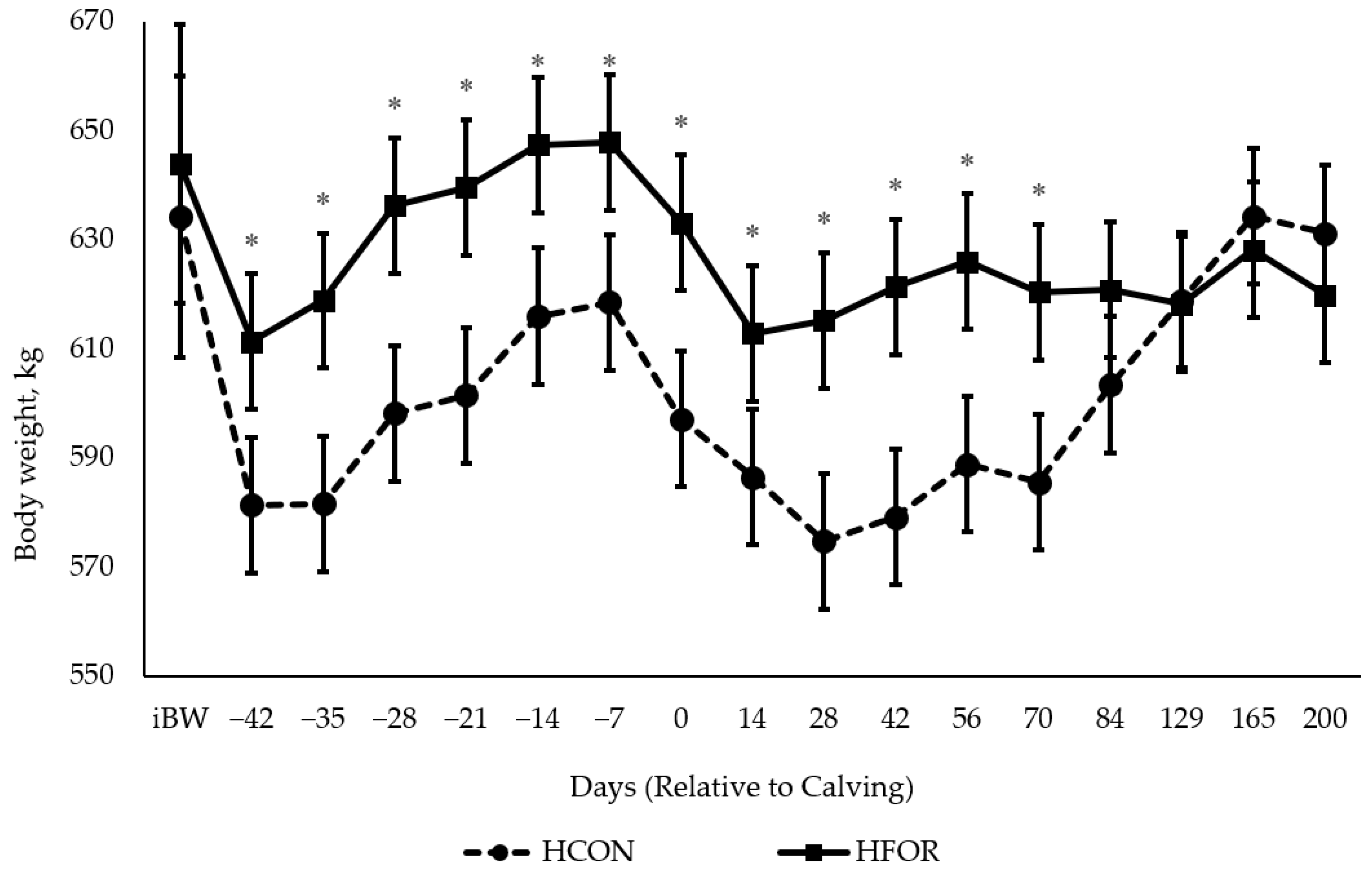
Cow BW measurements were taken on two consecutive days at the beginning of the experiment, and weights were averaged to determine initial BW. Cows were subsequently weighed weekly prior to calving (d −42, −35, −28, −21, −14, −7, and 0 ± 10) and biweekly post calving (d 14, 28, 42, 56, 70, and 84 ± 10), with d 0 being calving date. After the conclusion of the experiment (d 84), cows were additionally weighed on d 129, 165, and 200 (weaning). All cow BWs were recorded following a 12 h fast and were taken in a Silencer chute (Moly Manufacturing, LLC, Lorraine, KS, USA) equipped with a TruTest XR5000 scale head (readability: 0.91 kg; TrueTest, Inc., Mineral Wells, TX, USA).
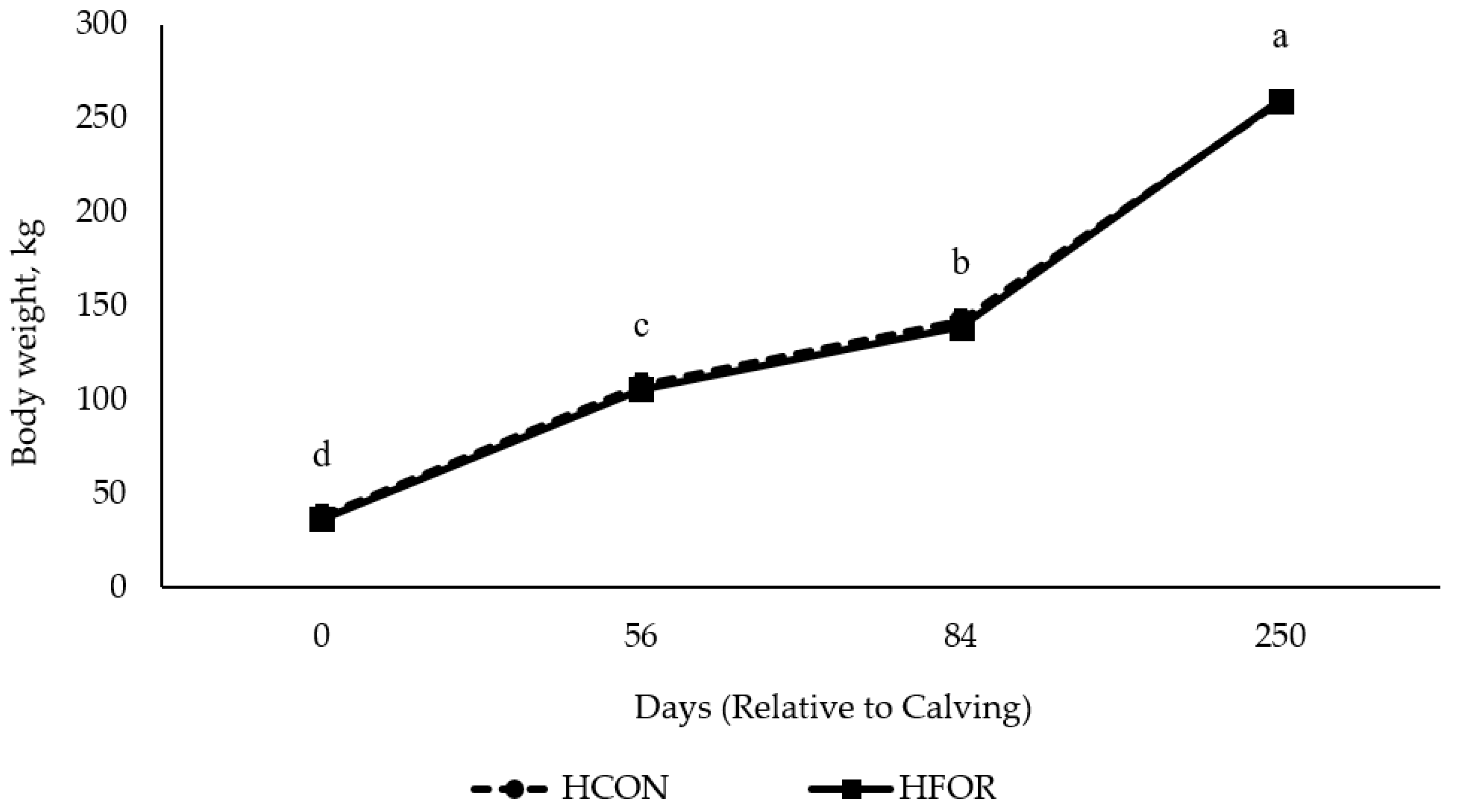
Calf individual BWs were collected on d 0 (calving) prior to suckling utilizing a hanging scale (Sunbeam Stewart ‘Farm ‘N’ Barn’ hanging scale (Model [8070/6010], Sunbeam Corp., Chicago, IL, USA). Calves were subsequently weighed on d 56, 84 and 200 (weaning), utilizing a For-Most squeeze chute (For-Most Livestock Equipment, Hawarden, IA, USA) equipped with a TruTest scale head, as previously mentioned.
2.7. Statistical Analysis
Data were analyzed as a randomized block design, using the GLIMMIX Procedure of SAS 9.4 (SAS Institute Inc., Cary, NC, USA). The animal was considered the experimental unit in all cases. No outliers were removed based on statistical analysis. The model included the fixed effect of treatment and the random effect of block (cow age). For variables analyzed as repeated measures (BW of cows and calves), the model included the fixed effects of treatment, day relative to calving, and their interaction, and the random effect of block. The subject was the cow nested within treatment, and the selected covariance structure was spatial power, based on the smallest AICC, and to account for unequal spacing and decaying correlation between timepoints with increasing distance. For calf BW, the effects of sire and calf sex were included as fixed effects. For the repeated-measures analysis, when the treatment-by-time interaction was significant, mean separation was performed using the slice statement with the slice-by-day option. Feed behavior data was analyzed with treatment and block as fixed effects. Initially, for all analyses, the block was tested as a random effect. For the subset of response variables related to feed behavior, the estimated random-effects variance for block was near zero, resulting in a non-positive-definite G-matrix. For that reason, and after testing alternative solutions, we decided to maintain block as a fixed effect for the feeding behavior analysis. The normality of the residuals was assessed using diagnostic plots obtained from the studentpanel of SAS, as previously recommended [
16]. Significance was determined at
p ≤ 0.05, and tendency was considered when 0.10 >
p > 0.05.
4. Discussion
In this comprehensive performance study, we expanded our previous investigation [
6,
7], where we reported that limit-feeding a high-concentrate corn-based diet during late gestation and early lactation (d −51 pre-calving until d 84 post-calving) altered placental transcriptomic profiles and improved colostrum and milk yield and composition. This study revealed further details, providing quantitative measurements of dry matter and water intake and performance of cow/calf pairs. Additionally, efficiency of energy utilization of mature beef cows was determined by indirectly measuring enteric methane emissions. As designed, the HCON cows consumed less dry matter, less drinking water, and produced less enteric methane emissions than HFOR cows. Further, the HCON cows consumed more DMI per meal and had less meals per day, highlighting the behavioral difference between the two winter-feeding strategies evaluated herein. However, when normalized to the net energy density of the diets, HCON cows exhibited a significant reduction in emissions per unit of NEm consumed. Even though we previously reported a lower abundance of glucose transporters and lower plasma glucose concentrations in the HCON calves at birth [
6], calf birth weights were not different between treatments, suggesting optimal utilization of this crucial metabolite. Our data demonstrate that a limit-fed high-concentrate corn-based diet combined with decreased water intake and enteric methane emissions resulted in no difference in calf performance and improved lactation capacity, which may indicate greater efficiency of energy utilization and water usage. The data generated in this study are unique and help elucidate behavioral and performance differences in beef cow/calf pairs in response to an alternative winter-feeding strategy. A detailed discussion of the main findings of this study is presented below.
The calculated intake levels for the HCON group were derived from two foundational studies in the literature [
5,
8]. Briefly, Loerch [
5] evaluated restricted intakes of 1.21%, 1.12%, and 1.25% of BW when feeding corn grain-based diets (approximately 80% concentrate and 20% hay) to pregnant and lactating beef cows. The second study, by Schoonmaker [
8], targeted an intake of 1.17% of BW for cows in those same physiological stages receiving corn-based diets (approximately 85% concentrate and 15% hay). In those studies, cows limit-fed corn-based diets consumed approximately half the amount of feed compared to cows fed ad libitum roughage-based diets. Despite the lower intakes, the greater energy density of corn permitted the cows to meet their increased nutritional requirements for late gestation and early lactation.
Our model achieved the targeted differences in daily intake between treatments throughout the course of the study. Physiological constraints related to late pregnancy and early lactation modified feed intake and feed behavior as well. For example, in the pre-calving period, the DMI of HCON cows was 0.96% of BW and the DMI of HFOR cows was 2.06% of BW, which may be due to the increased size of the gravid uterus that restricts the size of rumen distention [
17,
18]. In the post-calving period, the DMI of HCON cows was gradually increased to 1.89% of BW between days 0 and 28 post-calving. While initially the targeted intake was lower, this increment was adopted to ensure that cows were receiving enough nutrients to support the greater nutritional demands associated with lactation, and to avoid losses in body condition score. The HFOR cows achieved ad libitum intake in the post-calving period, which was evidenced by the greater amount of feed offered daily to those cows. Cumulatively, the HCON cows consumed an average of 1.4% of BW throughout the course of the study, while the HFOR cows consumed, on average, 2.39% of BW, which is similar to the average values reported for mature beef cows on these respective diets [
5,
8,
9].
We would like to highlight that, even though HCON cows were limit-fed (in kg of feed), they were not nutrient-restricted, due to a more nutrient-dense diet. The diet was formulated to meet the requirements of late gestation and early lactation, and adjustments in feed intake were performed as previously explained. It is worth noting that the HCON diet, containing slightly less CP compared to the HFOR diet (11.62 and 12.82% for HCON and HFOR, respectively), and the differences in DMI between the groups (5.52 and 12.89 kg/d pre-calving; 11.64 and 16.31 kg/d post-calving; 8.95 and 14.97 kg/d cumulatively, for HCON and HFOR, respectively) contributed to differences in daily protein intake (0.64 and 1.65 kg/d pre-calving; 1.36 and 2.09 kg/d post-calving; 1.04 and 1.90 kg/d cumulatively, for HCON and HFOR, respectively).
Feeding behavior revealed that HCON cows consumed fewer meals per day, had fewer visits to the feeders, and spent less total time eating, minutes per meal, and minutes per visit compared to HFOR cows. Conversely, the HCON cows consumed more DMI per meal, per visit, and per minute compared to HFOR cows. This difference in intake rate and total eating time is likely a function of both the distinct physical characteristics of the diets and feed management. Due to the greater density and lower volume of the concentrate diet, HCON cows were able to consume a greater quantity of DM per unit of time (increased rate of intake) compared to HFOR cows, whose forage-based diet required more time and effort to consume the same mass of dry matter. A previous study by Walsh [
19] reported a similar intake pattern, where beef steers fed a grass silage-based diet (ad libitum grass silage plus concentrate at 3 kg/d) made more frequent feeding visits than those fed high-concentrate diets (ad libitum concentrate plus grass silage at 5 kg/d). Additional feed behavior parameters, such as less meals per day and less visits to the feeder, can be explained by the fact that the HCON cows were fed once daily compared to four times daily for the HFOR cows. That management was necessary to achieve ad libitum intake for the HFOR cows, but it resulted in HCON bunks often being empty approximately one hour after feed delivery. Therefore, feeding behavior data can be explained due to HCON cows consuming their allotted feed intake sooner than HFOR cows, resulting in less feed available to consume the rest of the day.
Water intake followed a similar trend to DMI, where both HCON and HFOR cows had less water intake in the pre-calving compared to the post-calving period. We also observed that water intake (drinking, feed, and total water) was greater for HFOR cows compared to HCON cows throughout the course of the trial. Dry matter intake and stage of production are some of the major factors that affect water intake [
9]. Early research conducted by [
20,
21] demonstrated that water consumption increased when DMI increased. This concept was further validated by a regression coefficient to predict water intake from DMI [
22]. The DM content of the HFOR diet was 57.79%, while the DM content of the HCON diet was 73.13%, which explains why feed water intake was greater for HFOR cows. However, when drinking water was analyzed as L/kg DMI, the HCON cows had a greater ratio than the HFOR cows in the pre-calving period and cumulatively. Collectively, the HFOR cows consumed approximately 65% more feed than the HCON cows and 44% more drinking water, resulting in a lower ratio. However, when total water (drinking + feed water) was analyzed per kg of DMI, the HCON cows only consumed more water in the pre-calving period. When intakes were increased in the post-calving period, no difference was observed in water consumed per kg of DMI. The main difference is that total water accounts for the moisture present in feed, whereas drinking water is the water the cattle consume from the water trough. In essence, we expect that drinking water differs as a result of differences in moisture content of the diets, but total water consumption should be similar, and in fact, cumulatively, this is what happened. The fact that there is a difference in total water consumption per kg of intake during the pre-calving period, but not during the post-calving period, can be associated with the magnitude of the difference in feed intake between the treatments in different periods. During the pre-calving period, cows receiving HCON consume 43% the amount of feed that HFOR cows consume (5.5 vs. 12.9 kg/d, respectively), whereas during the post-calving period, that difference was smaller, with HCON cows consuming 71% of the amount of feed relative to HFOR cows (11.6 vs. 16.3 kg/d, respectively). It is possible that with such a low feed intake for the HCON group during the pre-calving period, the relationship between feed and water consumption becomes uncoupled. With a shortage of energy during the pre-calving period, tissue catabolism can occur, requiring water to eliminate excess residues such as urea nitrogen. For that reason, water consumption can increase above the expected level given the feed consumed.
The production of enteric CH
4 represents a significant loss of dietary energy within feeding systems [
23]. This by-product of microbial fermentation is primarily driven by the availability of molecular hydrogen in the rumen; while the production of acetate and butyrate releases hydrogen, propionate serves as a metabolic hydrogen sink [
24]. Although volatile fatty acids were not directly measured in the present study, the HCON diet contained 27.33% starch (DM basis)—nearly seven times that of the HFOR diet (4.30%). Such high starch inclusion is characteristically associated with a shift toward propionate production, which likely decreased the hydrogen available for methanogenesis and resulted in the lower total daily CH
4 emissions observed in HCON cows. These findings align with previous research [
25,
26] reporting that CH
4 emissions increase linearly with forage-to-concentrate ratios. While CH
4 emissions as a ratio of dry matter intake (g/kg of DMI) were greater for HCON cows due to their significantly lower feed intake, this metric does not fully capture the energetic status of the system. When normalized to the net energy density of the diets, HCON cows exhibited a significant reduction in emissions per unit of NEm consumed (16 vs. 19 g/Mcal). This reduction in energy “leakage” per Mcal of available energy, coupled with the maintenance of lactation capacity and calf performance despite lower total resource use, demonstrates that the limit-fed HCON strategy optimized energy partitioning and improved the overall biological efficiency of the production system compared to ad libitum HFOR feeding.
Cow BW did not statistically differ between groups at trial initiation (d −51; 634 and 644 kg, for HCON and HFOR, respectively). However, the HCON cows exhibited lower BW from d −42 to 70 compared to HFOR cows. The first significant BW drop, observed from d −51 to d −42, likely resulted from a combination of cold stress, targeted feed restriction, and reduction in gastrointestinal fill. A severe cold snap occurred during this period (12–19 January 2024), where the mean temperature reached −21°C (South Dakota Mesonet, SDSU, 2025). The metabolic demands of cold stress, combined with the targeted reduction in feed intake for HCON cows, resulted in the rapid decrease in BW observed in the first week of the trial. During the remainder of the pre-calving period (d −42 to 0), the reduced BW in HCON cows was likely attributed to the substantial reduction in gastrointestinal fill inherently associated with shifting from a high-forage to a high-concentrate diet. Additionally, HCON cows consumed 40% less ME (Mcal/d) and 60% less CP (kg/d) than HFOR cows during that period of time. The combination of loss of gut fill and comparatively lower nutrient intake is known to decrease the mass of visceral organs, particularly the liver and gastrointestinal tract, which collectively contributes to the observed lower BW in HCON cows compared to HFOR cows throughout the pre-calving period.
Postpartum, nutritional requirements increase substantially to support lactation [
9]. In the post-calving period, we observed a linear decrease in the BW of HCON cows from d 0 to 28; part of this reduction is attributed to the weights of the calf, placenta, and fetal fluids, and part is due to the intake restriction. As previously explained, we adjusted the intake of the HCON group, which allowed those cows to recover BW. The HCON cows demonstrated evidence of compensatory gain after the increase in DMI and once managed on pasture (d 84 to d 200). Historically, compensatory growth in ruminants involves both an increase in the efficiency of nutrient utilization for tissue deposition and a rapid restoration of visceral organ mass and gastrointestinal fill. Interestingly, the BW of HCON cows rebounded to be statistically similar to HFOR cows from d 84 (when cows transitioned to pasture) through weaning (d 200). This suggests that once the limit-fed HCON cows were provided greater DMI and subsequently transitioned to ad libitum grazing, the observed convergence in BW was likely driven by a combination of re-establishing normal gut fill, the expansion of metabolic tissues (e.g., liver and digestive tract) in response to increased nutrient flux, and the efficient recovery of mobilized body reserves. Crucially, despite the observed BW decrease in HCON dams during late gestation and early lactation, no negative effects were observed on calf performance. Calf birth weights, d 56 and 84 weights, and weaning weights were similar between groups. This result contradicts our initial hypothesis and also rebuts a previous study, where cows limit-fed a high-concentrate corn-based diet had calves with increased birth and weaning weights [
5]. This differential finding may be explained by experimental methods, since cows in that study were not individually fed and diets were formulated to meet or exceed requirements. This may have resulted in increased energy intake higher than what was initially targeted, and consequently affected offspring birth and weaning weights. Furthermore, Loerch in 1996 [
5] did not collect data regarding colostrum or milk yield and composition, which may also have been affected by maternal energy intake during late gestation and early lactation.







 ,
,