
PCE-FL: A Personalized, Clustered, and Communication-Efficient Federated Learning Framework for Robust Tomato Leaf Disease Detection

 , , ,
, , ,  and
and
Abstract
1. Introduction
- Novel Integrated Framework: To the best of our knowledge, PCE-FL is the first framework to integrate client clustering, knowledge distillation, and reputation-based aggregation into a single integrated framework specifically designed to apply to agricultural FL applications.
- Comprehensive Empirical Evaluation: Extensive experiments on realistic non-IID simulations of the PlantVillage tomato dataset across three Dirichlet heterogeneity levels () demonstrate superior accuracy and convergence over five state-of-the-art baselines, with all improvements being statistically significant ().
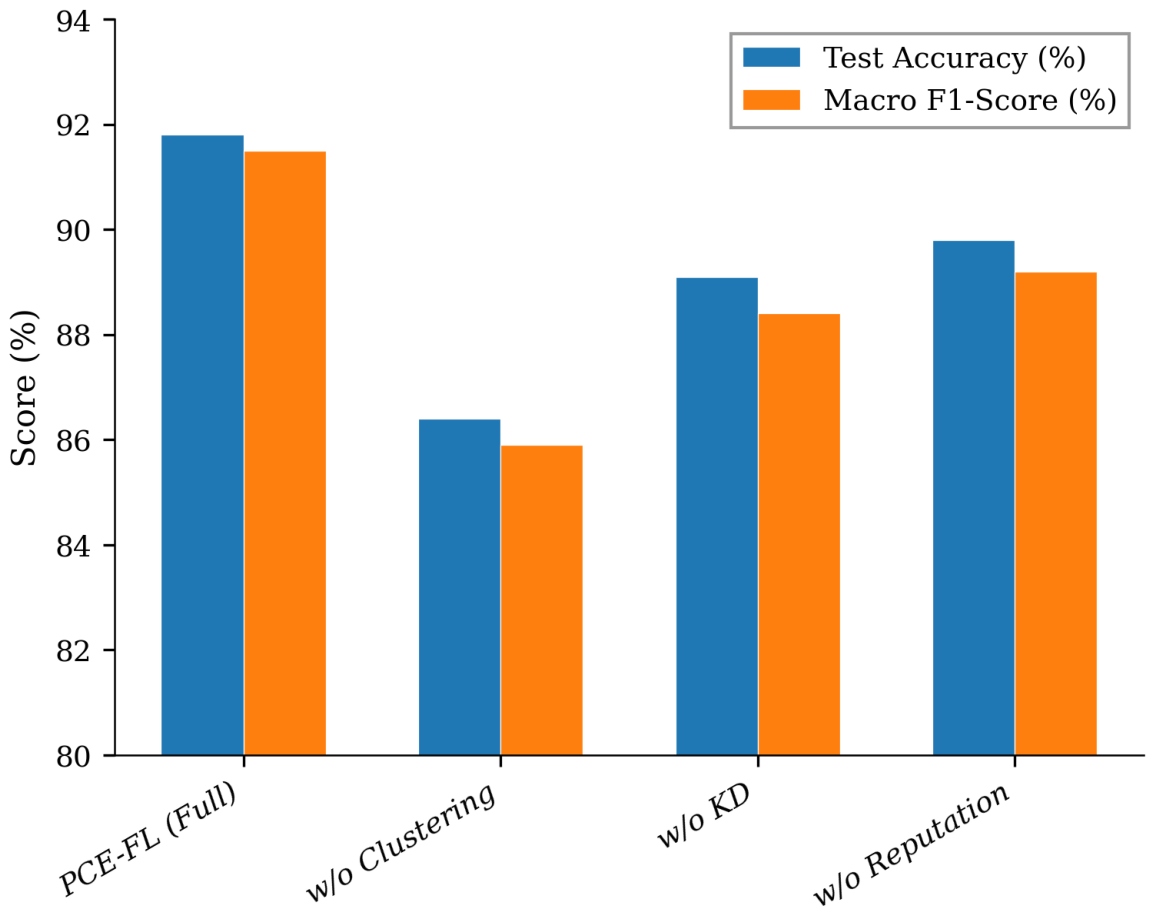
- Rigorous Ablation Study: A systematic component-removal analysis provides quantitative evidence for the necessity and complementary contribution of each core component.
- Practical Advancement: Significant refinements in the practical implementation of robust, high-performance, privacy-preserving collaborative AI, achieving a 91% reduction in communication overhead, are demonstrated in resource-constrained and heterogeneous agricultural settings.
2. Related Work
2.1. Deep Learning for Plant Disease Detection
2.2. Addressing Heterogeneity: Personalized and Clustered FL
2.3. Optimizing Communication: Federated Knowledge Distillation
2.4. Ensuring Robustness: Reputation-Based Aggregation
3. The PCE-FL Framework: Methodology
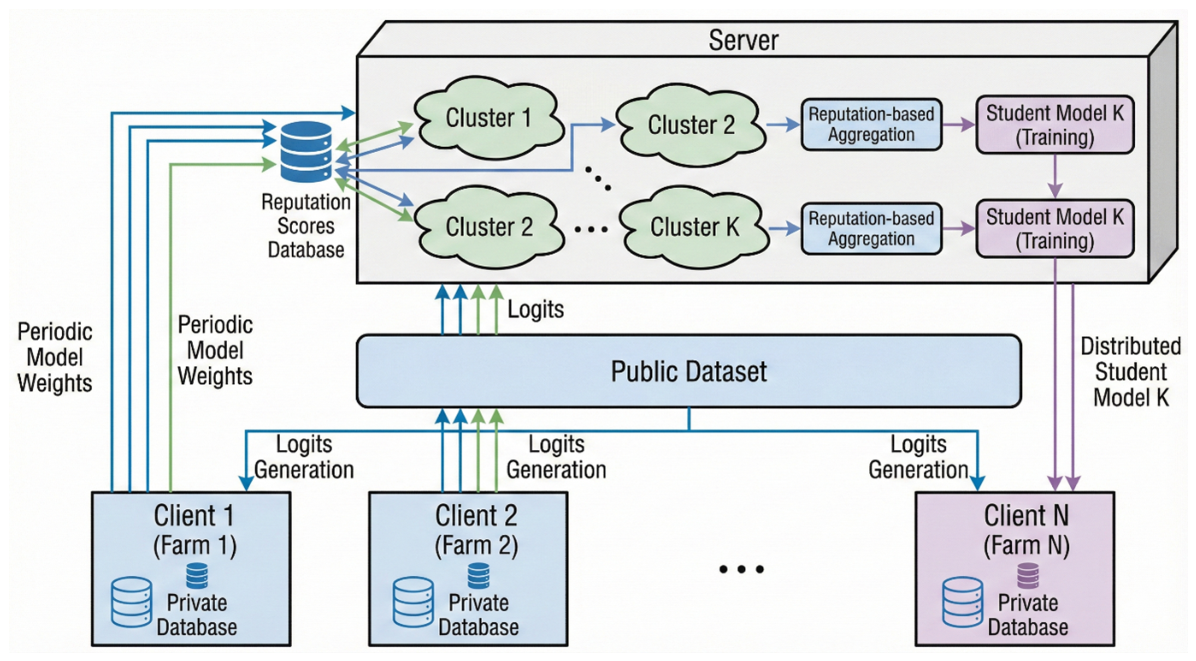
3.1. System Architecture and Overview
- Reputation score management over a long period of time with each client.
- Knowledge aggregation and model training in each cluster that is communication-efficient.

3.2. Dynamic Client Clustering for Personalization
3.3. Communication-Efficient Knowledge Transfer via Distillation
3.4. Reputation-Aware Intra-Cluster Aggregation
3.5. Complete Algorithm
| Algorithm 1 Personalized, Clustered, and Communication-Efficient Federated Learning (PCE-FL) |
Input: Number of clients N, number of clusters K, client datasets , public dataset , total rounds T, re-clustering period , local epochs E, momentum . Output: Cluster-wise student models . |
End of Algorithm |
4. Experimental Setup
4.1. Dataset and Non-IID Simulation
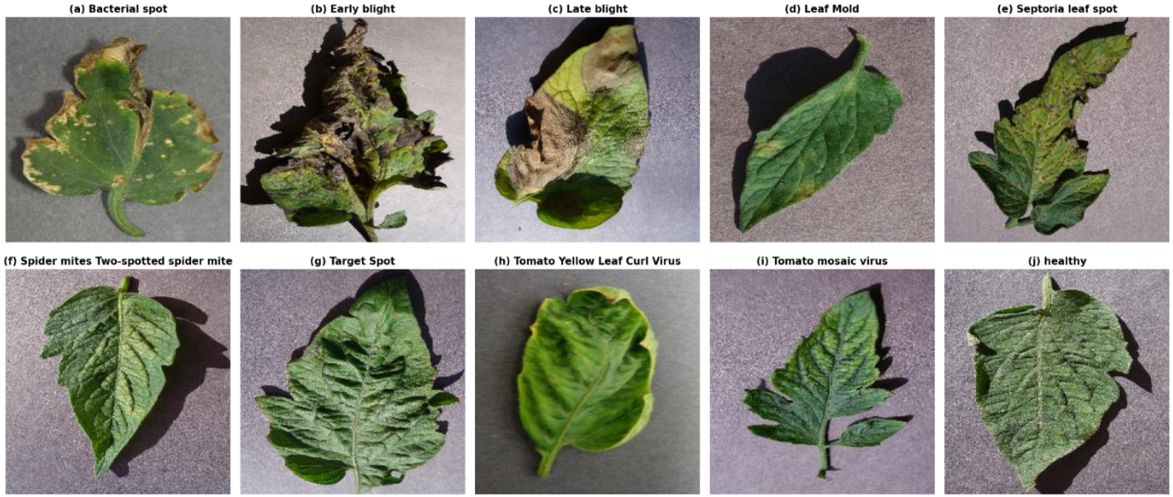
4.1.1. Dataset Description
4.1.2. Non-IID Partitioning
4.2. Model Architecture and Baselines
4.2.1. Base Model
4.2.2. Baseline Algorithms
- FedAvg [7]: Canonical algorithm using global weight averaging as the fundamental baseline.
- FedProx [24]: Addresses client drift in non-IID settings via a proximal term in the local objective.
- IFCA [28]: Iterative Federated Clustering Algorithm using weight averaging within clusters, isolating PCE-FL’s distillation and reputation benefits.
- FedMD [31]: Federated knowledge distillation for a single global model without clustering, highlighting PCE-FL’s personalization advantages.
- Krum [37]: Byzantine-robust method with geometric outlier detection, validating PCE-FL’s reputation mechanism.
4.3. Implementation Details and Evaluation Metrics
4.3.1. Implementation Details
4.3.2. Evaluation Metrics
- Top-1 Accuracy: The proportion of test samples whose predicted class matches the ground-truth class. This metric provides the overall multiclass classification accuracy on the balanced global test set.
- Total Communication Cost: The cumulative volume of information transmitted during training, measured in megabytes (MB). For weight-sharing baselines, this includes model-parameter exchange; for distillation-based methods, it includes logit exchange [7].
- Convergence Speed: The number of communication rounds required to reach predefined performance thresholds (80%, 85%, and 90% test accuracy), which provides an operational measure of training efficiency [7].
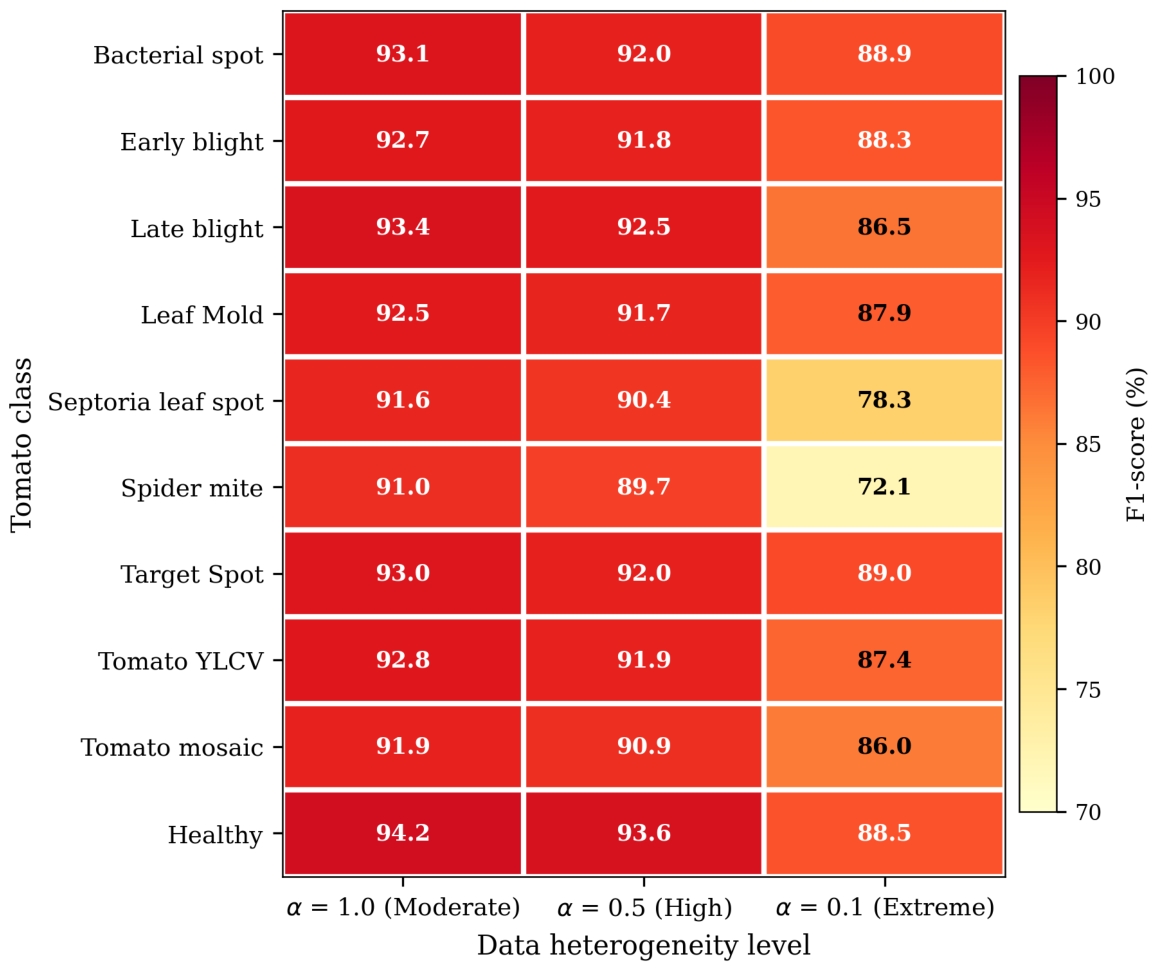
- Per-Class F1-Score: The F1-score computed separately for each disease class, enabling disease-specific analysis of rare-class behavior and the contribution of personalization/clustering mechanisms [45].
5. Results and Analysis
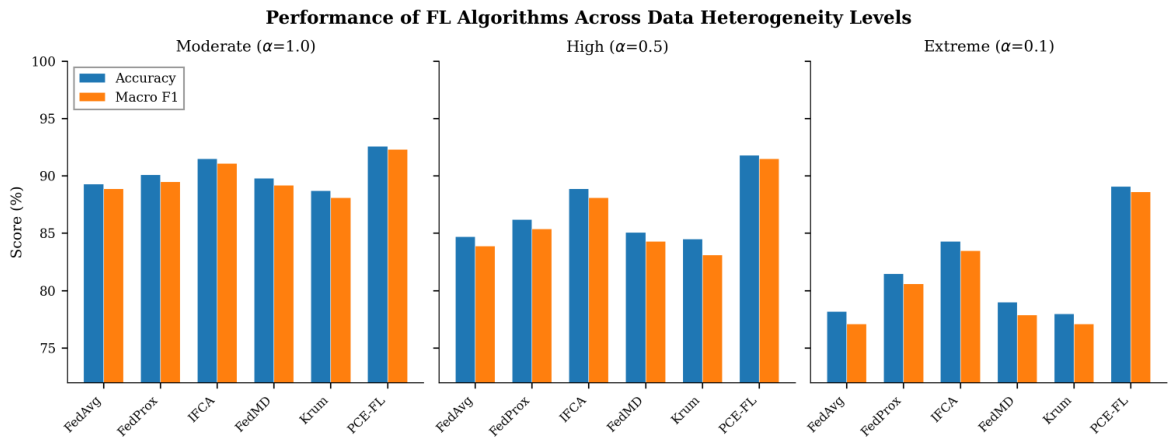
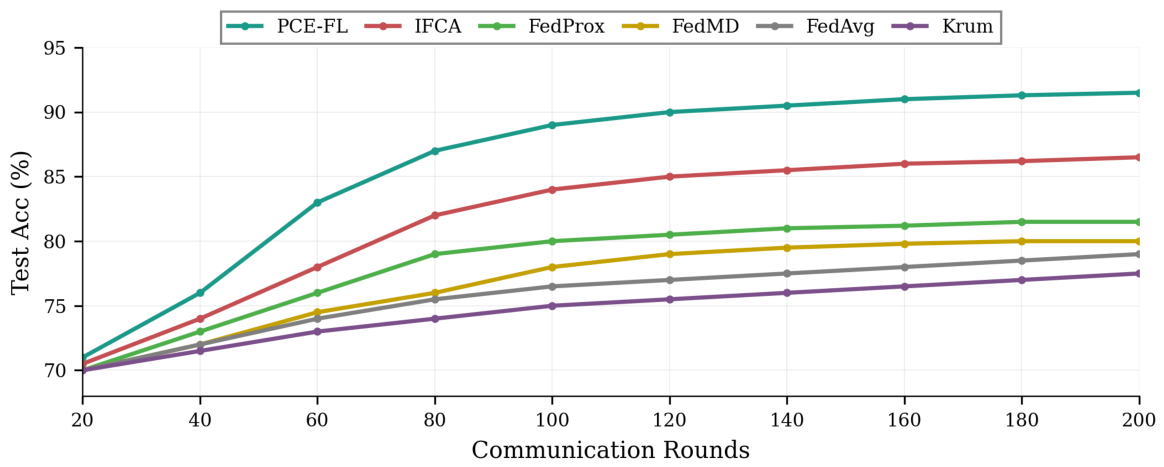
5.1. Overall Performance Comparison
5.2. Analysis of the Cost of Communication
5.3. Ablation Study
5.4. Ablation Findings and Discussion
5.5. Per-Class Analysis
6. Discussion
6.1. Practical Significance and Comparison with Existing Methods
6.2. Limitations
6.3. Future Directions
- Data-free distillation: Generator-based or data-free knowledge distillation: Adding data-free knowledge distillation in the absence of a public dataset and maintaining the classification performance and communication efficiency.
- Adaptive and asynchronous clustering: Implementing shift-dependent clustering mechanisms that can flexibly implement cluster boundaries depending on changing disease patterns and changing seasons, together with asynchronous update protocols in between the intermittent participation of a client.
- Enhanced privacy guarantees: Jointly using the reputation mechanism with differential privacy (DP) and secure aggregation to address the possible logit inversion attack and membership inference attacks on knowledge vectors being transmitted.
- Real-world field validation: Implementing PCE-FL on real farming networks with nonhomogeneous hardware, untrustworthy connectivity, and real disease distributions to test the structure during production. These field tests would also allow the testing of cultivar-specific impacts on disease detection performance.
- Extension to multi-crop and multi-modal settings: It is important to expand the model to multiple crops species at once, as well as to add other forms of data (e.g., multispectral images, weather data) to monitor plant health more comprehensively.
- Economic impact assessment: This is the quantification of the economic benefit of using PCE-FL in the system of lost crops, efficient allocation of resources (e.g., the use of specific fungicides), and better yield forecasting of the participating farms.
7. Conclusions
Author Contributions
Funding
Institutional Review Board Statement
Informed Consent Statement
Data Availability Statement
Acknowledgments
Conflicts of Interest
Abbreviations
| IID | Independent and Identically Distributed |
| FL | Federated Learning |
References
- FAO. The Impact of Disasters and Crises on Agriculture and Food Security: 2021; FAO: Rome, Italy, 2021. [Google Scholar] [CrossRef] [Scilit]
- Singh, P.P.; Kanth, D.R.; Madhuri, G.S.; Yadav, A.; Chauhan, S.S.; Kundu, P.; Bhattacharyya, U.K.; Banoo, S.; Ritu; Rajput, U.S. Deep Learning Techniques for Plant Disease Detection and Classification: A Comprehesive Review. Int. J. Adv. Biochem. Res. 2025, 9, 187–200. [Google Scholar] [CrossRef] [Scilit]
- Martinelli, F.; Scalenghe, R.; Davino, S.; Panno, S.; Scuderi, G.; Ruano, O.; Barone, S.; Porta-Puglia, A.; Ravasio, A.; Gullino, M.L. Advanced Methods of Plant Disease Detection: A Review. Agron. Sustain. Dev. 2015, 35, 1–25. [Google Scholar] [CrossRef] [Scilit]
- Saleem, M.H.; Potgieter, J.; Arif, K.M. Plant Disease Detection and Classification by Deep Learning. Plants 2019, 8, 468. [Google Scholar] [CrossRef] [Scilit] [PubMed]
- Li, L.; Zhang, S.; Wang, B. Plant Disease Detection and Classification by Deep Learning—A Review. IEEE Access 2021, 9, 56683–56698. [Google Scholar] [CrossRef] [Scilit]
- Li, T.; Sahu, A.K.; Talwalkar, A.; Smith, V. Federated Learning: Challenges, Methods, and Future Directions. IEEE Signal Process. Mag. 2020, 37, 50–60. [Google Scholar] [CrossRef] [Scilit]
- McMahan, B.; Moore, E.; Ramage, D.; Hampson, S.; Arcas, B.A. Communication-Efficient Learning of Deep Networks from Decentralized Data. In Proceedings of the 20th International Conference on Artificial Intelligence and Statistics (AISTATS), Fort Lauderdale, FL, USA, 20–22 April 2017; pp. 1273–1282. [Google Scholar] [CrossRef] [Scilit]
- Bonawitz, K.; Eichner, H.; Grieskamp, W.; Huba, D.; Ingerman, A.; Ivanov, V.; Kiddon, C.; Konečný, J.; Mazzocchi, S.; McMahan, B.; et al. Towards Federated Learning at Scale: System Design. arXiv 2019, arXiv:1902.01046. [Google Scholar] [CrossRef] [Scilit]
- Lu, Z.; Pan, H.; Dai, Y.; Si, X.; Zhang, Y. Federated Learning with Non-IID Data: A Survey. IEEE Internet Things J. 2024, 11, 19188–19209. [Google Scholar] [CrossRef] [Scilit]
- Bhanbhro, J.; Nisticò, S.; Palopoli, L. Issues in Federated Learning: Some Experiments and Preliminary Results. Sci. Rep. 2024, 14, 29881. [Google Scholar] [CrossRef] [Scilit]
- Briggs, C.; Fan, Z.; Andras, P. Federated Learning with Hierarchical Clustering of Local Updates to Improve Training on Non-IID Data. In Proceedings of the International Joint Conference on Neural Networks (IJCNN), Glasgow, UK, 19–24 July 2020. [Google Scholar] [CrossRef] [Scilit]
- Lin, T.; Kong, L.; Stich, S.U.; Jaggi, M. Ensemble Distillation for Robust Model Fusion in Federated Learning. Adv. Neural Inf. Process. Syst. 2020, 33, 2351–2363. [Google Scholar]
- Barbedo, J.G.A. Factors Influencing the Use of Deep Learning for Plant Disease Recognition. Biosyst. Eng. 2018, 172, 84–91. [Google Scholar] [CrossRef] [Scilit]
- Ferentinos, K.P. Deep Learning Models for Plant Disease Detection and Diagnosis. Comput. Electron. Agric. 2018, 145, 311–318. [Google Scholar] [CrossRef] [Scilit]
- Mohanty, S.P.; Hughes, D.P.; Salathé, M. Using Deep Learning for Image-Based Plant Disease Detection. Front. Plant Sci. 2016, 7, 1419. [Google Scholar] [CrossRef] [Scilit] [PubMed]
- Fuentes, A.; Yoon, S.; Kim, S.C.; Park, D.S. A Robust Deep-Learning-Based Detector for Real-Time Tomato Plant Diseases and Pests Recognition. Sensors 2017, 17, 2022. [Google Scholar] [CrossRef] [Scilit] [PubMed]
- Gupta, P.; Jadon, R.S. PlantVitGNet: A Hybrid Model of Vision Transformer and GoogLeNet for Plant Disease Identification. J. Phytopathol. 2025, 173, e70041. [Google Scholar] [CrossRef] [Scilit]
- Chen, J.; Zhang, D.; Zeb, A.; Nanehkaran, Y.A. Identification of Rice Plant Diseases Using Lightweight Attention Networks. Expert Syst. Appl. 2024, 169, 114514. [Google Scholar] [CrossRef] [Scilit]
- Vo, H.-T.; Quach, L.-D.; Tran Ngoc, H. Ensemble of Deep Learning Models for Multi-plant Disease Classification in Smart Farming. Int. J. Adv. Comput. Sci. Appl. 2023, 14, 1045–1054. [Google Scholar] [CrossRef] [Scilit]
- Liu, Z.; Gao, J.; Yang, G.; Zhang, H.; He, Y. Localization and Classification of Paddy Field Pests Using a Swin Transformer-Based Object Detection Framework. Remote Sens. 2024, 16, 1707. [Google Scholar] [CrossRef] [Scilit]
- Murugavalli, S.; Gopi, R. Plant Leaf Disease Detection Using Vision Transformers for Precision Agriculture. Sci. Rep. 2025, 15, 22361. [Google Scholar] [CrossRef] [Scilit] [PubMed]
- Salman, Z.; Muhammad, A.; Han, D. Plant Disease Classification in the Wild Using Vision Transformers and Mixture of Experts. Front. Plant Sci. 2025, 16, 1522985. [Google Scholar] [CrossRef] [Scilit]
- Piccialli, F.; Della Bruna, C.; Chiaro, D.; Qi, P.; Savoia, M. AGRIFOLD: AGRIculture Federated Learning for Optimized Leaf Disease Detection. Expert Syst. Appl. 2025, 289, 128371. [Google Scholar] [CrossRef] [Scilit]
- Li, T.; Sahu, A.K.; Zaheer, M.; Sanjabi, M.; Talwalkar, A.; Smith, V. Federated Optimization in Heterogeneous Networks. Proc. Mach. Learn. Syst. 2020, 2, 429–450. [Google Scholar] [CrossRef] [Scilit]
- Sattler, F.; Müller, K.-R.; Samek, W. Clustered Federated Learning: Model-Agnostic Distributed Multi-Task Optimization under Privacy Constraints. IEEE Trans. Neural Netw. Learn. Syst. 2021, 32, 3710–3722. [Google Scholar] [CrossRef] [Scilit] [PubMed]
- Smith, V.; Chiang, C.-K.; Sanjabi, M.; Talwalkar, A. Federated Multi-Task Learning. Adv. Neural Inf. Process. Syst. 2017, 30, 4424–4435. [Google Scholar]
- Liu, B.; Ma, Y.; Zhou, Z.; Shi, Y.; Li, S.; Tong, Y. CASA: Clustered Federated Learning with Asynchronous Clients. In Proceedings of the 27th ACM SIGKDD Conference on Knowledge Discovery & Data Mining (KDD), Singapore, 14–18 August 2021; pp. 1851–1862. [Google Scholar] [CrossRef] [Scilit]
- Ghosh, A.; Chung, J.; Yin, D.; Ramchandran, K. An Efficient Framework for Clustered Federated Learning. Adv. Neural Inf. Process. Syst. 2020, 33, 19586–19597. [Google Scholar] [CrossRef] [Scilit]
- Duan, M.; Liu, D.; Chen, X.; Liu, R.; Tan, Y.; Liang, L. FedGroup: Efficient Federated Learning via Decomposed Similarity-Based Clustering. IEEE Internet Things J. 2024, 11, 1234–1246. [Google Scholar] [CrossRef] [Scilit]
- Ma, X.; Zhu, J.; Lin, Z.; Chen, S.; Qin, Y. A State-of-the-Art Survey on Solving Non-IID Data in Federated Learning. Future Gener. Comput. Syst. 2024, 135, 244–258. [Google Scholar] [CrossRef] [Scilit]
- Li, D.; Wang, J. FedMD: Heterogeneous Federated Learning via Model Distillation. arXiv 2019, arXiv:1910.03581. [Google Scholar] [CrossRef] [Scilit]
- Hinton, G.; Vinyals, O.; Dean, J. Distilling the Knowledge in a Neural Network. arXiv 2015, arXiv:1503.02531. [Google Scholar] [CrossRef] [Scilit]
- Sattler, F.; Wiedemann, S.; Müller, K.-R.; Samek, W. Robust and Communication-Efficient Federated Learning from Non-i.i.d. Data. IEEE Trans. Neural Netw. Learn. Syst. 2020, 31, 3400–3413. [Google Scholar] [CrossRef] [Scilit]
- Zhu, Z.; Hong, J.; Zhou, J. Data-Free Knowledge Distillation for Heterogeneous Federated Learning. In Proceedings of the 38th International Conference on Machine Learning (ICML), Virtual, 18–24 July 2021; Volume 139, pp. 12878–12889. [Google Scholar]
- Yao, D.; Huang, T.; Zhang, Y.; Geng, G.; Sattler, F.; Vrang, I.; Wang, Z.; Samek, W. FEDGKD: Toward Heterogeneous Federated Learning via Global Knowledge Distillation. IEEE Trans. Comput. 2024, 73, 3–17. [Google Scholar] [CrossRef] [Scilit]
- Lamport, L.; Shostak, R.; Pease, M. The Byzantine Generals Problem. ACM Trans. Program. Lang. Syst. 1982, 4, 382–401. [Google Scholar] [CrossRef] [Scilit]
- Blanchard, P.; El Mhamdi, E.M.; Guerraoui, R.; Stainer, J. Machine Learning with Adversaries: Byzantine Tolerant Gradient Descent. In Proceedings of the Advances in Neural Information Processing Systems 30 (NIPS 2017), Long Beach, CA, USA, 4–9 December 2017; pp. 119–129. [Google Scholar]
- Kang, J.; Xiong, Z.; Niyato, D.; Zou, Y.; Zhang, Y.; Guizani, M. Reliable Federated Learning for Mobile Networks. IEEE Wirel. Commun. 2020, 27, 72–80. [Google Scholar] [CrossRef] [Scilit]
- Song, Z.; Sun, H.; Yang, H.-H.; Wang, X.; Zhang, Y.; Quek, T.Q.S. Reputation-Based Federated Learning for Secure Wireless Networks. IEEE Internet Things J. 2022, 9, 1212–1226. [Google Scholar] [CrossRef] [Scilit]
- Dou, Z.; Wang, J.; Sun, W.; Liu, Z.; Fang, M. Toward Malicious Clients Detection in Federated Learning. In Proceedings of the 2025 ACM Conference on Computer and Communications Security (CCS), Copenhagen, Denmark, 26–30 October 2025; pp. 456–472. [Google Scholar] [CrossRef] [Scilit]
- Mughal, F.R.; Ullah, R.; Ikram, M.; Ahmad, N.; Alamri, A.; Alharbi, M. Adaptive Federated Learning for Resource-Constrained IoT Devices through Edge Intelligence and Multi-Edge Clustering. Sci. Rep. 2024, 14, 28746. [Google Scholar] [CrossRef] [Scilit]
- Yang, X.; Li, J. A Clustering-Based Federated Deep Learning Approach for Enhancing Diabetes Management with Privacy-Preserving Edge AI. Healthc. Anal. 2025, 7, 100392. [Google Scholar] [CrossRef] [Scilit]
- Sheikhi, S.; Kostakos, P.; Loven, L. Hybrid Reputation Aggregation: A Robust Defense Mechanism for Adversarial Federated Learning in 5G and Edge Network Environments. arXiv 2025, arXiv:2509.18044. [Google Scholar] [CrossRef] [Scilit]
- Sokolova, M.; Lapalme, G. A Systematic Analysis of Performance Measures for Classification Tasks. Inf. Process. Manag. 2009, 45, 427–437. [Google Scholar] [CrossRef] [Scilit]
- Opitz, J.; Burst, S. Macro F1 and Macro F1. arXiv 2019, arXiv:1911.03347. [Google Scholar]



| Method | Application Domain | Capability (N/P/C/R/A) | Key Limitations |
|---|---|---|---|
| Centralized DL [15] | Plant disease detection | Requires raw data sharing; privacy violation; impractical across farms | |
| FedAvg [7] | Generic FL | Severe performance degradation under non-IID data; high communication cost | |
| IFCA [28] | Personalized FL | Ignores communication cost and robustness; cluster instability | |
| CFL [25] | Clustered FL | No robustness mechanism; high model transmission overhead | |
| CASA [27] | Asynchronous CFL | Addresses asynchrony only; lacks robustness and communication efficiency | |
| FedMD [31] | FKD-based FL | Assumes homogeneous, reliable clients; no personalization | |
| FedGKD [35] | Data-free FKD | No heterogeneity handling; no quality control | |
| Krum/Median [37] | Byzantine-robust FL | Discards benign non-IID updates; computationally expensive | |
| RFFL [39] | Reputation-based FL | No personalization or communication optimization | |
| Hybrid Robust FL [40] | Robust FL | Focuses only on robustness | |
| PCE-FL (Proposed) | Tomato leaf disease detection | None (jointly addresses heterogeneity, communication, and robustness) |
| Disease/Class | Label (ID) | Image Count |
|---|---|---|
| Bacterial Spot | A | 1702 |
| Early Blight | B | 1920 |
| Late Blight | C | 1851 |
| Leaf Mold | D | 1882 |
| Septoria Leaf Spot | E | 1745 |
| Spider Mite (Two-Spotted) | F | 1741 |
| Target Spot | G | 1827 |
| Tomato Mosaic Virus | H | 1790 |
| Tomato Yellow Leaf Curl Virus | I | 1961 |
| Healthy | J | 1926 |
| Grand Total | 18,345 |
| Heterogeneity Level | Dirichlet | Characteristics |
|---|---|---|
| Moderate | 1.0 | Moderately skewed; diverse client distributions |
| High | 0.5 | Significantly skewed; clients biased to few classes |
| Extreme | 0.1 | Highly specialized; clients hold 1–2 classes only |
| Hyperparameter | Symbol | Value | Description |
|---|---|---|---|
| Client learning rate | 0.01 | SGD optimizer learning rate | |
| Local training epochs per round | E | 5 | Client-side iterations per round |
| Batch size | – | 32 | Training batch size |
| Number of clusters | K | 5 | PCE-FL clustering parameter |
| Re-clustering period | 50 rounds | HAC re-clustering frequency | |
| Reputation momentum | 0.9 | Reputation smoothing factor | |
| Distillation temperature | T | 3 | Knowledge distillation softness |
| Public dataset size | 500 | Diverse tomato leaf images | |
| Total communication rounds | T | 200 | Full federated training rounds |
| Total clients | N | 100 | Simulated participating clients |
| Data Heterogeneity () | Algorithm | Test Accuracy (%, Mean ± std) | Macro F1-Score (%, Mean ± std) | Total Communication Cost (MB) |
|---|---|---|---|---|
| Moderate () | FedAvg | 1850 | ||
| FedProx | 1850 | |||
| IFCA | 1850 | |||
| FedMD | 165 | |||
| Krum | 1850 | |||
| PCE-FL | 165 | |||
| High () | FedAvg | 1850 | ||
| FedProx | 1850 | |||
| IFCA | 1850 | |||
| FedMD | 165 | |||
| Krum | 1850 | |||
| PCE-FL | 165 | |||
| Extreme () | FedAvg | 1850 | ||
| FedProx | 1850 | |||
| IFCA | 1850 | |||
| FedMD | 165 | |||
| Krum | 1850 | |||
| PCE-FL | 165 |
| Method | FL Strategy | Accuracy (%) | Total Comm. (MB) | Comm. Red. (%) | Convergence Speed * | Low-Bandwidth Suitability |
|---|---|---|---|---|---|---|
| FedAvg | Weight sharing | 78.2 | 1850 | – | Slow (85 rounds) | Low |
| FedProx | Weight sharing + regularization | 81.5 | 1850 | – | Moderate | Low |
| IFCA | Clustered FL | 84.3 | 1850 | – | Moderate (62 rounds) | Medium |
| Krum | Robust aggregation | 80.6 | 1850 | – | Slow | Low |
| FedMD | Knowledge distillation | 79.0 | 165 | 91 | Moderate | High |
| PCE-FL | Personalized KD (Ours) | 89.1 | 165 | 91 | Fast (58 rounds) | Very high |
| Framework Variant | Description | Acc. (%) | Macro F1 (%) | Degradation |
|---|---|---|---|---|
| PCE-FL (Full) | Clustering + knowledge distillation + reputation | 91.8 | 91.5 | – |
| PCE-FL w/o clustering | Single global cluster; knowledge distillation + reputation | 86.5 | 85.9 | |
| PCE-FL w/o KD | Clustering + reputation; weight sharing | 89.2 | 88.4 | |
| PCE-FL w/o reputation | Clustering + knowledge distillation; simple averaging | 89.9 | 89.3 |
Disclaimer/Publisher’s Note: The statements, opinions and data contained in all publications are solely those of the individual author(s) and contributor(s) and not of MDPI and/or the editor(s). MDPI and/or the editor(s) disclaim responsibility for any injury to people or property resulting from any ideas, methods, instructions or products referred to in the content. |
© 2026 by the authors. Licensee MDPI, Basel, Switzerland. This article is an open access article distributed under the terms and conditions of the Creative Commons Attribution (CC BY) license.
Share and Cite
Gupta, P.; Gupta, S.; Goel, L.; Agarwal, A.K.; Singh, A.; Sharma, V.S.; Chowdhary, C.L.; Chowdhary, R. PCE-FL: A Personalized, Clustered, and Communication-Efficient Federated Learning Framework for Robust Tomato Leaf Disease Detection. AgriEngineering 2026, 8, 182. https://doi.org/10.3390/agriengineering8050182
Gupta P, Gupta S, Goel L, Agarwal AK, Singh A, Sharma VS, Chowdhary CL, Chowdhary R. PCE-FL: A Personalized, Clustered, and Communication-Efficient Federated Learning Framework for Robust Tomato Leaf Disease Detection. AgriEngineering. 2026; 8(5):182. https://doi.org/10.3390/agriengineering8050182
Chicago/Turabian StyleGupta, Pradeep, Sonam Gupta, Lipika Goel, Abhay Kumar Agarwal, Arjun Singh, Vijay Shankar Sharma, Chiranji Lal Chowdhary, and Ruchita Chowdhary. 2026. "PCE-FL: A Personalized, Clustered, and Communication-Efficient Federated Learning Framework for Robust Tomato Leaf Disease Detection" AgriEngineering 8, no. 5: 182. https://doi.org/10.3390/agriengineering8050182
APA StyleGupta, P., Gupta, S., Goel, L., Agarwal, A. K., Singh, A., Sharma, V. S., Chowdhary, C. L., & Chowdhary, R. (2026). PCE-FL: A Personalized, Clustered, and Communication-Efficient Federated Learning Framework for Robust Tomato Leaf Disease Detection. AgriEngineering, 8(5), 182. https://doi.org/10.3390/agriengineering8050182