Multimodal Sensing to Estimate Soil Organic Carbon Using Limited Samples from Paddy Fields


Abstract
1. Introduction
2. Methodology
2.1. Soil Sampling and Analysis
2.1.1. Thermal Image Processing and Analysis
2.1.2. Spectroscopy-Based Analysis
2.1.3. RGB Image Recording and Analysis
2.2. Multimodal Sensing Data Integration for SOC Quantification
2.2.1. Integration of RGB Image and Spectroscopy Data
2.2.2. Integration of RGB Images and IR Images
| Algorithm 1: Main Event-Driven Logic |
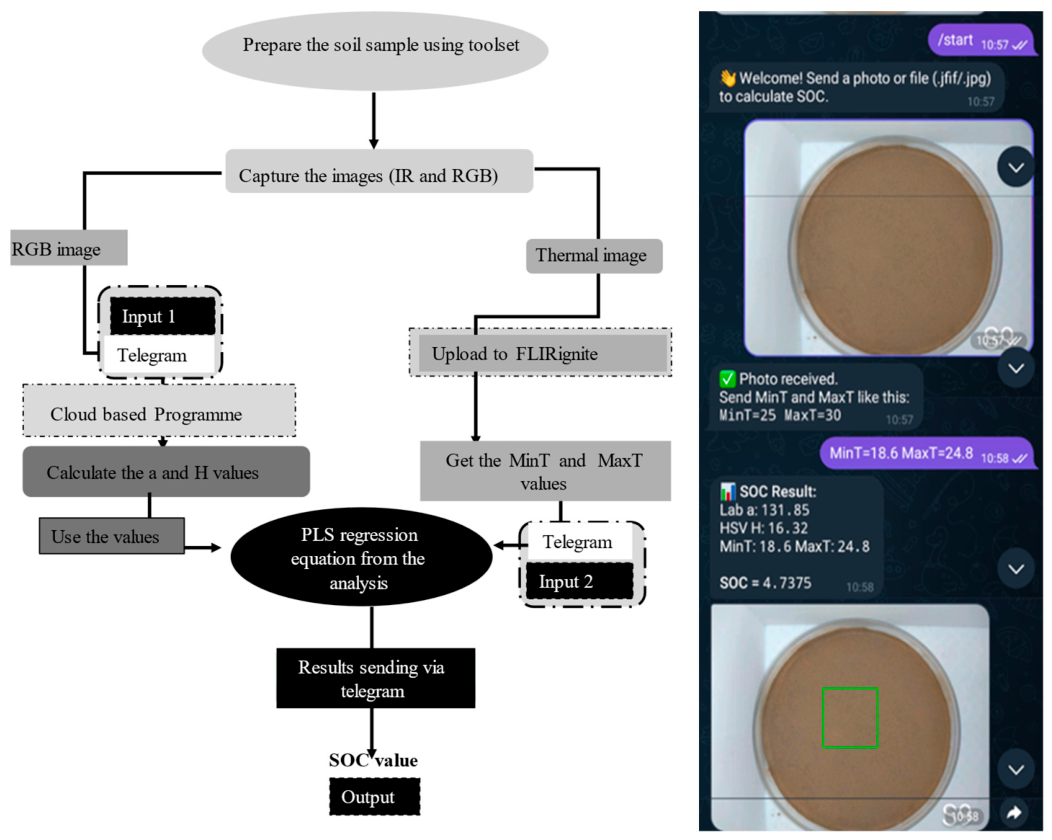
| Users start by sending the ‘/start’ command to the system, and upon receiving the command script, they encounter the welcome message and the step-to-step guide to submit input data starting with the image captured by the smartphone. PROCEDURE Main BEGIN REGISTER HANDLER for command “/start” to execute Procedure Handle_Start REGISTER HANDLER for incoming “photo” messages to execute Procedure Handle_Image REGISTER HANDLER for incoming “text” messages to execute Procedure Handle_Text START POLLING for events MAINTAIN IDLE state END |
| Algorithm 2: Image processing |
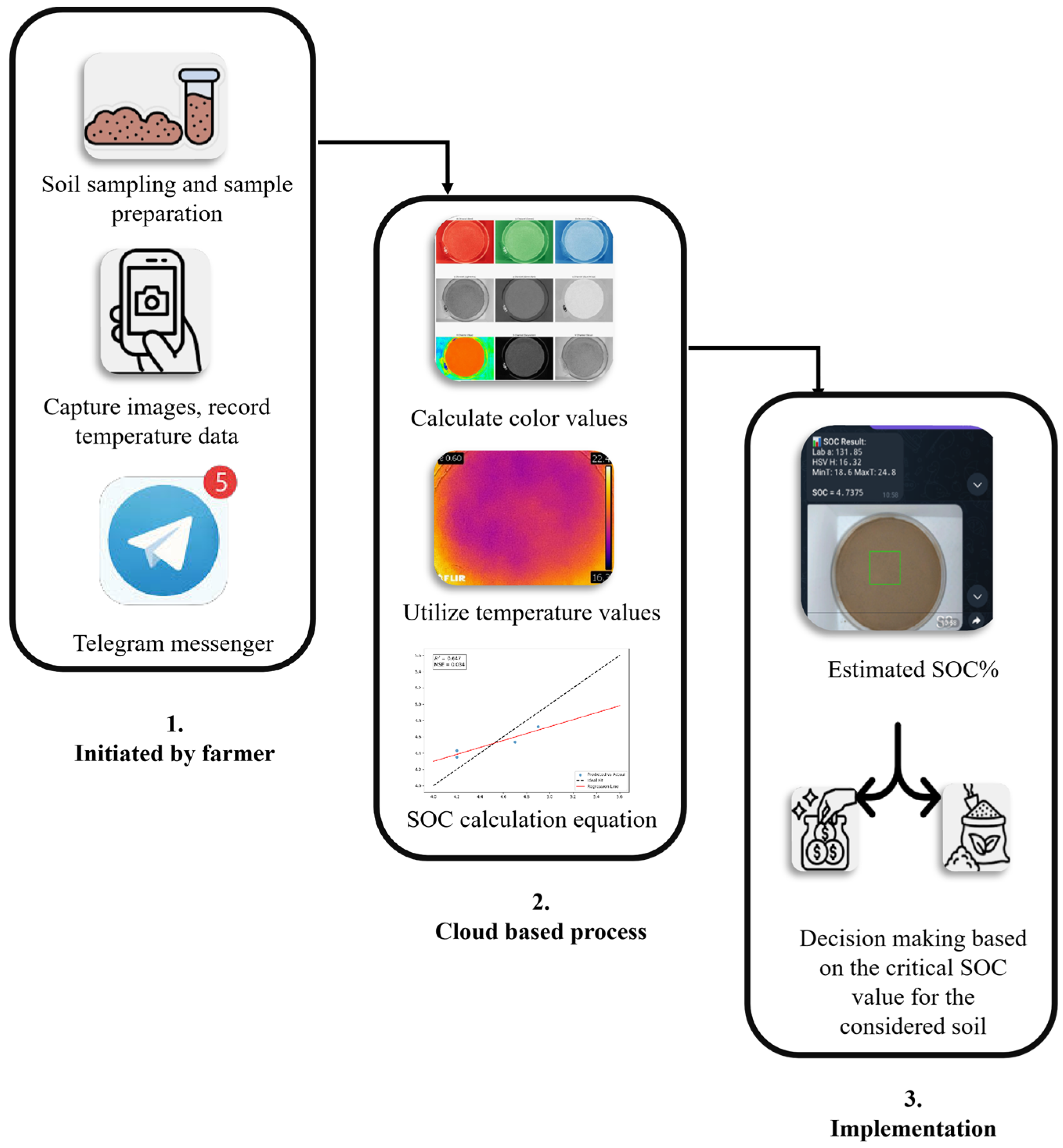
| Upon receiving the image, the system enters a temporary state and waits for the other data submissions. Here, the system sends a request to the user to submit the MinT and MaxT from the IR image with an example guide text. These data are directly taken for the calculation of the SOC, and they are integral parts of the equation. PROCEDURE Handle_Image(incoming_photo_message) BEGIN GET user_id FROM incoming_photo_message SET local_image_path = GENERATE_UNIQUE_PATH_FOR_USER(user_id) GET photo_file = SELECT_HIGHEST_RESOLUTION(incoming_photo_message) DOWNLOAD photo_file TO local_image_path CALL Store_Session_State(user_id, local_image_path) SET prompt_message = “Image received. Please provide ancillary data in the format: MinT = 25 MaxT = 30” SEND_MESSAGE (to user_id, with prompt_message) END |
| Algorithm 3: Secondary data handling and computation |
| Once all the inputs are received, the system starts the calculation of the SOC. This involves converting the RGB image to an HSV value and employing the CIE Lab models, which selects of ROI, calculates the average “H” and “a” values from the ROI area. These two values with MinT and MaxT are subsequently used by the system to compute the SOC via the equation. PROCEDURE Handle_Text(incoming_text_message) BEGIN GET user_id FROM incoming_text_message GET text_content FROM incoming_text_message SET session = Retrieve_Session_State(user_id) IF session is NULL THEN SEND_MESSAGE (to user_id, with “Error: Please send an image first.”) RETURN END IF TRY SET MinT = PARSE_NUMERIC_VALUE (from text_content, for key “MinT”) SET MaxT = PARSE_NUMERIC_VALUE(from text_content, for key “MaxT”) SET image_path = session.image_path SET a, H, SOC, roi_path = CALL Compute_SOC_and_Image(image_path, MinT, MaxT) SET result_text = FORMAT_RESULTS(a, H, MinT, MaxT, SOC) SEND_MESSAGE(to user_id, with result_text) SEND_PHOTO(to user_id, from roi_path) CALL Delete_Session_State(user_id) CATCH ParsingError SET error_message = “Error parsing input. Use format: MinT = 25 MaxT = 30” SEND_MESSAGE(to user_id, with error_message) END TRY END |
| Algorithm 4: SOC estimation and image handling |
| After the calculation is complete, together with the information of the data used to calculate the SOC and an image with the ROI, the calculated SOC is sent to the user via the automated analysis script. PROCEDURE Compute_SOC_and_Image (image_path, MinT, MaxT) BEGIN SET img = READ_IMAGE_FROM_PATH(image_path) SET lab_image = CONVERT_COLOR(img, from BGR to LAB) SET hsv_image = CONVERT_COLOR(img, from BGR to HSV) SET lab_roi = EXTRACT_REGION(lab_image, x_start, y_start, x_end, y_end) SET hsv_roi = EXTRACT_REGION(hsv_image, x_start, y_start, x_end, y_end) SET a_mean = CALCULATE_MEAN(channel ‘a’ of lab_roi) SET H_mean = CALCULATE_MEAN(channel ‘H’ of hsv_roi) CALCULATE ‘PLS regression equation for SOC’ DRAW_RECTANGLE(img, from (x_start, y_start) to (x_end, y_end)) SET result_img_path = GENERATE_PATH(image_path, suffix: “_roi”) SAVE_IMAGE(img, to result_img_path) SET data_record = [image_path, MinT, MaxT, a_mean, H_mean, SOC] APPEND_RECORD_TO_CSV(“soc_results.csv”, data_record) RETURN a_mean, H_mean, SOC, result_img_path END |
2.3. Instrument Design and Fabrication
3. Results
3.1. Soil Sampling Analysis
3.1.1. Thermal (IR) Images and SOC
3.1.2. Reflectance Data from the Spectral Engine
3.1.3. RGB Image Analysis
3.2. Multi-Model Sensing Integration for SOC Determination
4. Discussion
4.1. Color Models and SOC Prediction
4.2. Thermal Image Data and SOC Prediction
4.3. Spectroscopy Data and SOC Analysis
4.4. Multimodal Analysis with Integration of Sensors
4.5. Implementation of the Developed Method and Applications of the SOC Value
4.6. Application of SOC Data
5. Conclusions
- We were able to develop an SOC analysis method with reasonable accuracy (1% change in soil samples near the model’s mean value of SOC);
- Combining data from thermal images and RGB images provides the potential to predict the SOC values of samples with similar MSCC colors with smaller SOC variations;
- The process can be customized for individual farmers with digital literacy to conduct self-analyses in their fields.
Author Contributions
Funding
Institutional Review Board Statement
Informed Consent Statement
Data Availability Statement
Acknowledgments
Conflicts of Interest
References
- International Atomic Energy Agency. Agricultural Water Management. Joint FAO/IAEA Programme; Nuclear Techniques in Food and Agriculture. December 2024. Available online: https://www.iaea.org/topics/agricultural-water-management (accessed on 6 February 2025).
- Suchitra, M.S.; Pai, M.A. Improving the prediction accuracy of soil nutrient classification by optimizing extreme learning machine parameters. Inf. Process. Agric. 2019, 7, 72–81. [Google Scholar] [CrossRef] [Scilit]
- McCarty, G.W.; Reeves, J.B.; Reeves, V.B.; Follett, R.F.; Kimble, J.M. Mid-infrared and near-infrared diffuse reflectance spectroscopy for soil carbon measurements. Soil Sci. Soc. Am. J. 2002, 66, 640–646. [Google Scholar] [CrossRef] [Scilit]
- Anglopoulou, T.; Tziolas, N.; Balafoutis, A.; Zalidis, G.; Bochtis, D. Remote Sensing Techniques for Soil Organic Carbon Estimation: A Review. Remote Sens. 2019, 11, 676. [Google Scholar] [CrossRef] [Scilit]
- Loria, N.; Lal, R.; Chandra, R. Handheld in Situ Methods for Soil Organic Carbon Assessment. Sustainability 2024, 16, 5592. [Google Scholar] [CrossRef] [Scilit]
- Zhou, T.; Geng, Y.; Lv, W.; Xiao, S.; Zhang, P.; Xu, X.; Chen, J.; Wu, Z.; Pan, J.; Si, B.; et al. Effects of optical and radar satellite observations within Google Earth Engine on soil organic carbon prediction models in Spain. J. Environ. Manag. 2023, 338, 117810. [Google Scholar] [CrossRef] [Scilit]
- Kabiri, S.; O’Rourke, S.M. Coarse to superfine: Can hyperspectral soil organic carbon models predict higher-resolution information? Front. Environ. Sci. 2024, 12, 1392469. [Google Scholar] [CrossRef] [Scilit]
- Ou, J.; Wu, Z.; Yan, Q.; Feng, X.; Zhao, Z. Improving soil organic carbon mapping in farmlands using machine learning models and complex cropping system information. Environ. Sci. Eur. 2024, 36, 80. [Google Scholar] [CrossRef] [Scilit]
- Islam, S.F.; Van Groenigen, J.W.; Jensen, L.S.; Sander, B.O.; De Neergaard, A. The effective mitigation of greenhouse gas emissions from rice paddies without compromising yield by early-season drainage. Sci. Total Environ. 2018, 612, 1329–1339. [Google Scholar] [CrossRef] [Scilit]
- Xiao, Y.; Huang, R.; Zhang, Z.; Wong, V.N.L.; Li, X.; Tang, X.; Luo, Y.; Wu, Y.; Liu, J.; Li, S.; et al. Effects of soil labile carbon fractions and microbes on GHG emissions from flooding to drying in paddy fields. J. Environ. Sci. 2025, 158, 420–434. [Google Scholar] [CrossRef] [Scilit] [PubMed]
- USDA. Smart Nutrient Management Save Money and Protect Water Quality, United States of America Department of Agriculture (USDA), Factsheet. 2022; pp. 1–2. Available online: https://www.farmers.gov/sites/default/files/2022-09/farmersgov-fact-sheet-smart-nutr-mgnt-9-2022.pdf (accessed on 21 June 2025).
- Saiz-Rubio, V.; Rovira-Mas, F. From Smart Farming towards Agriculture 5.0: A Review on Crop Data Management. Agronomy 2020, 10, 207. [Google Scholar] [CrossRef] [Scilit]
- Shepherd, K.D.; Walsh, M. Development of Reflectance Spectral Libraries for Characterization of Soil Properties. Soil Sci. Soc. Am. 2002, 66, 988–998. [Google Scholar] [CrossRef]
- Fidêncio, P.H.; Poppi, R.J.; De Andrade, J.C. Determination of organic matter in soils using radial basis function networks and near infrared spectroscopy. Anal. Chim. Acta 2002, 453, 125–134. [Google Scholar] [CrossRef] [Scilit]
- Taneja, P.; Vasava, H.K.; Daggupati, P.; Biswas, A. Multi-algorithm comparison to predict soil organic matter and soil moisture content from cell phone images. Geoderma 2021, 385, 114863. [Google Scholar] [CrossRef] [Scilit]
- Tian, C.; Cui, D.; Cao, Y.; Luo, S.; Song, H.; Yang, P.; Bai, Y.; Tian, J. Temperature-dependent soil storage: Changes in microbial viability and respiration in semiarid grasslands. Soil Biol. Biochem. 2025, 202, 109673. [Google Scholar] [CrossRef] [Scilit]
- Fromin, N. Impacts of soil storage on microbial parameters. Soil 2024, 11, 247–265. [Google Scholar] [CrossRef] [Scilit]
- Pinhero, A.; Anupama, M.L.; Vinod, P.; Visaggioc, C.A.; Aneesh, N.; Abhijith, S.; AnanthaKrishnan, S. Malware detection employed by visualization and deep neural network. Comput. Secur. 2021, 105, 102247. [Google Scholar] [CrossRef] [Scilit]
- Rossel, R.A.V.; Walter, C.; Fouad, Y. Assessment of two reflectance techniques for the quantification of the within-field spatial variability of soil organic carbon. Precis. Agric. 2003, 697–703. [Google Scholar] [CrossRef] [Scilit]
- Wang, Z.h.o.u.; Bovik, A.C.; Sheikh, H.R.; Simoncelli, E.P. Image quality assessment: From error visibility to structural similarity. IEEE Trans. Image Process. 2004, 13, 600–612. [Google Scholar] [CrossRef] [Scilit] [PubMed]
- Scikit-Learn Developers. f_regression. In Scikit-Learn Documentation. Available online: https://scikit-learn.org/stable/modules/generated/sklearn.feature_selection.f_regression.html (accessed on 13 June 2024).
- Kirchhoff, G.R. Radiative Transfer. California Institute for Technology, 1891; pp. 51–55. Available online: https://web.gps.caltech.edu/~mbrown/classes/ge108/week3/lec6.pdf (accessed on 13 March 2025).
- NARO Japan Soil Inventory. 2023. Available online: https://soil-inventory.rad.naro.go.jp/offer.html (accessed on 4 February 2025).
- Taneja, P.; Vasava, H.B.; Fathololoumi, S.; Daggupati, P.; Biswas, A. Predicting soil organic matter and soil moisture content from digital camera images: Comparison of regression and machine learning approaches. Can. J. Soil Sci. 2022, 102, 767–784. [Google Scholar] [CrossRef] [Scilit]
- Morais, P.A.d.O.; de Souza, D.M.; Madari, B.E.; Soares, A.d.S.; de Oliveira, A.E. Using image analysis to estimate the soil organic carbon content. Microchem. J. 2019, 147, 775–781. [Google Scholar] [CrossRef] [Scilit]
- Rajalingam, B.; Mohamed, S.A.; Arshath, A.H.; Dinesh, K.S. Tamil Nadu Seed Image Dataset with OpenCV Preprocessing for Precision Agriculture. Int. J. Sci. Strateg. Manag. Technol. 2026, 2, 1–9. [Google Scholar] [CrossRef] [Scilit]
- Food and Agriculture organization (FAO). Basic Statistical Tools. 2023. Available online: https://www.fao.org/4/w7295e/w7295e08.htm (accessed on 20 December 2024).
- Senevirathne, N.S.L.; Ahamed, T. Rapid analysis of Soil Organic Carbon in Agricultural Lands: Potential of Integrated Image Processing and Infrared Spectroscopy. AgriEngineering 2024, 6, 3001–3015. [Google Scholar] [CrossRef] [Scilit]
- Ibraheem, N.A.; Hasan, M.M.; Khan, R.Z.; Mishra, P.K. Understanding Color Models: A Review. ARPN J. Sci. Technol. 2012, 2, 265–275. Available online: https://www.researchgate.net/publication/266462481 (accessed on 18 December 2024).
- Rossel, R.A.V.; Minasny, B.; Roudier, P.; McBratney, A.B. Color space models for soil science. Geoderma 2006, 133, 320–337. [Google Scholar] [CrossRef] [Scilit]
- Jorge, N.F.; Clark, J.; Cárdenas, M.L.; Geoghegan, H.; Shannon, V. Measuring soil color to estimate soil organic carbon using a large-scale citizen science-based approach. Sustainability 2021, 13, 11029. [Google Scholar] [CrossRef] [Scilit]
- Konen, M.E.; Burras, C.L.; Sandor, J.A. Organic Carbon, Texture, and Quantitative Color Measurement Relationships for Cultivated Soils in North Central Iowa. Soil Sci. Soc. Am. J. 2003, 67, 1823–1830. [Google Scholar] [CrossRef] [Scilit]
- Igne, B.; Reeves, J.B., III; MaCarty, G.; Hively, W.D.; Lund, E.; Hurburgh, C.R., Jr. Evaluation of Spectral Pretreatments, Partial Least Squares, Least Squares Support Vector Machines and Locally Weighted Regression for Quantitative Spectroscopic Analysis of Soils. J. Near Infrared Spectrosc. 2010, 18, 167–176. [Google Scholar] [CrossRef] [Scilit]
- Fu, Y.; Taneja, P.; Lin, S.; Ji, W.; Adamchuk, V.; Daggupati, P. Asim Biswas Predicting soil organic matter from cellular phone images under varying soil moisture. Geoderma 2020, 361, 114020. [Google Scholar] [CrossRef] [Scilit]
- Jamaluddin, S.P.S.; Hati, D.M.; Sahudin, N.A.; Yusof, S.M.; Redzuan, N.A.L.; Ishank, N.A.; Baharin, A.T. Exploring the Level of Digital Literacy and the Adoption of Precision Farming Technologies Among Smallholder Paddy Farmers in Kedah. J. Inf. Syst. Eng. Manag. 2025, 10, 829–843. Available online: https://jisem-journal.com/index.php/journal/article/view/7524/3473 (accessed on 20 January 2025). [CrossRef] [Scilit]
- Ma, Y.; Woolf, D.; Fan, M.; Qiao, L.; Li, R.; Lehmann, J. Global crop production increase by soil organic carbon. Nat. Geosci. 2023, 16, 1159–1165. [Google Scholar] [CrossRef] [Scilit]
- Parvej, M.R.; Brandt, D.; Myers, R.; Nelson, K.; Singh, G.; Reinbott, T. Soil Organic Carbon: A Foundational Indicator of Soil Health; Extention University of Missouri: Columbia, MO, USA, 2025; Available online: https://extension.missouri.edu/publications/g9071 (accessed on 20 January 2026).
- Patrick, M.; Tenywa, J.S.; Ebanyat, P.; Tenywa, M.M.; Mubiru, D.N.; Basamba, T.A.; Leip, A. Soil Organic Carbon Thresholds and Nitrogen Management in Tropical Agroecosystems: Concepts and Prospects. J. Sustain. Dev. 2013, 6, 31–43. [Google Scholar] [CrossRef] [Scilit]
- Lal, R.; Negassa, W.; Lorenz, K. Carbon sequestratiln in soil. Curr. Opin. Environ. Sustain. 2015, 15, 79–86. [Google Scholar] [CrossRef] [Scilit]
- Nisar, S.; Benbi, D.K. Tillage and mulching effects on carbon stabilization in physical and chemical pools of soil organic matter in a coarse textured soil. Geoderma Reg. 2024, 38, e00827. [Google Scholar] [CrossRef] [Scilit]
- Alvarez, R. A review of nitrogen fertilizer and conservation tillage effects on soil organic carbon storage. Soil Use Manag. 2005, 21, 38–52. [Google Scholar] [CrossRef] [Scilit]
- Hugar, G.M.; Sorganvi, V.; Hiremath, G.M. Effect of organic carbon on soil moisture. Indian J. Nat. Sci. 2012, 3, 1991–1997. Available online: https://tnsroindia.org.in/JOURNAL/ISSUE%2015.pdf (accessed on 7 June 2025).
- Matteau, J.-P.; Célicourt, P.; Létourneau, G.; Gumiere, T.; Walter, C.; Gumiere, S.J. Association between irrigation thresholds and promotion of soil organic carbon decomposition in sandy soil. Sci. Rep. 2021, 11, 6733. [Google Scholar] [CrossRef] [Scilit]







| Sample Number | SOC% |
|---|---|
| 1 | 4.4 |
| 2 | 5.2 |
| 3 | 5.6 |
| 4 | 5.1 |
| 5 | 5.0 |
| 6 | 4.9 |
| 7 | 4.9 |
| 8 | 5.0 |
| 9 | 4.0 |
| 10 | 4.6 |
| 11 | 4.7 |
| 12 | 4.2 |
| 13 | 4.3 |
| 14 | 4.3 |
| 15 | 4.2 |
| 16 | 4.2 |
| Chemical Analysis | SOC Value from Proposed Method | Difference | SOC% Difference from Mean | |
|---|---|---|---|---|
| 5.4 | 4.9017 | 0.4983 | −0.8% | |
| 6.0 | 4.9721 | 1.0279 | −1.4% | |
| 5.0 | 4.2847 | 0.7153 | −0.4% | |
| 4.3 | 4.2440 | 0.056 | 0.3% | |
| Average | 5.2 | 4.6006 | 0.5745 | −0.6% |
| Equation | Parameters | References |
|---|---|---|
| L; lightness (CIE Lab model) | [19] | |
| L; lightness (CIE Lab model) | [30] | |
| L; lightness (CIE Lab model) | [31] | |
| V; value in HSV color model | [19] | |
| V; value in HSV color model | [32] | |
| V; value in HSV color model | [31] |
| Number of Samples Used | SOC Range (%) | Reference |
|---|---|---|
| 200 | 0.54% to 4.00% | [14] |
| 1000 | Majority < 3% | [13] |
| 273 | 0.023% to 9.8% | [3] |
| 209 | 0.55% to 2.04% | [33] |
| 25 | 3.3% to 62.7% | [34] |
| 120 | 3.3% to 62.7% | [15] |
| 16 (initial study to accuracy test 40) | 4.03% to 5.64% | Present Study |
Disclaimer/Publisher’s Note: The statements, opinions and data contained in all publications are solely those of the individual author(s) and contributor(s) and not of MDPI and/or the editor(s). MDPI and/or the editor(s) disclaim responsibility for any injury to people or property resulting from any ideas, methods, instructions or products referred to in the content. |
© 2026 by the authors. Licensee MDPI, Basel, Switzerland. This article is an open access article distributed under the terms and conditions of the Creative Commons Attribution (CC BY) license.
Share and Cite
Senevirathne, N.S.L.; Chutichaimaytar, P.; Ahamed, T. Multimodal Sensing to Estimate Soil Organic Carbon Using Limited Samples from Paddy Fields. AgriEngineering 2026, 8, 185. https://doi.org/10.3390/agriengineering8050185
Senevirathne NSL, Chutichaimaytar P, Ahamed T. Multimodal Sensing to Estimate Soil Organic Carbon Using Limited Samples from Paddy Fields. AgriEngineering. 2026; 8(5):185. https://doi.org/10.3390/agriengineering8050185
Chicago/Turabian StyleSenevirathne, Nelundeniyage Sumuduni L., Parwit Chutichaimaytar, and Tofael Ahamed. 2026. "Multimodal Sensing to Estimate Soil Organic Carbon Using Limited Samples from Paddy Fields" AgriEngineering 8, no. 5: 185. https://doi.org/10.3390/agriengineering8050185
APA StyleSenevirathne, N. S. L., Chutichaimaytar, P., & Ahamed, T. (2026). Multimodal Sensing to Estimate Soil Organic Carbon Using Limited Samples from Paddy Fields. AgriEngineering, 8(5), 185. https://doi.org/10.3390/agriengineering8050185