


Abstract
Weed management, particularly in organic farming, poses a significant challenge due to high manual labor costs and the crop’s low competitive ability. Precision laser technology offers a promising non-chemical alternative. This study evaluates the field performance of a novel robotic system based on a Thulium fiber laser. The validation was conducted on commercial fields of the Westhof Bio GmbH in Friedrichsgabekoog, Germany. The Weeding Success rate of the laser weeding robot was 95% and the Detection Rate 85% for carrots for one weeding cycle. For beetroot, these values are 98% and 88%, respectively, after two weeding cycles. The field trials validate the Thulium fiber laser system as an agronomically effective and economically viable alternative for sustainable weed management. The technology demonstrates the potential to significantly reduce manual labor and reliance on herbicides in challenging crops.
1. Introduction
1.1. The Challenge of Sustainable Weed Management in Modern Agriculture
Modern agriculture faces the dual challenge of increasing global food production while minimizing its ecological impact. Weeds represent one of the greatest threats to yield security, as they compete with crops for essential resources such as water, nutrients, and light. Established methods of weed control strategies, such as chemical applications, mechanical tillage, plastic or dry crop mulching, and manual labor [1], are increasingly reaching their limits. While effective and economical weed control is essential, conventional methods often have harmful effects on the environment, as they pollute the environment, kill healthy plants, harm beneficial organisms, and impair soil health. The use of herbicides in particular can lead to environmental pollution, as weeds usually only cover a small part of the treated area, which can result in herbicide drift or effects on non-target organisms [2]. Furthermore, the long-term use of herbicides has led to the development of numerous resistant weed populations and has raised concerns about the contamination of soil, water, and food. Furthermore, regulatory frameworks, such as the European Union’s Green Deal, are tightening the requirements for the use of chemical plant protection products [3,4].
In parallel, mechanical methods such as hoeing or harrowing also have disadvantages [5]. They can damage the soil structure, increase the risk of erosion, release valuable soil moisture, and harm beneficial soil organisms. A critical aspect is that soil movement brings new weed seeds to the surface and stimulates their germination, causing subsequent weed waves. These cumulative disadvantages underscore the urgent need for innovative, precise, and sustainable alternatives that offer high selectivity with minimal environmental impact [6].
1.2. The Specific Agronomic Context in Organic Farming
The carrot (Daucus carota), for example, is a crop that particularly highlights the challenges of weed control in organic farming. Due to its slow germination and hesitant juvenile growth, it has extremely low competitive ability against most weed species. Its delicate leaf structure contributes minimally to soil shading, providing ideal growing conditions for weeds over a long vegetation period. This biological vulnerability requires intensive weed management to secure economic yields. In organic farming, weed regulation in carrots is extremely labor- and cost-intensive. For instance, our cooperation partner Westhof Bio GmbH spends over EUR 250,000 annually on manual intra-row hand-weeding across all organic vegetable crops, including carrots, beetroot, and celery, on approximately 140 ha of production area (Westhof Bio GmbH, personal communication, 2025). This figure refers exclusively to manual weeding labor and does not include mechanical inter-row cultivation, harvesting, or logistics. This illustrates the enormous economic pressure to develop automated solutions.
1.3. Laser-Based Weeding: A Precision Technology in Context
In response to the challenges mentioned in the previous chapters, laser-based weeding [7] offers a precise, chemical-free method of weed control in which focused laser beams damage the cell structure of weeds, effectively killing them without affecting the soil or damaging neighboring plants. Early research demonstrated the potential of using CO2 lasers for weed control [8,9], with significant weed mortality achieved under controlled conditions [10]. Subsequent studies explored the use of different diode lasers to optimize the effectiveness of laser weeding systems in various crop environments [11,12]. In [13], the effect of different laser wavelengths was investigated using four different laser systems: a gas laser (CO2, 10,600 nm, qcw—quasi-continuous-wave), a fiber laser (Tm, 1908 nm, qcw), a diode laser (InGaAs, 940 nm, cw—continuous wave), and a solid-state laser in frequency-doubled mode (Nd:YAG, 532 nm, pulsed). The laser wavelength strongly influenced the thermal coupling and the minimum lethal doses. Recent dose-response studies with a 50 W thulium-doped fibre laser confirmed that most dicotyledonous weeds at the cotyledon stage can be controlled at energy doses below 12.7 J mm−2 [14]. Even with comparatively low efficiency, the CO2 laser system still had the lowest energy demand. To summarize, it can be said that the energy requirement for weed control with the laser is around 20% compared to flaming, assuming a weed density in the row between the crops of 50 plants per 1 m2 and a requirement of 50 kg of propane gas per 1 ha. Effective weed control was possible up to a growth around the two-leaf stage.
The choice of laser technology is crucial for efficacy and practicality. The current state of the art includes various approaches: CO2 Lasers: Systems like those from Carbon Robotics use CO2 lasers (wavelength 10.6 μm) that offer high power for thermal destruction [15]. However, their critical weakness is extreme sensitivity to surface moisture, which blocks the laser beam and thus significantly limits the operational window. Blue Diode Lasers: Systems like those from WeedBot [16] or YOLOX [17] rely on blue lasers (wavelength approx. 450 nm), which have excellent moisture tolerance and high energy efficiency. However, their mechanism of action targets the plant’s chlorophyll, the concentration of which can vary, potentially affecting efficacy. Fiber Lasers: The system evaluated in this study uses a Thulium fiber laser with a wavelength of approx. 2 μm (1940 nm) [18]. This wavelength addresses a critical operational trade-off. Like the CO2 laser, it targets the water in the plant—a universal and robust target structure—but has significantly higher tolerance to surface moisture. This positions the technology in a “technological sweet spot” that combines a robust kill mechanism with a broad operational window, representing a potential advantage over existing commercial systems. The EU research project WeLASER [19,20] and Escarda [21] is also validating the use of 2 μm Thulium fiber lasers, underscoring the recognized potential of this technology. Beyond seedling control, recent studies have also investigated the potential of laser treatment for weed seed control on the soil surface [22].
1.4. Research Gap and Objectives of the Study
Although laboratory experiments and competing systems demonstrate the potential of laser weed control, there is a lack of comprehensive, comparative field studies under real-world conditions. In particular, there is a research gap in the validation of integrated systems that embed the promising thulium fiber laser technology in a commercially relevant setting. Therefore, this study pursues the following primary research objectives:
- To quantify the season-long weed control efficacy and crop selectivity of the novel laser weeding system in commercial organic farming cultivation.
- To analyze the operational performance of the system.
- To establish a framework for evaluating laser weeding systems.
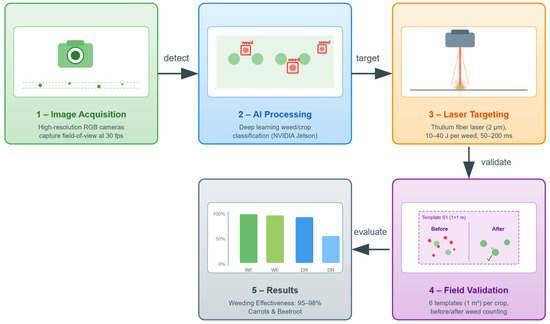
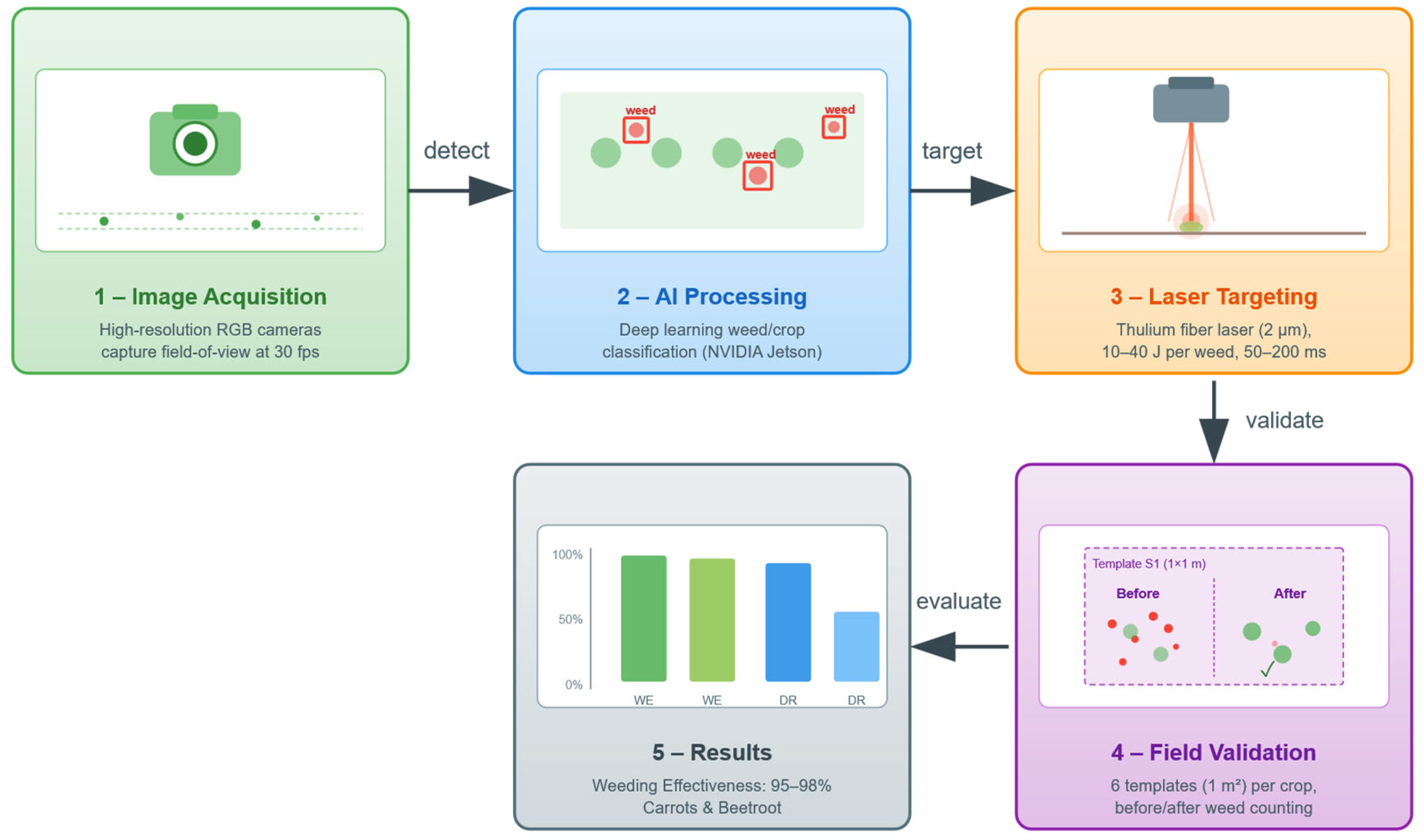
To provide a clear overview of the study’s framework, the entire workflow—from image acquisition and AI processing to laser targeting and field validation—is visualized in the graphical abstract in Figure 1.
Figure 1.
Graphical abstract illustrating the autonomous laser weeding system workflow and the field validation process.
2. Materials and Methods
2.1. Laser Weeding System and Robotic Platform
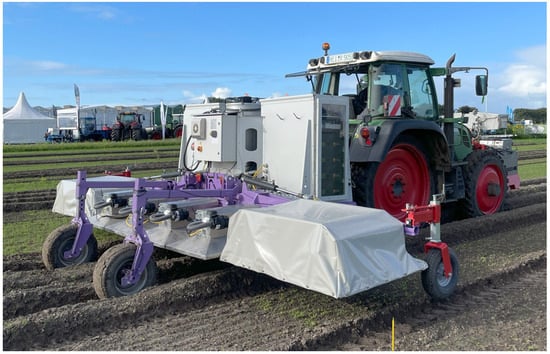
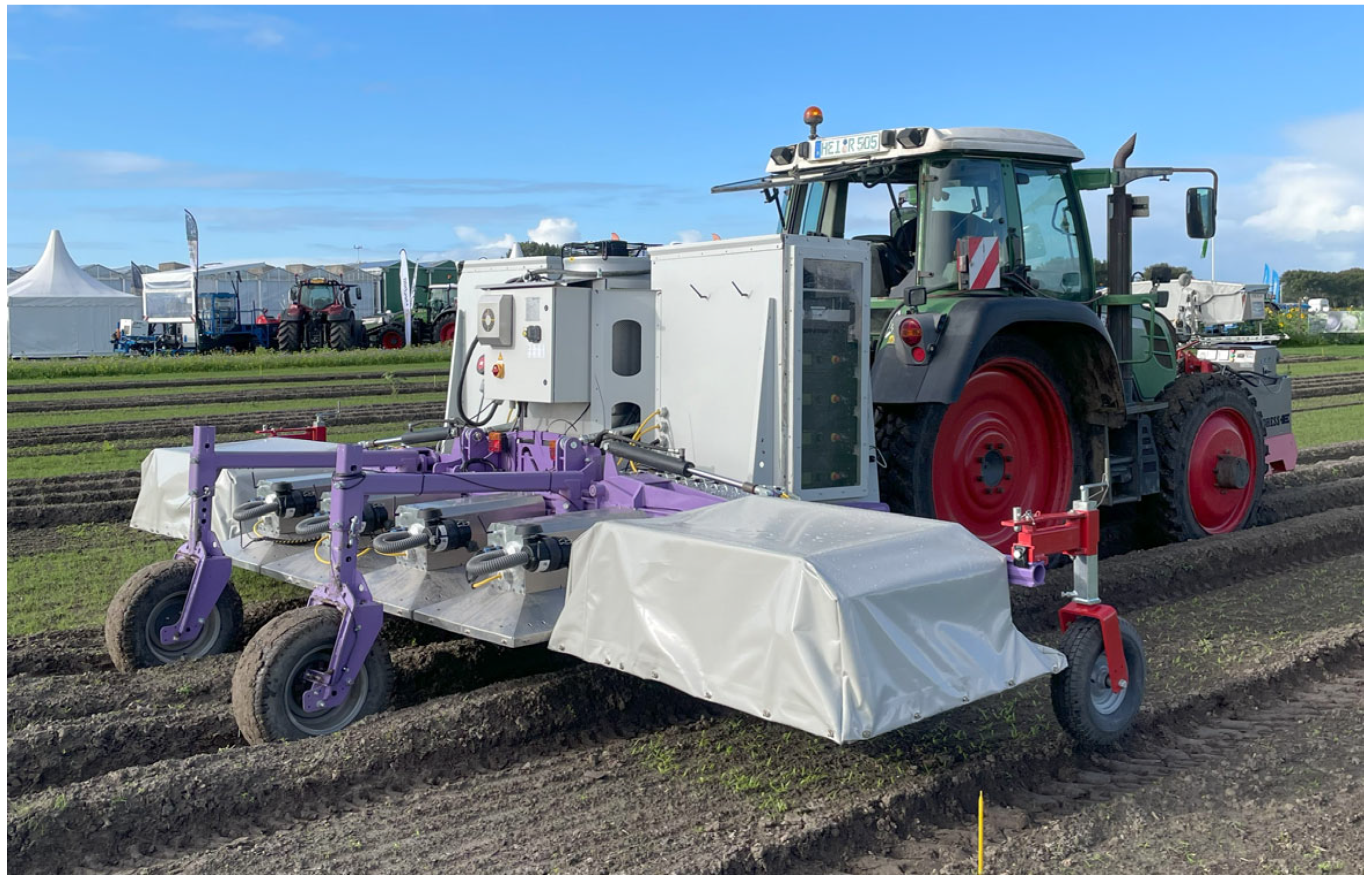
The field trials were conducted using the autonomous field robot system from Naiture GmbH & Co. KG, Friedrichsgabekoog, Germany, which is illustrated in Figure 2. The figure shows the robot system on carrot test fields in Warmenhuizen during the Bejo Open Days 2025, Warmenhuizen, Netherlands [23]. From 23–26 September 2025, Bejo held its annual Open Days in Warmenhuizen, Netherlands. Here, vegetable growers and partners from all over the world were able to discover the latest varieties and innovations. Over 800 participants registered for the event. Naiture took part in the daily demonstrations of weed robots from September 23 to 25 and successfully demonstrated the laser-based weeding robot on beetroot and carrots.
Figure 2.
Demonstration of the Naiture multi-track robot weeding system on carrot test fields in Warmenhuizen during the Bejo Open Days 2025 Warmenhuizen, Netherlands.
The weeding robot system is based on a combination of optical image recognition, artificial intelligence (AI) and high-precision laser technology. The aim is to selectively and efficiently remove weeds within the rows of plants without damaging the crops or mechanically disturbing the soil. Each of the eight weeding units is equipped with a camera and a powerful 200-watt fibre laser. While driving, the cameras capture the plant image in real time. The data is transmitted to a central AI module, which analyses the images captured. This involves precise classification of weeds and crops based on spectral and structural characteristics. The AI uses machine learning and is able to adapt to different crops (e.g., carrots, spinach, beetroot) and growth stages. Knoll et al. [24] developed an AI-based recognition system capable of distinguishing weeds from crops in real-time, facilitating targeted laser application. Our system incorporates similar AI technologies, achieving real-time weed detection up to 30 FPS and precise laser targeting at processing speeds up to 200 cm/s. Lightweight deep learning architectures for real-time deployment on embedded systems in commercial laser weeding robots have been investigated by Fatima et al. [25]. As soon as a weed is detected, the system calculates its exact position and activates the corresponding laser beam with pinpoint accuracy. The laser generates a high energy density that destroys the cell structures of the weed—typically at the plant’s growth core. The duration of the laser pulse and its intensity are adaptively adjusted to the plant species and its growth stage.
To provide the necessary context for interpreting the field validation results, the key engineering aspects of the system are summarized below; for complete technical details including hardware schematics, communication protocols, and software implementation, the reader is referred to [26].
Each of the eight modular weeding units is mounted in a fixed linear arrangement spanning the robot’s full working width, with each unit centered above one crop row at a working distance of approximately 40 cm above the soil surface. Within each unit, the RGB camera and the laser module with its scan head are mounted separately. The geometric relationship between camera and laser coordinate systems is established through a two-point affine calibration using the integrated visible pilot laser [26]. This calibration is performed once during system installation and remains stable during operation due to the rigid mechanical coupling of the components.
The camera’s field of view covers approximately 21 cm × 21 cm at the 40 cm working height, capturing the full intra-row area (12 cm width) with sufficient margin. Images are acquired continuously at 30 frames per second during operation. For each frame, the CNN performs real-time classification of all visible plant objects as either ‘crop’ or ‘weed’. The laser is activated exclusively for objects classified as ‘weed’; no continuous or pre-emptive irradiation takes place. Crop safety is ensured through multiple complementary mechanisms. First, the laser is activated exclusively when the CNN classifies an object as ‘weed’ with a confidence score above the operational threshold; objects with ambiguous classification are not treated. Second, the system applies a spatial exclusion zone around all detected crop plant positions: even if a weed bounding box partially overlaps with a crop, the laser spiral is constrained to avoid the crop area. Third, the laser power is limited to the adaptively calculated dose (10–40 J), which is sufficient to damage small weed tissue but causes only a superficial, localized burn on larger crop leaves in the unlikely event of a misclassification. One such misclassification event was observed during the beetroot trials, where the laser struck a crop leaf with no visible effect on subsequent plant growth. Regarding targeting accuracy under field conditions, the rigid mechanical coupling between camera, scan head, and mounting frame preserves the factory calibration during operation. The positional accuracy of ±1 mm validated in laboratory tests [26] is maintained in the field because the working height (40 cm) remains approximately constant due to the trapezoidal dam structure of the crop rows. Variations in terrain are absorbed by the robot’s suspension system, keeping the weeding units at a stable height relative to the ridge surface.
Once a weed is positively identified, the system calculates the target coordinates from the bounding box using the calibrated affine transformation [26]. The laser beam is then directed to the target by a galvanometer-based scan head with two orthogonal mirrors, which enables rapid two-dimensional positioning across the working area. The laser delivers energy in a spiral irradiation pattern centered on the weed’s bounding box. A tracking algorithm associates bounding boxes across consecutive frames to prevent re-processing of already treated weeds, as described in [26].
To summarize, the operational workflow from weed detection to laser targeting proceeds in five sequential steps for each camera frame: (1) Image Acquisition—the RGB camera captures a frame of the crop row at 30 Hz. (2) CNN Inference—the deep learning model classifies all plant objects in the frame as ‘crop’ or ‘weed’ and generates bounding boxes around identified weeds. (3) Tracking—a frame-to-frame tracking algorithm matches new detections with previously identified weeds to prevent redundant treatments and prioritizes untreated weeds closest to leaving the field of view. (4) Coordinate Transformation—the bounding box center of the highest-priority untreated weed is converted from image pixel coordinates to galvanometer scanner coordinates using the pre-calibrated affine transformation. (5) Laser Actuation—the galvanometer directs the laser beam to the target position and executes a spiral irradiation pattern with an adaptively calculated exposure time. This entire cycle is completed within a single frame interval (<33.3 ms), enabling continuous operation without interrupting the image acquisition pipeline.
The end-to-end latency from image capture to laser activation is less than 33.3 ms per frame at the 30 Hz capture rate [26]. Positional accuracy of the laser targeting was validated at ±1 mm under laboratory conditions [26]. The robot travel speed during the 2025 field trials reported in this study was approximately 0.5 km/h.
The laser used per weeding unit is a high-power Class 4 laser with an invisible infrared beam in the range of 1930–2050 nm. This wavelength is ideal for the precise thermal destruction of plant cell nuclei without affecting adjacent crops. The laser unit is characterized by a high beam quality (M2 < 1.2) and a long-term emission stability (<3%). The output power is 200 watts and can be transmitted up to 10 m via an optical fiber cable. The laser unit includes a water cooling system with an operating temperature range of 16–22 °C. It also has a pilot laser for positioning.
To evaluate the system’s energy efficiency, the specific energy delivered to each weed was monitored. With a continuous wave output power of 200 W, the pulse duration was adaptively adjusted linearly between 50 ms (for cotyledon stages, approx. 3–10 mm) and 200 ms (for larger weeds > 5 cm). Consequently, the applied energy per weed ranged from 10 J to 40 J. This adaptive energy input ensures sufficient heating of the meristematic tissue to >60 °C for lethal damage while optimizing processing speed.
The adaptive exposure time range was determined through a combination of literature-derived energy thresholds and experimental optimization with the 200 W laser system. Marx et al. [9] established the lethal energy requirement for dicotyledonous weeds at the cotyledon stage at approximately 25–50 J using a focused beam of 1.5 mm diameter. Based on these reference values, preliminary field tests were conducted with the 200 W Thulium fiber laser to identify the minimum exposure time that reliably achieved lethal damage across the observed weed species (predominantly Chenopodium album and Stellaria media). The resulting operational range of 50–200 ms (corresponding to 10–40 J at 200 W continuous wave output) was found to provide consistent weed destruction from the cotyledon stage up to the 4-leaf stage, while the spiral irradiation pattern distributes the energy across the full area of the weed’s bounding box.
The remaining key operational parameters were selected based on the following considerations. The robot travel speed of 0.5 km/h was determined by the requirement that every weed within the camera’s field of view must be detected and treated before the robot advances beyond it. At 30 Hz frame rate and a field-of-view height of 21 cm in the direction of travel, the system captures approximately 45 overlapping frames per 21 cm section (0.5 km/h ≈ 13.9 cm/s; at 30 FPS, this yields one frame every 4.6 mm of travel), providing sufficient redundancy for reliable detection and tracking. The working height of 40 cm above the soil surface was chosen as a trade-off between the scan head’s angular range and the resulting spot size: at this distance, the galvanometer achieves a working area of 21 cm × 21 cm that fully covers the 12 cm dam width, while maintaining a beam diameter of approximately 2 mm at the target surface. Increasing the working height would enlarge the covered area but reduce energy density per unit area, requiring longer exposure times.
2.2. Experimental Setup
The following procedure for determining the success of weeding was discussed and agreed upon:
Template locations were intentionally placed in areas with clearly visible weed pressure to ensure that the system was tested under high-demand conditions, providing a ‘stress test’ for the detection and actuation capabilities. We acknowledge that this deliberate selection biases the results and that system performance under average or low weed pressure conditions remains to be validated; however, it ensures that the system is tested under relevant commercial conditions. Regarding the initial field conditions, the crops were cultivated according to standard organic farming guidelines. Prior to the laser trials, the fields underwent standard pre-emergence thermal treatment (flaming) to reduce the initial weed bank, followed by mechanical inter-row hoeing. Consequently, the robotic system targeted the remaining intra-row weed population. The weed community present in the trial fields was typical for the marshland region of Schleswig-Holstein (young marine clay soils). The dominant species observed included Chenopodium album (common lambsquarters), Stellaria media (chickweed), and Polygonum spp. (knotgrass), with the majority being dicotyledonous weeds in the cotyledon to 2-leaf stage at the time of treatment. However, a formal botanical survey with species-level identification and quantification was not conducted. Soil conditions were typical for the marshland region (young marine clay), characterized by high water retention.
The crop rows follow a ridge culture with a trapezoidal dam structure (12 cm top width, 15 cm height, 75 cm row spacing), as described in detail in [26].
At least six measuring templates are placed at different locations in these selected fields. Locations were selected where weeds were most visible. The templates are considered observation subunits and are evaluated together per field. The opening of the templates on the carrot bed must be narrow enough that the camera used can see a border on both sides of the image. A reference measuring tape is attached to the templates.
An initial destruction run is carried out. The camera’s video stream is stored in the template area. In addition, the destruction area is recorded with another camera.
One day (approx. 24 h) after the destruction run, the monitored field section is recorded again with a camera and, if possible, also with a drone for testing purposes.
From then on, the field section is recorded every 3 days, weather permitting.
It must be noted that the six measurement templates per crop are observational sub-units within a single field and do not constitute independent experimental replicates. The reported Mean ± SD (n = 6) therefore reflects intra-field spatial heterogeneity rather than true experimental variability across different fields, soil types, or seasons.
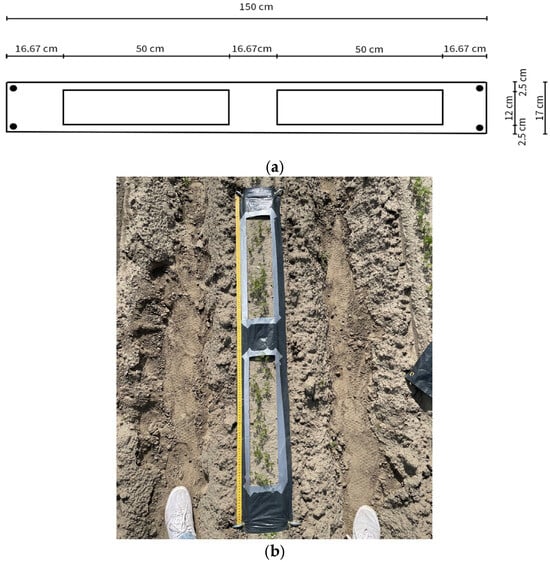
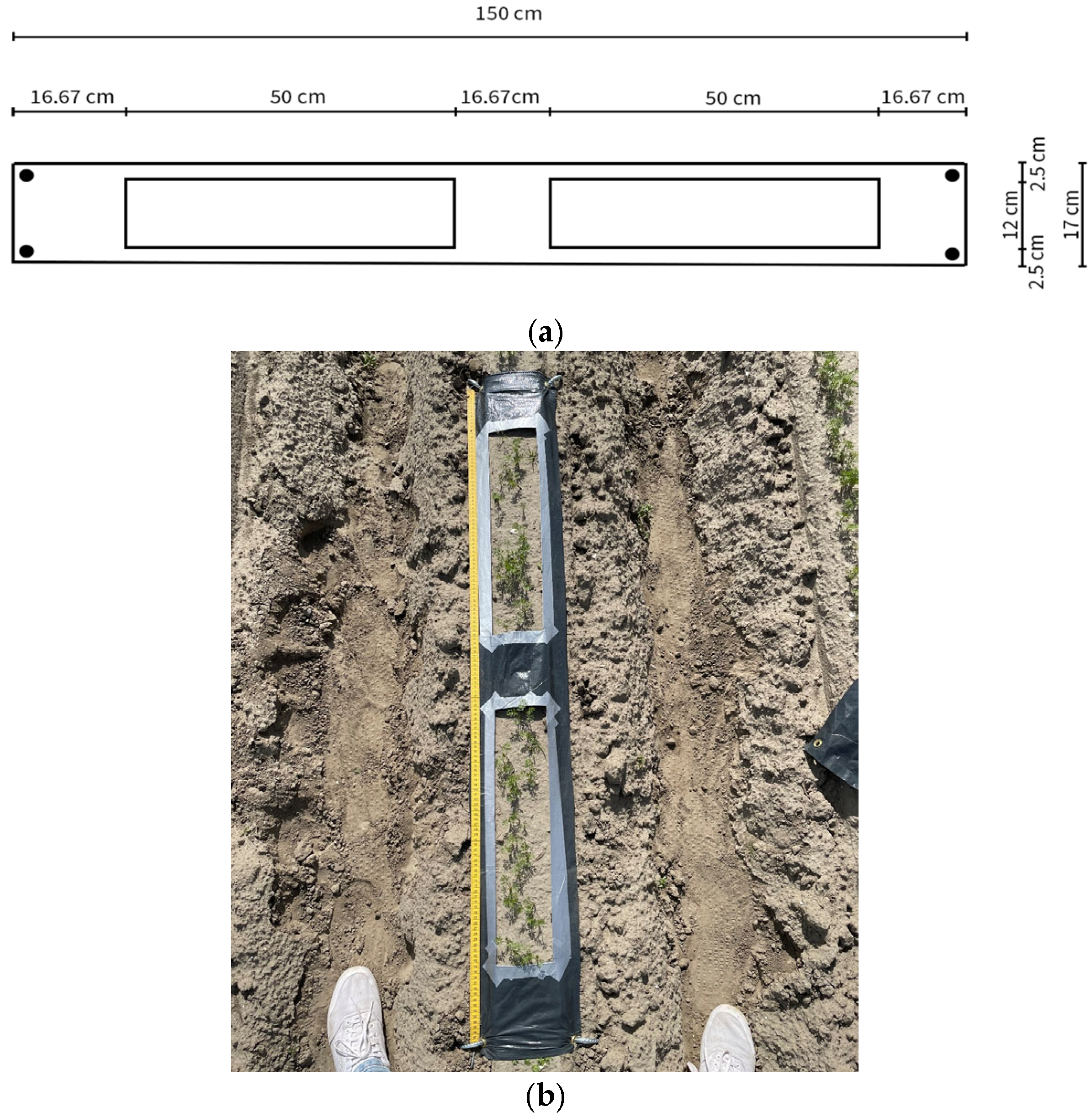
Figure 3 shows the dimensions of the templates created and the actual implementation of the template on the field.
Figure 3.
(a) Dimensions of the templates created and (b) template fixed to the field.
2.3. Measurement Methods and Data Normalisation
As illustrated in Figure 3, the field data was recorded using defined measurement templates placed centered on the crop row. To ensure reproducibility and normalize the absolute counts presented in the results, the specific dimensions and initial weed densities were defined as follows:
- Template Dimensions: Each evaluation window covered a length of 1.5 m and a width of 0.12 m, representing the relevant intra-row area.
- Initial Weed Density: Based on the raw counts, the initial weed pressure was approximately 25 weeds m−1 for carrots and 60 weeds m−1 for beetroot.
To prevent counting ambiguities, a binary tracking method was applied: each weed was indexed as a unique object. In the multi-cycle beetroot trial, weeds surviving the first pass were re-indexed as targets for the second pass, ensuring that the Cumulative Effectiveness metric reflects the true reduction relative to the initial population.
The following classes were defined for calculating the Weeding Success of the multi-track robot weeding system after only one weeding cycle:
- Success WC1 (SWC1): Weeds have been completely destroyed.
- Damage WC1 (DWC1): Weeds have been damaged but not completely destroyed.
- Failure WC1 (FWC1): Weeds have recovered despite laser treatment.
- Undetected WC1 (UWC1): Weeds were not detected by the AI and therefore not hit by the laser.
- New Emergence WC1 (RWC1): Weeds have sprouted again after being weeded by the weeding robot.
- Hit WC1 (HWC1): Weeds were hit by the laser.
- The calculation of the Weeding Success (WS) of the weeding robot for the First Weeding Cycle (WC1) can now be calculated as follows:
To provide a rigorous evaluation of the robotic system, we define indicators that distinguish between the performance of the physical destruction unit (actuation) and the overall agronomic outcome (system performance). This separation of detection accuracy from removal efficiency is consistent with methodologies proposed in robotic weeding literature [27].
First, we define Weeding Success (WS) (often referred to as Lethality or Actuator Efficacy). This metric evaluates the laser’s capability to inflict lethal damage on a targeted weed. Consequently, it excludes:
- Undetected weeds (UWC): These represent a computer vision failure, not a laser hardware failure. Including them would conflate AI performance with laser efficacy.
- New Emergence: Weeds that germinate after the treatment pass are environmental factors independent of the laser’s performance during the pass.
Therefore, Weeding Success (WS) for the first cycle is calculated as the ratio of effectively treated weeds to the total number of targeted weeds:
The Undetected class is not included in the calculation of the Weeding Success, as this is related to the recognition AI. The AI performance for carrots has already been calculated independently using a representative test data set that is significantly larger than the test areas specified here. A more detailed description of the carrot dataset and the principal structure of the recognition AI can be found in [26,28]. For the actual recognition AI, a mean average precision (mAP) of 98.5% was achieved with an intersection over union (IoU) range of 50–95%. The mAP value of 0.50:0.95 is almost 100% and speaks for the high performance of the AI recognition unit. These values are reached for small weeds approximately 4 weeks after sowing. They can be improved by providing the AI with even more representative data for training. This must be done continuously over future weed control cycles.
The New Emergence class is also not taken into account when calculating the Weeding Success of the multi-track robot weeding system, as these weeds have sprouted after the weeding robot has completed its weeding process. The robot cannot destroy what does not exist at this point in time. These weeds can only be detected if the weeding robot passes over the areas several times.
Second, from an agronomic perspective, the farmer is interested in the total reduction of weed pressure. We define this as Weeding Effectiveness (WE). This metric accounts for all system limitations, including AI false negatives (Undetected) and recovery of treated plants (Failure). It can be calculated for the First Weeding Cycle (WC1) as follows:
Another important value is the Detection Rate (DR) of the recognition AI. This is calculated as follows for the first weeding cycle:
In addition to the standard Detection Rate (DR), we define a supplementary metric, the Corrected Detection Rate (DR_corr), which excludes weeds that were undetectable due to (a) physical occlusion by crop canopy (Undetected_covered) and (b) mechanical misalignment between the weeding unit and the measurement template (Undetected_align). This metric is reported separately to isolate the AI’s intrinsic recognition capability from extrinsic operational factors. It is explicitly not used in the calculation of Weeding Effectiveness.
When a second weeding cycle is carried out the main aim is to reduce the Failure, New Emergence and Undetected classes from the first weeding cycle. This improves weeding success and weeding effectiveness. The formulas for Weeding Success and Weeding Effectiveness given in (1) and (2) must therefore be expanded to include the following categories due to the Second Weeding Cycle (WC2):
- Success WC2 (SWC2): New weeds that emerged after the evaluation of the first weeding cycle was completed were completely destroyed in the second weeding cycle. These are not weeds from the new growth class from the observation period of the first weeding cycle.
- Damage WC2 (DWC2): New weeds that emerged after the evaluation of the first weeding cycle was completed were damaged in the second weeding cycle, but not completely destroyed. These are not weeds from the new growth class from the observation period of the first weeding cycle.
- Failure WC2 (FWC2): New weeds that emerged after the evaluation of the first weeding cycle was completed recovered in the second weeding cycle despite the laser treatment. These are not weeds from the new growth class from the observation period of the first weeding cycle.
- Undetected WC2 (UWC2): New weeds that emerged after the evaluation of the first weeding cycle was completed were not detected by the AI in the second weeding cycle and were therefore not hit by the laser. These are not weeds from the new growth class from the observation period of the first weeding cycle.
- New Emergence WC2 (RWC2): New weeds have sprouted after the second weeding process by the weeding robot.
- Failure WC1 destroyed (FWC1D): The weeds from the Failure class from the first weeding cycle were destroyed during the second weeding cycle.
- Undetected WC1 destroyed (UWC1D): The weeds from the Undetected class from the first weeding cycle were destroyed during the second weeding cycle.
- New Emergence WC1 destroyed (RWC1D): The weeds from the New Emegernce class from the first weeding cycle were destroyed during the second weeding cycle.
The calculation of the Weeding Success (WS) over both weeding cycles of the weeding robot must therefore be adjusted as follows and is now calculated as follows:
The Undetected classes are again not included in the calculation of the overall Weeding Success, as this is related to the recognition AI. In 2025, a second weeding cycle was carried out for beetroot. For the actual recognition AI for beetroot, a mean average precision (mAP) of only 75% was achieved with an intersection over union (IoU) range of 50–95%. The reason for this was that the beetroot AI was trained for the first time in 2025. This value can therefore be significantly improved if more representative data is provided to the AI for training. This must be done continuously over future weeding cycles.
The New Emergence classes are again not included in the calculation of the overall Weeding Success. Weeds that emerge after a weeding cycle of the weeding robot system cannot be destroyed by the robot, as the weeds did not exist at this point in time. These weeds can only be detected if the weeding robot were to perform a third weeding cycle.
The calculation of Weeding Effectiveness (WE) over both weeding cycles must also be adjusted and is now calculated as follows:
The calculation of the Detection Rate does not change. However, this value is calculated separately for each weeding cycle.
3. Experimental Results and Performance Evaluation
3.1. Experimental Results of the Overall Weeding System for One Weeding Cycle
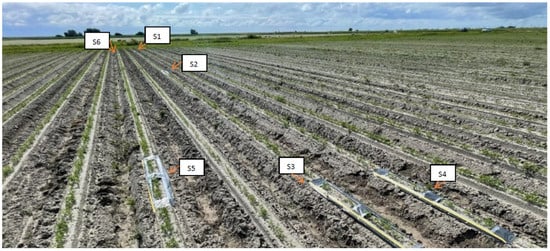
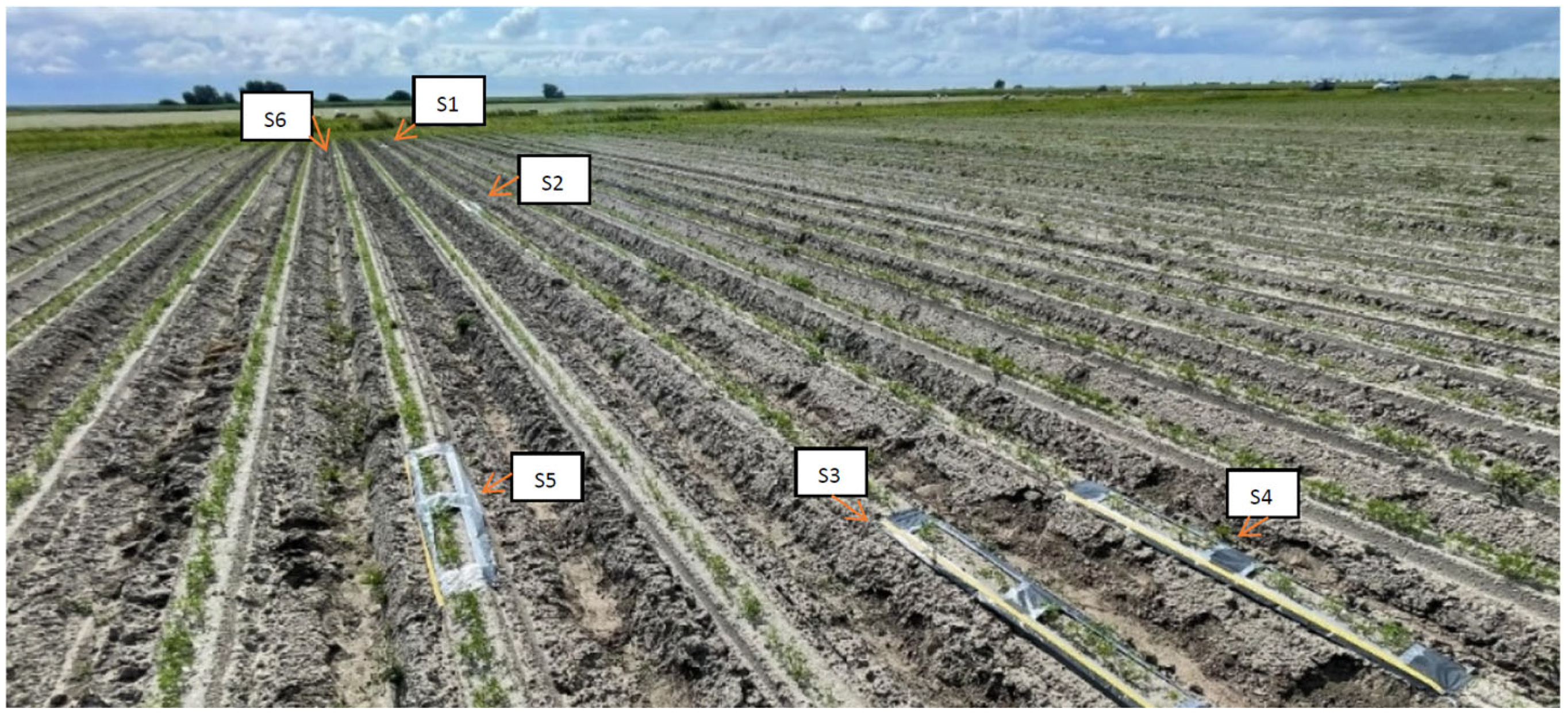
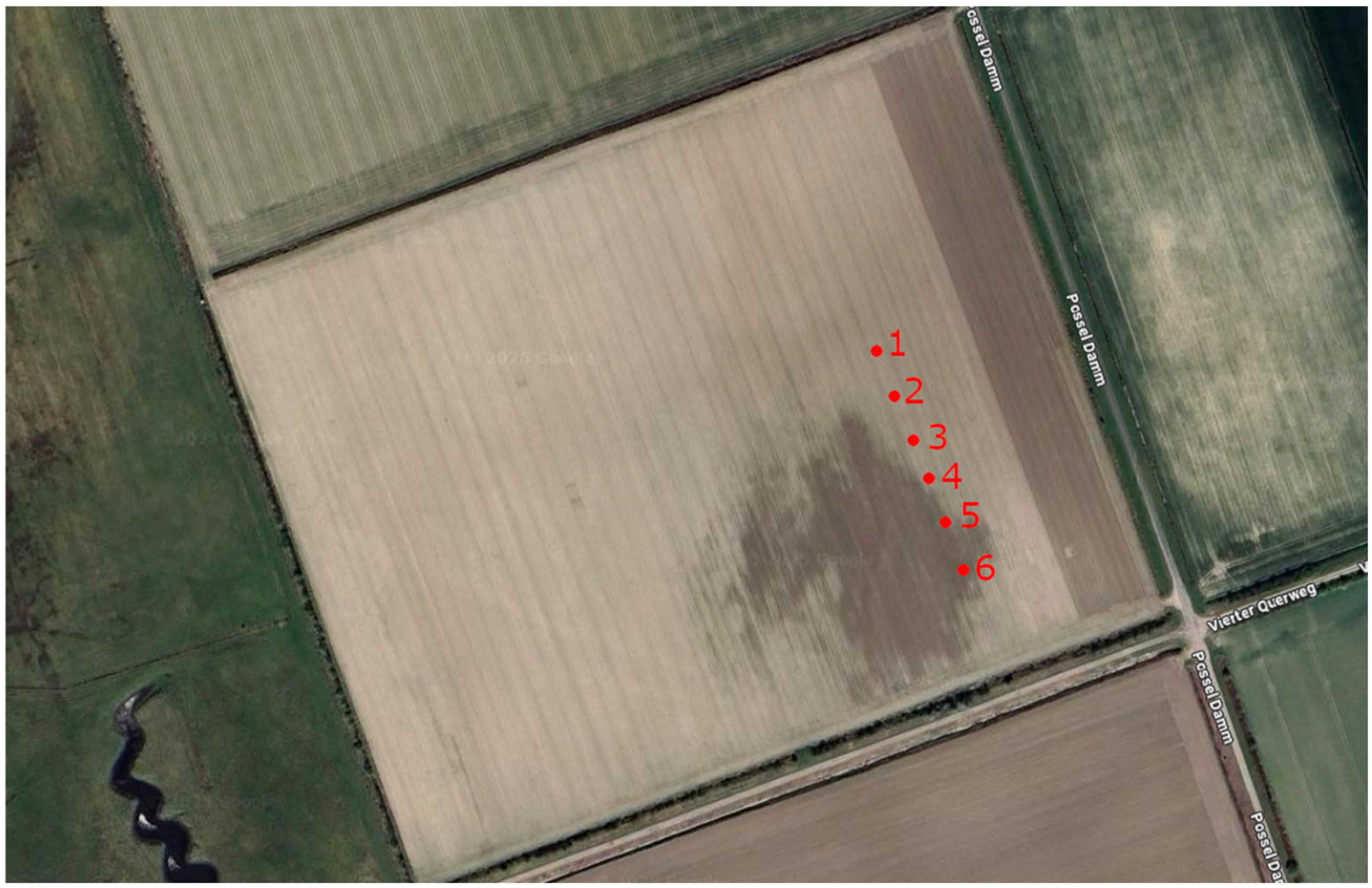
The robot’s performance for one weeding cycle was evaluated in 2025 on a carrot field belonging to Westhof Bio GmbH in Friedrichsgabekoog, Germany. Figure 4 shows the various locations where the templates were attached to the carrot field. This ensures that the images can be assigned to the corresponding templates. In addition, the templates are numbered, which makes the assignment considerably easier.
Figure 4.
Attachment locations of templates S1–S6 on the carrot field of the Westhof Bio GmbH.
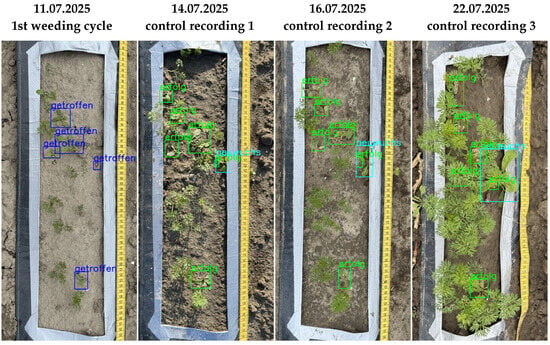
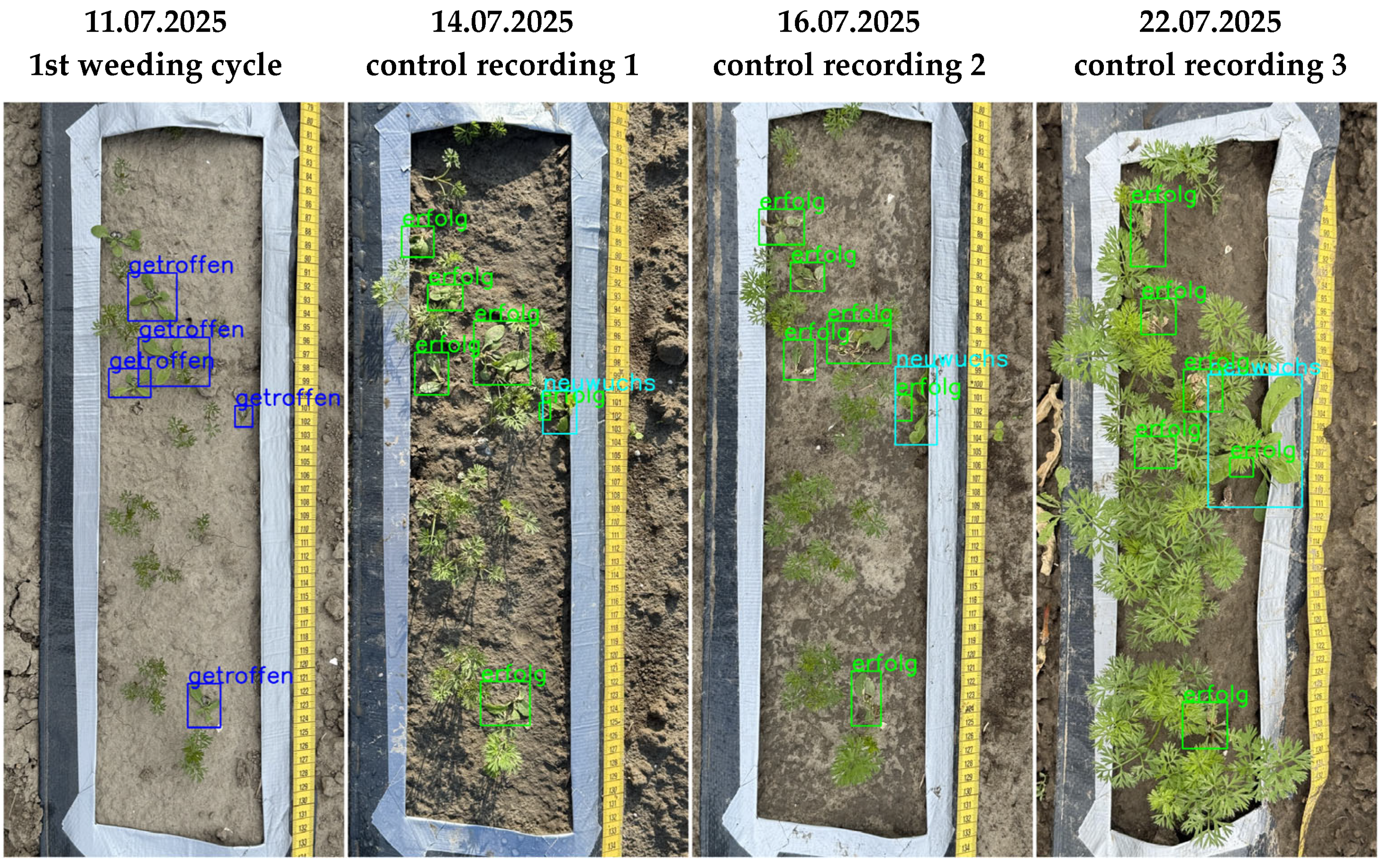
Weeding was carried out with the weeding robot on 11 July 2025. On this day, the Detection Rate of the recognition AI was calculated using Equation (3). Subsequently, on 14 July 2025, 16 July 2025 and 22 July 2025, images of the template areas were taken. This allows the weeding success of the weeding robot to be tracked and analysed for the specified days. However, only the result on 22 July 2025 is used to calculate the Weeding Success (see Equation (1)) and the Weeding Effectiveness (see Equation (2)) of the weeding robot. Figure 5 shows an example of the measurement results over 11 days for the upper measurement window of the first template S1.
Figure 5.
View of the upper measurement window of the first template S1 over a period of 11 days.
As shown in Figure 5, the entries in the individual classes were marked and counted manually by two people independently of each other. The two results were then checked for consistency by both people together.
3.2. Experimental Results of the Overall Weeding System for Two Weeding Cycles
The robot’s performance for two weeding cycles was also evaluated in 2025. This time, however, it was on a beetroot field belonging to Westhof Bio GmbH in Friedrichs-gabekoog, Germany. Figure 6 shows the various locations where the templates were placed on the beetroot field. This ensures once again that the images can be assigned to the corresponding templates.
Figure 6.
Attachment locations of templates S1–S6 on the beetroot field of the Westhof Bio GmbH.
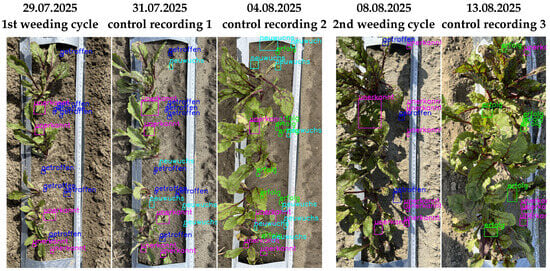
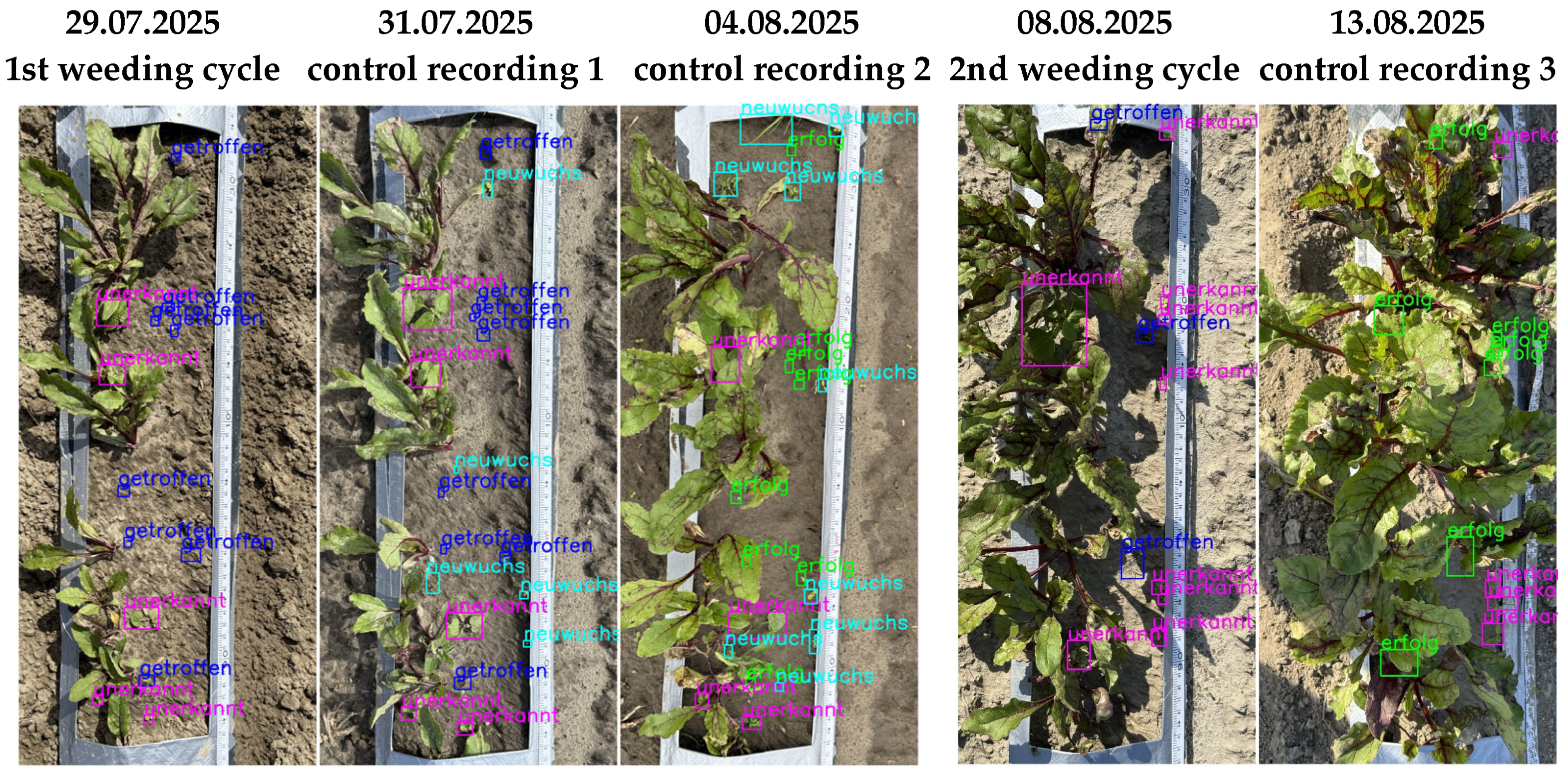
Weeding was carried out with the weeding robot for the first time on 29 July 2025. On this day, the Detection Rate of the recognition AI was calculated using Equation (3). Subsequently, on 31 July 2025 and 4 August 2025, new images of the template areas were taken. On 8 August 2025, weeding was carried out a second time to test how the weeding success changes with repeated weeding. The Detection Rate of the recognition AI was calculated once again on this day using Equation (3). The control images were then taken on 13 August 2025. Only the results from 4 August 2025 and 13 August 2025 are used to calculate the Weeding Success and the Weeding Effectiveness of the weeding robot using Equations (4) and (5), respectively. The results on the 4 August 2025 represent an interim result and those on the 13 August 2025 represent the final result of the weeding performance. Figure 7 shows an example of the measurement results over 16 days for the upper measurement window of the first template S1.
Figure 7.
View of the upper measurement window of the first template S1 over a period of 16 days.
As shown in Figure 7, the entries in the individual classes were again marked and counted manually by two people independently of each other. The two results were then checked for consistency by both people together.
3.3. Detection Rate
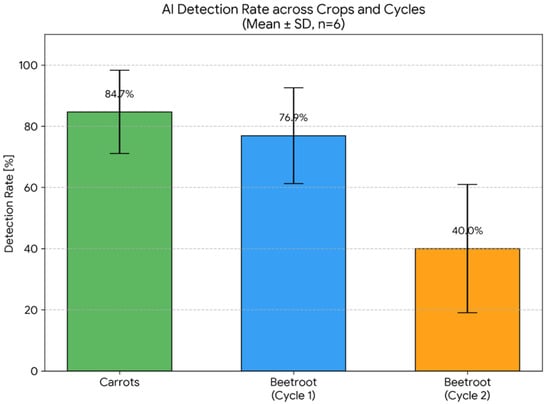
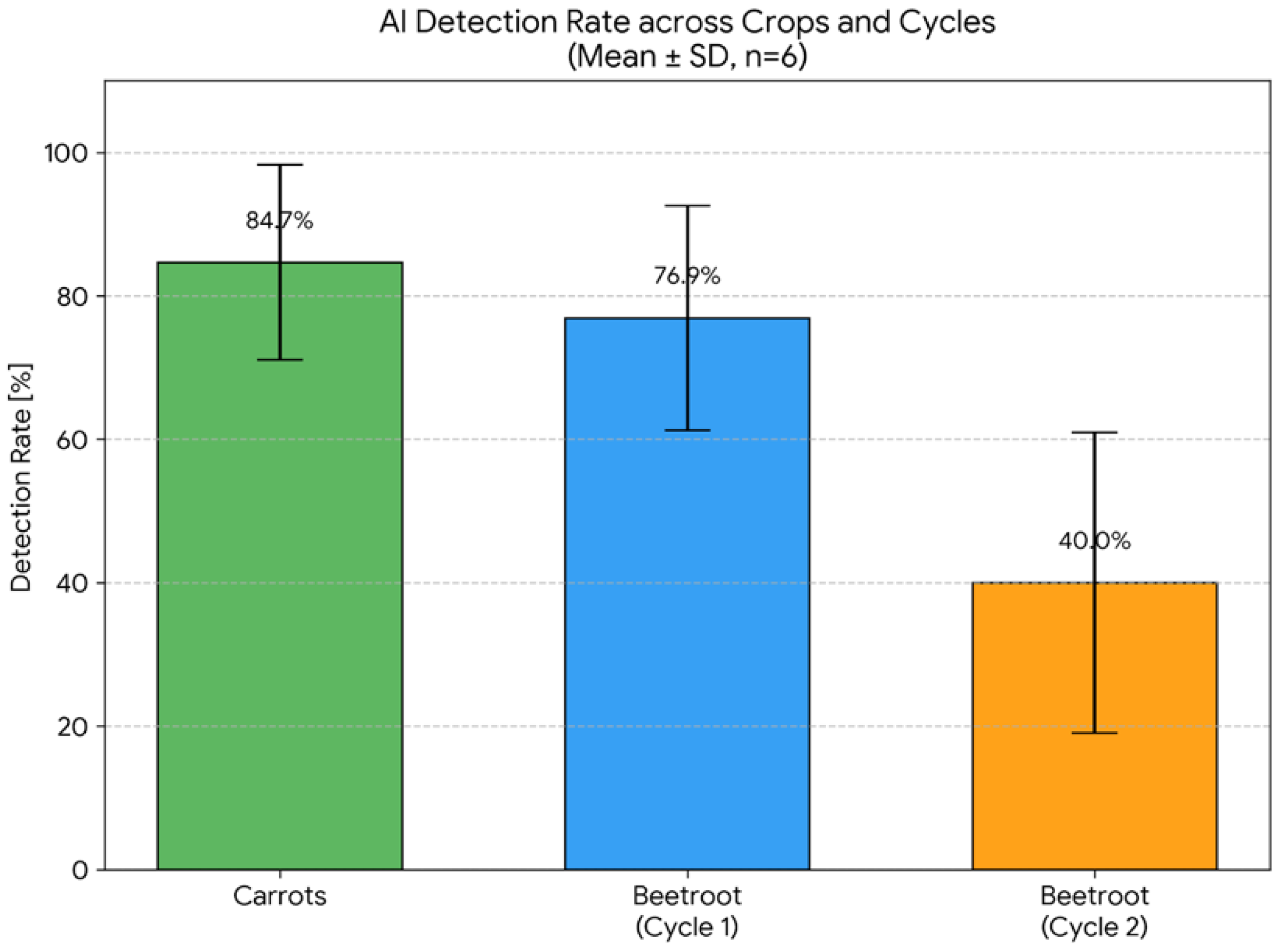
The performance of the deep learning model varied significantly depending on the crop type and growth stage, as illustrated in Figure 8.
Figure 8.
AI Detection Rate across different crops and weeding cycles. The data represents the mean value of n = 6 measurement templates per trial; error bars indicate the standard deviation (±SD). The significant drop in performance during the second beetroot cycle is attributed to canopy occlusion preventing visual detection.
In the carrot trials, the system achieved a mean Detection Rate of 84.7 ± 13.6% (mean ± SD). The relatively high standard deviation indicates spatial heterogeneity in detection performance across the field. Analysis of the individual templates revealed that false negatives were primarily caused by the small size of the weeds (cotyledon stage) combined with irregular soil texture and shadowing effects, which occasionally obscured the target features.
In the beetroot trials, a distinct performance decline was observed as the crop developed. In the first cycle (early growth stage), the Detection Rate was 76.9 ± 15.7%, comparable to the carrot trials. However, in the second cycle (later growth stage), the mean Detection Rate dropped significantly to 40.0 ± 20.9%. This substantial reduction and high variability are attributed to the onset of canopy closure. As the beetroot leaves expanded, they created a “canopy occlusion” effect, physically covering the smaller intra-row weeds. The top-down 2D camera perspective was unable to resolve these occluded targets, leading to a high number of “Undetected_covered” instances in the raw data. This result highlights a critical limitation of single-perspective 2D imaging in advanced growth stages.
3.4. Weeding Performance
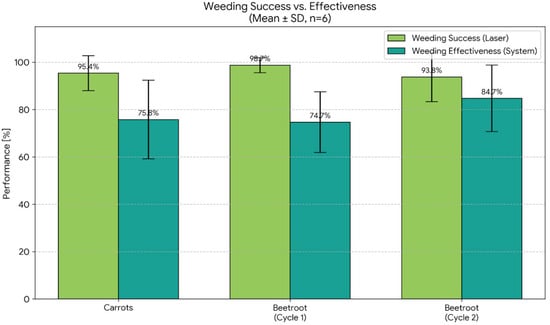
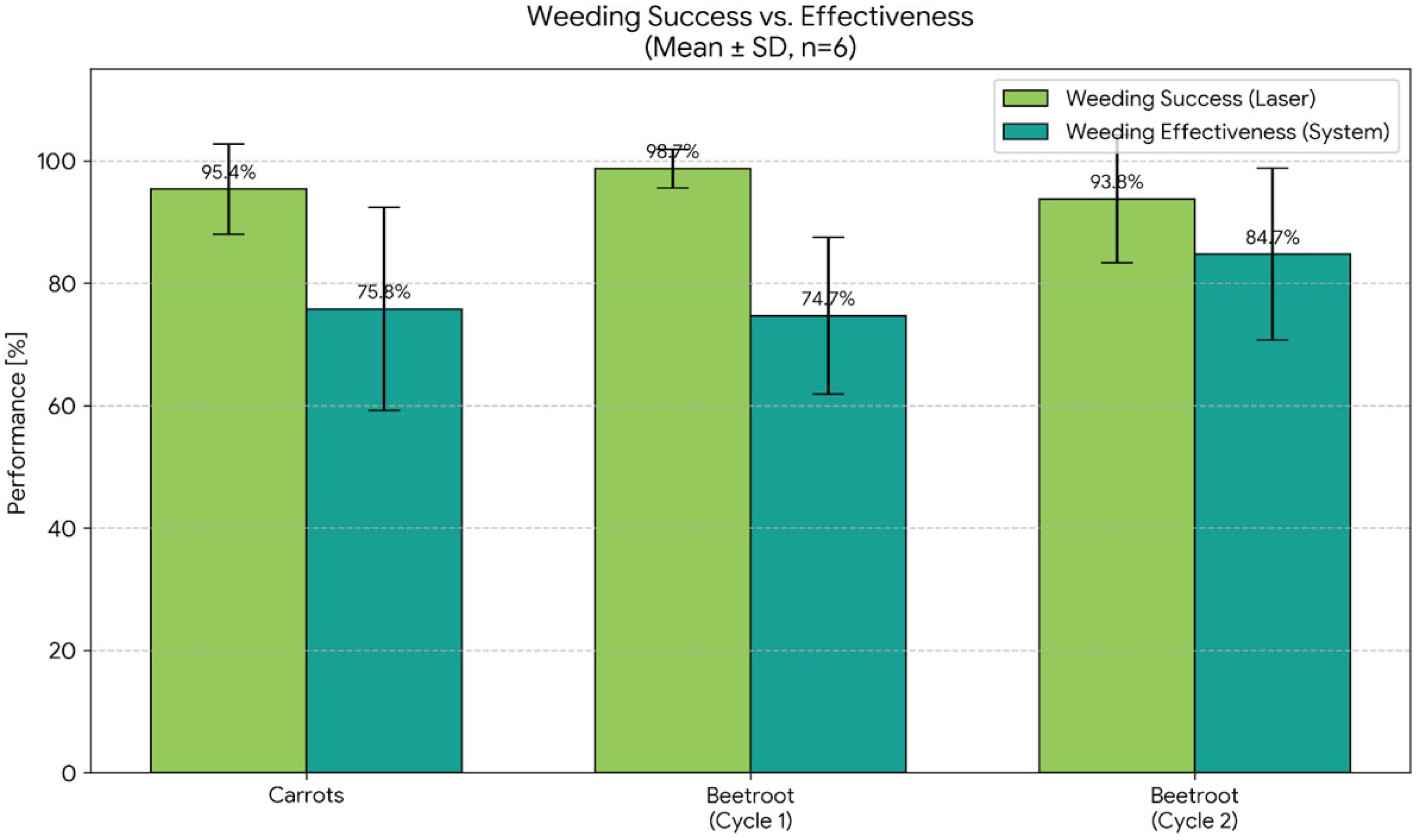
The weeding performance was evaluated using two distinct metrics: Weeding Success (WS), reflecting the laser’s physical lethality on targeted weeds, and Weeding Effectiveness (WE), reflecting the overall agronomic reduction of weed pressure seen in Figure 9.
Figure 9.
Comparative analysis of Weeding Success (WS) and Weeding Effectiveness (WE) across the field trials. Weeding Success measures the physical lethality of the laser on targeted weeds, while Weeding Effectiveness reflects the overall agronomic outcome, accounting for undetected weeds and new emergence. Error bars represent the standard deviation (±SD, n = 6).
Carrots: The system demonstrated high reliability in laser targeting, achieving a Weeding Success of 95.4 ± 7.4%. This confirms that once a weed is detected and targeted, the laser energy is sufficient to induce lethal damage in the vast majority of cases. However, the overall Weeding Effectiveness was limited to 75.8 ± 16.6%, primarily driven by the fraction of undetected weeds described in Section 3.1.
Beetroot: In the first cycle, the system achieved its highest physical performance with a Weeding Success of 98.7 ± 3.1%, indicating near-perfect lethality on the identified targets. The Weeding Effectiveness for this cycle was 74.7 ± 12.8%. In the second cycle, despite the poor detection rate caused by canopy occlusion, the laser remained highly effective on the weeds that were found, achieving a Weeding Success of 93.8 ± 10.5%. Most importantly, the cumulative strategy of two passes proved beneficial. By combining the removal from the first and second cycles, the cumulative Weeding Effectiveness for the beetroot crop reached 84.7 ± 14.0%. This demonstrates that while individual late-stage passes may suffer from occlusion, a multi-pass strategy can compensate for these limitations to achieve agronomically acceptable weed control levels.
4. Discussion and Future Work
The results of the field trials in 2025 are convincing. The Weeding Success rate of the laser weeding robot was 95% for carrots for one weeding cycle. However, it is also clear that the Detection Rate for carrots of 85% is not yet ideal, but this can be improved with more data acquired and a perfect alignment between destruction unit and the measuring template. Overall, the Weeding Effectiveness for carrots is 74%. This value can also be increased, for example, by weeding more than once to reduce regrowth of the carrots as demonstrated by the beetroot field. A higher detection rate would also directly increase Weeding Effectiveness.
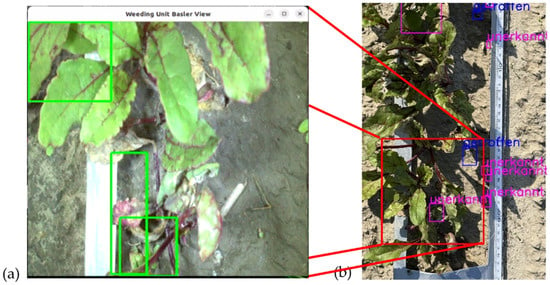
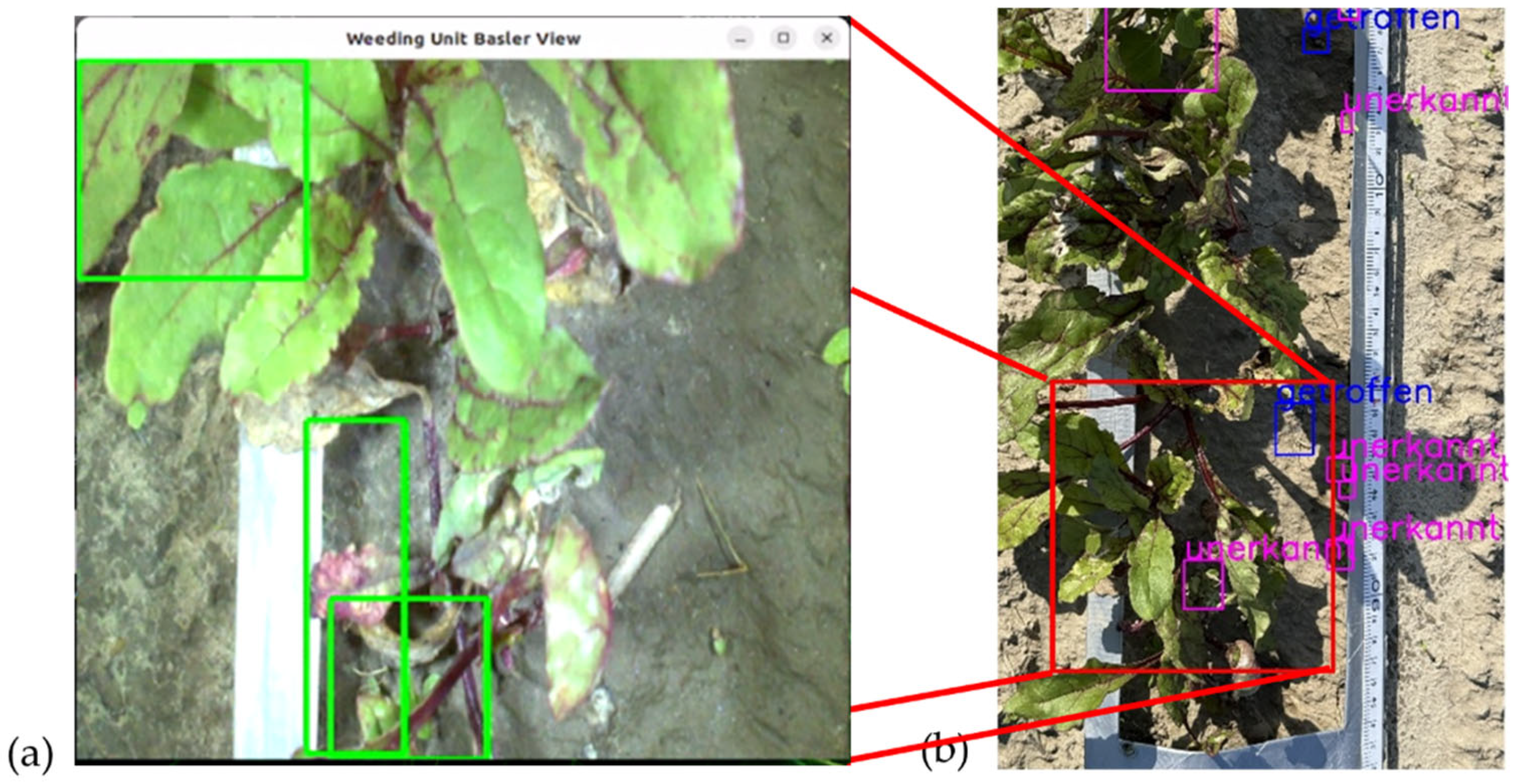
Two weeding cycles were carried out for the first time on beetroot. It was found that during the second weeding process, the Detection Rate was significantly worse (deterioration from 73% in the first weeding cycle to 41% in the second weeding cycle), as the plants were already quite large and partially covered or shaded the weeds. This prevents weeds from growing, as they no longer receive sunlight and therefore do not interfere with the growth of the plant. The Detection Rate was also not as high due to the suboptimal alignment between the destruction unit and the measuring template. This can have several causes, such as poor manual adjustments by the driver or uneven terrain. In Figure 10a, it can be seen that the right edge strip of template S1 (see Figure 10b) is not visible in the image. It is therefore not surprising that in Figure 10b the weeds could not be detected on the right edge of the template and, as a result, the detection rate is very poor. The red square marks the image section of the camera view from Figure 10a. In future evaluations, the templates must be better aligned with the center of the ridge. However, the weeds near the right-hand edge have no visible impact on the plants within the monitoring period, as they are usually removed mechanically during weed control between the rows and are also too far away from the plants to affect their growth as can be seen in Figure 10b.
Figure 10.
(a) Camera view of the destruction unit during the recording of measuring template S1 (above) on 8 August 2025 (see Figure 7). (b) Recording of measuring template S1 with marked image section (red square).
The standard Detection Rate for the second beetroot cycle was 40.0 ± 20.9%. For diagnostic purposes, we additionally report the Corrected Detection Rate (DR_corr = 84%), which excludes weeds lost to alignment errors and canopy occlusion. This value is provided solely to characterize the AI’s intrinsic performance and must not be interpreted as the system’s operational detection capability. This fundamental limitation of 2D top-down imaging under canopy closure has been highlighted as a key barrier for scalable laser weeding in advanced growth stages [29].
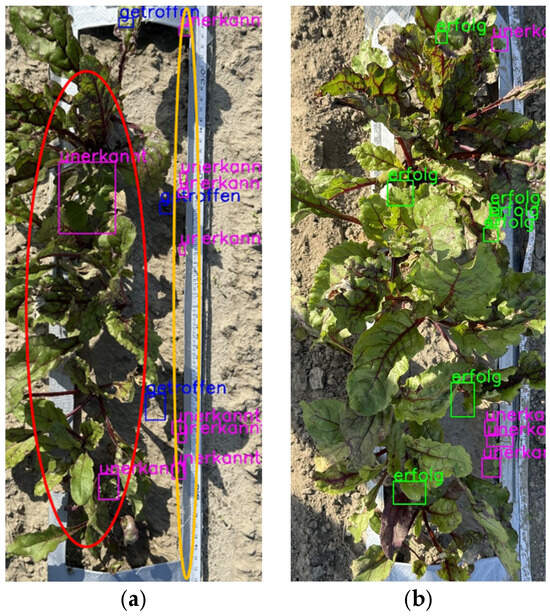
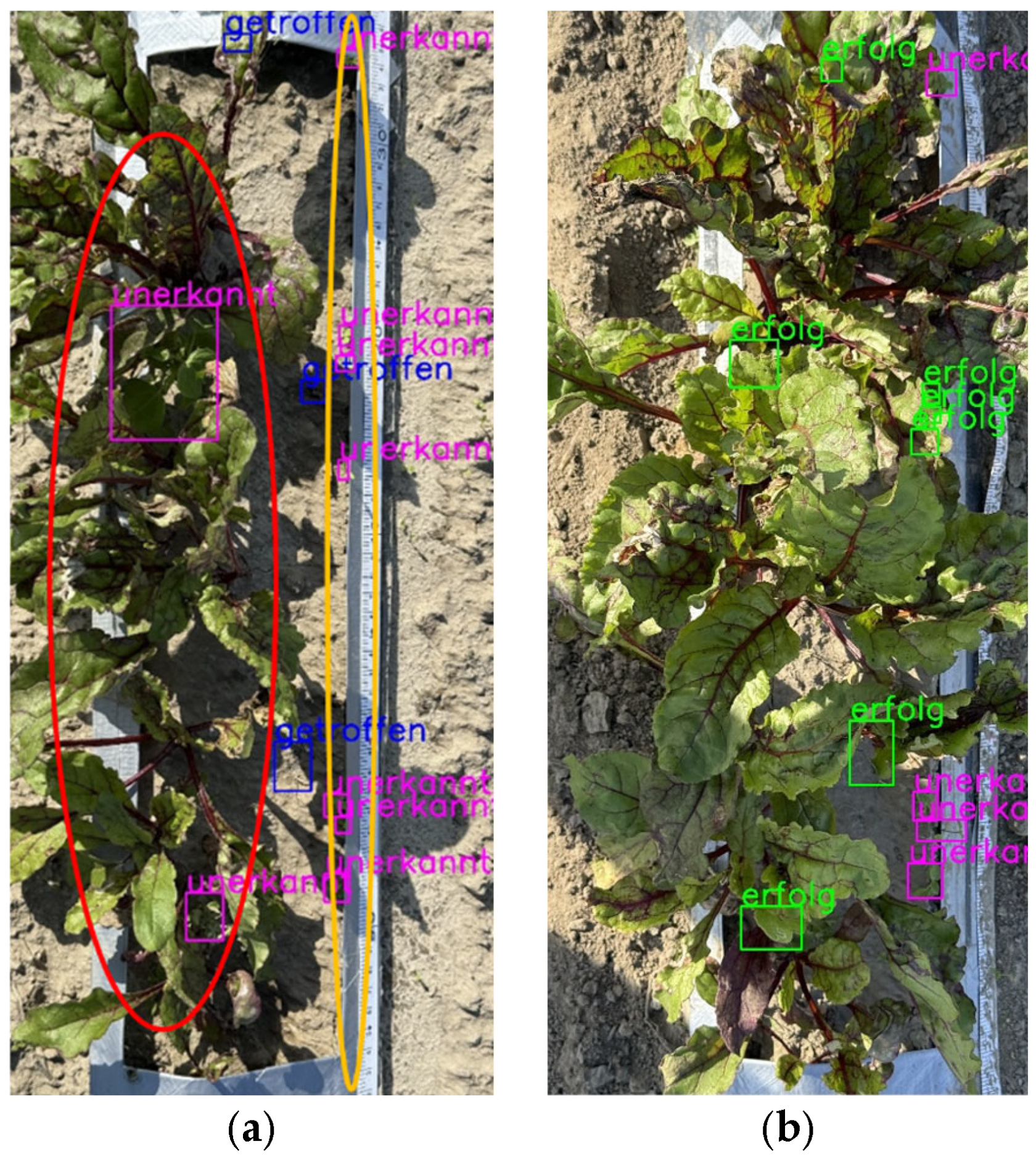
For a better understanding of Table 1, Figure 11 shows (a) a close-up of the image in Figure 7 for the 2nd weeding cycle taken at the 8 August 2025 and (b) the weeding result on the 13 August 2025. The original number of undetected weeds in Figure 11a is nine, as shown in column T1_above in Table 1. However, seven weeds are not detected due to misalignment (orange circle) and two weeds due to shadowing (red circle). Figure 11b shows the result of weed control. Based on visual observation, the undetected weeds near the edge of the template did not appear to visually affect the adjacent crop plants within the monitoring period. However, this observation is qualitative and not supported by yield measurements or competitive growth analyses. A quantitative assessment of the impact of undetected weeds on crop yield remains an important objective for future studies.
Table 1.
Calculation of the Corrected Detection Rate for the 2nd weeding cycle on the 8 August 2025.
Figure 11.
(a) Close-up of the image in Figure 7 for the 2nd weeding cycle taken on the 8 August 2025. (b) Results of the weed control.
In contrast to the Detection Rate, Weeding Effectiveness improved significantly due to the second weeding cycle, increasing from 71% to 88%. This value is significantly higher than for carrots and shows that a second weeding cycle increases the performance of the weeding robot. The weeding success remained the same after the second weeding cycle. However, the value for Weeding Success is very high, at 98%. It is therefore even slightly better than for carrots. This is because there were only a few entries in the Failure class.
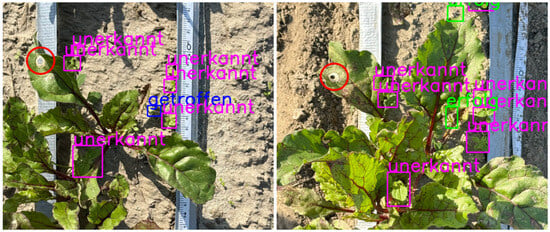
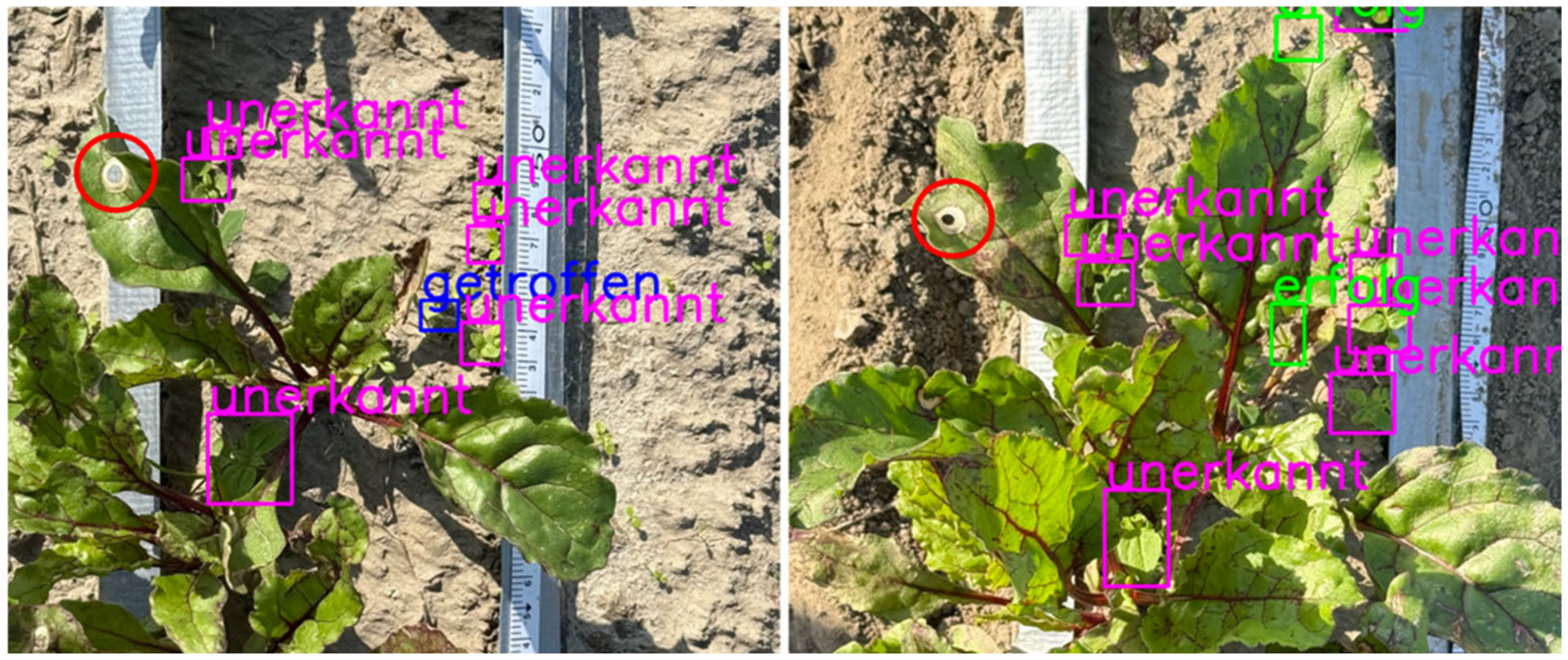
During the second weeding process, a misclassification also occurred where the laser penetrated a plant leaf (red circles in Figure 12). Based on visual observation, this had no visible effect on the plant growth as can be seen in Figure 12.
Figure 12.
Close-up of the lower measurement window of the first template S1 for the 2nd weeding cycle taken on the 08 August 2025 (left image) and 13 August 2025 (right image).
The present study did not differentiate laser treatment efficacy by weed species. Since the Thulium fiber laser’s mechanism of action targets water content in plant tissue—a universal property—we hypothesize that species-specific variation in lethality at the cotyledon stage is small. However, species with thicker cuticles, waxy coatings, or more robust meristematic tissue may require higher energy doses. Species-resolved efficacy trials are a necessary component of future validation. The initial condition of the fields must also be taken into account. In 2025, for example, it was not possible to flame all fields at the right time. This was due to the heavy weed pressure, which occurred almost simultaneously on all fields due to weather conditions.
The system was not tested in areas with low or heterogeneous weed densities. Therefore, the reported detection and effectiveness rates may not be representative of average field conditions. Future studies should employ stratified or randomized sampling across zones of varying weed pressure to assess generalizability.
For a complete description of the engineering chain from weed detection through coordinate transformation to laser actuation, including processing time benchmarks, tracking algorithms, and positional accuracy validation, the reader is referred to the companion publication [26], which provides the system-level technical foundation for the field validation presented in this study.
4.1. Comparison with State-of-the-Art Systems
To contextualize the performance of the presented Thulium fiber laser system, it is crucial to compare it with existing commercial and research solutions. Notably, systems like those from Carbon Robotics [15] and various blue laser prototypes (e.g., WeedBot [16]) employ different laser sources with distinct advantages and trade-offs. Table 2 summarizes the key technical differences.
Table 2.
Comparison of laser-based weeding technologies.
As shown in Table 2, the Carbon Robotics platform utilizes CO2 lasers, which offer high power but suffer from low wall-plug efficiency (~10%) and sensitivity to surface moisture on plants. Furthermore, their heavy platform design limits operation in wet soil conditions. A recent peer-reviewed field study by Sosnoskie et al. [30] demonstrated that CO2-laser weeding was as effective as or superior to conventional herbicides across beet, spinach, and pea production systems, confirming the agronomic viability of the laser approach. In contrast, blue diode lasers offer high efficiency but rely on chlorophyll absorption, which varies by plant age. A life cycle assessment of an autonomous laser weeding robot from the WeLASER project indicated that while energy consumption remains a challenge, the overall environmental performance is favorable compared to conventional methods [31]. The Thulium fiber laser system used in this study occupies a technological “sweet spot”: it targets water (like CO2) for robust destruction but offers the compactness and higher energy efficiency (~30%) of solid-state lasers, enabling lighter, more agile robotic platforms.
4.2. Cost-Effectiveness Analysis
A preliminary cost-effectiveness analysis highlights the economic potential of this technology. According to data from our partner Westhof Bio GmbH, manual weeding in organic carrot cultivation currently incurs costs of approximately 1800 € per hectare per season, driven by rising minimum wages and labor shortages. In comparison, recent large-scale case studies on autonomous laser weeding demonstrate significant cost advantages. For instance, total operational costs (including machine depreciation and labor) for laser weeding have been reported at approximately $268 per acre (approx. 610 € ha−1) [32], with net financial savings of over 40% compared to hand weeding. Peer-reviewed economic evaluations of autonomous weeding robots in German row crop production report operational costs that are substantially below the costs of manual weeding, with robotic systems offering competitive cost structures in the range of 250–600 € ha−1 depending on farm size, robot utilization, and the number of weeding passes [33]. Although the initial investment is high, these figures suggest that the return on investment (ROI) can be achieved quickly for large-scale organic farms, offering not only cost reduction but also independence from seasonal labor availability. A stakeholder analysis by Tran et al. [34] confirmed that the implementation potential of autonomous laser weeding is perceived as particularly high for organic farming in Europe, aligning with the commercial context of the present study. An economic simulation study by Shang et al. [35] found that Maximum Acquisition Values for weeding robots in organic sugar beet farming are substantially higher than for conventional farming, primarily driven by technology attributes such as area capacity and weeding efficiency.
5. Conclusions
This study presented the field validation of an autonomous weeding robot based on a 200 W Thulium fiber laser in organic carrot and beetroot production. The results demonstrate that the system serves as a technically effective alternative to manual weeding.
The laser hardware proved to be highly reliable, achieving a Weeding Success (lethality on targeted weeds) of 95.4% in carrots and up to 98.7% in beetroot. This confirms that the thermal energy of the Thulium fiber laser (10–40 J per weed) is sufficient for robust weed control. However, the overall agronomic Effectiveness was strongly dependent on the AI detection performance. While early-stage control was effective (~75% effectiveness), late-stage detection in beetroot dropped to 40% due to canopy occlusion. Nevertheless, a cumulative multi-pass strategy was able to compensate for these deficits, achieving a final weed reduction of 84.7%.
The generalizability of these results is limited by the fact that trials were conducted on a single field per crop type within one growing season. Future studies must include multi-field and multi-season replications to validate the robustness and external validity of these findings.
Regarding the economic perspective, this study suggests a strong potential for economic viability. As discussed in Section 4.2, the estimated operational costs of laser weeding (250–600 € ha−1) are significantly lower than current manual weeding costs in organic farming (~1800 € ha−1). While the high initial investment remains a barrier, the independence from seasonal labor availability and the capability to operate in wet soil conditions (where heavy machinery fails) offer distinct strategic advantages.
Future work will focus on three key areas: (1) integrating active mechanical foliage manipulators to resolve canopy occlusion in late growth stages; (2) conducting long-term studies to quantify the impact on crop yield and soil health compared to mechanical hoeing; and (3) expanding the economic analysis to include depreciation models for different farm sizes.
Author Contributions
Conceptualization, V.C., J.V. and S.H.; methodology, V.C., J.V. and S.H.; software, V.C. and J.V.; validation, V.C., F.Z. and J.V.; formal analysis, V.C., J.V., F.Z. and S.H.; investigation, V.C., F.Z. and J.V.; resources, V.C.; data curation, V.C., F.Z. and J.V.; writing—original draft preparation, V.C. and S.H.; writing—review and editing, V.C., J.V., F.Z. and S.H.; visualization, V.C., F.Z. and S.H.; supervision, S.H.; project administration, V.C.; funding acquisition, V.C. All authors have read and agreed to the published version of the manuscript.
Funding
This research is based on a project developed and implemented in cooperation with the Landgard producer organization. As recognized producer organization in Germany Landgard has applied for EU funding for this project under the Common Market Organization (CMO) funding program.
Institutional Review Board Statement
Not applicable.
Informed Consent Statement
Not applicable.
Data Availability Statement
The data are not publicly available due to our laboratory privacy data protection.
Acknowledgments
We would like to thank our cooperation partner Westhof Bio GmbH for their many years of support.
Conflicts of Interest
Authors Vitali Czymmek and Jost Völckner are employed by the company Naiture GmbH & Co. KG, Author Stephan Hussmann was commissioned by Landgard Obst & Gemüse GmbH & Co. KG to provide independent scientific support for the project. He is assisted in this task by Felik Zilske.
References
- Cloutier, D.C.; Leblanc, M.L. Mechanical Weed Control in Agriculture. In Physical Control Methods in Plant Protection; Vincent, C., Panneton, B., Fleurat-Lessard, F., Eds.; Springer: Berlin/Heidelberg, Germany, 2001; pp. 191–204. ISBN 978-3-662-04584-8. [Google Scholar] [CrossRef] [Scilit]
- Yaseen, M.U.; Long, J.M. Laser Weeding Technology in Cropping Systems: A Comprehensive Review. Agronomy 2024, 14, 2253. [Google Scholar] [CrossRef] [Scilit]
- Schneider, K.; Barreiro-Hurle, J.; Rodriguez-Cerezo, E. Pesticide Reduction Amidst Food and Feed Security Concerns in Europe. Nat. Food 2023, 4, 746–750. [Google Scholar] [CrossRef] [Scilit] [PubMed]
- Gerhards, R.; Belz, R.; Bohnen, C.; Dingebauer, F.; Ellenberger, J.; Inhestern, N.; Tschumi, M. Weed Management in Agroecosystems—A Review. Agronomy 2022, 12, 2195. [Google Scholar] [CrossRef] [Scilit]
- Jabran, K.; Chauhan, B.S. Overview and Significance of Non-Chemical Weed Control. In Non-Chemical Weed Control, 1st ed.; Jabran, K., Chauhan, B.S., Eds.; Elsevier: Amsterdam, The Netherlands, 2018; pp. 1–8. [Google Scholar] [CrossRef] [Scilit]
- Zingsheim, M.L.; Döring, T.F. What Weeding Robots Need to Know about Ecology. Agric. Ecosyst. Environ. 2024, 364, 108861. [Google Scholar] [CrossRef] [Scilit]
- Mathiassen, S.K.; Bak, T.; Christensen, S.; Kudsk, P. The effect of laser treatment as a weed control method. Biosyst. Eng. 2006, 95, 497–505. [Google Scholar] [CrossRef] [Scilit]
- Heisel, T.; Schou, J.; Christensen, S.; Andreasen, C. Cutting Weeds with a CO2 Laser. Weed Res. 2008, 41, 19–29. [Google Scholar] [CrossRef] [Scilit]
- Marx, C.; Barcikowski, S.; Hustedt, M.; Haferkamp, H.; Rath, T. Design and application of a weed damage model for laser-based weed control. Biosyst. Eng. 2012, 113, 148–157. [Google Scholar] [CrossRef] [Scilit]
- Sirikunkitti, S.; Chongcharoen, K.; Yoongsuntia, P.; Ratanavis, A. Progress in a Development of a Laser-Based Weed Control System. In Proceedings of the 2019 Research, Invention, and Innovation Congress (RI2C), Bangkok, Thailand, 11–13 December 2019; pp. 1–4. [Google Scholar] [CrossRef] [Scilit]
- Mwitta, C.; Rains, G.C.; Prostko, E. Evaluation of Diode Laser Treatments to Manage Weeds in Row Crops. Agronomy 2022, 12, 2681. [Google Scholar] [CrossRef] [Scilit]
- Xiong, Y.; Ge, Y.; Liang, Y.; Blackmore, S. Development of a prototype robot and fast path-planning algorithm for static laser weeding. Comput. Electron. Agric. 2017, 142, 494–503. [Google Scholar] [CrossRef] [Scilit]
- Kaierle, S.; Marx, C.; Rath, T.; Hustedt, M. Find and Irradiate—Lasers Used for Weed Control. Laser Tech. J. 2013, 10, 44–47. [Google Scholar] [CrossRef] [Scilit]
- Andreasen, C.; Vlassi, E.; Salehan, N. Laser weeding of common weed species. Front. Plant Sci. 2024, 15, 1375164. [Google Scholar] [CrossRef] [Scilit] [PubMed]
- Carbon Robotics. Available online: https://carbonrobotics.com (accessed on 5 December 2025).
- Weedbot. Available online: https://weedbot.eu/ (accessed on 5 December 2025).
- Zhu, H.; Zhang, Y.; Mu, D.; Bai, L.; Zhuang, H.; Li, H. YOLOX-Based Blue Laser Weeding Robot in Corn Field. Front. Plant Sci. 2022, 13, 1017803. [Google Scholar] [CrossRef] [Scilit] [PubMed]
- Futonics Laser GmbH. Available online: https://www.futonics.de (accessed on 5 December 2025).
- Emmi, L.; Fernández, R.; Gonzalez-de-Santos, P.; Francia, M.; Golfarelli, M.; Vitali, G.; Sandmann, H.; Hustedt, M.; Wollweber, M. Exploiting the Internet Resources for Autonomous Robots in Agriculture. Agriculture 2023, 13, 1005. [Google Scholar] [CrossRef] [Scilit]
- Andreasen, C.; Scholle, K.; Saberi, M. Laser Weeding With Small Autonomous Vehicles: Friends or Foes? Front. Agron. 2022, 4, 841086. [Google Scholar] [CrossRef] [Scilit]
- Escarda Technologies GmbH. Available online: https://www.escarda.tech (accessed on 16 December 2025).
- Andreasen, C.; Vlassi, E.; Salehan, N.; Johannsen, K.S.; Jensen, S.M. Laser weed seed control: Challenges and opportunities. Front. Agron. 2024, 6, 1342372. [Google Scholar] [CrossRef] [Scilit]
- Bejo Open Days 2025. Available online: https://www.brimapack.com/en/news/bejo-2025/ (accessed on 5 December 2025).
- Knoll, F.J.; Czymmek, V.; Harders, L.O.; Hussmann, S. Real-time classification of weeds in organic carrot production using deep learning algorithms. Comput. Electron. Agric. 2019, 167, 105097. [Google Scholar] [CrossRef] [Scilit]
- Fatima, H.S.; ul Hassan, I.; Hasan, S.; Khurram, M.; Stricker, D.; Afzal, M.Z. Formation of a Lightweight, Deep Learning-Based Weed Detection System for a Commercial Autonomous Laser Weeding Robot. Appl. Sci. 2023, 13, 3997. [Google Scholar] [CrossRef] [Scilit]
- Czymmek, V.; Völckner, J.; Hussmann, S. Development and Evaluation of a Laser System for Autonomous Weeding Robots. AgriEngineering 2024, 6, 4425–4441. [Google Scholar] [CrossRef] [Scilit]
- Slaughter, D.C.; Giles, D.K.; Downey, D. Autonomous robotic weed control systems: A review. Comput. Electron. Agric. 2008, 61, 63–78. [Google Scholar] [CrossRef] [Scilit]
- Czymmek, V.; Harders, L.O.; Knoll, F.J.; Hussmann, S. Vision-Based Deep Learning Approach for Real-Time Detection of Weeds in Organic Farming. In Proceedings of the 2019 IEEE International Instrumentation and Measurement Technology Conference (I2MTC), Auckland, New Zealand, 20–23 May 2019; pp. 1–5. [Google Scholar] [CrossRef] [Scilit]
- Zhang, H.; Cao, D.; Zhou, W.; Currie, K. Laser and Optical Radiation Weed Control: A Critical Review. Precis. Agric. 2024, 25, 2033–2057. [Google Scholar] [CrossRef] [Scilit]
- Sosnoskie, L.M.; Besançon, T.E.; Kikkert, J.R.; Swantek, J.M. Deep learning-based laser weed control compared to conventional herbicide application across three vegetable production systems. Pest Manag. Sci. 2025, 81, 4922–4936. [Google Scholar] [CrossRef] [Scilit]
- Krupanek, J.; Gonzalez-de-Santos, P.; Emmi, L.; Wollweber, M.; Sandmann, H.; Scholle, K.; Tran, D.D.M.; Schouteten, J.J.; Andreasen, C. Environmental performance of an autonomous laser weeding robot—A case study. Int. J. Life Cycle Assess. 2024, 29, 1021–1052. [Google Scholar] [CrossRef] [Scilit]
- Vahdanjoo, M.; Gislum, R.; Sørensen, C.A.G. Operational, Economic, and Environmental Assessment of an Agricultural Robot in Seeding and Weeding Operations. AgriEngineering 2023, 5, 299–324. [Google Scholar] [CrossRef] [Scilit]
- Fishkis, O.; Weller, J.; Lehmhus, J.; Pollinger, F.; Strassemeyer, J.; Koch, H.-J. Ecological and economic evaluation of conventional and new weed control techniques in row crops. Agric. Ecosyst. Environ. 2024, 360, 108786. [Google Scholar] [CrossRef] [Scilit]
- Tran, D.; Schouteten, J.J.; Degieter, M.; Krupanek, J.; Jarosz, W.; Areta, A.; Emmi, L.; De Steur, H.; Gellynck, X. European Stakeholders’ Perspectives on Implementation Potential of Precision Weed Control: The Case of Autonomous Vehicles with Laser Treatment. Precis. Agric. 2023, 24, 2200–2222. [Google Scholar] [CrossRef] [Scilit]
- Shang, L.; Pahmeyer, C.; Britz, W. How much can farmers pay for weeding robots? A Monte Carlo simulation study. Precis. Agric. 2023, 24, 1712–1737. [Google Scholar] [CrossRef] [Scilit]

Disclaimer/Publisher’s Note: The statements, opinions and data contained in all publications are solely those of the individual author(s) and contributor(s) and not of MDPI and/or the editor(s). MDPI and/or the editor(s) disclaim responsibility for any injury to people or property resulting from any ideas, methods, instructions or products referred to in the content. |
© 2026 by the authors. Licensee MDPI, Basel, Switzerland. This article is an open access article distributed under the terms and conditions of the Creative Commons Attribution (CC BY) license.