


Abstract
This study aimed to develop an automated irrigation system for substrate-grown strawberry plants and to evaluate whether irrigation and biostimulation levels influence yield and fruit quality. The system comprised two Arduino Pro Mini devices equipped with LoRa transceivers, substrate moisture sensors, and servomotors for valve control. Six biostimulants were assessed [control (without biostimulation), microalga Spirulina platensis (SP), mycorrhiza Scutellospora heterogama (SH), a mycorrhizal community (SJ CS), SP + SH, and SP + SJ CS] under four irrigation levels [reference tension of 5 kPa (moderate water deficit), 10% above the reference tension (severe water deficit), 10% below the reference tension (mild water deficit), and standard irrigation without restriction] defined by substrate water tension. Data were collected in real time and analyzed using the InfluxDB (version 3 Core) and Grafana (version 12.3.2) platforms. The automated system-controlled valve activation was based on moisture sensor readings, enabling the establishment of irrigation levels supported by energy-efficient technologies. Under standard irrigation, fruits exhibited lower acidity and improved flavor compared to those from plants under water deficit. Plants subjected to mild water deficit or standard irrigation achieved higher yields than those exposed to moderate or severe deficit. Fruits produced by plants treated with S. heterogama showed higher phytochemical concentrations. Overall, the findings support the use of automated irrigation and biostimulation as sustainable management strategies to enhance water use efficiency, productivity, and fruit quality in soilless strawberry cultivation.
1. Introduction
A practical way to improve strawberry (Fragaria × ananassa Duch.) horticultural performance is to use soilless greenhouse systems [1]. Besides improving ergonomics for producers, these systems allow for efficient monitoring and management of irrigation, fertilization, air temperature, and plant health [2]. However, a persistent challenge in protected strawberry cultivation is its high sensitivity to abiotic stresses, particularly water stress, whether due to deficit or excess [3].
Globally, agriculture accounts for roughly 71% of the 4250 km3 of water withdrawn from natural sources [4]. Strawberry is one of the most economically important horticultural crops, yet it demands substantial water inputs, especially in intensive production systems, consuming between 300 and 800 mm per cycle depending on climate, management, and cultivation method [5]. In this context, automated and intelligent control systems play a vital role in promoting water conservation, minimizing environmental impacts, and strengthening food security [6,7]. Long-range imaging (LoRa) technology, for instance, enables real-time data acquisition with low energy consumption and wide transmission range [8].
Beyond technological advancements in irrigation management, an additional bio-tool with potential to mitigate water stress in strawberries is the use of biostimulants during plant development, such as arbuscular mycorrhizal fungi (AMF) [9] and extracts from the microalga Spirulina platensis [10]. Biostimulation promotes root development, increasing water absorption and water use efficiency [11]. Biostimulants can also modify the growing medium, as they often increase soil or substrate moisture under drought and enhance plant growth and development [12].
In addition to reducing water stress, biostimulants commonly enhance strawberry yield and fruit quality [13]. However, the synergistic or antagonistic effects of these biostimulants (Scutellospora heterogama and S. platensis) under different levels of water deficit, precisely controlled through IoT-based real-time irrigation management, remain largely unexplored for strawberry in soilless cultivation system. This knowledge gap is particularly relevant for producers lacking adequate technologies or reliable water availability.
Based on the hypothesis that integrating automated irrigation with plant biostimulation enhances strawberry growth and productivity while optimizing water use in a sustainable manner, this study aimed to develop an Internet of Things (IoT)-based automated irrigation system for soilless strawberry cultivation and to evaluate whether the interaction between irrigation levels and biostimulation influences yield and fruit quality. Here, in addition to testing biostimulants and automated irrigation, we are investigating their interaction within a replicable and low-cost IoT framework to provide actionable insights for cultivation protocols that save water and improve the horticultural potential of strawberry plants. In addition, we emphasize that no previous study has combined S. heterogama and S. platensis with sensor-based deficit irrigation in soilless strawberry cultivation systems.
2. Materials and Methods
2.1. Hardware and Software
For the irrigation automation system, two devices with similar hardware configurations (I and II) were developed. Both devices were equipped with a 3.3 V, 8 MHz Arduino Pro Mini, RFM95 LoRa transceivers (M2M Shop®, Bangkok, Thailand), two capacitive soil moisture sensors [SKU SEN0193 V2.0 (DFRobot®, Shanghai, China)], two soil temperature sensors [DS18B20 (Analog Devices®, Wilmington, MA, USA)], and a servomotor. The only difference between them was that device I used two servomotors, whereas device II used only one.
The servomotors [model MG996R (TowerPro®, Taizhou, China)] are high-performance units with fiberglass-reinforced nylon gears for added durability, and their 50 Hz PWM control ensures precise movement within a 120° range. In both devices, the servomotors were connected to an N-channel MOSFET transistor functioning as a switch to reduce energy consumption. Each servomotor was powered by five AA alkaline batteries (7.5 V total), the maximum voltage supported by the motor.
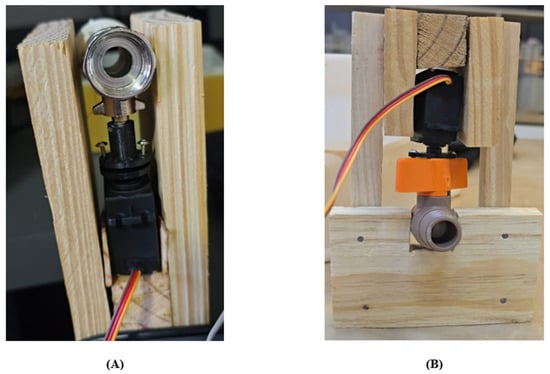
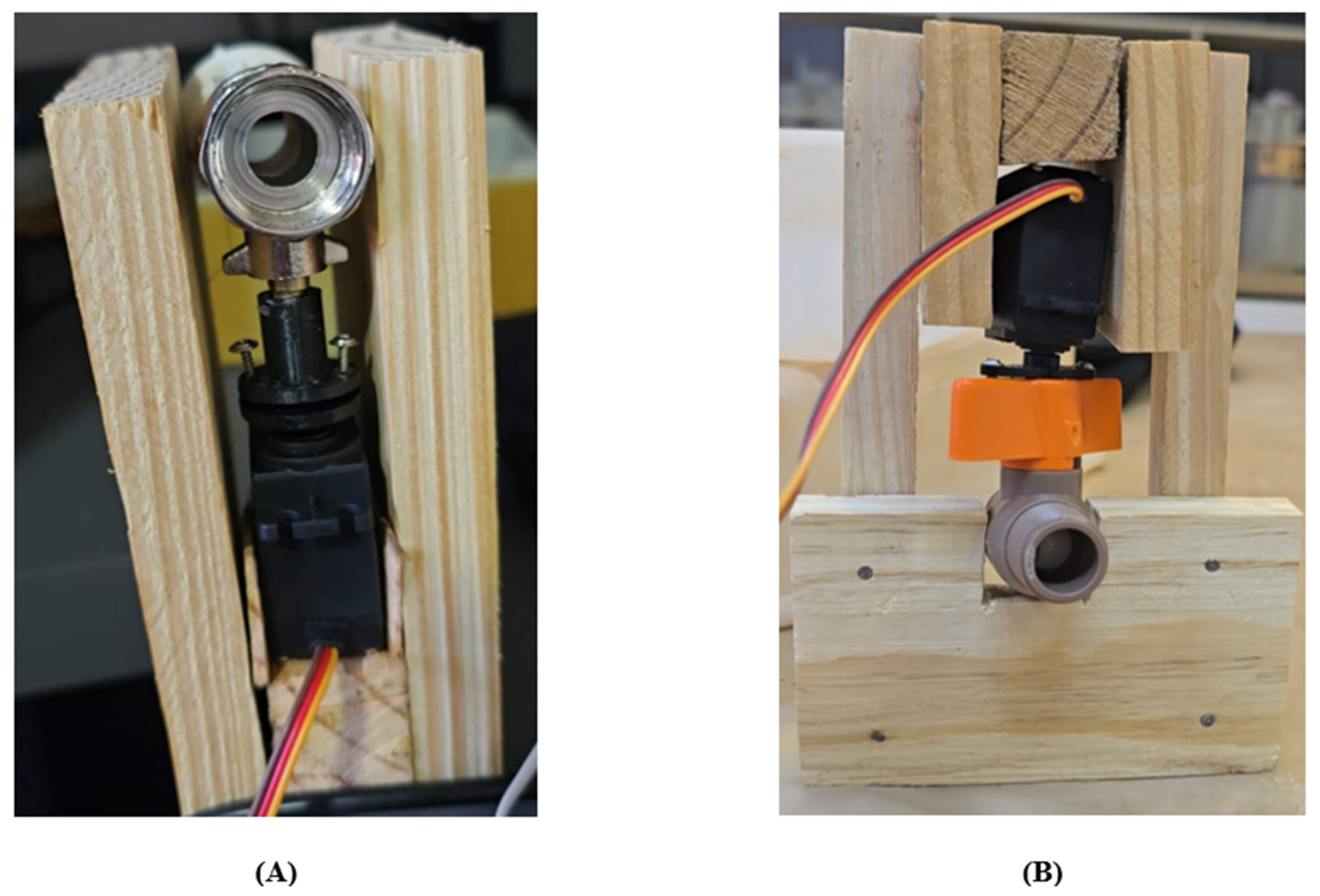
Two types of valves were assessed (Figure 1). The first was a metal valve (Figure 1A), for which a 3D-printed support was developed to attach the servomotor and the register. The second was a polyvinyl chloride (PVC) valve (Figure 1B), in which the servomotor was mounted directly onto the handle used for opening and closing. In both cases, wooden supports were built to align the servomotor with the valve, and the opening and closing angles were adjusted in the microcontroller code.
Figure 1.
Metallic (A) and polyvinyl chloride (B) valves with servomotors under experimental conditions. The images show the components used to compare performance, resistance, and functionality in response to servomotor actuation.
The system retained the main irrigation pump, and irrigation times were programmed using the primary timer. Thus, the only modification to the greenhouse irrigation setup was the installation of valves coupled to servomotors at the beginning of each drip tape feeding the growing containers. Real-time monitoring, data storage, and visualization of sensor readings were conducted using InfluxDB (version 3 Core) and Grafana (version 12.3.2). The collected data were then used to assess water consumption in each irrigation treatment.
2.2. Plant Material
The plant material consisted of bare-root strawberry daughter plants, ‘Monterey’ cultivar, obtained from the Llahuén nursery in Chilean Patagonia (33°50′15.41″ S; 70°40′03.06″ W). ‘Monterey’ is classified as a day-neutral cultivar. In addition to producing fruits appreciated by the consumer market, ‘Monterey’ is a cultivar responsive to biostimulation and is increasingly used by producers during the establishment of the plantation [9].
The experiment was conducted in a 430 m2 greenhouse with a semicircular structure covered with low-density polyethylene film and oriented in the northwest-southeast direction. To regulate the temperature inside the greenhouse, the sidewall curtains were opened (to decrease the temperature) or closed (to increase the temperature). The study was conducted from May 2024 to February 2025.
2.3. Experimental Design
The 24 treatments, arranged in a two-factor scheme, consisted of four irrigation levels [reference tension of 5 kPa (moderate water deficit), 10% above the reference tension (severe water deficit), 10% below the reference tension (mild water deficit), and standard irrigation without restriction] and six biostimulants [control (without biostimulation), microalga S. platensis (SP), mycorrhiza Scutellospora heterogama (TH Nicolson & Gerd.) C. Walker & FE Sanders (SH), a mycorrhizal community (SJ CS), SP + SH, and SP + SJ CS]. The experimental design was a strip-plot arrangement with four replications. Each plot consisted of six plants.
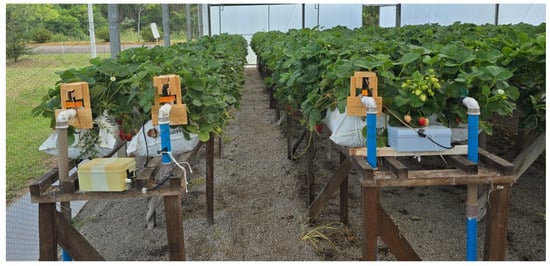
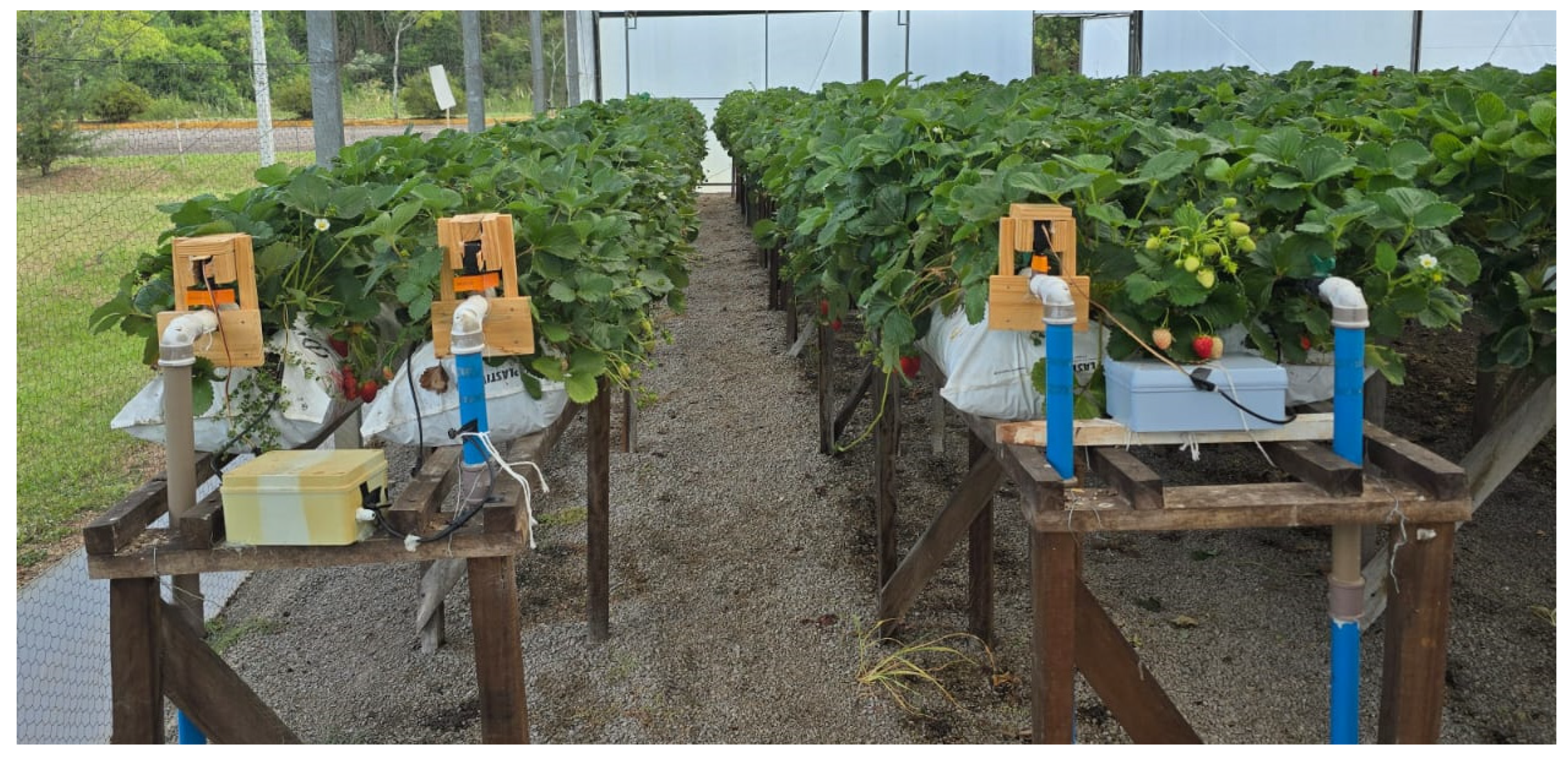
From May 2024 to November 2025, before the imposition of irrigation levels, the strawberry plants were managed using standard irrigation without restriction. Biostimulant applications and irrigation treatments were imposed from 6 December 2024, to 12 February 2025, totaling 68 days (Figure 2).
Figure 2.
Recording system installed in each row of strawberry plants in the greenhouse, with automatic activation water potential readings from the substrate.
For each irrigation line, one capacitive moisture sensor was installed in the substrate at root-zone depth, within the effective sensing range of the sensor, and positioned 3–5 cm laterally from the drip emitter to minimize direct wetting effects. Sensor readings were recorded every 30 min, and the sensor signal was used by the control algorithm to determine valve actuation. When sensor readings exceeded the predefined threshold, the corresponding valve remained closed; otherwise, it was opened during the programmed irrigation cycle.
2.4. Cultivation Techniques
Bare-root strawberry daughter plants were transplanted in May 2024 into containers measuring 1 m in length and 0.3 m in width, filled with Dallemole® substrate (Dallemole®, Vacaria, Rio Grande do Sul, Brazil). The substrate was composed of pine bark, rice husk, rice ash, and Class A organic compost. Plants were spaced 0.17 m apart, with a single row per container.
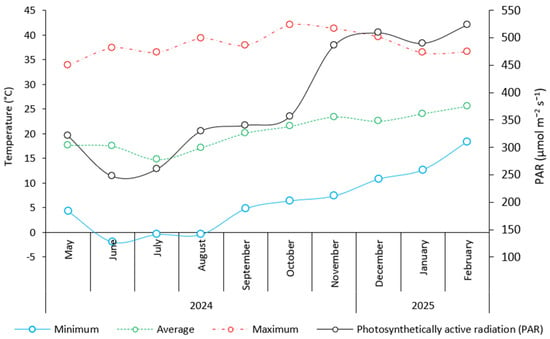
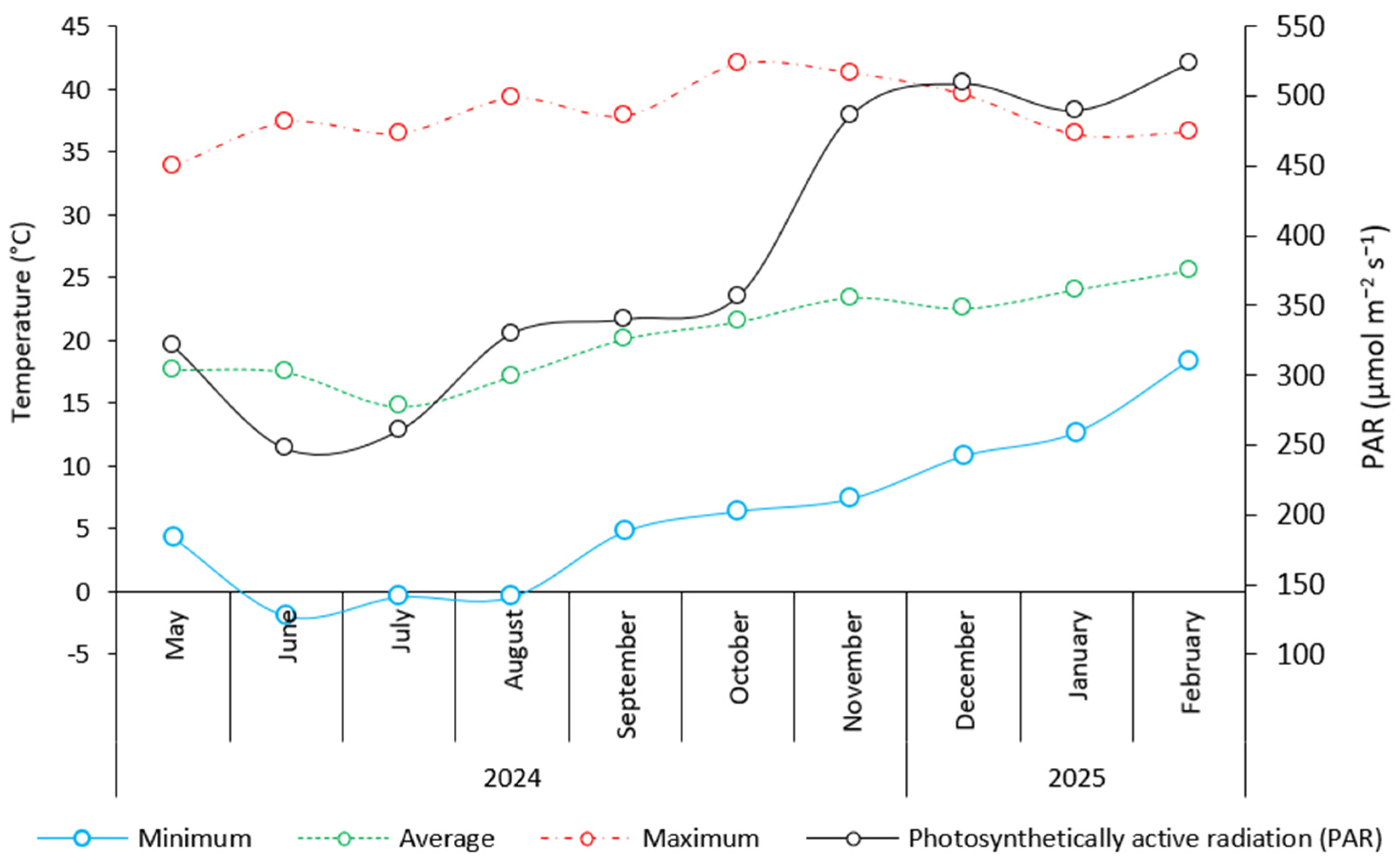
Irrigation was applied through drip tapes in an automated system, with a flow rate of 1.41 L h−1 per emitter. Nutrient solutions were supplied weekly [14]. The nutrient solutions were composed of calcium nitrate, potassium monobasic phosphate, potassium nitrate, magnesium sulfate, urea, and micronutrients (boron, copper, iron, manganese, molybdenum, and zinc). Throughout the experiment, minimum, average, and maximum air temperatures, as well as photosynthetically active radiation (PAR), were monitored inside the greenhouse (Figure 3). Mini station (WatchDog® 2475, Spectrum® Technologies, Inc., Chicago, IL, USA) was installed inside the greenhouse, at 3 m from where the experiment was conducted.
Figure 3.
Minimum, average, and maximum monthly temperatures and photosynthetically active radiation inside the greenhouse during the experiment.
To establish the moisture levels for each set of containers, the capacitive sensors were calibrated prior to installation using substrate-specific water retention curves obtained with a Haines funnel [15]. The Dallemole® substrate was subjected to controlled matric potentials, and sensor voltage output was recorded at each applied suction level, allowing the relationship between substrate water tension (kPa) and electrical voltage (V) to be established individually for each sensor.
Based on these calibration curves, a reference irrigation threshold corresponding to 5 kPa substrate water tension was defined. For the moderate water deficit level, this threshold corresponded to a sensor reading of 1.14 V. The severe water deficit level was set at 1.25 V, representing a 10% increase relative to the voltage associated with 5 kPa (1.11 V), while the mild water deficit level was defined as 0.95 V, corresponding to a 10% reduction from the 5 kPa reference voltage (1.05 V) (Table 1). The irrigation level corresponding to standard management, commonly used by strawberry producers in the Brazilian subtropics [9], was applied without restriction.
Table 1.
Average electrical voltage (V) recorded by the sensors for each reference water potential level (kPa).
For treatments receiving S. platensis, a 5% extract was prepared monthly. The microalga was cultivated in Zarrouk medium in greenhouse tanks under solar lighting and mechanized solution circulation. After cultivation, the suspension was centrifuged to separate the microalgal biomass, which was then dried, macerated, and stored at −18 °C. Cell disruption and extraction were performed by freezing the biomass for 24 h at −18 °C followed by slow thawing for 24 h at 1–4 °C. Before application, the dried biomass (5%) was diluted in distilled water. Three applications (December 2024, January 2025, and February 2025) of S. platensis were performed during the experiment (68-day period). For this purpose, 10 mL of the extract was applied to each plant at the base of the crown, allowing it to run onto the substrate, using a micropipette.
The AMF-based biostimulants consisted of on-farm inoculants. The monospecies inoculant, represented by S. heterogama (SH), was obtained from the International Culture Collection of Glomeromycota (CICG). The multispecies inoculant (SJ CS) was obtained from a trap culture of cultivated soil (CS) under strawberry production in São José do Hortêncio (29°29′33″ S; 51°12′24″ W), Rio Grande do Sul, Brazil [16]. This inoculant contained 10 fungal species classified within Glomeromycota [17], including: Acaulospora foveata Trappe & Janos, Claroideoglomus aff. luteum, C. claroideum (N.C. Schenck & G.S. Sm.) C. Walker & A. Schüßler, C. etunicatum (W.N. Becker & Gerd.) C. Walker & A. Schüßler, Funneliformis aff. geosporum, Funneliformis aff. mosseae, F. mosseae (T.H. Nicolson & Gerd.) C. Walker & A. Schüßler, Glomus aff. versiforme, Glomus sp. (caesaris like), and Glomus sp2.
Inoculants were produced using sorghum [Sorghum bicolor (L.) Moench] as the host species in trap cultivation [18]. Sterilized sand (120 °C, 20 min) was used as the substrate. The inoculants were produced in a 90 m2 greenhouse with a semicircular roof, covered with low-density polyethylene film (150 µm) containing an anti-UV additive. By the wet sieving method [19] and centrifugation in sucrose [20], it was found that the spore density (number per 50 g of on-farm inoculant) was 578 and 593 for S. heterogama and mycorrhizal community, respectively. Three applications (December 2024, January 2025, and February 2025) of on-farm inoculants were performed during the experiment (68-day period). For AMF-inoculated treatments, 2 g of on-farm inoculant were applied monthly around the plant crown. This equated to ~23 spores per plant for S. heterogama and ~24 spores per plant for mycorrhizal community in each application.
2.5. Fruit Yield
The total number of fruits per plant (TNF, number per plant) and total fruit production (TP, grams per plant) were evaluated. The fruits were harvested when fully ripe and weighed on a digital scale. The average fresh fruit mass (AFFM, grams) was obtained by dividing TP by TNF [21].
2.6. Strawberry Quality
In February 2025, after biostimulation and the 68-day irrigation period, harvested strawberries were used to determine total soluble solids (TSS, %) and total titratable acidity (TTA, % of citric acid). Immediately after harvesting, five fruits per treatment in each replication were analyzed following the standards of the Adolfo Lutz Institute [22]. Fruit flavor was assessed using the TSS/TTA ratio.
The harvested strawberries were also subjected to an extraction procedure based on Revilla et al. (1998) [23] for subsequent quantification of total flavonoids (TF) and total polyphenols (TPO). TF content [24] was expressed as milligrams of rutin per 100 g of fresh fruit (mg rutin/100 g FF−1). TPO content was determined using the Folin–Ciocalteu method [25] and expressed as milligrams of gallic acid equivalent per 100 g of fresh fruit (mg GAE/100 g FF−1).
2.7. Statistical Analysis
The system’s functionality was evaluated based on its opening and closing mechanisms and its performance throughout the experiment. For strawberry yield and quality analyses, the data normality was verified using the Shapiro–Wilk test. Subsequently, the data were subjected to analysis of variance (ANOVA). When significant effects were detected, treatment means were compared using Duncan’s test at a 5% probability level, with the aid of R version 4.5.2 [26].
3. Results
3.1. Hardware and Software
The first valve tested, with a metal body (Figure 1A), performed adequately during bench testing, where the servomotors were able to open and close it without difficulty and with minimal resistance. However, when the valve was installed in the oven for preliminary testing, several problems emerged. Over time, the 3D-printed support component deteriorated and no longer enabled proper valve actuation, while the valve itself oxidized rapidly, increasing operational resistance. As a result, the PVC valve (Figure 1B) was adopted, as it showed no limitations during either bench or oven testing and was therefore installed as described in Section 2.1.
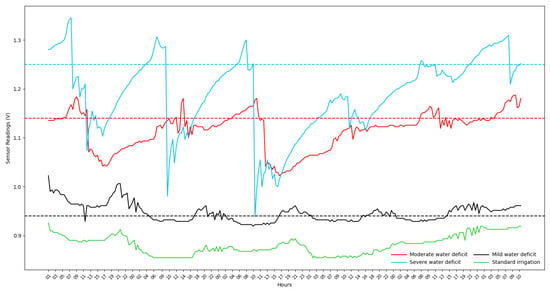
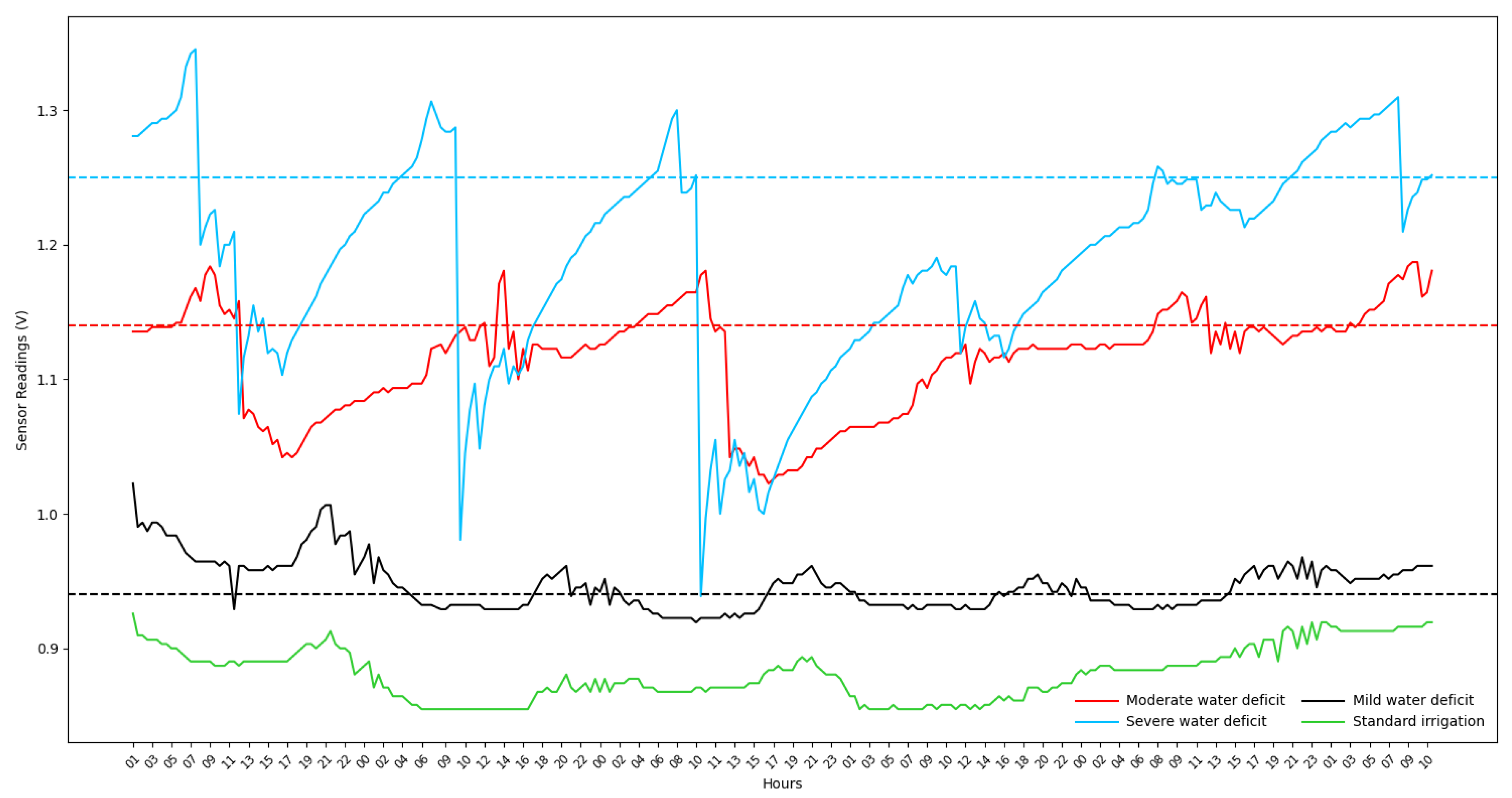
The system remained operational for more than two months and demonstrated stable and functional performance. Programmed to transmit data every 30 min, it responded effectively to changes in substrate moisture, opening the valves whenever moisture readings dropped below the pre-established irrigation thresholds (Figure 4).
Figure 4.
Substrate moisture sensor readings and their respective irrigation thresholds (dashed lines) during a six-day monitoring period.
Regarding battery use by the servomotors, one battery was replaced in a motor that exhibited difficulty closing the valve. Overall, due to the use of MOSFETs, energy consumption occurred only during actuation. The servomotor assigned to the moderate water deficit level averaged three to four opening or closing events per day, while the severe deficit level averaged one to two events. Nonetheless, the servomotor associated with the mild water deficit level registered too few actuations to quantify reliably.
A total of three servomotor-valve units were deployed, corresponding to the irrigation treatments in which automated flow restriction was required. The standard irrigation treatment operated without a servomotor, with the valve remaining fully open throughout the experimental period. During the experiment, one servomotor required battery replacement after approximately one month of operation. This event did not interrupt data transmission or irrigation control, and normal operation resumed immediately. No experimental units were excluded from the analysis, and treatment integrity and replication were preserved.
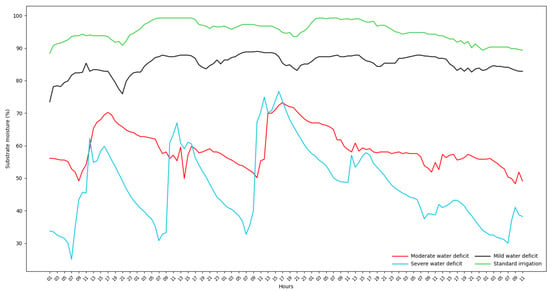
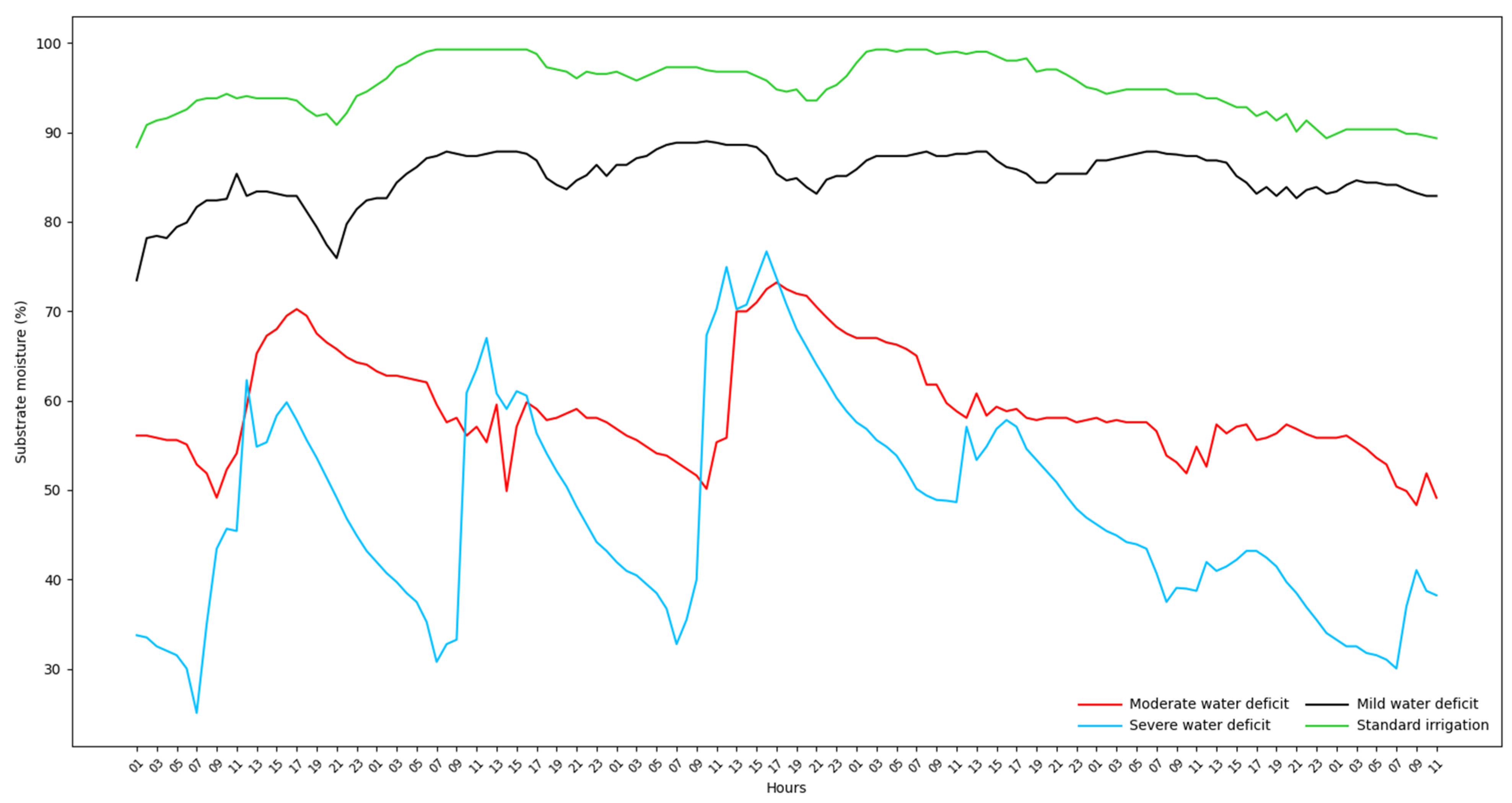
To further illustrate the distinct moisture dynamics imposed by each irrigation level, substrate moisture variation over time is presented in Figure 5. The data shows clear separation among treatments, reflecting the effectiveness of the automated control system in maintaining differentiated irrigation levels throughout the monitoring period.
Figure 5.
Temporal variation of substrate moisture (%) under four irrigation levels.
3.2. Water Consumption
During the 68-day irrigation period, water use was estimated from the time each irrigation-level valve remained open. The pump timer was programmed for eight irrigations per day, totaling 14 min day−1, with a flow rate of 1.41 L h−1 per dripper. In the moderate water deficit treatment, the valve remained open for 306 min, resulting in 7.19 L per dripper. In the severe deficit treatment, the valve was open for 208 min, totaling 4.80 L. The mild deficit treatment showed the highest consumption among the deficit levels, with 693 min of valve opening and 16.23 L per dripper. Under standard irrigation, where the valve remained fully open, total irrigation time reached 832 min, corresponding to 19.50 L per dripper.
Based on these values, the daily water supply per plant was calculated. Over the 68 days, considering the plant arrangement in each container (six plants per meter) and drippers spaced every 15 cm along drip tape, the average per-plant water application was 106 mL, 71 mL, 239 mL, and 287 mL per day for the moderate deficit, severe deficit, mild deficit, and standard irrigation levels, respectively.
Water consumption was estimated based on cumulative valve opening time and nominal emitter flow rate. Although this approach is commonly applied in controlled irrigation experiments, it may be affected by pressure variation and emitter flow heterogeneity. Therefore, the estimated values should be interpreted as approximations. Future studies should incorporate inline flow meters to validate and refine water consumption measurements.
3.3. Strawberry Yield and Quality
The two-way ANOVA revealed no significant interaction between irrigation levels and biostimulation for TNF (F = 0.84; p = 0.53), TP (F = 0.81; p = 0.55), AFFM (F = 0.68; p = 0.64), TSS (F = 1.43; p = 0.20), TTA (F = 0.85; p = 0.61), TSS/TTA (F = 0.42; p = 0.95), TF (F = 4.46; p = 0.10), and TPO (F = 8.13; p = 0.27). Irrigation had isolated effects on TTA, TSS/TTA ratio, TNF, TP, and AFFM (Table 2), while biostimulants had isolated effects on TTA, TF, and TPO (Table 3).
Table 2.
Yield and quality of ‘Monterey’ strawberries under irrigation levels.
Table 3.
Quality of ‘Monterey’ strawberries with and without biostimulants.
Under standard irrigation, fruits were less acidic (~30%) and exhibited higher flavor index values (~24%) compared with fruits from plants under water deficit (Table 2). Plants subjected to mild deficit or standard irrigation also produced higher yields, with TNF and TP increasing, on average, by 49% and 62%, respectively, compared with plants exposed to severe deficit (Table 2).
Regarding biostimulation, fruits from plants grown without biostimulants showed higher acidity (Table 3). In contrast, plants inoculated with the monospecific mycorrhizal inoculant S. heterogama produced fruits with 37% higher TF and 23% higher TPO compared with plants receiving no biostimulant treatment (Table 3).
4. Discussion
Although automated irrigation systems [7,15] and biostimulants [1] have been independently investigated as strategies to improve water use efficiency and stress tolerance in strawberry plants, studies integrating these approaches remain scarce. In particular, the combined effects of AMF and microalgal extracts under precisely controlled water deficit levels enabled by real-time, IoT-based irrigation management are largely unexplored in soilless strawberry cultivation systems.
The system proved efficient in data collection and transmission, and the use of LoRa technology ensured low energy consumption, allowing long-term operation. However, powering the servomotors with AA batteries caused issues in one unit, which required replacement after one month. As a result, a conclusive assessment of battery life was not possible. For greater operational stability, servomotors should be powered by longer-lasting batteries such as Li-Po units, which are more suitable for applications with current peaks. Their high energy density and discharge capacity make them ideal for systems requiring instantaneous power, such as actuators [27].
Standard irrigation treatment maintained substrate moisture near 1 kPa, corresponding to 0.90 V measured by the sensor (Figure 4). Cormier et al. (2020) [28] reported that using 5 kPa as an irrigation threshold in a peat-based soilless system led to earlier fruit harvesting (73–98% more harvested in July) than conventional soil-based cultivation. For the other irrigation levels, sensor values increased progressively according to the imposed water deficit. Occasional peaks in substrate moisture were observed (Figure 4), likely due to the proximity of the sensor to the dripper, which can affect reading accuracy. Sensors near the irrigation source typically register elevated values immediately after water application, which may not reflect average substrate moisture [29]. In addition, initial tests showed that sensors in direct contact with roots tend to register higher moisture values, probably due to increased hydraulic conductivity and the influence of roots on the dielectric properties of the medium [30].
The system demonstrated strong potential for irrigation management, although modern technologies often face operational or acceptance challenges during early implementation. Varela-Aldás et al. (2024) [31] noted lower ratings for perceived usefulness and system confidence in IoT-based irrigation systems. To increase adoption among strawberry producers, the system was designed for rapid installation without structural modifications to the greenhouse. Unlike other studies using specific pumps for irrigation control [32,33,34], this system relied solely on existing infrastructure. This design allows flexible irrigation management for multiple horticultural crops or for plants at different developmental stages, while reducing installation and energy costs because the system operates on batteries and uses servomotors to actuate valves.
In contrast to previous IoT-based irrigation studies in strawberry cultivation, which primarily focused on system architecture and intelligent control strategies [32,34], the system evaluated in the present study advances beyond automation alone by combining sensor-based, deficit-specific irrigation control with biostimulant application under defined substrate water potential thresholds. Additionally, our approach emphasizes a low-cost, modular, and energy-efficient LoRa-based platform designed to operate with minimal infrastructure modification, making it readily adaptable to commercial greenhouse environments. Therefore, this study contributes not only to irrigation automation but also to the integration of precision water management with biological inputs aimed at improving water productivity and fruit nutraceutical quality.
Imposing a mild water deficit resulted in TNF, TP, and AFFM values comparable to those of standard irrigation, enabling a 17% reduction in water use. Water use efficiency averaged 14.9 and 18.6 kg m−3 under standard irrigation and mild deficit, respectively, representing an increase of approximately 25% under mild deficit conditions. In contrast, the moderate deficit treatment maintained AFFM but reduced TNF and TP (Table 2). In soilless cultivation, Raffaelli et al. (2025) [2] reported water use efficiency of ~34 kg m−3 and ~18.8 kg m−3, depending on the cultivar and water supply. This demonstrated the genetic and management effects on efficiency. Furthermore, Bonelli et al. (2024) [6] found that wireless substrate sensors reduced total water use by ~26% compared to timer-based irrigation, in addition to improving yield. This resulted in a 46% improvement in water use efficiency (fresh weight of marketable fruit per liter of water applied).
TSS/TTA ratio observed under mild and moderate deficits was lower than under standard irrigation but higher than under severe deficit (Table 2). Overall, mild and moderate deficits offered a favorable balance between fruit yield and quality, indicating that high-quality fruit can be produced with improved water use efficiency. This aligns with findings by Yang et al. (2025) [35], who reported that soil-moisture-sensor-controlled irrigation can optimize water use without compromising fruit quality, especially when combined with environmental control techniques [36]. TSS/TTA ratio reflects the balance between sugars and acidity and is a key indicator of sensory fruit quality. Strawberries intended for consumption typically show TSS/TTA values between 8 and 14, which represents standard commercial quality [37].
Although not examined in this study, irrigation practices that lead to excess water can also compromise strawberry yield and quality. Saridaş et al. (2021) [38] reported that an optimal water supply increased soluble solids content, improved flavor, and enhanced fruit production. Our results showed that the volume of water applied under standard irrigation could be reduced without major reductions in yield or fruit quality (Table 2), promoting more sustainable irrigation management. This finding is particularly relevant in regions facing water scarcity, as water use during the 68-day experimental period varied substantially from 7.19 L per dripper under moderate deficit, where AFFM did not decrease, to 19.50 L under standard irrigation.
In contrast, severe water deficit increased fruit acidity and reduced yield (Table 2). These findings indicate that water stress negatively affects the horticultural potential of strawberries, as also reported by Adak et al. (2018) [39] and Celiktopuz et al. (2023) [40]. Abiotic stresses such as water deficit trigger complex plant responses involving signaling pathways, physiological adjustments, and activation of defense mechanisms. Together, these events alter the biosynthesis, transport, and storage of many primary and secondary metabolites, including citric acid [41]. Because endogenous citric acid accumulates following stress exposure [42], this likely explains the higher acidity observed in fruits from plants subjected to water deficit. Morphophysiological effects of deficit in strawberry plants include stomatal closure, reduced photosynthesis, and lower leaf relative water content [36,43,44], which ultimately result in decreased fruit production (Table 2).
Regardless of irrigation levels, biostimulation increased the phytochemical content of fruits, particularly when plants were inoculated with AMF, especially S. heterogama (Table 3). This increase in flavonoid and polyphenol content reflects activation of secondary metabolism as part of the host plant’s defense response to AMF colonization in roots [19]. AMF modulates plant metabolome through multiple pathways that influence the biosynthesis of phytonutrients important to human health [45]. These metabolic changes can arise from improved water and nutrient acquisition, enhanced photosynthetic capacity [46], phytohormone regulation [47], and the action of signaling molecules [48]. Considering the growing demand for nutraceutical foods free of chemical residues, the use of AMF as a bio-tool can add value to both strawberry production systems and consumer health. Large-scale multiplication of AMF for an inoculant formulation can be done in aeroponic, hydroponic, or in vitro systems [49]. However, one option for increasing the use and acceptance of an AMF-based biostimulant is to develop an inoculant produced by the on-farm method, obtained on site where it will later be used, to avoid the costs associated with buying a commercial product [50]. On-farm inoculant can be developed under natural environmental conditions, multiplying mycorrhizal species indigenous to a given ecosystem, and/or with known efficiency [51]. Under these conditions, the fungal species and the plant host are physiologically more compatible, which can ensure greater benefits from the association [52].
Although many studies have explored IoT-based irrigation management, few have focused on sensor calibration and validation in systems designed for low energy consumption and low equipment cost. This gap is particularly relevant for strawberries grown in substrate, where water tension rarely exceeds 10 kPa. Our findings demonstrate that irrigation levels can be effectively established with energy-efficient technologies that improve water use efficiency, fruit quality, and production. Although we expected biostimulant responses to vary with irrigation level, no interaction was observed. Nevertheless, the inoculant containing S. heterogama remains a promising biostrategy for enhancing fruit phytochemical content under both optimal and deficit moisture conditions.
The irrigation platform was developed using low-cost, open-source components, including Arduino microcontrollers, LoRa transceivers, capacitive sensors, and servomotors, resulting in a low per-unit investment [7]. The estimated cost of each control unit, including microcontroller, LoRa module, moisture sensor, servomotor, power supply, and auxiliary components, was approximately USD 35–40. The modular design allows straightforward scalability from experimental plots to commercial greenhouse operations without modifying existing pumping or fertigation infrastructure [15]. From an economic perspective, the observed reduction in water use combined with maintained yield and enhanced phytochemical quality may offset system implementation costs, particularly in regions facing increasing water scarcity.
Future studies should monitor at least one complete growing cycle while imposing irrigation levels in combination with biostimulation in strawberry crops. This approach would provide a broader understanding of crop water-demand dynamics across seasons and under varying micrometeorological conditions, as well as allowing investigation of biostimulants as mitigators of water stress. Irrigation management could also be improved by incorporating additional variables, such as substrate temperature and daily crop evapotranspiration.
It is also worth noting that the system can operate without servomotors when the objective is not to apply different irrigation depths. In this case, the hydraulic pump would be activated whenever substrate moisture, measured by the calibrated sensors, drops below a predefined threshold. Finally, considering the growing use of biostimulants to alleviate abiotic stresses, these inputs represent a sustainable and ecological tool for reducing the negative effects of water stress in strawberry plants.
5. Conclusions
The automated irrigation system effectively controlled valve activation based on substrate moisture readings, enabling the establishment of irrigation levels with greater energy efficiency and lower equipment acquisition and maintenance costs. Mild and moderate water deficit management reduced water consumption by 17% and 63%, respectively, while maintaining agronomic and sensory fruit traits within commercial standards. The biostimulants evaluated influenced strawberry fruit quality regardless of irrigation level, and the mycorrhizal species S. heterogama notably enhanced total flavonoid and polyphenol contents.
Author Contributions
Conceptualization, S.Z.D.M., J.L.T.C. and M.P.B.; methodology, S.Z.D.M., J.L.T.C., F.W.R.J., L.M.C. and M.P.B.; software, S.Z.D.M., J.L.T.C. and M.P.B.; validation, S.Z.D.M., J.L.T.C., F.W.R.J., L.M.C., W.P., E.C.B. and M.P.B.; formal analysis, S.Z.D.M., J.L.T.C., F.W.R.J., L.M.C., W.P., E.C.B. and M.P.B.; investigation, S.Z.D.M., J.L.T.C. and M.P.B.; resources, J.L.T.C. and M.P.B.; data curation, S.Z.D.M., J.L.T.C. and M.P.B.; writing—original draft preparation, S.Z.D.M., J.L.T.C., F.W.R.J. and M.P.B.; writing—review and editing, S.Z.D.M., J.L.T.C., F.W.R.J. and M.P.B.; visualization, S.Z.D.M., J.L.T.C., F.W.R.J., L.M.C., W.P., E.C.B. and M.P.B.; supervision, J.L.T.C. and M.P.B.; project administration, M.P.B.; funding acquisition, J.L.T.C. and M.P.B. All authors have read and agreed to the published version of the manuscript.
Funding
This study was partly funded by the Coordination for the Improvement of Higher Education Personnel (CAPES), under Finance Code 001, and by the Rio Grande do Sul Research Foundation (FAPERGS) through Public Call 06/2024—Research and Development Program Focused on Climate Disasters, Grant Agreement No. 24/2551-0002135-3.
Institutional Review Board Statement
Not applicable.
Informed Consent Statement
Not applicable.
Data Availability Statement
The raw data supporting the conclusions of this article will be made available by the authors on request.
Acknowledgments
To University of Passo Fundo, FAPERGS, and CAPES for granting scholarship. To Bioagro Comercial Agropecuária Ltda. for providing bare-root strawberry daughter plants, ‘Monte-rey’ cultivar.
Conflicts of Interest
The AMF used in this study are regulated by the National System for the Management of Genetic Heritage and Associated Traditional Knowledge (SisGen) of the Brazilian Ministry of the Environment, under registration number A198F50.
References
- Chiomento, J.L.T.; Mandelli, N.A.; Ely, A.J.S.; Welter, M.; Didó, H.; Oliveira, M.A.L.; Jirkowski, B.; Reichert Junior, F.W.; Bortoluzzi, M.P.; Rieder, R.; et al. Microbial biostimulants and their combinations alter phytochemical quality of strawberry fruits in a soilless cultivation system. Horticulturae 2026, 12, 56. [Google Scholar] [CrossRef] [Scilit]
- Raffaelli, D.; Qaderi, R.; Mazzoni, L.; Mezzetti, B.; Capocasa, F. Yield and sensorial and nutritional quality of strawberry (Fragaria × ananassa Duch.) fruits from plants grown under different amounts of irrigation in soilless cultivation. Plants 2025, 14, 286. [Google Scholar] [CrossRef] [Scilit]
- Cordoba-Novoa, H.A.; Pérez-Trujillo, M.M.; Cruz Rincón, B.E.; Flórez-Velasco, N.; Magnitskiy, S.; Moreno Fonseca, L.P. Shading reduces water deficits in strawberry (Fragaria × ananassa) plants during vegetative growth. Int. J. Fruit Sci. 2022, 22, 725–740. [Google Scholar]
- Chen, C.Y.; Wang, S.W.; Kim, H.; Pan, S.Y.; Fan, C.; Lin, Y.J. Non-conventional water reuse in agriculture: A circular water economy. Water Res. 2021, 199, 117193. [Google Scholar] [CrossRef] [Scilit] [PubMed]
- Lozano, D.; Ruiz, N.; Gavilán, P. Consumptive water use and irrigation performance of strawberries. Agric. Water Manag. 2016, 169, 44–51. [Google Scholar] [CrossRef] [Scilit]
- Bonelli, L.; Montesano, F.F.; D’Imperio, M.; Gonnella, M.; Boari, A.; Leoni, B.; Serio, F. Sensor-based fertigation management enhances resource utilization and crop performance in soilless strawberry cultivation. Agronomy 2024, 14, 465. [Google Scholar] [CrossRef] [Scilit]
- Dal Magro, S.Z.; Chiomento, J.L.T.; Pavan, W.; Bortoluzzi, E.C.; Bortoluzzi, M.P. Enhancing greenhouse management: Assessing sensor accuracy and device transmission in strawberry cultivation. Sci. Plena 2025, 21, 050202. [Google Scholar] [CrossRef] [Scilit]
- Mythily, K.; Nidhi, S.S.; Sridharan, D. Machine learning innovations in LoRaWAN: A comprehensive survey of technology, trends, and applications. Int. J. Commun. Syst. 2025, 38, 70285. [Google Scholar] [CrossRef] [Scilit]
- Chiomento, J.L.T.; De Nardi, F.S.; Fante, R.; Dal Pizzol, E.; Trentin, T.S.; Borba, A.C.; Basílio, L.S.P.; Garcia, V.A.S.; Lima, G.P.P. Building the microbiota in strawberry soilless cultivation systems with on-farm AMF inoculants: Roles in yield, phytochemical profile, and root morphology. S. Afr. J. Bot. 2025, 178, 226–234. [Google Scholar] [CrossRef] [Scilit]
- El-Shazoly, R.M.; Aloufi, A.S.; Fawzy, M.A. The potential use of Arthrospira (Spirulina platensis) as a biostimulant for drought tolerance in wheat (Triticum aestivum L.) for sustainable agriculture. J. Plant Growth Regul. 2025, 44, 686–703. [Google Scholar]
- Rostamian, A.; Moaveni, P.; Sadeghi-Shoae, M.; Mozafari, H.; Rajabzadeh, F. Effective drought mitigation by rhizobacteria consortium in wheat field trials. Rhizosphere 2023, 25, 100653. [Google Scholar] [CrossRef] [Scilit]
- Barros-Rodríguez, A.; García-Gálvez, C.; Pacheco, P.; Kalyuzhnaya, M.G.; Manzanera, M. Isolation of methane enriched bacterial communities and application as wheat biofertilizer under drought conditions: An environmental contribution. Plants 2023, 12, 2487. [Google Scholar] [CrossRef] [Scilit] [PubMed]
- Wise, K.; Selby-Pham, J. Strawberry field trial in Australia demonstrates improvements to fruit yield and quality control conformity, from application of two biostimulant complexes. N. Z. J. Crop. Hortic. Sci. 2024, 53, 3124–3139. [Google Scholar] [CrossRef] [Scilit]
- De Nardi, F.S.; Trentin, T.S.; Trentin, N.S.; Costa, R.C.; Calvete, E.O.; Palencia, P.; Chiomento, J.L.T. Mycorrhizal biotechnology reduce phosphorus in the nutrient solution of strawberry soilless cultivation systems. Agronomy 2024, 14, 355. [Google Scholar] [CrossRef] [Scilit]
- Dal Magro, S.Z.; Chiomento, J.L.T.; Werner, H.A.; Bortoluzzi, E.C.; Bortoluzzi, M.P. Enhancing greenhouse strawberry irrigation: Integrating IoT technologies and low-cost moisture sensors in substrate. Cad. Pedagóg. 2024, 21, 7258. [Google Scholar] [CrossRef] [Scilit]
- Chiomento, J.L.T.; Stürmer, S.L.; Carrenho, R.; Costa, R.C.; Scheffer-Basso, S.M.; Antunes, L.E.C.; Nienow, A.A.; Calvete, E.O. Composition of arbuscular mycorrhizal fungi communities signals generalist species in soils cultivated with strawberry. Sci. Hortic. 2019, 253, 286–294. [Google Scholar] [CrossRef] [Scilit]
- Redecker, D.; Schubler, A.; Stockinger, H.; Stürmer, S.L.; Morton, J.B.; Walker, C. An evidence based consensus for the classification of arbuscular mycorrhizal fungi (Glomeromycota). Mycorrhiza 2013, 23, 515–531. [Google Scholar] [CrossRef] [Scilit] [PubMed]
- Stutz, J.C.; Morton, J.B. Successive pot culture reaveal high species richness of arbuscular endomycorrhizal fungi in arid ecosystems. Can. J. Bot. 1996, 74, 1883–1889. [Google Scholar] [CrossRef] [Scilit]
- Gerdemann, J.W.; Nicolson, T.H. Spores of mycorrhizal endogone species extracted from soil by wet sieving and decanting. Trans. Br. Mycol. Soc. 1963, 46, 235–244. [Google Scholar] [CrossRef] [Scilit]
- Jenkins, W.R. A rapid centrifugal-flotation technique for separating nematodes from soil. Plant Dis. 1964, 48, 692–695. [Google Scholar]
- Chiomento, J.L.T.; Fracaro, J.; Görgen, M.; Fante, R.; Dal Pizzol, E.; Welter, M.; Klein, A.P.; Trentin, T.S.; Suzana-Milan, C.S.; Palencia, P. Arbuscular mycorrhizal fungi, Ascophyllum nodosum, Trichoderma harzianum, and their combinations influence the phyllochron, phenology, and fruit quality of strawberry plants. Agronomy 2024, 14, 860. [Google Scholar] [CrossRef] [Scilit]
- Zenebon, O.; Pascuet, N.S.; Tiglea, P. Métodos Físico-Químicos Para Análise de Alimentos, 4th ed.; Instituto Adolfo Lutz: São Paulo, Brasil, 2008; p. 1020. [Google Scholar]
- Revilla, E.; Ryan, J.M.; Martin-Ortega, G. Comparison of several procedures used for the extraction of anthocyanins from red grapes. J. Agric. Food Chem. 1998, 46, 4592–4597. [Google Scholar] [CrossRef] [Scilit]
- Basílio, L.S.P.; Borges, C.V.; Minatel, I.O.; Vargas, P.F.; Tecchio, M.A.; Vianello, F.; Lima, G.P.P. New beverage based on grapes and purple-fleshed sweet potatoes: Use of non-standard tubers. Food Biosci. 2022, 47, 101626. [Google Scholar] [CrossRef] [Scilit]
- Singleton, V.L.; Rossi, J.A. Colorimetry of total phenolics with phosphomolybidic-phosphotungstic acid reagent. Am. J. Enol. Vitic. 1965, 16, 144–158. [Google Scholar] [CrossRef] [Scilit]
- R Core Team. R: A Language and Environment for Statistical Computing; R Foundation for Statistical Computing: Vienna, Austria, 2025. [Google Scholar]
- Verstraten, T.; Hosen, M.S.; Berecibar, M.; Vanderborght, B. Selecting suitable battery technologies for untethered robot. Energies 2023, 16, 4904. [Google Scholar] [CrossRef] [Scilit]
- Cormier, J.; Depardieu, C.; Letourneau, G.; Boily, C.; Gallichand, J.; Caron, J. Tensiometer-based irrigation scheduling and water use efficiency of field-grown strawberries. Agron. J. 2020, 112, 2581–2597. [Google Scholar] [CrossRef] [Scilit]
- Santana Junior, E.B.; Coelho, E.F.; Santos, M.R.; Silva, A.J.P.; Reis, J.B.R.S.; Pereira, B.L.S. Management of trickle irrigation for banana: Hydrodynamic processes and sensor placement at the root zone. Rev. Bras. Eng. Agríc. Ambient. 2021, 25, 312–318. [Google Scholar] [CrossRef] [Scilit]
- Kim, J.K.; Kim, H.; Kang, K.J.; Kim, J. Comparison of soil moisture changes based on the installation position of soil moisture sensors in the Korean orchard field soils. J. Bio-Env. Con. 2024, 33, 107–113. [Google Scholar] [CrossRef] [Scilit]
- Varela-Aldás, J.; Gavilanes, A.; Velasco, N.; Del-Valle-Soto, C.; Bran, C. Acceptance of an IoT system for strawberry cultivation: A case study of different users. Sustainability 2024, 16, 7221. [Google Scholar] [CrossRef] [Scilit]
- Angelopoulos, C.M.; Filios, G.; Nikoletseas, S.; Raptis, T.P. Keeping data at the edge of smart irrigation networks: A case study in strawberry greenhouses. Comput. Netw. 2020, 167, 107039. [Google Scholar] [CrossRef] [Scilit]
- Sidhu, R.K.; Kumar, R.; Rana, P.S.; Jat, M.L. Automation in drip irrigation for enhancing water use efficiency in cereal systems of South Asia: Status and prospects. Adv. Agron. 2021, 167, 247–300. [Google Scholar]
- Maya Olalla, E.; Lopez Flores, A.; Zambrano, M.; Domínguez Limaico, M.; Diaz Iza, H.; Vasquez Ayala, C. Fuzzy control application to an irrigation system of hydroponic crops under greenhouse: Case cultivation of strawberries (Fragaria vesca). Sensors 2023, 23, 4088. [Google Scholar] [CrossRef] [Scilit] [PubMed]
- Yang, P.; Drohan, P.J.; Zhang, X.; Long, H.; Soulis, K.X.; Shi, X. Impacts of deficit irrigation on strawberry physiology, water productivity, quality, and yield. Sustainability 2025, 17, 675. [Google Scholar] [CrossRef] [Scilit]
- Yamanaka, R.; Yano, T.; Hikawa-Endo, M.; Yoshikoshi, H.; Kawashima, H.; Tojo, M.; Wada, T. Relationship between vapor pressure deficit condition and water-stress status in strawberry. Hort. J. 2025, 94, 73–80. [Google Scholar] [CrossRef] [Scilit]
- Chiomento, J.L.T.; De Nardi, F.S.; Kujawa, S.C.; Deggerone, Y.S.; Fante, R.; Kaspary, I.J.; Dornelles, A.G.; Huzar-Novakowiski, J.; Trentin, T.S. Multivariate contrasts of seven strawberry cultivars in soilless cultivation and greenhouse in southern Brazil. Adv. Chem. Res. 2023, 2, 62–76. [Google Scholar] [CrossRef] [Scilit]
- Saridaş, M.A.; Kapur, B.; Çeliktopuz, E.; Şahiner, Y.; Kargi, S.P. Land productivity, irrigation water use efficiency and fruit quality under various plastic mulch colors and irrigation regimes of strawberry in the eastern Mediterranean region of Turkey. Agric. Water Manag. 2021, 245, 106568. [Google Scholar] [CrossRef] [Scilit]
- Adak, N.; Gubbuk, H.; Tetik, N. Yield, quality and biochemical properties of various strawberry cultivars under water stress. J. Sci. Food Agric. 2018, 98, 304–311. [Google Scholar] [CrossRef] [Scilit]
- Celiktopuz, E.; Kapur, B.; Saridas, M.A.; Güney, O.I.; Aksoy, F. Yield, quality and physiological variation of strawberry in response to irrigation regimes and exogenous proline with a cost benefit analysis. Plant Physiol. Biochem. 2023, 195, 238–246. [Google Scholar] [CrossRef] [Scilit]
- Tahjib-ul-Arif, M.; Zahan, M.I.; Karim, M.M.; Imran, S.; Hunter, C.T.; Islam, M.S.; Mia, M.A.; Hannan, M.A.; Rhaman, M.S.; Hossain, M.A.; et al. Citric acid-mediated abiotic stress tolerance in plants. Int. J. Mol. Sci. 2021, 22, 7235. [Google Scholar] [CrossRef] [Scilit]
- Franco, A.; Ball, E.; Lüttge, U. Differential effects of drought and light levels on accumulation of citric and malic acids during CAM in Clusia. Plant Cell Environ. 1992, 15, 821–829. [Google Scholar] [CrossRef] [Scilit]
- Celiktopuz, E.; Saridas, M.A.; Kapur, B.; Ağçam, E.; Koyuncu, H.C. The impact of irrigation levels and abscisic acid application on the biochemical profiles of strawberries. Food Chem. 2025, 482, 144077. [Google Scholar] [CrossRef] [Scilit]
- Erdem, S.Ö.; Mutluay, M.K.; Karaer, M.; Gültaş, H.T. The effect of Fe3O4 nanoparticle applications on seedling development in water-stressed strawberry (Fragaria × ananassa ‘Albion’) plants. Appl. Fruit Sci. 2025, 67, 73. [Google Scholar] [CrossRef] [Scilit]
- Szczałba, M.; Kopta, T.; Gastoł, M.; Sękara, A. Comprehensive insight into arbuscular mycorrhizal fungi, Trichoderma spp. and plant multilevel interactions with emphasis on biostimulation of horticultural crops. J. Appl. Microbiol. 2019, 127, 630–647. [Google Scholar] [CrossRef] [Scilit]
- Zhao, Y.; Cartabia, A.; Lalaymia, I.; Declerck, S. Arbuscular mycorrhizal fungi and production of secondary metabolites in medicinal plants. Mycorrhiza 2022, 32, 221–256. [Google Scholar] [CrossRef] [Scilit] [PubMed]
- Erb, M.; Kliebenstein, D.J. Plant secondary metabolites as defenses, regulators, and primary metabolites: The blurred functional trichotomy. Plant Physiol. 2020, 184, 39–52. [Google Scholar] [CrossRef] [Scilit] [PubMed]
- Zhang, R.Q.; Zhu, H.H.; Zhao, H.Q.; Yao, Q. Arbuscular mycorrhizal fungal inoculation increases phenolic synthesis in clover roots via hydrogen peroxide, salicylic acid and nitric oxide signaling pathways. J. Plant Physiol. 2013, 170, 74–79. [Google Scholar] [CrossRef] [Scilit]
- Ijdo, M.; Cranenbrouch, S.; Declerck, S. Methods for large-scale production of AM fungi: Past, present, and future. Mycorrhiza 2011, 21, 1–16. [Google Scholar] [PubMed]
- Fornari, M.; Pinzon, E.D.S.; Albrecht, G.E.; Deggerone, Y.S.; Trentin, T.S.; Chiomento, J.L.T. On-farm inoculants based on arbuscular mycorrhizal fungi on wheat performance. Pesq. Agropec. Bras. 2024, 59, 03662. [Google Scholar] [CrossRef] [Scilit]
- Nadieline, C.V.; le Quéré, A.; Ndiaye, C.; Diène, A.A.; Do Rego, F.; Sadio, O.; Thioye, Y.I.; Neyra, M.; Mouhamed, C.; Kébé, F.; et al. Development of on-farm AMF inoculum production for sustainable agriculture in Senegal. PLoS ONE 2024, 19, 0310065. [Google Scholar]
- Chiomento, J.L.T.; Trentin, T.S.; Dornelles, A.G.; Klein, A.P.; Reichert Júnior, F.W. Temporal dynamics of the mycorrhizal inoculum potential of fungal communities in reference ecosystems for strawberry cultivation in southern Brazil. Sci. Plena 2024, 20, 070204. [Google Scholar] [CrossRef] [Scilit]

Disclaimer/Publisher’s Note: The statements, opinions and data contained in all publications are solely those of the individual author(s) and contributor(s) and not of MDPI and/or the editor(s). MDPI and/or the editor(s) disclaim responsibility for any injury to people or property resulting from any ideas, methods, instructions or products referred to in the content. |
© 2026 by the authors. Licensee MDPI, Basel, Switzerland. This article is an open access article distributed under the terms and conditions of the Creative Commons Attribution (CC BY) license.