Article

Effects of Infield Transshipment Traffic in Mechanized Sugarcane Harvest on Soil Physical Properties and Pore Functions


by
Diego Alexander Aguilera Esteban
1,2,*,
Zigomar Menezes de Souza
1,
Cássio Antonio Tormena
3,
Mayara Germana dos Santos Gomes
1,
Jeison Andrey Sanchez Parra
1,
Viviana Marcela Varón-Ramirez
4,5,
Moacir Tuzzin de Moraes
6 and
Renato Paiva de Lima
1
1
Department of Water and Soils, School of Agricultural Engineering (FEAGRI), University of Campinas (UNICAMP), Av. Cândido Rondon, 508, Campinas 13083-875, SP, Brazil
2
Brazilian Biorenewables National Laboratory (LNBR), Brazilian Center for Research in Energy and Materials (CNPEM), Giuseppe Máximo Scolfaro Street, 10000, Campinas 13083-100, SP, Brazil
3
Department of Agronomy, State University of Maringá (UEM), Av. Colombo, 5790, Maringá 87020-900, PR, Brazil
4
Instituto de Geociencias, Universidad Nacional Autónoma de México (UNAM), Campus Juriquilla, Blvd. Juriquilla 300, Querétaro 76230, Mexico
5
Corporación Colombiana de Investigación Agropecuaria, Centro de Investigación Tibaitatá, Mosquera 250047, Cundinamarca, Colombia
6
Department of Soil Science, Luiz de Queiroz College of Agriculture (Esalq), University of São Paulo (USP), Av. Pádua Dias, 11, P.O. Box 9, Piracicaba 13418-900, SP, Brazil
*
Author to whom correspondence should be addressed.
AgriEngineering 2026, 8(3), 82; https://doi.org/10.3390/agriengineering8030082
Submission received: 30 December 2025 / Revised: 19 February 2026 / Accepted: 22 February 2026 / Published: 27 February 2026

Abstract

The infield transport of harvested sugarcane stalks (transshipment operation) during mechanized harvesting is widely recognized as the operation with the greatest potential to induce soil compaction. Nevertheless, there is still a lack of experimental data on the effect of compaction resulting from transshipment vehicles on soil physical functionality. We assessed the effects of realistic infield traffic from different transshipment configurations on soil structural and functional properties and their effects on crop yield. Three transshipment systems under controlled traffic farming system were evaluated: a tractor pulling one four-axle trailer unit with 21 Mg carrying capacity (1T/21), a tractor pulling two axle trailer units with 10 Mg carrying capacity (2T/10), and an autonomous truck with four axles and one trailer with 20 Mg carrying capacity (1TT/20). Several analyses were conducted, including degree of compaction (DC), macroporosity (MaP), air-filled porosity (εa10), soil air permeability (ka10), and saturated hydraulic conductivity (Ks). Soil samplings were performed in surface and subsurface layers of an Oxisol in southeastern Brazil at the planting row and inter-row, and at the midpoint between these positions, over two consecutive sugarcane harvests. Although machine traffic occurred at low soil water content, all transshipment configurations promoted soil compaction during the first harvest, with the greatest changes in soil physical attributes in the 0–10 and 10–20 cm layers in the inter-row center and, in some cases, at the midpoint. However, all treatments preserved soil conditions in the planting row. The 1TT/20 transshipment induced the greatest compaction, with significant effects on DC, MaP, and εa10 in the inter-row and midpoint positions. Despite structural alterations, no significant differences were observed among treatments for ka10 and Ks. However, after the first harvest, ka10 frequently reached critical thresholds of low permeability in trafficked areas, indicating functional degradation of soil aeration. Sugarcane yield was not affected by the transshipment configurations. The absence of productivity differences reflects the effectiveness of controlled traffic in confining compaction to the inter-row center and midpoint while preserving the planting row. Although short-term yield was not affected, structural degradation in trafficked areas and the persistence of high subsoil compaction indicate the potential for cumulative long-term impacts. Continuous monitoring and integrated soil management strategies remain essential to mitigate progressive compaction under mechanized sugarcane harvesting.

1. Introduction

Agricultural mechanization has transformed farming over the last century, improving production efficiency, which was achieved due to the higher capacity of farm machines [1]. However, this shift towards higher operational scale resulted in a substantial increase in farm machine mass [1,2]. Intensification of agricultural mechanization, accompanied by the increase in machine mass, has elevated pressure levels on the soil, resulting in excessive compaction [2]. Soil compaction negatively affects the physical, chemical, and biological functions of the soil [3,4], compromising crop root development and agricultural productivity [5].
In Brazil, the sugarcane sector plays an important role in agribusiness, primarily due to its significant contribution to the sugar-energy industry. Over recent decades, the sector has undergone substantial technological modernization driven by environmental regulations, scientific advancements, the pursuit of higher productivity and sustainability, and cost reduction pressures. These changes have been led by the elimination of pre-harvest burning and the adoption of mechanized harvesting. As a result, sugarcane production has seen widespread mechanization across all stages, from planting to harvesting [6]. In the 2024/2025 crop year, approximately 92% of sugarcane harvest was conducted under unburned cane mechanized harvesting [7]. Although green sugarcane mechanized harvesting contributes to reducing greenhouse gas emissions, improving human health in sugarcane regions, and increasing operational efficiency [8], it has also introduced new challenges. The heavy mass of modern machinery and the intense traffic it imposes on fields have increased soil compaction levels [9,10,11,12].
In mechanized sugarcane harvesting, the transshipment operation has been identified as having the greatest potential for causing compaction [10,13,14,15]. This operation involves use of tractor tow trailers or truck trailers that transport harvested stalks from the field to the transshipment area in order to transfer them to road haulage vehicles for final transport to the mill. These machines repeatedly traffic the same areas, increasing the risk of excessive soil degradation [6,10,16]. Market trends point to the development of transshipment units with greater carrying capacity and operational efficiency, which implies heavier machine configurations, including an increased number of axles, towing of multiple units, use of wider tires, or use of self-propelled transshipment units [17]. Currently, different transshipment configurations allow for various sugarcane transport capacities (e.g., 8, 10, 21, 30, and 45 Mg). In this scenario, the search for strategies to prevent or mitigate soil compaction is crucial, including the adoption of management systems or technological options such as controlled agricultural traffic [18,19,20], standardization of machine track gauge [18,21], the use of low-pressure tires [18], and conservationist soil management systems such as reduced [20,22] or localized tillage [23,24], among others.
Soil compaction reduces total porosity and increases soil bulk density. Concurrently, it reduces the proportion of larger pores, which play a significant role in water and solute transport, nutrient availability, soil aeration, and consequently, crop productivity [25]. Compaction has negative consequences for the physical quality of the soil for plant development, ecological services, and soil functions related to water and gas transport [26,27,28]. Furthermore, intense compaction increases greenhouse gas emissions, particularly nitrous oxide, as the reduction in macroporosity and gas diffusivity promotes anaerobic conditions conducive to denitrification [28].
Structural properties such as soil bulk density, porosity, soil penetration resistance, and aggregate stability are commonly employed in evaluating the impacts of sugarcane production systems on soil physical quality [9,20,29,30,31]. Although studies have demonstrated the effectiveness of traffic control during mechanized harvesting operations in reducing compaction in the stool zone (planting row), both with the use of the same [19,20] and different transshipment configurations [20] in management with and without controlled traffic, there is still a gap in knowledge about the effects of traffic from different transshipment systems on the soil functional properties related to the transport of water and air such as hydraulic conductivity and air permeability. To address this, we conducted a study in a commercial sugarcane area with controlled traffic management, aiming to quantify the physical and hydraulic properties of an Oxisol under different transshipment configurations in mechanized harvesting and evaluate the productive responses of the crop.

2. Materials and Methods

2.1. Experimental Site and Soil

This study was conducted in a commercial sugarcane field (19°56′41″ S and 49°07′30″ W; 520 m.a.s.l. and slope of 2.7%) located in Frutal, Minas Gerais State, Southeastern Brazil. The climate is classified as tropical with dry season (Aw) according to the Köppen–Geige climate classification system [32]. The average temperature in the site is 24.7 °C and the average annual precipitation is 1373 mm. The soil is a sandy clay loam classified as Oxisol (Rhodic Hapludox) according to the USDA soil taxonomy [33] and a Latossolo Vermelho Distrófico in the Brazilian Soil Classification System [34].
Soil characterization was conducted in February 2020, prior to treatment implementation, using disturbed soil samples collected to a depth of 50 cm. The particle size distribution, particle density (PD), maximum bulk density (BDmax), and soil organic carbon content (SOC) for soil layers up to 50 cm depth are presented in Table 1. The particle size distribution was determined from air-dried soil samples using mechanical and chemical dispersion, with the silt and clay fractions obtained by the pipette method and the sand fraction by sieving [35]. PD was quantified by the volumetric flask method [36], BDmax was obtained from the soil compaction curve by the normal Proctor test according to the NBR 7182 standard [37], and SOC was quantified by dry combustion in an elemental analyzer (TruSpec CN, LECO, St. Joseph, MI, USA) [38].

2.2. Experiment Establishment

The experimental area had a 10-year history of sugarcane cultivation involving five-cut cropping cycles and mechanized renewal. Before the experiment, the previous sugarcane ratoon was mechanically eliminated to a depth of 15 cm, followed by subsoiling to a depth of 40 cm and intermediate harrowing 15–20 cm deep (for more details, also see [39]). In July 2019, the sugarcane variety CTC 9002 was manually planted in furrows 30 cm deep with 15 buds per meter and a 1.5 m spacing between crop rows. Each experimental plot (100 m long and 15.0 m wide) comprised 10 rows of sugar cane, spaced 1.5 m apart. Eight rows of sugarcane were left between the subsequent experimental plots (bordering) to prevent overlapping traffic from the different transshipment systems. During the experiment, precipitation and air temperature were recorded in the experimental area using the Zeus Agrotech platform with a weather monitoring station (Figure S2).

2.3. Experimental Design and Treatments

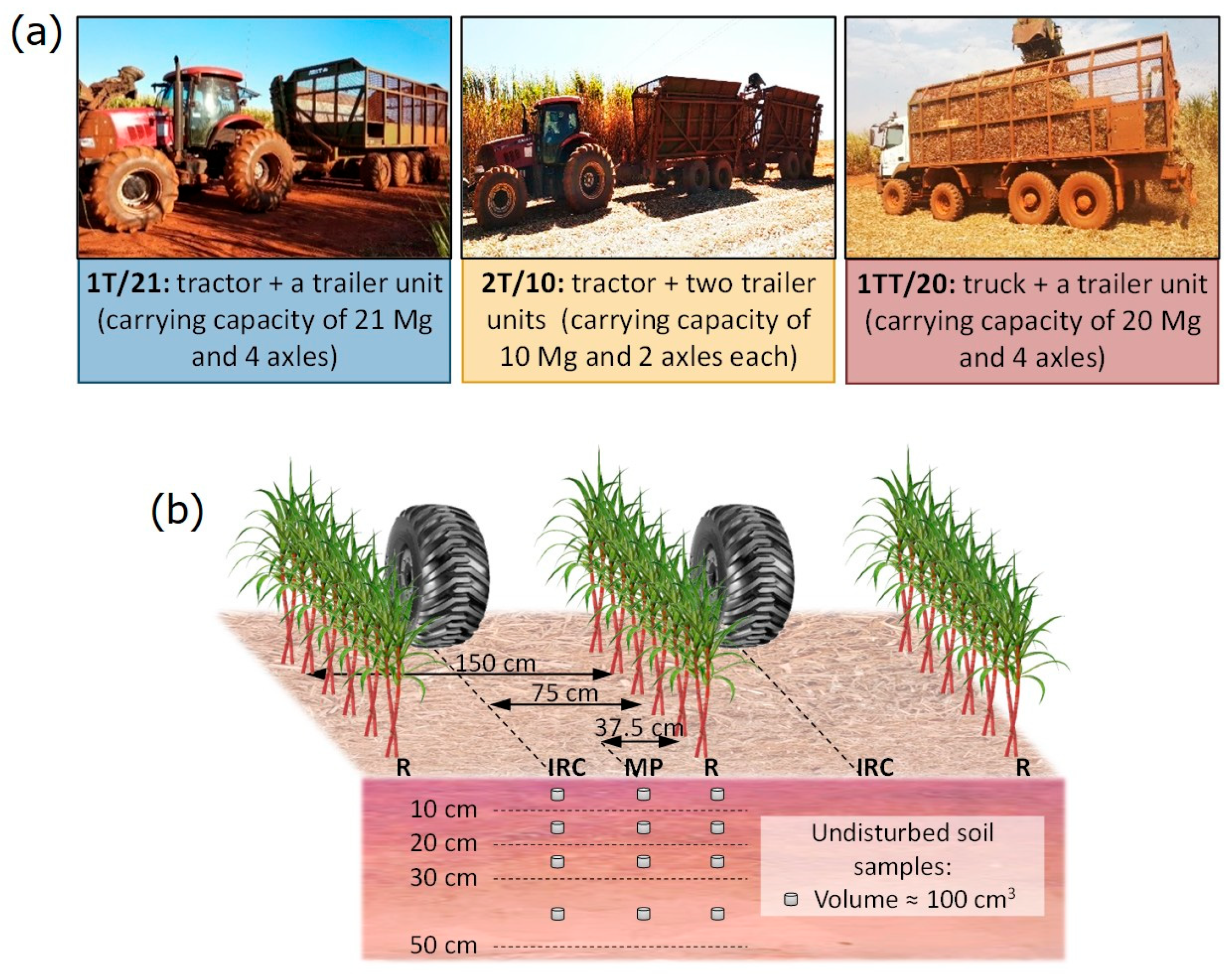
The experiment was implemented using a randomized complete block design with split plots, where three treatments corresponding to transshipment configurations used in mechanized sugarcane harvesting operations were evaluated with three replicates. The treatments were (Figure 1a): (i) a 134 kW tractor pulling one four-axle trailer unit with a carrying capacity of 21 Mg of sugarcane (1T/21); (ii) a 134 kW tractor pulling two axle trailer units with a carrying capacity of 10 Mg each (2T/10); (iii) a 228 kW autonomous truck with four axles and one trailer unit and a carrying capacity of 20 Mg (1TT/20). The parameters of the machines used in each treatment are described in Table 2. Although the evaluated transshipment systems are not mechanically equivalent in all their specifications (machinery, load capacity, wheel load, tire pressure, and axles), they represent different technological and operational pathways adopted in mechanized sugarcane harvesting.
The mechanized harvesting for the plant cane (first harvest), first ratoon (second harvest), and second ratoon (third harvest) cycles was carried out in August 2020 (13 months after planting), September 2021 (13 months after the first harvest), and October 2022 (13 months after the second harvest), respectively. In all cycles, a John Deere CH570 harvester (John Deere, Moline, IL, USA) was used, featuring a nominal/maximum power of 252 kW, a mass of 21 Mg, a track gauge of 1.88 m, and steel tracks 0.457 m wide, at an average operating speed of 4.5 km h−1. Sugarcane transshipment was performed according to the treatments described in Table 2. All mechanized operations were carried out under controlled traffic system with the aid of an onboard automatic steering system (Trimble, Sunnyvale, CA, USA). All the machines (tractor, trailer, and autonomous truck) had a track gauge adjustment of 3 m. Under this controlled traffic system, 37–42% of the area was trafficked by transshipment configurations (Figure S3). Specifically, the tractor rear tires in the 1T/20 and 2T/10 configurations trafficked 41.5% of the area, while their respective trailers impacted 40%. For the 1TT/20 configuration, the rear tires accounted for a trafficked area of 37.3%. Harvesting and transshipment operations were conducted under practical conditions of sugarcane harvesting at the mill, including machine configurations and time when the operation was carried out.
The Atterberg limits—plastic and shrinkage limits (Table 3)—were evaluated according to [36] and [40], respectively, and were previously reported in [39]. Soil water content at the time of machine traffic was determined from disturbed soil samples collected in the inter-row point of each plot (Table 3).

2.4. Soil Sampling and Structural and Functional Property Determinations

Undisturbed soil samples were collected in August 2020 (after the first harvest) and in September 2021 (after the second harvest) to measure soil bulk density and degree of compaction, saturated hydraulic conductivity, macroporosity, air-filled porosity, and soil air permeability. The samples were collected using stainless cylinders (4.9 cm diameter, 5.3 cm height, and volume ≈ 100 cm3) manufactured in-house at the School of Agricultural Engineering, University of Campinas (UNICAMP), from the planting line (R), the inter-row center (IRC), and the midpoint (MP) between the R and IRC positions at depths of 0–10, 10–20, 20–30, and 30–50 cm (Figure 1b). A total of 216 undisturbed soil samples were collected for each crop cycle.
The undisturbed soil samples were saturated by capillary rise with de-aired water. When saturation was reached, the saturated hydraulic conductivity (Ks) was measured using an automated KSAT system (UMS GmbH, Munich, Germany) with the falling-head method. During the test, measurements were performed at room temperature and the results normalized to a reference temperature of 20 °C. Subsequently, saturated samples were weighed and then equilibrated at matric potentials of −6 and −10 kPa using a sandbox (Eijkelkamp Soil & Water, Giesbeek, The Netherlands). After equilibrium was reached at each matric potential, the mass of each sample was measured. Soil air permeability (ka10) was determined at a matric potential of −10 kPa by the constant head method, using a custom-made laboratory permeameter similar to the one proposed by [41]. The measurement procedure followed the methodology described in [42]. The test was performed under controlled room temperature conditions of 20 °C, thus eliminating the effects of air viscosity variation due to temperature. The ka10 was calculated by:
k a 10 = q . η A p × L P × 1 × 10 12 μ m 2 m 2
where ka10 (μm2) is the air permeability at a matric potential of −10 kPa, q (m3·s−1) is the air flow rate, η (Pa·s) is the viscosity of air (1.84 × 10⁻⁵ Pa·s at 20 °C), Ap (m2) is the cross-sectional area of the soil sample, L (m) is the height of the soil sample, and P (Pa) is the differential air pressure.
After measurements, the samples were oven-dried at 105 °C for 24 h to determine dry mass and calculate bulk density (BD). The degree of compaction (DC, %) was then calculated as the ratio between BD and BDmax (DC = (BD/BDmax) × 100). Macroporosity (MaP, m3 m−3) was calculated from the water drained at −6 kPa (pores with diameter > 50 μm), and air-filled porosity (εa10) was calculated from the water drained at −10 kPa (pores with diameter > 30 μm). The pore continuity index (K1) was calculated based on the relationship between ka10 and εa10 (K1 = ka10a10) according to [43].

2.5. Crop Yield

The effect of the treatments on the crop yield was evaluated for the second and third harvests in September 2021 and 2022, respectively. Manual cutting of three rows of 5 m length, randomly distributed in each plot, was performed. The mass of stalks was measured on a digital scale with 0.1 kg precision (Kern & Sohn, Frommern, Germany) and converted to megagrams of cane per hectare (Mg ha−1).

2.6. Data Analysis

Statistical analyses were performed using SAS® OnDemand for Academics (SAS Institute Inc., Cary, NC, USA; available at https://welcome.oda.sas.com/, accessed on 1 December 2025). To evaluate the effects of treatments on the soil properties for each soil layer, a mixed model (PROC MIXED routine) was used with treatments, sampling positions, and the treatment × position interaction as fixed effects, and blocks and the treatment × block interaction as random effects. Data normality was verified by the Shapiro–Wilk test (p > 0.05) using the PROC UNIVARIATE routine. As ka10, K1, and Ks showed non-normal distribution, a log-transformation was applied. Regression analyses between soil properties were performed using the PROG REG routine.

3. Results and Discussion

3.1. Effects of Transshipment Configurations on Soil Structural Indicators

This study was conducted under real sugarcane harvesting field conditions in a commercial field in Southeast Brazil. Following the sugarcane mill’s operational schedule, the harvesting coincided with the dry season (Figure S2). Risk of soil compaction is highly dependent on soil moisture content, as soil precompression stress diminishes as water content increases [44]. At the time of the machines wheeling, the soil was quite dry, with soil water content ranging between 0.09 and 0.13 kg kg−1, close to the shrinkage limit (Table 3). Despite this low-moisture condition, which confers high soil strength, as shown in our previous study [39], the traffic of the transshipment systems caused distinct effects on soil structural indicators.
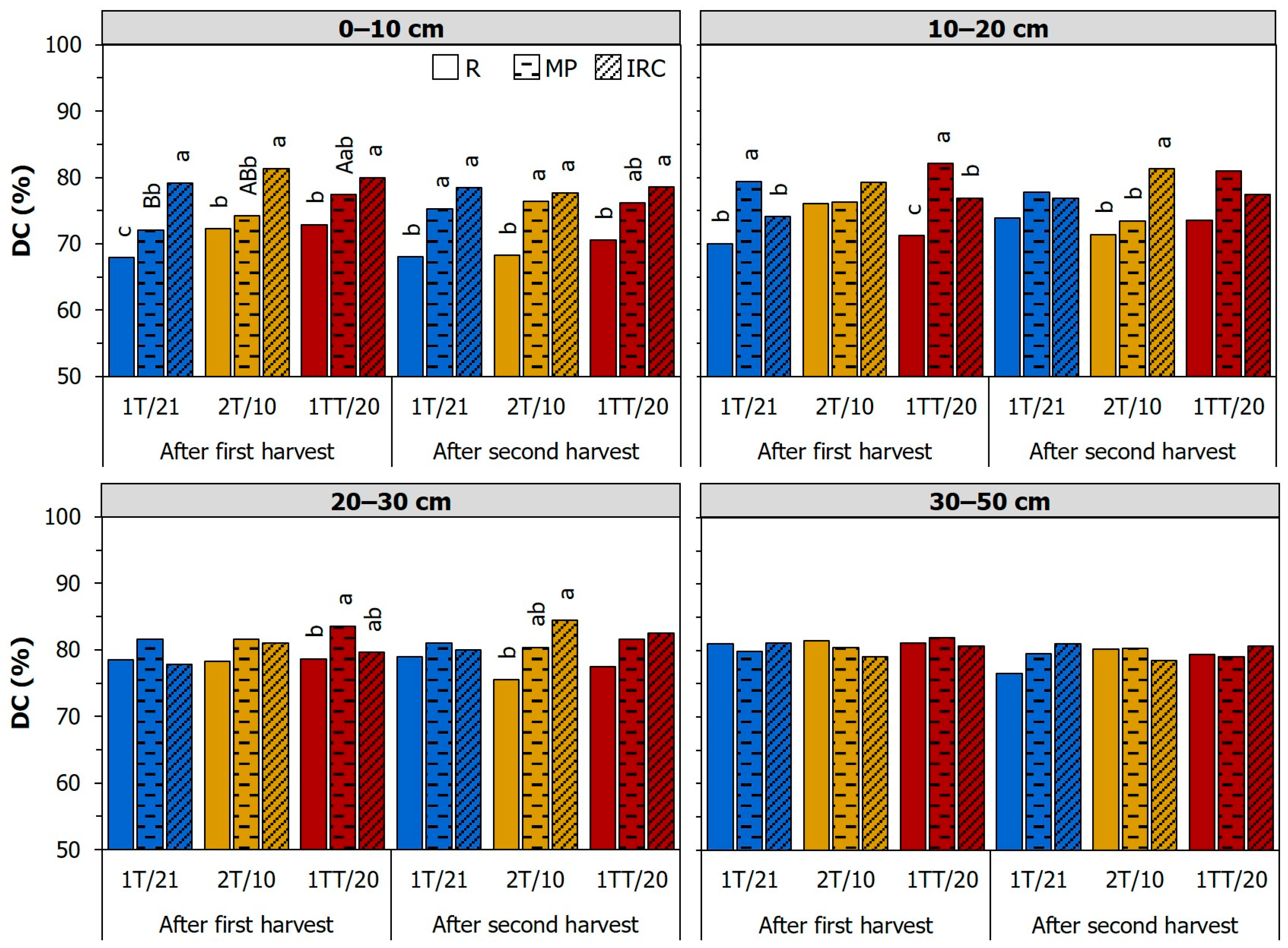
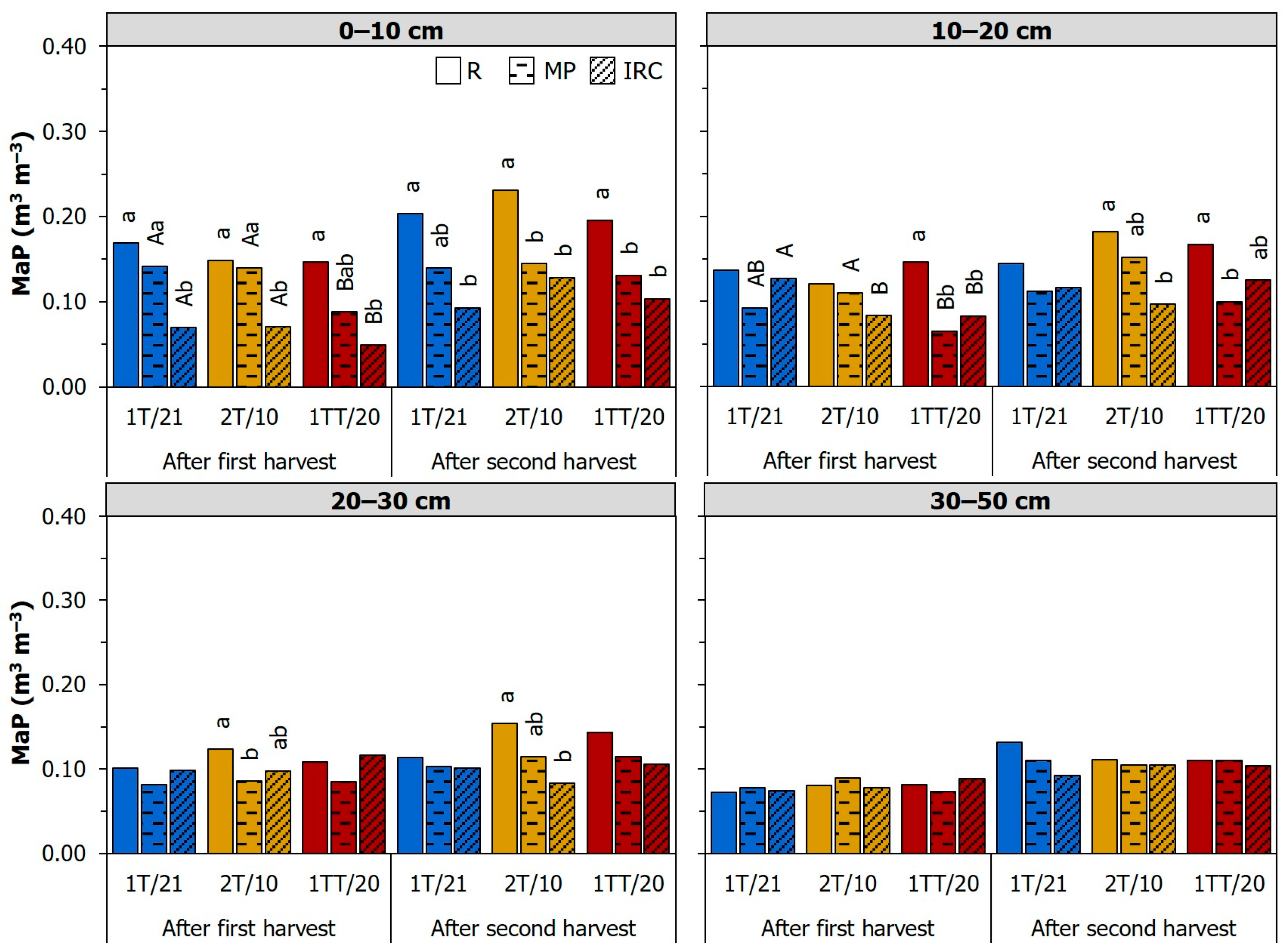
After the first harvest, significant alterations were observed in the degree of compaction (DC; Figure 2), macroporosity (MaP—pore diameter > 50 μm; Figure 3), and air-filled porosity at a matric potential of −10 kPa (εa10, pore diameter > 30 μm; Table 4), particularly in the surface layers (0–10 and 10–20 cm). After both the first and second harvests, DC varied between 68 and 84%. MaP ranged from 0.05 to 0.17 m3 m−3 after the first harvest and from 0.08 to 0.23 m3 m−3 after the second harvest. Correspondingly, εa10 ranged from 0.10 to 0.22 m3 m−3 and from 0.12 to 0.28 m3 m−3, respectively (Table 4).
The comparison of treatments at each position showed significant differences (p < 0.05) in DC, MaP, and εa10 only after the first harvest in the surface layers (up to 20 cm). The 1TT/20 transshipment system promoted the greatest soil compaction in the inter-row (IRC) and midpoint (MP) positions. In the 0–10 cm layer, the 1TT/20 reached the highest DC (77%) in the MP, resulting in a significant reduction in MaP (0.09 m3 m−3) and εa10 (0.13 m3 m−3). In the IRC of the same layer, although DC remained similar between treatments (79–81%), MaP was significantly lower in 1TT/20 (0.05 m3 m−3) compared to 1T/21 and 2T/10 (0.07 m3 m−3). In the 10–20 cm layer, despite no significant differences in DC between treatments in the IRC, there was a change in pore network distribution, with lower MaP values in 2T/10 and 1TT/20 (0.08 m3 m−3 in both treatments). In the MP, 1TT/20 also caused a reduction in MaP (0.07 m3 m−3) and εa10 (0.10 m3 m−3) compared to 2T/10 (0.11 and 0.15 m3 m−3). Despite this, no treatment exceeded the critical DC threshold of 87% reported for sugarcane root restriction [45].
Comparing sampling positions for each treatment, significant differences in DC (Figure 2), MaP (Figure 3), and εa10 (Figure 4) were obtained in the top three soil layers after both harvests. In the 0–10 cm layer following the first harvest, the IRC position consistently exhibited the highest DC and lowest MaP and εa10 values. Notably, the 1TT/20 treatment was the only configuration where the physical degradation at the MP was statistically equivalent to that observed in the IRC (p > 0.05), suggesting a broader impact area for this system. After the second harvest, both MP and IRC exhibited the highest DC and the lowest MaP and εa10. In general, the MaP and εa10 values increased by up to 111% and 83%, respectively, compared to the first harvest, except for the εa10 in the MP for 1T/21.
In the 10–20 cm layer, after the first harvest, DC was higher in MP for 1T/21 and 1TT/20. However, differences in MaP and εa10 only occurred in 1TT/20, with lower MaP in MP and IRC and lower εa10 in MP. Following the second harvest, higher DC was only observed in IRC in 2T/10, resulting in lower MaP and εa10. Furthermore, in the 1TT/20 treatment, MaP and εa10 showed a reduction in MP compared to R. In the 20–30 cm layer, significant differences in DC occurred only in 1TT/20 (MP > R) after the first harvest and in 2T/10 (IRC > R) after the second harvest. Nevertheless, differences in MaP and εa10 were observed only in 2T/10, with a reduction in MaP in MP compared to R after the first harvest and in MaP and εa10 in IRC compared to R after the second harvest.
Most of the significant differences obtained in DC were reflected in differences in MaP and εa10. During compaction, the reduction in soil volume is primarily due to a decrease in macropores [46]. In soils with low silt + clay content (<500 g kg−1), as in this study, the reduction in MaP is directly dependent on the increase in DC [47]. In addition to compression, the shear caused by tire traction contributes to pore volume distortion and alteration, as well as the disconnection of the soil’s porous network [27].
Our results indicate that while the planting row remained largely preserved across all depths and cycles, the midpoint frequently mirrored the degradation of the inter-row center. This was particularly evident in the 1TT/20 treatment, where greater soil compaction observed in the IRC and MP positions was attributed to the higher stresses transmitted to the soil by the tires, with greater differences in the superficial layers, as demonstrated in our previous study [39]. For this transshipment configuration, the stresses imposed by the tires of the rear axle (343 kPa) were almost double those under the tires of the 1T/20 (160 kPa) and 2T/10 (161 kPa) transshipment units, due to the higher wheel load, smaller tire width, and high inflation pressure (Table 2).
The effects of machinery traffic on soil compaction at the MP position suggest that imposed stresses could be transmitted to this zone, even with controlled traffic. There are several plausible explanations.
First, previous estimates of stresses under the tires of the machines used in this study showed that stresses of 25–75 kPa were propagated directly below the MP [39]. Secondly, although soil precompression stress in this position was not quantified, it is reasonable to assume the soil load-beating capacity to be lower than in the IRC since no mechanized operations occurred at this position during the crop cycle (e.g., herbicide application and fertilization), as all activities were conducted under controlled traffic. Therefore, the history of stresses imposed on the soil at the MP may have been lower compared to the IRC, which increased the risk of soil deformation even when subjected to stresses lower than those transmitted directly beneath the tire center. This assumption is supported by [48], who observed a trend of lower precompression stress values in the MP than in the IRC, regardless of whether the sugarcane harvest occurred with or without a controlled traffic system.
Third, incidental wheel traffic may have occurred at the MP position. Even with the use of controlled traffic and automatic steering, transshipment systems experience parallelism errors and misalignment [49]. In this study, the MP was defined as being 75 cm from both the R and the IRC. Theoretically, this implies that the center of the soil sample collected at this site was at a distance ranging from 7.5 cm (for the 1T/21 and 2T/10 trailer tires) to 9.5 cm (for the 1TT/20 rear tires) from the edge of the tire footprint (Figure S3), assuming no parallelism errors. These values are within the 10 cm safety margin commonly accepted for sugarcane crop [49].
On the other hand, although the 30–50 cm subsurface layer showed no differences in soil structural indicators between the transshipment systems and sampling positions, it exhibited a trend of high DC values (77 to 82%) and low MaP (0.07 to 0.09 m3 m−3) and εa10 values (0.10 to 0.13 m3 m−3). This condition is likely the result of accumulated subsoil compaction from the historical land use and soil re-compaction after mechanical subsoiling [50,51]. Even with the relatively recent use of the area for mechanized sugarcane (ten years), subsoil compaction has already occurred, which was not alleviated by tillage operations during sugarcane field renovation. Oliveira et al. [51] reported that subsoiling and harrowing reduced soil bulk density in surface layers but led to additional compaction at the maximum working depth of the subsoiler. These findings reinforce concerns about the persistence of subsoil compaction induced by machine traffic [2].
From a functional perspective, air-filled porosity is indicative of the status of soil aeration and its capacity to store and transport gases [52]. Values of εa10 below 0.10 m3 m−3 are commonly used as a threshold for restrictive aeration conditions [53]. This condition was observed after the first harvest in the 0–10 cm layer at the IRC position for 1T/21 and 1TT/20 treatments (0.10 m3 m−3, Table 4). However, after the second harvest, this condition was overcome, with relative increases of 52% and 83% for 1T/21 and 1TT/20, respectively.
In general, the second sugarcane harvest did not result in significant differences for DC, MaP, and εa10 among the transshipment configurations. Furthermore, machine traffic did not promote degradation in these indicators in relation to the soil condition after the preceding harvest. For instance, DC showed a reduction in 67% of the treatment, position, and layer combinations, with a relative decrease of up to 6%, while the remaining 33% showed a maximum increase of 5%. For MaP and εa10, in 89% of the combinations there was a relative increase of up to 55% and 83%, respectively, while only 11% had a relative reduction of up to 15% and 10%, respectively.
This trend of improving soil physical condition following the second harvest may have been attributed to two possible mechanisms. First, the increased soil strength due to compression during wheeling in the first harvest, combined with low soil water content at the time of the second harvest, gave the soil greater load-bearing capacity. Souza et al. [48] demonstrated increases in load-bearing capacity in the first ratoon cane compared to the plant cane, which rose from 9% to 18% and from 19% to 33% in the 0–15 and 15–0.30 cm soil layers. This is in line with [54], who showed that soils with a high degree of compaction are less susceptible to further compaction, as increases in the degree of compactness can enhance soil strength and decrease soil compressibility and elasticity. Second, natural wetting and drying cycles, as well as the formation of biopores from biological activity [55] and the accumulation of sugarcane roots over the crop cycles [56], led to an increase in the fraction of larger pores. Research has shown that large biopores can be preserved even after compaction events induced by agricultural traffic [57] and that these larger biopores are more stable than smaller ones due to their denser walls [58].

3.2. Effects on Functional Properties

Soil air permeability (ka10) is a fundamental property of soil structure functionality, reflecting the ability of the porous system to achieve gas transport [42,46,59]. Likewise, soil hydraulic conductivity (Ks) is a key hydrological attribute that governs the partitioning of water between infiltration and surface runoff, thereby regulating processes such as overland flow, flooding, and soil erosion [2].
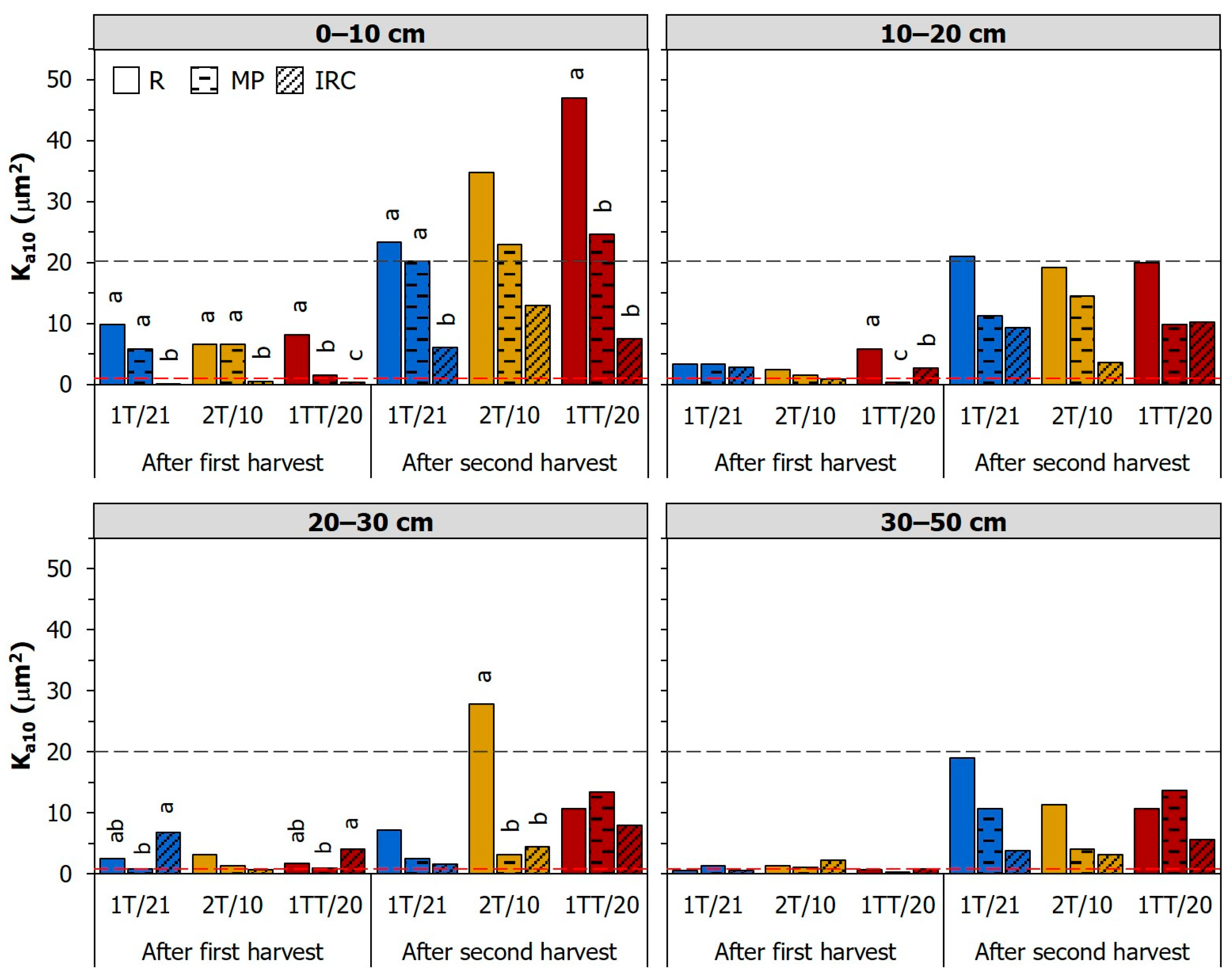
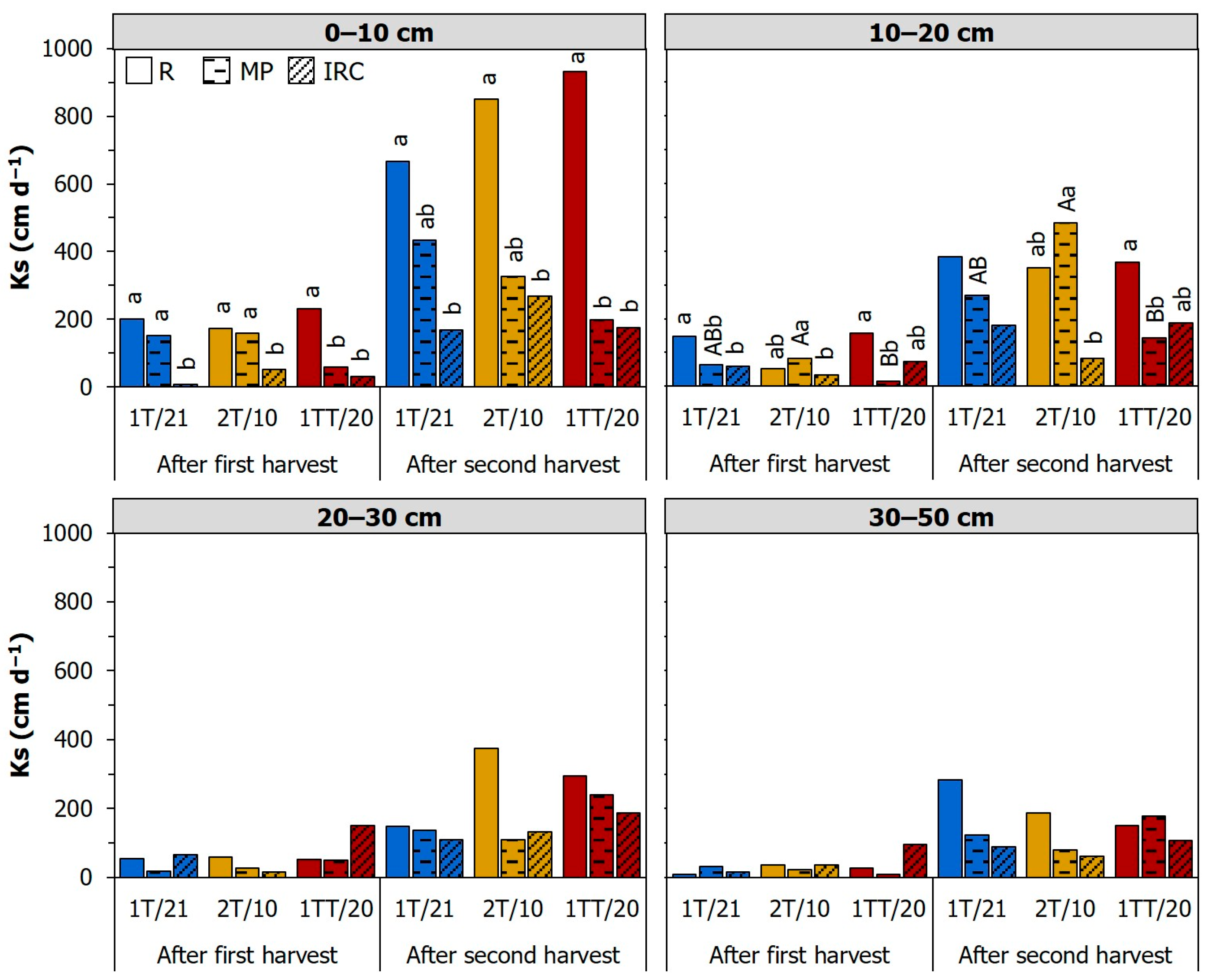
Both ka10 and Ks are soil properties that exhibit high variation. Following the first and second harvests, ka10 values ranged from 0.11 to 9.77 μm2 (CV 30–157%) and 1.59 to 47.01 μm2 (CV 41–208%), respectively (Figure 4 and Table S1). The order of magnitude of these values is consistent with those reported by [60] for the surface layer of a clayey Oxisol after five years of mechanized sugarcane harvesting in the Midwest region of Brazil. Similarly, Ks ranged from 6.6 to 230 cm d−1 (CV 4–122%) after the first harvest and from 60.6 to 930.9 cm d−1 (CV 29–175%) after the second harvest (Figure 5 and Table S1).
Despite the observed differences in DC, MaP, and εa10, no significant differences in ka10 were observed between transshipment configurations (Figure 4). The absence of significant differences between treatments in ka10 is supported by the absence of differences on the pore continuity index (K1, Table 5), indicating that pore size distribution and continuity have largely remained, since pore space contributes proportionally to air permeability [43].
Figure 4. Soil air permeability at −10 kPa matric potential (ka10) after the first and second mechanized sugarcane harvests using different transshipment systems. In the same soil layer, means followed by the same lowercase letter (comparing positions in the same treatment), or without letters do not differ statistically (Tukey’s test, p < 0.05), based on transformed data (Log(ka10 + 1)). No significant differences were found between treatments at the same position. R = planting row; IRC = inter-row center; MP = midpoint between R and IRC positions. Dashed red line indicates the threshold for low permeability (ka10 ≤ 20 μm2) [61]; dashed gray line represents the threshold for impermeable soil conditions (ka10 ≤ 1 μm2) [62,63].
Agriengineering 08 00082 g004
Regarding Ks, significant treatment effects were restricted to the 10–20 cm at the MP position (Figure 5). In this layer, the 1TT/20 configuration showed lower Ks values (13 and 143 cm d−1) compared to 2T/10 (83 and 483 cm d−1) after the first and second harvests, respectively. Ks is predominantly influenced by the presence of continuous macropores that act as preferential flow paths [64].
Figure 5. Saturated hydraulic conductivity (Ks) after the first and second mechanized sugarcane harvests using different transshipment systems. In the same soil layer, means followed by the same uppercase letter (comparing treatments in the same position), lowercase letter (comparing positions in the same treatment), or without letters do not differ statistically (Tukey’s test, p < 0.05) based on transformed data (Log(Ks)). R = planting row; IRC = inter-row center; MP = midpoint between R and IRC positions.
Agriengineering 08 00082 g005
However, differences in ka10 and Ks among sampling positions were observed, with all treatments showing a consistent decline in physical functionality within the IRC (Figure 4 and Figure 5). For the 0–10 cm layer, the IRC consistently exhibited lower ka10 values compared to the R and MP, a trend particularly evident in the 1T/21 and 2T/10 systems. The 1TT/20 configuration, however, demonstrated the most widespread impact, significantly reducing ka10 at both the IRC and midpoint MP compared to the R position by 96% and 81%, respectively, after the first harvest, and by 84 and 48% after second harvest. Furthermore, under the same transshipment configuration, in the 10–20 and 20–30 cm layers, ka10 was significantly lower at the MP compared to both the IRC and R positions in the 10–20 and 20–30 cm layers after the first harvest. Conversely, in the 20–30 cm layer, ka10 was lower in MP compared to IRC for 1TT/20 and 1T/21 after the first harvest and in the IRC and MP compared to R after the second harvest.
Saturated hydraulic conductivity followed a similar spatial trend. In the 0–10 cm layer, Ks was consistently lower in the IRC across all treatments, reinforcing the functional degradation of the trafficked zone. The 1TT/20 system again extended this impact to the MP, where Ks was reduced from 230 to 59 cm d−1 after first harvest and from 930 to 200 cm d−1 after the second harvest, compared to the R position. In the 10–20 cm layer, both 1T/21 and 1TT/20 induced significant declines in Ks at the MP and IRC positions, while 2T/10 showed localized reductions in the IRC. In contrast, no significant differences in Ks were observed among treatments and positions in the 20–30 and 30–50 cm layers.
The soil degradation observed mainly in the IRC in the surface layer is a direct consequence of compaction induced by heavy machine traffic, which exerts shear stress on the soil and physically distorts the pore network. This process breaks the continuity of macropores, thereby increasing their tortuosity and, consequently, reducing their air flow capacity [27]. In contrast, higher ka10 in R is favored by higher MaP (Figure 3), εa10 (Table 4), and K1 (Table 5), due to the absence of traffic at this position and the larger volume of roots [60,65] concentrated in the stubble zone [19,66,67].
Functionally, soils with ka10 values ≤ 20 μm2 exhibit low permeability [61], while ka10 values ≤ 1 μm2 indicate an impermeable soil condition [62,63]. After the first harvest, all treatments exhibited low air permeability, with impermeable soil conditions observed in at least one layer of each treatment, for instance, in the 0–10 cm layer in the IRC for all treatments; in the 10–20 cm layer in the IRC (2T/10) and MP (1TT/20); in the 20–30 cm layer in the MP and IRC (1T/21 e 1TT/20) and in the 30–50 cm layer in R and IRC (1T/21) and at all positions (1TT/20) (Figure 5). After the second harvest, ka10 increased in all treatments, overcoming the impermeability condition but generally remaining within the low permeability range. More expressive improvement was observed only in the R and MP positions in the 0–10 cm layer for all treatments, in R in the 10–20 cm layer (1TT/21), and in R in the 20–30 cm layer (2T/10), with values between 20 and 50 μm2. This pattern of incomplete and localized recovery suggests that the natural resilience of the soil is not sufficient to completely mitigate the effects of intense mechanization.
Air permeability and air-filled porosity are crucial for soil aeration, as these properties govern the physical restrictions to gas exchange. Generally, elevated air permeability values promote gas exchange between the soil and the atmosphere, which contributes to the replenishment of oxygen and the removal of detrimental gases in the rhizosphere [68]. On the other hand, low air permeability levels can severely impair soil aeration, particularly in more compacted layers, and heighten the risk of anoxic conditions within the soil profile, which can play a critical role in the production and mobilization of greenhouse gases [26] and may interfere with root development [68]. Soil compaction typically increases N2O fluxes by restricting aeration, a process that can be mitigated by traffic control strategies that preserve soil pore functions and maintain lower water-filled pore space [28,69]. According to the meta-analysis by [28], controlled traffic can substantially reduce N2O fluxes by one-third compared with random traffic.
Soil compaction reduces Ks, with its behavior negatively correlated with the increase in DC due to the distortion of the porous system, reducing the volume of large pores responsible for water movement under saturated conditions and converting them into storage pores [56]. The reduction in Ks may affect crop yields and result in negative impacts on the ecosystem [70]. Lower hydraulic conductivity increases the susceptibility of the soil to more intense surface runoff events, reduces water storage due to lower infiltration, and increases the risk of erosion in agricultural areas, potentially leading to an increase in the diffusion of nutrient loads to reservoirs [2,71].
In general, soil compaction, indicated by the increase in DC, promoted a redistribution of the porous system, leading to a reduction in MaP and εa10, and consequently, a decrease in both ka10 and Ks (Figure S3). In the studied soil, DC values exceeding 83% were found to severely compromise air flow, a condition specifically observed in the 20–30 cm layer at the MP of the 1TT/20 treatment and in the IRC of the 2T/10 treatment (Figure S4c). Soil air permeability and saturated hydraulic conductivity showed an exponential dependence on pore size [72] as demonstrated in Figure S4a,b. Therefore, the reduction in MaP and εa10 meant a degradation in soil structure, resulting in a reduction in both water and air flows. In this soil, a critical εa10 value of 0.10 m3 m−3 corresponded to a ka10 value of 3 μm2, which was greater than the critical threshold of 1 μm2 suggested by [62,63] (Figure S5a).
In fact, the saturated hydraulic conductivity and the soil air permeability showed a linear relationship (Log-Log), which explained 86% of the data variability, with a prediction accuracy of ±0.36 orders of magnitude (Figure S6). Theoretically, intrinsic permeability at saturation is equivalent for both water and air; however, higher viscosity and the interaction of water with the soil matrix reduce its conductivity in relation to air [41]. Thus, under saturated conditions, the soil structure analogously regulates the convective flow of both water and air [41].

3.3. Sugarcane Yield Under Different Controlled Traffic Transshipment Configurations

Sugarcane yield showed no significant differences among transshipment systems assessed (p > 0.05; Table 6). Despite the absence of statistical difference, productivity decreased in the sequence 1T/21 > 1TT/20 > 2T/10 and 1TT/20 > 2T/10 > 1T/20 for the second and third harvests, respectively (Table 6). In all treatments, there was an increase in productivity from the second to the third harvest, with relative variations between 14.43% and 27.63% occurring in treatments 1T/21 and 2T/10, respectively. This increase in productivity resulted in values higher than the production estimates for this 2022/2023 harvest for Brazil, the Southeast region, and Minas Gerais State (70.48, 72.05 and 78.14 Mg ha−1, respectively) [73]. The low crop yields obtained in all treatments in the second harvest can be attributed mainly to the rainfall levels recorded in the experimental area (Figure S2). Although the water requirement for sugarcane development varies from 1500 to 2500 mm, between 1100 and 1500 mm is considered sufficient for good crop development [74]. The period from August 2020 to September 2021, corresponding to the 2021/2022 crop year, was marked by an accumulated precipitation of 797 mm, with a significant reduction in rainfall during the summer months (November 2020 to February 2021), a critical period for ratoon cane development. In the 2022/2023 crop year, the accumulated precipitation was 1143 mm, closer to the ideal level. This may have contributed to the relative increase in productivity observed in all treatments, with variations from 14.43% to 27.63% (Table 6). In sugarcane cultivation, water deficit is one of the abiotic stresses that most reduces production, affecting the crop even in rainy seasons due to the occurrence of dry spells [75].
Although the use of different transshipment configurations promoted soil compaction with significant differences, primarily in DC, MaP, and εa10, in the surface layers, these alterations occurred predominantly in the inter-row and, occasionally, at the midpoint, without directly impacting the planting row zone. Therefore, the lack of yield response is likely attributed to the spatial management of machinery traffic rather than a lack of physical impact on the soil. In controlled traffic farming systems, stress propagation is restricted to the traffic lane [39], thereby preserving the soil structure within the crop row [19,20], as demonstrated in this study.
Furthermore, considering that most of the sugarcane root system is concentrated within 30 cm of the planting row and in the top 40 cm of the soil profile [67,76], the preservation of this stool zone allows for adequate root development and for nutrient and water uptake [20,77,78]. Thus, in this study, no differences in crop yield should be interpreted as a benefit of localized traffic management. Specifically, in the R, the DC remained below the critical threshold of 83%, which corresponded to a limiting εa10 of 0.10 m3 m−3. Additionally, ka10 in this position remained above 3 µm2 down to the 30 cm depth, exceeding the critical limit associated with that same aeration porosity. Conversely, the functional properties within the inter-row reached critical thresholds that could impair broader soil health and hydrological functions [64], even if they did not translate into immediate productivity losses [69]. However, it is important to note that the high degree of compaction in the trafficked area provides benefits for machinery trafficability by increasing soil strength and reducing rolling resistance for subsequent operations [72].
On the other hand, the impacts of machinery traffic on soil structure are cumulative and tend to intensify over successive harvest cycles, as sugarcane harvesting is cumulative [77,79,80]. Although significant yield reductions were not observed in this study, long-term research indicates that continuous mechanized operations progressively degrade soil physical quality, often extending compaction to deeper subsurface layers [79,80]. Our findings regarding the reduction in macroporosity and air permeability in the surface layers (0–20 cm) likely represent the initial stage of a long-term degradation process. Successive harvesting can cause compaction to migrate to deeper soil layers (below 0.40 m), where recovery is significantly more difficult [80]. Valente et al. [79] observed that even with the adoption of controlled traffic, successive harvests lead to a gradual reduction in macroporosity and an increase in soil penetration resistance across the soil profile, which may eventually impair root system expansion and crop longevity. Therefore, the findings of this study should be interpreted within its specific temporal scope. Continuous monitoring is essential, as the cumulative structural damage in the traffic lanes could eventually reach the root zone or impair broader hydrological functions.
Long-term mitigation of soil compaction requires a systemic approach. The effectiveness of such controlled traffic in preserving the stool zone is dependent on the precise matching of machine track gauges and field layout, thereby ensuring consistent overlap of traffic lanes [12,21]. As emphasized by [15,21], inadequate synchronization between the transshipment track gauge and the crop row spacing is a primary driver of accidental compaction over the planting rows. Under practical field conditions, since Brazilian sugarcane is mainly cultivated with 1.5 m row spacing, the track gauges of all machines must be standardized to 3.0 m. Otherwise, the structural degradation restricted to the inter-rows could extend closer to the planting rows. Esteban et al. [81] reported that even when employing controlled traffic, without track gauge adjustment (2.1 m), tractors trafficked 87% of the field area, whereas trailers adjusted to 3.0 m impacted only 40%. Conversely, Souza et al. [21] observed that the area trafficked was reduced to 47% when the entire tractor–trailer set was properly adjusted (3.0 m). This misalignment bypasses the benefits of controlled traffic and potentially leads to significant yield losses [15]. Furthermore, even with the use of controlled traffic and automatic steering, transshipment systems (trailers towed by tractors) experience parallelism errors and misalignment, strongly associated with the slope of the terrain and the type of path (straight or curved) [49]. These authors highlighted that the magnitude of this error is even greater in longer equipment combinations and/or in those with a higher number of articulation points.
Beyond machinery adjustments, a forward-looking mitigation of soil compaction strategy in sugarcane fields involves the integration of a controlled traffic system with localized soil tillage or strip tillage [24,82]. Strip tillage is a conservationist management practice that involves mobilizing soil only within the strip designated for the planting row, thereby preserving the soil structure of the inter-rows [24]. Strip tillage avoids the energy-intensive process of subsoiling the entire field, which often results in soil that is even more susceptible to subsequent compaction [24].
While controlled traffic effectively confines structural degradation to permanent traffic lanes, as evidenced by the functional losses observed in IRC position, strip tillage ensures that the planting row remains a highly favorable environment for root development [23,24,82]. Lima et al. [23] demonstrated that strip tillage can reduce soil penetration resistance in planting beds to levels as low as 1.45 MPa, significantly lower than the 2.55 MPa found in trafficked conventional tillage systems. These authors also reported that strip tillage reduced root dry mass in the bed by 47% to 62% compared to a conventional tillage system. According to [24], this integrated approach limits soil mobilization to only 53% of the total area, providing quantifiable benefits in operational and environmental efficiency. This includes an average reduction in diesel consumption of 43.5% and estimated CO2 emission reductions ranging from 163 to 315.4 kg ha−1. However, they highlighted the urgent need for standardized experimental validation to fully optimize the integration of traffic control and localized tillage in diverse sugarcane production environments.
Finally, it is important to note that in this study, harvesting and transshipment operations were conducted during the dry season (August–September, a period when soil moisture is typically low (Table 3 and Figure S2), which increases soil load-bearing capacity. However, in the broader context of Brazilian sugarcane production, the harvest season spans from March to December in the South–Central region and from November to April in the Northeast. Mechanized operations frequently occur under higher soil moisture conditions and the risk of structural degradation would be significantly higher than reported here. This concern is supported by [11], who demonstrated that mechanized sugarcane harvesting in a Brazilian Cerrado Oxisol can induce additional compaction even when performed within the friability zone. Similarly, Toledo et al. [54] highlighted the high susceptibility to compaction in sugarcane fields when matric potentials are close to field capacity. Therefore, while our results provide a comparative baseline for different transshipment systems, they should be interpreted as a conservative estimate of the potential structural damage that can occur across a full operational season.

4. Conclusions

Under controlled traffic conditions, all transshipment systems caused soil compaction during the first harvest, even though operations were conducted at low soil water content. Structural degradation was concentrated in the 0–10 and 10–20 cm layers and occurred primarily in the inter-row center and, in some cases, at the midpoint between the row and inter-row. The planting row remained structurally preserved.
Among the evaluated systems, 1TT/20 induced the greatest compaction intensity. This configuration, characterized by higher wheel load, narrower tires, and higher inflation pressure, significantly increased degree of compaction and reduced macroporosity and air-filled porosity in the surface layers, particularly in the inter-row and midpoint.
Despite structural alterations, no significant differences were observed among treatments for soil air permeability, pore continuity index, or saturated hydraulic conductivity. However, after the first harvest, air permeability frequently reached critical thresholds of low permeability in trafficked areas, indicating functional degradation of soil aeration. After the second harvest, most treatments exhibited partial structural recovery, with increases in macroporosity, air-filled porosity, air permeability, and saturated hydraulic conductivity, reflecting soil resilience under controlled traffic management.
Sugarcane yield was not affected by the different transshipment configurations. The absence of productivity differences reflects the effectiveness of controlled traffic in confining compaction to the inter-row center and midpoint while preserving the planting row. Although short-term yield was not affected, structural degradation in trafficked areas and the persistence of high subsoil compaction indicate the potential for cumulative long-term impacts. Continuous monitoring and integrated soil management strategies remain essential to mitigate progressive compaction under mechanized sugarcane harvesting.

Supplementary Materials

The following supporting information can be downloaded at https://www.mdpi.com/article/10.3390/agriengineering8030082/s1, Figure S1: Soil compaction curve obtained by the normal Proctor test for an Oxisol from the experimental area cultivated with sugarcane. BD = soil bulk density; W = water content; BDmax = maximum soil bulk density. Figure S2: Sequential 10-day water balance, air temperature (T), and precipitation (P) during the conduction of experiment in Frutal, Minas Gerais State, Southeast Brazil. The date labels on the X-axis represent the first 10-day period of each month. Figure S3: Trafficked area (AT) at mechanized sugarcane harvest using different transshipment systems. tw = tire width; R = planting row; IRC = inter-row center; MP = midpoint between R and IRC positions. Wheels in the position I indicate the traffic lane on the route for the harvest of a sugarcane row; position II indicates the return route for the harvest of the adjacent rows. Figure S4: Linear relationship between air-filled porosity (εa10, a), soil air permeability (ka10, b), and saturated hydraulic conductivity (Ks, c) as a function of the degree of compaction (DC, d) for an Oxisol after mechanized sugarcane harvesting. The dashed lines indicate the critical soil compaction values for εa10 = 0.10 m3 m−3 and for ka10 = 1 μm2. CI = 95% confidence interval. Figure S5: (a) Soil air permeability (ka10) as a function of air-filled porosity (εa10). (b) Saturated hydraulic conductivity (Ks) as a function of macroporosity (MaP) for an Oxisol after mechanized sugarcane harvesting; 95% CI = 95% confidence interval of the population; 95% PI = 95% prediction interval of the population. The dashed line indicates the critical soil compaction value for εa10 = 0.10 m3 m−3. Figure S6: Prediction relationship between saturated hydraulic conductivity (Log(Ks)) and soil air permeability (Log(ka10)) for an Oxisol after mechanized sugarcane harvesting; 95% CI = 95% confidence interval of the population; 95% PI = 95% prediction interval of the population. Table S1: Coefficient of variation (%) of soil air permeability (ka10) and saturated hydraulic conductivity (Ks) for an Oxisol after the first and second mechanized sugarcane harvests.

Author Contributions

Conceptualization, D.A.A.E. and Z.M.d.S.; methodology, D.A.A.E., Z.M.d.S. and C.A.T.; software, D.A.A.E., M.T.d.M. and R.P.d.L.; validation, D.A.A.E., Z.M.d.S., C.A.T., V.M.V.-R., M.T.d.M. and R.P.d.L.; formal analysis, D.A.A.E., C.A.T., V.M.V.-R., M.T.d.M. and R.P.d.L.; investigation, D.A.A.E., M.G.d.S.G. and J.A.S.P.; resources, D.A.A.E. and Z.M.d.S.; data curation, D.A.A.E., C.A.T., V.M.V.-R., M.T.d.M. and R.P.d.L.; writing—original draft preparation, D.A.A.E. and C.A.T.; writing—review and editing, D.A.A.E., Z.M.d.S., C.A.T., M.G.d.S.G., J.A.S.P., V.M.V.-R., M.T.d.M. and R.P.d.L.; visualization, D.A.A.E., M.G.d.S.G., J.A.S.P. and V.M.V.-R.; supervision, Z.M.d.S. and C.A.T.; project administration, D.A.A.E. and Z.M.d.S.; funding acquisition, D.A.A.E. and Z.M.d.S. All authors have read and agreed to the published version of the manuscript.

Funding

The first author received a scholarship from the National Council for Scientific and Technological Development—CNPq (grant number 140955/2019-4) and from the “Ministerio de Ciencia, Tecnología e Innovación de Colombia–MINCIENCIAS” (during the period May 2020–February 2023, grant number 106271). The research was supported with funding from AGRISUS Foundation—Sustainable Agriculture (grant number PA 3054/21) and by the São Paulo Research Foundation—FAPESP (grant number 2021/090772).

Institutional Review Board Statement

Not applicable.

Informed Consent Statement

Not applicable.

Data Availability Statement

The original contributions presented in the study are included in the article; further inquiries can be directed to the corresponding author.

Acknowledgments

The authors thank “Usina Cerradão” for the availability of the experimental area and for the logistical support (equipment and machinery, crop management, and technical and field staff) in conducting the research.

Conflicts of Interest

Author Viviana Marcela Varón Ramirez was employed by the Corporación Colombiana de Investigación Agropecuaria (AGROSAVIA), a public research institution. The authors declare no conflict of interest.

Abbreviations

The following abbreviations are used in this manuscript:
1T/21Tractor pulling one four-axle trailer unit with 21 Mg carrying capacity
1TT/20Autonomous truck with four axles and one trailer with 20 Mg carrying capacity
2T/10Tractor pulling two axle trailer units with 10 Mg carrying capacity
BDSoil bulk density
BDmaxMaximum bulk density
DCDegree of compaction
IRCInter-row center
K1Pore continuity index
ka10Soil air permeability
KsSaturated hydraulic conductivity
MaPMacroporosity
MPMidpoint between R and IRC positions
RPlanting row
εa10Air-filled porosity

References

  1. Keller, T.; Or, D. Farm Vehicles Approaching Weights of Sauropods Exceed Safe Mechanical Limits for Soil Functioning. Proc. Natl. Acad. Sci. USA 2022, 119, e2117699119. [Google Scholar] [CrossRef]
  2. Keller, T.; Sandin, M.; Colombi, T.; Horn, R.; Or, D. Historical Increase in Agricultural Machinery Weights Enhanced Soil Stress Levels and Adversely Affected Soil Functioning. Soil Tillage Res. 2019, 194, 104293. [Google Scholar] [CrossRef]
  3. ten Damme, L.; Stettler, M.; Pinet, F.; Vervaet, P.; Keller, T.; Munkholm, L.J.; Lamandé, M. The Contribution of Tyre Evolution to the Reduction of Soil Compaction Risks. Soil Tillage Res. 2019, 194, 104283. [Google Scholar] [CrossRef]
  4. Sonderegger, T.; Pfister, S.; Hellweg, S. Assessing Impacts on the Natural Resource Soil in Life Cycle Assessment: Methods for Compaction and Water Erosion. Environ. Sci. Technol. 2020, 54, 6496–6507. [Google Scholar] [CrossRef] [PubMed]
  5. Stoessel, F.; Sonderegger, T.; Bayer, P.; Hellweg, S. Science of the Total Environment Assessing the Environmental Impacts of Soil Compaction in Life Cycle Assessment. Sci. Total Environ. 2018, 630, 913–921. [Google Scholar] [CrossRef]
  6. Magalhães, P.S.G.; Braunbeck, O.A. Sugarcane and Straw Harvesting for Ethanol Production. In Sugarcane Bioethanol—R&D for Productivity and Sustainability; Cortez, L.A.B., Ed.; Editora Edgard Blücher: São Paulo, Brazil, 2014; pp. 465–476. [Google Scholar]
  7. CONAB—Companhia Nacional de Abastecimento. Acompanhamento da Safra Brasileira de Cana-de-Açúcar; V12–Safra 2024/25, n.4-Quarto Levantamento; CONAB: Brasília, DF, Brazil, 2025.
  8. Bordonal, R.d.O.; Carvalho, J.L.N.; Lal, R.; de Figueiredo, E.B.; de Oliveira, B.G.; La Scala, N. Sustainability of Sugarcane Production in Brazil. A Review. Agron. Sustain. Dev. 2018, 38, 13. [Google Scholar] [CrossRef]
  9. Cavalcanti, R.Q.; Rolim, M.M.; Lima, R.P.D.; Tavares, U.E.; Pedrosa, E.M.R.; Gomes, I.F. Soil & Tillage Research Soil Physical and Mechanical Attributes in Response to Successive Harvests under Sugarcane Cultivation in Northeastern Brazil. Soil Tillage Res. 2019, 189, 140–147. [Google Scholar] [CrossRef]
  10. Guimarães Júnnyor, W.d.S.; Diserens, E.; De Maria, I.C.; Araujo-Junior, C.F.; Farhate, C.V.V.; de Souza, Z.M. Prediction of Soil Stresses and Compaction Due to Agricultural Machines in Sugarcane Cultivation Systems with and without Crop Rotation. Sci. Total Environ. 2019, 681, 424–434. [Google Scholar] [CrossRef] [PubMed]
  11. Severiano, E.D.C.; Oliveira, G.C.D.; Dias Júnior, M.D.S.; Castro, M.B.D.; Oliveira, L.F.C.D.; Costa, K.a.D.P. Compactação de Solos Cultivados Com Cana-de-Açúcar: I-Modelagem e Quantificação Da Compactação Adicional Após as Operações de Colheita. Eng. Agríc. 2010, 30, 404–413. [Google Scholar] [CrossRef]
  12. Braunbeck, O.A.; Magalhães, P.S.G. Technological Evaluation of Sugarcane Mechanization. In Sugarcane Bioethanol—R&D for Productivity and Sustainability; Cortez, L.A.B., Ed.; Editora Edgard Blücher: São Paulo, Brazil, 2014; pp. 451–464. [Google Scholar]
  13. Lozano, N.; Rolim, M.M.; Oliveira, V.S.; Tavares, U.E.; Pedrosa, E.M.R. Evaluation of Soil Compaction by Modeling Field Vehicle Traffic with SoilFlex during Sugarcane Harvest. Soil Tillage Res. 2013, 129, 61–68. [Google Scholar] [CrossRef]
  14. Jimenez, K.J.; Rolim, M.M.; Gomes, I.F.; de Lima, R.P.; Berrío, L.L.A.; Ortiz, P.F.S. Numerical Analysis Applied to the Study of Soil Stress and Compaction Due to Mechanised Sugarcane Harvest. Soil Tillage Res. 2021, 206, 104847. [Google Scholar] [CrossRef]
  15. Delmond, J.G.; Guimarães Junnyor, W.d.S.; Brito, M.F.d.; Rossoni, D.F.; Araujo-Junior, C.F.; Severiano, E.d.C.; Severiano, E.C. Which Operation in Mechanized Sugarcane Harvesting Is Most Responsible for Soil Compaction? Geoderma 2024, 448, 116979. [Google Scholar] [CrossRef]
  16. Silva, R.B.d.; Iori, P.; Souza, Z.M.d.; Pereira, D.d.M.G.; Vischi Filho, O.J.; Silva, F.A.d.M. Contact Pressures and the Impact of Farm Equipment on Latosol with the Presence and Absence of Sugarcane Straw. Ciênc. Agrotecnologia 2016, 40, 265–278. [Google Scholar] [CrossRef]
  17. Melo, M.O.; Rosa, J.H.M. Corte, Transbordo e Transporte (CTT): Uso de Transbordo na Colheita Mecanizada e Seus Impactos no CTT. In Processos Agrícolas e Mecanização da Cana-de-Açúcar; Belardo, G.d.C., Cassia, M.T., Pereira da Silva, R., Eds.; SBEA: Jaboticabal, Brazil, 2015; pp. 429–437. [Google Scholar]
  18. Chamen, T.W.C.; Moxey, A.P.; Towers, W.; Balana, B.; Hallett, P.D. Mitigating Arable Soil Compaction: A Review and Analysis of Available Cost and Benefit Data. Soil Tillage Res. 2015, 146, 10–25. [Google Scholar] [CrossRef]
  19. Esteban, D.A.A.; de Souza, Z.M.; Tormena, C.A.; Lovera, L.H.; de Souza Lima, E.; de Oliveira, I.N.; de Paula Ribeiro, N. Soil Compaction, Root System and Productivity of Sugarcane under Different Row Spacing and Controlled Traffic at Harvest. Soil Tillage Res. 2019, 187, 60–71. [Google Scholar] [CrossRef]
  20. da Luz, F.B.; Gonzaga, L.C.; Castioni, G.A.F.; de Lima, R.P.; Carvalho, J.L.N.; Cherubin, M.R. Controlled Traffic Farming Maintains Soil Physical Functionality in Sugarcane Fields. Geoderma 2023, 432, 116427. [Google Scholar] [CrossRef]
  21. Souza, G.S.D.; Souza, Z.M.d.; Silva, R.B.d.; Barbosa, R.S.; Araújo, F.S. Effects of Traffic Control on the Soil Physical Quality and the Cultivation of Sugarcane. Rev. Bras. Cienc. Solo 2014, 38, 135–146. [Google Scholar] [CrossRef]
  22. da Luz, F.B.; Carvalho, M.L.; Castioni, G.A.F.; de Oliveira Bordonal, R.; Cooper, M.; Carvalho, J.L.N.; Cherubin, M.R. Soil Structure Changes Induced by Tillage and Reduction of Machinery Traffic on Sugarcane—A Diversity of Assessment Scales. Soil Tillage Res. 2022, 223, 105469. [Google Scholar] [CrossRef]
  23. de Lima, C.C.; De Maria, I.C.; da Silva Guimarães Júnnyor, W.; Figueiredo, G.C.; Dechen, S.C.F.; Bolonhezi, D. Root Parameters of Sugarcane and Soil Compaction Indicators under Deep Strip Tillage and Conventional Tillage. Sci. Rep. 2022, 12, 18537. [Google Scholar] [CrossRef] [PubMed]
  24. Neto, A.F.D.; Rossetto, R.; Albiero, D. Mitigating Soil Compaction in Sugarcane Production: A Systems Approach Integrating Controlled Traffic Farming and Strip Soil Tillage. AgriEngineering 2025, 7, 400. [Google Scholar] [CrossRef]
  25. Alaoui, A.; Lipiec, J.; Gerke, H.H. A Review of the Changes in the Soil Pore System Due to Soil Deformation: A Hydrodynamic Perspective. Soil Tillage Res. 2011, 115–116, 1–15. [Google Scholar] [CrossRef]
  26. Berisso, F.E.; Schjønning, P.; Keller, T.; Lamandé, M.; Simojoki, A.; Iversen, B.V.; Alakukku, L.; Forkman, J. Gas Transport and Subsoil Pore Characteristics: Anisotropy and Long-Term Effects of Compaction. Geoderma 2013, 195–196, 184–191. [Google Scholar] [CrossRef]
  27. Horn, R.F. Soils in Agricultural Engineering: Effect of Land-Use Management Systems on Mechanical Soil Processes. In Hydrogeology, Chemical Weathering, and Soil Formation; Hunt, A., Egli, M., Faybishenko, B., Eds.; Wiley & Sons: Hoboken, NJ, USA, 2021; pp. 187–199. [Google Scholar] [CrossRef]
  28. Hernandez-Ramirez, G.; Ruser, R.; Kim, D.G. How Does Soil Compaction Alter Nitrous Oxide Fluxes? A Meta-Analysis. Soil Tillage Res. 2021, 211, 105036. [Google Scholar] [CrossRef]
  29. Castioni, G.A.; Cherubin, M.R.; Menandro, L.M.S.; Sanches, G.M.; Bordonal, R.d.O.; Barbosa, L.C.; Franco, H.C.J.; Carvalho, J.L.N. Soil Physical Quality Response to Sugarcane Straw Removal in Brazil: A Multi-Approach Assessment. Soil Tillage Res. 2018, 184, 301–309. [Google Scholar] [CrossRef]
  30. Cherubin, M.R.; Franco, A.L.C.; Guimarães, R.M.L.; Tormena, C.A.; Cerri, C.E.P.; Karlen, D.L.; Cerri, C.C. Soil & Tillage Research Assessing Soil Structural Quality under Brazilian Sugarcane Expansion Areas Using Visual Evaluation of Soil Structure (VESS). Soil Tillage Res. 2017, 173, 64–74. [Google Scholar] [CrossRef]
  31. Ortiz, P.F.S.; Rolim, M.M.; de Lima, R.P.; Tormena, C.A.; Cavalcanti, R.Q.; Pedrosa, E.M.R. A Soil Physical Assessment Over Three Successive Burned and Unburned Sugarcane Annual Harvests. Sugar Tech 2022, 25, 518–530. [Google Scholar] [CrossRef]
  32. Alvares, C.A.; Stape, J.L.; Sentelhas, P.C.; De Moraes Gonçalves, J.L.; Sparovek, G. Köppen’s Climate Classification Map for Brazil. Meteorol. Z. 2013, 22, 711–728. [Google Scholar] [CrossRef]
  33. Soil Survey Staff. Keys to Soil Taxonomy; United States Department of Agriculture, Natural Resources Conservation Service: Washington, DC, USA, 2014.
  34. Santos, H.G.; Jacomine, P.K.T.; Anjos, L.H.C.; Oliveira, V.A.; Lumbreras, J.F.; Coelho, M.R.; Almeida, J.A.; Araujo Filho, J.C.; Oliveira, J.B.; Cunha, T.J.F. Sistema Brasileiro de Classificação de Solos, 5th ed.; Embrapa, Ed.; Embrapa: Brasília, Brazil, 2018; ISBN 978-85-7035-198-2. [Google Scholar]
  35. Gee, G.W.; Or, D. Particle-Size Analysis. In Methods of Soil Analysis, Part 4. Physical Methods; Dane, J.H., Topp, G.C., Eds.; American Society of America: Madison, WI, USA, 2002; pp. 255–289. [Google Scholar]
  36. Teixeira, W.G.; Donagemma, G.K.; Fontana, A.; Teixeira, W.G. Manual de Métodos de Análise de Solo, 3rd ed.; Embrapa: Brasília, Brazil, 2017; ISBN 9788570357717. [Google Scholar]
  37. ABNT NBR 7182; Ensaio de Compactação. ABNT: Rio de Janeiro, Brazil, 2016.
  38. Nelson, D.W.; Sommers, L.E. Total Carbon, Organic Carbon, and Organic Matter. In Methods of Soil Analysis; Sparks, D.L., Page, A.L., Helmke, P.A., Loeppert, R.H., Soltanpour, P.N., Tabatabai, M.A., Eds.; Wiley: Hoboken, NJ, USA, 1996; pp. 961–1010. ISBN 9780891188667. [Google Scholar]
  39. Esteban, D.A.A.; Souza, Z.M.d.; Tormena, C.A.; Gomes, M.G.d.S.; Parra, J.A.S.; Guimarães Júnnyor, W.d.S.; Moraes, M.T.d. Risk Assessment of Soil Compaction Due to Machinery Traffic Used in Infield Transportation of Sugarcane during Mechanized Harvesting. Soil Tillage Res. 2024, 244, 106206. [Google Scholar] [CrossRef]
  40. Aita, R.A.A.; Facco, R.; Werlang, A.P.; Werlang, M.K. Método Alternativo Para a Determinação Do Limite de Contração a Partir de Pastilha Parafinada Em Um Argissolo Vermelho Distrófico. Geogr. Ensino Pesqui. 2016, 20, 156–165. [Google Scholar] [CrossRef]
  41. Ball, B.C.; Schjønning, P. Air Permeability. In Methods of Soil Analysis; Dane, J.H., Topp, G.C., Eds.; American Society of Agronomy: Madison, WI, USA, 2002; Volume 1, pp. 1141–1158. [Google Scholar]
  42. Betioli Junior, E.; Tormena, C.A.; Moreira, W.H.; Ball, B.C.; Figueiredo, G.C.; Silva, Á.P.d.; Giarola, N.F.B. Aeration Condition of a Clayey Oxisol under Long-Term No-Tillage. Rev. Bras. Cienc. Solo 2014, 38, 990–999. [Google Scholar] [CrossRef][Green Version]
  43. Groenevelt, P.H.; Kay, B.D.; Grant, C.D. Physical Assessment of a Soil with Respect to Rooting Potential. Geoderma 1984, 34, 101–114. [Google Scholar] [CrossRef]
  44. Schjønning, P.; van den Akker, J.J.H.; Keller, T.; Greve, M.H.; Lamandé, M.; Simojoki, A.; Stettler, M.; Arvidsson, J.; Breuning-Madsen, H. Driver-Pressure-State-Impact-Response (DPSIR) Analysis and Risk Assessment for Soil Compaction—A European Perspective. Adv. Agron. 2015, 133, 183–237. [Google Scholar]
  45. de Sá, M.A.C.; Junior, J.d.D.G.d.S.; Franz, C.A.B.; Rein, T.A. Qualidade Física Do Solo e Produtividade Da Cana-de-Açúcar Com Uso Da Escarificação Entre Linhas de Plantio. Pesqui. Agropecu. Bras. 2016, 51, 1610–1622. [Google Scholar] [CrossRef]
  46. Schjønning, P.; Lamandé, M.; Berisso, F.E.; Simojoki, A.; Alakukku, L.; Andreasen, R.R. Gas Diffusion, Non-Darcy Air Permeability, and Computed Tomography Images of a Clay Subsoil Affected by Compaction. Soil Sci. Soc. Am. J. 2013, 77, 1977–1990. [Google Scholar] [CrossRef]
  47. de Lima, R.P.; Rolim, M.M.; Toledo, M.P.S.; Tormena, C.A.; da Silva, A.R.; e Silva, I.A.C.; Pedrosa, E.M.R. Texture and Degree of Compactness Effect on the Pore Size Distribution in Weathered Tropical Soils. Soil Tillage Res. 2022, 215, 105215. [Google Scholar] [CrossRef]
  48. de Sousa, A.C.M.; Farhate, C.V.V.; de Souza, Z.M.; Torres, J.L.R.; da Silva, R.B. Soil Load-Bearing Capacity and Development of Root System in Area Under Sugarcane with Traffic Control in Brazil. Sugar Tech 2019, 21, 153–161. [Google Scholar] [CrossRef]
  49. Passalaqua, B.P.; Molin, J.P. Path Errors in Sugarcane Transshipment Trailers. Eng. Agríc. 2020, 4430, 223–231. [Google Scholar] [CrossRef]
  50. Schjønning, P.; Lamandé, M.; Munkholm, L.J.; Lyngvig, H.S.; Nielsen, J.A. Soil Precompression Stress, Penetration Resistance and Crop Yields in Relation to Differently-Trafficked, Temperate-Region Sandy Loam Soils. Soil Tillage Res. 2016, 163, 298–308. [Google Scholar] [CrossRef]
  51. Oliveira, I.N.d.; Souza, Z.M.d.; Bolonhezi, D.; Totti, M.C.V.; Moraes, M.T.d.; Lovera, L.H.; Lima, E.d.S.; Esteban, D.A.A.; Oliveira, C.F. Tillage Systems Impact on Soil Physical Attributes, Sugarcane Yield and Root System Propagated by Pre-Sprouted Seedlings. Soil Tillage Res. 2022, 223, 105460. [Google Scholar] [CrossRef]
  52. Stepniewski, W.; Gliński, J.; Ball, B.C. Effects of Compaction on Soil Aeration Properties. Dev. Agric. Eng. 1994, 11, 167–189. [Google Scholar] [CrossRef]
  53. Grable, A.R. Effects of Compaction on Content and Transmission of Air in Soils; Barnes, K.I.C., Carieton, W.M., Taylor, H.M., Throckmorton, R.I., Vanden Berg, G.E., Eds.; American Society Agricultural Engineers: St. Joseph, MI, USA, 1971; pp. 154–164. [Google Scholar]
  54. Toledo, M.P.S.; Rolim, M.M.; de Lima, R.P.; Cavalcanti, R.Q.; Ortiz, P.F.S.; Cherubin, M.R. Strength, Swelling and Compressibility of Unsaturated Sugarcane Soils. Soil Tillage Res. 2021, 212, 105072. [Google Scholar] [CrossRef]
  55. Rabot, E.; Wiesmeier, M.; Schlüter, S.; Vogel, H.J. Soil Structure as an Indicator of Soil Functions: A Review. Geoderma 2018, 314, 122–137. [Google Scholar] [CrossRef]
  56. Awe, G.O.; Reichert, J.M.; Fontanela, E. Sugarcane Production in the Subtropics: Seasonal Changes in Soil Properties and Crop Yield in No-Tillage, Inverting and Minimum Tillage. Soil Tillage Res. 2020, 196, 104447. [Google Scholar] [CrossRef]
  57. Mossadeghi-Björklund, M.; Jarvis, N.; Larsbo, M.; Forkman, J.; Keller, T. Effects of Compaction on Soil Hydraulic Properties, Penetration Resistance and Water Flow Patterns at the Soil Profile Scale. Soil Use Manag. 2019, 35, 367–377. [Google Scholar] [CrossRef]
  58. Blackwell, P.S.; Green, T.W.; Mason, W.K. Responses of Biopore Channels from Roots to Compression by Vertical Stresses. Soil Sci. Soc. Am. J. 1990, 54, 1088–1091. [Google Scholar] [CrossRef]
  59. Holthusen, D.; Anibal, A.; Miguel, J.; Horn, R. Soil & Tillage Research Soil Porosity, Permeability and Static and Dynamic Strength Parameters under Native Forest/Grassland Compared to No-Tillage Cropping. Soil Tillage Res. 2018, 177, 113–124. [Google Scholar] [CrossRef]
  60. da Luz, F.B.; Castioni, G.A.F.; Tormena, C.A.; dos Santos Freitas, R.; Carvalho, J.L.N.; Cherubin, M.R. Soil Tillage and Machinery Traffic Influence Soil Water Availability and Air Fluxes in Sugarcane Fields. Soil Tillage Res. 2022, 223, 105459. [Google Scholar] [CrossRef]
  61. Fish, A.N.; Koppi, A.J. The Use of a Simple Field Air Permeameter as a Rapid Indicator of Functional Soil Pore Space. Geoderma 1994, 63, 255–264. [Google Scholar] [CrossRef]
  62. Ball, B.C.; O’Sullivan, M.F.; Hunter, R. Gas Diffusion, Fluid Flow and Derived Pore Continuity Indices in Relation to Vehicle Traffic and Tillage. J. Soil Sci. 1988, 39, 327–339. [Google Scholar] [CrossRef]
  63. Dörner, J.; Horn, R. Anisotropy of Pore Functions in Structured Stagnic Luvisols in the Weichselian Moraine Region in N Germany. J. Plant Nutr. Soil Sci. 2006, 169, 213–220. [Google Scholar] [CrossRef]
  64. Colombi, T.; Walder, F.; Büchi, L.; Sommer, M.; Liu, K.; Six, J.; Van Der Heijden, M.G.A.; Charles, R.; Keller, T. On-Farm Study Reveals Positive Relationship between Gas Transport Capacity and Organic Carbon Content in Arable Soil. Soil 2019, 5, 91–105. [Google Scholar] [CrossRef]
  65. Otto, R.; Silva, A.P.; Franco, H.C.J.; Oliveira, E.C.A.; Trivelin, P.C.O. High Soil Penetration Resistance Reduces Sugarcane Root System Development. Soil Tillage Res. 2011, 117, 201–210. [Google Scholar] [CrossRef]
  66. Lovera, L.H.; de Souza, Z.M.; Esteban, D.A.A.; Oliveira, I.N.d.; Farhate, C.V.V.; Lima, E.d.S.; Panosso, A.R. Sugarcane Root System: Variation over Three Cycles under Different Soil Tillage Systems and Cover Crops. Soil Tillage Res. 2021, 208, 104866. [Google Scholar] [CrossRef]
  67. Martínez, I.; Chervet, A.; Weisskopf, P.; Sturny, W.G.; Rek, J.; Keller, T. Two Decades of No-till in the Oberacker Long-Term Field Experiment: Part II. Soil Porosity and Gas Transport Parameters. Soil Tillage Res. 2016, 163, 130–140. [Google Scholar] [CrossRef]
  68. Antille, D.L.; Chamen, W.C.T.; Tullberg, J.N.; Lal, R. The Potential of Controlled Traffic Farming to Mitigate Greenhouse Gas Emissions and Enhance Carbon Sequestration in Arable Land: A Critical Review. Trans. ASABE 2015, 58, 707–731. [Google Scholar] [CrossRef]
  69. Luo, L.; Lin, H.; Li, S. Quantification of 3-D Soil Macropore Networks in Different Soil Types and Land Uses Using Computed Tomography. J. Hydrol. 2010, 393, 53–64. [Google Scholar] [CrossRef]
  70. Horn, R.; Fleige, H. Risk Assessment of Subsoil Compaction for Arable Soils in Northwest Germany at Farm Scale. Soil Tillage Res. 2009, 102, 201–208. [Google Scholar] [CrossRef]
  71. Pinheiro, E.A.R.; de Jong van Lier, Q.; Šimůnek, J. The Role of Soil Hydraulic Properties in Crop Water Use Efficiency: A Process-Based Analysis for Some Brazilian Scenarios. Agric. Syst. 2019, 173, 364–377. [Google Scholar] [CrossRef]
  72. Schjønning, P. Soil Permeability by Air and Water as Influenced by Soil Type and Incorporation of Straw. Tidsskriffio R Planteav 1986, 90, 227–240. [Google Scholar]
  73. Companhia Nacional de Abastecimento—CONAB. Acompanhamento Safra Brasileira de Cana-de-Açúcar; V10–Safra 2022/23, n. 4-Quarto Levantamento; CONAB: Brasília, Brazil, 2022. Available online: https://www.conab.gov.br/info-agro/safras/cana/boletim-da-safra-de-cana-de-acucar (accessed on 23 September 2023).
  74. Santos, F.; Diola, V. Physiology. In Sugarcane: Agricultural Production, Bioenergy and Ethanol; Santos, F., Borém, A., Caldas, C., Eds.; Academic Press: Cambridge, MA, USA, 2015; pp. 13–33. ISBN 9780128022399. [Google Scholar]
  75. Dias, H.B.; Sentelhas, P.C. Sugarcane Yield Gap Analysis in Brazil—A Multi-Model Approach for Determining Magnitudes and Causes. Sci. Total Environ. 2018, 637–638, 1127–1136. [Google Scholar] [CrossRef]
  76. Otto, R.; Cesar, P.; Trivelin, O.; Coutinho, H.; Franco, J.; Faroni, C.E.; Vitti, A.C. Root System Distribution of Sugar Cane as Related to Nitrogen Fertilization, Evaluated by Two Methods: Monolith and Probes. Rev. Bras. Cienc. Solo 2009, 33, 601–611. [Google Scholar] [CrossRef]
  77. Braunack, M.V.; McGarry, D. Traffic Control and Tillage Strategies for Harvesting and Planting of Sugarcane (Saccharum officinarum) in Australia. Soil Tillage Res. 2006, 89, 86–102. [Google Scholar] [CrossRef]
  78. van Antwerpen, R.; van Heerden, P.D.R.; Keeping, M.G.; Titshall, L.W.; Jumman, A.; Tweddle, P.B.; van Antwerpen, T.; Ramouthar, P.V.; Campbell, P.L. Chapter Two—A Review of Field Management Practices Impacting Root Health in Sugarcane. In Advances in Agronomy; Sparks Donald, L., Ed.; Academic Press: San Diego, CA, USA, 2022; Volume 173, pp. 79–162. ISBN 9780323989558. [Google Scholar]
  79. Valente, I.Q.M.; de Souza, Z.M.; Cassama, G.S.; da Silva Bitter, V.; Parra, J.A.S.; Guimarães, E.M.; da Silva, R.B.; Tavares, R.L.M. Changes in Soil Physical Quality, Root Growth, and Sugarcane Crop Yield During Different Successive Mechanized Harvest Cycles. AgriEngineering 2025, 7, 325. [Google Scholar] [CrossRef]
  80. Jimenez, K.J.; Rolim, M.M.; de Lima, R.P.; Cavalcanti, R.Q.; Silva, Ê.F.F.; Pedrosa, E.M.R. Soil Physical Indicators of a Sugarcane Field Subjected to Successive Mechanised Harvests. Sugar Tech 2021, 23, 811–818. [Google Scholar] [CrossRef]
  81. Esteban, D.A.A.; de Souza, Z.M.; da Silva, R.B.; de Souza Lima, E.; Lovera, L.H.; de Oliveira, I.N. Impact of Permanent Traffic Lanes on the Soil Physical and Mechanical Properties in Mechanized Sugarcane Fields with the Use of Automatic Steering. Geoderma 2020, 362, 114097. [Google Scholar] [CrossRef]
  82. Neto, A.F.D.; Albiero, D.; Rossetto, R.; Biagi, J.D.; da Silva, J.G. Strip Soil Tillage and Traffic Over the Soil on Sugar Cane Compared to Conventional Tillage Systems. Sugar Tech 2023, 25, 1025–1035. [Google Scholar] [CrossRef]
Figure 1. Treatments related to transshipment systems in mechanized sugarcane harvesting (a) and soil sampling scheme (b). R = planting row; IRC = inter-row center; MP = midpoint between R and IRC positions.
Agriengineering 08 00082 g001
Figure 2. Soil degree of compaction (DC) after the first and second mechanized sugarcane harvests with the use of different transshipment systems. In the same soil layer, means followed by the same uppercase letter (comparing treatments in the same position), lowercase letter (comparing positions in the same treatment), or without letters do not differ statistically (Tukey’s test, p < 0.05). R = planting row; IRC = inter-row center; MP = midpoint between R and IRC positions.
Agriengineering 08 00082 g002
Figure 3. Soil macroporosity (MaP) after the first and second mechanized sugarcane harvests with the use of different transshipment systems. In the same soil layer, means followed by the same uppercase letter (comparing treatments in the same position), lowercase letter (comparing positions in the same treatment), or without letters do not differ statistically (Tukey’s test, p < 0.05). R = planting row; IRC = inter-row center; MP = midpoint between R and IRC positions.
Agriengineering 08 00082 g003
Table 1. Particle size distribution, particle density (PD), maximum bulk density (BDmax), and total organic carbon (SOC) of an Oxisol in the experimental area cultivated with sugarcane.
Soil LayerSand *Silt *Clay *PDBDmax **SOC
(cm)(g kg−1) (Mg m−3)(Mg m−3)(g kg−1)
0–10633 (20)81 (9)286 (15)2.56 (0.06)1.8011.20 (1.67)
10–20633 (25)80 (7)287 (19)2.56 (0.05)1.8410.80 (1.18)
20–30636 (19)75 (15)289 (22)2.58 (0.09)1.808.85 (0.62)
30–50616 (12)78 (7)306 (12)2.56 (0.06)1.8010.20 (3.82)
* Soil particle size: sand (53–2000 μm), silt (2–53 μm), clay (<2 μm). ** The compaction curves can be found in the Supplementary Material (Figure S1). Values in brackets indicate the standard deviation.
Table 2. Specifications of the treatments using different transshipment systems during sugarcane harvests in the experimental area.
TreatmentMachineryCC
(Mg)
Axle §TireTw
(cm)
Tip
(kPa)
WL
(Mg)
RTip (kPa)σm ¥
(kPa)
1T/21:
Tractor + one trailer unit
TractorFront18.4–26471592.0812094
Rear24.5–32621452.6910083
Trailer211, 2, 3, 4600/50–22.5603454.73 *260160
2T/10:
Tractor + two trailer units
TractorFront18.4–26471592.0812094
Rear24.5–32621452.6910083
Trailer10 each1, 2600/50–22.5603454.47 *240161
1TT/20:
Truck + one trailer unit
Truck
and
Trailer
201400/70 R20414143.13 *320148
2400/70 R20414144.70 *420155
3, 4560/60 R22.5554145.37 *200343
CC = carrying capacity; Tw = tire width; Tip = tire inflation pressure; WL = wheel load; RTip = recommended tire inflation pressure; σm = mean tire–soil contact pressure, ¥ from [39]. § The track gauge of all machines is 3 m. * Obtained when the trailers were loaded at their maximum carrying capacity.
Table 3. Soil consistency limits (plasticity limit—PL; shrinkage limit—SL) and soil water content (WTR) at the time of machine traffic during the first and second sugarcane harvests using different transshipment systems. From [39].
Soil Layer PLSLTreatmentWTR
(cm)(kg kg−1) (kg kg−1)
First harvestSecond harvest
0–100.17 (0.03)0.11 (0.01)1T/210.10 (0.02)0.11 (0.03)
2T/100.09 (0.01)0.09 (0.02)
1TT/200.09 (0.01)0.10 (0.01)
10–200.17 (0.04)0.12 (0.02)1T/210.10 (0.01)0.10 (0.03)
2T/100.09 (0.02)0.10 (0.02)
1TT/200.10 (0.01)0.11 (0.01)
20–300.17 (0.06)0.12 (0.01)1T/210.11 (0.01)0.11 (0.03)
2T/100.09 (0.02)0.11 (0.03)
1TT/200.11 (0.01)0.10 (0.01)
30–500.17 (0.04)0.13 (0.03)1T/210.12 (0.02)0.13 (0.02)
2T/100.11 (0.02)0.12 (0.02)
1TT/200.12 (0.02)0.12(0.02)
Values in brackets indicate the standard deviation.
Table 4. Soil air-filled porosity at −10 kPa matric potential (εa10, m3 m−3) after the first and second mechanized sugarcane harvests using different transshipment systems.
After First HarvestAfter Second Harvest
PositionRMPIRCRMPIRC
Treatment0–10 cm soil layer
1T/210.22 a0.19 Aa0.10 b0.25 a0.18 b0.15 b
2T/100.19 a0.18 Aa0.12 b0.28 a0.19 b0.18 b
1TT/200.18 a0.13 Bab0.10 b0.26 a0.19 b0.18 b
10–20 cm soil layer
1T/210.160.12 AB0.170.200.160.17
2T/100.150.15 A0.120.23 a0.20 a0.14 b
1TT/200.18 a0.10 Bb0.15 a0.22 a0.14 b0.18 ab
20–30 cm soil layer
1T/210.130.110.140.150.140.14
2T/100.150.110.130.20 a0.16 ab0.12 b
1TT/200.140.120.160.200.160.15
30–50 cm soil layer
1T/210.100.110.100.170.140.13
2T/100.110.120.130.150.140.14
1TT/200.110.100.110.170.170.17
In the same soil layer, means followed by the same uppercase letter (comparing treatments in the same position), lowercase letter (comparing positions in the same treatment), or without letters do not differ statistically (Tukey’s test, p < 0.05). R = planting row; IRC = inter-row center; MP = midpoint between R and IRC positions.
Table 5. Pore continuity index (K1) after the first and second mechanized sugarcane harvests using different transshipment systems.
After First HarvestAfter Second Harvest
PositionRMPIRCRMPIRC
Treatment0–10 cm soil layer
1T/2142.98 a *30.92 a1.10 b92.91 a99.23 a37.83 b
2T/1033.94 a35.74 a3.98 b120.21116.4366.73
1TT/2034.60 a11.04 b2.73 c178.88 a97.88 b36.91 b
10–20 cm soil layer
1T/2118.3920.7613.26102.1063.7147.39
2T/1013.439.956.1372.5269.1326.99
1TT/2030.58 a3.67 b17.64 ab87.1654.7253.61
20–30 cm soil layer
1T/2114.22 ab5.67 b34.35 a42.11 18.0811.17
2T/1016.069.294.74138.45 a18.90 b31.24 b
1TT/2012.447.2122.8945.62 64.6064.60
30–50 cm soil layer
1T/214.66 11.514.18 103.4758.3528.31
2T/1010.048.38 12.3960.3323.8725.67
1TT/205.392.79 7.5264.8775.9835.20
In the same soil layer, means followed by the same lowercase letter (comparing position in the same treatment), or without letters do not differ statistically (Tukey’s test, p < 0.05). No significant differences were found between treatments at the same position. R = planting row; IRC = inter-row center; MP = midpoint between R and IRC; * based on transformed data (Log(K1 + 1)).
Table 6. Sugarcane yield (Mg ha−1) in the first, second, and third harvests using different transshipment systems.
TreatmentFirst Harvest
(2020/2021 Crop Year)
Second Harvest
(2021/2022 Crop Year)
Third Harvest
(2022/2023 Crop Year)
Relative Variation from Second to Third Harvest (%)
1T/21120.07 (13.01)69.73 (8.98)79.79 (6.66)14.43 (7.58)
2T/10120.34 (9.19)63.92 (7.41)81.58 (9.83)27.63 (10.29)
1TT/20137.10 (9.44)68.60 (10.21)85.55 (8.17)24.71 (4.69)
p-value0.1760.2960.2460.267
Values in brackets indicate the standard deviation.
Disclaimer/Publisher’s Note: The statements, opinions and data contained in all publications are solely those of the individual author(s) and contributor(s) and not of MDPI and/or the editor(s). MDPI and/or the editor(s) disclaim responsibility for any injury to people or property resulting from any ideas, methods, instructions or products referred to in the content.