
Unlocking the Potential of Tobacco Stalks for the Circular Bioeconomy: Implications on Soil Health

 ,
,  and
and 
Abstract
1. Introduction
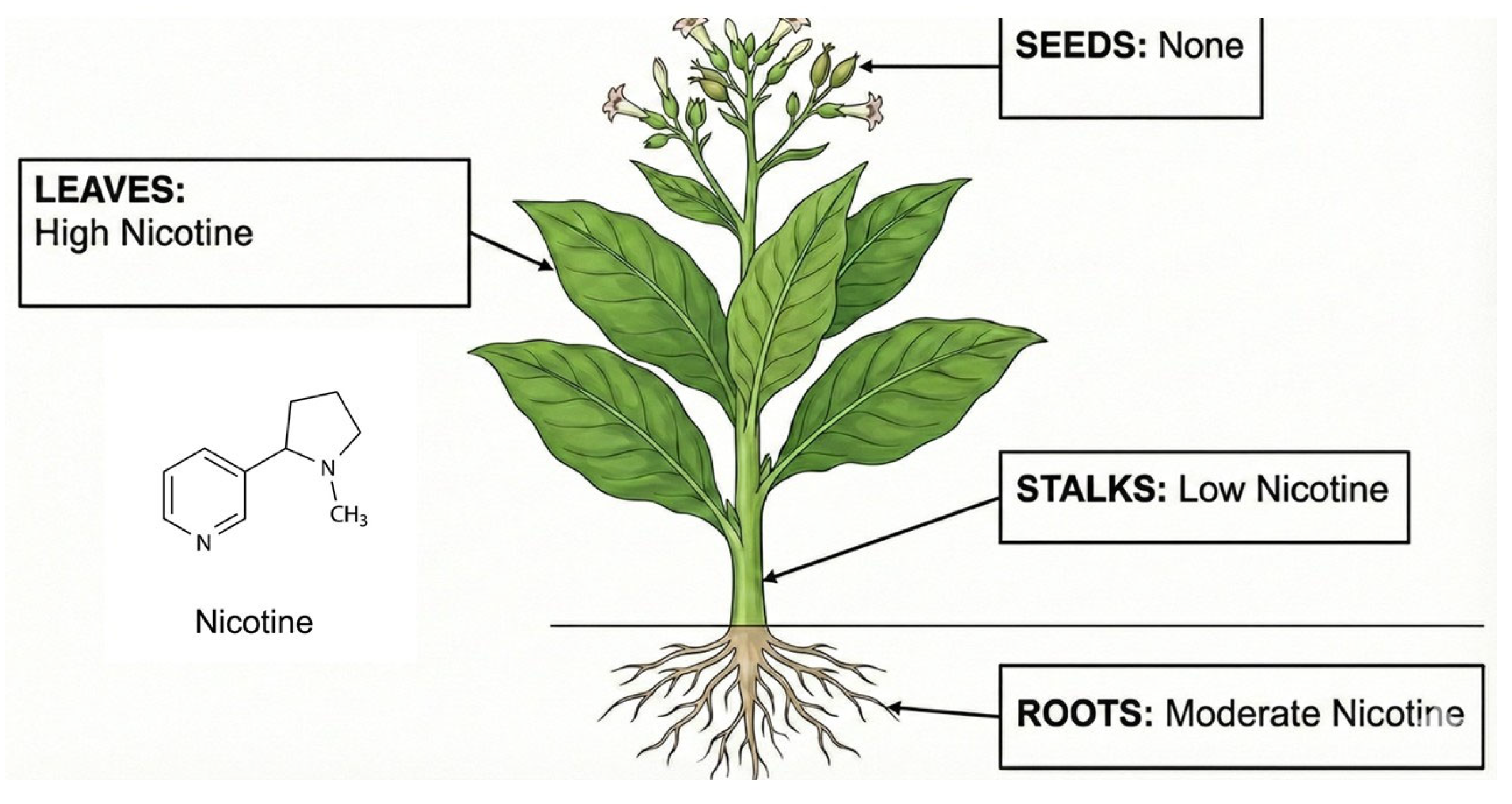
2. Characteristics of Tobacco Stalks’ Lignocellulosic Fraction
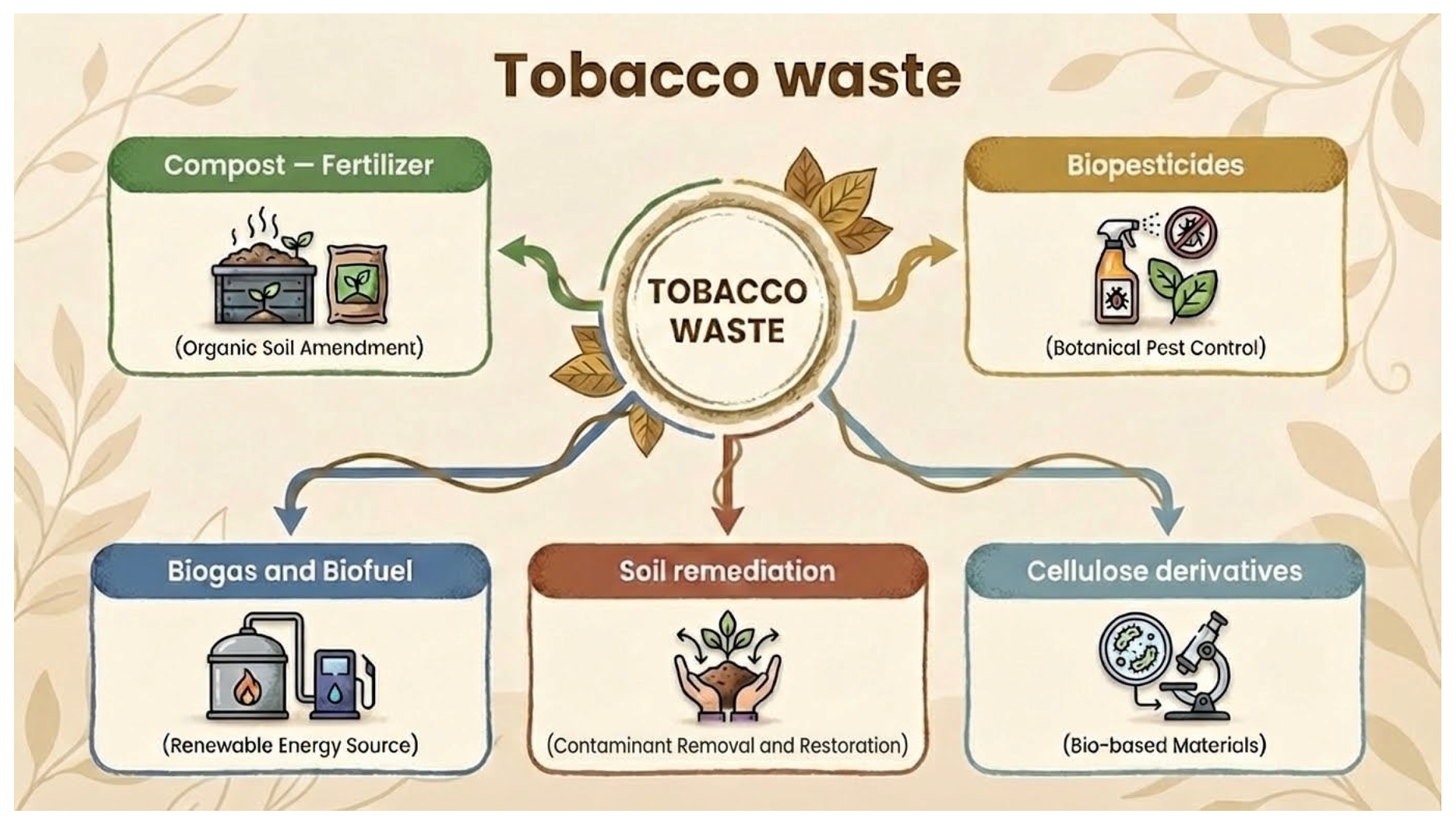
3. Tobacco Waste as Agriculture Resource
3.1. Compost of Tobacco Residues
3.2. Tobacco Stalk Biochar
3.2.1. Agronomic Utilization
3.2.2. Remediation of Heavy Metal-Contaminated Soils
4. Τοbacco Waste as Source of Biopesticides
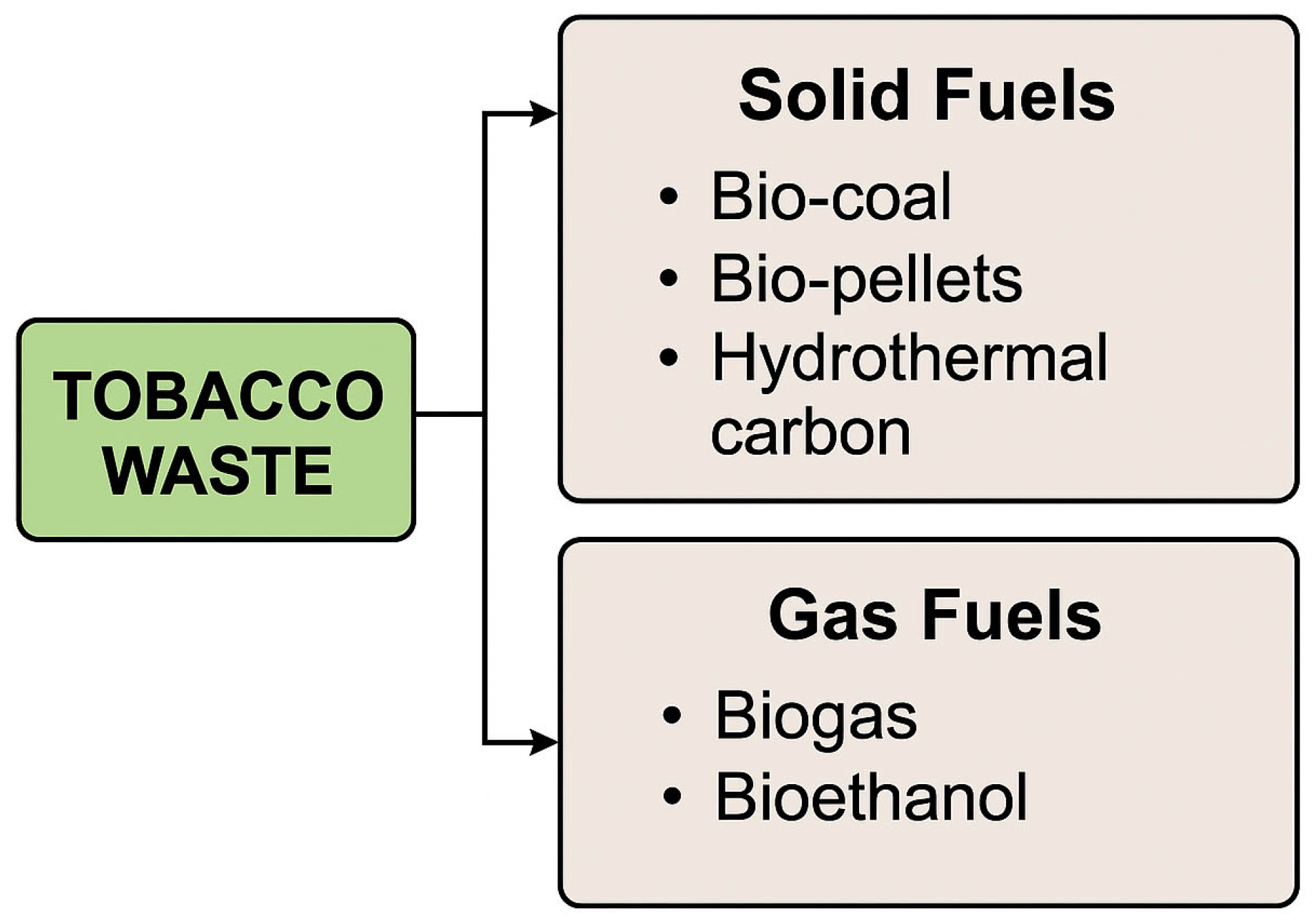
5. Tobacco Waste as Energy Source
6. Tobacco Waste Extracts as Medium for Cellulose Derivative Production

| Output | Process | Conditions | Main Findings | References |
| Bacterial Cellulose (BC) | Fermentation using Acetobacter, Gluconacetobacter, Agrobacterium, and Rhizobium | Carbon-rich substrates from tobacco waste; pH ≈ 6.5; two-stage fermentation; co-culture; nicotine removal | BC production 1.54 g/L → 2.27 g/L after nicotine removal; optimized strategies increase yields to 5.2–6.0 g/L | [89,97,98] |
| Cellulose Nitrate (Nitrocellulose) | Mechanical and chemical pulping → nitration | Pulping conditions adjusted to produce specific grades | Suitable for inks, paints, adhesives, and explosives | [35] |
| Cellulose Acetate | Chemical acetylation of cellulose pulp | Used as a safer replacement for cellulose nitrate | Applications in fibers, biodegradable plastics, and photographic/cinematographic carriers | [25] |
| Cellulose Fibers from Nicotiana Stalks | Water retting | Lower lignin content; favorable physical and mechanical properties | Eco-friendly alternative to synthetic fibers | [24] |
| Thermoplastic Composites (20–40 wt% Stalks) | Reinforcement of polymer matrices with tobacco stalk fibers | Matrix selection; tobacco Burley best performance; moisture control needed | Higher tensile/flexural modulus; Burley = highest stiffness and lowest water uptake | [99] |
7. Challenges and Conclusions
Author Contributions
Funding
Institutional Review Board Statement
Informed Consent Statement
Data Availability Statement
Conflicts of Interest
Abbreviations
| Bt | Bacillus thuringiensis |
| nHAP | Nano-hydroxyapatite |
| TS-biochar | Tobacco stalk biochar |
| TW | Tobacco waste |
| BC | Bacterial cellulose |
| LCA | Life-cycle assessment |
| TEA | Techno-economic analysis |
References
- Sun, D.; Wang, B.; Wang, H.M.; Li, M.F.; Shi, Q.; Zheng, L.; Wang, S.F.; Liu, S.J.; Sun, R.C. Structural Elucidation of Tobacco Stalk Lignin Isolated by Different Integrated Processes. Ind. Crops Prod. 2019, 140, 111631. [Google Scholar] [CrossRef]
- Liu, Y.; Dong, J.; Liu, G.; Yang, H.; Liu, W.; Wang, L.; Kong, C.; Zheng, D.; Yang, J.; Deng, L.; et al. Co-Digestion of Tobacco Waste with Different Agricultural Biomass Feedstocks and the Inhibition of Tobacco Viruses by Anaerobic Digestion. Bioresour. Technol. 2015, 189, 210–216. [Google Scholar] [CrossRef]
- Food and Agriculture Organization of the United Nations. Tobacco Production, 1995 to 2022. 2024. Available online: https://ourworldindata.org/grapher/tobacco-production (accessed on 23 December 2025).
- Tsaliki, E.; Moysiadis, T.; Toumpas, E.; Kalivas, A.; Panoras, I.; Grigoriadis, I. Evaluation of Greek Tobacco Varieties (Nicotiana Tabacum L.) Grown in Different Regions of Greece. Agriculture 2023, 13, 1394. [Google Scholar] [CrossRef]
- Wang, J.; He, H.; Wang, M.; Wang, S.; Zhang, J.; Wei, W.; Xu, H.; Lv, Z.; Shen, D. Bioaugmentation of Activated Sludge with Acinetobacter sp. TW Enhances Nicotine Degradation in a Synthetic Tobacco Wastewater Treatment System. Bioresour. Technol. 2013, 142, 445–453. [Google Scholar] [CrossRef] [PubMed]
- Zhong, W.; Zhu, C.; Shu, M.; Sun, K.; Zhao, L.; Wang, C.; Ye, Z.; Chen, J. Degradation of Nicotine in Tobacco Waste Extract by Newly Isolated Pseudomonas sp. ZUTSKD. Bioresour. Technol. 2010, 101, 6935–6941. [Google Scholar] [CrossRef] [PubMed]
- Radojicic, V.; Djulančić, N.; Kulic, G. Possibilities of Virginia Tobacco Stalks Utilization. Tobacco 2014, 64, 71–76. [Google Scholar]
- Lin, Y.; Yu, G.; Liang, R.; Kong, F.; Song, D. Converting Tobacco Stalk Wastes into Value-Added Products via Sequential Hydrothermal and Pyrolysis Treatments. Agronomy 2024, 14, 801. [Google Scholar] [CrossRef]
- Zafeiridou, M.; Hopkinson, N.S.; Voulvoulis, N. Cigarette Smoking: An Assessment of Tobacco’s Global Environmental Footprint Across Its Entire Supply Chain. Environ. Sci. Technol. 2018, 52, 8087–8094. [Google Scholar] [CrossRef]
- Santana, M.B.; Gama, F.Á.; Pereira, I.O.; Tramontina, R.; Squina, F.M.; Ambrosi, A.; Zielinski, A.; Poletto, P.; Ienczak, J.L. Harnessing Tobacco Stem Biomass for Eco-Friendly Xylo-Oligomers Production via Hydrothermal Treatment and Succinic Acid via Fermentation. J. Clean. Prod. 2024, 456, 142305. [Google Scholar] [CrossRef]
- Banožić, M.; Babić, J.; Jokić, S. Recent Advances in Extraction of Bioactive Compounds from Tobacco Industrial Waste-a Review. Ind. Crops Prod. 2020, 144, 112009. [Google Scholar] [CrossRef]
- Hu, B.B.; Lin, Z.L.; Chen, Y.; Zhao, G.K.; Su, J.E.; Ou, Y.J.; Liu, R.; Wang, T.; Yu, Y.B.; Zou, C.M. Evaluation of Biomass Briquettes from Agricultural Waste on Industrial Application of Flue-Curing of Tobacco. Energy Sources Part A Recovery Util. Environ. Eff. 2024, 46, 12055–12066. [Google Scholar] [CrossRef]
- Shen, K.; Xia, L.; Gao, X.; Li, C.; Sun, P.; Liu, Y.; Fan, H.; Li, X.; Han, L.; Lu, C.; et al. Tobacco as Bioenergy and Medical Plant for Biofuels and Bioproduction. Heliyon 2024, 10, e33920. [Google Scholar] [CrossRef]
- Ritchie, H.; Rosado, P.; Roser, M. “Agricultural Production”. 2023 Data adapted from Food and Agriculture Organization of the United Nations. Available online: https://archive.ourworldindata.org/20251014-161652/grapher/tobacco-production.html (accessed on 14 October 2025).
- Hu, R.S.; Wang, J.; Li, H.; Ni, H.; Chen, Y.F.; Zhang, Y.W.; Xiang, S.P.; Li, H.H. Simultaneous extraction of nicotine and solanesol from waste tobacco materials by the column chromatographic extraction method and their separation and purification. Sep. Purif. Technol. 2015, 146, 1–7. [Google Scholar] [CrossRef]
- Meng, X.; Wang, X.; Guan, Y. Salting-out-assisted liquid–liquid extraction for nicotine from its aqueous solutions. J. Chem. Eng. Data 2022, 67, 453–462. [Google Scholar] [CrossRef]
- Manthos, G.; Tsigkou, K. Upscaling of tobacco processing waste management: A review and a proposed valorization approach towards the biorefinery concept. J. Env. Manag. 2025, 387, 125942. [Google Scholar] [CrossRef] [PubMed]
- Cai, J.; Li, B.; Chen, C.; Wang, J.; Zhao, M.; Zhang, K. Hydrothermal Carbonization of Tobacco Stalk for Fuel Application. Bioresour. Technol. 2016, 220, 305–311. [Google Scholar] [CrossRef]
- Sun, D.; Sun, S.C.; Wang, B.; Sun, S.F.; Shi, Q.; Zheng, L.; Wang, S.F.; Liu, S.J.; Li, M.F.; Cao, X.F. Effect of Various Pretreatments on Improving Cellulose Enzymatic Digestibility of Tobacco Stalk and the Structural Features of Co-Produced Hemicelluloses. Bioresour. Technol. 2020, 297, 122471. [Google Scholar] [CrossRef]
- Yao, M.; Liu, B.; Qin, L.; Du, Z.; Wang, Z.; Qin, C.; Liang, C.; Huang, C.; Yao, S. Preparation of Homogeneous Lignin Nanoparticles by Efficient Extraction of Lignin and Modification of Its Molecular Structure Using a Functional Deep Eutectic Solvent Containing γ-Valerolactone. Green Chem. 2024, 26, 4528–4543. [Google Scholar] [CrossRef]
- Agrupis, S.; Maekawa, E.; Suzuki, K. Industrial Utilization of Tobacco Stalks II: Preparation and Characterization of Tobacco Pulp by Steam Explosion Pulping. J. Wood Sci. 2000, 46, 222–229. [Google Scholar] [CrossRef]
- Srbinoska, M.; Filiposki, K.; Risteski, I.; Pelivanoska, V.; Rafajlovska, V.; Krsteska, V. Tobacco Stalks as renewable raw material for agro-industrial utilization. In Proceedings of the International Symposium for Agriculture and Food; Faculty of Agricultural Science and Food in Skopje: Skopje, North Macedonia, 2013; pp. 734–741. Available online: https://www.researchgate.net/publication/285311064_Tobacco_stalks_as_renewable_raw_material_for_agro-industrial_utilization (accessed on 7 January 2026).
- Sophanodorn, K.; Unpaprom, Y.; Whangchai, K.; Homdoung, N.; Dussadee, N.; Ramaraj, R. Environmental Management and Valorization of Cultivated Tobacco Stalks by Combined Pretreatment for Potential Bioethanol Production. Biomass Convers. Biorefinery 2022, 12, 1627–1637. [Google Scholar] [CrossRef]
- Ovali, S. Characterization of Waste Nicotiana rustica L. (Tobacco) Fiber Having a Potential in Textile and Composite Applications. Polymers 2024, 16, 1117. [Google Scholar] [CrossRef]
- Kulic, G.; Radojicic, V. Analysis of Cellulose Content in Stalks and Leaves of Large Leaf Tobacco. J. Agric. Sci. 2011, 56, 207–215. [Google Scholar] [CrossRef]
- Cacicedo, M.L.; Castro, M.C.; Servetas, I.; Bosnea, L.; Boura, K.; Tsafrakidou, P.; Dima, A.; Terpou, A.; Koutinas, A.; Castro, G.R. Progress in Bacterial Cellulose Matrices for Biotechnological Applications. Bioresour. Technol. 2016, 213, 172–180. [Google Scholar] [CrossRef]
- Jahan, F.; Kumar, V.; Saxena, R.K. Distillery Effluent as a Potential Medium for Bacterial Cellulose Production: A Biopolymer of Great Commercial Importance. Bioresour. Technol. 2018, 250, 922–926. [Google Scholar] [CrossRef] [PubMed]
- Rao, J.; Lv, Z.; Chen, G.; Peng, F. Hemicellulose: Structure, Chemical Modification, and Application. Prog. Polym. Sci. 2023, 140, 101675. [Google Scholar] [CrossRef]
- Deng, J.; Yun, J.; Gu, Y.; Yan, B.; Yin, B.; Huang, C. Evaluating the In Vitro and In Vivo Prebiotic Effects of Different Xylo-Oligosaccharides Obtained from Bamboo Shoots by Hydrothermal Pretreatment Combined with Endo-Xylanase Hydrolysis. Int. J. Mol. Sci. 2023, 24, 13422. [Google Scholar] [CrossRef]
- Hu, N.; Liu, X.; Wei, S.; Yao, J.; Wang, W.; Liu, B.; Tang, T.; Jiang, J.; Wang, L. Current status and future prospects of pretreatment for tobacco stalk lignocellulose. Front. Bioeng. Biotechnol. 2024, 12, 1465419. [Google Scholar] [CrossRef] [PubMed]
- Cheng, J.; Liu, X.; Huang, C.; Zhan, Y.; Huang, C.; Chen, T.; Meng, X.; Yoo, C.G.; Fang, G.; Ragauskas, A.J. Novel biphasic DES/GVL solvent for effective biomass fractionation and valorization. Green Chem. 2023, 25, 6270–6281. [Google Scholar] [CrossRef]
- Cheng, J.; Huang, C.; Liu, X.; Zhou, X.; Zhan, Y.; Chen, T.; Huang, C.; Meng, X.; Fang, G.; Ragauskas, A.J. Direct Extraction of Uniform Lignin Microspheres from Bamboo Using a Polyol-Based Deep Eutectic Solvent. ACS Sustain. Chem. Eng. 2023, 11, 10158–10163. [Google Scholar] [CrossRef]
- Shen, X.; Xin, Y.; Liu, H.; Han, B. Product-oriented Direct Cleavage of Chemical Linkages in Lignin. ChemSusChem 2020, 13, 4367–4381. [Google Scholar] [CrossRef]
- Wang, L.; Li, X.; Jiang, J.; Zhang, Y.; Bi, S.; Wang, H.M. Revealing structural and functional specificity of lignin from tobacco stalk during deep eutectic solvents deconstruction aiming to targeted valorization. Ind. Crops Prod. 2022, 180, 114696. [Google Scholar] [CrossRef]
- Muvhiiwa, R.; Mawere, E.; Moyo, L.B.; Tshuma, L. Utilization of cellulose in tobacco (Nicotiana tabacum) stalks for nitrocellulose production. Heliyon 2021, 7, e07598. [Google Scholar] [CrossRef] [PubMed]
- Golia, E.E.; Liava, V.; Achilias, D.S.; Navarro-Pedreño, J.; Zorpas, A.A.; Bethanis, J.; Girousi, S. Microplastics’ impact on soil health and quality: Effect of incubation time and soil properties in soil fertility and pollution extent under the circular economy concept. Waste Manag. Res. 2025, 43, 1146–1155. [Google Scholar] [CrossRef]
- Mahmud, M.; Islam, M.S.; Rahman, A.; Fares, A.; Rahman, M.Z. Development and Comparative Assessment of TobaccoWaste-Based Composts for Sustainable Agriculture. Sustainability 2025, 17, 10144. [Google Scholar] [CrossRef]
- Abdellah, Y.; Yang, S.; Yang, C.; Yang, Z.; Elsheikh, E.A.E.; Keiblinger, K.M.; Taha, A.M.; Rana, M.S.; Liu, D.; Yu, F. Tobacco waste valorization through composting: A systematic review of biomass conversion efficiency and circular bioeconomy strategies. Biomass Bioenergy 2025, 201, 108137. [Google Scholar] [CrossRef]
- Piccolo, A.; Drosos, M. The essential role of humified organic matter in preserving soil health. Chem. Biol. Technol. Agric. 2025, 12, 21. [Google Scholar] [CrossRef]
- Kayikçioğlu, H.H.; Okur, N. Evolution of enzyme activities during composting of tobacco waste. Waste Manag. Res. 2011, 29, 1124–1133. [Google Scholar] [CrossRef]
- Szwed, A.; Bohacz, J. Enzymatic Activity and Certain Chemical Properties of Grey-Brown Podzolic Soil (Haplic Luvisol) Amended with Compost of Tobacco Wastes. Arch. Environ. Prot. 2014, 40, 61–73. [Google Scholar] [CrossRef]
- Delibacak, S.; Ongun, A.R. Influence of composted tobacco waste and farmyard manure applications on the yield and nutrient composition of lettuce (Lactuca sativa L. var. capitata). Eurasian J. Soil. Sci. 2015, 5, 132. [Google Scholar] [CrossRef][Green Version]
- Di, H.; Wang, R.; Ren, X.; Deng, J.; Deng, X.; Bu, G. Co-composting of fresh tobacco leaves and soil: An exploration on the utilization of fresh tobacco waste in farmland. Environ. Sci. Pollut. Res. 2022, 29, 8191–8204. [Google Scholar] [CrossRef] [PubMed]
- Cheng, Z.W.; Yang, W.L.; Tang, X.; Wu, C.Z.; Zhao, B.; Li, J.C.; Liao, H.P.; Li, W.Q.; Zhou, S.G. Benefits of tobacco stalk compost in tobacco cultivation: Improving soil health, microbial function, crop yield, and economic viability. Soil. Sci. Soc. Am. J. 2025, 89, 70155. [Google Scholar] [CrossRef]
- Zittel, R.; da Silva, C.P.; Domingues, C.E.; Seremeta, D.C.H.; da Cunha, K.M.; de Campos, S.X. Availability of nutrients, removal of nicotine, heavy metals and pathogens in compounds obtained from smuggled cigarette tobacco compost associated with industrial sewage sludge. Sci. Total Environ. 2020, 699, 134377. [Google Scholar] [CrossRef] [PubMed]
- Adediran, J.A.; Mnkeni, P.N.S.; Mafu, N.C.; Muyima, N.Y.O. Changes in Chemical Properties and Temperature during the Composting of Tobacco Waste with Other Organic Materials, and Effects of Resulting Composts on Lettuce (Lactuca sativa L.) and Spinach (Spinacea oleracea L.). Bioll Agric. Hortic. 2004, 22, 101–119. [Google Scholar] [CrossRef]
- Mandić, N.; Lalević, B.; Raičević, V.; Radojičić, V. Impact of composting conditions on the nicotine degradation rate using nicotinophilic bacteria from tobacco waste. Int. J. Env. Sci. Tech. 2023, 20, 7787–7798. [Google Scholar] [CrossRef]
- Li, Y.; Zhang, X.; Chen, S.; Gao, M.; Wang, L. Effects of tobacco residue compost on soil fertility and microbial activity in tobacco-growing soils. Appl. Soil Ecol. 2018, 123, 489–498. [Google Scholar]
- Chen, Z.; Wang, H.; Liu, X.; Zhao, X.; Lu, D.; Zhou, J.; Li, C. Changes in soil microbial community and organic carbon fractions under short-term straw return in a rice–wheat cropping system. Soil Tillage Res. 2014, 136, 35–43. [Google Scholar] [CrossRef]
- Briški, F.; Kopčić, N.; Ćosić, I.; Kučić, D.; Vuković, M. Biodegradation of tobacco waste by composting: Genetic identification of nicotine-degrading bacteria and kinetic analysis of transformations in leachate. Chem. Pap. 2012, 66, 1103–1110. [Google Scholar] [CrossRef]
- Golia, E.E. The impact of heavy metal contamination on soil quality and plant nutrition. Sustainable management of moderate contaminated agricultural and urban soils, using low cost materials and promoting circular economy. Sustain. Chem. Pharm. 2023, 33, 101046. [Google Scholar] [CrossRef]
- Jiang, X.; Wu, J.; Zhao, L.; Wang, J.; Xiao, W.; Chen, Z.; Jiang, J.; Liang, M.; Wang, J.; Zhang, J. Study on the Pyrolysis Behaviour of Different Types of Tobacco and Their Pyrolytic Aroma Components Distribution Under Stepwise Heating Conditions. Flavour Fragr. J. 2025, 40, 512–527. [Google Scholar] [CrossRef]
- Marcińczyk, M.; Oleszczuk, P. Biochar and engineered biochar as slow- and controlled-release fertilizers. J. Clean. Prod. 2022, 339, 130685. [Google Scholar] [CrossRef]
- Ding, Y.; Liu, Y.; Liu, S.; Li, Z.; Tan, X.; Huang, X.; Zeng, G.; Zhou, L.; Zheng, B. Biochar to improve soil fertility. A review. Agron. Sustain. Dev. 2016, 36, 36. [Google Scholar] [CrossRef]
- Yan, B.; Zhang, S.; Chen, W.; Cai, Q. Pyrolysis of tobacco wastes for bio-oil with aroma compounds. J. Anal. Appl. Pyrolysis 2018, 136, 248–254. [Google Scholar] [CrossRef]
- Bindu, J.P.; Reddy, D.D.; Santhy, P.; Chandrasekhara Rao, C.; Ghosh, R.K. Effect of Chemical Fertilizer and Tobacco Stalks-Derived Biochar on FCV Tobacco Yield, Nutrient Use Efficiency and Carbon Management Index in a Light Textured Alfisol. Int. J. Plant Soil Sci. 2023, 35, 88–107. [Google Scholar] [CrossRef]
- Bian, R.; Joseph, S.; Cui, L.; Pan, G.; Li, L.; Liu, X.; Zhang, A.; Rutlidge, H.; Wong, S.; Chia, C.; et al. A three-year experiment confirms continuous immobilization of cadmium and lead in contaminated paddy field with biochar amendment. J. Hazard. Mater. 2014, 272, 121–128. [Google Scholar] [CrossRef]
- Huang, R.; Gao, X.; Wang, F.; Xu, G.; Long, Y.; Wang, C.; Wang, Z.; Gao, M. Effects of biochar incorporation and fertilizations on nitrogen and phosphorus losses through surface and subsurface flows in a sloping farmland of Entisol. Agric. Ecosyst. Environ. 2020, 300, 106988. [Google Scholar] [CrossRef]
- Qiu, Z.; Tang, J.; Chen, J.; Zhang, Q. Remediation of cadmium-contaminated soil with biochar simultaneously improves biochar’s recalcitrance. Environ. Pollut. 2020, 256, 113436. [Google Scholar] [CrossRef] [PubMed]
- Uchimiya, M.; Lima, I.M.; Klasson, K.T.; Wartelle, L.H. Contaminant immobilization and nutrient release by biochar soil amendment: Roles of natural organic matter. Chemosphere 2010, 80, 935–940. [Google Scholar] [CrossRef]
- Azeem, M.; Sun, D.; Crowley, D.; Hayat, R.; Hussain, Q.; Ali, A.; Tahir, M.I.; Jeyasundar, P.G.S.A.; Rinklebe, J.; Zhang, Z. Crop types have stronger effects on soil microbial communities and functionalities than biochar or fertilizer during two cycles of legume-cereal rotations of dry land. Sci. Total Environ. 2020, 715, 136958. [Google Scholar] [CrossRef]
- Dangi, S.; Gao, S.; Duan, Y.; Wang, D. Soil microbial community structure affected by biochar and fertilizer sources. Appl. Soil Ecol. 2020, 150, 103452. [Google Scholar] [CrossRef]
- Enebe, M.; Ray, R.l.; Griffin, R.W. The impacts of biochar on carbon sequestration, soil processes, and microbial communities: A review. Biochar 2025, 7, 107. [Google Scholar] [CrossRef]
- Yu, X.; Zhou, H.; Ye, X.; Wang, H. From hazardous agriculture waste to hazardous metal scavenger: Tobacco stalk biochar-mediated sequestration of Cd leads to enhanced tobacco productivity. J. Hazard. Mater. 2021, 413, 125303. [Google Scholar] [CrossRef]
- Lv, C.; Yang, S.; Chen, Y.; Xu, L.; Wang, A.; Zhang, Z.; Wang, S.; Yin, G.; Wei, Z.; Xia, Y. Biochar derived from tobacco waste significantly reduces the accumulations of cadmium and copper in edible parts of two vegetables: An in-situ field study. Environ. Sci. Pollut. Res. 2024, 31, 7533–7542. [Google Scholar] [CrossRef]
- Li, T.; Li, X.; Shen, C.; Chen, D.; Li, F.; Xu, W.; Wu, X.; Bao, Y. Nano-Hydroxyapatite Modified Tobacco Stalk-Based Biochar for Immobilizing Cd(II): Interfacial Adsorption Behavior and Mechanisms. Processes 2024, 12, 1924. [Google Scholar] [CrossRef]
- Kiatikidis, N.; Golia, E.E.; Alexiadis, D.; Vogia, R.; Papadimou, S.G.; Tsaliki, E.; Paraskevaidou, N.; Pérez-Gimeno, A.; Navarro-Pedreño, J. Use of Alternative Soil Amendments to Enhance the Phytoremediation Capacity of Heavy Metal Hyperaccumulator Plants. Land 2025, 14, 2399. [Google Scholar] [CrossRef]
- Kamran, M.; Malik, Z.; Parveen, A.; Zong, Y.; Abbasi, G.H.; Rafiq, M.T.; Shaaban, M.; Mustafa, A.; Bashir, S.; Rafay, M.; et al. Biochar alleviates Cd phytotoxicity by minimizing bioavailability and oxidative stress in pak choi (Brassica chinensis L.) cultivated in Cd-polluted soil. J. Environ. Manag. 2019, 250, 109500. [Google Scholar] [CrossRef] [PubMed]
- Mahmoud, M.E.; Amira, M.F.; Seleim, S.M.; Mohamed, A.K. Amino-decorated magnetic metal-organic framework as a potential novel platform for selective removal of chromium (Vl), cadmium (II) and lead (II). J. Hazard. Mater. 2020, 381, 120979. [Google Scholar] [CrossRef]
- Komárek, M.; Antelo, J.; Králová, M.; Veselská, V.; Číhalová, S.; Chrastný, V.; Ettler, V.; Filip, J.; Yu, Q.; Fein, J.B.; et al. Revisiting models of Cd, Cu, Pb and Zn adsorption onto Fe (III) oxides. Chem. Geol. 2018, 493, 189–198. [Google Scholar] [CrossRef]
- Saeed, Z.; Naveed, M.; Imran, M.; Bashir, M.A.; Sattar, A.; Mustafa, A.; Hussain, A.; Xu, M. Combined use of Enterobacter sp. MN17 and zeolite reverts the adverse effects of cadmium on growth, physiology and antioxidant activity of Brassica napus. PLoS ONE 2019, 14, e0213016. [Google Scholar] [CrossRef] [PubMed]
- Xiang, Y.; Xu, Z.; Wei, Y.; Zhou, Y.; Yang, X.; Yang, Y.; Yang, J.; Zhang, J.; Luo, L.; Zhou, Z. Carbon-based materials as adsorbent for antibiotics removal: Mechanisms and influencing factors. J. Environ. Manag. 2019, 237, 128–138. [Google Scholar] [CrossRef]
- Haryuni, H.; Soelistijono, R.; Priyadi, S.; Maryanti, I.E.; Suprtini, S. The effect of tobacco leaf biopesticides on the development of bacterial leaf blight of rice. IOP conf. Series: Earth Environ. Sci. 2023, 1230, 012094. [Google Scholar] [CrossRef]
- Isman, M.B. Botanical insecticides, deterrents, and repellents in modern agriculture. Annu. Rev. Entomol. 2006, 51, 45–66. [Google Scholar] [CrossRef] [PubMed]
- Sparks, T.C. Insecticide discovery: An evaluation and analysis. Pestic. Biochem. Physiol. 2012, 102, 8–17. [Google Scholar] [CrossRef] [PubMed]
- Radev, Z.; Stoyanova, L. Study for bioinsecticidal activity of tobacco extracts against Helicoverpa armigera Hubner (Lepidoptera: Noctuidae). Bulg. J. Agric. Sci. 2024, 30, 486–490. [Google Scholar]
- Safitri, D.M.; Wagiman, W.; Jumeni, J. Optimization of Tobacco Waste extraction using ultrasonic assisted extraction (UAE) to produce biopesticide. AgriTECH 2025, 45, 70–81. [Google Scholar] [CrossRef]
- Bažok, R.; O’Keeffe, J.; Jurada, I.; Drmić, Z.; Kadoić Balaško, M.; Čačija, M. Low-Dose Insecticide Combinations for Colorado Potato Beetle Control. Agriculture 2021, 11, 1181. [Google Scholar] [CrossRef]
- Pesticide Properties Database (PPDB) Maintained by the University of Hertfordshire. Available online: https://sitem.herts.ac.uk/aeru/bpdb/Reports/485.htm (accessed on 23 December 2025).
- Göldel, B.; Lemic, D.; Bažok, R. Alternatives to Synthetic Insecticides in the Control of the Colorado Potato Beetle (Leptinotarsa decemlineata Say) and Their Environmental Benefits. Agriculture 2020, 10, 611. [Google Scholar] [CrossRef]
- Kaelin, P.; Gadani, F. Occurrence of Bacillus thuringiensis on Cured Tobacco Leaves. Curr. Microbiol. 2000, 40, 205–209. [Google Scholar] [CrossRef]
- Prima Indahsari, O.; Suryo Negoro, A.H. Contribution of tobacco waste for agriculture. E3S Web Conf. 2020, 142, 04006. [Google Scholar] [CrossRef]
- Xiao, X.; Li, C.; Ya, P.; He, J.; He, Y.; Bi, X.T. Industrial Experiments of Biomass Briquettes as Fuels for Bulk Curing Barns. Int. J. Green Energy 2015, 12, 1061–1065. [Google Scholar] [CrossRef]
- Liang, M.; Zhang, K.; Lei, P.; Wang, B.; Shu, C.M.; Li, B. Fuel properties and combustion kinetics of hydrochar derived from co-hydrothermal carbonization of tobacco residues and graphene oxide. Biomass Convers. Biorefinery 2020, 10, 189–201. [Google Scholar] [CrossRef]
- Chen, R.; Li, L.; Liu, Z.; Lu, M.; Wang, C.; Li, H.; Ma, W.; Wang, S. Preparation and characterization of activated carbons from tobacco stem by chemical activation. J. Air Waste Manag. Assoc. 2017, 67, 713–724. [Google Scholar] [CrossRef]
- Bareschino, P.; Marrasso, E.; Roselli, C. Tobacco stalks as a sustainable energy source in civil sector: Assessment of techno-economic and environmental potential. Renew. Energy 2021, 175, 373–390. [Google Scholar] [CrossRef]
- Cardoso, C.R.; Ataíde, C.H. Analytical pyrolysis of tobacco residue: Effect of temperature and inorganic additives. J. Anal. Appl. Pyrolysis 2013, 99, 49–57. [Google Scholar] [CrossRef]
- Berbeć, A.K.; Matyka, M. Biomass characteristics and energy yields of tobacco (Nicotiana tabacum L.) cultivated in eastern Poland. Agriculture 2020, 10, 551. [Google Scholar] [CrossRef]
- Ye, J.; Zheng, S.; Zhang, Z.; Yang, F.; Ma, K.; Feng, Y.; Zheng, J.; Mao, D.; Yang, X. Bacterial cellulose production by Acetobacter xylinum ATCC 23767 using tobacco waste extract as culture medium. BioresTechn 2019, 274, 518–524. [Google Scholar] [CrossRef] [PubMed]
- Uzyol, H.K.; Saçan, M.T. Bacterial cellulose production by Komagataeibacter hansenii using algae-based glucose. Environ. Sci. Pollut. Res. 2017, 24, 11154–11162. [Google Scholar] [CrossRef] [PubMed]
- Campano, C.; Balea, A.; Blanco, A.; Negro, C. Enhancement of the fermentation process and properties of bacterial cellulose: A review. Cellulose 2016, 23, 57–91. [Google Scholar] [CrossRef]
- Wang, S.; Jiang, F.; Xu, X.; Kuang, Y.; Fu, K.; Hitz, E.; Hu, L. Super-Strong, Super-Stiff Macrofibers with Aligned, Long Bacterial Cellulose Nanofibers. Adv. Mater. 2017, 29, 35. [Google Scholar] [CrossRef]
- Lima, F.d.M.T.; Pinto, F.C.M.; Andrade-da-Costa, B.L.; Martins da Silva, J.G.; Campos Júnior, O.; Aguiar, J.L.d.A. Biocompatible bacterial cellulose membrane in dural defect repair of rat. J. Mater. Sci Mater. Med. 2017, 28, 37. [Google Scholar] [CrossRef]
- Shah, N.; Ul-Islam, M.; Khattak, W.A.; Park, J.K. Overview of bacterial cellulose composites: A multipurpose advanced material. Carbohydr. Polym. 2013, 98, 1585–1598. [Google Scholar] [CrossRef]
- Shi, Z.; Li, Y.; Chen, X.; Han, H.; Yang, G. Double network bacterial cellulose hydrogel to build a biology–device interface. Nanoscale 2014, 6, 970–977. [Google Scholar] [CrossRef] [PubMed]
- Hu, S.Q.; Gao, Y.G.; Tajima, K.; Sunagawa, N.; Zhou, Y.; Kawano, S.; Fujiwara, T.; Yoda, T.; Shimura, D.; Satoh, Y.; et al. Structure of bacterial cellulose synthase subunit D octamer with four inner passageways. Proc. Natl. Acad. Sci. USA 2010, 107, 17957–17961. [Google Scholar] [CrossRef] [PubMed]
- Cheng, Z.; Yang, R.; Liu, X.; Liu, X.; Chen, H. Green synthesis of bacterial cellulose via acetic acid pre-hydrolysis liquor of agricultural corn stalk used as carbon source. Bioresour. Technol. 2017, 234, 8–14. [Google Scholar] [CrossRef] [PubMed]
- Nie, W.; He, Z.; Gu, M.; Zhou, T.; Xu, J.; Zhong, J.; Yang, Y.; Zhong, W. Improved bacterial cellulose production by Acetobacter oryzoeni MGC-N8819 in tobacco waste extract coupled with nicotine removal by Pseudomonas sp. JY-Q/5∆. Int. J. Biol. Macromol. 2025, 293, 139336. [Google Scholar] [CrossRef]
- Paglicawan, M.; Jimenez, J.P.; Emolaga, C.S. Properties of Tobacco Stalks as Reinforcement in Natural Fiber Composites. Philipp. J. Sci. 2025, 154, 967–982. [Google Scholar] [CrossRef]


| Cellulose (%) | Hemicellulose (%) | Lignin (%) | Reference |
| 41.30 | 32.00 | 21.00 | [21] |
| 38.53 | ND | 22.47 | [22] |
| 35.45 | 43.90 | 18.16 | [23] |
| 56.60 | 11.80 | 14.97 | [24] |
| Method/Application | Effects on Soil Health | References |
| Sustainable TW management methods—recycling and upcycling (thermochemical/biological methods)) | Waste reduction, resource conservation, nicotine recycling, and biochar/fertilizer production—circular economy framework | [38] |
| Field trial with tobacco stalk compost via organic fertilizer | Raised pH, lower EC, increased SOC, improved N availability, amd enhanced microbial diversity | [44] |
| Modified biochar from TW using hydroxyapatite for Cd engagement | High Cd adsorption (13.17–14.50 mg/g), using mainly adsorption and precipitation mechanisms | [66] |
| In situ application of biochar from TW in legumes and flowers | 5–10 t/ha TW reduced bioavailable Cd and Cu in soil, reduced metal accumulation in edible parts; increased biomass in chrysanthemum | [65] |
| Residues + vegetable waste and biofortification | Enhanced detoxification and nutrient-rich compost | [46] |
| Biochar from tobacco stems + inorganic fertilizers in light Alfisol | One t/ha biochar significantly increased N and K utilization, improving the Carbon Management Index | [56] |
| Composting fresh tobacco residues | Reduction in nicotine, increase of available N and K, and increase in beneficial microbes | [43] |
| Tobacco stalk conversion to biochar (TS-biochar) | Increased soil pH (5.21 → 7.39), reduced exchangeable Cd, and improved biomass and photosynthesis | [64] |
| TW composting with effluents | Reduced nicotine/metals and balanced macronutrients | [45] |
| TW composting in comparison with manure | Increase lettuce yield and nutrient content (N, P, K, Ca, Mg, Fe, Zn, and Mn) | [42] |
| TW + bark/straw | Enriched nutrients and improved crop response | [41] |
| TW compost blends with olive and grape pomace | Nicotine degraded, nutrient levels (N–P–K) increased, organic carbon and C:N ratio decreased, electrical conductivity reduced, and effective detoxification and maturation of tobacco waste compost after 4 months | [40] |
| TW compost with wood chips/manure | Major nicotine reduction and improved productivity | [46] |
| Biochar properties for heavy metal stabilization | Alkalinity and surface charge improve soil pH and reduce toxicity | [60] |
| Biochar as soil amendment | Enhances nutrient availability, microbial activity, and soil fertility | [54,57,58,61,62,63] |
Disclaimer/Publisher’s Note: The statements, opinions and data contained in all publications are solely those of the individual author(s) and contributor(s) and not of MDPI and/or the editor(s). MDPI and/or the editor(s) disclaim responsibility for any injury to people or property resulting from any ideas, methods, instructions or products referred to in the content. |
© 2026 by the authors. Licensee MDPI, Basel, Switzerland. This article is an open access article distributed under the terms and conditions of the Creative Commons Attribution (CC BY) license.
Share and Cite
Adamantidou, C.; Minos, T.; Toumpas, E.; Kalivas, A.; Golia, E.E.; Tsaliki, E. Unlocking the Potential of Tobacco Stalks for the Circular Bioeconomy: Implications on Soil Health. AgriEngineering 2026, 8, 84. https://doi.org/10.3390/agriengineering8030084
Adamantidou C, Minos T, Toumpas E, Kalivas A, Golia EE, Tsaliki E. Unlocking the Potential of Tobacco Stalks for the Circular Bioeconomy: Implications on Soil Health. AgriEngineering. 2026; 8(3):84. https://doi.org/10.3390/agriengineering8030084
Chicago/Turabian StyleAdamantidou, Chrysovalantou, Traianos Minos, Evripidis Toumpas, Apostolos Kalivas, Evangelia E. Golia, and Eleni Tsaliki. 2026. "Unlocking the Potential of Tobacco Stalks for the Circular Bioeconomy: Implications on Soil Health" AgriEngineering 8, no. 3: 84. https://doi.org/10.3390/agriengineering8030084
APA StyleAdamantidou, C., Minos, T., Toumpas, E., Kalivas, A., Golia, E. E., & Tsaliki, E. (2026). Unlocking the Potential of Tobacco Stalks for the Circular Bioeconomy: Implications on Soil Health. AgriEngineering, 8(3), 84. https://doi.org/10.3390/agriengineering8030084