


Highlights
What are the main findings?
- A stochastic fixed-route electric freight planning model integrating heterogeneous electric truck fleets and partial recharging shows that accounting for demand uncertainty increases total costs by 6–33% while significantly improving operational robustness.
- Chance-constrained programming reveals a clear cost-reliability trade-off, where higher service confidence levels require larger or more diverse fleets and higher state-of-charge reserves along long-haul corridors.
What are the implications of the main findings?
- Ignoring demand uncertainty in long-haul electric freight planning can underestimate fleet size, charging requirements, and total system cost, increasing the risk of operational infeasibility.
- The proposed framework provides decision support for logistics operators and policymakers to design reliable, cost-resilient electric freight corridors aligned with net-zero and sustainable city objectives.
Abstract
The electrification of long-haul freight transport introduces significant challenges in fleet planning, charging decisions, and reliability management under uncertainty. This study proposed a Stochastic Electric Freight Operations Planning Problem on Predefined Routes with Partial Recharging and Heterogeneous Fleets (SEFOP-PR-HF), to support corridor-based electric truck operations under uncertain demand. The model represents real-world interregional logistics, where vehicles operate on fixed long-haul routes and may perform partial recharging at fast-charging stations. Freight demand is modeled as a normally distributed random variable, and Chance-Constrained Programming (CCP) is employed to ensure probabilistic feasibility of vehicle capacity and battery constraints. The objective is to minimize total long-term system cost, including fleet acquisition and charging expenditures, while maintaining operational reliability. A Mixed-Integer Linear Programming (MILP) formulation is applied for multiple corridor instances using real heavy-duty electric truck data. Computational results show that incorporating demand uncertainty improves robustness but raises total cost by 6–33% compared to deterministic solutions. Sensitivity analyses further reveal how reliability levels and demand variability influence fleet allocation and charging strategies.
1. Introduction
The global freight transportation sector is undergoing a rapid transition as governments and industries face increasing pressure to reduce greenhouse gas emissions, lower fossil fuel dependency, and enhance energy efficiency. Road freight transport remains a major contributor to global CO2 emissions due to the continued growth of e-commerce, regional trade, and long-haul logistics activities. In many countries, including Thailand, heavy-duty trucks dominate interregional freight movement, making freight decarbonization a critical component of national climate and sustainable development strategies. Electrification of freight transport has therefore emerged as a promising pathway toward low-carbon logistics systems [1,2].
Battery-electric trucks offer significant environmental benefits but introduce new planning and operational challenges compared to conventional diesel vehicles. Limited driving range, long recharging times, and energy consumption that depends on payload, route characteristics, and charging strategies fundamentally alter freight system design requirements. These characteristics necessitate coordinated decisions regarding vehicle type selection, fleet composition, charging behavior, and load allocation to ensure both feasibility and cost efficiency. Erdelić and Carić [3] provided a comprehensive survey of Electric Vehicle Routing Problem (EVRP) formulations, highlighting how battery constraints and recharging decisions fundamentally extend classical routing models. Schneider et al. [4] further formalized the EVRP with time windows and recharging stations, while Keskin and Çatay [5] demonstrated that allowing partial recharging significantly improves operational efficiency. Although this literature provides important methodological foundations, many real-world freight applications, especially long-haul corridor operations, do not involve route construction or sequencing decisions.
This research is motivated by Thailand’s national commitment to achieving net-zero emissions and the strategic goal of transforming major logistics routes into sustainable freight networks. The East–West Economic Corridor (EWEC), one of the country’s principal interregional freight corridors, serves as a representative case for long-haul electric freight operations. Such corridors are characterized by fixed and repetitive routes governed by contractual agreements, infrastructure availability, and regulatory constraints. In these settings, routing decisions are largely exogenous, while the primary planning challenges involve determining appropriate fleet composition, charging strategies, and freight allocation to satisfy uncertain demand. Schiffer and Walther [6] showed that intercity electric vehicle operations differ fundamentally from urban distribution systems due to longer travel distances and limited rerouting flexibility. Shoman et al. [2] further highlighted the stringent charging power and energy requirements associated with long-haul electric trucks, emphasizing the need for careful planning to avoid infeasible operations and service disruptions.
The joint consideration of predefined routes, heterogeneous vehicle fleets, partial recharging, and stochastic demand is therefore particularly critical for long-haul electric freight corridors. Ge et al. [7] and Oladimeji et al. [8] demonstrated that ignoring stochastic freight demand can lead to systematic underestimation of required fleet capacity and energy reserves, increasing the risk of infeasible operations under real-world variability. Hiermann et al. [9] further showed that heterogeneous fleet configurations can substantially reduce system cost compared to homogeneous fleet assumptions by allowing better matching between vehicle capabilities and demand profiles. Wang et al. [10] highlighted the operational advantages of deploying multiple vehicle types in heterogeneous fleets, particularly when demand levels vary across routes. In addition, Keskin and Çatay [5] demonstrated that full-recharge-only policies significantly overestimate charging time and infrastructure requirements. Froger et al. [11] extended this concept through the Fixed Route Vehicle Charging Problem (FRVCP) and showed that partial recharging strategies provide greater operational flexibility and improved feasibility on long-distance routes. Because these factors interact strongly, addressing them in isolation leads to misleading cost assessments and unreliable operational plans.
To address this gap, this study develops a Stochastic Electric Freight Operations Planning Problem on Predefined Routes with Partial Recharging and Heterogeneous Fleets (SEFOP-PR-HF) to support corridor-based electric truck operations under uncertain demand. The proposed framework jointly optimizes fleet composition, vehicle assignment, freight load allocation, and partial recharging decisions. Chance-constrained programming is employed to ensure that vehicle capacity and energy feasibility constraints are satisfied with a specified confidence level.
The proposed model is intended as a long-term planning framework that represents average system behavior over an extended horizon rather than a short-term operational or real-time control model. Stochastic freight demand captures day-to-day variability around long-run expected demand levels and is treated as a stationary approximation of a multi-period stochastic process, a common assumption in strategic and tactical planning to balance realism and tractability. Within this setting, the model is fundamentally different from classical EVRP, as it does not involve route construction or sequencing decisions; vehicles operate on predefined long-haul corridors typical of interregional freight systems [6]. Moreover, unlike FRVCP, which primarily optimizes charging schedules along given routes [11], charging in this study is embedded within a broader stochastic planning framework that jointly optimizes heterogeneous fleet composition, freight load allocation, and partial recharging under uncertain demand. By integrating long-term fleet investment decisions with operational charging and energy management, the proposed model goes beyond charging-only optimization and addresses electric freight operations planning at both strategic and operational levels.
The key contributions of this research are summarized as follows:
- A stochastic electric freight operations planning model is developed for predefined long-haul corridors, integrating heterogeneous fleet composition, load assignment, and partial recharging within a long-term planning framework under demand uncertainty.
- A chance-constrained programming formulation is employed to capture the trade-off between long-term cost efficiency and operational reliability by ensuring probabilistic feasibility of capacity and energy constraints.
- Computational experiments and sensitivity analyses quantify how demand variability and reliability requirements influence fleet investment decisions, charging strategies, and total system cost.
The remainder of this paper is organized as follows. Section 2 reviews the related literature. Section 3 presents the problem description and mathematical model. Section 4 reports the computational experiments and result analysis, and Section 5 concludes the study and outlines directions for future research.
2. Literature Review
The Electric Vehicle Routing Problem (EVRP) extends the classical Vehicle Routing Problem (VRP) by incorporating the operational characteristics of battery-electric vehicles, including limited driving range, recharging requirements, and nonlinear energy consumption [4,12,13]. Early EVRP studies primarily focused on routing feasibility under simplifying assumptions such as full recharging, homogeneous fleets, and deterministic demand. Over time, the EVRP literature has evolved toward more realistic formulations that allow partial recharging, heterogeneous fleets, stochastic demand, and advanced charging technologies [3,14].
Beyond routing feasibility, several EVRP research streams have examined contextual factors that influence electric vehicle operations. Charging infrastructure characteristics and electricity market conditions have been shown to play an important role in feasibility and cost. Limited charging station capacity can introduce congestion and infeasible charging schedules when multiple vehicles require simultaneous access [15,16], while time-varying electricity prices and demand charges significantly affect charging costs and operational decisions [17,18]. Environmental considerations have also been incorporated through emission and energy-aware objectives, demonstrating that the environmental benefits of electric freight depend not only on vehicle technology but also on charging patterns, utilization rates, and the underlying electricity generation mix [19,20]. Recent methodological advances have further improved EVRP solution quality and scalability, including route-based branch-and-price algorithms [21], reinforcement learning approaches [22], CMSA metaheuristics [23], and heuristics for heterogeneous multi-trip EVRP [10]. Despite these advances, EVRP formulations remain inherently routing-based, with route construction and sequencing as core decisions, making them primarily suited to urban or last-mile applications rather than corridor-based freight systems with predefined routes.
Long-haul and corridor-based electric freight systems differ fundamentally from urban delivery networks that dominate much of the EVRP literature. They are characterized by long intercity distances, highway-based travel, limited detour options, and charging infrastructure located at strategic corridor nodes. Pelletier et al. [1] observed that most EVRP studies emphasize urban distribution, while Schiffer and Walther [6] highlighted that intercity electric vehicle operations require distinct planning considerations due to range limitations and constrained charging opportunities. Recent studies on electric truck corridors further emphasize the high charging power requirements, long charging durations, and synchronized vehicle arrivals typical of long-haul freight systems [2]. These characteristics motivate modeling approaches that assume fixed and repetitive routes determined exogenously by contractual agreements, infrastructure availability, or regulatory constraints. In such settings, routing decisions are largely predetermined, and the primary planning challenges shift toward fleet deployment, energy feasibility, charging strategies, and freight allocation along predefined corridors.
Within fixed-route contexts, the Fixed-Route Vehicle Charging Problem (FRVCP) has emerged as a prominent modeling framework. FRVCP studies assume predefined routes and focus primarily on optimizing charging schedules, charging amounts, or charging locations along a given path, typically for short-term operational decision making [24,25,26,27]. Froger et al. [11] provided a foundational formulation incorporating nonlinear charging functions and partial recharging under deterministic assumptions, considering multi-route fixed networks served by homogeneous fleets. This modeling structure has since become a common baseline, further supported by open-source implementations that facilitate its adoption [28]. Subsequent research has concentrated on improving charging optimization along fixed routes, often in single-route settings, using dynamic programming and advanced heuristics to handle nonlinear energy management with high fidelity. Examples include continuous-state dynamic programming approaches [29], discretized partial recharging strategies that reduce travel time [30], and linearization-based heuristics for time-dependent nonlinear charging [31]. Additional operational refinements include variable speed and trip duration constraints [32,33], driver-centric long-trip scheduling [34], and heavy-duty electric truck charging under hours-of-service regulations [35]. Strategic-level FRVCP studies primarily focus on charging infrastructure location and capacity planning while continuing to assume deterministic demand and homogeneous fleets [36,37].
While FRVCP models provide detailed representations of charging behavior, they typically treat vehicle assignments, fleet composition, fleet size, and freight load as fixed inputs. Charging is optimized as a standalone operational decision, rather than as part of an integrated planning framework that jointly considers fleet investment, load allocation, and demand uncertainty. Fleet heterogeneity introduces additional flexibility in electric freight systems, as vehicles differ substantially in payload capacity, battery size, energy consumption, and charging characteristics. Hiermann et al. [9] demonstrated that heterogeneous fleet configurations can significantly reduce operating costs by better matching vehicle capabilities to service requirements. Subsequent studies integrated heterogeneous fleets with battery swapping, partial recharging, and charger selection decisions [38,39]. More recent contributions have begun to incorporate load-related decisions within fixed-route or routing-based electric vehicle problems [40,41]. However, these studies remain largely operational in nature and continue to assume predetermined fleet sizes or vehicle compositions. The joint optimization of fleet investment, load allocation, and charging decisions remains limited, particularly in corridor-based freight systems where vehicle diversity plays a central role in balancing cost, feasibility, and reliability.
Uncertainty modeling represents a further methodological advancement in electric freight planning. Stochastic programming and chance-constrained programming have been widely applied to ensure feasibility under uncertain travel times, service durations, and customer demand [7,42,43]. Chance-constrained approaches are particularly attractive for planning-level models, as they enforce probabilistic guarantees on capacity and feasibility without requiring explicit multi-scenario routing decisions. Within fixed-route studies, uncertainty is more commonly represented through time-dependent traffic conditions or charging station queuing [44,45], rather than stochastic freight demand. Moreover, stochastic demand has rarely been integrated with heterogeneous fleet selection and partial recharging in fixed-route corridor settings, despite its importance for long-haul freight systems subject to demand variability.
Table 1 summarizes key characteristics of representative FRVCP and related studies. According to Table 1, existing FRVCP studies have made substantial progress in modeling charging decisions and energy feasibility. However, most studies focus on operational-level problems, typically assuming deterministic demand, homogeneous fleets, and fixed fleet sizes. Partial recharging is generally treated as an operational charging decision, while fleet sizing and load allocation are exogenous.
Table 1.
Comparison of fixed-route electric vehicle charging and freight planning studies.
Although some studies extend fixed-route formulations to multi-route settings or heterogeneous fleets, they rarely integrate stochastic freight demand or long-term fleet investment decisions. Strategic-level studies emphasize charging infrastructure planning but abstract from operational load allocation and charging flexibility. Overall, the literature addresses individual components of corridor-based electric freight systems but fails to jointly integrate predefined multi-route corridors, heterogeneous fleet sizing, partial recharging, stochastic demand, and load assignment within a unified planning-level framework.
This study addresses this gap by proposing a stochastic electric freight operations planning model that jointly optimizes heterogeneous fleet composition, freight load allocation, and partial recharging under demand uncertainty using chance-constrained programming. By integrating long-term fleet investment decisions with operational energy and charging management, the proposed framework extends existing FRVCP formulation beyond charging-only optimization and provides a structurally distinct contribution for realistic long-haul electric freight corridor planning.
3. Problem Description and Mathematical Model
3.1. Problem Description
This study addresses the transformation of conventional long-haul freight operations into an electrified system supported by a heterogeneous fleet of battery-electric trucks. Unlike traditional diesel-based logistics networks, electric freight transport is constrained by limited driving range, longer recharging times, and uneven spatial distribution of charging infrastructure. These challenges are particularly significant in interregional long-haul transportation, where trucks traverse large geographical areas connecting depots, logistics hubs, and regional distribution centers.
Freight movements are assumed to take place along a set of predefined long-haul routes that represent established freight corridors determined by contractual agreements, infrastructure availability, and operational constraints. Each route connects an origin region with a destination region, where trucks carry a full load without intermediate deliveries. Intermediate nodes serve exclusively as recharging stations, where vehicles may perform partial recharging at DC fast-charging facilities. Partial recharging is restricted to the 20–80% state-of-charge (SoC) range to reduce charging time and mitigate battery degradation. Regional freight demand on each route is assumed to be stochastic and is modeled as a normally distributed random variable with known mean and standard deviation. This stochastic representation captures day-to-day demand variability around long-run expected levels and is treated as a stationary approximation suitable for long-term planning. The heterogeneous fleet consists of multiple electric truck types, each characterized by its payload capacity, battery capacity, and energy consumption rate per kilometer. These characteristics jointly determine the feasibility and cost of operating each route under uncertain demand.
The objective of the model is to determine an optimal electric freight operations plan that minimizes the total expected long-term system cost. The cost component includes (i) vehicle purchasing cost, representing long-term capital investment in fleet acquisition, and (ii) charging cost, representing electricity expenditures incurred during operation. Other operational costs, such as labor, maintenance and depreciation, are assumed to be constant across alternatives and are therefore excluded from the optimization. The proposed framework is intended as a long-term planning model and the planning horizon is assumed to be sufficiently long to capture representative operational conditions, with demand characterized by an identical probability distribution over the analysis period. The key decision variables include selecting vehicle types and fleet composition, assigning vehicles to predefined routes, determining freight load allocation, selecting charging stations along each route, and deciding partial recharging quantities at each selected station. These decisions are strongly interdependent. Heavier loads increase energy consumption and recharging frequency, whereas larger vehicle types increase capital cost but enhance payload flexibility and operational robustness. Operational feasibility is enforced through vehicle capacity constraints, battery state-of-charge tracking, and energy feasibility constraints along each route.
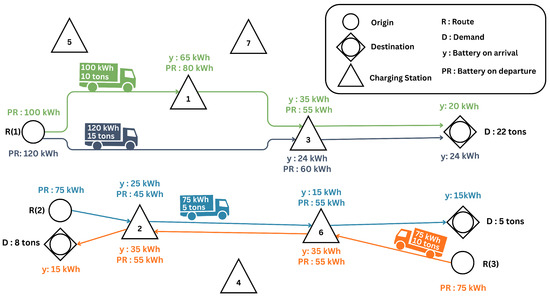
Although the routes in this study are predefined, the proposed problem is fundamentally different from classical Fixed-Route Vehicle Charging Problems (FRVCP). In FRVCP formulations, routes and vehicle assignments are typically fixed exogenously, and the primary objective is to optimize charging schedules along a given path. In contrast, the proposed framework jointly optimizes heterogeneous fleet selection, vehicle assignment, freight load allocation, charging station selection, and partial recharging quantities under stochastic demand. The interactions between vehicle capacity, battery size, energy consumption, and demand uncertainty introduce coupled feasibility and cost trade-offs that are not addressed in traditional FRVCP models. Consequently, the problem extends beyond charging optimization on fixed routes and represents a Stochastic Electric Freight Operations Planning Problem on Predefined Long-Haul Routes with Partial Recharging and Heterogeneous Fleets (SEFOP-PR-HF). Accordingly, a mixed-integer linear programming (MILP) model is developed to jointly optimize fleet allocation, route-level vehicle assignment, charging decisions, and load allocation under stochastic demand using chance-constrained programming. Figure 1 illustrates a simplified region-to-region long-haul electric freight network with three predefined routes (R1–R3), highlighting the interaction among fleet selection, charging decisions, and energy feasibility.
Figure 1.
Representative region-to-region long-haul electric freight network with predefined-route operations.
As presented in Figure 1, circular nodes represent origin depots, diamond-shaped nodes denote destination points with specified freight demand, and triangular nodes indicate candidate charging stations located along predefined long-haul corridors. Each route is served by one or more electric trucks selected from a heterogeneous fleet with different payload capacities and battery sizes. Vehicles may perform partial recharging at selected stations to maintain battery feasibility within the 20–80% SoC range. On Route 1 (R1), two heterogeneous trucks with 100 kWh and 120 kWh battery capacities jointly satisfy a 22-ton demand, demonstrating coordinated use of vehicles with distinct energy and capacity characteristics. Routes 2 (R2) and 3 (R3) depict smaller-scale operations where 5- to 10-ton vehicles operate along predefined routes and rely on intermediate charging stations to maintain sufficient energy levels for longer travel segments.
3.2. Mathematical Model
3.2.1. Model Assumptions
To develop the proposed SEFOP-PR-HF model, several assumptions are adopted to simplify the real-world complexity while preserving the essential characteristics of the long-haul electric freight operations. The model is formulated as a mixed-integer linear programming (MILP) framework and incorporates chance-constrained programming (CCP) to explicitly account for stochastic freight demand. Uncertainty in the model originates solely from freight demand, while all other parameters are treated as deterministic. These assumptions reflect a long-term operations planning perspective and are intended to ensure tractability while capturing key planning trade-offs. The main assumptions are summarized as follows:
- All charging stations provide DC fast charging with sufficient power availability. Charging station queuing and capacity constraints are not modeled, as the focus is on fleet-level planning decisions rather than detailed infrastructure congestion analysis.
- Vehicles depart from origin depots with a fully charged battery (SoC = 100%).
- The fleet is heterogeneous, with trucks differing in payload capacity, battery capacity, and energy consumption rate.
- Vehicle breakdowns and operational disruptions are not considered.
- Freight demand on each predefined route is modeled as a normally distributed random variable with known mean and standard deviation, representing day-to-day variability around long-term expected demand levels. Demand is assumed to be stationary over the analysis period, consistent with a planning-level approximation.
- Vehicles may perform partial recharging at intermediate charging stations, with battery SoC constrained to the 20–80% range to balance charging efficiency and battery health.
- Vehicles operate on predefined origin-destination routes with no route deviations or sequencing decisions.
- Total system cost is evaluated over a 10-year planning horizon (approximately 2500 operating days, assuming 250 operating days per year), reflecting the expected service life of heavy-duty electric trucks and the long-term nature of fleet investment decisions [2,46]. Other operational costs, including maintenance, depreciation, and labor, are assumed to be constant and excluded.
Chance-constrained programming (CCP) is used to ensure that vehicle capacity and energy feasibility constraints are satisfied with a specified confidence level under stochastic demand. This provides a planning-level representation of uncertainty, yielding robust fleet and charging decisions without explicitly modeling multi-period or real-time adaptive operations.
The following subsection defines the sets, parameters, and decision variables, followed by the mathematical formulation of the proposed SEFOP-PR-HF model.
3.2.2. Sets
The sets used in the proposed model are defined as follows:
- : Set of predefined routes;
- : Set of candidate charging stations;
- : Set of electric vehicles;
- : Set of candidate charging stations, including the origin node (starting node), defined as , where 0 denotes the origin node
- : Set of candidate charging stations, including the destination node (ending node), defined as , where denotes the destination node.
- : Set of all nodes along a predefined route, indexed from the origin node (0) through intermediate candidate charging stations to the destination node ()
3.2.3. Parameters
The parameters used in the model are defined as follows:
- : Distance from node to on a predefined route ; ( and
- : Battery capacity of vehicle ; (
- : Energy consumption rate of vehicle ; (
- : Payload capacity of vehicle ; (
- : Purchasing cost of vehicle type ; (
- : Unit charging cost
- : Number of operating days in the planning horizon
- : 1 if arc to belongs to predefined route ; 0 otherwise; ( and
- : Confidence level for satisfaction of the constraint set,
3.2.4. Decision Variables
The decision variables considered in this model are as follows:
- : Battery level of vehicle upon arrival at node on predefined route (
- : Battery level of vehicle upon departure from node on predefined route ; (
- : Freight load carried by vehicle on predefined route ; (
- : 1 if vehicle is used on predefined route ; 0 otherwise; (
- : 1 if vehicle travels from node to on predefined route ; 0 otherwise ( and
3.2.5. Stochastic Variables
The stochastic variables incorporated in the model are defined as follows:
- : Freight Demand on predefined route ; (
- : Expected value of demand on predefined route ; (
- : Variance of demand on predefined route ; (
3.2.6. Mathematical Model Formulation
The mathematical formulation of the problem is presented as follows:
Subject to:
The objective function (1) minimizes the total system cost, consisting of vehicle purchasing and charging costs. Equation (2) regulates vehicle movement along predefined routes and controls visits to candidate charging stations. Equations (3) and (4) ensure that vehicles assigned to each route depart from the corresponding origin and arrive at the designated destination. Equation (5) guarantees flow consistency along each predefined route, ensuring continuity of vehicle operation without route deviations. Equation (6) enforces the vehicle payload capacity limit, preventing trucks from carrying loads exceeding their capacity. Equation (7) ensures that regional demand is satisfied under uncertainty by requiring the total transported load to meet or exceed stochastic demand with a specified confidence level . Equation (8) models battery SoC dynamics, ensuring that the SoC remains above the minimum safety threshold throughout the trip. Equations (9) and (10) update the SoC after recharging events and enforce upper and lower SoC limits. Equation (11) defines the binary decision variables associated with vehicle selection, while Equation (12) specifies the non-negativity requirement for continuous variables.
Chance-Constrained Programming (CCP), introduced by Charnes and Cooper [47], is employed to explicitly incorporate demand uncertainty into the planning framework by enforcing probabilistic feasibility of capacity and energy constraints. CCP has been widely applied in stochastic logistics and transportation planning problems to manage uncertainty in customer demand and operational requirements [47,48,49,50]. In this study, CCP enables the proposed stochastic electric freight operations planning model to generate fleet and charging decisions that remain feasible with high probability under long-term demand variability, without requiring explicit multi-period or real-time adaptive decision-making. In CCP, constraint satisfaction is defined probabilistically as follows:
where denotes the probability that the constraint is satisfied, represents the constraint function of the problem, and is the required confidence level within the range 0 < < 1. In Equation (13), represents the decision variables, while denotes the random variables capturing system uncertainty. This formulation ensures that the probability of satisfying the constraint is at least . This approach manages uncertainty by imposing a minimum probability threshold for satisfying the constraints. While CCP provides robustness under uncertainty, it can increase computational complexity due to the probabilistic nature of the constraints. To make the model solvable using conventional optimization algorithms, stochastic constraints are typically converted into deterministic equivalents. Following the approach proposed by Kall & Wallace [51].
To illustrate the deterministic equivalents of the chance constraint, consider the case in which the demand in Equation (7) is treated as a random variable. Let the associated function be denoted by . The expectation and variance of this function can be derived as shown in Equations (14)–(16).
Both and are assumed to follow normal distributions; that is, and . The expected value and variance of are therefore given by:
To standardize the distribution, the variable is transformed into a standard normal form with zero mean and unit variance, , as:
Thus, the probabilistic constraint can be expressed as:
or equivalently.
Since, accordingly, the chance constraint can be expressed as
Since . This condition is satisfied when the inverse cumulative distribution function (quantile) of the standard normal distribution, , satisfies.
Accordingly, the deterministic equivalent of the stochastic constraint in Equation (7) is derived as:
where and denote the cumulative and inverse cumulative distribution functions of the standard normal distribution, respectively. and represent the expected value and variance operators.
By substituting the predetermined mean and variance of the stochastic parameters, the probabilistic model is converted into a deterministic equivalent, effectively eliminating randomness. This transformation enables efficient computation using mixed-integer linear programming (MILP) techniques while preserving the probabilistic feasibility of the original stochastic problem.
4. Computational Experiment
4.1. Test Instance and Parameter Setting
To evaluate the performance of the proposed SEFOP-PR-HF, a series of numerical experiments was conducted using 20 test instances representing real-world regional freight operations in Thailand. Each instance varies in scale according to three key parameters: the number of predefined routes, the number of candidate charging stations, and the number of vehicles. The spatial configuration of the test instances reflects the geographical characteristics of Thailand’s logistics network, particularly along the East–West Economic Corridor (EWEC), which connects major logistics hubs between western and eastern regions of the country. This corridor represents a typical long-haul freight environment with fixed origin-destination corridors and limited route flexibility. Freight demand along the corridor exhibits natural variability arising from daily order fluctuations, measurement uncertainty, last-minute shipment adjustments, and seasonal effects. Accordingly, the test instance was designed to capture realistic interregional freight operations, where multiple origins-destination pairs and charging stations are located within the same or adjacent provinces. This structure reflects the operational complexity faced in electric freight planning, including overlapping service regions and limited charging infrastructure coverage.
Vehicle characteristics are based on actual specifications of battery-electric trucks used or piloted in Thailand’s logistics sector. Three electric truck categories are considered: 6-wheel rigid trucks, 12-wheel rigid trucks, and electric tractors, each with distinct technical and economic attributes. Battery capacities range from 105.28 to 423.93 kWh, energy consumption rates from 0.42 to 1.21 kWh/km, payload capacities from 5.63 to 50.5 tons, and vehicle purchase costs from 1.25 to 4.95 million THB. These specifications are based on battery-electric truck models that are commercially deployed or currently under pilot operation.
At DC fast-charging stations, the allowable state of charge (SoC) range is restricted to 20–80%, consistent with operational and battery health guidelines. The evaluation horizon is set to 10 years (2500 operating days), consistent with the long-term planning assumptions of the model. To account for demand uncertainty, a confidence level of = 0.95 is adopted in the chance-constrained programming formulation, ensuring that the freight demand is satisfied with at least 95% probability. Table 2 and Table 3 summarize the key parameters and their corresponding values used in the computational experiments.
Table 2.
Vehicle parameter values.
Table 3.
Economic parameters values.
4.2. Experimental Results
The proposed SEFOP-PR-HF was implemented and solved using LINGO 22.0, a commercial optimization solver capable of handling linear, nonlinear, and mixed-integer programming problems. All computational experiments were conducted on a workstation equipped with a 13th Gen Intel® Core™ i5-13420H (2.10 GHz) processor and 16 GB of RAM.
Table 4 summarizes the computational results obtained from both the deterministic and stochastic (CCP-based) models. For the stochastic model, freight demand uncertainty is represented as a normally distributed random variable with a mean equal to the baseline demand and a standard deviation () set to 15% of the mean, which is incorporated into the chance-constrained formulation to enforce probabilistic feasibility. This setting provides adequate coverage of demand variability while maintaining computational tractability. In contrast, the deterministic model assumes fixed mean demand values for each route. The comparison highlights how incorporating uncertainty via the CCP approach affects total cost, solution robustness, and computational performance relative to the deterministic baseline.
Table 4.
Computational results for deterministic and stochastic models under = 15% and = 0.95.
To quantify the difference between the two approaches, the percentage deviation (PD) between the stochastic and deterministic solutions was computed as follows:
where and denote the costs obtained from the stochastic and deterministic models, respectively.
According to the results in Table 4, both deterministic and stochastic formulations of the proposed SEFOP-PR-HF model obtained optimal solutions for 17 out of 20 test instances. The stochastic model generally required longer computation times, reflecting the additional complexity introduced by chance-constrained feasibility requirements under demand uncertainty. For Instances 18–20, which include 10 or more candidate charging stations and multiple routes, LINGO was unable to reach optimality within the 6-hour computational limit. The reported outcomes, therefore, represent the best feasible solutions found before termination, illustrating the well-known scalability challenges associated with large-scale mixed-integer stochastic programs.
Across all instances, the deterministic model produced total costs between 7.99 and 22.83 million THB, while the stochastic model yielded higher costs of 8.05 to 25.45 million THB. The PD values between the two formulations ranged from 6% to 33%, confirming that demand uncertainty introduces a measurable cost premium. This increase reflects the model’s adjustments to maintain feasibility, primarily through more frequent partial recharging and the selection of higher-capacity or additional vehicles. Instances 6 and 7, for example, show vehicle cost increases exceeding 100%, suggesting that stochastic demand prompts conservative fleet sizing to safeguard service reliability. Although several smaller instances (e.g., 3, 8, 13) exhibited no deviation, indicating stable fleet allocation and charging decisions under low variability, most instances displayed sensitivity to demand uncertainty, particularly those with tight capacity-to-demand ratios or longer route lengths. This demonstrates that incorporating stochastic demand reshapes both energy-management decisions and fleet allocation, leading to higher but more reliable operational plans.
Overall, the results highlight a clear robustness-cost trade-off between the two formulations. The deterministic model offers computational efficiency and lower nominal cost but remains vulnerable to demand fluctuations, whereas the stochastic CCP-based model achieves greater robustness by increasing operational costs through additional charging and larger or more diversified fleet utilization. This trade-off underscores the importance of explicitly integrating demand uncertainty into electric freight operations planning to ensure feasible, reliable, and cost-resilient logistics operations under real-world variability.
4.3. Result Analysis
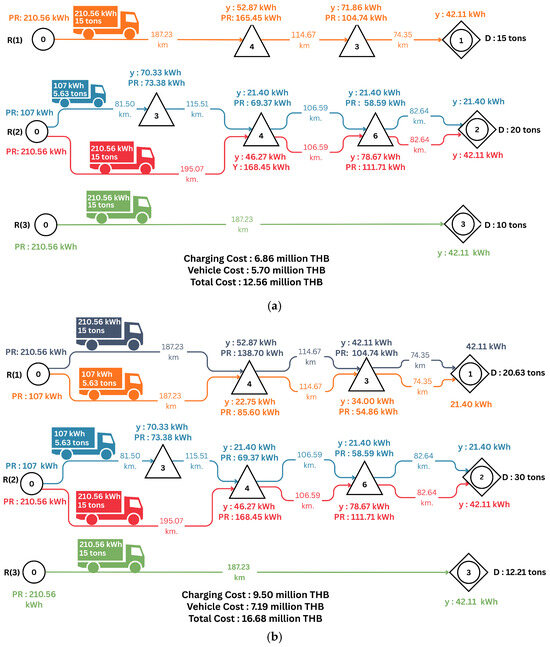
To further investigate the solution behavior under demand uncertainty, Figure 2 compares the optimal vehicle allocation and charging plans obtained from the deterministic and stochastic formulations for Instance 9, which exhibits the highest percentage deviation (33%) among all test cases. In the deterministic setting, the total transportation cost is 12.56 million THB, consisting of 6.86 million THB in charging costs and 5.70 million THB in vehicle costs. In contrast, the stochastic model yields a higher total cost of 16.68 million THB, comprising 9.50 million THB in charging costs and 7.19 million THB in vehicle costs.
Figure 2.
Comparison of optimal vehicle allocation and charging plans for Instance 9: (a) deterministic model; (b) stochastic model.
In the deterministic model, fleet allocation and charging decisions are optimized under fixed demand assumptions. Vehicles operate close to their payload and energy limits, selecting the smallest feasible fleet configuration and performing recharging only when necessary. Consequently, energy utilization is tightly managed, with battery levels at departure and arrival closely aligned with minimum feasibility thresholds, minimizing both operational and capital expenditures.
The stochastic solution, optimized under 15% demand variability and a 95% confidence level using CCP, alters both vehicle assignment and recharging strategies to preserve feasibility across uncertain demand scenarios. The solution introduces additional or alternative recharging stops, maintains higher state-of-charge reserves, and often deploys a greater number of vehicles. These adjustments increase operational cost but significantly enhance reliability against heavier-than-expected loads. Notably, the stochastic model reallocates freight and assigns higher-capacity vehicles to routes with greater demand volatility. Although these larger vehicles consume more energy, their extended battery capacity allows longer trips between charges, reducing total charging frequency and improving service reliability.
Overall, the comparison highlights the cost-robustness trade-off inherent in stochastic electric freight operations planning. The deterministic model achieves lower costs but remains vulnerable to demand fluctuations, whereas the stochastic formulation sacrifices some travel efficiency to ensure operational robustness and service continuity under uncertainty.
4.4. Sensitivity Analysis
To examine how uncertainty and risk tolerance affect the model performance, a sensitivity analysis was conducted using Instance 16. Two parameters were examined: the confidence level () and the standard deviation () of customer demand, expressed as a percentage deviation from the mean demand, representing the deterministic baseline.
4.4.1. Impact of Confidence Level
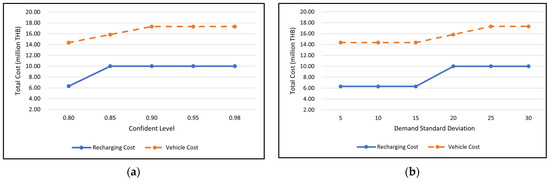
Table 5 and Figure 3a present the effects of varying confidence levels ( = 0.8, 0.85, 0.90, 0.95, 0.98) on total cost and operational behavior, under a fixed demand variability of = 25%. The results show that the confidence level directly influences the trade-off between cost efficiency and solution robustness.
Table 5.
Effect of confidence level () on model results for Instance 16 ( = 25%).
Figure 3.
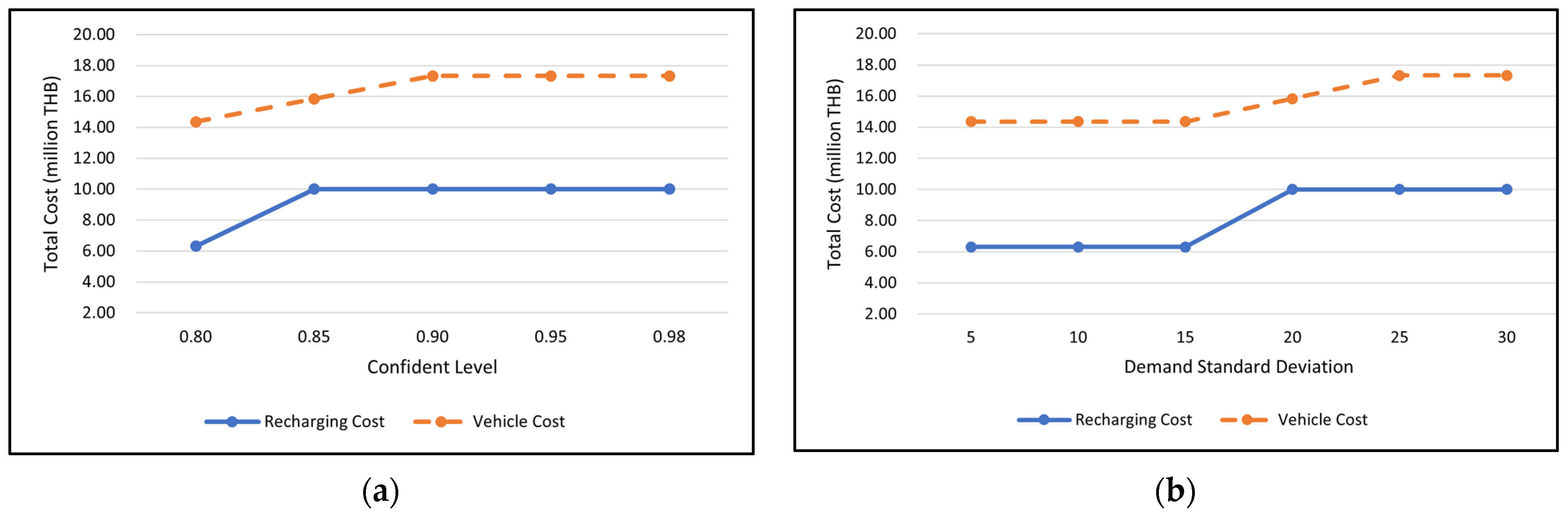
Sensitivity of total cost components under uncertainty: (a) effect of confidence level ( = 0.95); (b) effect of demand standard deviation ( = 25%).
At lower confidence levels (0.80–0.85), the model exhibits risk-tolerant behavior, producing lower total costs but relying on minimal SoC reserves and limited spare vehicle capacity. For example, at = 0.80, the total cost is 20.67 million THB, achieved through minimal recharging and full utilization of smaller vehicles. As the confidence level increases to 0.85, total cost rises by approximately 25%, primarily due to additional charging and larger vehicle deployment to maintain feasibility under a wider range of demand realizations.
When the confidence level exceeds = 0.85, both cost components stabilize. The recharging cost remains constant at 10.01 million THB, while vehicle cost converges to 17.33 million THB for confidence levels ≥ 0.90. This stabilization indicates that once sufficient robustness is achieved, further increases in reliability yield diminishing returns on cost and have minimal impact on fleet composition or charging decisions.
Overall, increasing the confidence level enhances reliability but increases operating cost. The observed threshold near = 0.85 represents a practical trade-off, where further risk aversion adds negligible robustness but significantly increases expenditure. These results offer valuable guidance for logistics planners in selecting service reliability levels that balance cost efficiency and reliability under demand uncertainty.
4.4.2. Impact of Demand Variability
The second analysis examines how demand variability, measured by the standard deviation as a percentage deviation from the mean demand, affects the stochastic model under a fixed confidence level of = 0.95. Results in Table 6 and Figure 3b show distinct behavioral patterns under low and high variability conditions.
Table 6.
Effect of demand standard deviation () on model results for Instance 16 (confidence level, = 0.95).
For low variability ( ≤ 15%), total, vehicle, and recharging costs remain unchanged. The baseline configuration, including fleet composition and charging schedule, is sufficiently robust to accommodate small fluctuations in demand, demonstrating the inherent stability of the deterministic solution. However, for high variability ( ≥ 20%), both cost components increase noticeably. Recharging cost rises from 6.31 to 10.01 million THB, indicating that greater uncertainty requires additional charging events and higher SoC reserves to avoid battery depletion. As variability further increases to 25–30%, vehicle cost also increases from 14.36 to 17.33 million THB, reflecting the need to deploy larger or additional trucks to satisfy volatile freight demand.
As demand variability increases from low to high levels, the model shifts from energy-based adjustments, such as more frequent charging and higher SoC reserves, to structural fleet modifications, including the deployment of larger vehicles or additional units. These results highlight the importance of accounting for demand variability in long-haul electric freight planning. Ignoring such uncertainty may result in underestimated fleet sizes and insufficient energy provisioning for real-world operations.
These results demonstrate that both the confidence level and demand variability jointly shape the balance between cost efficiency and robustness in the proposed model. The confidence level reflects managerial risk preference, while demand variability captures the degree of environmental uncertainty. Together, they determine a nonlinear relationship between cost and reliability, where higher reliability or variability generally leads to rising operational costs but diminishing improvements in robustness. This behavior is consistent with prior findings in stochastic optimization (e.g., [48,49]), which shows that the marginal cost of robustness increases rapidly under greater uncertainty. For long-haul electric freight systems, these results emphasize the importance of carefully selecting reliability settings that achieve a practical equilibrium between economic efficiency and operational resilience.
4.5. Impact of Charging Policy
This analysis evaluates the incremental value of partial recharging compared with a simplified full-recharging-only policy under stochastic demand. Table 7 reports cost outcomes for selected instances under the demand variability of = 15% and a confidence level of = 0.95.
Table 7.
Cost comparison between partial and full recharging policies under stochastic demand ( = 15%, = 0.95.
Across all instances, partial recharging consistently results in lower charging costs and lower total system costs than full recharging. Vehicle investment costs remain identical under both policies, indicating that fleet sizing decisions are primarily driven by demand uncertainty rather than charging strategy, while energy-related costs are highly sensitive to the recharging policy adopted. For Instances 13 and 14, partial recharging reduces charging costs by approximately 5.15–5.97%, resulting in total cost savings of 2.69–3.10%. Substantially larger benefits are observed in Instances 15 and 16, where charging cost reductions reach 92.02% and 44.08%, respectively, translating into total cost savings exceeding 13%. Instance 17 further reinforces this pattern, with charging and total cost reductions of 15.87% and 7.86%, respectively.
These results indicate that full-recharging-only policies lead to excessive energy provisioning, particularly under probabilistic feasibility requirements, whereas partial recharging enables vehicles to replenish only the energy necessary to satisfy reliability constraints. As a result, partial recharging improves cost efficiency without compromising service reliability.
Overall, this analysis demonstrates that partial recharging provides substantial incremental value over simplified full-recharging models, especially in long-haul corridor operations subject to demand uncertainty. Incorporating flexible recharging decisions is therefore essential for accurate cost assessment and robust electric freight planning.
4.6. Impact of Fleet Heterogeneous
This analysis evaluates the incremental value of heterogeneous fleet selection by comparing the proposed model against simplified homogeneous fleet configurations. Table 8 reports cost outcomes under stochastic demand with = 15% and a confidence level of = 0.95, considering homogeneous fleets composed exclusively of 6-wheel trucks, 12-wheel trucks, or electric tractors.
Table 8.
Cost comparison between heterogeneous and homogeneous fleet under stochastic demand ( = 15%, = 0.95).
The results show that heterogeneous fleets consistently achieve the lowest total system cost across all instances. Homogeneous 6-wheel fleets incur substantially higher costs, often exceeding the heterogeneous case by more than 90%, due to frequent recharging requirements and the need for additional vehicles to satisfy probabilistic feasibility constraints. Homogeneous 12-wheel fleets reduce charging frequency compared to smaller 6-wheel configurations; however, they still incur higher total costs than heterogeneous fleets. Because heterogeneous fleets incorporate a mix of vehicle sizes, they achieve more efficient capacity utilization and avoid unnecessary overcapacity. As a result, the total cost of a homogeneous 12-wheel fleet is approximately 14.84% to 39% higher than that of a heterogeneous fleet. Similarly, for the electric tractor fleet, charging costs are generally lower due to larger battery capacities. Nevertheless, these savings are outweighed by substantially higher vehicle investment costs. Consequently, the total system cost remains higher than that of the heterogeneous fleet, with increases of up to 55.82% in some instances.
These results highlight that fleet heterogeneity plays a critical role in balancing charging and investment costs under demand uncertainty. By allowing flexible assignment of vehicle types across routes, heterogeneous fleets better adapt to variations in demand intensity and route characteristics than any single-vehicle-type configuration.
Overall, this analysis quantifies the incremental value of heterogeneous fleet sizing over simplified homogeneous fleet models, demonstrating that ignoring fleet diversity can lead to significantly overestimated system costs and inefficient investment decisions in long-haul electric freight operations.
5. Conclusions
This study developed a Stochastic Electric Freight Operations Planning Problem on Predefined Routes with Partial Recharging and Heterogeneous Fleets (SEFOP-PR-HF) to support the transition of long-haul freight operations toward sustainable electric logistics networks. The proposed mixed-integer linear programming (MILP) model jointly optimizes fleet composition, route-level vehicle assignment, freight load allocation, and partial recharging decisions while satisfying vehicle capacity and battery state-of-charge constraints. To address operational uncertainty, regional freight demand was modeled as a stochastic variable, and Chance-Constrained Programming (CCP) was employed to ensure probabilistic feasibility of demand satisfaction and energy constraints.
Computational experiments based on long-haul freight data demonstrated that the proposed model effectively identifies cost-efficient and operationally feasible planning solutions for corridor-based electric freight systems. Comparison between deterministic and stochastic formulations showed that incorporating demand uncertainty leads to higher total system cost but substantially improves operational robustness. In particular, the stochastic CCP-based model systematically favors higher-capacity vehicles, diversified fleet compositions, and increased SoC reserves to safeguard feasibility under demand variability. Sensitivity analyses further revealed that both the confidence level and the magnitude of demand variability significantly influence fleet investment decisions, charging behavior, and total cost, highlighting a clear and quantifiable trade-off between cost efficiency and service reliability.
Beyond methodological contributions, the results yield concrete planning and policy insights. Partial recharging consistently outperformed full recharging, achieving substantial charging cost reductions without increasing fleet investment, highlighting the value of flexible charging strategies along long-haul corridors. In addition, heterogeneous fleets markedly outperformed homogeneous configurations under demand uncertainty, as uniform fleets often incur higher costs due to overcapacity or excessive charging. These findings indicate that logistics operators should favor diversified vehicle portfolios tailored to route characteristics and demand variability, while policymakers and infrastructure planners should support partial recharging operations and heterogeneous electric truck deployment to reduce electrification costs and enhance system reliability.
The proposed framework is positioned as a long-term operations planning model. By assuming predefined routes and stationary stochastic demand, it represents average system behavior over an extended horizon and enables the evaluation of long-term trade-offs among fleet investment, charging strategies, and reliability. While this abstraction enhances tractability and supports strategic decision-making, it also introduces limitations. Dynamic factors such as evolving charging infrastructure, charging station congestion, terrain-dependent energy consumption, and adaptive daily dispatch decisions are not explicitly modeled. Moreover, computational results indicate that exact MILP-based solution approaches face scalability challenges, with solution times increasing substantially as the number of routes and charging stations grows. These limitations suggest several directions for future research. Modeling extensions could incorporate multi-period stochastic demand, explicit charging station capacity constraints, or environmental performance metrics to enhance realism and policy relevance. From a methodological perspective, decomposition techniques, tailored metaheuristics, or hybrid metaheuristic-exact approaches could improve scalability and enable application to larger corridor networks while preserving planning-level insights.
Overall, this study provides a structured foundation for stochastic electric freight operations planning on predefined long-haul corridors. By integrating fleet heterogeneity, partial recharging, and demand uncertainty within a unified planning framework, the proposed approach offers actionable insights for logistics operators, infrastructure planners, and policymakers seeking reliable and cost-effective electric freight systems.
Author Contributions
Conceptualization, W.N. (Warisa Nakkiew) and P.J.; methodology, K.N., W.N. (Warisa Nakkiew) and P.J.; software, K.N.; validation, K.N., W.N. (Warisa Nakkiew) and P.J.; formal analysis, K.N.; investigation, K.N. and W.N. (Warisa Nakkiew); data curation, K.N.; writing—original draft preparation, K.N.; writing—review and editing, W.N. (Warisa Nakkiew) and W.N. (Wasawat Nakkiew); visualization, K.N.; supervision, W.N. (Warisa Nakkiew); project administration, W.N. (Warisa Nakkiew); funding acquisition, W.N. (Wasawat Nakkiew) All authors have read and agreed to the published version of the manuscript.
Funding
This research project was funded by Chiang Mai University, Thailand.
Data Availability Statement
The raw data supporting the conclusions of this article will be made available by the authors on request.
Acknowledgments
This research project was supported by Chiang Mai University, Thailand. During the preparation of this manuscript, the authors used ChatGPT (OpenAI, GPT-5.1) for the purposes of text editing (e.g., grammar, structure, spelling, punctuation, and formatting). The authors have reviewed and edited the output and take full responsibility for the content of this publication.
Conflicts of Interest
The authors declare no conflicts of interest.
Abbreviations
The following abbreviations are used in this manuscript:
| SEFOP-PR-HF | Stochastic Electric Freight Operations Planning Problem on Predefined Long-Haul Routes with Partial Recharging and Heterogeneous Fleets |
| CCP | Chance-Constrained Programming |
| MILP | Mixed-Integer Linear Programming |
| EVRP | Electric Vehicle Routing Problem |
| VRP | Vehicle Routing Problem |
| EWEC | East–West Economic Corridor |
| SoC | State-of-Charge |
| FRVCP | Fixed Route Vehicle Charging Problem |
References
- Pelletier, S.; Jabali, O.; Laporte, G. 50th Anniversary Invited Article—Goods Distribution with Electric Vehicles: Review and Research Perspectives. Transp. Sci. 2016, 50, 3–22. [Google Scholar] [CrossRef] [Scilit]
- Shoman, W.; Yeh, S.; Sprei, F.; Plötz, P.; Speth, D. Battery Electric Long-Haul Trucks in Europe: Public Charging, Energy, and Power Requirements. Transp. Res. Part D Transp. Environ. 2023, 121, 103825. [Google Scholar] [CrossRef] [Scilit]
- Erdelić, T.; Carić, T. A Survey on the Electric Vehicle Routing Problem: Variants and Solution Approaches. J. Adv. Transp. 2019, 2019, 5075671. [Google Scholar] [CrossRef] [Scilit]
- Schneider, M.; Stenger, A.; Goeke, D. The Electric Vehicle-Routing Problem with Time Windows and Recharging Stations. Transp. Sci. 2014, 48, 500–520. [Google Scholar] [CrossRef] [Scilit]
- Keskin, M.; Çatay, B. Partial Recharge Strategies for the Electric Vehicle Routing Problem with Time Windows. Transp. Res. Part C Emerg. Technol. 2016, 65, 111–127. [Google Scholar] [CrossRef] [Scilit]
- Schiffer, M.; Walther, G. The Electric Location Routing Problem with Time Windows and Partial Recharging. Eur. J. Oper. Res. 2017, 260, 995–1013. [Google Scholar] [CrossRef] [Scilit]
- Ge, X.; Zhu, Z.; Jin, Y. Electric Vehicle Routing Problems with Stochastic Demands and Dynamic Remedial Measures. Math. Probl. Eng. 2020, 2020, 8795284. [Google Scholar] [CrossRef] [Scilit]
- Oladimeji, O.; Gonzalez-Castellanos, A.; Pozo, D.; Dvorkin, Y.; Acharya, S. Impact of Electric Vehicle Routing With Stochastic Demand on Grid Operation. In Proceedings of the 2021 IEEE Madrid PowerTech; IEEE: Madrid, Spain, 2021; pp. 1–6. [Google Scholar]
- Hiermann, G.; Puchinger, J.; Ropke, S.; Hartl, R.F. The Electric Fleet Size and Mix Vehicle Routing Problem with Time Windows and Recharging Stations. Eur. J. Oper. Res. 2016, 252, 995–1018. [Google Scholar] [CrossRef] [Scilit]
- Wang, L.; Ding, Y.; Chen, Z.; Su, Z.; Zhuang, Y. Heuristic Algorithms for Heterogeneous and Multi-Trip Electric Vehicle Routing Problem with Pickup and Delivery. World Electr. Veh. J. 2024, 15, 69. [Google Scholar] [CrossRef] [Scilit]
- Froger, A.; Mendoza, J.E.; Jabali, O.; Laporte, G. Improved Formulations and Algorithmic Components for the Electric Vehicle Routing Problem with Nonlinear Charging Functions. Comput. Oper. Res. 2019, 104, 256–294. [Google Scholar] [CrossRef] [Scilit]
- Conrad, R.; Figliozzi, M. The Recharging Vehicle Routing Problem. In Proceedings of the 2011 Industrial Engineering Research Conference; IISE: Norcross, GA, USA, 2011; Volume 8. [Google Scholar]
- Erdoğan, S.; Miller-Hooks, E. A Green Vehicle Routing Problem. Transp. Res. E 2012, 48, 100–114. [Google Scholar] [CrossRef] [Scilit]
- Goeke, D.; Roberti, R.; Schneider, M. Exact and Heuristic Solution of the Consistent Vehicle-Routing Problem. Transp. Sci. 2019, 53, 1023–1042. [Google Scholar] [CrossRef] [Scilit]
- Zhao, M.; Lu, Y. A Heuristic Approach for a Real-World Electric Vehicle Routing Problem. Algorithms 2019, 12, 45. [Google Scholar] [CrossRef] [Scilit]
- de Vos, M.; van Lieshout, R.N.; Dollevoet, T. Electric Vehicle Scheduling with Capacitated Charging Stations and Partial Charging. arXiv 2022, arXiv:2207.13734. [Google Scholar] [CrossRef] [Scilit]
- Sassi, O.; Oulamara, A. Electric Vehicle Scheduling and Optimal Charging Problem: Complexity, Exact and Heuristic Approaches. Int. J. Prod. Res. 2017, 55, 519–535. [Google Scholar] [CrossRef] [Scilit]
- Lin, B.; Ghaddar, B.; Nathwani, J. Electric Vehicle Routing with Charging/Discharging under Time-Variant Electricity Prices. Transp. Res. Part C Emerg. Technol. 2021, 130, 103285. [Google Scholar] [CrossRef] [Scilit]
- Bektaş, T.; Laporte, G. The Pollution-Routing Problem. Transp. Res. Part B Methodol. 2011, 45, 1232–1250. [Google Scholar] [CrossRef] [Scilit]
- Xiao, Y.; Konak, A. The Heterogeneous Green Vehicle Routing and Scheduling Problem with Time-Varying Traffic Congestion. Transp. Res. Part E Logist. Transp. Rev. 2016, 88, 146–166. [Google Scholar] [CrossRef] [Scilit]
- Bezzi, D.; Ceselli, A.; Righini, G. A Route-Based Algorithm for the Electric Vehicle Routing Problem with Multiple Technologies. Transp. Res. Part C Emerg. Technol. 2023, 157, 104374. [Google Scholar] [CrossRef] [Scilit]
- Aslan Yıldız, Ö.; Sarıçiçek, İ.; Yazıcı, A. A Reinforcement Learning-Based Solution for the Capacitated Electric Vehicle Routing Problem from the Last-Mile Delivery Perspective. Appl. Sci. 2025, 15, 1068. [Google Scholar] [CrossRef] [Scilit]
- Akbay, M.A.; Kalayci, C.B.; Blum, C. Application of CMSA to the Electric Vehicle Routing Problem with Time Windows, Simultaneous Pickup and Deliveries, and Partial Vehicle Charging. In Metaheuristics; Di Gaspero, L., Festa, P., Nakib, A., Pavone, M., Eds.; Lecture Notes in Computer Science; Springer International Publishing: Cham, Switzerland, 2023; Volume 13838, pp. 1–16. [Google Scholar]
- Montoya, A.; Guéret, C.; Mendoza, J.E.; Villegas, J.G. The Electric Vehicle Routing Problem with Nonlinear Charging Function. Transp. Res. Part B Methodol. 2017, 103, 87–110. [Google Scholar] [CrossRef] [Scilit]
- Pelletier, S.; Jabali, O.; Laporte, G. Charge Scheduling for Electric Freight Vehicles. Transp. Res. Part B Methodol. 2018, 115, 246–269. [Google Scholar] [CrossRef] [Scilit]
- Su, Z.; Lamantia, M.; Chen, P. Social-Aware Long-Distance Trip Planner for Electric Vehicles Using Genetic Algorithm. ASME Lett. Dyn. Syst. Control 2023, 3, 021011. [Google Scholar] [CrossRef] [Scilit]
- Deschênes, A.; Boudreault, R.; Gaudreault, J.; Quimper, C.-G. The Soft Fixed Route Hybrid Electric Aircraft Charging Problem with Variable Speed. World Electr. Veh. J. 2025, 16, 471. [Google Scholar] [CrossRef] [Scilit]
- Kullman, N.D.; Froger, A.; Mendoza, J.E.; Goodson, J.C. Frvcpy: An Open-Source Solver for the Fixed Route Vehicle Charging Problem. Inf. J. Comput. 2021, 33, 1277–1283. [Google Scholar] [CrossRef] [Scilit]
- Deschenes, A.; Gaudreault, J.; Quimper, C.-G. Dynamic Programming for the Fixed Route Electric Vehicle Charging Problem with NonLinear Energy Management. In Proceedings of the 2022 IEEE 25th International Conference on Intelligent Transportation Systems (ITSC); IEEE: Macau, China, 2022; pp. 3956–3962. [Google Scholar]
- Mandal, D.; Sarkar, A.; Mondal, A. A Discrete Partial Charging Enabled Dynamic Programming Strategy for Optimal Fixed-Route Electric Vehicle Charging. ACM Trans. Embed. Comput. Syst. 2025, 24, 154. [Google Scholar] [CrossRef] [Scilit]
- Ke, Y.; Luo, R.; Yang, J. A Heuristic Approach for Fixed-Route Vehicle Charging with Nonlinear Time-Dependent Charging Function. Adv. Comput. Mater. Sci. Res. 2025, 4, 30. [Google Scholar] [CrossRef] [Scilit]
- Deschenes, A.; Gaudreault, J.; Vignault, L.-P.; Bernard, F.; Quimper, C.-G. The Fixed Route Electric Vehicle Charging Problem with Nonlinear Energy Management and Variable Vehicle Speed. In Proceedings of the 2020 IEEE International Conference on Systems, Man, and Cybernetics (SMC); IEEE: Toronto, ON, Canada, 2020; pp. 1451–1458. [Google Scholar]
- Widmann, J.; Briegel, B.; Hofmann, D.; Sawodny, O. Charging Strategy Optimization for Battery Electric Vehicles Based on Dynamic Programming. In Proceedings of the 2024 IEEE/SICE International Symposium on System Integration (SII); IEEE: Ha Long, Vietnam, 2024; pp. 986–991. [Google Scholar]
- Su, Z.; Chen, P. A Driver-Centric Long-Trip Schedule Optimizer for Battery Electric Vehicles. In Proceedings of the 2024 American Control Conference (ACC); IEEE: Toronto, ON, Canada, 2024; pp. 3001–3006. [Google Scholar]
- Bai, T.; Li, Y.; Johansson, K.H.; Mårtensson, J. Rollout-Based Charging Strategy for Electric Trucks With Hours-of-Service Regulations. IEEE Control Syst. Lett. 2023, 7, 2167–2172. [Google Scholar] [CrossRef] [Scilit]
- Wang, I.-L.; Wang, Y.; Lin, P.-C. Optimal Recharging Strategies for Electric Vehicle Fleets with Duration Constraints. Transp. Res. Part C Emerg. Technol. 2016, 69, 242–254. [Google Scholar] [CrossRef] [Scilit]
- Davatgari, A.; Cokyasar, T.; Subramanyam, A.; Larson, J.; Mohammadian, A. Electric Vehicle Supply Equipment Location and Capacity Allocation for Fixed-Route Networks. Eur. J. Oper. Res. 2024, 317, 953–966. [Google Scholar] [CrossRef] [Scilit]
- Hof, J.; Schneider, M.; Goeke, D. Solving the Battery Swap Station Location-Routing Problem with Capacitated Electric Vehicles Using an AVNS Algorithm for Vehicle-Routing Problems with Intermediate Stops. Transp. Res. Part B Methodol. 2017, 97, 102–112. [Google Scholar] [CrossRef] [Scilit]
- Dönmez, S.; Koç, Ç.; Altıparmak, F. The Mixed Fleet Vehicle Routing Problem with Partial Recharging by Multiple Chargers: Mathematical Model and Adaptive Large Neighborhood Search. Transp. Res. E 2022, 167, 102917. [Google Scholar] [CrossRef] [Scilit]
- Xia, X.; Zhuang, H.; Wang, Z.; Chen, Z. Two-Stage Heuristic Algorithm with Pseudo Node-Based Model for Electric Vehicle Routing Problem. Appl. Soft Comput. 2024, 165, 112102. [Google Scholar] [CrossRef] [Scilit]
- Chen, Y.; Xue, J.; Zhou, Y.; Wu, Q. An Efficient Threshold Acceptance-Based Multi-Layer Search Algorithm for Capacitated Electric Vehicle Routing Problem. IEEE Trans. Intell. Transport. Syst. 2024, 25, 5867–5879. [Google Scholar] [CrossRef] [Scilit]
- Zhang, S.; Gajpal, Y.; Appadoo, S.S. A Meta-Heuristic for Capacitated Green Vehicle Routing Problem. Ann. Oper. Res. 2018, 269, 753–771. [Google Scholar] [CrossRef] [Scilit]
- Florio, A.M.; Hartl, R.F.; Minner, S.; Salazar-González, J.-J. A Branch-and-Price Algorithm for the Vehicle Routing Problem with Stochastic Demands and Probabilistic Duration Constraints. Transp. Sci. 2021, 55, 122–138. [Google Scholar] [CrossRef] [Scilit]
- Kullman, N.D.; Goodson, J.C.; Mendoza, J.E. Electric Vehicle Routing with Public Charging Stations. Transp. Sci. 2021, 55, 637–659. [Google Scholar] [CrossRef] [Scilit]
- Bi, X.; Tang, W.K.S. Logistical Planning for Electric Vehicles Under Time-Dependent Stochastic Traffic. IEEE Trans. Intell. Transport. Syst. 2019, 20, 3771–3781. [Google Scholar] [CrossRef] [Scilit]
- De Albuquerque Felizola Romeral, P.A.; Zancul, E. Total Cost of Ownership of Electric Vehicles: A Synthesis of Critical Factors. J. Eng. 2025, 2025, e70113. [Google Scholar] [CrossRef] [Scilit]
- Charnes, A.; Cooper, W.W. Chance-Constrained Programming. Manag. Sci. 1959, 6, 73–79. [Google Scholar] [CrossRef] [Scilit]
- Mendoza, J.E.; Rousseau, L.-M.; Villegas, J.G. A Hybrid Metaheuristic for the Vehicle Routing Problem with Stochastic Demand and Duration Constraints. J. Heuristics 2016, 22, 539–566. [Google Scholar] [CrossRef] [Scilit]
- Messaoud, E. A Chance Constrained Programming Model and an Improved Large Neighborhood Search Algorithm for the Electric Vehicle Routing Problem with Stochastic Travel Times. Evol. Intel. 2023, 16, 153–168. [Google Scholar] [CrossRef] [Scilit]
- Miranda, D.M.; Conceição, S.V. The Vehicle Routing Problem with Hard Time Windows and Stochastic Travel and Service Time. Expert Syst. Appl. 2016, 64, 104–116. [Google Scholar] [CrossRef] [Scilit]
- Kall, P.; Wallace, S.W. Stochastic Programming; Wiley-Interscience series in systems and optimization; Reprinted; Wiley: Chichester, UK, 1994. [Google Scholar]

Disclaimer/Publisher’s Note: The statements, opinions and data contained in all publications are solely those of the individual author(s) and contributor(s) and not of MDPI and/or the editor(s). MDPI and/or the editor(s) disclaim responsibility for any injury to people or property resulting from any ideas, methods, instructions or products referred to in the content. |
© 2026 by the authors. Licensee MDPI, Basel, Switzerland. This article is an open access article distributed under the terms and conditions of the Creative Commons Attribution (CC BY) license.