


Abstract
Dielectric capacitors, characterized by ultra-fast charge/discharge speeds and high power densities, are widely used in modern electronic power systems. However, their low energy density and poor thermal stability limit applications. In this study, SrBi3.25La0.75Ti4O15 (SBLT) ferroelectric thin films were prepared by the sol–gel method. We systematically investigated the effect of annealing temperature on microstructural evolution, electrical properties, and energy storage performance. The SBLT film annealed at 700 °C exhibited optimal performance, achieving a balanced enhancement in polarization and breakdown strength, with an energy storage density of 48.66 J cm−3 and an efficiency of 78%. The material also demonstrated excellent thermal stability (30–175 °C) and frequency stability (0.1–100 kHz). These findings not only validate the potential of SBLT as a next-generation energy storage dielectric but also provide a practical solution for applications in semiconductor technology.
1. Introduction
With the rapid development of advanced electronic and electrical systems, the demand for improved energy and power densities has become increasingly urgent, driving the continuous improvement of energy storage devices. Dielectric capacitors, due to their ultra-fast charge/discharge speeds, are considered one of the most promising candidates for capacitors [1,2,3,4,5,6,7]. However, compared to electrochemical batteries and supercapacitors, dielectric capacitors have relatively low energy densities, limiting their applications [8,9]. The recoverable energy density (Ue) of dielectric capacitors depends on their dielectric polarization (P) and breakdown strength (BDS) under an applied electric field (E) [10,11,12,13]. Specifically, Ue = , where Pm and Pr are maximum polarization and remnant polarization, respectively. Additionally, polarization hysteresis also determines energy storage efficiency (η), defined as η = Ue/(Ue + Uloss). Thus, enhancing BDS is crucial for improving overall energy storage performance [14,15,16,17,18,19,20,21].
Various methods have been attempted to improve the breakdown field strength. For example, high-entropy design can effectively refine grain sizes and induce the formation of an amorphous phase, thereby significantly enhancing BDS in the high-entropy-stabilized perovskite structure [22,23,24], with reported BDS increasing from 2.88 MV cm−1 to 6.4 MV cm−1 [23]. Similarly, interface engineering can suppress the expansion of the breakdown path, also contributing to the improvement of BDS [25,26,27], with reported BDS increasing from 3.3 MV cm−1 to 4.7 MV cm−1 [26]. Compared to these more intricate and complex design strategies, almost amorphous dielectric materials, lacking long-range order, often achieve higher BDS more easily [28,29,30,31,32,33], such as an increase from 2.0 MV cm−1 to 8.3 MV cm−1 [28]. The linear polarization characteristics of amorphous dielectrics also favor high η. For example, Huang et al. reported high η (88.3%) in nearly amorphous 0.92BaTiO3-0.08Bi (Ni0.5Zr0.5)O3 films [29]; Wang et al. also achieved 90% efficiency in nearly amorphous (Ba0.95, Sr0.05) (Zr0.2, Ti0.8)O3 films [31]. However, the energy density of amorphous dielectrics is limited by their low polarization. Therefore, controlling an appropriate crystalline–amorphous phase ratio is crucial for optimizing overall performance.
SrBi4Ti4O15 (SBT), a typical Aurivillius-phase layered ferroelectric material [34], the crystal structure is formed by alternating (Bi2O2)2+ layers and (SrBi2Ti4O13)2− perovskite layers. Owing to its high Curie temperature, excellent fatigue resistance, and environmental friendliness, SBT holds promising prospects for applications in high-temperature electronics, information storage, and microwave communications. Doping with La3+ stabilizes the A-site and reduces the concentration of oxygen vacancies generated by the volatilization of Bi3+, thereby lowering leakage current density in SBT films and enhancing breakdown strength and operational stability [35,36,37,38,39]. Therefore, La-doped SBT films have significant potential for energy storage applications that require high thermal stability [40,41]. Yu et al. [42] reported that doping SBT with Er3+ not only produces strong green upconversion luminescence but also significantly enhances the ferroelectric and piezoelectric properties (e.g., achieving a remnant polarization of 14.92 μC/cm2 at an erbium doping level of x = 0.008). This results in a high-performance material integrating both optical and electrical functionalities. In another study, Sun et al. [43] fabricated SBT thin films with Sr-deficient and Bi-excess composition (Sr0.8Bi4.13Ti4O15), which exhibited a markedly increased remnant polarization up to 36.6 μC/cm2, along with excellent fatigue endurance (up to 4.4 × 10¹⁰ switching cycles). However, the generally observed large remnant polarization (2Pr > 14 μC/cm2) in SBT-based systems typically leads to high hysteresis losses, fundamentally limiting the energy storage efficiency and thus constraining their application in the field of dielectric energy storage. In this study, SrBi3.25La0.75Ti4O15 (SBLT) films were prepared via the sol–gel method. By adjusting the annealing temperature to optimize the crystalline–amorphous phase ratio, the SBLT films annealed at 700 °C exhibited high relaxation characteristics and enhanced BDS. The balance between polarization and breakdown strength was well optimized, achieving a high Ue of 48.66 J cm−3 and η of 78%. Additionally, the films demonstrated good temperature stability (30–175 °C), providing a new solution for improving the energy storage performance of dielectric capacitors.
2. Experimental Section
2.1. Film Preparation
SrBi3.25La0.75Ti4O15 (SBLT) films were prepared on Pt/Ti/SiO2/Si substrates using the sol–gel method. The precursor solution was prepared using bismuth (Ⅲ) acetate (99.99%, Aladdin, Shanghai, China), lanthanum acetate (99.99%, Aladdin, Shanghai, China), strontium acetate (99.97%, Aladdin, Shanghai, China), and titanium tetrabutoxide (99%, Aladdin, Shanghai, China) as raw materials, with propionic acid (99.99%, Aladdin, Shanghai, China) as the solvent and ethanolamine (99.99%, Aladdin, Shanghai, China) as the stabilizer. The bismuth (Ⅲ) acetate, lanthanum acetate, strontium acetate, and titanium tetrabutoxide were dissolved sequentially in propionic acid at 50 °C, followed by the addition of an appropriate amount of ethanolamine to stabilize the colloid. To compensate for bismuth volatilization during heat treatment, 5% excess bismuth was added to the solution. The solution was stirred at room temperature for 24 h. After aging the solution at room temperature for 48 h, it was filtered using a 0.22 μm filter and spin-coated onto the Pt/Ti/SiO2/Si substrates at 6000 rpm for 20 s. The wet film was baked at 200 °C for 5 min to evaporate the organic solvent. The spin-coating and baking steps were repeated multiple times to increase the thickness. Finally, the films were annealed at different temperatures (550 °C, 600 °C, 650 °C, 700 °C, 750 °C, and 800 °C) for 25 min in a rapid thermal annealing furnace (RTP-3S01, Jouleyacht, Wuhan, China) with a heating rate of 10 °C/s.
2.2. Characterization of Materials
The crystallinity and phase of the samples were analyzed by X-ray diffraction (XRD, PANalytical EMPYREAN, Almelo, The Netherlands). The surface morphology and thickness of the samples were measured using scanning electron microscopy (SEM, TESCANCLARA, Brno, Czech Republic). The dielectric properties of the samples were characterized using an LCR tester (DMS2000, BALAB, Wuhan, China). P–E hysteresis loops were measured by a ferroelectric testing system (Huace FE-2000, Huace, Beijing, China).
3. Results and Discussion
3.1. Structure and Microstructure
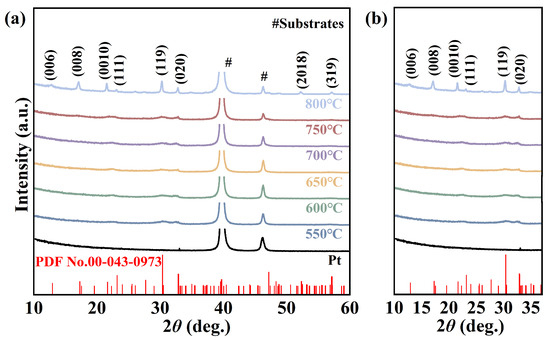
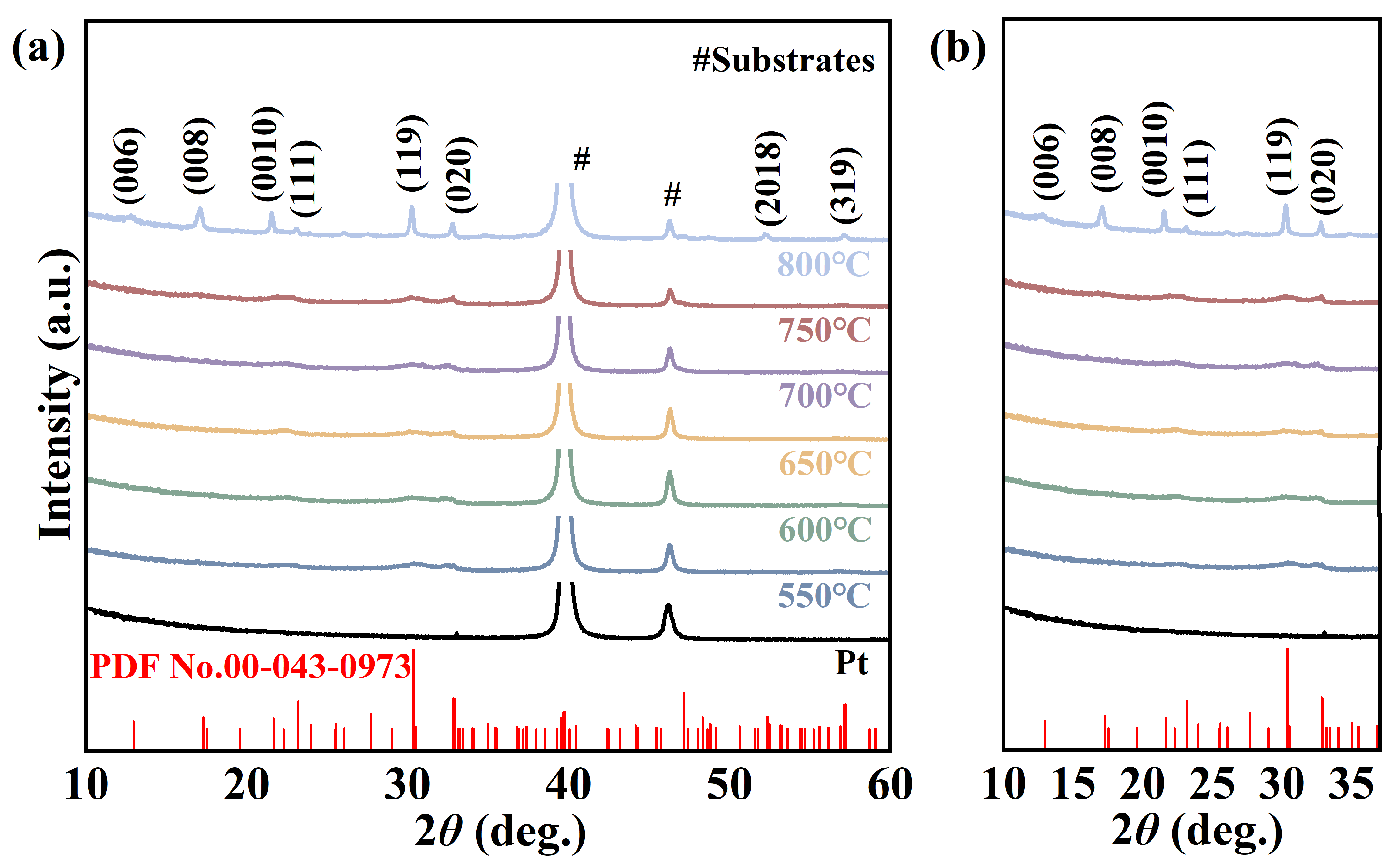
XRD and SEM were employed to characterize the phase structure and surface morphology of SBLT films with annealing temperature. As shown in Figure 1a, the XRD results indicate that when annealed at 550 °C, the pattern exhibits only a broad and diffused diffraction peak within the 30–35°, suggesting that the film is predominantly amorphous [29]. As the annealing temperature increases to 800 °C, multiple distinct diffraction peaks emerge, demonstrating a significant improvement in crystallinity. The previously amorphous regions have transformed into an ordered crystalline structure, and the diffraction peaks further confirm the formation of a typical Aurivillius phase (ICDD PDF No. 00-043-0973) in the film. In addition, as shown in Table 1, the crystallinity (Xc) estimated from XRD—calculated via the semi-quantitative formula Xc = [Icrystalline/(Icrystalline + Iamorphous)] × 100%, where Icrystalline and Iamorphous are the integrated intensities of the crystalline diffraction peaks and the amorphous halo, respectively—increases monotonically with annealing temperature (≈3% at 550 °C, ≈5% at 600 °C, ≈20% at 650 °C, ≈27% at 700 °C, ≈43% at 750 °C, and ≈62% at 800 °C), consistent with the progressive peak sharpening and intensity enhancement. Moreover, the enlarged low-angle region (Figure 1b) clearly shows the gradual appearance and strengthening of the characteristic low-angle reflections with increasing temperature, further evidencing the development of an ordered layered Aurivillius structure. These results illustrate that with increasing annealing temperature, the SBLT film gradually transitions from an amorphous state to a crystalline state.
Figure 1.
(a) XRD patterns of SBLT thin films annealed at different temperatures (550–800 °C) and the bare Pt/Ti/SiO2/Si substrate; (b) enlarged view of the XRD patterns in the low-angle region (10–37°). The symbol “#” denotes diffraction peaks originating from the substrate (Pt/Ti/SiO2/Si).
Table 1.
Crystallinity of SBLT thin films annealed at different temperatures.
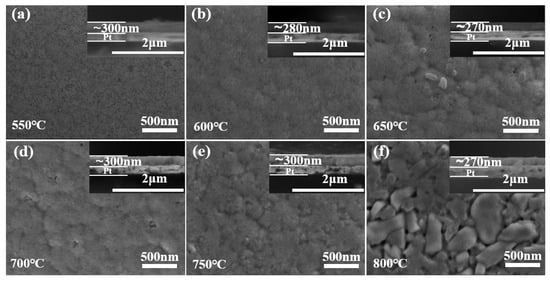
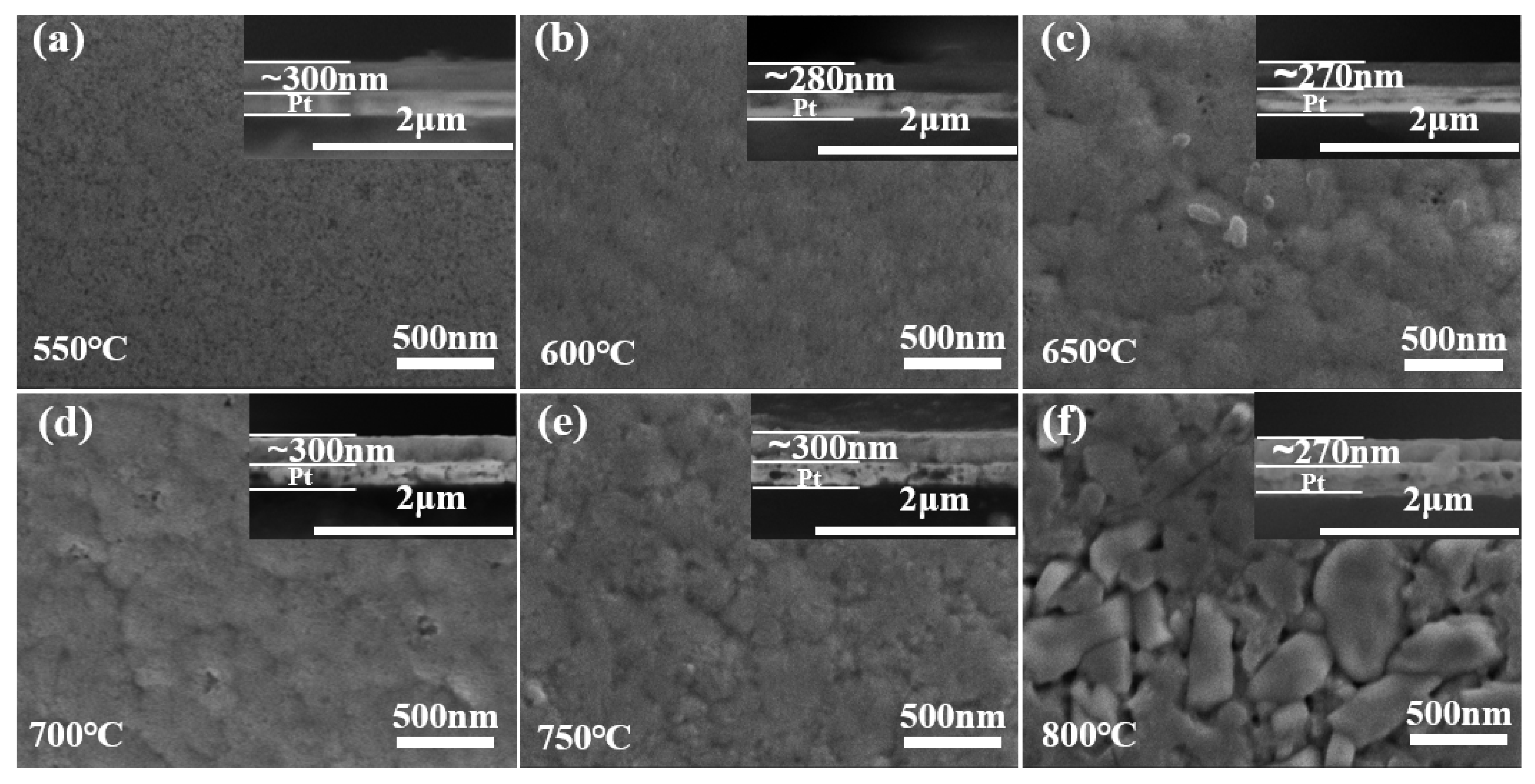
The microstructure of SBLT films was characterized by SEM images, as shown in Figure 2. As the annealing temperature increased, the film gradually transformed from an amorphous to a crystalline state. Compared to crystalline films, the surface of amorphous films was smoother and flatter. Under annealing at 550 °C, no obvious crystalline particles were observed on the film surface, indicating that the film was primarily in an amorphous matrix form. When the annealing temperature reached 800 °C, clear grains and grain boundaries appeared on the surface, indicating a significant reduction in the amorphous matrix and the dominance of an ordered crystalline phase. This morphological evolution is consistent with the structural changes reflected in the X-ray diffraction results. Therefore, by adjusting the annealing temperature, films with varying crystalline–amorphous phase ratios can be effectively obtained.
Figure 2.
Surface and cross-sectional morphologies of SBLT films at different annealing temperatures: (a) 550 °C, (b) 600 °C, (c) 650 °C, (d) 700 °C, (e) 750 °C, (f) 800 °C.
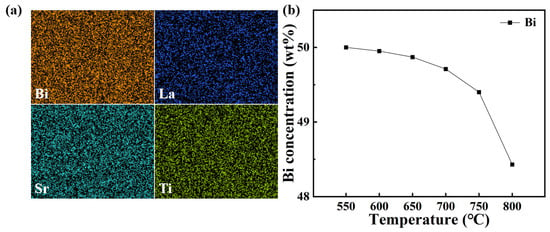
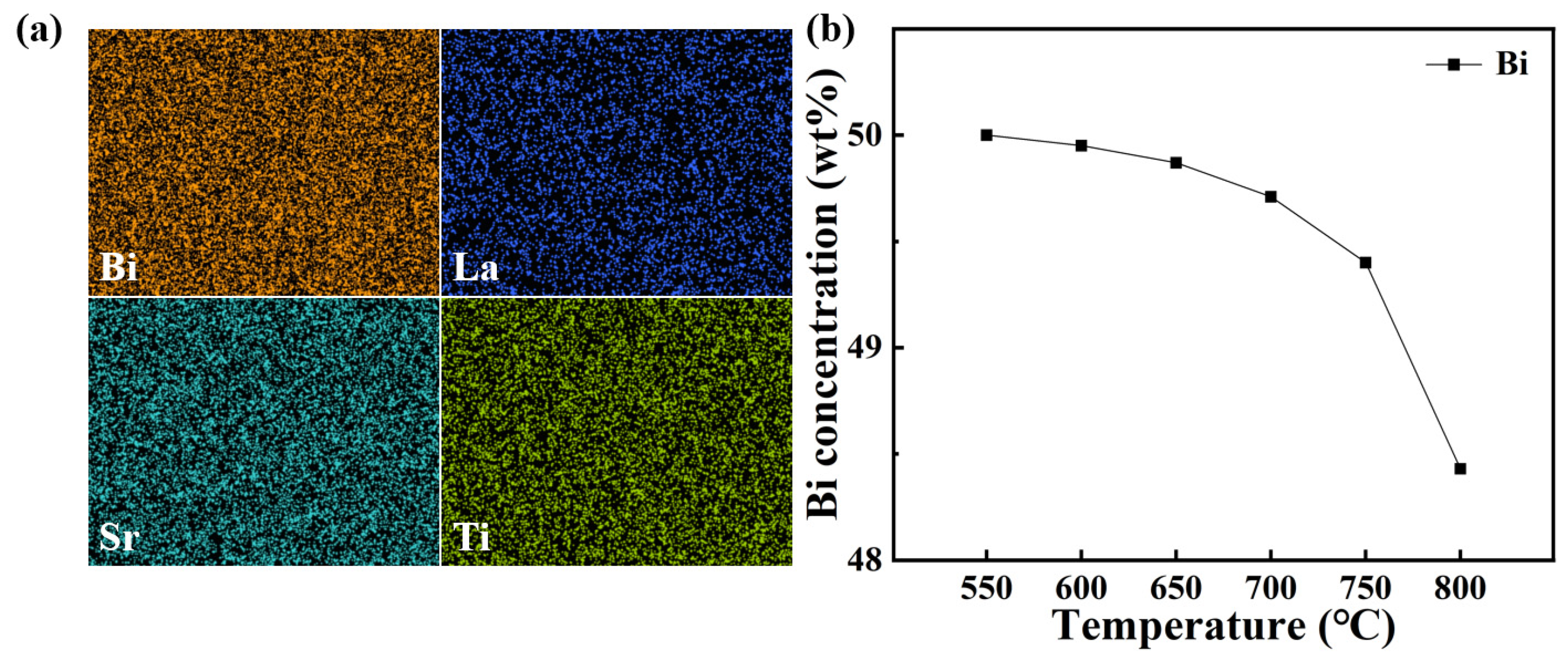
As shown in Figure 3a, the EDX elemental mapping images of the SBLT thin film annealed at 700 °C reveal a homogeneous spatial distribution of Bi, La, Sr, and Ti across the investigated area. No obvious elemental segregation or compositional inhomogeneity is observed, indicating that the sol–gel process combined with annealing at 700 °C ensures good chemical uniformity of the film. As shown in Figure 3b, the Bi concentration (wt%) exhibits a gradual decrease with increasing annealing temperature from 550 to 800 °C. The nearly monotonic reduction in the relative Bi content suggests that Bi becomes progressively deficient at elevated temperatures. Considering the high volatility of Bi-containing species during thermal treatment, this trend is plausibly associated with partial Bi loss (e.g., volatilization) upon high-temperature annealing, which may drive a deviation from the nominal composition. Notably, the drop becomes more pronounced at 750–800 °C, implying that Bi loss is accelerated in this temperature range. Overall, the mapping result in (a), together with the compositional trend in (b), indicates that annealing at 700 °C provides a favorable balance between chemical uniformity and Bi retention, whereas higher annealing temperatures may increase the risk of Bi deficiency and compositional fluctuation.
Figure 3.
(a) EDX elemental mapping images of the sample annealed at 700 °C, showing the spatial distributions of Bi, La, Sr, and Ti. (b) Variation in Bi concentration (wt%) as a function of annealing temperature for samples annealed at different temperatures.
3.2. Dielectric Properties
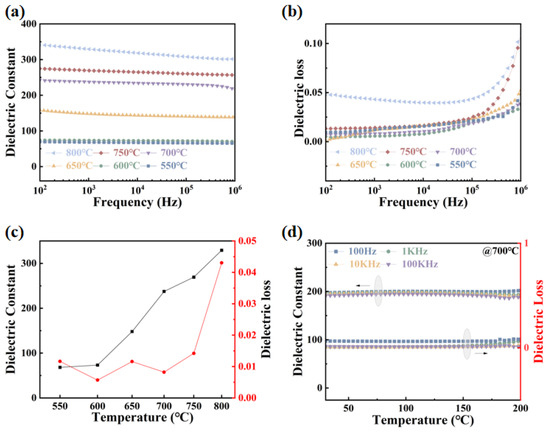
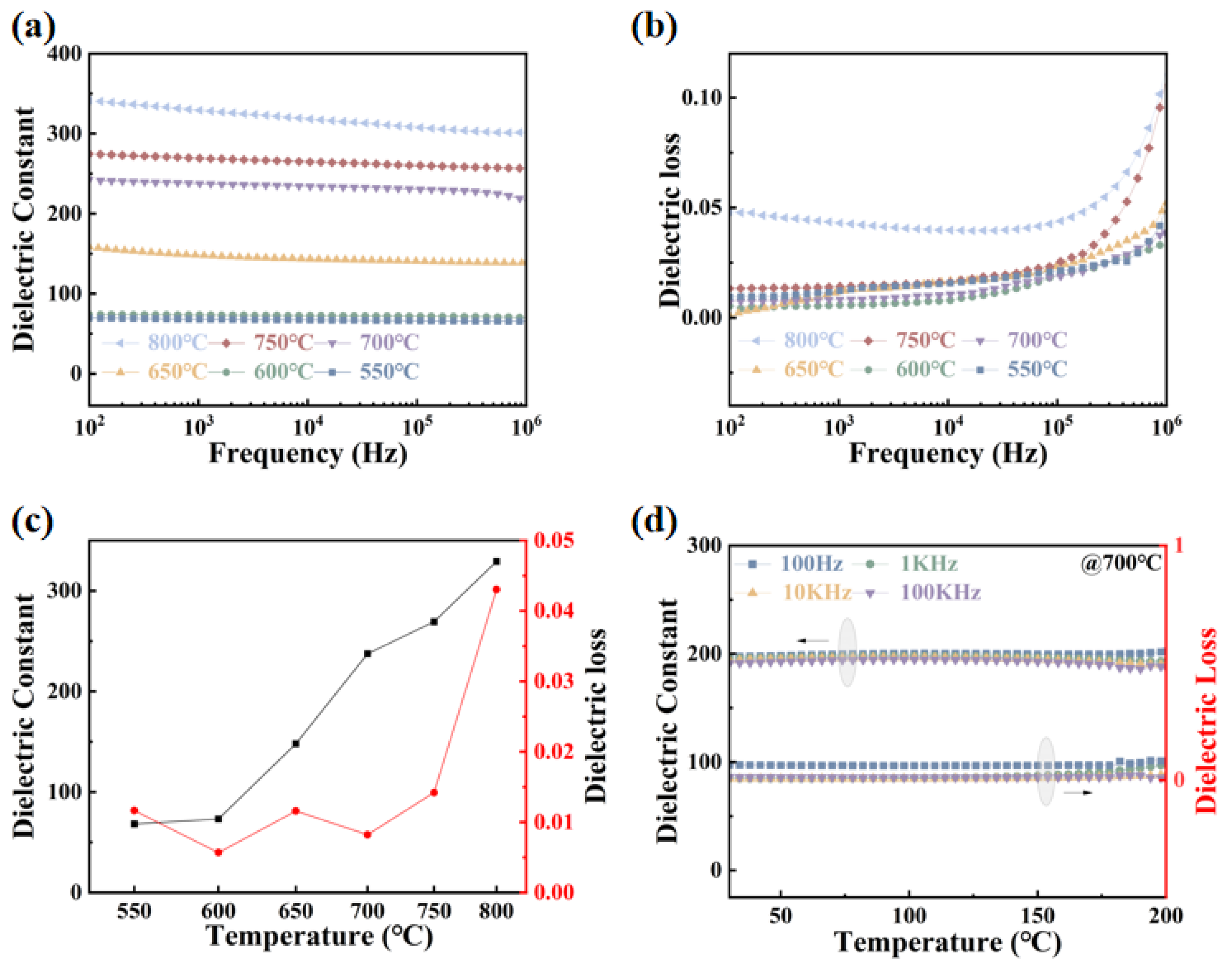
Figure 4a,b show the frequency dependence of the dielectric constant and loss of thin films. As the annealing temperature increases, the dielectric constant of the SBLT films gradually increases. The dielectric loss remains low across 0.1 kHz to 1 MHz, indicating that SBLT films have good dielectric frequency stability. Figure 4c shows the dielectric constant and dielectric loss (1 kHz) of all films. The dielectric constants of the films were 68, 73, 148, 237, 269, and 329 for annealing temperatures from 550 to 800 °C, primarily due to the formation and growth of crystalline regions. Meanwhile, the dielectric loss of the films at different annealing temperatures was 0.0116, 0.0057, 0.0116, 0.0079, 0.0142, and 0.0431, respectively. Except for the film annealed at 800 °C, all other samples had dielectric loss levels below 0.02, which is beneficial for their energy storage performance. Specifically, the samples annealed at relatively low temperatures may retain organic residues and exhibit residual porosity, both of which can contribute to an elevated loss. As the annealing temperature increases into the intermediate regime, enhanced densification reduces extrinsic loss pathways and thus lowers the dielectric loss. With further heating, the onset of crystallization can introduce crystalline/amorphous interfaces as well as additional defects, and the associated interfacial polarization and defect-related scattering lead to a rebound in loss. Around ~700 °C, densification and a moderate degree of crystallization appear to reach a balance, giving rise to a comparatively low dielectric loss. At even higher temperatures, however, Bi volatilization and the concomitant increase in oxygen vacancies and defect concentrations substantially enhance conduction- and defect-mediated loss, resulting in a pronounced increase in dielectric loss. The significant increase in dielectric loss for the 800 °C sample is likely due to bismuth volatilization and increased defect density [44,45].
Figure 4.
(a) Frequency-dependent dielectric constant and (b) dielectric loss of SBLT films at room temperature. (c) Dielectric constant and loss (1 kHz) of SBLT films at different annealing temperatures. (d) Temperature dependence of dielectric constant and loss of the film annealed at 700 °C.
Figure 4d shows the temperature-dependent dielectric properties of SBLT films annealed at 700 °C. The temperature range tested was from 30 °C to 200 °C. Both dielectric constant and loss remained stable with minimal variation, demonstrating excellent thermal stability. The slight increase in loss at higher temperatures may be attributed to enhanced lattice vibrations and conduction losses.
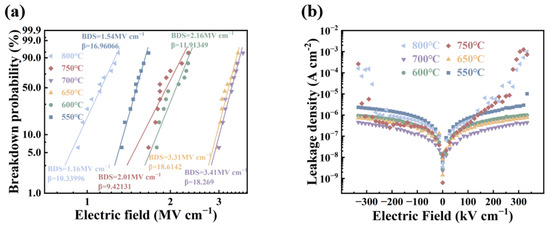
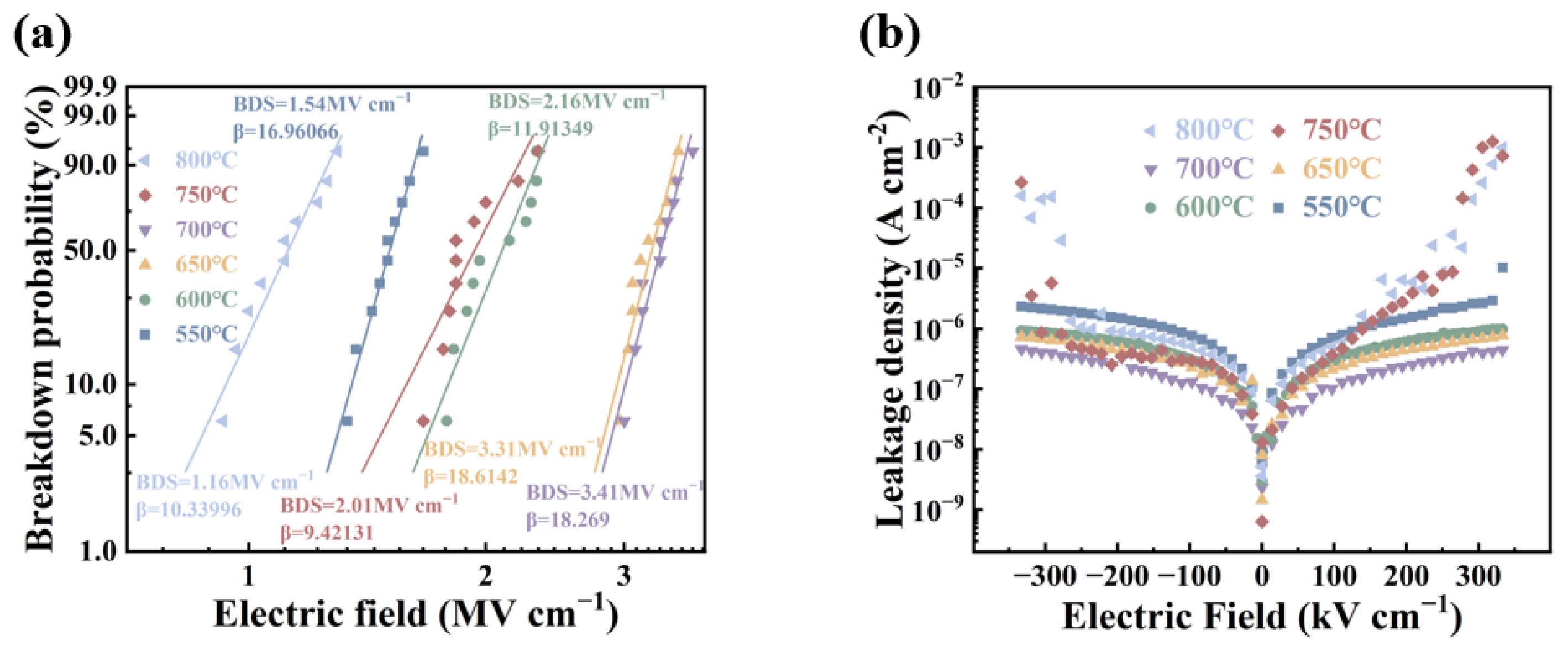
Figure 5a shows the Weibull distribution of BDS of all films. All shape factors (β) exceeded 9.4, indicating reliable fitting. The BDS initially increased with annealing temperature, reaching a maximum of 3410 kV cm−1 at 700 °C due to improved crystallinity and densification [46]. Further increasing the temperature to 800 °C leads to a decrease in the BDS due to increased defect concentration caused by Bi volatilization, which results in a reduction in the breakdown field strength [47,48]. Figure 5b shows the leakage current density. Under 300 kV cm−1, the leakage current density first decreased and then increased with annealing temperature. When the annealing temperature is below 700 °C, the decrease results from the removal of organic residues and increased film density. Above 700 °C, bismuth volatilization led to a sharp increase in oxygen vacancy concentration and leakage current, consistent with the observed decline in BDS. The film annealed at 700 °C exhibited the lowest leakage current.
Figure 5.
(a) Weibull distribution of BDS and (b) leakage current density of SBLT thin films annealed at different temperatures.
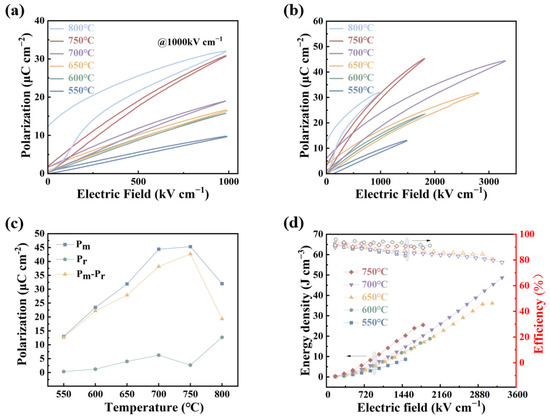
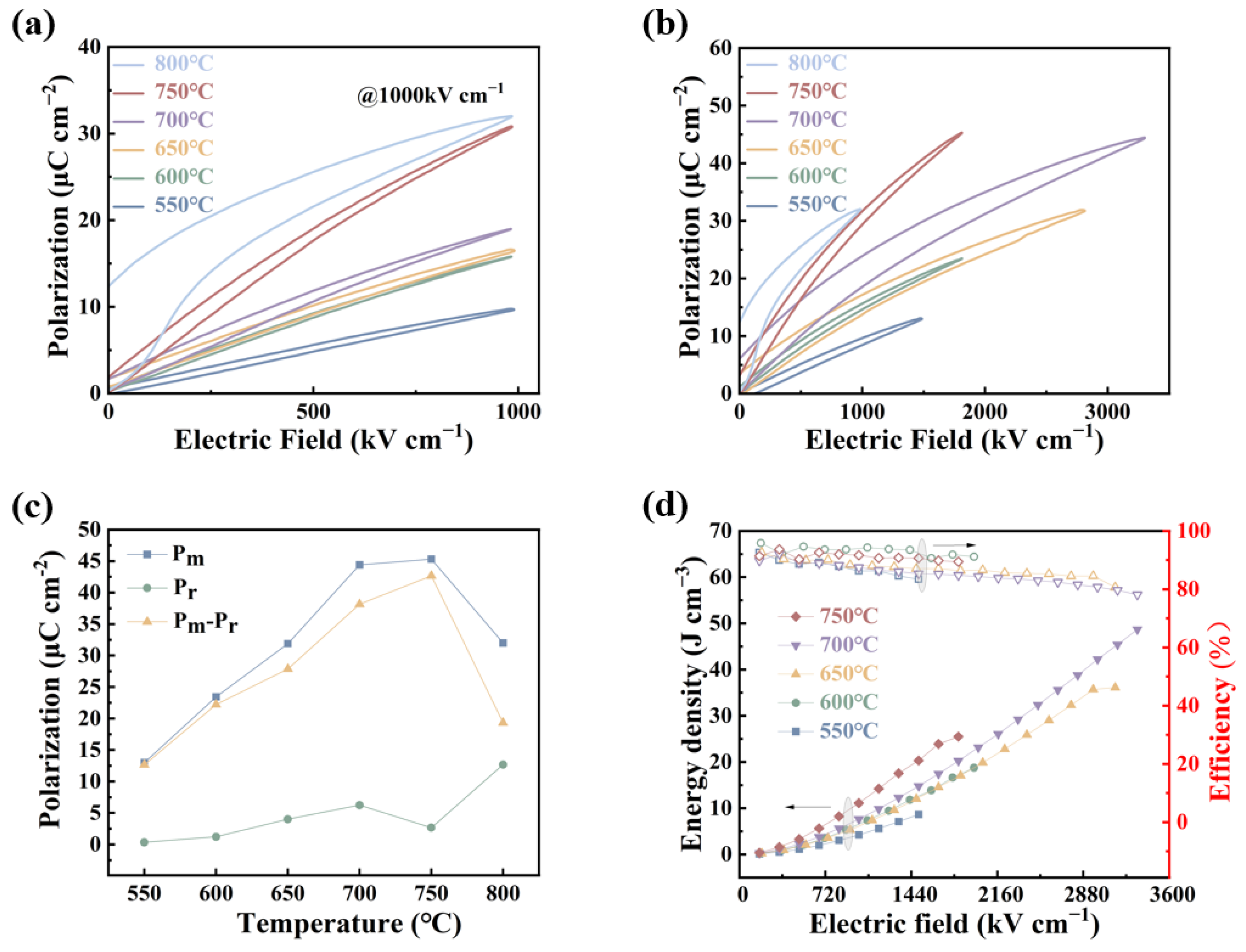
Figure 6a shows unipolar P–E hysteresis loops of SBLT thin films annealed at different temperatures under 1000 kV cm−1 and 10 kHz. Ferroelectricity strengthened with annealing temperature due to increased crystallinity. The 800 °C sample showed large Pr, detrimental to efficiency [49]. Figure 6b,c show the P–E hysteresis loops under their respective Em and the corresponding Pm, Pr, and Pm − Pr values for all SBLT films. SBLT films annealed at 700 °C and 750 °C exhibit larger Pm − Pr, which is beneficial for improving Ue and η. However, the high leakage current in the 750 °C sample limited BDS and Ue. Figure 6d shows the Ue and η as a function of electric field for SBLT films annealed at different temperatures. Among them, the film annealed at 700 °C exhibited the best performance, reaching a high Ue of 48.66 J cm−3 and η of 78%. This optimum stems from its high BDS, low leakage current, and enhanced polarization due to appropriate crystallization.
Figure 6.
(a) Unipolar P–E hysteresis loops at 1000 kV cm−1 and 10 kHz; (b) unipolar P–E hysteresis loops at Em. and 10 kHz. (c) Comparison of Pm, Pr, and ΔP (Pm − Pr) of SBLT thin films at Em. (d) Ue and η as functions of electric field.
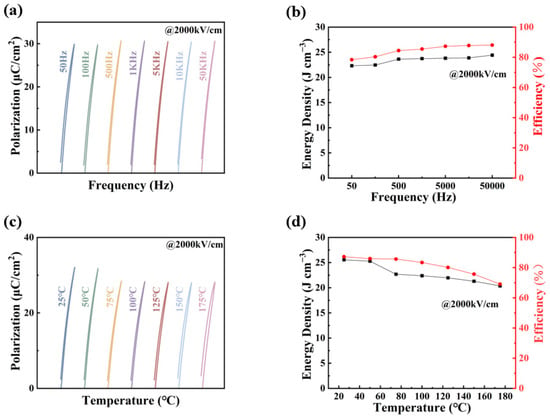
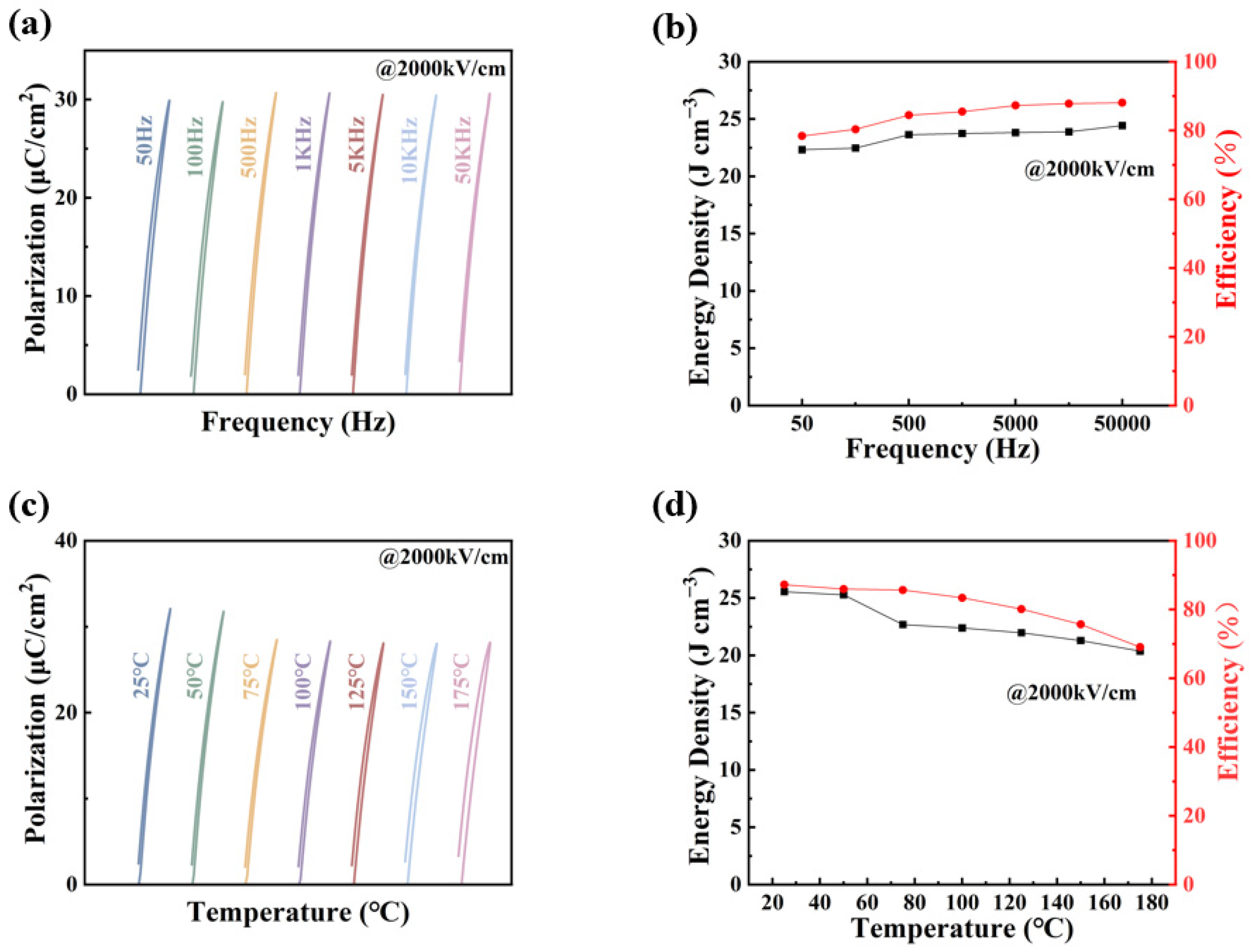
The reliability of the energy storage performance of SBLT films annealed at 700 °C at different frequencies and temperatures was evaluated. As shown in Figure 7a,b, at 2000 kV cm−1, when the frequency increased from 100 Hz to 100 kHz, Pm increased from 29.88 μC cm−2 to 30.60 μC cm−2, while Ue and η increased by 2.1 J cm−3 and 9.6%, respectively. With the temperature rising from 30 to 175 °C (Figure 7c,d), Pm gradually decreased due to enhanced lattice vibrations that hinder domain switching. At 175 °C, Ue decreased by 5.18 J cm−3 and η dropped by 18.3% relative to room temperature, which is usually due to the contribution of thermally activated charge carriers to conductivity at higher temperatures [50]. This indicates that the energy storage performance of the 700 °C annealed SBLT films has good frequency and temperature stability.
Figure 7.
SBLT films annealed at 700 °C, (a) frequency-dependent P–E hysteresis loops at 2000 kV cm−1, and (b) corresponding Ue and η of SBLT film. (c) Temperature-dependent P–E hysteresis loops at 2000 kV cm−1 and 10 kHz, and (d) corresponding Ue and η.
4. Conclusions
In conclusion, SrBi3.25La0.75Ti4O15 (SBLT) thin films were successfully synthesized on Pt/Ti/SiO2/Si substrates via sol–gel processing. By controlling the annealing temperature to tune the crystalline–amorphous phase ratio, the energy-storage performance was optimized. The film annealed at 700 °C exhibited the most compact microstructure, low dielectric loss and leakage current, and the highest BDS. Coupled with enhanced polarization from appropriate crystallization, it achieved a high Ue of 48.66 J cm−3 with 78% η. Furthermore, this film demonstrated good frequency stability (0.1–100 kHz) and thermal stability (30–175 °C). This work demonstrates that balancing the crystalline and amorphous phases through annealing is an effective strategy for developing high-performance dielectric energy-storage films, providing a solid foundation for next-generation capacitor applications.
Author Contributions
Conceptualization and methodology, Y.S. and W.Y.; software, F.H. (Fu Huang); visualization and validation, Y.D., Y.Z. and J.M.; formal analysis, Y.Z.; investigation, J.M.; resources, F.H. (Fayaz Hussain); data curation, A.A.; writing—original draft preparation, Y.S.; writing—review and editing, F.H. (Fayaz Hussain), G.A. and D.W.; supervision, J.W. and D.W.; funding acquisition, A.A. and D.W. All authors have read and agreed to the published version of the manuscript.
Funding
This research was funded by the National Natural Science Foundation of China (Grant No. 52472122), and Deanship of Scientific Research, Vice Presidency for Graduate Studies and Scientific Research, King Faisal University, Saudi Arabia (Grant No. KFU260080).
Institutional Review Board Statement
Not applicable.
Informed Consent Statement
Not applicable.
Data Availability Statement
The data that support the findings of this study are available from the corresponding author upon reasonable request.
Conflicts of Interest
The authors declare no conflicts of interest.
References
- Chu, B.; Zhou, X.; Ren, K.; Neese, B.; Lin, M.; Wang, Q.; Bauer, F.; Zhang, Q.M. A dielectric polymer with high electric energy density and fast discharge speed. Science 2006, 313, 334–336. [Google Scholar] [CrossRef] [Scilit] [PubMed]
- Pan, H.; Li, F.; Liu, Y.; Zhang, Q.; Wang, M.; Lan, S.; Zheng, Y.; Ma, J.; Gu, L.; Shen, Y.; et al. Ultrahigh-energy density lead-free dielectric films via polymorphic nanodomain design. Science 2019, 365, 578–582. [Google Scholar] [CrossRef] [Scilit] [PubMed]
- Yang, L.; Kong, X.; Li, F.; Hao, H.; Cheng, Z.; Liu, H.; Li, J.-F.; Zhang, S. Perovskite lead-free dielectrics for energy storage applications. Prog. Mater. Sci. 2019, 102, 72–108. [Google Scholar] [CrossRef] [Scilit]
- Yao, Z.; Song, Z.; Hao, H.; Yu, Z.; Cao, M.; Zhang, S.; Lanagan, M.T.; Liu, H. Homogeneous/Inhomogeneous-Structured Dielectrics and their Energy-Storage Performances. Adv. Mater. 2017, 29, 1601727. [Google Scholar] [CrossRef] [Scilit]
- Li, Q.; Yao, F.-Z.; Liu, Y.; Zhang, G.; Wang, H.; Wang, Q. High-Temperature Dielectric Materials for Electrical Energy Storage. Annu. Rev. Mater. Res. 2018, 48, 219–243. [Google Scholar] [CrossRef] [Scilit]
- Li, Y.; Sun, N.; Li, X.; Du, J.; Chen, L.; Gao, H.; Hao, X.; Cao, M. Multiple electrical response and enhanced energy storage induced by unusual coexistent-phase structure in relaxor ferroelectric ceramics. Acta Mater. 2018, 146, 202–210. [Google Scholar] [CrossRef] [Scilit]
- Yue, W.F.; Yan, T.N.; Wang, D.W. Research Progress on Dielectric Energy Storage Ceramic Thin Films. J. Chin. Ceram. Soc. 2024, 52, 1413–1437. [Google Scholar] [CrossRef]
- Wang, G.; Lu, Z.; Li, Y.; Li, L.; Ji, H.; Feteira, A.; Zhou, D.; Wang, D.; Zhang, S.; Reaney, I.M. Electroceramics for High-Energy Density Capacitors: Current Status and Future Perspectives. Chem. Rev. 2021, 121, 6124–6172. [Google Scholar] [CrossRef] [Scilit]
- Li, J.; Shen, Z.; Chen, X.; Yang, S.; Zhou, W.; Wang, M.; Wang, L.; Kou, Q.; Liu, Y.; Li, Q.; et al. Grain-orientation-engineered multilayer ceramic capacitors for energy storage applications. Nat. Mater. 2020, 19, 999–1005. [Google Scholar] [CrossRef] [Scilit]
- Yang, B.; Zhang, Q.; Huang, H.; Pan, H.; Zhu, W.; Meng, F.; Lan, S.; Liu, Y.; Wei, B.; Liu, Y.; et al. Engineering relaxors by entropy for high energy storage performance. Nat. Energy 2023, 8, 956–964. [Google Scholar] [CrossRef] [Scilit]
- Wang, Y.; Zhang, B.; Mao, M.; Cao, L.; Mohamad, A.A.; Alshoaibi, A.A.; Abdurakhmanov, G.; Lou, X.; Wang, D.; Song, K. Optimization strategies of filler morphology and spatial design in polymer nanocomposites for next-generation energy storage. J. Adv. Dielectr. 2025, 15, 2530001. [Google Scholar] [CrossRef] [Scilit]
- Yue, W.; Li, T.; Yu, L.; Cai, Y.; Liu, L.; Guo, Q.; Wang, D.; Jia, T.; Yu, S. High energy storage density of Bi3.25La0.75Ti3O12/SrTiO3 multilayer thin films by structural design. Mater. Lett. 2023, 333, 133576. [Google Scholar] [CrossRef] [Scilit]
- Yue, W.; Cai, Y.; Zhao, H.; Guo, Q.; Wang, D.; Jia, T. Enhanced energy storage density of Bi3.25La0.75Ti3O12 thin films by preferred orientation and interface engineering. Ceram. Int. 2024, 50, 13644–13651. [Google Scholar] [CrossRef] [Scilit]
- Liu, C.; Li, F.; Ma, L.P.; Cheng, H.M. Advanced materials for energy storage. Adv. Mater. 2010, 22, E28–E62. [Google Scholar] [CrossRef] [Scilit]
- Li, H.; Zhou, S.; Zhao, J.; Yan, T.; Du, Y.; Zhou, H.; Pu, Y.; Wang, D. Dielectric temperature stability and energy storage performance of NBT-based lead-free ceramics for Y9P capacitors. J. Adv. Dielectr. 2022, 13, 2242007. [Google Scholar] [CrossRef] [Scilit]
- Li, D.; Guo, Q.; Cao, M.; Yao, Z.; Liu, H.; Hao, H. The influence of A/B-sites doping on antiferroelectricity of PZO energy storage films. Microstructures 2023, 3, 2023007. [Google Scholar] [CrossRef] [Scilit]
- Zhao, P.; Li, L.; Wang, X. BaTiO3-NaNbO3 energy storage ceramics with an ultrafast charge-discharge rate and temperature-stable power density. Microstructures 2022, 3, 2023002. [Google Scholar] [CrossRef] [Scilit]
- Hou, C.; Huang, W.; Zhao, W.; Zhang, D.; Yin, Y.; Li, X. Ultrahigh Energy Density in SrTiO3 Film Capacitors. ACS Appl. Mater. Interfaces 2017, 9, 20484–20490. [Google Scholar] [CrossRef] [Scilit]
- Xie, Z.; Yue, Z.; Peng, B.; Zhang, J.; Zhao, C.; Zhang, X.; Ruehl, G.; Li, L. Large enhancement of the recoverable energy storage density and piezoelectric response in relaxor-ferroelectric capacitors by utilizing the seeding layers engineering. Appl. Phys. Lett. 2015, 106, 202901. [Google Scholar] [CrossRef] [Scilit]
- Hao, X. A review on the dielectric materials for high energy-storage application. J. Adv. Dielectr. 2013, 3, 1330001. [Google Scholar] [CrossRef] [Scilit]
- Xie, Y.; Hao, H.; Xie, J.; Zhang, S.; Cao, M.; Yao, Z.; Liu, H. Ultra-high energy storage density and enhanced dielectric properties in BNT-BT based thin film. Ceram. Int. 2021, 47, 23259–23266. [Google Scholar] [CrossRef] [Scilit]
- Chen, L.; Deng, S.; Liu, H.; Wu, J.; Qi, H.; Chen, J. Giant energy-storage density with ultrahigh efficiency in lead-free relaxors via high-entropy design. Nat. Commun. 2022, 13, 3089. [Google Scholar] [CrossRef] [Scilit] [PubMed]
- Yang, B.; Zhang, Y.; Pan, H.; Si, W.; Zhang, Q.; Shen, Z.; Yu, Y.; Lan, S.; Meng, F.; Liu, Y.; et al. High-entropy enhanced capacitive energy storage. Nat. Mater. 2022, 21, 1074–1080. [Google Scholar] [CrossRef] [Scilit] [PubMed]
- Ning, Y.; Pu, Y.; Wu, C.; Zhou, S.; Zhang, L.; Zhang, J.; Zhang, X.; Shang, Y. Enhanced capacitive energy storage and dielectric temperature stability of A-site disordered high-entropy perovskite oxides. J. Mater. Sci. Technol. 2023, 145, 66–73. [Google Scholar] [CrossRef] [Scilit]
- Lv, P.; Yang, C.; Qian, J.; Wu, H.; Huang, S.; Cheng, X.; Cheng, Z. Flexible Lead-Free Perovskite Oxide Multilayer Film Capacitor Based on (Na0.8K0.2)0.5Bi0.5TiO3/Ba0.5Sr0.5(Ti0.97Mn0.03)O3 for High-Performance Dielectric Energy Storage. Adv. Energy Mater. 2020, 10, 1904229. [Google Scholar] [CrossRef] [Scilit]
- Sun, Z.; Ma, C.; Liu, M.; Cui, J.; Lu, L.; Lu, J.; Lou, X.; Jin, L.; Wang, H.; Jia, C.L. Ultrahigh Energy Storage Performance of Lead-Free Oxide Multilayer Film Capacitors via Interface Engineering. Adv. Mater. 2017, 29, 1604427. [Google Scholar] [CrossRef] [Scilit]
- Zhou, Z.; Liu, Y.; Lan, S.; Yang, B.; Nan, C.-W.; Lin, Y.-H. Optimized energy storage performance in bilayer heterogeneous films. Scr. Mater. 2024, 243, 115968. [Google Scholar] [CrossRef] [Scilit]
- Shi, M.; Liu, Z.; Qiao, N.; Hu, J.; Wang, T.; Liu, J.; Gong, W.; Pan, Z. Tailoring energy storage properties of lead-free Bi4.25La0.75Mg0.5Ti3Hf0.5O15 ferroelectric thin films via grain microstructure engineering. J. Alloys Compd. 2025, 1036, 181828. [Google Scholar] [CrossRef] [Scilit]
- Huang, R.; Wang, H.; Tao, C.; Hao, H.; Yao, Z.; Liu, H.; Cao, M. Evolution of polarization crystallites in 0.92BaTiO3-0.08Bi(Ni0.5Zr0.5)O3 microcrystal-amorphous composite thin film with high energy storage capability and thermal stability. Chem. Eng. J. 2022, 433, 133579. [Google Scholar] [CrossRef] [Scilit]
- Yue, W.; Cai, Y.; Guo, Q.; Wang, D.; Jia, T. Effect of Thickness on Ferroelectric Properties of Bi3.25La0.75Ti3O12 Thin Films. Ceramics 2024, 7, 29–38. [Google Scholar] [CrossRef] [Scilit]
- Wang, K.; Ouyang, J.; Wuttig, M.; Zhao, Y.Y.; Cheng, H.; Zhang, Y.; Su, R.; Yan, J.; Zhong, X.; Zeng, F. Superparaelectric (Ba0.95,Sr0.05)(Zr0.2,Ti0.8)O3 Ultracapacitors. Adv. Energy Mater. 2020, 10, 2001778. [Google Scholar] [CrossRef] [Scilit]
- Li, Y.Z.; Lin, J.L.; Bai, Y.; Li, Y.; Zhang, Z.D.; Wang, Z.J. Ultrahigh-Energy Storage Properties of (PbCa)ZrO3 Antiferroelectric Thin Films via Constructing a Pyrochlore Nanocrystalline Structure. ACS Nano 2020, 14, 6857–6865. [Google Scholar] [CrossRef] [Scilit] [PubMed]
- Jiang, X.; Lv, J.; Chen, Z.; Shen, Z.; Wang, J.; Deng, Z.; Cao, M.; Yao, Z.; Zhang, S.; Liu, H.; et al. Superior energy storage BaTiO3-based amorphous dielectric film with polymorphic hexagonal and cubic nanostructures. Chem. Eng. J. 2022, 431, 133447. [Google Scholar] [CrossRef] [Scilit]
- Sun, S.; Yin, X. Progress and Perspectives on Aurivillius-Type Layered Ferroelectric Oxides in Binary Bi4Ti3O12-BiFeO3 System for Multifunctional Applications. Crystals 2020, 11, 23. [Google Scholar] [CrossRef] [Scilit]
- Sharma, V.K.; Nathawat, R.; Chakinala, N.; Chakinala, A.G.; Rathore, S.S. UV Light-Driven Photocatalytic Activity in Ferroelectric SrBi4Ti4O15 and Influence of Metal Modification. Arab. J. Sci. Eng. 2024, 49, 8321–8330. [Google Scholar] [CrossRef] [Scilit]
- Zhang, Y.; Song, D.P.; Hui, Z.Z.; Lei, Y.; Li, R.Z.; Pei, C.H.; Yang, J. The SrBi4Ti4O15-based sandwich-structured films for energy storage capacitors. J. Appl. Phys. 2024, 136, 154103. [Google Scholar] [CrossRef] [Scilit]
- Pan, Z.; Wang, P.; Hou, X.; Yao, L.; Zhang, G.; Wang, J.; Liu, J.; Shen, M.; Zhang, Y.; Jiang, S.; et al. Fatigue-Free Aurivillius Phase Ferroelectric Thin Films with Ultrahigh Energy Storage Performance. Adv. Energy Mater. 2020, 10, 2001536. [Google Scholar] [CrossRef] [Scilit]
- Hailili, R.; Li, Z. Synergizing photocatalysis with Aurivillius-phase Bi4Ti3O12: Current insights and emerging trends. J. Mater. Chem. A 2025, 13, 16345–16381. [Google Scholar] [CrossRef] [Scilit]
- Panda, R.; Hota, S.S.; Panda, D.; Choudhary, R.N.P. Unveiling the electrical and energy storage performance of SrBi4Ti4O15 for device applications. Mater. Adv. 2025, 6, 5667–5676. [Google Scholar] [CrossRef] [Scilit]
- Keum, Y.H.; Shin, H.W.; Son, J.Y. Improvement of energy storage performance by controlling the crystallinity of Aurivillius BaBi4Ti4O15 thin films. J. Korean Ceram. Soc. 2023, 60, 959–966. [Google Scholar] [CrossRef] [Scilit]
- Kurakula, A.; Paranjape, M.V.; Manchi, P.; Arbaz, S.J.; Gujjala, L.K.S.; Graham, S.A.; Kavarthapu, V.S.; Yu, J.S. Aurivillius-Type SrBi4Ti4O15/PGA Composite Film-Based Flexible Triboelectric Nanogenerators for Energy Harvesting/Storage and Multipurpose Tap-Indication Transducer Applications. ACS Appl. Mater. Interfaces 2024, 16, 48246–48256. [Google Scholar] [CrossRef] [Scilit]
- Yu, L.; Hao, J.; Xu, Z.; Li, W.; Chu, R. Strong up-conversion luminescence and electrical properties of SrBi4Ti4O15 multifunctional ceramics by Er3+ doping. J. Mater. Sci. 2017, 28, 5840–5845. [Google Scholar] [CrossRef] [Scilit]
- Sun, H.; Chen, X. Structure and ferroelectric properties of stoichiometric and Sr-deficient–SrBi4Ti4O15 thin films. J. Mater. Sci. 2011, 46, 1581–1584. [Google Scholar] [CrossRef] [Scilit]
- Yao, M.; Li, Q.; Li, F.; Peng, Y.; Su, Z.; Yao, X. Leakage current and breakdown behavior of bismuth-doped amorphous strontium titanate thin film. Mater. Chem. Phys. 2018, 206, 48–55. [Google Scholar] [CrossRef] [Scilit]
- Li, G.; Wu, X.-Q.; Ren, W.; Shi, P.; Chen, X.-F.; Yao, X. Effects of excess amount of K and Na on properties of (K0.48Na0.52)NbO3 thin films. Ceram. Int. 2012, 38, S279–S281. [Google Scholar] [CrossRef] [Scilit]
- Yang, B.; Liu, Y.; Li, W.; Lan, S.; Dou, L.; Zhu, X.; Li, Q.; Nan, C.W.; Lin, Y.H. Balancing Polarization and Breakdown for High Capacitive Energy Storage by Microstructure Design. Adv. Mater. 2024, 36, e2403400. [Google Scholar] [CrossRef] [Scilit]
- Pan, Z.; Ding, J.; Hou, X.; Shi, S.; Yao, L.; Liu, J.; Li, P.; Chen, J.; Zhai, J.; Pan, H. Substantially improved energy storage capability of ferroelectric thin films for application in high-temperature capacitors. J. Mater. Chem. A 2021, 9, 9281–9290. [Google Scholar] [CrossRef] [Scilit]
- Zhang, J.; Huang, X.; Yu, S.; Zhang, W. Effect of substrate temperature on structural and electrical properties of BaZr0.2Ti0.8O3 lead-free thin films by pulsed laser deposition. Ceram. Int. 2016, 42, 13262–13267. [Google Scholar] [CrossRef] [Scilit]
- Yuan, Q.; Li, G.; Yao, F.-Z.; Cheng, S.-D.; Wang, Y.; Ma, R.; Mi, S.-B.; Gu, M.; Wang, K.; Li, J.-F.; et al. Simultaneously achieved temperature-insensitive high energy density and efficiency in domain engineered BaTiO3-Bi(Mg0.5Zr0.5)O3 lead-free relaxor ferroelectrics. Nano Energy 2018, 52, 203–210. [Google Scholar] [CrossRef] [Scilit]
- An, W.; Song, D.P.; Zhang, Y.; Zhou, A.X.; Yang, J. Engineering crystal structure transformation from layered perovskite-like to pyrochlore for electrostatic energy storage. Appl. Phys. Lett. 2024, 124, 092908. [Google Scholar] [CrossRef] [Scilit]

Disclaimer/Publisher’s Note: The statements, opinions and data contained in all publications are solely those of the individual author(s) and contributor(s) and not of MDPI and/or the editor(s). MDPI and/or the editor(s) disclaim responsibility for any injury to people or property resulting from any ideas, methods, instructions or products referred to in the content. |
© 2026 by the authors. Licensee MDPI, Basel, Switzerland. This article is an open access article distributed under the terms and conditions of the Creative Commons Attribution (CC BY) license.