


Abstract
The selective removal of radioactive cesium-137 and strontium-90 from high-salinity radioactive wastewater remains a critical challenge, as competing ions reduce adsorption efficiency and selectivity. In this study, high-performance granulated adsorbents were developed based on alkali-activated geopolymer matrices to enhance sorption performance. The adsorbents were synthesized by inorganic polymerization, and mechanically robust granules with controlled porosity and surface chemistry were obtained. Batch sorption experiments conducted in simulated seawater demonstrated greater than 99% removal efficiencies for cesium and strontium. Isotherm modeling confirmed high maximum sorption capacities (up to 0.41 meq/g for Cs+ and 5.07 meq/g for Sr2+). Continuous fixed-bed column tests demonstrated sustained removal efficiencies for the optimized adsorbents. Structural analyses, including scanning electron microscopy, energy-dispersive X-ray spectroscopy mapping, and X-ray diffraction, confirmed uniform elemental distribution and crystalline phases consistent with selective sorption mechanisms. Assessment of mechanical strength revealed sufficient compressive strengths to ensure operational durability under hydraulic stress. These findings demonstrate that the synthesized geopolymer-based granules are a potentially effective and versatile solution for the comprehensive treatment of radioactive wastewater.
1. Introduction
The management of radioactive wastewater containing fission products such as cesium-137 (Cs-137) and strontium-90 (Sr-90) remains a critical environmental and technological challenge, particularly in the aftermath of nuclear accidents like those that occurred at Chernobyl and Fukushima, which have led to widespread contamination of marine environments [1,2]. Both radionuclides exhibit long half-lives (30.2 years for Cs-137 and 28.8 years for Sr-90), are highly soluble in water, and are significantly radiotoxic, contributing to their persistence and bioaccumulation in aquatic food chains [3,4].
High-salinity environments, such as seawater or saline cooling water, complicate radionuclide removal due to the abundance of competing cations (Na+, K+, Ca2+, Mg2+), which reduce adsorption selectivity and capacity through ionic competition and electrical double-layer effects [5,6]. Conventional adsorbents, including natural zeolites, activated carbons, and clay minerals, often exhibit poor selectivity and diminished performance under these saline conditions [7,8,9].
To overcome these limitations, studies have focused on developing engineered adsorbents with enhanced selectivity and chemical stability. For instance, Prussian blue analogues and ferrocyanide-based materials exhibit strong affinity for monovalent cesium ions (Cs+) through selective ion-exchange and cage-like crystal structures; however, they are often mechanically unstable and exhibit limited sorption capacity for divalent strontium ions [10,11,12,13]. Conversely, materials such as sodium titanates, layered double hydroxides, and synthetic ion exchangers show promise for Sr2+ adsorption, despite their performance often being hampered by competing divalent cations and chemical instability under high salinity [14,15,16,17].
Geopolymers, a class of alkali-activated aluminosilicate materials, have emerged as versatile adsorbents due to their high thermal and chemical stability, tunable structure, and potential for surface modification [18,19,20,21]. Modified geopolymers, functionalized with ferrocyanide complexes or alkaline-earth metals, have demonstrated promising Cs+ and Sr2+ sorption capacities in saline media [22,23,24]. Their granulated forms improve mechanical strength and facilitate integration into fixed-bed and continuous-flow treatment systems, addressing practical application requirements [7,25].
Strontium removal poses challenges because Sr2+ has a similar hydration radius and chemical properties to Ca2+, intensifying competitive adsorption in saline matrices. Incorporation of alkaline-earth metals such as Ba2+ or Ca2+ into geopolymer frameworks enhances the immobilization of Sr2+ through mechanisms including isovalent substitution, lattice trapping, and surface precipitation [26,27]. Functionalization with chelating groups (e.g., phosphonates or carboxylates) can further improve selectivity; however, it faces issues related to ligand leaching and stability in complex aqueous environments [28,29]. Ba-impregnated 4A zeolite was selected as a potential adsorbent for strontium, exhibiting a decontamination factor (DF) of approximately 200 [30].
Previous studies have focused either on the geopolymer matrix only or on the iron hexacyanoferrate active phase alone. In contrast, this study demonstrates a controlled integration of iron hexacyanoferrate functionality into the polymer framework, resulting in an integrated material design with good structural stability and high ion selectivity. In addition, commercial benchmark sorbents such as CsTreat, a transition-metal hexacyanoferrate-based material, have been applied for cesium removal under saline conditions, including implementation in the Fukushima Advanced Liquid Processing System (ALPS), while SrTreat, a sodium titanate-based sorbent, has been developed for strontium removal [31,32,33]. However, systematic studies addressing their mechanical properties remain limited [34,35].
Despite advances in individual radionuclide adsorbents, adsorbents that simultaneously exhibit high ion selectivity and sufficient mechanical strength are needed to ensure reliable long-term and continuous operation in high-salinity environments. Furthermore, this study systematically evaluated the adsorption performance under practical conditions relevant to nuclear wastewater treatment, including high-salinity solutions. Herein, we report the synthesis and systematic evaluation of high-performance, granulated geopolymer-based adsorbents designed for the selective removal of Cs-137 and Sr-90 from simulated seawater. The materials integrate ion-selective functional groups and structural modifications for enhanced sorption capacity, chemical stability, and mechanical durability. Detailed characterizations and sorption performance assessments under high-salinity conditions were performed to elucidate structure–function relationships and guide scalable solutions for nuclear wastewater remediation.
2. Materials and Methods
2.1. Preparation of Adsorbents for Strontium Removal
A series of strontium-selective adsorbents was developed, including various powder-form adsorbents such as sodium aluminosilicate (ZA), barium-modified aluminosilicate (Ba-ZA), sodium titanate (ST), and titanium oxide (TO) and granulated adsorbents such as composite ACSr, Ba-4A, and commercial SrTreat.
Among the powered-form adsorbents, ZA was synthesized by dissolving sodium orthosilicate (Na4SiO4) in 500 mL of tap water at 60 °C, followed by slow addition of sodium aluminate (Na2Al2O4). The mixture (Na4SiO4:Na2Al2O4 = 1:1.78) was stirred with a speed of 500 rpm at 60 °C for 18 h, filtered, washed, dried at 105 °C, and crushed. Ba-ZA was synthesized similarly, with the addition of barium nitrate (Ba(NO3)2) to the initial sodium orthosilicate solution before adding sodium aluminate. ST was prepared by reacting tetraisopropyl titanate with toluene (2 mol/L), then adding NaOH (0.8 mol/L) and stirring for 4 h. The precipitate was filtered, washed, dried at 105 °C, and crushed to 0.30–0.85 mm. TO was synthesized by hydrolyzing tetraisopropyl titanate in toluene with water under conditions and processing similar to those for ST.
As to the granulated adsorbents, the granulated Ba-4A adsorbent was prepared by mixing an appropriate amount of barium nitrate (Ba(NO3)2) solution with 4A zeolite (8–12 mesh), followed by uniform stirring at 60 °C for 18 h to carry out a hydrothermal chemical reaction. After the reaction, the reactor contents were transferred to a vacuum filtration system, thoroughly washed with ultrapure water, and filtered. The resulting solid was then dried in a forced-air oven at 105 °C. Additionally, a granulated ACSr adsorbent was prepared by mixing sodium metasilicate solution and metakaolin to form a slurry, which was combined with 40 g of ZA, spread over a nylon mesh, air-dried, and sieved to obtain 0.5–2 mm granules. This granulation process uses inorganic polymerization, where aluminosilicate minerals and alkali metal silicates form a hardened matrix upon drying, embedding the active component. A widely used commercial strontium-selective adsorbent, SrTreat (Fortum NURES®, Espoo, Finland), was purchased for comparison [34].
2.2. Preparation of High-Salinity Simulated Wastewaters
The high-salinity simulated wastewaters containing strontium ions were prepared using analytical-grade sodium chloride, calcium chloride, magnesium chloride, and strontium chloride reagents. A simulated seawater background wastewater comprising 35,000 mg/L NaCl [36], 650 mg/L Ca2+, 1038 mg/L Mg2+, and 10 mg/L Sr2+ was prepared. This wastewater was pretreated with carbonate co-precipitation method to remove calcium and magnesium ions, which can affect the adsorption of strontium ion. Sodium carbonate was added in a 0.58 molar ratio of CO32−/(Ca2+ + Mg2+). A simulated carbonate-pretreated seawater background wastewater was then prepared with the initial composition of 35,000 mg/L NaCl, 1.9 mg/L Ca2+, 0.1 mg/L Mg2+, and 1.9 mg/L Sr2+. Additionally, a simulated groundwater background wastewater with the initial composition of 524 mg/L Ca2+, 52 mg/L Mg2+, and 8 mg/L Sr2+ was prepared as well.
The high-salinity simulated wastewaters containing cesium ions were prepared using analytical-grade sodium chloride and cesium chloride reagents. The simulated seawater background wastewaters comprising 0–35,000 mg/L NaCl, and 10 mg/L Cs+ were prepared to evaluate the cesium removal efficiency of various adsorbents under different saline concentrations.
The concentrations of Ca2+, Mg2+, and Sr2+ ions were determined by inductively coupled plasma–optical emission spectrometry (Thermo scientific iCAP 6000, Thermo fisher scientific, Waltham, MA, USA), with emission wavelengths of 370.6 nm for Ca2+, 280.27 nm for Mg2+, and 216.59 nm for Sr2+. The concentration of Cs+ ions in the test solutions was analyzed using an atomic absorption spectrometer (PerkinElmer PinAAcle 900F, Perkin Elmer, Waltham, MA, USA), which provided a detection range of 0–10 mg/L and a calibration curve exhibiting excellent linearity (R2 = 0.9991). The minimum detectable amounts (MDAs) for Sr, Ca, and Mg ions were 0.01, 0.003, and 0.01 µg/L, respectively.
A high-salinity radioactive wastewater containing 35,000 mg/L NaCl was prepared with activity concentrations of 125 Bq/L for Sr-90 and 3297 Bq/L for Cs-137. Following the adsorption experiments, the Cs-137 activity in the aqueous phase was quantified using a high-purity germanium gamma spectrometer (Canberra HPGe GC 4020, Mirion Technologies, Atlanta, GA, USA). For Sr-90 analysis, the samples were subjected to concentration and chemical purification pretreatment, and the Sr-90 activity concentration was subsequently determined by liquid scintillation counting (PerkinElmer Tri-Carb 2910TR, PerkinElmer, Waltham, MA, USA).
2.3. Preparation of Adsorbents for Cesium Removal
Several powder-form hexacyanoferrate (FC)-based adsorbents were synthesized, including nickel hexacyanoferrate (NiFC), copper hexacyanoferrate (CuFC), cobalt hexacyanoferrate (CoFC), and a bimetallic composite of nickel and cobalt hexacyanoferrate (NCFC). All adsorbents were prepared by co-precipitation reactions of metal salts with potassium ferrocyanide. NiFC was synthesized by dissolving nickel(II) chloride hexahydrate (NiCl2·6H2O) in 50 mL of deionized water, heated to 40 °C, and maintained at this temperature. Next, potassium ferrocyanide trihydrate (K4Fe(CN)6·3H2O) was added dropwise, and the mixture (K4Fe (CN)6 3H2O = 2.65:1) was stirred at room temperature for 18 h. The mixture was centrifuged, and the precipitate was collected, dried in a hot-air oven at 90 °C, crushed, and sieved to obtain powdered NiFC. CuFC (Cu2[Fe(CN)6]3) and CoFC (Co2[Fe(CN)6]3) were prepared similarly using copper(II) and cobalt(II) salts, respectively. NCFC was synthesized by mixing cobalt(II) chloride hexahydrate (1 mol) and nickel(II) chloride hexahydrate (2 mol) in 500 mL of deionized water. The temperature was raised to 40 °C, and 0.13 M K4Fe(CN)6·3H2O was added dropwise. The mixture was stirred for 18 h, centrifuged, dried at 90 °C, crushed, and sieved to obtain NCFC powder. In addition, crystalline sodium titanate (Na2TiO3) adsorbent was synthesized by allowing titanium (IV) isopropoxide (TTIP) to react with a sodium hydroxide alkaline solution. The reaction yielded a sodium titanate product with defined crystallinity suitable for ion-exchange applications.
To improve mechanical strength and reusability, the powder-form FC-based adsorbents were granulated using inorganic polymerization techniques. CuFC/4A was prepared by impregnating 30 wt% CuFC into 4A zeolite, followed by drying at 105 °C. Granular NCGO, a granular form of NCFC, was synthesized by mixing kaolin and powdered NCFC with 4 M sodium metasilicate. The mixture was stirred to form a slurry, coated on 1.25 mm metal mesh, air-dried for 24 h, and sieved to obtain 0.5–2 mm particles. Granular NiGO and CoGO were prepared by granulating NiFC and CoFC, respectively, through the same procedure as for NCGO. In addition, the widely used commercial cesium-selective adsorbent CsTreat (Fortum NURES®, Espoo, Finland)) was purchased for comparison [33].
2.4. Characterization and Performance-Assessment of Synthesized Adsorbents
The physicochemical properties of the synthesized adsorbents were characterized using standard analytical techniques. Specific surface area and porosity were determined by nitrogen adsorption–desorption isotherms at 77 K, employing a Brunauer–Emmett–Teller (BET, Micromeritics ASAP 2020, Micromeritics, Norcross, GA, USA) surface area analyzer. Morphological features and surface microstructures were observed using a scanning electron microscope (SEM, Hitachi S-4800 Type II, Hitachi High-Tech, Tokyo, Japan) operated at 3 kV, equipped with a backscattered electron detector. Elemental composition was examined by energy-dispersive X-ray spectroscopy coupled with SEM, thus providing both point and area analyses. Crystalline structures of the adsorbents were identified through X-ray diffraction (XRD) analysis, performed on a diffractometer (Bruker D8 ADVANCE, Bruker Corporation, Billerica, MA, USA) operating at 40 kV and 40 mA, equipped with a high-resolution detector and a Cu Kα radiation source (λ = 1.5418 Å). To ensure that the adsorbents can withstand continuous wastewater treatment operations, the mechanical strength of the granular materials was evaluated as an essential performance characteristic. The compressive strength of each adsorbent was measured using a compression tester (YM-H35, Yang Yi Instrument Co, Tainan, Taiwan) following the procedures outlined in ASTM D6175-24 [37]; the average diameter of the granular adsorbents was obtained by measuring individual particles using a caliper and calculating the mean value.
Adsorption performance in batch test was evaluated for the removal efficiency of various powder-form adsorbents using 0.15 g of each material in various simulated test solutions of 15 mL, with the rotation speed of 200 rpm for 16 h at 25 °C. The adsorption behaviors of various adsorbents, including various adsorbents prepared in this study, and the commercial CsTreat and SrTreat adsorbents for comparison, were further analyzed using adsorption isotherm models. The maximum adsorption capacity () was calculated using the linearized form of the Langmuir isotherm equation, as shown in Equation (1). Here, Ce (mg/L) is the equilibrium concentration of the adsorbate, (mg/g) is the amount of adsorbate adsorbed per unit mass of adsorbent at equilibrium, (mg/g) is the theoretical maximum adsorption capacity, and (L/mg) is the Langmuir equilibrium constant, representing the affinity of the binding sites. Both physical and chemical adsorption contributions were assessed using the model fitting and thermodynamic parameters derived from the isotherm analysis.
2.5. Adsorption Performance Test Using Granulated Adsorbents in a Flow-Through Column
The adsorption performance of the synthesized materials was evaluated in a continuous fixed-bed column. A 20 cm3 column with a diameter of 1.1 cm and a bed height of 21.1 cm was packed with the adsorbent and operated at room temperature. The liquid hourly space velocity (LHSV) ranged from 8.75 to 60 h−1. The adsorption column system included a peristaltic pump (EYELA MP-1000, EYELA, Tokyo, Japan), adsorption columns, and an effluent collection unit. For experiments on adsorption performance of decontamination factor (DF), simulated wastewaters containing radioactive cesium (Cs-137) and strontium (Sr-90) were used.
3. Results and Discussion
3.1. Adsorption Performance of Divalent Strontium Ion
To develop an effective adsorbent for the removal of divalent Sr2+ radionuclides, four adsorbents (ZA, Ba-ZA, ST, TO) in powder-form were synthesized and evaluated. Each adsorbent was initially tested for Sr2+ sorption to determine its adsorption capacity. The material with the highest capacity was then selected for subsequent strontium decontamination experiments and granulation processing. Among the tested materials, ZA demonstrated the highest sorption Sr2+ capacity (8.15 meq/g), significantly outperforming the others. ST ranked second (2.89 meq/g), followed by Ba-ZA (2.38 meq/g), whereas the TO powder exhibited the lowest capacity (0.32 meq/g). Based on these results, ZA was selected for further assessments, including performance testing in decontamination systems and subsequent granulation for practical applications.
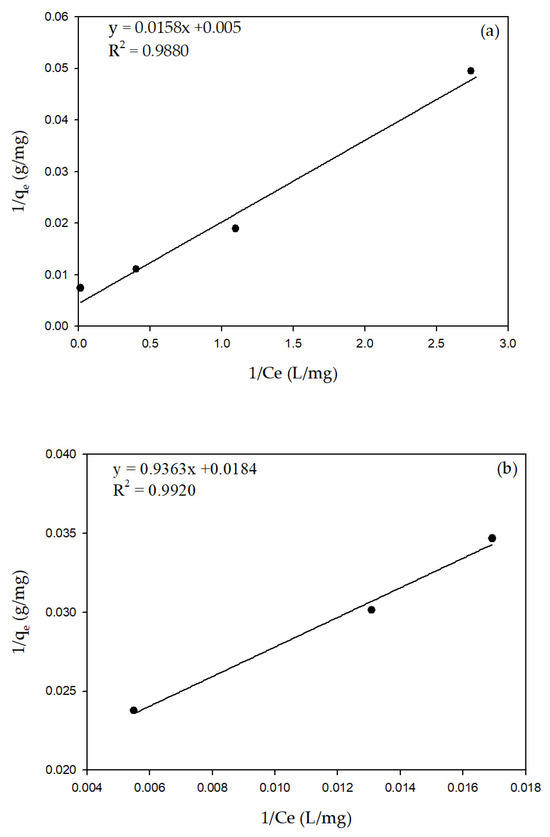
Powder-form adsorbent ZA with the highest sorption capacity for Sr2+, and ACSr, synthesized via the inorganic polymerization of ZA, were evaluated for their capacity to remove divalent strontium (Sr2+) ions. The performance of ACSr, a granular form of ZA, was compared with that of Ba-4A adsorbents and commercial SrTreat. Adsorption isotherm studies were conducted using granular form adsorbents, and the Langmuir fitting curves of ACSr are shown in Figure 1a. According to Equation (1), the maximum adsorption capacity () of ACSr was 5.07 meq g−1. Similarly, the Langmuir isotherms and corresponding values of the other granular adsorbents were obtained. Among the granular adsorbents for strontium ions, SrTreat exhibited the highest maximum adsorption capacity (5.31 meq/g), followed by ACSr (5.07 meq/g). Ba-4A exhibited the lowest adsorption capacity (3.81 meq/g). These results confirm the effectiveness of ACSr in Sr2+ uptake, which closely matches that of SrTreat.
Figure 1.
Langmuir isotherm adsorption curve of (a) ACSr, a granular form of ZA, for strontium ions and (b) NCGO, a granular form of NCFC, for cesium ions at 25 °C.
Subsequently, ACSr, rather than ZA, was selected for further performance assessments in simulated water matrices and compared with commercial SrTreat. Under high-ionic-strength groundwater conditions (Table 1), ACSr achieved a Sr2+ removal efficiency of 90%, slightly lower than that of the commercial Sr Treat (93.3%). However, ACSr retained a significantly higher concentration of Ca2+ in the treated water, which is advantageous for applications requiring selective strontium removal without substantial calcium depletion. While ACSr could modestly remove Mg2+ (32%), the rate exhibited by SrTreat was 57.6%. In the low-background carbonate-pretreated seawater, both materials reduced Sr2+, Ca2+, and Mg2+ to below detection limits, demonstrating complete decontamination. Thus, in water matrices with high hardness, competitive adsorption significantly affects Sr2+ uptake, highlighting the importance of pretreatment steps such as carbonate co-precipitation.
Table 1.
Comparison of granular adsorbents for strontium removal.
3.2. Sr-90 Decontamination Performance
Given the application of treating radioactive wastewater, the ACSr adsorbent was further tested for Sr-90 removal efficiency. The radioactive wastewater with an initial Sr-90 activity concentration was 35,700 Bq/L. After treatment with ACSr or SrTreat (for comparison), all residual Sr-90 concentrations fell below the minimum detectable activity (MDA) of 13.4 Bq/L—well below the discharge regulatory limit of 32.6 Bq/L. Both adsorbents achieved decontamination factors (DFs) exceeding 2600. These results demonstrate ACSr as a promising candidate for the removal of radiostrontium from contaminated water.
3.3. Cesium Removal Efficiency and Adsorption Capacity
The adsorption capacity of Cs+ is a critical parameter in evaluating the performance of candidate adsorbents. In this study, the cesium removal efficiency was used as the key performance metric. Among the examined materials, sodium titanate exhibited the highest adsorption capacity at 0.96 meq/g, followed by NCFC at 0.59 meq/g, whereas CoFC demonstrated the lowest capacity at 0.29 meq/g. Further tests were conducted using 35,000 mg/L NaCl solution to evaluate adsorbent performance under saline conditions simulating seawater environments. Table 2 summarizes the cesium removal efficiency of various powder-form adsorbents under different NaCl concentrations in batch tests. At 0 mg/L NaCl, all tested powder-form adsorbents exhibited nearly complete Cs+ removal (~99.9%), indicating a high affinity for cesium ions under low-ionic-strength conditions. With increasing NaCl concentration, a sharp decline in Cs+ removal efficiency was observed for Na2TiO3 and FeFC, reflecting strong competitive effects from Na+ ions. In contrast, CuFC, NiFC, CoFC, and NCFC maintained consistently high Cs+ removal efficiencies (>98%) even at 35,000 mg/L NaCl, demonstrating superior selectivity and resistance to high-salinity interference. The reduced Cs+ sorption by Na2TiO3 in NaCl solutions is likely attributable to Na+ competition [32]. Because Na2TiO3 contains exchangeable Na+, elevated Na+ concentrations under high-salinity conditions suppress Cs+/Na+ ion exchange, resulting in decreased Cs+ uptake. For FeFC, the decline in Cs+ sorption efficiency can be attributed to structural and selectivity effects associated with the metal center in the hexacyanoferrate framework [38]. The Fe-based hexacyanoferrate is expected to exhibit relatively larger effective cavity or exchange-site characteristics due to the larger atomic radius of Fe compared with Co, Ni, and Cu, which may reduce Cs+ selectivity.
Table 2.
Cesium removal efficiency (%) of various powder-form adsorbents under different NaCl concentrations in a batch test.
Based on prior screening results, high-performance sorbents suitable for granulation were selected, including CoFC, NiFC, and a co-precipitated variant (NCFC). All selected materials demonstrated cesium sorption capacities exceeding 0.3 meq/g and removal efficiencies above 98% under high-salinity conditions.
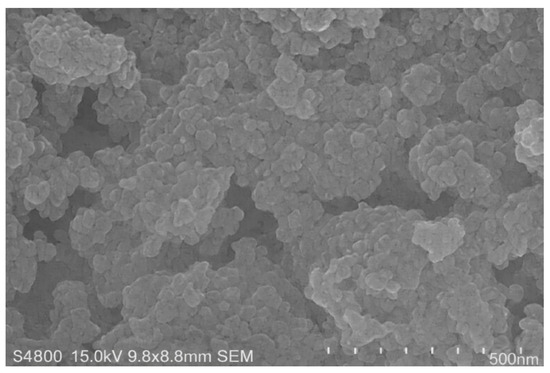
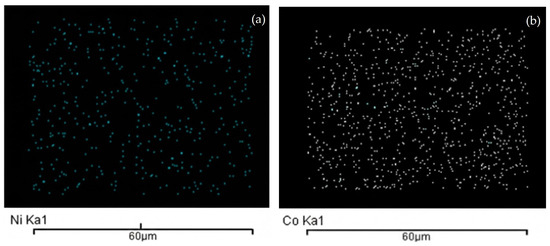
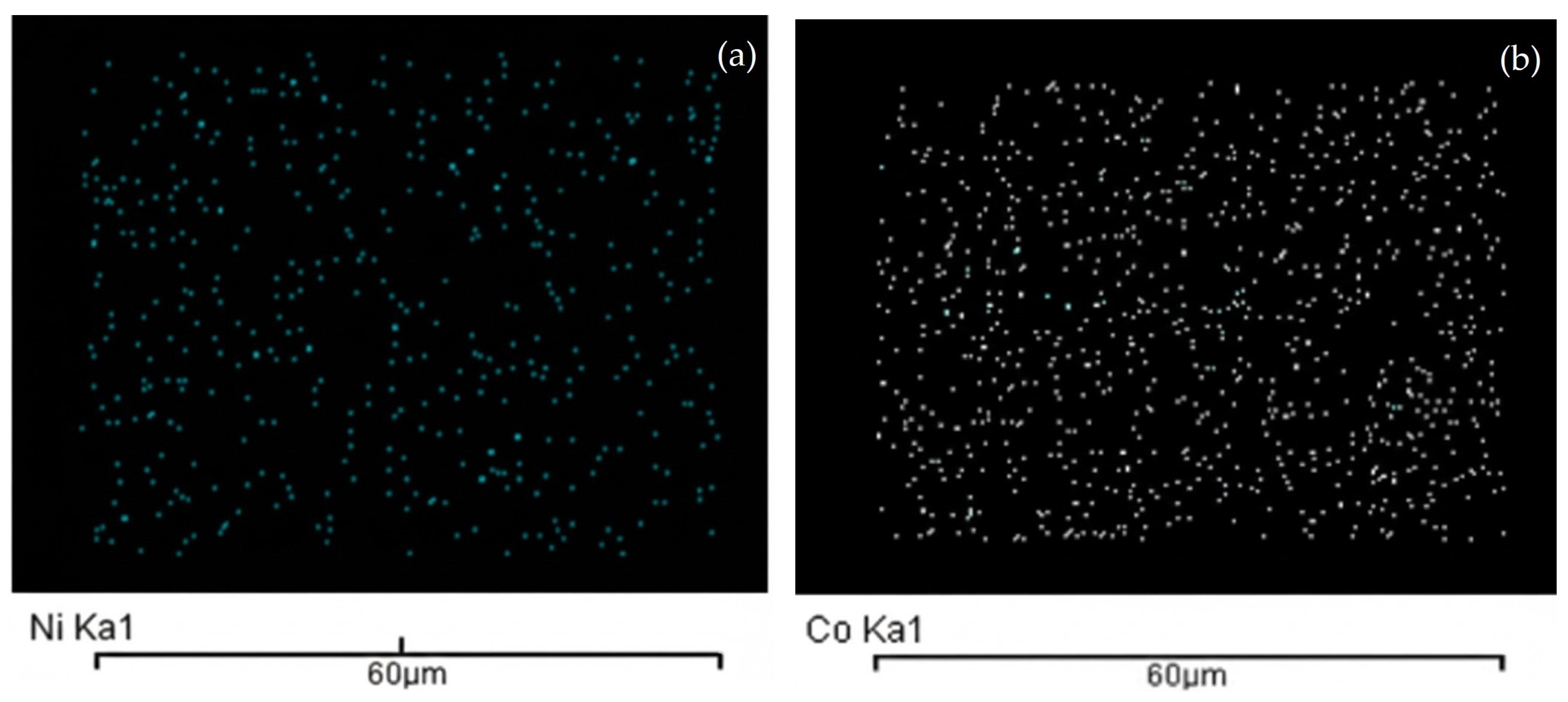
The powdered NCFC was synthesized via a co-precipitation reaction of cobalt salts, nickel salts, and potassium ferrocyanide. The resulting product has a nominal chemical formula of NiCo[Fe(CN)6]3. The surface morphology of the NCFC powder is shown in Figure 2. NCFC exhibits a pronounced granular morphology, with particle sizes in the order of several tens of nanometers, indicating that the structure is formed by the aggregation of multiple nanoparticles. The particles appear uniformly distributed, with no obvious large-scale cracks or sheet-like structures. The surface appears highly rough, suggesting a potentially high specific surface area. Elemental mapping results, presented in Figure 3, confirm a homogeneous distribution of Ni and Co across the particle surface, indicating effective co-precipitation and compositional uniformity.
Figure 2.
Scanning electron microscopic image of nickel and cobalt hexacyanoferrate (NCFC) adsorbent.
Figure 3.
Elemental mapping images of (a) Ni and (b) Co on the surface of the nickel and cobalt hexacyanoferrate (NCFC) adsorbent.
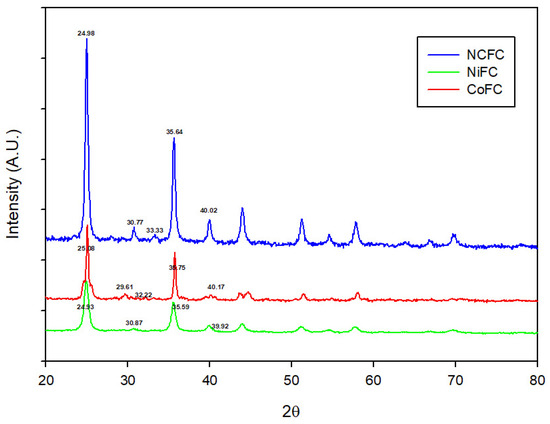
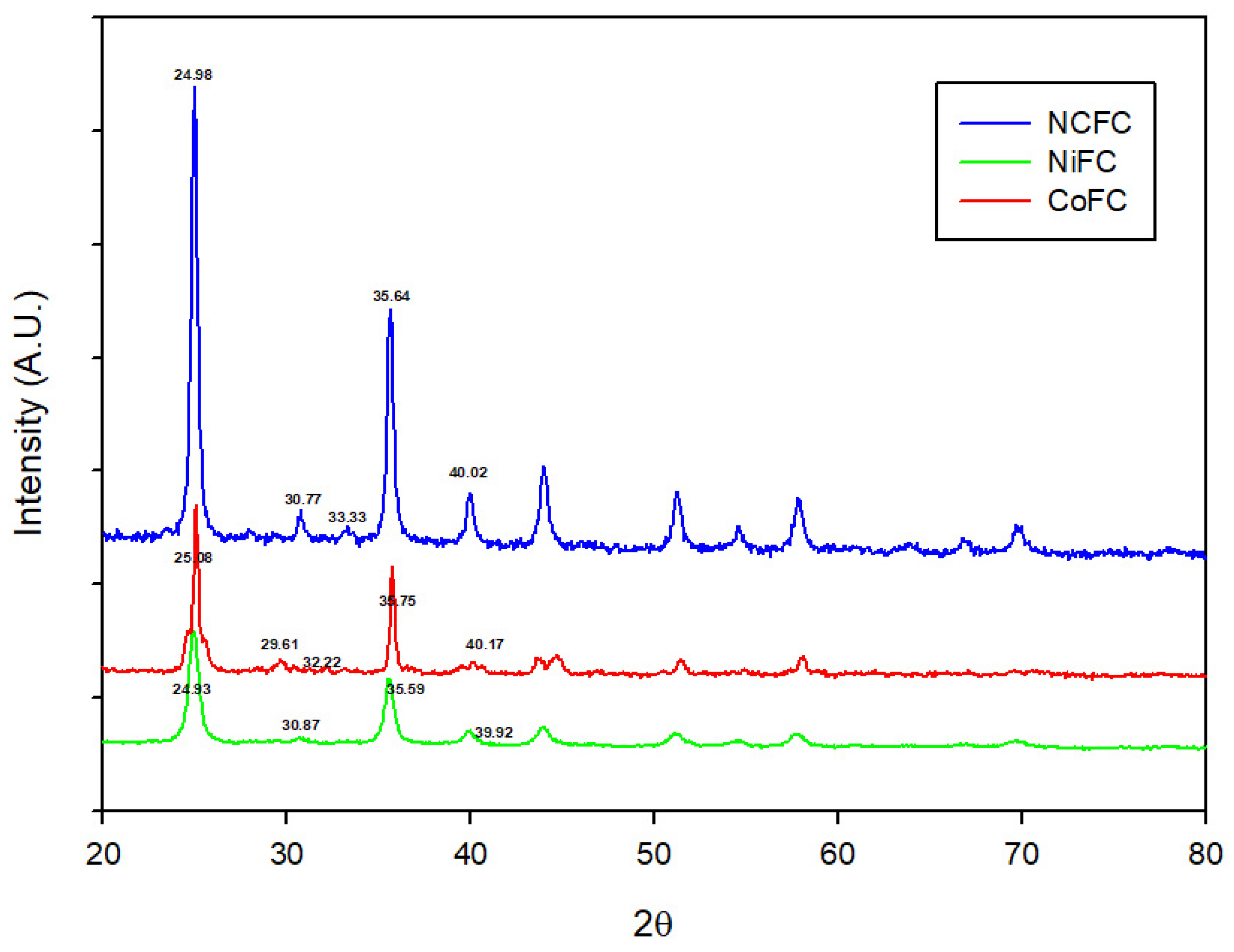
The XRD patterns of NCFC, NiFC, and CoFC adsorbents (Figure 4) exhibit clear and well-defined diffraction peaks, suggesting good crystallinity. Based on the characteristic XRD peaks, NCFC exhibits a diffraction structure similar to those of NiFC and CoFC, with diffraction signals observed at approximately 2θ = 25° (220), 35° (400), and 40° (420). Given the similarity in synthesis methods and crystal phases, the bonding mechanism of NCFC is inferred to be comparable to that of NiFC and CoFC, with the adsorption of metal ions within the crystal lattice being the dominant mechanism. Furthermore, no diffraction peaks attributable to the precursor salts NiCl2·6H2O (JCPDS No. 25-1044) or CoCl2 (JCPDS No. 72-2408) were observed in the NCFC XRD pattern. This indicates that these metal chlorides are not present in crystalline form in the final product. Hence, based on the XRD results, the unreacted precursor salts can be excluded. These results collectively establish the successful synthesis of NCFC with a well-defined crystalline structure and uniform elemental composition, supporting its potential as a selective adsorbent for radionuclide removal.
Figure 4.
X-ray diffraction patterns of nickel and cobalt hexacyanoferrate (NCFC), nickel ferrocyanide (NiFC), and cobalt ferrocyanide (CoFC) adsorbents.
The CuFC/4A adsorbent, prepared by impregnating CuFC onto a 4A zeolite support, exhibited poor mechanical stability due to weak adhesion between the active CuFC layer and the support surface. During long-term leaching tests with simulated wastewater, the color of the adsorbent faded noticeably, indicating detachment of the surface-active material. This degradation resulted in a significant decline in sorption efficiency, underscoring the limitations of conventional impregnation techniques for long-term applications.
To address this issue, an inorganic geopolymer-based granulation method was employed in this study as an alternative to the traditional impregnation process, with an aim to enhance the mechanical integrity and operational durability of the adsorbents. The selected materials were incorporated into geopolymer granules and evaluated through Langmuir isotherm modeling to determine their sorption capacities. The adsorption isotherm and corresponding Langmuir fit for NCGO are shown in Figure 1b. The maximum adsorption capacity (qm) of NCGO was determined to be 0.41 meq/g using Equation (1). Similarly, the Langmuir isotherms and corresponding qm values of the other granular adsorbents were obtained. Among the granular adsorbents for cesium ion, CuFC/4A exhibited the highest maximum adsorption capacity (0.65 meq/g), followed by NCGO (0.41 meq/g), the commercial benchmark CsTreat (0.39 meq/g), and NiGO (0.35 meq/g), while CoGO showed the lowest adsorption capacity (0.34 meq/g). Notably, CuFC/4A and NCGO (a kaolinite-based geopolymer incorporating NCFC) demonstrated superior adsorption capacities compared with the commercial CsTreat. However, CuFC/4A had weak interfacial adhesion between the CuFC active phase and the 4A zeolite support, which may result in partial loss of the active component due to washout during operation, thereby limiting its adsorption performance.
Under high-salinity conditions, CoGO maintained a 100% removal efficiency, indicating no loss of adsorption performance. NCGO and NiGO also exhibited strong cesium removal, with efficiencies of 99.21% and 98.13%, respectively. These results confirm that CoGO is the least affected by salinity among the materials tested, with all three materials retaining excellent performance even under salt stress. Notably, NCGO consistently achieved greater than 99% Cs+ removal rates in saline environments, meeting the target criteria and exhibiting adsorption efficiency comparable to the commercial benchmark CsTreat. These results indicate well preserved structural stability and ion selectivity of NCGO under high-salinity conditions, making it a strong candidate for application in seawater-derived radioactive wastewater.
The practical applicability of various granular adsorbents under continuous-flow conditions was evaluated by conducting fixed-bed column experiments. The LHSV was set at 8.75 h−1. The feed solution consisted of 10 mg/L Cs+ in 35,000 mg/L NaCl(aq), simulating a high-salinity environment.
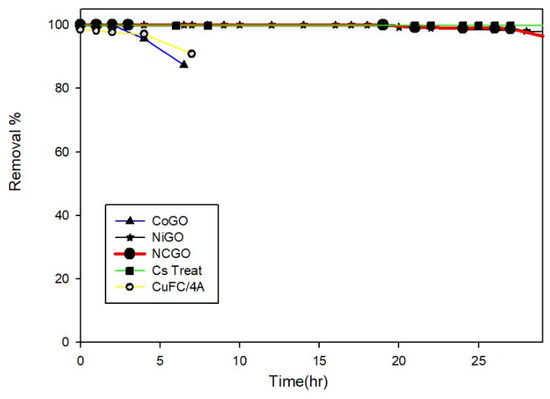
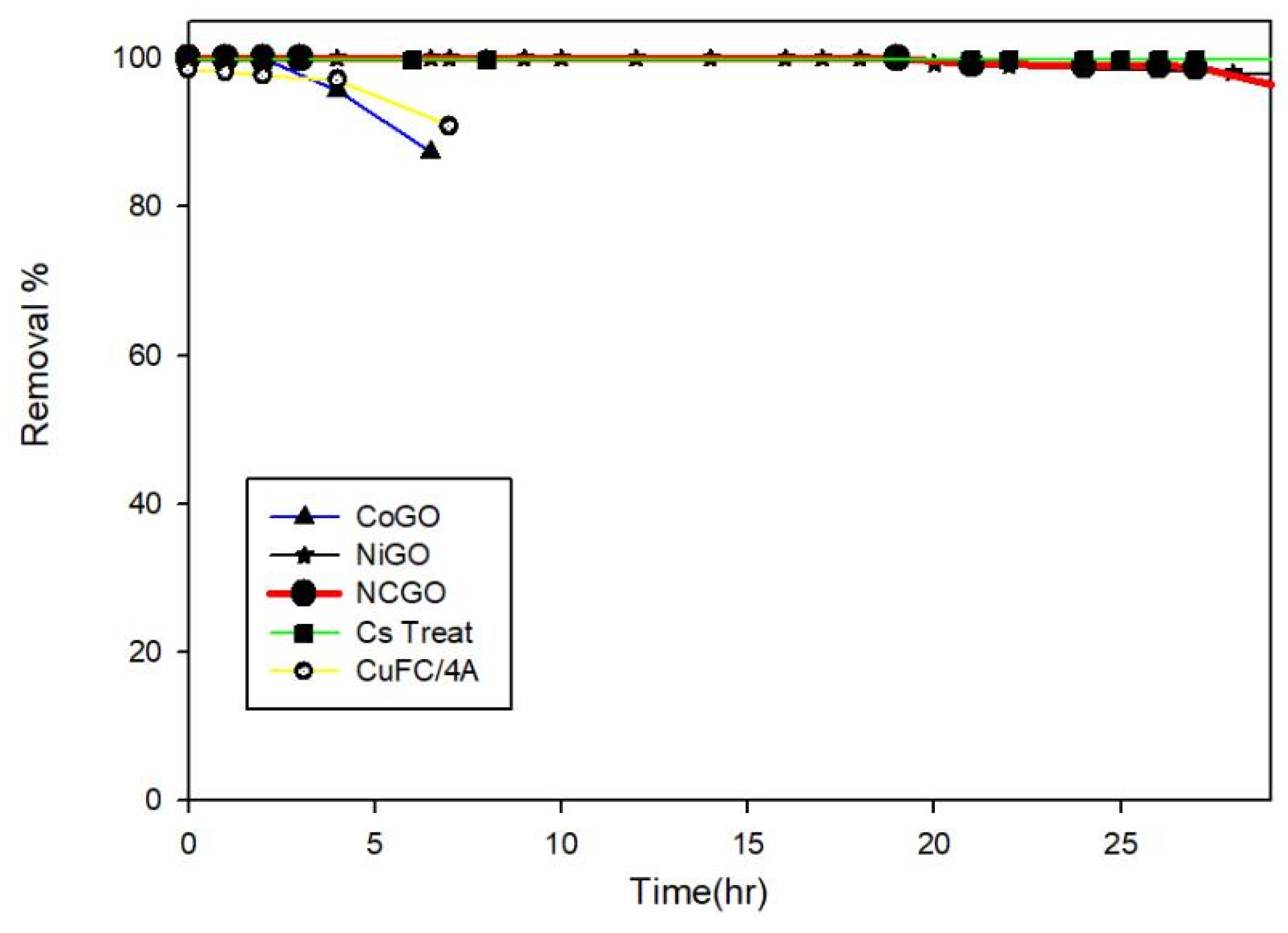
For comparison, five adsorbents were selected: commercial CsTreat, CuFC/4A, CoGO, NiGO, and NCGO. The removal efficiencies of various adsorbents at different time intervals are presented in Figure 5 and Table 3. Within the initial 7 h of the experiment, NCGO, NiGO, and commercial CsTreat could stably maintain a cesium removal rate above 99.9%. In contrast, the removal efficiency of the CuFC/4A adsorbent decreased to approximately 90.9%, whereas CoGO exhibited the poorest performance, dropping to around 87% at 7 h. The reduced adsorption efficiency of CoGO, along with its comparatively low adsorption capacity, is primarily attributed to adsorption site saturation and the decreased availability of active sites caused by competitive Na+ ion adsorption. For CuFC/4A, the observed rapid decline in adsorption efficiency is associated with the weak interfacial binding between CuFC and the 4A support, thus resulting in adsorbent loss through washout. When the duration of the experiment was extended to 22 h, NCGO, NiGO, and CsTreat all maintained greater than 99% cesium removal efficiencies, demonstrating good operational stability over prolonged periods. Further extension to 28 h indicated that both CsTreat and the synthesized NCGO retained removal rates exceeding 99%, whereas NiGO showed a slight decrease to approximately 98%, remaining within the high-performance range overall.
Figure 5.
Comparison of the removal efficiencies of various granular adsorbents for cesium ions in the column test.
Table 3.
The removal efficiencies of various granular adsorbents for cesium ions in the column test.
3.4. Mechanical Strength of Adsorbents
To evaluate the mechanical integrity of the synthesized ACSr adsorbent relative to commercial materials, including Sr Treat and activated carbon, compressive strength testing was conducted. The coefficient of variation (CV) was high across all tested materials due to irregular granule morphology and inherent variability in single-particle strength measurements. Therefore, average compressive strength was used as the primary indicator of mechanical performance.
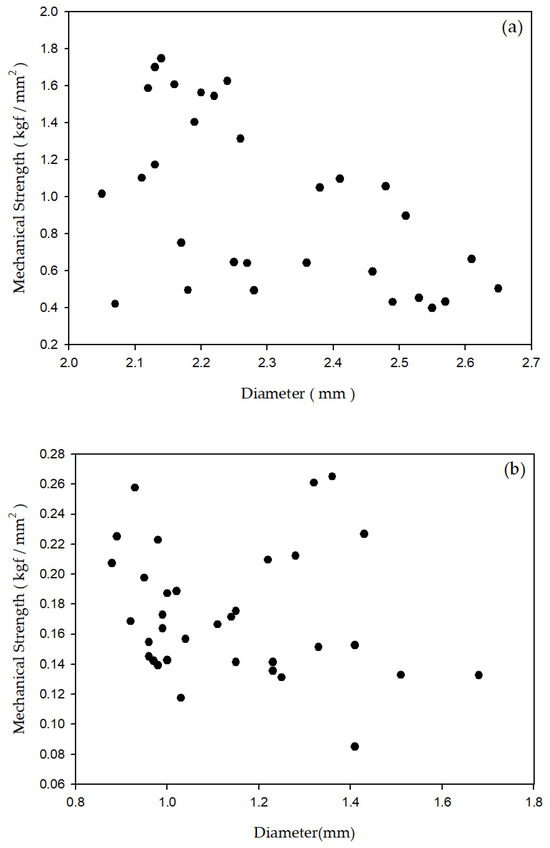
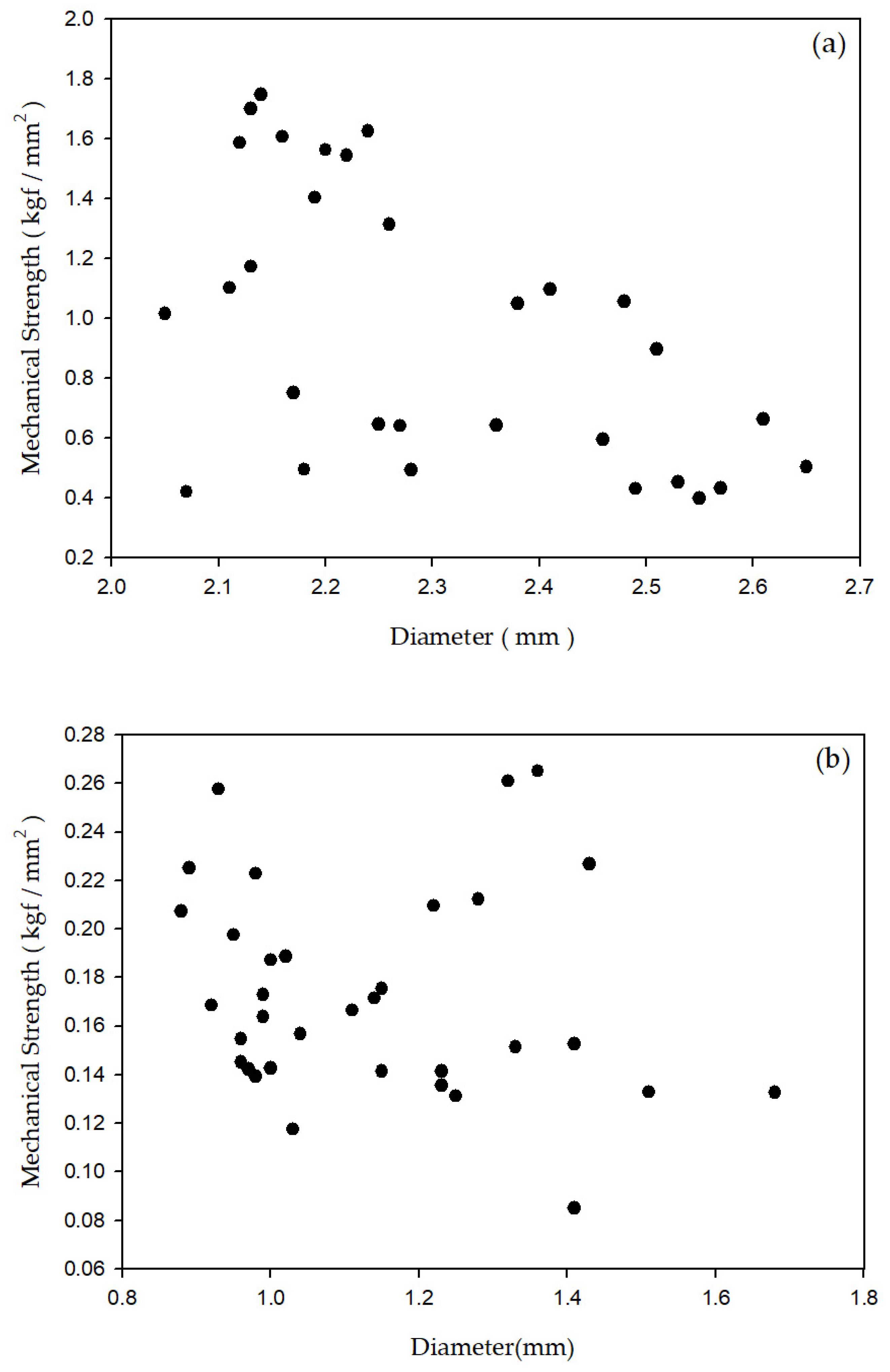
For the ACSr adsorbent, the relationship between particle size and compressive strength is shown in Figure 6a. The particle diameter ranged from 2.05 to 2.65 mm, and no significant correlation was observed between particle size and mechanical strength. Thus, particle size variation did not have a significant influence on compressive performance within the tested size range.
Figure 6.
Mechanical strength versus particle diameter distribution of (a) the ACSr adsorbent and (b) SrTreat adsorbent.
The average compressive strength of ACSr was measured at 0.83 kgf/mm2, significantly higher than that of the commercial SrTreat adsorbent (0.17 kgf/mm2) as shown in Figure 6b, indicating superior mechanical strength. This enhanced strength exhibited by ACSr demonstrates its suitability for practical applications where hydraulic or mechanical stress is expected, such as fixed-bed column operations or dynamic flow systems.
The mechanical strength of the commercial adsorbent CsTreat and the synthesized inorganic geopolymer-based adsorbents were tested and compared (Table 4). Among the tested adsorbents, CuFC/4A exhibited the highest average mechanical strength, followed by NCGO, whereas CsTreat showed the lowest strength. The descending order of average mechanical strength was as follows: CuFC/4A > NCGO > NiGO > CoGO > CsTreat. In addition to average values, the CV for each adsorbent was calculated to evaluate the consistency of mechanical strength across different particles. A higher CV indicates greater data dispersion and lower reproducibility, whereas a lower CV suggests more uniform mechanical characteristics. The variability in mechanical strength was in the order of CoGO > NiGO > NCGO > CsTreat. Notably, CoGO exhibited the highest CV (90.1%), indicating considerable variability in strength, likely due to irregular particle morphology and heterogeneity among individual granules in terms of mechanical properties. In contrast, NCGO exhibited the lowest CV, indicating stable, consistent mechanical performance.
Table 4.
Comparison of properties and performance of granular adsorbents for cesium removal.
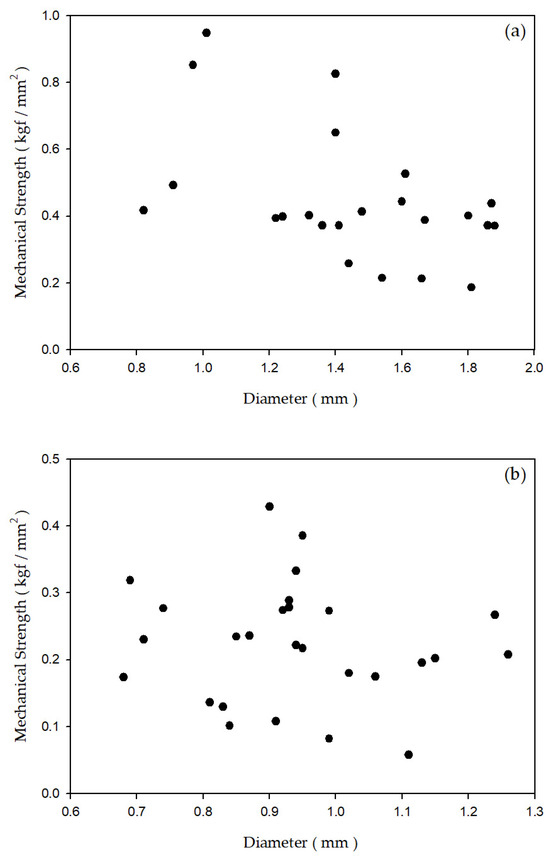
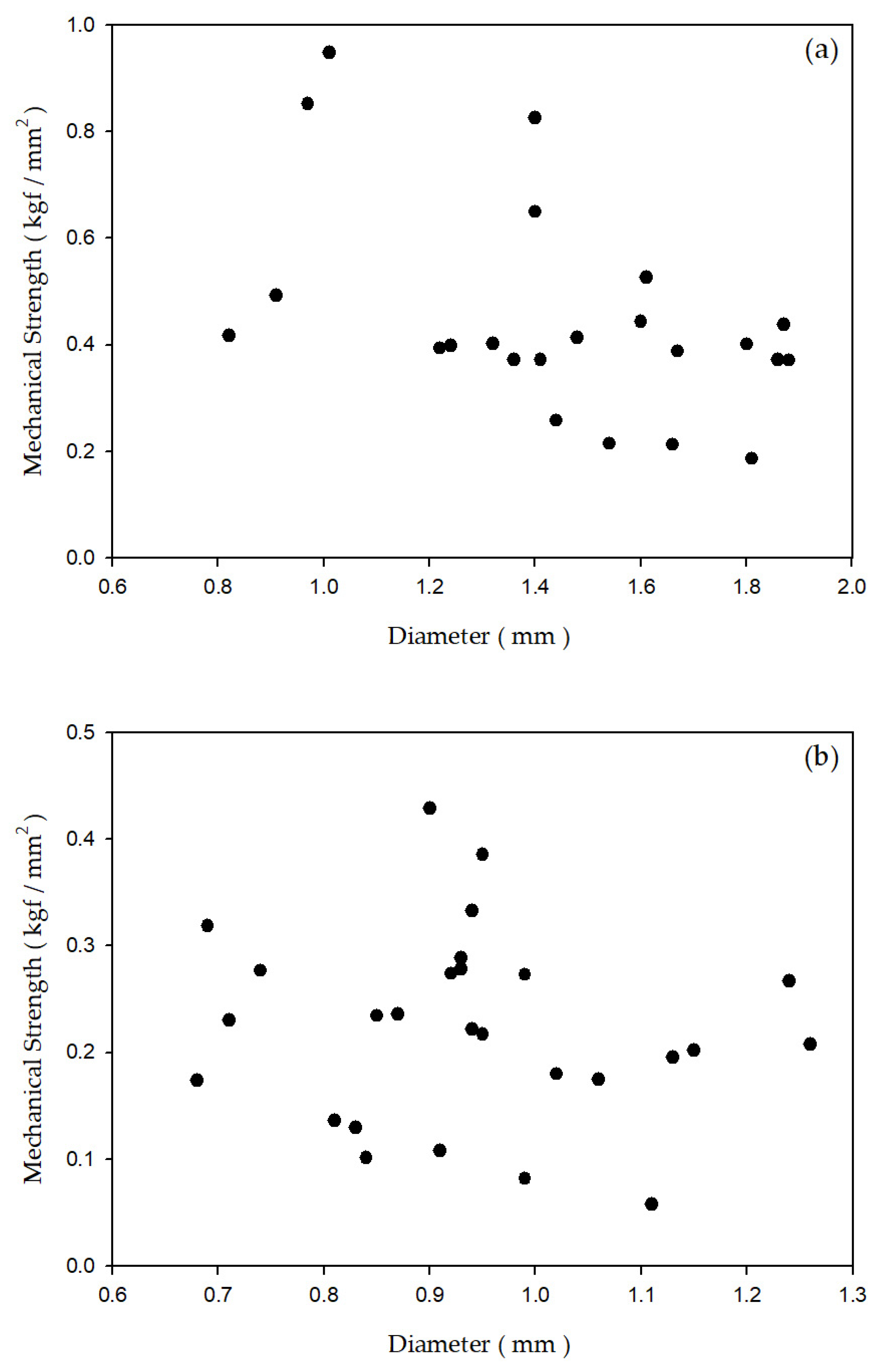
Given the observed variability, average strength values serve as the primary indicator for assessing mechanical performance. For example, the particle size distribution and corresponding mechanical strength of NCGO are shown in Figure 7a. The particle diameters ranged from 0.82 to 1.88 mm, and no clear correlation between particle size and mechanical strength was observed, suggesting uniform strength characteristics across size fractions. Overall, the NCGO adsorbent exhibited an average compressive strength of 0.45 kgf/mm2, which is significantly higher than that of the commercial CsTreat (0.22 kgf/mm2). The relationship between particle size and compressive strength of CsTreat is presented in Figure 7b. These results highlight the superior mechanical stability of NCGO and its potential applicability in adsorption systems subjected to hydraulic stress caused by continuous flow in a column.
Figure 7.
Mechanical strength versus particle diameter distribution of (a) the NCGO (a granular form of NCFC) adsorbent and (b) the CsTreat adsorbent.
In geopolymer-based granulation processes, overall sorption performance can be enhanced by increasing the content of active adsorbent material; nonetheless, it may also adversely affect the mechanical integrity of the granules. To investigate this trade-off, NCGO granules were prepared at three different adsorbent-to-geopolymer binder weight ratios of 2:1, 2.5:1, and 3:1, and their compressive strength was evaluated. The data show a clear inverse relationship between adsorbent content and mechanical strength. As the adsorbent-to-binder ratio increased from 2:1 to 2.5:1 and 3:1, the average compressive strength decreased from 0.45 kgf/mm2 to 0.19 kgf/mm2 and 0.10 kgf/mm2, respectively. This trend suggests that although higher adsorbent loading may introduce more active sorption sites, it simultaneously reduces the proportion of geopolymer matrix, consequently weakening the structural cohesion of the granules.
Notably, the mechanical strength of NCGO granules at both 2.5:1 and 3:1 ratios was lower than that of the commercial CsTreat adsorbent (0.22 kgf/mm2), indicating that elevated adsorbent loadings limit the mechanical stability. Given the operational demands of practical applications—particularly in packed-bed or fluidized systems where structural robustness is essential—the 2:1 ratio was selected as the optimal formulation. This ratio provides a satisfactory balance between mechanical durability and sorption capacity, ensuring both robust performance and long-term stability of the granulated adsorbent.
The four granulated cesium adsorbents—CuFC/4A, NCGO, NiGO, and CoGO—were comprehensively compared to evaluate their suitability for radioactive cesium removal in saline conditions. As shown in Table 4, surface property measurements revealed a stark contrast between CuFC/4A and the geopolymer (GO)-granulated materials. CuFC/4A had the lowest surface area (5.25 m2/g) and the smallest average pore diameter (0.19 nm), but the highest pore volume (1.52 cm3/g), potentially reflecting macropore voids due to the loose deposition of CuFC. In contrast, NCGO, NiGO, and CoGO exhibited significantly higher BET surface areas (29–39 m2/g) and much larger pore sizes, leading to enhanced ion accessibility.
Considering the performance, Cs+ adsorption capacity was highest for CuFC/4A (0.65 meq/g), followed by NCGO (0.41 meq/g), NiGO (0.35 meq/g), and CoGO (0.34 meq/g). However, in simulated seawater conditions (35,000 mg/L NaCl), only NCGO and NiGO could completely remove Cs+ (100%), whereas the performance of CuFC/4A dropped to 90.9%, and that of CoGO further reduced to 87.3%, indicating lower selectivity and salt tolerance.
These results demonstrate that while CuFC/4A offers high initial adsorption capacity, its practical applicability is limited due to its lower salt tolerance and structural adhesion issues. In contrast, NCGO offers a superior balance of mechanical integrity, selective performance, and structural stability, making it the most promising candidate among the examined materials for decontamination systems involving saline wastewater.
3.5. Decontamination Performance of Adsorbents in High-Salinity Radioactive Wastewater
The applicability of the NCGO and ACSr adsorbents was evaluated for removing Cs-137 and Sr-90 in high-salinity wastewater; a radioactive wastewater containing 35,000 mg/L NaCl, 898 Bq/L Sr-90, and 624 Bq/L Cs-137 with a pH value of approximately 6.7, was tested at room temperature. The adsorbents were sequentially arranged in an adsorption system as follows: (1) activated carbon (AC), (2) NCGO adsorbent, and (3) ACSr adsorbent. After treatment, the residual concentration of Cs-137 in the effluent decreased to levels below the minimum detectable activity (MDA) of 0.56 Bq/L. Similarly, Sr-90 was also effectively removed to levels below its MDA of 3.45 Bq/L, achieving regulatory compliance for discharge standards. The decontamination factors (DFs) of Sr-90 and Cs-137 were greater than 260 and 1114, respectively.
These results demonstrate that the adsorption system containing NCGO and ACSr adsorbent is highly effective in removing both Cs-137 and Sr-90 under high-salinity conditions. Therefore, the combined use of activated carbon for organics pretreatment, NCGO for cesium-specific adsorption, and ACSr for strontium removal offers a comprehensive treatment approach suitable for practical applications in radioactive wastewater management.
4. Conclusions
This study successfully demonstrates the design and synthesis of granulated geopolymer-based adsorbents, ACSr and NCGO, with high selectivity and capacity for the removal of Cs+ and Sr2+ from high-salinity aqueous environments. With the incorporation of ferrocyanide compounds and alkaline-earth metals into the geopolymer matrix, the adsorbents combined chemical specificity with enhanced mechanical integrity, achieving cesium removal efficiencies exceeding 99% and strontium decontamination factors greater than 1000 under simulated seawater conditions. Isotherm analyses further confirmed adsorption capacities comparable to or exceeding those of commercial adsorbents. Continuous fixed-bed column experiments validated the operational stability of the adsorbent materials over extended periods, with minimal performance degradation. SEM and XRD characterizations supported the formation of well-defined crystalline structures and homogeneous elemental distributions, which facilitated selective ion capture. Mechanical analyses revealed sufficient compressive strength of the granules to withstand practical treatment conditions. Overall, these synthesized high-performance geopolymer-based granulated adsorbents represent a promising, scalable platform for effective and durable treatment of radioactive wastewater containing multiple competing ions in saline matrices, with NCGO identified as the most effective sorbent for Cs+ removal and ACSr for Sr2+ removal. They can be combined in sequential configurations for simultaneous decontamination of radioactive cesium and strontium.
Author Contributions
Conceptualization, C.-Y.L. and Y.-C.L.; methodology, C.-Y.L.; validation, C.-Y.L., Y.-C.L. and B.-L.J.; formal analysis, C.-Y.L., Y.-C.L. and B.-L.J.; investigation, C.-Y.L., Y.-C.L. and B.-L.J.; resources, Y.-C.L. and B.-L.J.; data curation, C.-Y.L., Y.-C.L. and B.-L.J.; writing—original draft preparation, C.-Y.L.; writing—review and editing, C.-Y.L., Y.-C.L. and B.-L.J.; visualization, B.-L.J.; supervision, C.-Y.L.; project administration, C.-Y.L.; funding acquisition, C.-Y.L. All authors have read and agreed to the published version of the manuscript.
Funding
This research was funded by National Science and Technology Council (NSTC), Taiwan, under grant number NSTC 113-3111-Y-042A-010. The APC was funded by National Atomic Research Institute (NARI), Taiwan.
Data Availability Statement
The original contributions presented in this study are included in the article. Further inquiries can be directed to the corresponding authors.
Acknowledgments
The authors thank Chao-Wei Huang and Chun-Chi Hou for assistance with inductively coupled plasma–optical emission spectrometry, and Yi-Lun Chen for access to and assistance with high-purity germanium gamma spectrometry and liquid scintillation counting facilities.
Conflicts of Interest
The authors declare no conflicts of interest. The funders had no role in the design of the study; in the collection, analyses, or interpretation of data; in the writing of the manuscript; or in the decision to publish the results.
References
- Buesseler, K.O.; Jayne, S.R.; Fisher, N.S.; Yoshida, S.; Aoyama, M.; Hamajima, Y.; Kaeriyama, H.; Kodama, T.; Kudo, T.; Nishino, S.; et al. Fukushima-Derived Radionuclides in the Ocean and Biota off Japan. Proc. Natl. Acad. Sci. USA 2012, 109, 5984–5988. [Google Scholar] [CrossRef] [Scilit]
- Buesseler, K.; Dai, M.; Aoyama, M.; Benitez-Nelson, C.; Charmasson, S.; Higley, K.; Maderich, V.; Masqué, P.; Morris, P.J.; Oughton, D.; et al. Fukushima Daiichi–Derived Radionuclides in the Ocean: Transport, Fate, and Impacts. Annu. Rev. Mar. Sci. 2017, 9, 173–203. [Google Scholar] [CrossRef] [Scilit] [PubMed]
- Cao, Y.; Zhou, L.; Ren, H.; Zou, H. Determination, Separation and Application of 137Cs: A Review. Int. J. Environ. Res. Public Health 2022, 19, 10183. [Google Scholar] [CrossRef] [Scilit] [PubMed]
- Kryshev, A.I. 90Sr in Fish: A Review of Data and Possible Model Approach. Sci. Total Environ. 2006, 370, 182–189. [Google Scholar] [CrossRef] [Scilit] [PubMed]
- Delaval, A.; Duffa, C.; Radakovitch, O. A Review on Cesium Desorption at the Freshwater–Seawater Interface. J. Environ. Radioact. 2020, 218, 106255. [Google Scholar] [CrossRef] [Scilit]
- Park, J.-H.; Kim, M.; Kim, H.; Kim, W.-Y.; Ryu, J.-M.; Lim, J.-M.; Kim, S. Enhancement of Cesium Adsorption on Prussian Blue by TiO2 Photocatalysis: Effect of the TiO2/PB Ratio. J. Water Process Eng. 2020, 38, 101571. [Google Scholar] [CrossRef] [Scilit]
- Petlitckaia, S.; Rousselot, I.; Rossignol, S. Functionalized Geopolymer Foams for Cesium Removal from Liquid Nuclear Waste. J. Clean. Prod. 2020, 269, 122400. [Google Scholar] [CrossRef] [Scilit]
- Handley-Sidhu, S.; Mullan, T.K.; Grail, Q.; Albadarneh, M.; Ohnuki, T.; MacAskie, L.E. Influence of pH, Competing Ions and Salinity on the Sorption of Strontium and Cobalt onto Biogenic Hydroxyapatite. Sci. Rep. 2016, 6, 23361. [Google Scholar] [CrossRef] [Scilit]
- Roushdy, A.F.; Mekawy, Z.A.; Saad, E.A.; Sheha, R.R. Sorption Performance and Migration Modeling of Radiocesium in the Geosphere of a Subsurface System. Int. J. Environ. Res. 2025, 19, 169. [Google Scholar] [CrossRef] [Scilit]
- Jang, S.-C.; Hong, S.-B.; Yang, H.-M.; Lee, K.-W.; Moon, J.-K.; Seo, B.-K.; Huh, Y.S.; Roh, C. Removal of Radioactive Cesium Using Prussian Blue Magnetic Nanoparticles. Nanomaterials 2014, 4, 894–901. [Google Scholar] [CrossRef] [Scilit]
- Kim, Y.K.; Kim, T.; Kim, Y.; Harbottle, D.; Lee, J.W. Highly Effective Cs+ Removal by Turbidity-Free Potassium Copper Hexacyanoferrate–Immobilized Magnetic Hydrogels. J. Hazard. Mater. 2017, 340, 130–139. [Google Scholar] [CrossRef] [Scilit] [PubMed]
- Khandaker, S.; Fujibayashi, M.; Kuba, T. Innovative Potassium Hexacyanoferrate Intercalated into Layered Double Hydroxide Adsorbent for Efficient Cesium Removal from Seawater. Sep. Purif. Technol. 2025, 354, 128984. [Google Scholar] [CrossRef] [Scilit]
- Lee, J.H.; Kwak, S.Y. Mechanochemically Synthesized Prussian Blue for Efficient Removal of Cesium Ions from Aqueous Solutions. ACS Omega 2022, 7, 3222–3229. [Google Scholar] [CrossRef] [Scilit] [PubMed]
- Kim, G.; Lee, D.S.; Eccles, H.; Kim, S.M.; Cho, H.U.; Park, J.M. Selective Strontium Adsorption Using Synthesized Sodium Titanate in Aqueous Solution. RSC Adv. 2022, 12, 18936–18944. [Google Scholar] [CrossRef] [Scilit]
- Smičiklas, I.; Coha, I.; Jović, M.; Nodilo, M.; Šljivić-Ivanović, M.; Smiljanić, S.; Grahék, Ž. Efficient Separation of Strontium Radionuclides from High-Salinity Wastewater by Zeolite 4A Synthesized from Bayer Process Liquids. Sci. Rep. 2021, 11, 1738. [Google Scholar] [CrossRef] [Scilit]
- Deb, A.K.; Saha, B.; Chattopadhyay, S.; Mishra, S.P.; Tiwari, A. Efficient Separation of Strontium Ions from Aqueous Solution by Radiation-Stable Sorbent. Chem. Eng. J. Adv. 2022, 10, 100308. [Google Scholar] [CrossRef] [Scilit]
- Guo, Y.; Nhung, N.T.H.; Dai, X.; He, C.; Wang, Y.; Wei, Y.; Fujita, T. Strontium Ion Removal from Artificial Seawater Using a Combination of Adsorption with Biochar and Precipitation by Blowing CO2 Nanobubbles with Neutralization. Front. Bioeng. Biotechnol. 2022, 10, 819407. [Google Scholar] [CrossRef] [Scilit]
- Luhar, I.; Luhar, S.; Abdullah, M.M.A.B.; Razak, R.A.; Vizureanu, P.; Sandu, A.V.; Matasaru, P.-D. A State-of-the-Art Review on Innovative Geopolymer Composites Designed for Water and Wastewater Treatment. Materials 2021, 14, 7456. [Google Scholar] [CrossRef] [Scilit]
- Chuang, L.-C.; Liao, C.-H. Sorption of Cesium Using KZnFc on Phosphoric Acid-Based Geopolymer. Ceram.–Silikáty 2015, 59, 125–134. [Google Scholar]
- Tian, Q.; Nakama, S.; Sasaki, K. Immobilization of Cesium in Fly Ash–Silica Fume-Based Geopolymers with Different Si/Al Molar Ratios. Sci. Total Environ. 2019, 691, 1006–1014. [Google Scholar] [CrossRef] [Scilit]
- Yang, R.; Tang, R.; Qie, F.; Huang, T.; Sun, Q.; Liang, Z.; Wang, W.; Zhang, P. Preparation and Accelerating Mechanism of Aluminum Sulfate-Based Alkali-Free Accelerating Additive for Sprayed Concrete. J. Build. Eng. 2025, 114, 114471. [Google Scholar] [CrossRef] [Scilit]
- Niu, X.; Elakneswaran, Y.; Islam, C.R.; Provis, J.L.; Sato, T. Adsorption Behaviour of Simulant Radionuclide Cations and Anions in Metakaolin-Based Geopolymer. J. Hazard. Mater. 2022, 429, 128373. [Google Scholar] [CrossRef] [Scilit] [PubMed]
- Varon, A.; Gossard, A.; Coppel, Y.; Barré, Y.; Poulesquen, A. Interplay between Geopolymer Formulation, Microstructure, and Strontium Sorption Properties. Clean. Mater. 2025, 170, 100331. [Google Scholar] [CrossRef] [Scilit]
- Yang, R.; He, T.; Guan, M.; Guo, X.; Xu, Y.; Xu, R.; Da, Y. Potential Effect of Pseudo-Boehmite on Cement and Mortar: Workability, Mechanical Strength and Mechanism. Constr. Build. Mater. 2020, 234, 117334. [Google Scholar] [CrossRef] [Scilit]
- Zicman, L.R.; Neacsu, E.; Done, L.; Tugulan, L.C.; Alexandru, C.; Dragolici, F.N.; Nicu, M.; Ionascu, L.F.; Obreja, B.T.; Dogaru, G.; et al. Investigation and Modeling of Fixed-Bed Cesium Sorption on Nickel Ferrocyanide Precipitated on Silica Gel. Rom. J. Phys. 2017, 62, 806. [Google Scholar]
- Walkley, B.; Ke, X.; Hussein, O.H.; Bernal, S.A.; Provis, J.L. Incorporation of Strontium and Calcium in Geopolymer Gels. J. Hazard. Mater. 2020, 382, 121015. [Google Scholar] [CrossRef] [Scilit]
- O’Donoghue, K.T.; Geddes, D.A.; Hayes, M.; Walkley, B. Reaction Mechanisms and Kinetics in Geopolymers Incorporating Strontium Salts. Dalton Trans. 2025, 54, 11337–11348. [Google Scholar] [CrossRef] [Scilit]
- Kavitha, E.; Prabhakar, S. Review and Assessment on the Separation of Cesium and Strontium from the Aqueous Stream. Desalination Water Treat. 2022, 251, 43–56. [Google Scholar] [CrossRef] [Scilit]
- Zhang, S.; Huang, Q.; Chen, L.; Zhong, Y.; Hu, F.; Wu, K.; Yin, X.; Hamza, M.F.; Wei, Y.; Ning, S. Phosphination of Amino-Modified Mesoporous Silica for the Selective Separation of Strontium. J. Hazard. Mater. 2024, 467, 133741. [Google Scholar] [CrossRef] [Scilit]
- Kim, K.-W.; Lee, K.-Y.; Lee, E.-H.; Baek, Y.; Chung, D.-Y.; Moon, J.-K. A Concept for an Emergency Countermeasure Against Radioactive Wastewater Generated in Severe Nuclear Accidents Like the Fukushima Daiichi Disaster. Nucl. Technol. 2016, 193, 318–327. [Google Scholar] [CrossRef] [Scilit]
- Lehto, J.; Koivula, R.; Leinonen, H.; Tusa, E.; Harjula, R. Removal of Radionuclides from Fukushima Daiichi Waste Effluents. Sep. Purif. Rev. 2019, 48, 122–142. [Google Scholar] [CrossRef] [Scilit]
- Takahatake, Y.; Shibata, A.; Nomura, K.; Sato, T. Effect of Flowing Water on Sr Sorption Changes of Hydrous Sodium Titanate. Minerals 2017, 7, 247. [Google Scholar] [CrossRef] [Scilit]
- NURES® & BORES® Usage at Paks Nuclear Power Plant. Available online: https://www.fortum.com/media/2025/03/nures-bores-usage-paks-nuclear-power-plant?utm_source=chatgpt.com (accessed on 18 December 2025).
- Liu, H.; Tong, L.; Su, M.; Chen, D.; Song, G.; Zhou, Y. The Latest Research Trends in the Removal of Cesium from Radioactive Wastewater: A Review Based on Data-Driven and Visual Analysis. Sci. Total Environ. 2023, 869, 161664. [Google Scholar] [CrossRef] [Scilit]
- Yu, Y.; Perumal, P.; Corfe, I.J.; Paul, T.; Illikainen, M.; Luukkonen, T. Combined Granulation–Alkali Activation–Direct Foaming Process: A Novel Route to Porous Geopolymer Granules with Enhanced Adsorption Properties. Mater. Des. 2023, 227, 111781. [Google Scholar] [CrossRef] [Scilit]
- Why Is the Ocean Salty? Available online: https://oceanservice.noaa.gov/facts/whysalty.html (accessed on 22 December 2025).
- ASTM D6175-24; Standard Test Method for Radial Crush Strength of Extruded Catalyst and Catalyst Carrier Particles. ASTM International: West Conshohocken, PA, USA, 2024.
- El-Bahy, S.M.; Alotaibi, M.T.; Metwally, A.M. Efficient and Selective Removal of Cesium from Aqueous Solution Using Copper Hexacyanoferrate Nanoparticles Supported on Poly(methacrylic Acid-co-Itaconic Acid). Desalin. Water Treat. 2021, 234, 102–114. [Google Scholar] [CrossRef] [Scilit]

Disclaimer/Publisher’s Note: The statements, opinions and data contained in all publications are solely those of the individual author(s) and contributor(s) and not of MDPI and/or the editor(s). MDPI and/or the editor(s) disclaim responsibility for any injury to people or property resulting from any ideas, methods, instructions or products referred to in the content. |
© 2026 by the authors. Licensee MDPI, Basel, Switzerland. This article is an open access article distributed under the terms and conditions of the Creative Commons Attribution (CC BY) license.