


Abstract
This comprehensive review examines the application of fractal theory and technology in the study of cementitious materials, with a focus on cement and concrete. We begin by introducing the fundamental concepts of fractal geometry and the various fractal dimensions used to quantify material features. We then explore how fractal analysis has been applied to key aspects of cementitious materials, including pore structure, particle size distribution, fracture surfaces, and crack propagation. Each section highlights the methodologies employed, the insights gained, and the implications for material design and performance. Additionally, we discuss the use of fractal-based techniques in the non-destructive testing and monitoring of structures. Finally, we address the challenges and limitations of fractal approaches and propose future directions for research in this interdisciplinary field. Fractal theory can become a useful tool in the study of cementitious materials, aiding a deeper understanding of their physical properties and long-term durability, and guiding the design of more durable and efficient construction materials by giving engineers the required knowledge on the technology and its limitations.
1. Introduction
Cementitious materials, such as cement and concrete, are inherently complex and heterogeneous. Their internal structures, from the nano-scale hydration products to the macro-scale aggregate distribution, exhibit irregular and seemingly random features that defy description by traditional Euclidean geometry [1,2]. This complexity is not merely academic; it underpins the material’s mechanical properties, durability, and performance under various conditions. In recent decades, researchers have increasingly turned to fractal theory as a powerful tool to quantify and understand these complex structures [3,4]. Fractal geometry provides a mathematical framework for describing self-similar, scale-invariant patterns that are common in nature and in engineered materials [5,6]. By applying fractal analysis, scientists and engineers can characterize the roughness, irregularity, and complexity of cementitious materials at multiple scales [7,8], bridging the gap between microstructure and macroscopic behavior [9,10].
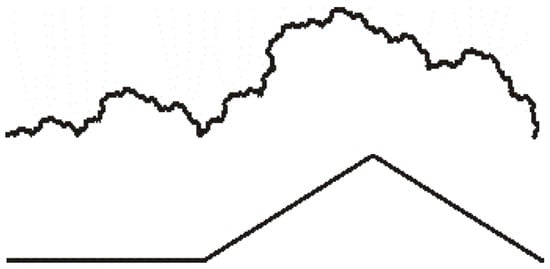
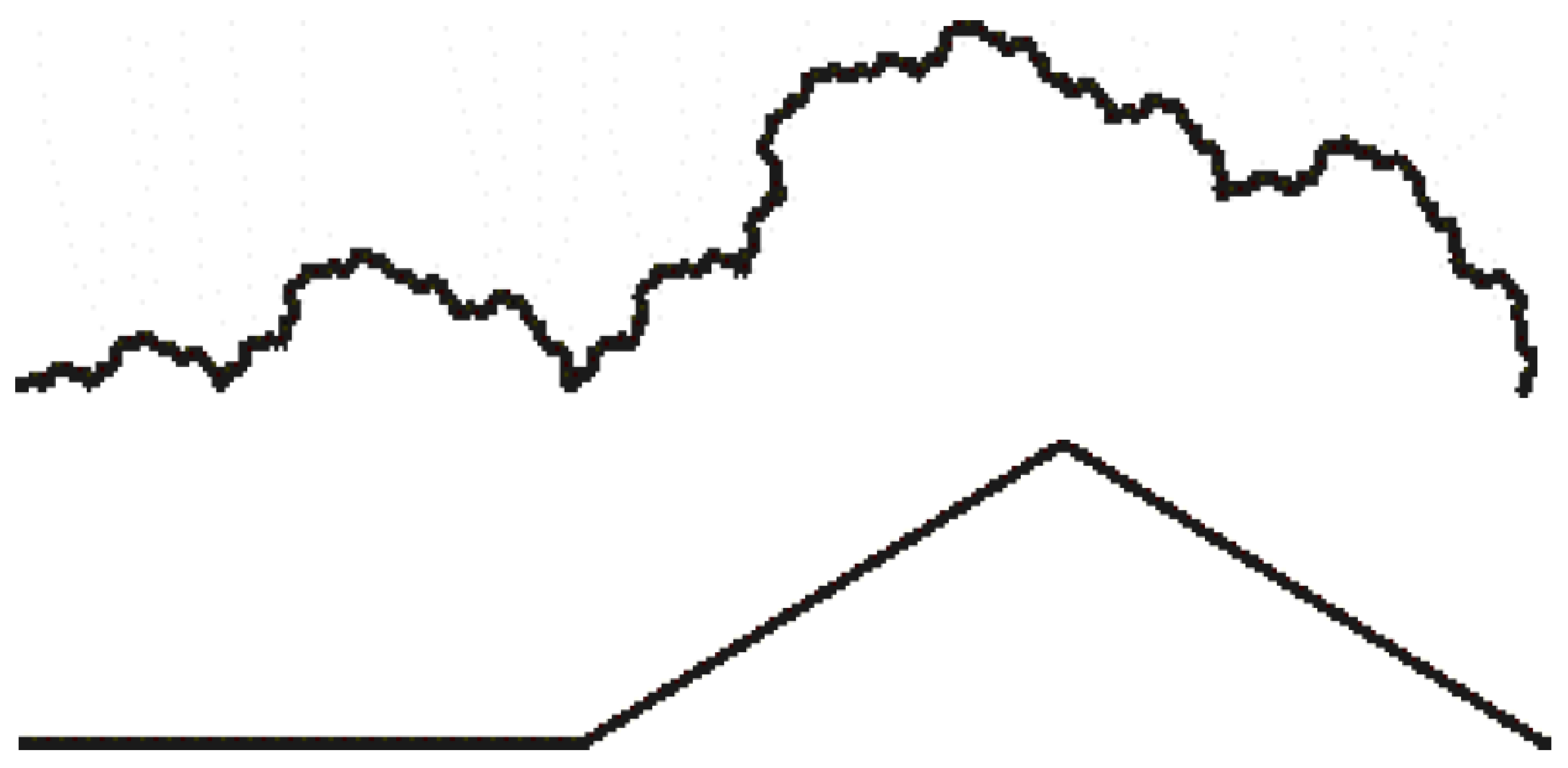
Fractal theory is a branch of mathematics that deals with complex geometric shapes exhibiting self-similarity and scale invariance [11,12]. Unlike classical Euclidean shapes such as lines, squares, and cubes, fractals have fractional dimensions that quantify their complexity. The core idea is that many natural and man-made structures, when viewed at different magnifications, reveal similar patterns, a property known as self-similarity [13,14]. In cementitious materials, features like pore surfaces or fracture profiles are similarly rough and detailed at all scales, making fractal analysis a natural fit (Figure 1).
Figure 1.
Actual fractal in concrete and generated shape [15].
Central to fractal analysis is the fractal dimension, a numerical value that quantifies the space-filling capacity of a pattern. Unlike a one-dimensional smooth line or a flat surface dimension, a fractal curve or surface can have a non-integer dimension, indicating a higher degree of complexity. The most well-known fractal dimension is the Hausdorff dimension [14], which rigorously defines the dimension of a set in terms of coverage by balls of diminishing size. In practice, researchers often use computationally simpler dimensions such as the box-counting dimension or capacity dimension, which estimate the Hausdorff dimension by counting the number of boxes needed to cover the fractal at different scales. Other common fractal dimensions include the information dimension which considers the probability of box occupation and the correlation dimension used for analyzing point distributions. Each has its own mathematical definition and interpretation, but all serve to capture the complexity and irregularity of the object under study. The box-counting method estimates the fractal dimension by systematically covering a complex object with grids of decreasing box size and counting how many boxes contain any part of the object, with the slope of log(box count) versus log(1/box size) yielding the fractal dimension D; schematically, one would first overlay a coarse grid (e.g., 4 × 4 boxes) on a jagged crack profile and count N = 12 occupied boxes, then repeat with finer grids (8 × 8, 16 × 16, 32 × 32) obtaining N = 28, 65, and 152 respectively, then plot these four (log(1/s), logN) points, and fit a straight line whose slope D ≈ 1.26 indicates the crack’s roughness exceeds a smooth line (D = 1) but remains below a space-filling curve (D = 2).
It is important to note that while the Hausdorff dimension is considered the gold standard, it can be difficult to apply to concrete, which is a complex material. In many “well-behaved” fractals, the Hausdorff dimension equals the box-counting dimension, but there are pathological cases where they differ. For most practical applications in materials science, the box-counting dimension or its variants provides a robust and reproducible measure of fractality. Fractal theory also encompasses multifractal analysis, which extends the concept to cases where different regions of a structure exhibit different scaling behaviors [16]. In multifractals, a spectrum of generalized dimensions are often denoted to be used to characterize the heterogeneity of the measure, e.g., pore size distribution or mass distribution across scales [17].
While fractal theory has been extensively documented across physics, mathematics, and materials science, its application to cementitious materials requires careful attention since cementitious materials are very complex. In cement-based systems, the fractal characteristics emerge from distinct physical processes at multiple scales: at the nanoscale, calcium–silicate-hydrate (C-S-H) gel exhibits surface fractal dimensions reflecting its colloidal packing density and gel-pore connectivity, which directly correlates with strength development and permeability; at the microscale, the interfacial transition zone (ITZ) surrounding aggregates displays self-similar roughness due to the wall effect and particle segregation, with its fractal dimension serving as a possible indicator for mechanical properties; and at the mesoscale, crack paths through hardened cement paste and aggregates follow fractal patterns dictated by the competition between brittle matrix failure and tortuous deflection around aggregates. The aggregate phase itself contributes to this complexity through its own surface fractality which modifies the effective ITZ thickness and interlocking efficiency. Thus, rather than treating the fractal dimension as a standalone descriptive parameter, researchers must establish explicit mechanistic links between different types of cementitious materials and this parameter. Without such material-specific interpretation, fractal analysis could not be useful for assessing and predicting concrete durability and performance engineering. Thus, this review is necessary for providing engineers with a basic understanding of this field.
2. Fractal Characteristics of Cementitious Materials
Cementitious materials, particularly concrete, are prime examples of natural fractals in engineering [18,19]. Their formation processes—from the hydration of cement grains to the curing of concrete—involve the gradual growth of complex structures that exhibit self-similarity across a range of scales [20,21]. X-ray scattering can be used to demonstrate that the internal pore structure of hardened cement paste is fractal, and a wealth of research has confirmed that many features of cementitious materials can be described as fractals [22]. For instance, the pore network in concrete, which consists of capillary pores, gel pores, and microcracks, is highly irregular and exhibits scale-invariant properties. The aggregate particles and their size distribution in concrete also follow fractal scaling in their distribution [23]. Aggregate size distribution often obeys a power law, indicating that the mixture of coarse and fine aggregates has a fractal character [24]. Even the fracture surfaces of concrete and other brittle materials are rough and jagged at all magnifications, a classic signature of fractal geometry [25]. These observations have led to the widespread adoption of fractal analysis in the study of cementitious materials [26], as it provides a way to quantify features that were previously only qualitatively described as “rough” or “irregular” [27].
The fractal characteristics of cementitious materials manifest in several key areas:
- (1)
- Pore Structure: The voids within a material, pores, cracks, and voids between aggregate and paste, form a complex network that is often fractal [28,29,30]. MIP and nitrogen adsorption tests on cement paste and mortar have revealed that the cumulative pore volume follows a power law with respect to pore size, indicating a fractal pore size distribution [31]. The surface of the pores, the solid–void interface, is also a “rough” surface in Euclidean terms and can be characterized by a surface fractal dimension. This fractal pore structure influences properties like permeability and strength, as will be discussed later.
- (2)
- Particle Size Distribution (PSD): The particles that make up a building material, cement grains, fine and coarse aggregates [29], supplementary cementitious materials, etc., often have a size distribution that can be described by a fractal model. For example, the mass of particles smaller than a certain size in a concrete mix may follow a power-law distribution, reflecting a self-similar pattern of particle sizes. This is not surprising, since natural aggregates and crushed materials often have fractal size distributions, and even industrial by-products like fly ash or slag exhibit fractal characteristics in their particle morphology [24,28]. Fractal analysis of particle size distribution is useful for optimizing mix designs, as the fractal dimension of the PSD can influence workability and packing density [29].
- (3)
- Fracture Surfaces and Cracks: When concrete or other brittle cementitious materials fail, the resulting fracture surfaces are extremely rough. These surfaces exhibit similar views of a small region which looks like the entire fracture surface [32]. This has been confirmed by the fractal analysis of crack profiles and 3D fracture surfaces [33], which yield fractal dimensions greater than two for a 3D surface. The fractal dimension of a fracture surface is related to the material’s toughness and the energy dissipated during fracture—a higher fractal dimension generally indicates a more tortuous crack path and higher fracture energy [34]. Similarly, the propagation of cracks in concrete can be studied using fractal techniques; for example, acoustic emission events during cracking have been analyzed in a fractal framework to understand the damage evolution [15].
Recognizing these fractal characteristics is crucial because it allows researchers to apply fractal geometry to quantify and model the material’s behavior [35,36]. In essence, the fractal nature of cementitious materials provides a common language to link their structure across scales [37,38,39]. The relationships between these fractal dimensions of cementitious materials and their physical properties will be reported in the subsequent sections of this review.
3. Fractal Analysis of Pore Structure in Cement-Based Materials
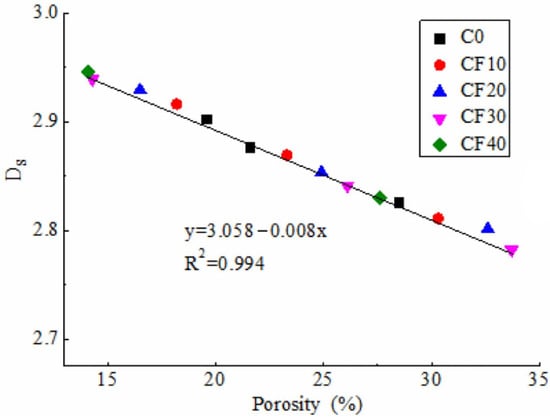
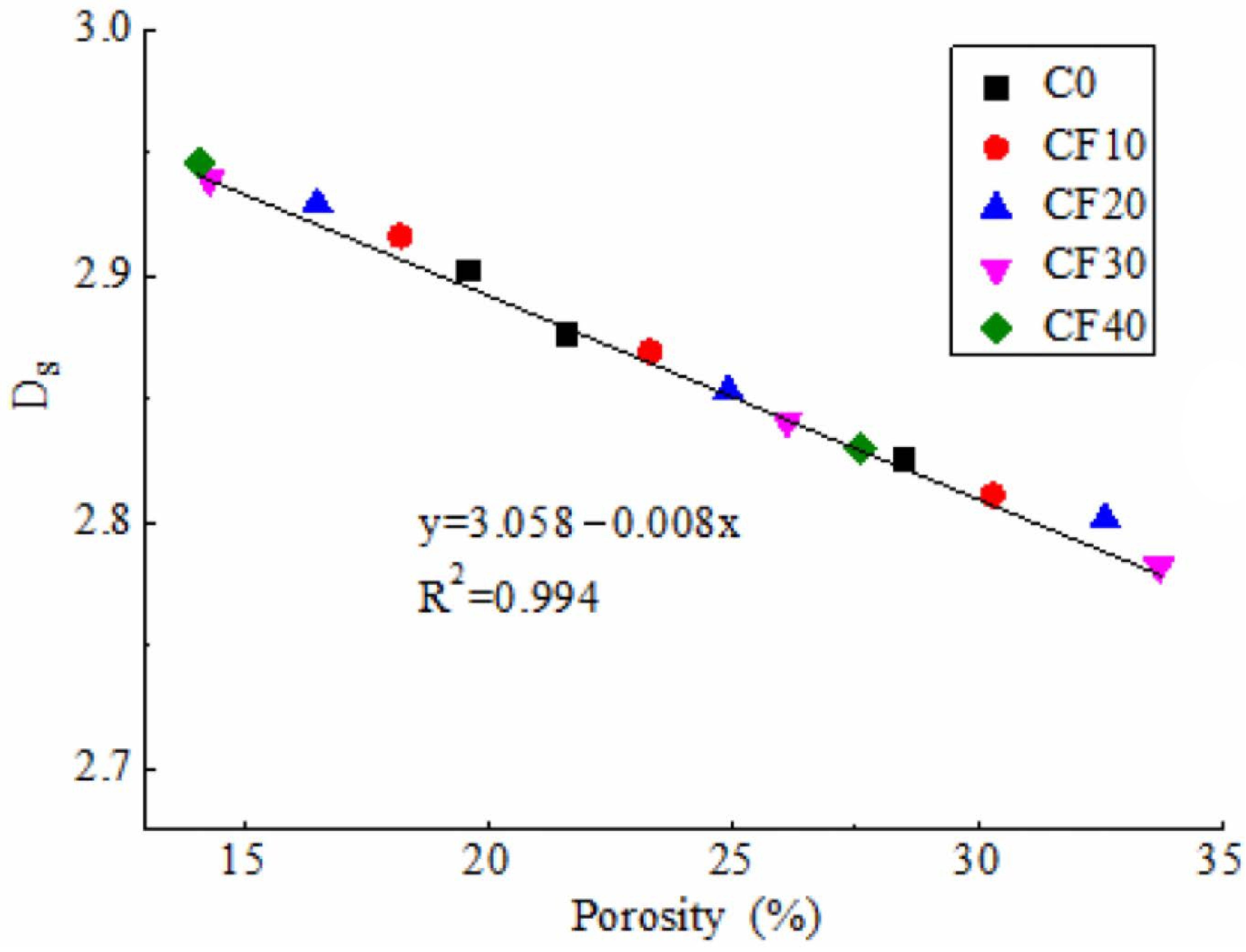
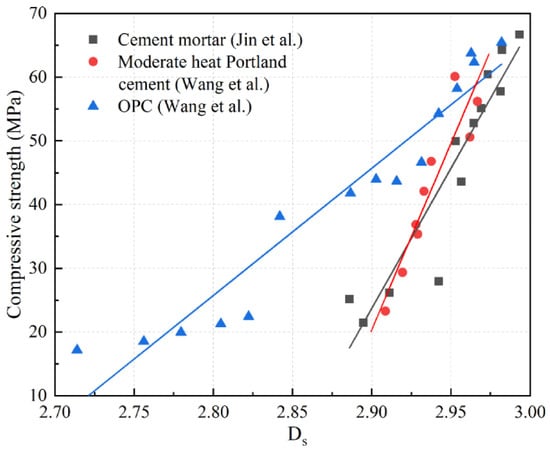
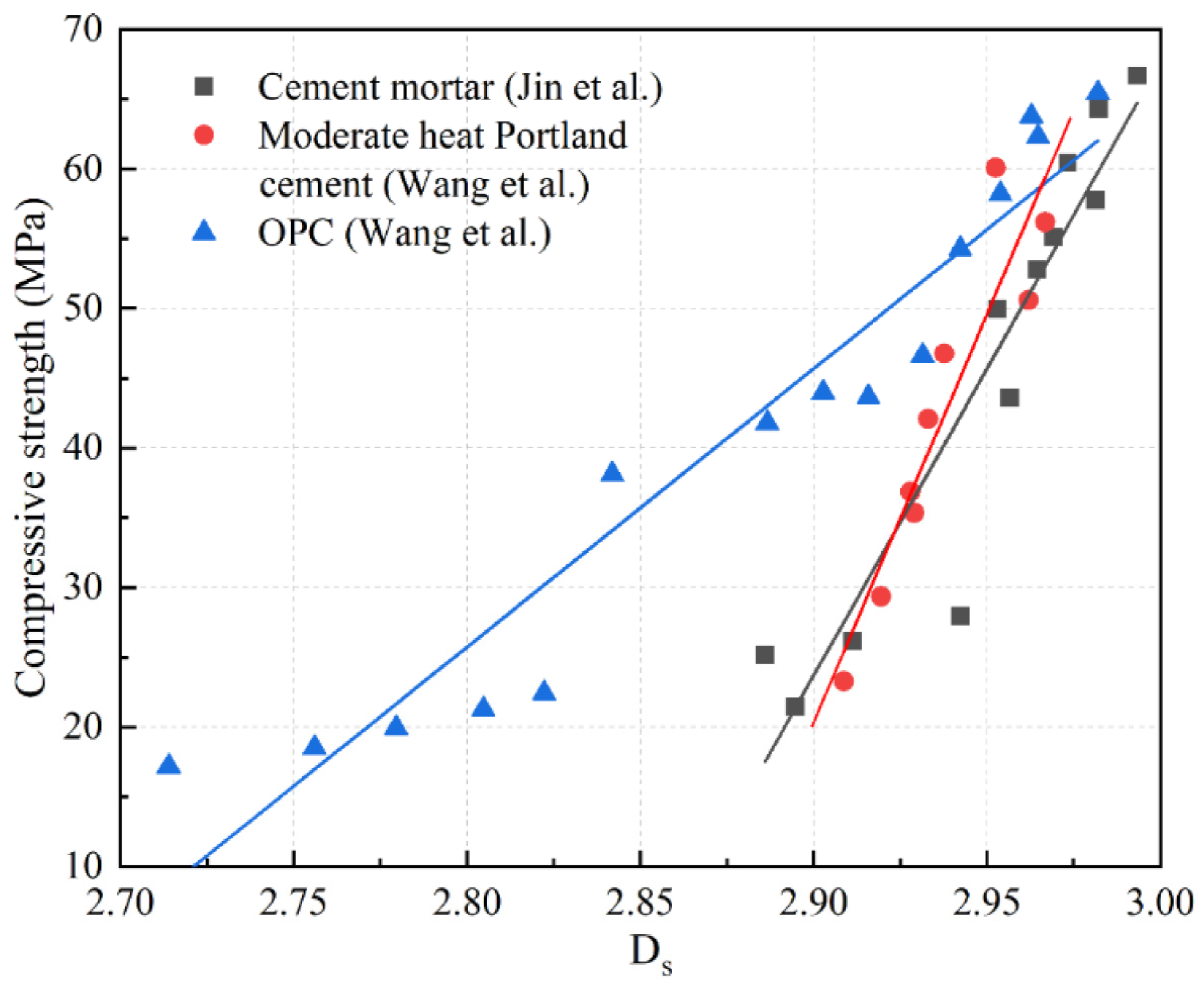
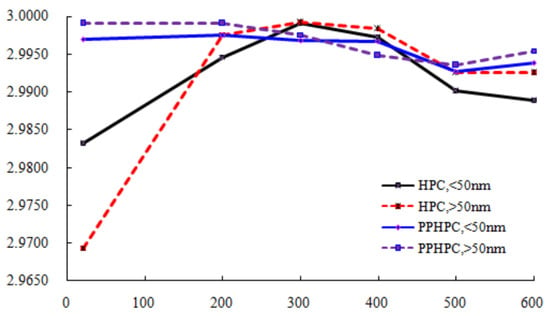
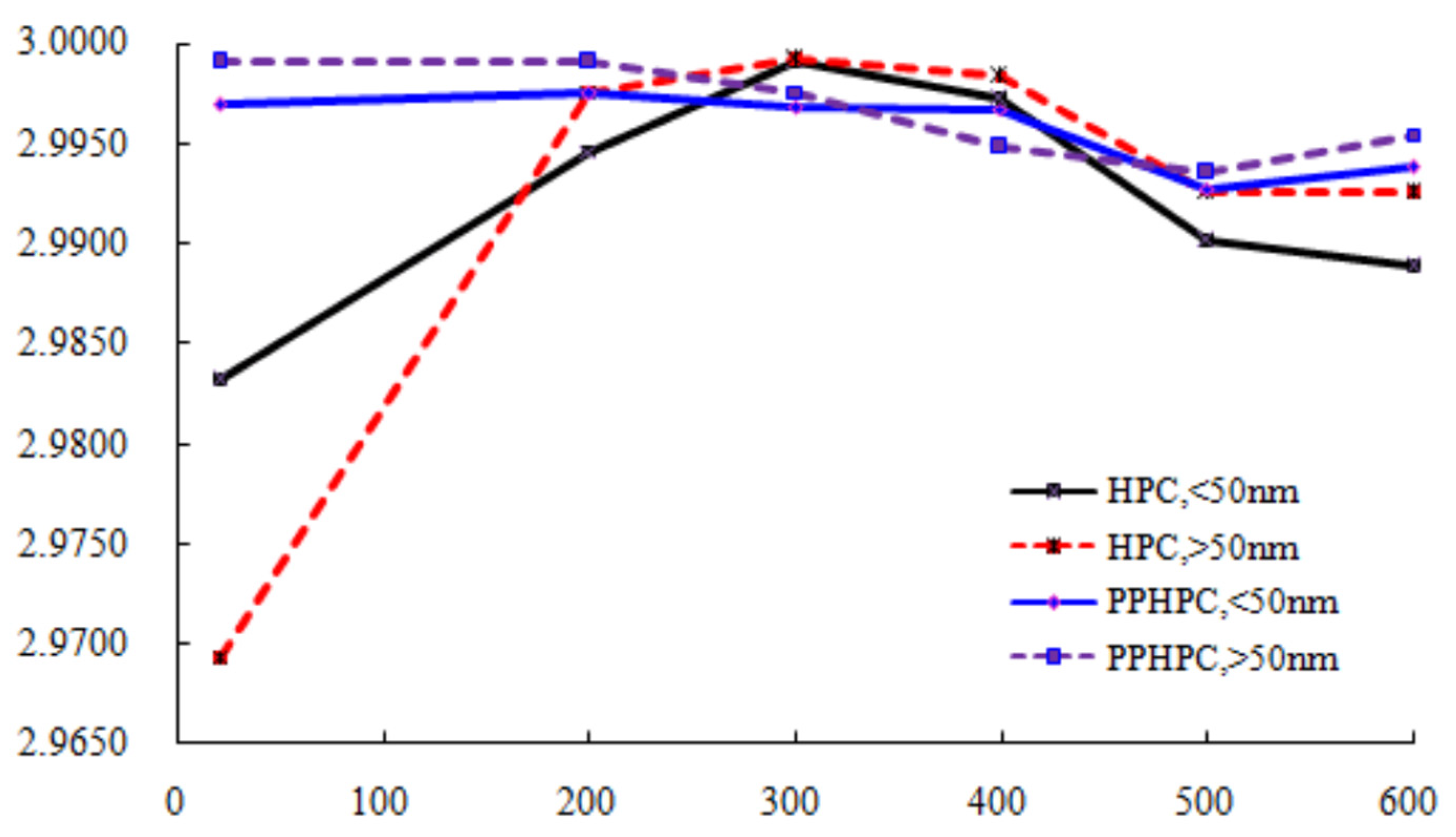
The pore structure of cement-based materials is a critical determinant of their strength, durability, and transport properties. It encompasses pores ranging from nanometer gel pores in the C-S-H to millimeter capillary pores and entrained air voids. Traditional methods of characterizing pore structure, such as mercury intrusion porosimetry (MIP) or nitrogen adsorption [3], provide pore size distributions, but they do not fully capture the geometric complexity of the pore network. Figure 2 clearly shows a strong correlation between fractal dimension and porosity. Fractal analysis has emerged as a complementary approach to quantify this complexity and link to the physical properties of materials [21]. By treating the pore network as a fractal object, researchers can assign a fractal dimension that describes how the pore surface or volume scales with size [23]. This has led to significant insights into the relationship between pore structure and material performance [14,30,40] (Figure 3 and Figure 4). It can be seen from Figure 3 that a higher pore surface fractal dimension indicates a higher compressive strength for cement paste and mortar. Sometimes, the contradiction in the relationship between fractal dimension and concrete properties stems from the fact that the fractal dimension quantifies complexity without distinguishing between beneficial and detrimental microstructural features, so its interpretation depends entirely on which specific attribute is being analyzed. A higher fractal dimension of C-S-H gel indicates a more intricate, space-filling nanostructure with a higher surface area and denser packing, which enhances strength and durability by providing more bonding sites and reducing permeability; conversely, a higher fractal dimension of cracks or pores signifies more tortuous, branched damage networks that increase stress concentrations, facilitate aggressive ion transport pathways, and reduce fracture toughness. Thus, while the elevated fractal dimension reflects improved performance when describing the hydration product morphology, it signals degradation when characterizing defect geometries, necessitating careful contextual specification in multiscale concrete analysis.
Figure 2.
Pore surface fractal dimension (Ds) and porosity of concrete [41]. CF: Concrete with fly ash; 0, 10, 20, 30, 40: 0%, 10%, 20%, 30%, 40% replacement of PC with fly ash.
Figure 3.
Pore surface fractal dimension (Ds) and compressive strength [7,22,23,24].
Figure 4.
Fractal dimension of pores in concrete (Y-axis) after different temperature exposure (X-axis) [42].
One of the earliest applications of fractal theory in cement-based materials was to analyze the pore surface fractal dimension [43]. The idea is that the solid–void interface in a porous material is a rough surface that can be characterized by a fractal dimension for a 3D material [44]. Beyond MIP, other techniques like X-ray computed tomography (CT) [28] and scanning electron microscopy (SEM) have been combined with fractal analysis to visualize and quantify pore networks in 3D. CT scans of concrete can be processed to extract the pore phase, and then box-counting methods are applied to determine the fractal dimension of the pore network in 3D. These studies [28,42] often find that the 3D pore fractal dimension is quite high for normal concrete (Figure 4), reflecting a highly complex, space-filling pore structure. Such high-dimensional pore networks are consistent with the percolating nature of pores in concrete. Fractal analysis can also be used to study the evolution of the pore structure under different conditions. In general, processes that refine the pore structure such as pozzolanic reactions or prolonged curing tend to increase the fractal dimension by creating a more intricate pore network, whereas degradation that coarsens the pores like leaching or freeze–thaw damage can decrease the fractal dimension by simplifying the pore geometry.
The practical implications of fractal pore analysis are significant. By quantifying the pore structure’s complexity, engineers can better predict properties like permeability, diffusivity, and mechanical strength [45]. For instance, a higher pore surface fractal dimension often correlates with lower permeability as seen above [46], which is desirable for durability. On the other hand, a very high fractal dimension might also indicate a highly tortuous pore network that could trap moisture and affect freeze–thaw resistance. Thus, fractal analysis provides a nuanced view of pore structure that goes beyond total porosity. It has been used to optimize mix designs—for example, by adjusting the fine aggregate content or using supplementary cementitious materials to achieve a target fractal dimension that balances strength and permeability. In summary, the application of fractal theory to pore structure has deepened our understanding of how the geometry of pores controls the macroscopic behavior of cement-based materials, guiding the development of more durable and high-performance concretes.
4. Fractal Characterization of Particle Distribution and Particle Morphology
Cementitious materials are often composed of a mixture of particles of various sizes, from fine cement grains to coarse aggregates. The particle size distribution (PSD) of these components plays a crucial role in properties like workability, packing density, and strength. The PSD and particle morphology of the particles will influence the hydration and the packing microstructure of cementitious materials. Fractal theory has been applied to characterize PSDs and the morphology of particles [47,48], revealing that many construction materials follow fractal scaling in their particle populations [14]. This is particularly true for materials like aggregate, sand, and even industrial by-products used as admixtures [49].
A key observation is that the mass or number distribution of particles in many construction materials obeys a power law over a range of sizes, which is a signature of fractal behavior [50]. This relationship implies that the particle sizes are self-similar—the ratio of fine to coarse particles remains constant across different size scales [51]. Such fractal PSDs are common in natural soils and rock fragmentation processes often yield fractal size distributions, and they are also found in crushed stone and gravel used in concrete. Researchers have used this concept to model and optimize aggregate gradation. By fitting a fractal PSD model, one can determine the fractal dimension D that best describes the aggregate blend. A higher D closer to three indicates a broader distribution with more fine particles, whereas a lower D closer to two indicates a more uniform, coarse gradation. This fractal dimension can be linked to physical properties [52]: for instance, in a higher D more fines might improve the packing density and strength of the concrete, but could reduce workability. Thus, fractal analysis provides a quantitative tool to balance these trade-offs in mix design.
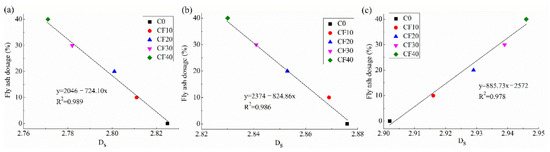
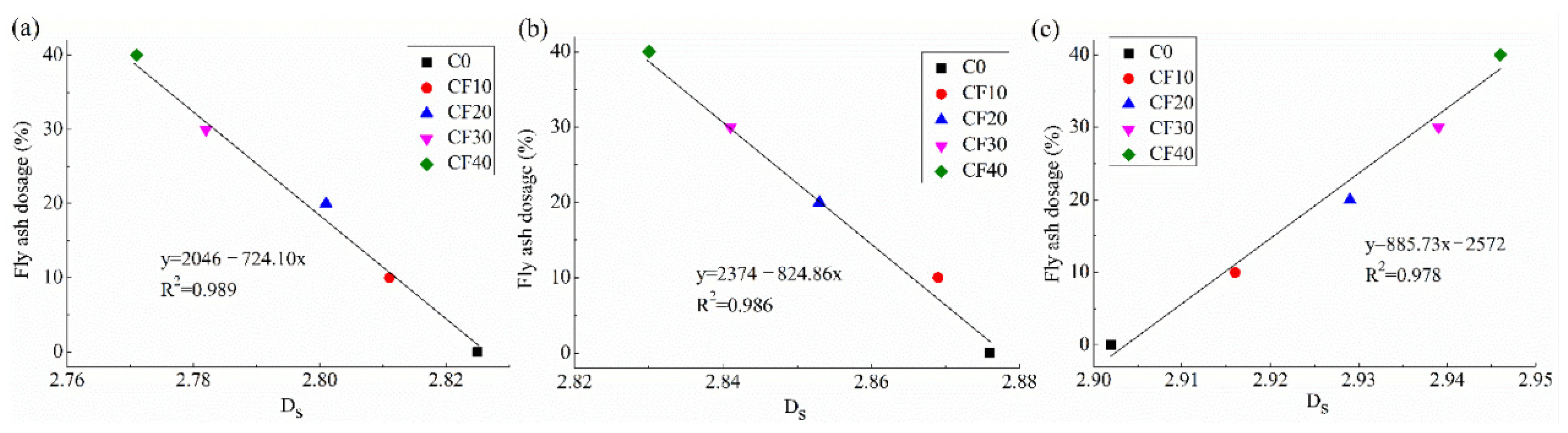
Beyond aggregates, the morphology of individual particles can also be fractal. Many binders used in construction, such as cement, fly ash, silica fume, and ground, granulated blast-furnace slag, have highly irregular particle shapes [14]. These shapes exhibit self-similarity when magnified, meaning the surface roughness or angularity of a particle looks similar at different scales [53]. Fractal analysis has been employed to quantify the surface texture of these particles. For example, the surface fractal dimension of cement particles can be measured using image analysis or nitrogen adsorption, and it has been related to the reactivity of the cement [53]. A rougher particle surface typically has a larger surface area, which can enhance the rate of hydration and thus the early strength development. Similarly, the fractal dimension of fly ash particles has been correlated with their pozzolanic activity; more fractal, rougher fly ash particles tend to react more readily with calcium hydroxide, improving the strength and durability of the concrete (Figure 5) [41]. From Figure 5, it can be seen that the increasing fly ash content reduced the Ds at earlier periods (3 and 28 days) but increased the Ds at a longer period (180 days).
Figure 5.
Ds and fly ash content in concrete at (a) 3 days, (b) 28 days and (c) 180 days [41].
Fractal characterization is not limited to the particles themselves but can also be extended to the arrangement and packing of particles. The way particles pack together in a mix, for example, the distribution of voids between aggregate particles, can be analyzed using fractal geometry. Researchers have used box-counting on cross-sectional images of concrete to measure the fractal dimension of the aggregate–paste interface and the overall spatial distribution of the aggregates [28]. These studies often find that the aggregate distribution in concrete is fractal over the normal particle size (0.16–25 mm) reflecting the random placement of different size particles, and that the fractal dimension can influence properties like permeability and strength [42]. For instance, a higher fractal dimension of the aggregate distribution, indicating a more uniform dispersion of aggregate sizes and better packing, might lead to higher strength and lower permeability, given the condition that the same type of material is used and all testing conditions are the same [42].
In summary, the fractal characterization of particles in cementitious materials has provided valuable insights into how particle size and shape influence material properties. It has enabled engineers to describe and optimize aggregate gradations, to evaluate the quality of cementitious powders, and to understand the microstructure of packed particle beds. By assigning a fractal dimension to a particle size distribution or surface texture, one can compare different materials on a common scale and predict their performance. For example, a concrete mix with a certain fractal PSD might be designed to achieve a target strength, or fly ash with a known fractal dimension might be selected for its reactivity. These applications underscore the importance of fractal theory in bridging the gap between microscale particle features and the macroscale behavior of cementitious materials.
5. Fractal Analysis of Fracture Surfaces and Crack Propagation
The fracture behavior of cementitious materials, particularly brittle materials like concrete, is a complex process involving the initiation and growth of cracks. Traditional fracture mechanics uses parameters like fracture toughness and fracture energy to quantify a material’s resistance to crack propagation [54,55]. However, these parameters do not directly describe the geometry of the fracture surface itself. Fractal analysis has been introduced in this context to characterize the roughness and tortuosity of fracture surfaces, providing a new perspective on material toughness and damage mechanisms [32,56].
When a material like concrete fractures, the resulting crack path is highly irregular [57]. The fracture surface is not a smooth plane but a rough, jagged interface that can be described as a fractal [58]. The fractal dimension of a fracture surface of a 3D material is typically greater than a 2D material, reflecting a surface that is so convoluted it begins to fill space. A higher fractal dimension indicates a more complex, tortuous crack path [59]. This has important implications: a more tortuous crack means the crack had to deviate and twist more to advance, which usually requires more energy. Indeed, studies have shown a strong correlation between the fractal dimension of a fracture surface and the material’s fracture energy, and the energy absorbed per unit area of new surface created [60].
The fractal dimension fundamentally differs from conventional fracture mechanics by characterizing geometric complexity and scale-invariant self-similarity rather than treating cracks as idealized smooth surfaces with single-valued parameters like the stress intensity factor or energy release rate, thereby capturing the hierarchical roughness and irregularity that classical Linear Elastic Fracture Mechanics assumes as negligible; indeed, a fractal description directly corresponds to identifiable physical processes—lower fractal dimensions near D ≈ 1.0 indicate straight, unstable crack initiation at stress concentrators, while an increasing D reflects tortuous propagation around aggregates and through the ITZ, with peak complexity at an even higher D value marking extensive branching and microcrack coalescence prior to catastrophic failure, and post-peak D reduction signaling macro-crack localization. The physical mechanism driving fractal characteristics in concrete arises from the material’s intrinsic heterogeneity at multiple scales—random aggregate distribution creates self-affine crack surfaces where local arrest at stiff inclusions generates branching, while the quasi-brittle nature of cement paste produces scale-free energy dissipation through microcracking cascades, with the resulting fractal geometry emerging as a natural consequence of energy minimization in disordered media, analogous to diffusion-limited aggregation processes where the competition between elastic energy release and surface energy creation selects for roughness that is statistically similar across magnification scales from micrometers to meters.
Fractal analysis of fracture surfaces is typically done using profilometry or imaging techniques [56]. A common approach is to take a profile of the fracture surface with either a 2D cut or a 3D scan and apply the box-counting method to determine the fractal dimension. In 2D, one might analyze the line profile of the crack—the length of the profile will increase with finer resolution, and the slope of the log–log plot of length vs. resolution gives the fractal dimension. In 3D, one can use laser scanning or CT to reconstruct the surface and then apply box-counting in 3D. These analyses have been applied to concrete, mortar, rocks, and even fiber-reinforced composites [61,62]. In concrete, researchers have found that the fracture surface fractal dimension can be higher, depending on the mix and loading conditions. For instance, the addition of fibers to concrete often increases DS as the fibers introduce more interfaces, bridge cracks and force them to follow a more tortuous path, which is reflected in a rougher fracture surface [63]. This is consistent with the observed increase in fracture energy and toughness of fiber-reinforced concrete. Beyond just the final fracture surface, fractal concepts have been used to study the process of crack propagation itself. The growth of a crack can be viewed as a fractal process in space and time [54]. One innovative application is the use of acoustic emission (AE) monitoring during the loading of concrete.
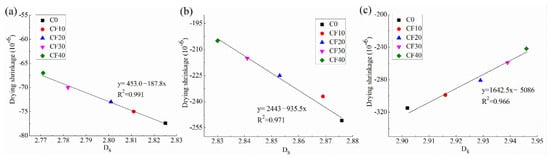
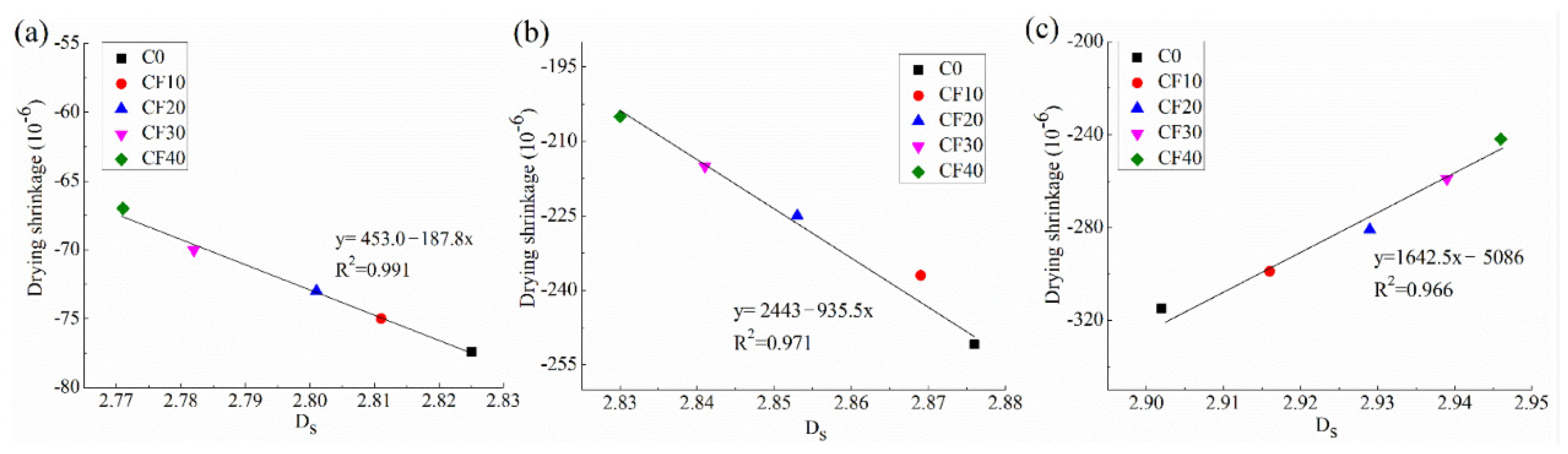
In studying the cracking of drying shrinkage [41,61,62] in concrete (Figure 6), one can map the network of cracks and calculate the fractal dimension of the network based on the box method. From Figure 6, it can be seen that the relationship between drying shrinkage and Ds is not consistent at different ages of concrete. A higher fractal dimension of the crack network indicates a more pervasive, interconnected cracking pattern [15]. This has been used to compare the effectiveness of different crack-control measures like shrinkage-reducing admixtures or curing compounds—a lower crack network fractal dimension would suggest fewer or less connected cracks, which is desirable. Similarly, in the context of fracture mechanics testing, fractal analysis has been used to quantify the so-called fractal process zone—the region of microcracking and damage ahead of the crack tip. The size and fractal dimension of this process zone can influence the apparent fracture toughness of the material.
Figure 6.
Correlations between drying shrinkage and Ds at (a) 3 days, (b) 28 days and (c) 180 days [41].
In summary, the application of fractal theory to fracture in cementitious materials could provide a deeper understanding of the cracking properties of concrete. Fractal analysis provides a practical bridge between microscopic crack patterns and macroscopic material performance in cementitious systems. By measuring the roughness of fracture surfaces through fractal dimension, engineers can quantify how tortuous or irregular a crack path is higher values indicating more energy absorption and toughness, lower values signaling brittleness and easy crack propagation. This enables deliberate material design: adding fibers, selecting rough aggregates, or using specific admixtures can all increase surface fractality and tailor fracture resistance. It also serves as a quality control tool, where rough fracture surfaces in tests indicate good toughness while smooth surfaces may reveal construction problems. Overall, fractal analysis complements traditional fracture mechanics by capturing geometric complexity that standard parameters miss, offering a straightforward framework for designing better concrete and evaluating its real-world performance.
6. Fractal Approaches in Mixed and Composite Cementitious Materials
Modern construction often involves the use of mixed and composite materials, such as fiber-reinforced concrete, polymer-modified mortars, or high-performance concretes with multiple admixtures [63]. These materials combine different phases, e.g., cement paste, aggregate, fibers, and polymers to achieve superior properties. The presence of multiple phases introduces additional complexity in the microstructure, which can be fruitfully analyzed using fractal theory [64]. Researchers have applied fractal analysis to understand how the different components interact and how the overall composite structure behaves [65].
One area of interest is the interfacial transition zone (ITZ) in concrete—the thin layer of cement paste surrounding each aggregate particle, which is often weaker and more porous than the bulk paste [66]. The ITZ is a critical factor in concrete’s strength and durability. Fractal analysis has been used to characterize the ITZ’s structure. For example, by imaging the ITZ at high magnification and applying box-counting, researchers have measured the fractal dimension of the ITZ’s pore structure and microcracks. These studies often find that the ITZ has a higher porosity and a more complex pore structure higher fractal dimension than the bulk paste, which explains its lower strength. Understanding the ITZ’s fractal nature has guided improvements—for instance, using mineral admixtures or fine particles to fill the ITZ and reduce its fractal dimension making it less porous and more like the bulk paste, in other words, more compact, thereby enhancing the composite’s performance.
Another application is in fiber-reinforced composites [67]. The addition of fibers to cement or mortar creates a composite with improved toughness and crack resistance by introducing more interfaces and bridgingi different phases. Fractal analysis can help quantify how the fibers influence the microstructure. For example, the distribution of fibers in the matrix can be analyzed using fractal geometry; a uniform, well-dispersed fiber network might have a certain fractal dimension, whereas clustering of fibers would change that dimension [63]. Additionally, the presence of fibers affects the fracture surface, as mentioned earlier [67].
In summary, fractal approaches in mixed and composite cementitious materials provide a way to quantify and optimize the complex microstructures that arise from combining different materials. Whether it is the ITZ in concrete, the fiber network in a composite, or the nanostructure of a high-performance paste, fractal analysis offers a common metric to compare and evaluate these features. This has practical implications for material design; for example, by adjusting the mix to achieve a desired fractal dimension in a certain phase, one can tailor the composite’s properties. As cementitious materials become more advanced with fibers, polymers, nanomaterials, etc., the role of fractal theory in understanding and engineering these materials will only grow.
7. Fractal Theory in Durability and Long-Term Performance
The durability of cementitious materials—their ability to withstand environmental exposure and maintain performance over time—is a critical concern in construction [68]. Many durability-related processes, such as corrosion of reinforcement [69], freeze–thaw damage [70], sulfate attack, and carbonation, are influenced by the material’s microstructure. Fractal theory has been applied to study these processes by linking the fractal characteristics of the material’s structure to its durability [3]. This section highlights how fractal analysis has provided insights into various durability mechanisms and how it can be used to predict or improve long-term performance.
Two of the most studied durability aspects are permeability and transport properties [71,72], which are directly related to the pore structure [14]. As discussed earlier, the fractal dimension of the pore network can indicate how tortuous the flow paths are [46]. A more tortuous higher fractal dimension pore structure generally leads to lower permeability, which is beneficial for durability because it slows down the ingress of harmful agents such as water, chlorides, sulfates, etc., [73]. Researchers have used fractal analysis to correlate pore structure with transport coefficients. Different fractal dimensions from the pore structure, particle distribution, etc., can be used to evaluate and predict permeability [46] and other durability metrics. In practice, this means one could use a fractal model to estimate the diffusion coefficient of chloride ions in concrete based on its pore fractal dimension, or to predict the rate of carbonation penetration. Such predictions are valuable for the service life modeling of structures.
Freeze–thaw resistance is another area where fractal analysis has been applied. Freeze–thaw damage in concrete occurs when water in the pores freezes and expands, causing internal cracking [74]. The air-void system’s entrained air bubbles in concrete are crucial for accommodating this expansion [75]. The distribution and size of air voids can be analyzed using fractal geometry. Studies have shown that a well-distributed air-void system which is more fractal, with a range of bubble sizes, provides better protection against freeze–thaw damage. Conversely, a non-fractal or poorly distributed air-void system, e.g., mostly large bubbles, might not effectively relieve pressure. Fractal analysis has been used to quantify the air-void system’s structure and correlate it with freeze–thaw test results. For instance, a higher fractal dimension of the air-void distribution might indicate a more optimal spacing factor and bubble size, leading to higher freeze–thaw resistance. This has guided the use of air-entraining agents—the goal is to achieve a certain fractal characteristic in the air-void system for maximum durability.
Corrosion of steel reinforcement in concrete is influenced by the concrete’s pore structure and permeability, as discussed [76,77]. But fractal theory has also been applied directly to study corrosion products and the cracking they induce [78]. When steel corrodes, it forms rust iron oxides which occupy a larger volume than the original steel. This expansion creates cracks in the concrete [78]. The pattern of these cracks and the morphology of the rust layer can be fractal. Researchers have used fractal analysis to characterize the rust layer’s surface and the crack patterns around corroding reinforcement. A higher fractal dimension of the rust layer might indicate a more porous, flaky rust that allows easier ingress of oxygen and moisture, potentially accelerating corrosion [69]. On the other hand, a more compact rust lower fractal dimension might slow down the process [78]. By understanding these relationships, engineers can better predict corrosion rates and the effectiveness of corrosion-inhibiting strategies like concrete cover quality or coating.
Sulfate attack and other chemical attacks on concrete involve the penetration of sulfate ions and subsequent chemical reactions that cause expansion and cracking. The penetration of sulfates is again a transport process influenced by the pore structure’s fractal nature. Additionally, the microcracking pattern caused by sulfate attack can be analyzed fractally. Engineers can compare the fractal dimension of crack networks in concrete specimens exposed to sulfates versus those not exposed. It is easy to understand that the attacked specimens develop a more extensive and interconnected crack network. A higher fractal dimension can be used as an indicator of damage level. This approach can be used to quantify the degree of sulfate attack in field samples, complementing traditional measures like expansion or strength loss.
Fractal theory has also been applied to shrinkage in concrete [41,61], although to a lesser extent. The idea is that the microstructure of concrete which is fractal evolves over time under sustained load or drying conditions. Some researchers have used fractal analysis to study the development of microcracks during the changes in pore structure during drying shrinkage [41]. For example, the fractal dimension of the pore structure might increase as drying progresses due to the formation of more fine pores as water is removed, which could be related to the material’s increased brittleness over time [61,62]. While this area is still developing, it shows the potential of fractal analysis to provide a unified framework for understanding various time-dependent phenomena in cementitious materials.
In summary, fractal theory in durability offers a way to connect the microstructural characteristics of materials to their long-term performance. By quantifying the fractal nature of pores, cracks, and other features, researchers can better predict how a material will behave under aggressive environments. This has practical applications, for instance, using fractal analysis to select concrete mixes or protective treatments that will result in a more durable structure. It also enhances our fundamental understanding of degradation mechanisms, which can lead to new strategies for improving durability such as designing a concrete mix with a specific pore fractal dimension to resist chloride ingress. As the focus in construction shifts towards longer service lives and sustainability, the role of fractal analysis in ensuring and predicting durability will become increasingly important.
8. Fractal Methods in Non-Destructive Testing and Monitoring
Ensuring the safety and integrity of structures requires effective non-destructive testing (NDT) and monitoring techniques [79]. Fractal theory has found innovative applications in this domain, particularly in the analysis of data from NDT methods [80]. By treating the signals or images obtained from NDT as fractal patterns, engineers can extract more information about the condition of a material or structure [80].
One prominent application is in the analysis of surface cracks using image processing [15,33]. Cracks on the surface of concrete or masonry structures are a primary indicator of damage. Traditional crack detection often relies on simple thresholding or edge detection in images, but these methods can be sensitive to noise and lighting conditions. Fractal-based methods offer a more robust approach [62]. Fractal analysis can also be used in acoustic emission (AE) monitoring. The sequence of AE hits during loading or environmental exposure can be analyzed in various ways, and fractal theory provides a unique perspective. For example, the time series of AE amplitudes or the spatial distribution of AE sources could be examined for fractal patterns.
Another NDT technique where fractal analysis can be applied is infrared thermography. In thermography, surface temperature variations are used to detect subsurface defects like voids or delamination because these affect heat flow. The temperature field on a surface can be complex and irregular, especially in the presence of defects. Fractal analysis can be used to quantify the texture of the thermogram images. By calculating the fractal dimension of the temperature field, one can detect and even characterize defects. This approach can be used for detecting subsurface cracks in concrete and voids in masonry walls. It could offer a way to enhance the interpretation of thermography data beyond simple thresholding, providing a measure of the complexity of the thermal signature which can be linked to defect severity.
Ultrasonic testing [79] and impact-echo are other NDT methods that generate signal wave forms that can be analyzed using fractal techniques. The response of a material to an impact or ultrasonic pulse can carry information about its internal structure [79]. Fractal analysis of these signals, for example, the wave form time series or their frequency spectra, can reveal characteristics of the material’s heterogeneity.
In summary, fractal methods in NDT and monitoring could provide a novel way to analyze and interpret the complex data these techniques generate. By treating signals, images, or sensor data as fractal patterns, engineers can detect damage more reliably and even quantify its nature. This has the potential to improve the safety and maintenance of infrastructure. As NDT technologies advance with higher resolution sensors and more data, the role of fractal analysis in making sense of this data will only grow, helping to unlock the full potential of these techniques for ensuring the longevity of our built environment.
9. Challenges and Future Directions
While fractal theory has proven to be a powerful tool in the study of cementitious materials, as seen in Table 1, there are several challenges and limitations that researchers and practitioners must contend with [81]. One of the primary challenges is the choice of fractal model and dimension. As seen in this review, there are multiple ways to define and calculate fractal dimensions, Hausdorff, box-counting, information dimension, etc., and different models might yield different values for the same material. This can lead to confusion when comparing results across studies. For instance, the pore fractal dimension of concrete measured by one researcher using MIP and a certain model might not be directly comparable to another’s measurement using CT and box-counting. Efforts are needed to standardize methods or at least to clearly report the techniques used so that results can be interpreted correctly. However, these measurement technologies all have their own limitations, such as ink-bottle effects in MIP, segmentation sensitivity in CT, or resolution constraints that affect fractal scaling ranges. Additionally, the range of scales over which a structure exhibits fractal behavior is important. Many materials are fractal only over a limited scale range, for example, from nanometers to micrometers, and beyond that the structure might become homogeneous or random. Identifying the appropriate scale range and ensuring that the data covers it is crucial for accurate fractal analysis. Most importantly, the fundamental and scientific relationships between the fractal dimension and engineering properties (permeability, strength, fracture energy, etc.) should be investigated in depth in the future.
Table 1.
Key elements requiring fractal analysis in cementitious materials.
Another challenge is the interpretation of fractal dimensions in terms of material properties. While correlations have been found, e.g., a higher pore fractal dimension means lower permeability, these relationships are not universal. A higher fractal dimension could sometimes be detrimental. For example, a very high pore fractal dimension might indicate a tortuous pore network that traps moisture. Thus, one must be cautious in extrapolating fractal results to performance without understanding the underlying mechanisms. There is also the issue of causality—does a certain fractal structure cause a property, or is the fractal dimension just a manifestation of some other factor? For example, a mix with more fine particles might have a higher PSD fractal dimension and higher strength, but the strength is due to the packing density rather than the fractal dimension per se. Researchers are working to unravel these relationships and to use fractal analysis in conjunction with other microstructural characterization to build comprehensive models.
From a practical standpoint, the complexity of fractal analysis can be a barrier to its widespread adoption in industry. Many engineers in construction are not trained in fractal geometry, and the calculations, especially for 3D data or multifractals, can be computationally intensive. There is a need for user-friendly software and guidelines that allow practitioners to apply fractal analysis to their data. Additionally, integrating fractal-based parameters into design codes or standards is challenging because codes typically rely on well-established, simple metrics. Convincing code bodies to include something like a pore fractal dimension would require extensive validation and demonstration of its benefits over traditional parameters.
Looking to the future, there are several exciting directions for the application of fractal theory in cementitious materials. One is the increasing use of multifractal analysis. As materials become more complex, with multi-scale pores, fibers, nanoparticles, etc., a single fractal dimension might not fully capture their structure. Multifractal analysis can provide a spectrum of dimensions, offering a richer description. For example, a multifractal analysis of a pore structure could reveal not just the overall complexity but also how the heterogeneity of pore sizes varies across scales. This could be particularly useful for studying highly heterogeneous materials like recycled aggregate concrete or concrete with waste materials, where the pore and particle distributions might be very irregular.
Another future direction is the integration of fractal analysis with computational modeling and simulation. With the rise of digital twins and the computational modeling of structures, incorporating fractal descriptions of materials into these models could improve their accuracy. For instance, a finite element model of concrete could use a fractal-based representation of the pore structure or fracture process zone to better predict cracking. Similarly, in multiscale modeling, fractal theory can provide the link between scales; one could use a fractal upscaling technique to relate microstructural properties to macroscopic behavior. This is an active area of research in materials science, and cementitious materials stand to benefit greatly from it.
The combination of fractal analysis with machine learning and AI is also a promising avenue. As we saw with the FTM model for crack detection, fractal features can be used as inputs to machine learning algorithms to improve classification or prediction. In the future, we might have AI models that take in microstructural images or other data and, using fractal analysis among other features, predict the material’s performance or even suggest optimal mix designs. This could accelerate the development of new materials by quickly evaluating the fractal characteristics of candidate formulations.
Finally, as the construction industry moves towards sustainability and a circular economy, fractal theory could play a role in evaluating and designing materials with recycled or waste content. Many waste materials like crushed glass, recycled concrete aggregate, or industrial slags have complex particle shapes and size distributions. Fractal analysis can help characterize these materials and understand how they will behave when incorporated into concrete or other products. For example, a fractal analysis of recycled aggregate might reveal a rougher surface texture which could improve bond strength but also increase water demand—knowledge that can be used to adjust the mix design accordingly. By quantifying the fractal nature of these alternative materials, engineers can make more informed decisions about their use, contributing to more sustainable construction practices.
In conclusion, while challenges remain in terms of standardization and interpretation, the future of fractal theory in cementitious materials research and practice is bright. It offers a unique lens through which to view and understand the complexity of materials. As our computational and analytical tools advance, we will be able to extract even more value from fractal analysis, leading to smarter material design, better prediction of performance, and, ultimately, more resilient and sustainable infrastructure.
10. Conclusions
Fractal theory and technology have become deeply intertwined with the study of cementitious materials, providing a quantitative framework to describe and analyze their complex structures. From the nanometer-scale pores in cement paste to the macroscopic cracks in a concrete beam, fractal geometry offers a common language to characterize features that were once considered too irregular to measure. This review has traversed the various applications of fractal analysis in cementitious materials, highlighting how it has been used to: (1) quantify the pore structure of cement-based materials and link it to properties like permeability and strength; (2) characterize the particle size distribution and morphology of aggregates, cement, and admixtures, aiding in mix design and material selection. Through these applications, it is evident that fractal theory is not just an abstract mathematical concept but a practical tool that has provided tangible benefits. It has allowed researchers to uncover relationships between structure and properties that were previously hidden, and it has guided the development of new materials with improved performance. For example, by understanding the fractal nature of pores, engineers can design concretes with optimized pore structures for durability. By analyzing the fractal dimension of fracture surfaces, materials scientists can develop tougher composites. And by using fractal-based NDT methods, inspectors can more reliably assess the condition of infrastructure.
However, fractal characteristics alone cannot universally predict physical properties across different concrete types or composite materials, as pore and crack surface chemistries vary significantly and strongly influence water ingress and crack propagation. Therefore, fractal-property correlations should be established only within specific, well-defined material classes. The interdisciplinary nature of fractal theory bridging mathematics, materials science, and civil engineering has enriched our understanding of cementitious materials and accelerated the adoption of advanced imaging and computational techniques. Its integration with machine learning and multiscale modeling promises further transformative advancements.
In summary, fractal theory has become an established and increasingly practical tool for cementitious materials research. As global infrastructure demands grow, the ability to understand and control material complexity across scales remains paramount. Fractal theory, with its emphasis on scale invariance and hierarchical structure, is ideally suited to this challenge. This review highlights the significant progress to date and points toward a future where fractal-based approaches will enable safer, more durable, and more sustainable construction materials. However, the same fractal characteristics in different types of concrete or composite materials should not be treated as the same physical properties or permeabilities, because the surface and chemical compositions of the pores or cracks are not the same, which could have significant effects on the water ingress or crack propagation in these materials. Thus, the link between fractal characteristics and physical properties of concrete should be assumed only in the same type of materials and under the same measuring conditions. In practice, the functional role of fractal complexity is context-dependent and may vary with connectivity, anisotropy, and percolation thresholds. Important issues such as limited scaling domains, resolution dependence, non-self-similar behavior in real materials, and challenges in linking fractal descriptors to predictive constitutive models should be examined more critically.
Author Contributions
Conceptualization, formal analysis, writing—original draft, writing—review and editing, supervision, investigation, and project administration, J.W.; formal analysis, writing—original draft, writing—review and editing, and investigation, Y.Z. All authors have read and agreed to the published version of the manuscript.
Funding
This research received no external funding.
Data Availability Statement
The data that support the findings of this study are available from the cited reference.
Acknowledgments
The authors would like to thank Tsinghua University and Beijing No. 4 Municipal Construction Engineering Co., Ltd.
Conflicts of Interest
Author Yi Zhao is employed by Beijing No. 4 Municipal Construction Engineering Co., Ltd. The remaining authors declare that the research was conducted in the absence of any commercial or financial relationships that could be construed as a potential conflict of interest.
References
- Wang, L.; Tang, S. Fractal and Fractional in Construction Materials. Fractal Fract. 2025, 9, 785. [Google Scholar] [CrossRef] [Scilit]
- Avery, I.; Hall, F.; Sturgess, C. Fractal modelling of materials. J. Mater. Process. Technol. 1998, 80, 565–571. [Google Scholar] [CrossRef] [Scilit]
- Tang, S.; Huang, J.; Duan, L.; Yu, P.; Chen, E. A review on fractal footprint of cement-based materials. Powder Technol. 2020, 370, 237–250. [Google Scholar] [CrossRef] [Scilit]
- Lu, X.; Lu, T.; Viljanen, M. Application of fractal geometry to sustainable architecture. In Proceedings of the 2nd International Conference on Civil Engineering and Information Technologylos Angeles, Los Angeles, CA, USA, 1–2 June 2012; Department of Civil Engineering: Hong Kong, China, 2012; pp. 27–32. [Google Scholar]
- Wang, L.; Zeng, X.; Yang, H.; Lv, X.; Guo, F.; Shi, Y.; Hanif, A. Investigation and application of fractal theory in cement-based materials: A review. Fractal Fract. 2021, 5, 247. [Google Scholar] [CrossRef] [Scilit]
- Khamidulina, D.D.; Nekrasova, S.A. Fractals in construction material science. In Proceedings of the International Conference on Construction, Architecture and Technosphere Safety (ICCATS), Chelyabinsk, Russia, 26–28 September 2018; South Ural State University; IOP: Philadelphia, PA, USA, 2018. [Google Scholar]
- Zhang, P.; Ding, J.; Guo, J.; Wang, F. Fractal analysis of cement-based composite microstructure and its application in evaluation of macroscopic performance of cement-based composites: A review. Fractal Fract. 2024, 8, 304. [Google Scholar] [CrossRef] [Scilit]
- Niklasson, G. Adsorption on fractal structures-applications to cement materials. Cem. Concr. Res. 1993, 23, 1153–1158. [Google Scholar] [CrossRef] [Scilit]
- Mayatskaya, I.; Yazyeva, S.; Gatiev, M.; Kuznetsov, V.; Klyuev, S.; Sabitov, L. Application of fractal methods in the design of modern structures. In Proceedings of the International Scientific Conference Industrial and Civil Construction 2022, Belgorod, Russia, 18–19 January 2022; Selected Papers; Lecture Notes in Civil Engineering (436); Springer: Berlin/Heidelberg, Germany, 2024; pp. 414–422. [Google Scholar]
- Wang, L.; Tang, S. Investigation and application of fractals in civil engineering materials. Fractal Fract. 2023, 7, 369. [Google Scholar] [CrossRef] [Scilit]
- Yakovlev, G.; Polyanskikh, I.; Belykh, V.; Stepanov, V.; Smirnova, O. Evaluation of changes in structure of modified cement composite using fractal analysis. Appl. Sci. 2021, 11, 4139. [Google Scholar] [CrossRef] [Scilit]
- Rian, I.M. A brief overview of the applications and potentials of fractal geometry in sustainable structures design. In Towards a Carbon Neutral Future: The Proceedings of the 3rd International Conference on Sustainable Buildings and Structures, Suzhou, China, 17–20 August 2023; Lecture Notes in Civil Engineering (393); Springer: Berlin/Heidelberg, Germany, 2024; pp. 717–730. [Google Scholar]
- Wei, G.; Honggen, Q.; Huisu, C.; Wei, S. Fractal theory and its applications in the study of concrete materials. J. Chin. Ceram. Soc. 2010, 38, 1362–1368. [Google Scholar]
- Lü, Q.; Qiu, Q.; Zheng, J.; Wang, J.; Zeng, Q. Fractal dimension of concrete incorporating silica fume and its correlations to pore structure, strength and permeability. Constr. Build. Mater. 2019, 228, 116986. [Google Scholar] [CrossRef] [Scilit]
- Konkol, J. A fractal model of cracking of cement matrix composites. Buildings 2020, 10, 52. [Google Scholar] [CrossRef] [Scilit]
- Weitao, L.; Hongquan, S.; Jun, X. Theory of fractal applied to concrete study. J. Hebei Univ. Technol. 2003, 32, 13–16. [Google Scholar]
- Zhai, T. Study about characteristics of cement paste on fractal theory. In Applied Materials and Technologies for Modern Manufacturing; pts 1–4; Trans Tech Publications Ltd.: Baech, Switzerland, 2013; pp. 1051–1054. [Google Scholar]
- Zhang, Y.; Zhang, Z.; Zhou, J.; Zhao, L.; Liu, J. Application of fractal theory in concrete research. J. Phys. Conf. Ser. 2021, 1865, 032014. [Google Scholar] [CrossRef] [Scilit]
- Tang, M.; Liu, H.; Li, J.; Chen, N. Fractal analysis on microstructure characteristics of concrete materials. In Sustainable Development of Urban Environment and Building Material; pts 1–4; Trans Tech Publications Ltd.: Baech, Switzerland, 2012; pp. 1843–1847. [Google Scholar]
- Gao, Y.; Jiang, J.; De Schutter, G.; Ye, G.; Sun, W. Fractal and multifractal analysis on pore structure in cement paste. Constr. Build. Mater. 2014, 69, 253–261. [Google Scholar] [CrossRef] [Scilit]
- Jin, S.; Zhang, J.; Han, S. Fractal analysis of relation between strength and pore structure of hardened mortar. Constr. Build. Mater. 2017, 135, 1–7. [Google Scholar] [CrossRef] [Scilit]
- Wang, L.; Jin, M.; Wu, Y.; Zhou, Y.; Tang, S. Hydration, shrinkage, pore structure and fractal dimension of silica fume modified low heat Portland cement-based materials. Constr. Build. Mater. 2021, 272, 121952. [Google Scholar] [CrossRef] [Scilit]
- Wang, L.; Jin, M.M.; Guo, F.X.; Wang, Y.; Tang, S.W. Pore structural and fractal analysis of the influence of fly ash and silica fume on the mechanical property and abrasion resistance of concrete. Fractals 2021, 29, 2140003. [Google Scholar] [CrossRef] [Scilit]
- Jin, S.; Zhang, J.; Chen, C.; Chen, W. Study of pore fractal characteristic of cement mortar. J. Build. Mater. 2011, 14, 92–97. [Google Scholar]
- Tian, W.; Yang, J.; Zhao, X. Study on properties of foam concrete based on fractal theory. Adv. Eng. Mater. 2011, 194–196, 1916–1919. [Google Scholar] [CrossRef] [Scilit]
- Yang, X.; Li, L.; Dai, H.; Jia, M. Effect of fractal dimension in concrete meso-structure on its axial mechanical behavior: A numerical case study. Fractals-Complex Geom. Patterns Scaling Nat. Soc. 2021, 29, 2140011. [Google Scholar] [CrossRef] [Scilit]
- Abdeldjalil, M.; Chouicha, K. Study of the prediction of the mechanical strength of concrete based on the fractal model of granular distribution. Constr. Build. Mater. 2022, 348, 128562. [Google Scholar] [CrossRef] [Scilit]
- Liu, P.; Chen, Y.; Sha, F.; Yu, Z.; Shao, G. Study on micro structure and composition distribution of concrete surface zone based on fractal theory and xct technology. Constr. Build. Mater. 2020, 263, 120209. [Google Scholar] [CrossRef] [Scilit]
- Lv, Z.; Zhang, S.; Duan, Z.; Chen, Y.; Zheng, Z.; Xiao, X. Equivalent model of green concrete pore structure based on fractal calculations by additive manufacturing. J. Build. Eng. 2025, 111, 113564. [Google Scholar] [CrossRef] [Scilit]
- He, C.; Liu, C. Fractal dimensions of a porous concrete and its effect on the concrete’s strength. Facta Univ.-Ser. Mech. Eng. 2023, 21, 137–150. [Google Scholar] [CrossRef] [Scilit]
- Liu, H.; Xie, Z.; Yu, R.; Zhang, N. A new three-dimensional fractal dimension model to describe the complexity of concrete pores. J. Adv. Concr. Technol. 2022, 20, 127–138. [Google Scholar] [CrossRef] [Scilit]
- Ding, C.; Xu, T.; Chen, Q.; Su, C.; Zhao, P. Study on the relationship between fractal characteristics and mechanical properties of tensile fracture of reinforced concrete structures. KSCE J. Civ. Eng. 2022, 26, 2225–2233. [Google Scholar] [CrossRef] [Scilit]
- Dai, K.; Li, D.; Luo, M.; Shi, Y.; Zhang, S.; Huang, Z. Machine vision-based concrete beam crack pattern identification using fractal theory. In Proceedings of the Nondestructive Characterization and Monitoring of Advanced Materials, Aerospace, Civil Infrastructure, and Transportation XIII, Denver, CO, USA, 4–7 March 2019; SPIE: Bellingham, WA, USA, 2019. [Google Scholar]
- Gu, S.; Zhao, J.; Li, J.; Peng, F.; Kong, C.; Yang, L. Application of fractal theory to the analysis of failure characteristics of low-velocity-impact concrete slabs. Buildings 2023, 13, 2190. [Google Scholar] [CrossRef] [Scilit]
- Han, X.; Feng, J.; Wang, B. Relationship between fractal feature and compressive strength of fly ash-cement composite cementitious materials. Cem. Concr. Compos. 2023, 139, 105052. [Google Scholar] [CrossRef] [Scilit]
- He, C.; Liu, C. Fractal approach to the fluidity of a cement mortar. Nonlinear Eng.-Model. Appl. 2022, 11, 1–5. [Google Scholar] [CrossRef] [Scilit]
- Abdeldjalil, M.; Chouicha, K. Effect of the cement-to-water ratio and fractal granular model on the prediction of concretes compressive strength. Int. J. Concr. Struct. Mater. 2022, 16, 43. [Google Scholar] [CrossRef] [Scilit]
- Xu, Q.; Chen, J.; Li, J.; Wang, M. Multi-scale numerical model for simulating concrete material based on fractal theory. Acta Mech. Solida Sin. 2013, 26, 344–352. [Google Scholar] [CrossRef] [Scilit]
- Zhao, D.; Xu, J.; Han, Z.; Liu, Y.; Liu, Y.; Yang, X. Study on the correlation between pore structure characterization and early mechanical properties of foamed concrete based on x-ct. Constr. Build. Mater. 2024, 450, 138603. [Google Scholar] [CrossRef] [Scilit]
- Gao, Y.; Feng, P.; Jiang, J. Analytical and numerical modeling of elastic moduli for cement based composites with solid mass fractal model. Constr. Build. Mater. 2018, 172, 330–339. [Google Scholar] [CrossRef] [Scilit]
- Wang, L.; Yu, Z.; Liu, B.; Zhao, F.; Tang, S.; Jin, M. Effects of fly ash dosage on shrinkage, crack resistance and fractal characteristics of face slab concrete. Fractal Fract. 2022, 6, 335. [Google Scholar] [CrossRef] [Scilit]
- Fan, Y.; Du, H.; Shi, L. The fractal characteristics of c80 high performance concrete pore structure subject to high temperatures. In Proceedings of the 2020 4th International Workshop on Renewable Energy and Development (IWRED 2020), Sanya, China, 13 July 2020; IOP: Bristol, UK, 2020. [Google Scholar]
- Bespalhuk, K.; Oliveira, T.; Valverde, J.; Goncalves, R.; Ferreira-neto, L.; Souto, P.; Silva, J.; Souza, N. Fractal analysis of microstructures in portland cement pastes-effect of curing conditions. Constr. Build. Mater. 2023, 363, 129881. [Google Scholar] [CrossRef] [Scilit]
- Xi, Y.; Li, W.; Lei, D.; Gao, Y. The pore size-dependent fractality of porous structure in cement paste: Analysis, modeling and applications. Fractals-Complex Geom. Patterns Scaling Nat. Soc. 2023, 31, 2340170. [Google Scholar] [CrossRef] [Scilit]
- Ding, K.; Zeng, C. Study on the compressive strength, pore structure characteristics, and fractal dimension of the ecological porous concrete specimens based on ordinary portland cement. Constr. Build. Mater. 2025, 483, 141795. [Google Scholar] [CrossRef] [Scilit]
- Kim, J.; Hong, G.; Oh, S.; Choi, S. Application of various fractal models in characterizing the morphology of pore structures of hydrating cement pastes. J. Mater. Res. Technol. 2022, 20, 3818–3835. [Google Scholar] [CrossRef] [Scilit]
- Yang, X.; Wang, M. Fractal dimension analysis of aggregate packing process: A numerical case study on concrete simulation. Constr. Build. Mater. 2021, 270, 121376. [Google Scholar] [CrossRef] [Scilit]
- Ma, G.; Wang, F. A dem-based framework to optimize the gradation of concrete aggregate using fractal approach. Comput. Part. Mech. 2024, 11, 2203–2214. [Google Scholar] [CrossRef] [Scilit]
- Huang, T.; Chen, K.; Yang, J.; Huang, Y.; He, X.; Su, Y.; Strnadel, B. Grinding kinetics of wet milled ultrafine phosphorus slag as a supplementary cementitious material. Constr. Build. Mater. 2025, 486, 141938. [Google Scholar] [CrossRef] [Scilit]
- Gao, S.; Li, Q.; Luo, J. Fractal characteristic of recycled aggregate and its influence on physical property of recycled aggregate concrete. Rev. Adv. Mater. Sci. 2021, 60, 663–677. [Google Scholar] [CrossRef] [Scilit]
- Li, H.; Zhang, H.; Yan, P.; Tong, Y.; Yan, C.; Ding, Y. Experiment on size effect and fractal characteristics of waste brick and concrete recycled aggregate. Adv. Mater. Sci. Eng. 2021, 2021, 6097897. [Google Scholar] [CrossRef] [Scilit]
- Zhang, P.; Gao, Z.; Shi, Y.; Lin, Y.; Li, J. Effect of large broken stone content on properties of roller compacted concrete based on fractal theory. Constr. Build. Mater. 2020, 262, 120821. [Google Scholar] [CrossRef] [Scilit]
- Ge, X.; Xu, H.; Liu, W.; Wang, H.; Yang, H. Self-similar fractal characteristics of phosphorus slag powder particles and its effect on the mechanical properties of cementitious systems. Strength Mater. 2023, 55, 1288–1296. [Google Scholar] [CrossRef] [Scilit]
- Jin, Z.; Xie, F.; Yang, T.; Han, X.; Chen, X.; Zhang, Y. Fractal dimension analysis of concrete specimens under different strain rates. J. Build. Eng. 2023, 76, 107044. [Google Scholar] [CrossRef] [Scilit]
- Ding, R.; Zhang, Y.; Zhao, Y.; Deng, X.; Zhang, Z. Experimental investigation on fractal mechanism and shear failure characteristics of cement mortar at different curing ages. J. Build. Eng. 2024, 93, 109851. [Google Scholar] [CrossRef] [Scilit]
- Jiang, H.; Sui, H.; Zou, F.; Yu, S.; Qian, W.; Liu, B.; Liu, Y.; Gao, Y. Mechanical performance and crack propagation characteristics of the recycled concrete using fractal gradation. Constr. Build. Mater. 2025, 492, 143101. [Google Scholar] [CrossRef] [Scilit]
- Wang, J.; Liu, E. The relationship between steady-state chloride diffusion and migration coefficients in cementitious materials. Mag. Concr. Res. 2020, 72, 1016–1026. [Google Scholar] [CrossRef] [Scilit]
- Shen, J.; Xu, Q.; Liu, M. Fractal analysis of defects in concrete under elevated temperatures. ACI Mater. J. 2022, 119, 19–34. [Google Scholar]
- Gao, X.; Xia, H.; Fan, K.; Yi, L.; Yin, J. Study on dynamic crack expansion and size effect of back-filling concrete under uniaxial compression. Materials 2023, 16, 7503. [Google Scholar] [CrossRef] [Scilit]
- Yuan, X.; Cui, Z.; Chen, G. Influence of steel fiber content on the fractal evolution of bending cracks in alkali-activated slag concrete beams. Buildings 2025, 15, 2444. [Google Scholar] [CrossRef] [Scilit]
- Zhang, S.; Fang, Z.; Qi, W.; Fan, Y.; Shah, S. Study on the relationship between early shrinkage cracking and mechanical properties of nano-clay cement mortar based on fractal theory. Buildings 2023, 13, 123. [Google Scholar] [CrossRef] [Scilit]
- Wang, Y.; He, H.; Wang, J.; Li, F.; Ding, Y.; Xu, L. Effect of aggregate micro fines in machine-made sand on bleeding, autogenous shrinkage and plastic shrinkage cracking of concrete. Mater. Struct. 2022, 55, 106. [Google Scholar] [CrossRef] [Scilit]
- Gao, Z.; Zhang, P.; Dai, X.; Zheng, Y.; Feng, H. Assessment of bonding behavior of hybrid fiber alkali-activated concrete for tunnel lining concrete restoration. J. Clean. Prod. 2025, 514, 145803. [Google Scholar] [CrossRef] [Scilit]
- Anarova, S.; Sadullaeva, S.; Berdiev, G. Calculation of building dimensions in the method of composition fractal analysis. In Proceedings of the 2021 International Conference on Information Science and Communications Technologies (ICISCT), Tashkent, Uzbekistan, 3–5 November 2021; IEEE: New York, NY, USA, 2021; p. 4. [Google Scholar]
- Kuldasheva, A.; Huang, B.; Kuldashev, K.; Li, B.; Saidmuratov, B. Fractal geometry-based porosity analysis of cementitious composite material using wollastonite under freeze-thaw condition. J. Wuhan Univ. Technol.-Mater. Sci. Ed. 2025, 40, 769–779. [Google Scholar] [CrossRef] [Scilit]
- Wang, J.; Guo, J.; Su, J.; Huang, R.; Xu, L.; Chen, S.; Chen, X.; Tang, H.; Wang, Y.; Xiang, D.; et al. Improving the bonding performance of new and old cement pastes by high-temperature treatment on the surface of old cement pastes. J. Build. Eng. 2024, 90, 109482. [Google Scholar] [CrossRef] [Scilit]
- Chen, M.; Cheng, J.; Zhang, T.; Wang, Y. Experimental characterization and constitutive modelling of the anisotropic dynamic compressive behavior of 3d printed engineered cementitious composites. Cem. Concr. Compos. 2025, 160, 105995. [Google Scholar] [CrossRef] [Scilit]
- Xie, J.; Wang, J.; Li, M.; Xu, L.; Xiang, D.; Wang, Y.; He, H.; Zhu, Y.; Zhao, J. Estimation of chloride diffusion coefficient from water permeability test of cementitious materials. Constr. Build. Mater. 2022, 340, 127816. [Google Scholar] [CrossRef] [Scilit]
- Yogalakshmi, N.J.; Rao, K.B. Estimation of corrosion initiation time considering fractal nature of concrete pores. In Advances in Reliability and Safety Assessment for Critical Systems, Proceedings of the 5th National Conference on Reliability and Safety (NCRS 2022) Lecture Notes in Mechanical Engineering, Virtual, 10–12 March 2022; Lecture Notes in Mechanical Engineering; Springer: Berlin/Heidelberg, Germany, 2023; pp. 25–34. [Google Scholar]
- Li, J.; Wang, F.; Yi, F.; Wu, F.; Liu, J.; Lin, Z. Effect of freeze-thaw cycles on triaxial strength property damage to cement improved aeolian sand (cias). Materials 2019, 12, 2801. [Google Scholar] [CrossRef] [Scilit]
- Wang, B.; Guo, J.; Liu, J.; Wang, Q. Prediction method of permeability of textile-reinforced concrete based on fractal dimension theory. Constr. Build. Mater. 2022, 327, 126868. [Google Scholar] [CrossRef] [Scilit]
- Du, Z.; Sun, W. Study on the influence of air-entraining agent on the impermeability of cement-based composites based on its pore structure by fractal theory. Adv. Build. Mater. 2011, 168, 615–618. [Google Scholar] [CrossRef] [Scilit]
- Xie, J.; Wang, J.; Liu, Y.; Wang, Y. Comparison of Three Different Methods for Measuring Chloride Transport in Predamaged Concretes. J. Mater. Civ. Eng. 2020, 32, 04020033. [Google Scholar] [CrossRef] [Scilit]
- Xu, L.; Lai, Y.; Ma, D.; Wang, J.; Li, M.; Li, L.; Gao, Z.; Liu, Y.; He, P.; Zhang, Y. Effects of Fiber and Surface Treatment on Airport Pavement Concrete against Freeze–Thawing and Salt Freezing. Materials 2022, 15, 7528. [Google Scholar] [CrossRef] [Scilit]
- Xu, L.; Zhang, C.; Wang, J.; Du, Z.; Hu, X.; Yang, Q.; Li, F.; Li, Z.; He, P. Service Life Prediction of Concrete with Combined Air-Entraining Admixture and Fibers under Freeze-Thaw Cycles Based on Critical Water Saturation Theory. J. Mater. Civ. Eng. 2024, 36, 04024274. [Google Scholar] [CrossRef] [Scilit]
- Wang, J.; Nanukuttan, S.V.; Basheer, P.A.M.; Bai, Y. Influence of micro and macro cracks due to sustained loading on chloride-induced corrosion of reinforced concrete beams. In Proceedings of the 4th International Conference on the Durability of Concrete Structures, West Lafayette, IN, USA, 24–26 July 2014; ICDCS: Glasgow, UK, 2014; pp. 1–9. [Google Scholar]
- Wang, J.; Basheer, P.A.M.; Nanukuttan, S.V.; Long, A.E.; Bai, Y. Influence of service loading and the resulting micro-cracks on chloride resistance of concrete. Constr. Build. Mater. 2016, 108, 56–66. [Google Scholar] [CrossRef] [Scilit]
- Jiang, H.; Jin, N.; Ye, H.; Tian, Y.; Jin, X.; Zeng, Q.; Yan, D.; Xu, X. Fractal Characterization of Non-Uniform Corrosion of Steel Bars in Concrete Beams after Accelerated depassivation and Seven-Year Natural Corrosion. Materials 2019, 12, 3919. [Google Scholar] [CrossRef] [Scilit] [PubMed]
- Wang, J.; Basheer, P.A.M.; Nanukuttan, S.V.; Bai, Y. Monitoring the development of microcracks in reinforced concrete caused by sustained loading and chloride induced corrosion. In Proceedings of the Concrete Solutions-Proceedings of Concrete Solutions, 5th International Conference on Concrete Repair, Northern Ireland, UK, 1–3 September 2014; CRC Press: Boca Raton, FL, USA, 2014; pp. 603–609. [Google Scholar]
- Zhang, X.; Lv, Z.; Huang, H.; Li, R.; Qiu, Q.; Huang, Y. Evaluation of Mechanical Properties and Micro-Mechanism of Alkali-Activated Material with CG Under Ultrasonic Treatment from a Fractal Perspective. Fractal Fract. 2025, 9, 401. [Google Scholar] [CrossRef] [Scilit]
- Lin, Z.; Wang, F.; Chen, T. Study on the pore fractal characteristics and mechanical properties of concrete incorporating waste glass. Constr. Build. Mater. 2026, 511, 145268. [Google Scholar] [CrossRef] [Scilit]

Disclaimer/Publisher’s Note: The statements, opinions and data contained in all publications are solely those of the individual author(s) and contributor(s) and not of MDPI and/or the editor(s). MDPI and/or the editor(s) disclaim responsibility for any injury to people or property resulting from any ideas, methods, instructions or products referred to in the content. |
© 2026 by the authors. Licensee MDPI, Basel, Switzerland. This article is an open access article distributed under the terms and conditions of the Creative Commons Attribution (CC BY) license.