
Article

A Semi-Analytical and Topological Study of Fractional Dynamical Systems in Banach Spaces Endowed with the Compact-Open Topology: Applications to Wave Propagation Phenomena

1
Department of Mathematics, Faculty of Science, University of Ha’il, Ha’il 55473, Saudi Arabia
2
Department of Mathematics, Faculty of Applied Sciences, Taiz University, Taiz 6803, Yemen
3
Department of Mathematics, College of Science, Qassim University, Buraydah 51452, Saudi Arabia
4
Department of Basic Sciences, University College of Haqel, University of Tabuk, Tabuk 71491, Saudi Arabia
5
Department of Mathematics, College of Science and Humanities in Al-Kharj, Prince Sattam Bin Abdulaziz University, Al-Kharj 11942, Saudi Arabia
6
Department of Mathematics, Faculty of Science, Islamic University of Madinah, Madinah 42351, Saudi Arabia
7
Department of Mathematics and Statistics, College of Science, Imam Mohammad Ibn Saud Islamic University (IMSIU), Riyadh 11564, Saudi Arabia
*
Authors to whom correspondence should be addressed.
Fractal Fract. 2026, 10(3), 181; https://doi.org/10.3390/fractalfract10030181
Submission received: 8 February 2026 / Revised: 1 March 2026 / Accepted: 8 March 2026 / Published: 11 March 2026

Abstract

This paper develops a functional operator-theoretic framework for nonlinear Erdelyi–Kober (EK) fractional dynamical systems formulated in Banach spaces endowed with the compact-open topology. Within this setting, sufficient conditions for existence, uniqueness, and Ulam–Hyers stability of solutions are established using the Banach and Schaefer fixed-point theorems. The continuity, boundedness, and Lipschitz properties of the associated nonlinear operators are analyzed to ensure well-posedness of the fractional system. As a constructive complement to the theoretical results, a power series iterative method (PSIM) is employed to obtain an explicit fractional series representation of the solution in the case 0 < α < 1 . The applicability of the theoretical framework is illustrated through a nonlinear fractional dynamical Belousov–Zhabotinsky system (DBZS), where the assumptions of the main theorems are verified and the solution is constructed via the proposed series scheme. The results provide a coherent link between abstract fixed-point analysis and a constructive semi-analytical representation of solutions for EK fractional systems.

1. Introduction

In recent years, the theory of fractional calculus (FC) has improved from a purely theoretical notion to a fundamental mathematical system that joins complex real-world modeling and classical analysis. It offers a flexible extension of integration and traditional differentiation by extending their orders to be real or complex numbers instead of integers. This extension lets FC provide operators capable of modeling hereditary characteristics and temporal nonlocal interactions and capturing phenomena governed by memory. Such properties render FC effective in modeling systems whose states depend on the cumulative influence of all preceding states [1,2,3]. This nonlocal behavior grants FC the ability to outperform classical models in engineered and natural systems where memory effects play an important role. The notion of fractional operators began in 1695, when Leibniz wrote to L’Hôpital introducing the concept of a derivative of order 1 2 . The rigorous theoretical formulation emerged much later through the seminal contributions of Riemann, Liouville, and Grunwald during the nineteenth century [4,5]. Their groundbreaking works established the mathematical bedrock for FC, and under this notion many researchers introduced operators like Katugampola, Caputo–Fabrizio, Hilfer, and EK derivatives. These operators differ mainly in the choice of their kernel functions, which control the memory behavior of the fractional process. Several kernels are singular, whereas others exhibit Mittag–Leffler attenuation or exponential decay, thereby modeling long-term memory behaviors. FC has grown into a dynamic and rich field of research encompassing rigorous theory, numerical computation, and a wide spectrum of practical applications [6]. The growing significance of FC is evident in its wide range of scientific and engineering applications. In viscoelasticity, fractional constitutive relations effectively capture power-law stress–strain responses that classical models cannot. In thermal transport and diffusion, FC naturally describes anomalous diffusion, encompassing both subdiffusive and superdiffusive behaviors in heterogeneous materials and biological media. Fractional-order control theory has emerged in recent years and has significantly better robustness and adaptability than traditional proportional–integral–derivative designs. Moreover, FC is a fundamental tool for modeling electrical circuits and image and signal processing, as well as bioengineering and electrochemical systems, where the natural memory of material behavior needs to be taken into account. In applications outside of physical sciences, fractional approaches have been successfully used in the field of financial mathematics to characterize long-range dependence in stock market behavior and epidemiological modeling, which rely on delayed infection effects [7]. Together, they show that FC can be considered a universal modeling tool to describe processes with complexity, scales, and hereditary interactions.
These progressive studies are parallel to those in which PDEs are one of the cornerstone mathematical tools for continuous physical systems, including heat conduction, wave propagation, elasticity, and diffusion. However, ordinary PDEs are local by nature: the changing rate at one point depends only on infinitesimal neighborhoods. This assumption is insufficient for heterogeneous, anisotropic, and multi-scale media or in the presence of long-term memory and spatial correlation. To address these limitations, fractional partial differential equations (FPDEs) are derived by replacing integer-order derivatives with fractional-order ones [8]. This extension incorporates nonlocal and hereditary effects into the model equations, enabling one to capture processes occurring in complex media more accurately. FPDEs have been demonstrated to be especially effective in describing anomalous diffusion, viscoelastic fluid flow, fractional quantum mechanics, turbulence, and stochastic transport. In plasma physics, for instance, they characterize anomalous confinement of particles; in geophysics, they represent transport of pollutants through porous soil; in biology, they account for the subdiffusive movement of macromolecules and cells; and in finance, they describe heavy-tailed variation and volatility driven by memory [9]. These diverse applications illustrate the generality of fractional modeling in science and engineering.
The study of FPDEs has led to the development of many analytical and numerical methods. Integral transforms (e.g., Laplace, Fourier, Sumudu, etc.) have also been extended to the fractional domain for convolution-type kernels. Analytical tools, including hybrid and iterative methods such as the Adomian decomposition, homotopy perturbation and variational iteration method, as well as the residual power series method, have been developed to treat nonlinear and multiple-term FPDEs. On the side of numerical techniques, fractional finite difference, finite element, spectral, and collocation methods have been proposed, among others, to improve stability, convergence, and computational efficiency. Significant contributions include the sine-Gordon expansion [10], direct algebraic mapping [11], fractional Newton method [12], residual power series scheme [13], Laplace transform method [4], modified Adams–Bashforth method [14], homotopy perturbation [15], expansion method [16], variational iteration [17], residual power series method [18], Sumudu decomposition [19], Laplace-coupled approach [20], Adomian decomposition [21], LRPSM [22], iterative reaction–diffusion approach [23], kernel Hilbert space method [24], scaling transform [25], and q-homotopy analysis transform method [26]. Collectively, these methods have significantly enhanced the accuracy and numerical stability of fractional models, establishing FPDEs as a pillar of contemporary applied mathematics. Consider the EK fractional dynamical system
D ξ α ω ( κ , ξ ) = ω κ κ ( κ , ξ ) + η 1 ( κ , ξ , ω ( κ , ξ ) , ω ( κ , ξ ρ ) , ν ( κ , ξ ϱ ( ω ( κ , ξ ) ) ) ) , D ξ α ν ( κ , ξ ) = ν κ κ ( κ , ξ ) + η 2 ( κ , ξ , ν ( κ , ξ ) , ν ( κ , ξ ρ ) , ω ( κ , ξ ϱ ( ν ( κ , ξ ) ) ) ) , ω ( κ , ξ ) = ψ 1 ( κ , ξ ) , 0 ξ ρ 0 , ν ( κ , ξ ) = ψ 2 ( κ , ξ ) , 0 ξ ρ 0 , ω ( κ , 0 ) = f 0 ( κ ) , ν ( κ , 0 ) = f ^ 0 ( κ ) ,
for all ( κ , ξ ) Ω × [ 0 , ξ 0 ] , where Ω R , D ξ α denotes the EK fractional derivative of order 0 < α 1 , ρ 0 = max { ρ , sup t ϱ ( t ) } with ρ 0 < ξ 0 , ρ > 0 , ϱ is a real continuous function mapping into ( 0 , ρ 0 ] , ψ 1 , 2 are continuous and bounded functions, and f 1 , 2 are continuous. If η 1 = ω [ 1 ω γ 1 ν ] + γ 1 ν and η 2 = γ 2 ω ν + γ 3 ν , then system (1) can be regarded as the EK fractional BZDS [27], where ω and ν represent the concentrations of the reacting species and γ 1 , 2 , 3 , γ 1 positive reaction constants. The BZDS is the prototype for nonlinear chemical oscillations, which are commonly related to catalytic oxidation of organic acids in acidic bromate media [28]. By generalizing this model to the fractional case one can incorporate hereditary diffusion and chemical memory, which results in better agreement with experimental results. Some of the recent analytical and semi-analytical approaches to the solution of the EK fractional BZDS are the polynomial numerical scheme [27], double Laplace method [29], q-homotopy analysis transform [30], Elzaki transform method [31], Fourier spectral method [32] and fractional reduced differential transform method [33].
The main objective of this work is to develop a rigorous operator-theoretic framework for nonlinear EK fractional dynamical systems formulated in Banach spaces endowed with the compact-open topology. The aim is to provide a consistent functional analytic setting in which existence, uniqueness, contraction-type conditions, and Ulam–Hyers stability of solutions can be systematically established through classical fixed-point theorems. In Section 2, we present the necessary definitions and preliminary results concerning the EK fractional integral and derivative in the two-variable setting. These concepts are formulated within Banach spaces equipped with the compact-open topology. In Section 3, we define the functional Banach space B = C Ω 0 × C Ω 0 and introduce the associated nonlinear operators. Their continuity, Lipschitz properties, equicontinuity, and compactness conditions are analyzed in preparation for the fixed-point framework. In Section 4, the Banach and Schaefer fixed-point theorems are applied to derive sufficient conditions for existence and uniqueness of solutions. Contraction-type estimates are established, and the Ulam–Hyers stability of the system is investigated. In Section 5, a semi-analytical PSIM is introduced to construct an explicit fractional series representation of the solution whose existence and uniqueness are guaranteed by the theoretical analysis. This method serves as a constructive complement to the operator framework. Finally, the applicability of the developed framework is illustrated through a nonlinear EK fractional DBZS. In this section, the assumptions of the main theorems are verified and the PSIM procedure is applied to obtain a series representation of the solution. The example is included solely to demonstrate the direct implementation of the theoretical results within a concrete fractional system. The novelty of the proposed PSIM lies in its direct adaptation to EK-type fractional operators and its integration with the fixed-point framework established in this paper.

2. On EK Operators

The definitions and results on EK fractional operators presented here were originally developed in the single-variable setting [34,35,36]. We extend them to the two-variable case and, to avoid repetition, cite only the one-variable proofs, as our results follow by a natural and straightforward generalization.
Definition 1
([35]). Let Ω be any subset of R and ω be any map on Ω × [ 0 , ξ 0 ] . Let 0 < β 1 and σ R . The EK fractional integral of order α is given by
I ξ α , β , σ ω κ ( ξ ) = β ξ β ( α + σ ) Γ ( α ) 0 ξ ( ξ β τ β ) α 1 τ β σ ω ( κ , τ ) d τ .
where ω κ ( ξ ) : = ω ( κ , ξ ) .
Define the differential operator
A ξ : = 1 β ξ β 1 ξ ,
and define its iterates recursively by A ξ n f : = A ξ ( A ξ n 1 f ) , n N .
Definition 2
([35]). Let Ω be any subset of R and ω be any map on Ω × [ 0 , ξ 0 ] . Let 0 < β 1 , n = [ α ] , and σ R . The EK fractional derivative of order α is given by
D ξ α , β , σ ω κ ( ξ ) = ξ β σ A ξ n ξ β ( n + σ ) I ξ n α , β , σ ω ( κ , ξ ) , n 1 < α < n ω ξ n ( n ) ( κ , ξ ) , α : = n N ,
The EK fractional integral and derivative are defined for ξ > 0 . Although the factor ξ β ( α + σ ) appears in Definition 1, the integral term vanishes sufficiently fast as ξ 0 + under the assumptions 0 < α 1 , 0 < β 1 , and ω C ( Ω × [ 0 , ξ 0 ] ) . In particular, the kernel ( ξ β τ β ) α 1 τ β σ remains integrable on [ 0 , ξ ] , ensuring that the limit as ξ 0 + exists and the expression remains finite. Therefore, no pole occurs at ξ = 0 , and the operators are well-defined together with the prescribed initial conditions. Recalling [36], we have
D ξ α , β , σ I ξ α , β , σ ( ω ( κ , ξ ) ) = ω ( κ , ξ ) .
Throughout this paper, the space A C ( [ 0 , ξ 0 ] ) denotes the set of all absolutely continuous functions on [ 0 , ξ 0 ] ; i.e.,
A C ( [ 0 , ξ 0 ] ) : = h : [ 0 , ξ 0 ] R : h is absolutely continuous on [ 0 , ξ 0 ] .
Moreover, for n N , we define
A C n ( [ 0 , ξ 0 ] ) : = h : [ 0 , ξ 0 ] R : A y k y β σ h ( y ) A C ( [ 0 , ξ 0 ] ) , k = 1 , 2 , , n .
Theorem 1
([34]). Let ω ( κ , · ) A C n ( [ 0 , ξ 0 ] ) for all κ Ω and n 1 α < n . Then
I ξ α , β , σ D ξ α , β , σ ( ω ( κ , ξ ) ) = ω ( κ , ξ ) k = 0 n 1 ξ β ( σ + k ) k ! A ξ k ξ β σ ω ( κ , ξ ) ξ = 0 .
where n N .
Since ω C ( Ω × [ 0 , ξ 0 ] ) , it follows that ω κ C ( [ 0 , ξ 0 ] ) for every fixed κ , and therefore all one-dimensional EK results apply pointwise in κ . Moreover, continuity in both variables follows from the uniform continuity of ω on compact subsets of Ω × [ 0 , ξ 0 ] together with the continuity of the EK integral operator. Throughout this work, we assume that the fractional parameters satisfy 0 < α 1 , 0 < β 1 , and σ R . The kernel function ( ξ β τ β ) α 1 τ β σ is considered on 0 τ ξ ξ 0 , where ξ 0 > 0 is fixed. We further assume that Ω R is locally compact and that the delay parameters satisfy ρ > 0 and ρ 0 = max { ρ , sup t ϱ ( t ) } with ρ 0 < ξ 0 . All functions are taken in C ( Ω × [ 0 , ξ 0 ] ) , ensuring boundedness on compact subsets and well-definedness of the EK integral and derivative operators.

3. Continuity and Local Compactness Framework

In this section, we establish a topological setting suitable for the analysis of the fractional nonlinear system (1) and for the investigation of its operator continuity. The discussion is conducted within a locally compact Hausdorff space, which provides an appropriate environment for examining continuity and convergence features of fractional-order mappings. By providing the space of continuous maps on Ω × [ 0 , ξ 0 ] with the compact-open topology, we study the boundedness and Lipschitz behavior of the operators generated by the fractional model. These findings constitute the analytical foundation required for the application of fixed-point theorems in the subsequent section, ensuring the existence, uniqueness, and stability of the resulting solutions. A subset Ω of a topological space C is said to be locally compact if every point x Ω has a neighborhood N whose closure N ¯ is compact in C. The Hausdorff property is satisfied in Ω if any two distinct points in Ω lie in two disjoint open sets. Let R Ω × [ 0 , ξ 0 ] denote the class of all real-valued functions defined on Ω × [ 0 , ξ 0 ] . Consider the Banach space B : = C Ω 0 × C Ω 0 with norm
( ω , ν ) B = max ( κ , ξ ) Ω × [ 0 , ξ 0 ] ω ( κ , ξ ) , ν ( κ , ξ ) ,
where C Ω 0 : = C Ω × [ 0 , ξ 0 ] R Ω × [ 0 , ξ 0 ] denotes the set of all continuous functions from Ω × [ 0 , ξ 0 ] into R . It is important to observe that the collection of open sets in any usual metrizable space constitutes a sub-base for its topology. Accordingly, the family of all balls D ( κ 0 , r ) in the space R , equipped with the usual topology induced by d ( κ , ξ ) = | κ ξ | , forms a sub-base for the usual topology on R . Since Ω × [ 0 , ξ 0 ] is a subspace of the Euclidean space R 2 , the collection
C O = { E , D ( κ 0 , r ) : E is compact set in Ω × [ 0 , ξ 0 ] , κ 0 R , r > 0 }
constitutes a sub-base for the compact-open topology on C Ω 0 , where
E , D ( κ 0 , r ) = { ω C Ω 0 : ω [ E ] D ( κ 0 , r ) } .
In the following, the space R Ω × [ 0 , ξ 0 ] is considered with the compact-open topology.
Define the operators F ω , F ν : Ω × [ 0 , ξ 0 ] × R Ω × [ 0 , ξ 0 ] × R Ω × [ 0 , ξ 0 ] R by
F ω ( κ , ξ , ω , ν ) = ω κ κ ( κ , ξ ) + η 1 ( κ , ξ , ω ( κ , ξ ) , ω ( κ , ξ ρ ) , ν ( κ , ξ ϱ ( ω ( κ , ξ ) ) ) )
and
F ν ( κ , ξ , ω , ν ) = ν κ κ ( κ , ξ ) + η 2 ( κ , ξ , ν ( κ , ξ ) , ν ( κ , ξ ρ ) , ω ( κ , ξ ϱ ( ν ( κ , ξ ) ) ) ) .
Apply the EK integral operator of system (1) and use (2) to get
ω ( κ , ξ ) = f 0 ( κ ) + β ξ β ( α + σ ) Γ ( α ) 0 ξ ( ξ β τ β ) α 1 τ β σ F ω ( κ , τ , ω , ν ) d τ
and
ν ( κ , ξ ) = f ^ 0 ( κ ) + β ξ β ( α + σ ) Γ ( α ) 0 ξ ( ξ β τ β ) α 1 τ β σ F ν ( κ , τ , ω , ν ) d τ .
Define the operators F ω , F ν : R Ω × [ 0 , ξ 0 ] × R Ω × [ 0 , ξ 0 ] R Ω × [ 0 , ξ 0 ] by
F ω ( ω , ν ) ( κ , ξ ) = f 0 ( κ ) + β ξ β ( α + σ ) Γ ( α ) 0 ξ ( ξ β τ β ) α 1 τ β σ F ω ( κ , τ , ω , ν ) d τ
and
F ν ( ω , ν ) ( κ , ξ ) = f ^ 0 ( κ ) + β ξ β ( α + σ ) Γ ( α ) 0 ξ ( ξ β τ β ) α 1 τ β σ F ν ( κ , τ , ω , ν ) d τ .
We say F ω has the Lipschitz property if there is a constant θ ω > 0 such that
F ω ( κ , ξ , ω , ν ) F ω ( κ , ξ , ω 1 , ν 1 ) θ ω ( ω , ν ) ( ω 1 , ν 1 ) B
for all ( κ , ξ ) Ω × [ 0 , ξ 0 ] .
Theorem 2.
If F ω and F ν satisfy Lipschitz conditions, then F ω and F ν satisfy Lipschitz conditions.
Proof. 
By the Lipschitz property of F ω and F ν there are θ ω , θ ν > 0 such that
F ω ( κ , ξ , ω , ν ) F ω ( κ , ξ , ω 1 , ν 1 ) θ ω ( ω , ν ) ( ω 1 , ν 1 ) B
and
F ν ( κ , ξ , ω , ν ) F ν ( κ , ξ , ω 1 , ν 1 ) θ ν ( ω , ν ) ( ω 1 , ν 1 ) B .
Hence
F ω ( ω , ν ) ( κ , ξ ) F ω ( ω 1 , ν 1 ) ( κ , ξ ) β ξ β ( α + σ ) Γ ( α ) 0 ξ ( ξ β τ β ) α 1 τ β σ F ω ( κ , τ , ω , ν ) d τ 0 ξ ( ξ β τ β ) α 1 τ β σ F ω ( κ , τ , ω 1 , ν 1 ) d τ β ξ β ( α + σ ) Γ ( α ) 0 ξ ξ β τ β α 1 τ β σ F ω ( κ , ξ , ω , ν ) F ω ( κ , ξ , ω 1 , ν 1 ) d τ S α β σ θ ω ( ω , ν ) ( ω 1 , ν 1 ) B
where S α β σ : = ξ 0 1 β Γ σ + 1 β Γ α + σ + 1 β . Then we have
F ω ( ω , ν ) F ω ( ω 1 , ν 1 ) S α β σ θ ω ( ω , ν ) ( ω 1 , ν 1 ) B .
Similarly, we have
F ν ( ω , ν ) F ν ( ω 1 , ν 1 ) S α β σ θ ν ( ω , ν ) ( ω 1 , ν 1 ) B .
 □
Define the operators S ω , S ν : B R Ω × [ 0 , ξ 0 ] as
S ω ( ω , ν ) = ω κ κ ( κ , ξ ) + η 1 ( κ , ξ , ω ( κ , ξ ) , ω ( κ , ξ ρ ) , ν ( κ , ξ ϱ ( ω ( κ , ξ ) ) ) )
and
S ν ( ω , ν ) = ν κ κ ( κ , ξ ) + η 2 ( κ , ξ , ν ( κ , ξ ) , ν ( κ , ξ ρ ) , ω ( κ , ξ ϱ ( ν ( κ , ξ ) ) ) ) .
For the Lipschitz continuity of the operators S ω and S ν , note that if F ω and F ν satisfy Lipschitz conditions, then we have
| S ω ( ω , ν ) S ω ( ω 1 , ν 1 ) , ( ω , ν ) ( ω 1 , ν 1 ) | θ ω ( ω , ν ) ( ω 1 , ν 1 ) B 2
and
| S ν ( ω , ν ) S ν ( ω 1 , ν 1 ) , ( ω , ν ) ( ω 1 , ν 1 ) | θ ν ( ω , ν ) ( ω 1 , ν 1 ) B 2 .
Theorem 3.
If F ω is continuous, then the operator S ω is continuous.
Proof. 
We will show that S ω 1 ( T , D ( κ 0 , r ) ) is open in B for every sub-basic open T , D ( κ 0 , r ) of R Ω × [ 0 , ξ 0 ] for any compact set T Ω × [ 0 , ξ 0 ] , κ 0 R and r > 0 . Note that
S ω 1 ( T , D ( κ 0 , r ) ) = ( ς , ς ) B : S ω ( ς , ς ) [ T ] D ( κ 0 , r )
= ( ς , ς ) B : F ω ( { ( ς , ς ) } × T ) D ( κ 0 , r ) .
Fix ( ς 0 , ς 0 ) S ω 1 ( T , D ( κ 0 , r ) ) . Then F ω ( ς 0 , ς 0 , t ) D ( κ 0 , r ) for all t T , i.e., { ( ς 0 , ς 0 ) } × T F ω 1 ( D ( κ 0 , r ) ) . Since
F ω 1 ( D ( κ 0 , r ) ) [ Ω × [ 0 , ξ 0 ] ] × C Ω 0 × C Ω 0
is open and F ω is continuous, for each t T there exist open neighborhoods M t C Ω 0 × C Ω 0 of ( ς 0 , ς 0 ) and Y t R 2 of t such that
M t × Y t F ω 1 ( D ( κ 0 , r ) ) .
The family { Y t } t T is an open cover of the compact set T, so choose t 1 , , t n T with T i = 1 n Y t i , and set
M : = i = 1 n M t i .
Then M is an open neighborhood of ( ς 0 , ς 0 ) in B and hence for any ( ς , ς ) M and any k T , there exists i with k Y t i such that
( t , k ) M t i × Y t i F ω 1 ( D ( κ 0 , r ) ) .
Then F ω ( ς , ς , T ) D ( κ 0 , r ) ; equivalently, S ω ( ς , ς ) T , D ( κ 0 , r ) . Hence M S ω 1 ( T , D ( κ 0 , r ) ) ; that is, S ω 1 ( T , D ( κ 0 , r ) ) is open. Therefore S ω is continuous. □
Theorem 4.
If the operator S ω is continuous and Ω is a locally compact set in R then the restriction F ω on Ω × [ 0 , ξ 0 ] × B is continuous.
Proof. 
We prove directly that F ω 1 ( D ( κ , r ) ) is open in [ Ω × [ 0 , ξ 0 ] ] × B for each open ball D ( κ , r ) R . Fix an arbitrary open ball D ( κ 0 , r ) R and take a point ( ξ 0 , ξ 0 , ς 0 , ς 0 ) F ω 1 ( D ( κ 0 , r ) ) ; that is, S ω ( ς 0 , ς 0 ) ( ξ 0 , ξ 0 ) D ( κ 0 , r ) . Since Ω is locally compact in R and so it is Hausdorff, Ω × [ 0 , ξ 0 ] is locally compact Hausdorff. Hence there exists an open neighborhood E of ( ξ 0 , ξ 0 ) such that E ¯ is compact containing ( ξ 0 , ξ 0 ) , where E ¯ is the closure set of E.
Set T : = E ¯ ; then T is compact and ( ξ 0 , ξ 0 ) E T . Since S ω ( ς 0 , ς 0 ) ( ξ 0 , ξ 0 ) D ( κ 0 , r ) and ( ξ 0 , ξ 0 ) T , it follows that S ω ( ς 0 , ς 0 ) [ T ] R intersects D ( κ 0 , r ) at least at ( ξ 0 , ξ 0 ) . Define the sub-basic open set
T , D ( κ 0 , r ) = { ( ς , ς ) R Ω × [ 0 , ξ 0 ] × R Ω × [ 0 , ξ 0 ] : S ω ( ς , ς ) [ T ] D ( κ 0 , r ) } .
Since S ω is continuous and T , D ( κ 0 , r ) is an open set in R Ω × [ 0 , ξ 0 ] , there exists an open neighborhood M B of ( ς 0 , ς 0 ) such that S ω ( M ) T , D ( κ 0 , r ) . Equivalently, for every x M we have S ω ( x ) [ T ] D ( κ 0 , r ) . Now consider the product open set
E × M [ Ω × [ 0 , ξ 0 ] ] × B .
If ( ξ , ξ , ς , ς ) E × M and since ( ξ , ξ ) E T and S ω ( ς , ς ) [ T ] D ( κ 0 , r ) , then we get F ω ( ξ , ξ , ς , ς ) = S ω ( ς , ς ) ( ξ , ξ ) D ( κ 0 , r ) . Therefore M × E F ω 1 ( D ( κ 0 , r ) ) . We have found, for the arbitrary ( ξ 0 , ξ 0 , ς 0 , ς 0 ) F ω 1 ( D ( κ 0 , r ) ) , an open neighborhood E × M of ( ξ 0 , ξ 0 , ς 0 , ς 0 ) with M × E F ω 1 ( D ( κ 0 , r ) ) ; hence F ω 1 ( D ( κ 0 , r ) ) is open. Since D ( κ 0 , r ) R is arbitrary, F ω is continuous. □
In the theorems above (Theorems 3 and 4), similar reasoning holds for the continuity of the operator S ν with F ν .

4. On Topological Characterizations of System (1)

In this part, we investigate the well-posedness of the fractional BZDS by proving the existence and uniqueness of solutions within a Banach space equipped with the compact-open topology. Fixed-point arguments are employed to derive sufficient conditions under which the system admits a unique solution exhibiting stability. Define the operator F : B B by
F ( ω , ν ) ( κ , ξ ) = ( F ω ( ω , ν ) ( κ , ξ ) , F ν ( ω , ν ) ( κ , ξ ) )
for all ( κ , ξ ) Ω × [ 0 , ξ 0 ] . In order to ensure that (1) admits a unique solution, we impose the following assumptions:
C1:
The domain of (1) is the space C 3 Ω × [ 0 , ξ 0 ] endowed with the compact-open topology, where Ω is a locally compact and bounded subset of R .
C2:
There exist constants R F ω , R F ν > 0 such that F ω ( κ , ξ , ω ) R F ω and F ν ( κ , ξ , ω , ν ) R F ν .
C3:
The functions F ω and F ν satisfy Lipschitz conditions with constants θ ω , θ ν > 0 , respectively.
Lemma 1.
If C1 is satisfied then the restrictions of the operators S ω and S ν are continuous.
Proof. 
Since the operators κ 2 : C 2 Ω × [ 0 , ξ 0 ] C Ω × [ 0 , ξ 0 ] , η 1 , and η 2 are continuous, it is easy to see that S ω ( ω , ν ) and S ν ( ω , ν ) are continuous. □
Theorem 5.
If C1 and C2 hold then system (1has solutions.
Proof. 
To get this solution we will use Schaefer’s fixed-point theorem. For any ϵ > 0 , let
D ϵ = ( ω , ν ) B : ( ω , ν ) B ϵ .
Firstly, for the continuity property of F , we will prove that F ( ω n , ν n ) F ( ω , ν ) B 0 for any convergent sequence ( ω n , ν n ) ( ω , ν ) in B . Let ( ω n , ν n ) ( ω , ν ) in B . For any ( κ , ξ ) Ω × [ 0 , ξ 0 ] we have
F ω ( ω n , ν n ) ( κ , ξ ) F ω ( ω , ν ) ( κ , ξ ) β ξ β ( α + σ ) Γ ( α ) 0 ξ ( ξ β τ β ) α 1 τ β σ F ω ( κ , τ , ω n , ν n ) F ω ( κ , τ , ω , ν ) d τ β ξ β ( α + σ ) Γ ( α ) 0 ξ ( ξ β τ β ) α 1 τ β σ F ω ( κ , τ , ω n , ν n ) F ω ( κ , τ , ω , ν ) d τ .
By Lemma 1, S ω is continuous. Since Ω is a locally compact Hausdorff, then by Theorem 4, F ω is continuous. Hence for any ( κ , ξ ) Ω × [ 0 , ξ 0 ] we have
F ω ( κ , ξ , ω n , ν n ) F ω ( κ , ξ , ω , ν ) 0 .
By the boundedness of Ω , we have ω n ω uniformly in D ϵ . Hence for all n N and for any ( κ , ξ ) Ω × [ 0 , ξ 0 ] , ω n < C ω and ω < C ω for some constants C ω . So by using the dominated convergence theorem, we get
sup ( κ , ξ ) Ω × [ 0 , ξ 0 ] F ω ( ω n , ν n ) ( κ , ξ ) F ω ( ω , ν ) ( κ , ξ ) 0 .
Similarly,
sup ( κ , ξ ) Ω × [ 0 , ξ 0 ] F ν ( ω n , ν n ) ( κ , ξ ) F ν ( ω , ν ) ( κ , ξ ) 0 .
That is, F ( ω n , ν n ) F ( ω , ν ) B 0 and hence F is continuous.
Secondly, we prove that the boundedness of sets is a topological property under the continuous map F . Let ( ω , ν ) D ϵ . Then
F ω ( ω , ν ) ( κ , ξ ) f 0 ( κ ) + β ξ β ( α + σ ) Γ ( α ) 0 ξ ( ξ β τ β ) α 1 τ β σ F ω ( κ , τ , ω , ν ) d τ f 0 ( κ ) + S α β σ R F ω
and
F ν ( ω , ν ) ( κ , ξ ) f ^ 0 ( κ ) + β ξ β ( α + σ ) Γ ( α ) 0 ξ ( ξ β τ β ) α 1 τ β σ F ν ( κ , τ , ω , ν ) d τ f ^ 0 ( κ ) + S α β σ R F ν
Hence F ( D ϵ ) D ϵ where
ϵ = max f 0 ( κ ) + S α β σ R F ω , f ^ 0 ( κ ) + S α β σ R F ν .
Since ϵ is independent on ( ω , ν ) , F ( D ϵ ) is a uniformly bounded set.
Thirdly, for the equicontinuity property of F , let ( κ 1 , ξ 1 ) , ( κ , ξ ) Ω × [ 0 , ξ 0 ] be arbitrary points. Note that
F ω ( ω , ν ) ( κ , ξ ) F ω ( ω , ν ) ( κ 1 , ξ 1 ) β ( ξ ξ 1 ) β ( α + σ ) Γ ( α ) × 0 ξ ( ξ β τ β ) α 1 ( ξ 1 β τ β ) α 1 τ β σ F ω ( κ , τ , ω , ν ) F ω ( κ 1 , τ , ω , ν ) d τ β ( ξ ξ 1 ) β ( α + σ ) Γ ( α ) 0 ξ ( ξ β τ β ) α 1 ( ξ 1 β τ β ) α 1 τ β σ × F ω ( κ , τ , ω , ν ) + F ω ( κ 1 , τ , ω , ν ) d τ β ( ξ ξ 1 ) β ( α + σ ) Γ ( α ) 0 ξ ( ξ β τ β ) α 1 ( ξ 1 β τ β ) α 1 τ β σ d τ .
Since the kernel functions are integrable, it follows that F ω ( ω , ν ) ( κ , ξ ) F ω ( ω , ν ) ( κ 1 , ξ 1 ) 0 as ( κ , ξ ) ( κ 1 , ξ 1 ) . Similarly, F ν ( ω , ν ) ( κ , ξ ) F ν ( ω , ν ) ( κ 1 , ξ 1 ) 0 as ( κ , ξ ) ( κ 1 , ξ 1 ) . Therefore, F ( κ , ξ ) F ( κ 1 , ξ 1 ) B 0 as ( κ , ξ ) ( κ 1 , ξ 1 ) , which implies that F possesses the equicontinuity property. Since boundedness is preserved under continuous mappings, the Arzelà–Ascoli theorem guarantees that F is a compact operator.
Finally, we prove that the set Δ = { ( ω , ν ) B : ( ω , ν ) = δ F ( ω , ν ) , δ [ 0 , 1 ] } is bounded in B . Let ( ω , ν ) = δ F ( ω , ν ) for some δ [ 0 , 1 ] . Then we have
ω ( κ , ξ ) = δ F ω ( ω , ν ) ( κ , ξ ) = δ F ω ( ω , ν ) ( κ , ξ ) δ f 0 ( κ ) + S α β σ R F ω
and
ν ( κ , ξ ) = δ F ν ( ω , ν ) ( κ , ξ ) = δ F ν ( ω , ν ) ( κ , ξ ) δ f ^ 0 ( κ ) + S α β σ R F ν .
That is, Δ is bounded in B . Accordingly, by Schaefer’s fixed-point theorem, the operator F admits a fixed point in D ϵ , which yields a solution of system (1). □
Theorem 6.
If C1–C3 hold and θ ω + θ ν < S α β σ 1 then system (1has a unique solution.
Proof. 
From (C3) and Theorem 2 we get that for ( ω , ν ) , ( ω 1 , ν 1 ) B ,
F ω ( ω , ν ) F ω ( ω 1 , ν 1 ) S α β σ θ ω ( ω , ν ) ( ω 1 , ν 1 ) B
and
F ν ( ω , ν ) F ν ( ω 1 , ν 1 ) S α β σ θ ν ( ω , ν ) ( ω 1 , ν 1 ) B .
Hence
F ( ω , ν ) F ( ω 1 , ν 1 ) S α β σ θ ω ( ω , ν ) ( ω 1 , ν 1 ) B + S α β σ θ ν ( ω , ν ) ( ω 1 , ν 1 ) B = θ ω + θ ν S α β σ ( ω , ν ) ( ω 1 , ν 1 ) B .
Therefore, if the inequality ( θ ω + θ ν ) S α β σ < 1 ( i . e . , θ ω + θ ν < S α β σ 1 ) is satisfied, then the operator F is a contraction mapping. Accordingly, by the Banach fixed-point theorem, we conclude that the system admits a unique solution. □
Now we analyze Hyers–Ulam stability of the EK fractional BZDS (1) by investigating the sensitivity of its solutions with respect to small perturbations in the initial conditions or in the system parameters. This notion of stability guarantees that approximate solutions remain confined within a prescribed neighborhood of the exact solution, which supports the robustness and reliability of the developed analytical framework. By combining suitable integral inequalities with the existence and uniqueness results established in the previous sections, we derive sufficient criteria ensuring the Hyers-Ulam stability of the fractional BZDS (1). Let ( ω ^ , ν ^ ) denote an approximate solution of (1) satisfying
D ξ α ω ^ ( κ , ξ ) F ω ( κ , ξ , ω ^ , ν ^ ) μ 1 , D ξ α ν ^ ( κ , ξ ) F ν ( κ , ξ , ω ^ , ν ^ ) μ 2 ,
for all ( κ , ξ ) Ω × [ 0 , ξ 0 ] , where μ 1 , μ 2 > 0 . Following [37], we say system (1) is Hyers-Ulam stable if it has a unique solution ( ω , ν ) such that
ω ^ ω μ 1 μ 1 and ν ^ ν μ 2 μ 2 ,
where μ 1 , μ 2 > 0 are constants independent of μ 1 , μ 2 , and · represents the supremum norm on C [ Ω × [ 0 , ξ 0 ] ] .
Theorem 7.
If C1–C3 hold and θ ω + θ ν < S α β σ 1 then system (1is Hyers-Ulam stable.
Proof. 
Let ( ω ^ , ν ^ ) be an approximate solution and ( ω , ν ) the unique exact solution of (1). Suppose that the approximate pair ( ω ^ , ν ^ ) satisfies the inequalities in (21). Then there exist two continuous functions g and g defined on Ω × [ 0 , ξ 0 ] such that
g ( κ , ξ ) ε 1 , g ( κ , ξ ) ε 2 ,
D ξ α ω ^ ( κ , ξ ) = F ω ( κ , ξ , ω ^ , ν ^ ) + g ( κ , ξ ) ,
and
D ξ α ν ^ ( κ , ξ ) = F ν ( κ , ξ , ω ^ , ν ^ ) + g ( κ , ξ ) ,
for all ( κ , ξ ) Ω × [ 0 , ξ 0 ] . Here the approximate solution ( ω ^ , ν ^ ) will be
ω ^ ( κ , ξ ) = g 0 ( κ ) + β ξ β ( α + σ ) Γ ( α ) 0 ξ ( ξ β τ β ) α 1 τ β σ F ω ( κ , τ , ω ^ , ν ^ ) d τ + β ξ β ( α + σ ) Γ ( α ) 0 ξ ( ξ β τ β ) α 1 τ β σ g ( κ , τ ) d τ
and
ν ^ ( κ , ξ ) = g ^ 0 ( κ ) + β ξ β ( α + σ ) Γ ( α ) 0 ξ ( ξ β τ β ) α 1 τ β σ F ν ( κ , τ , ω ^ , ν ^ ) d τ + β ξ β ( α + σ ) Γ ( α ) 0 ξ ( ξ β τ β ) α 1 τ β σ g ( κ , τ ) d τ
for all ( κ , ξ ) Ω × [ 0 , ξ 0 ] . Then by Theorem 6 for all ( κ , ξ ) Ω × [ 0 , ξ 0 ] we have
ω ^ ( κ , ξ ) ω ( κ , ξ ) β ξ β ( α + σ ) Γ ( α ) × 0 ξ ( ξ β τ β ) α 1 τ β σ F ω ( κ , τ , ω ^ , ν ^ ) F ω ( κ , τ , ω , ν ) + g ( κ , τ ) d τ β ξ β ( α + σ ) Γ ( α ) 0 ξ ( ξ β τ β ) α 1 τ β σ θ ω ( ω ^ , ν ^ ) ( ω , ν ) B + ε 1 d τ S α β σ θ ω ( ω ^ , ν ^ ) ( ω , ν ) B + ε 1 .
That is,
ω ^ ω S α β σ θ ω ( ω ^ , ν ^ ) ( ω , ν ) B + ε 1 .
Similarly,
ν ^ ν S α β σ θ ν ( ω ^ , ν ^ ) ( ω , ν ) B + ε 2 .
Hence
ω ^ ω S α β σ θ ω ( ω ^ , ν ^ ) ( ω , ν ) B + ε 1 S α β σ S α β σ θ ω 1 S α β σ ( θ ω + θ ν ) max { ε 1 , ε 2 } + S α β σ ε 1
and
ν ^ ν S α β σ θ ν ( ω ^ , ν ^ ) ( ω , ν ) B + ε 2 S α β σ S α β σ θ ν 1 S α β σ ( θ ω + θ ν ) max { ε 1 , ε 2 } + S α β σ ε 2 .
In particular, if we set ε : = max { ε 1 , ε 2 } , then
ω ^ ω ε S α β σ S α β σ θ ω 1 S α β σ ( θ ω + θ ν ) + 1
and
ν ^ ν ε S α β σ S α β σ θ ν 1 S α β σ ( θ ω + θ ν ) + 1 .
Take
ε 1 : = S α β σ S α β σ θ ω 1 S α β σ ( θ ω + θ ν ) + 1 a n d ε 2 : = S α β σ S α β σ θ ν 1 S α β σ ( θ ω + θ ν ) + 1 .
The Hyers-Ulam stability constants ε 1 and ε 2 measure how closely the approximate solution remains to the exact one. These constants are inversely related to the denominator
1 S α β σ ( θ ω + θ ν ) ,
which characterizes the contraction gap of the operator. A smaller value of S α β σ , θ ω , or θ ν increases this denominator, thereby reducing the values of ε 1 and ε 2 and yielding a stronger form of stability. To reinforce the stability of the system, it is therefore desirable to ensure that
S α β σ ( θ ω + θ ν ) 1 , i . e . , θ ω + θ ν < S α β σ 1 .
Each of these requirements can be met through several possible adjustments, including the selection of a shorter time interval ξ 0 , the reduction in the Lipschitz constants associated with the nonlinear operators, or the increase in the fractional order α , which results in a larger value of Γ ( α ) . Every one of these modifications enlarges the denominator in the stability estimate, leading to an improved Hyers-Ulam stability bound for the underlying fractional nonlinear model. Consequently, system (1) is verified to be Hyers-Ulam stable. □

5. Development of PSIM

This section is included to provide a constructive procedure for obtaining an explicit series representation of the solution whose existence and uniqueness were established in Section 4. In particular, the method presented here is used exclusively to solve Equation (40) in the applications section. It is important to emphasize that the PSIM is not introduced as an independent study. Rather, it serves as a semi-analytical tool for constructing an approximation of the solution guaranteed by the operator-theoretic results. In this way, the application section remains logically connected to the theoretical framework developed earlier.
Lemma 2.
Let γ > 0 , 0 < α , β 1 and σ R . Then
D ξ α , β , σ ξ n α = ξ n α β + 1 Γ 1 + G n α , β , σ Γ 1 α + G n α , β , σ
where
G x , y , z : = y z + x + 1 y
for n = 0 , 1 , 2 ,
Proof. 
For 0 < α < 1 and for n = 0 , 1 , 2 , , we have
I ξ 1 α , β , σ ξ n α = β ξ β ( 1 α + σ ) Γ ( 1 α ) 0 ξ ( ξ β τ β ) α τ β σ + n α d τ = Γ β σ + n α + 1 β Γ 1 α + β σ + n α + 1 β = ξ n α β + 1 Γ G n α , β , σ Γ 1 α + G n α , β , σ .
Hence
D ξ α , β , σ ξ γ = ξ β σ Γ G n α , β , σ Γ 1 α + G n α , β , σ 1 β 1 ξ β 1 ξ ξ β ( 1 + σ ) + n α + 1 β = ξ n α β + 1 Γ G n α , β , σ Γ 1 α + G n α , β , σ σ + n α + 1 β = ξ n α β + 1 Γ 1 + G n α , β , σ Γ 1 α + G n α , β , σ
for n = 0 , 1 , 2 ,  □
Consider a power series
n = 0 c n ( ξ a ) n α = C 0 + C 1 ( ξ a ) α + C 2 ( ξ a ) 2 α + ,
to be called a fractional power series expansion (FPSE) about a, such that ξ is a variable and c n are called the coefficients of the series, where 0 n 1 < α n , n N , and ξ a .
Theorem 8.
Consider that the FPSE notation of Q about a = 0 has the form
Q ( ξ ) = n = 0 c n ξ n α ,
where 0 < α < 1 and 0 ξ R . If Q ( ξ ) , D ξ n α Q ( ξ ) C [ 0 , R ] for n = 1 , 2 , 3 , , then the terms c n are given by
c n = D ξ n α Q ( ξ ) Γ ( α , β , σ , n ) | ξ = 0 ,
where D ξ n α = D ξ α D ξ α D ξ α (n times), R is the convergence radius and
Γ ( α , β , σ , n ) : = k = 0 n Γ 1 + G k α , β , σ Γ 1 α + G k α , β , σ
Proof. 
By Lemma 2, for each m 0 ,
D ξ α , β , σ ξ m α = ξ m α β + 1 Γ 1 + G m α , β , σ Γ 1 α + G m α , β , σ .
Applying this operator repeatedly yields, by induction,
D ξ n α ξ m α = 0 , m < n , A m , n ξ ( m n ) α , m n ,
where
A m , n = j = 0 n 1 Γ 1 + G ( m j ) α , β , σ Γ 1 α + G ( m j ) α , β , σ .
Now apply D ξ n α to the fractional power series:
D ξ n α Q ( ξ ) = m = 0 c m D ξ n α ξ m α = m = n c m A m , n ξ ( m n ) α .
Since ( m n ) α > 0 for all m > n , we have ξ ( m n ) α 0 as ξ 0 + . Therefore continuity of D ξ n α Q implies
D ξ n α Q ( ξ ) | ξ = 0 = c n A n , n = c n Γ ( α , β , σ , n )
Solving for c n yields the stated formula:
c n = D ξ n α Q ( ξ ) Γ ( α , β , σ , n ) | ξ = 0 .
 □
For two variables, a power series
ω ( κ , ξ ) = n = 0 Q n ( κ ) ξ n α , κ Ω , 0 ξ R .
is called a multiple FPSE of ω about 0.
Theorem 9.
If D ξ n α ω ( κ , ξ ) , n = 0 , 1 , 2 , 3 , , are continuous on Ω × [ 0 , R ] in the series (26then
Q n ( κ ) = D ξ n α ω ( κ , ξ ) Γ ( α , β , σ , n ) | ξ = 0 ,
where R = min κ Ω R κ , with R κ being the convergence radius of the FPSE (26).
Proof. 
Fix an arbitrary κ and define the function Q κ by Q κ ( ξ ) = ω ( κ , ξ ) Then, for this fixed κ , the FPS (26) becomes
Q κ ( ξ ) = n = 0 Q n ( κ ) ξ n α .
By the continuity assumptions, Q κ ( ξ ) and D a ξ n α Q κ ( ξ ) = D a ξ n α ω ( κ , ξ ) satisfy the hypotheses of Theorem 8, and we get
Q n ( κ ) = D a ξ n α Q κ ( ξ ) Γ ( α , β , σ , n ) | ξ = 0 = D a ξ n α ω ( κ , ξ ) Γ ( α , β , σ , n ) | ξ = 0 .
This is the desired result. □
Theorem 10.
Consider that the multiple FPSE notation of ω about 0 has the form
ω ( κ , ξ ) = n = 0 Q n ( κ ) ξ n α ,
where κ Ω 1 × Ω 2 × Ω m , 0 ξ R . If D ξ n α ω ( κ , ξ ) , n = 0 , 1 , 2 , 3 , , are continuous on Ω 1 × Ω 2 × Ω m × [ 0 , R ] , then
Q n ( κ ) = D ξ n α ω ( κ , ξ ) Γ ( α , β , σ , n ) | ξ = 0 ,
where R = min κ Ω 1 × Ω 2 × Ω m R κ , with R κ being the convergence radius of the FPSE
n = 0 Q n ( κ ) ξ n α .
Proof. 
The proof is directly from Theorem 9 and the Cartesian product properties. □
We now present the principal steps of the hybrid semi-analytical approach PSIM. This method is introduced to construct an explicit series representation of the solution whose existence and uniqueness were established in the previous section. The proposed framework provides a systematic procedure for generating convergent series solutions for nonlinear fractional systems formulated with EK fractional operators. It serves as a constructive complement to the theoretical analysis and prepares the ground for the illustrative application presented in the following section. Consider the following EK fractional dynamical system
D ξ α , β , σ ω ( κ , ξ ) = N ω ( κ , ξ , ω , ν ) + θ ω ( κ , ξ , ω , ν ) D ξ α , β , σ ν ( κ , ξ ) = N ν ( κ , ξ , ω , ν ) + θ ν ( κ , ξ , ω , ν )
where 0 < α 1 , N ω , N ν denote the nonlinear parts, and θ ω , θ ν denote any known functions. The initial conditions are met by ω and ν , allowing them to be rewritten as
ω ( κ , 0 ) = f 0 ( κ ) ν ( κ , 0 ) = f ^ 0 ( κ ) .
The approximate series solution of (31) can be expressed as
ω ( κ , ξ ) = n = 0 h n ( κ ) ξ n α Γ ( α , β , σ , n ) ν ( κ , ξ ) = n = 0 h ^ n ( κ ) ξ n α Γ ( α , β , σ , n ) .
To find the terms h n and h ^ n , we will apply the NIM to system (31), beginning by rewriting the FDEs in an equivalent integral form using the inverse EK fractional operator. Consequently, system (31) may be represented schematically as
ω ( κ , ξ ) = f 0 ( κ ) + I ξ α N ω ( κ , ξ , ω , ν ) + θ ω ( κ , ξ , ω , ν ) ν ( κ , ξ ) = f ^ 0 ( κ ) + I ξ α N ν ( κ , ξ , ω , ν ) + θ ν ( κ , ξ , ω , ν ) .
We separate the known (linear or source) parts from the nonlinear operators by introducing
F ω ( κ , ξ ) = f 0 ( κ ) + I ξ α θ ω ( κ , ξ , ω , ν ) F ν ( κ , ξ ) = f ^ 0 ( κ ) + I ξ α θ ν ( κ , ξ , ω , ν ) .
and the nonlinear operators
G ω ( ω , ν ) ( κ , ξ ) = I ξ α N ω ( κ , ξ , ω , ν ) G ν ( ω , ν ) ( κ , ξ ) = I ξ α N ν ( κ , ξ , ω , ν ) .
Thus (31) can be written as
ω = F ω + G ω ( ω , ν ) and ν = F ν + G ν ( ω , ν ) .
Let S ω m and S ν m be the partial sum sequences of the series (33); that is,
S ω m ( κ , ξ ) = n = 0 m ω n ( κ , ξ ) and S ν m ( κ , ξ ) = n = 0 m ν n ( κ , ξ )
where
ω n ( κ , ξ ) = h n ( κ ) ξ n α Γ ( α , β , σ , n ) and ν n ( κ , ξ ) = h ^ n ( κ ) ξ n α Γ ( α , β , σ , n ) .
Find the terms of h n and h ^ n by solving the following:
ω m + 1 ( κ , ξ ) = G ω S ω m ( κ , ξ ) , S ν m ( κ , ξ ) G ω S ω m 1 ( κ , ξ ) , S ν m 1 ( κ , ξ )
and
ν m + 1 ( κ , ξ ) = G ν S ω m ( κ , ξ ) , S ν m ( κ , ξ ) G ν S ω m 1 ( κ , ξ ) , S ν m 1 ( κ , ξ )
for m = 0 , 1 , 2 , 3 , , where
G ω S ω 1 ( κ , ξ ) , S ν 1 ( κ , ξ ) = 0 and G ν S ω 1 ( κ , ξ ) , S ν 1 ( κ , ξ ) = 0 .
The finding iteration generates a sequence of approximations that leads to the m-th order solution of system (31). When the nonlinear operators satisfy the required conditions, the series n = 0 ω n and n = 0 ν n converge to the exact solutions ω and ν , respectively.

6. Some Applications

In this section, we demonstrate how the theoretical results obtained in Section 4 are applied to a concrete fractional model. The considered Equation (40) corresponds to a nonlinear fractional wave-type system derived from the classical BZDS. Such systems are known, at the mathematical level, to exhibit wave propagation structures within reaction–diffusion settings. In the present work, the example is used solely to illustrate the applicability of the developed operator-theoretic framework to a fractional system of wave propagation type. In particular, we verify that Equation (40) satisfies the assumptions of Theorems 5 and 6. By checking the boundedness and Lipschitz conditions of the associated operators, we ensure that the hypotheses of Theorem 5 are fulfilled, which guarantees the existence of a solution. Moreover, by verifying the contraction condition, we apply Theorem 6 to establish the uniqueness of this solution.
Once existence and uniqueness are theoretically ensured, it is natural to ask what the explicit form of the solution looks like. To address this question, we employ the semi-analytical PSIM developed in Section 5 to construct a series representation of the solution. The role of the PSIM here is purely constructive: it provides an explicit approximation of the solution whose existence has already been established by the operator-theoretic framework. As an illustrative example, we take
η 1 = ω 1 ω γ 1 ν + γ 1 ν , η 2 = γ 2 ω ν + γ 3 ν ,
in the nonlinear system (1), with the parameters
γ 1 = 1 , γ 2 = 6 , γ 3 = γ 1 = 0 .
Accordingly, the resulting model represents the EK fractional BZDS:
D ξ α ω ( κ , ξ ) = ω κ κ ( κ , ξ ) + ω ( κ , ξ ) ω 2 ( κ , ξ ) ω ( κ , ξ ) ν ( κ , ξ ) D ξ α ν ( κ , ξ ) = ν κ κ ( κ , ξ ) 6 ω ( κ , ξ ) ν ( κ , ξ ) + 6 ν ( κ , ξ ) ω ( κ , 0 ) = e κ + 1 2 ν ( κ , 0 ) = 5 e κ e κ + 2 e κ + 1 2 .
Note that the exact solution of (40) at α = 1 is given by
ω ( κ , ξ ) = e 10 ξ e κ + e 10 ξ 2 and ν ( κ , ξ ) = 5 e κ e κ + 2 e 10 ξ e κ + e 10 ξ 2 .
For 0 < α < 1 , we verify that Equation (40) satisfies the hypotheses of Theorems 5 and 6. Let Ω = [ a , b ] R be bounded and locally compact and consider B = C Ω 0 × C Ω 0 endowed with the compact-open topology. Assume ( ω , ν ) C 2 ( Ω × [ 0 , ξ 0 ] ) × C 2 ( Ω × [ 0 , ξ 0 ] ) . Define
F ω ( κ , ξ , ω , ν ) = ω κ κ + η 1 ( ω , ν ) and F ν ( κ , ξ , ω , ν ) = ν κ κ + η 2 ( ω , ν ) ,
where η 1 ( ω , ν ) = ω ω 2 ω ν and η 2 ( ω , ν ) = 6 ω ν + 6 ν . Assume ( ω , ν ) C 2 ( Ω × [ 0 , ξ 0 ] ) × C 2 ( Ω × [ 0 , ξ 0 ] ) . It is clear the operators F ω and F ν are continuous operators, since they are polynomials in two dimensions. Since Ω is locally compact and bounded, C1 is satisfied. For ( ω , ν ) D ε , we have | ω | ε and | ν | ε . Hence
| η 1 ( ω , ν ) | = | ω ω 2 ω ν | ε + ε 2 + ε 2 = ε + 2 ε 2
and
| η 2 ( ω , ν ) | = | 6 ω ν + 6 ν | 6 ε 2 + 6 ε .
Since κ κ is continuous, there exist constants M ω = sup | ω κ κ | and M ν = sup | ν κ κ | . Therefore
| F ω | M ω + ε + 2 ε 2 and | F ν | M ν + 6 ε + 6 ε 2 .
That is, C2 holds and hence Theorem 5 yields existence of a solution of Equation (40). To apply Theorem 6, we verify C3. Let
M = max { ω ω 1 , ν ν 1 } .
For the operator η 1 , we have
η 1 ( ω , ν ) η 1 ( ω 1 , ν 1 ) = ( ω ω 1 ) ( ω 2 ω 1 2 ) ( ω ν ω 1 ν 1 ) .
Since
| ω 2 ω 1 2 |   = | ω + ω 1 | | ω ω 1 |   2 ε M
and
| ω ν ω 1 ν 1 |   | ω | | ν ν 1 |   +   | ν 1 | | ω ω 1 |   2 ε M .
then
| η 1 ( ω , ν ) η 1 ( ω 1 , ν 1 ) |   ( 1 + 4 ε ) M .
Hence θ ω = 1 + 4 ε . Similarly, for the operator η 2 , we have
η 2 ( ω , ν ) η 2 ( ω 1 , ν 1 ) = 6 ( ω ν ω 1 ν 1 ) + 6 ( ν ν 1 ) .
Then
| η 2 ( ω , ν ) η 2 ( ω 1 , ν 1 ) |   6 ( 2 ε M ) + 6 M = ( 6 + 12 ε ) M .
Hence θ ν = 6 + 12 ε . So we can choose parameters ( α , β , σ , ξ 0 ) and a ball size ε > 0 such that ( θ ω + θ ν ) S α β σ < 1 . That is, Equation (40) has a unique solution.
After existence and uniqueness are ensured by Theorems 5 and 6, we use the PSIM only as a constructive tool to obtain a series representation of the unique solution. Apply the PSIM to get
ω 0 ( κ , ξ ) = 1 ( e κ + 1 ) 2 ω 1 ( κ , ξ ) = 10 ξ α Γ ( α ) e κ ( e κ + 1 ) 3 ω 2 ( κ , ξ ) = 50 ξ 2 α Γ ( 2 α + 1 ) e κ ( 2 e κ 1 ) ( e κ + 1 ) 4 ω 3 ( κ , ξ ) = 50 ξ 3 α Γ ( 3 α + 1 ) 100 Γ ( α ) 2 e 2 κ ( e κ + 1 ) 6 e κ ( 15 e 2 κ 20 e 2 κ + 6 e κ 5 ) ( e κ + 1 ) 6
and
ν 0 ( κ , ξ ) = 5 e κ e κ + 2 e κ + 1 2 ν 1 ( κ , ξ ) = 50 ξ α Γ ( α ) e κ ( e κ + 1 ) 3 ν 2 ( κ , ξ ) = 250 ξ 2 α Γ ( 2 α + 1 ) e κ ( 2 e κ 1 ) ( e κ + 1 ) 4 ν 3 ( κ , ξ ) = 250 ξ 3 α Γ ( 3 α + 1 ) 100 Γ ( α ) 2 e 2 κ ( e κ + 1 ) 6 e κ ( 15 e 2 κ 20 e 2 κ + 6 e κ 5 ) ( e κ + 1 ) 6
Therefore the solution of (40) is given by
ω ( κ , ξ ) = 1 ( e κ + 1 ) 2 + 10 ξ α Γ ( α ) e κ ( e κ + 1 ) 3 + 50 ξ 2 α Γ ( 2 α + 1 ) e κ ( 2 e κ 1 ) ( e κ + 1 ) 4 + 50 ξ 3 α Γ ( 3 α + 1 ) 100 Γ ( α ) 2 e 2 κ ( e κ + 1 ) 6 e κ ( 15 e 2 κ 20 e 2 κ + 6 e κ 5 ) ( e κ + 1 ) 6 +
and
ν ( κ , ξ ) = 5 e κ e κ + 2 e κ + 1 2 50 ξ α Γ ( α ) e κ ( e κ + 1 ) 3 250 ξ 2 α Γ ( 2 α + 1 ) e κ ( 2 e κ 1 ) ( e κ + 1 ) 4 250 ξ 3 α Γ ( 3 α + 1 ) 100 Γ ( α ) 2 e 2 κ ( e κ + 1 ) 6 e κ ( 15 e 2 κ 20 e 2 κ + 6 e κ 5 ) ( e κ + 1 ) 6 +
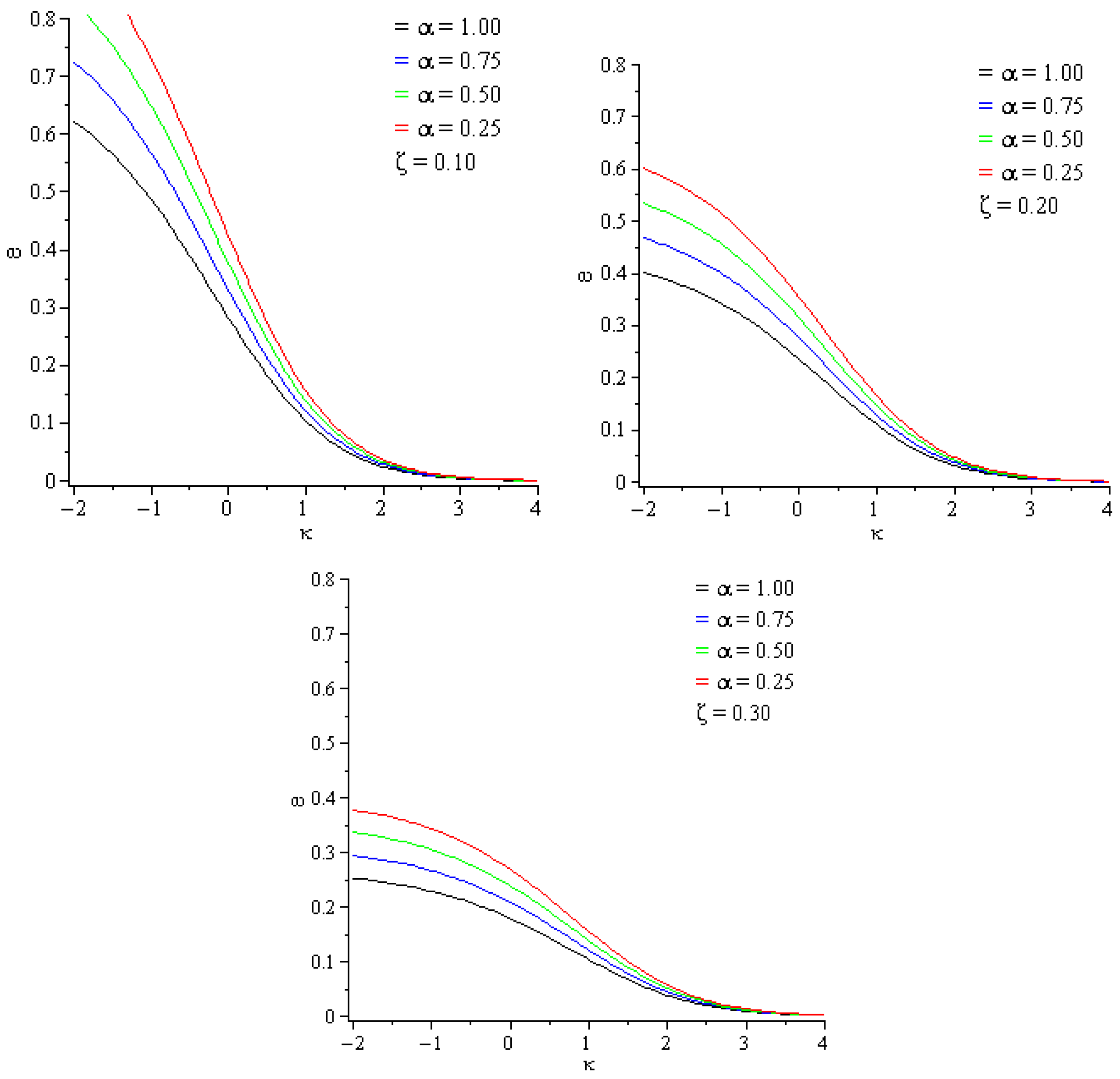
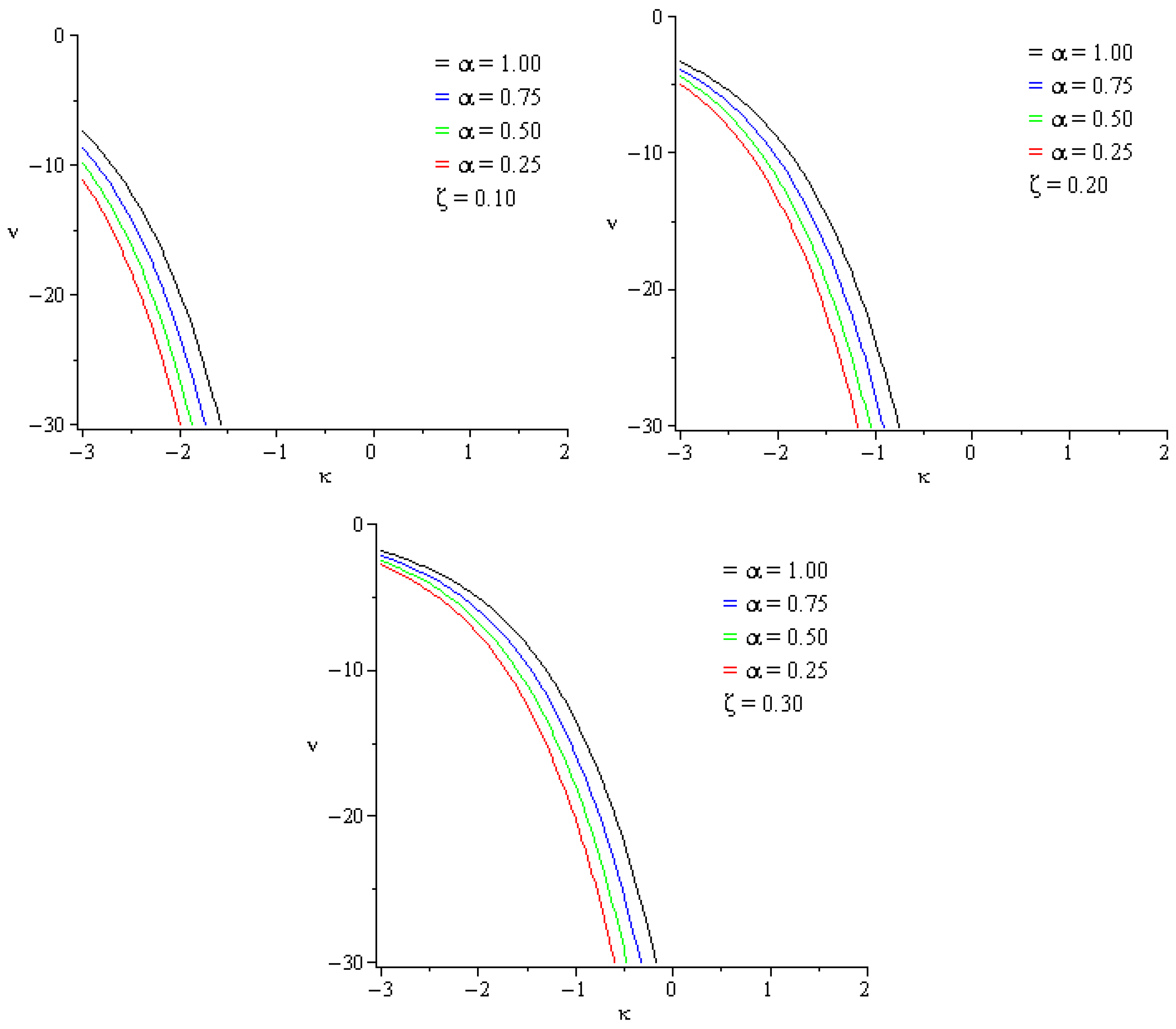
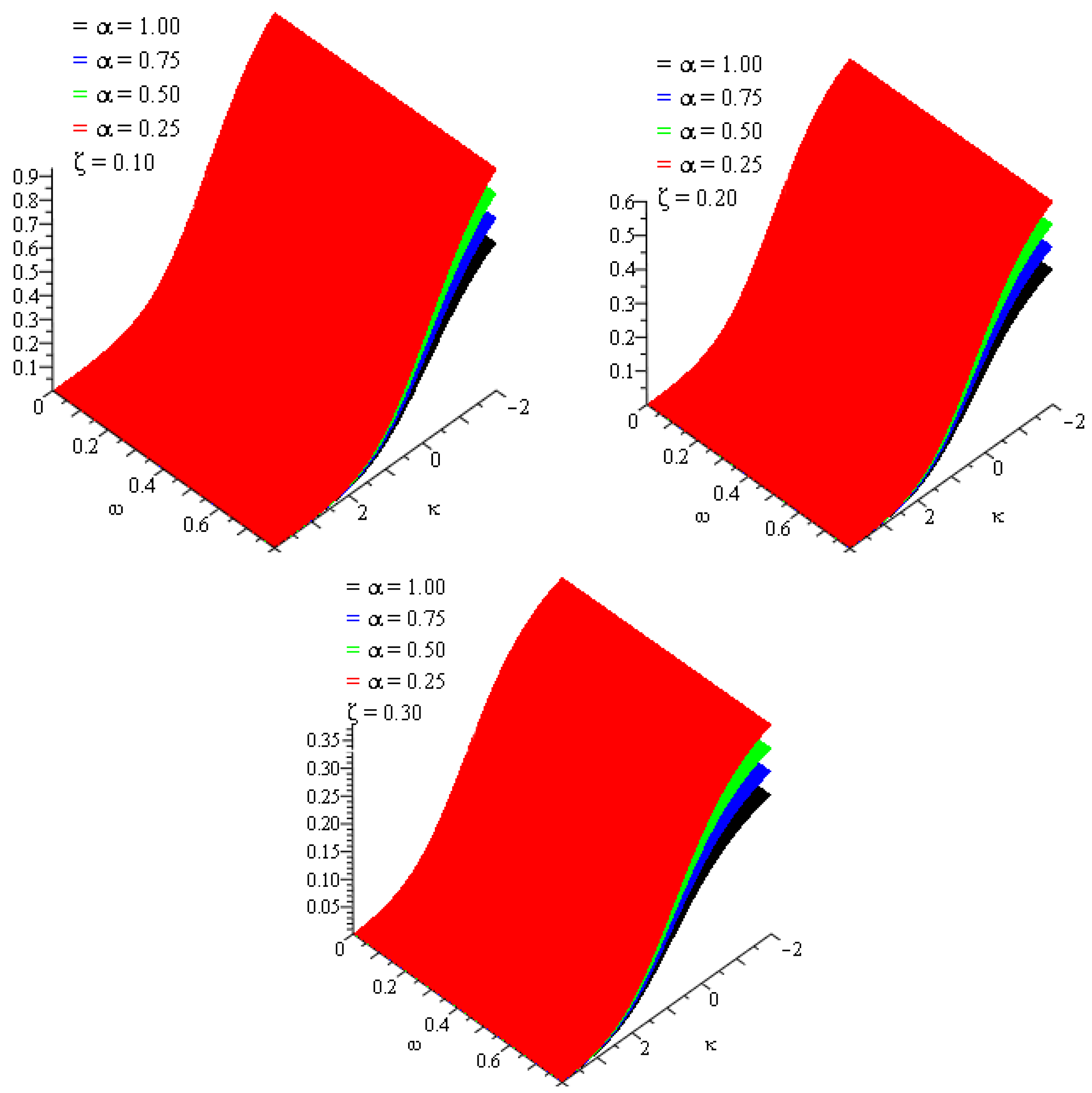
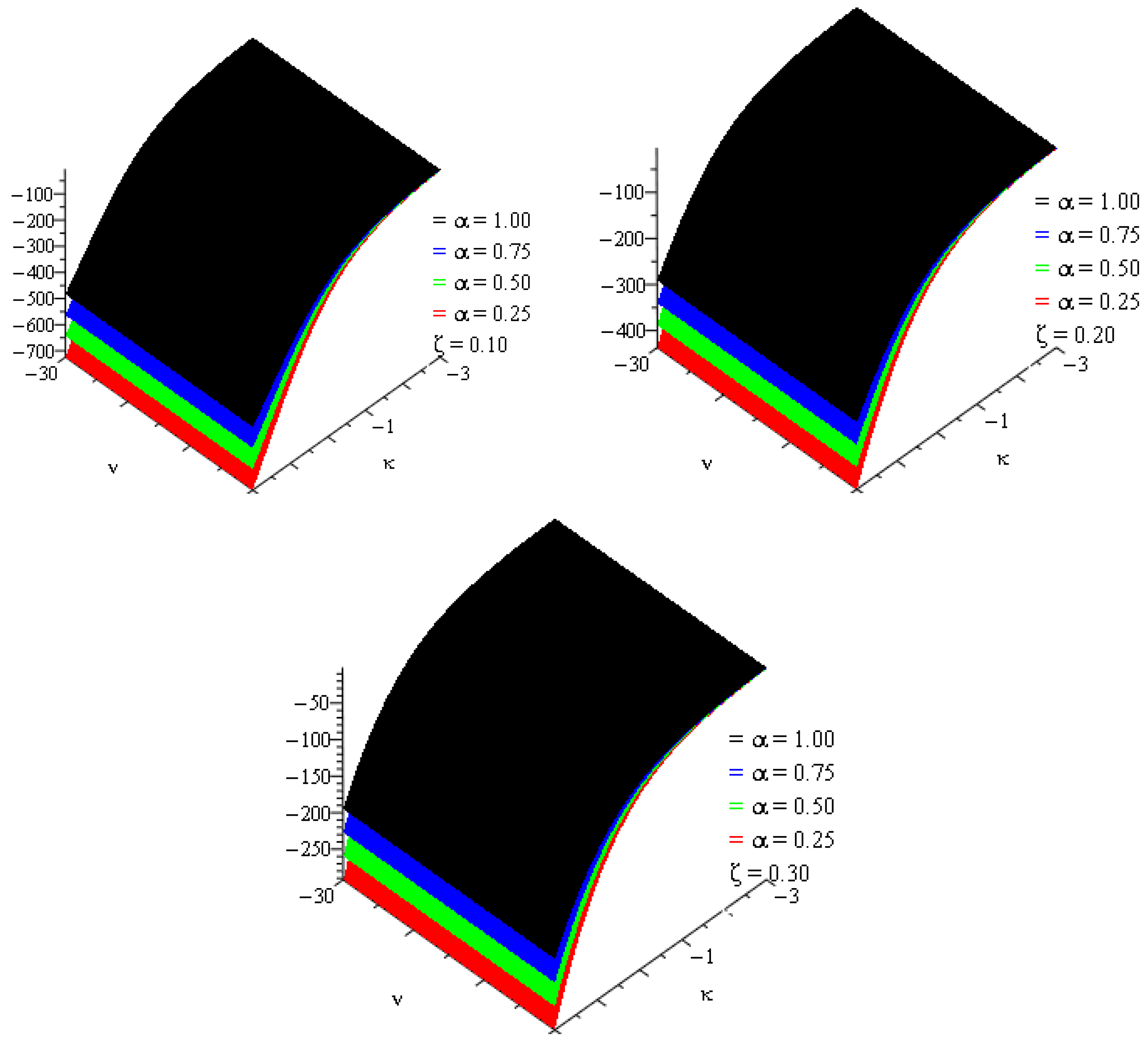
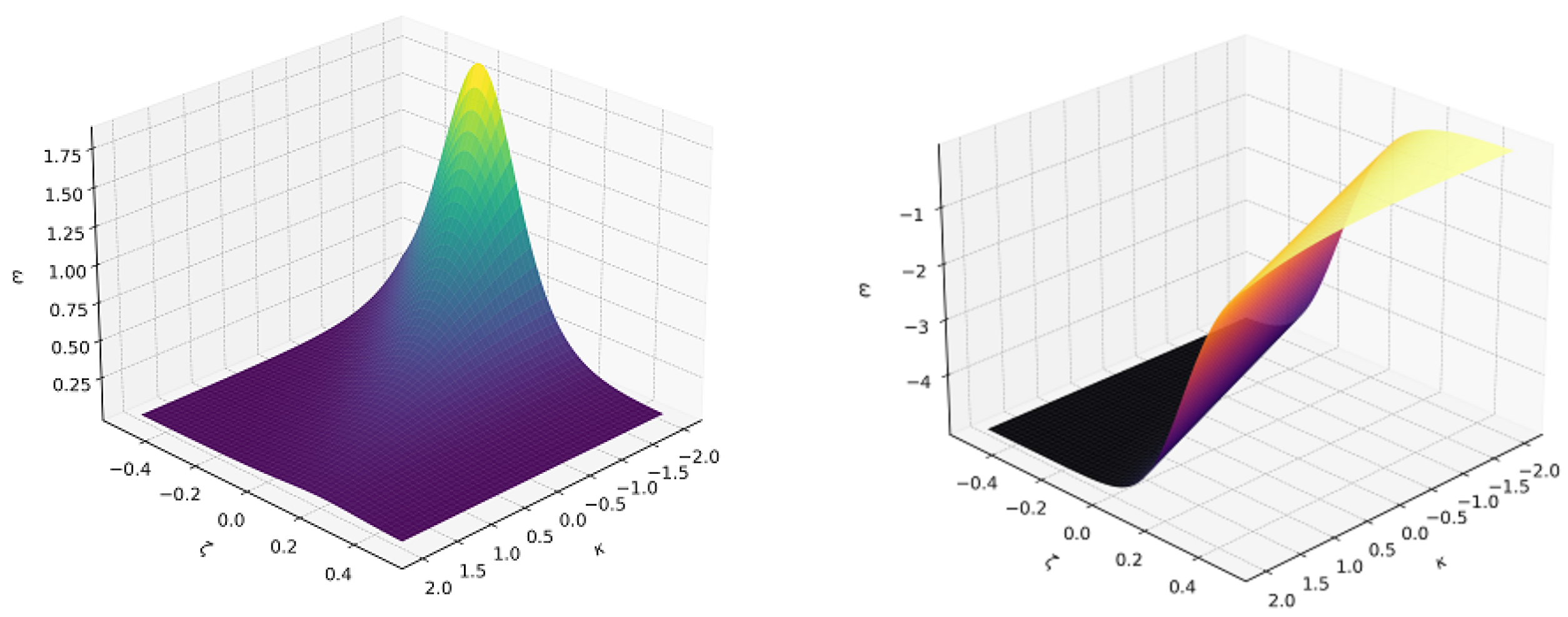
To further examine the consistency of the constructed series solution, we compare the PSIM approximation with the exact classical solution obtained in the limiting case α = 1 . This comparison serves as a reference validation of the series representation. Table 1 presents the absolute errors (AEs) for the dependent variables ω and ν at selected spatial points κ { 0.2 , 0.4 , 0.6 , 0.8 } and small time values ξ [ 0.01 , 0.05 ] . The errors remain within the range 10 5 10 4 , indicating strong agreement between the semi-analytical PSIM approximation and the classical exact solution. This confirms the convergence of the PSIM expansion in the integer-order limit. Figure 1, Figure 2, Figure 3, Figure 4 and Figure 5 display the spatial and temporal evolution of the PSIM solution components. The profiles illustrate smooth and stable behavior over successive time levels, reflecting the well-posedness of the system established by Theorems 5 and 6. The surface representations further demonstrate the regularity of the constructed solution in the ( κ , ξ ) domain. These graphical results, together with the small error values reported for α = 1 , support the consistency of the PSIM construction with the theoretical framework. The figures are included to visualize the constructed solution, while the main analytical conclusions follow directly from the fixed-point analysis. Overall, this example demonstrates the practical implementation of the developed operator-theoretic framework and the associated PSIM representation for a nonlinear fractional dynamical system.

7. Conclusions

In this work, we developed a rigorous operator-theoretic framework for nonlinear EK fractional dynamical systems formulated in Banach spaces endowed with the compact-open topology. By employing the Banach and Schaefer fixed-point theorems, sufficient conditions for existence, uniqueness, contraction-type bounds, and Ulam–Hyers stability of solutions were established. The semi-analytical PSIM was introduced as a constructive complement to the theoretical analysis, providing an explicit fractional series representation of the solution whose existence is guaranteed by the fixed-point framework. The method was implemented for the EK fractional BZDS (Equation (40)), where the assumptions of Theorems 5 and 6 were verified. The comparison with the classical case α = 1 further confirmed the consistency of the constructed series solution. The results presented in this paper provide a coherent link between abstract operator-theoretic analysis and constructive series representation for EK-type fractional systems. In particular, the illustrative fractional BZDS example indicates that the present theoretical–constructive framework may serve as a rigorous basis for future quantitative investigations of related physical models. Future research may extend this framework to other classes of fractional operators, more general nonlinear systems, and higher-dimensional models within the compact-open topology setting. Further investigations may also explore relaxation of certain regularity assumptions and refinement of convergence analysis for the proposed series scheme.

Author Contributions

Formal analysis, H.N.Z.; funding acquisition, M.S.; investigation, H.N.Z., N.H. and A.S.A.; methodology, H.N.Z., N.H. and A.H.T.; project administration, K.A.; software, A.H.T.; writing—original draft, A.S. and K.A.; writing—review and editing, M.S., N.H. and A.S.A. All authors have read and agreed to the published version of the manuscript.

Funding

The Researchers would like to thank the Deanship of Graduate Studies and Scientific Research at Qassim University for financial support (QU-APC-2026).

Data Availability Statement

The original contributions presented in this study are included in the article. Further inquiries can be directed to the corresponding authors.

Conflicts of Interest

The authors declare no conflicts of interest.

References

  1. Ashraf, R.; Nawaz, R.; Alabdali, O.; Fewster-Young, N.; Ali, A.H.; Ghanim, F.; Alb Lupas, A. A new hybrid optimal auxiliary function method for approximate solutions of non-linear fractional partial differential equations. Fractal Fract. 2023, 7, 673. [Google Scholar] [CrossRef]
  2. Damag, F.H. On Comparing Analytical and Numerical Solutions of Time Caputo Fractional Kawahara Equations via Some Techniques. Mathematics 2025, 13, 2995. [Google Scholar] [CrossRef]
  3. Iqbal, A.; Nawaz, R.; Hina, H.; Ahmad, A.G.; Emadifar, H. Utilizing the Optimal Auxiliary Function Method for the Approximation of a Nonlinear Long Wave System considering Caputo Fractional Order. Complexity 2024, 2024, 8357221. [Google Scholar] [CrossRef]
  4. Shah, K.; Seadawy, A.R.; Arfan, M. Evaluation of one dimensional fuzzy fractional partial differential equations. Alex. Eng. J. 2020, 59, 3347–3353. [Google Scholar] [CrossRef]
  5. Damag, F.H.; Saif, A.; Kilicman, A. ϕ-Hilfer Fractional Cauchy Problems with Almost Sectorial and Lie Bracket Operators in Banach Algebras. Fractal Fract. 2024, 8, 741. [Google Scholar] [CrossRef]
  6. Hamza, A.E.; Osman, O.; Ali, A.; Alsulami, A.; Aldwoah, K.; Mustafa, A.; Saber, H. Fractal-fractional-order modeling of liver fibrosis disease and its mathematical results with subinterval transitions. Fractal Fract. 2024, 8, 638. [Google Scholar] [CrossRef]
  7. Adel, M.; Aldwoah, K.; Alahmadi, F.; Osman, M.S. The asymptotic behavior for a binary alloy in energy and material science: The unified method and its applications. J. Ocean Eng. Sci. 2024, 9, 373–378. [Google Scholar] [CrossRef]
  8. Li, Y.; Liu, F.; Turner, I.W.; Li, T. Time-fractional diffusion equation for signal smoothing. Appl. Math. Comput. 2018, 326, 108–116. [Google Scholar] [CrossRef]
  9. Aldwoah, K.A.; Almalahi, M.A.; Shah, K.; Awadalla, M.; Egami, R.H. Dynamics analysis of dengue fever model with harmonic mean type under fractal-fractional derivative. AIMS Math. 2024, 9, 13894–13926. [Google Scholar] [CrossRef]
  10. Yazgan, T.; Ilhan, E.; Çelik, E.; Bulut, H. On the new hyperbolic wave solutions to Wu-Zhang system models. Opt. Quantum Electron. 2022, 54, 298. [Google Scholar] [CrossRef]
  11. Seadawy, A.R.; Iqbal, M.; Lu, D. Propagation of kink and anti-kink wave solitons for the non-linear dampedmodified Korteweg-de Vries equation arising in ion-acoustic wave in an unmagnetized collisional dusty plasma. Phys. Stat. Mech. Appl. 2020, 544, 123560. [Google Scholar] [CrossRef]
  12. Akgul, A.; Cordero, A.; Torregrosa, J.R. A fractional Newton method with 2α-order of convergence and its stability. Appl. Math. Lett. 2019, 98, 344–351. [Google Scholar] [CrossRef]
  13. Nadeem, M.; Alotaibi, S.H.; Alotaibi, F.M.; Alsayaad, Y. Numerical investigation of two-dimensional fuzzy fractional heat problem with an external source variable. PLoS ONE 2024, 19, e0304871. [Google Scholar] [CrossRef]
  14. Rahman, M.U.; Arfan, M.; Shah, Z.; Alzahrani, E. Evolution of fractional mathematical model for drinking under Atangana-Baleanu Caputo derivatives. Phys. Scr. 2021, 96, 115203. [Google Scholar] [CrossRef]
  15. He, J.H. Homotopy perturbation technique. Comput. Methods Appl. Mech. Eng. 1999, 3–4, 257–262. [Google Scholar] [CrossRef]
  16. Kilic, S.; Celik, E. Complex solutions to the higher-order non-linear boussinesq type wave equation transform. Ric. Mat. 2024, 73, 1793–1800. [Google Scholar] [CrossRef]
  17. Sontakke, B.R.; Shelke, A.S.; Shaikh, A.S. Solution of non-linear fractional differential equations by variational iteration method and applications. Far East J. Math. Sci. 2019, 1, 113–129. [Google Scholar] [CrossRef]
  18. Wang, L.; Chen, X. Approximate analytical solutions of time fractional Whitham-Broer-Kaup equations by a residual power series method. Entropy 2015, 17, 6519–6533. [Google Scholar] [CrossRef]
  19. Shams, A.; Mohamed, E.; Abdelgabar, A.; Walid, H. Numerical Solutions of Time-Fractional Whitham-Broer-Kaup Equations via Sumudu Decomposition Method. J. Math. 2023, 2023, 4664866. [Google Scholar] [CrossRef]
  20. Ali, A.; Shah, K.; Khan, R.A. Numerical treatment for traveling wave solutions of fractional Whitham-Broer-Kaup equations. Alex. Eng. J. 2018, 57, 1991–1998. [Google Scholar] [CrossRef]
  21. El-Sayed, S.M.; Kaya, D. Exact and numerical traveling wave solutions of Whitham-Broer-Kaup equations. Appl. Math. Comput. 2005, 167, 1339–1349. [Google Scholar] [CrossRef]
  22. Damag, F.H.; Saif, A. On Solving Modified Time Caputo Fractional Kawahara Equations in the Framework of Hilbert Algebras Using the Laplace Residual Power Series Method. Fractal Fract. 2025, 9, 301. [Google Scholar] [CrossRef]
  23. Dhaigude, D.B.; Kiwne, S.B.; Dhaigude, R.M. Monotone iterative scheme for weakly coupled system of finite difference reaction diffusion equations. Commun. Appl. Anal. 2008, 2, 161. [Google Scholar]
  24. Boutarfa, B.; Akgul, A.; Inc, M. New approach for the Fornberg-Whitham type equations. J. Comput. Appl. Math. 2017, 312, 13–26. [Google Scholar] [CrossRef]
  25. Xu, H.; Cheng, W.; Cui, J. Multiple-soliton and periodic solutions to space-time fractional Whitham-Broer-Kaup equations. Eur. Phys. J. Spec. Top. 2022, 231, 2353–2357. [Google Scholar] [CrossRef]
  26. Shah, R.; Khan, H.; Baleanu, D. Fractional Whitham-Broer-Kaup equations within modified analytical approaches. Axioms 2019, 8, 125. [Google Scholar] [CrossRef]
  27. Karaagac, B.; Owolabi, K.M.; Pindza, E. Analysis and new simulations of fractional Noyes-Field model using Mittag-Leffler kernel. Sci. Afr. 2022, 17, e01384. [Google Scholar] [CrossRef]
  28. Zhabotinsky, A.M. Belousov-zhabotinsky reaction. Scholarpedia 2007, 2, 1435. [Google Scholar] [CrossRef]
  29. Alsallami, S.A.; Maneea, M.; Khalil, E.M.; Abdel-Khalek, S.; Ali, K.K. Insights into time fractional dynamics in the Belousov-Zhabotinsky system through singular and non-singular kernels. Sci. Rep. 2023, 13, 22347. [Google Scholar] [CrossRef]
  30. Baishya, B.; Veeresha, P. Fractional approach for Belousov-Zhabotinsky reactions model with unified technique. Progr. Fract. Differ. Appl. 2024, 10, 295–311. [Google Scholar] [CrossRef]
  31. Naeem, M.; Aljahdaly, N.H.; Shah, R.; Weera, W. The study of fractional-order convection-reaction-diffusion equation via an Elzake Atangana-Baleanu operator. AIMS Math. 2022, 7, 18080–18098. [Google Scholar] [CrossRef]
  32. Owolabi, K.M.; Hammouch, Z. Spatiotemporal patterns in the Belousov-Zhabotinskii reaction systems with Atangana-Baleanu fractional order derivative. Phys. A Stat. Mech. Appl. 2019, 523, 1072–1090. [Google Scholar] [CrossRef]
  33. Akinyemi, L. A fractional analysis of Noyes-Field model for the nonlinear Belousov-Zhabotinsky reaction. Comput. Appl. Math. 2020, 39, 175. [Google Scholar] [CrossRef]
  34. Samko, S.G.; Kilbas, A.A.; Marichev, O.I. Fractional Integrals and Derivatives. Theory and Applications; Gordon and Breach Science Publishers: Amsterdam, The Netherlands, 1993. [Google Scholar]
  35. Tassaddiq, A.; Srivastava, R.; Alharbi, R.; Kasmani, R.M.; Qureshi, S. New inequalities using multiple Erdelyi-Kober fractional integral operators. Fractal Fract. 2024, 8, 180. [Google Scholar] [CrossRef]
  36. Kiryakova, V.; Paneva-Konovska, J. Generalized Erdélyi-Kober fractional integrals and images of special functions. Fractal Fract. 2025, 9, 567. [Google Scholar] [CrossRef]
  37. Rus, I.A. Ulam stabilities of ordinary differential equations in a Banach space. Carpath. J. Math. 2010, 26, 103–107. [Google Scholar]
Figure 1. The PSIM curves for the solutions ω ( κ , ξ ) of (40).
Fractalfract 10 00181 g001
Figure 2. The PSIM curves for the solutions ν ( κ , ξ ) of (40).
Fractalfract 10 00181 g002
Figure 3. The PSIM plots for solutions ω of (40).
Fractalfract 10 00181 g003
Figure 4. The PSIM plots for solutions ν of (40).
Fractalfract 10 00181 g004
Figure 5. The surface PSIM solutions of (40).
Fractalfract 10 00181 g005
Table 1. Comparing AE of exact and PSIM solutions of (40) at α = 1 .
κ ξ ω ( κ , ξ ) Exact ω ( κ , ξ ) β LHPM AE ω ν ( κ , ξ ) Exact ν ( κ , ξ ) β LHPM AE ν
0.200.010.20417180.20415140.0000204−3.8717761−3.87138900.0003872
0.020.20468270.20466220.0000205−3.7500000−3.74962500.0003750
0.030.20417180.20415140.0000204−3.6219843−3.62162210.0003622
0.040.20264940.20262920.0000203−3.4884129−3.48806400.0003488
0.050.20014550.20012550.0000200−3.3500790−3.34974400.0003350
0.400.010.16655380.16653710.0000167−4.0436517−4.04324730.0004044
0.020.16288430.16286800.0000163−3.7454821−3.74510750.0003745
0.030.15823590.15822010.0000158−3.4112804−3.41093930.0003411
0.040.15277450.15275930.0000153−3.0564823−3.05617670.0003065
0.050.14668770.14667300.0000147−2.6910445−2.69077540.0002689
0.600.010.13480240.13478890.0000135−4.3457480−4.34531340.0004346
0.020.13149610.13148300.0000131−4.0319705−4.03156730.0004032
0.030.12728970.12727700.0000127−3.6780249−3.67765710.0003678
0.040.12236290.12235070.0000122−3.2993832−3.29905320.0003299
0.050.11690930.11689760.0000117−2.9097560−2.90946500.0002910
0.800.010.10868210.10867120.0000109−4.6575273−4.65706150.0004660
0.020.10572720.10571660.0000106−4.3273984−4.32696560.0004327
0.030.10203970.10202950.0000102−3.9569812−3.95658550.0003964
0.040.09775640.09774660.0000098−3.5612461−3.56089000.0003561
0.050.09302380.09301450.0000093−3.1531704−3.15285510.0003153
Disclaimer/Publisher’s Note: The statements, opinions and data contained in all publications are solely those of the individual author(s) and contributor(s) and not of MDPI and/or the editor(s). MDPI and/or the editor(s) disclaim responsibility for any injury to people or property resulting from any ideas, methods, instructions or products referred to in the content.