


Abstract
Acute exercise can improve mood in older adults, but little is known about whether multimorbidity modifies these responses in older women. This preliminary study examined whether multimorbidity moderates acute multidimensional mood responses to a single community-based exercise session in older women. Participants were +60-year-old women (n = 85, 73.6 ± 5.9 years of age) who were involved in a community-based exercise program classified as having multimorbidity (MM; ≥2 chronic conditions, n = 37) or no multimorbidity (NMM; 0–1 chronic condition, n = 48). Mood was assessed immediately before and after exercise using the Brunel Mood Scale (BRUMS), including tension, depression, anger, vigor, fatigue, confusion, and total mood disturbance (TMD). Rating of perceived exertion (RPE) was also assessed before and after the exercise session. Two-way repeated-measures ANOVA was used to examine time, group, and time × group effects. Exploratory within-group correlation analyses were performed to examine possible pre-to-post changes in associations among mood dimensions. Significant ANOVA effects for “time” indicated significant reductions in depression (F-test = 8.31, p < 0.01; η2 = 0.09), anger (F-test = 8.38, p < 0.01; η2 = 0.09), and TMD (F-test = 8.75, p < 0.01, η2 = 0.09), together with increases in fatigue (F-test = 9.17, p < 0.001, η2 = 0.10) and an increase in RPE (F-test = 22.79, p < 0.001, η2 = 0.21). Significant “time × group” interactions were observed for tension (F-test = 27.04, p < 0.001, η2 = 0.25), TMD (F-test = 9.71, p < 0.001, η2 = 0.11), and RPE (F-test = 15.82, p < 0.001, η2 = 0.16). Tension increased in the MM but decreased in the NMM group, while TMD decreased significantly only in the NMM group. Although the RPE increased in both groups, the post-exercise RPE was higher in MM individuals, which could be associated with differential mood changes. Exploratory correlation analyses indicated certain differential pre-to-post changes in the relationships among mood dimensions in the MM and NMM groups. It seems that multimorbidity did not eliminate the acute mood benefits of exercise but appeared to selectively shape specific components of the post-exercise mood response. These preliminary findings suggest that multimorbidity and perceived effort should be considered when tailoring community-based exercise for older women.
Keywords:
aged; female; exercise; affect; mood; multimorbidity; chronic disease; community-based exercise 1. Introduction
Aging is associated with progressive decline in muscular strength, cardiorespiratory fitness, balance, mobility and cognitive function. It is also accompanied by an increased susceptibility to age-related musculoskeletal conditions, including osteoporosis. Collectively, these changes can heighten the physical demands of everyday tasks, compromise functional independence and quality of life, and contribute to reduced participation in physical activity and exercise among older adults [1,2,3]. These physical and psychological processes associated with aging can operate in a self-perpetuating cycle; depressive symptoms can reduce habitual participation, whereas inactivity may further impair physical fitness and motor function, thereby reinforcing sedentary behavior in older adults [4]. Regular physical activity, particularly physical exercise, may help mitigate these effects [5,6,7].
While physical activity (PA) refers to any bodily movement produced by skeletal muscles that increases energy expenditure, physical exercise (PE) is considered a planned, structured, and repetitive form of movement performed to maintain or improve physical fitness [8]. PE therefore can provide a systematic means of addressing age-related cardiorespiratory, musculoskeletal, and neuromotor limitations through the manipulation of modality, frequency, intensity, duration, and progression [9]. However, these adaptations depend on regular and sustained participation, which in older adults is influenced by a range of physical, psychological, social, and environmental factors [3,10]. Within this context, it is generally known that acute mood responses to PE warrant attention as a psychological factor potentially related to continued exercise participation.
In general, mood state is commonly conceptualized as a transient, multidimensional affective state reflecting an individual’s current psychological experience across several positive and negative dimensions, including vigor, tension, fatigue, depression, anger, and confusion [11,12]. In older adults, acute mood responses to PE may reflect the interaction between physical exertion and psychosocial factors, including perceived mastery, exercise self-efficacy, baseline psychological state, and the social context in which exercise occurs [11,13]. As it comes to PE, the practical significance of mood state lies in its immediate temporal position within the training process, since affective changes may be experienced during or shortly after a single session [14]. This is particularly important from the perspective of persistence in exercise since favorable post-exercise mood response may provide immediate psychological reinforcement for future participation [15]. On the other hand, unchanged or unfavorable mood responses to exercise may be less likely to support continued engagement. Accordingly, examining the magnitude and consistency of acute mood responses to PE may help clarify their contribution to PE participation among older adults.
Although previous studies suggest that a single bout of exercise may improve mood in older adults, responses vary across studies and mood dimensions. A meta-analysis of 103 studies involving 4671 participants found a small overall improvement in general mood after acute exercise, with exercise intensity identified as the strongest examined moderator. However, intensity explained only part of the variability, indicating that other determinants remain relevant [16]. Research in older adults, assessed mainly with the Profile of Mood States (POMS) and the Brunel Mood Scale (BRUMS), also shows heterogeneous findings [17,18,19,20,21]. Among longer sessions, 75 min of aerobic line dancing reduced tension, depression, fatigue and anger while increasing vigor, with no change in confusion [19]. A remotely delivered bodyweight resistance session reduced total mood disturbance but not fatigue [21], whereas a 60 min session in physically active older women increased both positive and negative mood scores, indicating a mixed response [12]. Walking studies have similarly reported selective effects: self-paced walking for 80–120 min reduced tension/anxiety, anger/hostility and confusion [18], whereas 30 min of mild to moderate walking produced the clearest improvements in vigor and confusion [17]. Likewise, 30 min of combined aerobic, resistance and stretching exercise increased vigor without significantly altering other POMS dimensions [22]. Shorter protocols have also produced contrasting results. For example, 6 min of walking improved energy, tension, confusion and total mood disturbance [23], whereas six stair-climbing bouts lasting 1 min each did not improve mood and increased tiredness [24]. Differences have also been observed between exercise modes, as 10 min of light-intensity aerobic dance produced more favorable changes in vitality and pleasure than cycling of similar duration and intensity [25]. Recently, a study examining acute mood changes confirmed positive effects of outdoor exercising in older females, with a significant moderating effect of exercise experience [26].
Collectively, results from previous studies suggest that differences in acute mood responses are not consistently associated with exercise duration, intensity, or modality alone. This interpretation is further supported by a meta-analysis of Arent et al., in which the effect of acute exercise on mood in older adults was small and not statistically significant [11]. This implies that, although individual studies have reported improvements in mood, these effects are not sufficiently consistent across exercise protocols and mood outcomes to produce a clear overall acute effect. These inconsistencies suggest that factors beyond exercise duration, intensity, and modality may contribute to individual differences in acute mood response, including characteristics of both the exercise context and the participants themselves.
Among participant characteristics that may contribute to the variability of mood responses to exercise, health status may be particularly relevant. First, health status directly determines one’s physical capacities and therefore could strongly moderate exercise mood responses to physical exercise [27,28]. Second, with regard to sex, there is a problem of multimorbidity, which tends to be more prevalent in women than in men [29]. However, studies involving older women have predominantly recruited healthy, physically active, or community-dwelling participants, while health status has received limited attention in the acute exercise mood literature [12,22]. Consequently, direct evidence regarding whether chronic health conditions are associated with the magnitude or direction of acute-exercise-induced mood changes in older women remains limited. This limited evidence on the eventual moderating effects of health status on PE-induced mood responses may partly reflect methodological difficulties in examining health status in older populations, where multiple chronic conditions frequently coexist and occur in different combinations.
Several mechanisms may explain why multiple chronic conditions (multimorbidity) could modify acute mood responses to exercise in older adults. First, multimorbidity is known to be associated with greater symptom burden and reduced functional reserve, which may increase the relative physiological and perceptual demands of a given exercise bout [30,31,32]. Second, multimorbidity may influence the appraisal of exercise-related bodily sensations, as breathlessness, palpitations, muscular discomfort, or weakness may be perceived as more concerning in individuals with a greater health burden [33]. Since higher relative exercise intensity is generally associated with less favorable affective responses, the same external workload may produce different emotional responses depending on physiological reserve, symptom burden, and the interpretation of bodily signals [34]. Therefore, multimorbidity could be reasonably observed as a potential moderator of acute-exercise-induced mood responses, while there is an evident lack of research that investigated this problem specifically.
Therefore, this preliminary study aimed to examine whether health status moderates acute multidimensional mood responses to a single community-based exercise session in older women. In this study, health status was operationalized through multimorbidity, defined as the presence of two or more chronic conditions, in line with commonly used approaches in gerontological research [35,36]. Initially, we hypothesized that multimorbidity status will have significant impact of acute mood changes in the studied women.
2. Materials and Methods
2.1. Participants
The study included 85 older women aged 60 years and above (73.6 ± 5.9 years of age) who voluntarily participated in a community-based outdoor exercise program located in Split, Croatia. The program was specifically developed for older adults and consisted of group sessions incorporating aerobic, resistance, mobility, and relaxation exercises. To minimize the potential influence of sociocultural differences, all participants were recruited from the same geographical area. The sample included women without diagnosed medical conditions as well as women with chronic diseases, including cardiovascular disorders, diabetes, and arthritis (please see Supplementary Table S1 for details). Despite this variability, all participants were functionally independent and able to participate in the organized exercise program. Participants were classified according to multimorbidity status in a multimorbidity group (n = 37) and a non-multimorbidity group (n = 48), as described below.
Multimorbidity was operationalized as “the presence of two or more physician-diagnosed chronic conditions”, consistent with commonly used definitions in older adult research [30,35]. Chronic conditions considered for classification included long-term somatic diseases requiring ongoing medical monitoring or treatment, such as cardiovascular diseases, diabetes mellitus, arthritis and other clinically relevant musculoskeletal, respiratory, renal, or metabolic disorders. Participants with no chronic condition or one chronic condition were classified as non-multimorbid (NMM), whereas those with two or more chronic conditions were classified as multimorbid (MM). This dichotomization was chosen to reflect cumulative chronic disease burden rather than the presence of a single diagnosis, which may have limited functional relevance when considered in isolation. Psychiatric conditions were not included in the multimorbidity count to avoid conceptual overlap with the primary outcome of mood. Also, all participants were functionally independent, cognitively capable of completing the study procedures, and regularly engaged in the exercise program, indicating the absence of overt psychiatric impairment that would interfere with participation.
Participants were classified according to multimorbidity status because the presence of multiple chronic conditions may provide a more clinically meaningful indicator of overall health burden than a single diagnosis considered in isolation [28,30,37]. A single chronic condition, particularly when well controlled, may have limited impact on everyday functioning, whereas the coexistence of two or more conditions increases the likelihood of interacting symptoms, treatment burden, reduced physiological reserve, and functional limitations. Following commonly used reporting approaches in multimorbidity research, the prevalence of individual chronic conditions and the most frequent combinations of coexisting conditions were summarized descriptively and are presented in Supplementary Table S1 [38].
Recruitment took place through the exercise program’s organizers. Before any assessments were performed, prospective participants received detailed information about the study objectives and procedures. Participation was entirely voluntary, and written informed consent was obtained from each participant before enrollment. The study was conducted in accordance with the ethical principles of the Declaration of Helsinki and received approval from the Ethics Committee of the Faculty of Kinesiology at the University of Split. The broader study project was prospectively registered at ClinicalTrials.gov (NCT07365228). The analyses reported in the present study were conducted as a secondary exploratory analysis within the registered project (ClinicalTrials.gov (NCT07365228)).
Eligibility for inclusion required that participants be (i) female, (ii) aged 60 years or older, (iii) medically fit to take part in the planned exercise session, and (iv) cognitively capable of following study instructions and completing questionnaires without assistance. Women were removed from the final analyses if they did not finish the exercise session or had incomplete pre- or post-exercise data. Additional grounds for exclusion were (i) pronounced cognitive impairment, (ii) dependence on others to complete the assessment procedures, and (iii) motor limitations that would compromise safe participation in the recreational program. A total of 89 women were initially approached, of whom two did not complete the exercise session, and two had incomplete pre- or post-exercise assessments, resulting in the final sample of 85 participants observed in the study.
2.2. Physical Exercise Program
The exercise intervention was implemented in a public park through supervised group sessions conducted three times per week. Session lasted approximately 60 min and were divided into three successive 20 min components: (i) aerobic activity, (ii) resistance and balance training, and (iii) flexibility and relaxation exercises. Nordic walking poles served a dual purpose, used for the aerobic work itself and then as support equipment during select strength, balance, and flexibility exercises, while elastic bands provided resistance for the strength segment.
All exercises were performed without musical accompaniment. Exercise intensity was maintained at a moderate-to-vigorous level, corresponding to approximately 6 to 7 on the 10-point Borg Category-Ratio Scale (CR10). Specifically, participants were instructed to increase/decrease the workload intensity, if necessary, by increasing/decreasing the pace of walking (during aerobic activity), to use more resistive/flexible elastic bands (for strength exercises), and to take a rest (break) and to skip exercise if the training session was demanding. The same exercise protocol was applied to all participants. The exercise session was intentionally delivered as a standardized group-based program under usual community conditions, thereby preserving the ecological validity of the study rather than applying individually prescribed exercise protocols.
The exercise program observed was done in early May 2026. The sessions were led by the first author, and the program was designed to maintain and improve functional capacity and mobility while providing an accessible and sustainable model of community-based physical activity for older women. Photos of the exercise program are available in Supplementary File S1.
2.3. Variables
The variables assessed in this study included age, body height, body mass, body mass index (BMI), rating of perceived exertion (RPE), and mood states.
Anthropometric measurements were obtained in a laboratory using digital anthropometric equipment (Seca, Birmingham, UK). Body height was recorded in centimeters, whereas body mass was measured in kilograms. BMI was calculated by dividing body mass in kilograms by the square of body height in meters, with the result expressed in kilograms per square meter (kg/m2).
RPE was assessed immediately before and after the exercise session using the Borg CR10, a valid and widely used instrument for evaluating subjective exercise intensity across different populations, including older adults [39,40]. Pre-exercise RPE was collected for descriptive purposes and to provide a reference value for comparison with post-exercise perceived exertion. For post-RPE participants rated the overall intensity of the completed session on a scale ranging from 0, indicating “nothing at all,” to 10, indicating “extremely strong” or “maximal”.
Mood states were evaluated immediately before and after the exercise session using the Brunel Mood Scale (BRUMS), a 24-item self-report questionnaire designed to assess temporary mood responses in sport and exercise settings and widely used in research involving older adults [21,41]. The BRUMS consists of six subscales: tension, depression, anger, vigor, fatigue, and confusionwith each subscale comprising four items. Participants rated how accurately each mood descriptor reflected their current feelings on a 5-point Likert scale ranging from 0, “not at all,” to 4, “extremely.” Internal consistency, evaluated by Cronbach alpha coefficients (α) at the pre-exercise BRUMS assessment was α = 0.60 for tension, α = 0.87 for depression, α = 0.66 for anger, α = 0.61 for vigor, α = 0.76 for fatigue, and α = 0.69 for confusion. Scores for each mood dimension were calculated by summing the responses to its four items, resulting in possible subscale scores from 0 to 16. Lower scores generally represented more favorable mood states for all dimensions except vigor, for which higher scores indicated a more favorable state. Total mood disturbance (TMD) was calculated by adding the scores for tension, depression, anger, fatigue, and confusion and then subtracting the vigor score. Higher TMD values indicated a less favorable overall mood profile. The pre- and post-exercise BRUMS assessments enabled the evaluation of acute changes in mood following the exercise session.
2.4. Statistics
The normality of data distribution was assessed using the Kolmogorov–Smirnov test. Descriptive statistics are presented as means and standard deviations (SDs). Independent-samples t-tests were used to compare the multimorbid (MM) and non-multimorbid (NMM) groups in age and anthropometric characteristics.
As an initial omnibus analysis of the multidimensional mood response, a multivariate analysis of variance (MANOVA) was performed on the pre-to-post change scores of the six BRUMS subscales; following a significant multivariate group effect, separate univariate repeated-measures ANOVAs were conducted for each BRUMS subscale. In the next phase, the effects of the exercise session on mood states and perceived exertion were examined using two-way repeated-measures analysis of variance (ANOVA), with time (pre-exercise vs. post-exercise) as the within-subject factor, group (MM vs. NMM) as the between-subject factor, and the time × group interaction. Separate ANOVAs were performed for each BRUMS subscale (tension, depression, anger, vigor, fatigue, and confusion), total mood disturbance (TMD), and rating of perceived exertion (RPE). Follow-up simple-effects analyses using Fisher’s least significant difference (LSD) test were conducted only when a significant time × group interaction was identified in the corresponding ANOVA. No follow-up comparisons were performed in the absence of a significant interaction, and no additional adjustment for multiplicity across the separate BRUMS outcomes was applied. Partial eta squared (ηp2) was used to report ANOVA effect sizes, with values of 0.01, 0.06, and 0.14 interpreted as small, medium, and large effects, respectively.
To further explore possible changes in the relationships among mood dimensions, Pearson product–moment correlation matrices were calculated separately for MM and NMM women at the pre- and post-exercise assessments. As a methodological remark we must note that correlational analyses should be considered exploratory and were used to provide additional context for the primary pre–post comparisons and not to test predefined hypotheses.
Data were analyzed using Statistica for Windows (version 14.5; TIBCO Software Inc., Palo Alto, CA, USA). Statistical significance was set at p < 0.05.
3. Results
Table 1 presents results of the descriptive statistics together with t-test differences between study groups. As evident, NMM participants were significantly taller, heavier, and had a higher BMI than MM participants (all at p < 0.05).
Table 1.
Descriptive statistics and t-test differences between study groups (MM—participants with multimorbidity, NMM—participants without multimorbidity).
Descriptive statistics for BRUMS-derived variables at pre- and post-testing for the total sample of participants are presented in the Table 2.
Table 2.
Descriptive statistics for variables of mood dimensions and rating of perceived exertion (RPE) at pre- and post-testing.
The MANOVA performed on the pre-to-post change scores of the six BRUMS subscales revealed a significant overall multivariate difference between the MM and NMM groups (F = 3.31, p = 0.03), indicating that the overall pattern of mood change differed according to multimorbidity status.
The main and interaction ANOVA effects are presented in Table 3. Significant main effects for “time” were evidenced for depression, anger, fatigue, TMD, and RPE. When combining ANOVA main effects with descriptive statistics from Table 2, it can be stated that favorable pre- to post-changes were found for depression (medium ES), anger (medium ES), and TMD. Meanwhile, exercise induced acute an increase in fatigue (medium ES) and RPE (large ES). The ANOVA main effects for “group” were significant for depression (medium ES), TMD (medium ES), and RPE (large ES). ANOVA interaction effects (time × group) were significant for tension (large ES), TMD (large ES), and RPE (large ES), indicating differential pre- to post-changes in these variables for two study groups.
Table 3.
Results of the two-way analysis of variance for repeated measurement.
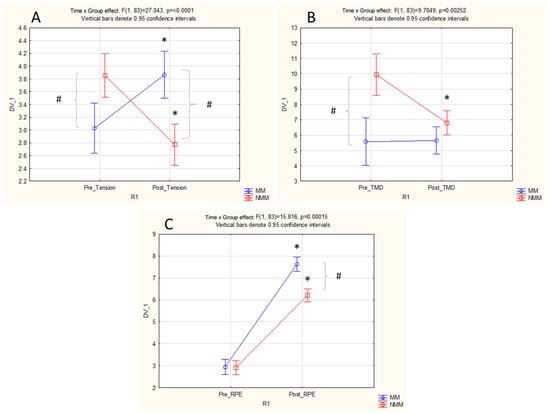
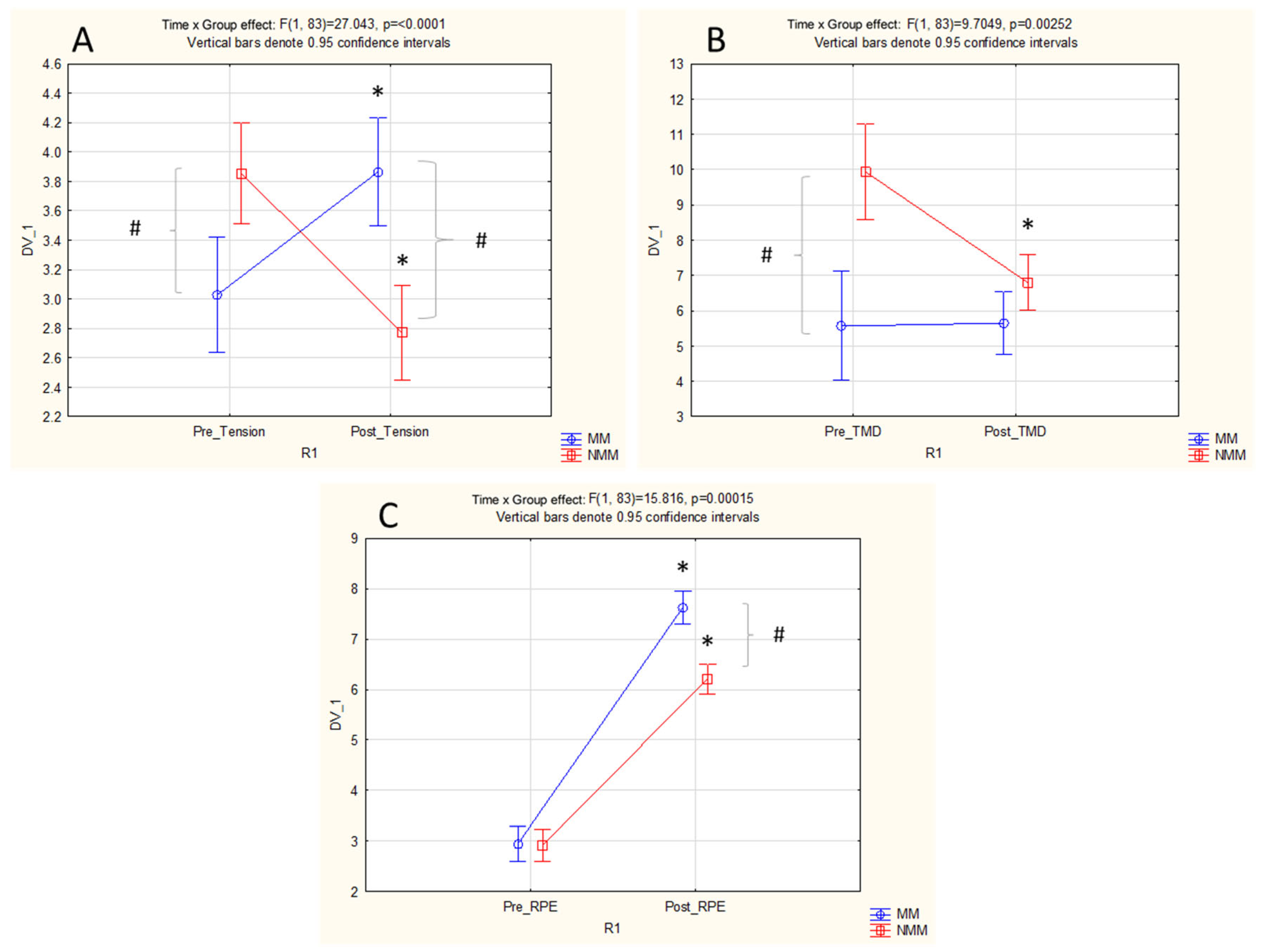
Figure 1 presents the descriptive statistics and statistical significance of simple effects for variables where significant ANOVA interactions (differential effects) were found. Specifically, tension changed in different directions in study groups (significant increase in MM and decrease in NMM), with significant differences between groups pre-measurement (higher score in NMM) and post-measurement (higher score in MM) (Figure 1A). From pre- to post-measurement the TMD decreased significantly in NMM, with significantly higher TMD in NMM for pre-measurement (Figure 1B). Both study groups rated exertion higher in post- than in pre-measurement, but the post-exercise RPE was significantly higher in the MM than in the NMM group (p < 0.05), despite both groups completing the same exercise protocol (Figure 1C).
Figure 1.
Descriptive statistics (means ± 95% CI) in study groups (MM—multimorbidity, NMM—non-multimorbidity) and significance of simple effects for study variables with significant ANOVA interactions (tension—(A), TMD—(B), rating of perceived exertion—(C), *—significant differences within groups at p < 0.05, #—significant differences between groups at p < 0.05).
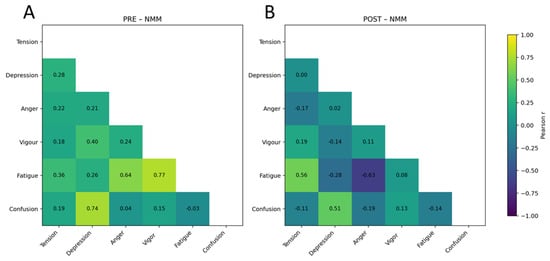
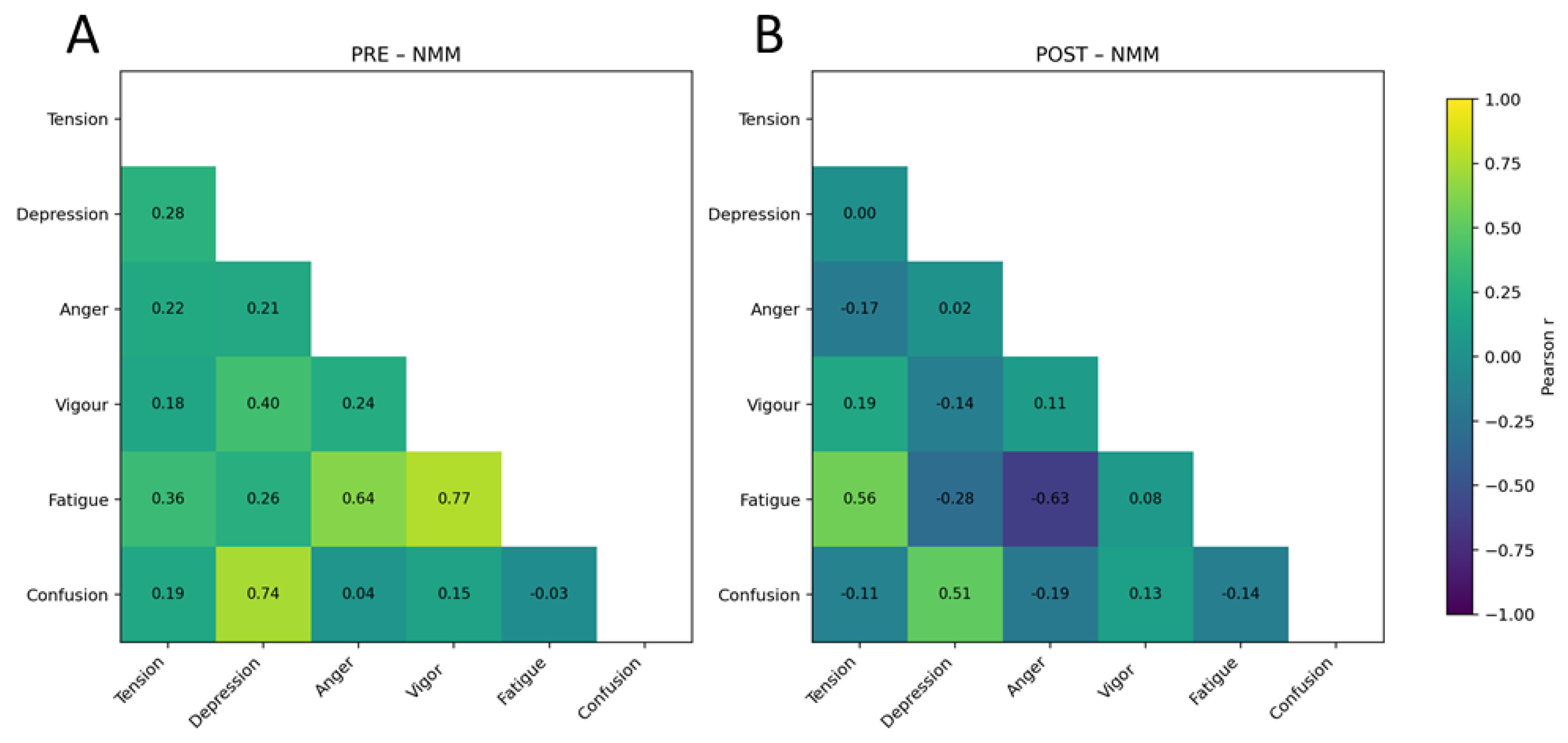
In the NMM, the pattern of correlations changed from pre- (Figure 2A) to post-exercise (Figure 2B). Before exercise, fatigue showed strong positive associations with vigor (r = 0.77) and anger (r = 0.64), while depression was strongly related to confusion (r = 0.74). After exercise, the association between vigor and fatigue was markedly reduced (r = 0.08), whereas the association between anger and fatigue reversed direction and became strongly negative (r = −0.63).
Figure 2.
Heatmaps of Pearson correlation coefficients among BRUMS mood dimensions before (A) and after the exercise session (B) in women without multimorbidity.
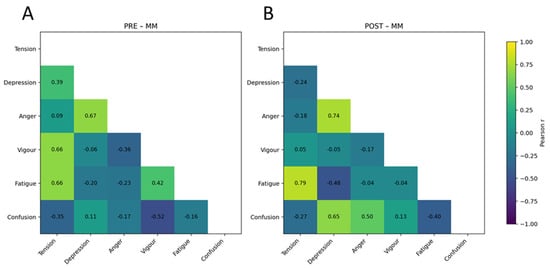
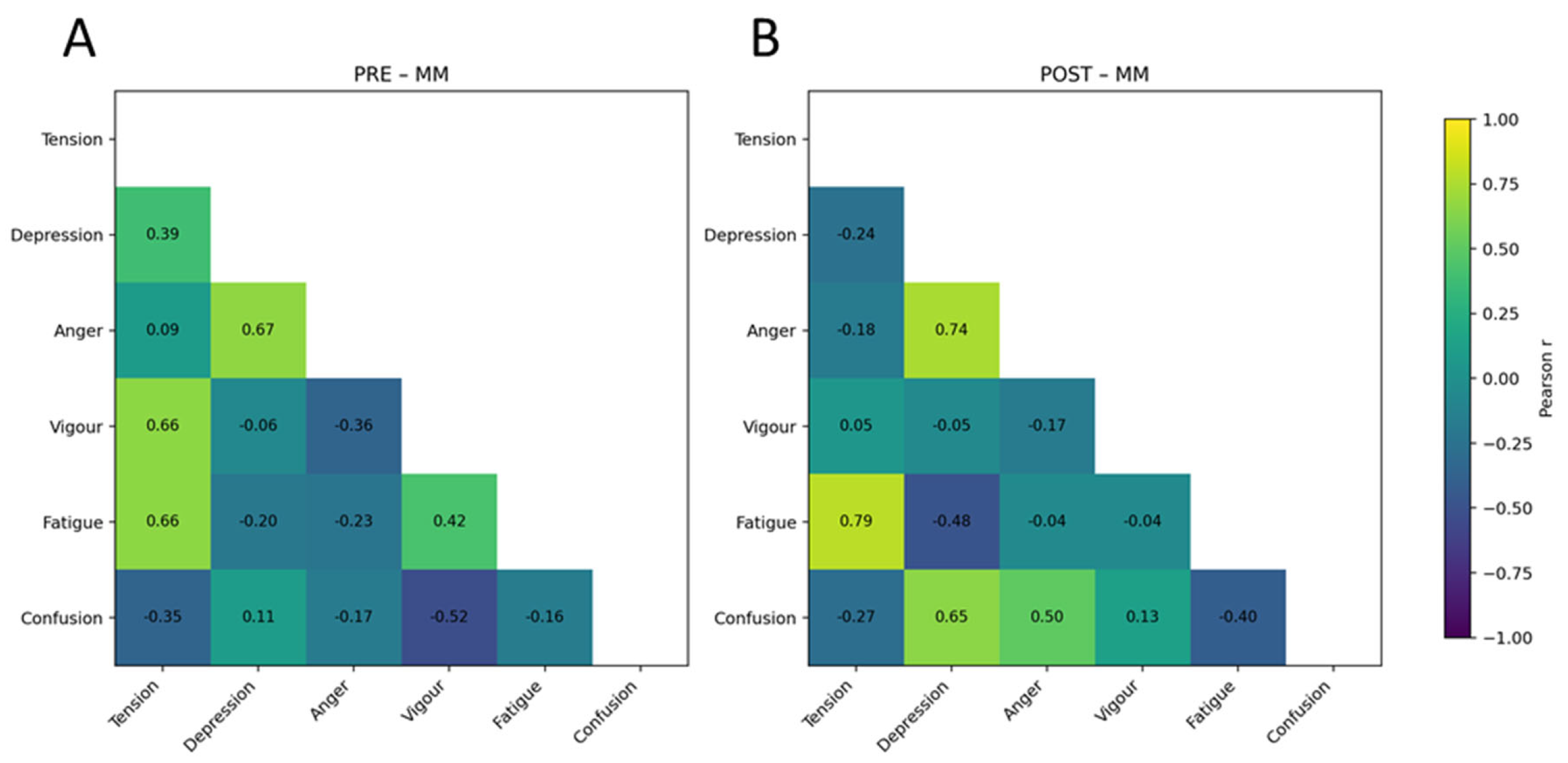
In the MM group, the correlations between mood dimensions also changed from pre- (Figure 3A) to post-exercise (Figure 3B) but in a different way than in previously presented in the NMM group. Before exercise, tension was strongly related to both vigor (r = 0.66) and fatigue (r = 0.66), whereas after exercise the association between tension and fatigue became even stronger (r = 0.79). At the same time correlation between tension and vigor almost disappeared (r = 0.05), and depression became more strongly associated with confusion (r = 0.65) and remained strongly related to anger (r = 0.74).
Figure 3.
Heatmaps of Pearson correlation coefficients among BRUMS mood dimensions before (A) and after the exercise session (B) in women with multimorbidity.
4. Discussion
There are several important findings of the study. First, the exercise session organized in the public park induced positive acute mood responses in several variables, irrespective of the multimorbidity status of participants. Second, the results showed several differential effects in the MM and NMM groups. Third, exploratory findings suggest that acute exercise may be associated with different pre- to post-exercise changes in the relationships among mood dimensions in the MM and NMM groups. Therefore, our initial study hypothesis could be accepted.
4.1. General Effects on Mood Status
Previous studies have generally shown that a single bout of exercise can produce favorable acute changes in mood among older adults, including older women [16]. These effects are commonly attributed to a combination of physiological and psychosocial mechanisms. Proposed physiological mechanisms include changes in monoaminergic activity, endorphin and endocannabinoid signaling, cerebral blood flow, arousal, and stress regulation [42]. Meanwhile, psychological and social mechanisms include distraction from negative thoughts, feelings of accomplishment and self-efficacy, social interaction, and a sense of belonging during group exercise [43]. In this context, our findings partially support previous evidence, as depression and anger significantly decreased following exercise irrespective of health status. However, the overall pattern of mood changes was not uniformly positive.
The overall pattern of results indicates that acute exercise was simultaneously associated with favorable changes in some negative emotional states and with greater immediate subjective fatigue. Previous studies highlighted that a single, tolerable exercise bout may support short-term affect regulation through several pathways, including (i) temporary distraction from rumination, (ii) a sense of mastery after completing a meaningful task, and (iii) faster recovery from negative affect [44]. These mechanisms are plausible in explaining the positive changes in depression and anger in our participants as well. Nevertheless, it is important to note that these beneficial emotional responses to exercise may be expected regardless of multimorbidity status.
Specifically, the reduction in depression and anger in both groups suggests that some beneficial emotional responses to acute exercise may remain preserved irrespective of multimorbidity status. This is particularly interesting knowing that the MM group experienced higher perceived effort (observed by RPE), but evidently, this was not translated to less favorable mood changes when it comes to depression and anger. In explaining such results, we should first highlight the non-exhaustive character of the applied exercise.
Most specifically, the workload of the applied exercise was sufficient to trigger the positive psychological mechanisms but not too demanding to provoke stress and discomfort (note that participants were instructed to modify exercise execution in order to keep an RPE of maximally 7 during the exercise session; please see Materials and Methods for details). It is well known that a moderate and tolerable exercise stimulus may activate (i) neurobiological mechanisms associated with improved affect (i.e., monoaminergic, endocannabinoid, and opioid pathways) [42]. In addition, (ii) successful completion of a manageable exercise session may enhance feelings of accomplishment, self-efficacy, and control, while providing distraction from eventual illness-related concerns [45]. Together, these (i) physiological and (ii) psychosocial mechanisms may help explain why anger and depressive mood decreased even in MM group.
The positive acute effects of physical exercising on anger and depression in MM individuals are particularly important. Namely, depressive symptoms and feelings of anger, frustration, and emotional distress are commonly reported among older adults living with multiple chronic conditions [46,47]. Therefore, the fact that both dimensions improved regardless of health status suggests that these emotional benefits of acute exercise may occur even in such a vulnerable population.
Meanwhile, sense of fatigue increased in both groups, but this is almost certainly the result of the immediate post-exercise evaluation of mood state. In other words, higher fatigue scores likely reflect the acute subjective experience of physical exertion and tiredness rather than a deterioration in mood in a broader sense. Since the exercise session consisted of a combination of aerobic workout coupled with strength, balance and flexibility/mobility exercise, the sense of fatigue is actually a normal psychophysiological consequence of workout, which is directly supported by increase in RPE values in both groups [48]. It is also important to note that increased fatigue actually reflects the feelings of tiredness as a result of executed training, while this feeling may coexist with a sense of accomplishment, mastery, and satisfaction after completing a sufficiently challenging training session [49].
4.2. Differential Effects in Multimorbid and Non-Multimorbid Groups
Multimorbidity was rarely directly evaluated as a factor that may modify the acute mood response to a single bout of exercise in older adults. Nevertheless, several authors have emphasized the importance of multimorbidity when interpreting exercise responses in older populations [31,50]. For example, multimorbidity can decrease compensational capacities and functional reserve [31]. It naturally makes physical exercising more demanding and challenging, altogether resulting in higher relative exercise intensity, which is further associated with less pleasant affective responses during exercise [34]. Consequently, there is a rationale for assuming that multimorbidity may influence the immediate psychological response to exercise. While our results support this assumption to some extent, they also indicate that the effect is not uniform across mood dimensions. Specifically, multimorbidity significantly moderated changes in tension and TMD.
The most probable explanation for this pattern could be found in the already mentioned fact that the same exercise bout may represent a greater subjective psychophysiological load for women with multimorbidity [31]. This is supported by our finding that end-exercise RPE was higher in the MM group. Namely, it is well known that higher perceived exertion may reflect reduced functional reserve, greater symptom burden, pain, dyspnea, or other consequences of multiple chronic conditions [32]. Therefore, our participants with multimorbidity could objectively perceive the exercise stimulus as more demanding. Interestingly, although women in the NMM group had a significantly higher body mass and BMI, these anthropometric differences were not accompanied by a less favorable acute mood response. This suggests that, within the present sample, greater body mass or BMI alone did not appear to account for the less favorable changes observed in tension and TMD, further supporting the possibility that multimorbidity-related factors and perceived exercise demand may have been more relevant.
Specifically for tension, the non-favorable exercise effects in MM could be associated with heightened interoceptive sensitivity and increased monitoring of bodily symptoms. Namely, the individuals with multiple chronic conditions may be more attentive to bodily sensations such as breathlessness, heart rate, pain, or weakness during exercise. When physical effort is perceived as demanding, this heightened interoceptive and symptom monitoring may amplify sensations of discomfort or threat [33]. Also, lower functional reserve and higher perceived exertion in the MM individuals may have increased their acute sensations of physical strain, altogether resulting in greater post-exercise tension [51]. Once again, the higher post-exercise RPE observed in the MM group may help explain their less favorable tension response. In short, a greater perceived exercise demand could have amplified awareness of bodily strain and discomfort, thereby contributing to the post-exercise increase in tension. However, because mediation or moderation by RPE was not formally tested, this interpretation should be considered mechanistic and preliminary.
TMD decreased significantly among NMM individuals, whereas no significant pre-to-post change was observed in the MM group. This pattern suggests a more favorable overall net mood response among women without multimorbidity. However, TMD should be interpreted as a composite index derived from all six BRUMS dimensions rather than as an independent aspect of mood [52]. Its change therefore reflects the balance between favorable and unfavorable shifts across individual subscales. In this context, the divergent TMD responses between groups were almost certainly a result of different combinations of changes across specific mood dimensions.
In the NMM group, favorable effects in mood dimensions were sufficiently pronounced to produce an overall decrease in TMD, despite an increase in fatigue. In contrast, women with multimorbidity exhibited a more heterogeneous response profile, with positive mood changes in anger and depression, while tension and fatigue increased. This combination of changes may have resulted in partial cancellation of favorable and unfavorable components, leaving overall TMD relatively unchanged. Supportively, studies already showed that mood dimensions may respond differently to an exercise-related intervention, with changes in specific subscales not necessarily mirroring the pattern observed for TMD [53]. It altogether underscores the importance of interpreting TMD alongside the individual mood components. Accordingly, the absence of a significant change in TMD among the MM individuals should not be interpreted as an absence of psychological responsiveness to exercise. Rather, it may reflect a less consistent or more heterogeneous acute mood profile in which favorable changes in some dimensions occur simultaneously with less favorable changes in others. This pattern further supports the possibility that multimorbidity may influence the qualitative profile of the acute mood response rather than simply its magnitude.
4.3. Correlations Between BRUMS Variables Pre- and Post-Measurement
Given the differential time × group effects observed across several BRUMS dimensions, we additionally explored whether the correlations among individual mood states changed from pre- to post-exercise within each group. Although these analyses were simply exploratory, the results revealed some interesting findings that actually could broaden our previous discussion on acute mood changes in the studied groups. First, in the MM group, the association between tension and fatigue became more pronounced after exercise. In other words, it is probable that women with multimorbidity who were more fatigued during exercise (and consequently reported higher post-exercise RPE) experienced higher tension. This actually supports our previous discussion that greater RPE and physical strain may have contributed to their post-exercise tension response. Supportively, studies showed that exercise-induced increases in physiological responses to physical effort (i.e., breathing frequency, heart rate, sweating, muscular pain) may become particularly salient when the relative exercise demand is high. It is important to note that in such circumstances greater attention to such bodily sensations can contribute to affective responses associated with discomfort or threat [33,34]. For example, a woman with multimorbidity who experienced more pronounced breathlessness, palpitations, or muscular strain during exercise could interpret these bodily sensations as signs that the activity is particularly demanding or potentially threatening. Heightened attention to such interoceptive signals may, in turn, amplify feelings of worry and tension immediately after exercise [33].
A somewhat different pattern was observed in the NMM group, where several pre-exercise associations among mood dimensions became weaker or changed direction following exercise. One particularly illustrative example is the changing relationship between anger and fatigue (positive correlation in pre- but negative correlation in post-measurement). Fatigue experienced before exercise may coexist with irritability or frustration, whereas post-exercise tiredness may primarily reflect physical exertion rather than negative emotional distress. In this sense, the same level of reported fatigue may have a different psychological meaning before and after exercise. In general, this is consistent with the literature showing that acute exercise can alter individual mood dimensions in different ways [42].
4.4. Methodological Considerations
The previous interpretation and discussion require caution because of substantial baseline differences between groups. The NMM group had higher baseline scores on tension and TMD. Consequently, this group also had greater scope for improvement following exercise. Therefore, part of the observed time × group interaction in these variables may be attributable to baseline between-group differences and possible floor effects and not exclusively to a differential psychological response to exercise. Consequently, the significant reduction in TMD observed only in the NMM group should not be interpreted as evidence that multimorbidity prevents a favorable acute mood response. Instead, the finding is more appropriately regarded as preliminary evidence of different overall post-exercise mood profiles that should be confirmed in larger samples and with better control of baseline differences.
Attention is needed with regard to discussion and examples related to exploratory correlational analyses (structural differences). These analyses were performed after we observed different time × group effects across several BRUMS dimensions, so their purpose was simply to provide additional context for the main findings. Because the analyses included several correlations within relatively small subgroups, some changes in the strength or direction of the correlations may simply reflect sampling variability. In addition, we did not formally test whether individual correlations differed significantly between pre- and post-exercise measurements or between groups. Therefore, these findings should be viewed as exploratory and hypothesis-generating.
4.5. Limitations and Strengths
This study has several important limitations. First, we observed a convenience sample of women who were already engaged in regular exercise, which may have introduced selection bias and limits the generalizability of the findings to less active or exercise-naïve older women. Second, the study examined only acute responses to a single exercise session, so the results cannot be extrapolated to longer-term mood adaptations or exercise adherence. Third, apart from RPE, no physiological markers of exercise load were collected (e.g., heart rate, oxygen uptake, or lactate), making it difficult to determine whether the higher perceived effort in the multimorbid group reflected objectively greater physiological strain or primarily a subjective perception of effort. In addition, between-group differences in BMI, baseline mood scores, and perceived exertion were not controlled for in the primary analyses; therefore, their potential contribution to the observed time × group effects cannot be excluded and should be examined in larger confirmatory studies using covariate-adjusted and sensitivity analyses.
On the other hand, it should be emphasized that this is one of the relatively few studies to directly compare acute mood responses to exercise between older women with and without multimorbidity. The study also has high ecological validity, as the exercise session was part of an existing community-based program conducted under real-world conditions. Also, participants were women who were already regularly attending the sessions rather than being specifically recruited or encouraged to exercise for research purposes. In addition, all participants were assessed during the same type of exercise session, delivered by the same instructor with whom they had an established working relationship, which helped reduce variability related to instructor behavior, unfamiliarity, or differences in session structure. These features increase the practical relevance of the findings and support their applicability to community-based exercise settings for older women.
5. Conclusions
As both the MM and NMM groups showed favorable reductions in depression and anger, we may say that multimorbidity did not eliminate the acute mood benefits of exercise. However, multimorbidity appeared to selectively shape the overall mood response, with group differences emerging in tension and total mood disturbance. Thus, multimorbidity may influence specific components of the acute psychological response to exercise rather than uniformly reducing its beneficial effects.
The immediate post-exercise mood response should be interpreted as multidimensional, since individual BRUMS components may change in different directions. In the present study, increased fatigue did not necessarily indicate a worsening of mood, particularly because anger and depressive mood decreased at the same time. Similarly, TMD should be viewed as a composite summary score rather than as a complete representation of the psychological response to exercise. Therefore, the absence of a significant reduction in TMD in the multimorbid group does not imply a lack of beneficial effects but may simply reflect the balance of simultaneous favorable and unfavorable changes across individual mood dimensions.
Given that the study was conducted within a real-world exercise program, the findings also have potential practical implications. The results suggest that multimorbidity status and individual perception of effort may be relevant when considering exercise delivery for older women. Specifically, although the same exercise session was feasible for all participants, women with multimorbidity experienced it as more demanding, which may have contributed to differences in their immediate mood response. Such an approach may contribute to a more positive and sustainable exercise experience and, ultimately, support long-term participation and adherence.
The present findings should not be interpreted as direct evidence regarding future exercise adherence, underlying physiological mechanisms, or optimal exercise prescription, as these outcomes were not directly assessed. Rather, they generate hypotheses that greater perceived effort and less favorable acute responses in selected mood dimensions may influence how exercise is experienced and, potentially, subsequent participation. Future longitudinal and mechanistic studies are needed to determine whether these acute responses predict adherence and whether exercise workload should be adapted according to multimorbidity status. Community-based, non-exhaustive exercise programs may nevertheless provide a useful setting for such research because they allow some degree of individual adaptation while preserving the social and motivational characteristics of group exercise.
Supplementary Materials
The following supporting information can be downloaded. Supplementary Table S1: https://www.dropbox.com/scl/fi/re50282kh779kvs1rtxmc/Supplementary-table-1.docx?rlkey=89f4yvwqxihs91u4s36jnkl0x&dl=0; Supplementary File S1: https://www.dropbox.com/scl/fo/rynxwniflglbh3aijas5x/AFRHAAtXFJ5DtyonMCZfKQw?rlkey=n28es0ywk7pxx8955v7yhia1i&dl=0 (accessed on 4 November 2026).
Author Contributions
Conceptualization, N.Z., D.M. and D.S.; methodology, D.S. and P.R.V.; formal analysis, N.Z. and M.G.K.; investigation, N.Z., D.M. and P.R.V.; resources, N.Z., D.S. and M.G.K.; data curation, N.Z. and D.M.; writing—original draft preparation, D.M., D.S., P.R.V. and M.G.K.; project administration, D.S.; funding acquisition, D.S., M.G.K. and P.R.V. All authors have read and agreed to the published version of the manuscript.
Funding
This research was funded by the European Union (NextGenerationEU) under the Croatian Recovery and Resilience Plan 2021–2026 (NRRP) through the University of Split institutional project “Open space and closed years” (IP-UNIST-23) approved by the Ministry of Science, Education and Youth of the Republic of Croatia. The analyses reported in the present study were conducted as a secondary exploratory analysis within the registered project (ClinicalTrials.gov (NCT07365228).
Institutional Review Board Statement
The study was conducted in accordance with the Declaration of Helsinki and approved by the Institutional or Ethics Committee of the Faculty of Kinesiology, University of Split (protocol code 003-08/26-04/001, 18 February 2026).
Informed Consent Statement
Informed consent was obtained from all subjects involved in the study.
Data Availability Statement
Data are available upon reasonable request from the corresponding author.
Acknowledgments
The authors are particularly grateful to all participants for their voluntary participation and support for the study. Figure 2 and Figure 3 were created with the assistance of OpenAI’s ChatGPT (GPT-5.6; OpenAI, San Francisco, CA, USA; accessed September 2026), based on data and prompts provided by the authors; the final content was reviewed and approved by the authors and the authors take full responsibility for the content.
Conflicts of Interest
The authors declare no conflicts of interest. The funders had no role in the design of the study; in the collection, analyses, or interpretation of data; in the writing of the manuscript; or in the decision to publish the results.
Abbreviations
The following abbreviations are used in this manuscript:
| TMD | Total mood disturbance |
| RPE | Rating of perceived exertion |
| MM | Multimorbidity group |
| NMM | Non-multimorbidity group |
| ANOVA | Analysis of variance |
References
- Chodzko-Zajko, W.J.; Proctor, D.N.; Fiatarone Singh, M.A.; Minson, C.T.; Nigg, C.R.; Salem, G.J.; Skinner, J.S. Exercise and physical activity for older adults. Med. Sci. Sports Exerc. 2009, 41, 1510–1530. [Google Scholar] [CrossRef] [Scilit]
- Taylor, A.H.; Cable, N.T.; Faulkner, G.; Hillsdon, M.; Narici, M.; Van Der Bij, A.K. Physical activity and older adults: A review of health benefits and the effectiveness of interventions. J. Sports Sci. 2004, 22, 703–725. [Google Scholar] [CrossRef] [Scilit]
- Koeneman, M.A.; Verheijden, M.W.; Chinapaw, M.J.; Hopman-Rock, M. Determinants of physical activity and exercise in healthy older adults: A systematic review. Int. J. Behav. Nutr. Phys. Act. 2011, 8, 142. [Google Scholar] [CrossRef] [Scilit]
- Monteiro-Junior, R.S.; Rodrigues, V.D.; Campos, C.; Paes, F.; Murillo-Rodriguez, E.; Maranhão-Neto, G.A.; Machado, S. The role of physical activity on mood state and functional skills of elderly women. Clin. Pract. Epidemiol. Ment. Health 2017, 13, 125. [Google Scholar] [CrossRef] [Scilit]
- Linhares, D.G.; de Castro, J.B.P.; Borba-Pinheiro, C.J.; Linhares, B.G.; dos Santos, L.L.; Marcos-Pardo, P.J.; Vale, R.G.d.S. Effect of Combat Sports on Physical Fitness and Activities of Daily Living of Older Adults: A Systematic Review and Meta-Analysis of Randomized Controlled Trials. J. Gerontol. Geriatr. 2023, 71, 115–126. [Google Scholar] [CrossRef] [Scilit]
- Linhares, D.G.; Monteiro, A.B.M.d.C.; Linhares, B.G.; da Silva, G.C.P.S.M.; dos Santos, L.L.; Cordeiro, L.d.S.; Borba-Pinheiro, C.J.; Vale, R.G.d.S. Effects of Multicomponent Exercises on Muscle Strength and Balance in Frail Older: A Systematic Review and Meta-Analysis of Randomized Controlled Trials. J. Gerontol. Geriatr. 2025, 73, 153–163. [Google Scholar] [CrossRef] [Scilit]
- Vale, R.G.d.S.; Linhares, D.G.; Meireles, A.S.; da Silva, G.C.P.S.M.; da Silva, E.B. Effects of Physical Exercise on the Functional Autonomy in the Older Evaluated by the GDLAM Protocol: A Systematic Review with Meta-Analysis of Randomized Clinical Trials. J. Gerontol. Geriatr. 2024, 72, 160–171. [Google Scholar] [CrossRef] [Scilit]
- Caspersen, C.J.; Powell, K.E.; Christenson, G.M. Physical activity, exercise, and physical fitness: Definitions and distinctions for health-related research. Public Health Rep. 1985, 100, 126. [Google Scholar]
- Singh, M.A.F. Exercise comes of age: Rationale and recommendations for a geriatric exercise prescription. J. Gerontol. Ser. A Biol. Sci. Med. Sci. 2002, 57, M262–M282. [Google Scholar] [CrossRef] [Scilit]
- Schutzer, K.A.; Graves, B.S. Barriers and motivations to exercise in older adults. Prev. Med. 2004, 39, 1056–1061. [Google Scholar] [CrossRef] [Scilit]
- Arent, S.M.; Landers, D.M.; Etnier, J.L. The effects of exercise on mood in older adults: A meta-analytic review. J. Aging Phys. Act. 2000, 8, 407–430. [Google Scholar] [CrossRef] [Scilit]
- Christofoletti, A.E.M.; Sebastião, E.; Ueno, D.T.; Bonolo, A.; Deutsch, S.; Nakamura, P.M. Effects of acute physical exercise and television viewing on mood in older active women. Mot. Rev. Educ. Fís. 2019, 25, e101973. [Google Scholar] [CrossRef] [Scilit]
- Timonen, L.; Rantanen, T.; Timonen, T.; Sulkava, R. Effects of a group-based exercise program on the mood state of frail older women after discharge from hospital. Int. J. Geriatr. Psychiatry 2002, 17, 1106–1111. [Google Scholar] [CrossRef] [Scilit]
- Yeung, R.R. The acute effects of exercise on mood state. J. Psychosom. Res. 1996, 40, 123–141. [Google Scholar] [CrossRef] [Scilit]
- McAuley, E.; Jerome, G.J.; Elavsky, S.; Marquez, D.X.; Ramsey, S.N. Predicting long-term maintenance of physical activity in older adults. Prev. Med. 2003, 37, 110–118. [Google Scholar] [CrossRef] [Scilit]
- Weinstein, A.A.; van Aert, R.C.M.; Donovan, K.; Muskens, L.; Kop, W.J. Affective Responses to Acute Exercise: A Meta-Analysis of the Potential Beneficial Effects of a Single Bout of Exercise on General Mood, Anxiety, and Depressive Symptoms. Psychosom. Med. 2024, 86, 486–497. [Google Scholar] [CrossRef] [Scilit]
- Geraldes, A.A.R.; Silva, W.B.d.; Balikian, P.; Pereira, P.M.G. Effects of walking on the mood of physically active older people. Rev. Bras. Med. Esporte 2019, 25, 63–66. [Google Scholar] [CrossRef] [Scilit]
- Hatta, A.; Nishihira, Y.; Higashiura, T. Effects of a single bout of walking on psychophysiologic responses and executive function in elderly adults: A pilot study. Clin. Interv. Aging 2013, 8, 945–952. [Google Scholar] [CrossRef] [Scilit]
- Pierce, E.F.; Pate, D.W. Mood alterations in older adults following acute exercise. Percept. Mot. Ski. 1994, 79, 191–194. [Google Scholar] [CrossRef] [Scilit]
- de Morais, M.A.; de Lima, B.E.; Bandeira Santos, L.C. Acute effect of Xbox exercise on mood states in older adults. Act. Adapt. Aging 2020, 44, 146–156. [Google Scholar] [CrossRef] [Scilit]
- de Souza Zanini, G.; Correa, M.M.S.; Fernandes, B.; do Amaral, V.T.; Ciolac, E.G. Acute remote home-based exercise improves mood profile in older individuals during the COVID-19 pandemic. Res. Sports Sci. 2022, 12, 20–23. [Google Scholar] [CrossRef] [Scilit]
- Nouchi, R.; Nouchi, H.; Kawashima, R. A single 30 minutes bout of combination physical exercises improved inhibition and vigor-mood in middle-aged and older females: Evidence from a randomized controlled trial. Front. Aging Neurosci. 2020, 12, 179. [Google Scholar] [CrossRef] [Scilit]
- Boolani, A.; Sur, S.; Yang, D.; Avolio, A.; Goodwin, A.; Mondal, S.; Fulk, G.; Towler, C.; Smith, M.L. Six minutes of physical activity improves mood in older adults: A pilot study. J. Geriatr. Phys. Ther. 2021, 44, 18–24. [Google Scholar] [CrossRef] [Scilit]
- Nasrollahi, N.; Quensell, J.; Machado, L. Effects of a brief stair-climbing intervention on cognitive functioning and mood states in older adults: A randomized controlled trial. J. Aging Phys. Act. 2021, 30, 455–465. [Google Scholar] [CrossRef] [Scilit]
- Hyodo, K.; Jindo, T.; Suwabe, K.; Soya, H.; Nagamatsu, T. Acute effects of light-intensity, slow-tempo aerobic dance exercise on mood and executive function in older adults. Bull. Phys. Fit. Res. Inst. 2019, 117, 8–16. [Google Scholar]
- Zenic, N.; Jezdimirovic Stojanovic, T.; Maric, D.; Pajek, M.; Sekulic, D. Acute Mood Responses to a Community-Based Exercise Session in Older Women: Differences According to Previous Program Participation. Women 2026, 6, 62. [Google Scholar] [CrossRef] [Scilit]
- Yao, S.-S.; Meng, X.; Cao, G.-Y.; Huang, Z.-T.; Chen, Z.-S.; Han, L.; Wang, K.; Su, H.-X.; Luo, Y.; Hu, Y. Associations between multimorbidity and physical performance in older Chinese adults. Int. J. Environ. Res. Public Health 2020, 17, 4546. [Google Scholar] [CrossRef] [Scilit]
- Ryan, A.; Wallace, E.; O’Hara, P.; Smith, S.M. Multimorbidity and functional decline in community-dwelling adults: A systematic review. Health Qual. Life Outcomes 2015, 13, 168. [Google Scholar] [CrossRef] [Scilit]
- Nguyen, H.; Manolova, G.; Daskalopoulou, C.; Vitoratou, S.; Prince, M.; Prina, A.M. Prevalence of multimorbidity in community settings: A systematic review and meta-analysis of observational studies. J. Comorbidity 2019, 9, 2235042X19870934. [Google Scholar] [CrossRef] [Scilit]
- Salive, M.E. Multimorbidity in older adults. Epidemiol. Rev. 2013, 35, 75–83. [Google Scholar] [CrossRef] [Scilit]
- Calderon-Larranaga, A.; Vetrano, D.L.; Ferrucci, L.; Mercer, S.W.; Marengoni, A.; Onder, G.; Eriksdotter, M.; Fratiglioni, L. Multimorbidity and functional impairment-bidirectional interplay, synergistic effects and common pathways. J. Intern. Med. 2019, 285, 255–271. [Google Scholar] [CrossRef] [Scilit]
- Durstine, J.L.; Painter, P.; Franklin, B.A.; Morgan, D.; Pitetti, K.H.; Roberts, S.O. Physical activity for the chronically ill and disabled. Sports Med. 2000, 30, 207–219. [Google Scholar] [CrossRef] [Scilit]
- Quadt, L.; Critchley, H.D.; Garfinkel, S.N. The neurobiology of interoception in health and disease. Ann. N. Y. Acad. Sci. 2018, 1428, 112–128. [Google Scholar] [CrossRef] [Scilit]
- Ekkekakis, P.; Hall, E.E.; Petruzzello, S.J. Variation and homogeneity in affective responses to physical activity of varying intensities: An alternative perspective on dose-response based on evolutionary considerations. J. Sports Sci. 2005, 23, 477–500. [Google Scholar] [CrossRef] [Scilit]
- Calderon-Larranaga, A.; Vetrano, D.L.; Onder, G.; Gimeno-Feliu, L.A.; Coscollar-Santaliestra, C.; Carfi, A.; Pisciotta, M.S.; Angleman, S.; Melis, R.J.F.; Santoni, G.; et al. Assessing and Measuring Chronic Multimorbidity in the Older Population: A Proposal for Its Operationalization. J. Gerontol. A Biol. Sci. Med. Sci. 2017, 72, 1417–1423. [Google Scholar] [CrossRef] [Scilit]
- Rillamas-Sun, E.; LaCroix, A.Z.; Bell, C.L.; Ryckman, K.; Ockene, J.K.; Wallace, R.B. The Impact of Multimorbidity and Coronary Disease Comorbidity on Physical Function in Women Aged 80 Years and Older: The Women’s Health Initiative. J. Gerontol. A Biol. Sci. Med. Sci. 2016, 71, S54–S61. [Google Scholar] [CrossRef] [Scilit]
- Skou, S.T.; Mair, F.S.; Fortin, M.; Guthrie, B.; Nunes, B.P.; Miranda, J.J.; Boyd, C.M.; Pati, S.; Mtenga, S.; Smith, S.M. Multimorbidity. Nat. Rev. Dis. Primers 2022, 8, 48. [Google Scholar] [CrossRef] [Scilit]
- Goodman, R.A.; Ling, S.M.; Briss, P.A.; Parrish, R.G.; Salive, M.E.; Finke, B.S. Multimorbidity Patterns in the United States: Implications for Research and Clinical Practice. J. Gerontol. A Biol. Sci. Med. Sci. 2016, 71, 215–220. [Google Scholar] [CrossRef] [Scilit]
- Bove, A.M.; Lynch, A.D.; DePaul, S.M.; Terhorst, L.; Irrgang, J.J.; Fitzgerald, G.K. Test-retest reliability of rating of perceived exertion and agreement with 1-repetition maximum in adults. J. Orthop. Sports Phys. Ther. 2016, 46, 768–774. [Google Scholar] [CrossRef] [Scilit]
- Morishita, S.; Tsubaki, A.; Nakamura, M.; Nashimoto, S.; Fu, J.B.; Onishi, H. Rating of perceived exertion on resistance training in elderly subjects. Expert Rev. Cardiovasc. Ther. 2019, 17, 135–142. [Google Scholar] [CrossRef] [Scilit]
- Richardson, D.L.; Duncan, M.J.; Clarke, N.D.; Myers, T.D.; Tallis, J. The influence of COVID-19 measures in the United Kingdom on physical activity levels, perceived physical function and mood in older adults: A survey-based observational study. J. Sports Sci. 2021, 39, 887–899. [Google Scholar] [CrossRef] [Scilit]
- Basso, J.C.; Suzuki, W.A. The Effects of Acute Exercise on Mood, Cognition, Neurophysiology, and Neurochemical Pathways: A Review. Brain Plast. 2017, 2, 127–152. [Google Scholar] [CrossRef] [Scilit]
- Magnan, R.E.; Kwan, B.M.; Bryan, A.D. Effects of current physical activity on affective response to exercise: Physical and social-cognitive mechanisms. Psychol. Health 2013, 28, 418–433. [Google Scholar] [CrossRef] [Scilit]
- Welkerling, J.; Niess, A.; Schneeweiss, P.; Sudeck, G.; Rohe, T.; Wolf, S. Single bout of exercise reduces self-reported and decoded rumination in favor of distraction in patients with major depression. J. Affect. Disord. 2026, 397, 120829. [Google Scholar] [CrossRef] [Scilit]
- Ekkekakis, P.; Parfitt, G.; Petruzzello, S.J. The pleasure and displeasure people feel when they exercise at different intensities: Decennial update and progress towards a tripartite rationale for exercise intensity prescription. Sports Med. 2011, 41, 641–671. [Google Scholar] [CrossRef] [Scilit]
- Carlson, D.M.; Yarns, B.C. Managing medical and psychiatric multimorbidity in older patients. Ther. Adv. Psychopharmacol. 2023, 13, 20451253231195274. [Google Scholar] [CrossRef] [Scilit]
- Thomas-Purcell, K.B.; Jacobs, R.J.; Seidman, T.L.; Acevedo, A.; Waldrop-Valverde, D.; Ownby, R.L. A mixed analysis approach to elucidate the multiple chronic condition experience of English- and Spanish-speaking older adults. Clin. Interv. Aging 2019, 14, 407–418. [Google Scholar] [CrossRef] [Scilit]
- Wilmore, J.H.; Costill, D.L.; Kenney, W.L. Physiology of Sport and Exercise; Human Kinetics: Champaign, IL, USA, 2004; Volume 20. [Google Scholar]
- Barnett, F. The effect of exercise on affective and self-efficacy responses in older and younger women. J. Phys. Act. Health 2013, 10, 97–105. [Google Scholar] [CrossRef] [Scilit]
- Barker, K.; Holland, A.E.; Skinner, E.H.; Lee, A.L. Clinical Outcomes Following Exercise Rehabilitation in People with Multimorbidity: A Systematic Review. J. Rehabil. Med. 2023, 55, jrm00377. [Google Scholar] [CrossRef] [Scilit]
- Chan, M.L.T.; Yu, D.S.F. The effects of low-impact moderate-intensity stepping exercise on fatigue and other functional outcomes in older adults with multimorbidity: A randomized controlled trial. Arch. Gerontol. Geriatr. 2022, 98, 104577. [Google Scholar] [CrossRef] [Scilit]
- Vlachopoulos, S.P.; Lane, A.M.; Terry, P.C. A Greek Translation of the Brunel Mood Scale: Initial Validation among Exercise Participants and Inactive Adults. Sports 2023, 11, 234. [Google Scholar] [CrossRef] [Scilit]
- Lewis, C.; Annett, L.E.; Davenport, S.; Hall, A.A.; Lovatt, P. Mood changes following social dance sessions in people with Parkinson’s disease. J. Health Psychol. 2016, 21, 483–492. [Google Scholar] [CrossRef] [Scilit]

Disclaimer/Publisher’s Note: The statements, opinions and data contained in all publications are solely those of the individual author(s) and contributor(s) and not of MDPI and/or the editor(s). MDPI and/or the editor(s) disclaim responsibility for any injury to people or property resulting from any ideas, methods, instructions or products referred to in the content. |
© 2026 by the authors. Published by MDPI on behalf of the Italian Society of Gerontology and Geriatrics. Licensee MDPI, Basel, Switzerland. This article is an open access article distributed under the terms and conditions of the Creative Commons Attribution (CC BY) license.