You are currently viewing a new version of our website. To view the old version click .

Fishes, Volume 10, Issue 1

January 2025 - 36 articles

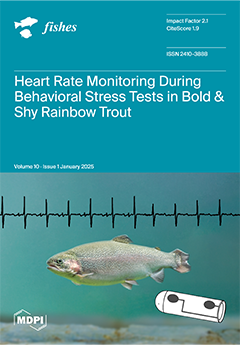
Cover Story: Monitoring stress in captive fish is essential for safeguarding their welfare. Rainbow trout exhibit distinct bold and shy personality traits. This study investigated whether personality influences heart rate during a series of stressful events. Trout were categorized as bold or shy using a novel object test and then implanted with biologgers for in vivo heart rate recording. Following recovery, the fish underwent a second novel object test, a confinement test, a pairwise contest, and an additional novel object test to assess whether boldness was consistent. Heart rate increased most during confinement followed by the pairwise contest with minimal change observed during the novel object test. No variation based upon personality was recorded, indicating that increases in heart rate may reflect stress irrespective of intra-specific behavioral differences. View this paper
  • Issues are regarded as officially published after their release is announced to the table of contents alert mailing list .
  • You may sign up for email alerts to receive table of contents of newly released issues.
  • PDF is the official format for papers published in both, html and pdf forms. To view the papers in pdf format, click on the "PDF Full-text" link, and use the free Adobe Reader to open them.

Articles (36)

  • Article
  • Open Access
1,988 Views
21 Pages

20 January 2025

Freshwater fish community surveys are an important component of aquatic ecosystem management. However, the standard method for taxonomic identification currently used for these surveys, wherein fishes are manually identified in the field by a taxonom...

  • Article
  • Open Access
1,331 Views
12 Pages

Report on Intersex and Abnormal Mature Aquacultured Walleye Pollock, Gadus chalcogrammus

  • Hae-Kyun Yoo,
  • Soo-Ji Woo,
  • Ki-Wook Lee,
  • Min-Soo Joo,
  • Kyeong-Duck Kim,
  • Jung-Jun Park and
  • So-Sun Kim

18 January 2025

Walleye pollock (Gadus chalcogrammus) is a commercially important species widely distributed in cold-water regions. We have been culturing this species artificially since 2015. The average embryo diameter was 1.43 ± 0.056 mm, and hatching occu...

  • Article
  • Open Access
3,430 Views
19 Pages

Garlic Powder Evaluation as Feed Additive on Nile Tilapia (Oreochromis niloticus L.) Growth Performance, Feed Utilization, Gill Parasitic Treatment, and Monogenean Diversity

  • Socorro Marisa Salgado-Moreno,
  • Ranferi Gutiérrez-Leyva,
  • Carlos Alfredo Carmona-Gasca,
  • Sergio Martínez-González,
  • José Carmen Ramírez-Ramírez,
  • Carlos Omar De La Cruz-Moreno and
  • Juan José Fernando Borrayo-González

18 January 2025

The present study evaluates garlic powder (GP) effects on growth performance, feed utilization, gill parasitic treatment, and monogenean diversity. Thus, a trial was performed under controlled conditions with 84 juvenile Nile tilapia, Oreochromis nil...

  • Article
  • Open Access
1 Citations
3,127 Views
21 Pages

16 January 2025

Chinese herbal medicines have become a new green feed additive in the aquaculture industry. The aim of this study is to investigate the effects of traditional Chinese herbal medicines (Isatidis radix, Forsythia suspensa, and Schisandra chinensis) on...

  • Article
  • Open Access
1,320 Views
16 Pages

Bile Imprint on Parietal Peritoneum of Gilthead Seabream and Red Seabream: Effects of Fasting Duration, Stress, and Ice Storage

  • Sofia Brinkmann Bougali,
  • Nafsika Karakatsouli,
  • Christos Balaskas,
  • Konstantinos Petropoulos,
  • Despoina Trampouli,
  • Alkisti Batzina and
  • Pinelopi-Paraskevi Laskari

15 January 2025

The Mediterranean aquaculture industry has recently been confronted with the appearance of a bile imprint on fish filets, which to-date remains of unknown etiology. This study investigates the involvement of common procedures applied before (fasting)...

  • Article
  • Open Access
1,577 Views
19 Pages

The Tasmanian Estuary Perch Population—A Threatened Species?

  • Jonah L. Yick,
  • Bryan Van Wyk and
  • James Haddy

15 January 2025

Estuary perch (Percalates colonorum) are a long-lived and slow-growing species which are distributed throughout southeastern Australian estuaries. In Tasmania, only one known population remains which is located in the Arthur River, on the remote nort...

  • Article
  • Open Access
4 Citations
2,263 Views
21 Pages

14 January 2025

Fishing vessels are known to have a fatality rate from accidents nearly 100 times higher than that of merchant ships. However, since most cases are resolved internally without maritime tribunals, obtaining accurate statistics on accidents is challeng...

  • Article
  • Open Access
1 Citations
1,442 Views
17 Pages

Study on the Role and Pathological and Immune Responses of Silver Nanoparticles Against Two Aeromonas salmonicida subsp. salmonicida Strains at Different Virulence Levels in Rainbow Trout (Oncorhynchus mykiss)

  • Yunqiang Guo,
  • Chaoli Zheng,
  • Yingfei Wang,
  • Yongji Dang,
  • Ruiyuan Li,
  • Ye Tao,
  • Yucheng Yang,
  • Xiaofeng Sun,
  • Zekun Song and
  • Pengcheng Sun
  • + 12 authors

13 January 2025

Aeromonas species are among the main pathogens causing rainbow trout infections. Silver nanoparticles (AgNPs) have a broad spectrum of antimicrobial properties and are usually produced by various green-synthesis methods. However, the application of c...

  • Article
  • Open Access
5 Citations
2,280 Views
15 Pages

Functional Involvement of Melatonin and Its Receptors in Reproductive Regulation of the Marine Teleost, Large Yellow Croaker (Larimichthys crocea)

  • Xudong Liang,
  • Jixiu Wang,
  • Baoyi Huang,
  • Haojie Yuan,
  • Yucheng Ren,
  • Chenqian Wu,
  • Tianming Wang and
  • Jingwen Yang

10 January 2025

Melatonin is a critical regulator of biological rhythms across organisms, transducing light signals into neuroendocrine signals that facilitate reproductive regulation in response to environmental cues. However, the precise mechanisms through which m...

  • Feature Paper
  • Article
  • Open Access
2 Citations
1,333 Views
16 Pages

9 January 2025

The costly production of live microalgal feed prevents the inclusion of an extended nursery phase in bivalve aquaculture. One method of feeding juvenile bivalves that has received minimal attention is the use of dissolved nutrients to reduce the reli...

of 4

Get Alerted

Add your email address to receive forthcoming issues of this journal.

XFacebookLinkedIn
Fishes - ISSN 2410-3888