


You are currently viewing a new version of our website. To view the old version click .

Biomimetics, Volume 10, Issue 2

February 2025 - 59 articles

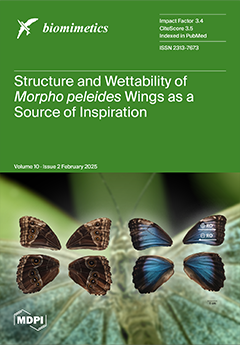
Cover Story: Natural surfaces have intricate topographies, giving them unique wettability behaviors. However, correlating topography and wettability remains challenging. In Morpho peleides, micro- and nanostructures are crucial for survival. This paper analyzes the wetting properties of Morpho peleides wings, examining the role of topography and surface chemistry. Structures responsible for wettability are studied via scanning electron and atomic force microscopy. Wettability is characterized through static contact and sliding angle measurements. To clarify roughness contributions, the models of Extrand and Rahmawan et al. are applied. Understanding these mechanisms offers insights into bioinspired surfaces with self-cleaning, anti-icing, and anti-corrosive properties. View this paper
  • Issues are regarded as officially published after their release is announced to the table of contents alert mailing list .
  • You may sign up for email alerts to receive table of contents of newly released issues.
  • PDF is the official format for papers published in both, html and pdf forms. To view the papers in pdf format, click on the "PDF Full-text" link, and use the free Adobe Reader to open them.

Articles (59)

  • Article
  • Open Access
2 Citations
1,427 Views
13 Pages

Expanding the Applicability of Electroactive Polymers for Tissue Engineering Through Surface Biofunctionalization

  • Beatriz Leiva,
  • Igor Irastorza,
  • Andrea Moneo,
  • Gaskon Ibarretxe,
  • Unai Silvan and
  • Senentxu Lanceros-Méndez

19 February 2025

Polyvinylidene fluoride (PVDF) is a synthetic semicrystalline fluoropolymer with great potential for tissue engineering applications. In addition to its excellent mechanical strength, thermal stability, biocompatibility and simple processability into...

  • Review
  • Open Access
19 Citations
3,115 Views
18 Pages

19 February 2025

The sector of 4D printing represents a new frontier in additive manufacturing that allows for a material’s capability to adapt and respond to various stimuli, such as thermal transitions, humidity, and pH levels. The adaptability of such a mate...

  • Review
  • Open Access
5 Citations
8,972 Views
26 Pages

19 February 2025

Biomimicry architecture provides innovative solutions to contemporary environmental challenges by drawing inspiration from nature’s strategies to enhance sustainability and energy efficiency in the built environment. Plants, with their remarkab...

  • Article
  • Open Access
2 Citations
1,259 Views
13 Pages

Effect of Different Luting Methods on the Microtensile Bond Strength of CAD/CAM Resin Blocks

  • Alexandra Vinagre,
  • Carla Delgado,
  • Gabriela Almeida,
  • Ana Messias and
  • João Carlos Ramos

19 February 2025

The widespread implementation of new CAD/CAM materials has led to the necessity of establishing an adequate luting protocol. The aim of this study was to evaluate the microtensile bond strength (μTBS) and the film thickness of different luting met...

  • Article
  • Open Access
2,881 Views
26 Pages

Biomimicry-Based Design of Underground Cold Storage Facilities: Energy Efficiency and Sustainability

  • Mugdha Kshirsagar,
  • Sanjay Kulkarni,
  • Ankush Kumar Meena,
  • Danby Caetano D’costa,
  • Aroushi Bhagwat,
  • Md Irfanul Haque Siddiqui and
  • Dan Dobrotă

18 February 2025

Underground cold storage gives rise to special challenges that require innovative solutions to ensure maximum energy efficiency. Conventional energy systems tend to be based on high energy use, so sustainable solutions are crucial. This study explore...

  • Review
  • Open Access
3,428 Views
20 Pages

Flash Memory for Synaptic Plasticity in Neuromorphic Computing: A Review

  • Jisung Im,
  • Sangyeon Pak,
  • Sung-Yun Woo,
  • Wonjun Shin and
  • Sung-Tae Lee

18 February 2025

The rapid expansion of data has made global access easier, but it also demands increasing amounts of energy for data storage and processing. In response, neuromorphic electronics, inspired by the functionality of biological neurons and synapses, have...

  • Article
  • Open Access
1,643 Views
20 Pages

Treating White Spot Lesions and Non-Carious Cervical Lesions with Amelogenin Peptide-Based Hydrogel

  • Erika Bauza Nowotny,
  • Salony Jassar,
  • Jin-Ho Phark and
  • Janet Moradian-Oldak

18 February 2025

Peptide-based biomimetic treatments have gained increased attention in the dental field due to their biocompatibility and minimally invasive qualities. These biomimetic approaches can replicate the native architecture of dental tissues, thus contribu...

  • Article
  • Open Access
1,368 Views
20 Pages

18 February 2025

This study presents a comprehensive three-dimensional finite element (FE) model inspired by the biomechanics of the human knee, specifically the tibiofemoral joint during the gait cycle. Drawing from natural biological systems, the model integrates b...

  • Article
  • Open Access
3 Citations
1,590 Views
22 Pages

18 February 2025

Brain–computer interface (BCI)-based assistive technologies enable intuitive and efficient user interaction, significantly enhancing the independence and quality of life of elderly and disabled individuals. Although existing wet EEG-based syste...

  • Article
  • Open Access
2 Citations
1,201 Views
15 Pages

In Vivo Vascularization of Cell-Supplemented Spider Silk-Based Hydrogels in the Arteriovenous Loop Model

  • Justus Osterloh,
  • Stefanie Heltmann-Meyer,
  • Vanessa T. Trossmann,
  • Aijia Cai,
  • Yvonne Kulicke,
  • Klara Terörde,
  • Celena A. Sörgel,
  • Isabell Lang,
  • Harald Wajant and
  • Thomas Scheibel
  • + 4 authors

18 February 2025

The goal of reconstructive surgery in treating tissue defects is to achieve a stable reconstructive outcome while minimizing donor site morbidity. As a result, tissue engineering has emerged as a key focus in the pursuit of this goal. One approach is...

of 6

Get Alerted

Add your email address to receive forthcoming issues of this journal.

XFacebookLinkedIn
Biomimetics - ISSN 2313-7673