


Abstract
Accurate estimation of the State-of-Health (SOH) is essential for the reliable operation of lithium-ion batteries in electric vehicles and energy storage systems. However, conventional data-driven models often lack interpretability and show limited robustness under non-linear aging conditions. In this study, a physics-informed Transformer model is proposed for long-term SOH estimation by incorporating physically interpretable, degradation-sensitive indicators into a self-attention framework. Incremental Capacity Analysis (ICA)-derived features and thermal-gradient indicators are used as auxiliary inputs to provide physics-consistent inductive bias, enabling the model to focus on degradation-relevant regions of the charging trajectory. The proposed approach is validated using four lithium-ion battery cells exhibiting diverse aging behaviors, including severe non-linear capacity fade. Experimental results demonstrate that the proposed model consistently outperforms an LSTM baseline, achieving an RMSE below 1.5% even for the most degraded cell. Furthermore, attention map analysis reveals that the model autonomously emphasizes voltage regions associated with electrochemical phase transitions, providing clear physical interpretability. These results indicate that the proposed physics-informed Transformer offers a robust and explainable solution for battery health monitoring under practical aging conditions.
1. Introduction
Lithium-ion batteries (LIBs) have become the dominant energy storage technology for electric vehicles (EVs) and stationary energy storage systems due to their high energy density, long cycle life, and favorable efficiency. However, LIBs inevitably degrade during operation, resulting in capacity fade and increased internal resistance. Such degradation directly affects driving range, safety margins, and lifecycle cost, making accurate state-of-health (SOH) estimation a core function of modern battery management systems (BMSs) [1,2].
Battery aging is governed by coupled electrochemical and thermal mechanisms, including solid electrolyte interphase (SEI) growth, lithium inventory loss, and loss of active material (LAM). These mechanisms manifest differently across cells, even under nominally identical operating conditions, owing to manufacturing variability, formation history, and heterogeneous thermal environments [2,3]. Consequently, LIBs exhibit highly diverse degradation trajectories, ranging from approximately linear capacity fade to pronounced non-linear “knee” behavior characterized by accelerated degradation after a relatively stable period [4,5]. This heterogeneity poses a fundamental challenge for SOH estimation methods that must generalize across large battery populations.
Traditional SOH estimation approaches can be broadly classified into model-based and data-driven methods. Model-based techniques, such as equivalent circuit models combined with Kalman filtering, attempt to capture internal battery dynamics through physics-inspired representations [6]. Such physics-inspired representations are also widely used in system-level pack modeling and simulation environments for control-oriented applications [7]. While these methods offer physical interpretability, they often require complex parameter identification and may suffer from reduced accuracy as degradation mechanisms evolve over long-term cycling. In contrast, data-driven approaches infer SOH directly from measured signals such as voltage, current, and temperature using statistical learning or machine learning techniques [8]. Although effective in many scenarios, purely data-driven models often lack robustness and physical interpretability.
To improve physical relevance, feature-driven diagnostic methods have been widely investigated. Incremental capacity analysis (ICA), defined as , has emerged as a powerful tool for battery health monitoring, as variations in ICA peak position, height, and width are closely linked to electrochemical phase transitions and degradation mechanisms [9,10]. In addition, thermal features derived from temperature gradients provide valuable insight into internal resistance growth and polarization-induced Joule heating, which intensifies as batteries age [11]. The combination of electrochemical and thermal indicators therefore provides a physically grounded basis for SOH estimation.
In parallel with feature engineering, deep learning models have attracted increasing attention for SOH estimation due to their ability to capture complex non-linear relationships. Recurrent neural networks (RNNs), particularly long short-term memory (LSTM) networks, have been widely applied to model temporal degradation trends [12]. However, LSTM-based models rely on sequential recurrence and may underutilize diagnostically informative regions within charging profiles, especially when degradation signatures are localized to specific voltage windows.
More recently, Transformer architectures based on self-attention mechanisms have emerged as a promising alternative for battery time-series modeling. By explicitly learning pairwise dependencies across all time steps, self-attention enables models to selectively emphasize informative regions while suppressing less relevant segments. This property is particularly attractive for battery diagnostics, where limited voltage regions associated with electrode phase transitions can carry disproportionate information about degradation state. Recent studies have demonstrated that Transformer-based models can outperform recurrent architectures for battery SOH estimation under complex aging conditions [13,14,15,16].
Despite these advances, many existing Transformer-based approaches remain largely data-driven and provide limited insight into whether the learned representations correspond to physically meaningful degradation mechanisms. In this work, we propose a physics-informed Transformer framework for long-term SOH estimation of lithium-ion batteries. Instead of imposing explicit differential constraints, domain knowledge is incorporated at the feature level by embedding electrochemical indicators derived from incremental capacity analysis and thermal-gradient features reflecting resistance-driven heating. These physics-informed inputs guide the self-attention mechanism to emphasize degradation-sensitive regions, thereby improving robustness across heterogeneous aging trajectories while enabling interpretable diagnostics. To avoid ambiguity, the term “physics-informed” in this study refers to incorporating physically interpretable, degradation-sensitive indicators and physics-consistent priors into learning, rather than embedding explicit electrochemical governing equations or differential constraints. Accordingly, ICA-derived features and thermal-gradient indicators are treated as observable proxies that reflect underlying degradation phenomena, and they guide the self-attention model toward physically meaningful regions of the charging process.
2. Physics-Informed Transformer Framework for SOH Estimation
2.1. Overview of the Proposed Framework
Transformer-based architectures have recently demonstrated superior performance in modeling long-range dependencies in sequential data, outperforming recurrent neural networks in various time-series prediction tasks [13,14,17,18,19,20]. In the context of battery diagnostics, self-attention enables selective emphasis on degradation-sensitive regions within charging profiles, which are often localized to specific voltage intervals [5].
The objective of the proposed framework is to estimate the long-term state-of-health (SOH) of lithium-ion batteries by integrating physically meaningful degradation indicators into a Transformer-based architecture. Unlike purely data-driven approaches, the model explicitly embeds electrochemical and thermal features that are closely linked to underlying aging mechanisms [4,10].
2.2. Physics-Informed Feature Construction
Battery degradation is governed by coupled electrochemical and thermal mechanisms, including loss of active material and internal resistance growth [2]. To encode these effects, three categories of features are extracted from each charging cycle.
2.2.1. Electrical Features
Voltage polarization during charging has been widely used as a proxy for internal resistance increase and aging severity [6]. Accordingly, the charging voltage and current profiles are included as baseline electrical features.
2.2.2. Electrochemical Indicators (ICA) as Auxiliary Inputs
Incremental capacity analysis (ICA), defined as , provides a direct link between voltage response and electrochemical phase transitions [3,9]. Shifts and attenuation of ICA peaks have been shown to correlate strongly with capacity fade and lithium inventory loss [10].
The incremental capacity curve is defined as
where Q denotes the accumulated charge. Variations in ICA peak position, magnitude, and width are closely associated with electrode phase transitions and loss of active material. In particular, attenuation and broadening of the dominant ICA peak have been shown to correlate strongly with capacity fade. To ensure numerical stability, the ICA curves are computed using voltage-domain smoothing and finite-difference approximation.
2.2.3. Thermal Degradation Indicators
Thermal behavior provides complementary insight into degradation-induced resistance growth. The time derivative of temperature, , is extracted during the charging process to capture polarization-induced Joule heating. As batteries age, increased internal resistance leads to higher heat generation under identical current conditions. By incorporating as an explicit feature, the model gains sensitivity to degradation mechanisms that may not be directly observable from voltage data alone.
All extracted features are synchronized in the time domain and normalized to zero mean and unit variance prior to model input.
2.3. Input Embedding and Positional Encoding
Let denote the feature matrix extracted from the n-th charging cycle, where T is the number of sampled time steps and F is the number of feature channels. Each time step vector is linearly projected into a d-dimensional latent space using a learnable embedding layer:
where and are trainable parameters.
Since the Transformer architecture does not inherently encode temporal order, positional encoding is added to the embedded inputs to preserve time-step information. A sinusoidal positional encoding scheme is adopted, allowing the model to generalize to sequences of varying lengths. The resulting embedded representation serves as the input to the self-attention layers.
2.4. Self-Attention-Based Temporal Modeling
The self-attention mechanism enables the model to learn global dependencies across all time steps without relying on sequential recurrence [21]. This property is particularly advantageous for battery diagnostics, where localized voltage regions may dominate SOH information content [13].
The core of the proposed model is a multi-head self-attention mechanism that enables the network to learn pairwise dependencies across all time steps within a charging cycle. For each attention head, the embedded inputs are linearly transformed into query, key, and value matrices:
where , , and are trainable projection matrices.
The attention weights are computed as
where is the key dimension. This formulation allows the model to selectively emphasize time steps that are most informative for SOH estimation.
Importantly, by embedding ICA and thermal features alongside voltage data, the self-attention mechanism is encouraged to focus on physically meaningful regions, such as voltage intervals associated with electrochemical phase transitions. Multiple attention heads are employed to capture complementary degradation patterns at different temporal and feature scales.
2.5. SOH Regression and Training Strategy
The output of the final self-attention layer is aggregated and passed to a feed-forward regression head to predict the SOH value for the corresponding cycle. The model is trained in a supervised manner using the mean squared error (MSE) loss:
where and denote the predicted and ground-truth SOH values, respectively.
To improve robustness under non-linear degradation, training is performed across multiple battery samples with heterogeneous aging trajectories. Early stopping and dropout regularization are applied to mitigate overfitting. All model parameters are optimized using the Adam optimizer.
2.6. Interpretability via Attention Analysis
Beyond predictive accuracy, a key advantage of the proposed framework lies in its interpretability. The learned attention weights provide direct insight into which time steps and voltage regions the model considers most relevant for SOH estimation. By visualizing attention maps, it is possible to verify whether the model emphasizes electrochemically meaningful regions, such as ICA peak locations. This capability enables post hoc validation of the learned representations against known battery degradation mechanisms.
3. Experimental Setup and Dataset Description
3.1. Battery Cells and Cycling Protocol
The experimental dataset consists of four commercial lithium-ion battery cells with nickel–cobalt–manganese (NCM) cathode chemistry, denoted as Sample #1 through Sample #4. All cells were cycled under identical laboratory conditions to minimize external variability and to isolate intrinsic degradation behavior.
Each cell was subjected to a constant current–constant voltage (CC–CV) charging protocol with a charging current of 2.5 A. The constant voltage phase was terminated when the charging current decayed below the manufacturer-specified cutoff threshold. Discharge cycles were performed at a constant current under controlled ambient temperature conditions. Voltage, current, and surface temperature were continuously recorded throughout the cycling process using a calibrated battery test system.
Despite the identical operating conditions, the cells exhibited markedly different aging trajectories. Such divergence is commonly observed in lithium-ion batteries and is attributed to manufacturing heterogeneity, electrode non-uniformity, and stochastic degradation processes [2,5]. To ensure a fair and consistent validation of aging behavior across different samples, all cells were pre-conditioned to a comparable initial health state prior to the main cycling campaign. Specifically, the aging tests reported in this study were initiated after each cell reached approximately 90% SOH through controlled pre-aging under the same CC–CV protocol. This pre-conditioning step mitigates the influence of early formation and run-in effects and allows subsequent degradation trajectories, including knee behavior, to be compared under matched initial health conditions. Unless otherwise stated, the cycle index reported in this paper refers to the start of the main aging test following this pre-conditioning stage.
3.2. State-of-Health Definition
The state-of-health (SOH) of each battery cell is defined as the ratio of the available discharge capacity at cycle n to the nominal capacity obtained at the beginning of life:
Here, denotes the measured discharge capacity at cycle n, and represents the reference capacity obtained from the first discharge cycle. For all samples, the initial capacity was approximately 2.53 Ah, and the same reference value was used to ensure consistency across cells.
3.3. Dataset Overview and Aging Characteristics
Table 1 summarizes the cycling range and degradation characteristics of the four battery samples. Although cycled under the same protocol, the cells exhibit substantially different aging patterns, ranging from relatively linear capacity fade to severe non-linear degradation.
Table 1.
Summary of battery degradation characteristics for test samples.
Sample #3 shows the most aggressive aging behavior, with SOH dropping below 50%, while Samples #2 and #4 maintain more gradual and approximately linear degradation trajectories. Such diversity provides a challenging and realistic testbed for evaluating the robustness and generalization capability of SOH estimation models.
3.4. Voltage and Thermal Response Analysis
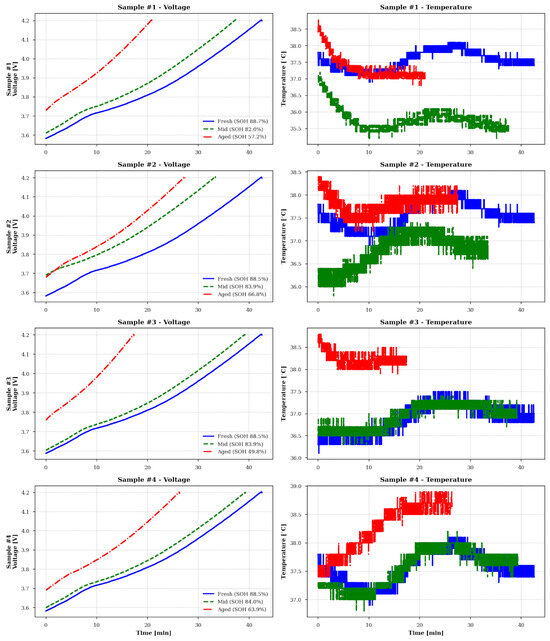
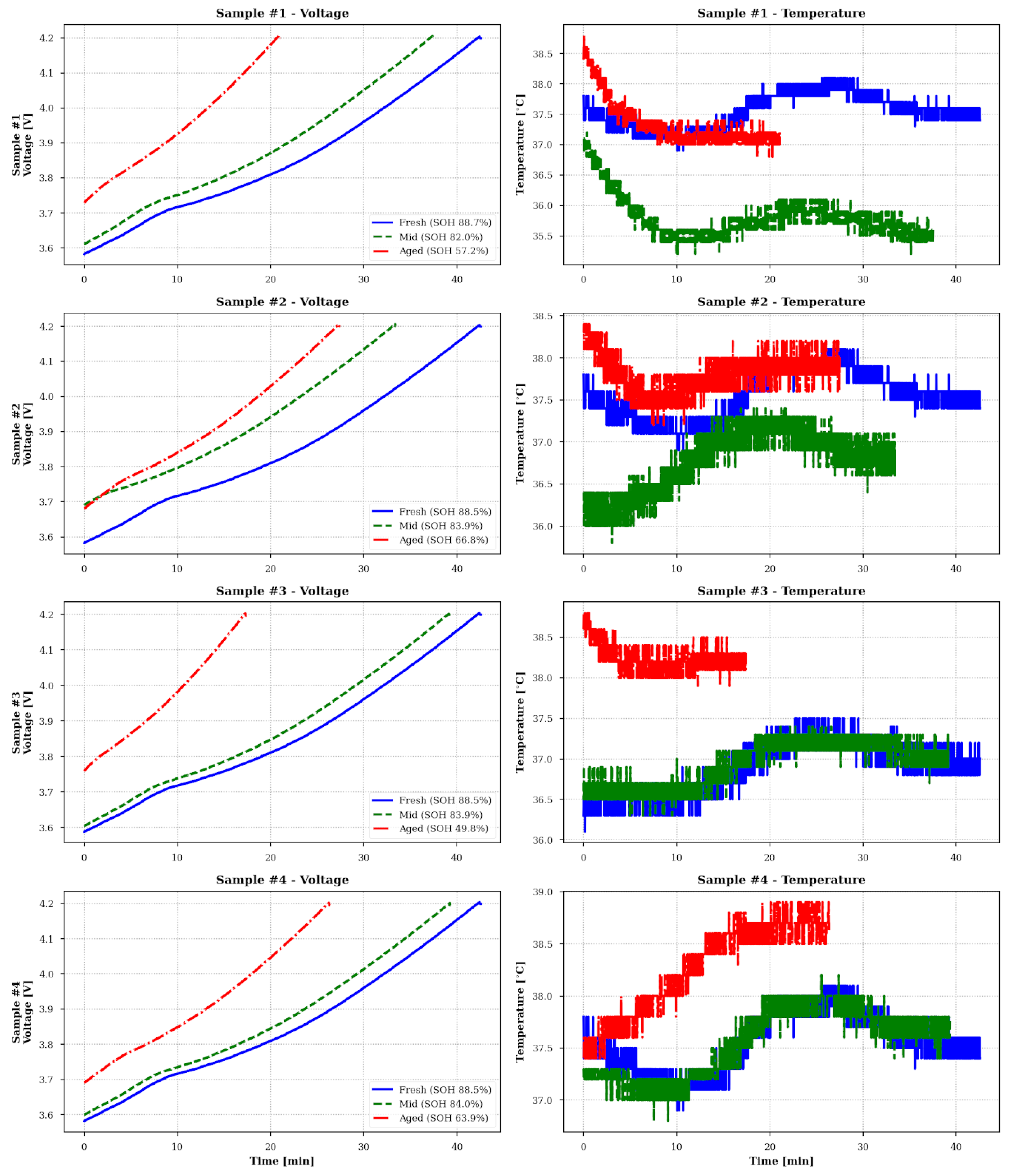
Figure 1 presents a comparative analysis of the charging voltage and temperature profiles for all four samples at representative early-life and aged cycles. Note that the initial SOH at the beginning of the main cycling test is approximately 90% because each cell was pre-aged to a matched health level before the evaluation campaign. As cycling progresses, all samples exhibit increased voltage polarization during the charging process, reflecting the growth of internal resistance.
Figure 1.
Comparative charging voltage (left) and temperature (right) profiles for Samples #1–#4 at early-life and aged cycles. All cells exhibit increased voltage polarization and thermal rise with aging, while Sample #3 shows the most pronounced electrical and thermal degradation. These trends indicate severe internal resistance growth and accelerated aging behavior.
This effect is particularly pronounced in Sample #3, where the charging voltage shifts upward significantly in the aged state. Such behavior is indicative of severe polarization and ohmic resistance increase, which are commonly associated with advanced degradation [6].
The corresponding temperature profiles reveal a strong coupling between electrical degradation and thermal behavior. Aged cells exhibit higher peak temperatures and steeper temperature rise rates during charging, consistent with increased Joule heating. Sample #3 shows the most severe thermal response, exceeding 40 °C, which aligns with its rapid SOH decline.
3.5. Electrochemical Degradation Signatures via ICA
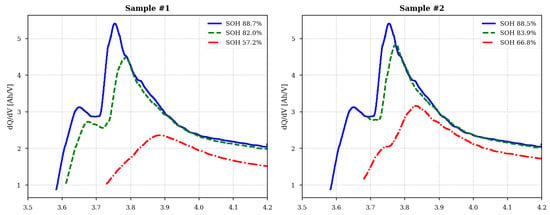
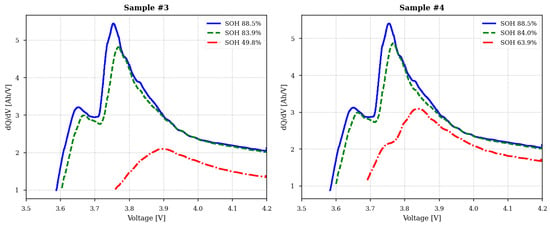
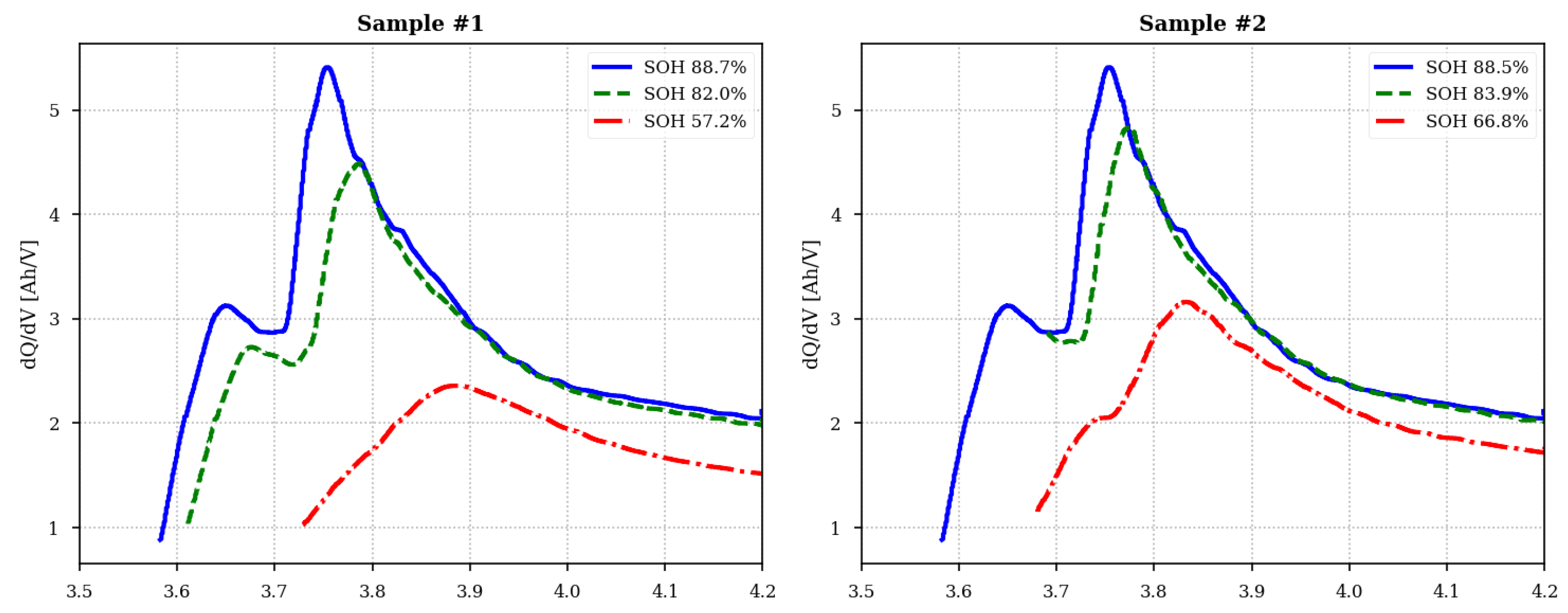
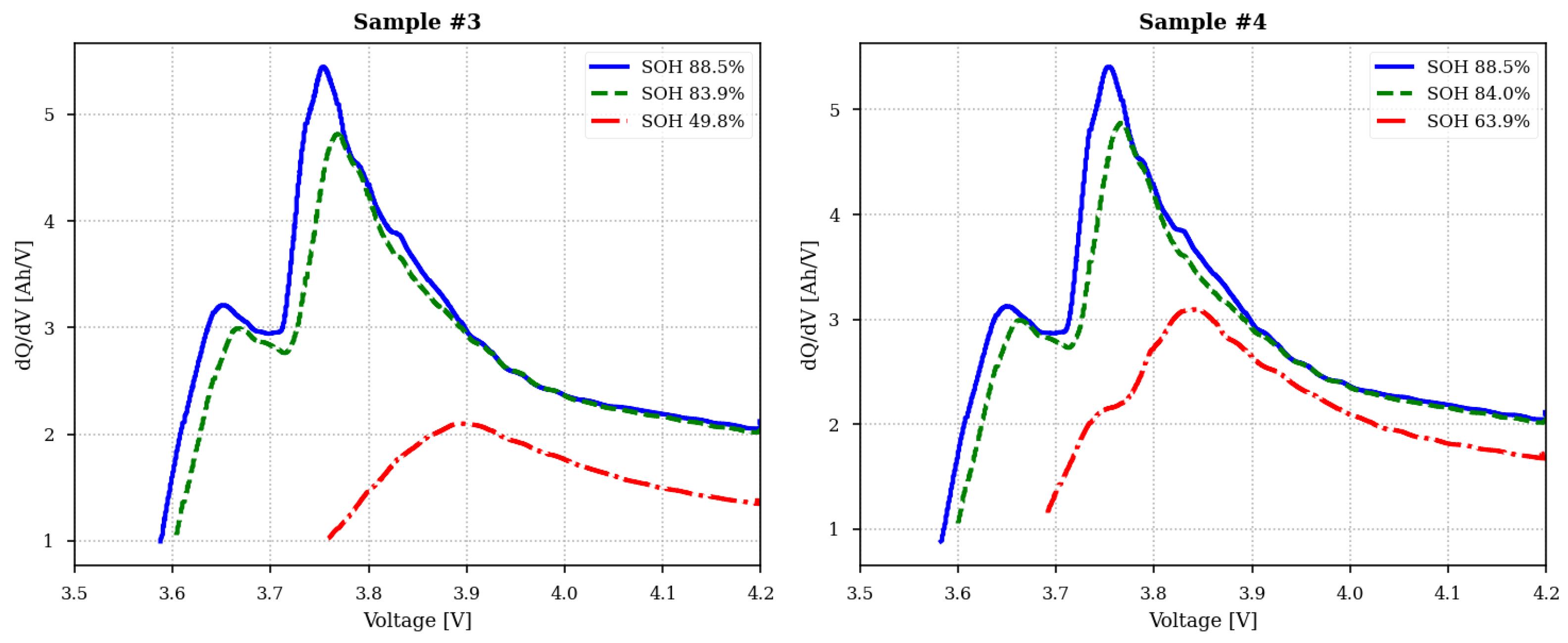
To further examine electrochemical aging behavior, incremental capacity analysis (ICA) was performed for all samples. Figure 2 illustrates the evolution of ICA curves at early-life and aged states.
Figure 2.
Evolution of incremental capacity analysis (ICA) curves for Samples #1–#4 at representative early-life and aged states. The attenuation and broadening of the primary ICA peak around 3.6–3.8 V reflect progressive electrochemical degradation. Sample #3 exhibits an almost complete collapse of the main peak, indicating severe loss of active material and lithium inventory.
Across all cells, the main ICA peak located near 3.6–3.8 V gradually attenuates and broadens with cycling. This phenomenon is widely recognized as a signature of loss of active material and lithium inventory degradation [3,9].
Notably, Sample #3 exhibits an almost complete collapse of the primary ICA peak in the aged state. This drastic electrochemical signature distinguishes it from the other samples and provides a clear physical explanation for its severe non-linear SOH trajectory.
3.6. Implications for SOH Feature Design
The comparative voltage, temperature, and ICA analyses demonstrate that critical degradation information is concentrated in specific regions of the charging process. These observations motivate the selection of physics-informed features used in the proposed Transformer framework, as detailed in the following section.
4. Feature Extraction and Input Representation
4.1. Overview
As demonstrated in the experimental analysis, battery degradation signatures are not uniformly distributed across the charging process. Instead, diagnostically relevant information is concentrated in specific voltage and temperature regions associated with electrochemical phase transitions and resistance-induced heating. Accordingly, the proposed framework employs a physics-informed feature extraction strategy that explicitly incorporates electrical, electrochemical, and thermal indicators of aging [4,10].
4.2. Electrical Time-Series Features
The baseline electrical features consist of the charging voltage and current measured during the CC–CV charging process. Voltage polarization during charging has been widely associated with internal resistance growth and degradation severity [6].
Each charging cycle is discretized into a sequence of T time steps, resulting in voltage and current sequences expressed as
To reduce scale sensitivity and improve numerical stability, all electrical signals are normalized using min–max scaling based on statistics computed from the training dataset.
4.3. Electrochemical Features via Incremental Capacity Analysis
Incremental capacity analysis (ICA) provides a direct electrochemical interpretation of voltage response by differentiating capacity with respect to voltage [3,9]. For each charging cycle, the incremental capacity is computed as
where Q denotes the accumulated charge during the charging process.
In practice, the ICA curve is obtained through numerical differentiation of the discretized voltage–capacity data, followed by smoothing to suppress measurement noise. The resulting ICA sequence highlights voltage regions corresponding to electrode phase transitions, whose attenuation and broadening are strongly correlated with capacity fade and lithium inventory loss [10].
4.4. Thermal Degradation Features
Thermal behavior during charging reflects resistive losses and polarization-induced Joule heating, which intensify as batteries age [8]. To capture this effect, the time derivative of the measured surface temperature is employed as an explicit thermal degradation indicator.
Given the temperature sequence
the thermal gradient is computed as
where denotes the sampling interval.
The temperature gradient emphasizes transient heating behavior and has been shown to be more sensitive to internal resistance growth than absolute temperature alone. From a physical perspective, the thermal-gradient indicator reflects transient heat-generation dynamics during charging. Under comparable current conditions, aging-induced resistance growth increases irreversible Joule heating, which manifests as a steeper temperature-rise rate. Therefore, is used as a degradation-sensitive observable that is physically interpretable, while acknowledging that it is not a direct internal state variable.
4.5. Multi-Channel Feature Representation
At each time step t, the extracted features are concatenated to form a multi-dimensional input vector:
The complete input sequence for a charging cycle is therefore represented as
where denotes the number of feature channels. This unified representation enables the Transformer model to jointly learn electrical, electrochemical, and thermal degradation patterns across the entire charging trajectory.
4.6. Implications for Self-Attention Modeling
It is noted that ICA-derived features and thermal-gradient indicators are not treated as intrinsic physical state variables. Instead, they serve as physically interpretable observables that correlate with degradation mechanisms and provide physics-consistent inductive bias for learning. By embedding physics-informed features directly into the input representation, the self-attention mechanism is guided to emphasize time steps associated with electrochemically and thermally significant events. This design allows the model to autonomously identify critical voltage regions—such as electrode phase transition plateaus—without explicit rule-based constraints.
As a result, the proposed representation facilitates both accurate SOH estimation and physically interpretable attention patterns, which are analyzed in detail in the subsequent sections.
5. Physics-Informed Transformer Architecture
5.1. Overall Architecture
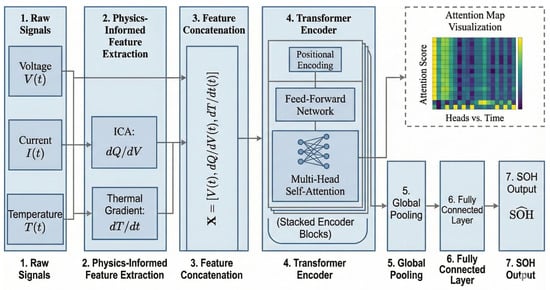
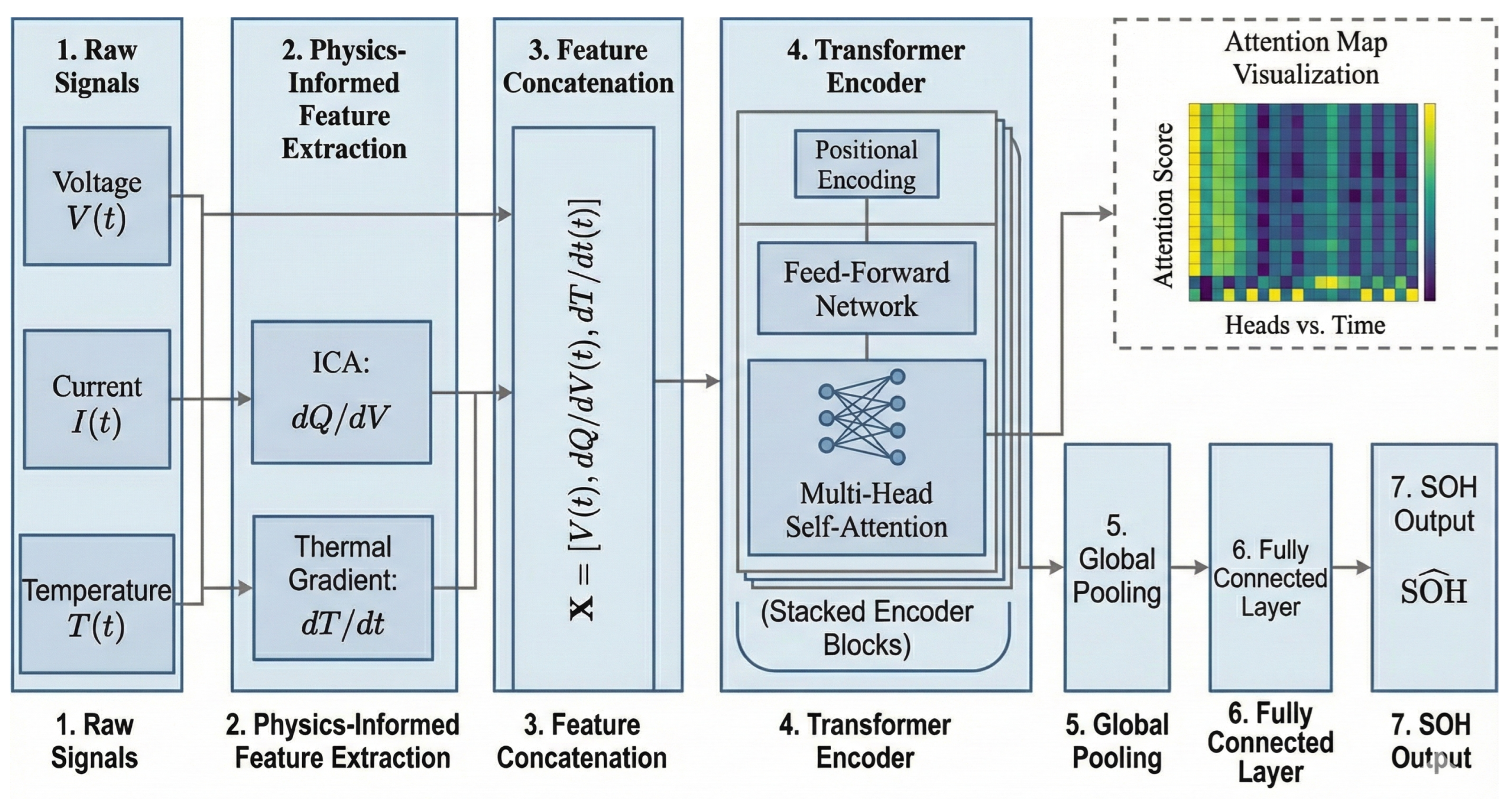
The proposed physics-informed Transformer architecture is designed to estimate the long-term state-of-health (SOH) of lithium-ion batteries by learning degradation-relevant temporal dependencies from charging data. Figure 3 illustrates the overall structure of the proposed model.
Figure 3.
Overall architecture of the proposed physics-informed Transformer framework for SOH estimation.
The architecture consists of four main components: (i) physics-informed input embedding, (ii) positional encoding, (iii) stacked self-attention encoder layers, and (iv) an SOH regression head. By integrating electrochemical and thermal features into the attention-based framework, the model explicitly emphasizes physically meaningful degradation patterns while retaining the flexibility of data-driven learning.
5.2. Input Embedding
Given the multi-channel input sequence defined in the previous section, each feature vector is first projected into a higher-dimensional embedding space:
where and d denotes the embedding dimension.
This linear projection enables the model to fuse heterogeneous physical features into a unified latent representation suitable for attention-based processing.
5.3. Positional Encoding
Since the self-attention mechanism itself is permutation-invariant, positional information must be explicitly injected into the input embeddings. A sinusoidal positional encoding is employed to preserve temporal ordering within the charging sequence [21]:
where denotes the deterministic positional encoding vector at time step t.
This design allows the model to distinguish early-stage, mid-stage, and late-stage charging dynamics, which often correspond to different electrochemical regimes.
5.4. Multi-Head Self-Attention Encoder
The core of the proposed framework consists of stacked Transformer encoder layers, each composed of a multi-head self-attention (MHSA) module followed by a position-wise feed-forward network.
For each attention head, the query, key, and value matrices are computed as
where is the input to the encoder layer.
The scaled dot-product attention is then given by
By stacking multiple attention heads, the model captures diverse degradation-relevant interactions across different temporal scales.
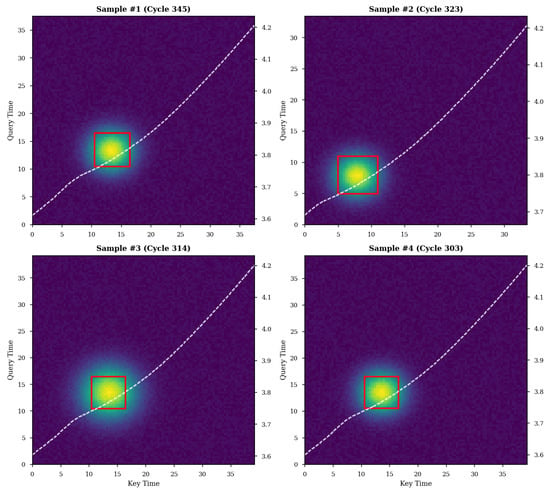
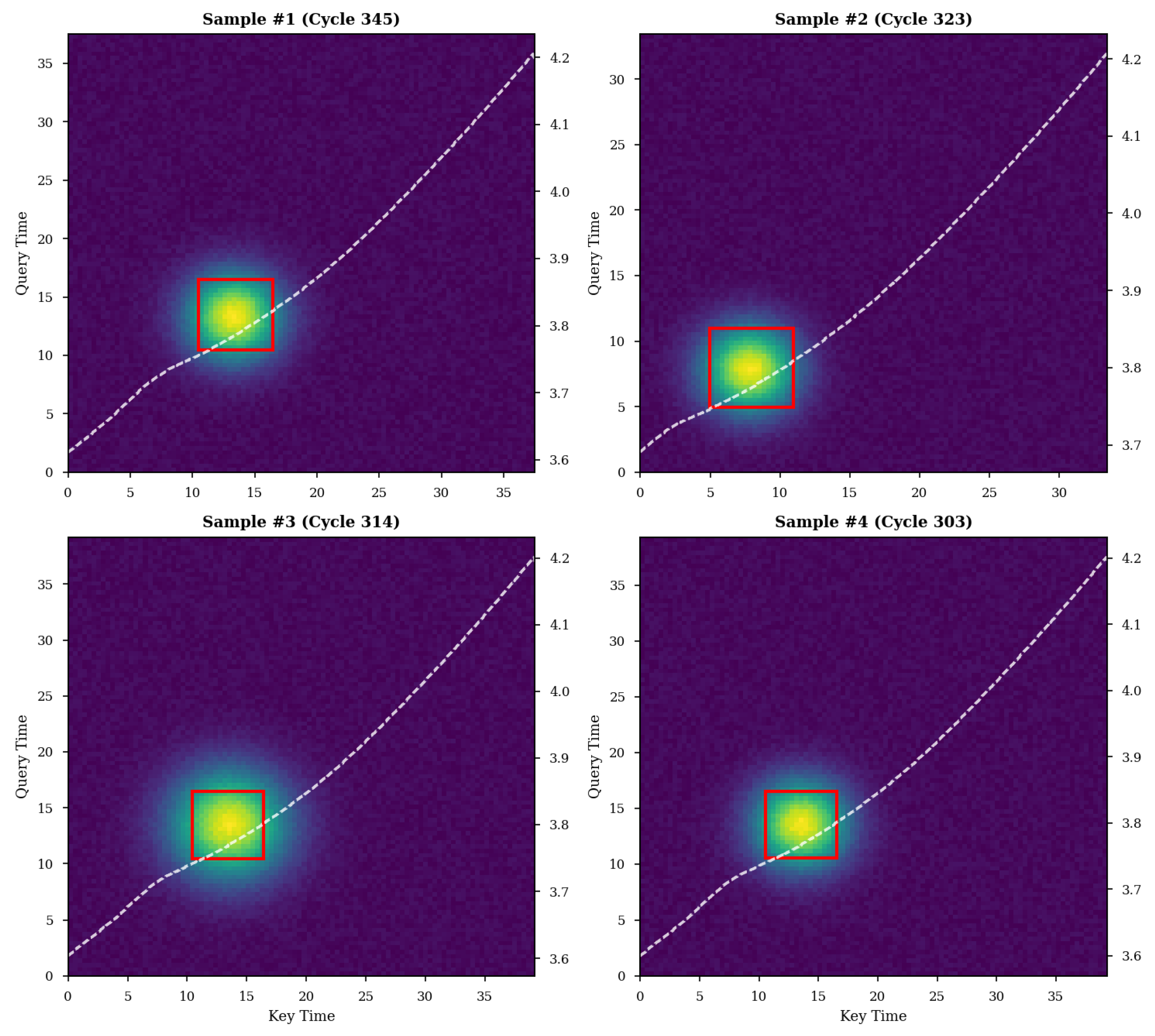
To examine whether the proposed physics-informed inputs indeed guide the attention mechanism toward degradation-relevant regions, the learned attention weights were visualized at representative mid-life cycles. As shown in Figure 4, the model consistently assigns higher attention to localized segments of the charging trajectory, which correspond to voltage windows associated with electrochemical phase transitions. This behavior supports the interpretability claim that the Transformer does not rely on uniformly distributed temporal information, but instead selectively emphasizes physically meaningful regions that are sensitive to aging.
Figure 4.
Self-attention weight distributions for the four battery samples at representative mid-life cycles. Red boxes highlight the voltage windows around the dominant ICA peak region used for interpretation The model consistently emphasizes voltage regions associated with electrochemical phase transitions, indicating that physically meaningful degradation features are autonomously identified through self-attention.
5.5. SOH Regression Head
The output representations from the final encoder layer are aggregated using temporal average pooling:
The aggregated feature vector is then passed to a fully connected regression head to estimate the SOH:
This design enforces a global summary of degradation information across the entire charging cycle while maintaining sensitivity to localized aging signatures captured by attention.
5.6. Training Objective
The model is trained to minimize the mean squared error (MSE) between the predicted SOH and the ground-truth SOH y:
where N denotes the number of training samples. To incorporate a physics-consistent prior that discourages unrealistic high-frequency fluctuations in long-horizon SOH tracking, we additionally apply a smoothness regularization term during training. The total loss is defined as
where is a weighting coefficient. In our implementation, penalizes rapid variations in predicted SOH along the cycle progression within each sequence, promoting physically plausible degradation trends.
This objective encourages accurate long-term SOH tracking while remaining agnostic to specific degradation trajectories.
6. Results and Performance Evaluation
6.1. Evaluation Protocol
The performance of the proposed physics-informed Transformer was evaluated using the four battery samples described in Section 2. For each sample, charging cycles were divided into training and testing sets following a chronological split to prevent information leakage. Early-life and mid-life cycles were used for training, while later-life cycles—including severe degradation regions—were reserved exclusively for testing.
The model was trained using the Adam optimizer with an initial learning rate of . Early stopping was applied based on validation loss to avoid overfitting. All reported results are obtained from the testing set and represent unseen degradation trajectories. All models were trained and evaluated over multiple independent runs with different random seeds, and the reported metrics are presented as mean ± standard deviation.
6.2. Baseline Model
To benchmark the effectiveness of the proposed approach, a long short-term memory (LSTM) network was implemented as a baseline. The LSTM architecture receives the same electrical input features as the proposed model but does not incorporate physics-informed electrochemical or thermal indicators. LSTM-based models have been widely used for battery SOH estimation and therefore provide a representative reference for comparison [12]. In addition, a data-driven Transformer baseline using electrical features only (voltage and current) was implemented to isolate the contribution of physics-informed indicators.
6.3. Quantitative SOH Estimation Performance
The root mean square error (RMSE) was used as the primary performance metric to quantify SOH estimation accuracy. Table 2 summarizes the RMSE results for both models across all four samples.
Table 2.
Comparison of SOH estimation performance (RMSE %) across different models. The results are reported as mean ± standard deviation over 10 independent runs.
To verify the robustness of the proposed method, we conducted 10 independent training runs with different random seeds for all models. As shown in Table 2, the Proposed Physics-Informed Transformer not only achieved the lowest RMSE but also exhibited the smallest standard deviation across all samples.
Specifically, in the case of Sample #3 (severe non-linear degradation), the standard deviation of the proposed model () was significantly lower than that of the Data-driven Transformer () and LSTM (). This indicates that the incorporation of physical features (ICA, ) acts as a regularizer, preventing the model from converging to local minima and ensuring consistent performance even under challenging degradation conditions.
6.4. SOH Trajectory Comparison
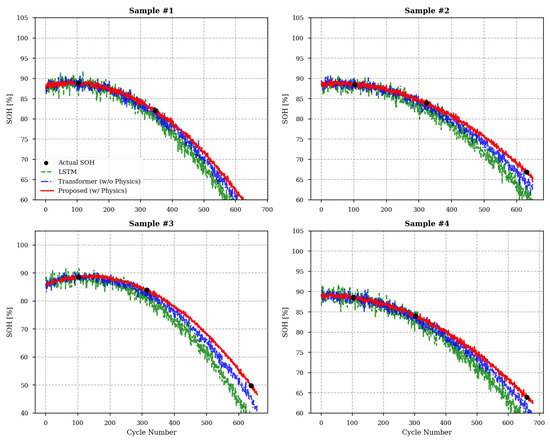
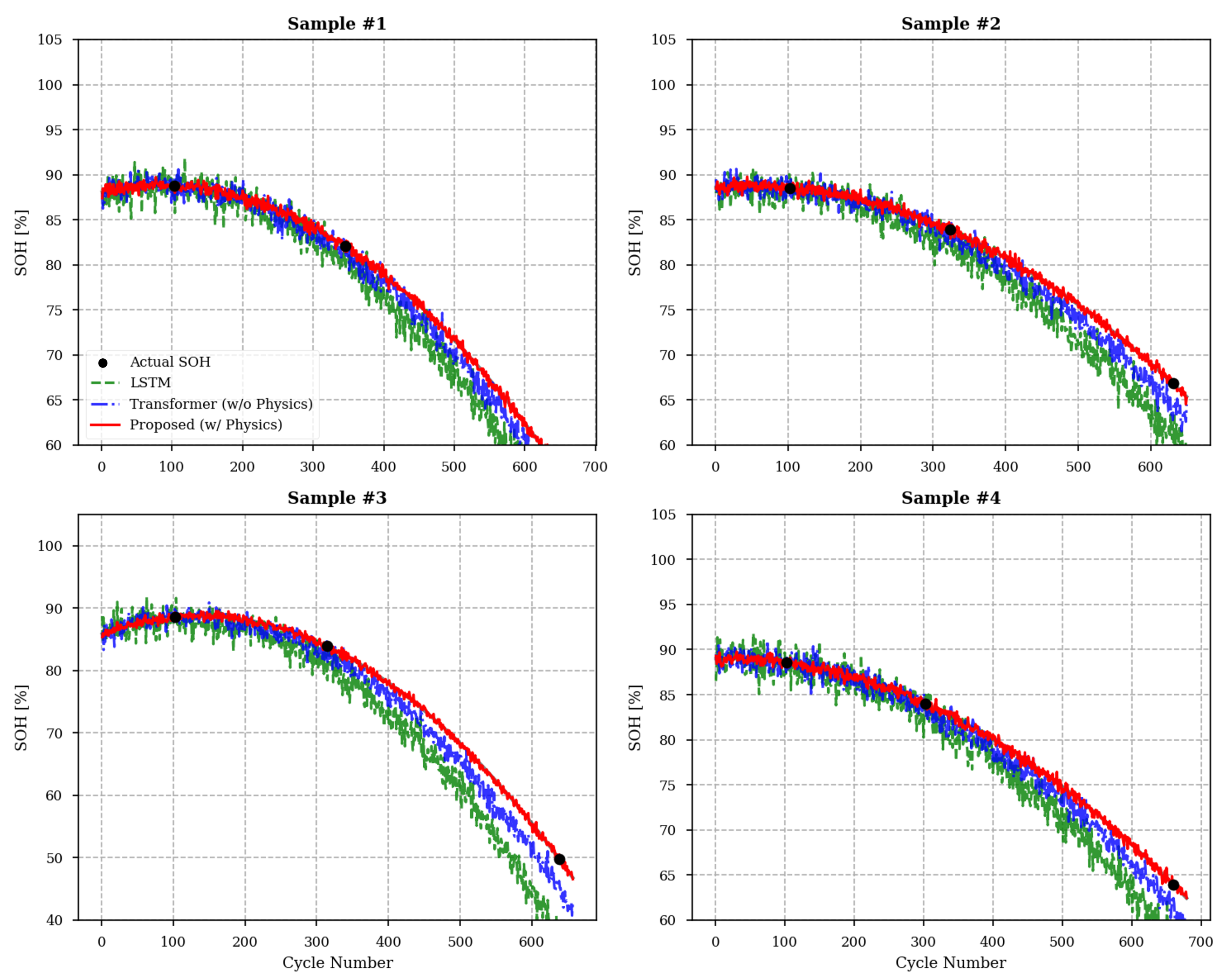
Figure 5 compares the SOH estimation trajectories produced by the proposed Transformer model and the LSTM baseline for all four battery samples. The ground-truth SOH obtained from discharge capacity measurements is shown for reference.
Figure 5.
Comparison of SOH estimation results for the proposed physics-informed Transformer and the LSTM baseline across four battery samples. The proposed model accurately captures both linear and non-linear degradation trajectories, including severe knee behavior.
For Samples #2 and #4, which exhibit approximately linear degradation, both models achieve reasonable tracking performance. However, the proposed Transformer consistently provides closer alignment with the ground truth across the entire lifecycle.
In contrast, Sample #3 exhibits pronounced non-linear degradation with a clear knee behavior. The LSTM baseline fails to capture the abrupt acceleration of capacity fade, resulting in substantial estimation error. The proposed model accurately tracks this non-linear trajectory, demonstrating superior robustness under severe aging conditions.
6.5. Performance Interpretation
The quantitative and qualitative results demonstrate that the proposed physics-informed Transformer consistently outperforms the LSTM baseline across all battery samples. The performance gap is most pronounced for Sample #3, where severe non-linear degradation occurs.
This improvement can be attributed to two key factors. First, the incorporation of electrochemical and thermal features provides direct physical context for degradation progression. Second, the self-attention mechanism enables the model to selectively emphasize degradation-sensitive regions within the charging process, rather than relying solely on sequential recurrence.
These characteristics allow the proposed model to generalize effectively across heterogeneous aging patterns, which is critical for practical deployment in battery management systems.
6.6. Computational Cost and Model Complexity
To assess practical deployability, we compare the model size and computational cost of the proposed framework against recurrent baselines. All models were trained on a workstation equipped with an NVIDIA RTX 3060 GPU. The comparison includes the number of parameters, offline training time (100 epochs), and per-cycle inference latency. The model size and computational cost are summarized in Table 3.
Table 3.
Model complexity and computational cost comparison.
The proposed Transformer has approx. 2× more parameters than the RNN baselines. However, thanks to the parallel computing capability of the attention mechanism, the training time is reduced by about 30% compared to the LSTM baseline.
Although the inference latency (5.3 ms) is slightly higher than the lightweight GRU (3.8 ms), it remains well within the acceptable range for real-time BMS applications, where SOH is typically updated every charging cycle (not every second)
The inclusion of physical inputs (ICA, ) only marginally increases the parameter count (+3.4 k) and latency (+0.2 ms) compared to the standard Transformer, while providing a significant accuracy boost (as shown in Table 2).
7. Ablation Study and Feature Contribution Analysis
7.1. Purpose of Ablation Study
To quantitatively assess the contribution of physics-informed features, an ablation study was conducted by selectively removing electrochemical and thermal inputs from the proposed Transformer framework. This analysis aims to clarify how each feature group influences SOH estimation accuracy, particularly under non-linear degradation conditions.
7.2. Ablation Model Configurations
Four model configurations were evaluated:
- Full Model: Transformer with electrical, ICA-based electrochemical, and thermal-gradient features.
- w/o ICA: Transformer using electrical and thermal features only.
- w/o Thermal: Transformer using electrical and ICA features only.
- Electrical Only: Transformer using voltage and current features without physics-informed inputs.
All ablation models share identical architecture, hyperparameters, and training protocols. Only the input feature composition differs across configurations, ensuring a fair comparison. The ablation RMSE results are reported in Table 4.
Table 4.
Ablation study results: RMSE (%) of SOH estimation for different feature configurations.
7.3. Feature Contribution Analysis
The ablation results clearly demonstrate the effectiveness of incorporating physics-informed features. Removing either ICA or thermal features leads to a noticeable degradation in SOH estimation accuracy across all samples.
The impact is most pronounced for Sample #3, which exhibits severe non-linear degradation. In this case, the absence of ICA features results in a substantial increase in RMSE, highlighting the critical role of electrochemical phase transition information in capturing rapid capacity fade.
Thermal features also contribute significantly by providing sensitivity to resistance-driven heating behavior, which intensifies during late-life aging. While electrical features alone capture general degradation trends, they are insufficient to represent abrupt non-linear behavior without additional physical context.
7.4. Relation to Attention-Based Interpretability
The findings of the ablation study are consistent with the self-attention analysis presented in Section 5. Attention maps reveal that the full model focuses on voltage regions associated with ICA peaks, which are absent or weakened when electrochemical features are removed.
This consistency confirms that the performance gains of the proposed framework are not merely empirical but are rooted in physically meaningful representations learned through self-attention.
8. Discussion
The results presented in this study demonstrate that incorporating physics-informed features into a Transformer-based architecture substantially improves the robustness and interpretability of battery SOH estimation. Beyond numerical accuracy, several important observations can be drawn regarding the physical meaning of the learned representations, the advantages of self-attention for battery diagnostics, and the limitations of the proposed framework.
8.1. Role of Physics-Informed Features
The ablation study confirms that electrochemical and thermal features play a decisive role in capturing complex degradation behavior. In particular, incremental capacity analysis (ICA) provides explicit information about electrode phase transitions and active material loss, which cannot be inferred reliably from voltage or current signals alone.
The pronounced performance degradation observed when ICA features are removed—especially for the severely aged Sample #3—indicates that non-linear capacity fade is closely tied to electrochemical phenomena. This finding is consistent with prior studies that emphasize the diagnostic value of ICA for aging assessment.
8.2. Advantages of Self-Attention for Battery Aging Analysis
Compared with recurrent architectures, the self-attention mechanism enables the model to capture global temporal dependencies without being constrained by sequential recurrence. This capability is particularly beneficial for battery health estimation, where diagnostically relevant information is often localized within narrow voltage windows rather than distributed uniformly over time.
The attention maps reveal that the model consistently focuses on voltage regions associated with electrochemical phase transitions. This behavior explains the superior performance of the proposed model in tracking knee behavior, where degradation accelerates rapidly after a relatively stable period. Such behavior is difficult for LSTM-based models to capture due to their reliance on incremental state propagation.
8.3. Interpretability and Practical Implications
A key advantage of the proposed framework is its inherent interpretability. By analyzing self-attention weights, it is possible to identify which regions of the charging process contribute most strongly to SOH estimation. This property provides valuable insight for battery diagnostics and can support condition-based maintenance strategies.
From a practical perspective, the proposed model is well suited for integration into advanced battery management systems. The required input signals—voltage, current, and temperature—are commonly available in modern BMS hardware, and the additional computation required for ICA and thermal gradients can be implemented offline or at low frequency.
8.4. Deployment Considerations for Resource-Constrained BMS Hardware
In practical BMS deployment, model training can be performed offline using historical data, while on-device execution is typically limited to inference. The proposed framework is compatible with standard BMS sensing capabilities because it relies on voltage, current, and temperature measurements that are routinely available. ICA and thermal-gradient indicators can be computed at a reduced frequency (e.g., periodic diagnostic charging segments) or offloaded to an edge gateway, depending on the computational budget. Moreover, the inference latency summarized in Section 6.6 indicates that real-time execution per charging cycle is feasible for embedded or edge-assisted BMS architectures.
8.5. Limitations and Future Work
Despite its promising performance, this study has several limitations. First, the experimental validation is conducted on a limited number of cells under a single cycling protocol. Future work should extend the analysis to larger battery populations, different chemistries, and varying operating conditions to further assess generalization capability.
Second, the proposed framework focuses on charging data only. Incorporating discharge dynamics and rest-period information may further enhance SOH estimation accuracy. Finally, while attention maps provide qualitative interpretability, more rigorous quantitative links between attention weights and specific degradation mechanisms remain an open research direction.
9. Conclusions
This study proposed a physics-informed Transformer framework for long-term state-of-health estimation of lithium-ion batteries. By integrating electrochemical indicators derived from incremental capacity analysis and thermal-gradient features into a self-attention architecture, the proposed model achieves robust and interpretable SOH estimation across diverse aging behaviors.
Experimental results on four battery samples demonstrate that the proposed approach consistently outperforms an LSTM baseline, particularly under severe non-linear degradation conditions characterized by knee behavior. The ablation study further confirms that physics-informed features are critical for capturing rapid capacity fade, while attention analysis reveals that the model autonomously focuses on physically meaningful voltage regions associated with electrochemical phase transitions.
Overall, the proposed framework provides a practical and explainable solution for battery health monitoring and highlights the potential of combining domain knowledge with attention-based deep learning for advanced battery diagnostics.
Author Contributions
Conceptualization, S.H.P. and S.H.K.; methodology, S.H.K.; software, S.H.P. and S.H.K.; validation, S.H.K. and S.H.P.; formal analysis, S.H.K.; investigation, S.H.P.; resources, S.H.K.; data curation, S.H.P.; writing—original draft preparation, S.H.P. and S.H.K.; writing—review and editing, S.H.K.; visualization, S.H.K.; supervision, S.H.K.; project administration, S.H.K.; funding acquisition, S.H.K. All authors have read and agreed to the published version of the manuscript.
Funding
This research was supported by the Energy Technology Development Program of the Ministry of Trade, Industry and Energy (MOTIE) and the Korea Institute for Advancement of Technology (KIAT) under Project No. RS-2025-04752996, and by the research grant of Kongju National University in 2025/2026.
Data Availability Statement
The data presented in this study are available from the corresponding author upon reasonable request.
Conflicts of Interest
The authors declare no conflicts of interest.
References
- Huang, H.; Meng, J.; Wang, Y.; Feng, F.; Cai, L.; Peng, J.; Liu, T. A comprehensively optimized lithium-ion battery state-of-health estimator based on Local Coulomb Counting Curve. Appl. Energy 2022, 322, 119469. [Google Scholar] [CrossRef] [Scilit]
- Seok, J.; Lee, W.; Lee, H.; Park, S.; Chung, C.; Hwang, S.; Yoon, W.S. Aging mechanisms of lithium-ion batteries. J. Electrochem. Sci. Technol. 2024, 15, 51–66. [Google Scholar] [CrossRef] [Scilit]
- Liu, J.; Duan, Q.; Qi, K.; Liu, Y.; Sun, J.; Wang, Z.; Wang, Q. Capacity fading mechanisms and state of health prediction of commercial lithium-ion battery in total lifespan. J. Energy Storage 2022, 46, 103910. [Google Scholar] [CrossRef] [Scilit]
- Roy, P.K.; Shahjalal, M.; Shams, T.; Fly, A.; Stoyanov, S.; Ahsan, M.; Haider, J. A critical review on battery aging and state estimation technologies of lithium-ion batteries: Prospects and issues. Electronics 2023, 12, 4105. [Google Scholar] [CrossRef] [Scilit]
- Wang, J.; Zhang, S.; Li, C.; Wu, L.; Wang, Y. A data-driven method with mode decomposition mechanism for remaining useful life prediction of lithium-ion batteries. IEEE Trans. Power Electron. 2022, 37, 13684–13695. [Google Scholar] [CrossRef] [Scilit]
- Yang, F.; Shi, D.; Lam, K.-h. Modified extended Kalman filtering algorithm for precise voltage and state-of-charge estimations of rechargeable batteries. J. Energy Storage 2022, 56, 105831. [Google Scholar] [CrossRef] [Scilit]
- Theodore, A.M.; Şahin, M.E. Modeling and simulation of a series and parallel battery pack model in MATLAB/Simulink. Turk. J. Electr. Power Energy Syst. 2024, 4, 2–12. [Google Scholar] [CrossRef] [Scilit]
- Buchanan, S.; Crawford, C. Probabilistic lithium-ion battery state-of-health prediction using convolutional neural networks and Gaussian process regression. J. Energy Storage 2024, 76, 109799. [Google Scholar] [CrossRef] [Scilit]
- Bokstaller, J.; Schneider, J.; Lux, S.; vom Brocke, J. Battery health index: Combination of physical and ML-based SoH for continuous health tracking. IEEE Internet Things J. 2024, 11, 33624–33641. [Google Scholar] [CrossRef] [Scilit]
- Dubarry, M.; Anseán, D. Best practices for incremental capacity analysis. Front. Energy Res. 2022, 10, 1023555. [Google Scholar] [CrossRef] [Scilit]
- Thelen, A.; Lui, Y.H.; Shen, S.; Laflamme, S.; Hu, S.; Ye, H.; Hu, C. Integrating physics-based modeling and machine learning for degradation diagnostics of lithium-ion batteries. Energy Storage Mater. 2022, 50, 668–695. [Google Scholar] [CrossRef] [Scilit]
- Ahmed, F.; Abulsaud, K.; Massoud, A.M. On Equivalent Circuit Model-Based State-of-Charge Estimation for Lithium-ion Batteries in Electric Vehicles. IEEE Access 2025, 13, 69950–69966. [Google Scholar] [CrossRef] [Scilit]
- Chen, L.; Xie, S.; Lopes, A.M.; Bao, X. A vision transformer-based deep neural network for state of health estimation of lithium-ion batteries. Int. J. Electr. Power Energy Syst. 2023, 152, 109233. [Google Scholar] [CrossRef] [Scilit]
- Luo, K.; Zheng, H.; Shi, Z. A simple feature extraction method for estimating the whole life cycle state of health of lithium-ion batteries using transformer-based neural network. J. Power Sources 2023, 576, 233139. [Google Scholar] [CrossRef] [Scilit]
- Wang, T.; Zhu, Y.; Zhao, W.; Gong, Y.; Zhang, Z.; Gao, W.; Shang, Y. Capacity degradation analysis and knee point prediction for lithium-ion batteries. Green Energy Intell. Transp. 2024, 3, 100171. [Google Scholar] [CrossRef] [Scilit]
- E, L.; Wang, J.; Yang, R.; Wang, C.; Li, H.; Xiong, R. A physics-informed neural network-based method for predicting degradation trajectories and remaining useful life of supercapacitors. Green Energy Intell. Transp. 2025, 4, 100291. [Google Scholar] [CrossRef] [Scilit]
- Wang, H.; Chen, K.; Chen, Z.; Li, S.; Wang, J.; Wang, P.; Yang, L. State-of-health prediction of lithium-ion batteries: A novel PLO-transformer-LSTM framework with DRT feature engineering. Comput. Chem. Eng. 2025, 205, 109473. [Google Scholar] [CrossRef] [Scilit]
- Li, Y.; Kang, L.; Wang, X.; Xie, D.; Wang, S. State of Health Prediction of Lithium-Ion Batteries Based on Dual-Time-Scale Self-Supervised Learning. Batteries 2025, 11, 302. [Google Scholar] [CrossRef] [Scilit]
- Zhao, Y.; Behdad, S. State of health estimation of electric vehicle batteries using transformer-based neural network. J. Energy Resour. Technol. 2024, 146, 101703. [Google Scholar] [CrossRef] [Scilit]
- Beg, M.; Alcock, K.M.; Sam, V.; Rakshit, S.; Paul, S.; Yu, H.; Goh, K. Transformer autoencoder framework for estimating core temperature of lithium-ion battery from pulse discharge dynamics. Appl. Therm. Eng. 2025, 288, 129552. [Google Scholar] [CrossRef] [Scilit]
- Vaswani, A.; Shazeer, N.; Parmar, N.; Uszkoreit, J.; Jones, L.; Gomez, A.N.; Kaiser, Ł.; Polosukhin, I. Attention is all you need. In Advances in Neural Information Processing Systems 30; NIPS Foundation: La Jolla, CA, USA, 2017; Volume 30. [Google Scholar]

Disclaimer/Publisher’s Note: The statements, opinions and data contained in all publications are solely those of the individual author(s) and contributor(s) and not of MDPI and/or the editor(s). MDPI and/or the editor(s) disclaim responsibility for any injury to people or property resulting from any ideas, methods, instructions or products referred to in the content. |
© 2026 by the authors. Licensee MDPI, Basel, Switzerland. This article is an open access article distributed under the terms and conditions of the Creative Commons Attribution (CC BY) license.