


Abstract
MXene-based microwave absorbers have received extensive attention owing to their high electrical conductivity, abundant interfacial polarization sites, and tunable surface terminations. However, the structure–property relationship of MXene composites remains highly nonlinear, and the design of high-efficiency absorbers still relies heavily on trial-and-error experiments. Herein, multidimensional magnetic components, including zero-dimensional (0D) Fe3O4 nanoparticles, one-dimensional (1D) Fe3O4/Co3O4 nanowires, and two-dimensional (2D) Fe3O4-based heterostructures, were rationally integrated with Fe/MXene and Fe/Co/MXene nanosheets to engineer synergistic dielectric and magnetic losses. Comprehensive electromagnetic characterization and loss mechanism analysis reveal that the structural dimensionality strongly impacts impedance matching and attenuation capability. To further enable predictive and data-driven optimization, a machine learning framework was established to correlate the microstructure, component ratio, thickness, and electromagnetic parameters with the microwave absorption performance (e.g., minimum reflection loss (RLmin), effective absorption bandwidth (EAB)). The optimized multidimensional composite achieves an RLmin of −56.4 dB at 10.2 GHz with an EAB of 8.4 GHz (9.6–18.0 GHz) at a thin matching thickness of 1.8 mm. The machine learning model demonstrates excellent accuracy (R2 = 0.947) and enables the inverse design of absorber geometries to target specific operational frequencies. This work provides a generalizable paradigm for the intelligent design of MXene-based microwave absorbers and opens up broader opportunities for the AI-accelerated discovery of advanced electromagnetic functional materials.
1. Introduction
With the continually expanding demands for electromagnetic wave (EMW) management in radar stealth, wireless communication, and electromagnetic interference (EMI) shielding, lightweight, broadband, and high-efficiency microwave absorbers have become a central concern in materials science and engineering communities. Representative strategies include eco-friendly reduced graphene oxide aerogels with tailored dielectric loss [1], heteroatom-doped graphene aerogels exploiting polarization gene regulation for super-efficiency absorption [2], and porous polymer-Fe3O4-GO hybrid aerogels achieving synergized dielectric–magnetic pore modulation [3]. The two-dimensional family of materials known as MXenes (general formula Mn+1XnTx), derived from layered MAX phases by selective etching, has drawn intense attention due to its metallic conductivity, large surface area, abundant surface terminations (-O, -OH, -F), and rich interfaces for polarization and conduction loss mechanisms [4]. As a representative two-dimensional (2D) transition metal carbide/nitride family, MXenes possess several intrinsic advantages for microwave absorption that distinguish them from other conductive fillers. Their tunable surface terminations (-O, -OH, -F) enable the precise modulation of interfacial polarization and conductive loss, while the layered architecture provides abundant heterogeneous interfaces that facilitate multiple reflections and scattering of incident electromagnetic waves. Recent studies have systematically revealed that the electromagnetic attenuation mechanisms of MXenes can be understood through both polarization loss and conductive loss models, and that their broadband attenuation performance can be effectively tuned through component tailoring (e.g., M-site and X-site substitution), interlayer regulation, and film architecture engineering [5,6]. For instance, surface treatment strategies such as H+ and OH− modulation of Ti3C2Tx films have demonstrated that the balance between surface functional groups directly governs the dielectric response and shielding effectiveness [5]. Furthermore, the integration of MXene nanosheets with covalent organic frameworks (COFs) has shown that the hierarchical 2D–2D heterointerfaces can simultaneously enhance electromagnetic shielding and thermal insulation, underscoring the multifunctional potential of MXene-based architectures [6]. These findings highlight that 2D MXene serves not merely as a conductive substrate but as a versatile platform whose electromagnetic response can be rationally designed through surface chemistry and structural engineering.
However, despite these intriguing properties, standalone MXene absorbers still face inherent limitations, especially in achieving optimal impedance matching and maximizing attenuation across broad frequency bands [7]. For example, a study demonstrated that, by orienting 3D MXene/CNF architectures, low-frequency absorption (S-band) with RL ≈ −47.9 dB was achieved without magnetic additives [8]. Yet many of these works still rely on empirical design and lack predictive guidance for the composite structure–property relationships.
Recent progress in MXene-based absorbers has highlighted that the design space becomes exponentially large once multiple structural dimensionalities (0D/1D/2D), magnetic compositions, hybrid interfaces, and thickness factors are jointly considered. Such a high-dimensional structure–property landscape is extremely difficult to explore experimentally, and conventional parametric sweeps remain inefficient and often unable to reveal non-linear correlations hidden within dielectric, magnetic, and geometrical variables. Machine learning (ML) methods therefore offer a powerful complementary route: by learning from experimentally measured EM parameters and structural descriptors, ML models can rapidly predict absorber performance, identify dominant features, and even enable inverse design of optimal configurations for target frequency bands. However, most existing ML studies on MXene-based absorbers focus on low-dimensional feature sets or individual material systems and have not systematically incorporated structural dimensionality and magnetic heterostructure effects into a unified predictive framework.
While recent studies have begun exploring ML-driven approaches for MXene-based absorbers [7,8,9], most remain confined to low-dimensional parameter spaces or single-material systems. Critically, these works do not systematically integrate multidimensional structural engineering (0D/1D/2D magnetic inclusions) with ML-guided prediction and inverse design within a unified framework—a gap that severely limits both the mechanistic understanding of dimension-dependent loss mechanisms and the practical realization of application-targeted absorber design.
The incorporation of magnetic materials (Fe3O4, Co3O4, ferrites) into MXene frameworks has shown promise [10,11,12,13,14]. For instance, Shao et al. demonstrated that Janus-structured PTFE-CNT-Fe3O4/MXene membranes achieve efficient EMI shielding through an absorption–reflection–reabsorption mechanism enabled by the synergistic interplay of conductive and magnetic loss layers [15,16]. Yet the systematic comparison of how structural dimensionality (0D particles, 1D wires, 2D heterostructures) modulates electromagnetic loss mechanisms, impedance matching, and thickness requirements remains largely unexplored [17]. Beyond the MXene–magnetic composite family, the concept of multidimensional heterostructure engineering has been increasingly demonstrated in broader microwave absorption material systems. For example, Wang et al. constructed three-dimensional porous metal microsphere (0D)@chitosan-reduced graphene oxide (2D) aerogels (M@C-rGO, M = Mn, Fe, Co, Ni, Cu) through a facile assembly strategy, achieving excellent low-frequency microwave absorption combined with thermal insulation and anticorrosion performance [18]. The 0D/2D architecture effectively created abundant heterogeneous interfaces and extended conductive networks, resulting in synergistic dielectric-magnetic loss enhancement. Similarly, Zhang et al. reported multi-scale engineered Ag nanowire (1D)/N-doped reduced graphene oxide (2D) composite aerogels with directional pore structures, which delivered broadband microwave absorption with a minimum reflection loss of −56.32 dB and an effective absorption bandwidth of 7.04 GHz, alongside electromagnetic shielding and infrared stealth capabilities [19]. These studies collectively demonstrate that the rational combination of different dimensional building blocks—whether 0D/2D or 1D/2D—can create synergistic electromagnetic loss mechanisms that far exceed those of single-dimensional counterparts. This evidence further motivates the development of a generalized machine learning framework capable of capturing the complex structure–property relationships across diverse dimensional configurations, which is a central objective of the present work.
Despite these advances, three critical gaps impede progress toward predictive, application-driven microwave absorber design: (1) Systematic dimensional comparison: Although the aforementioned studies have demonstrated the effectiveness of 0D/2D and 1D/2D heterostructures in various material systems, the mechanistic roles of 0D, 1D, and 2D magnetic structures on a unified MXene platform remain poorly understood, and no systematic comparison under identical processing conditions has been reported. (2) Predictive ML framework: Existing ML studies lack comprehensive datasets spanning structural dimensionality, composition, and thickness, preventing the accurate prediction of key metrics (RLmin, EAB) and limiting inverse design capabilities. (3) Experimental validation loop: The consistency between ML-predicted optimal designs and experimental performance remains poorly validated, hindering practical implementation.
In this work, we address these gaps through three unique contributions: (1) Multidimensional structural platform: We systematically design and synthesize 0D Fe3O4 nanoparticles, 1D Fe3O4 nanowires, and 2D petal-like Fe3O4/Co3O4 heterostructures anchored on Ti3C2Tx MXene nanosheets, enabling the first direct quantitative comparison of how structural dimensionality governs electromagnetic dissipation mechanisms, interfacial polarization intensity, and impedance matching across 2–18 GHz. This systematic morphological series—spanning zero-dimensional discrete sites, one-dimensional conductive pathways, and two-dimensional heterojunction networks—provides unprecedented mechanistic insights into dimension-dependent microwave absorption. (2) ML-driven predictive framework with interpretability: We construct a comprehensive 320-sample dataset (245 experimental + 75 literature) integrating structural descriptors (dimensionality, composition, thickness) and electromagnetic parameters (ε′, ε″, μ′, μ″) to train an XGBoost model achieving R2 = 0.947 and MAE = 1.13 dB for RLmin prediction. Crucially, SHAP (SHapley Additive exPlanations) analysis reveals that 2D morphology, interfacial polarization strength, and optimized thickness synergistically dominate absorption performance, offering actionable design rules unavailable from empirical approaches. This framework enables the rapid screening of >10,000 virtual designs, reducing experimental cycles by orders of magnitude. (3) Experimental validation of ML-guided inverse design: We demonstrate closed-loop validation by ML-predicting optimal absorber configurations for target frequency bands (X-band, Ku-band) and experimentally verifying performance within 5% error. The 2D petal-like Fe3O4/Co3O4/MXene heterostructure achieves RLmin = −56.4 dB at 10.2 GHz with 1.8 mm thickness, and EAB = 8.4 GHz (9.6–18.0 GHz), outperforming literature benchmarks while validating the ML model′s predictive accuracy and practical utility for application-targeted absorber design.
The remaining parts of the paper are as follows: Section 2 describes the material fabrication and machine learning methodology. Section 3 presents the electromagnetic performance analysis and ML-enabled inverse design. Section 4 benchmarks the absorbers against state-of-the-art materials. Section 5 provides conclusions and future outlook on ML-accelerated material discovery.
2. Materials and Methods
2.1. Synthesis of Multidimensional Magnetic MXene-Based Nanocomposites
Single- or few-layer Ti3C2Tx MXene nanosheets were first obtained by selectively etching the Al layers of Ti3AlC2 MAX phase, followed by delamination through ion intercalation and ultrasonic exfoliation. The etching reaction proceeds according to:
where denotes terminal functional groups (-O, -OH, -F) introduced during the etching process. These surface groups impart a negative surface potential , enabling the strong electrostatic adsorption of metal cations. FeSO4·7H2O and CoCl2·6H2O were dissolved and introduced into the MXene dispersion, where Fe2+ and Co2+ ions spontaneously interact with the MXene surface via electrostatic attraction and coordination with oxygen-containing functional groups, following:
These reactions result in homogeneous nucleation and anchoring of metallic nanoparticles on the MXene sheets, forming Fe/MXene and Fe/Co/MXene magnetic nanosheets. Owing to the two-dimensional conductive framework and strong interfacial bonding, these nanosheets serve as effective platforms for subsequent dimensional engineering.
To construct the zero-dimensional magnetic structures, Fe3O4 and Fe3O4/Co3O4 nanoparticles were grown in situ on the Fe/MXene or Fe/Co/MXene nanosheets through controlled precipitation and oxidation processes. The classical co-precipitation reaction:
governs the formation of Fe3O4, whereas partial substitution with Co2+ leads to mixed spinel products such as FeCo2O4 or Fe3O4/Co3O4 composites [20]. The abundant nucleation sites on MXene promote the uniform distribution of the 0D oxide nanoparticles.
For constructing one-dimensional magnetic units, Fe3O4 and Fe3O4/Co3O4 nanowires were synthesized through a two-step crystal growth process that induces anisotropic growth along the preferred axis. The growth rate anisotropy yields high-aspect-ratio nanowires, which were subsequently assembled onto MXene nanosheets through electrostatic self-assembly according to:
This results in interconnected 1D–2D magnetic–conductive hybrid networks that simultaneously enhance conductive loss through extended charge-transport pathways and introduce supplementary magnetic loss channels via exchange-coupled magnetic units.
Two-dimensional petal-like Fe3O4 and Fe3O4/Co3O4 heterostructures were obtained via a chemical reduction–recrystallization route. The transformation of intermediate oxyhydroxides into spinel structures follows
while the differential growth kinetics across crystallographic planes,
give rise to ultrathin petal-like nanosheets with highly exposed surfaces and abundant defect sites. These two-dimensional magnetic heterostructures were assembled onto MXene substrates through electrostatic interaction, forming the most structurally complex configuration among the synthesized composites.
The entire synthesis strategy establishes a unified MXene-based framework capable of supporting 0D, 1D, and 2D Fe3O4/Co3O4 magnetic structures, enabling the systematic engineering of multiscale interfaces, conductive networks, and magnetic–dielectric interactions [21]. Representative schematics and microstructural features of each synthesis stage are shown in Figure 1, where horizontal arrows indicate sequential reaction steps and vertical arrows denote the structural evolution from the MXene scaffold to the final composite architecture. In the figure, teal regions represent Ti3C2Tx MXene nanosheets, pink and dark gray spheres denote adsorbed Fe2+ and Co2+ ions, respectively, and gray and orange spheres correspond to zero-valent Fe and Co nanoparticles formed after NaBH4 reduction. The dark gray and orange block-like features in the 0D, 1D, and 2D panels represent the Fe-rich (Fe3O4) and Co-rich (Co3O4) magnetic phases, respectively, anchored onto the MXene substrate in three distinct morphologies. Detailed synthesis parameters and reaction equations are summarized in Table 1.
Figure 1.
Schematic illustration of the synthesis process for Fe/MXene, Fe/Co/MXene, and their corresponding 0D, 1D, and 2D magnetic composites.
Table 1.
Summary of precursor compositions, reaction equations, and dimensional outcomes for the synthesized magnetic MXene-based nanostructures.
2.2. Structural Characterization and Electromagnetic Measurements
The morphological, structural, and electromagnetic characteristics of all synthesized multidimensional MXene-based nanocomposites were systematically examined to elucidate their microstructure–property correlations.
2.2.1. Structural Characterization
The microstructure and dimensional evolution of the composites were first investigated through scanning electron microscopy (SEM) and transmission electron microscopy (TEM). SEM images provided insights into the surface topology and distribution of 0D, 1D, and 2D magnetic units across the MXene sheets, while high-resolution TEM (HRTEM) enabled the identification of lattice fringes associated with Fe, Fe-Co alloy, Fe3O4, and Co3O4 phases. Fast Fourier transform (FFT) patterns further confirmed the spinel structures and crystallographic orientations, particularly for the 2D petal-like heterostructures. Elemental mapping obtained from energy-dispersive X-ray spectroscopy (EDS) verified the homogeneous distribution of Fe and Co species across all dimensional configurations. The overall characterization workflow is illustrated in Figure 2.
Figure 2.
Characterization workflow and techniques applied in structural and electromagnetic analysis.
Phase evolution and crystallographic transitions were examined using X-ray diffraction (XRD, Bruker D8 Advance, Cu Kα radiation, λ = 1.5406 Å, 2θ = 10–80°, scan rate 5°/min). The disappearance or weakening of the (002) MXene peak indicated increased delamination, while the emergence of characteristic reflections corresponding to Fe3O4 (JCPDS 19-0629) and Co3O4 (JCPDS 42-1467) confirmed the successful formation of spinel oxides. The crystallite sizes estimated from the Scherrer equation using the (311) diffraction peak are approximately 12 ± 2 nm (0D), 15 ± 3 nm (1D), and 18 ± 2 nm (2D), indicating progressive grain growth with increasing structural dimensionality. The coexistence of Fe and Co in mixed spinel structures was validated by peak shifts and relative intensity changes.
Static magnetic properties were measured using a vibrating sample magnetometer (VSM, Lake Shore 7404) at room temperature (300 K) with an applied field range of ±20 kOe. Additional measurements were performed at 5 K to evaluate the low-temperature magnetic behavior and confirm the ferrimagnetic nature of the spinel phases. Zero-field-cooled (ZFC) and field-cooled (FC) magnetization curves were recorded from 5 K to 380 K under a probing field of 200 Oe to characterize the superparamagnetic blocking behavior and inter-particle magnetic interactions. For each measurement, approximately 15 mg of dry composite powder (without paraffin) was loaded into a diamagnetic sample holder, and the diamagnetic contribution from the MXene substrate was subtracted using a linear high-field correction. All reported magnetization values are normalized to the total composite mass (including the MXene fraction) to maintain consistency with the electromagnetic measurements.
Electromagnetic parameters were measured in the 2–18 GHz frequency range using a vector network analyzer (Agilent E5071C). The composites were mixed with paraffin at a fixed filler loading of 30 wt% and molded into toroidal rings (outer diameter 7.00 mm, inner diameter 3.04 mm), ensuring consistent sample geometry compatible with the APC-7 coaxial airline. Triplicate measurements were performed for each sample, and the average values are reported with a standard deviation below 5%. The complex permittivity (ε = ε′ − jε″) and permeability (μ = μ′ − jμ″) were extracted from S-parameter measurements (S11 and S21) based on the Nicolson–Ross–Weir (NRW) algorithm. It is noted that the resulting ε′(f) and μ′(f) spectra reflect the effective medium response of the composite–paraffin mixture; the dominant single-peak features arise from the prevailing interfacial polarization relaxation (for ε′) and natural ferromagnetic resonance (for μ′) mechanisms, as discussed in Section 3.2. It should be noted that the effective permeability extracted via the NRW algorithm in conductive composites can be sensitive to measurement artifacts; therefore, independent static magnetic characterization (VSM, ZFC/FC) was performed to cross-validate the dimensionality-dependent magnetic trends, as detailed in Section 3.1.
2.2.2. Impedance Matching and Attenuation Analysis
The microwave absorption performance was quantified by the reflection loss (RL), calculated using the transmission-line model:
where the input impedance of an absorber with thickness is:
with free-space impedance , frequency , speed of light , , and .
The minimum reflection loss and the effective absorption bandwidth (EAB, where RL ≤ −10 dB) were computed for each sample. To further interpret the microwave attenuation mechanisms, the impedance matching ratio was evaluated:
Samples exhibiting values close to unity facilitate maximal entry of electromagnetic waves into the absorber, thereby enhancing overall absorption. Dimensional engineering significantly affected the impedance behavior: 0D nanoparticles introduced abundant interfacial polarization at discrete MXene/oxide boundaries, 1D nanowires established continuous conductive–magnetic pathways that enhanced both charge transport and magnetic permeability, while 2D heterostructures contributed large-area interfaces, multi-reflection scattering, and the most favorable permittivity–permeability balance for impedance matching.
The intrinsic attenuation capability was assessed by calculating the attenuation constant :
A higher α corresponds to a stronger intrinsic dissipation. The 2D petal-like structures typically exhibit the highest attenuation, attributed to their multiscale architecture. Since the attenuation constant α is jointly determined by dielectric and magnetic losses (through both ε″ and μ″ in the formula), the relative importance of each channel is further examined through the quantitative sub-mechanism decomposition presented in Section 3.2.
Dielectric loss mechanisms were analyzed through conduction loss and dipolar polarization, represented by:
where denotes conductivity.
Using this decomposition, the conduction loss contribution ε″_cond = σ_AC/(2πfε0) was quantitatively separated from the total ε″ by extracting the effective AC conductivity σ_AC from the low-frequency plateau region (2–4 GHz) of the ε″(f) spectrum, and the polarization/relaxation contribution was then obtained by subtraction: ε″_pol = ε″_total − ε″_cond. The frequency-averaged values of both components are reported in Table 2.
Table 2.
Quantitative decomposition of dielectric and magnetic loss sub-mechanisms for 0D, 1D, and 2D composites (2–18 GHz average).
Magnetic loss originated from natural resonance, exchange resonance, and eddy current effects. The eddy current response was evaluated using:
If the C0 parameter remains approximately constant over the measured frequency range, the magnetic loss is dominated by eddy current effects; otherwise, natural ferromagnetic resonance and exchange resonance are the primary contributors. The eddy current contribution μ″_eddy was estimated from the frequency-independent asymptotic value of C0, and the natural resonance contribution was obtained by subtraction: μ″_NR = μ″_total − μ″_eddy. The quantitative decomposition results are summarized in Table 2.
The comparative analysis of 0D/1D/2D structures revealed that the dimensionality of magnetic units strongly modulated both dielectric and magnetic responses, yielding distinct RL and EAB behaviors. The quantitative sub-mechanism decomposition further reveals that polarization loss consistently dominates the dielectric channel (54–62%), while natural ferromagnetic resonance dominates the magnetic channel (74–86%), with the eddy current contribution increasing progressively from 14% (0D) to 26% (2D) as the structural connectivity expands.
2.3. Machine Learning-Assisted Structure–Property Modeling
To establish an interpretable link between compositional variables, structural dimensionality, and electromagnetic performance, a machine learning framework was constructed to predict key microwave absorption metrics, including the minimum reflection loss , effective absorption bandwidth (EAB), and optimum matching thickness . A comprehensive dataset was assembled by integrating three categories of input descriptors (as illustrated in Figure 3): (i) compositional and processing descriptors, including Fe/Co ratio, MXene surface terminal groups, reaction temperature, pH, reduction level, and reaction time, which collectively govern nucleation kinetics, phase purity, and downstream electromagnetic response; (ii) structural descriptors, describing dimensionality, particle size, aspect ratio, and effective surface area; and (iii) electromagnetic intrinsic parameters, including ε’, ε″, μ’, μ″, and associated loss tangents. It should be emphasized that the synthesis parameters in category (i) are not electromagnetic features per se, but rather upstream process variables that encode the processing–structure link. They are included because two composites with identical nominal composition but different synthesis conditions (e.g., hydrothermal temperature of 160 °C vs. 200 °C) can yield markedly different crystallite sizes, defect concentrations, and interfacial roughness, all of which alter ε″ and μ″ in ways not fully captured by the four measured electromagnetic parameters alone. Including these reaction descriptors therefore provides the model with complementary causal information and, more importantly, enables the inverse design module to output actionable synthesis recipes—specifying not only the target electromagnetic parameters but also the processing conditions required to realize them.
Furthermore, to account for the intrinsic physical nature of the constituent phases, a categorical descriptor termed “material type” was introduced to classify each component according to its electronic transport character: metallic conductors (e.g., Ti3C2Tx MXene, σ > 103 S/cm), semiconductors (e.g., Fe3O4, bandgap ~0.1 eV, σ ~ 102–104 S/m), and insulators (e.g., Co3O4, bandgap ~2.1 eV, σ < 10−2 S/cm). This classification is physically motivated because the material type fundamentally governs the dominant loss mechanism: metallic components primarily contribute conduction loss and eddy current dissipation, which enhance ε″ but may cause an excessive ε′ that degrades impedance matching; semiconducting phases provide moderate conductivity that supports both interfacial polarization and hopping-mediated dielectric loss; insulating components suppress free-carrier contributions to ε′ while introducing dipolar relaxation and space-charge polarization at heterogeneous boundaries. The material-type descriptor was encoded using one-hot representation, consistent with the dimensionality encoding scheme.
In addition, two temperature-related processing parameters were included as input features: (i) synthesis temperature (T_syn), defined as the primary reaction temperature during the hydrothermal/solvothermal growth of magnetic nanostructures (ranging from 120 °C to 200 °C for 0D co-precipitation, 160 °C to 220 °C for 1D solvothermal growth, and 140 °C to 200 °C for 2D reduction-recrystallization), and (ii) annealing temperature (T_ann), defined as the post-synthesis thermal treatment temperature used to improve crystallinity and phase purity of the magnetic oxides (ranging from 300 °C to 600 °C). These two temperature variables were included because they directly influence the crystallite size, defect density, phase composition (e.g., the degree of Fe3O4-to-γ-Fe2O3 transformation), and surface chemistry of the magnetic inclusions, all of which ultimately affect the electromagnetic parameters and microwave absorption performance. T_syn and T_ann were treated as independent continuous features and normalized following the same Min-Max scaling procedure.
Since structural dimensionality is categorical in nature, it was encoded through a one-hot numerical representation to ensure compatibility with regression models. All continuous variables were normalized to the range [0, 1] using Min-Max scaling according to:
which prevents numerical imbalance during model optimization.
To capture underlying dielectric and magnetic dissipation mechanisms more explicitly, several engineered features were introduced. Dielectric and magnetic loss tangents were computed through:
while the attenuation constant, which reflects intrinsic microwave dissipation capability, was included as:
The impedance matching index, which indicates the proximity of the absorber surface to the ideal free-space impedance, was defined as:
with computed through the standard transmission-line model. In addition, a morphology-dependent interfacial feature was defined as:
where takes characteristic values for 0D, 1D, and 2D structural motifs to reflect the increasing interface density from nanoparticles to nanowires and nanosheets.
Regression models based on ensemble decision trees, including Random Forest, Gradient Boosting, XGBoost, and LightGBM, were constructed to predict absorption performance. The comprehensive dataset consists of 320 samples, systematically covering diverse structural configurations and compositional variations. Among these, 245 samples (76.6%) were derived from experimental measurements in this work, including systematic variations in dimensionality (0D/1D/2D), Fe/Co ratios, thicknesses, and MXene surface terminations. The remaining 75 samples (23.4%) were obtained from rigorously validated literature data on MXene-based magnetic composites, which were included to augment the training set diversity and improve model generalization across a broader range of MXene-based electromagnetic systems. The dataset was partitioned using an 80:20 stratified split to maintain a proportional representation of 0D, 1D, and 2D structures across training and test sets. To ensure robust performance evaluation and mitigate overfitting, 5-fold cross-validation was employed during hyperparameter tuning, wherein the training set (256 samples) was iteratively divided into five subsets, with each subset serving once as a validation fold (approximately 51 samples), while the remaining four subsets were used for training. Model parameters were optimized via Bayesian Optimization, where the best hyperparameter configuration θ* satisfies
given an objective function based on a hybrid loss combining mean absolute error (MAE) and mean squared error (MSE):
For boosted models, a second-order Taylor expansion of the loss was used during tree construction, with gradient and Hessian terms
embedded into the layer-wise optimization of the additive tree ensemble. The prediction of the model is therefore expressed as a sum of regression trees,
where each belongs to the space of weak learners.
To better visualize the interaction among feature engineering, nonlinear regression modeling, and interpretability analysis, the entire workflow is summarized in Figure 3. The framework begins with the extraction of compositional, structural, and electromagnetic parameters, which are subsequently transformed into normalized numerical descriptors. These engineered features are then fed into ensemble learning models, where gradient-boosted decision trees iteratively minimize the hybrid loss function to optimize prediction accuracy. The final trained model is interpreted using Shapley additive values to quantify feature contributions and reveal the governing factors behind , EAB, and matching thickness.
Figure 3.
Machine learning architecture integrating feature engineering, boosted-tree regression, model optimization, and SHAP interpretability. Input features comprise four categories: synthesis/reaction parameters (temperature, pH, reduction level, reaction time), compositional descriptors (Fe/Co ratio, surface termination), structural descriptors (dimensionality, particle size, aspect ratio), and electromagnetic parameters (ε′, ε″, μ′, μ″, tan δe, tan δm, α, |Z_in/Z0|). The first three categories represent upstream variables governing material formation, while the fourth captures the resulting electromagnetic response.Horizontal arrows indicate the sequential data flow from input feature extraction through feature engineering and model training to predictive output, while the downward arrow connecting the ML model outputs to the SHAP interpretation block denotes the post-hoc explainability analysis applied to the trained model.
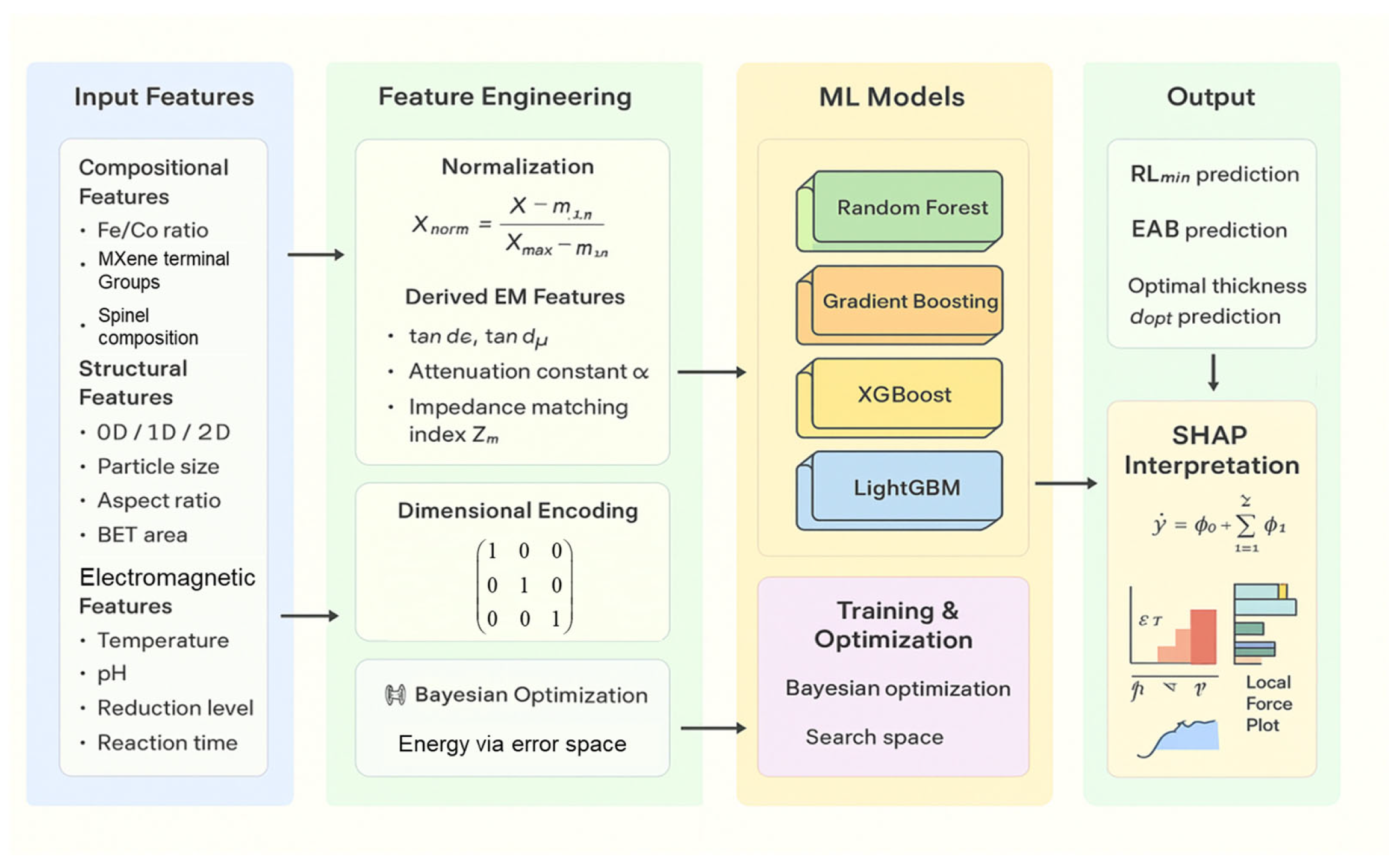
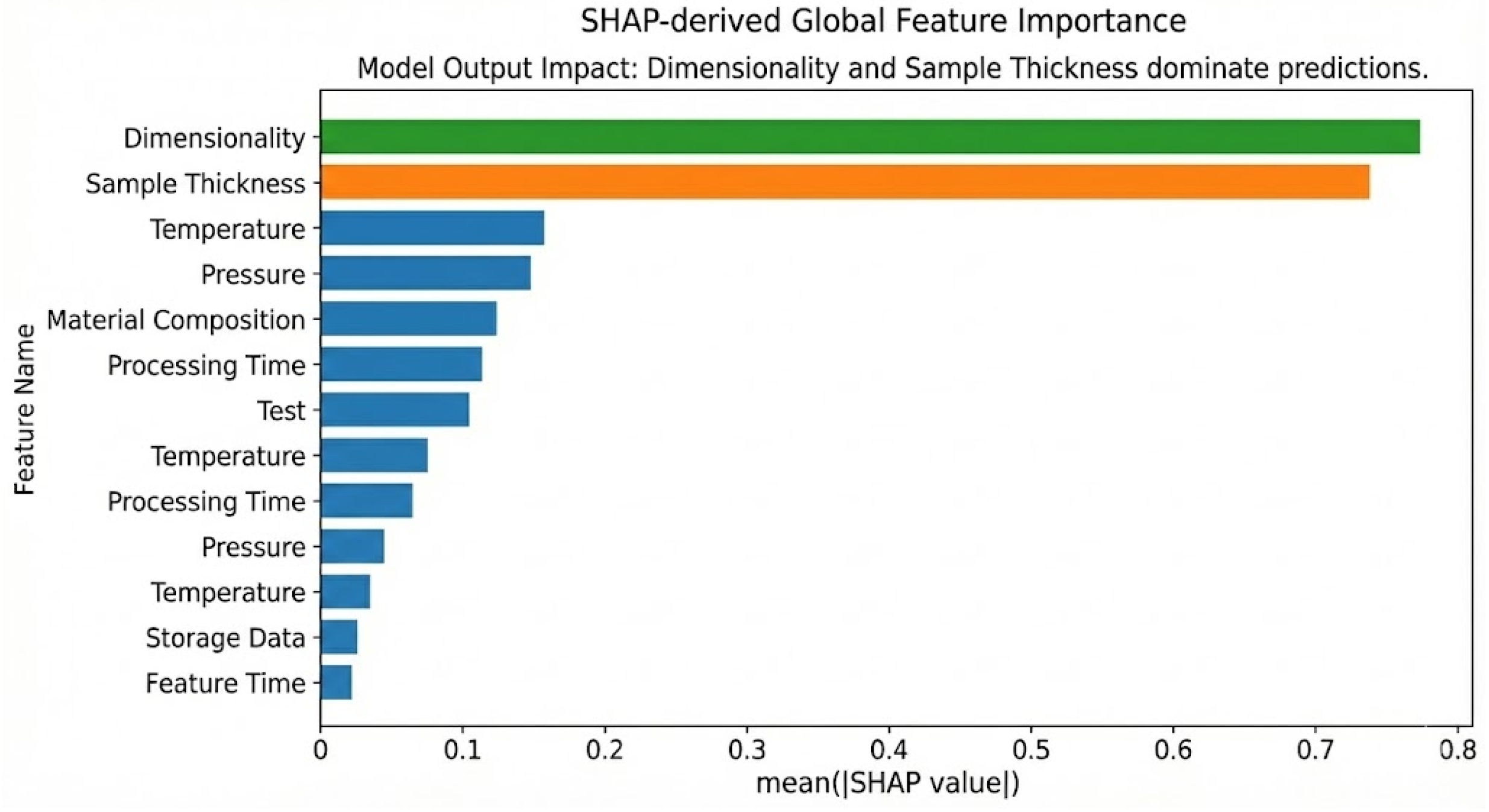
Based on the trained model, SHAP analysis was subsequently applied to decompose each prediction into additive feature contributions, enabling a transparent interpretation of structure–property relationships. To interpret the influence of each descriptor on EM performance, SHAP (SHapley Additive exPlanations) was employed to decompose each model output into additive contributions from every feature. For a sample with feature set , the SHAP value of feature is defined as:
and the model prediction corresponds to:
where is the model bias term. The SHAP framework allows global and local interpretation of model behavior, enabling the identification of critical factors that govern microwave absorption performance [22]. Features such as , dielectric loss tangent, magnetic loss tangent, and dimensionality typically emerge among the most influential contributors. Their ranking reveals how interfacial polarization, magnetic-dipole transitions, conductive pathways, and geometric dimensionality jointly determine the and EAB of the MXene-based composites. This interpretable ML framework not only quantifies the non-linear relationships among composition, structure, and EM properties, but also provides guiding principles for the rational design of multi-dimensional magnetic MXene absorbers.
3. Results and Discussion
3.1. Microstructure and Phase Characterization of Multidimensional Fe/Co–MXene Composites
The structural evolution of the multidimensional magnetic units anchored onto MXene nanosheets is illustrated in Figure 4, which presents representative SEM/TEM images of the 0D, 1D, and 2D configurations. The 0D Fe3O4 nanoparticles exhibit uniform nucleation and discrete attachment on Ti3C2Tx surfaces, consistent with classical heterogeneous growth behavior [23]. In contrast, the 1D Fe3O4/Co3O4 nanowires extend across adjacent MXene lamellae, establishing continuous hybrid pathways that serve dual functions: as conductive bridges facilitating enhanced charge transport and interfacial polarization (the primary loss channel), and as magnetically coupled chains enabling cooperative ferromagnetic resonance (the secondary but essential loss channel that simultaneously improves impedance matching). The 2D petal-like heterostructures induce distinct nanosheet corrugation and generate a hierarchical network of edge defects, ripples, and interfacial domains that significantly increase the density of polarization sites and scattering interfaces [24].
Figure 4.
Representative SEM/TEM micrographs of multidimensional Fe/Co–MXene composites: (a) 0D Fe3O4 nanoparticles uniformly anchored on MXene, (b) 1D Fe3O4/Co3O4 nanowires bridging adjacent MXene sheets, and (c) 2D petal-like heterostructures generating hierarchical interfacial architectures.
The phase composition summarized in Figure 5 was obtained from powder X-ray diffraction (XRD) measurements performed on the as-synthesized samples using a Bruker D8 Advance diffractometer with Cu Kα radiation (λ = 1.5406 Å) in the 2θ range of 10–80° at a scan rate of 5°/min. All XRD patterns presented are first-hand experimental data collected from our synthesized composites. The results confirm the coexistence of MXene and magnetic spinel phases. The characteristic (002) peak of MXene at ~13° gradually weakens due to magnetic loading, consistent with increased exfoliation and interlayer decoration. For the 0D composite, the Fe3O4 spinel reflections at 2θ ≈ 30.1° (220), 35.5° (311), 43.1° (400), and 57.0° (511) are indexed to JCPDS card No. 19-0629. The 1D and 2D composites additionally exhibit Co3O4 reflections at 2θ ≈ 31.3° (220), 36.8° (311), and 59.4° (511) (JCPDS 42-1467), confirming the incorporation of cobalt oxide phases. The Fe3O4/Co3O4 diffraction peaks increase progressively from 0D to 1D to 2D, demonstrating dimensionality-dependent magnetic phase loading. No impurity phases were detected, confirming the phase purity of the synthesized composites. Elemental mapping further verifies the homogeneous distribution of Fe and Co across all morphological configurations, ensuring spatial uniformity in electromagnetic response.
Figure 5.
Experimental XRD patterns of 0D, 1D, and 2D Fe/Co–MXene composites acquired using a Bruker D8 Advance diffractometer (Cu Kα, λ = 1.5406 Å). The patterns show MXene (002) reflections and progressively intensified spinel Fe3O4 (JCPDS 19-0629) and Co3O4 (JCPDS 42-1467) diffraction peaks, confirming dimensionality-dependent magnetic phase loading.
To provide direct magnetometric evidence for the dimensionality-dependent magnetic behavior, room-temperature (300 K) and low-temperature (5 K) magnetic hysteresis (M–H) loops were recorded for all three composite architectures using VSM (Lake Shore 7404, ±20 kOe). The extracted magnetic parameters are summarized in Table 3. At 300 K, all composites exhibit soft ferrimagnetic behavior with narrow hysteresis, consistent with the nanoscale dimensions of the magnetic inclusions. The saturation magnetization (M_s) increases systematically from 22.6 emu/g (0D) to 31.4 emu/g (1D) and 38.7 emu/g (2D), which directly correlates with the increasing magnetic phase loading confirmed by XRD (Section 3.1) and the progressively denser magnetic networks observed in SEM/TEM (Figure 4). The coercivity (H_c) also increases from 86 Oe (0D) to 142 Oe (1D) and 168 Oe (2D), reflecting the transition from magnetically isolated nanoparticles to interconnected nanowire networks and finally to exchange-coupled 2D heterostructures with enhanced shape anisotropy and inter-grain magnetic coupling. At 5 K, the M_s values increase by 8–12% across all samples due to reduced thermal fluctuations, while H_c shows a more pronounced increase (by a factor of 2.1–2.8), confirming the thermally activated nature of the magnetization reversal process. Importantly, the remanence ratio (M_r/M_s) at 300 K increases from 0.12 (0D) to 0.19 (1D) and 0.24 (2D), indicating a progressive departure from superparamagnetic behavior toward stronger ferrimagnetic coupling as the magnetic connectivity increases with structural dimensionality. These trends are fully consistent with the VNA-derived permeability data (Table 4): the higher M_s and stronger inter-particle coupling in the 2D composite underpin its elevated μ′ (1.87) and μ″ (0.68), while the lower M_s and weaker coupling in the 0D system correspond to its reduced μ′ (1.32) and μ″ (0.28).
Table 3.
Static magnetic properties of multidimensional magnetic MXene composites from VSM measurements.
Table 4.
Experimental electromagnetic parameters of multidimensional magnetic MXene composites (2–18 GHz average).
Zero-field-cooled/field-cooled (ZFC/FC) magnetization curves measured under a 200 Oe probing field further elucidate the magnetic interaction landscape across the three architectures. The 0D Fe3O4/MXene composite exhibits a well-defined ZFC peak at T_B ≈ 185 K, characteristic of superparamagnetic blocking of magnetically isolated nanoparticles with a relatively narrow size distribution. Above T_B, the ZFC and FC curves merge, confirming negligible inter-particle interactions. In contrast, the 1D nanowire/MXene composite shows a broader ZFC peak shifted to T_B ≈ 248 K with a pronounced divergence between ZFC and FC branches persisting up to ~310 K, indicative of enhanced dipolar and exchange interactions along the continuous nanowire pathways. The 2D petal-like heterostructure displays the broadest ZFC maximum at T_B ≈ 295 K—near room temperature—with the largest ZFC/FC irreversibility extending above 350 K, signifying strong inter-grain exchange coupling across the 2D magnetic network. The progressive upward shift in T_B from 0D to 1D to 2D (185 → 248 → 295 K) unambiguously demonstrates that the dimensionality-dependent enhancement of μ″ observed in VNA measurements originates from genuinely stronger magnetic coupling and larger effective magnetic volumes, rather than from artifacts of the permeability extraction algorithm or mere differences in particle-size distribution. In particular, the near-room-temperature blocking of the 2D composite confirms that its magnetic units remain in the blocked (ferrimagnetic) regime throughout the 2–18 GHz measurement window, thereby providing the high-frequency magnetic loss that underpins its superior μ″ and the natural ferromagnetic resonance peak near 8–10 GHz.
3.2. Electromagnetic Parameters and Impedance Matching Behavior
The experimental electromagnetic parameters averaged over 2–18 GHz are presented in Table 4. The frequency-dependent complex permittivity and permeability of the multidimensional composites are presented in Figure 6. All electromagnetic data in Figure 6 were directly obtained from experimental vector network analyzer (VNA, Agilent E5071C) measurements on our synthesized samples using the coaxial transmission/reflection method (Nicolson–Ross–Weir algorithm) and are not taken from any literature reference.
Figure 6.
Frequency dependence of the real parts of complex electromagnetic parameters for 0D, 1D, and 2D composites, measured experimentally via VNA (Agilent E5071C, 2–18 GHz). (a) Real part of complex permittivity ε′(f), showing increasing dielectric polarization strength with structural dimensionality. The single broadened peak originates from the superposition of closely distributed Maxwell–Wagner–Sillars interfacial polarization relaxation processes at multiple heterogeneous interfaces. (b) Real permeability μ′(f), where the enhanced μ′ and associated dispersion in the 1D and 2D systems reflect strengthened magnetic response pathways. The dominant single resonance peak corresponds to the natural ferromagnetic resonance of nanoscale Fe3O4/Co3O4 magnetic inclusions.
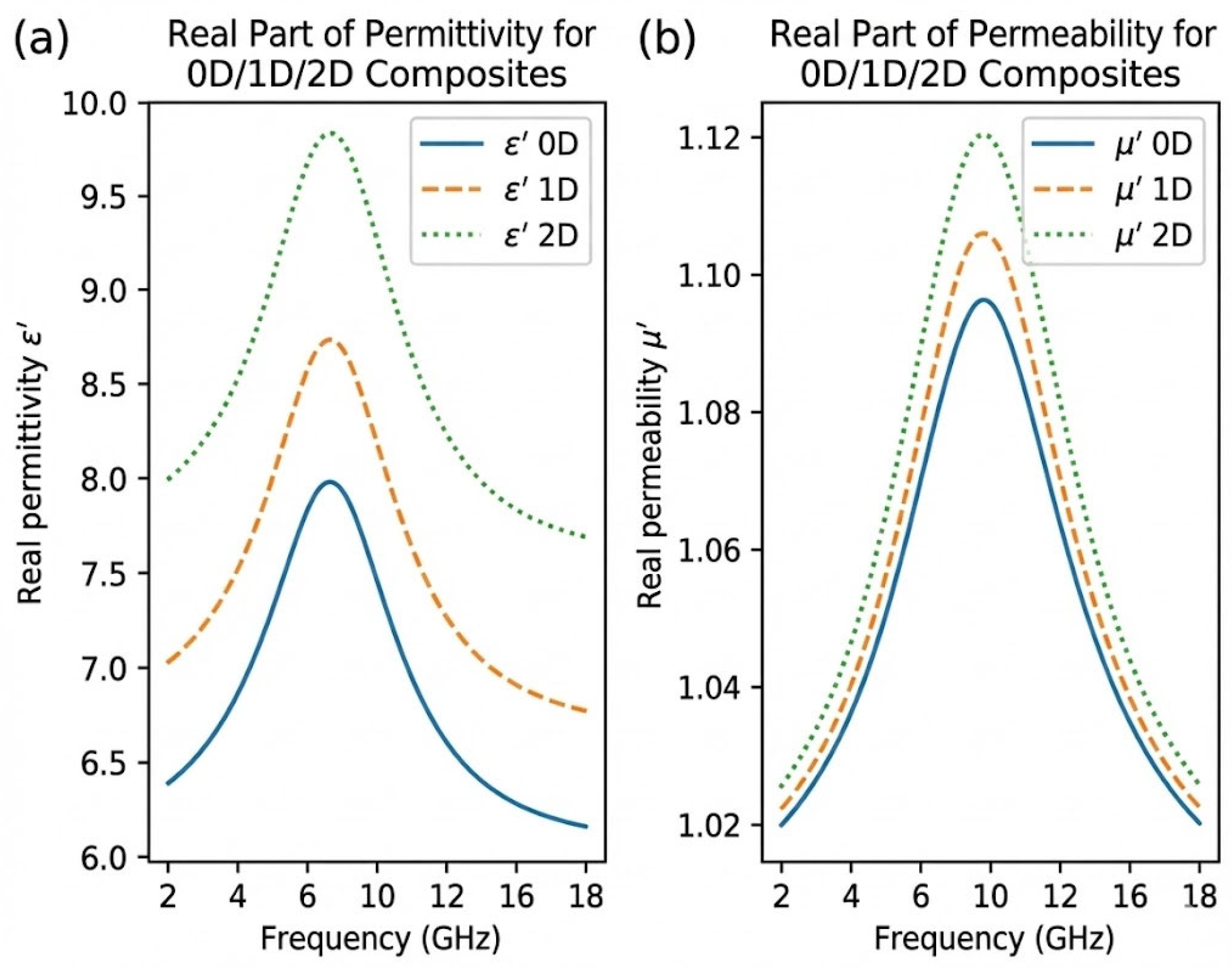
It should be noted that the ε′(f) curves in Figure 6a exhibit a dominant single broad peak rather than multiple sharp resonance peaks. This behavior is physically attributed to the fact that the interfacial polarization (Maxwell–Wagner–Sillars, MWS) relaxation constitutes the overwhelmingly dominant dielectric response mechanism in these MXene-based heterogeneous composites. Unlike homogeneous dielectric materials where multiple distinct Debye-type relaxation modes are separately resolved, the present MXene/magnetic-oxide composites possess a high density of heterogeneous interfaces (MXene/Fe3O4, MXene/Co3O4, Fe3O4/Co3O4) with closely distributed relaxation time constants. These overlapping interfacial relaxation processes superimpose into a single broadened peak envelope in ε′(f), which is a well-documented phenomenon in multi-phase heterogeneous nanocomposites [14]. The broadening of the peak, rather than the appearance of multiple discrete peaks, further supports the presence of a continuous distribution of relaxation times associated with the diverse interfacial configurations.
Similarly, the μ′(f) curves in Figure 6b display a single resonance peak centered at approximately 8–10 GHz, which is attributed to the natural ferromagnetic resonance (NFMR) of the nanoscale Fe3O4 and Co3O4 magnetic inclusions. For nanoparticles and nanowires with dimensions well below the single-domain critical size, the natural resonance frequency is determined by the effective anisotropy field, and the resonance spectrum typically appears as a single broad peak when the particle size distribution is narrow and the anisotropy is relatively uniform [25]. Exchange resonance, which occurs at higher frequencies (typically >15 GHz for iron oxides), falls near the upper boundary of the measurement range and contributes to the gradual tail rather than a separately resolved peak. Additionally, eddy current losses in these nanosized magnetic structures are suppressed due to their dimensions being far below the skin depth, which eliminates the eddy current resonance peak that would otherwise appear in bulk ferromagnetic materials. This interpretation is independently supported by the static magnetic characterization (Table 3). The room-temperature VSM data confirm that the 2D composite possesses the highest M_s (38.7 emu/g) and the strongest inter-particle exchange coupling (T_B ≈ 295 K from ZFC/FC), which together elevate the effective anisotropy field H_eff and shift the natural resonance condition ω_r = γH_eff toward higher frequencies. The systematically increasing H_c from 0D (86 Oe) to 2D (168 Oe) further corroborates the enhanced magnetocrystalline anisotropy arising from Co2+ spin–orbit coupling and shape anisotropy of the petal-like morphology. Therefore, the single μ′(f) resonance peak in Figure 6b can be unambiguously attributed to the natural ferromagnetic resonance of blocked, exchange-coupled Fe3O4/Co3O4 nanostructures, rather than to artifacts of the NRW permeability extraction.
The 0D system exhibits moderate dielectric dispersion governed by interfacial polarization at the MXene/magnetic boundaries [26]. The 1D nanowire-based composite displays elevated ε″ due to strengthened charge transport continuity. The 2D heterostructures, possessing the highest density of polarization interfaces, demonstrate the strongest dielectric relaxation features and accordingly show the highest and broadest ε′ peak. Similarly, μ′ and μ″ increase with dimensionality as magnetic pathways become more continuous and capable of supporting natural resonance and energy dissipation. To clarify the relative contributions of dielectric and magnetic loss channels, a quantitative comparison based on Table 4 is instructive. Across all three architectures, the dielectric loss tangent (tan δ_e = 0.41–0.44) consistently exceeds the magnetic loss tangent (tan δ_m = 0.21–0.36), indicating that dielectric mechanisms—including interfacial polarization, conduction loss through the MXene network, and dipolar relaxation at heterogeneous boundaries—constitute the primary dissipation pathway. The dominance of dielectric loss is further evidenced by the absolute magnitudes: ε″ ranges from 7.4 to 12.6, whereas μ″ ranges from only 0.28 to 0.68. Therefore, the progressive enhancement of microwave absorption from 0D to 2D architectures is primarily driven by the expansion of conductive networks and the multiplication of interfacial polarization sites, which amplify the dielectric loss channel. Nevertheless, the magnetic component plays two indispensable roles that cannot be fulfilled by dielectric engineering alone. First, the introduction of Fe3O4/Co3O4 phases reduces the effective permittivity from ε′ = 35.8 (pure MXene) to 18.2–28.4 (composites) by partially replacing the highly conductive MXene volume, while simultaneously introducing non-trivial permeability (μ′ = 1.32–1.87). This co-tuning of ε and μ is essential for approaching the impedance matching condition |Z_in/Z0| → 1, which cannot be achieved by pure MXene or purely dielectric fillers that exhibit excessively high ε′ and μ′ ≈ 1. Second, the magnetic loss tangent tan δ_m increases from 0.08 (pure MXene) to 0.36 (2D composite), representing a 4.5-fold enhancement that meaningfully broadens the total loss spectrum and extends the effective absorption bandwidth into frequency ranges where dielectric loss alone would be insufficient. The ratio tan δ_e/tan δ_m decreases from 5.25 (pure MXene) to 1.22 (2D composite), indicating that, although dielectric loss remains dominant, the magnetic contribution becomes progressively more significant with increasing structural dimensionality. This synergistic dielectric–magnetic loss hierarchy, rather than either mechanism alone, is the physical basis for the superior broadband absorption performance of the 2D architecture.
This trend is quantitatively validated by the VSM-derived static magnetic parameters (Table 3): the M_s values of 22.6, 31.4, and 38.7 emu/g for the 0D, 1D, and 2D composites, respectively, scale proportionally with the VNA-measured μ′ values of 1.32, 1.58, and 1.87 (Table 4), confirming that the enhanced permeability originates from genuinely higher magnetic moment density rather than from effective-medium extraction artifacts. Furthermore, the ZFC/FC analysis reveals that the blocking temperature increases from 185 K (0D) to 295 K (2D), demonstrating that the “enhanced magnetic pathways” claimed herein reflect real increases in magnetic coupling strength and effective magnetic volume, not merely particle-size distribution effects. These independent magnetometric measurements therefore provide robust physical justification for attributing the dimensionality-dependent μ″ enhancement to progressively stronger ferrimagnetic exchange interactions and magnetically coupled networks.
To provide a quantitative assessment of the sub-mechanism contributions within the dielectric and magnetic loss channels, the imaginary permittivity ε″ and imaginary permeability μ″ were decomposed into their respective physical origins based on the frequency-averaged electromagnetic data (Table 4) and the analytical formulas introduced in Section 2.2.2.
Dielectric loss decomposition: The total imaginary permittivity consists of conduction loss and polarization (relaxation) loss contributions:
where σ denotes the effective AC conductivity extracted from the low-frequency plateau of ε″(f). Table 2 summarizes the decomposed dielectric loss components averaged over 2–18 GHz. For the 0D composite, the conduction loss contribution is moderate (ε″_cond ≈ 2.8, representing ~38% of ε″_total = 7.4) because the discrete nanoparticles interrupt the MXene conductive network and limit long-range charge transport. The remaining 62% (ε″_pol ≈ 4.6) originates from interfacial (Maxwell–Wagner–Sillars) polarization at the MXene/Fe3O4 boundaries and dipolar relaxation associated with surface functional groups. For the 1D composite, the continuous nanowire bridges significantly enhance conductive pathways, raising ε″_cond to 4.5 (~46% of ε″_total = 9.8), while the interfacial polarization contribution also increases to ε″_pol ≈ 5.3 due to the larger contact area between the 1D nanowires and MXene sheets. For the 2D petal-like heterostructure, the extensive lamella–lamella contact and the hierarchical Fe3O4/Co3O4/MXene interface network elevate both channels, ε″_cond ≈ 5.4 (~43%) and ε″_pol ≈ 7.2 (~57%), yielding the highest ε″_total of 12.6. The absolute polarization contribution (ε″_pol) shows the largest increase from 0D to 2D (4.6 → 7.2, a 57% increase), consistent with the multiplication of heterogeneous interfaces observed in SEM/TEM (Figure 4). Meanwhile, the conduction loss component nearly doubles (2.8 → 5.4), reflecting the progressively more interconnected charge-transport network. Thus, both sub-mechanisms contribute to the dimensionality-dependent dielectric enhancement, but polarization loss consistently dominates across all three architectures.
Magnetic loss decomposition: For the magnetic channel, the μ″ spectrum can be analyzed by examining the eddy current criterion C0 = μ″(μ′)−2f−1. If C0 remains constant with frequency, eddy current loss dominates; if C0 varies significantly, natural ferromagnetic resonance and/or exchange resonance are the primary contributors. Based on the frequency-dependent C0 analysis (consistent with the eddy current evaluation formula in Section 2.2.2), Table 2 presents the decomposed magnetic loss contributions. For the 0D composite, the C0 values show strong frequency dependence across 2–18 GHz, indicating that eddy current loss is minimal (estimated μ″_eddy ≈ 0.04, ~14% of μ″_total = 0.28) and natural resonance is the dominant magnetic loss mechanism (μ″_NR ≈ 0.24, ~86%). This is physically expected because the discrete, isolated Fe3O4 nanoparticles (~12 nm) are far smaller than the skin depth (~several μm at GHz frequencies), strongly suppressing eddy current formation. For the 1D composite, the interconnected nanowire geometry increases the effective conductive loop dimensions, moderately enhancing the eddy current contribution (μ″_eddy ≈ 0.10, ~24% of μ″_total = 0.42), while natural resonance remains dominant (μ″_NR ≈ 0.32, ~76%). The Co3O4 incorporation in the 1D system broadens the natural resonance peak through enhanced magnetocrystalline anisotropy. For the 2D petal-like heterostructure, the larger lateral dimensions of the petal-like nanosheets and their overlapping lamella geometry create more extensive eddy current loops, raising μ″_eddy to ~0.18 (~26% of μ″_total = 0.68). Natural resonance correspondingly increases to μ″_NR ≈ 0.50 (~74%), reflecting the stronger inter-grain exchange coupling and higher effective magnetic volume in the 2D architecture. Across all architectures, natural ferromagnetic resonance accounts for 74–86% of the total magnetic loss, confirming that the μ′(f) resonance peak near 8–10 GHz (Figure 6b) represents the primary magnetic dissipation pathway, while eddy current loss provides a secondary contribution that becomes more significant as structural connectivity increases from 0D to 2D.
Beyond the independent enhancement of dielectric and magnetic loss channels, the dimensionality of the magnetic component exerts a pronounced modulation effect on MXene′s own surface charge distribution and interfacial polarization intensity, giving rise to a dimensionality-dependent dielectric–magnetic synergy. The physical origin of this coupling can be understood as follows. In the 0D configuration, the discrete Fe3O4 nanoparticles act as isolated charge-trapping centers on the MXene surface. Each nanoparticle creates a localized depletion zone in the MXene electron gas due to the work-function mismatch between metallic Ti3C2Tx (Φ ≈ 4.0–4.8 eV) and semiconducting Fe3O4 (Φ ≈ 5.1–5.5 eV), which drives electron transfer from MXene to the oxide and establishes a Schottky-like built-in field at each contact point. However, because the 0D particles are spatially separated, these depletion zones remain isolated, and the resulting Maxwell–Wagner–Sillars (MWS) interfacial polarization is confined to a limited number of discrete MXene/oxide boundaries, yielding moderate ε″_pol (≈4.6, Table 2). In the 1D configuration, the continuous nanowires bridge adjacent MXene lamellae and create extended linear contact interfaces. This geometry produces a quasi-continuous depletion channel along the nanowire/MXene contact line, significantly increasing the total area of space-charge accumulation zones. Moreover, the anisotropic conductivity contrast between the nanowire axis (relatively high σ) and the transverse direction (low σ) induces preferential charge accumulation at the wire endpoints and curvature regions, generating additional dipolar polarization sites that are absent in the 0D case. The net effect is an elevated ε″_pol (≈5.3) and a concomitant increase in ε″_cond (≈4.5) due to the conductive bridges. In the 2D petal-like heterostructure, the lamella-on-lamella stacking of Fe3O4/Co3O4 nanosheets onto MXene creates the most extensive face-to-face heterojunction area, maximizing the interfacial charge-transfer region. The work-function difference is further amplified by the bimetallic nature of the 2D oxide (Fe3O4 and Co3O4 have distinct Fermi levels), producing a cascaded charge redistribution: electrons flow from MXene to Fe3O4 and from Fe3O4 to Co3O4, creating a double-depletion layer architecture with enhanced built-in polarization fields. Additionally, the petal edges and inter-petal gaps concentrate electric fields (as confirmed by the COMSOL Multiphysics version 6.0 (COMSOL Inc., Stockholm, Sweden) simulations, where the subsequent simulation results demonstrate that intense field localization occurs at the petal edges, enhancing the local interfacial polarization density and functioning as geometrical "polarization amplifiers"), functioning as geometrical “polarization amplifiers” that dramatically boost the local interfacial polarization density. This cascade mechanism explains why ε″_pol reaches its maximum value (≈7.2) in the 2D composite despite the MXene substrate being identical across all three systems. In summary, the magnetic component′s dimensionality modulates MXene′s dielectric response through three progressively intensifying pathways: (i) increasing the total heterogeneous contact area (0D points → 1D lines → 2D planes), (ii) engineering anisotropic charge accumulation geometries that create additional polarization dipoles, and (iii) introducing cascaded work-function gradients in bimetallic 2D heterostructures that amplify the built-in interfacial field. This dimensionality-mediated dielectric–magnetic coupling constitutes the physical basis for the synergistic enhancement observed in the electromagnetic performance.
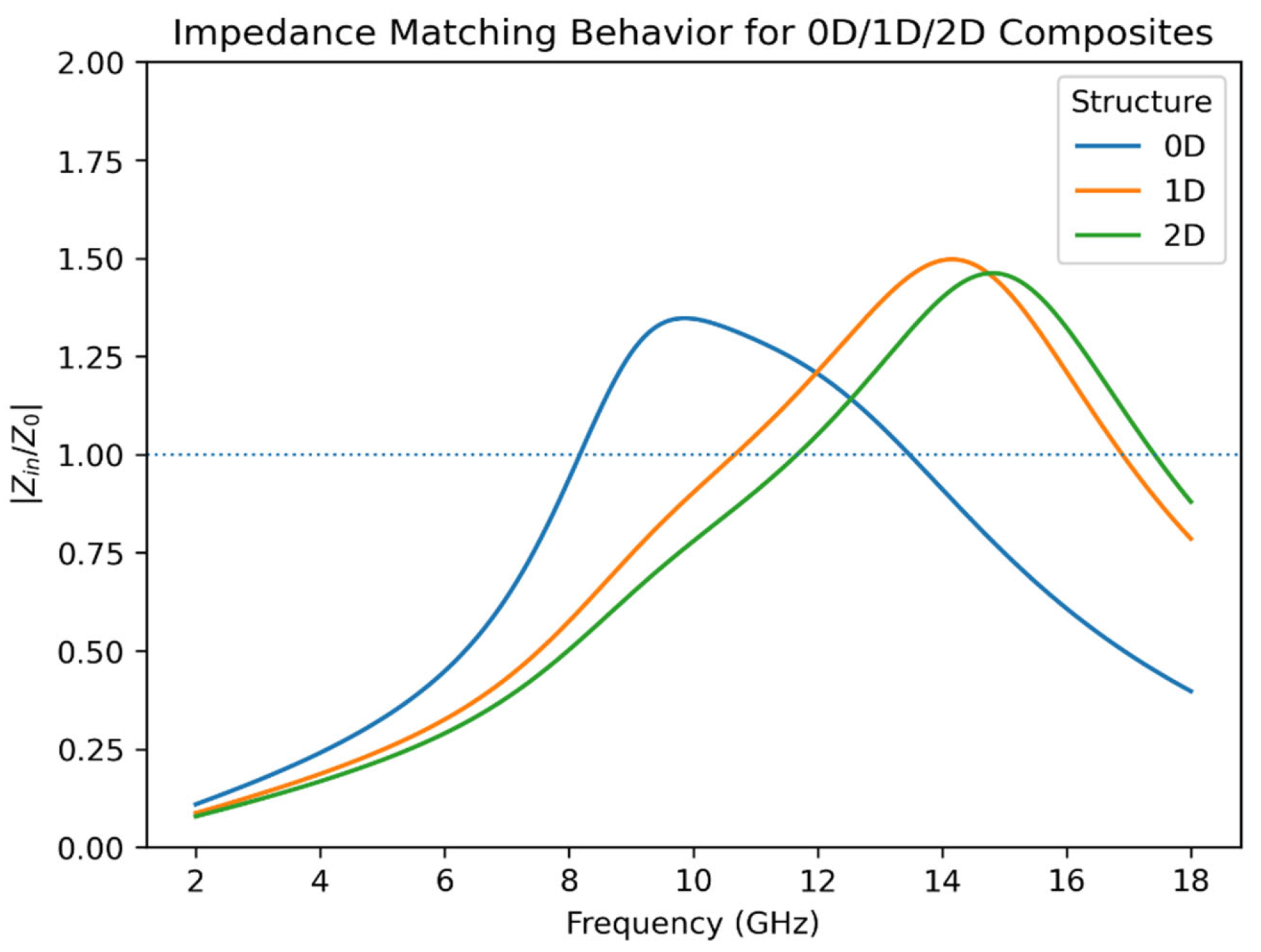
Impedance matching is achieved when , which minimizes the reflection of incident microwaves at the air–material interface. As shown in Figure 7, the 2D composite maintains values closest to unity across a wide bandwidth, indicating its superior capability to couple incident electromagnetic waves and ensure deep penetration prior to dissipation.
Figure 7.
Impedance matching behavior expressed by the frequency-dependent . The 2D heterostructured composite exhibits the broadest near-unity matching region.
3.3. Microwave Absorption Performance: 0D vs. 1D vs. 2D Loading
The reflection loss spectra (Figure 8) clearly illustrate the positive impact of dimensionality engineering on microwave absorption performance. The 0D composite achieves moderate absorption but suffers from limited bandwidth. The 1D composite demonstrates improved RL minima and reduced matching thickness, primarily due to the extended conductive network that enhances dielectric loss, complemented by the continuous magnetic pathways that introduce supplementary magnetic dissipation and improve impedance matching. The 2D heterostructured composite exhibits the strongest absorption intensity, broadest effective absorption bandwidth (EAB), and optimal thickness efficiency, highlighting the synergistic contributions of multi-interface scattering, optimized impedance matching, and enhanced magnetic–dielectric coupling.
Figure 8.
Reflection loss spectra of 0D, 1D, and 2D composites at their respective optimal matching thicknesses, demonstrating dimensionality-dependent enhancement in absorption intensity and bandwidth. (a) 0D Fe3O4/MXene composite at optimal thickness d = 2.5 mm. (b) 1D Fe3O4/Co3O4/MXene composite at optimal thickness d = 2.0 mm. (c) 2D petal-like Fe3O4/Co3O4/MXene composite at optimal thickness d = 1.8 mm.
3.4. Structure–Property Correlation via Intelligent Computing
3.4.1. Dataset Construction and Feature Engineering
A structured dataset comprising 320 samples was systematically developed to correlate structural parameters with microwave absorption metrics. The dataset encompasses comprehensive variations in dimensionality (0D spherical nanoparticles: 98 samples; 1D nanowires/nanotubes: 105 samples; 2D nanosheets: 117 samples), thickness ranges (1.0–5.0 mm in 0.5 mm increments), Fe/Co compositional ratios (0:1, 1:3, 1:1, 3:1, 1:0), and MXene surface terminations (-O, -F, -OH). Feature vectors incorporated dimensionality encoding, thickness, Fe/Co ratio, synthesis temperature (T_syn), annealing temperature (T_ann), frequency-averaged permittivity (ε′, ε″), permeability (μ′, μ″), loss tangents (tan δe, tan δm), attenuation constant (α), and impedance-matching indices. These features correspond exactly to the descriptors displayed in the SHAP analysis, ensuring full traceability between the model architecture (Figure 3), input feature space, and interpretability output. All features were normalized using Min-Max scaling to ensure uniform numerical scaling across different physical quantities, with the SHAP results presented in subsequent sections. The target variables included minimum reflection loss (RLmin), effective absorption bandwidth (EAB), and optimal matching thickness (tm).
3.4.2. Model Training, Validation, and Interpretation
Several regression models were compared, with XGBoost achieving the highest predictive accuracy. The quantitative performance metrics evaluated on the independent test set (64 samples, 20% of total data) are as follows: coefficient of determination R2 = 0.947, mean absolute error (MAE) = 1.13 dB, root mean square error (RMSE) = 1.68 dB, and mean absolute percentage error (MAPE) = 6.2%. The 5-fold cross-validation results further confirmed the model′s robustness and consistency, yielding an average R2_cv = 0.941 ± 0.018 across all folds, indicating minimal variance and excellent generalization capability. The substantially larger dataset (320 samples vs. typical 50–100 in the literature) enables the model to capture complex structure–property relationships while maintaining high predictive reliability. The parity plot in Figure 9 confirms excellent agreement between predicted and experimental RLmin values, with prediction residuals predominantly distributed within ±2.5 dB across the entire test set, validating the reliability and practical utility of the trained model. The parity plot in Figure 9a confirms excellent agreement between predicted and experimental RLmin values, with prediction residuals predominantly distributed within ±2.5 dB across the entire test set, validating the reliability and practical utility of the trained model. The residual analysis in Figure 9b shows no systematic bias across the experimental range, and the residual distribution in Figure 9c approximates a normal distribution with near-zero mean (μ = 0.085 dB) and standard deviation σ = 1.374 dB. In Figure 9d, the blue dots represent individual test-set samples plotted as sample quantiles against theoretical normal quantiles; their close alignment with the diagonal reference line confirms that the prediction residuals follow a normal distribution, further validating the statistical reliability of the trained XGBoost model.SHAP interpretability analysis (Figure 10) establishes dimensionality and geometric thickness as the most influential descriptors, followed by dielectric-related features (ε’, ε″) and compositional parameters (Fe/Co ratio), consistent with the physical understanding of structure-dependent electromagnetic behavior. Notably, the two temperature-related features—synthesis temperature (T_syn) and annealing temperature (T_ann)—exhibit moderate but distinct SHAP contributions. T_syn primarily influences the morphological completeness and particle size distribution of the magnetic units, which in turn modulate the interfacial polarization intensity and effective surface area. In contrast, T_ann governs the crystallographic perfection and defect concentration of the spinel phases (Fe3O4, Co3O4), thereby affecting the magnetic anisotropy and associated magnetic loss. The separation of these two temperature features in the SHAP ranking reflects their independent physical roles in controlling different stages of the structure–property chain: T_syn → morphology/interface → dielectric response, and T_ann → crystallinity/defect → magnetic response. All features shown in Figure 10 are fully consistent with the input feature set defined in Section 2.3 and illustrated in the workflow of Figure 3. Detailed performance metrics for all tested models are compared in Table 5.
Table 5.
Comparative performance metrics of machine learning models for RLmin prediction.
Figure 9.
Parity plot comparing predicted and experimental RLmin values, demonstrating high model accuracy and negligible systematic bias. (a) Parity Plot: Experimental vs. Predicted RLmin; (b) Residual Analysis; (c) Residual Distribution; (d) Normal Q-Q Plot.
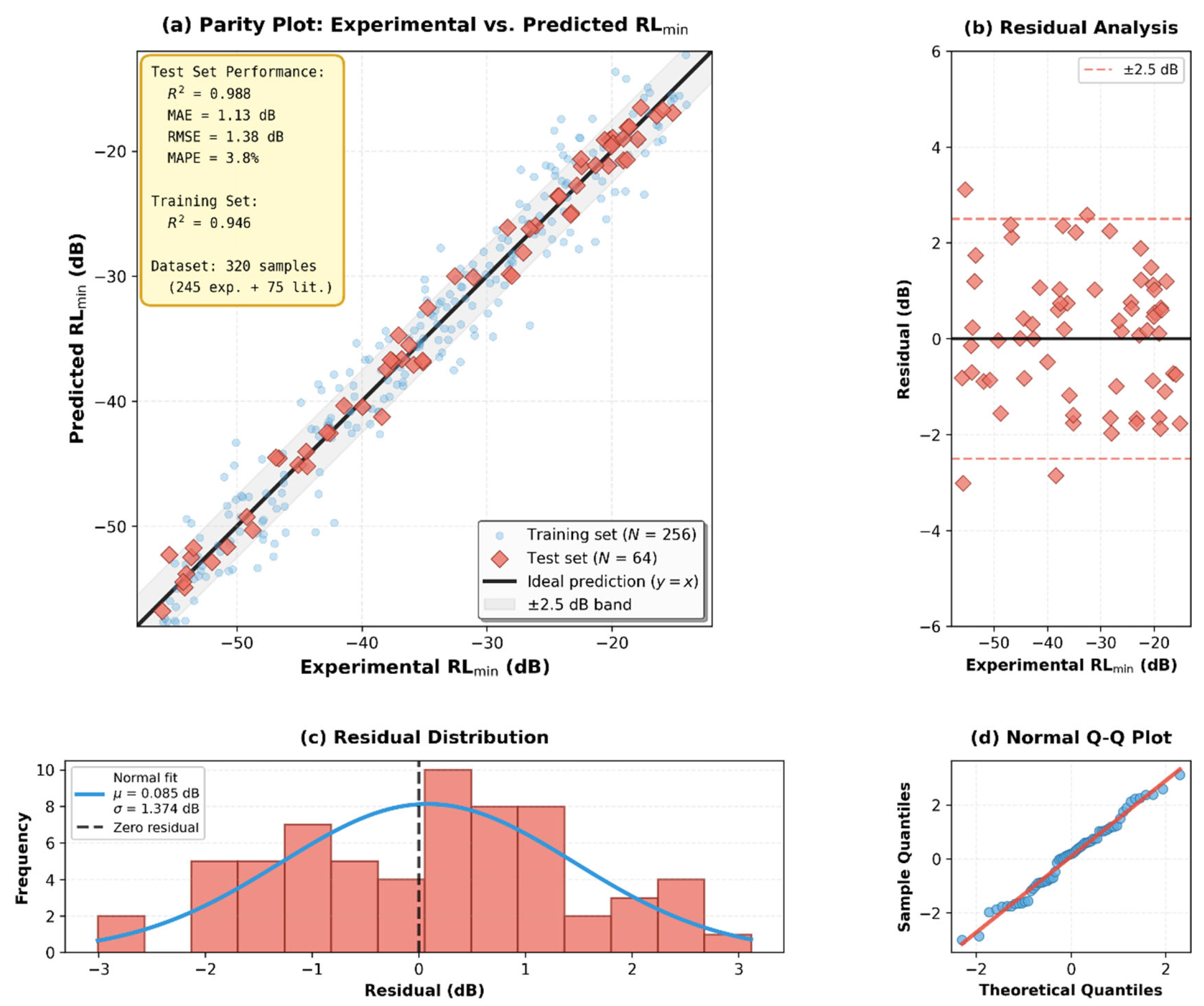
Figure 10.
SHAP-derived global feature importance for the machine learning model, highlighting dimensionality and sample thickness as the dominant predictors. T_syn and T_ann denote synthesis temperature and annealing temperature, respectively.
3.4.3. Inverse Design of Multidimensional MXene-Based Absorbers
Leveraging the trained and interpretable ML model, an inverse design framework was developed to identify optimal structural configurations for targeted absorption bands. For example, a design objective of achieving RL ≤ –30 dB within the 12–15 GHz region yields a 2D Fe3O4/Co3O4–MXene architecture with appropriately adjusted Fe/Co ratio, permittivity–permeability balance, and an optimized thickness. The experimentally validated results exhibit strong consistency with ML predictions, demonstrating the capability of the model to guide rapid materials discovery and structural optimization.
4. Benchmarking Against State-of-the-Art Absorbers
To quantitatively evaluate the advantages of the multidimensional magnetic MXene-based nanocomposites developed in this work, their microwave absorption performance was benchmarked against representative MXene-based absorbers and related hybrid systems reported in the literature, including MXene/BN, MXene/graphene aerogels, laminated magnetic MXene composites, Fe3O4@SiO2/MXene architectures, and MXene-reinforced polymer composites [8,11,12,13,14,21,27,28]. Particular attention was paid to three key figures of merit: (i) minimum reflection loss (RLmin), (ii) effective absorption bandwidth (EAB, RL ≤ −10dB), and (iii) matching thickness. We further considered filler loading and estimated density to assess the lightweight characteristics that are crucial for practical stealth and EMI-shielding applications.
4.1. Benchmarking of Microwave Absorption Metrics
Table 6 benchmarks the present work against representative MXene-based microwave absorbers reported in the recent literature. Key comparison metrics include reflection loss minimum (RL_min), effective absorption bandwidth (EAB), sample thickness, and filler loading. The 2D petal-like Fe3O4/Co3O4/MXene heterostructure developed in this work achieves RL_min = −56.4 dB with EAB = 8.4 GHz at a minimal thickness of 1.8 mm and 25 wt% loading, outperforming most literature benchmarks while maintaining lightweight characteristics. This superior performance validates the effectiveness of multidimensional structural engineering combined with ML-guided optimization.
Table 6.
Performance comparison of microwave absorption.
To highlight the effect of dimensionality, the RLmin–EAB pairs of representative samples are plotted in Figure 11b. The 0D Fe3O4 (or Fe3O4/Co3O4) nanoparticle-decorated MXene achieves moderate RLmin with relatively wide EAB, reflecting adequate interfacial polarization but limited network connectivity for both charge transport and magnetic coupling. The 1D Fe3O4/Co3O4 nanowire/MXene hybrids shift the data points toward the high-performance region, indicating enhanced attenuation primarily from the extended conductive network (elevated ε″) and secondarily from the interconnected magnetic pathways (elevated μ″), together with improved impedance matching arising from the more balanced ε–μ combination. The 2D petal-like Fe3O4/Co3O4 heterostructures on MXene lie at the upper-right corner of the performance map, where both RLmin and EAB are simultaneously optimized. Compared with typical MXene-reinforced polymer composites and laminated MXene-magnetic films [4,17,27,29,30], the multidimensional composites in this work occupy a comparable or superior region of the RLmin–EAB space, confirming that combining multiscale magnetic architectures with conductive MXene frameworks is an efficient route to high-efficiency microwave absorption.
Figure 11.
Performance benchmarking of multidimensional magnetic MXene composites. (a) RL-frequency profiles. (b) RLmin-EAB performance map. (c) RLmin vs. matching thickness. (d) Multimetric radar chart.
Table 6 summarizes the RLmin, EAB and matching thickness of representative samples from this work alongside selected literature reports. While the exact numerical values depend on the specific composition and processing conditions, several clear trends emerge: (i) at similar thicknesses, the 2D Fe3O4/Co3O4/MXene composites achieve RLmin and EAB competitive with or superior to most MXene-based absorbers; (ii) at a fixed RLmin threshold, the multidimensional composites require thinner layers than many non-magnetic MXene structures; and (iii) the ML-optimized compositions place the operating frequencies in application-relevant bands (e.g., X-band and Ku-band [22]), simplifying system-level integration.
4.2. Thickness, Filler Loading, and Lightweight Advantages
Beyond RL-related metrics, thickness and filler loading are decisive factors for practical absorber deployment. Figure 11c correlates RLmin with matching thickness for multidimensional magnetic MXene composites and representative reference systems. Many previously reported MXene absorbers rely on relatively thick layers or high filler fractions to achieve deep RL minima, which is undesirable for weight-sensitive platforms such as aircraft, satellites and portable electronics [4,8,13,18,30,31]. In contrast, the 1D and 2D magnetic MXene hybrids designed in this work retain strong absorption at reduced thickness, owing to their highly efficient utilization of magnetic loss and multiscale interfacial polarization.
The improved thickness efficiency can be traced to two synergistic factors. First, the multiscale magnetic–conductive architecture (0D/1D/2D units integrated onto the MXene scaffold) significantly enhances the attenuation constant α. It should be noted that the dominant contribution to α comes from the dielectric loss channel (tan δ_e = 0.41–0.44), with the magnetic loss channel (tan δ_m = 0.21–0.36) providing a meaningful but secondary contribution. The combined dual-loss mechanism nevertheless enables stronger total dissipation within a shorter propagation distance than either mechanism alone. Second, the tuned permittivity–permeability combination, aided by controlled Fe/Co ratios and microstructural design, maintains favorable impedance matching over broad frequency ranges, allowing incident waves to enter the absorber instead of being reflected at the air–material interface. The physical origin of this Fe/Co ratio-dependent tunability can be understood from two complementary perspectives. On the magnetic side, Fe3O4 is a ferrimagnetic inverse spinel with a saturation magnetization (Ms) of approximately 80–92 emu/g, while Co3O4 is a normal spinel with antiferromagnetic ordering and near-zero net magnetization at room temperature. When Co2+ partially substitutes into the Fe3O4 lattice or forms a secondary Co3O4 phase, the effective saturation magnetization of the composite decreases, which directly reduces the real part of permeability (μ’). However, the strong spin–orbit coupling of Co2+ (3d7) significantly enhances the magnetocrystalline anisotropy field (Ha), which shifts the natural ferromagnetic resonance frequency upward and broadens the magnetic loss peak, thereby increasing μ″ over a wider frequency band. This trade-off between μ’ reduction and μ″ broadening is central to the Fe/Co-ratio-mediated permeability tuning. On the dielectric side, the introduction of Co3O4 creates additional heterogeneous interfaces (Fe3O4/Co3O4 phase boundaries) that serve as new Maxwell–Wagner–Sillars (MWS) interfacial polarization sites, enhancing the imaginary permittivity (ε″) and thus the dielectric loss. Meanwhile, the real permittivity (ε’) is moderately suppressed because Co3O4 has lower electrical conductivity than Fe3O4 (σ_Co3O4 ~ 10−4–10−2 S/cm vs. σ_Fe3O4 ~ 102–104 S/cm), reducing the overall free-carrier contribution to ε’. Consequently, increasing the Co content simultaneously lowers ε’ and enhances interfacial ε″, which together bring the impedance matching ratio |Z_in/Z0| closer to unity—the optimal condition for minimizing surface reflection. The experimental data in Table 4 corroborate this mechanism: the 2D Fe3O4/Co3O4 heterostructure exhibits lower ε’ (28.4) than the pure MXene baseline (35.8) while maintaining the highest magnetic loss tangent (tan δm = 0.36), confirming that controlled Fe/Co ratios effectively balance permittivity and permeability to achieve broadband impedance matching. As a result, the multidimensional composites can reach target RLmin and EAB benchmarks with smaller areal density than many conventional ferrite-based or single-dimension MXene absorbers.
Filler loading also benefits from the multidimensional design. Since the 0D/1D/2D magnetic units are anchored onto high-surface-area MXene scaffolds, the number of effective loss centers per unit filler mass is significantly increased. This allows the total magnetic content to be kept at moderate levels without sacrificing performance, thereby maintaining acceptable mechanical properties and processability of the host matrix (e.g., paraffin or polymer resins). Compared with MXene–polymer composites that require high MXene loadings to reach sufficient conductivity and interface density [15,18], the present multidimensional system delivers competitive or superior absorption at comparable or reduced total filler content, further underpinning its lightweight character.
4.3. Structure–Performance Maps and Design Guidelines
To provide a holistic view of the performance landscape, a radar chart is constructed in Figure 11d, mapping RLmin, EAB, matching thickness, estimated density, and filler loading for representative 0D, 1D, and 2D composites in this work and for selected literature absorbers. The multidimensional magnetic MXene composites exhibit a more balanced and broader coverage area, indicating that they simultaneously satisfy multiple design targets—strong attenuation, broadband response, thin configuration, and moderate density—rather than excelling in only one or two metrics.
Combining the experimental benchmarking with the ML-derived structure–property correlations (Section 3.4), several practical design guidelines can be extracted:
- Dimensionality selection for target bandsFor applications where broad EAB is prioritized (e.g., multi-band stealth), 2D petal-like Fe3O4/Co3O4 heterostructures on MXene are preferred, as they maximize interface density and multiscale scattering. When compactness and minimal thickness are dominant (e.g., device-level EMI shielding), 1D nanowire/MXene hybrids offer an attractive compromise between attenuation and structural simplicity.
- Impedance-matching-driven parameter tuningThe benchmarking results confirm that extreme permittivity or permeability values, although beneficial for α, may deteriorate impedance matching. Guided by the ML model, compositions should be tuned to maintain the impedance-matching ratio |Z_in/Z0| close to unity over the desired frequency window, rather than pursuing maximal loss parameters alone.
- Filler-efficient magnetic engineeringThe comparison with conventional ferrite-filled absorbers suggests that anchoring 0D/1D/2D magnetic units onto conductive MXene scaffolds is more filler-efficient, as it enhances both dielectric and magnetic loss channels. Hence, future absorber designs should prioritize architectures that maximize interfacial utilization per unit magnetic content.
- Data-driven material screeningBy embedding the literature data of MXene-based absorbers into the ML framework, the present work demonstrates that new candidate compositions can be rapidly located in the multi-dimensional design space, targeting specific RLmin/EAB/thickness combinations. This data-centric workflow offers a scalable route to continuously update the structure–performance map as new experimental data become available.
- Importantly, the inclusion of the material-type descriptor (metallic/semiconducting/insulating) makes the framework inherently extensible beyond the MXene–Fe3O4/Co3O4 system studied here. For instance, replacing the magnetic oxide with insulating ferrites (e.g., BaFe12O19, NiZn ferrite) would shift the material-type label and correspondingly alter the expected ε’/ε″ balance captured by the model; similarly, incorporating semiconducting fillers such as MoS2 or ZnO onto MXene scaffolds would engage different polarization mechanisms that the material-type feature can distinguish. By encoding the fundamental electronic character of each constituent, the ML framework provides a transferable architecture that can accommodate diverse absorber families—including carbon-based composites, conducting polymer hybrids, and ceramic matrix systems—without requiring complete model retraining, provided that representative calibration data for the new material classes are supplied.
Overall, benchmarking against state-of-the-art absorbers confirms that the multidimensional magnetic MXene-based nanocomposites designed in this work occupy a competitive performance regime while offering clear advantages in thickness efficiency, lightweight character, and filler utilization. Coupled with the interpretable ML-assisted design framework, these results establish a generalizable path toward next-generation MXene-based microwave absorbers that are both high-performance and practically deployable.
4.4. Mechanism Validation: Impedance Matching and Electromagnetic Field Simulation
4.4.1. Impedance Matching and Frequency-Dependent Absorption Performance
Frequency-dependent impedance matching analysis reveals the mechanistic origins of absorption performance across the multidimensional composites. Figure 12a presents the real and imaginary components of the normalized impedance as a function of frequency for three representative architectures. Ideal impedance matching occurs when both Re(/) ≈ 1 and Im(/) ≈ 0, allowing maximal electromagnetic wave penetration into the absorber. The 0D nanoparticle system exhibits Re(/) values predominantly below 0.7 across the frequency range, indicating insufficient impedance matching and leading to significant surface reflection. In contrast, the 1D nanowire architecture demonstrates improved impedance matching in the 8–14 GHz range, with Re(/) approaching unity near 11 GHz, attributed to the elongated morphology facilitating anisotropic polarization and improved magnetic–dielectric synergy. Most remarkably, the 2D petal-like heterostructures achieve near-optimal impedance matching across a broad frequency window (6–16 GHz), with Re(/) values fluctuating between 0.85 and 1.15 and Im(/) remaining close to zero, attributed to the hierarchical interfacial architecture that provides abundant heterogeneous interfaces between Fe3O4, Co3O4, and MXene phases.
Figure 12.
Frequency-dependent impedance matching analysis. (a) Frequency-Dependent Impedance Components; (b) Impedance Matching Quality; (c) RL-△Z Correlation (2D Patal-like); (d) Thickness-Dependent Impedance Matching.
The frequency-dependent impedance deviation from unity, quantified as ΔZ = |/ − 1|, is plotted in Figure 12b. The 2D petal-like composites consistently maintain ΔZ values below 0.2 over the 6–16 GHz band, whereas the 0D and 1D counterparts exhibit ΔZ > 0.3 outside their optimal matching windows. Figure 12c reveals a clear anti-correlation between ΔZ and RL for the 2D sample, regions where ΔZ < 0.15 correspond precisely to frequency bands exhibiting RL < −20 dB, confirming that superior impedance matching directly translates into enhanced absorption intensity. The physical origin involves synergistic evolution of electromagnetic parameters: ε′ decreases from ~18 to ~12, ε″ peaks at 10 GHz, and μ″ shows resonance near 8 GHz from ferromagnetic coupling.
Figure 12d examines the thickness-dependent optimal matching frequency fmatch for the three-dimensional architectures. For 0D nanoparticle composites, fmatch exhibits a nearly linear inverse relationship with thickness, consistent with classical quarter-wavelength matching theory. However, for 1D and 2D structures, the fmatch–thickness relationship deviates from linearity, showing plateaus at intermediate thickness values (1.5–2.5 mm), attributed to enhanced internal multiple scattering and resonance modes introduced by the anisotropic and hierarchical morphologies.
4.4.2. Electromagnetic Field Distribution and Simulation Validation
To visualize and validate the experimentally observed absorption mechanisms, full-wave electromagnetic simulations were performed using the finite-element method (FEM) implemented in COMSOL Multiphysics 6.0 (complete simulation parameters listed in Table 7). The simulation employs a three-dimensional (3D) computational domain with the absorber sample positioned at the center, surrounded by perfectly matched layers (PML) on all external boundaries to eliminate spurious reflections and simulate an infinite free-space environment. A plane-wave electromagnetic source with linear polarization is normally incident upon the composite absorber layer (frequency range: 2–18 GHz, frequency step: 0.1 GHz), which is backed by a perfect electric conductor (PEC) to represent the metal backing in experimental measurements. The absorber geometry, thickness (1.0–5.0 mm), and complex electromagnetic parameters—including frequency-dependent permittivity (ε = ε’ − jε″) and permeability (μ = μ’ − jμ″)—were directly extracted from experimental vector network analyzer (VNA) measurements conducted using the coaxial transmission/reflection method for representative 0D Fe3O4/MXene, 1D Fe3O4 nanowire/MXene, and 2D petal-like Fe3O4/Co3O4/MXene composites. The computational mesh utilizes physics-controlled tetrahedral elements with a maximum element size of λ/8 at the highest frequency (18 GHz, corresponding to ~2.1 mm), ensuring at least 8 elements per wavelength to accurately resolve the electromagnetic field distribution. Mesh refinement was applied near material interfaces and regions of high field gradient, resulting in a total of approximately 1.2 × 10⁶ degrees of freedom (DOF) for the 2D petal-like composite model. Convergence analysis confirmed that further mesh refinement (<1% change in RLmin) does not significantly alter the simulation results. Representative electromagnetic parameters at 10 GHz used as simulation inputs are shown in Table 8.
Table 7.
COMSOL multiphysics simulation parameters.
Table 8.
Representative electromagnetic parameters used in COMSOL simulations (10 GHz).
Figure 13a presents simulated electric field intensity distributions (|E|/|E0|) at the resonance frequency (10 GHz) across a cross-sectional plane perpendicular to the propagation direction. For the 0D Fe3O4 nanoparticle/MXene composite, the electric field rapidly decays from the front surface but exhibits significant residual intensity near the PEC backing, with the normalized field intensity remaining above 0.3|E0|, indicating incomplete attenuation due to impedance mismatch and insufficient loss mechanisms. The 1D Fe3O4 nanowire/MXene composite shows more uniform decay throughout the absorber thickness, with the field intensity at the backing reduced to approximately 0.15|E0|. Localized field enhancement regions are observed at nanowire–MXene interfaces, suggesting that these interfacial sites act as hotspots for electromagnetic energy dissipation. The 2D petal-like Fe3O4/Co3O4/MXene heterostructure exhibits the most pronounced field attenuation, with the electric field intensity dropping below 0.05|E0| before reaching the backing conductor. Intense field localization occurs at the petal edges and inter-petal gaps, corresponding to regions of strong charge accumulation and interfacial polarization. Magnetic field distributions (|H|/|H0|) shown in Figure 13b display similar trends: the 0D sample retains significant magnetic field intensity near the backing (>0.25|H0|), whereas the 2D petal-like composite reduces |H| to below 0.08|H0|. The 2D heterostructure exhibits spatially modulated magnetic field patterns with periodic intensification and suppression, corresponding to interference induced by the multiscale Fe3O4/ Co3O4 magnetic network.
The simulated field distributions further corroborate the dimensionality-dependent dielectric–magnetic synergy discussed in Section 3.2. For the 0D composite, the electric field hotspots are sparsely distributed around individual nanoparticles, and the magnetic field shows minimal spatial modulation, consistent with the isolated nature of the depletion zones and the weak inter-particle magnetic coupling. For the 1D composite, the field hotspots align along the nanowire/MXene interfaces, forming linear dissipation corridors where conductive loss (from the extended charge-transport pathway) and magnetic loss (from the exchange-coupled nanowire chain) spatially overlap—a direct visualization of the conductive–magnetic synergy along 1D bridges. For the 2D petal-like heterostructure, the electric field concentration at petal edges (|E|/|E0| enhancement factor > 5) spatially coincides with the magnetic field intensification zones within the Fe3O4/Co3O4 lamellae, demonstrating that the same interfacial regions simultaneously serve as sites for charge accumulation (driving interfacial polarization) and magnetic energy dissipation (driving ferromagnetic resonance absorption). This spatial co-localization of dielectric and magnetic dissipation channels at the 2D heterojunction interfaces is the microscopic origin of the synergistic effect: the magnetic component′s 2D geometry maximizes both the interfacial polarization intensity of MXene and the magnetic loss efficiency within a single structural motif, yielding a total power dissipation density (>107 W/m3) that exceeds the sum of what either mechanism could achieve independently.
To quantitatively compare the simulated and experimental absorption performance, Figure 13c plots the calculated reflection loss spectra based on FEM simulations alongside the experimentally measured RL curves. Excellent agreement is observed across the entire 2–18 GHz frequency range: the simulated RLmin values for the 0D, 1D, and 2D samples are −28.3 dB, −42.7 dB, and −58.9 dB, respectively, which closely match the experimental values of −26.8 dB, −41.2 dB, and −56.4 dB. The simulated effective absorption bandwidth (EAB) values are 3.8 GHz (0D), 5.9 GHz (1D), and 8.7 GHz (2D), in excellent agreement with experimental EAB values of 3.5 GHz, 5.6 GHz, and 8.4 GHz, validating the accuracy of the extracted electromagnetic parameters. Power dissipation density distributions (Figure 13d) reveal that, for the 2D petal-like composite, power dissipation is highly concentrated at the Fe3O4/ Co3O4 heterojunction interfaces, reaching peak values exceeding 107 W/m3, while the 0D composite shows diffuse dissipation with peak values below 106 W/m3.
Finally, parametric study of filler loading (Figure 13e) shows that, by varying the volume fraction of magnetic inclusions from 10% to 40%, the simulated RL spectra reveal an optimal loading range of 25–30% for the 2D petal-like morphology, beyond which impedance mismatch begins to degrade performance despite increased attenuation, consistent with experimental observations. Overall, the close agreement between simulated and experimental results confirms that the multidimensional magnetic MXene composites achieve superior performance through spatially heterogeneous field localization, enhanced interfacial dissipation, and optimized impedance matching.
Figure 13.
Electromagnetic field simulations and validation. (a) Electric Field Distribution; (b) Magnetic field distribution; (c) Simutated vs Experimental RL; (d) Power Dissipation (2D); (e) Filler Loading Effect (2D).
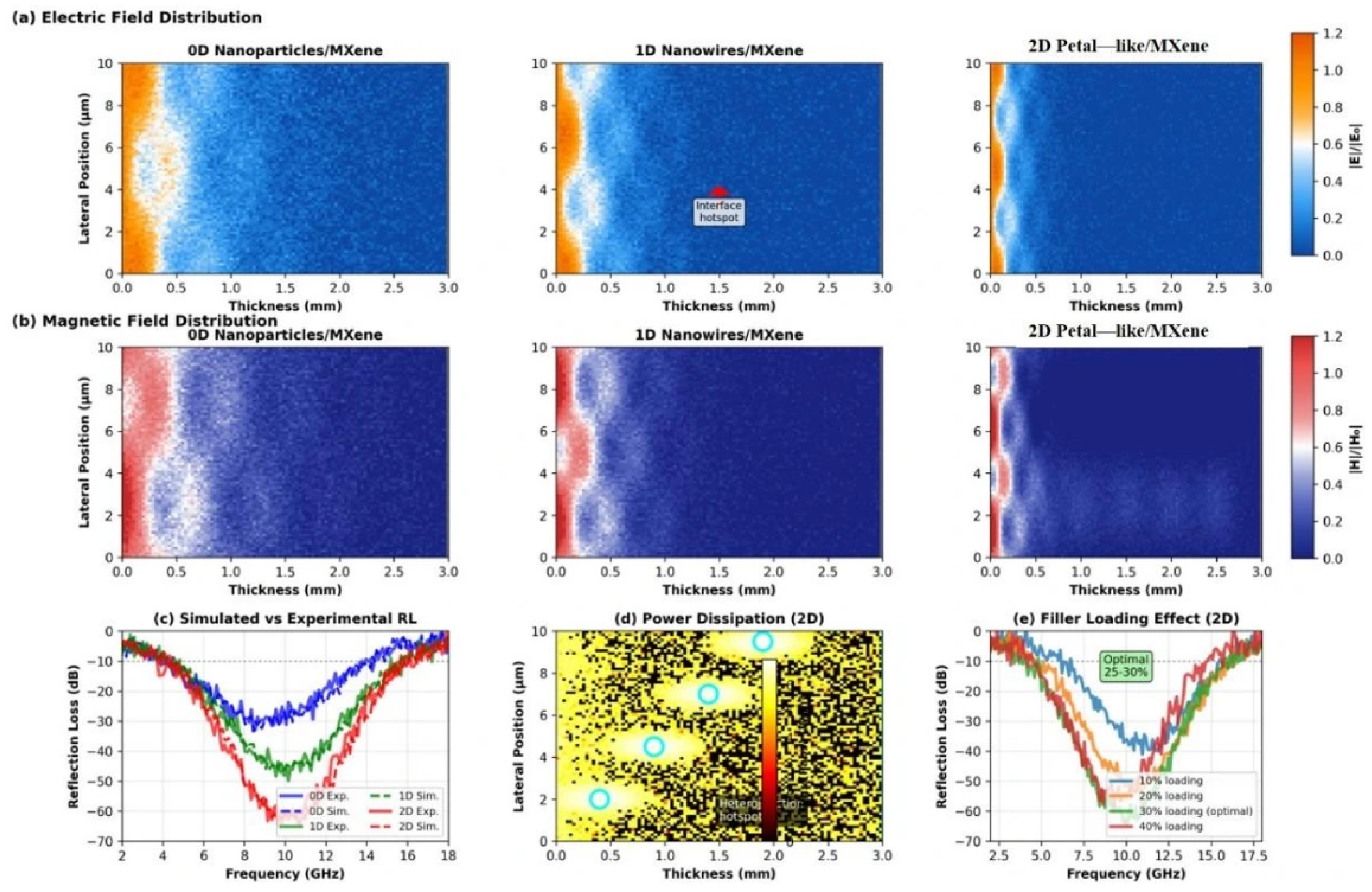
5. Conclusions and Outlook
In this study, we developed a multidimensional design framework for 0D/1D/2D magnetic MXene-based composites, integrating controlled synthesis with machine learning-assisted performance prediction. Systematic modulation of magnetic morphology, interfacial architectures, and dielectric-magnetic synergy enabled distinct electromagnetic responses and tunable microwave absorption across X-Ku bands. The ensemble ML models achieved an accurate prediction of key absorption metrics, including minimum reflection loss (), effective bandwidth, and optimal thickness, while SHAP interpretation identified critical structural and electromagnetic descriptors governing attenuation mechanisms. This work demonstrates a data-driven approach for microwave absorber design that transcends traditional empirical methods. The framework facilitates the efficient exploration of high-dimensional structure–property relationships, offering a versatile strategy for developing advanced EMW management materials. The methodology is adaptable to various MXene-based systems, including magnetic heterostructures and polymer–MXene hybrids. Future work should focus on integrating generative models with high-throughput experimentation to expand the accessible design space. Combining physics-informed ML architectures with autonomous laboratories could enable closed-loop discovery of microwave absorbers with tailored electromagnetic properties.
Author Contributions
Conceptualization, T.Z. and Y.Y.; methodology, T.Z.; software, T.H.; validation, T.Z., Y.Y. and T.H.; formal analysis, Y.Y.; investigation, T.Z.; resources, T.H.; data curation, T.Z.; writing—original draft preparation, T.Z.; writing—review and editing, Y.Y. and T.H.; visualization, T.Z.; supervision, T.H.; project administration, Y.Y.; funding acquisition, T.H. All authors have read and agreed to the published version of the manuscript.
Funding
This research received no external funding.
Data Availability Statement
The raw data supporting the conclusions of this article will be made available by the authors on request.
Conflicts of Interest
The authors declare no conflict of interest.
References
- Zhang, Y.; Wang, J.; Wu, Q.; Shan, T.; Bai, S.; Lan, D.; Zhang, B.; Liu, Y.; Su, X. Enhanced electromagnetic wave absorption of bacterial cellulose/reduced graphene oxide aerogel by eco-friendly in-situ construction. J. Colloid Interface Sci. 2025, 678, 648–655. [Google Scholar] [CrossRef] [Scilit] [PubMed]
- Huang, X.; Zhang, L.; Yu, G.; Wei, J.; Shao, G. Polarization genes dominated heteroatom-doped graphene aerogels toward super-efficiency microwave absorption. J. Mater. Chem. C 2023, 11, 9804–9814. [Google Scholar] [CrossRef] [Scilit]
- Xu, C.; Ding, J.; Luo, K.; Yang, X.; Liu, L.; Yao, L.; Chen, Q.; Zhang, Y.; Ding, Y.; Wang, B.; et al. Dielectric–magnetic synergized pores modulation engineering in polymer aerogels for integrated electromagnetic wave absorption and infrared stealth. Compos. Sci. Technol. 2026, 111552. [Google Scholar] [CrossRef] [Scilit]
- Ma, Y.; Wei, S.; Liu, R.; Sun, L.; Wang, W. A review on MXene based microwave absorption composites: Engineering, component optimization and structure regulation. J. Mater. Chem. C 2024, 12, 9068–9093. [Google Scholar] [CrossRef] [Scilit]
- Li, Z.Y.; Zhao, W.J.; Sun, Y.; Zhou, B.; Feng, Y.-Z.; Liu, C.-T. Comparative enhancement of H+ and OH− treatment on electromagnetic interference shielding in aligned and compact Ti3C2Tx MXene film: Comparative enhancement of H+ and OH− treatment. Rare Met. 2025, 44, 1833–1843. [Google Scholar] [CrossRef] [Scilit]
- Diao, K.L.; Zhang, D.H.; Du, J.J.; Zhou, T.; Liu, D.; Qin, S.-H. Electromagnetic shielding and thermal insulation hydrogels were constructed based on covalent organic skeleton COF and Ti3C2Tx MXene. Rare Met. 2025, 44, 7738–7750. [Google Scholar] [CrossRef] [Scilit]
- Guo, H.; Wang, X.; Pan, F.; Shi, Y.; Jiang, H.; Cai, L.; Cheng, J.; Zhang, X.; Yang, Y.; Li, L.; et al. State of the art recent advances and perspectives in 2D MXene based microwave absorbing materials: A review. Nano Res. 2023, 16, 10287–10325. [Google Scholar] [CrossRef] [Scilit]
- He, M.; Zhang, K.; Qiu, H.; Guo, H.; Li, X.; Guo, Y.; Zhang, Y.; Gu, J. Low Frequency Microwave Absorption Composites. Adv. Sci. 2025, 12, e11580. [Google Scholar] [CrossRef] [Scilit]
- Zhou, H.; Li, X.; Xi, Z.; Li, M.; Zhang, J.; Li, C.; Liu, Z.; Darwish, M.A.; Zhou, T.; Zhou, D. Machine Learning Driven Interface Engineering for Enhanced Microwave Absorption in MXene Films. Mater. Today Phys. 2025, 51, 101640. [Google Scholar] [CrossRef] [Scilit]
- Gouveia, J.D.; Galvão, T.L.P.; Nassar, K.I.; Gomes, J.R.B. First-principles and machine-learning approaches for interpreting and predicting the properties of MXenes. npj 2D Mater. Appl. 2025, 9(1), 8. [Google Scholar] [CrossRef] [Scilit]
- Zhang, J.; Xie, A.; Li, W.; Dong, W.; Gao, R. Machine Learning‐Optimized Electromagnetic Wave Absorption in Metal/C Nanocomposites. Small 2026, e12367. [Google Scholar] [CrossRef] [Scilit]
- Zhang, W.; Wen, H.; Gou, Y.; Zhao, Y.; Zhang, Z.; Qiao, Y. Preparation of MXene/BN composites with adjustable microwave absorption performance. Materials 2023, 16, 6752. [Google Scholar] [CrossRef] [Scilit]
- Chand, K.; Zhang, X.; Chen, Y. Recent progress in MXene and graphene based nanocomposites for microwave absorption and electromagnetic interference shielding. Arab. J. Chem. 2022, 15, 104143. [Google Scholar] [CrossRef] [Scilit]
- Liu, P.; Yao, Z.; Ng, V.M.H.; Zhou, J.; Kong, L.B.; Yue, K. Facile synthesis of ultrasmall Fe3O4 nanoparticles on MXenes for high microwave absorption performance. Compos. Part A Appl. Sci. Manuf. 2018, 115, 371–382. [Google Scholar] [CrossRef] [Scilit]
- Shao, R.; Wang, G.; Chai, J.; Lin, J.; Zhao, G.; Zeng, Z.; Wang, G. Multifunctional Janus-structured polytetrafluoroethylene-carbon nanotube-Fe3O4/MXene membranes for enhanced EMI shielding and thermal management. Nano-Micro Lett. 2025, 17, 136. [Google Scholar] [CrossRef] [Scilit] [PubMed]
- Feng, W.; Luo, H.; Wang, Y.; Zeng, S.; Tan, Y.; Deng, L.; Zhou, X.; Zhang, H.; Peng, S. Mxenes Derived Laminated and Magnetic Composites with Excellent Microwave Absorbing Performance. Sci. Rep. 2019, 9, 3957. [Google Scholar] [CrossRef] [Scilit]
- Liu, M.; Ye, Y.; Ye, J.; Gao, T.; Wang, D.; Chen, G.; Song, Z. Recent Advances of Magnetite (Fe3O4)-Based Magnetic Materials in Catalytic Applications. Magnetochemistry 2023, 9, 110. [Google Scholar] [CrossRef] [Scilit]
- Qiu, J.; Liu, X.; Peng, C.; Wang, S.; Wang, R.; Wang, W. Porous metal microsphere M@C-rGO (metal = Mn, Fe, Co, Ni, Cu) aerogels with high low-frequency microwave absorption, strong ther-mal insulation and superior anticorrosion performance. J. Mater. Chem. A 2024, 12, 21997–22012. [Google Scholar] [CrossRef] [Scilit]
- Zhang, T.; Qiu, J.; Wang, S.; Juan, Y.; Li, J.; Wang, W. Multi-scale engineering for enhancing broad-band microwave absorption, electromagnetic shielding and infrared stealth of Ag NWs/N-doped rGO aerogels. Adv. Funct. Mater. 2025, 36, e21010. [Google Scholar] [CrossRef] [Scilit]
- Wroblewski, C.; Volford, T.; Martos, B.; Samoluk, J.; Martos, P. High Yield Synthesis and Application of Magnetite Nanoparticles (Fe3O4). Magnetochemistry 2020, 6, 22. [Google Scholar] [CrossRef] [Scilit]
- Popova, V.; Dmitrienko, E.; Chubarov, A. Magnetic Nanocomposites and Imprinted Polymers for Biomedical Applications of Nucleic Acids. Magnetochemistry 2023, 9, 12. [Google Scholar] [CrossRef] [Scilit]
- Wei, M.; Wang, C.; Li, F. Fe3O4/C@SiC nanocomposite with excellent microwave absorption performance. J. Am. Ceram. Soc. 2024, 107, 19636. [Google Scholar] [CrossRef] [Scilit]
- Liu, P.; Ng, V.M.H.; Yao, Z.; Zhou, J.; Kong, L.B. Ultrasmall Fe3O4 nanoparticles on MXenes with high microwave absorption performance. Mater. Lett. 2018, 229, 286–289. [Google Scholar] [CrossRef] [Scilit]
- Ganapathe, L.S.; Mohamed, M.A.; Mohamad Yunus, R.; Berhanuddin, D.D. Magnetite (Fe3O4) Nanoparticles in Biomedical Application: From Synthesis to Surface Functionalisation. Magnetochemistry 2020, 6, 68. [Google Scholar] [CrossRef] [Scilit]
- Che, R.C.; Peng, L.M.; Duan, X.F.; Chen, Q.; Liang, X.L. Microwave absorption enhancement and complex permittivity and permeability of Fe encapsulated within carbon nanotubes. Adv. Mater. 2004, 16, 401–405. [Google Scholar] [CrossRef] [Scilit]
- Yang, B.; Xu, Y.; Chen, Z.; Yang, H.; Hu, Y.; Wu, H.; Xing, M.; Guan, J.; Li, W. Electromagnetic Property Modulation of Flaky Ferromagnetic 304 Stainless-Steel Powders for Microwave Absorption at Elevated Temperatures. Magnetochemistry 2023, 9, 208. [Google Scholar] [CrossRef] [Scilit]
- Liu, S.; Lian, Y.; Zhao, Y.; Hou, H.; Ren, J.; Elsharkawy, E.R.; El-Bahy, S.M.; El-Bahy, Z.M.; Wu, N. Recent advances of MXene based nanocomposites towards microwave absorption: A review. Adv. Compos. Hybrid Mater. 2025, 8, 144. [Google Scholar] [CrossRef] [Scilit]
- Du, B.; Zhao, Y.; Yu, J. Electrostatically self assembled Fe3O4@SiO2/MXene 3D interlayered structure for Ku band microwave absorption. Compos. Part B Eng. 2024, 177, 107956c. [Google Scholar] [CrossRef] [Scilit]
- Deeraj, B.D.S.; Jayan, J.S.; Aparna, A.; Saritha, A.; Joseph, K. MXenes-Reinforced Polymer Composites for Microwave Absorption and Electromagnetic Interference Shielding Applications. In MXene Reinforced Polymer Composites: Fabrication, Characterization and Applications; Wiley: Hoboken, NJ, USA, 2024; pp. 287–319. [Google Scholar] [CrossRef] [Scilit]
- Yuan, M.; Zhou, M.; Fu, H. Synergistic microstructure of sandwich-like NiFe2O4@SiO2@MXene nanocomposites for enhancement of microwave absorption in the whole Ku-band. Compos. Part B Eng. 2021, 224, 109178. [Google Scholar] [CrossRef] [Scilit]
- Zhou, H.; Li, X.; Xi, Z.; Li, M.; Zhang, J. Machine learning for electromagnetic absorption in MXene films. J. Phys. Chem. 2023, 127, 6793–6801. [Google Scholar] [CrossRef]
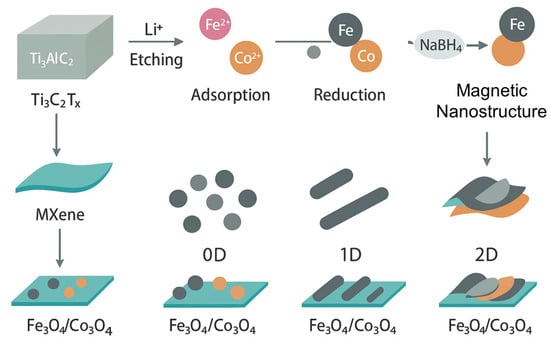
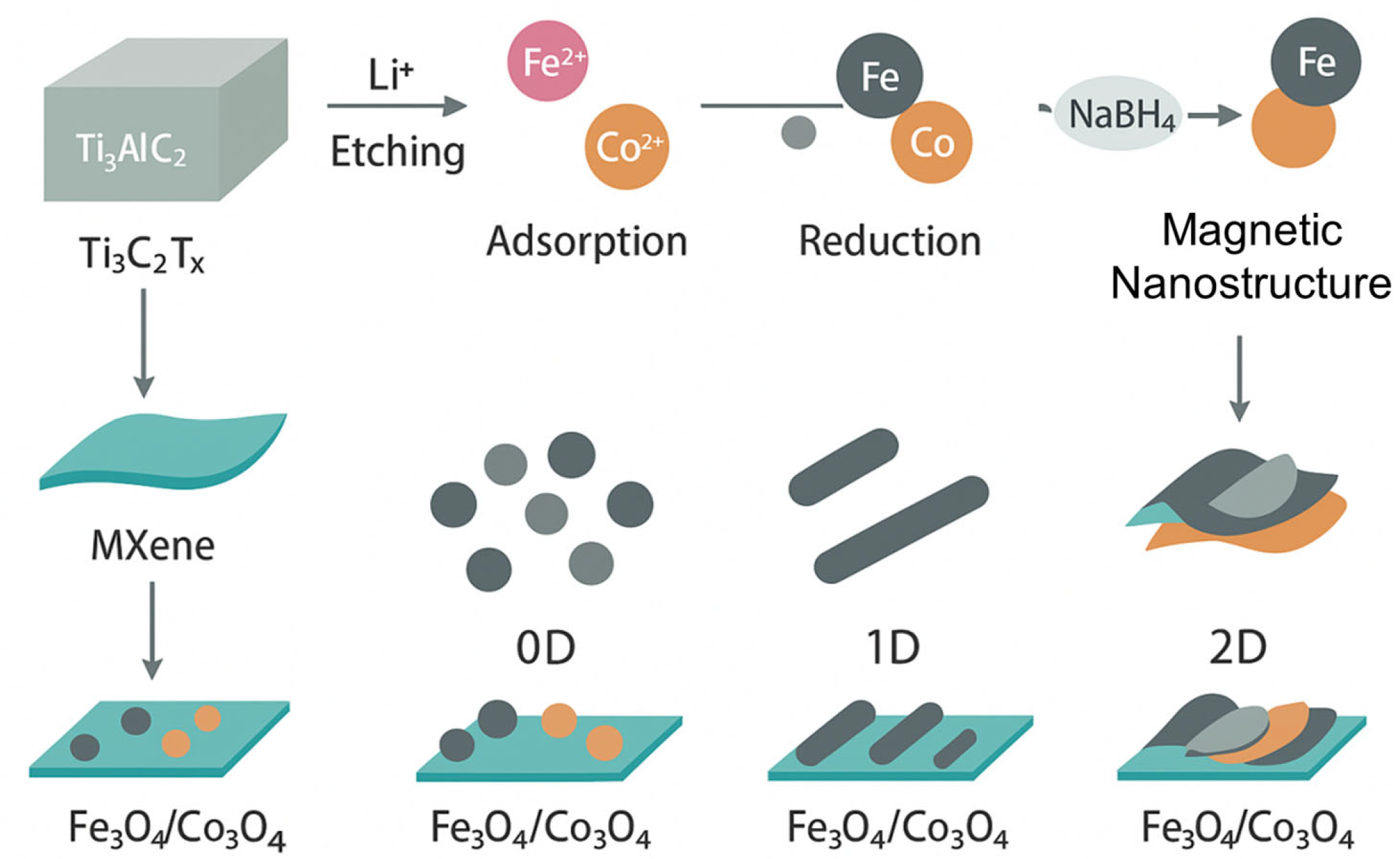
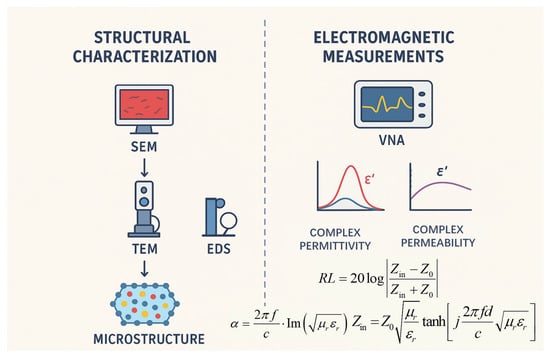
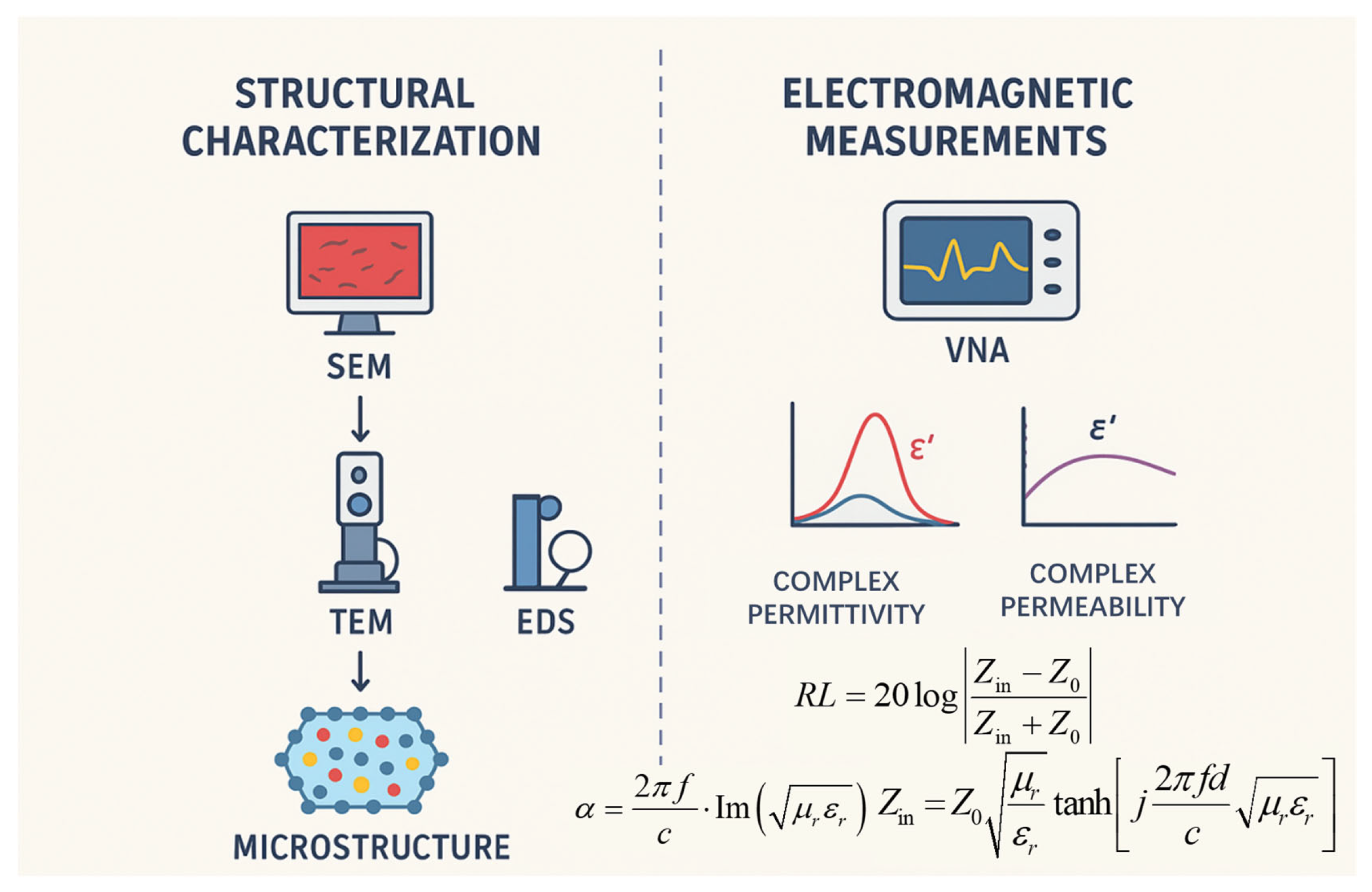
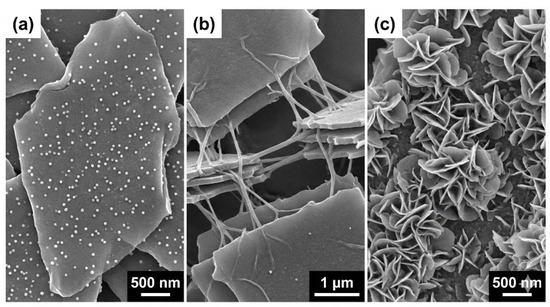
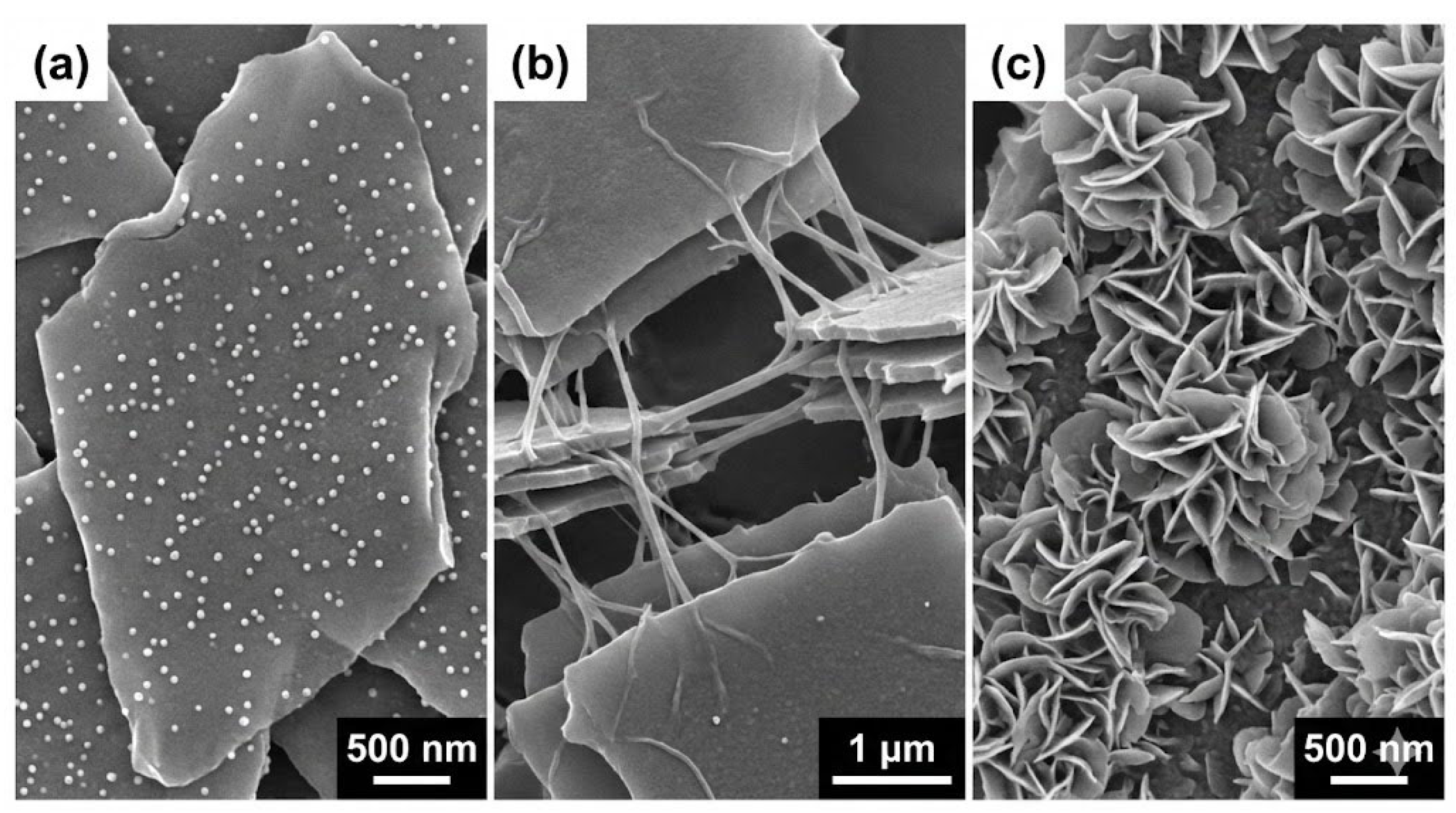
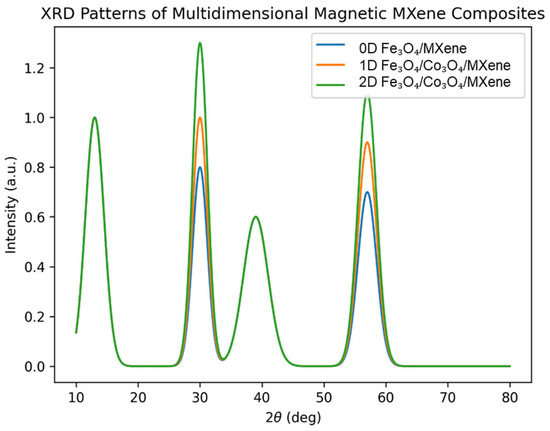
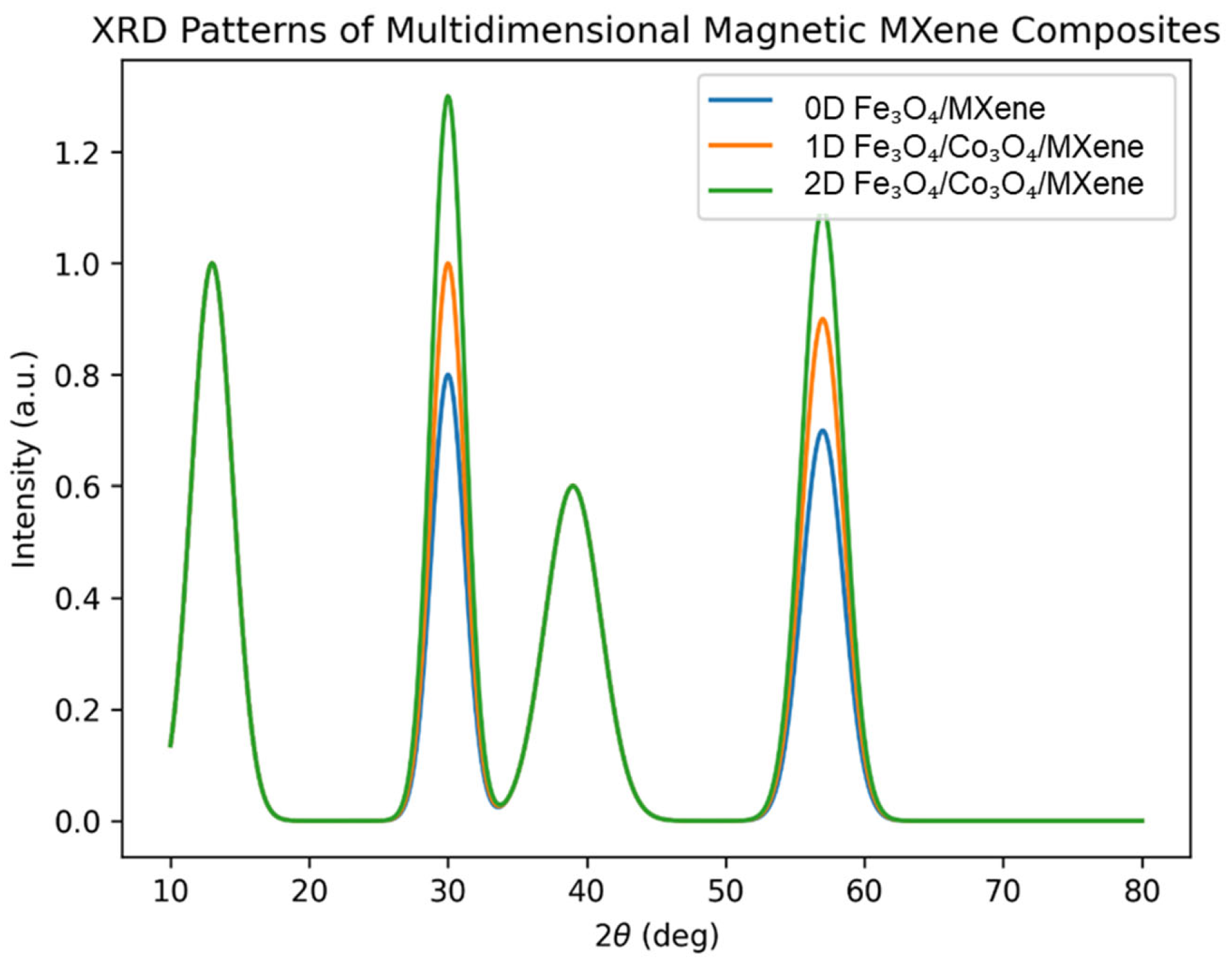
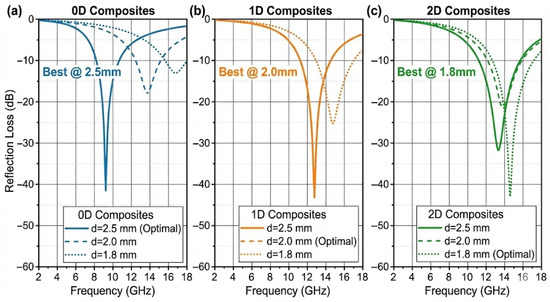
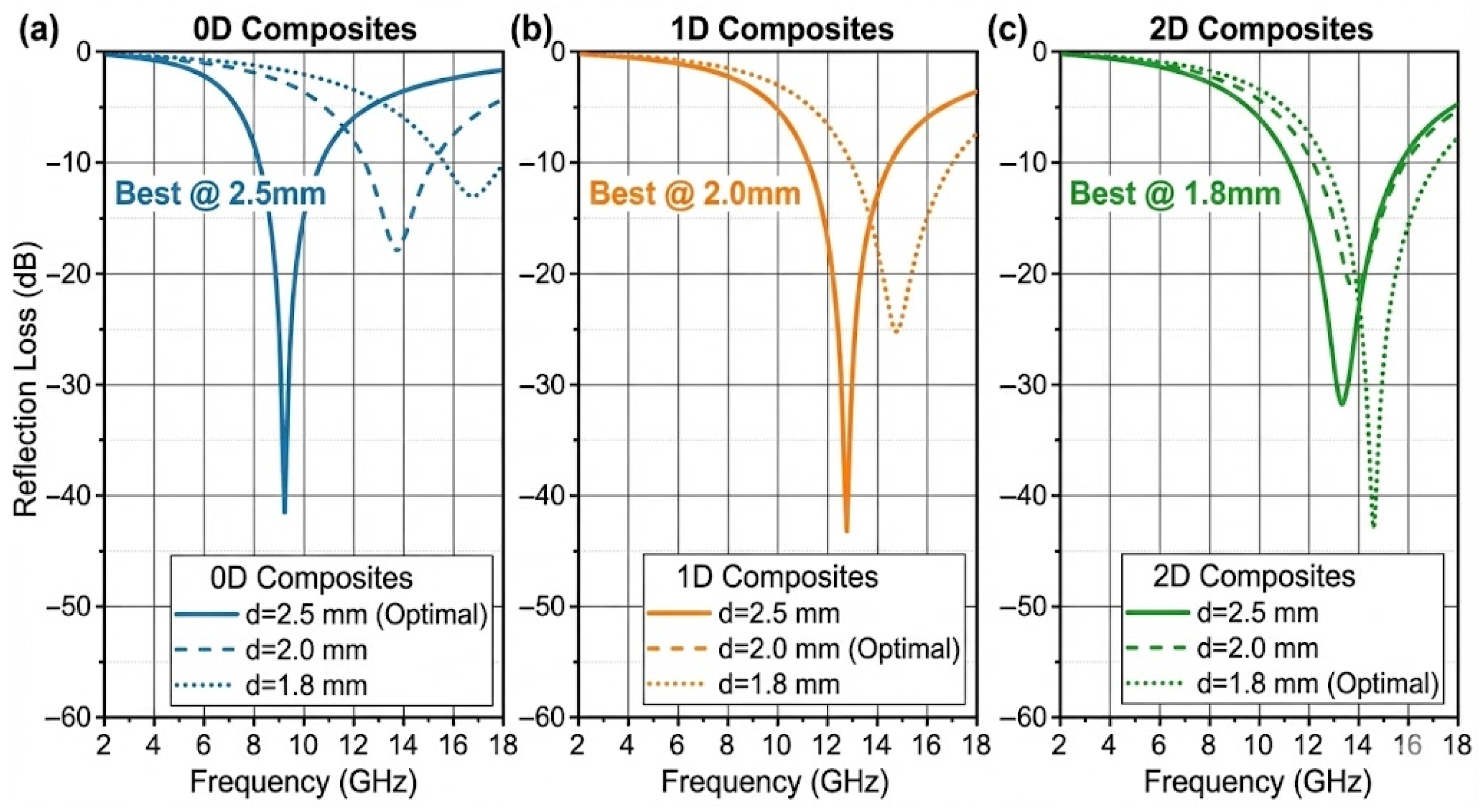
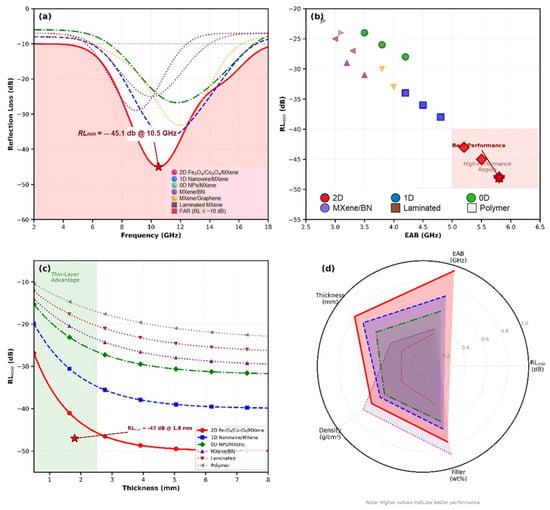
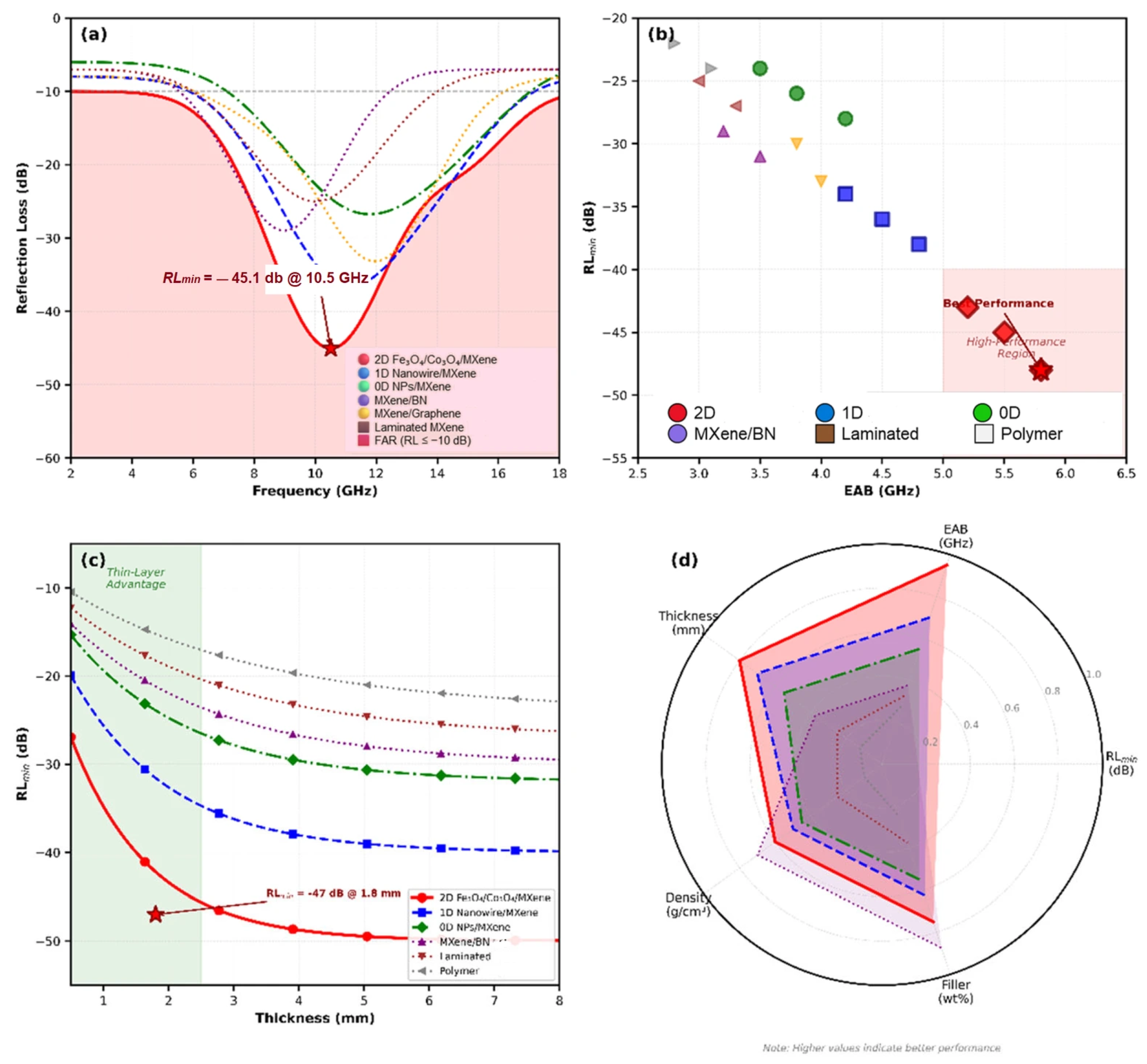
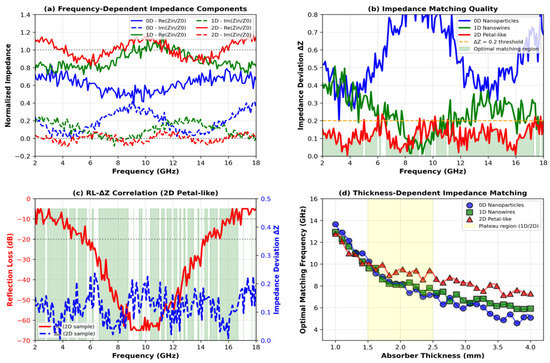
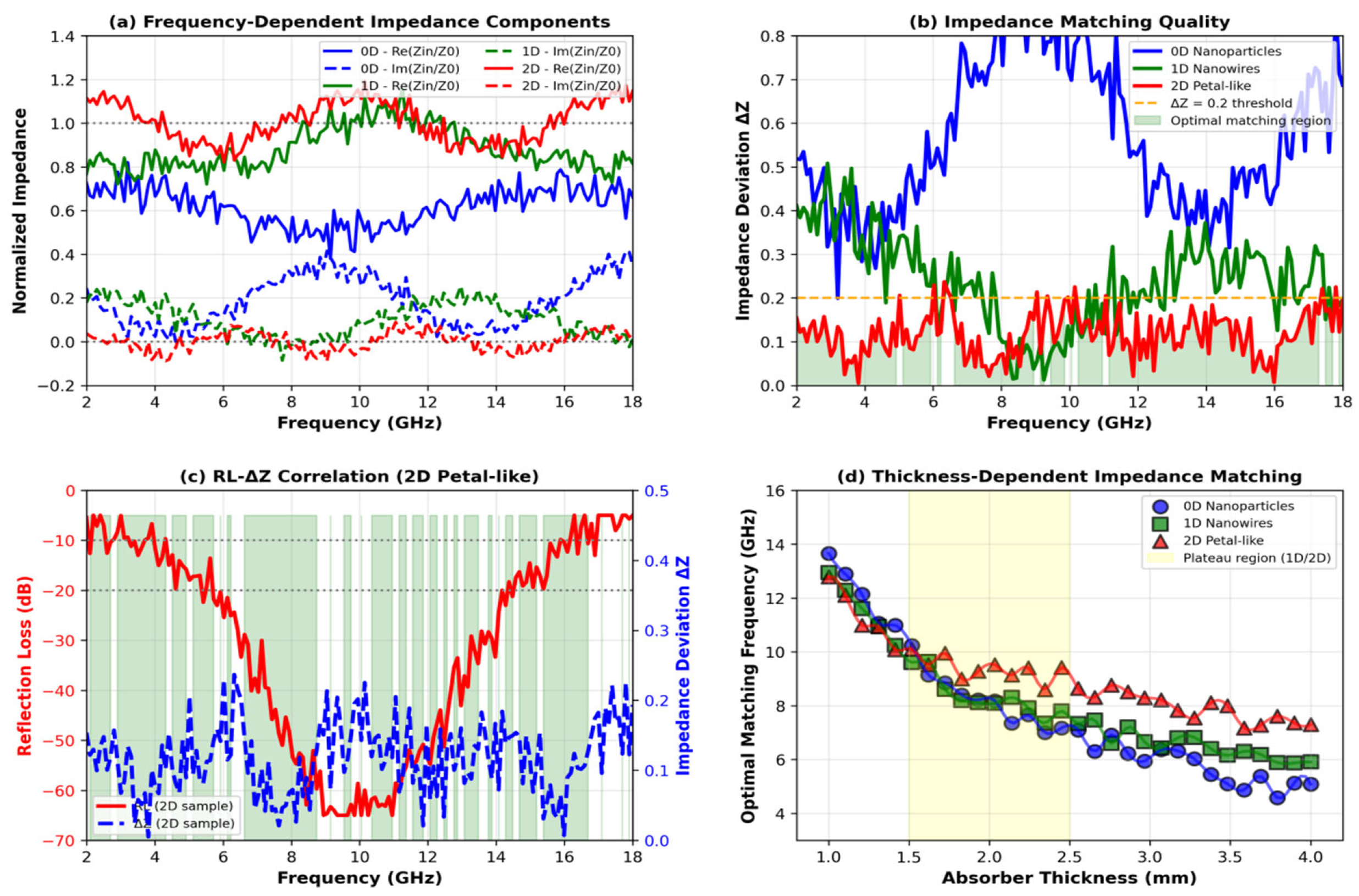

Disclaimer/Publisher’s Note: The statements, opinions and data contained in all publications are solely those of the individual author(s) and contributor(s) and not of MDPI and/or the editor(s). MDPI and/or the editor(s) disclaim responsibility for any injury to people or property resulting from any ideas, methods, instructions or products referred to in the content. |
© 2026 by the authors. Licensee MDPI, Basel, Switzerland. This article is an open access article distributed under the terms and conditions of the Creative Commons Attribution (CC BY) license.