


Abstract
This manuscript reports the influence of Hf substitution for Fe on the magnetic properties and microstructure of near-stoichiometric Pr-Fe-B alloys. Melt-spun ribbons with nominal compositions of Pr26.7Fe72.3B1, Pr26.7Fe71.8Hf0.5B1, and Pr26.7Fe71.3Hf1B1 (wt%) are synthesized with optimized wheel speed. Transmission electron microscopy analysis reveals that Hf addition effectively refines the grain structure in terms of grain size. Magnetic characterization at 300 K demonstrates that the partial Hf addition significantly enhances the hard magnetic performance. The pristine alloy (Pr26.7Fe72.3B1) exhibits an intrinsic coercivity (Hcj) of 11.95 kOe, a remanence (Br) of 8.23 kG, and a maximum energy product ((BH)max) of 12.6 MGOe. With 0.5% Hf addition, the properties improve to Hcj of 11.47 kOe, Br of 8.5 kG, and (BH)max of 15.33 MGOe. A further increase to 1.0% Hf leads to a slight reduction in properties, with Hcj of 11.66 kOe, Br of 8.37 kG, and (BH)max of 13.32 MGOe, though they remain superior to the pristine alloy. Furthermore, Hf addition improves the high-temperature magnetic stability. The results indicate that optimal Hf addition is a promising strategy for enhancing the magnetic properties of near-stoichiometric Pr-Fe-B ribbons through microstructural refinement and reducing the volume fraction of the soft magnetic phase.
1. Introduction
Permanent magnets (PMs) constitute a critical class of functional materials that underpin modern technology, enabling the unprecedented miniaturization, and high efficiency of devices ranging from electric motors and generators to data storage systems and medical equipment [1,2,3]. Among PMs, rare-earth (RE) based magnets, particularly the Nd2Fe14B-type magnets, have remained in dominance since their invention because of their very high maximum energy product ((BH)max) reaching near 60 MGOe [4,5]. The isostructural Pr2Fe14B compound is also very significant, offering a higher magnetocrystalline anisotropy field, i.e., high HA, which provides the basis for achieving superior intrinsic coercivity (Hcj) [6]. In fact, the room temperature HA of the Pr2Fe14B compound is higher than that of the Nd2Fe14B compound, but the HA of Pr2Fe14B deteriorates faster at high temperature [1,3,7]. However, a fundamental limitation of all the RE2Fe14B magnets is their relatively modest Curie temperature (TC), and high dependence of HA on temperature, which lead to a pronounced temperature sensitivity of magnetic properties and restrict their application in high-temperature environments [7,8].
Significant research efforts have been dedicated to improving the high-temperature performance of RE-Fe-B magnets. The partial substitution of Fe by Co is a well-established method to elevate the TC, though this often concurrently reduces the magnetocrystalline anisotropy constant and can complicate the microstructure [9,10]. An alternative and complementary strategy involves micro-alloying with refractory elements such as Nb, Zr, Ti, V, and Cr [11,12,13]. These additions typically do not enter the 2:14:1 lattice in large quantities, but form fine precipitates to segregate at grain boundaries. The primary role of the refractory elements is to refine the grain structure, suppress the formation of the soft magnetic phases such as α-Fe, and potentially pin the domain wall motion, thereby enhancing the intrinsic coercivity and thermal stability [14,15].
Hafnium (Hf) has emerged as an intriguing element among the refractory elements. In the Nd-Fe-B type alloys, Hf addition has been shown to be beneficial. Previous works indicate that Hf effectively inhibits the grain growth in nanocomposite alloys, leading to a finer and more uniform nanostructure [16,17,18]. Furthermore, Hf forms nanoscale precipitates, which may act as pinning centers, contributing to increased intrinsic coercivity [17,19]. In Nd-Ce-Fe-B magnets a (BH)max of 12.3 MGOe was obtained by adding 1% Hf [19]. Hf has also shown great potential in enhancing the magnetic properties in Sm-Co-type alloys [20,21]. These microstructural modifications translate to improved hard magnetic properties, including enhanced room-temperature coercivity and better thermal stability. The favorable influence of Hf is not limited to Nd-based systems. Research on Pr-Fe-B-based nanocomposites has demonstrated that microalloying with Hf (and Ti) promotes the formation of a nearly ideal, fine-scale mixture of Pr2Fe14B and α-Fe grains, as confirmed by advanced microstructural characterization [22]. In Pr2(Fe,Co)14B/α-(Fe,Co) nanocomposites, the partial substitution of Fe with 1 at.% Hf is reported to optimize both the intrinsic coercivity and maximum energy product, outperforming other elemental additions like Al and Ti [23]. Hf has also been reported to help in the continuation of the Cu-rich phase in Alnico 8 alloys, thus enhancing the intrinsic coercivity [24].
Despite these useful findings, a systematic investigation focusing on the impact of Hf on stoichiometric Pr-Fe-B alloys—compositions designed to closely approximate the Pr2Fe14B phase—remains un-attempted in the literature. Most prior work has concentrated on either RE-lean nanocomposite compositions, where the interplay between hard and soft phases dominates behavior, or on Nd-based analogues [25,26]. The stoichiometric alloy provides a fundamental baseline, primarily comprising the single hard magnetic phase, and is thus an ideal platform to isolate and study how Hf influences the magnetic properties and intergranular interactions without the complicating factor of a significant soft magnetic phase fraction. Understanding these effects is crucial for the targeted design of high-performance Pr-Fe-B magnets.
Previously we explored the concept of integrating Alnico-type semi-hard phases into Pr-Fe-B and Didymium-Fe-B matrices, successfully achieving concurrent improvements in the Curie temperature and maximum energy product via the formation of complex nanocomposite structures [27,28]. In a separate, detailed study on Nd-Fe-B alloys, the role of Hf addition was investigated across a range of Nd contents, concluding that Hf’s efficacy in refining microstructure and boosting intrinsic coercivity is most pronounced in alloys near the stoichiometric 2:14:1 composition [16]. These findings motivate the need for the current paper to investigate the influence of Hf on the magnetic properties, high-temperature performance, and microstructure of a stoichiometric Pr-Fe-B alloy.
In this study, we systematically investigate the effects of Hf addition (0, 0.5, and 1.0 wt%) on Pr26.7Fe72.3B1 melt-spun ribbons. The room-temperature and high-temperature magnetic properties (Hcj, Br and (BH)max) are studied. The Curie temperature, interaction mechanisms, and minor loops are investigated in detail. By providing a comprehensive analysis of how Hf modifies the properties of stoichiometric Pr-Fe-B, this work aims to furnish essential insights for the development of advanced Pr-based permanent magnets with tailored performance for demanding applications.
2. Materials and Methods
Ingots with the nominal compositions of Pr26.7Fe72.3B1, Pr26.7Fe71.8Hf0.5B1, and Pr26.7Fe71.3Hf1B1 (wt%) were prepared by arc-melting the constituent elements (Pr: 99.95%, Fe: 99.99%, Hf: 99.95%) under a high-purity argon atmosphere. Each ingot was re-melted at least five times in order to obtain homogeneity. The as-cast ingots were then crushed into small slivers of approximately 8–9 g. These precursor pieces were inductively melted in a quartz tube under highly pure argon gas and rapidly solidified via melt-spinning onto a copper wheel rotating at surface velocity ranging from 18 to 35 m/s. Preliminary magnetic screening indicated that the optimal comprehensive magnetic properties for all three compositions were obtained in the ribbons produced at wheel speeds between 24 and 28 m/s. These optimally quenched ribbons were selected for all the subsequent characterizations.
The phase constitution and structural analysis of the melt-spun ribbons were investigated at room temperature using X-ray diffraction (XRD) on a PANalytical X’Pert Pro diffractometer (Malvern Panalytical, Almelo, Netherlands) with Cu-Kα radiation. The magnetic properties were characterized using a vibrating sample magnetometer (VSM, 9 T, PPMS, Quantum Design, San Diego, USA). Hysteresis loops (M-H curves) were measured at 300 K and 400 K with an applied field of up to ±3.0 T to determine the saturation magnetization (Ms), remanence (Br), and intrinsic coercivity (Hcj). The Curie temperature (TC) was determined from thermomagnetic (M-T) curves. The TC was measured by heating the samples from 300 K to 700 K under a constant applied field of 0.10 T. The thermal stability of coercivity was assessed by measuring temperature-dependent hysteresis loops. The nano-structural morphology and phase distribution of the selected ribbons were examined using transmission electron microscopy (TEM, Tecnai G2 F20, FEI, Hillsboro, OR, USA) operated at 200 kV.
3. Results and Discussion
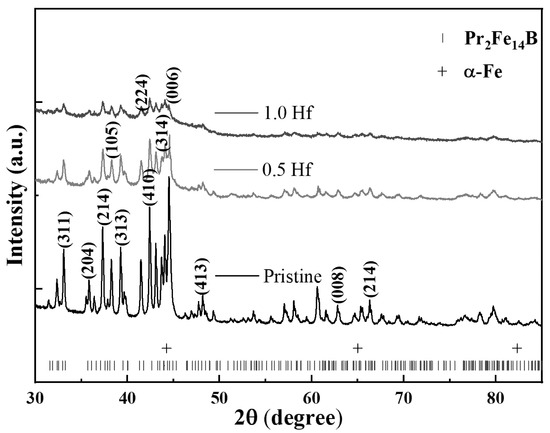
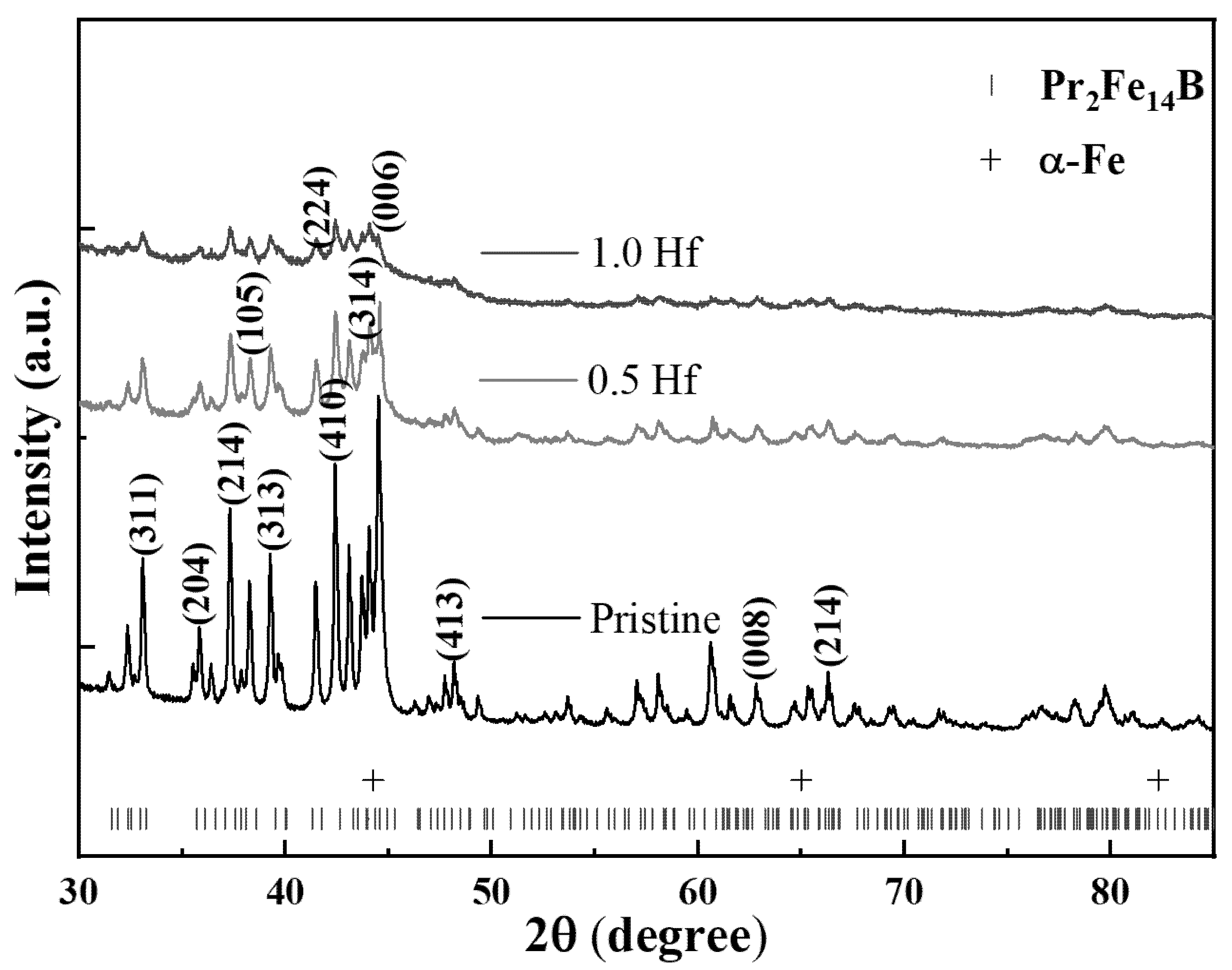
The XRD patterns of the investigated alloys are shown in Figure 1. Figure 1 shows that the pristine alloy, Pr26.7Fe72.3B1 exhibits relatively sharp and intense diffraction peaks which correspond to the tetragonal Pr2Fe14B phase, indicating a relatively large crystallite size, and high structural coherence. With the addition of Hf, a progressive broadening and intensity reduction of the Pr2Fe14B reflections is observed, suggesting grain refinement and increased micro-strain [17,29]. No crystalline Hf-containing secondary phases are detected. Furthermore, the relative intensity of α-Fe peaks, observed in the pristine alloy, decreases with increasing Hf content, indicating suppression of α-Fe-rich segregation. These structural modifications are expected to enhance the intrinsic coercivity through grain refinement, reduced soft magnetic phase content, and increased domain wall pinning. It is evident that there is no shift in the XRD peaks, which indicates that Hf atoms, with much larger radius compared to Fe, have not entered into the main phase to replace Fe sites [30].
Figure 1.
The room temperature XRD of the Pr26.7Fe72.3B1 (pristine), Pr26.7Fe71.8Hf0.5B1 (0.5Hf), and Pr26.7Fe71.3Hf1B1 (1.0 Hf) melt-spun ribbons.
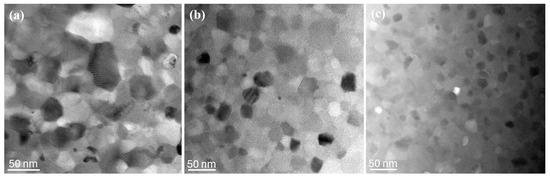
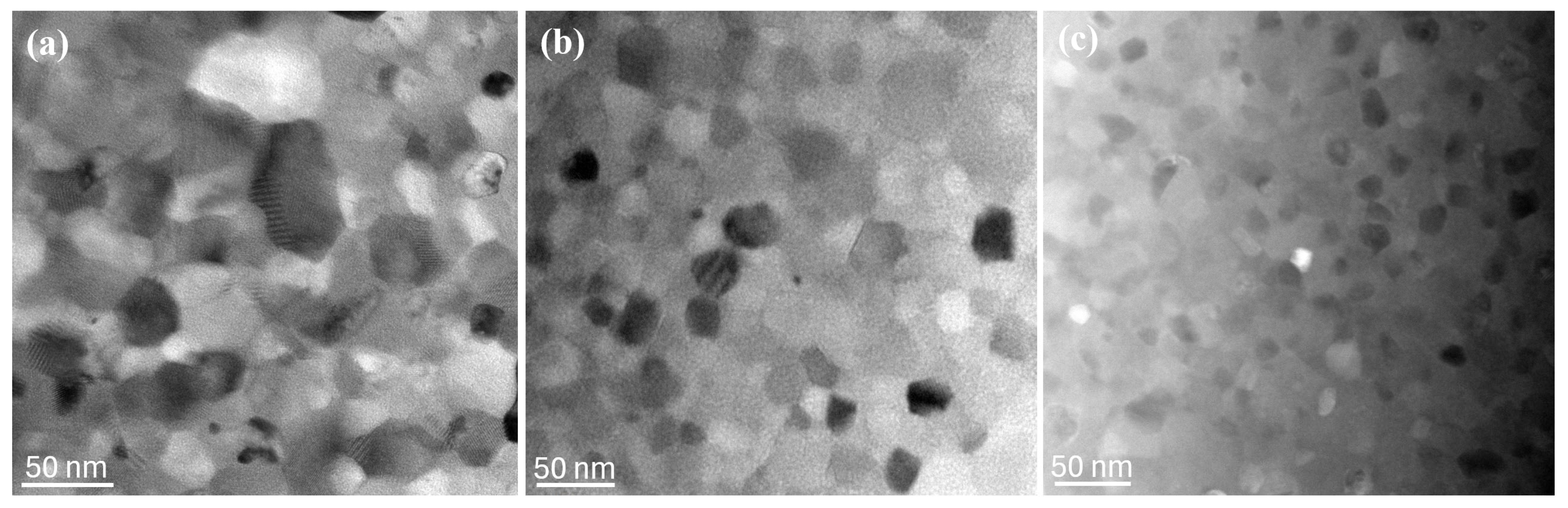
Transmission electron microscopy (TEM) is employed to investigate the microstructural modifications induced by Hf addition in the near-stoichiometric Pr-Fe-B alloys. The TEM images of the pristine, 0.5 Hf and 1.0 Hf samples are respectively presented in Figure 2a–c, which reveal the evolution in the grain morphology and the size distribution. The pristine alloy shown in Figure 2a exhibits a heterogeneous microstructure with a broad grain size distribution, featuring locally coarsened regions and irregular, elongated grains. The average grain size of the Hf free melt-spun ribbon is 50 ± 5 nm. This morphology suggests less controlled grain growth during processing, which can be detrimental to uniform magnetic properties [31]. With the incorporation of 0.5% Hf, as shown in Figure 2b, a significant refinement effect is observed. The microstructure becomes more homogeneous with a reduced average grain size (35 ± 5 nm), and a transition to a more equiaxed morphology. This indicates that Hf effectively acts as a grain refiner, suppressing grain growth and promoting uniform nucleation, a phenomenon consistent with the role of transition metal additives in rare-earth permanent magnets [32]. The refinement is maximized at 1.0 Hf (Figure 2c), resulting in a very fine microstructure with the narrowest grain size distribution. The average grain size is found to be 25 ± 5 nm. From these observations, it is evident that the Hf-free sample (pristine) displays larger grains and fine grains, thus creating microstructural inhomogeneity. In contrast, the Hf-containing alloys, particularly the 0.5 Hf alloy, demonstrate a much uniform grain distribution.
Figure 2.
TEM images of the (a) Pr26.7Fe72.3B1 (b) Pr26.7Fe71.8Hf0.5B1, and (c) Pr26.7Fe71.3Hf1B1 melt-spun ribbons.
The microstructural trends observed have direct and significant implications for the magnetic performance. The grain sizes of all the three alloys are in the single domain range for RE-Fe-B type magnets, which result in good magnetic properties, with more homogeneous structures having more advantages [33,34]. The Hf addition gradually refines and homogenizes the microstructure of Pr-Fe-B alloys. This tailored microstructural evolution, encompassing grain size reduction and improved uniformity, combined with less soft magnetic phase observed in XRD patterns, is expected to directly translate into enhanced magnetic stability, making Hf a potent microstructural modifier for high-performance permanent magnets.
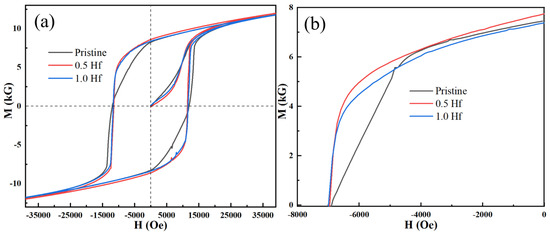
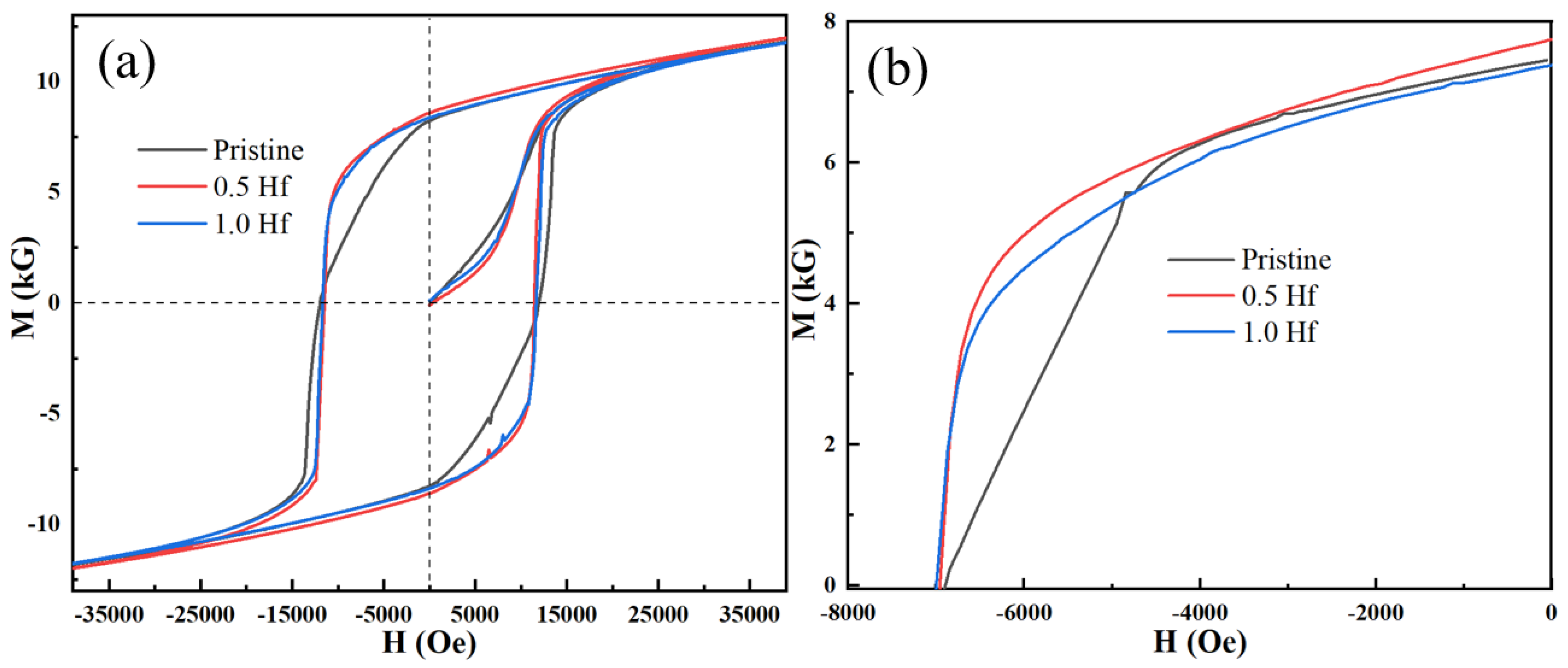
The M-H curves of the Pr26.7Fe72.3B1, Pr26.7Fe71.8Hf0.5B1 and Pr26.7Fe71.3Hf1B1 alloys are given in Figure 3. The pristine alloy, characterized by sharper diffraction peaks and α-Fe reflections as shown in Figure 1 and relatively bigger and irregular grains as shown in Figure 2a, exhibits a relatively gradual demagnetization process, consistent with the heterogeneous grains. In contrast, the Hf-containing alloys display broadened XRD reflections and reduced α-Fe intensity, showing steeper demagnetization curves and more abrupt reversal, resulting in a squarer demagnetization curve, which is also supported by the finer and more homogeneous microstructure shown in Figure 2b,c. These observations validate that Hf addition effectively modifies the structural framework of the Pr–Fe–B alloy. Figure 3a illustrates the microstructural-dependent magnetic properties such as Hcj and Br of the melt-spun ribbons at 300 K. The pristine Pr26.7Fe72.3B1 ribbon has an intrinsic coercivity Hcj = 11.95 kOe, remanence Br = 8.23 kG, and maximum energy product (BH)max = 12.6 MGOe. The magnetic properties increase to Hcj = 11.47 kOe, Br= 8.58 kG and (BH)max = 15.33 MGOe for the 0.5 Hf ribbon. Then the magnetic properties slightly decreased to Hcj = 11.66 kOe, Br = 8.37 and (BH)max = 13.32 MGOe, which is still better than those of the pristine alloy. The comprehensive magnetic properties reported here are comparable to or even better than those reported in the literature, despite the fact that much less rare earth has been consumed in the current study [17,35,36,37].
Figure 3.
(a). M−H curves of the pristine Pr26.7Fe72.3B1, 0.5 Hf Pr26.7Fe71.8Hf0.5B1, and Pr26.7Fe71.3Hf1B1 melt-spun ribbons taken at 300 K, and (b) demagnetization curves of the melt spun ribbons at 400 K.
To test the high-temperature performance of the melt-spun ribbons, the M-H curves were obtained at 400 K as shown in Figure 3b. The pristine alloy exhibits an intrinsic coercivity Hcj = 6.90 kOe; the 0.5 Hf alloy shows Hcj = 6.99 kOe and 1.0 Hf shows Hcj = 7.0 kOe. For the pristine alloy, the Br =7.46 kG increases to Br = 7.75 for the 0.5 Hf alloy and Br = 7.39 kG for the 1.0 Hf alloy. Based on the magnetic properties presented in Figure 3a,b, the temperature coefficient of remanence α and temperature coefficient of coercivity β are calculated using the following formulae [38]:
where T1 is 400 K and T0 is 300 K. The α value of the pristine melt-spun ribbon is found to be −0.094%/K, which changes to 0.096%/K for 0.5 Hf and 0.117 for 1.0 Hf alloy. The β values were calculated to be 0.423, 0.390%/K and 0.400%/K for the pristine, 0.5 Hf and 1.0 Hf alloy. The temperature coefficients, particularly the temperature coefficient of coercivity, clearly improve for the Hf-containing alloys. This can be linked to microstructural refinement including the homogenous grains and reduced soft magnetic phases. As shown in Figure 2, Hf reduces the grain size, and in Figure 1, the Fe phase reduces. Smaller grains and reduced soft magnetic phases decrease the demagnetizing stray fields at grain boundaries, leading to better stability at elevated temperatures [20,39].
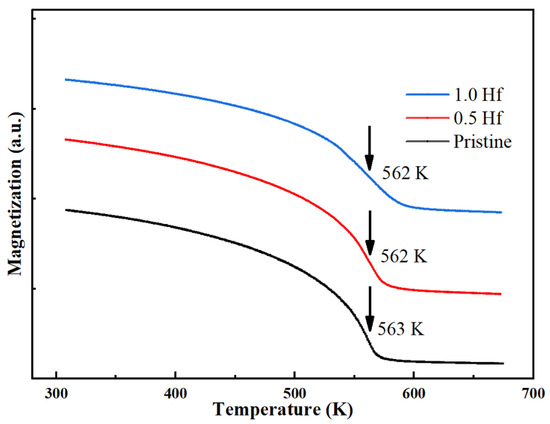
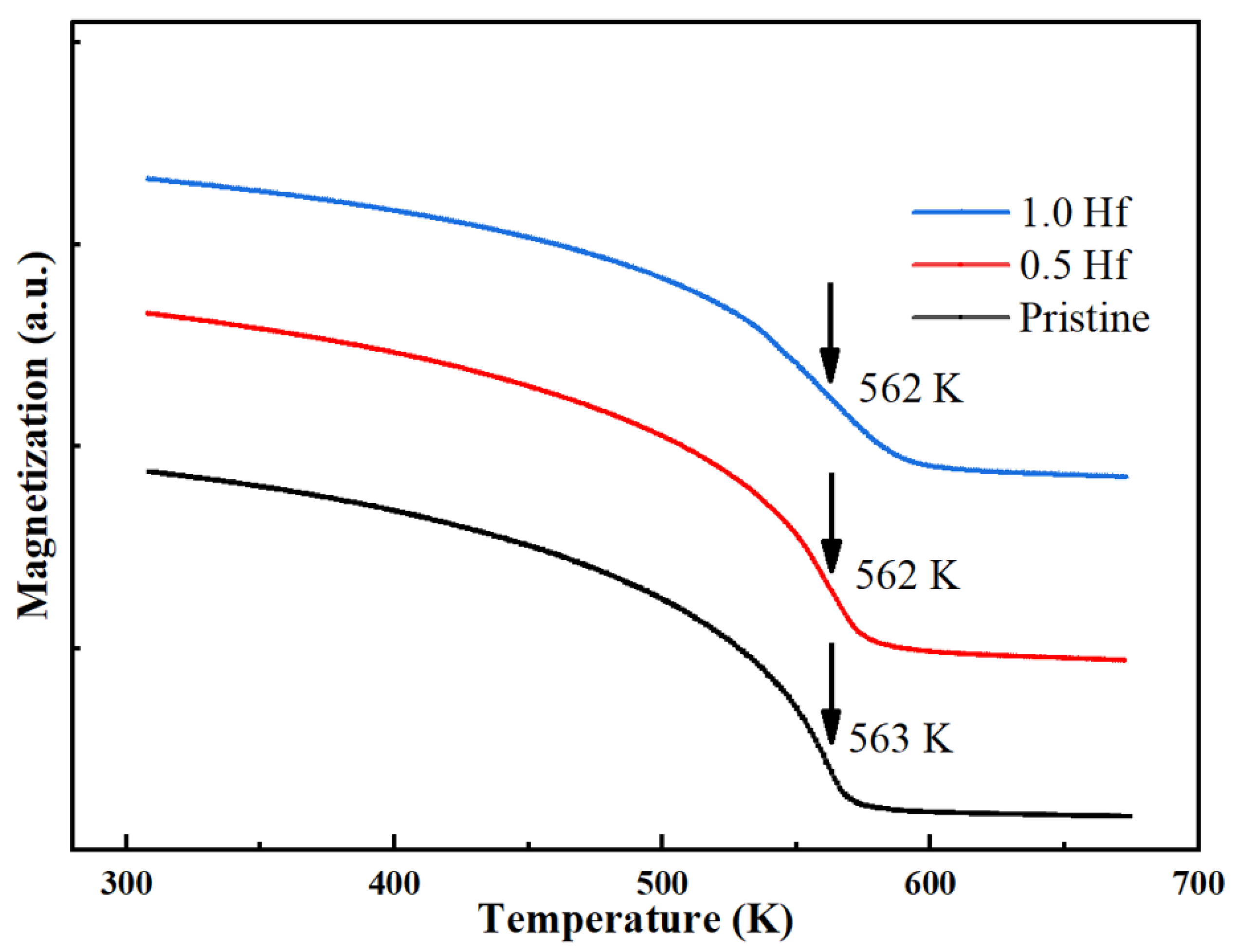
Shown in Figure 4 are the M-T curves of the investigated alloys taken in the temperature range of 300 to 675 K. No obvious change in the Curie temperature is observed, which indicates that the Hf element might not have entered into the main phase grains. When a paramagnetic element such as Hf enters in to the main phase to replace the Fe sites, the Curie temperature must decrease [39].
Figure 4.
M-T curves of the pristine Pr26.7Fe72.3B1, 0.5 Hf Pr26.7Fe71.8Hf0.5B1, and Pr26.7Fe71.3Hf1B1 melt-spun ribbons.
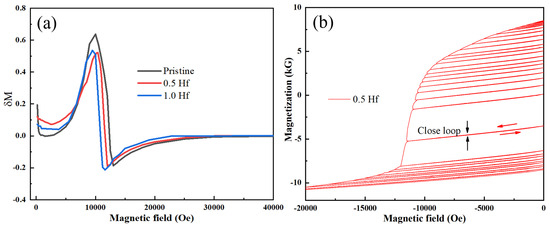
To understand the short-range magnetic interactions, which is expected to exist among the nanograins and various phases, the Henkel plots are obtained using the following equation [40]:
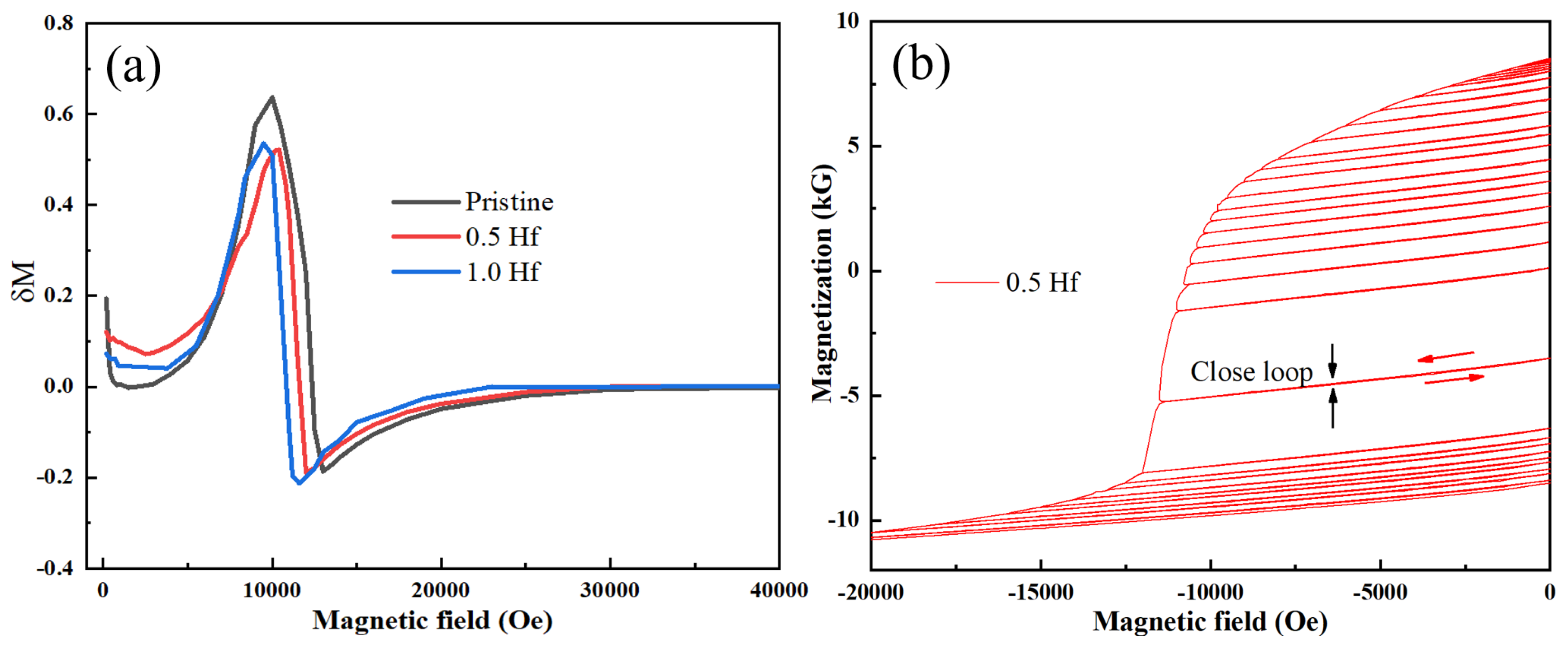
where δM is the change in magnetization; Md(H), Mr(H), and Mr(∞) represent the reduced magnetization, remanence at certain applied magnetic field, and remanence at maximum applied field, respectively. δM > 0 shows the short-range exchange interactions among the grains, δM = 0 indicates the absence of any interaction among the grains, and δM < 0 indicates the long-range interactions [41]. The Henkel plots of the Pr26.7Fe72.3B1, Pr26.7Fe71.8Hf0.5B1, and Pr26.7Fe71.3Hf1B1 melt-spun ribbons are shown in Figure 5a. The pristine alloy depicts a δM value of about 0.63, which decreases with the addition of Hf, as the values reach 0.52 for the Pr26.7Fe71.8Hf0.5B1 and Pr26.7Fe71.3Hf1B1 melt-spun ribbons. This decrease might be due to the reduction of the ferromagnetic phase (α-Fe), which helps in increasing the short-range interactions. The recoil loops obtained by demagnetizing and re-magnetizing the samples multiple times for the best-performing ribbon Pr26.7Fe71.8Hf0.5B1, are shown in Figure 5b. The magnetization and demagnetization parts in the recoil loops do not overlap, resulting in closed loops with no inscribed area. This indicates that there will be negligible energy loss while a magnetic field is applied during operation of the magnet [42]. The closed loops and the smooth magnetization and demagnetization curves with no bumps indicate the good practical usage of this alloy in changing magnetic field environments.
Figure 5.
(a). Henkel plots of the Pr26.7Fe72.3B1 (pristine), Pr26.7Fe71.8Hf0.5B1 (0.5 Hf), and Pr26.7Fe71.3Hf1B1 (1.0 Hf) melt-spun ribbons; (b) minor loops of the Pr26.7Fe71.8Hf0.5B1 melt-spun ribbon.
4. Conclusions
Investigated in this manuscript are the magnetic properties of near-stoichiometric Pr-Fe-B melt-spun ribbons with small additions of Hf. Melt-spun ribbons with nominal compositions of Pr26.7Fe72.3B1, Pr26.7Fe71.8Hf0.5B1, and Pr26.7Fe71.3Hf1B1 were prepared with optimized wheel speed. The pristine alloy (Pr26.7Fe72.3B1) exhibits an intrinsic coercivity (Hcj) of 11.95 kOe, a remanence (Br) of 8.23 kG, and a maximum energy product ((BH)max) of 12.6 MGOe. With 0.5% Hf addition, the properties improved to Hcj = 11.47 kOe, Br = 8.5 kG, and (BH)max = 15.33 MGOe. A further increase to 1.0% Hf leads to a slight reduction in properties (Hcj = 11.66 kOe, Br = 8.37 kG, (BH)max = 13.32 MGOe), though they remain superior to the pristine alloy. The XRD analysis indicated that Hf does not enter into the main phase. Transmission electron microscopy analysis reveals that Hf addition effectively refines the grain structure. Furthermore, Hf doping improves the high-temperature magnetic stability. The results indicate that optimal Hf addition is a promising strategy for enhancing the magnetic properties of near-stoichiometric Pr-Fe-B ribbons through microstructural refinement.
Author Contributions
S.U.R.: Conceptualization, Writing – review & editing, Supervision; Z.W.: Experiments, Writing – original draft; R.Y.: Funding acquisition, Project administration, Supervision; Q.T.: Writing – original draft, Data analysis, Project administration; M.Y.: Supervision, Funding acquisition. All authors have read and agreed to the published version of the manuscript.
Funding
This work was supported by Jiangxi Province “Double Thousand Plan” Project (S2020DQKJ0839), the Ministry of Education, Jiangxi Province (20242BCE50010), and the Jiangxi Provincial Key Laboratory of Magnetic Metallic Materials and Devices (2024SSY05061).
Data Availability Statement
The data can be made available on request.
Conflicts of Interest
The authors declare no conflicts of interest.
References
- Coey, J.M.D. Hard magnetic materials: A perspective. IEEE Trans. Magn. 2011, 47, 4671–4681. [Google Scholar] [CrossRef] [Scilit]
- Gutfleisch, O.; Willard, M.A.; Brück, E.; Chen, C.H.; Sankar, S.G.; Liu, J.P. Magnetic materials and devices for the 21st century: Stronger, lighter, and more energy efficient. Adv. Mater. 2011, 23, 821–842. [Google Scholar]
- Sugimoto, S. Current status and recent topics of rare-earth permanent magnets. J. Phys. D Appl. Phys. 2011, 44, 064001. [Google Scholar] [CrossRef] [Scilit]
- Cui, J.; Ormerod, J.; Parker, D.; Ott, R.; Palasyuk, A.; Mccall, S.; Paranthaman, M.P.; Kesler, M.S.; McGuire, M.A.; Nlebedim, I.C.; et al. Manufacturing processes for permanent magnets: Part I—Sintering and casting. JOM 2022, 74, 1279–1295. [Google Scholar] [CrossRef] [Scilit]
- Croat, J.J.; Herbst, J.F.; Lee, R.W.; Pinkerton, F.E. Pr-Fe and Nd-Fe-based materials: A new class of high-performance permanent magnets (invited). J. Appl. Phys. 1984, 55, 2078–2082. [Google Scholar]
- Maltseva, V.E.; Andreev, S.V.; Selezneva, N.V.; Golovnia, O.A.; Volegov, A.S. Magnetization reversal processes of nanostructured PrFeB alloys. J. Magn. Magn. Mater. 2024, 589, 171585. [Google Scholar] [CrossRef] [Scilit]
- Durst, K.-D.; Kronmüller, H. The coercive field of sintered and melt-spun NdFeB magnets. J. Magn. Magn. Mater. 1987, 68, 63–75. [Google Scholar] [CrossRef] [Scilit]
- Goll, D.; Seeger, M.; Kronmüller, H. Magnetic and microstructural properties of nanocrystalline exchange coupled PrFeB permanent magnets. J. Magn. Magn. Mater. 1998, 185, 49–60. [Google Scholar]
- Peng, H.; Zhang, M.; Bao, X. Effect of doping of Ti and C on crystallization and magnetic properties of NdPrFeB thick melt-spun ribbons. Rare Met. Mater. Eng. 2012, 41, 212–214. [Google Scholar]
- Liu, Z.; Davies, H.A. Elevated temperature study of nanocrystalline (Nd/Pr)–Fe–B hard magnetic alloys with Co and Dy additions. J. Magn. Magn. Mater. 2005, 290–291, 1230–1233. [Google Scholar] [CrossRef] [Scilit]
- Liu, W.; Yue, M.; Cui, B.; Hadjipanayis, G.C. Permanent magnetic nanoparticles and nanoflakes prepared by surfactant-assisted high-energy ball milling. Rev. Nanosci. Nanotechnol. 2014, 3, 259–275. [Google Scholar] [CrossRef] [Scilit]
- Alam, M.K.; Han, G.; Kang, S. High coercivity Pr2 Fe14 B/α-Fe nanocomposite permanent magnets with Zr addition. Rare Met. 2020, 39, 41–47. [Google Scholar] [CrossRef] [Scilit]
- Mural, Z.; Kollo, L.; Xia, M.; Bahl, C.R.; Abrahamsen, A.B.; Bez, H.N.; Link, J.; Veinthal, R. The effect of nano-TiC addition on sintered Nd-Fe-B permanent magnets. J. Magn. Magn. Mater. 2017, 429, 23–28. [Google Scholar] [CrossRef] [Scilit]
- Chen, W.; Huang, Y.; Luo, J.; Hou, Y.; Ge, X.; Guan, Y.; Liu, Z.; Zhong, Z.; Wang, G. Microstructure and improved properties of sintered Nd-Fe-B magnets by grain boundary diffusion of non-rare earth. J. Magn. Magn. Mater. 2019, 476, 134–141. [Google Scholar] [CrossRef] [Scilit]
- Betancourt, I.; Davies, H. Influence of Zr and Nb dopant additions on the microstructure and magnetic properties of nanocomposite RE2(Fe,Co)14B/α(Fe,Co) (RE=Nd–Pr) alloys. J. Magn. Magn. Mater. 2003, 261, 328–336. [Google Scholar] [CrossRef] [Scilit]
- Zhong, M.; Tao, L.; Wu, T.; Zhang, Q.; Liu, R.; Zhong, Z.; Rehman, S.U. Tailoring the magnetic properties and microstructure of NdFeB ribbon alloys by Hf addition. J. Alloy. Compd. 2021, 876, 160197. [Google Scholar] [CrossRef] [Scilit]
- Jiang, Q.-Z.; Zhong, M.-L.; Quan, Q.-C.; Zhang, J.-S.; Zhong, Z.-C. Striking effect of Hf addition on magnetic properties and thermal stability of Nd13Fe81−xB6Hfx (x = 0–1.0) alloys. J. Alloy. Compd. 2016, 688, 363–367. [Google Scholar] [CrossRef] [Scilit]
- Zhang, Z.; Sharma, P.; Yubuta, K.; Makino, A. Synthesis, microstructure and magnetic properties of low Nd content Fe90Nd5B3.5M1.5 (M = Hf, Ti and Ta) alloys. J. Appl. Phys. 2012, 111, 07B501. [Google Scholar] [CrossRef] [Scilit]
- Lostun, M.; Grigoraș, M.; Budeanu, L.C.; Roman, T.; Buema, G.; Ababei, G.; Stoian, G.; Lupu, N. Effect of Nonmagnetic Hf Addition on Magnetic Properties of Melt-Spun Misch Metal-Fe-B Ribbons. Crystals 2024, 14, 517. [Google Scholar] [CrossRef] [Scilit]
- Zhong, M.; Xie, W.; Rehman, S.U. Magnetic Properties and Microstructural Modifications of Sm-Co-Hf Alloy Ribbons by B Addition. J. Supercond. Nov. Magn. 2022, 35, 1329–1335. [Google Scholar] [CrossRef] [Scilit]
- Arkhipenko, A.A.; Petrova, K.V.; Baranovskaya, V.B. Sorption preconcentration and analytical determination of Cu, Zr and Hf in waste samarium–cobalt magnet samples. Molecules 2022, 27, 5275. [Google Scholar] [CrossRef] [Scilit] [PubMed]
- Shield, J.; Liu, Y.; Marr, R. Novel nanostructures in microalloyed Pr-Fe-B nanocomposite permanent magnets. J. Magn. Magn. Mater. 2004, 284, L1–L6. [Google Scholar] [CrossRef] [Scilit]
- Wang, Z.; Davies, H. Magnetic property enhancement in Pr2(FeCo)14B/α-(FeCo)-based nanocomposite magnets through Hf, Ti or Al additions. Scr. Mater. 2003, 48, 845–850. [Google Scholar] [CrossRef] [Scilit]
- Liu, Z.; Rehman, S.U.; Deng, Y.; Yu, X.; Yang, M. Influence of Hf on the spinodal decomposition structure and magnetic properties of Alnico alloys. J. Alloy. Compd. 2025, 1026, 180400. [Google Scholar] [CrossRef] [Scilit]
- Kneller, E.; Hawig, R. The exchange-spring magnet: A new material principle for permanent magnets. IEEE Trans. Magn. 1991, 27, 3588–3600. [Google Scholar] [CrossRef] [Scilit]
- Withanawasam, L.; Murphy, A.S.; Hadjipanayis, G.C.; Krause, R.F. Nanocomposite R2Fe14B/Fe exchange coupled magnets. J. Appl. Phys. 1994, 76, 7065–7067. [Google Scholar] [CrossRef] [Scilit]
- Liang, H.; Rehman, S.U.; Zhang, R.; Deng, Y.; Liu, H.; Yang, M. Fabrication and application prospects of Pr–Fe–B/Alnico nanocomposite alloys. J. Rare Earths 2024, 42, 1717–1723. [Google Scholar] [CrossRef] [Scilit]
- Rehman, S.U.; Qiao, L.; Zhang, R. Nanocomposite Didymium-Fe-B/Alnico magnetic alloys with core shell structure and improved magnetic properties. J. Magn. Magn. Mater. 2023, 585, 171129. [Google Scholar] [CrossRef] [Scilit]
- Wang, F.; Chen, K.; Du, J.; Zhang, J. Simultaneous increase in remanence and coercivity during grain refining of Nd-Fe-B deformed magnets. J. Rare Earths 2022, 40, 1763–1771. [Google Scholar] [CrossRef] [Scilit]
- Bakonyi, I.; Mehner, F.; Rapp, M.; Cziraki, A.; Kronmüller, H.; Kirchheim, R. Preparation, Structure and Physical Properties of Fe-, Co- and Ni-rich Melt-quenched Ribbons Containing Zr or Hf Part I: Preparation Details and Structural Characterization. Int. J. Mater. Res. 1995, 86, 619–625. [Google Scholar] [CrossRef] [Scilit]
- Quan, N.; Luo, Y.; Yan, W.; Yuan, C.; Yu, D.; Sun, L.; Lu, S.; Li, H.; Zhang, H. Hard magnetic properties and coercivity mechanism of melt-spun Misch Metal-Fe-B alloy. J. Magn. Magn. Mater. 2017, 437, 12–16. [Google Scholar] [CrossRef] [Scilit]
- Bernardi, J.; Fidler, J.; Fodermayr, F. The effect of V or W additives to microstructure and coercivity of Nd-Fe-B based magnets. IEEE Trans. Magn. 2002, 28, 2127–2129. [Google Scholar] [CrossRef] [Scilit]
- Hono, K.; Sepehri-Amin, H. Strategy for high-coercivity Nd–Fe–B magnets. Scr. Mater. 2012, 67, 530–535. [Google Scholar] [CrossRef] [Scilit]
- Pollard, R.; Parker, S.; Grundy, P. The effect of quench rate on the microstructure and coercivity of some Nd-Fe-B based ribbons. J. Magn. Magn. Mater. 1988, 75, 239–242. [Google Scholar] [CrossRef] [Scilit]
- Rehman, S.U.; Jiang, Q.; Lei, W.; Zeng, L.; Tan, Q.; Ghazanfar, M.; Awan, S.U.; Ahmad, T.; Zhong, M.; Zhong, Z. Microstructure, magnetic properties, thermal stabilities and coercivity mechanisms of Ta doped Nd-Fe-B ribbons. J. Phys. Chem. Solids 2019, 124, 261–265. [Google Scholar] [CrossRef] [Scilit]
- Derewnicka-Krawczyńska, D.; Ferrari, S.; Bilovol, V.; Pagnola, M.; Morawiec, K.; Saccone, F. Influence of Nb, Mo, and Ti as doping metals on structure and magnetic response in NdFeB based melt spun ribbons. J. Magn. Magn. Mater. 2018, 462, 83–95. [Google Scholar] [CrossRef] [Scilit]
- Zhang, L.-L.; Song, J.; Rehman, S.U.; Li, J.-J.; Wang, L.; Yang, M.-N.; Liu, R.-H.; Jiang, Q.-Z.; Zhong, Z.-C. Uneven evolution of microstructure, magnetic properties and coercivity mechanism of Mo-substituted Nd–Ce–Fe–B alloys. Acta Met. Sin. 2021, 34, 590–596. [Google Scholar] [CrossRef] [Scilit]
- Peng, B.; Ma, T.; Zhang, Y.; Jin, J.; Yan, M. Improved thermal stability of Nd-Ce-Fe-B sintered magnets by Y substitution. Scr. Mater. 2017, 131, 11–14. [Google Scholar] [CrossRef] [Scilit]
- Sepehri-Amin, H.; Hirosawa, S.; Hono, K. Advances in Nd-Fe-B based permanent magnets. In Handbook of Magnetic Materials; Elsevier: Amsterdam, The Netherlands, 2018; Volume 27, pp. 269–372. [Google Scholar]
- Zhang, H.-W.; Rong, C.-B.; Du, X.-B.; Zhang, J.; Zhang, S.-Y.; Shen, B.-G. Investigation on intergrain exchange coupling of nanocrystalline permanent magnets by Henkel plot. Appl. Phys. Lett. 2003, 82, 4098–4100. [Google Scholar] [CrossRef] [Scilit]
- Rehman, S.U.; Wei, C.; Huang, Q.; Jiang, Q.; Haq, A.U.; Wang, J.; Zhong, Z. Tailoring the microstructure, magnetic properties and interaction mechanisms of Alnico-Ta alloys by magnetic field treatment. J. Alloy. Compd. 2021, 857, 157586. [Google Scholar] [CrossRef] [Scilit]
- Choi, Y.; Jiang, J.S.; Pearson, J.E.; Bader, S.D.; Liu, J.P. Origin of recoil hysteresis loops in Sm–Co/Fe exchange-spring magnets. Appl. Phys. Lett. 2007, 91, 022502. [Google Scholar] [CrossRef] [Scilit]
Disclaimer/Publisher’s Note: The statements, opinions and data contained in all publications are solely those of the individual author(s) and contributor(s) and not of MDPI and/or the editor(s). MDPI and/or the editor(s) disclaim responsibility for any injury to people or property resulting from any ideas, methods, instructions or products referred to in the content. |
© 2026 by the authors. Licensee MDPI, Basel, Switzerland. This article is an open access article distributed under the terms and conditions of the Creative Commons Attribution (CC BY) license.