


Abstract
Surfactin is a lipopeptide biosurfactant with significant industrial potential, but high production costs have hindered its commercialization. In this study, we developed a sustainable and cost-effective bioprocess for surfactin biosynthesis using Bacillus subtilis 55033, utilizing kitchen waste as the primary fermentation substrate without any previous pretreatment—an advantage that simplifies the process and reduces costs compared to previous reports. To maximize productivity, the fermentation parameters were systematically optimized through single-factor and orthogonal experimental designs. The optimal conditions were as follows: a fermentation temperature of 31 °C, a duration of 48 h, a 5% v/v inoculum, a 7% w/v solid-to-liquid ratio, an initial pH of 7.5, and an agitation speed of 200 rpm. Under these conditions, the surfactin yield reached 371.67 mg/L, an increase of 100.5% from 185.4 mg/L prior to optimization. We performed a comparative analysis of the surfactin biosynthetic gene clusters between B. subtilis 55033 and the model strain B. subtilis 168. The produced surfactin exhibited potent antagonistic activity against aquatic pathogens, significantly inhibiting the growth of several species of Vibrio and the division and hatching of Cryptocaryon irritans Tomonts. These findings demonstrate that our platform not only provides a high-value valorization route for organic waste but also enables preliminary exploration of surfactin applications in aquaculture, in line with the principles of a circular bioeconomy.
1. Introduction
Bacilli are well-established producers of biosurfactants, particularly cyclic lipopeptides (CLPs). The CLPs are broadly categorized into three main families: surfactins, iturins, and fengycins [1]. Among these, surfactin produced by various Bacillus strains [2] is widely recognized as one of the most potent biosurfactants known, capable of reducing the surface tension of water from 72 mN/m to approximately 27 mN/m [3]. First identified in 1968, microbial biosurfactants have garnered significant interest in recent decades as alternatives to synthetic surfactants [4]. This renewed interest stems from several advantageous properties, including superior biodegradability [5], lower toxicity, and robust retention of efficacy under extremes of temperature, pH, and salinity. Furthermore, surfactins exhibit unique surface-active properties coupled with diverse biological activities, including antibacterial, antifungal, antiviral, and antitumor effects, that are uncommon in synthetic surfactants. These attributes confer significant potential for applications across diverse sectors, including food processing, pharmaceuticals, agriculture, and environmental bioremediation [6,7,8].
Surfactin biosynthesis is catalyzed by the nonribosomal peptide synthetase (NRPS) complex encoded by the srfA operon, which consists of four subunits: SrfAA, SrfAB, SrfAC, and SrfAD [9]. Surfactin biosynthesis is catalyzed by the nonribosomal peptide synthetase (NRPS) complex encoded by the srfA operon, which consists of four subunits: SrfAA, SrfAB, SrfAC, and SrfAD [9]. This multi-modular enzymatic complex sequentially incorporates and modifies specific amino acids to assemble the characteristic cyclic heptapeptide ring (L-Glu-L-Leu-D-Leu-L-Val-L-Asp-D-Leu-L-Leu), which is covalently linked to a β-hydroxy fatty acid tail derived from endogenous cellular fatty acid biosynthesis. The production of surfactin is highly sensitive to environmental conditions [10], with factors such as pH, temperature, agitation speed, and inoculum concentration significantly influencing the final yield [11,12].
Despite their considerable potential, large-scale commercial production of most biosurfactants, including surfactin, remains limited. Current synthesis is predominantly confined to the laboratory scale and is characterized by low volumetric yields and high production costs [13]. A critical challenge hindering broader application is the need for a more efficient and economical production strategy. Consequently, substantial research effort has focused on cost reduction, primarily through the utilization of renewable and low-cost raw materials [14]. Notably, various waste streams, including olive mill wastewater, cassava processing effluent, spent distiller’s grains, and waste glycerol, have been successfully employed as alternative carbon sources to enhance surfactin production by species of Bacillus [15,16,17]. Various agro-industrial waste streams, such as processing effluents [18,19]; spent coffee grounds [20]; and agricultural residues [17,21], have been successfully utilized as cost-effective feedstocks for surfactin production, yielding titers ranging from several milligrams to grams per liter. Selecting appropriate waste substrates thus represents a highly viable and cost-effective strategy for improving biosurfactant economics. While surfactin has been produced from food waste using Bacillus amyloliquefaciens [22], the adaptability, metabolic response, and production efficiency of the classic surfactin producer, B. subtilis, on the same substrate require further investigation. This study systematically evaluated the feasibility of surfactin production by B. subtilis using kitchen waste as a substrate.
At present, global kitchen waste generation exceeds one billion tons annually, with its high organic content (≈60% carbohydrates, 20% protein, 10% lipids) constituting an economical substrate for microbial fermentation [23]. The hydrolysis of kitchen waste produces monosaccharides that microorganisms can ferment to produce biofuels such as ethanol, hydrogen, and methane [24,25], as well as various biopolymers [26]. However, kitchen waste is generally not utilized as a high-value material, and improper disposal can easily lead to decay and environmental pollution [27]. Consequently, the development and utilization of kitchen waste can not only mitigate environmental pollution but also enhance its value-added potential. Compared with current low-value applications (such as the production of organic fertilizers) [28], kitchen waste represents a cost-effective raw material for microbial fermentation, thereby enabling the development of high-value-added products and achieving harmless and resource-efficient utilization [29]. Thus, using kitchen waste as a substrate for fermentative production of surfactin is a potential pathway toward making surfactin production from Bacillus economically feasible.
Beyond its surface-active characteristics, Surfactin possesses broad-spectrum antibacterial [30], antiparasitic, antiviral, antimycoplasma, antioxidant, and immunomodulatory properties [31,32]. Importantly, surfactin exerts antagonistic effects against both aquatic pathogenic bacteria and parasitic ciliates [33,34], suggesting its application in the green prevention and control of aquaculture diseases. Aquaculture has become one of the fastest-growing food production sectors globally. With the rapid global expansion and intensification of aquaculture [35], the high-density, intensive aquaculture mode and the structure of open-water systems have significantly elevated the risk of disease outbreaks, representing a core bottleneck that restricts the industry’s sustainable development [36].
Specifically, infection with Cryptocaryon irritans is a severe disease that has long hindered the marine perch aquaculture industry in Fujian Province, China [37]. C. irritans has repeatedly caused regional mass mortality of farmed fish, resulting in substantial economic losses. At present, the primary strategies for the prevention and control of aquaculture diseases rely on the use of antibiotics and chemical disinfectants. However, the long-term, inappropriate use of these agents has led to the rise of bacterial antibiotic resistance. Drug-resistant strains have been detected in 30–50% of aquaculture wastewater from major producing regions in Southeast Asia, among which 99% of Aeromonas isolates and 94% of Vibrio isolates displayed multidrug-resistant phenotypes [33]. In addition, such misuse has led to serious problems, including parasite resistance, environmental residual pollution, and potential safety risks to aquatic products. In light of this, screening and developing environmentally friendly antibiotic alternatives with low potential to induce microbial drug resistance have become a key research priority in aquaculture disease prevention and control. Surfactin, derived from cost-effective organic waste, presents a compelling candidate to address this critical gap.
In this study, we examined surfactin production using kitchen waste as the main carbon and energy source via B. subtilis 55033. Comprehensive optimization of fermentation parameters (temperature, duration, inoculum size, solid-to-liquid ratio, pH, and agitation) enhanced surfactin yield, while biosynthetic pathway analysis elucidated the metabolic foundations of the process. We explored the antagonistic activity of surfactin against the growth of aquatic pathogens such as Vibrio bacteria, as well as the division and hatching of Cryptocaryon irritans tomonts. This approach provides a win-win strategy for sustainable resource utilization of waste and efficient biosynthesis of surfactin, and a preliminary exploration was conducted on the application of surfactin in the aquaculture field.
2. Materials and Methods
2.1. Identification of B. subtilis 55033 and Culture Conditions
B. subtilis 55033 was isolated from the coastal waters of Ningbo, China, during a screening program for potent biosurfactant-producing bacteria. High-performance liquid chromatography (HPLC) combined with liquid chromatography-mass spectrometry (LC-MS) was performed to verify and quantify the surfactin production capability of the isolate. To confirm its phylogenetic identity, 16S rRNA gene sequencing was conducted, followed by NCBI BLAST+2.15.0 alignment against the NCBI GenBank database and phylogenetic tree construction using the neighbor-joining method, which clustered the consensus sequence robustly within the B. subtilis clade.
The strain was maintained at −80 °C in Luria–Bertani (LB) medium supplemented with 20% (v/v) glycerol. To prepare the seed culture, 20 mL of LB medium was inoculated with 100 μL of the glycerol stock and incubated at 37 °C with shaking at 200 rpm for 15 h prior to fermentation.
2.2. Complete Genome Sequencing and Annotation for B. subtilis 55033
Genomic DNA was extracted and purified using a Bacteria Genomic DNA Extraction Kit (Cat. No. 9763, Takara Bio Inc., Kusatsu, Shiga, Japan) for genomic sequencing. DNA quality and quantity were assessed by Agarose gel electrophoresis and a Qubit fluorometer (Thermo Fisher Scientific, Waltham, MA, USA). The 10 Kb SMRT Bell library was constructed for PacBio platform sequencing, and a 350 bp short fragment library was constructed for sequencing on an Illumina PE150 platform. The raw reads were assembled using SMRT Link v5.1.0 software, and the results were optimized by Arrow software. Genome annotation and component predictions were performed using GeneMarkS (v4.17) for coding genes, RepeatMasker (v_open-4.0.5) and TRF (v4.07b) for repeat sequences, tRNAscan-SE (v1.3.1) and rRNAmmer (v1.2) for RNAs, cmsearch (v1.1rc4) for sRNAs, IslandPath-DIOMB (v0.2) for genomic islands, phiSpy (v2.3) for prophages, and antiSMASH (v2.0.2) for secondary metabolite gene clusters.
2.3. Substrates and Reagents
The kitchen waste substrate used in this study was provided by Ningbo Lijing Environmental Technology Co., Ltd., Ningbo, China. The collected waste was first drained of water, cleared of nonorganic impurities (plastics and metals), and sequentially subjected to primary crushing, low-temperature hot-air drying, and secondary pulverization to obtain a fine kitchen waste powder. The resulting substrate powder was sterilized at 121 °C for 20 min prior to use.
LB medium was purchased from Qingdao Hopebio, Qingdao, China, while reagents such as hydrochloric acid, methanol, ammonia solution, acetonitrile, and formic acid were procured from Hushi.
2.4. Biosurfactant Production and Process Optimization
Fermentations were conducted in 250 mL baffled flasks containing 100 mL of basal medium (95% deionized water, 5% w/v sterilized kitchen waste). Seed inoculum was aseptically transferred at 1% v/v. The cultures were incubated at 37 °C with orbital agitation at 200 rpm (shaking diameter 50 mm) for 24 h (initial pH 7.0). The culture flasks were sealed with high-gas-permeability breathable sealing film (membrane diameter 30 mm) to facilitate gas exchange while maintaining sterility. To improve the fermentation level, single-factor experiments were performed to assess the effects of critical parameters: Temperature (25–40 °C), Initial pH (6.0–8.0, adjusted with 1 M HCl/NaOH), Inoculum percentage (1–9% v/v), Agitation rate (0–250 rpm), and the Solid–liquid ratio (1–11% w/v substrate). Detailed configurations of fermentation parameters are summarized in Table 1. To evaluate the optimization based on dynamic production profiles, broth samples were collected every 12 h over a 12–72 h period to determine the kinetic profiles and the maximum surfactin yield. Orthogonal optimization was performed using an L18 (3 × 6) array (Table 2) to refine the parameters identified in the single-factor experiments.
Table 1.
Environmental conditions for the fermentation test.
Table 2.
Orthogonal test table.
2.5. Biomass Monitoring and Substrate Utilization Analysis
To quantify viable cell density during fermentation, 1 mL aliquots of broth were aseptically collected at 0-, 24-, and 48-h intervals. The samples were serially diluted (10−4) in 1 × PBS (pH 7.4) and plated on LB agar. Colonies were enumerated after 12 h of incubation at 37 °C, with the results expressed as colony-forming units per milliliter (CFU/mL).
For substrate consumption kinetics, fermentation broth samples were taken every 12 h. At each sampling point, triplicate flasks were sacrificed to serve as biological replicates. The residual solid substrate was separated by filtration through 200-mesh gauze. The collected substrate residues were washed twice with deionized water, dried to constant weight in an oven at 70 °C, and then weighed. The overall consumption of kitchen waste substrate was calculated gravimetrically from the difference in dry weight before and after fermentation.
The dried residues were ground into a fine powder and used for the determination of total fat, ash, total protein, and total sugars. Total fat, ash, and crude protein contents of the substrate residues were determined in accordance with the Chinese National Standards GB5009.6-2016 [38], GB5009.4-2016 [39], and GB5009.5-2016 [40], respectively.
All compositional analyses were performed in triplicate for each biological sample, and the results were expressed as either mass percentage of the initial dry substrate or residual mass per flask, as appropriate.
2.6. Extraction and Characterization of Surfactin
2.6.1. Surfactin Extraction
Crude surfactin for HPLC characterization was isolated from the fermentation broth by acid precipitation [41]. The fermentation broth was centrifuged at 12,000× g for 10 min to collect the supernatant. Then, the pH of the supernatant was adjusted to 2.0 with 6.0 M HCl solution and allowed to stand overnight at 4 °C. The resulting solution was centrifuged at 12,000× g for 20 min at 4 °C; the supernatant was discarded, and the precipitate retained. Methanol was added to the resulting precipitate, followed by ultrasonication for 20 min until the precipitate was fully dissolved. The supernatant was spun to dryness using a rotary evaporator, and the precipitate was redissolved in methanol to obtain a crude extract of surfactin.
The surfactin used for the aquatic pathogen antagonism assay was prepared as follows: the fermentation broth was centrifuged at 12,000× g for 10 min, and the supernatant was collected. The supernatant was concentrated to 3000 μg/mL using a rotary evaporator, referring to the HPLC results.
2.6.2. HPLC-UV and LC-HRMS Characterization of Surfactin
Diluent was prepared containing 30 mL of acetonitrile, 70 mL of ddH2O, and 0.5 mL of ammonia.
For both HPLC-UV quantification and LC-HRMS characterization of surfactin, sample pre-treatment was performed uniformly as follows: 100 μL of methanolic crude surfactin extract was diluted with 1 mL of the above diluent, centrifuged at 10,000× g for 5 min, and the resulting supernatant was filtered through a 0.22 μm organic filter membrane. The consistent chromatographic conditions were adopted for all sample analyses using a Waters BEH C18 column (50 mm × 2.1 mm, 1.7 μm) with an isocratic elution system of 90% methanol (mobile phase B) and 10% 0.1% formic acid aqueous solution (mobile phase A), a flow rate of 0.3 mL/min, and an injection volume of 10 μL. HPLC-UV quantification was conducted on a Waters HPLC system with a detection wavelength of 205 nm, and the surfactin concentration was calculated based on the standard curve established with a commercial surfactin reference standard (≥99%, CAS: 24730-31-2, Maclin, Shanghai, China). The applied standard was a mixture of surfactin homologs, exhibiting multiple characteristic HPLC peaks in accordance with previous literature [42], and the corresponding standard curve is displayed in Figure S1.
For further structural identification, LC-HRMS analysis was carried out on a Waters ACQUITY UPLC system coupled to a Q Exactive Orbitrap high-resolution mass spectrometer (Thermo Fisher Scientific, USA). Mass detection was performed via electrospray ionization (ESI) in positive ion full-scan mode with an m/z range of 500–1500 and a resolution of 70,000 (at m/z 200). The ESI source parameters were set as a spray voltage of 3.5 kV, capillary temperature of 320 °C, sheath gas flow rate of 35 arb, auxiliary gas flow rate of 10 arb, AGC target of 3 × 10⁶, and maximum injection time of 100 ms. A 100 mg/L surfactin standard solution prepared with the same diluent was used for qualitative comparison. All mass spectral data were processed using Xcalibur 4.4 software, and surfactin homologs were identified by matching retention times and accurate m/z values with the commercial standard, with a mass error below 5 ppm defined as the acceptable identification threshold.
2.7. Experimental Methods for the Effects of Surfactin on the Growth of Marine Vibrio
2.7.1. Plate Preparation
Antibacterial activity against marine Vibrio species was evaluated using the agar well diffusion method (9-mm well diameter) on 2216E plates. Zones of inhibition were measured after 24 h of incubation at 25 °C.
2.7.2. Surfactin Addition Culture and Inhibition Zone Measurement
100 uL of crude extract of surfactin at different concentrations was added to each well. The concentration gradient was set at 300, 1500, and 3000 μg/mL, with three replicate wells for each concentration [43]. The surfactin standard purchased from Maclin Co. was used as the positive control, and 100 μL of sterile seawater was added to each well as a negative control. After sample loading, the plates were placed upright and left to stand for 2 h to allow sufficient diffusion of the drug solution, then inverted and placed in a constant-temperature incubator at 25 °C for 24 h.
Upon completion of incubation, the diameter of the transparent inhibition zone around each well (including the well diameter) was measured using a vernier caliper in two perpendicular directions. The edge of the inhibition zone was determined as the boundary with no visible colony growth. The average value of three replicate measurements was adopted for each treatment group.
2.8. Effects of Surfactin on the Development of Cryptocaryon irritans
2.8.1. Collection of C. irritans Tomonts
The Cryptocaryon irritans used in this study was provided and preserved by the Laboratory of Diagnosis and Prevention of Fish, Shrimp, Crab, and Shellfish Diseases, Ningbo University. The tomonts of C. irritans were obtained through artificial infection experiments. C. irritans propagation followed established protocols, and Larimichthys crocea were exposed to a standardized theronts inoculum (20 theronts/g body weight) under controlled conditions (27 ± 1 °C, salinity 22 ± 2 psu, dissolved oxygen 10.0 ± 0.5 mg/L, pH 8.0 ± 0.2). After 2–3 days of infection, white spots appeared on the skin and fins of the fish [44]. After 3–4 days of infection, many tomonts were attached to the bottom of the bucket. The fish were then transferred to another bucket containing clean seawater, and the tomonts at the bottom of the original bucket were collected for use in the experiment.
2.8.2. Determination of Cleavage and Hatching Rate of C. irritans Tomonts Under Treatment of Surfactin
The bioassay was performed in 96-well microplates at 27 °C, with 20 tomonts added to each well. Eight concentrations of crude surfactin extract were tested, and each treatment at different exposure times was set up in triplicate. The development of tomonts was examined using an inverted microscope every 12 h, accompanied by medium renewal. After 14 days of incubation, the cleavage rate (percentage of tomonts with asymmetric dichotomous division) and hatching rate (percentage of tomonts releasing theronts) were calculated. Untreated tomonts cultured in fresh seawater served as the blank control.
2.9. Data Analysis
Statistical analyses were performed using SPSS 26.0. All experiments were independently performed in triplicate. Data were presented as mean ± standard deviation (SD). Differences among groups were analyzed by one-way ANOVA, followed by Tukey’s honest significant difference (HSD) post hoc test for multiple comparisons. Differences were considered statistically significant at two-tailed p < 0.05. In figures and tables, varying levels of statistical significance were denoted by asterisks (* p < 0.05, ** p < 0.01, *** p < 0.001).
3. Results and Discussion
3.1. Screening and Identification of Surfactant-Producing Strains and Analysis of Substrate Production
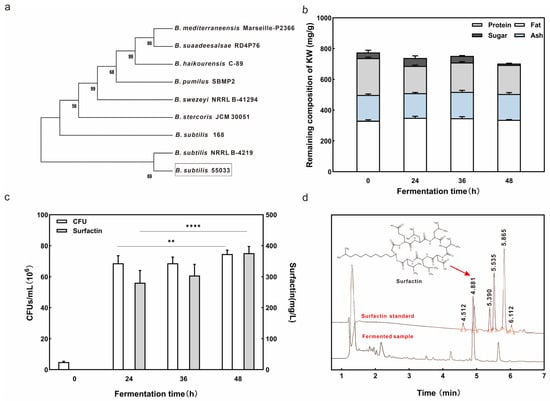
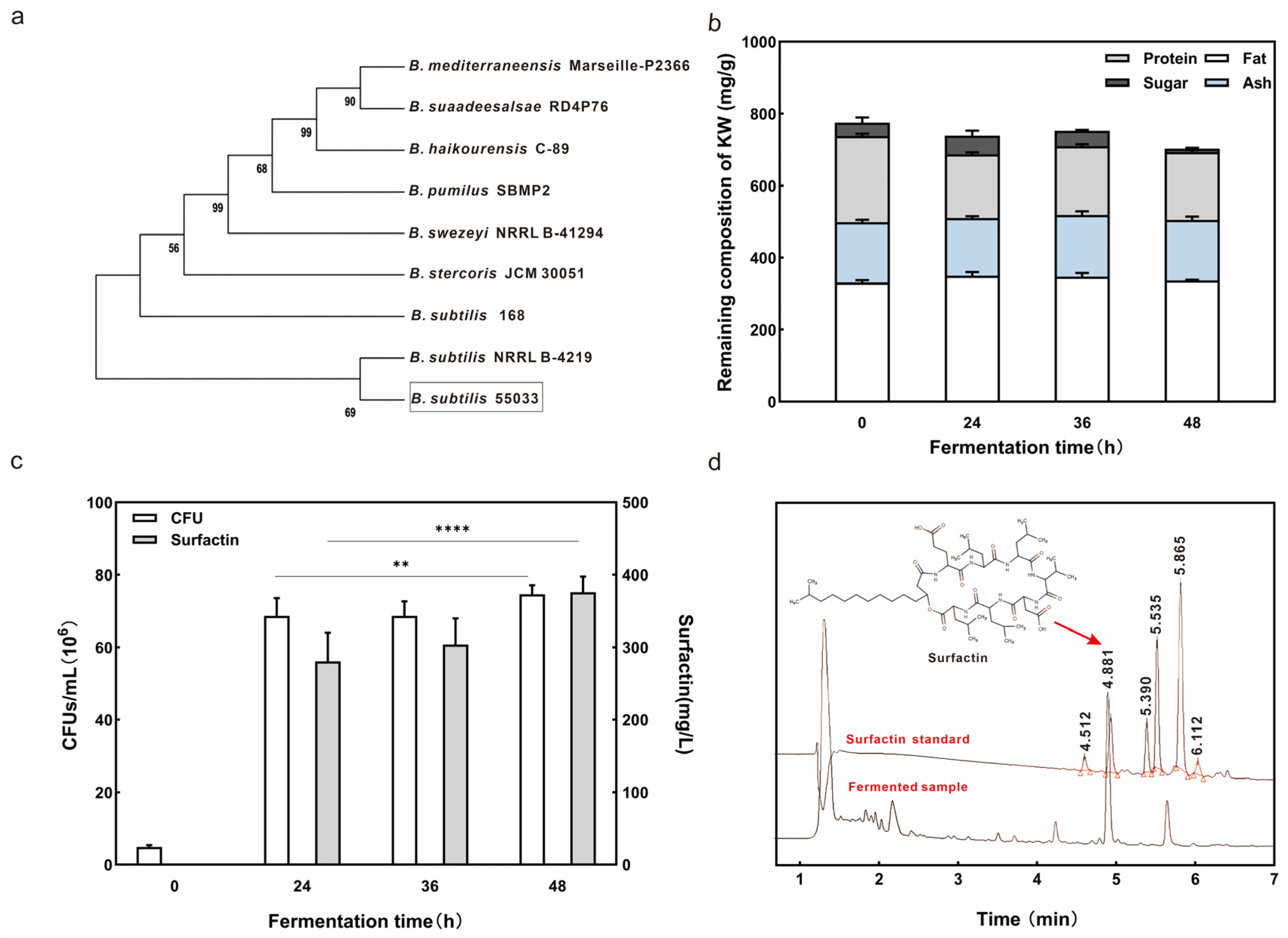
The screened bacterial isolate was identified as Bacillus subtilis 55033 via 16S rRNA gene sequencing, and the sequence has been deposited in the NCBI SRA database under accession number SRR39003715. BLAST alignment and phylogenetic analysis revealed 99% sequence similarity to reference B. subtilis strains, with the isolate clustering closely within the B. subtilis clade (Figure 1a).
Figure 1.
Screening and identification of surfactant-producing strains and analysis of substrate production ability; (a) The phylogenetic tree for B. subtilis 55033; (b) Substrate consumption of surfactin synthesis by B. subtilis 55033 fermented by kitchen waste substrate; (c) Cell growth and surfactin production of B. subtilis 55033 at different fermentation times; (d) HPLC combined chromatogram of the surfactin standard and the fermented sample. Statistical significance: ** p < 0.01, **** p < 0.0001.
To evaluate the feasibility of using kitchen waste (KW) as a low-cost fermentation substrate, the consumption profiles of major macro-components (total protein, fat, sugar, and ash) were monitored over 48 h of cultivation (Figure 1b). While crude fat and ash contents remained nearly constant throughout the fermentation process, total protein was rapidly assimilated during the initial 12 h, leaving substantial residual protein unutilized at 48 h. Conversely, total sugars were nearly exhausted by the end of the 48-h fermentation (Figure S2), demonstrating that B. subtilis 55033 preferentially utilizes soluble carbohydrates as its primary carbon and energy sources to support robust biomass accumulation. Biomass tracking and quantitative assays further confirmed that B. subtilis 55033 grew robustly in the KW substrate and successfully synthesized surfactin. Colony-forming units (CFUs) and surfactin yield increased with fermentation time (Figure S3), showing highly significant production up to 48 h (Figure 1c). High-Performance Liquid Chromatography (HPLC) analysis was conducted to verify the final product. The chromatogram of the fermented sample exhibited retention peaks that aligned with the surfactin standard (Figure 1d).
To definitively confirm the chemical identity and homolog composition of the product, liquid chromatography-high resolution mass spectrometry (LC-HRMS) was performed (Figures S4 and S5). The commercial standard exhibited characteristic peaks for various surfactin homologs and their isomers, identified as: C13 [M + H]+ (m/z 994.6440); C14 [M + H]+ (m/z 1008.6587–1008.6595); C15 [M + H]+ (m/z 1022.6736–1022.6761); C16 [M + H]+ (m/z 1036.6895–1036.6912); and C17 [M + H]+ (m/z 1050.7063). The fermentation sample displayed an identical mass spectral fingerprint, with major peaks at m/z 1008.6590, 1022.6765, and 1036.6915, corresponding to the C14 (10.06 min), C15 (10.46 min), and C16 (10.84 min) homologs, respectively. These findings unequivocally demonstrate that B. subtilis 55033 successfully biosynthesizes a well-defined mixture of surfactin homologs using kitchen waste as the sole substrate.
3.2. Optimization of the Fermentation Process
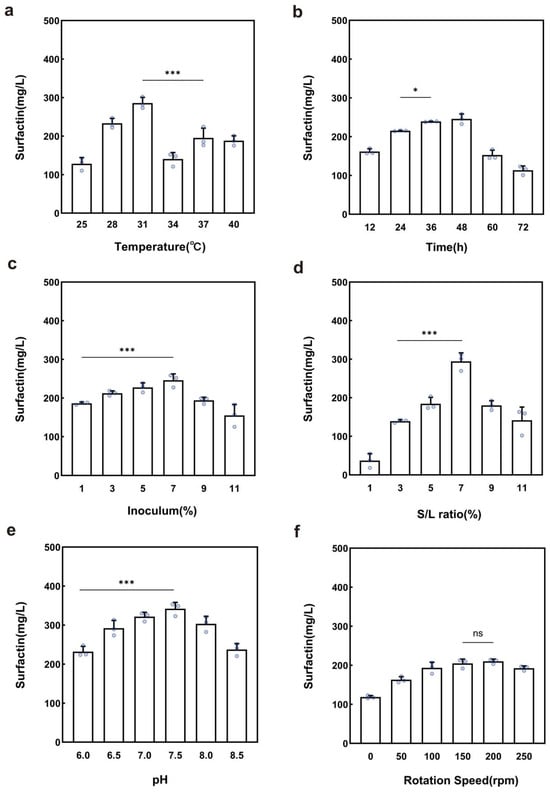
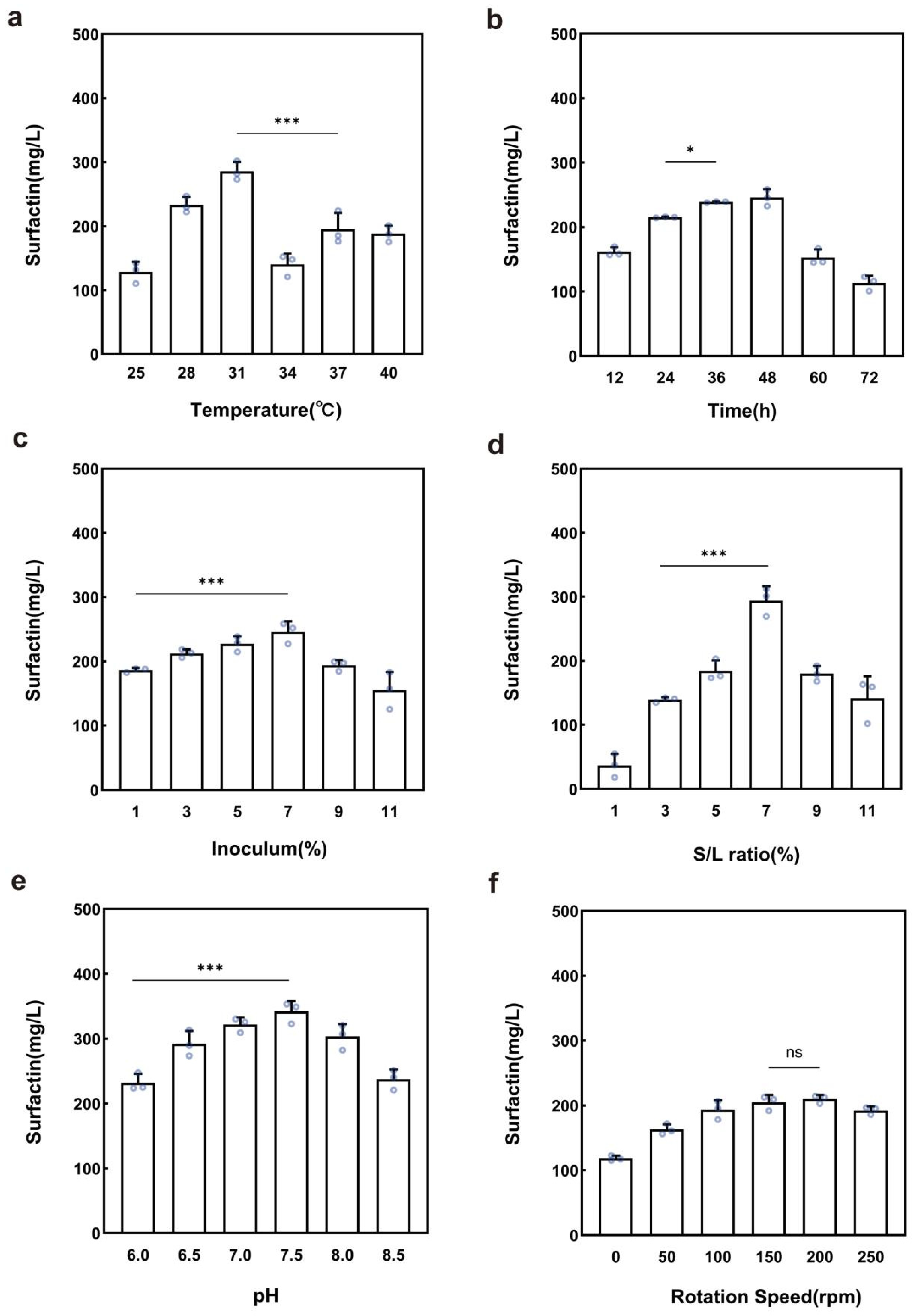
Preliminary single-factor assays evaluated the effects of key environmental and operational parameters on surfactin production by B. subtilis 55033 (Figure 2). Temperature significantly influenced metabolic activity; the optimal yield was achieved at 31 °C, whereas lower temperatures inhibited metabolic rates and excessively high temperatures (>40 °C) precipitated premature cell senescence (Figure 2a). Time-course profiling established 48 h as the optimal harvest time, as surfactin titer peaked at this point and declined after 60 h, reflecting a dynamic equilibrium between product synthesis and potential degradation (Figure 2b). Variations in inoculum size (1–7%, v/v) exerted marginal effects, with yield increasing from 202.28 mg/L at 1% to a maximum of 232.12 mg/L at 7% (Figure 2c). A 7% solid-to-liquid ratio was identified as optimal, likely by reducing broth viscosity to enhance dissolved oxygen (DO) levels and nutrient mass transfer (Figure 2d). Furthermore, the strain preferred slightly alkaline conditions, peaking at an initial pH of 7.5 (Figure 2e). Finally, agitation speed positively correlated with the oxygen transfer rate (OTR), with vigorous aeration at 200 rpm maximizing biosynthesis (Figure 2f).
Figure 2.
Surfactin concentration of B. subtilis 55033 under different fermentation parameters: (a) Temperature; (b) Time; (c) Seed liquid inoculum amount; (d) medium solid-to-liquid ratio; (e) pH; (f) rotation speed. Statistical significance: * p < 0.05, *** p < 0.001; ns, not significant.
Analysis of variance (ANOVA) of the subsequent orthogonal tests ranked the statistical influence of parameters on surfactin yield in descending order: temperature > initial pH > fermentation time > agitation speed > solid-to-liquid ratio > inoculum size (Table 2 and Table 3). The optimized conditions comprised a temperature of 31 °C, 48 h incubation, 7% inoculum (5 mL in 100 mL working volume), a 7% solid-to-liquid ratio, an initial pH of 7.5, and an agitation speed of 200 rpm. Verification experiments validated these parameters, yielding a maximum surfactin titer of 371 mg/L, a peak biomass density of 75 × 106 CFU/mL, and a total substrate consumption of 474.3 mg (6.78% of the initial 7 g loading) (Figure S6).
Table 3.
Analysis of variance for the orthogonal test results.
Fractional analysis indicated that substrate consumption was driven by the preferential assimilation of total sugars (decreasing from 40.0 to 10.0 mg/g dry substrate; 75.0% consumption) as a fast-acting carbon source, and crude proteins (declining from 240.0 to 185.0 mg/g; 22.9% consumption) for cell proliferation and lipopeptide synthetase biosynthesis. Conversely, the relative lipid content increased slightly from 335.0 to 340.0 mg/g due to a mass normalization effect, confirming negligible lipid degradation by *B. subtilis* 55033 (Figure S2). Ultimately, a strong positive correlation was observed among substrate consumption, cell proliferation, and product accumulation.
Crucially, the 371 mg/L titer represents a conservative estimate of the strain’s full biosynthetic potential, as the 40% liquid-to-flask volume ratio (100 mL in a 250 mL flask) likely restricted oxygen mass transfer during this highly aerobic process. Additionally, while ANOVA robustly validated the 48-h harvest window, fixed-point sampling may obscure subtle kinetic variations. Future scale-up optimizations under enhanced aeration, paired with high-resolution temporal tracking or online monitoring, are warranted to fully exploit the dynamic production optimum.
3.3. Comparative and Comprehensive Analysis of Surfactin Biosynthetic Gene Clusters and Pathways Between B. subtilis 55033 and B. subtilis 168
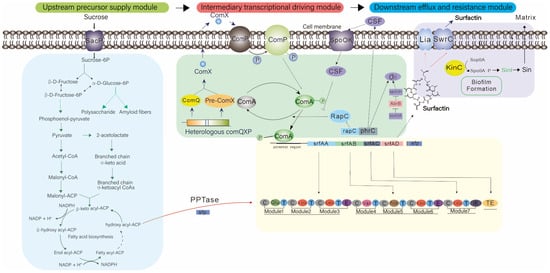
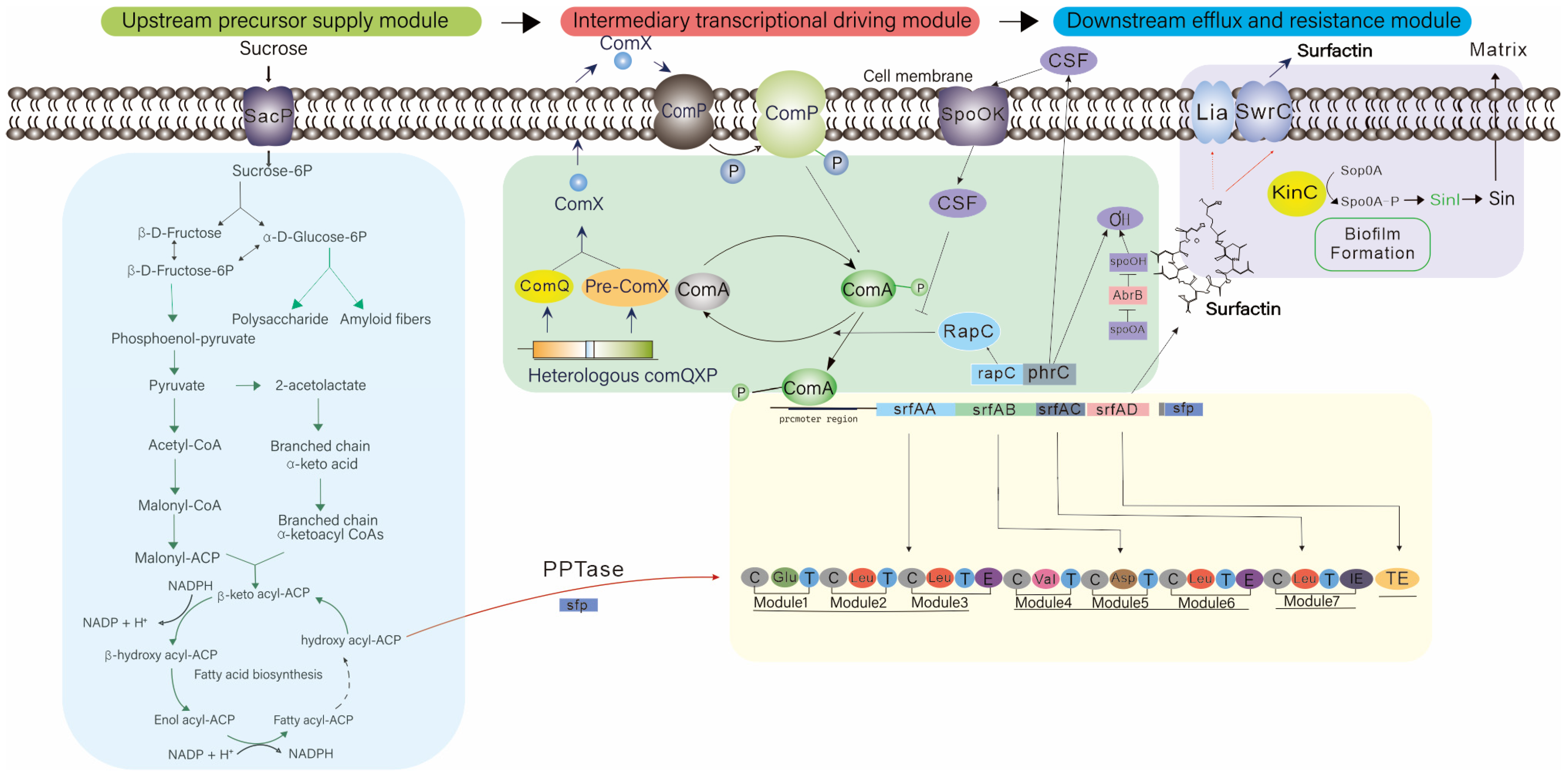
The biosynthesis of surfactin in B. subtilis 55033 is a highly coordinated process integrating central carbon metabolism, complex transcriptional regulation, non-ribosomal peptide synthesis (NRPS), and specialized efflux mechanisms (Figure 3). Based on the metabolic network and comparative proteomic alignment with the reference strain B. subtilis 168 (Table 4), the biosynthetic landscape could be divided into four functional modules: the upstream precursor supply, transcriptional driving, NRPS assembly, and efflux/resistance [45].
Figure 3.
The biosynthetic pathway of surfactin in B. subtilis.
Table 4.
Protein sequence alignment of key synthetic genes between B. subtilis 55033 and B. subtilis 168.
Although the vast majority of core functional genes share highly conserved sequences, multiple critical genetic variations were identified in this study, which may directly lead to distinct surfactin yields between the two strains observed in fermentation assays. Bacillus subtilis 168 completely loses the capacity for surfactin biosynthesis owing to a loss-of-function pseudogenization of its sfp gene, whereas strain 55033 is competent for surfactin production. Accordingly, the functional integrity of the Sfp protein acts as the master genetic switch governing whether a strain can synthesize surfactin. Beyond this decisive on/off divergence for biosynthetic competence, sequence alignment uncovered several additional polymorphic loci; such mutations are presumed to modulate the magnitude of surfactin biosynthesis specifically in strain 55033. Sucrose internalization via the SacP permease (99.57% identity, 99.78% similarity to strain B. subtilis 168; Table 4) yields sucrose-6-phosphate and feeds glycolysis. Pyruvate serves as a branch point, generating β-hydroxy-acyl-ACP through acetyl-CoA and malonyl-ACP for the lipopeptide tail, and supplying branched-chain amino acid precursors via the 2-acetolactate pathway [46]. All central metabolic enzymes examined showed >99% identity (Table 4), suggesting that precursor supply from primary metabolism is functionally equivalent between the two strains and thus not a contributing factor to the differential production capacity. Regarding quorum sensing and transcriptional regulation, the srfA operon is controlled by the ComQXPA quorum-sensing circuit and the Rap-Phr antagonistic system [47] (Figure 3). The downstream regulators ComA, PhrC, Spo0A [48], and AbrB were fully conserved (100% identity) [49], whereas the pheromone synthase ComQ and sensor ComP exhibited only 40.75% and 58.13% identity [50], respectively (Table 4). While these proteins are not required for the binary on/off state of surfactin production (since ComA~P can still be generated via other pathways), their divergence may quantitatively alter the threshold or dynamics of ComA phosphorylation. In strain 55033, this could lead to a different timing or magnitude of srfA transcription compared to a typical wild-type B. subtilis strain with canonical ComQ/ComP. The high conservation of RapC (99.74%), which is inhibited by the PhrC (CSF) peptide, stabilizes ComA~P levels and maintains srfA transcription.
In the NRPS assembly line, the srfAA-AD gene cluster encodes the NRPS that sequentially condenses Glu-Leu-Leu-Val-Asp-Leu-Leu onto a β-hydroxy fatty acid [51], with the cyclization and release performed by the SrfAD thioesterase domain [52] (Figure 3). The catalytic domains are highly conserved (98.20–99.72% identity; Table 4). This near-identity implies that if the NRPS enzymes were activated, their catalytic efficiency and substrate specificity would be comparable between strains. However, activation depends entirely on Sfp. In contrast, the Sfp phosphopantetheinyl transferase, essential for converting apo-NRPS to the holo-form, displayed only 72.08% identity and a 12.50% gap frequency (Table 4). Given that the sfp gene of strain 168 is a nonfunctional pseudogene [53], the divergent Sfp in strain 55033 likely influences post-translational NRPS activation. Regarding efflux, self-resistance, and physiological integration, surfactin secretion and self-resistance rely on the SwrC efflux pump (99.43% identity; Table 4) and on accessory modules (Figure 3) [54]. Extracellular surfactin triggers the LiaGHI-FSR envelope stress response, with the LiaR regulator exceeding 94% identity (Table 4), and induces biofilm formation through the KinC kinase, leading to Spo0A~P accumulation and derepression of matrix genes via the SinI/SinR switch [55,56]. All downstream regulatory components are nearly identical between strains, so any surfactin-mediated feedback regulation would operate similarly in 55033 as in a hypothetical Sfp-complemented 168 strain.
3.4. Effects of Surfactin on the Growth of Marine Vibrio
The antibacterial efficacy of the surfactin produced by B. subtilis 55033 was evaluated against five pathogenic aquaculture strains (Table 5), using the agar diffusion method.
Table 5.
Diameter of the inhibition zone.
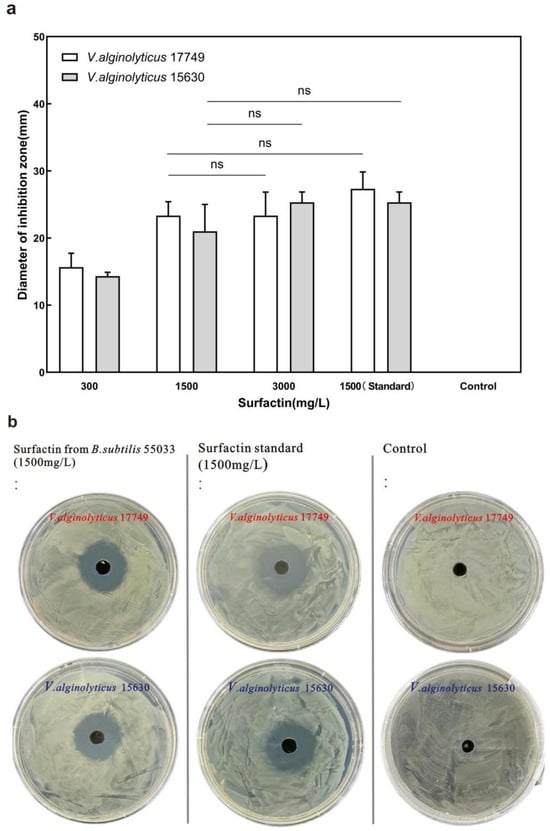
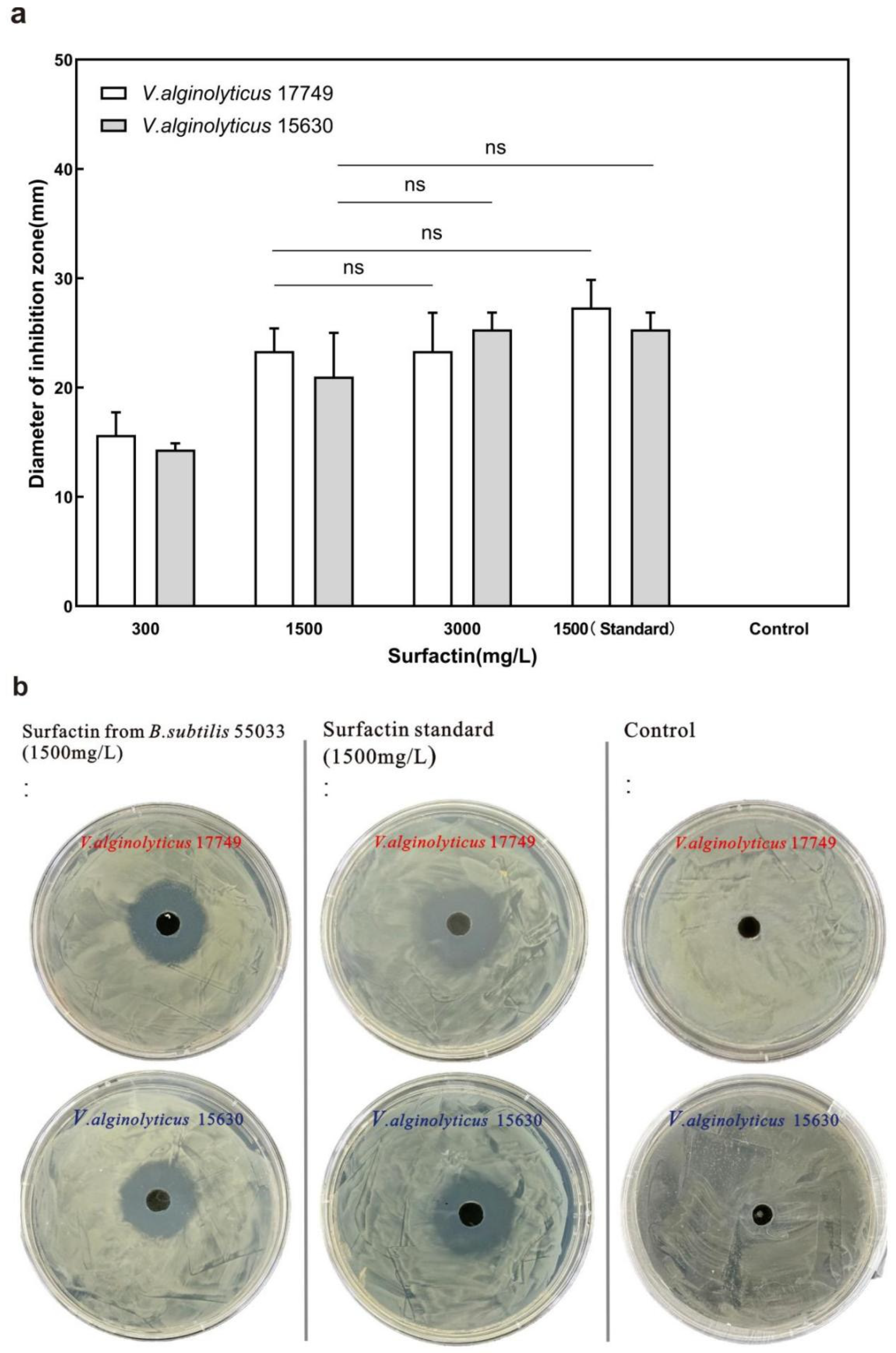
The crude surfactin extract exhibited pronounced antagonistic activity against some of the tested strains (Figure 4a). At 300 mg/L, inhibition zones of 15.6 mm and 14.3 mm were observed for V. alginolyticus 17749 and V. alginolyticus 15630, respectively. Increasing the concentration to 1500 mg/L substantially enlarged the zones, indicating strong concentration-dependent activity. However, no further significant increase was observed at 3000 mg/L compared to 1500 mg/L. In contrast, V. harveyi 1280, V. harveyi 15634, and V. xuii R-15052 showed no inhibition at any tested concentration (Table 5).
Figure 4.
Inhibition zone results of surfactin against V. alginolyticus; (a) Inhibition zone sizes of surfactin against V. alginolyticus at different concentrations; (b) Agar diffusion plate. Statistical significance: ns, not significant.
This strain-specific susceptibility pattern is consistent with the known intrinsic resistance of Vibrio species to anionic surfactants. Lee demonstrated that Vibrio vulnificus expels anionic surfactants via RND-family efflux pumps; inhibiting efflux activity restores susceptibility, confirming active efflux as a core resistance mechanism. In a separate study [57], Xu tested surfactin N3 against nine Vibrio isolates and observed MICs ranging from 12.5 to >200 mg/L—values generally higher than those for typical Gram-positive bacteria—indicating that the outer membrane itself acts as a permeability barrier. Based on these reports and our data [58], we hypothesize that the complete insusceptibility of V. harveyi and V. xuii across 0–3000 mg/L arises from elevated efflux pump expression, or from synergistic protection by distinct LPS architecture, capsular polysaccharide, and biofilm-forming capacity. Thus, surfactin exhibits broad-spectrum yet non-universal antibacterial activity, with its efficacy primarily governed by strain-specific intrinsic defense mechanisms.
To assess whether the observed activity was attributable to surfactin rather than co-extracted metabolites, we compared the crude extract with a commercial high-purity surfactin standard (>99%) at 1500 mg/L. No significant difference in inhibition zone diameters was detected between the two (Figure 4b). Both produced clear, uniformly sized halos, whereas control wells showed no inhibition. These results confirm that the inhibitory activity observed with the cell-free supernatant from cultures of Bacillus subtilis 55033 highlights the potential application of surfactin produced by this strain as an active agent against aquatic pathogens. The selective activity against only a subset of Vibrio strains further suggests that the antibacterial mechanism of the crude surfactin extract involves strain-specific surface interactions rather than a universal bactericidal effect.
3.5. Effects of Surfactins on the Development of Cryptocaryon irritans
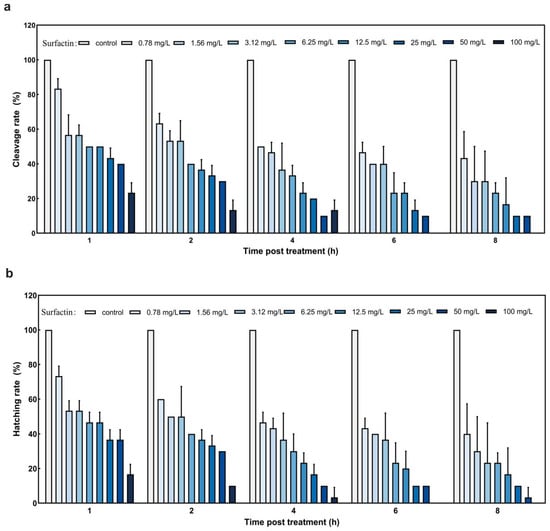
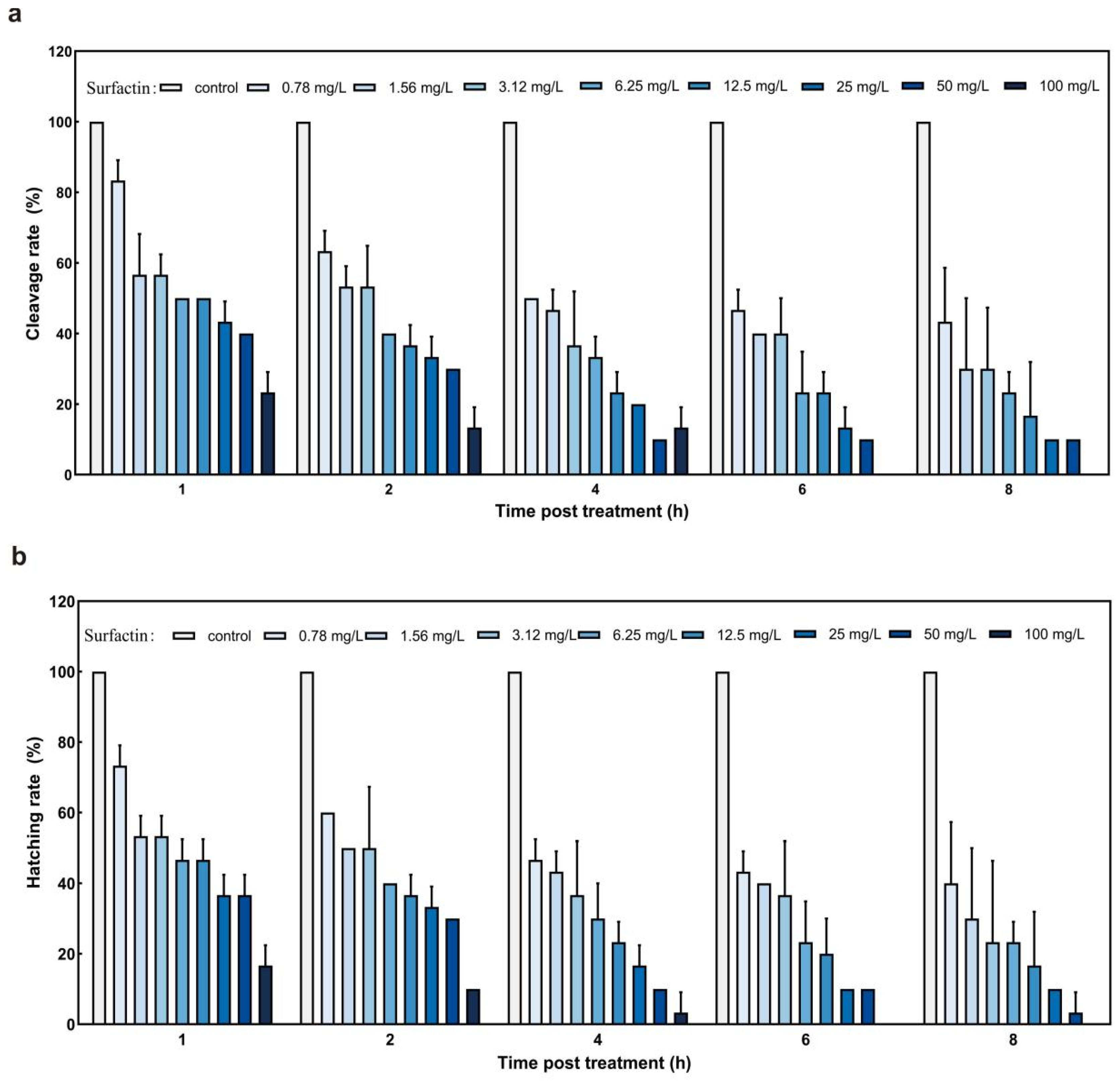
The inhibitory potential of the crude surfactin extract (produced by B. subtilis 55033) against the development of C. irritans tomonts was evaluated by monitoring the cleavage and hatching rates across a range of concentrations (0.78–100 mg/L, based on the surfactin content in the crude extract) over an 8-h treatment period (Figure 5).
Figure 5.
Effects of Surfactins on the development of Cryptocaryon irritans; (a) The effects of different concentrations of surfactin on the cleavage rate of C. irritans tomonts; (b) The effects of different concentrations of surfactin on the hatching rate of C. irritans tomonts.
The crude surfactin extract significantly affected the cleavage rate of C. irritans tomonts (Figure 5a). While the control group maintained a 100% cleavage rate throughout the experiment, the treated groups showed a marked reduction in developmental progression. At a concentration of 0.78 mg/L, the cleavage rate was slightly decreased to approximately 43% after 8 h of exposure. In contrast, high concentrations of the crude extract (50 and 100 mg/L) induced rapid and severe suppression, with the cleavage rate dropping to approximately 0% by the 6-h mark. These results indicate that the crude surfactin extract effectively interferes with the early mitotic division of the parasite within the tomont stage.
The impact of the crude surfactin extract on the final hatching stage of the tomonts is illustrated in Figure 5b. Similar to the cleavage results, the hatching rate decreased significantly upon treatment with the crude extract. For the groups treated with concentrations exceeding 12.5 mg/L, there was a sharp decline in hatching within the first four hours. Notably, at the highest tested concentration (100 mg/L), hatching was almost entirely suppressed, declining to 16.5% at 1 h and reaching a minimum of 0% by 6 h. The overall trend suggests that the crude surfactin extract not only inhibits internal cellular division but also effectively prevents the emergence of theronts from the protective tomont wall.
While these in vitro findings convincingly demonstrate the potent biocontrol efficacy of this waste-derived crude surfactin against C. irritans, translating this laboratory-scale success into practical aquaculture applications demands a comprehensive understanding of its biosafety. The present study focused exclusively on the in vitro anti-parasitic efficacy of the crude surfactin extract. No toxicity tests on host fish species have been performed to date. Therefore, the safety of this extract for aquaculture applications remains unknown, and any potential use would require systematic evaluation of its host toxicity and environmental impact in future studies.
4. Conclusions
This study has demonstrated that kitchen waste after simple homogenization can serve as an efficient fermentation substrate for surfactin synthesis by B. subtilis, suggesting a promising direction for potential application. We compared the differences in the surfactin biosynthetic gene clusters responsible for surfactin production between B. subtilis 55033 and the model strain B. subtilis 168, and further analyzed the metabolic pathway of surfactin synthesis in B. subtilis. The fermentation process of strain 55033 was systematically optimized through single-factor experiments and orthogonal tests. The optimal fermentation conditions were as follows: a fermentation temperature of 31 °C, a fermentation duration of 48 h, an initial inoculum volume of 5 mL, a medium solid-to-liquid ratio of 7%, an initial pH of 7.5, and a shaking speed of 200 rpm. Production of surfactin was achieved using a low-value waste substrate that was utilized without any previous pretreatment, representing a significant advantage for process simplicity and economic feasibility, with the final yield reaching 371 mg/L.
This study preliminarily explored the antagonistic effect of surfactin produced by B. subtilis against aquatic pathogens. We verified that surfactin could inhibit the growth of several Vibrio species, as well as the division and hatching of Cryptocaryon irritans tomonts. This study provides preliminary evidence for the potential use of surfactin in aquaculture disease control.
Supplementary Materials
The following supporting information can be downloaded at: https://www.mdpi.com/article/10.3390/fermentation12060298/s1, Figure S1: Standard curve. Figure S2: Analysis of Substrate Consumption at Different Fermentation Stages. (a) Total fat; (b) Ash; (c) Protein; (d) Total sugars. Figure S3: Growth curve of B. subtilis 55033 during fermentation. Figure S4: Total Ion Current chromatograms a. Standard sample b. Fermentation sample. Figure S5: High-resolution mass spectra of surfactin homologs from B. subtilis 55033 (a). Mass spectrum of C14-surfactin showing at m/z 1008.6590 (b). Mass spectrum of C15-surfactin showing at m/z 1022.6757 (c). Mass spectrum of C16-surfactin showing at m/z 1036.6906. Figure S6: Substrate consumption, bacterial biomass, and surfactin yield under optimized conditions.
Author Contributions
Conceptualization, Y.Z. and Y.F.; methodology, Y.Z. and Y.F.; software, C.Z. and Y.L.; validation, C.Z., Y.Z. and Y.F.; formal analysis, C.Z.; investigation, C.Z. and Y.L.; resources, Y.F. and C.W.; data curation, C.Z. and Y.L.; writing—original draft preparation, C.Z.; writing—review and editing, Y.Z. and Y.F.; visualization, X.W.; supervision, Y.Z. and Y.F.; project administration, X.W. and C.W.; funding acquisition, Y.Z. and Y.F. All authors have read and agreed to the published version of the manuscript.
Funding
This research was funded by the Ningbo Science and Technology Bureau (Grant No. 2023S062). The APC was funded by the Ningbo Institute of Oceanography.
Institutional Review Board Statement
Not applicable.
Informed Consent Statement
Not applicable.
Data Availability Statement
The original contributions presented in this study are included in the article/Supplementary Materials. Further inquiries can be directed to the corresponding authors.
Conflicts of Interest
The authors declare no conflicts of interest.
References
- Gudiña, E.J.; Teixeira, J.A. Bacillus licheniformis: The unexplored alternative for the anaerobic production of lipopeptide biosurfactants? Biotechnol. Adv. 2022, 60, 108013. [Google Scholar] [CrossRef] [Scilit] [PubMed]
- Wang, M.; Yu, H.; Li, X.; Shen, Z. Single-gene regulated non-spore-forming Bacillus subtilis: Construction, transcriptome responses, and applications for producing enzymes and surfactin. Metab. Eng. 2020, 62, 235–248. [Google Scholar] [PubMed]
- Czinkóczky, R.; Sakiyo, J.; Eszterbauer, E.; Németh, Á. Prediction of surfactin fermentation with Bacillus subtilis DSM10 by response surface methodology optimized artificial neural network. Cell Biochem. Funct. 2023, 41, 234–242. [Google Scholar] [CrossRef] [Scilit] [PubMed]
- Arima, K.; Kakinuma, A.; Tamura, G. Surfactin, a crystalline peptidelipid surfactant produced by Bacillus subtilis: Isolation, characterization and its inhibition of fibrin clot formation. Biochem. Biophys. Res. Commun. 1968, 31, 488–494. [Google Scholar] [CrossRef] [Scilit] [PubMed]
- Bjerk, T.R.; Severino, P.; Jain, S.; Marques, C.; Silva, A.M.; Pashirova, T.; Souto, E.B. Biosurfactants: Properties and applications in drug delivery, biotechnology and ecotoxicology. Bioengineering 2021, 8, 115. [Google Scholar] [CrossRef] [Scilit] [PubMed]
- Hammad, M.; Ali, H.; Hassan, N.; Tawab, A.; Salman, M.; Jawad, I.; de Jong, A.; Moreno, C.M.; Kuipers, O.P.; Feroz, Y. Food safety and biological control; genomic insights and antimicrobial potential of Bacillus velezensis FB2 against agricultural fungal pathogens. PLoS ONE 2023, 18, e0291975. [Google Scholar] [CrossRef] [Scilit] [PubMed]
- Torres, M.J.; Brandan, C.P.; Sabaté, D.C.; Petroselli, G.; Erra-Balsells, R.; Audisio, M.C. Biological activity of the lipopeptide-producing Bacillus amyloliquefaciens PGPBacCA1 on common bean Phaseolus vulgaris L. Pathogens. Biol. Control 2017, 105, 93–99. [Google Scholar]
- Yin, J.; Wei, X.; Hu, F.; Cheng, C.; Zhuang, X.; Song, M.; Zhuang, G.; Wang, F.; Ma, A. Halotolerant Bacillus velezensis sustainably enhanced oil recovery of low permeability oil reservoirs by producing biosurfactant and modulating the oil microbiome. Chem. Eng. J. 2023, 453, 139912. [Google Scholar]
- Xu, Y.; Wu, J.-Y.; Liu, Q.-J.; Xue, J.-Y. Genome-Wide Identification and Evolutionary Analyses of SrfA Operon Genes in Bacillus. Genes 2023, 14, 422. [Google Scholar] [PubMed]
- Ravi, A.; Nandayipurath, V.V.T.; Rajan, S.; Salim, S.A.; Khalid, N.K.; Aravindakumar, C.T.; Krishnankutty, R.E. Effect of zinc oxide nanoparticle supplementation on the enhanced production of surfactin and iturin lipopeptides of endophytic Bacillus sp. Fcl1 and its ameliorated antifungal activity. Pest Manag. Sci. 2021, 77, 1035–1041. [Google Scholar] [PubMed]
- Moshtagh, B.; Hawboldt, K.; Zhang, B. Optimization of biosurfactant production by Bacillus subtilis N3-1P using the brewery waste as the carbon source. Environ. Technol. 2019, 40, 3371–3380. [Google Scholar] [PubMed]
- Moshtagh, B.; Hawboldt, K.; Zhang, B. Biosurfactant production by native marine bacteria (Acinetobacter calcoaceticus P1-1A) using waste carbon sources: Impact of process conditions. Can. J. Chem. Eng. 2021, 99, 2386–2397. [Google Scholar]
- Poveda-Giraldo, J.A.; Solarte-Toro, J.C.; Treinen, C.; Noll, P.; Henkel, M.; Hausmann, R.; Cardona Alzate, C.A. Assessing the feasibility and sustainability of a surfactin production process: A techno-economic and environmental analysis. Environ. Sci. Pollut. Res. 2025, 32, 27699–27714. [Google Scholar]
- Sharon, A.B.; Ahuekwe, E.F.; Nzubechi, E.G.; Oziegbe, O.; Oniha, M. Statistical optimization strategies on waste substrates for solving high-cost challenges in biosurfactants production: A review. IOP Conf. Ser. Earth Environ. Sci. 2023, 1197, 012004. [Google Scholar] [CrossRef] [Scilit]
- Ramírez, I.M.; Vaz, D.A.; Banat, I.M.; Marchant, R.; Alameda, E.J.; Román, M.G. Hydrolysis of olive mill waste to enhance rhamnolipids and surfactin production. Bioresour. Technol. 2016, 205, 1–6. [Google Scholar] [CrossRef] [Scilit] [PubMed]
- Zhi, Y.; Wu, Q.; Xu, Y. Production of surfactin from waste distillers’ grains by co-culture fermentation of two Bacillus amyloliquefaciens strains. Bioresour. Technol. 2017, 235, 96–103. [Google Scholar] [CrossRef] [Scilit] [PubMed]
- Janek, T.; Gudiña, E.J.; Połomska, X.; Biniarz, P.; Jama, D.; Rodrigues, L.R.; Rymowicz, W.; Lazar, Z. Sustainable surfactin production by Bacillus subtilis using crude glycerol from different wastes. Molecules 2021, 26, 3488. [Google Scholar] [CrossRef] [Scilit] [PubMed]
- Gugel, I.; Vahidinasab, M.; Benatto Perino, E.H.; Hiller, E.; Marchetti, F.; Costa, S.; Pfannstiel, J.; Konnerth, P.; Vertuani, S.; Manfredini, S.; et al. Fed-Batch Bioreactor Cultivation of Bacillus subtilis Using Vegetable Juice as an Alternative Carbon Source for Lipopeptides Production: A Shift towards a Circular Bioeconomy. Fermentation 2024, 10, 323. [Google Scholar] [CrossRef] [Scilit]
- Nazareth, T.C. Biosurfactant Production by Bacillus subtilis ATCC 6051 Using Brewery Waste as a Carbon Source. Master’s Thesis, Federal University of Santa Catarina, Florianópolis, Brazil, 2019. [Google Scholar]
- Moya-Ramírez, I.; Pegalajar-Robles, M.E.; Debiasi Alberton, M.; Rufián-Henares, J.A.; Fernández-Arteaga, A.; Garcia-Roman, M.; Altmajer-Vaz, D. Spent coffee grounds as feedstock for the production of biosurfactants and the improved recovery of melanoidins. World J. Microbiol. Biotechnol. 2023, 39, 254. [Google Scholar] [CrossRef] [Scilit] [PubMed]
- Santos, B.L.P.; Vieira, I.M.M.; Santos, P.O.L.; Menezes, M.S.; de Souza, R.R.; Ruzene, D.S.; Silva, D.P. Use of corncob and pineapple peel as associated substrates for biosurfactant production. Environ. Sci. Pollut. Res. 2024, 31, 57973–57988. [Google Scholar] [CrossRef] [Scilit] [PubMed]
- Pan, F.-D.; Liu, S.; Xu, Q.-M.; Chen, X.-Y.; Cheng, J.-S. Bioconversion of kitchen waste to surfactin via simultaneous enzymolysis and fermentation using mixed-culture of enzyme- producing fungi and Bacillus amyloliquefaciens HM618. Biochem. Eng. J. 2021, 172, 108036. [Google Scholar] [CrossRef] [Scilit]
- Chavan, S.; Yadav, B.; Tyagi, R.D.; Wong, J.W.C.; Drogui, P. Trends and challenges in the valorization of kitchen waste to polyhydroxyalkanoates. Bioresour. Technol. 2023, 369, 128323. [Google Scholar] [CrossRef] [Scilit] [PubMed]
- Hafid, H.S.; Rahman, N.A.A.; Shah, U.K.M.; Baharuddin, A.S.; Ariff, A.B. Feasibility of using kitchen waste as future substrate for bioethanol production: A review. Renew. Sustain. Energy Rev. 2017, 74, 671–686. [Google Scholar] [CrossRef] [Scilit]
- Ma, J.; Duong, T.H.; Smits, M.; Verstraete, W.; Carballa, M. Enhanced biomethanation of kitchen waste by different pre-treatments. Bioresour. Technol. 2011, 102, 592–599. [Google Scholar] [CrossRef] [Scilit] [PubMed]
- Chandra, M.S.; Srinivasulu, M.; Yadav, P.S.; Ramesh, B.; Narasimha, G.; Chandrasekhar, T.C. Value Added Products from Agriculture, Paper and Food Waste: A Source of Bioenergy Production. In Bioenergy Research: Commercial Opportunities & Challenges; Clean Energy Production Technologies; Springer: Singapore, 2021. [Google Scholar]
- Li, Y.; Jin, Y.; Li, J.; Chen, Y.; Gong, Y.; Li, Y.; Zhang, J. Current situation and development of kitchen waste treatment in China. Procedia Environ. Sci. 2016, 31, 40–49. [Google Scholar] [CrossRef] [Scilit]
- Soni, S.K.; Dogra, S.; Sharma, A.; Thakur, B.; Yadav, J.; Soni, R. Enzyme-powered waste valorization: Simultaneous hydrolysis and fermentation of kitchen waste for biofertilizer production. Bioresour. Technol. Rep. 2024, 25, 101700. [Google Scholar] [CrossRef] [Scilit]
- Zhang, W.; Qiu, L.; Gong, A.; Cao, Y.; Wang, B. Solid-state Fermentation of Kitchen Waste for Production of Bacillus thuringiensis-based Bio-pesticide. BioResources 2013, 8, 1124–1135. [Google Scholar]
- Heerklotz, H.; Seelig, J. Leakage and lysis of lipid membranes induced by the lipopeptide surfactin. Eur. Biophys. J. 2007, 36, 305–314. [Google Scholar] [PubMed]
- Vollenbroich, D.; Pauli, G.; Ozel, M.; Vater, J. Antimycoplasma properties and application in cell culture of surfactin, a lipopeptide antibiotic from Bacillus subtilis. Appl. Environ. Microbiol. 1997, 63, 44–49. [Google Scholar] [CrossRef] [Scilit] [PubMed]
- Zhang, Y.; Liu, C.; Dong, B.; Ma, X.; Hou, L.; Cao, X.; Wang, C. Anti-inflammatory activity and mechanism of surfactin in lipopolysaccharide-activated macrophages. Inflammation 2015, 38, 756–764. [Google Scholar] [PubMed]
- Kumar, S.; Kumar, A.; Soratur, A.; Sarkar, A.; Venmathi Maran, B.A. Harnessing Marine Bacterial Lipopeptides for Sustainable Disease Management in Open Sea Cage Aquaculture. Oceans 2026, 7, 4. [Google Scholar] [CrossRef] [Scilit]
- Xiang, L.; Zhou, Z.; Wang, X.; Jiang, G.; Cheng, J.; Hu, Y.; Qian, J.; Sun, X.; Shen, H. Surfactin, bacillibactin and bacilysin are the main antibacterial substances of Bacillus subtilis JSHY-K3 that inhibited the growth of VpAHPND (the main pathogen of acute hepatopancreatic necrosis disease in shrimp). Aquac. Rep. 2025, 42, 102745. [Google Scholar]
- Yang, J.; Bhassu, S.; Rajamanikam, A. Charting the Future: Advanced Technologies for Sustainable Parasite Control in Aquaculture. Int. J. Mol. Sci. 2025, 26, 10738. [Google Scholar] [CrossRef] [Scilit] [PubMed]
- Tran, V.L.; Barnes, A.C.; Samsing, F.; Vu, U.N.; Wiley, K. Striped catfish (Pangasianodon hypophthalmus) farmers’ perspectives on challenges and health management practices in the Mekong Delta, Vietnam: A qualitative study. Prev. Vet. Med. 2025, 239, 106527. [Google Scholar] [CrossRef] [Scilit] [PubMed]
- Yin, F.; Liu, W.; Bao, P.; Jin, S.; Qian, D.; Wang, J.; Tang, B. Comparison of the susceptibility and resistance of four marine perciform fishes to Cryptocaryon irritans infection. Fish Shellfish Immunol. 2018, 77, 298–303. [Google Scholar] [CrossRef] [Scilit] [PubMed]
- GB 5009.6-2016; National Health and Family Planning Commission of the People’s Republic of China and National Medical Products Administration, National Food Safety Standard Determination of Fat in Food. Standards Press of China: Beijing, China, 2016.
- GB 5009.4-2016; National Health and Family Planning Commission of the People’s Republic of China and National Medical Products Administration, National Food Safety Standard Determination of Ash in Food. Standards Press of China: Beijing, China, 2016.
- GB 5009.5-2016; National Health and Family Planning Commission of the People’s Republic of China and State Food and Drug Administration, National Food Safety Standard Determination of Protein in Food. Standards Press of China: Beijing, China, 2016.
- Firdose, A.; Msarah, M.J.; Chong, N.; Aqma, W.S. Extraction and antimicrobial activity of rhamnolipid biosurfactant produced by Pseudomonas aeruginosa UKMP14T. Malays. J. Microbiol. 2021, 17, 103. [Google Scholar] [CrossRef] [Scilit]
- Mubarak, M.Q.E.; Hassan, A.R.; Hamid, A.A.; Khalil, S.; Isa, M.H.M. A simple and effective isocratic HPLC method for fast identification and quantification of surfactin. Sains Malays. 2015, 44, 115–120. [Google Scholar] [CrossRef] [Scilit]
- Balouiri, M.; Sadiki, M.; Ibnsouda, S.K. Methods for in vitro evaluating antimicrobial activity: A review. J. Pharm. Anal. 2016, 6, 71–79. [Google Scholar] [CrossRef] [Scilit] [PubMed]
- Yin, F.; Liu, W.; Bao, P.; Tang, B. Food intake, survival, and immunity of Nibea albiflora to Cryptocaryon irritans infection. Parasitol. Res. 2018, 117, 2379–2384. [Google Scholar] [CrossRef] [Scilit] [PubMed]
- Qi, X.; Liu, W.; He, X.; Du, C. A review on surfactin: Molecular regulation of biosynthesis. Arch. Microbiol. 2023, 205, 313. [Google Scholar] [CrossRef] [Scilit] [PubMed]
- Zhi, Y.; Wu, Q.; Xu, Y. Genome and transcriptome analysis of surfactin biosynthesis in Bacillus amyloliquefaciens MT45. Sci. Rep. 2017, 7, 40976. [Google Scholar] [CrossRef] [Scilit] [PubMed]
- Tran, L.S.P.; Nagai, T.; Itoh, Y. Divergent structure of the ComQXPA quorum-sensing components: Molecular basis of strain-specific communication mechanism in Bacillus subtilis. Mol. Microbiol. 2000, 37, 1159–1171. [Google Scholar] [PubMed]
- Burbulys, D.; Trach, K.A.; Hoch, J.A. Initiation of sporulation in B. subtilis is controlled by a multicomponent phosphorelay. Cell 1991, 64, 545–552. [Google Scholar] [CrossRef] [Scilit] [PubMed]
- Wang, X.; Chen, Z.; Feng, H.; Chen, X.; Wei, L. Genetic variants of the oppA gene are involved in metabolic regulation of surfactin in Bacillus subtilis. Microb. Cell Fact. 2019, 18, 141. [Google Scholar] [CrossRef] [Scilit] [PubMed]
- Piazza, F.; Tortosa, P.; Dubnau, D. Mutational analysis and membrane topology of ComP, a quorum-sensing histidine kinase of Bacillus subtilis controlling competence development. J. Bacteriol. 1999, 181, 4540–4548. [Google Scholar] [PubMed]
- Vater, J.; Stein, T.; Vollenbroich, D.; Kruft, V.; Wittmann-Liebold, B.; Franke, P.; Liu, L.; Zuber, P. The modular organization of multifunctional peptide synthetases. J. Protein Chem. 1997, 16, 557–564. [Google Scholar] [CrossRef] [Scilit] [PubMed]
- Steller, S.; Sokoll, A.; Wilde, C.; Bernhard, F.; Franke, P.; Vater, J. Initiation of surfactin biosynthesis and the role of the SrfD-thioesterase protein. Biochemistry 2004, 43, 11331–11343. [Google Scholar] [PubMed]
- Quadri, L.E.; Weinreb, P.H.; Lei, M.; Nakano, M.M.; Zuber, P.; Walsh, C.T. Characterization of Sfp, a Bacillus subtilis phosphopantetheinyl transferase for peptidyl carrier protein domains in peptide synthetases. Biochemistry 1998, 37, 1585–1595. [Google Scholar] [CrossRef] [Scilit] [PubMed]
- Qiao, J.; Borriss, R.; Sun, K.; Zhang, R.; Chen, X.; Liu, Y.; Liu, Y. Research advances in the identification of regulatory mechanisms of surfactin production by Bacillus: A review. Microb. Cell Fact. 2024, 23, 100. [Google Scholar] [CrossRef] [Scilit] [PubMed]
- Fujita, M.; González-Pastor, J.E.; Losick, R. High-and low-threshold genes in the Spo0A regulon of Bacillus subtilis. J. Bacteriol. 2005, 187, 1357–1368. [Google Scholar] [PubMed]
- López, D.; Fischbach, M.A.; Chu, F.; Losick, R.; Kolter, R. Structurally diverse natural products that cause potassium leakage trigger multicellularity in Bacillus subtilis. Proc. Natl. Acad. Sci. USA 2009, 106, 280–285. [Google Scholar] [CrossRef] [Scilit] [PubMed]
- Lo, C.-C.; Lin, P.-T.; Chiang-Ni, C.; Lin, K.-H.; Lee, S.-L.; Kuo, T.-F.; Lo, H.-R. Contribution of efflux systems to the detergent resistance, cytotoxicity, and biofilm formation of Vibrio vulnificus. Gene Rep. 2017, 9, 115–122. [Google Scholar] [CrossRef] [Scilit]
- Xu, H.-M.; Rong, Y.-J.; Zhao, M.-X.; Song, B.; Chi, Z.-M. Antibacterial activity of the lipopetides produced by Bacillus amyloliquefaciens M1 against multidrug-resistant Vibrio spp. isolated from diseased marine animals. Appl. Microbiol. Biotechnol. 2014, 98, 127–136. [Google Scholar] [PubMed]

Disclaimer/Publisher’s Note: The statements, opinions and data contained in all publications are solely those of the individual author(s) and contributor(s) and not of MDPI and/or the editor(s). MDPI and/or the editor(s) disclaim responsibility for any injury to people or property resulting from any ideas, methods, instructions or products referred to in the content. |
© 2026 by the authors. Licensee MDPI, Basel, Switzerland. This article is an open access article distributed under the terms and conditions of the Creative Commons Attribution (CC BY) license.