


Abstract
In ruminant nutrition, the lignocellulosic complex is a primary constraint limiting the utilization of dietary fiber. The objective of this study was to evaluate the effects of inoculating lignin-degrading bacteria (LDB) isolated from the ruminant rectum on in vitro rumen fermentation characteristics. Rectal fecal samples were collected from healthy beef cattle, dairy cattle, buffaloes, and goats (n = 4 per species) using the grab sampling technique. Twenty-eight bacterial colonies were isolated through enrichment and screening on media containing sodium lignosulfonate. Lignin degradation efficiency was assessed spectrophotometrically, while laccase activity was determined using a 2,2′-azino-bis(3-ethylbenzothiazoline-6-sulfonic acid) (ABTS) oxidation assay. Seven isolates exhibiting ligninolytic activity (1.4–5.6% degradation efficiency) were selected to evaluate their effects on in vitro rumen fermentation using a completely randomized design with four replicates. LDB treatments were standardized to a concentration of 2.4 × 10⁵ colony-forming units/mL of rumen fluid medium, while the control received an equal volume of a 0.85% sterile NaCl solution. A rice straw-based total mixed ration served as the substrate, with rumen fluid collected from beef cattle. All treatments were incubated for 48 h. Notably, isolate BC3 consistently enhanced in vitro dry matter digestibility (23.1%), total gas production (18.6%), and total volatile fatty acid concentrations (13.2%) relative to the control and other LDB isolates (p < 0.01). All seven LDB isolates were identified as Gram-negative, rod-shaped, facultative anaerobic bacteria that exhibit catalase activity and tolerate moderately acidic conditions. Phylogenetic tree analysis based on 16S rRNA gene sequencing identified isolate BC3 as being closely related to Escherichia coli strains. These findings demonstrate that the ruminant hindgut is a promising source of LDB with the functional potential to enhance feed digestibility and fermentation end-products in the rumen. Future research should prioritize in vivo trials to evaluate the safety and efficacy of LDB as a direct-fed microbial, specifically focusing on its impact on animal performance and health.
1. Introduction
Improving the efficiency and sustainability of ruminant production systems requires the development of effective feeding strategies to address feed shortages and the rising costs of conventional feed ingredients. The utilization of agricultural by-products as alternative feed resources has therefore attracted increasing attention as they can enhance feed security, reduce production costs, and promote the circular use of agricultural residues. Commonly used by-products include rice straw, corn cobs, and sugarcane tops [1,2]; however, many other residues remain underutilized due to their low nutritive value, poor digestibility, and the presence of anti-nutritional factors or chemical contaminants.
A natural constraint limiting the utilization of agricultural residues is their high lignocellulosic content, which constitutes the primary structural framework of plant cell walls. Lignocellulose is a complex and recalcitrant biomass composed mainly of cellulose, hemicellulose, and lignin, along with minor components such as pectin, proteins, and non-structural carbohydrates. Among these components, lignin represents the principal barrier to microbial fiber degradation. Structurally, lignin is a heterogeneous, three-dimensional aromatic polymer composed primarily of p-hydroxyphenyl, guaiacyl, and syringyl units [3]. Its complex and irregular structure restricts enzymatic access to polysaccharides [4] and renders lignin highly resistant to both chemical and biological degradation [5], thereby constraining the efficiency of ruminal fermentation.
Although white-rot fungi are recognized as highly efficient lignin degraders [6], increasing attention has been directed toward lignin-degrading bacteria (LDB) due to their faster growth rates, metabolic versatility, and adaptability to diverse environmental conditions. Bacterial ligninolysis has been reported in both Gram-positive and Gram-negative taxa [7], and while generally less extensive than fungal systems, bacterial lignin modification may offer practical advantages for agricultural and feed-related applications.
In recent years, LDB have been isolated for use in various sectors, including the pulp and paper industry, bioremediation, wastewater treatment, and animal feed improvement [8,9,10,11,12]. Within ruminant nutrition, the rumen ecosystem represents a specialized microbial environment with considerable potential for lignocellulose degradation. Several studies have successfully isolated LDB from buffalo rumen contents, including Ochrobactrum pseudintermedium, Klebsiella pneumoniae, Bacillus sonorensis, and Bacillus cereus, highlighting the contribution of rumen-associated microorganisms to lignin transformation [7,13]. In addition, Wahyudi et al. [14] reported the presence of LDB in the gastrointestinal tracts of buffaloes and horses, as well as in elephant dung.
Thus, LDB are likely present not only in the rumen but also in the distal gastrointestinal tract, where microorganisms encounter plant fibers that escape ruminal digestion. However, information regarding the ligninolytic potential and functional roles of LDB originating from rectal feces remains limited. This study tested the hypothesis that the inoculation of hindgut-derived LDB may effectively enhance ruminal diet degradation. Therefore, we isolated and characterized potent LDB from ruminant rectal fecal samples and evaluated the effects of their inoculation on in vitro rumen fermentation characteristics.
2. Materials and Methods
2.1. Isolation of LDB
Fecal samples were collected directly from the rectum of healthy beef cattle, dairy cattle, buffaloes, and goats (n = 4 animals per species) raised at the Faculty of Natural Resources, Rajamangala University of Technology Isan, Sakon Nakhon Campus, Sakon Nakhon Province, Thailand, in May 2025, using the grab sampling technique in the morning prior to feeding. The animals used in this study were yearling males that grazed on natural pasture during daylight hours. Overnight, they were group-housed in communal pens with ad libitum access to rice straw, mineral supplements, and drinking water. Approximately 10 g of feces from each animal was placed in sterile zip-lock bags, maintained at 39 °C, and immediately transferred to the laboratory.
Each fecal sample (10 g) was homogenized with 90 mL of sterile 0.85% NaCl solution and filtered through four layers of cheesecloth. Bacterial isolation was conducted following a modified method described by Wang et al. [7]. Briefly, 10 mL of the filtrate was inoculated into 90 mL of an enrichment medium consisting of buffer A ((NH4)2SO4 3.0 g/L, NaCl 6.0 g/L, KH2PO4 3.0 g/L, CaCl2·2H2O 0.4 g/L, and MgSO4·7H2O 0.6 g/L), buffer B (K2HPO4·3H2O 4.0 g/L), glucose 1.0 g/L, NaHCO3 5.0 g/L, tryptone 1.0 g/L, and yeast extract 1.0 g/L. Cultures were incubated anaerobically (CO2 purging before closing) at 39 °C for 24 h. To isolate LDB, aliquots from the enrichment culture were spread onto a selective screening agar medium containing sodium lignosulfonate as the sole complex carbon source containing buffer A 165.0 mL/L, buffer B 165.0 mL/L, NaHCO3 5.0 g/L, sodium lignosulfonate 1.0 g/L, and agar 18.0 g/L, and incubated anaerobically (O2 trapping) at 39 °C for 72 h. Distinct single colonies exhibiting robust growth on the selective lignin medium were selected based on morphological differences and further purified by streaking onto Luria–Bertani (LB) (NaCl 10.0 g/L, tryptone 10.0 g/L, yeast extract 5.0 g/L) agar using a cross-streak technique, followed by anaerobic incubation (O2 trapping) at 39 °C for 24 h. Purification was repeated until pure cultures were obtained. Pure isolates were preserved in nutrient broth supplemented with 15% (v/v) glycerol and stored at −20 °C for subsequent analyses.
2.2. Lignin Degradation Efficiency and Laccase Activity Determination
The lignin-degrading efficiency of the isolated bacteria was evaluated based on the degradation of sodium lignosulfonate. Each bacterial isolate was cultured anaerobically (CO2 purging before closing) in LB medium at 39 °C for 24 h. The cultures were adjusted to a concentration of 1.0 × 10⁷ colony-forming units (cfu) per mL using a sterile 0.85% (w/v) NaCl solution. An aliquot of the adjusted bacterial suspension was inoculated into a lignin medium containing buffer A, buffer B, cell-free rumen fluid, sodium lignosulfonate, NaHCO3, tryptone, and yeast extract, and was incubated anaerobically (CO2 purging before closing) at 39 °C for 7 days. An uninoculated lignin medium was incubated under the same conditions to serve as the control. During incubation, 2 mL of the culture supernatant was sampled every 24 h and analyzed for lignin degradation using a microplate reader (Infinite 200 PRO, Tecan Trading, Austria GmbH, Grödig, Austria). Lignin degradation efficiency was calculated as follows:
where A represents absorbance.
Degradation efficiency (%) = (A control − A sample)/A control
For the laccase activity assay, the adjusted cultures were inoculated into an enzyme-producing medium composed of buffer A, buffer B, cell-free rumen fluid, rice straw powder, NaHCO3, tryptone, and yeast extract, and were incubated anaerobically (CO2 purging before closing) at 39 °C for 7 days. An uninoculated medium served as the control. During incubation, 5 mL of the culture supernatant was collected every 24 h for laccase analysis. Laccase activity was determined based on the oxidation of 2,2′-azino-bis(3-ethylbenzothiazoline-6-sulfonic acid) (ABTS), measured spectrophotometrically at 420 nm (Infinite 200 PRO). The laccase activity was reported in units (U)/mL.
2.3. Phenotypic Characterization of Bacterial Isolates
Gram staining was performed following the method described by Paray et al. [15]. Only freshly prepared cultures (18–24 h of incubation) were used to ensure consistency. Bacterial smears were prepared on glass slides, air-dried, heat-fixed, and sequentially stained with crystal violet, Gram’s iodine, 95% ethanol, and safranin. Stained slides were examined under an oil immersion lens (100× magnification). Purple-stained cells were classified as Gram-positive, whereas pink- or red-stained cells were classified as Gram-negative.
Catalase activity was assessed according to AL-Joda and Jasim [16] by placing bacterial colonies on a glass slide and adding 1–2 drops of 3% H2O2. The formation of gas bubbles within 10 s was considered a positive reaction.
Bacterial growth on de Man, Rogosa, and Sharpe (MRS) agar (Difco Laboratories Inc., Detroit, MI, USA) was evaluated under both anaerobic (O2 trapping) and aerobic conditions. Plates were incubated at 39 °C for 48 h. Additionally, the pH values of MRS broth cultures incubated at 39 °C for 48 h were measured using a pH meter (FiveGo, Mettler-Toledo GmbH, Greifensee, Switzerland).
2.4. In Vitro Rumen Fermentation Experiment
An in vitro gas production technique was used to evaluate in vitro dry matter (DM) digestibility (IVDMD), total gas production (GP), and fermentation end-products after 48 h of incubation. The experimental treatments included seven LDB isolates (BC1, BC2, BC3, BC4, BU3, GO1, and GO3) and a control group. These isolates were selected and characterized primarily based on their functional phenotypes, specifically their superior lignin-degrading efficiency and laccase activity (as described in Section 2.2). They represent unique functional strains obtained from ruminant hosts, specifically beef cattle (BC), buffalo (BU), and goats (GO). A completely randomized design was employed, with four bottles per treatment serving as independent replicates. Approximately 0.25 g of finely ground (passed through 1-mm screen) total mixed ration (TMR; roughage-to-concentrate (R:C) ratio of 70:30) was weighed into fiber filter bags (F57 fiber analysis bags, ANKOM Technology, Macedon, NY, USA) and sealed using a heat sealer. Bags were placed into 50-mL serum bottles (4 replicates/treatment), sealed with rubber stoppers and aluminum caps, and filled with 20 mL of rumen fluid medium prepared according to Makkar et al. [17].
Rumen fluid was collected using a stomach tube before the morning feeding from two healthy mature male Zebu × Angus (75:25) crossbred beef cattle (mean body weight of 200 ± 15 kg). The cattle were housed in individual pens and fed a TMR with a R:C ratio of 70:30. The ingredient and chemical composition of the TMR are provided in Supplementary Table S2. The animals had free access to fresh water and were fed two equal meals at 08:00 and 16:00. To avoid saliva contamination, the first 500 mL of collected rumen fluid was discarded, following the protocol of Muizelaar et al. [18]. Subsequently, the collected rumen fluid was immediately transferred to the laboratory, filtered through four layers of cheesecloth, thoroughly mixed with a buffer solution, and flushed with CO2 to maintain an anaerobic environment. To ensure the uniformity and functional stability of the inoculum across all treatments, the LDB isolates were freshly prepared from glycerol stocks and anaerobically cultured in LB medium at 39 °C for 24 h prior to use. Each pure isolate was then adjusted to a consistent concentration of 1.0 × 10⁷ cfu/mL using a sterile 0.85% NaCl solution. During the in vitro incubation, each sample bottle received 0.5 mL of the assigned LDB isolate, resulting in a final inoculation level of 2.4 × 10⁵ cfu/mL within the rumen medium mixture. The control received an equal volume of 0.85% sterile NaCl solution. Three bottles without substrate were included as blanks. The headspace was purged with CO2, and all bottles were incubated in an orbital shaker incubator (SI600, Stuart, Staffordshire, UK) at 39 °C with shaking at 60 rpm. Gas production (GP) was measured at 2, 4, 8, 16, 32, and 48 h using a calibrated glass syringe equipped with an air connector. The residual samples in the bags were washed with pepsin solution and distilled water, dried at 100 °C in an air-drying oven for 24 h, and weighed to determine IVDMD. The volatile fatty acid (VFA) concentration was determined using a gas chromatograph (GC-2020, Shimadzu Co., Kyoto, Japan) equipped with a split-mode injector, a capillary column (DB-WAX 30 m, 0.25 mm, 0.25 μm, Agilent Technologies, Inc., Santa Clara, CA, USA), and a flame ionization detector following the method fully described by Kaewpila et al. [19].
2.5. Chemical Composition Analysis and BC3 Identification Using Genomic Analysis
The DM, organic matter, crude protein, and ether extract of the substrate TMR were determined according to the AOAC [20] standard procedures (methods 930.15, 942.05, 984.13, and 920.39, respectively). Neutral detergent fiber (including residual ash with heat-stable α-amylase and acid detergent fiber including residual ash) were determined using a fiber analyzer (ANKOM 200, ANKOM Technology, NY, USA) [21]. Acid detergent lignin was measured by solubilization with sulfuric acid [22]. The feed ingredients and chemical composition of the TMR are presented in Supplementary Table S1.
In light of biosafety requirements and isolate BC3’s promising effects on in vitro rumen fermentation, isolate BC3 was subjected to molecular identification to validate its status as a safe and effective microbial candidate. This isolate, which showed the highest potential for improving IVDMD, was identified through 16S rRNA gene sequencing. The purified colony was cultured anaerobically (with CO2 purging prior to sealing) in LB broth at 39 °C for 24 h, and cells were harvested by centrifugation at 6000 rpm for 5 min. Genomic DNA was extracted following the method described by Yu et al. [23]. The 16S rRNA gene was amplified by PCR using the universal primers 27F (5′-AGAGTTTGATCCTGGCTCAG-3′) and 1492R (5′-GGTTACCTTGTTACGACTT-3′). The PCR product was purified using spin columns and sequenced using a genetic analyzer (ABI 3730XL-96, Applied Biosystems, CA, USA). The sequence was initially identified by comparison with the GenBank database. A maximum-likelihood phylogenetic tree generated using FastTree v2.1.11 based on 16S rRNA gene sequences is shown in Supplementary Figure S1.
2.6. Statistical Analysis
Data on IVDMD, total GP, and VFA concentrations after 48 h of incubation were analyzed using the analysis of variance (ANOVA) procedure in SAS software (version 6.12). The statistical model was as follows:
where Yij is the observation for treatment i and replicate j, μ is the overall mean, Ti is the treatment effect (i = 1–8), and ɛij is the residual error. Treatment means were compared using Duncan’s New Multiple Range Test at a significance level of p < 0.05 [24].
Yij = µ + Ti + ɛij
3. Results
3.1. The Numbers of LDB Isolated from Rectal Feces
A total of twenty-eight bacterial isolates exhibiting distinct morphological characteristics were obtained. Of these, six were recovered from beef cattle, six from dairy cattle, eight from buffaloes, and eight from goats (Table 1). The rectal feces of buffaloes and goats yielded a higher proportion of lignin-degrading isolates (28.6% each) compared to those of beef cattle and dairy cattle (21.4% each).
Table 1.
Distribution of LDB isolates recovered from ruminant rectal feces.
3.2. Lignin Degradation Efficiency of LDB
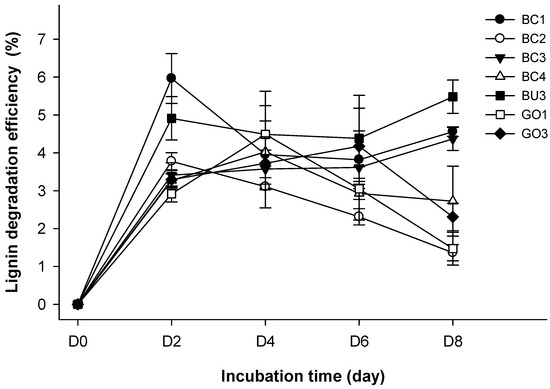
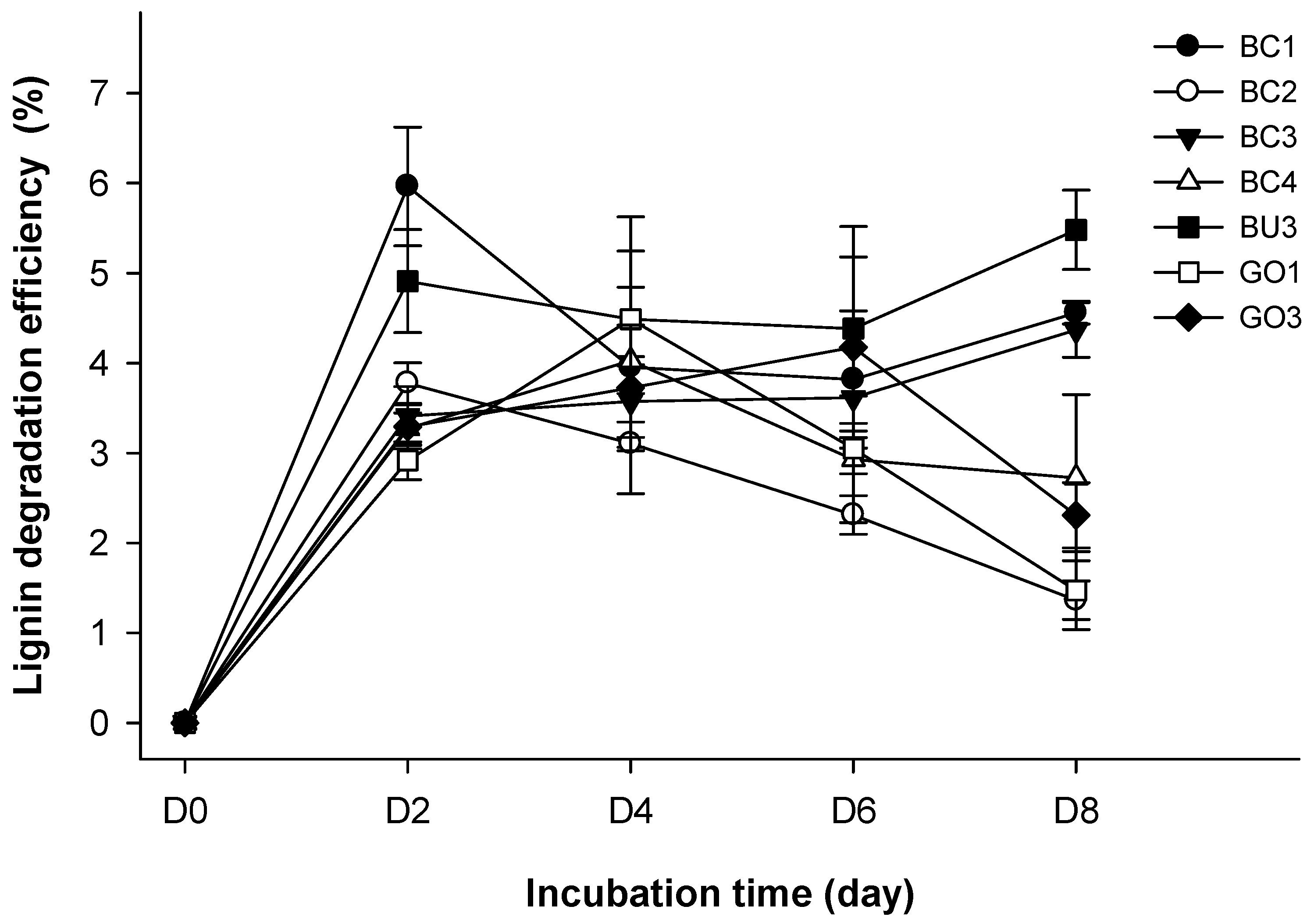
The lignin degradation efficiency of the twenty-eight LDB isolates was evaluated based on their ability to reduce sodium lignosulfonate during incubation. Among these, seven isolates (BC1, BC2, BC3, BC4, BU3, GO1, and GO3) exhibited measurable degradation (Figure 1). Degradation efficiency generally increased during the initial 2–4 days of incubation, followed by isolate-specific trends in the subsequent period. Isolates BC1 and BU3 showed rapid early lignin degradation, reaching peak values of 5.97% and 4.91%, respectively, within the first four days. In addition, BC3 and BU3 demonstrated a more sustained degradation pattern, achieving the highest lignin degradation efficiency by the end of the 8-day period (5.48% and 4.37% on day 8). Other isolates, including BC2, BC4, GO1, and GO3 displayed moderate increases in lignin degradation up to day 6, followed by a decline on day 8.
Figure 1.
Lignin degradation efficiency of LDB isolated from ruminant rectal feces. Error bars represent standard deviation. LDB, lignin-degrading bacteria; BC, isolates derived from beef cattle; BU, isolate derived from buffalo; GO, isolates derived from goats.
3.3. Laccase Activity
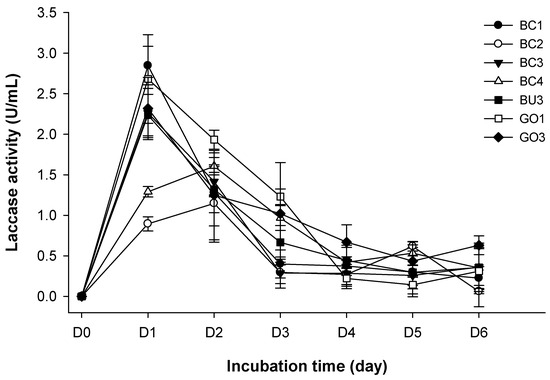
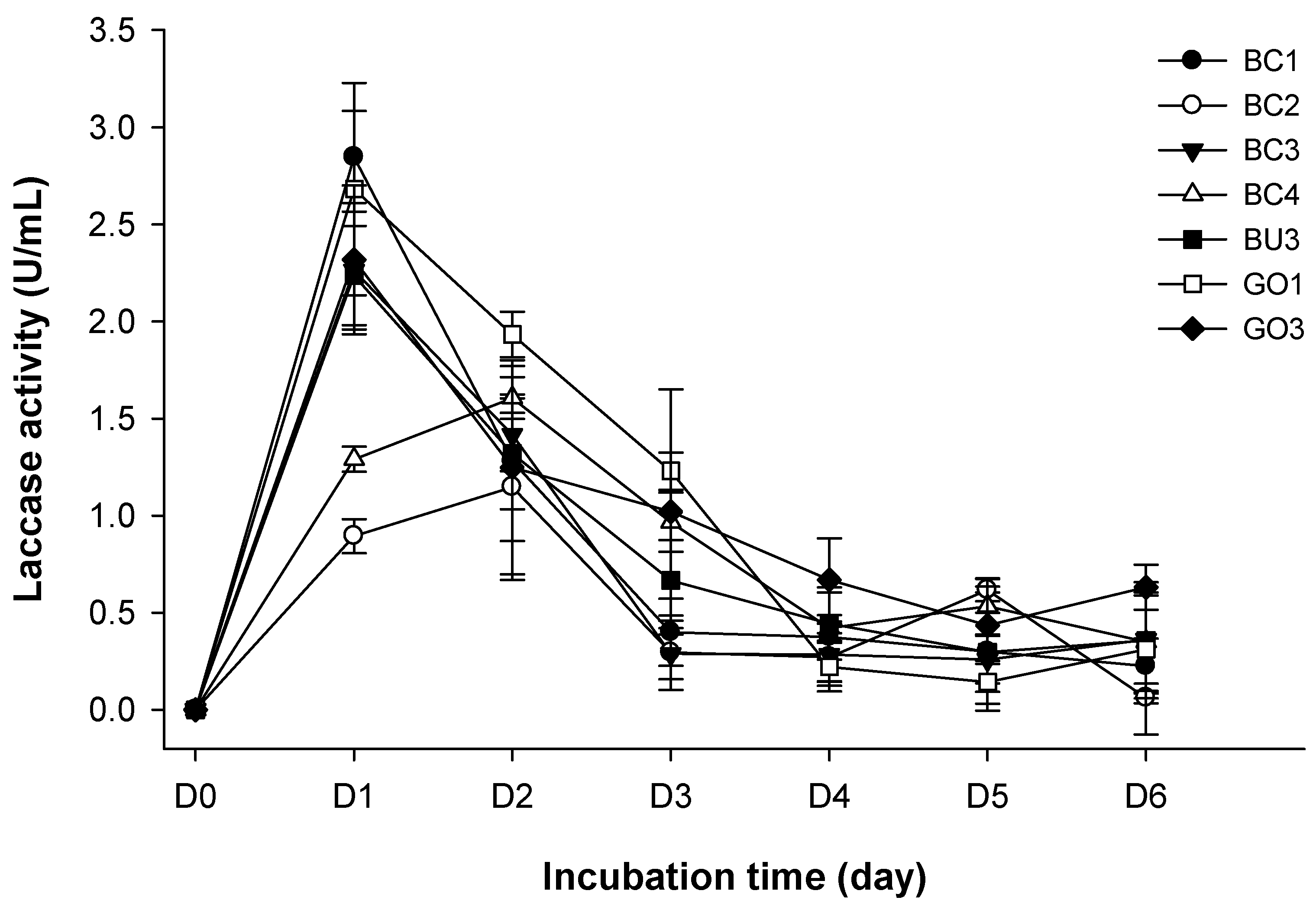
The laccase activity assay revealed that all bacterial isolates exhibited detectable activity after 1 day of incubation, with values ranging from 0.89 to 2.85 U/mL (Figure 2). Following this initial peak, laccase activity decreased substantially during days 2 and 3 of incubation across all isolates. Thereafter, the activity remained at low and relatively stable levels from day 3 to day 6, with values ranging from 0.06 to 0.63 U/mL.
Figure 2.
Laccase activity (U/mL) of LDB isolated from ruminant rectal feces. Error bars represent standard deviation. LDB, lignin-degrading bacteria; BC, isolates derived from beef cattle; BU, isolate derived from buffalo; GO, isolates derived from goats.
3.4. Phenotypic Characterization of LDB
Following the screening and selection of LDB based on lignin degradation efficiency and laccase activity, the phenotypic characteristics of the selected bacteria were determined and are summarized in Table 2. All isolates were rod-shaped, Gram-negative, and exhibited positive catalase activity. Growth assessment on MRS agar showed that all isolates were able to grow under both aerobic and anaerobic conditions, reflecting a facultative anaerobic growth pattern. Incubation in MRS broth led to a decrease in culture pH for all isolates, with final pH values ranging from 5.32 to 5.60. Among the isolates, BC4 exhibited the lowest final pH (5.32), while BC1 and BC2 showed the highest pH (5.60).
Table 2.
Phenotypic characteristics of LDB isolated from ruminant rectal feces.
3.5. In Vitro Rumen Fermentation Characteristics
Significant differences among treatments (p < 0.01) were observed across all in vitro rumen fermentation characteristics (Table 3). Isolates BC1, BC3, BC4, and GO1 yielded significantly higher (p < 0.05) IVDMD values than the control treatment. Among all isolates, BC3 exhibited the highest (p < 0.05) total GP compared with the control and other LDB treatments. Similarly, the concentrations of total VFAs and acetic acid were significantly greater (p < 0.05) in the BC3 treatment than in the control. Isolates BC3 and BC1 resulted in higher (p < 0.05) propionic acid concentrations relative to the control, while butyric acid levels were elevated (p < 0.05) in the BC3 and GO3 treatments. Furthermore, all isolates (except BU3) exhibited higher (p < 0.05) valeric acid concentrations compared to the control group.
Table 3.
In vitro rumen fermentation characteristics after 48 h of incubation with TMR supplemented with LDB isolated from ruminant rectal feces.
4. Discussion
Identifying lignin-depolymerizing microorganisms has gained significant attention in biomass utilization and animal nutrition [7,13]. In this study, LDB were isolated from rectal fecal samples of four ruminant species (Table 1). Our results demonstrate that ruminant feces represent an accessible and ecologically relevant source of bacteria with lignin-modifying potential. Similar observations have been reported in other lignin-rich environments, including buffalo rumen fluid, soil, rice straw, silage, the herbivore digestive tract, and elephant feces [7,14,25,26]. Regarding LDB diversity, the varying abundances of isolates across animal species reflects the heterogeneity of fecal microbial communities, which is likely shaped by dietary composition, feeding management, and host-specific gastrointestinal conditions. Wahyudi et al. [14] demonstrated that sample origin and environmental niche exert a stronger influence on ligninolytic bacterial diversity than culture conditions. Although this study primarily focused on evaluating the functional effects of these isolates on in vitro degradation, these preliminary findings underscore the importance of further investigating interspecies differences in the microbial diversity of lignin-degrading communities. Future research should employ high-throughput sequencing technologies, such as 16S rRNA gene sequencing and metagenomic analysis, to better characterize the taxonomic composition and the abundance of functional genes (e.g., laccase- and peroxidase-encoding genes) across host species. Such comparative studies could help clarify whether the higher recovery rates observed in buffaloes and goats are associated with specific evolutionary adaptations or with physiological factors, such as rumen retention time and forage preferences.
In this study, seven LDB isolates were selected based on their superior lignin degradation efficiency (Figure 1) for further evaluation of their laccase activity (Figure 2), phenotypic characteristics (Table 2), and in vitro rumen fermentation characteristics (Table 3). We observed that lignin degradation efficiency exhibited a marked increase across all isolates relative to the early incubation period, specifically between days 2 and 4 (Figure 1). This pattern is likely associated with the exponential growth phase, during which rapid cell proliferation and elevated metabolic activity occur. Under these conditions, microorganisms are known to actively secrete extracellular ligninolytic enzymes, including laccase, manganese peroxidase (MnP), and lignin peroxidase (LiP), which play central roles in the oxidative depolymerization of lignin [27,28]. The temporal variation in lignin degradation efficiency observed among isolates implies strain-specific differences in ligninolytic enzyme systems and regulatory mechanisms.
Gonzalo et al. [28] revealed that the two major classes of enzymes related to bacterial lignin modification are laccases and DyP-type peroxidases. Our results showed that all LDB isolates exhibited high laccase activity within the first 24 h of incubation, ranging from 0.89 to 2.85 U/mL, followed by a decline during days 2 and 3 (Figure 2). In general, this reduction likely reflects the metabolic transition from the exponential to the stationary phase, where nutrient limitation triggers a reallocation of cellular resources toward maintenance rather than enzyme biosynthesis. Furthermore, the energy-intensive nature of laccase production, coupled with the potential feedback inhibition from accumulated phenolic intermediates, may explain the low, stable activity (0.06–0.63 U/mL) observed from day 3 to day 6. These results suggest that while the isolates are capable of rapid ligninolytic induction, sustained high-level activity is limited by substrate availability and metabolic by-products. When averaged over the entire incubation period, laccase activity ranged from 0.55 to 1.06 U/mL, which is comparable to the laccase activity reported by Wang et al. [7] for isolates obtained from the rumen of buffaloes (0.46–0.79 U/mL). The decrease in laccase activity after the first day and its stabilization from day 3 to day 7 are consistent with the findings of Xu et al. [29], who reported laccase activity of approximately 0.1–0.2 U/mL in Klebsiella pneumoniae NX-1 isolated from leaf mold samples during a 7-day incubation. This pattern suggests that ligninolytic enzymes are produced throughout the microbial life cycle, occurring during both primary and secondary metabolic phases, with peak activity associated with early growth and substrate utilization.
Our results found that all seven selected LDB isolates were Gram-negative, rod-shaped, and facultative anaerobes (Table 2). Additionally, they exhibited positive catalase activity and the ability to grow under moderately acidic conditions (pH 5.32 to 5.60). The phenotypic characteristics of the isolates, particularly their facultative anaerobic nature, suggest high environmental adaptability. While the rumen is primarily anaerobic, the ability to tolerate low O2 levels might be beneficial during the initial colonization of ingested feed particles, where trace O2 may be present. Furthermore, their viability at pH 5.32 to 5.60 indicates a broad pH tolerance. This trait is crucial for ensuring functional resilience within the rumen environment, where pH typically ranges from 6.2 to 6.8 but can fluctuate depending on the fermentation rate of dietary components [30]. The positive catalase activity observed may further support their robustness against oxidative stress, a byproduct potentially encountered during the enzymatic breakdown of complex lignin structures, thereby maintaining their ligninolytic efficiency throughout the fermentation process.
In the present study, phylogenetic tree analysis based on 16S rRNA gene sequencing revealed that isolate BC3 belongs to the genus Escherichia, showing high similarity to Escherichia coli strains (Supplementary Figure S1). It is important to note that this molecular marker may not fully resolve the intra-species functional variations or strain-specific metabolic capabilities. Further whole-genome sequencing (WGS) or multi-locus sequence analysis (MLSA) would be required to definitively resolve its taxonomic position and the genetic basis of its lignolytic activity. Our molecular identification of BC3 as a member of the Enterobacteriaceae family is consistent with the findings of Dube et al. [31], who isolated twenty-six strains of LDB from soil, sawdust, and cattle manure. In their study, the most abundant isolates belonged to Pseudomonas spp. (88%), followed by Enterobacter spp. (8%) and Escherichia coli (4%), with Pseudomonas aeruginosa (CP031449.2) and Escherichia coli (LR025096.1) exhibiting the highest lignin degradation efficiency. Collectively, these results indicate that ligninolytic activity is not restricted to a single bacterial genus but is distributed among diverse facultative and aerobic bacterial groups. Consistent with these observations, previous studies have demonstrated that LDB can be isolated from various compartments of the gastrointestinal tract across different ruminant species. Wahyudi et al. [14] identified Enterococcus casseliflavus/gallinarum isolated from the cecum of buffalo as a ligninolytic bacterium, while Wang et al. [7] reported three species of LDB isolated from buffalo rumen fluid, namely Ochrobactrum pseudintermedium, Klebsiella pneumoniae, and Bacillus sonorensis. Together, these findings support the notion that the ruminant digestive system—including that of cattle, buffaloes, and goats—harbors a diverse microbial community with functional potential for lignin degradation. Although isolate BC3 exhibited close phylogenetic affiliation with Escherichia coli strains, it is important to recognize that Escherichia coli is a genetically diverse species comprising both pathogenic and non-pathogenic strains. Previous studies have reported that more than 90% of Escherichia coli strains naturally inhabit the gastrointestinal tract of humans and warm-blooded animals without causing disease and may play beneficial roles for the host, including the synthesis of vitamins K and B12 [32,33].
Our study demonstrated that supplementation with isolate BC3 resulted in consistently higher (p < 0.01) IVDMD, total GP, and total VFA concentrations compared with the other isolates (Table 3). These findings suggest that isolate BC3 plays a key role in enhancing ruminal fermentation efficiency. The improved IVDMD value observed in the BC3-supplemented group could be attributed to synergistic interactions with rumen microorganisms, particularly through the enhanced degradation of plant cell wall components. This activity likely increases microbial access to fermentable carbohydrates, thereby promoting substrate utilization and overall fermentation efficiency. This mechanism is further supported by the concomitant increase in total VFA production, which reflects an intensified microbial fermentation and improved conversion of digested substrates into fermentation end products. Moreover, GP serves as an indirect indicator of ruminal fermentation kinetics, reflecting the extent of microbial activity during substrate degradation. Fermentation gases are generated from the microbial metabolism of both endogenous and exogenous substrates within the rumen environment [34]. Because GP is strongly influenced by the availability of readily fermentable components, its levels provide insight into substrate accessibility and microbial efficiency. In the present study, the GP of TMR inoculated with BC3 was greater than those of the other treatments, indicating enhanced fermentation activity and improved utilization of soluble nutrients. These results are consistent with previous findings reporting that Lactobacillus plantarum F1 isolated from dairy cow feces increased the IVDMD of alfalfa silage by 7.7% compared with the control [35].
Overall, the distribution and metabolic activity of LDB within the ruminant gastrointestinal tract are profoundly influenced by physicochemical characteristics, including pH gradients, redox potential, and the availability of complex substrates [14,30]. In the present study, LDB were isolated from rectal feces—an environment characterized by concentrated lignocellulosic residues comprising undigested feed particles that escaped ruminal fermentation [7,14]. It is crucial to emphasize that while this study screened for lignin-degrading capacity, the functional impact within the rumen involves the synergistic degradation of the entire lignocellulosic complex. Lignin does not exist in isolation and is covalently cross-linked to hemicellulose, forming a recalcitrant barrier that encases cellulose fibers [30]. Notably, although direct lignin degradation by isolates such as BC3 appeared relatively low in pure culture, its impact on overall fermentation was disproportionately high. The lignin degradation process initiated by these isolates involves the secretion of extracellular enzymes that disrupt these complex aromatic polymers. This suggests that even a minor degree of delignification or structural modification of the lignin-carbohydrate complexes is sufficient to unlock the lignocellulosic matrix. This enzymatic unlocking is vital as it increases the surface area and accessibility of structural carbohydrates for primary cellulolytic and hemicellulolytic microbes. Consequently, the disruption of the lignin barrier—regardless of the absolute amount of lignin mineralized—directly enhances the digestive efficiency of the rumen microbiome, as evidenced by the observed increases in GP and VFA concentrations. This process ultimately facilitates the conversion of recalcitrant biomass into metabolizable energy sources (primarily VFAs) that are readily utilized by the host animal for physiological maintenance and production.
5. Conclusions
This study demonstrates that the ruminant gastrointestinal tract serves as a prolific source of functional LDB with high environmental adaptability. Our findings reveal that the inoculation of these LDB isolates, particularly BC3 (member of the genus Escherichia), effectively enhances the in vitro rumen fermentation of rice straw-based diets. The primary impact of LDB inoculation is the improvement in IVDMD, which facilitates the disruption of the recalcitrant lignin barrier and subsequently increases the digestibility of the lignocellulosic complex for microbial fermentation. This process was further evidenced by a significant increase in cumulative GP and total VFA concentrations. These results suggest that BC3 holds strong potential as a functional microbial inoculant that can improve the nutritional value and utilization of high-lignin agricultural by-products for ruminant production. Future research should prioritize in vivo trials to evaluate the safety and efficacy of these isolates as direct-fed microbials, specifically assessing their impact on animal performance and health.
Supplementary Materials
The following supporting information can be downloaded at: https://www.mdpi.com/article/10.3390/fermentation12040179/s1, Supplementary Table S1: Ingredients and chemical composition of TMR used as substrate in this study; Supplementary Table S2: Ingredients and chemical composition of TMR fed to the beef cattle donors; Supplementary Figure S1: Phylogenetic tree of isolate BC3 (QRY_CSF3-27F-1492R) based on 16S rRNA gene sequences together with reference strains from the NCBI GenBank database. Bootstrap values are shown at each node, and the scale bar represents 0.01 substitutions per nucleotide position (1% sequence divergence).
Author Contributions
Conceptualization, W.K. and C.K.; methodology, C.K.; software, W.K.; validation, C.K., W.K. and N.S.; formal analysis, C.K. and W.K.; investigation, W.K. and C.K.; resources, P.G. and C.S.; data curation, C.K. and W.K.; writing—original draft preparation, C.K. and W.K.; writing—review and editing, C.K., P.G., N.S., C.S. and W.K.; visualization, C.K.; supervision, W.K. and C.K.; project administration, W.K.; funding acquisition, W.K. All authors have read and agreed to the published version of the manuscript.
Funding
This research project is supported by Science Research and Innovation Fund (Agreement No. FF68/SKC/001). The APC was funded by Rajamangala University of Technology Isan.
Institutional Review Board Statement
The animal experimental protocols performed in this work were approved by the Institutional Animal Care and Use Committee of Rajamangala University of Technology Isan, based on the Ethics of Animal Experimentation of the National Research Council, Thailand (Project ID 04-68-010), approved on 27 May 2025.
Informed Consent Statement
Not applicable.
Data Availability Statement
The original contributions presented in this study are included in the article/Supplementary Material. Further inquiries can be directed to the corresponding author.
Acknowledgments
The authors thank Rajamangala University of Technology Isan and Khon Kaen University for providing the infrastructure and laboratory facilities. W.K. and C.K. would like to thank Yimin Cai from Zhengzhou University (ZZU) for his support with the experimental tools.
Conflicts of Interest
The authors declare no conflicts of interest. The funders had no role in the design of the study; in the collection, analyses, or interpretation of data; in the writing of the manuscript; or in the decision to publish the results.
References
- He, L.; Huang, Y.; Shi, L.; Zhou, Z. Steam explosion processing intensifies the nutritional values of most crop byproducts: Morphological structure, carbohydrate-protein fractions, and rumen fermentation profile. Front. Nutr. 2022, 9, 979609. [Google Scholar] [CrossRef] [Scilit] [PubMed]
- Kyawt, Y.Y.; Aung, M.; Xu, Y.; Zhou, Y.; Li, Y.; Sun, Z.; Zhu, W.; Cheng, Y. Methane production and lignocellulosic degradation of wastes from rice, corn and sugarcane by natural anaerobic fungi-methanogens co-culture. World J. Microbiol. Biotechnol. 2024, 40, 109. [Google Scholar] [CrossRef] [Scilit] [PubMed]
- Dona, N.L.K.; Smith, R.C. Tailoring polymer properties through lignin addition: A recent perspective on lignin-derived polymer modifications. Molecules 2025, 30, 2455. [Google Scholar] [CrossRef] [Scilit]
- Wu, W.; Li, P.; Huang, L.; Wei, Y.; Li, J.; Zhang, L.; Jin, Y. The role of lignin structure on cellulase adsorption and enzymatic hydrolysis. Biomass 2023, 3, 96–107. [Google Scholar] [CrossRef] [Scilit]
- Pérez, J.; Muñoz-Dorado, J.; De La Rubia, T.; Martínez, J. Biodegradation and biological treatments of cellulose, hemicellulose and lignin: An overview. Int. Microbiol. 2002, 5, 53–63. [Google Scholar] [CrossRef] [Scilit]
- Cerro, C.D.; Erickson, E.; Dong, T.; Wong, A.R.; Eder, E.K.; Purvine, S.O.; Mitchell, H.D.; Weitz, K.K.; Markillie, L.M.; Burnet, M.C.; et al. Intracellular pathways for lignin catabolism in white-rot fungi. Proc. Natl. Acad. Sci. USA 2021, 118, e2017381118. [Google Scholar] [CrossRef] [Scilit]
- Wang, Z.; Wu, W.; Cui, L.; Li, X.; Kulyar, M.F.A.; Xiong, H.; Zhou, N.; Yin, H.; Li, J.; Li, X. Isolation, characterization, and interaction of lignin-degrading bacteria from rumen of buffalo (Bubalus bubalis). J. Basic Microbiol. 2021, 61, 757–768. [Google Scholar] [CrossRef] [Scilit]
- Tian, J.-H.; Pourcher, A.-M.; Peu, P. Isolation of bacterial strains able to metabolize lignin and lignin related compounds. Appl. Microbiol. 2016, 63, 30–37. [Google Scholar] [CrossRef] [Scilit]
- Yang, C.-X.; Wang, T.; Gao, L.-N.; Yin, H.-J.; Lu, X. Isolation, identification and characterization of lignin-degrading bacteria from Qinling, China. J. Appl. Microbiol. 2017, 123, 1447–1460. [Google Scholar] [CrossRef] [Scilit]
- Zainith, S.; Purchase, D.; Dattatraya, G.; Luiz, S.; Ferreira, F.R.; Bilal, M.; Bharagava, R.N. Isolation and characterization of lignin-degrading bacterium Bacillus aryabhattai from pulp and paper mill wastewater and evaluation of its lignin-degrading potential. 3 Biotech 2019, 9, 92. [Google Scholar] [CrossRef] [Scilit] [PubMed]
- Mei, J.; Shen, X.; Gang, L.; Xu, H.; Wu, F.; Sheng, L. A novel lignin degradation bacteria-Bacillus amyloliquefaciens SL-7 used to degrade straw lignin efficiently. Bioresour. Technol. 2020, 310, 123445. [Google Scholar] [CrossRef] [Scilit]
- Riyadi, F.A.; Tahir, A.A.; Nurtasbiyah, Y. Enzymatic and genetic characterization of lignin depolymerization by Streptomyces sp. S6 isolated from a tropical environment. Sci. Rep. 2020, 10, 7813. [Google Scholar] [CrossRef] [Scilit]
- Zhong, H.; Zhou, J.; Wang, F.; Wu, W. Isolation and identification of ligninolytic bacterium (Bacillus cereus) from buffalo (Bubalus bubalis) rumen and its effects on the fermentation quality, nutrient composition, and bacterial community of rape silage. Front. Microbiol. 2023, 14, 1103652. [Google Scholar] [CrossRef] [Scilit] [PubMed]
- Wahyudi, A.; Cahyanto, M.N.; Soejono, M.; Bachruddin, Z. Potency of lignocellulose degrading bacteria isolated from buffalo and horse gastrointestinal tract and elephant dung for feed fiber degradation. J. Indones. Trop. Anim. Agric. 2010, 35, 34–41. [Google Scholar] [CrossRef] [Scilit]
- Paray, A.A.; Singh, M.; Mir, M.A.; Kaur, A. Gram staining: A brief review. Int. J. Res. Rev. 2023, 10, 336–341. [Google Scholar] [CrossRef] [Scilit]
- AL-Joda, B.M.S.; Jasim, A.H. Biochemical testing revision for identification several kinds of bacteria. J. Univ. Babylon 2021, 29, 168–176. [Google Scholar]
- Makkar, H.P.; Blümmel, M.; Becker, K. Formation of complexes between polyvinyl pyrrolidones or polyethylene glycols and tannins, and their implication in gas production and true digestibility in in vitro techniques. Br. J. Nutr. 1995, 73, 897–913. [Google Scholar] [CrossRef] [Scilit]
- Muizelaar, W.; Bani, P.; Kuhla, B.; Larsen, M.; Tapio, I.; Yáñez-Ruiz, D.; Van Gastelen, S. Rumen fluid sampling via oral stomach tubing method. In Methods in Cattle Physiology and Behaviour Research—Recommendations from the SmartCow Consortium; Mesgaran, S.D., Baumont, R., Munksgaard, L., Humphries, D., Kennedy, E., Dijkstra, J., Dewhurst, R., Ferguson, H., Terré, M., Kuhla, B., Eds.; PUBLISSO: Cologne, Germany, 2020; p. 6. [Google Scholar]
- Kaewpila, C.; Gunun, P.; Tongkasee, P.; Puangploy, P.; Khota, W. Ensiling characteristics and in vitro rumen fermentation of Sesbania grandiflora pods prepared with inhibitory and stimulatory additives. Sci. Rep. 2025, 15, 22758. [Google Scholar] [CrossRef] [Scilit]
- AOAC. Official Methods of Analysis, 15th ed.; Association of Official Analytical Chemists: Arlington, VA, USA, 1990. [Google Scholar]
- Van Soest, P.J.; Robertson, J.B.; Lewis, B.A. Methods for dietary fiber, neutral detergent fiber, and nonstarch polysaccharides in relation to animal nutrition. J. Dairy Sci. 1991, 74, 3583–3597. [Google Scholar] [CrossRef] [Scilit]
- Galyean, M.L. Laboratory Procedures in Animal Nutrition Research; Department of Animal and Food Sciences Texas Tech University: Lubbock, TX, USA, 1980; p. 177. [Google Scholar]
- Yu, Z.; Morrison, M. Improved extraction of PCR-quality community DNA from digesta and fecal samples. Biotechniques 2004, 36, 808–812. [Google Scholar] [CrossRef] [Scilit]
- Steel, R.G.D.; Torrie, J.H. Principles and Procedures of Statistics: A Biometrical Approach, 2nd ed.; McGraw–Hill Book Co. Inc.: New York, NY, USA, 1980. [Google Scholar]
- Huang, X.; Santhanam, N.; Badri, D.V.; Hunter, W.J.; Manter, D.K.; Decker, S.R.; Vivanco, J.M.; Reardon, K.F. Isolation and characterization of lignin-degrading bacteria from rainforest soils. Biotechnol. Bioeng. 2013, 110, 1616–1626. [Google Scholar] [CrossRef] [Scilit]
- Xiong, Y.I.; Zhao, Y.; Ni, K.; Shi, Y.U.E.; Xu, Q. Characterization of ligninolytic bacteria and analysis of alkali-lignin biodegradation products. Pol. J. Microbiol. 2020, 69, 339–347. [Google Scholar] [CrossRef] [Scilit]
- Zhong, H.; Zhou, J.; Abdelrahman, M.; Xu, H.; Wu, Z.; Cui, L. The effect of lignin composition on ruminal fiber fractions degradation from different roughage sources in water buffalo (Bubalus bubalis). Agriculture 2021, 11, 1015. [Google Scholar] [CrossRef] [Scilit]
- Gonzalo, G.D.; Colpa, D.I.; Habib, M.H.M.; Fraaije, M.W. Bacterial enzymes involved in lignin degradation. J. Biotechnol. 2016, 236, 110–119. [Google Scholar] [CrossRef] [Scilit] [PubMed]
- Xu, Z.; Qin, L.; Cai, M.; Hua, W.; Jin, M. Biodegradation of kraft lignin by newly isolated Klebsiella pneumoniae, Pseudomonas putida, and Ochrobactrum tritici strains. Environ. Sci. Pollut. Res. 2018, 25, 14171–14181. [Google Scholar] [CrossRef] [Scilit] [PubMed]
- Van Soest, P.J. Nutritional Ecology of the Ruminant, 2nd ed.; Cornell University Press: Ithaca, NY, USA, 1994. [Google Scholar]
- Dube, S.L.; Osunsanmi, F.O.; Ngcobo, B.P.; Mkhwanazi, L.B. Isolation and characterization of potential lignin peroxidase-producing bacteria from compost samples at Richards Bay (South Africa). Pol. J. Microbiol. 2023, 72, 117–124. [Google Scholar] [CrossRef] [Scilit] [PubMed]
- Stromberg, Z.R.; Van Goor, A.; Redweik, G.A.J.; Brand, M.J.W.; Wannemuehler, M.J.; Mellata, M. Pathogenic and non-pathogenic Escherichia coli colonization and host inflammatory response in a defined microbiota mouse model. Dis. Model. Mech. 2018, 11, dmm035063. [Google Scholar] [CrossRef] [Scilit]
- Ramos, S.; Silva, V.; Dapkevicius, M.d.L.E.; Caniça, M.; Tejedor-Junco, M.T.; Igrejas, G.; Patrícia, P. Escherichia coli as commensal and pathogenic bacteria among food-producing animals: Health implications of extended spectrum β-lactamase (ESBL) production. Animals 2020, 10, 2239. [Google Scholar] [CrossRef] [Scilit]
- Zheng, M.L.; Niu, D.Z.; Jiang, D.; Zuo, S.S.; Xu, C.C. Dynamics of microbial community during ensiling direct-cut alfalfa with and without LAB inoculant and sugar. J. Appl. Microbiol. 2017, 122, 1456–1470. [Google Scholar] [CrossRef] [Scilit]
- Guo, L.; Yao, D.; Li, D.; Lin, Y.; Bureenok, S.; Ni, K. Effects of lactic acid bacteria isolated from rumen fluid and feces of dairy cows on fermentation quality, microbial community, and in vitro digestibility of alfalfa silage. Front. Microbiol. 2020, 10, 2998. [Google Scholar] [CrossRef] [Scilit]

Disclaimer/Publisher’s Note: The statements, opinions and data contained in all publications are solely those of the individual author(s) and contributor(s) and not of MDPI and/or the editor(s). MDPI and/or the editor(s) disclaim responsibility for any injury to people or property resulting from any ideas, methods, instructions or products referred to in the content. |
© 2026 by the authors. Licensee MDPI, Basel, Switzerland. This article is an open access article distributed under the terms and conditions of the Creative Commons Attribution (CC BY) license.