


Gels, Volume 12, Issue 4 (April 2026) – 81 articles
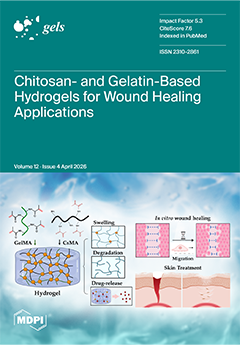
Cover Story (view full-size image):
This study presents novel photocrosslinked hydrogels based on methacrylated chitosan and methacrylated gelatin/allyl-modified gelatin and compares their properties as drug delivery systems in wound healing applications. Allylic gelatin-based hydrogels present larger pores and a stronger pH-responsive swelling behaviour, reflecting the higher flexibility of the 3D networks. The hydrogels release bacitracin during the first six hours, with a release profile that follows a non-Fickian diffusion mechanism. All formulated hydrogels exhibit antioxidant capacity and protein stabilization properties. The cytocompatibility, in vitro wound healing, and biological properties of the obtained hydrogels, as well as the drug release results, confirm their suitability in wound healing applications. View this paper
- Issues are regarded as officially published after their release is announced to the table of contents alert mailing list.
- You may sign up for e-mail alerts to receive table of contents of newly released issues.
- PDF is the official format for papers published in both, html and pdf forms. To view the papers in pdf format, click on the "PDF Full-text" link, and use the free Adobe Reader to open them.
Previous Issue
Next Issue
