Comparison of Oleogels Obtained by Emulsion Template Method Using Low Molecular Weight Hydroxypropyl Methylcellulose (HPMC) with Fish and Vegetable Oils

Abstract
1. Introduction
2. Results and Discussion
2.1. Rheology of Employed Vegetable and Fish Oils
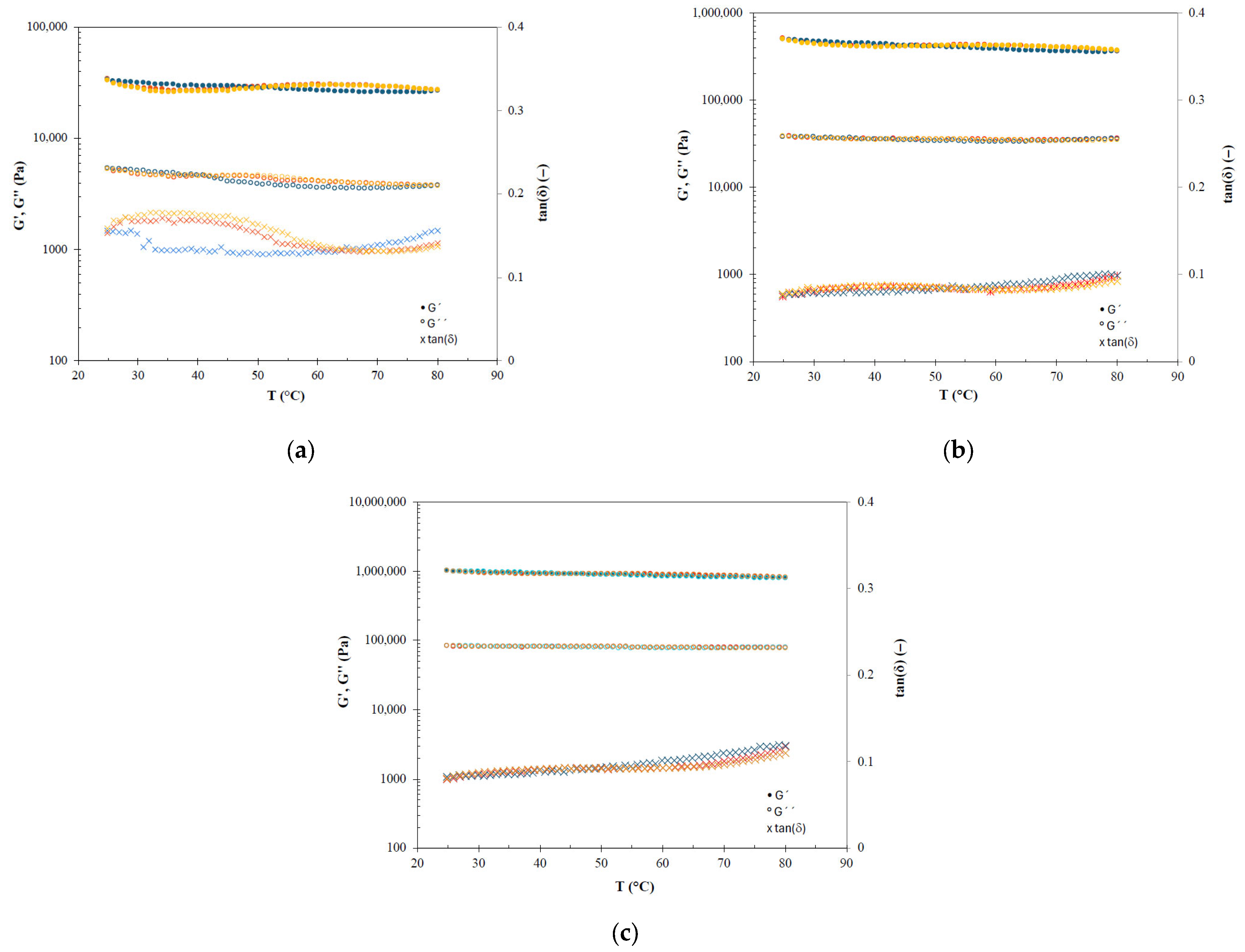
2.2. Rheology of Oleogels
2.3. Texture Properties of Oleogels
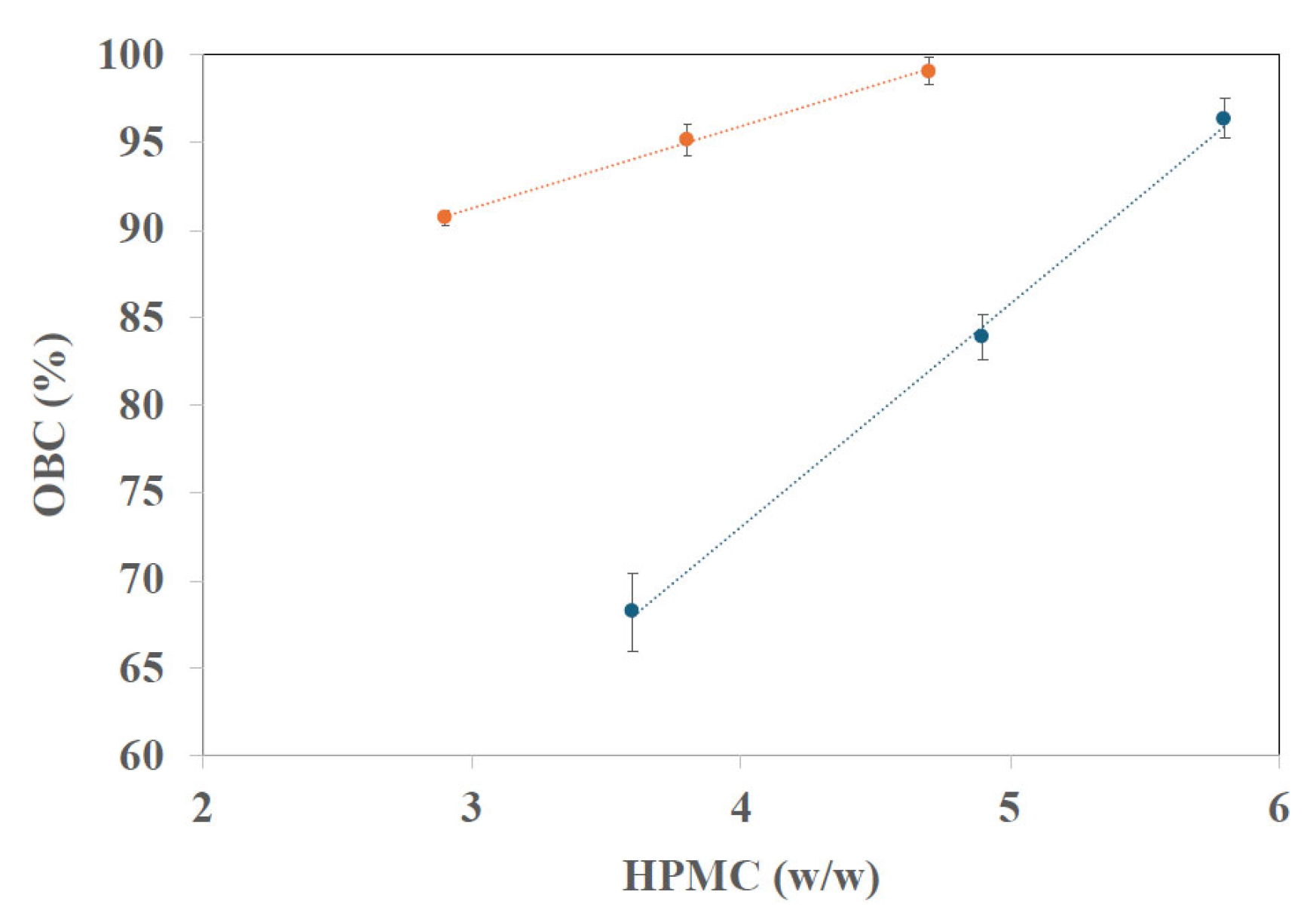
2.4. Oil Binding Capacity (OBC)
2.5. Colour Features of Oleogels
3. Conclusions
4. Materials and Methods
4.1. Materials
4.2. Preparation of Emulsions
4.3. Formation of Oleogel
4.4. Rheological Characterization
4.5. Texture Properties
4.6. Oil Binding Capacity
4.7. Colour Features
4.8. Statistical Analysis
Supplementary Materials
Author Contributions
Funding
Institutional Review Board Statement
Informed Consent Statement
Data Availability Statement
Conflicts of Interest
References
- World Health Organization. Trans Fat. Available online: https://www.who.int/news-room/fact-sheets/detail/trans-fat (accessed on 19 November 2025).
- World Heart Federation (WHF). World Heart Report 2023: Confronting the World’s Number One Killer; WHF: Geneva, Switzerland, 2023; pp. 1–52. [Google Scholar]
- Kirkhus, B.; Skuladottir, G.V.; Lampi, A.-M.; Nilsson, A. Nutritional aspects of fats and oils. In Advances in Oleogel Development, Characterization, and Nutritional Aspects; Palla, C., Valoppi, F., Eds.; Springer International Publishing: Cham, Switzerland, 2024; pp. 13–38. [Google Scholar]
- World Hearth Organization. WHO Awards Countries for Progress in Eliminating Industrially Produced Trans Fats for First Time. Available online: https://www.who.int/news/item/29-01-2024-who-awards-countries-for-progress-in-eliminating-industrially-produced-trans-fats-for-first-time (accessed on 21 November 2025).
- Vieira, S.A.; McClements, D.J.; Decker, E.A. Challenges of utilizing healthy fats in foods. Adv. Nutr. 2015, 6, 309S–317S. [Google Scholar] [CrossRef] [PubMed]
- Cerqueira, M.A.; Palla, C.; Valoppi, F. Tracing the evolution of oleogels: A historical overview. In Advances in Oleogel Development, Characterization, and Nutritional Aspects; Palla, C., Valoppi, F., Eds.; Springer International Publishing: Cham, Switzerland, 2024; pp. 1–12. [Google Scholar]
- Patel, A.R.; Dewettinck, K. Edible oil structuring: An overview and recent updates. Food Funct. 2016, 7, 20–29. [Google Scholar] [CrossRef] [PubMed]
- Pinto, T.C.; Sabet, S.; Kazerani García, A.; Kirjoranta, S.; Valoppi, F. Oleogel preparation methods and classification. In Advances in Oleogel Development, Characterization, and Nutritional Aspects; Palla, C., Valoppi, F., Eds.; Springer International Publishing: Cham, Switzerland, 2024; pp. 77–114. [Google Scholar]
- Patel, A.R.; Cludts, N.; Bin Sintang, M.D.; Lewille, B.; Lesaffer, A.; Dewettinck, K. Polysaccharide-based oleogels prepared with an emulsion-templated approach. ChemPhysChem 2014, 15, 3435–3439. [Google Scholar] [CrossRef] [PubMed]
- Hu, X.; Jiang, Q.; Du, L.; Meng, Z. Edible polysaccharide-based oleogels and novel emulsion gels as fat analogues: A review. Carbohydr. Polym. 2023, 322, 121328. [Google Scholar] [CrossRef]
- Pal, S.; Das, R.; Ghorai, S. Hydroxypropyl methyl cellulose grafted with poly(acrylamide) application as novel polymeric material as flocculant as well as adsorbent. In Cellulose-Based Graft Copolymers: Structure and Chemistry, 1st ed.; Thaku, V.K., Ed.; CRC Press: Boca Raton, FL, USA, 2015; pp. 301–334. [Google Scholar]
- Meng, Z.; Qi, K.; Guo, Y.; Wang, Y.; Liu, Y. Macro-micro structure characterization and molecular properties of emulsion-templated polysaccharide oleogels. Food Hydrocoll. 2018, 77, 17–29. [Google Scholar] [CrossRef]
- Oh, I.; Lee, J.; Lee, H.G.; Lee, S. Feasibility of hydroxypropyl methylcellulose oleogel as an animal fat replacer for meat patties. Food Res. Int. 2019, 122, 566–572. [Google Scholar] [CrossRef]
- Jasrotia, R.; Langer, S.; Dhar, M. Fish Waste and By-Product Utilization: A Circular economy. In Fish Waste to Valuable Products; Maqsood, S., Naseer, M.N., Benjakul, S., Zaidi, A.A., Eds.; Springer: Singapore, 2024; pp. 461–477. [Google Scholar]
- Kalkan, E.; Keskin Çavdar, H.; Maskan, M. Health impacts and innovative extraction methods of fish oil: A review. Eur. J. Lipid Sci. Technol. 2025, 127, e202400171. [Google Scholar] [CrossRef]
- Ramadhan, W.; Firdaos, A.N.; Krisnawan, W.V.; Suseno, S.H.; Riyanto, B.; Trilaksani, W.; Santoso, J. Synthesis of a sustainable marine oleogel and its application as a fat substitute in a sponge cake system. Sustain. Food Technol. 2024, 2, 1022–1032. [Google Scholar] [CrossRef]
- Truong, L.T.; Glomm, W.R.; Molesworth, P.P. Fish oil oleogels with wax and fatty acid gelators: Effects on microstructure, thermal behaviour, viscosity, and oxidative stability. Gels 2025, 11, 723. [Google Scholar] [CrossRef]
- Espert, M.; Salvador, A.; Sanz, T. Cellulose ether oleogels obtained by emulsion-templated approach without additional thickeners. Food Hydrocoll. 2020, 109, 106085. [Google Scholar] [CrossRef]
- Lama, M.; Franco-Uría, A.; Moreira, R. Characterization of rapeseed oil oleogels produced by the emulsion template method using hydroxypropyl methylcellulose and the drying kinetics of the emulsions. Foods 2025, 14, 2908. [Google Scholar] [CrossRef] [PubMed]
- Wang, Q.; Espert, M.; Larrea, V.; Quiles, A.; Salvador, A.; Sanz, T. Comparison of different indirect approaches to design edible oleogels based on cellulose ethers. Food Hydrocoll. 2023, 134, 108007. [Google Scholar] [CrossRef]
- Cheng, K.; Pan, Y.; Han, Z.; Wang, Z.; Sun, Q.; Wei, S.; Xia, Q.; Liu, Y.; Liu, S.; Shao, J.-H. A sight of self-assembly mechanism in fish oil oleogels: Phase transition, crystal structure and non-covalent interaction. Food Chem. 2024, 433, 137323. [Google Scholar] [CrossRef] [PubMed]
- Vithanage, C.R.; Grimson, M.J.; Smith, B.G. The effect of temperature on the rheology of butter, a spreadable blend and spreads. J. Texture Stud. 2009, 40, 346–369. [Google Scholar] [CrossRef]
- Montes, L.; Rosell, C.M.; Moreira, R. Rheological properties of corn starch gels with the addition of hydroxypropyl methylcellulose of different viscosities. Front. Nutr. 2022, 9, 866789. [Google Scholar] [CrossRef]
- Silva, S.M.C.; Pinto, F.V.; Antunes, F.E.; Miguel, M.G.; Sousa, J.J.S.; Pais, A.A.C.C. Aggregation and gelation in hydroxypropylmethyl cellulose aqueous solutions. J. Colloid Interface Sci. 2008, 327, 333–340. [Google Scholar] [CrossRef]
- Miao, W.; McClements, D.J.; Wang, J.; Zhang, Z.; Lin, Q.; Ji, H.; Jin, Z.; Qiu, C. Effects of different polysaccharides on the formation, stability, and rheological properties of oleogels structured by octenyl succinic anhydride starch. Food Chem. 2025, 473, 143076. [Google Scholar] [CrossRef]
- Bascuas, S.; Hernando, I.; Moraga, G.; Quiles, A. Structure and stability of edible oleogels prepared with different unsaturated oils and hydrocolloids. Int. J. Food Sci. Technol. 2020, 55, 1458–1467. [Google Scholar] [CrossRef]
- Hwang, H.-S.; Kim, S.; Winkler-Moser, J.K.; Lee, S.; Liu, S.X. Feasibility of hemp seed oil oleogels structured with natural wax as solid fat replacement in margarine. J. Am. Oil Chem. Soc. 2022, 99, 1055–1070. [Google Scholar] [CrossRef]
- Yang, X.; Saunders, A.; Mohan, M.S. Effect of temperature on the rheological, textural, and sensory properties of butters from New Zealand market. J. Texture Stud. 2024, 55, e12859. [Google Scholar] [CrossRef]
- Ziarno, M.; Derewiaka, D.; Florowska, A.; Szymańska, I. Comparison of the spreadability of butter and butter substitutes. Appl. Sci. 2023, 13, 2600. [Google Scholar] [CrossRef]
- Blount, R.J.S.; Ferdaus, M.J.; Silva, R.C.d. Influence of water content and emulsifiers on the stability and texture of oleogel-emulsions. Appl. Food Res. 2025, 5, 100796. [Google Scholar] [CrossRef]
- Sarraf, M.; Naji-Tabasi, S.; Beig-Babaei, A.; Moros, J.E.; Carrillo, M.C.S.; Tenorio-Alfonso, A. Developing edible oleogels structure prepared with emulsion-template approach based on soluble biopolymer complex. Food Chem. X 2024, 24, 101917. [Google Scholar] [CrossRef] [PubMed]
- Glibowski, P.; Zarzycki, P.; Krzepkowska, M. The rheological and instrumental textural properties of selected table fats. Int. J. Food Prop. 2008, 11, 678–686. [Google Scholar] [CrossRef]
- Armijo, C.; Montes, L.; Moreira, R.; Franco, D. Structuring olive oil with ethyl cellulose of different molecular weights: Influence of concentration, viscosity and mixtures. Future Foods 2025, 11, 100637. [Google Scholar] [CrossRef]
- Saavedra, M.Y.; Montes, L.; Franco, D.; Franco-Uría, A.; Moreira, R. Drying kinetics modeling of hot air drying of emulsion templated oleogels employing hydroxypropyl methylcellulose as structuring agent. Food Biosci. 2024, 59, 103912. [Google Scholar] [CrossRef]
- Li, S.; Li, P.; Chen, Y.; Zhao, Z.; Jiang, J.; Cheng, X.; Bi, L. Camellia saponin based oleogels by emulsion-templated method: Preparation, characterization, and in vitro digestion. ACS Food Sci. Technol. 2023, 3, 2085–2093. [Google Scholar] [CrossRef]
- Moradabbasi, M.; Goli, S.A.H.; Fayaz, G. Effect of biopolymers concentration and drying methods on physicochemical properties of emulsion-templated oleogel. J. Food Sci. Technol. 2022, 59, 1994–2003. [Google Scholar] [CrossRef]
- Xu, Z.; Lin, X.; Zhao, W.; Ding, X.; Sun, X.; Ding, Y.; Chen, H.; Cui, P. Phosphorylation-modified fava bean 11S protein fibril-based oleogels: A novel strategy to enhance network flexibility and alter rheological and textural properties. Food Hydrocoll. 2026, 175, 112477. [Google Scholar] [CrossRef]
- Lama, M.; Montes, L.; Franco, D.; Franco-Uría, A.; Moreira, R. Chitosan-based oleogels: Emulsion drying kinetics and physical, rheological, and textural characteristics of olive oil oleogels. Mar. Drugs 2024, 22, 318. [Google Scholar] [CrossRef]
- Dimakopoulou-Papazoglou, D.; Giannakaki, F.; Katsanidis, E. Structural and physical characteristics of mixed-component oleogels: Natural wax and monoglyceride interactions in different edible oils. Gels 2023, 9, 627. [Google Scholar] [CrossRef]
- Roufegarinejad, L.; Dehghani, S.; Bakhshi, S.; Toker, O.S.; Pirouzian, H.R.; Khiabani, A.H. Oleogelation of sunflower-linseed oils with carnauba wax as an innovative strategy for shortening substitution in cakes. Food Chem. 2024, 437, 137745. [Google Scholar] [CrossRef]
- Konica Minolta. Color Spaces. Available online: https://sensing.konicaminolta.us/us/learning-center/color-measurement/color-spaces/ (accessed on 5 December 2025).



| Oleogel | Hardness (N) | Adhesiveness (N·s) | Cohesiveness (−) | Elasticity (%) |
|---|---|---|---|---|
| S-2.9 | 4.42 ± 0.37 C | 0.86 ± 0.07 A | 0.28 ± 0.03 B | 63.18 ± 4.32 A |
| S-3.8 | 7.46 ± 0.57 B | 0.92 ± 0.06 A | 0.27 ± 0.01 B | 68.44 ± 4.23 A |
| S-4.7 | 9.56 ± 0.66 A | 0.45 ± 0.10 B | 0.40 ± 0.03 A | 58.91 ± 1.96 B |
| F-3.6 | 1.10 ± 0.26 c | 0.80 ± 0.14 a | 0.30 ± 0.06 a | 60.15 ± 6.58 b |
| F-4.9 | 4.76 ± 0.52 b | 0.24 ± 0.07 b | 0.36 ± 0.05 a | 72.83 ± 4.87 a |
| F-5.8 | 9.46 ± 0.56 a | 0.11 ± 0.07 b | 0.36 ± 0.05 a | 73.47 ± 6.91 a |
| Oleogel | L* (−) | C* (–) | h* (°) |
|---|---|---|---|
| S-2.9 | 43.31 ± 1.62 | 6.28 ± 0.48 | 103.05 ± 2.60 |
| S-3.8 | 41.52 ± 1.00 | 5.98 ± 0.10 | 102.11 ± 0.55 |
| S-4.7 | 42.96 ± 1.53 | 6.12 ± 0.47 | 101.73 ± 2.74 |
| F-3.6 | 27.79 ± 0.40 b | 20.20 ± 0.35 a | 74.06 ± 1.29 b |
| F-4.9 | 32.82 ± 0.68 a | 18.69 ± 0.43 b | 72.92 ± 0.43 b |
| F-5.8 | 32.47 ± 0.21 a | 18.79 ± 0.67 b | 76.73 ± 0.76 a |
Disclaimer/Publisher’s Note: The statements, opinions and data contained in all publications are solely those of the individual author(s) and contributor(s) and not of MDPI and/or the editor(s). MDPI and/or the editor(s) disclaim responsibility for any injury to people or property resulting from any ideas, methods, instructions or products referred to in the content. |
© 2026 by the authors. Licensee MDPI, Basel, Switzerland. This article is an open access article distributed under the terms and conditions of the Creative Commons Attribution (CC BY) license.
Share and Cite
Escobar, A.; Montes, L.; Franco-Uría, A.; Moreira, R. Comparison of Oleogels Obtained by Emulsion Template Method Using Low Molecular Weight Hydroxypropyl Methylcellulose (HPMC) with Fish and Vegetable Oils. Gels 2026, 12, 319. https://doi.org/10.3390/gels12040319
Escobar A, Montes L, Franco-Uría A, Moreira R. Comparison of Oleogels Obtained by Emulsion Template Method Using Low Molecular Weight Hydroxypropyl Methylcellulose (HPMC) with Fish and Vegetable Oils. Gels. 2026; 12(4):319. https://doi.org/10.3390/gels12040319
Chicago/Turabian StyleEscobar, Alonso, Leticia Montes, Amaya Franco-Uría, and Ramón Moreira. 2026. "Comparison of Oleogels Obtained by Emulsion Template Method Using Low Molecular Weight Hydroxypropyl Methylcellulose (HPMC) with Fish and Vegetable Oils" Gels 12, no. 4: 319. https://doi.org/10.3390/gels12040319
APA StyleEscobar, A., Montes, L., Franco-Uría, A., & Moreira, R. (2026). Comparison of Oleogels Obtained by Emulsion Template Method Using Low Molecular Weight Hydroxypropyl Methylcellulose (HPMC) with Fish and Vegetable Oils. Gels, 12(4), 319. https://doi.org/10.3390/gels12040319