


Abstract
Boletaceae, a family of profound ecological influence and economic value, has been the subject of prolific taxonomic research over the past decade, with new taxa continually being discovered. In this study, Similiboletinus tomentopileatus gen. et sp. nov., collected from a tropical region of China, is proposed based on integrative morphological and phylogenetic analyses. Phylogenetic analyses of a multigene dataset (LSU-rpb2-tef1-α-atp6) strongly support the position of Similiboletinus within the Suillelloideae. Morphologically, it is characterized by a tomentose and yellow–brown pileus, a subdecurrent hymenophore, unchanging context when injured, a boletoid hymenophoral trama, a cutis-type pileipellis, and broadly ellipsoid to ovoid basidiospores. The identification of Similiboletinus further underscores the striking and largely unexplored diversity of Boletaceae within tropical China.
1. Introduction
The family Boletaceae Chevall. (Boletales, Agaricomycetes) plays vital roles in diverse ecosystems, primarily owing to its ectomycorrhizal symbiotic abilities [1,2]. Additionally, it holds significant economic values in the market, largely due to the edible value of its members [3,4]. Morphologically, most fungi in Boletaceae are stipitate-pileate (i.e., boletoid or phylloporoid) and rarely gasteroid [5,6,7]. They are typically characterized by fleshy context and tubulose, lamellate or loculate hymenophore [8,9,10]. Recent phylogenetic studies have classified Boletaceae into eight subfamilies: Austroboletoideae G. Wu & Zhu L. Yang, Boletoideae Singer, Chalciporoideae G. Wu & Zhu L. Yang, Leccinoideae G. Wu & Zhu L. Yang, Phylloboletelloideae Dentinger et al., Suillelloideae Dentinger et al., Xerocomoideae Singer, and Zangioideae G. Wu et al. [8,11]. To date, approximately 110 genera and 1200 species have been reported in this family [11,12].
Among the various subfamilies of Boletaceae, the Suillelloideae has attracted particular attention due to its remarkable morphological diversity, including gasteroid, secotioid and stipitate-pileate forms. It was recently erected by Tremble et al. [13] and its phylogenetic position was further consolidated using whole-genome sequencing data [11]. Thus, the formal name Suillelloideae has replaced the provisional designation “Pulveroboletus Group”, which was proposed by Wu et al. [8] to accommodate several distinct genera. Currently, 27 genera are recognized under this subfamily, half of which (13 genera) have been erected by Chinese researchers, namely Acyanoboletus, Amoenoboletus, Baorangia, Crocinoboletus, Erythrophylloporus, Hemilanmao, Hongoboletu, Lanmaoa, Pseudobaorangia, Rubroboletus, Rubroleccinum, Rufoboletus, and Rugiboletus (Table 1).
Table 1.
Genera of the subfamily Suillelloideae supported by morphological and molecular phylogenetic analyses (as of December 2025).
In China, particularly in Yunnan Province, boletes are highly valued for their exceptional organoleptic qualities and medicinal properties, contributing substantially to local economies [12,15,32]. Moreover, the region’s microhabitats, shaped by variations in altitude and precipitation, along with the abundance of host plants (primarily Fagaceae and Pinaceae), have facilitated species diversification within Boletaceae [36,37,38]. Although numerous genera and species of Boletaceae have been documented in this region [4,12,15,39], this biodiversity hotspot continues to harbor novel genera and taxa awaiting discovery. Recent species surveys conducted in tropical areas of Yunnan have yielded several noteworthy specimens. Subsequent morphological and molecular phylogenetic analyses indicate that these specimens represent a novel genus and species, which could contribute significantly to understanding the diversity and evolution of Boletaceae in this biodiversity hotspot. A detailed description of this new taxon is provided herein.
2. Materials and Methods
2.1. Sampling and Morphological Studies
The collection information of voucher specimens and the sequences used for phylogenetic analyses are provided in Table 2. Color codes (hex triplets) from ColorHexa (https://www.colorhexa.com) were used to represent the color of basidiomata. Each code consists of characters ranging from “a” to “f” and “0” to “9”, with each pair corresponding to the red, green, and blue components of the color. The morphological classification framework for Boletaceae followed the criteria established by Vellinga et al. [40], Wu et al. [9], and Li and Yang [7]. All voucher specimens have been deposited in the Cryptogamic Herbarium (HKAS) of the Herbaria of Kunming Institute of Botany, Chinese Academy of Sciences (KUN).
Sections of dried basidiomata were rehydrated in 5-10% KOH solution and occasionally stained with 1% Congo red to improve visibility. The Melzer’s reagent was also used to test the amyloidity or dextrinoidity of the basidiospores. The notation “[n/m/p]” indicates that n basidiospores were measured from m basidiomata of p specimens. Measurements of basidiospores are presented as (a–)b–c(–d); the range b–c stands for a minimum of 90% of the measured values, while a and d (given in parentheses) represent the extreme values. The mean length and width of basidiospore (±standard deviation) are abbreviated as Lm and Wm, respectively. The symbol Q refers to the “length/width ratio” of a basidiospore in lateral view, with Qm representing the average Q of all basidiospores (± sample standard deviation). For scanning electron microscopy (SEM), tiny hymenophore fragments from dried specimens were mounted on aluminum stubs using double-sided adhesive tape, coated with gold-palladium, and then observed under a Hitachi S4800 (Hitachi high-tech corporation, Ibaraki, Japan) scanning electron microscope to examine the basidiospore ornamentation.
2.2. DNA Extraction, PCR Amplification, and DNA Sequencing
In this study, four nuclear loci were employed, comprising one non-protein-coding and three protein-coding genes. They are the large subunit ribosomal RNA gene (LSU), the RNA polymerase II second largest subunit (rpb2), the translation elongation factor 1-alpha gene (tef1-α), and the mitochondrial ATPase subunit 6 (atp6). Detailed primer information (LR0R/LR5, bRPB2-6F/bRPB2-7.1R, EF1-983F/EF1-1953R, and ATP6-3/ATP6-6R) followed the references cited in Wu et al. [8], Li et al. [41], and Jian et al. [42]. Furthermore, the internal transcribed spacer (ITS) region (ITS1-5.8S-ITS2) was sequenced with the primers ITS5/ITS4 for subsequent BLAST queries (https://blast.ncbi.nlm.nih.gov/) and phylogenetic placement.
DNA was extracted from collected samples and herbarium specimens using the cetyltrimethylammonium bromide (CTAB) method described by Doyle and Doyle [43]. Polymerase chain reaction (PCR) amplification was carried out following the procedure implemented by Wu et al. [8] and Li and Yang [7]. The PCR products were purified via gel extraction and subsequently sequenced on an ABI-3730-XL DNA analyzer (Applied Biosystems, Foster City, CA, USA) using the same primers as employed in amplification. When PCR products could not be sequenced directly, they were cloned into a PMD18-T vector (Takara, Shiga, Japan), then amplified, and sequenced using the standard primers M13F and M13R. All newly generated sequences are indicated in bold in Table 2 and deposited in the GenBank database.
Table 2.
Voucher specimens and GenBank accession numbers for sequences used in phylogenetic analyses. E or H in parentheses refers to the epitype or holotype specimen. Sequences newly generated in this study are shown in bold.
2.3. Phylogenetic Analyses
Firstly, sequence processing was performed using Sequencher v4.1.4 (Gene Code Corp., Ann Arbor, MI, USA) to assemble sequences, remove regions of ambiguous bases, and merge degenerate bases. Then, sequences were aligned with MAFFT v7.526 using the E-INS-i strategy [61] and manually verified in BioEdit v7.7.1 [62]. Each single-gene dataset was checked for topological incongruence; Maximum Likelihood (ML) analyses were conducted on every single-gene dataset. All single-gene alignments were then concatenated using Phyutility v2.2 [63], with any missing sequence data coded as gaps, to generate a final super-matrix of all four gene loci.
The best-fit nucleotide substitution model for each partition was selected under the Akaike Information Criterion (AIC) using MrModeltest v2.3 [64]. Specifically, the GTR+I+G was the best model for LSU, tef1-α and atp6, whereas SYM+I+G was selected as the best model for rpb2. Phylogenetic inferences were conducted using both ML and Bayesian Inference (BI) approaches. The ML analysis was performed in RAxML v7.2.6 [65] on the combined dataset under the GTRGAMMAI model, and nodal support was assessed with 1000 non-parametric bootstrap replicates. For the BI analysis, executed in MrBayes v3.2.6 [66], we implemented a partitioned mixed model, treating the LSU, rpb2, tef1-α, and atp6 sequences as independent partitions, each with its own model parameters. The Markov Chain Monte Carlo (MCMC) analysis was run for four million generations, sampling trees every 100 generations, with a stop rule value (STOPVAL) set at 0.01. Chain convergence was confirmed using Tracer v1.5 (http://tree.bio.ed.ac.uk/software/tracer/, accessed on 15 October 2025), ensuring all effective sample size (ESS) values exceeded 200. A 25% burn-in was applied before summarizing the posterior distribution of trees using the sump and sumt commands.
In light of the genetic relationships within Boletaceae, two closely related genera (Buchwaldoboletus Pilát and Chalciporus Bataille) were selected as outgroups. Specifically, the taxa were Buchwaldoboletus xylophilus (Petch) Both & B. Ortiz, Buchwaldoboletus lignicola (Kallenb.) Pilát, Chalciporus piperatus (Bull.) Bataille, and Chalciporus africanus Degreef & De Kesel.
3. Results
3.1. Phylogenetic Results
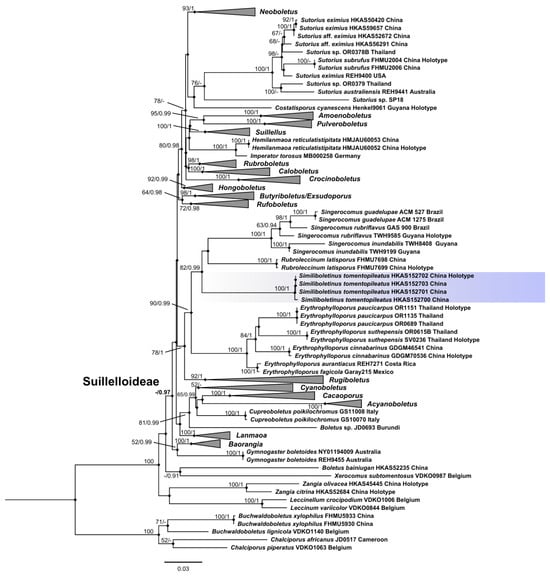
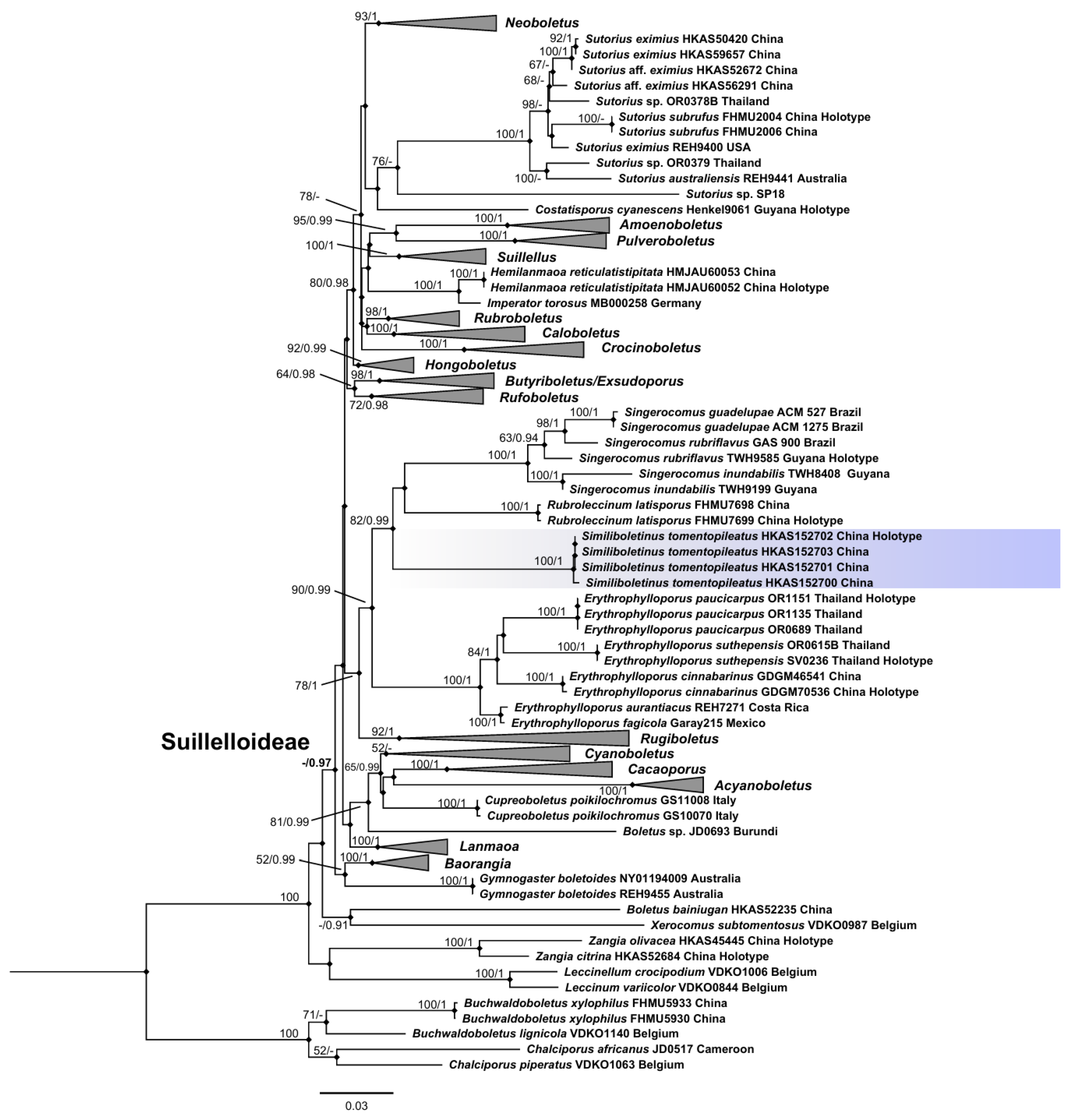
For the single-gene or multi-gene dataset, no topological inconsistency was detected between the ML and BI analyses. Thus, the phylogenetic tree inferred from the ML strategy is presented, with statistical results from both ML (Bootstrap Supports, BS) and BI (Posterior Probabilities, PP) displayed on the branches (see Figure 1). In the multi-gene matrix, we assembled a total of 182 collections: 133 for LSU, 170 for rpb2, 174 for tef1-α, and 56 for atp6. The final combined dataset included 3755 sites (including gaps): 1004 bp for LSU, 800 bp for rpb2, 1207 bp for tef1-α, and 744 bp for atp6.
Figure 1.
Phylogenetic relationships among representative genera in Boletaceae were inferred from a multigene dataset (LSU-rpb2-tef1-α-atp6) using both ML and BI methods (only shown the ML tree). Supported branches indicate bootstrap supports (BS > 50%) and posterior probabilities (PP > 0.90). Sequences from type specimens (holotype) are marked, while the new genus and new species are highlighted with a bluish background.
Phylogenetic analysis placed the monophyletic new genus within Suillelloideae (BS/PP = -/0.97) with strong statistical support (BS/PP = 100/1), confirming it as both a novel genus and a novel species. It was phylogenetically closer to three genera, viz., Rubroleccinum, Singerocomus, and Erythrophylloporus.
3.2. Morphological Observations and SEM
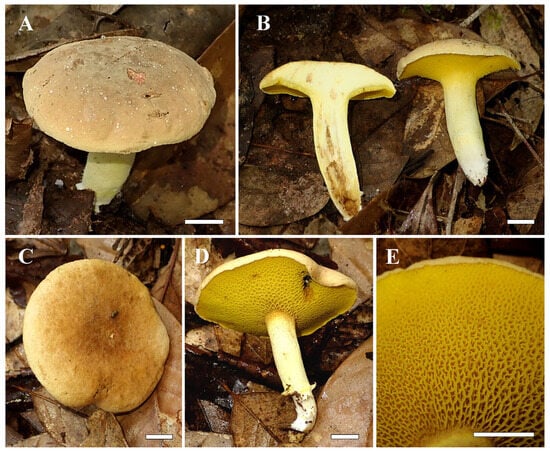
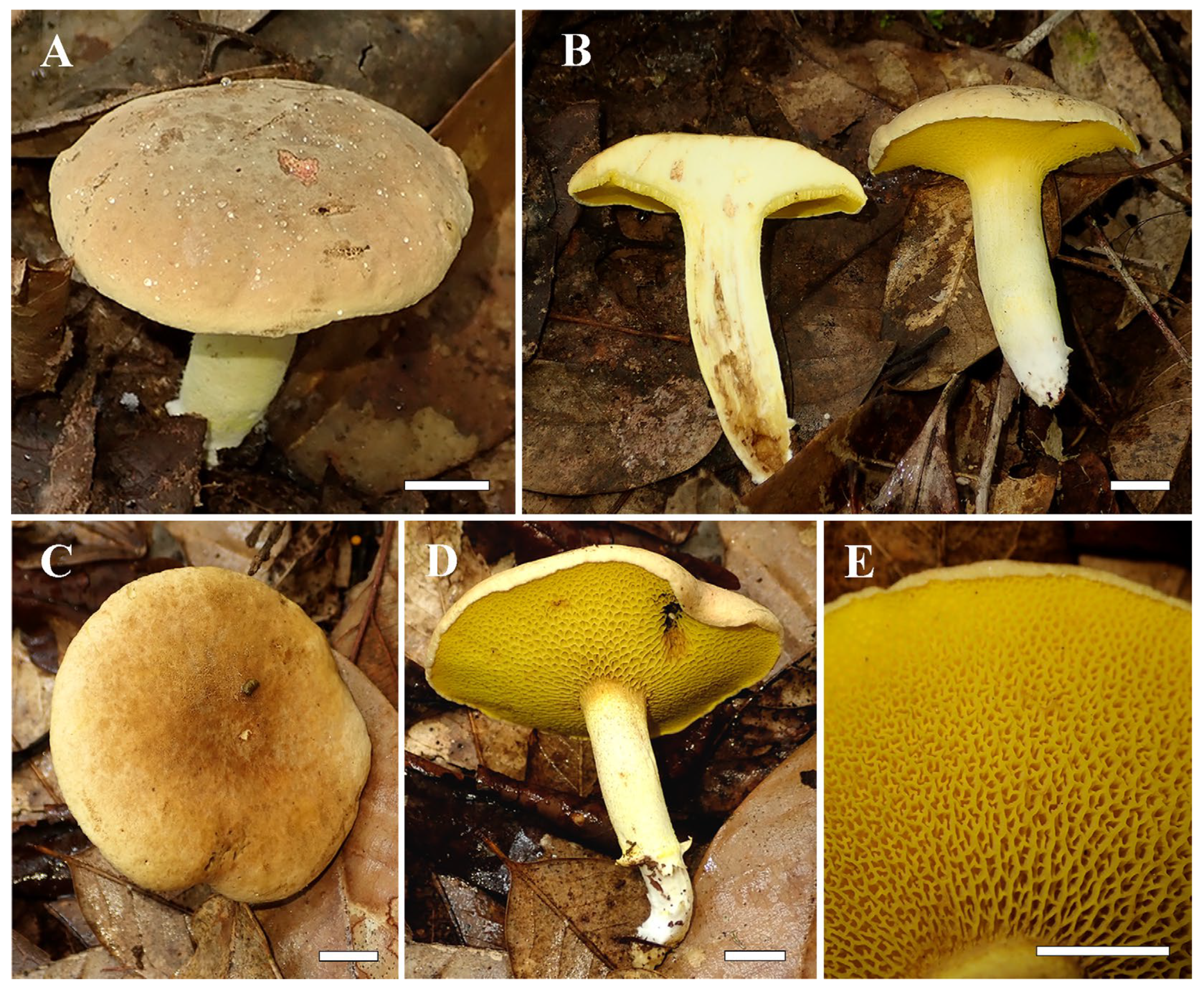
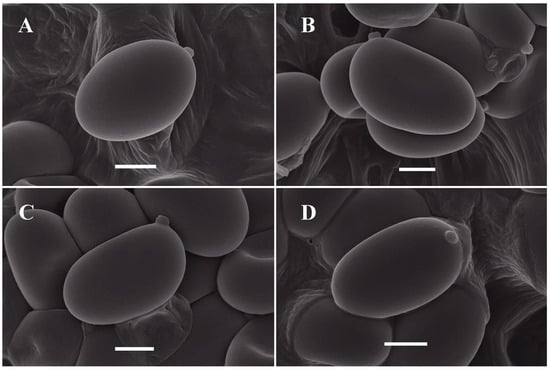
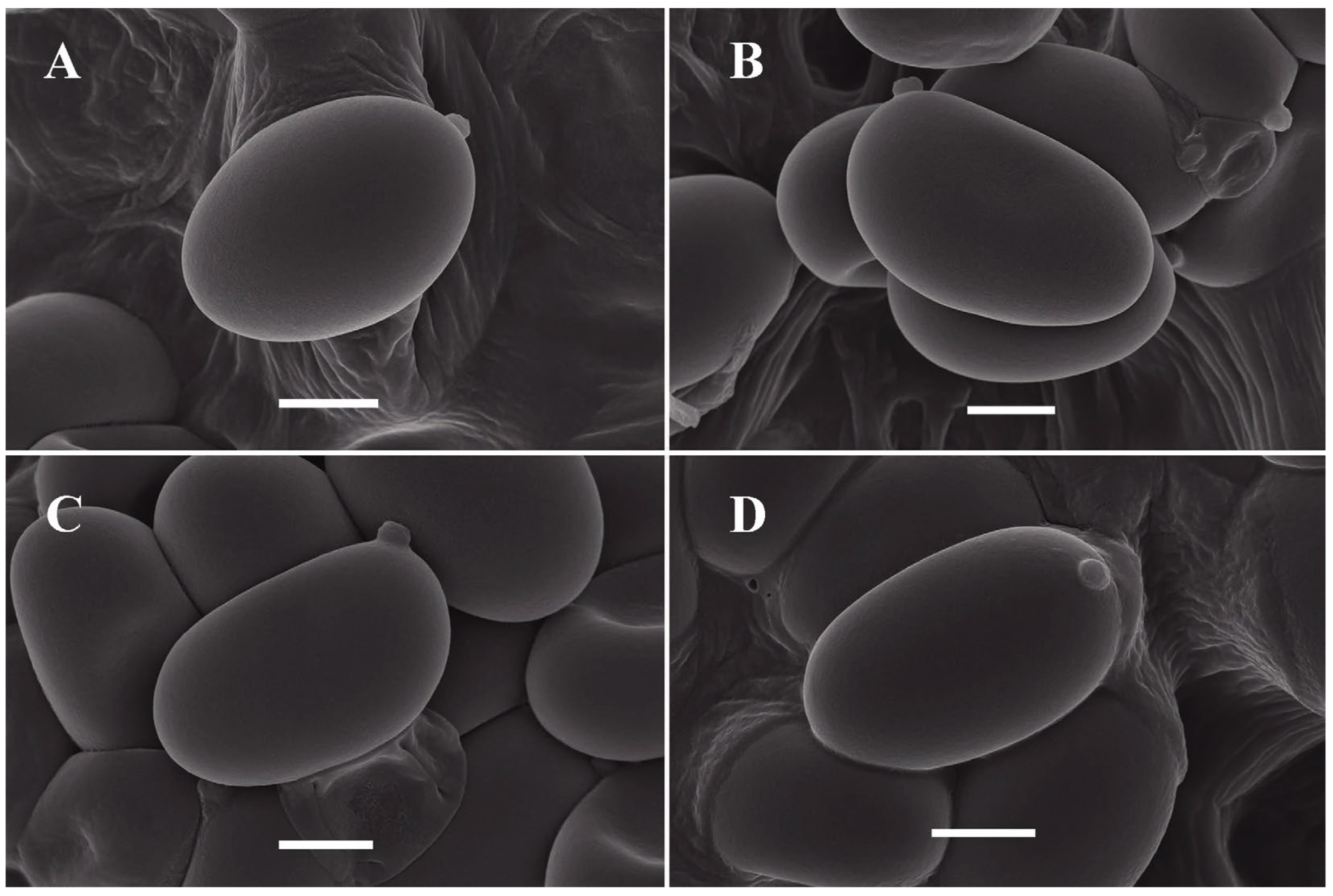
The images of fresh basidiomata, substrate and habitats of the collected specimens are shown in Figure 2. The scanning electron microscopy revealed that the basidiospore surface is smooth (Figure 3).
Figure 2.
Fresh basidiomata of Similiboletinus tomentopileatus. KUN-HKAS 152701: (A) basidiomata; (B) context; KUN-HKAS 152702 (holotype): (C) pileus; (D) hymenophore; (E) pores. Bars = 1 cm.
Figure 3.
(A–D) Different views of basidiospores of Similiboletinus tomentopileatus (KUN-HKAS 152703) captured by SEM. Bars = 2 μm.
3.3. Taxonomy
Similiboletinus S.P. Jian & Yan C. Li, gen. nov.
MycoBank MB861840
Type species: Similiboletinus tomentopileatus S.P. Jian & Yan C. Li
Diagnosis: Similiboletinus differs from other genera within Suillelloideae by the following characteristics: stipitate-pileate basidiomata, a tomentose and yellow–brown pileus, a slightly thick context, a poroid hymenophore with short tubes, a white stipe base, and unchanging in color of the context, hymenophore and stipe when injured. Additionally, it also features a boletoid hymenophoral trama, a cutis-type pileipellis, and broadly ellipsoid to ovoid, smooth basidiospores (Table 3).
Table 3.
Comparison of related genera to Similiboletinus in morphology and phylogeny.
Etymology: “Simili-” from latin similis, similar to, because its morphological similarity to Boletinus Kalchbr.
Description: Basidiomata stipitate-pileate with a poroid hymenophore. Pileus plano-convex, tomentose to subtomentose; context yellowish, unchanging in color when injured. Hymenophore yellow, subdecurrent to adnate, unchanging in color when injured, slightly radially arranged. Pores compound and angular. Stipe central, yellowish to cream, interspersed with granular or punctate squamules; context cream to yellowish, unchanging in color when injured; mycelium at the base of stipe white to whitish. Basidiospores broadly ellipsoid, ellipsoid to ovoid, smooth, thin-walled, and inamyloid. Pleurocystidia and cheilocystidia present, lanceolate, lageniform, or ventricose-mucronate. Pileipellis a cutis. Clamp connections absent.
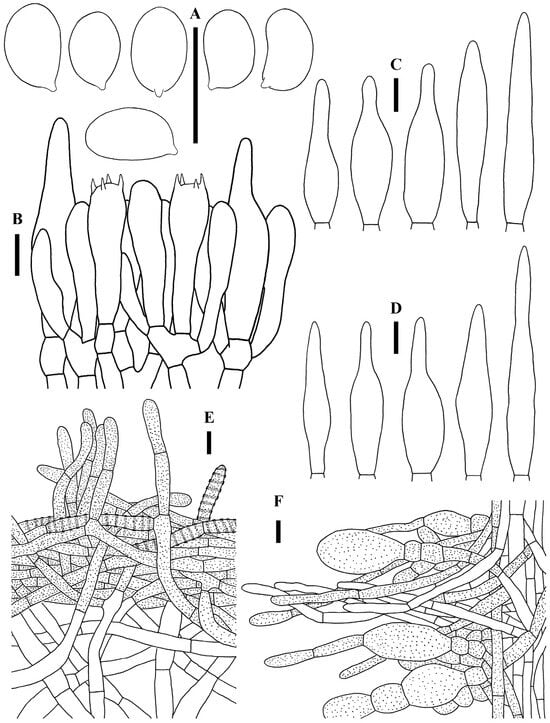
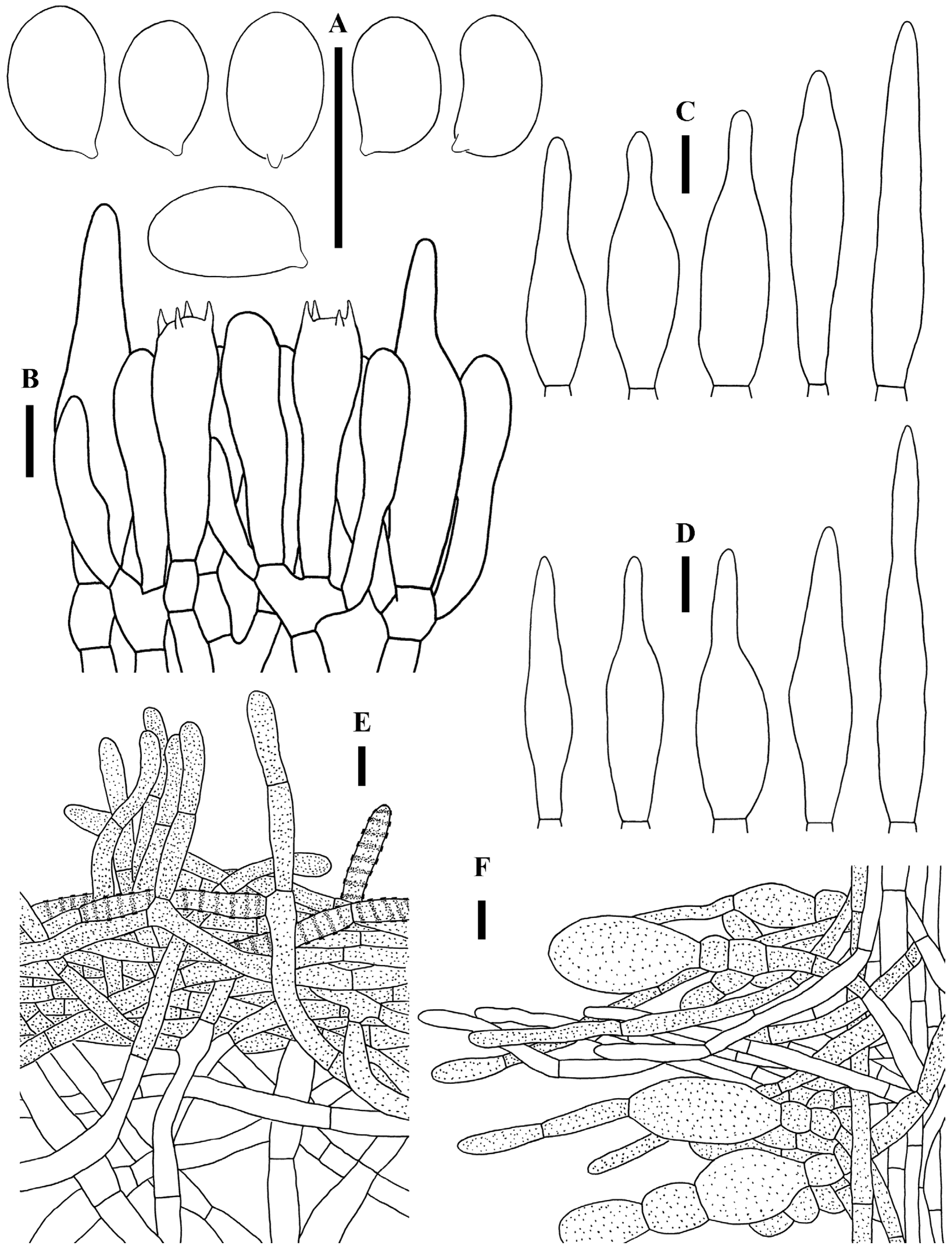
Figure 4.
Microscopic features of Similiboletinus tomentopileatus (KUN-HKAS 152702, holotype). (A) basidiospores; (B) hymenium and subhymenium; (C) cheilocystidia; (D) pleurocystidia; (E) pileipellis; (F) stipitipellis. Bars: 10 μm.
MycoBank MB861841
Holotype: China, Yunnan Province, Dai Autonomous Prefecture of Xishuangbanna, Mengla County, Yao District, Yao Ethnic Town, E 101.50, N 21.77, alt. 945 m, scattered on soil, in the tropical broadleaved forest (Lithocarpus and Castanopsis), 6 August 2025, collected by S.P. Jian, X.J. Xu, and F. Gao, JSP2025-240 (KUN-HKAS 152702). GenBank: ITS = PX843738; LSU = PX843741; rpb2 = PX854053; tef1-α = PX880580; atp6 = PX880584.
Etymology: “tomentopileatus” refers to the tomentose pileal surface.
Diagnosis: This new species is characterized by its yellow–brown and tomentose to subtomentose pileus, yellow subdecurrent hymenophore with compound angular pores and short tubes, and yellowish to cream stipe. It also features broadly ellipsoid to ovoid basidiospores, a boletoid hymenophoral trama, a cutis-type pileipellis with some erect hyphae, and unchanging in color in all parts when injured.
Description: Basidiomata small to medium-sized. Pileus 4.8–8.5 cm in diam., plano-convex to convex or hemispherical to subhemispherical; surface tomentose to subtomentose, hydrophobic, yellow–brown (#845432) to brown (#724311) near the center, yellowish (#efd598) to pale orange (#e5cd8b) towards the margin, sometimes uniformly yellowish (#dfc485) or brownish (#cda56d); margin incurved; context 0.7–1.2 cm thick at the center of the pileus, yellowish (#e8eeba), unchanging in color when injured. Hymenophore poroid, subdecurrent to adnate to the stipe, slightly radially arranged; tubes short, 0.2–2.0 cm in length, yellow (#d2c459), unchanging in color when injured; pores compound, angular, faveolate, yellow (#fde66f) to brilliant yellow (#c7a005), single pore around 0.5–0.8 mm, compound pore around 1–2 mm. Stipe 4.0–6.0 × 0.6–1.3 cm, central, solid but sometimes fragile, tapering downwards; surface yellowish (#e2e1a7), interspersed with dark yellow (#8c6d01) granular or punctate squamulose; context cream (#ecf1be) in the inner part, yellowish (#e7ecb5) towards the peripheral layers, unchanging in color when injured; basal mycelium white (#cbccb6) to whitish (#cacebb). Odor and taste indistinct or mild.
Basidiospores [88/4/4] 6.0–9.0 × 4.0–5.0 (5.5) μm, Lm × Wm = 7.20 (±0.60) × 4.50 (±0.23) μm, Q = 1.30–1.91 (Qm = 1.55 ± 0.11), yellowish in KOH, broadly ellipsoid, ellipsoid to ovoid in side and face view, occasionally phaseoliform or allantoid in side view, smooth, thin-walled, inamyloid. Basidia 28–38 × 8–12 µm, clavate, four-spored, rarely two-spored. Cheilocystidia 40–74 × 6–14 μm, abundant, thin-walled, lanceolate, lageniform or ventricose-mucronate. Pleurocystidia 47–75 × 9–14 μm, abundant, thin-walled, lanceolate, lageniform or ventricose-mucronate. Hymenophoral trama boletoid, consisting of a compact central strand of cylindrical to subcylindrical hyphae (4–22 μm wide) with sparse, gelatinous hyphae diverging from center towards the subhymenium. Pileipellis a cutis, around 45–104 μm thick, composed of filamentous, cylindrical hyphae, 4.5–10.5 μm wide, smooth or incrusted, containing yellowish to yellow pigments either intracellular or parietal. Pileal trama composed of interwoven or irregularly arranged, hyaline, cylindrical hyphae, 4.5–16.5 μm wide. Stipitipellis a cutis composed of yellowish hyphae, 3–13 μm wide; sometimes with hyaline or yellowish, filamentous erect hyphae, 5–13 μm wide; occasionally intermixed with yellowish, inflated, globular to clavate terminal cells measuring 16–43 × 11–26 μm. Stipe trama composed of regular, compact, thin-walled, parallel hyphae, 4–13 μm wide. Clamp connections absent.
Ecology and distribution: Solitary, scattered on soil under tropical fagaceous trees (mainly Lithocarpus and Castanopisis), distributed in Yunnan Province, China, June to August.
Additional specimens examined: China, Yunnan Province, Dai Autonomous Prefecture of Xishuangbanna, Mengla County, Yao District, Yao Ethnic Town, E 101.50, N 21.77, alt. 945 m, scattered on soil, in the tropical broadleaved forest (Lithocarpus and Castanopsis), 30 June 2025, collected by S.P. Jian, X.J. Xu, and Y.W. Fang, JSP2025-107 (KUN-HKAS 152700); ibid., alt. 945 m, scattered on soil, in the tropical broadleaved forest (Lithocarpus and Castanopsis), 6 August 2025, collected by S.P. Jian, X.J. Xu, and F. Gao, JSP2025-239 (KUN-HKAS 152701); ibid., alt. 943 m, scattered on soil, in the tropical broadleaf (Lithocarpus and Castanopsis) forest, 6 August 2025, collected by S.P. Jian, X.J. Xu, and F. Gao, JSP2025-241 (KUN-HKAS 152703).
Notes: In the phylogenetic tree, S. tomentopileatus belongs to Suillelloideae. However, this new taxon is morphologically more similar to Boletinus asiaticus Singer, Boletinellus merulioides (Schwein.) Murrill, Chalciporus radiatus Ming Zhang & T.H. Li, Hemileccinum parvum Mei-Xiang Li et al., Singerocomus inundabilis, Suillus americanus (Peck) Snell, and Xerocomus yunnanensis (W.F. Chiu) F.L. Tai. Boletinus asiaticus, first described from Siberia, form obligate ECM association with Larix spp. in boreal regions and is characterized by radially arranged and yellow hymenophore. It differs from S. tomentopileatus by its noteworthy purple–red pileus, the presence of a veil, annulus, and hollow stipe [67,68]. Another species similar to S. tomentopileatus is Boletinellus merulioides, which has a yellow–brown pileus and a deeply decurrent hymenophore and was originally reported from North America. It could be distinguished from S. tomentopileatus by its short and eccentric stipe, ovoid or subglobose basidiospores (7–10 × 6–7.5 μm) and gregarious growth on stumps and decaying roots [10,30]. Chalciporus radiatus, originally described from Hunan Province, China, is characterized by its brownish orange pileus and a radially arranged hymenophore with short tubes. However, it differs from S. tomentopileatus in its yellowish white context, turning pastel yellow to light yellow when injured, brown to reddish-brown hymenophore, and fusiform to cylindrical basidiospores (Qm = 2.12) [69].
Hemileccinum albidum has a brownish pileus and no color change in context when injured. However, it differs from S. tomentopileatus by its hymenophore depressed around the stipe, much longer stipe (5–16 cm), and larger basidiospores (11–12.5 × 4.5–5.5 μm) [70]. Singerocomus inundabilis was initially discovered in Brazil and placed in the genus Xerocomus Quél. as Xerocomus inundabilis Singer. Then, Henkel et al. [34] proposed a new genus, Singerocomus, to accommodate this species. It is characterized by a pinkish-red pileus and stipe, as well as an unchanging color of the hymenophore when injured. This species differs from S. tomentopileatus in its hymenophore depressed around the stipe, phylloporoid hymenophoral trama, and olivaceous-brown basidiospores. Suillus americanus could be confused with S. tomentopileatus due to its yellow pileus and adnate hymenophore. However, it can be distinguished by its viscid pileal surface, slow color change in hymenophore when injured, and relatively large basidiospores (8–11 × 3–4 μm) [10,71]. Lastly, Xerocomus yunnanensis, originally described from Yunnan Province, China, also resembles S. tomentopileatus in its yellowish brown and tomentose pileus and slightly decurrent hymenophore. Nonetheless, it differs significantly from S. tomentopileatus due to its very small-sized basidiomata (only 1.5–2 cm), larger basidiospores (9–12 × 4–5 μm), and trichoderm pileipellis [72,73].
4. Discussion
Bolete fungi of Yunnan Province, China—a globally recognized biodiversity hotspot [74]—are well known for their edible and medicinal value [9,75,76,77]. The determination of the new genus Similiboletinus in this region further underscores the remarkable diversity of the Boletaceae in Yunnan. In this study, phylogenetic analyses reveal that Similiboletinus is closely related to Erythrophylloporus, Rubroleccinum, Rugiboletus, and Singerocomus. Erythrophylloporus, established by Zhang and Li [23], is characterized by a yellowish-orange to red pileus and a lamellate hymenophore. Such traits clearly differentiate it from Similiboletinus. The recently described genus Rubroleccinum is characterized by a red-tinged pileus, a color-changing hymenophore upon injury, and a trichoderm pileipellis [32]. In contrast, Rugiboletus typically exhibits larger basidiomata (pileus size > 9 cm), long basidiospores (length > 10 μm), and trichoderm pileipellis (such as trichoderm, ixotrichoderm, and so on) [15,55,78]. Species of Singerocomus are mainly distributed in neotropical regions such as Brazil and Guyana [34,57,79] and are characterized by pinkish-red to red pileus and stipe, hymenophore depressed around the stipe, phylloporoid hymenophoral trama, and trichoderm pileipellis [34]. Despite the phylogenetic proximity, the aforementioned genera are clearly distinct from Similiboletinus in key morphological characteristics, contrasting with other genera (below) that exhibit greater morphological convergence.
Morphologically, the basidiomata of Similiboletinus may be confused with those of Acyanoboletus, Boletinus, Boletinellus Murrill, Hemileccinum, and Xerocomus. Acyanoboletus, recently proposed by Wu et al. [12], is distinguished by its strongly incurved pileal margin, strong unpleasant odor, and intricate trichoderm pileipellis, features absent in Similiboletinus. Boletinus was erected by Kalchbrenner [80] and characterized by Singer [5], who noted the presence of clamp connections. In morphology, Boletinus is strictly associated with conifer (especially larch trees) and shares with Similiboletinus a yellow hymenophore decurrent around the stipe. However, it differs from Similiboletinus by its membranous annulus and clamp connections [5]. Boletinellus could be confused with Similiboletinus due to its tomentose pileus and radially arranged hymenophore decurrent around the stipe. However, it could significantly differ from Similiboletinus by its brown pileus with fulvous or olivaceous tinge and clamp connections [10,81]. Hemileccinum was established by Šutara [82] based on morphological analysis and later confirmed phylogenetically by Nuhn et al. [83] and Wu et al. [8]. While Hemileccinum shares with Similiboletinus the absence of color change upon injury and yellow hymenophore, it differs in its adnate to sinuate hymenophore, long (length > 10 μm), cylindrical (Qm > 2), and irregularly warty basidiospores (observed under SEM), and trichoderm peileipellis. Finally, Xerocomus is a historically recognized genus [82], and its circumscription (i.e., Xerocomus sensu stricto) has been refined through phylogenetic studies [9,72,83]. Its adnate or sinuate hymenophore, color-changing context when injured, mostly bacillate basidiospores, and trichoderm peileipellis make it different from Similiboletinus.
5. Conclusions
In summary, the newly proposed genus Similiboletinus is clearly distinguished from other known genera in Boletaceae by a unique combination of morphological characters: a yellow–brown pileus, a subdecurrent yellow hymenophore with compound angular pores, a yellowish to cream stipe, broadly ellipsoid to ovoid basidiospores, a boletoid hymenophoral trama, a cutis-type pileipellis with some erect hyphae, and no color change in any part of the basidiomata when injured (see detail in Table 3). Although only one species of Similiboletinus has been identified in this study, more extensive fieldwork and integrative taxonomic research are likely to reveal more species diversity within this new genus. Furthermore, while nearly 400 bolete taxa have been recorded in China to date, it is anticipated that many more remain to be discovered in the future.
Author Contributions
Conceptualization, Y.L. and S.J.; methodology, S.J.; software, S.J. and T.Y.; validation, S.J.; formal analysis, Y.F.; investigation, J.L.; resources, F.G., Y.F., and X.X.; data curation, S.J.; writing—original draft preparation, S.J.; writing—review and editing, C.Z., and Y.L.; visualization, W.A.; supervision, C.Z.; project administration, C.Z.; funding acquisition, S.J., C.Z., and Y.L. All authors have read and agreed to the published version of the manuscript.
Funding
This research was funded by the Doctoral Launch Program in 2025, Yunnan Institute of Tropical Crops (No. ZY11), the Funds of Sci-Tech Innovation System Construction for Tropical Crops of Yunnan Province (No. 727-18), Xishuangbanna Prefecture Sci-Tech Innovation Program (No. 2025kjcx004), Yunnan Fundamental Research Projects (No. 202501BD070001-110) and the National Natural Science Foundation of China (No. 32270027).
Institutional Review Board Statement
Not applicable.
Informed Consent Statement
Not applicable.
Data Availability Statement
The sequence data generated in this study can be obtained from NCBI GenBank (http://www.ncbi.nlm.nih.gov/). The data included in this study are available by contacting the authors.
Acknowledgments
The authors are very grateful to Geng-Shen Wang (Southwest Forestry University) and Ya-Jun Hou for providing some constructive information and suggestions. The authors thank the herbaria KUN-HKAS for providing storage of materials. The authors thank Zhi-Jia Gu (Kunming Institute of Botany, Chinese Academy of Science) for supplying scanning electron microscope (SEM) assistance.
Conflicts of Interest
The authors declare no conflicts of interest.
References
- Tedersoo, L.; Bahram, M.; Zobel, M. How mycorrhizal associations drive plant population and community biology. Science 2020, 367, eaba1223. [Google Scholar] [CrossRef] [Scilit]
- Gao, Q.; Yang, Z.L. Ectomycorrhizal fungi associated with two species of Kobresia in an alpine meadow in the eastern Himalaya. Mycorrhiza 2010, 20, 281–287. [Google Scholar] [CrossRef] [Scilit]
- Dentinger, B.T.M.; Ammirati, J.F.; Both, E.E.; Desjardin, D.E.; Halling, R.E.; Henkel, T.W.; Moreau, P.-A.; Nagasawa, E.; Soytong, K.; Taylor, A.F.; et al. Molecular phylogenetics of porcini mushrooms (Boletus section Boletus). Mol. Phylogenet. Evol. 2010, 57, 1276–1292. [Google Scholar] [CrossRef] [Scilit] [PubMed]
- Cui, Y.-Y.; Feng, B.; Wu, G.; Xu, J.; Yang, Z.L. Porcini mushrooms (Boletus sect. Boletus) from China. Fungal Divers. 2015, 81, 189–212. [Google Scholar] [CrossRef] [Scilit]
- Singer, R. The Agaricales in Modern Taxonomy, 4th ed.; Koeltz Scientific Books: Koenigstein, Germany, 1986; p. 981. [Google Scholar]
- Wang, S.R.; Wang, Q.; Wang, D.L.; Li, Y. Gastroboletus thibetanus: A new species from China. Mycotaxon 2014, 129, 79–83. [Google Scholar] [CrossRef] [Scilit]
- Li, Y.C.; Yang, Z.L. The Boletes of China: Tylopilus s.l.; Springer Nature Pte Ltd.: Singapore, 2021; p. 418. [Google Scholar]
- Wu, G.; Feng, B.; Xu, J.P.; Zhu, X.T.; Li, Y.C.; Zeng, N.K.; Hosen, M.I.; Yang, Z.L. Molecular phylogenetic analyses redefine seven major clades and reveal 22 new generic clades in the fungal family Boletaceae. Fungal Divers. 2014, 69, 93–115. [Google Scholar] [CrossRef] [Scilit]
- Wu, G.; Li, Y.C.; Zhu, X.T.; Zhao, K.; Han, L.H.; Cui, Y.Y.; Li, F.; Xu, J.P.; Yang, Z.L. One hundred noteworthy boletes from China. Fungal Divers. 2016, 81, 25–188. [Google Scholar] [CrossRef] [Scilit]
- Smith, A.H.; Thiers, H.D. The Boletes of Michigan; The University of Michigan Press: Ann Arbor, MI, USA, 1971. [Google Scholar]
- Tremble, K.; Henkel, T.; Bradshaw, A.; Domnauer, C.; Brown, L.M.; Thám, L.X.; Furci, G.; Aime, M.C.; Moncalvo, J.-M.; Dentinger, B. A revised phylogeny of Boletaceae using whole genome sequences. Mycologia 2024, 116, 392–408. [Google Scholar] [CrossRef] [Scilit]
- Wu, G.; Li, H.J.; Horak, E.; Wu, K.; Li, G.M.; Yang, Z.L. New taxa of Boletaceae from China. Mycosphere 2023, 14, 745–746. [Google Scholar] [CrossRef] [Scilit]
- Tremble, K.; Halling, R.E.; Henkel, T.W.; Moncalvo, J.M.; Dentinger, B.T.M. Nomenclatural novelties. Index Fungorum. 2023, 555, 1. Available online: https://www.indexfungorum.org/Publications/Index%20Fungorum%20no.555.pdf (accessed on 10 September 2025).
- Wu, G.; Li, M.-X.; Horak, E.; Yang, Z.L. Phylogenetic analysis reveals the new genus Amoenoboletus from Asia and New Zealand. Mycologia 2021, 114, 144–156. [Google Scholar] [CrossRef] [Scilit] [PubMed]
- Wu, G.; Zhao, K.; Li, Y.-C.; Zeng, N.-K.; Feng, B.; Halling, R.E.; Yang, Z.L. Four new genera of the fungal family Boletaceae. Fungal Divers. 2016, 81, 1–24. [Google Scholar] [CrossRef] [Scilit]
- Arora, D.; Frank, J.L. Clarifying the butter Boletes: A new genus, Butyriboletus, is established to accommodate Boletus sect. Appendiculati, and six new species are described. Mycologia 2017, 106, 464–480. [Google Scholar] [CrossRef] [Scilit]
- Vadthanarat, S.; Lumyong, S.; Raspé, O. Cacaoporus, a new Boletaceae genus, with two new species from Thailand. MycoKeys 2019, 54, 1–29. [Google Scholar] [CrossRef] [Scilit] [PubMed]
- Vizzini, A. Nomenclatural novelties. Index Fungorum 2014, 146, 1–2. [Google Scholar]
- Smith, M.E.; Amses, K.R.; Elliott, T.F.; Obase, K.; Aime, M.C.; Henkel, T.W. New sequestrate fungi from Guyana: Jimtrappea guyanensis gen. sp. nov., Castellanea pakaraimophila gen. sp. nov., and Costatisporus cyanescens gen. sp. nov. (Boletaceae, Boletales). IMA Fungus 2015, 6, 297–317. [Google Scholar] [CrossRef] [Scilit]
- Zeng, N.-K.; Wu, G.; Li, Y.-C.; Liang, Z.-Q.; Yang, Z.-L. Crocinoboletus, a new genus of Boletaceae (Boletales) with unusual boletocrocin polyene pigments. Phytotaxa 2014, 175, 133–140. [Google Scholar] [CrossRef] [Scilit]
- Gelardi, M.; Simonini, G.; Ercole, E.; Davoli, P.; Vizzini, A. Cupreoboletus (Boletaceae, Boletineae), a new monotypic genus segregated from Boletus sect. Luridi to reassign the Mediterranean species B. poikilochromus. Mycologia 2015, 107, 1254–1269. [Google Scholar] [CrossRef] [Scilit]
- Gelardi, M.; Vizzini, A.; Simonini, G. Nomenclatural novelties. Index Fungorum 2014, 176, 1. [Google Scholar]
- Zhang, M.; Li, T.H. Erythrophylloporus (Boletaceae, Boletales), a new genus inferred from morphological and molecular data from subtropical and tropical China. Mycosystema 2018, 37, 1111–1126. [Google Scholar] [CrossRef]
- Vizzini, A. Nomenclatural novelties. Index Fungorum 2014, 183, 1. [Google Scholar]
- Cribb, J.W. The gasteromycetes of Queensland—II. Secotiaceae. Pap. Dep. Bot. Univ. Qld. 1956, 3, 107–111. [Google Scholar]
- Wang, Y.; Wang, L.Y.; Dai, D.; Qi, Z.X.; Zhang, Z.H.; Liu, Y.J.; Hu, J.J.; Zhang, P.; Li, Y.; Zhang, B. Boletaceae in China: Taxonomy and phylogeny reveal a new genus, two new species, and a new record. Front. Microbiol. 2023, 13, 1052948. [Google Scholar] [CrossRef] [Scilit]
- Assyov, B.; Bellanger, J.M.; Bertéa, P.; Courtecuisse, R.; Koller, G.; Loizides, M.; Marques, G.; Muñoz, J.A.; Oppicelli, N.; Puddu, D.; et al. Nomenclatural novelties. Index Fungorum 2015, 243, 1. [Google Scholar]
- Vizzini, A. Nomenclatural novelties. Index Fungorum 2014, 192, 1. [Google Scholar]
- Zhou, F.; Zhang, J.; Liu, S.; Liu, Q.; Luo, X.; Luo, X.; Wang, L.; Liu, C.; Guo, X.; Feng, Y.; et al. Pseudobaorangia (Boletaceae, Boletales), a new genus for Boletus lakhanpalii. MycoKeys 2025, 119, 281–294. [Google Scholar] [CrossRef] [Scilit] [PubMed]
- Murrill, W.A. The Boletaceae of North America—I. Mycologia 1909, 1, 4–18. [Google Scholar] [CrossRef] [Scilit]
- Zhao, K.; Wu, G.; Yang, Z.L. A new genus, Rubroboletus, to accommodate Boletus sinicus and its allies. Phytotaxa 2014, 188, 61–77. [Google Scholar] [CrossRef] [Scilit]
- Qin, H.-Z.; Wang, Y.; Lin, W.-F.; Zeng, H.; Hu, L.-G.; Ke, B.-R.; Zeng, Z.-H.; Liang, Z.-Q.; Zeng, N.-K. Pseudophylloporus gen. nov. and Rubroleccinum gen. nov., two new genera revealed by morphological and phylogenetic evidences in the family Boletaceae from subtropical China. J. Fungi 2024, 10, 817. [Google Scholar] [CrossRef] [Scilit]
- Liu, S.-L.; Wang, X.-W.; Li, G.-J.; Deng, C.-Y.; Rossi, W.; Leonardi, M.; Liimatainen, K.; Kekki, T.; Niskanen, T.; Smith, M.E.; et al. Fungal diversity notes 1717–1817: Taxonomic and phylogenetic contributions on genera and species of fungal taxa. Fungal Divers. 2024, 124, 1–216. [Google Scholar] [CrossRef] [Scilit]
- Henkel, T.W.; Obase, K.; Husbands, D.; Uehling, J.K.; Bonito, G.; Aime, M.C.; Smith, M.E. New Boletaceae taxa from Guyana: Binderoboletus segoi gen. and sp. nov., Guyanaporus albipodus gen. and sp. nov., Singerocomus rubriflavus gen. and sp. nov., and a new combination for Xerocomus inundabilis. Mycologia 2016, 108, 157–173. [Google Scholar] [CrossRef] [Scilit]
- Halling, R.E.; Nuhn, M.; Fechner, N.A.; Osmundson, T.W.; Soytong, K.; Arora, D.; Hibbett, D.S.; Binder, M. Sutorius: A new genus for Boletus eximius. Mycologia 2012, 104, 951–961. [Google Scholar] [CrossRef] [Scilit]
- Gong, S.; Feng, B.; Jian, S.P.; Wang, G.S.; Ge, Z.W.; Yang, Z.L. Elevation matters more than season in shaping the heterogeneity of soil and root associated ectomycorrhizal fungal community. Microbiol. Spectr. 2022, 10, e01950-21. [Google Scholar] [CrossRef] [Scilit] [PubMed]
- Brundrett, M.C.; Tedersoo, L. Evolutionary history of mycorrhizal symbioses and global host plant diversity. New Phytol. 2018, 220, 1108–1115. [Google Scholar] [CrossRef] [Scilit]
- Wu, G.; Miyauchi, S.; Morin, E.; Kuo, A.; Drula, E.; Varga, T.; Kohler, A.; Feng, B.; Cao, Y.; Lipzen, A.; et al. Evolutionary innovations through gain and loss of genes in the ectomycorrhizal Boletales. New Phytol. 2021, 233, 1383–1400. [Google Scholar] [CrossRef] [Scilit]
- Li, Y.C.; Feng, B.; Yang, Z.L. Zangia, a new genus of Boletaceae supported by molecular and morphological evidence. Fungal Divers. 2011, 49, 125–143. [Google Scholar] [CrossRef] [Scilit]
- Vellinga, E.C.; Kuyper, T.W.; Ammirati, J.; Desjardin, D.E.; Halling, R.E.; Justo, A.; Læssøe, T.; Lebel, T.; Lodge, J.; Matheny, P.B.; et al. Six simple guidelines for introducing new genera of fungi. IMA Fungus 2015, 6, 65–68. [Google Scholar] [CrossRef] [Scilit]
- Li, Y.C.; Yang, Z.L.; Tolgor, B. Phylogenetic and biogeographic relationships of Chroogomphus species as inferred from molecular and morphological data. Fungal Divers. 2009, 38, 85–104. [Google Scholar]
- Jian, S.P.; Bau, T.; Zhu, X.T.; Deng, W.Q.; Zhao, Z.W.; Yang, Z.L. Clitopilus, Clitocella and Clitopilopsis in China. Mycologia 2020, 112, 371–399. [Google Scholar] [CrossRef] [Scilit]
- Doyle, J.J.; Doyle, J.L. A rapid DNA isolation procedure for small quantities of fresh leaf tissue. Phytochem. Bull. 1987, 19, 11–15. [Google Scholar]
- Phookamsak, R.; Hyde, K.D.; Jeewon, R.; Bhat, D.J.; Jones, E.B.G.; Maharachchikumbura, S.S.N.; Raspé, O.; Karunarathna, S.C.; Wanasinghe, D.N.; Hongsanan, S.; et al. Fungal diversity notes 929–1035: Taxonomic and phylogenetic contributions on genera and species of fungi. Fungal Divers. 2019, 95, 1–273. [Google Scholar] [CrossRef] [Scilit]
- Xie, H.J.; Zhang, C.X.; He, M.X.; Liang, Z.Q.; Deng, X.H.; Zeng, N.K. Buchwaldoboletus xylophilus and Phlebopus portentosus, two non-ectomycorrhizal boletes from tropical China. Phytotaxa 2021, 520, 137–154. [Google Scholar] [CrossRef] [Scilit]
- Vadthanarat, S.; Raspé, O.; Lumyong, S. Phylogenetic affinities of the sequestrate genus Rhodactina (Boletaceae), with a new species, R. rostratispora from Thailand. MycoKeys 2018, 29, 63–80. [Google Scholar] [CrossRef] [Scilit]
- Raspé, O.; Vadthanarat, S.; De Kesel, A.; Degreef, J.; Hyde, K.D.; Lumyong, S. Pulveroboletus fragrans, a new Boletaceae species from Northern Thailand, with a remarkable aromatic odor. Mycol. Prog. 2016, 15, 38. [Google Scholar] [CrossRef] [Scilit]
- Zhao, K.; Wu, G.; Feng, B.; Yang, Z.L. Molecular phylogeny of Caloboletus (Boletaceae) and a new species in East Asia. Mycol. Prog. 2014, 13, 1127–1136. [Google Scholar] [CrossRef] [Scilit]
- Farid, A.; Bessette, A.E.; Bessette, A.R.; Bolin, J.A.; Kudzma, L.V.; Franck, A.R.; Garey, J.R. Investigations in the boletes (Boletaceae) of southeastern USA: Four novel species and three novel combinations. Mycosphere 2021, 12, 1038–1076. [Google Scholar] [CrossRef] [Scilit]
- Vadthanarat, S.; Amalfi, M.; Halling, R.E.; Bandala, V.; Lumyong, S.; Raspé, O. Two new Erythrophylloporus species (Boletaceae) from Thailand, with two new combinations of American species. MycoKeys 2019, 55, 29–57. [Google Scholar] [CrossRef] [Scilit]
- Biketova, A.Y.; Gelardi, M.; Smith, M.E.; Simonini, G.; Healy, R.A.; Taneyama, Y.; Vasquez, G.; Kovács, Á.; Nagy, L.G.; Wasser, S.P.; et al. Reappraisal of the genus Exsudoporus (boletaceae) worldwide based on multi-gene phylogeny, morphology and biogeography, and insights on Amoenoboletus. J. Fungi 2022, 8, 101. [Google Scholar] [CrossRef] [Scilit]
- Wu, K.; Wu, G.; Yang, Z.L. A taxonomic revision of Leccinum rubrum in subalpine coniferous forests, southwestern China. Acta Edulis Fungi 2020, 27, 92–100. [Google Scholar]
- Zeng, N.-K.; Liang, Z.-Q.; Wu, G.; Li, Y.-C.; Yang, Z.L.; Liang, Z.-Q. The genus Retiboletus in China. Mycologia 2017, 108, 363–380. [Google Scholar] [CrossRef] [Scilit]
- Liang, Z.-Q.; An, D.-Y.; Jiang, S.; Su, M.-S.; Zeng, N.-K. Butyriboletus hainanensis (Boletaceae, Boletales), a new species from tropical China. Phytotaxa 2016, 267, 256–262. [Google Scholar] [CrossRef] [Scilit]
- Wang, Y.; Ma, Y.H.; Wu, G.; Yang, X.Y.; Liu, Y.J.; Rao, G.; Dai, D.; Gui, X.Y.; Tuo, Y.L.; Wang, L.Y.; et al. Polyphasic taxonomy clarifies the relationships between Butyriboletus and Exsudoporus, and new taxa and reports of Boletaceae from China. Mycosphere 2024, 15, 881–953. [Google Scholar] [CrossRef] [Scilit]
- Das, K.; Datta, S.; Vizzini, A. Multigene genealogy and morphology unveil one new genus, one new species and one new combination of boletoid mushrooms (Boletaceae) from Indian Himalaya. Taiwania 2025, 70, 147‒155. [Google Scholar] [CrossRef]
- Magnago, A.C.; Henkel, T.; Neves, M.A.; Silveira, R.M.B.d. Singerocomus atlanticus sp. nov., and a first record of Singerocomus rubriflavus (Boletaceae, Boletales) for Brazil. Acta Bot. Bras. 2018, 32, 222–231. [Google Scholar] [CrossRef] [Scilit]
- Magnago, A.C.; Alves-Silva, G.; Henkel, T.W.; da Silveira, R.M.B. New genera, species, and combinations of Boletaceae from Brazil and Guyana. Mycologia 2022, 114, 607–625. [Google Scholar] [CrossRef] [Scilit]
- Wang, Y.; Tuo, Y.-L.; Wu, D.-M.; Gao, N.; Zhang, Z.-H.; Rao, G.; Wang, X.-M.; Wang, J.; Dai, D.; Li, Y.; et al. Exploring the relationships between four new species of boletoid fungi from northern China and their related species. J. Fungi 2022, 8, 218. [Google Scholar] [CrossRef] [Scilit] [PubMed]
- Chai, H.; Liang, Z.Q.; Xue, R.; Jiang, S.; Luo, S.H.; Wang, Y.; Wu, L.L.; Tang, L.P.; Chen, Y.; Hong, D.; et al. New and noteworthy boletes from subtropical and tropical China. MycoKeys 2019, 46, 55–96. [Google Scholar] [CrossRef] [Scilit]
- Katoh, K.; Kuma, K.; Toh, H.; Miyata, T. MAFFT version 5: Improvement in accuracy of multiple sequence alignment. Nucleic Acids Res. 2005, 33, 511–518. [Google Scholar] [CrossRef] [Scilit]
- Hall, T.A. BioEdit: A user-friendly biological sequence alignment editor and analysis program for Windows 95/98/NT. Nucleic Acids Symp. Ser. 1999, 41, 95–98. [Google Scholar]
- Smith, S.A.; Dunn, C.W. Phyutility: A phyloinformatics tool for trees, alignments and molecular data. Bioinformatics 2008, 24, 715–716. [Google Scholar] [CrossRef] [Scilit]
- Nylander, J.A.A. MrModeltest v2. Program Distributed by the Author; Evolutionary Biology Center, Uppsala University: Uppsala, Sweden, 2004. [Google Scholar]
- Stamatakis, A. RAxML-VI-HPC: Maximum likelihood-based phylogenetic analyses with thousands of taxa and mixed models. Bioinformatics 2006, 22, 2688–2690. [Google Scholar] [CrossRef] [Scilit]
- Ronquist, F.; Huelsenbeck, J.P. MrBayes 3: Bayesian phylogenetic inference under mixed models. Bioinformatics 2003, 19, 1572–1574. [Google Scholar] [CrossRef] [Scilit]
- Shi, X.; Zhang, S.; Mueller, G.M.; Liu, P.; Yu, F.; Senanayake, I.C. A subgeneric revision of the genus Suillus (Suillaceae, Boletales) and novel taxa from eastern Asia based on morphology and multigene phylogenies. IMA Fungus 2025, 16, e144260. [Google Scholar] [CrossRef] [Scilit] [PubMed]
- Singer, R. Sur les genres Ixocomus, Boletinus, Phylloporus, Gyrodon et Gomphidius. 2. Les Boletinus. Rev. Mycol. 1938, 3, 157–177. [Google Scholar]
- Zhang, M.; Wang, C.-Q.; Li, T.-H.; Song, B. A new species of Chalciporus (Boletaceae, Boletales) with strongly radially arranged pores. Mycoscience 2016, 57, 20–25. [Google Scholar] [CrossRef] [Scilit]
- Li, M.-X.; Wu, G.; Yang, Z.L. Four new species of Hemileccinum (Xerocomoideae, Boletaceae) from southwestern China. J. Fungi 2021, 7, 823. [Google Scholar] [CrossRef] [Scilit] [PubMed]
- Yang, Z.; Wu, G.; Li, Y.; Wang, X.; Cai, Q. Common Edible and Poisonous Mushrooms of Southwestern China; Science Press: Beijing, China, 2021. [Google Scholar]
- Xue, R.; Zhang, X.; Xu, C.; Xie, H.J.; Wu, L.L.; Wang, Y.; Tang, L.P.; Hao, Y.J.; Zhao, K.; Jiang, S.; et al. The subfamily Xerocomoideae (Boletaceae, Boletales) in China. Stud. Mycol. 2023, 106, 95–197. [Google Scholar] [CrossRef] [Scilit]
- Chiu, W.F. The Boletes of Yunnan. Mycologia 1948, 40, 199–231. [Google Scholar] [CrossRef] [Scilit]
- Myers, N.; Mittermeier, R.A.; Mittermeier, C.G.; da Fonseca, G.A.B.; Kent, J. Biodiversity hotspots for conservation priorities. Nature 2000, 403, 853–858. [Google Scholar] [CrossRef] [Scilit]
- Zang, M. Flora Fungorum Sinicorum. Vol. 22, Boletaceae (I); Science Press: Beijing, China, 2006; p. 215. [Google Scholar]
- Zang, M. Flora Fungorum Sinicorum. Vol. 44, Boletaceae (II); Science Press: Beijing, China, 2013; p. 188. [Google Scholar]
- Feng, B.; Xu, J.; Wu, G.; Hosen, M.I.; Zeng, N.K.; Li, Y.C.; Tolgor, B.; Kost, G.W.; Yang, Z.L. DNA sequence analyses reveal abundant diversity, endemism and evidence for Asian origin of the porcini mushrooms. PLoS ONE 2012, 7, e37567. [Google Scholar] [CrossRef] [Scilit]
- Halling, R.E. A synopsis of Colombian boletes. Mycotaxon 1989, 34, 93–113. [Google Scholar] [CrossRef]
- Peixoto, A.E.S.; Falcão, E.S.; Barbosa-Silva, A.; Koroiva, R.; Wartchow, F. Singerocomus guadelupae (Boletaceae, Agaricomycetes): Morphology and phylogeny reveal a widely distributed neotropical bolete discovered in Northeast Brazil. Ital. J. Mycol. 2025, 54, 139–148. [Google Scholar] [CrossRef]
- Kalchbrenner, C. Notiz über eine neue Polyporengattung. Bot. Ztg. 1867, 25, 181–182. [Google Scholar]
- Liu, L.R.; Wang, G.S.; Jia, L.K.; Kang, J.Q.; Yang, Z.L.; Li, Y.C. Type studies on two Paxillus species (Paxillaceae, Boletales) described from China. Phytotaxa 2022, 530, 177–188. [Google Scholar] [CrossRef] [Scilit]
- Šutara, J. Xerocomus s. l. in the light of the present state of knowledge. Czech Mycol. 2008, 60, 29–62. [Google Scholar] [CrossRef] [Scilit]
- Nuhn, M.E.; Binder, M.; Taylor, A.F.S.; Halling, R.E.; Hibbett, D.S. Phylogenetic overview of the Boletineae. Fungal Biol. 2013, 117, 479–511. [Google Scholar] [CrossRef] [Scilit]

Disclaimer/Publisher’s Note: The statements, opinions and data contained in all publications are solely those of the individual author(s) and contributor(s) and not of MDPI and/or the editor(s). MDPI and/or the editor(s) disclaim responsibility for any injury to people or property resulting from any ideas, methods, instructions or products referred to in the content. |
© 2026 by the authors. Licensee MDPI, Basel, Switzerland. This article is an open access article distributed under the terms and conditions of the Creative Commons Attribution (CC BY) license.