


Abstract
Morchella is a highly valued edible and medicinal fungus with significant nutritional and economic value. In recent years, with the development of artificial cultivation techniques, the planting area of Morchella has been expanding continuously, while the incidence of fungal diseases has also increased sharply, seriously affecting its yield and quality and further restricting the development of the Morchella industry. To date, ten fungal diseases of Morchella have been reported, mainly including white mold, cobweb disease, pileus rot and fungal rot. The mycoparasitic fungi responsible for these diseases can infect Morchella by secreting proteins and secondary metabolites, while Morchella responds to fungal disease stress through genetic and metabolic regulation. Currently, biological control strategies for Morchella fungal diseases primarily rely on antagonistic microorganisms and natural products. This review summarizes the research progress on major fungal diseases of Morchella, including their causal fungi, pathogenic factors and infection mechanisms, host response mechanisms, and biological control. It also identifies existing research gaps and prospects for future research directions.
1. Introduction
Morchella belongs to the phylum Ascomycota, class Pezizomycetes, order Pezizales, family Morchellaceae, and genus Morchella [1]. Its fruiting body morphology is similar to that of the genus Peziza and is characterized by an irregularly shaped pileus and a wrinkled reticulate surface, which resembles a honeycomb structure and a sheep’s stomach in shape [2]. Accumulating studies have confirmed that Morchella is rich in proteins, vitamins, and trace elements, with a comprehensive profile of amino acids and a high proportion of unsaturated fatty acids [3]. Moreover, it contains a variety of bioactive components that exert antibacterial, antiviral, tumor-inhibitory, immune-regulating, and anti-fatigue effects, thus establishing it as a highly valued edible and medicinal fungus globally [4,5,6]. Driven by the breeding of new varieties and innovations in cultivation techniques, significant breakthroughs have been achieved in the industrialized cultivation of Morchella, further fueling the continuous expansion of its cultivation area and increase in annual output to meet the growing market demand [7,8]. Since 2012, China has successfully realized artificial field cultivation of Morchella, and by 2023, its planting area had exceeded 29,000 hectares (ha).
However, with the continuous expansion of Morchella cultivation area and the prolongation of its continuous cropping years, the incidence, severity, and taxonomic diversity of fungal diseases have increased year by year. Among these diseases, white mold, cobweb disease, and pileus rot have posed severe threats to the quality and yield of Morchella [9,10,11,12]. In particular, Morchella is mainly cultivated in seasonal greenhouses, where fungal pathogens spread rapidly and trigger widespread infections in such environments. Approximately 25% of the planting area in China is affected by fungal diseases annually, which has become a major bottleneck restricting the sustainable development of the Morchella industry [13,14,15,16]. At present, research findings on Morchella fungal diseases are being continuously published, laying a solid foundation for disease prevention and control. Therefore, this paper systematically reviews the major fungal diseases of Morchella and their causal fungi, the pathogenic factors and infection mechanisms of the pathogens, the defense response mechanisms of Morchella, and the latest progress in biological control technologies. It also identifies existing research gaps and outlines prospects for future research directions, aiming to help researchers quickly grasp the current research status of Morchella fungal diseases and provide a theoretical basis for in-depth studies and practical disease management in the future.
2. Main Fungal Diseases of Morchella and Their Causal Fungi
To date, ten fungal diseases of Morchella have been reported worldwide, including white mold, pileus rot, fungal wilt, cobweb disease, fungal rot, stipe rot, white rot, primordia rot, stipe spot, and apothecium deformity. All of these diseases have been confirmed to be induced by fungal pathogens, and their typical symptoms are systematically summarized in Table 1 to facilitate differentiation and accurate identification in practical production. Among these diseases, white mold is the most prevalent and widely distributed, followed by cobweb disease, pileus rot, and fungal rot, which collectively pose the primary threat to Morchella cultivation. Fungal diseases of Morchella exhibit certain common phenotypic characteristics: obvious white flocculent lesions usually emerge in the early stage, followed by withering of the infected tissues, and ultimately rot and deformation of the fruiting bodies. Notably, under high-temperature and high-humidity cultivation conditions, these fungal diseases are prone to large-scale outbreaks and epidemics, resulting in substantial yield losses [15]. It is worth emphasizing that there are significant symptom similarities among some diseases, posing considerable challenges to field diagnosis and prevention. For instance, the symptoms of pileus rot disease are highly consistent with the white mold symptoms reported by He et al. [13], especially in terms of occurrence conditions, the white mold layer formed on the pileus in the early stage, and the lesion characteristics in the late stage (e.g., dryness, shrinkage, and even perforation). Similarly, white rot and fungal rot also exhibit certain symptom similarities to the field-occurring white mold symptoms, further increasing the difficulty of disease prevention and control [17,18].
Rapid and accurate identification of mycoparasitic fungi is a prerequisite for effective prevention and control of Morchella fungal diseases. In recent years, the combined application of morphological observation and PCR-based molecular detection techniques has become the mainstream method for identifying mycoparasitic fungi of Morchella. In particular, the analysis of multi-locus gene sequences such as the internal transcribed spacer (ITS), translation elongation factor 1-α (EF1-α), and the second largest subunit of RNA polymerase II (RPB2) has significantly improved the accuracy and reliability of pathogen identification [19]. Based on existing studies, a variety of fungal species have been confirmed as potential pathogens of Morchella fungal diseases, including Paecilomyces penicillatus [13], Pseudodiploöspora longispora [20,21], Pestalotiopsis trachicarpicola [22], Cladobotryum protrusum [23], C. varium [24], C. mycophilum [16], Trichoderma atroviride [25], Lecanicillium aphanocladii [18], Clonostachys rosea [26], Aspergillus niger [27], Fusarium incarnatum [28], F. equiseti [28], F. nematophilum [29], F. oxysporum [30], Purpureocillium lilacinum [31], Cladosporium scabrellum [32] and Alternaria alternata [33] (detailed information is summarized in Table 1). Among these pathogens, Shi et al. [15] collected disease samples from 32 major Morchella planting areas in 18 provinces across China, and ITS sequence analysis showed that P. longispora had a high abundance in almost all samples, indicating its primary role in triggering Morchella fungal disease outbreaks. Traceability analysis further revealed that P. longispora is widely present in soil and air, and it can be enriched under the specific nutritional or environmental conditions of the Morchella cultivation system, then gradually colonize and invade the ascocarps during the fruiting period [15]. In general, the pathogens causing Morchella fungal diseases are characterized by high diversity, and mixed infections of multiple pathogens often occur in the field. However, there is no sufficient evidence to indicate significant geographical variation in these pathogens, suggesting that the occurrence of Morchella fungal diseases may be more closely related to local cultivation conditions rather than geographical factors.
Table 1.
Main fungal diseases and pathogens of Morchella.
3. Pathogenic Factors and Infection Mechanisms of Two Major Fungal Pathogens Causing Morchella Diseases
Investigating the pathogenic factors of fungi infecting Morchella is critical not only for deciphering their underlying infection mechanisms, but also for identifying novel candidate targets for antifungal agent development and guiding the design of efficient disease prevention and control strategies. Among the diverse fungal diseases threatening cultivated Morchella, white mold and cobweb disease are the most widespread and well-characterized, with their pathogenic pathways being relatively well elucidated; notably, no studies have yet fully characterized the pathogenic factors or infection processes of other reported Morchella fungal diseases. Accordingly, this section focuses on these two representative diseases to elaborate on their key pathogenic factors and conserved or distinct infection mechanisms. Genomic analyses have revealed that the mycoparasitic fungi responsible for these two diseases harbor abundant genes encoding secreted proteins and other factors associated with pathogen-host interactions [16]. During host infection, these mycoparasites deploy a repertoire of virulence factors, primarily including secreted proteins and secondary metabolites (SMs), both of which are essential determinants of pathogenicity [48,49]. The key virulence factors identified to date are systematically summarized in Table 2.
3.1. White Mold
Secreted proteins are key virulence determinants of mycoparasitic fungi, with core genes in the fungal genome encoding carbohydrate-active enzymes (CAZymes)—enzymes that play vital roles in degrading host cell wall components (e.g., chitin and cellulose) at the early infection stage [50]. Multiple independent studies have reached consistent conclusions regarding the contribution of CAZymes to the pathogenicity of white mold-causing pathogens. Wang et al. [51] identified an extensive repertoire of CAZyme-encoding genes in the whole genome of P. penicillatus, with chitinases and β-(1,3)-glucanases representing the dominant classes. Using dual RNA-seq to characterize the interaction between M. sextelata and P. penicillatus, a subsequent study further verified that numerous CAZyme-encoding genes in P. penicillatus were significantly upregulated during infection [52]. Consistently, Chen et al. [35] obtained consistent results through genomic analysis of P. penicillatus during its interaction with M. importuna. In line with functional characteristics documented in plant pathogenic oomycetes, the expansion of CAZyme gene families in the P. penicillatus genome is inferred to improve its parasitic infectivity toward Morchella hosts [53,54]. At the initial infection stage, CAZymes and other cell wall-degrading enzymes disrupt the structural integrity of the host cell wall, laying a prerequisite for the successful colonization of mycoparasitic fungi [55]. Further targeted research has clarified that β-glucanases and mannanases are the principal CAZymes in P. penicillatus that mediate the degradation process of M. sextelata cell walls [52]. Parallel observations in M. sextelata infected by P. longispora revealed obvious cell wall loosening, followed by cell membrane rupture and leakage of intracellular contents [21]. Collectively, these findings confirm a conserved invasion strategy among white mold-causing pathogens: secreting diverse CAZymes to degrade the host cell wall and establish successful infection [35,52,56].
Beyond CAZymes, additional enzymatic components, including o-phenylenediamine biosynthesis enzymes, aldehyde reductases, and NADPH-hydrate isomerases, have been implicated in regulating the infection process of P. penicillatus on M. importuna [35]. To characterize the chemical basis of pathogenicity, Dong et al. [56] compared metabolic profiles among P. longispora, infected Morchella, and uninfected Morchella using LC-MS/MS. Four highly abundant peptaibols—longisporin A, septocylindrin B, polysporin B, and alamethicin F-50—were isolated and identified, all of which significantly suppressed mycelial growth of Morchella and induced tissue necrosis in treated fruiting bodies. These results firmly establish peptaibols as key virulence factors of P. longispora during Morchella infection [40]. Additionally, mycoparasitic fungi produce various SMs, including toxins, pigments, and stress-tolerance-related compounds. These SMs facilitate host invasion, nutrient competition, and niche occupation, and are therefore recognized as critical contributors to pathogenicity [56,57]. Genomic analysis of P. penicillatus further identified numerous biosynthetic gene clusters associated with cytotoxic secondary metabolites, which are proposed to act synergistically with CAZymes to promote pathogenesis [51]. Despite these advances, several key scientific questions remain unresolved: the synergistic action mechanisms between different CAZymes and peptaibols during infection remain uncharacterized, and the specific molecular targets of peptaibols in Morchella cells have not been identified.
3.2. Cobweb Disease
Genomic analysis of C. mycophilum has uncovered 499 CAZyme-encoding genes, 30 of which belong to the glycoside hydrolase 18 (GH18) subfamily—the most abundant subgroup within the GH superfamily [16]. Given that GH18 encodes chitinase-like proteins, this gene subfamily is hypothesized to mediate the degradation of chitin in M. sextelata cell walls during the early infection stage [16,58]. In parallel, the GH55 gene family, which primarily encodes endo-1,3-β-glucanase, has been annotated in the genome of C. protrusum and is functionally associated with the degradation of β-1,3-glucan in M. importuna cell walls [50]. These convergent findings suggest that cobweb disease-causing pathogens may utilize a conserved early infection mechanism, in which CAZyme-mediated cell wall degradation is a prerequisite for successful host invasion. In addition to CAZymes, most other secreted protein-coding genes in the C. protrusum genome are annotated as proteases (peptidases), lipases, hydrophobins, KP4 killer proteins, and ROS-related enzymes [50]. By referencing well-characterized pathogenic mechanisms in other edible mushroom pathogens [59,60], it is reasonable to hypothesize that secreted proteases may selectively degrade defensive enzymes in Morchella, while ROS-related enzymes likely attenuate the host’s oxidative stress-induced defense responses during infection [61].
In terms of secondary metabolism, the aur1 gene in C. mycophilum participates in the biosynthesis of yellow fusarubin and a red pigment first characterized in F. graminearum [16,62]. Through comparative genomic analysis of Morchella pathogens, Xie et al. [40] identified SM gene clusters responsible for the synthesis of leucin A, leucin B, and ochratoxin A in C. protrusum, and these SMs are postulated to play pivotal roles in pathogenicity. Notably, mycoparasitic fungi exhibit distinct capabilities in SM biosynthesis: C. protrusum possesses a stronger SM synthetic potential than both P. longispora and P. penicillatus, a divergence that is likely accountable for the interspecific variations in virulence observed among these pathogens [40]. Lan et al. [50] proposed a preliminary mechanistic model for cobweb disease development: pathogens first secrete antifungal compounds (e.g., AAs family enzymes and KP4 killer proteins) to inhibit host cell growth, followed by the secretion of chitinases, endo-1,3-β-glucanases, and other hydrolases (e.g., proteases and lipases) to degrade host cell walls and complete the infection cycle, with hydrophobins playing a key role in regulating this sequential process. However, critical knowledge gaps persist in this field: the precise regulatory pathways governing the biosynthesis and secretion of key SMs remain uncharacterized, the specific molecular functions of hydrophobins during infection have not been experimentally validated, and the synergistic relationships between different pathogenic factors in cobweb disease pathogens remain to be systematically investigated.
Table 2.
Pathogenic factors in mycoparasitic fungi and their functions.
4. Response Mechanism of Morchella to Pathogen Infection
Under fungal disease stress, Morchella regulates the expression levels of various stress-related genes and the activity of transcriptional regulatory factors, which in turn modulate its cellular physiological and biochemical responses. Ultimately, it achieves adaptation to the stress through metabolic adjustments and other mechanisms [63]. In recent years, advances in molecular biology—particularly the application of omics technologies—have paved the way for elucidating the response mechanism of Morchella to fungal disease stress, and have also provided an effective approach for breeding disease-resistant Morchella varieties to manage these diseases.
4.1. White Mold
Numerous studies have investigated the response of Morchella to white mold pathogen infection, with the core study parameters (Morchella species, mycoparasitic fungi, experimental treatments, technologies, and key response mechanisms) systematically summarized in Table 3. Consistent with omics-based analyses, integrated transcriptomic and proteomic analyses reveal that under P. longispora stress, metabolic pathways associated with cell wall and cell membrane metabolism are enriched in M. sextelata, with increased activities of chitin synthase I and 1,3-β-glucan synthase—a phenomenon that may contribute to the repair of the host cell wall [21]. In M. sextelata, genes encoding chitin recognition proteins and the precursor of the allergen Asp f 15 homolog are upregulated, which activates downstream immune responses. Additionally, genes encoding caffeine-induced death protein 2-domain protein and putative apoptotic proteins are upregulated, whereas cyclin genes are downregulated, and these coordinated expression changes collectively trigger programmed cell death, thereby enhancing the immunity of the fungus [52]. In M. importuna infected by P. penicillatus, the expression level of cyclin-dependent kinase inhibitor (CDKI) genes is additionally found to increase as the infection progresses. During the early stage of this infection, fatty acid biosynthesis and metabolic pathways are significantly enriched [35]. These pathways have been demonstrated to play a crucial role in host–pathogen fungal interactions [64]. Therefore, glycerolipid metabolism pathways and fungal-pathogen interaction pathways may collectively participate in the response of M. importuna to infection by P. penicillatus [35]. Notably, there are both commonalities and species-specific differences in the response patterns of different Morchella species to white mold pathogens: while programmed cell death and metabolic pathway regulation are conserved responses, the specific genes and pathways enriched (e.g., fatty acid metabolism in M. importuna vs. chitin recognition in M. sextelata) vary by host species.
In addition, studies have found that genes encoding laccase-2, tyrosinase, and cytochrome P450 were upregulated in M. sextelata infected by P. longispora, and the tyrosine metabolic pathway was enriched. Among these upregulated genes, the laccase-2 gene exhibits the most pronounced upregulation, which may be involved in the detoxification of toxic metabolites [52,60]. A conserved defensive response across M. sextelata to infection by both P. penicillatus and P. longispora is the induction of melanin-dependent pigmentation, which forms a protective barrier to resist pathogen invasion [21,52]. Excessive lipid oxidation can modify the physical properties of the cell membrane, leading to structural damage. Wang et al. [21] demonstrated that the gene encoding Fet3 (a multicopper oxidase with ferroxidase activity) was upregulated in M. sextelata upon P. longispora infection, and Fet3 may help prevent cell membrane rupture. Additionally, the significant upregulation of the Sod2 gene indicates that the antioxidant system plays a crucial role in responding to P. longispora infection.
For metabolite-related studies, Su et al. [65] employed LC-MS to investigate metabolite dynamics in M. esculenta under P. longispora stress. The number of differential metabolites increased significantly as the infection progressed; notably, DL-arginine, proline, L-glutamic acid, D-phenylalanine, trehalose, and ergosterol exhibited substantial alterations. These metabolites are hypothesized to be closely associated with the response of M. sextelata to P. longispora infection. Liu et al. [37] collected samples of M. importuna fruiting bodies at different stages of P. penicillatus infection. By analyzing metabolite profile dynamics during the progression of P. penicillatus-induced white mold, they observed that the relative abundance of most metabolites decreased with increasing infection severity, a finding that suggests that infection significantly suppresses the production, accumulation, and release of metabolites in M. importuna fruiting bodies. Consistent with this finding, Su et al. [65] further verified that disease severity of P. penicillatus infection is strongly correlated with the relative abundance of key metabolites in M. esculenta fruiting bodies. Specifically, key differential metabolites—including lipids, nucleotides and their derivatives, sugars, organic acids, phenolic acids, and alkaloids—are hypothesized to act synergistically in responding to P. penicillatus-induced disease during infection [37].
In summary, Morchella primarily responds to white mold infection by regulating cell wall repair, programmed cell death, the antioxidant system, and metabolic reprogramming. For a quick overview and cross-comparison of the experimental design, core parameters, and key conclusions of each study, readers can refer to Table 3. Despite these insights, several knowledge gaps remain: the specific molecular crosstalk between different response pathways (e.g., the antioxidant system and metabolic reprogramming) has not been fully elucidated, and the key regulatory genes coordinating these multi-pathway responses require further identification.
Table 3.
Mechanism of stress response in Morchella to white mold.
4.2. Other Fungal Diseases
In studies on response mechanisms to other fungal diseases, Li et al. [45] found that infection by P. trachicarpicola can induce changes in the activities of host defense enzymes such as superoxide dismutase (SOD), polyphenol oxidase (POD), and catalase (CAT) in Morchella fruiting bodies. Infection of M. rufobrunnea by P. lilacinum induces browning—a phenotypic change that further reflects alterations in oxidase activity in this Morchella species under pathogenic infection stress [31]. In contrast, in artificial inoculation experiments, P. penicillatus-infected M. importuna showed no obvious ascus membrane browning [13]. From the above results (e.g., varying browning degrees under different infections), it can be inferred that Morchella exhibits differences in its physiological and biochemical responses when challenged by different pathogen-induced disease stresses. Studies on the response mechanisms of Morchella species to fungal disease stress lay a theoretical basis for further identifying disease resistance-related genes, key metabolites, and underlying disease resistance mechanisms in these fungi. Despite this, current research on molecular regulatory mechanisms of responses remains limited to white mold, with fewer studies investigating other fungal diseases infecting Morchella. This imbalance highlights a critical research gap: the response mechanisms to non-white mold diseases (e.g., cobweb disease, pileus rot disease) are largely uncharacterized, a gap that hinders the development of comprehensive disease prevention and control strategies for the Morchella cultivation industry.
5. Biological Control of Fungal Diseases in Morchella
Compared with other edible fungi, research on the prevention and control of fungal diseases in Morchella started relatively late. Consequently, there are currently no practical and immediately effective measures for fungal disease prevention and control in Morchella cultivation [66,67]. Driven by the growing demand for the green and high-quality agricultural development, eco-friendly biological control strategies have emerged as a global research hotspot in the field of fungal disease control—particularly relevant for edible fungi like Morchella, as chemical control poses a risk of compromising product quality. To date, a range of biological control strategies have been explored and verified to effectively inhibit the pathogens responsible for Morchella fungal diseases, including fungal rot, white mold, and pileus rot. These strategies primarily fall into two categories: (1) beneficial antagonistic microorganisms, including genera such as Bacillus, Pseudomonas, and Streptomyces; and (2) natural products, such as microbial volatile compounds (MVCs) and plant-derived fungistatic agents [36,68,69,70] (Table 4).
5.1. Antagonistic Microorganisms
Notably, specific Bacillus strains—including B. subtilis QST 713, B. subtilis ME-1, and B. amyloliquefaciens MBI 600—as well as microbial compound inoculants dominated by Bacillus species, have all demonstrated significant control efficacy against fungal diseases in edible fungi [71,72,73]. Artificial endosymbiotic associations between Pedobacter sp. DDGJ and three Morchella strains—M. sextelata 13, M. eximia SM, and M. importuna Y2—can significantly enhance the antagonistic capacity of Morchella against the pathogenic fungus F. oxysporum and remarkably increase field yield [30]. In contrast to transient biocontrol agents, endophytic bacteria are more suitable for biological control, primarily because they can stably and persistently colonize the internal tissues of the host (without inducing adverse effects)—a trait that allows them to continuously suppress mycoparasitic fungi [74]. As reported by Chen et al. [46], B. subtilis strain A9 was isolated from endophytic bacterial communities of M. esculenta. In in vitro assays, this strain inhibited L. aphanocladii with an antagonistic rate of 72.2%; in field trials, it achieved a disease control efficacy of 62.5% against L. aphanocladii-induced diseases in M. esculenta. Furthermore, the strain displayed broad-spectrum antagonistic activity against multiple other mycoparasitic fungi infecting M. esculenta. Genomic analysis of B. subtilis A9 revealed an antibiotic biosynthetic gene cluster [46], which may act by disrupting the fungal cell wall, leading to hyphal damage [75]. Electron microscopy also showed abnormal hyphal development, impaired hyphal integrity, and reduced spore formation in L. aphanocladii [46]. Beyond direct antagonism, biocontrol Bacillus strains can further activate the expression of disease resistance-related genes in the host, thereby enhancing the host’s intrinsic disease resistance [76,77]. Consistently, transcriptomic analysis by Chen et al. [46] found that B. subtilis A9 upregulated the expression of defense enzyme genes such as POD, SOD, phenylalanine ammonia-lyase (PAL), and CAT in M. esculenta, regulated nitrogen metabolism, and induced the pentose phosphate pathway (PPP). Since antioxidant enzymes are critical for scavenging reactive oxygen species (ROS) and protecting against oxidative damage [78], these results suggest that B. subtilis A9 induces host-induced systemic resistance (ISR) by regulating stress response and redox metabolism genes, indirectly enhancing host resistance to pathogen infection [46]. Collectively, studies on the tripartite interaction among Morchella, biocontrol Bacillus, and mycoparasitic fungi provide novel insights into the multi-dimensional mechanisms underlying the action of biocontrol antagonistic microorganisms.
Pseudomonas, a genus of biocontrol bacteria, has been successfully applied to alleviate soil-borne diseases and is also recognized as a group of strains that can promote the growth of edible fungi [71,79]. A key advantage of Pseudomonas is its dominant abundance in the rhizosphere soil microbiota of both wild and cultivated Morchella, where it influences key physiological processes of Morchella, including mycelial growth, fruiting body development, and nutrient uptake [14,80]. Lohberger et al. [81] have reported that co-culture of M. crassipes and P. putida improves proteolytic enzyme activity and enhances the hydrolysis capacity for organic nitrogen sources. Thus, modulating the population of Pseudomonas may help establish a healthy rhizosphere soil microbiota for Morchella, suppress populations of P. penicillatus, and alleviate white mold severity [70]. P. chlororaphis is a dominant bacterial species in the rhizosphere soil microbiota of M. importuna [82]. After inoculating P. chlororaphis into the continuous cropping soil of M. importuna with a high incidence of white mold, biofilms of P. chlororaphis covered the mycelia and ascus surfaces of M. importuna [70]—this coverage forms a physical barrier against pathogen invasion [83,84]. Soil metagenomics further revealed elevated abundances of genes encoding alkaline proteases and chitinases (which degrade P. penicillatus cell walls) and reduced abundances of genes encoding glucanases and laccases (which aid P. penicillatus infection) [70]. Importantly, P. penicillatus is ubiquitous in soil but only induces disease under conditions of imbalanced microbial communities or weak host resistance [14]. This highlights a critical research focus: understanding the environmental factors and ecological mechanisms that trigger common soil microorganisms to become opportunistic pathogens is essential for developing targeted control strategies [70]. These studies confirm that regulating the mycosphere microbiota of macrofungi can inhibit microfungal soil-borne diseases, providing a scientific basis for developing Morchella-specific biocontrol strains and green control strategies.
In addition, Streptomyces species exhibit strong inhibitory activity against edible fungus pathogens [85]. Liu (2024) [86] isolated and screened two antagonistic actinomycetes, S. rochei and S. tricolor, from the rhizosphere soil of Morchella. The fermentation broths of these two strains inhibited the mycelial growth of P. trachicarpicola, while their volatile substances suppressed conidia germination—indicating a synergistic antagonistic effect through multiple mechanisms. The fermentation broth also showed high antifungal activity in field trials. However, a critical challenge remains: highly efficient antagonistic strains screened in the laboratory are vulnerable to field environmental fluctuations, making it difficult for them to rapidly colonize the Morchella rhizosphere and inhibit pathogens. This poor colonization greatly reduces disease control efficacy, so further research is needed to evaluate their applicability and effectiveness in Morchella cultivation systems [67].
5.2. MVCs
MVCs exert significant regulatory effects on the growth and development of other microorganisms (both prokaryotes and eukaryotes) and play pivotal ecological roles in maintaining the structural and functional stability of soil microbial communities—a key factor for soil ecosystem health [87,88,89]. 1-Octen-3-ol, a volatile compound produced by macrofungi, has broad-spectrum antifungal activity and exerts dual inhibitory and stimulatory effects on different fungi [90,91]. Berendsen et al. [92] have reported that 1-octen-3-ol can inhibit Lecanicillium sp. and effectively control dry bubble disease of Agaricus bisporus. Pretreating soil with 1-octen-3-ol prior to sowing M. sextelata significantly altered the soil microbial community structure throughout its growth cycle, reducing P. penicillatus populations and thereby decreasing white mold incidence [36]. Further analysis revealed an extremely significant positive correlation between soil Rhodococcus abundance and M. sextelata yield [36]. Analogous to its role in other mushroom systems, Pseudomonas stimulates A. bisporus primordia formation by metabolizing 1-octen-3-ol [93,94], and M. crassipes forms a mutualistic interaction with P. putida (bacteria proliferate using fungal exudates, while fungi obtain supplementary carbon sources) [95]. Based on these interspecific interaction patterns, it is hypothesized that Rhodococcus also stimulates M. sextelata fruiting body formation by metabolizing soil-accumulated 1-octen-3-ol [36]. Systematic investigations into the regulatory relationships between 1-octen-3-ol, Morchella fruiting body development, and specific soil bacterial populations have led to the development of a novel soil microecology-based strategy for addressing Morchella fruiting failure, providing an ecologically friendly alternative to traditional cultivation approaches.
5.3. Phytogenic Antimicrobial Agents
A variety of phytogenic antimicrobial agents—including plant essential oils, aqueous/organic solvent extracts, and natural plant acids—have shown pronounced antifungal activity against edible fungus diseases, providing an environmentally benign alternative to synthetic fungicides [19,96,97]. For example, 20% eugenol at a 2000-fold dilution significantly inhibits P. longispora mycelial growth while showing high safety to Morchella mycelia [69]. Plants like Chaotian pepper, garlic, Chinese prickly ash, and ginger also exhibit antifungal activity against Pestalotiopsis spp. [98]. The antifungal mechanisms of these agents are presumably associated with their volatile and non-volatile metabolites, which disrupt fungal cell wall integrity [99]. Despite their demonstrated in vitro efficacy, current research on phytogenic agents for Morchella disease control is limited to in vitro tests. Their vulnerability to environmental factors and poor stability has hindered their practical application in Morchella cultivation [67]. Two key knowledge gaps persist: (1) the control efficacy of these phytogenic antimicrobial agents in Morchella field cultivation remains unvalidated; (2) as plant extracts are complex mixtures, potential functional antagonism among their components and the underlying control mechanisms of these extracts require further clarification.
Table 4.
Biological control of fungal diseases in cultivated Morchella.
6. Conclusions and Prospects
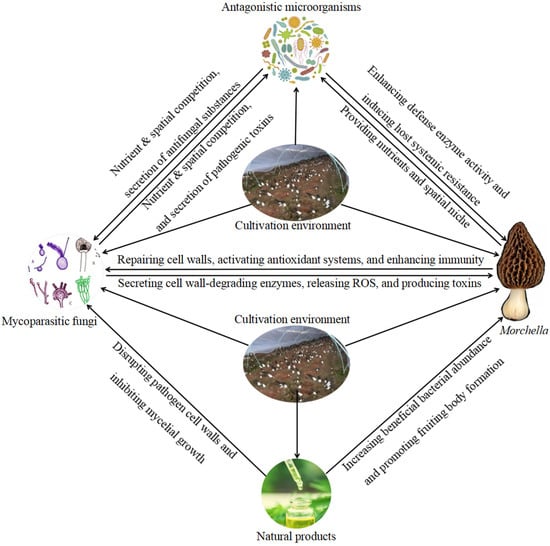
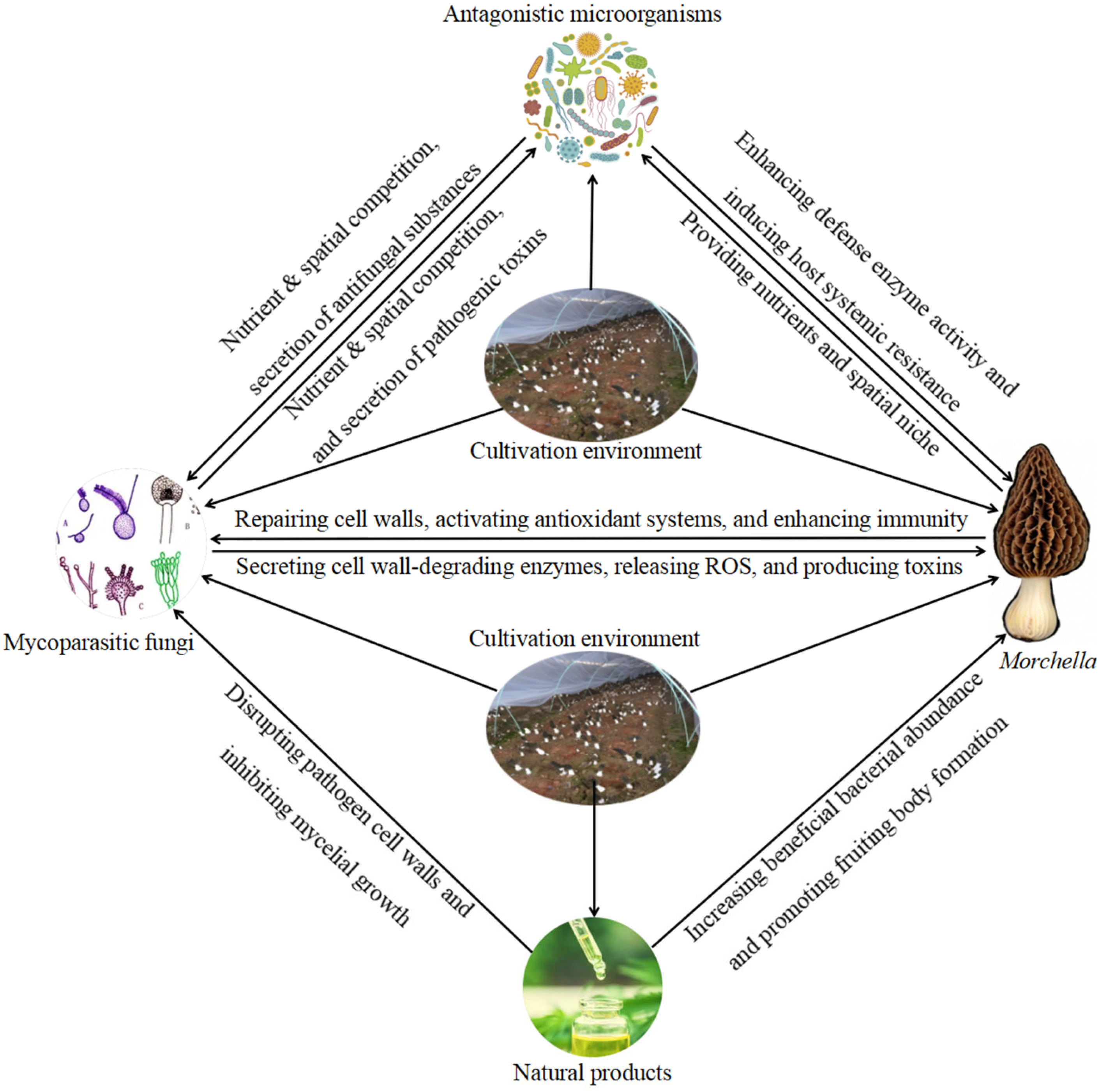
This review provides a comprehensive and detailed overview of the current research status regarding the interaction mechanisms between Morchella and fungal pathogens, as well as the biological control of Morchella fungal diseases, by synthesizing existing knowledge regarding key aspects, including the major fungal diseases and causal fungi affecting Morchella, the pathogenic factors and infection mechanisms of these fungal pathogens, the host defense response mechanisms of Morchella, and the currently developed biological control technologies (Figure 1). However, the current research on Morchella fungal diseases still has several critical limitations: (1) The lack of large-scale, systematic surveys of Morchella fungal diseases has led to insufficient clarity about the primary disease types prevalent in different cultivation regions. (2) Most existing studies on Morchella fungal diseases are confined to pathogen identification reports and analyses of soil samples collected from affected cultivation areas, and there is a lack of systematic research on the occurrence dynamics, epidemiological patterns, damage levels, and control strategies of these diseases. (3) Transcriptome sequencing has facilitated the identification of several genes and gene families involved in the immune response of Morchella; however, the specific functions of these genes are not fully elucidated. Furthermore, research addressing the pathogenic mechanisms of most causative pathogens and their corresponding host response mechanisms in Morchella is still largely unexplored. (4) In commercial production, the prevention and control of Morchella fungal diseases remain heavily reliant on agricultural cultivation practices and chemical fungicides, and there are significant gaps in both the application of biological control and related mechanistic research. Consequently, research addressing Morchella fungal diseases is relatively underdeveloped—i.e., both in the macroscopic field of disease epidemiology and the microscopic realm of molecular biology—with considerable room for improvement in terms of research breadth and depth.
Figure 1.
Interactions among antagonistic microorganisms/natural products, mycoparasitic fungi, Morchella, and the cultivation environment.
Moving forward, research on Morchella fungal diseases may prioritize the following key directions: (1) For the identification of Morchella fungal diseases and their causal pathogens: Conduct comprehensive surveys of diseases across major Morchella cultivation regions to define the pathogenic microbial community, thereby clarifying the key diseases prevalent in these areas. For pathogen identification, based on multi-gene sequence analysis, develop rapid and accurate molecular detection techniques—including DNA barcoding, quantitative polymerase chain reaction (qPCR), and loop-mediated isothermal amplification (LAMP). (2) For the interaction mechanisms between Morchella and its mycoparasitic fungi: Elucidate the molecular mechanisms underlying pathogen infection and identify the critical stages of disease development, to provide robust support for disease prevention and control. Additionally, accelerate the fine mapping of major disease resistance loci in Morchella, the cloning of resistance-related genes, and the dissection of their regulatory mechanisms—all of which will lay a solid theoretical foundation for breeding disease-resistant Morchella cultivars and optimizing disease control strategies. (3) In the field of biological control: Sustained efforts should be devoted to screening for potential biocontrol microbial resources. On one hand, endophytes isolated from Morchella should be explored for their antagonistic secondary metabolites and growth regulators that promote Morchella development, thereby facilitating the development of novel, Morchella-specific microbial pesticides. On the other hand, the composition and structure of soil microbial communities in high-yield versus low-yield Morchella cultivation soils should be analyzed; based on these insights, composite microbial inoculants can be formulated through rational combination to suppress soil-borne pathogens. Furthermore, transferring antagonism-related genes from highly antagonistic bacterial strains into strains with enhanced environmental adaptability to construct genetically engineered biocontrol agents represents a viable strategy for improving biocontrol efficacy. Additionally, leveraging omics technologies to dissect the multi-dimensional antibacterial mechanisms of biocontrol agents, as well as to decipher the interaction dynamics among the quartet system consisting of the host, pathogen, biocontrol agent, and indigenous microbiota, is critical for developing tailored formulations and application protocols.
Author Contributions
Conceptualization, R.Z.; methodology, R.Z. and J.X.; writing—original draft, R.Z.; investigation, J.X. and P.J.; formal analysis, P.J. and X.H.; project administration, R.Z.; supervision, X.H.; data curation, P.J. and J.X.; writing—review and editing, R.Z. All authors have read and agreed to the published version of the manuscript.
Funding
This work was supported by National Natural Science Foundation of China (grant number 32260797); Natural Science Project of Shaanxi Energy Institute (grant number 2025KYZRZ02).
Data Availability Statement
No new data were created or analyzed in this study. Data sharing is not applicable.
Conflicts of Interest
The authors declare no conflicts of interest.
References
- Du, X.H.; Wu, D.M.; Kang, H.; Wang, H.C.; Xu, N.; Li, T.T.; Chen, K.L. Heterothallism and potential hybridization events inferred for twenty-two yellow morel species. IMA Fungus 2020, 11, 4. [Google Scholar] [CrossRef] [Scilit] [PubMed]
- Du, X.H.; Wang, H.C.; Sun, J.J.; Xiong, L.Y.; Yu, J.J. Hybridization, characterization and transferability of SSRs in the genus Morchella. Fungal Biol. 2019, 123, 528–538. [Google Scholar] [CrossRef] [Scilit] [PubMed]
- Zhao, R.H.; He, X.L.; Gao, X.P.; Wang, F. Comparative analysis of nutrients in fruiting bodies between wild and cultivated Morchella in different cultivation models. Food Mach. 2022, 38, 27–31, (In Chinese with English abstract). [Google Scholar]
- Liu, C.; Sun, Y.H.; Mao, Q.; Guo, X.L.; Li, P.; Liu, Y.; Xu, N. Characteristics and antitumor activity of Morchella esculenta polysaccharide extracted by pulsed electric field. Int. J. Mol. Sci. 2016, 17, 986. [Google Scholar] [CrossRef] [Scilit]
- Tang, Y.; Chen, J.L.; Li, F.H.; Yang, Y.X.; Wu, S.R.; Ming, J. Antioxidant and antiproliferative activities of modified polysaccharides originally isolated from Morchella angusticepes Peck. J. Food Sci. 2019, 84, 448–456. [Google Scholar] [CrossRef] [Scilit]
- Li, Y.T.; Chen, H.Y.; Zhang, X. Cultivation, nutritional value, bioactive compounds of morels, and their health benefits: A systematic review. Front. Nutr. 2023, 10, 1159029. [Google Scholar] [CrossRef] [Scilit]
- Xu, Y.Y.; Tang, J.; Wang, Y.; He, X.L.; Tan, H.; Yu, Y.; Chen, Y.; Peng, W.H. Large-scale commercial cultivation of morels: Current state and perspectives. Appl. Microbiol. Biotechnol. 2022, 106, 4401–4412. [Google Scholar] [CrossRef] [Scilit]
- Liu, Q.Z.; Dong, C.H. Science and technology breakthroughs to advance artificial cultivation of true morels. Front. Microbiol. 2023, 14, 1259144. [Google Scholar] [CrossRef] [Scilit]
- Liu, W.; Cai, Y.L.; He, P.X.; Ma, X.L.; Bian, Y.B. Occurrence and control of pests and diseases in field cultivation of Morchella mushrooms. Acta Edulis Fungi 2019, 26, 128–134, (In Chinese with English abstract). [Google Scholar]
- Tang, J.; Wang, Y.; Xu, Y.Y.; Tan, H.; He, X.L.; Yu, Y.; Chen, Y.; Peng, W.H. Research progress on key issues of morel industry development. J. Fungal Res. 2021, 19, 217–231, (In Chinese with English abstract). [Google Scholar]
- Liu, W.; He, P.X.; Shi, X.F.; Zhang, Y.; Perez-Moreno, J.; Yu, F.Q. Large-scale field cultivation of Morchella and relevance of basic knowledge for its steady production. J. Fungi 2023, 9, 855. [Google Scholar] [CrossRef] [Scilit] [PubMed]
- Peng, B.; Bian, Y.B.; Gong, Y.H.; Xiao, Y. Diseases of Morchella and their comprehensive prevention and control techniques. Edible Med. Mushrooms 2024, 32, 129–135, (In Chinese with English abstract). [Google Scholar]
- He, X.L.; Peng, W.H.; Miao, R.Y.; Tang, J.; Chen, Y.; Liu, L.X.; Wang, D.; Gan, B.C. White mold on cultivated morels caused by Paecilomyces penicillatus. FEMS Microbiol. Lett. 2017, 364, fnx037. [Google Scholar] [CrossRef] [Scilit]
- Tan, H.; Liu, T.H.; Yu, Y.; Tang, J.; Jiang, L.; Martin, F.M.; Peng, W.H. Morel production related to soil microbial diversity and evenness. Microbiol. Spectr. 2021, 9, e0022921. [Google Scholar] [CrossRef] [Scilit]
- Shi, X.F.; Liu, D.; He, X.H.; Liu, W.; Yu, F.Q. Epidemic identification of fungal diseases in Morchella cultivation across China. J. Fungi 2022, 8, 1107. [Google Scholar] [CrossRef] [Scilit]
- Liu, Z.H.; Cong, Y.L.; Sossah, F.L.; Lu, Y.Z.; Kang, J.C.; Li, Y. Characterization and genome analysis of Cladobotryum mycophilum, the causal agent of cobweb disease of Morchella sextelata in China. J. Fungi 2023, 9, 411. [Google Scholar] [CrossRef] [Scilit]
- Yu, M.; Yin, Q.; He, P.X. Isolation and identification of pathogen of morel white rot. North. Horticult. 2020, 7, 142–145, (In Chinese with English abstract). [Google Scholar]
- Lv, B.B.; Sun, Y.; Chen, Y.F.; Yu, H.L.; Mo, Q. First report of Lecanicillium aphanocladii causing rot of Morchella sextelata in China. Plant Dis. 2022, 106, 3202. [Google Scholar] [CrossRef] [Scilit]
- Hou, X.L.; Luo, C.Q.; Chen, S.S.; Zhang, X.W.; Jiang, J.M.; Yang, Z.F.; Wang, F.; Xie, X. Progress in research on diseases of edible fungi and their detection methods: A review. Crop Prot. 2023, 174, 106420. [Google Scholar] [CrossRef] [Scilit]
- He, P.X.; Li, C.C.; Cai, Y.L.; Zhang, Y.; Bian, Y.B.; Liu, W. First report of pileus rot disease on cultivated Morchella importuna caused by Diploöspora longispora in China. J. Gen. Plant Pathol. 2018, 84, 65–69. [Google Scholar] [CrossRef] [Scilit]
- Wang, S.R.; Wang, J.Y.; Wang, T.Y.; Li, T.L.; Xu, L.J.; Cheng, Y.F.; Chang, M.C.; Meng, J.L.; Hou, L.D. Integrated transcriptomics-proteomics analysis reveals the response mechanism of Morchella sextelata to Pseudodiploöspora longispora infection. J. Fungi 2024, 10, 604. [Google Scholar] [CrossRef] [Scilit] [PubMed]
- Liang, Z.; Liu, Y.; Zhao, K.; Li, L.H.; Jiang, S.J. First Report of Pestalotiopsis trachicarpicola causing apothecium wither on cultivated Morchella sextelata in Sichuan, China. Plant Dis. 2023, 107, 3631. [Google Scholar] [CrossRef] [Scilit]
- Lan, Y.F.; Cong, Q.Q.; Wang, Q.W.; Tang, L.N.; Li, X.M.; Yu, Q.W.; Cui, X.; An, X.R.; Yu, C.X.; Kong, F.H.; et al. First report of Cladobotryum protrusum causing cobweb disease on cultivated Morchella importuna. Plant Dis. 2020, 104, 977. [Google Scholar] [CrossRef] [Scilit]
- Gao, Z.H.; Hua, R.; Sun, D.F.; Liu, S.X.; Yue, W.S.; Zhang, X.H.; Yu, S.S.; Li, J.Y. Isolation and identification of two diseases pathogens from Morchella spp. Ed. Fungi China 2023, 42, 109–113+120, (In Chinese with English abstract). [Google Scholar]
- Fu, Y.W.; Wu, H.H.; Wang, S.; Yu, Q.; Tian, D.S.; Xu, X. First report of Trichoderma atroviride causing rot of Morchella sextelata in Anhui Province, China. Crop Prot. 2023, 168, 106206. [Google Scholar] [CrossRef] [Scilit]
- Fu, Y.W.; Xu, X.; Wu, H.H.; Li, L.L.; Wang, J.J.; Sun, Y.Q.; Gu, L.J.; Yu, Q. First report of Clonostachys rosea causing rot of Morchella sextelata in Anhui province, China. Plant Dis. 2023, 107, 1623. [Google Scholar] [CrossRef] [Scilit]
- Tu, S.Q.; Zhang, Y.; Chen, X.; Song, L.L.; Chen, Y.F.; Lv, B.B. First report of Aspergillus niger causing rot of Morchella sextelata in China. Plant Dis. 2024, 108, 804. [Google Scholar] [CrossRef] [Scilit]
- Guo, M.P.; Chen, K.; Wang, G.Z.; Bian, Y.B. First report of stipe rot disease on Morchella importuna caused by Fusarium incarnatum, F. equiseti species complex in China. Plant Dis. 2016, 100, 2530. [Google Scholar] [CrossRef] [Scilit]
- Liu, T.H.; Zhou, J.; Wang, D.; He, X.L.; Tang, J.; Chen, Y.; Wang, J.; Peng, W.H. A new stipe rot disease of the cultivated Morchella sextelata. Mycosystema 2021, 40, 2229–2243, (In Chinese with English abstract). [Google Scholar]
- Zhang, W.C.; Cao, M.T.; Yin, Q.; Zhang, J.; Wang, C.H.; Han, L.; Cai, Y.L.; Shi, X.F.; Ma, L.J.; Abdellah, Y.A.Y.; et al. Artificial endosymbiosis of Pedobacter sp. DDGJ boosts the growth potential, stress resistance and productivity of Morchella mushrooms. Microb. Biotechnol. 2025, 18, e70197. [Google Scholar] [CrossRef] [Scilit]
- Masaphy, S. First report on Purpureocillium lilacinum infection of indoor-cultivated morel primordia. Agriculture 2022, 12, 695. [Google Scholar] [CrossRef] [Scilit]
- Zhang, Y.Y.; Xu, H.Y.; Ding, J.; Qin, B.F.; Zhou, G.X. First report of Cladosporium scabrellum causing stipe spot disease of Morchella importuna in China. Plant Dis. 2024, 108, 225. [Google Scholar] [CrossRef] [Scilit]
- Wei, Y.F.; Fu, M.H.; Li, W.L.; Luo, Y.; Zhang, Y.T.; Sun, W.L.; Zou, J. First report on apothecium deformity of Morchella importuna caused by Alternaria alternata in China. Plant Dis. 2024, 108, 1398. [Google Scholar] [CrossRef] [Scilit]
- Wang, Y.J. Biological Characteristics of the Pathogen of White Mold and Soil Microbial Diversity in the Diseased Area. Master’s Thesis, Sichuan Agricultural University, Yaan, China, 2019. [Google Scholar]
- Chen, C.; Fu, R.T.; Wang, J.; Li, X.Y.; Chen, X.J.; Li, Q.; Lu, D.H. Genome sequence and transcriptome profiles of pathogenic fungus Paecilomyces penicillatus reveal its interactions with edible fungus Morchella importuna. Comput. Struct. Biotechnol. 2021, 19, 2607–2617. [Google Scholar] [CrossRef] [Scilit]
- Yu, Y.; Liu, T.H.; Liu, L.X.; Chen, Y.; Tang, J.; Peng, W.H.; Tan, H. Application of the mushroom volatile 1-octen-3-ol to suppress a morel disease caused by Paecilomyces penicillatus. Appl. Microbiol. Biotechnol. 2022, 106, 4787–4799. [Google Scholar] [CrossRef] [Scilit]
- Liu, H.J.; Ma, L.; Cheng, Z.F.; Yang, S.Y.; Xie, J. Metabolomic profiles and differential metabolites in the fruiting bodies of Morchella spp. infected with white mold at different degrees. Food Chem. 2025, 480, 143892. [Google Scholar] [CrossRef] [Scilit]
- Su, W.Y.; Liu, X.M.; Ji, W.; Liang, C.D.; Zhao, S.G.; Ren, L.K. Pathogen identification and biological characteristics of Morchella esculenta. J. Zhejiang Agric. Sci. 2023, 64, 204–208, (In Chinese with English abstract). [Google Scholar]
- Liu, J.M.; Feng, J.C.; Wu, Z.T.; Yang, X.Z. Study on pathogen identification and biological morel of Morchella white mold disease in Hexi area. North. Horticul. 2023, 17, 116–123, (In Chinese with English abstract). [Google Scholar]
- Xie, J.T.; Liu, X.; Qin, Z.L.; Mei, S.H.; Tarafder, E.; Li, C.; Zeng, X.Y.; Tian, F.H. Evolution and related pathogenic genes of Pseudodiploöspora longispora on Morchella based on genomic characterization and comparative genomic analysis. Sci. Rep. 2024, 14, 18588. [Google Scholar] [CrossRef] [Scilit]
- Huang, H.; Zhang, X.Y.; Zheng, H.; Cai, Q.Y.; Luo, J.J.; Luo, K.; Li, S.J.; Yang, Y.L. Identification and cultural characterization of Diploöspora longispora associated with pileus rot disease on cultivated morel. J. Plant Prot. 2022, 48, 66–72, (In Chinese with English abstract). [Google Scholar]
- Fu, B.; Wang, J.Z.; Li, Y.M.; Zhang, S.L.; Hao, Z.; Zhang, F. Isolation, identification and biological characteristics of causal pathogen causing pileus rot of cultivated Morchella importuna. Acta Agric. Boreali-Occident. Sin. 2022, 31, 640–647, (In Chinese with English abstract). [Google Scholar]
- Li, B.; Tian, F.; Jin, L.; Gao, X.; Liu, G.; Zheng, H.K.; Hu, W.; He, P.X. Isolation, identification and control measures of a pathogenic fungus of Morchella. Rural Sci. Technol. 2024, 15, 71–75, (In Chinese with English abstract). [Google Scholar]
- Lan, Y.F.; Yu, Q.W.; Cui, X.; Kong, Y. Isolation and identification of causal pathogen causing pileus rot disease on cultivated Morchella spp. Edible Fungi 2024, 46, 68–70, (In Chinese with English abstract). [Google Scholar]
- Li, B.H.; Liang, Z.; Liu, Y.; Zhao, K.; Li, L.H. Effect of Pestalotiopsis trachicarpicola on growth of Morchella sextelata. Acta Edulis Fungi 2025, 32, 35–43, (In Chinese with English abstract). [Google Scholar]
- Chen, X.; Zhang, Y.; Chao, S.Q.; Song, L.L.; Wu, G.G.; Sun, Y.; Chen, Y.F.; Lv, B.B. Biocontrol potential of endophytic Bacillus subtilis A9 against rot disease of Morchella esculenta. Front. Microbiol. 2024, 15, 1388669. [Google Scholar] [CrossRef] [Scilit]
- Hu, S.H.; An, J.S.; Feng, J.; Yan, C.; Wu, W.N. Isolating and purifying of pathogenic fungi of stipe rot of Morchella and screening of combination agents. Agrochem 2023, 62, 684–688, (In Chinese with English abstract). [Google Scholar]
- De Wit, P.J.G.M.; Mehrabi, R.; Van den Burg, H.A.; Stergiopoulos, I. Fungal effector proteins: Past, present and future. Mol. Plant Pathol. 2009, 10, 735–747. [Google Scholar] [CrossRef] [Scilit]
- Sperschneider, J.; Gardiner, D.M.; Dodds, P.N.; Tini, F.; Covarelli, L.; Singh, K.B.; Manners, J.M.; Taylor, J.M. EffectorP: Predicting fungal effector proteins from secretomes using machine learning. New Phytol. 2016, 210, 743–761. [Google Scholar] [CrossRef] [Scilit]
- Lan, Y.F.; Cong, Q.Q.; Yu, Q.W.; Liu, L.; Cui, X.; Li, X.M.; Wang, Q.; Yang, S.T.; Yu, H.; Kong, Y. Genome sequencing of three pathogenic fungi provides insights into the evolution and pathogenic mechanisms of the cobweb disease on cultivated mushrooms. Foods 2024, 13, 2779. [Google Scholar] [CrossRef] [Scilit]
- Wang, X.X.; Peng, J.Y.; Sun, L.; Bonito, G.; Guo, Y.X.; Li, Y.; Fu, Y.P. Genome sequencing of Paecilomyces penicillatus provides insights into its phylogenetic placement and mycoparasitism mechanisms on morel mushrooms. Pathogens 2020, 9, 834. [Google Scholar] [CrossRef] [Scilit]
- Yu, Y.; Tan, H.; Liu, T.H.; Liu, L.X.; Tang, J.; Peng, W.H. Dual RNA-Seq analysis of the interaction between edible fungus Morchella sextelata and its pathogenic fungus Paecilomyces penicillatus uncovers the candidate defense and pathogenic factors. Front. Microbiol. 2021, 12, 760444. [Google Scholar] [CrossRef] [Scilit] [PubMed]
- Zerillo, M.M.; Adhikari, B.N.; Hamilton, J.P.; Buell, C.R.; Lévesque, C.A.; Tisserat, N. Carbohydrate-active enzymes in Pythium and their role in plant cell wall and storage polysaccharide degradation. PLoS ONE 2013, 8, e72572. [Google Scholar] [CrossRef] [Scilit] [PubMed]
- Brouwer, H.; Coutinho, P.M.; Henrissat, B.; de Vries, R.P. Carbohydrate-related enzymes of important Phytophthora plant pathogens. Fungal Genet. Biol. 2014, 72, 192–200. [Google Scholar] [CrossRef] [Scilit] [PubMed]
- Bashyal, B.M.; Rawat, K.; Sharma, S.; Kulshreshtha, D.; Gopala Krishnan, S.; Singh, A.K.; Dubey, H.; Solanke, A.U.; Sharma, T.R.; Aggarwal, R. Whole genome sequencing of Fusarium fujikuroi provides insight into the role of secretory proteins and cell wall degrading enzymes in causing bakanae disease of rice. Front. Plant Sci. 2017, 8, 2013. [Google Scholar] [CrossRef] [Scilit]
- Dong, W.; Chen, B.S.; Zhang, R.; Dai, H.Q.; Han, J.J.; Lu, Y.Z.; Zhao, Q.; Liu, X.Z.; Liu, H.W.; Sun, J.Z. Identification and characterization of peptaibols as the causing agents of Pseudodiploöspora longispora infecting the edible mushroom Morchella. J. Agric. Food Chem. 2023, 71, 18385–18394. [Google Scholar] [CrossRef] [Scilit]
- Lu, L.; Galappaththi, M.C.A.; Patabendige, N.M.; Feng, Y.Z.; Yang, T.; Karunarathna, S.C.; Xie, J.T.; Gentekaki, E.; Rapior, S.; Charria-Girón, E.; et al. Metabolomic profiles of the infection pathways of Calcarisporium cordycipiticola on the cultivated and medicinal mushroom, Cordyceps militaris. Fungal Biol. 2025, 129, 101561. [Google Scholar] [CrossRef] [Scilit]
- Huang, Q.S.; Xie, X.L.; Liang, G.; Gong, F.; Wang, Y.; Wei, X.Q.; Wang, Q.; Ji, Z.L.; Chen, Q.X. The GH18 family of chitinases: Their domain architectures, functions and evolutions. Glycobiology 2012, 22, 23–34. [Google Scholar] [CrossRef] [Scilit]
- Abubaker, K.S.; Sjaarda, C.; Castle, A.J. Regulation of three genes encoding cell-wall-degrading enzymes of Trichoderma aggressivum during interaction with Agaricus bisporus. Can. J. Microbiol. 2013, 59, 417–424. [Google Scholar] [CrossRef] [Scilit]
- Sjaarda, C.P.; Abubaker, K.S.; Castle, A.J. Induction of lcc2 expression and activity by Agaricus bisporus provides defence against Trichoderma aggressivum toxic extracts. Microb. Biotechnol. 2015, 8, 918–929. [Google Scholar] [CrossRef] [Scilit]
- Lu, M.L.; Wen, T.C.; Guo, M.; Li, Q.H.; Peng, X.C.; Zhang, Y.; Lu, Z.H.; Wang, J.; Xu, Y.J.; Zhang, C. Regulation of intracellular reactive oxygen species levels after the development of Phallus rubrovolvatus rot disease due to Trichoderma koningii mycoparasitism. J. Fungi 2023, 9, 525. [Google Scholar] [CrossRef] [Scilit]
- Frandsen, R.J.N.; Nielsen, N.J.; Maolanon, N.; Sørensen, J.C.; Olsson, S.; Nielsen, J.; Giese, H. The biosynthetic pathway for aurofusarin in Fusarium graminearum reveals a close link between the naphthoquinones and naphthopyrones. Mol. Microbiol. 2006, 61, 1069–1080. [Google Scholar] [CrossRef] [Scilit] [PubMed]
- Zhao, R.H. Research progress on the mechanism of Morchella species in response to adversity stress analyzed from the perspective of omics. Mycosystema 2025, 44, 4–17, (In Chinese with English abstract). [Google Scholar]
- Beccaccioli, M.; Reverberi, M.; Scala, V. Fungal lipids: Biosynthesis and signalling during plant-pathogen interaction. Front. Biosci.-Landmrk 2019, 24, 172–185. [Google Scholar]
- Su, W.Y.; Ji, W.; Liu, X.M.; Qin, Y.Y.; Ren, L.K. Effect of Pseudodiploöspora longispora infection on Morchella esculenta metabolism based on non-targeted metabonomics analysis. Acta Agric. Jiangxi 2023, 35, 60–65, (In Chinese with English abstract). [Google Scholar]
- Gea, F.J.; Navarro, M.J.; Santos, M.; Diánez, F.; Carrasco, J. Control of fungal diseases in mushroom crops while dealing with fungicide resistance: A review. Microorganisms 2021, 9, 585. [Google Scholar] [CrossRef] [Scilit]
- Li, P.X.; Miao, R.Y.; Wu, B.; Ruan, Z.Y.; He, M.X. Prevention and control of microbial diseases in soil-covered cultivation of edible fungi. Acta Microbiol. Sin. 2023, 63, 1888–1898, (In Chinese with English abstract). [Google Scholar]
- Yin, Y.Y.; Du, Z.C.; Li, H.X. Progress in research on integrated control technology of edible fungi diseases and pests. Edible Fungi 2023, 45, 62–66, (In Chinese with English abstract). [Google Scholar]
- Peng, B. Preliminary Study on the Influence of Continuous Cropping on Soil Characteristics and Disease Control in Morchella sextelata Cultivation. Master’s Thesis, Huazhong Agricultural University, Shenyang, China, 2024. [Google Scholar]
- Yu, Y.; Kang, X.; Liu, T.H.; Wang, Y.; Tang, J.; Peng, W.H.; Martin, F.M.; Tan, H. Inoculation of the Morchella importuna mycosphere with Pseudomonas chlororaphis alleviated a soil-borne disease caused by Paecilomyces penicillatus. Biol. Fertil. Soils 2025, 61, 141–161. [Google Scholar] [CrossRef] [Scilit]
- Carrasco, J.; Preston, G.M. Growing edible mushrooms: A conversation between bacteria and fungi. Environ. Microbiol. 2020, 22, 858–872. [Google Scholar] [CrossRef] [Scilit]
- Chen, S.C.; Song, Z.W.; Wang, X.L.; Xu, M.H. Effect of compound microbiological preparation on the mycelial growth and the fruitbody yield of Pleurotus ostreatus. Acta Edulis Fungi 2005, 12, 53–57, (In Chinese with English abstract). [Google Scholar]
- Yang, W.; Wang, W.; Xiang, S.H.; Xia, Z.L.; Luo, K. Isolation and identification of an antagonistic strain against green mold of edible fungi. Edible Fungi China 2020, 39, 55–60, (In Chinese with English abstract). [Google Scholar]
- Fontana, D.C.; de Paula, S.; Torres, A.G.; de Souza, V.H.M.; Pascholati, S.F.; Schmidt, D.; Dourado Neto, D. Endophytic fungi: Biological control and induced resistance to phytopathogens and abiotic stresses. Pathogens 2021, 10, 570. [Google Scholar] [CrossRef] [Scilit] [PubMed]
- Fernandes, M.F.R.; Ribeiro, T.G.; Rouws, J.R.; de Barros Soares, L.H.; Zilli, J.E. Biotechnological potential of bacteria from genera Bacillus Paraburkholderia and Pseudomonas to control seed fungal pathogens. Braz. J. Microbiol. 2021, 52, 705–714. [Google Scholar] [CrossRef] [Scilit] [PubMed]
- Chen, Q.Q.; Qiu, Y.; Yuan, Y.Z.; Wang, K.Y.; Wang, H.Y. Biocontrol activity and action mechanism of Bacillus velezensis strain SDTB038 against Fusarium crown and root rot of tomato. Front. Microbiol. 2022, 13, 994716. [Google Scholar] [CrossRef] [Scilit]
- Zhang, Y.; Gao, W.H.; Zhang, H.; Sun, T.; Yang, H.X.; Liu, Y.; Han, X.Y.; Yin, D.K.; Xu, W.F. Antagonistic mechanism of Bacillus velezensis HX0039 as a biocontrol agent against Trichoderma virens-induced “Sanghuang” green mold. Appl. Environ. Microbiol. 2025, 91, e0000525. [Google Scholar] [CrossRef] [Scilit]
- Li, D.; Limwachiranon, J.; Li, L.; Du, R.X.; Luo, Z.S. Involvement of energy metabolism to chilling tolerance induced by hydrogen sulfide in cold-stored banana fruit. Food Chem. 2016, 208, 272–278. [Google Scholar] [CrossRef] [Scilit]
- Dai, J.W.; Xu, Z.F.; Yang, N.; Tuerxunjiang, H.; Shan, X.; Diao, Y.T.; Zhao, J.H.; Ma, M.Q.; Li, X.; Xiao, M.; et al. Investigation of the biocontrol mechanism of a novel Pseudomonas species against phytopathogenic Fusarium graminearum revealed by multi-omics integration analysis. Appl. Environ. Microb. 2024, 90, e0045524. [Google Scholar] [CrossRef] [Scilit]
- Cailleau, G.; Hanson, B.T.; Cravero, M.; Zhioua, S.; Hilpish, P.; Ruiz, C.; Robinson, A.J.; Kelliher, J.M.; Morales, D.; Gallegos-Graves, L.V.; et al. Associated bacterial communities, confrontation studies, and comparative genomics reveal important interactions between Morchella with Pseudomonas spp. Front. Fungal Biol. 2023, 4, 1285531. [Google Scholar] [CrossRef] [Scilit]
- Lohberger, A.; Spangenberg, J.E.; Ventura, Y.; Bindschedler, S.; Verrecchia, E.P.; Bshary, R.; Junier, P. Effect of organic carbon and nitrogen on the interactions of Morchella spp. and bacteria dispersing on their mycelium. Front. Microbiol. 2019, 10, 124. [Google Scholar] [CrossRef] [Scilit]
- Tan, H.; Kohler, A.; Miao, R.; Liu, T.; Zhang, Q.; Zhang, B.; Jiang, L.; Wang, Y.; Xie, L.; Tang, J.; et al. Multi-omic analyses of exogenous nutrient bag decomposition by the black morel Morchella importuna reveal sustained carbon acquisition and transferring. Environ. Microbiol. 2019, 21, 3909–3926. [Google Scholar] [CrossRef] [Scilit]
- Billings, N.; Millan, M.R.; Caldara, M.; Rusconi, R.; Tarasova, Y.; Stocker, R.; Ribbeck, K. The extracellular matrix component Psl provides fast-acting antibiotic defense in Pseudomonas aeruginosa biofilms. PLoS Pathog. 2013, 9, e1003526. [Google Scholar] [CrossRef] [Scilit] [PubMed]
- Liu, J.C.; Wu, S.Y.; Feng, L.F.; Wu, Y.C.; Zhu, J.L. Extracellular matrix affects mature biofilm and stress resistance of psychrotrophic spoilage Pseudomonas at cold temperature. Food Microbiol. 2023, 112, 104214. [Google Scholar] [CrossRef] [Scilit] [PubMed]
- Bian, Y.B.; Xiao, Y.; Guo, M.P. Research progress on disease control of edible fungi. Acta Edulis Fungi 2021, 28, 121–131, (In Chinese with English abstract). [Google Scholar]
- Liu, Y. Screening of Antagonistic Actinomycetes Against Pestalotiopsis trachicarpicola of Morchella Pathogens and Preliminary Study on Its Control. Master’s Thesis, China West Normal University, Nanchong, China, 2024. [Google Scholar]
- van der Voort, M.; Kempenaar, M.; van Driel, M.; Raaijmakers, J.M.; Mendes, R. Impact of soil heat on reassembly of bacterial communities in the rhizosphere microbiome and plant disease suppression. Ecol. Lett. 2016, 19, 375–382. [Google Scholar] [CrossRef] [Scilit]
- Schulz-Bohm, K.; Martin-Sanchez, L.; Garbeva, P. Microbial volatiles: Small molecules with an important role in intra- and inter-kingdom interactions. Front. Microbiol. 2017, 8, 2484. [Google Scholar] [CrossRef] [Scilit]
- Viviane, C.; Carrion, V.J.; Etalo, D.W.; Roland, M.; Hua, Z.; Van, W.; Raaijmakers, J.M. Diversity and functions of volatile organic compounds produced by Streptomyces from a disease-suppressive soil. Front. Microbiol. 2020, 6, 1081. [Google Scholar]
- Herrero-Garcia, E.; Garzia, A.; Cordobés, S.; Eduardo, E.A.; Ugalde, U. 8-Carbon oxylipins inhibit germination and growth, and stimulate aerial conidiation in Aspergillus nidulans. Fungal Biol. 2011, 115, 393–400. [Google Scholar] [CrossRef] [Scilit]
- Yin, G.H.; Moore, G.G.; Bennett, J.W. Diversity and functions of fungal VOCs with special reference to the multiple bioactivities of the mushroom alcohol. Mycology 2025, 16, 1011–1022. [Google Scholar] [CrossRef] [Scilit]
- Berendsen, R.L.; Kalkhove, S.I.; Lugones, L.G.; Baars, J.J.; Wösten, H.A.; Bakker, P.A. Effects of the mushroom-volatile 1-octen-3-ol on dry bubble disease. Appl. Microbiol. Biotechnol. 2013, 97, 5535–5543. [Google Scholar] [CrossRef] [Scilit]
- Noble, R.; Dobrovin-Pennington, A.; Hobbs, P.J.; Rodger, P.A. Volatile C8 compounds and Pseudomonads influence primordium formation of Agaricus bisporus. Mycologia 2009, 101, 583–591. [Google Scholar] [CrossRef] [Scilit]
- Eastwood, D.C.; Herman, B.; Noble, R.; Dobrovin-Pennington, A.; Sreenivasaprasad, S.; Burton, K.S. Environmental regulation of reproductive phase change in Agaricus bisporus by 1-octen-3-ol, temperature and CO2. Fungal Genet. Biol. 2013, 55, 54–66. [Google Scholar] [CrossRef] [Scilit]
- Pion, M.; Spangenberg, J.E.; Simon, A.; Bindschedler, S.; Junier, P. Bacterial farming by the fungus Morchella crassipes. Proc. Biol. 2013, 280, 20132242. [Google Scholar]
- Diánez, F.; Santos, M.; Parra, C.; Navarro, M.J.; Blanco, R.; Gea, F.J. Screening of antifungal activity of 12 essential oils against eight pathogenic fungi of vegetables and mushroom. Lett. Appl. Microbiol. 2018, 67, 400–410. [Google Scholar] [CrossRef] [Scilit]
- Muhammad, I.; Sossah, F.L.; Yang, Y.; Li, D.; Li, S.; Fu, Y.; Li, Y. Identification of resistance to cobweb disease caused by Cladobotryum mycophilum in wild and cultivated strains of Agaricus bisporus and screening for bioactive botanicals. RSC Adv. 2019, 9, 14758–14765. [Google Scholar] [CrossRef] [Scilit]
- Wang, B.X. Preliminary Study on Identification of Pathogen Fungi and Biological Control in Morchella Cultivation. Master’s Thesis, China West Normal University, Nanchong, China, 2021. [Google Scholar]
- Wang, K.B.; Jiang, S.S.; Pu, T.; Fan, L.M.; Su, F.W.; Ye, M. Antifungal activity of phenolic monoterpenes and structure-related compounds against plant pathogenic fungi. Nat. Prod. Res. 2019, 33, 1423–1430. [Google Scholar] [CrossRef] [Scilit]
Disclaimer/Publisher’s Note: The statements, opinions and data contained in all publications are solely those of the individual author(s) and contributor(s) and not of MDPI and/or the editor(s). MDPI and/or the editor(s) disclaim responsibility for any injury to people or property resulting from any ideas, methods, instructions or products referred to in the content. |
© 2026 by the authors. Licensee MDPI, Basel, Switzerland. This article is an open access article distributed under the terms and conditions of the Creative Commons Attribution (CC BY) license.