

You are currently viewing a new version of our website. To view the old version click .

Beverages, Volume 10, Issue 2

June 2024 - 25 articles

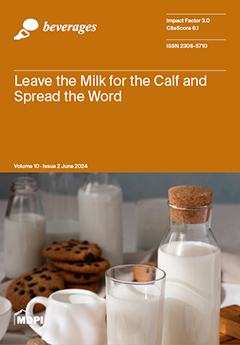
Cover Story: Plant-based milk alternatives are important beverages in US consumer markets. Sustainability, consumer awareness, lifestyle changes, and other value-based reasons are why these beverages are increasing in popularity. The present study is focused on plant-based milk alternatives. It builds on an online consumer survey that explores the factors explaining US consumers’ willingness to try plant-based milk alternatives and their word-of-mouth sharing about these beverages. Animal welfare concerns, environmental concerns, health consciousness, and dairy preferences are the factors under investigation. Results show that animal welfare, dairy preference, environmental concerns, and plant-based milk enthusiasm are significant predictors for willingness to try plant-based milk alternatives. View this paper
  • Issues are regarded as officially published after their release is announced to the table of contents alert mailing list .
  • You may sign up for email alerts to receive table of contents of newly released issues.
  • PDF is the official format for papers published in both, html and pdf forms. To view the papers in pdf format, click on the "PDF Full-text" link, and use the free Adobe Reader to open them.

Articles (25)

  • Article
  • Open Access
4,295 Views
16 Pages

Since March 2020, there have been multiple outside influences negatively impacting the U.S. craft beer industry from COVID-19 to inflation all leading up to increased prices for consumers. However, to date, research has not investigated consumer sent...

  • Article
  • Open Access
6 Citations
4,063 Views
15 Pages

Strawberry Post-Harvest Anthocyanin Development to Improve the Colour Stability of Strawberry Nectars

  • Helen Murray,
  • Fabio Stipkovits,
  • Jasmin Wühl,
  • Heidrun Halbwirth and
  • Manfred Gössinger

Strawberry nectars have increased colour stability when produced from overripe, darker, and redder strawberries, with a high anthocyanin concentration. The post-harvest storage of strawberries has been shown to develop these properties. Nectars are f...

  • Article
  • Open Access
8 Citations
9,662 Views
22 Pages

This study investigated the impact of storage temperatures (−20 °C, room temperature, and 40 °C) on the sensory evaluation, metabolites, and volatile compounds of green tea stored for 12 months. The sensory evaluation revealed that tea...

  • Article
  • Open Access
3 Citations
5,741 Views
31 Pages

Production and Optimisation of Fermented Pumpkin-Based Mature Coconut Water Kefir Beverage Using Response Surface Methodology

  • Wee Yin Koh,
  • Xiao Xian Lim,
  • Ban Hock Khor,
  • Babak Rasti,
  • Thuan Chew Tan,
  • Rovina Kobun and
  • Utra Uthumporn

Fermentation of pumpkin puree and mature coconut water using water kefir grains is a potential method for producing a novel functional non-dairy-based probiotic drink. In the present study, response surface methodology based on Box–Behnken desi...

  • Review
  • Open Access
3 Citations
8,364 Views
20 Pages

Common Beverage Consumption and Benign Gynecological Conditions

  • Rachel Michel,
  • Dana Hazimeh,
  • Eslam E. Saad,
  • Sydney L. Olson,
  • Kelsey Musselman,
  • Eman Elgindy and
  • Mostafa A. Borahay

The purpose of this article is to review the effects of four commonly consumed beverage types—sugar-sweetened beverages (SSBs), caffeinated beverages, green tea, and alcohol—on five common benign gynecological conditions: uterine fibroids, endometrio...

  • Article
  • Open Access
7 Citations
6,232 Views
12 Pages

Total Dealcoholisation of Wines by Very Low Temperature Vacuum Distillation Technology Called GoLo

  • José Manuel Veiga-del-Baño,
  • Juan José Cuenca-Martínez,
  • José Oliva,
  • Miguel Ángel Cámara and
  • Pedro Andreo-Martínez

The use of wine dealcoholisation has multiplied in recent years as a result of various factors, including the increase in alcohol content due to global warming and changes in consumer drinking habits. There are several post-fermentation dealcoholisat...

  • Article
  • Open Access
3 Citations
3,300 Views
18 Pages

Fortification of White Wines with Antioxidants and Se: Impacts on Browning Development and Phenolic Content

  • Melina Maria Chatzistavridi,
  • Stefania Christofi and
  • Stamatina Kallithraka

The present study explores the efficiency of selenomethionine (Semeth), an organic form of Se, as an antioxidant compared with commonly used antioxidants (ascorbic acid, glutathione, and potassium metabisulfite) in preventing oxidative browning in Gr...

  • Article
  • Open Access
5 Citations
4,667 Views
11 Pages

The Ability of Lacticaseibacillus paracasei MSMC 36-9 Strain with Probiotic Potential to Ferment Coconut Milk and Produce a Yogurt-Type Beverage

  • Porntipha Vitheejongjaroen,
  • Pooyanee Phettakhu,
  • Wannicha Arsayot,
  • Malai Taweechotipatr and
  • Ulisa Pachekrepapol

The efficacy of the Lacticaseibacillus paracasei MSMC 36-9 strain with probiotic potential to ferment coconut milk and produce coconut milk yogurt-type beverages was examined. Tapioca starch was used as a stabilizer at concentrations of 0, 1.0, and 2...

  • Article
  • Open Access
13 Citations
6,884 Views
16 Pages

Development of a New Kombucha from Grape Pomace: The Impact of Fermentation Conditions on Composition and Biological Activities

  • Nathalie Barakat,
  • Jalloul Bouajila,
  • Sandra Beaufort,
  • Ziad Rizk,
  • Patricia Taillandier and
  • Youssef El Rayess

Winemaking is one of the oldest biotechnology techniques in the world. The wine industry generates 20 million tons of by-products, such as wastewater, stalk, lees, pomace, and stems, each year. The objective of this research project is to valorize wi...

  • Article
  • Open Access
2 Citations
2,372 Views
11 Pages

Acetic Fermentation of Cagaita Pulp: Technological and Chemical Characteristics

  • Jeisa Farias De Sousa Santana,
  • Guilherme Freitas de Lima Hercos,
  • Josemar Gonçalves de Oliveira Filho,
  • Daiane Costa dos Santos,
  • Marilene Silva Oliveira,
  • Bheatriz Silva Morais de Freitas,
  • Fabiano Guimarães Silva and
  • Mariana Buranelo Egea

The Brazilian Cerrado region has a rich plant diversity, with fruits that have peculiar and unique sensory characteristics. For these reasons, using these fruits for biotechnological production is a promising alternative, mainly to protect this biome...

of 3

Get Alerted

Add your email address to receive forthcoming issues of this journal.

XFacebookLinkedIn
Beverages - ISSN 2306-5710