


Abstract
The search for new bright scintillators with performance close to ideal is the target for many research centers worldwide. This paper presents advanced bright thallium (Tl)-based K2PtCl6-type intrinsic scintillators for detection and imaging applications. Dopant-free Tl-based compounds of Tl2HfX6 and Tl2ZrX6 (X = Cl, Br, or mixed halogens) that were investigated, grown, and published previously are now scaled up to one-inch-diameter crystals. Energy resolutions of 4.1% for Tl2HfCl6, 4.4% for Tl2ZrCl6, 4.8% for Tl2Hf(Cl,Br)6, and 4.1% for Tl2Zr(Cl,Br)6, as well as light yields of 22,300 ph/MeV for Tl2HfCl6, 38,500 ph/MeV for Tl2ZrCl6, 19,000 ph/MeV for Tl2Hf(Cl,Br)6, and 39,900 ph/MeV for Tl2Zr(Cl,Br)6, are measured. These crystals have generally linear responses to gamma-rays above 100 keV. Because of their many favorable attributes, these novel crystals will be beneficial in many gamma-ray detector applications that require better physical densities, Zeff values, energy resolutions, and relative detection efficiency than NaI:Tl, without the constraints of light yield and decay time constants.
1. Introduction
Scintillation detectors play a crucial role in many detection and imaging applications due to their tunable properties and being widely accessible compared to other types of solid-state detectors. While an ideal scintillator does not exist and requirements vary from application to application, it is generally recognized that good material properties along with good energy resolution, high light yield, and fast decay time are typically desirable [1].
Lately, intrinsic scintillators belonging to an inorganic compound family K2PtCl6 [2] have been rediscovered and studied by several groups. These novel scintillators include Cs2HfCl6 or CHC [3,4,5,6,7,8] and Cs2ZrCl6 or CZC [4,9,10,11], as well as the corresponding Tl-based compositions Tl2HfCl6 or THC [7,12,13,14,15] and Tl2ZrCl6 or TZC [7,12,14,15,16,17]. Mixed halide Cs2Hf(Cl,Br)6 has also been investigated [5,6,18]. Cs2HfCl6, the first rediscovered composition from the K2PtCl6 family, exhibited promising properties, such as good resolution of <4% and moderately high light yield between 27,000 and 54,000 ph/MeV, that could compete with traditional scintillators like NaI:Tl [19] and CsI:Tl [20]. Although the primary decay constant for Cs2HfCl6 is long (approximately 4 μs) [3,5,6], studies showed that the decay constant was halved by growing a mixed-halide composition, Cs2Hf(Cl,Br)6 or CHCB [5,6].
For Tl-based K2PtCl6-type compositions, Tl2HfCl6 (THC) and Tl2ZrCl6 (TZC), the Tl-ion substitution increases both physical density and effective atomic number Zeff, two factors which directly determine photon detection efficiency of materials as well as provide high photoelectric conversion from gamma-rays and X-rays. This property makes thallium-based materials excellent for applications in radiation detection for medical imaging, security and high-energy physics. Tl-substitution in other ternary halides, including intrinsic TlMgCl3, Eu-doped TlSr2I5, Ce-doped Tl2LaBr5, as well as many others, have also reported highly dense materials with high light yield and fast decay constants, even though most of them are challenging to process post-growth due to high hygroscopicity [21,22,23,24,25,26,27] unlike CHC, THC and TZC. Likewise, CHC, THC and TZC are also intrinsic scintillators. The absence of intentional doping excludes the possibility of dopant segregation that can occur during growth. Other types of crystal inhomogeneities and defects (such as stoichiometric variations, vacancies, or halide segregation in mixed compounds) may still affect the crystal quality and scintillation performance. As in the cases of CHC and CHCB, these Tl-based compounds were also typically grown by the vertical Bridgman–Stockbarger method.
Previous studies conducted at Fisk University showed that THC and TZC exhibited improved decay times compared to the Cs-based counterparts that lacked the presence of Tl [7,14]. Another research center reported that both THC and TZC crystals showed an intrinsic emission band peak between 450 and 470 nm under UV light and X-ray excitations. Their reported energy resolutions at 662 keV, however, were 17.7% for THC and 5.6% for TZC, while scintillation decay constants were measured to be 288 ns and 6.34 μs for THC, and 696 ns and 2.36 μs for TZC [12]. In addition to better detection efficiency for gamma-rays due to an improved Zeff, due to chlorine (specifically 35Cl) these compounds can be used for fast neutron detection [28,29], which is important, for example, for oil exploration field applications.
This paper reports on initial large-diameter (∅1-inch or 25.4 mm) bulk crystal growths of THC and TZC, as well as mixed-halide compounds Tl2Hf(Cl,Br)6 (THCB) and Tl2Zr(Cl,Br)6 (TZCB). Compared to previously published papers on these materials, with respect to crystal size and scintillating performance, our results demonstrated successful crystal growth resulting in better crystal quality and scintillation performance. In general, the larger the size of a gamma-ray detector, the better the detection efficiency is due to increased probability of interactions in the material. Specifically, the probability of total energy deposition in the material increases with size, and as a result, the (full-energy) peak efficiency is improved. The larger the detector size, the more interactions can be recorded, thus counting statistics is improved and counting time can also be reduced [30]. Attempts to improve scintillation properties of K2PtCl6-type compounds through mixing halides were demonstrated first with Cs2HfCl4Br2 (CHCB), with the most significant improvement seen in a reduction in the primary (long) decay component, from about 4 μs for CHC to 2 μs for CHCB [5], while energy resolutions and light yields remained identical. Due to a lower energy valence orbital (3p in Cl− vs. 4p in Br−) [31], the valence band maximum in chloride compounds is lower, creating a larger bandgap Eg than bromide compounds. Electronegativity χ for an atom [32], which is the average value of the ionization energy ([33], p. 54) and the electron affinity ([33], p. 62) according to L. Mulliken, can also be used to explain the relationship between electronic structure and Eg. Because chlorine is more electronegative than bromine, chloride compounds have more tightly bound valence electrons, which lowers the valence band and increases Eg. The influence of electronic structures on Eg is frequently studied in halide perovskites, where mixing or substituting halides are investigated for the purpose of Eg tuning [34,35]. For scintillators, the number of photons produced is directly proportional to the average energy required to produce an electron–hole pair or W, which is directly proportional to Eg. Hence, as Eg decreases, light yield is expected to increase. Similar investigations were carried out with mixed-halide variants of the Tl-based compounds, and the results are presented in this paper.
2. Results and Discussion
Material synthesis and purification was the starting point after purchasing raw materials TlX, HfX4 and ZrX4 (where X is Cl, Br or mixed halogens). Because the materials purchased from commercial vendors came with a best purity level of only 3N, an in-house purification process done prior to growth to obtain high-quality and well-performing crystals had to be conducted. The as-received HfCl4 came in with a 3N purity level, thus the synthesis process was started by first purifying ZrCl4 and HfCl4 by sublimation. The purified ZrX4 and HfX4 were then mixed with TlX (4N as-received purity level) to synthesize Tl2ZrX6 (TZX) and Tl2HfX6 (THX), respectively.
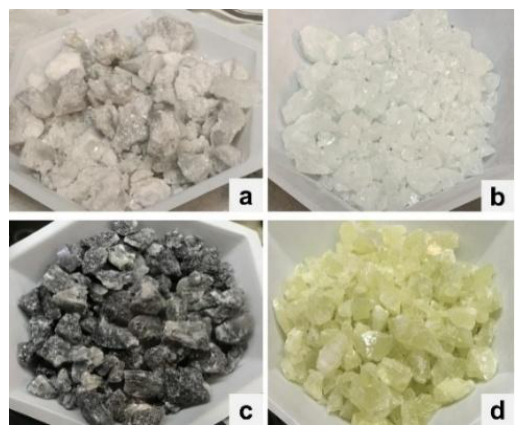
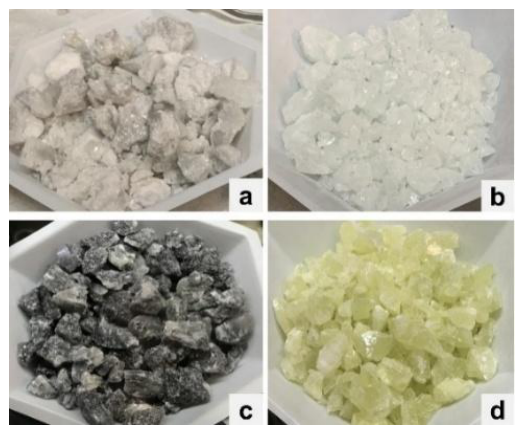
During the synthesis process, the mixture, loaded into a cleaned quartz ampoule, was dehydrated and the ampoule was subsequently sealed under high vacuum. The charge was quickly melted, mixed, and cooled within two days. Figure 1a,b show the results of sublimed and synthesized Tl2HfCl6 (THC) after the first cycle and third cycle of processing. Similarly, Figure 1c,d show the results of sublimed and synthesized Tl2ZrCl6 (TZC) after the first cycle and fourth cycle of processing. These sublimation processes resulted in a total mass loss of approximately 20 to 30% of the original weight.
Figure 1.
Sublimed and synthesized Tl2HfCl6: (a) after the first cycle and (b) after the third cycle of processing. Sublimed and synthesized Tl2ZrCl6: (c) after the first cycle and (d) after the fourth cycle of processing.
2.1. Growth and Characterization of Tl2HfCl6
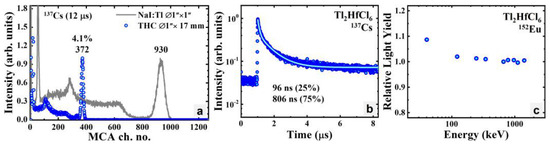
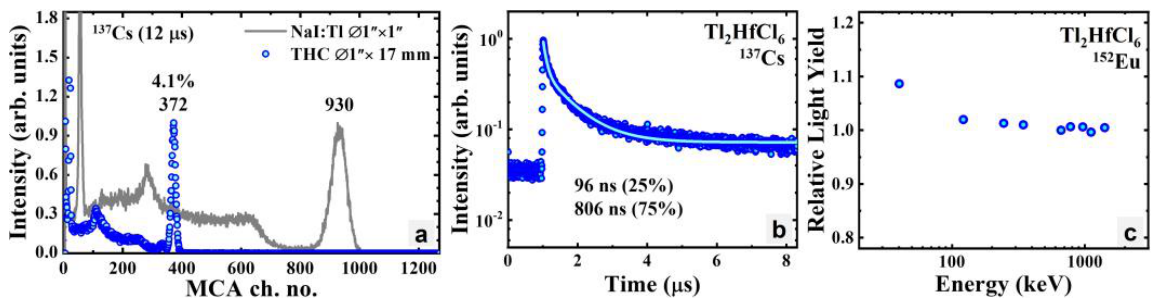
Figure 2a,b show two successfully grown 1-inch-diameter THC crystals constituting the first successfully grown ∅1-inch THC crystal boules. The crystal boules had cleaved due to crystal attachment to the quartz ampoule wall and a fast-cooling thermal stress. A single and crack-free crystal sample (based on macroscopic observation) sized ∅1-inch × 17 mm was cut and processed from the boule in Figure 2a (outlined diagram). The sample was then polished for characterization. Spectra of 137Cs, 22Na, 133Ba, 57Co, and 241Am were collected with the crystal. Figure 3a shows 137Cs spectra collected by the THC sample and compared to a reference NaI:Tl crystal with a size of ∅1-inch × 1 inch. A light yield of 22,300 ph/MeV was approximated by comparing the peak positions of the full-energy peaks as well as taking into account the emission spectrum of THC [12] and NaI:Tl [19], the quantum efficiency or spectral response of the PMT [36], and the light yield of the NaI:Tl crystal (38,000 ph/Mev) provided by the vendor [19]. Energy resolution of the full-energy peak was measured to be 4.1% (FWHM). It is worth noting that the THC sample analyzed for the current paper was much larger and thicker (∅1-inch × 17 mm) than the THC sample this group reported in [7] (approximately ∅16 mm × 5 mm). The difference in the measured light yield and previously reported light yield of 27,000 ph/MeV [7] may be caused by the differences in sample geometries or dimensions. Anode signals resulted from 137Cs photon interactions in the crystal were then collected with a digitizer and the average of the waveforms is shown in Figure 3b. Analyzed using two exponential decay functions, decay constants of 96 ns (25%) and 806 ns (75%) were calculated using the ExpDecay2 function in OriginLab (OriginLab Corporation, Northampton, MA, USA). While still in the same orders of magnitude, these decay constants were faster in terms of values and proportions than previously measured THC decay times of 300 ns (15%) and 1.1 μs (85%) this group reported in [7], and they were indeed faster than CHC reported in [3,4,6,8]. The improvement in the decay constants may be due to higher THC crystal clarity and better crystal quality produced compared to the results in [7]. Relative light yield data with respect to photon energy is shown in Figure 3c, where a linear response (0.95 < relative light yield < 1.05) was observed for photon energy above 100 keV. The origin of the non-proportionality behavior for low photon energy was not analyzed and is currently unknown.
Figure 2.
Two successfully grown single-phase transparent ∅1-inch THC crystal boules: (a) First growth run. (b) Second growth runs.
Figure 3.
(a) 137Cs spectra collected with a ∅1-inch × 17 mm THC crystal and ∅1-inch × 1-inch NaI:Tl crystal. (b) Decay time measured for the ∅1-inch × 17 mm THC crystal. (c) Relative light yield of THC with respect to photon energy.
2.2. Growth and Characterization of Tl2ZrCl6
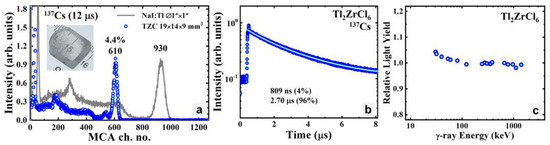
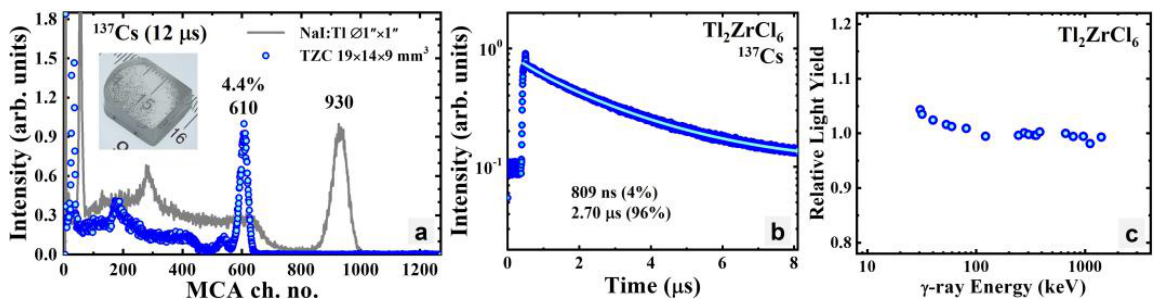
A crystal sample of Tl2ZrCl6 (TZC), with dimensions of approximately 19 × 14 × 9 mm3, was cut from a ∅1-inch boule and then was processed or polished prior to characterization (Figure 4a inset picture). 137Cs spectrum collected by the sample is shown in Figure 4a, with a measured energy resolution of 4.4% (FWHM) at 662 keV. The same light yield calculation procedure was also utilized to calculate the light yield of the TZC sample, resulting in an approximated light yield of 38,500 ph/MeV. As in the case of the THC sample, the TZC sample was larger and thicker than the sample in [7], and as the inset picture in Figure 4a shows, the TZC sample had some inclusions and irregular sample geometry. These factors may affect light collection efficiency within the sample and thus affect the measured energy resolution. Nevertheless, as previously reported, TZC has a higher light yield than THC and CZC [12], and it is comparable to NaI:Tl [19]. The average waveforms of TZC are shown in Figure 4b, from which decay constants of 809 ns (4%) and 2.70 μs (96%) were calculated using the ExpDecay2 function in OriginLab. Although these decay constants are higher in value compared to the decay constants of 500 ns (2%) and 2.3 μs (98%) reported in [7], they had the same orders of magnitude and they were also faster than the reported values for CZC [4,8]. TZC has a relatively linear response to gamma-rays above 30 keV as shown in the graph of relative light yield as a function of energy (Figure 4c).
Figure 4.
(a) 137Cs spectra collected with a 19 × 14 × 9 mm3 TZC crystal (inset picture) and ∅1-inch × 1-inch NaI:Tl crystal. (b) Decay time measured for the 19 ×14 × 9 mm3 TZC crystal. (c) Relative light yield of TZC with respect to photon energy.
2.3. Growth and Characterization of Mixed Halides Tl2Hf(Cl,Br)6
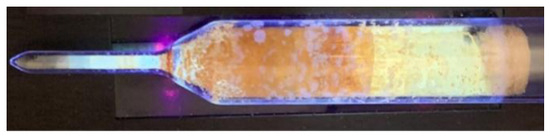
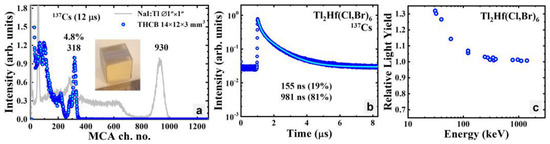
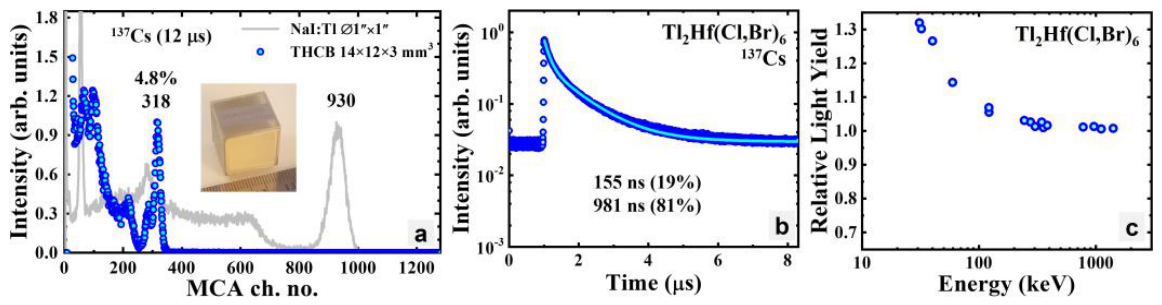
As mentioned in the Introduction, the purpose of growing the mixed-halide compound was to investigate whether mixed-halide compositions improve the scintillation properties of the THC-type compounds. Figure 5 shows an as-grown ∅16 mm Tl2HfCl4Br2 (THCB) grown using the Bridgman method. The 137Cs spectrum collected with a THCB sample is shown in Figure 6a, with a measured energy resolution of 4.8% (FWHM) at 662 keV. The same light yield calculation procedure was also utilized to calculate the light yield of the THCB sample, with the assumption that the emission of THCB was similar to THC [12], resulting in an estimated light yield of 19,000 ph/MeV. When comparing the emission spectra of the chloride compounds to the bromide analogs, however, the emission spectra of the bromide compounds (CHB and THB) appeared red-shifted compared to the chloride analogs (CHC and THC) [37,38]. It is then expected that the emission spectrum for mixed-halide Tl2HfCl1−xBrx (0 < x < 1) will be red-shifted compared to THC, and therefore, the estimated light yield of THCB is expected to be higher. This prediction is also consistent with the bromide compounds having smaller Eg compared to the chloride analogs, which also leads to high light yield.
Figure 5.
Picture of the as-grown 16 mm diameter Tl2HfCl4Br2 (THCB) crystal.
Figure 6.
(a) 137Cs spectra collected with a THCB crystal and ∅1-inch × 1 inch NaI:Tl crystal. (b) Time profile for THCB. (c) Non-proportionality data for THCB.
The average waveforms of THCB are shown in Figure 6b, from which decay constants of 155 ns (19%) and 981 ns (81%) were calculated using the ExpDecay2 function in OriginLab. The calculated decay constants for THCB were similar to those of THC. Gamma-ray spectra from other check sources (57Co,133Ba,152Eu, and 241Am) were also collected and analyzed to get relative light yield as a function of photon energy (Figure 6c). The light yield for THCB was linear (0.95 < relative light yield < 1.05) for photon energies above 122 keV.
2.4. Growth and Characterization Mixed Halides Tl2Zr(Cl,Br)6
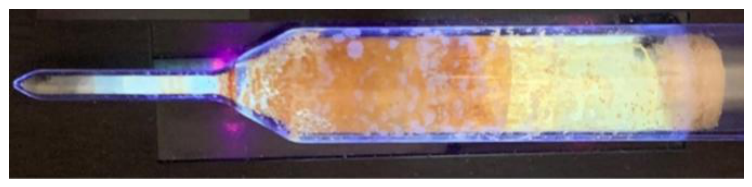
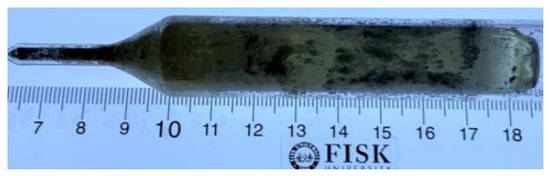
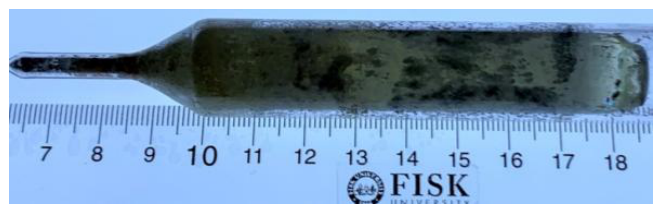
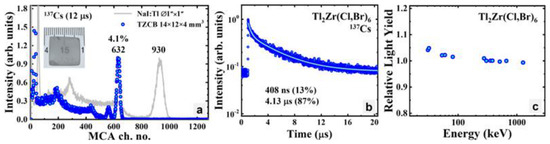
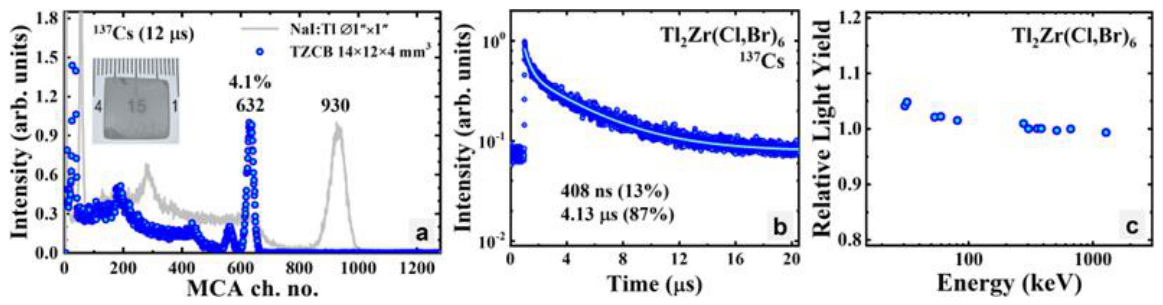
Figure 7 shows an as-grown ∅16 mm Tl2Zr(Cl,Br)6 (TZCB) in its growth ampoule. Figure 8a shows a 137Cs spectrum collected with a lapped and polished TZCB sample (~14 × 12 × 4 mm3; see inset picture) extracted from the TZCB boule. The single and opaque sample was extracted from the part of the boule that was crack-free. An energy resolution of 4.1% (FWHM) at 662 keV was measured (Figure 8a). Although TZCB was not as transparent as TZC, good energy resolution was still attainable, and the light yield was similar to TZC. Using the same procedure for light yield calculation, while assuming that the emission of TZCB was similar to TZC [12], the light yield of the TZCB sample was estimated to be 39,900 ph/MeV. TZCB has a slightly higher light yield than TZC and CZC [12], and, similar to TZC, it is comparable to NaI:Tl [19]. The average waveforms of TZCB are shown in Figure 8b, from which decay constants of 408 ns (13%) and 4.13 μs (87%) were calculated using the ExpDecay2 function in OriginLab. The slow primary decay constant of TZCB was longer compared to TZC; however, the fast decay constant was shorter and with a higher proportion. The plot of relative light yield (RLY) vs. γ-ray energy (Figure 8c, from 241Am, 133Ba, 137Cs, and 22Na check sources) shows the non-proportionality behavior of the TZCB crystal that is linear (0.95 ≤ RLY ≤ 1.05) for γ-ray energy above 30 keV, with the largest deviation from linearity ~4.8%.
Figure 7.
Picture of the as-grown 16 mm diameter Tl2Zr(Cl,Br)6 (TZCB) crystal.
Figure 8.
(a) 137Cs spectra collected with a ~14 × 12 × 4 mm3 TZCB crystal and ∅1-inch × 1 inch NaI:Tl crystal. (b) Time profile for TZCB. (c) The plot of relative light yields vs. γ-ray energy (from 241Am, 133Ba, 137Cs, and 22Na check sources) shows the non-proportionality behavior of the TZCB crystal that is linear for γ-ray energy above 30 keV.
3. Experimental Methods
Raw materials with 3N to 4N purity levels were purchased from several vendors based on availability. To start the growth process, stoichiometric amounts of raw materials were loaded into clean ∅16 mm to 1-inch (25.4 mm)-diameter ampoules, respectively, according to the compound (TlCl (4N) and HfCl4 (3N) for THC; TlCl (4N) and ZrCl4 (3N) for TZC; TlCl (4N), TlBr (4N), HfCl4 (3N), and HfBr4 (3N) for THCB; and TlCl (4N), TlBr (4N), ZrCl4 (3N), and ZrBr4 (3N) for TZCB). Material loading was carried out inside a glove box with inert atmosphere. Prior to sealing, the materials inside the clean growth ampoule were dehydrated under high vacuum (<10−4 Torr) at or below 80 °C for 2 to 3 h. After the ampoule was sealed, it was then loaded into a two-zone Mellen® vertical furnace (MELLEN Company, Inc., Concord, NH, USA), with the top and bottom zones heated a few degrees above and below melting points at 630 °C and 650 °C, respectively. The crystal growth commenced at 3–4 mm/h. At the end of the crystal growth process, the temperatures of the furnace zones were reduced at a cooling rate of 8–10 °C/h to room temperature. After retrieval from the growth ampoules, each of the grown crystal boules were cut into slices with a diamond wire saw. Crystal samples from each compound were subsequently processed by polishing with 240 to 8000 grit Al2O3 or SiC polishing pads. The processed samples were tested for their scintillation properties by placing a crystal sample in a quartz cup filled with mineral oil. The measuring cup itself was wrapped with Teflon tape as a reflector and during measurements a piece of Gore® flexible Teflon sheet (W. L. Gore & Associates, Inc., Newark, DE, USA) was used as the back reflector. The oil cup was coupled to a R6231-100 Hamamatsu super bi-alkali photomultiplier tube (PMT) (Hamamatsu Photonics, Hamamatsu City, Japan) using an optical grease. Gamma-ray spectroscopy equipment that consisted of Hamamatsu C9525-02 high-voltage power supply, Canberra 2005 preamplifier (Canberra Industries, Inc., Meriden, CT, USA), Canberra 2020 spectroscopy amplifier, and Amptek MCA800D multichannel analyzer (Amptek, Inc., Bedford, MA, USA) were utilized to process anode signals. The 137Cs spectrum collected by each sample was used to obtain full-energy peak information (including energy resolution) and compared to the 137Cs spectrum collected with a ∅1-inch × 1-inch NaI:Tl (purchased from Saint Gobain Crystals (Hiram, OH, USA)) to obtain light yield, while taking into account the emission spectrum of the sample, the quantum efficiency or spectral response of the PMT, and the light yield of the NaI:Tl crystal (38,000 ph/Mev) provided by the vendor [18]. Spectra from check sources with x-/γ-ray energies between 14 keV and 1275 keV (241Am, 57Co, 133Ba, 22Na, 137Cs, and 60Co) were collected to obtain energy resolution and light yield at specific photon energies. Relative light yield data were obtained by normalizing the light yield at the specific energy to that of 137Cs. The non-proportionality curve was obtained by plotting the relative light yield as a function of photon energy. To obtain luminescence decay time information, waveforms from the PMT anode of samples irradiated with 137Cs were recorded with CAEN DT5720C digitizer (CAEN S.p.A., Viareggio, Italy) and analyzed offline. For spectra measurement, the high-voltage power supply was set at −700 V, while it was set at −1200 V for scintillation decay measurement to ensure adequate signal height above electronic noise threshold and good sampling statistics.
4. Conclusions
Table 1 presents the properties of Tl2HfX6 and Tl2ZrX6 crystals processed for and analyzed in this paper. As seen from Table 1, Tl-ion substitution in the K2PtCl6-type compounds improved decay constants in most of the compounds, especially THC and THCB. While both TZC and TZCB have higher light yields than CHC, CHCB, THC, and THCB, both compounds have slower decay components. All Tl-based compounds have good energy resolutions <5% at 662 keV and generally linear responses to gamma-rays above 100 keV. While the origin of the non-proportionality in the lower energy region is unknown, the relative light yield deviation from unity was generally less for materials that have high light yield like TZC and TZCB, compared to THC and THCB. Because these materials are intrinsic, the dopant segregation issue is absent. These materials are also less affected by humidity than other Tl-based scintillators [21,22,23,24,25,26,27]. The thallium-based ternary halide Tl2HfX6 and Tl2ZrX6 have many favorable physical properties and scintillation properties that are beneficial in many gamma-ray detector applications that require better physical densities, Zeff values, energy resolutions, and relative detection efficiency than NaI:Tl, if said applications can still accommodate slightly lower light yields and slower decay constants than NaI:Tl. Because of these attributes, future studies to further probe the merits of these thallium-based ternary halide Tl2HfX6 and Tl2ZrX6 materials will be necessary.
Table 1.
Summary of Tl2HfX6 and Tl2ZrX6 scintillation properties.
Author Contributions
Conceptualization, R.H.; data curation, R.H. and E.A.; formal analysis, R.H. and E.A.; funding acquisition, S.M.; investigation, R.H. and E.A.; methodology, R.H. and E.A.; project administration, R.H. and S.M.; resources, R.H.; supervision, R.H.; validation, R.H. and E.A.; visualization, R.H. and E.A.; writing—original draft, R.H., E.A. and A.P.; writing—review and editing, R.H., E.A. and A.P. All authors have read and agreed to the published version of the manuscript.
Funding
The work presented in this paper was partially supported by Defense Threat Reduction Agency Contract No. HDTRA1-20-C-0051.
Data Availability Statement
The datasets presented in this article are not readily available because of proprietary reasons. Requests to access the datasets should be directed to the corresponding author.
Conflicts of Interest
Shariar Motakef is the President of Cape Sym, Inc. The remaining authors declare that the research was conducted in the absence of any commercial or financial relationships that could be construed as a potential conflict of interest.
References
- Derenzo, S.E.; Weber, M.J.; Bourret-Courchesne, E.; Klintenberg, M.K. The quest for the ideal inorganic scintillator. Nucl. Instrum. Methods Phys. Res. A 2003, 505, 111–117. [Google Scholar] [CrossRef] [Scilit]
- Maniv, S. Crystal data for Cs2HfCl6. J. Appl. Cryst. 1976, 9, 245. [Google Scholar] [CrossRef] [Scilit]
- Burger, A.; Rowe, E.; Groza, M.; Figueroa, K.M.; Cherepy, N.J.; Beck, P.R.; Hunter, S.; Payne, S.A. Cesium Hafnium Chloride: A high light yield, non-hygroscopic cubic crystal scintillator for gamma spectroscopy. Appl. Phys. Lett. 2015, 107, 143505. [Google Scholar] [CrossRef] [Scilit]
- Saeki, K.; Fujimoto, Y.; Koshimizu, M.; Yanagida, T.; Asai, K. Comparative study of scintillation properties of Cs2HfCl6 and Cs2ZrCl6. Appl. Phys. Express 2016, 9, 042602. [Google Scholar]
- Lam, S.; Guguschev, C.; Burger, A.; Hackett, M.; Motakef, S. Crystal growth and scintillation performance of Cs2HfCl6 and Cs2HfCl4Br2. J. Cryst. Growth 2018, 483, 121–124. [Google Scholar]
- Ariesanti, E.; Hawrami, R.; Burger, A.; Motakef, S. Improved growth and scintillation properties of intrinsic, non-hygroscopic scintillator Cs2HfCl6. J. Lumin. 2020, 217, 116784. [Google Scholar] [CrossRef] [Scilit]
- Hawrami, R.; Ariesanti, E.; Buliga, V.; Motakef, S.; Burger, A. Latest Progress on Advanced Bridgman Method-Grown K2PtCl6 Cubic Structure Scintillator Crystals. IEEE Trans. Nucl. Sci. 2020, 67, 1020–1026. [Google Scholar] [CrossRef] [Scilit]
- Nagorny, S. Novel Cs2HfCl6 Crystal Scintillator: Recent Progress and Perspectives. Physics 2021, 3, 320–351. [Google Scholar]
- Belli, P.; Bernabei, R.; Cappella, F.; Caracciolo, V.; Cerulli, R.; Incicchitti, A.; Laubenstein, M.; Leoncini, A.; Merlo, V.; Nagorny, S.S.; et al. Development of low-background Cs2ZrCl6 detectors to study rare decays in Zr isotopes. Eur. Phys. J. A 2023, 59, 176. [Google Scholar]
- Swiderski, L.; Brylew, K.; Janiak, L.; Mianowska, Z.; Moszyński, M.; Mykhaylyk, V.; Nagorny, S.; Nahorna, V.; Wang, P. Cs2ZrCl6 scintillation properties studied using γ-ray spectroscopy and Compton coincidence technique. Nucl. Instrum. Methods Phys. Res. A 2023, 1057, 168735. [Google Scholar]
- Cappella, F.; Di Stefano, P.C.F.; Ellingwood, E.; Hucker, J.; Leroy, T.; Nagorny, S.; Nahorna, V.; Pagnanini, L.; Skensved, P.; Swidinsky, N.; et al. Scintillating properties of Cs2ZrCl6 crystals in the temperature range of 5–300 K. J. Instrum. 2025, 20, P10033. [Google Scholar]
- Fujimoto, Y.; Saeki, K.; Nakauchi, D.; Yanagida, T.; Koshimizu, M.; Asai, K. New Intrinsic Scintillator with Large Effective Atomic Number: Tl2HfCl6 and Tl2ZrCl6 Crystals for X-ray and Gamma-ray Detections. Sens. Mater. 2018, 30, 1577–1583. [Google Scholar]
- Vuong, P.Q.; Tyagi, M.; Kim, S.H.; Kim, H.J. Crystal growth of a novel and efficient Tl2HfCl6 scintillator with improved scintillation characteristics. CrystEngComm 2019, 21, 5898–5904. [Google Scholar]
- Hawrami, R.; Ariesanti, E.; Buliga, V.; Burger, A.; Lam, S.; Motakef, S. Tl2HfCl6 and Tl2ZrCl6: Intrinsic Tl-, Hf-, and Zr-based scintillators. J. Cryst. Growth 2020, 531, 125316. [Google Scholar] [CrossRef] [Scilit]
- Kim, H.; Rooh, G.; Khan, A.; Vuong, P.Q.; Kim, S. Discovery, Crystal Growth, and Scintillation Properties of Novel Tl-Based Scintillators. Cryst. Res. Technol. 2020, 55, 2000074. [Google Scholar]
- Phan, Q.V.; Kim, H.J.; Rooh, G.; Kim, S.H. Tl2ZrCl6 crystal: Efficient scintillator for X- and γ-ray spectroscopies. J. Alloys Compd. 2018, 766, 326–330. [Google Scholar]
- Vuong, P.Q.; Kim, H.; Park, H.; Rooh, G.; Kim, S. Pulse shape discrimination study with Tl2ZrCl6 crystal scintillator. Radiat. Meas. 2019, 123, 83–87. [Google Scholar]
- Kodama, S.; Kurosawa, S.; Fujii, K.; Murakami, T.; Yashima, M.; Pejchal, J.; Král, R.; Nikl, M.; Yamaji, A.; Yoshino, M.; et al. Single-crystal growth, structure and luminescence properties of Cs2HfCl3Br3. Opt. Mater. 2020, 106, 109942. [Google Scholar] [CrossRef] [Scilit]
- NaI(Tl) Scintillation Crystal. Available online: https://luxiumsolutions.com/radiation-detection-scintillators/crystal-scintillators/naitl-scintillation-crystals (accessed on 7 June 2026).
- CsI(Tl) Scintillation Material. Available online: https://luxiumsolutions.com/radiation-detection-scintillators/crystal-scintillators/csi-cesium-iodide (accessed on 7 June 2026).
- Kim, H.J.; Rooh, G.; Kim, S. Tl2LaCl5 (Ce3+): New fast and efficient scintillator for X- and γ-ray detection. J. Lumin. 2017, 186, 219–222. [Google Scholar]
- Hawrami, R.; Ariesanti, E.; Wei, H.; Finkelstein, J.; Glodo, J.; Shah, K.S. Tl2LaCl5:Ce, high performance scintillator for gamma-ray detectors. Nucl. Instrum. Meth. A 2017, 869, 107–109. [Google Scholar] [CrossRef] [Scilit]
- Kim, H.J.; Rooh, G.; Khan, A.; Park, H.; Kim, S. Scintillation performance of the TlSr2I5 (Eu2+) single crystal. Opt. Mater. 2018, 82, 7–10. [Google Scholar]
- Shirwadkar, U.; Loyd, M.; Du, M.-H.; van Loef, E.; Ciampi, G.; Pandian, L.S.; Stand, L.; Koschan, M.; Zhuravleva, M.; Melcher, C.; et al. Thallium-based scintillators for high-resolution gamma-ray spectroscopy: Ce3+-doped Tl2LaCl5 and Tl2LaBr5. Nucl. Instrum. Meth. A 2020, 962, 163684. [Google Scholar]
- Hawrami, R.; Ariesanti, E.; Burger, A.; Parkhe, H. Latest updates in growth and performance of Ce-doped Tl2LaCl5 and Tl2GdBr5 and Eu-doped TlCa2Br5 and TlSr2I5. Opt. Mater. 2021, 121, 111495. [Google Scholar]
- Pandian, L.S.; Loyd, M.; Du, M.; van Loef, E.; Ciampi, G.; Stand, L.; Zhuravleva, M.; Koschan, M.; Glodo, J.; Melcher, C.; et al. TlSr2I5:Eu2+—A new high density scintillator for gamma-ray detection. Nucl. Instrum. Meth. A 2021, 988, 164876. [Google Scholar]
- Kim, H.J.; Khan, A.; Daniel, J.; Rooh, G.; Vuong, P.Q. Thallium-based heavy inorganic scintillators: Recent developments and future perspectives. CrystEngCom 2022, 24, 450–464. [Google Scholar]
- Taggart, M.P.; Henderson, J.; O’Neill, J.; Hawrami, R.; Ariesanti, E.; Burger, A.; Sellin, P.J. Fast-neutron response of the novel scintillator caesium hafnium chloride. Nucl. Instrum. Meth. A 2021, 1012, 165224. [Google Scholar] [CrossRef] [Scilit]
- Davis, H.; Delzer, C.; Wen, X.; Cao, L.R.; Hayward, J.; Lukosi, E. Systematic evaluation of fast neutron sensing with Cesium Hafnium Chloride. Nucl. Instrum. Meth. A 2023, 1052, 168247. [Google Scholar] [CrossRef] [Scilit]
- Knoll, G. Radiation Detection and Measurement, 3rd ed.; John Wiley & Sons, Inc.: New York, NY, USA, 2000; pp. 335–342. [Google Scholar]
- Ashcroft, N.W.; Mermin, N.D. Solid State Physics; Saunders College Publishing: Orlando, FL, USA, 1976; front cover. [Google Scholar]
- Mills, I.; Cvitaŝ, T.; Homann, K.; Kallay, K.; Kuchitsu, K. Quantities, Units, and Symbols in Physical Chemistry, 2nd ed.; International Union of Pure and Applied Chemistry by Blackwell Science, Ltd.: Oxford, UK, 1993; Volume 20. [Google Scholar]
- Kittel, C. Introduction to Solid State Physics, 8th ed.; John Wiley & Sons, Inc.: Hoboken, NJ, USA, 2005; pp. 54, 62. [Google Scholar]
- Zhang, S.; Tang, M.-C.; Nguyen, N.V.; Anthopoulos, T.D.; Hacker, C.A. Wide-Band-Gap Mixed Halide 3D Perovskites: Electronic Structure and Halide Segregation Investigation. ACS Appl. Electron. Mater. 2021, 3, 2277–2285. [Google Scholar]
- Miah, M.H.; Khandaker, M.U.; Rahman, M.B.; Nur-E-Alam, M.; Islam, M.A. Band gap tuning of perovskite solar cells for enhancing the efficiency and stability: Issues and prospects. RSC Adv. 2024, 14, 15876–15906. [Google Scholar] [CrossRef] [Scilit] [PubMed]
- PHOTOMULTIPLIER TUBES AND ASSEMBLY—HAMAMATSU. Available online: https://www.hamamatsu.com/content/dam/hamamatsu-photonics/sites/documents/99_SALES_LIBRARY/etd/High_energy_PMT_TPMZ0003E.pdf (accessed on 8 June 2026).
- Saeki, K.; Fujimoto, Y.; Koshimizu, M.; Nakauchi, D.; Tanaka, H.; Yanagida, T.; Asai, K. Luminescence and scintillation properties of Cs2HfBr6 and Cs2ZrBr6 crystals. Jpn. J. Appl. Phys. 2018, 57, 030310. [Google Scholar]
- van Loef, E.V.; Ciampi, G.; Shirwadkar, U.; Pandian, L.S.; Shah, K.S. Crystal growth and scintillation properties of thallium-based halide scintillators. J. Cryst. Growth 2020, 532, 125438. [Google Scholar] [CrossRef] [Scilit]



Disclaimer/Publisher’s Note: The statements, opinions and data contained in all publications are solely those of the individual author(s) and contributor(s) and not of MDPI and/or the editor(s). MDPI and/or the editor(s) disclaim responsibility for any injury to people or property resulting from any ideas, methods, instructions or products referred to in the content. |
© 2026 by the authors. Licensee MDPI, Basel, Switzerland. This article is an open access article distributed under the terms and conditions of the Creative Commons Attribution (CC BY) license.