Article

Charge- and Orbital-Order Transitions in the A-Site-Ordered Quadruple Perovskite NdCuMn6O12

1
Research Center for Materials Nanoarchitectonics (MANA), National Institute for Materials Science (NIMS), Namiki 1-1, Tsukuba 305-0044, Ibaraki, Japan
2
Graduate School of Chemical Sciences and Engineering, Hokkaido University, North 10 West 8, Kita-ku, Sapporo 060-0810, Hokkaido, Japan
3
Institute of Scientific and Industrial Research, Osaka University, Mihogaoka 8-1, Osaka 567-0047, Ibaraki, Japan
4
National Institute for Materials Science (NIMS), Sengen 1-2-1, Tsukuba 305-0047, Ibaraki, Japan
*
Author to whom correspondence should be addressed.
Inorganics 2026, 14(7), 174; https://doi.org/10.3390/inorganics14070174

Submission received: 21 May 2026 / Revised: 18 June 2026 / Accepted: 24 June 2026 / Published: 26 June 2026
(This article belongs to the Special Issue Recent Progress in Perovskites)

Abstract

AMn7O12 perovskites (with A = divalent elements) show complex structural and magnetic transitions including incommensurate orbital density waves and coupled/decoupled modulated spin helicity originating from charge-ordered Mn3+/Mn4+ cations with the 3:1 ratio at the B perovskite sites and unusual apically compressed Jahn–Teller distortions of MnO6 octahedra. The same Mn3+:Mn4+ ratio can be achieved in RCuMn6O12 compositions, where R is a trivalent rare-earth cation. Therefore, the comparison in behavior of AMn7O12 and RCuMn6O12 is of interest. In this work, the A-site-ordered quadruple perovskite NdCuMn6O12 was prepared by a high-pressure high-temperature method. Its structural properties were investigated by synchrotron powder X-ray diffraction between 100 K and 350 K and laboratory powder X-ray diffraction between 5 K and 300 K. It shows a first-order structural phase transition from Im-3 symmetry (at high temperatures) to R-3 symmetry near 292 K. The structural transition is accompanied by charge (Mn3+/Mn4+) and unusual orbital (on the Jahn–Teller active Mn3+ cations located in MnO6 octahedra) orders. However, no additional structural/orbital modulations were found at lower temperatures in comparison with AMn7O12. Magnetic properties were investigated by temperature- and field-dependent magnetization and specific heat measurements, where a ferrimagnetic transition was found near 120 K. In addition, low-temperature magnetic anomalies were observed near 20 K, probably originating from the Nd sublattice.

1. Introduction

Manganites have played an important role in the science of perovskite-structure materials since the 1950s [1,2]. They were used for understanding the interplay between charge, spin, and orbital degrees of freedom and the crystal lattice in transition-metal oxides and developing such concepts as small polarons, double exchange, electron–phonon couplings, and Jahn–Teller (JT) distortions [3,4,5].
A lot of papers were published on simple perovskite R1−xAxMnO3 manganites, where R is a rare-earth cation and A is a divalent cation [3,4,5], and detailed composition–temperature phase diagrams were constructed [3,4,5,6]. Charge-ordering (CO) phenomena were often observed at some special doping levels, such as near x = 0.5 (half-doped), x = 1/3 (one-third-doped), x = 1/4 (quarter-doped), and others. In addition to different CO patterns, orbital ordering (OO) on sites containing Mn3+ cations is realized, and complex spin orderings take place coupled with underlying charge-ordered and orbital-ordered structures.
A-site-ordered quadruple perovskites [7,8,9,10,11] with the general composition of AA′3B4O12 form a different playground to manipulate charge, spin, and orbital degrees of freedom. Such manganites, AMn3Mn4O12 or AMn7O12 in short [10,11], intrinsically have different ratios of Mn3+ and Mn4+ cations (at the perovskite B sites) without any doping, depending on the oxidation state of the A cation. With A = Na+ [12,13], the Mn4+:Mn3+ ratio is 1:1 (half-doped). With A = Mn2+, Ca2+, Cd2+, Sr2+, Hg2+, and Pb2+ [14,15,16,17,18,19,20,21,22,23], the Mn4+:Mn3+ ratio is 1:3 (quarter-doped). Among different AMn7O12 compounds, CaMn7O12 (= [Ca2+Mn33+][Mn33+Mn4+]O12) was the most studied compound because it is the only composition that can be prepared at ambient pressure [15]. CaMn7O12 [10] shows a CO transition below TCO = 409–448 K (TCO is a CO transition temperature) with the Im-3 symmetry above TCO and R-3 symmetry below TCO. The R-3 structure has apically compressed Mn3+O6 octahedra with four longer and two shorter Mn–O distances [16] while usual JT systems have two longer and four shorter Mn–O distances. CaMn7O12 shows another transition below TOO = 260 K with an incommensurate structural modulation and propagation vector, kS = (0, 0, ~0.92). The incommensurate structure has a complex modulation of Mn–O bond distances interpreted as an incommensurate orbital density wave localized on the B-site Mn3+ cations, and the majority of MnO6 octahedra in this structure are locally elongated along one of two axes with certain periods resulting in the apparent apical compression of MnO6 octahedra on average. CaMn7O12 shows the first long-range magnetic ordering transition below TN1 = 90 K with an incommensurate propagation vector locked to the structural modulation [18]. Below the second magnetic transition at TN2 = 48 K, the magnetic structure delocks from the structural modulation giving rise to a complex multi-k magnetic ground state [18]. Magnetic structures of CaMn7O12 break the inversion symmetry producing spin-induced ferroelectric polarization [17,18]. The similar picture of complex structural and magnetic phase transitions is realized in other members of the AMn7O12 series with A = Mn, Cd, Sr, Hg, and Pb [10,20,21,22,23]. Therefore, AMn7O12 compounds and their variations, such as CaCuxMn7−xO12 solid solutions [24,25,26,27,28,29,30,31,32,33,34,35,36,37] with 0 ≤ x ≤ 3, have attracted a lot of attention in the literature. For example, compounds with large Cu contents show robust ferrimagnetic properties above room temperature [31,37], large low-field magnetoresistance [32,33,36], and magnetocaloric properties [34]. AMn7O12 compounds and their variations show good catalytic properties [38].
The Mn4+: Mn3+ ratio of 1:3 at the B sites can also be achieved in the following compositions: RCuMn6O12 (=[R3+Cu2+Mn23+][Mn33+Mn4+]O12), where R is a trivalent rare-earth cation, which are the members of more general solid solutions with the composition of RCuxMn7−xO12 [39,40,41,42,43,44,45,46,47,48,49,50,51,52,53,54] and with x = 1. Therefore, it could be interesting to compare the structural and magnetic properties of the AMn7O12 and RCuMn6O12 series. In this work, we prepared one member of the RCuMn6O12 series with R = Nd using a high-pressure high-temperature method. NdCuMn6O12 shows a CO transition near 290 K from Im-3 symmetry (above 290 K) to R-3 symmetry (below 290 K). The R-3 symmetry remains down at 5 K without any additional structural distortions/modulations in comparison with the AMn7O12 series. NdCuMn6O12 also shows a ferrimagnetic transition below 120 K and a second magnetic transition near 20 K probably originating from the Nd sublattice, again in comparison with the AMn7O12 series.

2. Results and Discussion

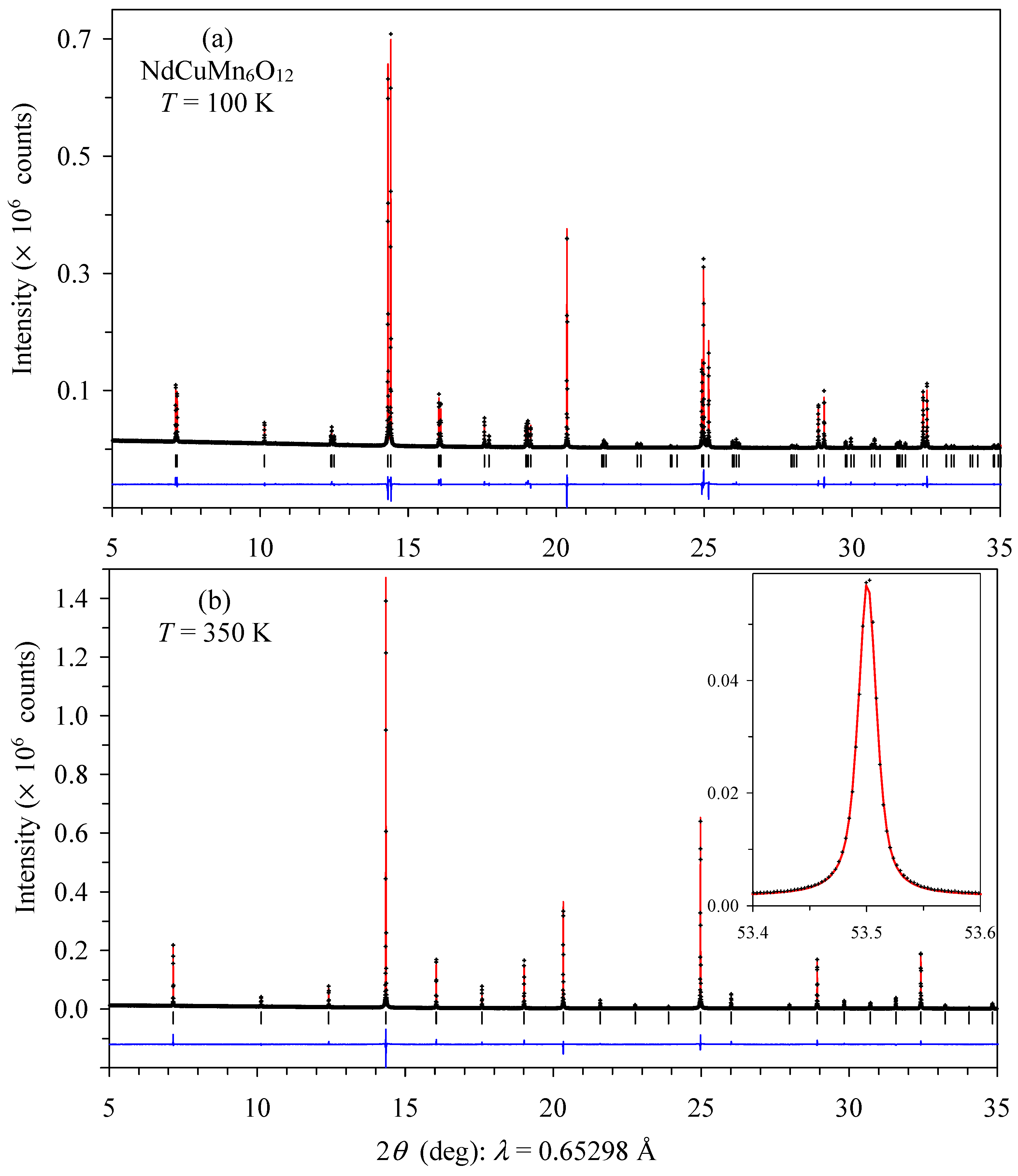
No impurity reflections were detected even on high-resolution, high-intensity synchrotron powder X-ray diffraction (XRD) data of the prepared NdCuMn6O12 samples confirming the high quality of the samples. However, room-temperature (RT) XRD data (laboratory and synchrotron) showed the presence of two phases, cubic Im-3 and trigonal R-3, because a structural phase transition temperature is very close to RT (292 K, see below). Therefore, we show synchrotron XRD patterns at 100 K and 350 K (not at RT) in Figure 1 to demonstrate the sample quality.
The crystal structures of NdCuMn6O12 were refined by the Rietveld method from synchrotron XRD data. The initial structural models were taken from CaMn7O12 [16]. Structural parameters of NdCuMn6O12 at some selected temperatures are summarized in Table 1 and Table 2. Experimental, calculated, and difference synchrotron XRD patterns of NdCuMn6O12 at 100 K and 350 K are shown in Figure 1. In the cubic Im-3 modification, reflections were very sharp and symmetrical (the inset of Figure 1b) indicating good crystallinity and homogeneity of the sample.
In the crystal structure analysis, Cu2+ cations were placed at the square-planar A′ site (together with Mn3+ cations) with a fixed occupation as 2/3Mn + 1/3Cu for the Mn1/Cu1 site. Previous structural studies of similar compounds with neutron powder diffraction (which can easily distinguish between Cu and Mn) showed that Cu2+ cations are always located at the A′ site due to the strong JT effect of Cu2+ cations [25,37,41,47,53,54]. For unknown reasons, the available synchrotron XRD data were not so sensitive to the location of Cu2+ cations in NdCuMn6O12 even though the Cu2+ and Mn3+ cations differ by five electrons (or about 20%). For example, the refined occupation factor of the Mn1 site (when only Mn was placed at this site) was g(Mn1) = 1.036(1) with refined B = 0.67(9) Å2 (using the 350 K data in the cubic modification because of the lower number of refined parameters). The obtained g value was within the sensitivity of the method (that is, not noticeably higher) as a similar value was obtained for the Nd site when refined (g(Nd) = 1.035(1) with refined B = 0.497(6) Å2). g(Mn2) was refined to be 0.983(1) with refined B = 0.289(8) Å2. Note that two other sets of synchrotron XRD data measured on different batches of NdCuMn6O12 (at T = 380 K with λ = 0.65298 Å) gave g(Nd) = 1.015(1), g(Mn1) = 1.045(2), and g(Mn2) = 1.000(2), and g(Nd) = 1.024(1), g(Mn1) = 1.044(1), and g(Mn2) = 1.014(1). In all cases, the occupation factor of the Mn1 site was slightly larger than that of the Mn2 site (when only Mn was placed at these sites).
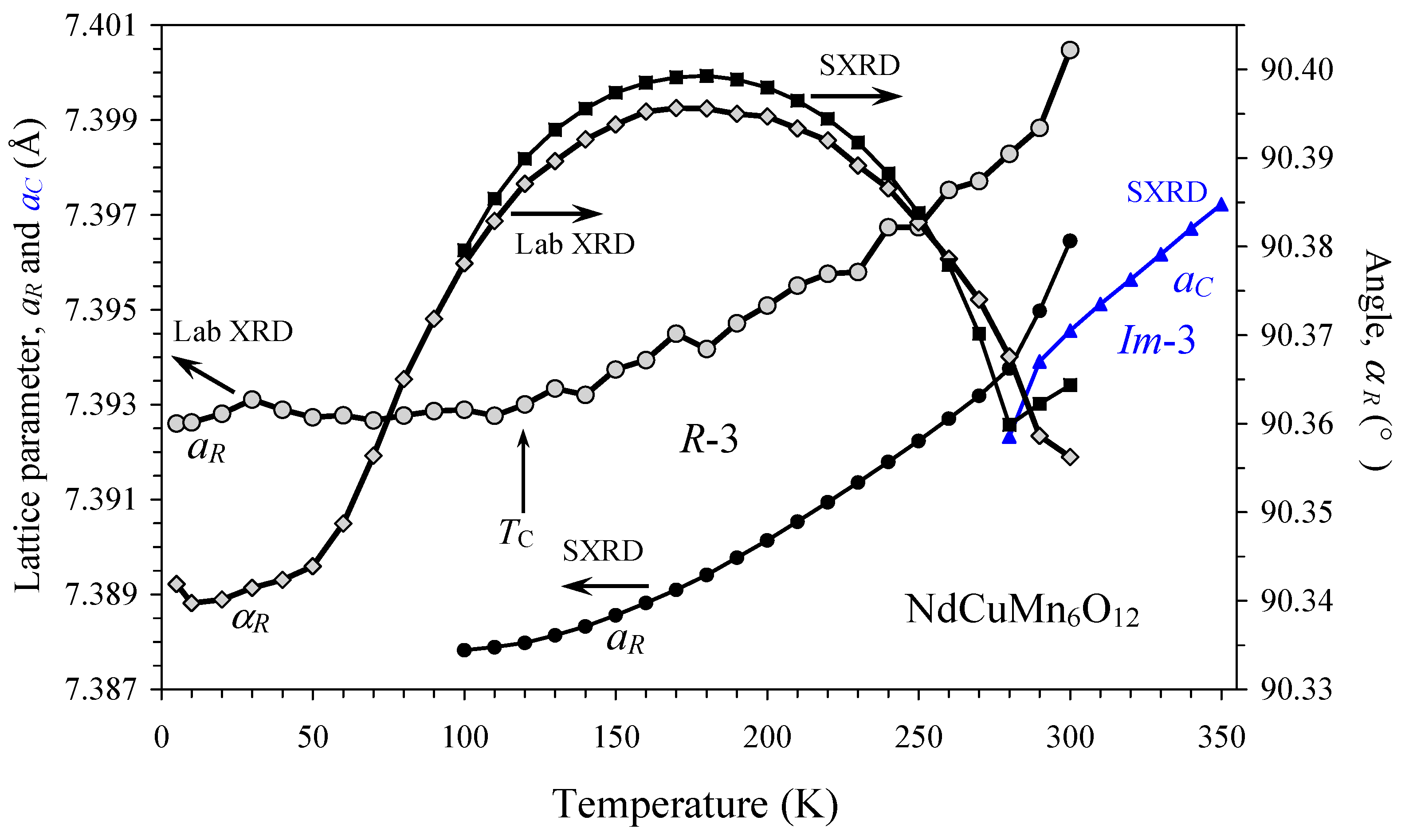
Figure 2 shows the temperature dependence of the lattice parameters obtained from laboratory and synchrotron XRD data (see also Tables S1 and S2). Note that the lattice parameters of the R-3 modification were transformed from the hexanogal axes (aH ≈ 10.5 Å and cH ≈ 6.36 Å) to the rhombohedral axes (aR ≈ 6.42 Å and αR ≈ 109.6°; aR = (aH × β)/3, αR = 2 × arcsin(1.5/β), β = (3 + (cH/aH)2)1/2) and then to a different cell choice in the rhombohedral axes (aR ≈ 7.40 Å and αR ≈ 90.3°) for the better comparison with the cubic Im-3 modification (aC ≈ 7.40 Å (and αC = 90°)). The two phases co-existed in a certain temperature range near RT indicating a phase transition of the first order. There were some differences in the aR parameter for the laboratory and synchrotron XRD data. These differences can be explained by different zero-shift parameters for different XRD sources (zero-shift parameters are usually very small for synchrotron XRD data) and by the fact that samples from different batches were used for the laboratory and synchrotron XRD measurements. The aR parameter gradually decreases with decreasing temperature and then becomes nearly temperature-independent below about 100 K. The rhombohedral angle αR shows a dome-like behavior between TCO (≈292 K) and 60 K, and its temperature behavior changes below 50 K, where it slightly decreases with decreasing temperature. No anomalies in the lattice parameters were observed at the first magnetic transition temperature (TC = 120 K, see below). The R-3 modification was found to be stable below TCO down to 5 K since no (new) modulation reflections were observed on laboratory XRD data down to 5 K and on high-resolution, high-intensity synchrotron XRD data down to 100 K within the sensitivity of both methods. Therefore, the structural behavior of NdCuMn6O12 is different from that of CaMn7O12 [10,16,17,18,19] below TCO.
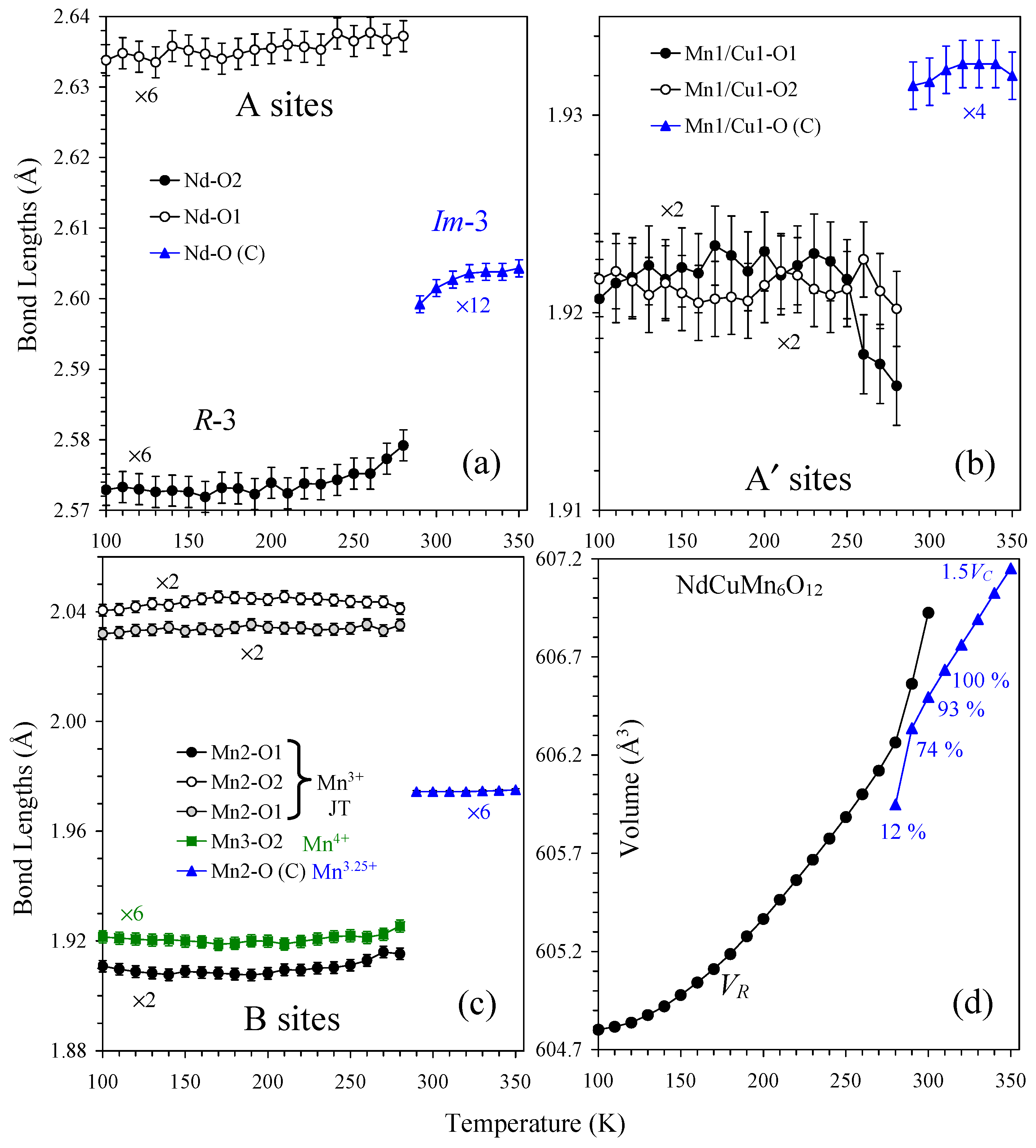
Figure 3 shows the temperature dependence of the bond lengths in NdCuMn6O12 in the R-3 and Im-3 modifications. The Im-3 modification has one crystallographic site for octahedral Mn cations. Therefore, this site should have an average oxidation state of +3.25. The bond-valence sum [55] value of +3.35 (at 350 K) supports the average value (for calculations we used R0 = 1.76 for all Mn). The R-3 modification has two crystallographic sites for octahedral Mn cations. One octahedral site (Mn3) has short Mn-O distances (which are all the same and, therefore, the octahedral distortion parameter is zero). Therefore, this site should be occupied by Mn4+. The bond-valence sum [55] value of +3.87 (at 270 K) supports this assignment. For the second octahedral site (Mn2), the MnO6 octahedra have an apically compressed geometry with four longer Mn-O distances and two shorter Mn-O distances (and the resulting octahedral distortion parameter was about 8.4 × 10⁻⁴). Such distortions are caused by the JT effect. This site should be occupied by Mn3+, and the bond-valence sum [55] value of +3.20 (at 270 K) supports this assignment. The same structural features take place in CaMn7O12 [16] below TCO. The bond-valence sum [55] values of the Nd sites remain nearly the same (+3.20 to +3.23) in the R-3 and Im-3 modifications. The larger values than expected indicate that Nd3+ cations are overbonded, and this fact could be a reason why NdMn7O12 [51] and NdCuMn6O12 need a high-pressure high-temperature method for their preparation. The bond lengths remain nearly the same at all temperatures (except in the vicinity of TCO). Therefore, the bond-valence sum values remain nearly constant at different temperatures. We note that the degree of charge separation [56] estimated by bond-valence sum calculations (about 66% in our case at 270 K) is always below ideal values as emphasized in the literature [23,56], and bond-valence calculations just indicate tendencies. The main reason seems to be the nature of bond-valence calculations as they are based on some average parameters obtained from the statistical analysis of many reported crystal structures. In principle, bond-valence parameters can be adjusted for specific materials and coordination numbers and environments. For example, in R3+MnO3 perovskites, where Mn definitely has the fixed oxidation state of +3 and strong JT distortions, the standard bond-valence calculations (with R0(Mn3+) = 1.76 [55]) give values from +3.12 to +3.21 even when structural parameters determined from neutron diffraction (with precise localization of oxygen atoms) are used [57]. The use of R0(Mn3+) = 1.74 gives bond-valence sums close to +3.0 in RMnO3 perovskites and in the Mn2 site of NdCuMn6O12 (for the R-3 modification).
The Mn-O bond lengths in NdCuMn6O12 in the R-3 modification are nearly temperature-independent (Figure 3). Therefore, the unusual JT distortions in NdCuMn6O12 do not experience any relaxation in comparison with CaMn7O12 [10,16]. However, the rhombohedral distortions/angles (Figure 2) first increased with decreasing temperature from 292 K to about 180 K in NdCuMn6O12; then they reduced on further cooling from 180 K down to 60 K producing the dome-like behavior of the temperature dependence of the rhombohedral angle. Below 60 K, the rhombohedral distortion/angle is nearly locked. This behavior could be related to unusual JT distortions and their tendency to be relaxed.
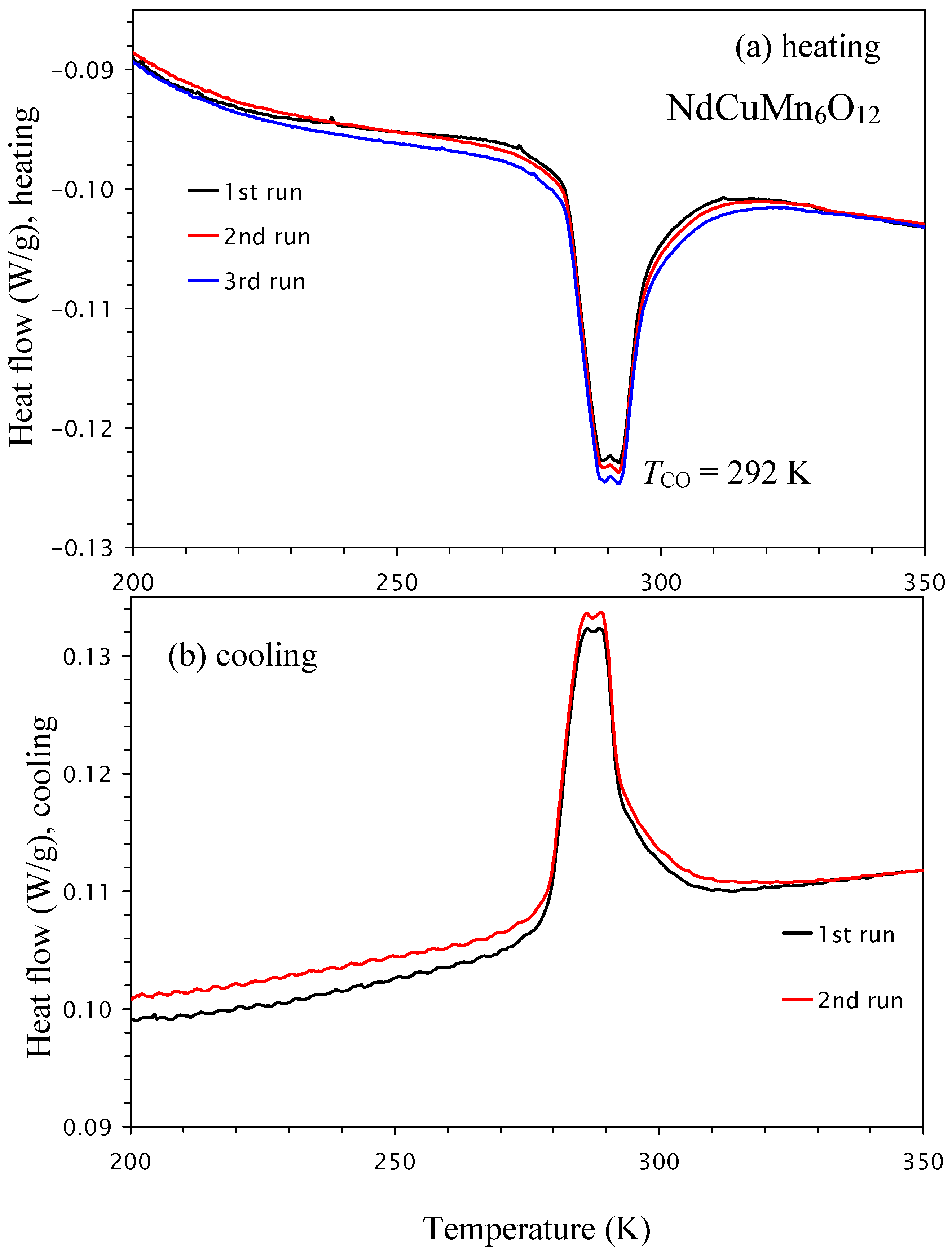
Structural behavior of NdCuMn6O12 was also investigated with differential scanning calorimetry (DSC) (Figure 4). NdCuMn6O12 showed sharp and strong DSC anomalies on both heating and cooling curves confirming the presence of a structural phase transition with TCO = 292 K (defined from peak positions on heating curves). DSC anomalies showed good reproducibility on cycling. The sample batch used in this study showed relatively strong and sharp DSC anomalies, and two peaks with nearly the same intensity were clearly resolved plus a shoulder was observed from a high-temperature side. This feature could indicate a phase separation, which was observed in NdCuxMn7−xO12 solid solutions with x = 0.1, 0.2, and 0.3 [52]. However, high-resolution synchrotron XRD data (the inset of Figure 1b) did not detect any evidence of a phase separation. Other batches of NdCuMn6O12 samples showed broader and weaker DSC anomalies (Figures S1 and S2), and no evidence of a phase separation could be seen from such DSC data. Therefore, if a phase separation is present, it is quite small.
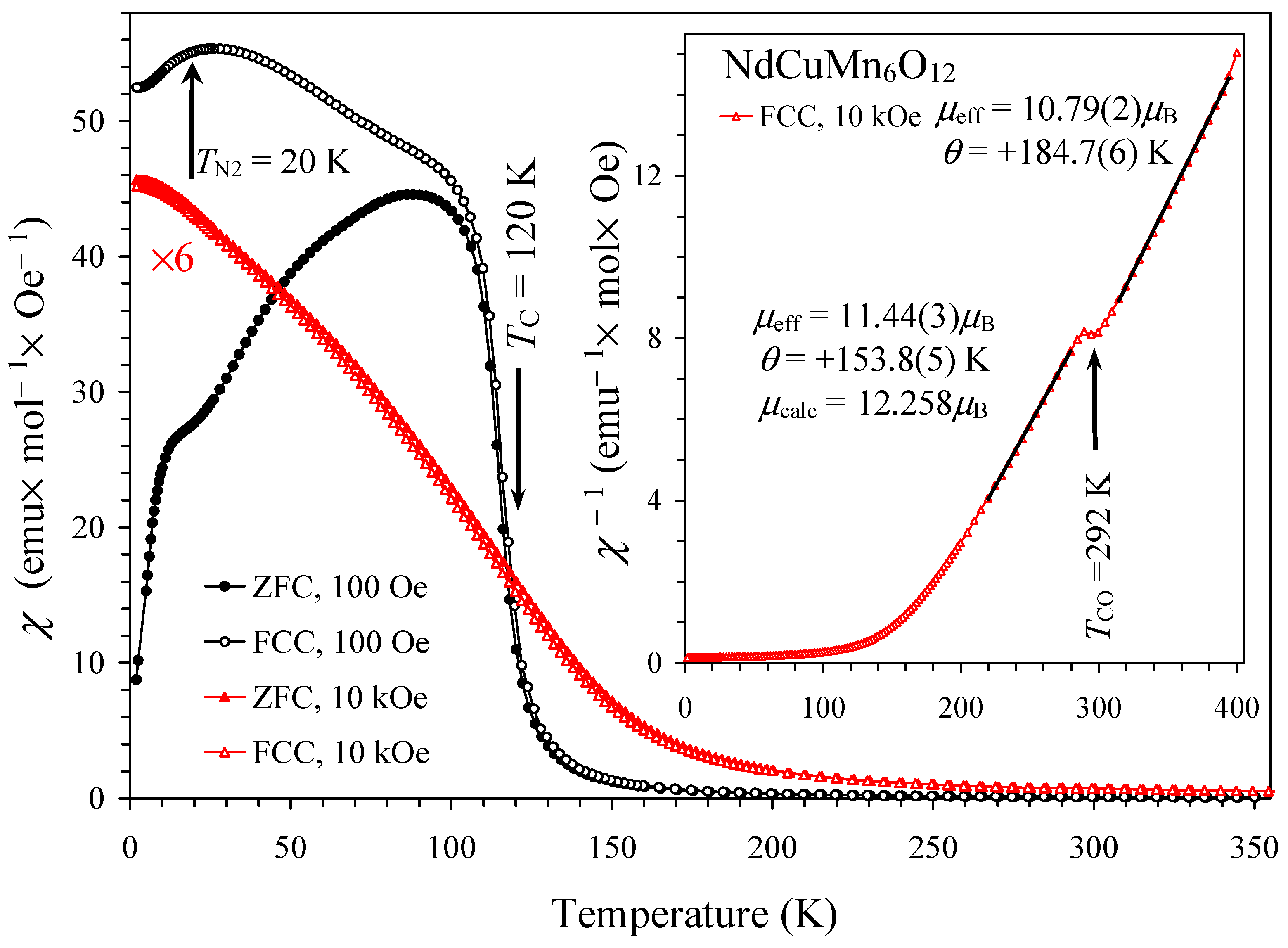
Figure 5 shows the direct current (dc) χ versus T curves of NdCuMn6O12 under magnetic fields H = 100 Oe and 10 kOe. There were two clear anomalies (at H = 100 Oe). The first strong anomaly was observed on both zero-field-cooled (ZFC) and field-cooled on cooling (FCC) curves near TC = 120 K due to a ferrimagnetic transition. TC was defined from the peak positions on differential curves (Figure S3). The second anomaly (near TN2 = 20 K) was quite broadened and was observed as a kink on the ZFC curve and a gradual decrease on the FCC curve. No clear anomalies could be seen at a large magnetic field of H = 10 kOe. Neutron diffraction studies of the undoped NdMn7O12 showed that a gradual small decrease on χ versus T curves is correlated with a gradual increase in the ordered moments on the Nd3+ sublattice [50,51], and the Nd3+ sublattice orders antiferromagnetically with the ferrimagnetic structure formed by the Mn3+ sublattices [50]. However, we note that the decrease on χ versus T curves was observed in NdMn7O12 below T3 ~ 8 K at higher magnetic fields (e.g., H = 10 kOe); at smaller magnetic fields (e.g., H = 100 Oe), the decrease already started below about 16 K. Therefore, we can assume that the second magnetic anomaly in NdCuMn6O12 also corresponds to the antiferromagnetic (AFM) ordering of the Nd3+ sublattice. A similar decrease in magnetic susceptibilities at low temperatures was observed in NdCuxMn7−xO12 solid solutions with x = 1.5−3 [40,41] and in NdCu3Mn3FeO12 [58]. Neutron diffraction studies of NdCu3Mn3FeO12 [58] also allowed suggesting AFM ordering of the Nd sublattice. However, a final conclusion about the origin of the low-temperature susceptibility drops at small magnetic fields and the second magnetic transition in NdCuMn6O12 can only be made from future neutron diffraction studies.
Magnetic anomalies were observed at the structural phase transition of TCO = 292 K, where they could be clearly seen as a sharp step on the inverse magnetic susceptibilities (the inset of Figure 5). The Curie–Weiss law was applied to obtain effective magnetic moments and Curie–Weiss temperatures. We fitted the FCC inverse magnetic susceptibilities (at H = 10 kOe) in the temperature ranges of 220–270 K and 320–395 K. The fitting parameters are reported in Figure 5. The Curie–Weiss temperature was positive indicating the predominant ferromagnetic (FM) interactions between magnetic ions. The Curie–Weiss temperature was larger in the Im-3 modification in comparison with the R-3 modification, while the effective magnetic moment was larger for the R-3 modification and closer to the expected value of 12.258 μB (for the calculation, we used 3.5 μB for Nd3+, 1.732 μB for Cu2+, 4.899 μB for Mn3+, and 3.873 μB for Mn4+ [59]). Similar behavior of inverse magnetic susceptibilities was observed in PrCuMn6O12 [43], CeCuMn6O12 [44], and BiCuMn6O12 [53,54].
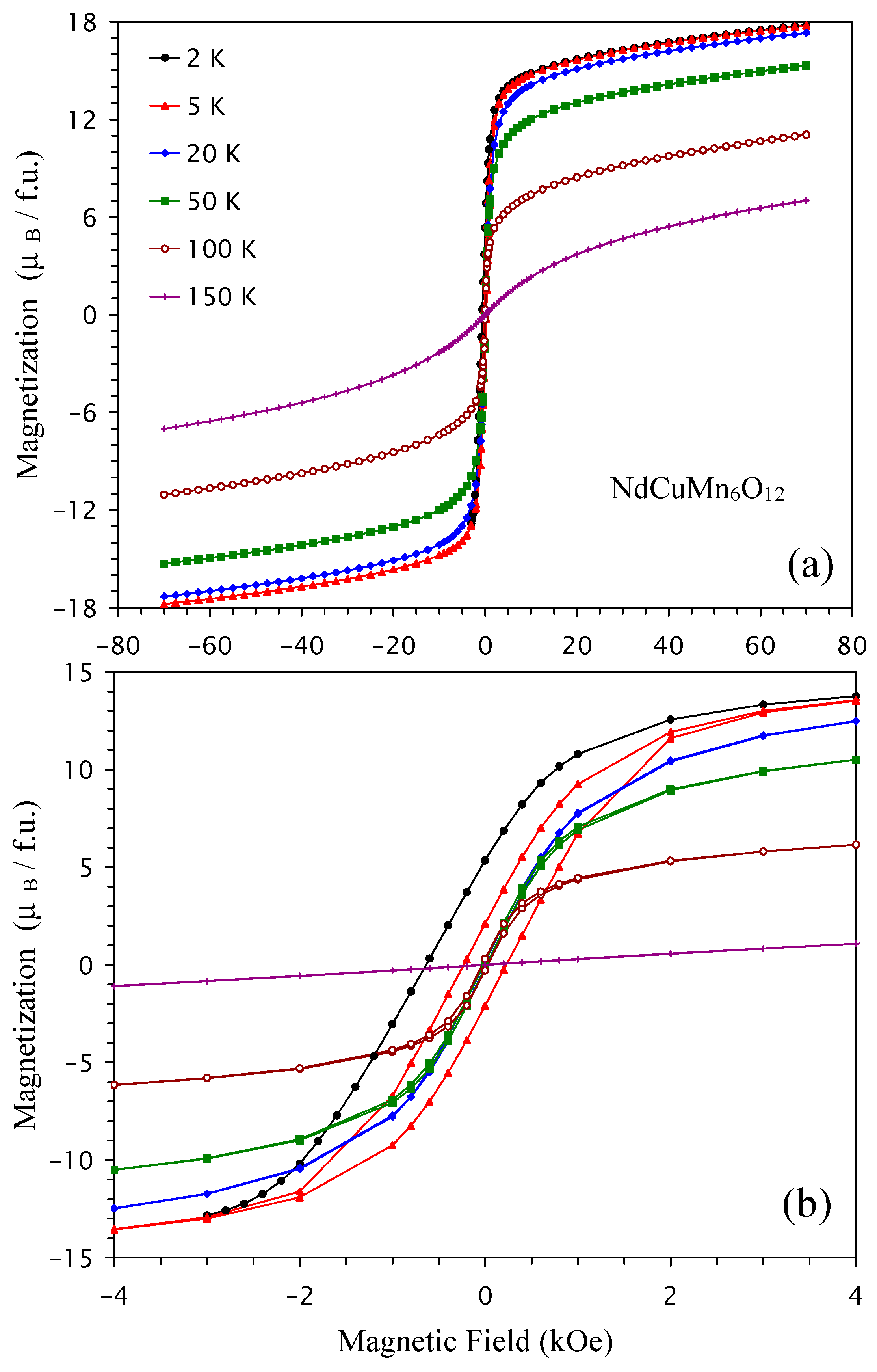
Isothermal magnetization curves (M versus H) at different temperatures are shown in Figure 6 and Figure S4. They were typical for ferrimagnets with well-defined hysteresis near the origin. However, they did not fully saturate and showed gradual continuous increases in magnetization at higher magnetic fields indicating contributions from AFM interactions. The coercive field was about 600 Oe at T = 2 K, 200 Oe at T = 5 K, and ~0 Oe at T = 20 K. The magnetization values reached ≈ 17.8 μB at T = 2 and 5 K (and at H = 70 kOe) and ≈17.3 μB at T = 20 K. These values are close to the expected values with the FM interactions between Cu2+ and all Mn3+ cations and AFM interactions with Mn4+ cations, (1 + 20 − 3) = 18 μB (1 μB is the maximum ordered moment of Cu2+, 4 μB is the maximum ordered moment of Mn3+, and 3 μB is the maximum ordered moment of Mn4+). Contributions from Nd3+ can be neglected as the ordered moments of Nd3+ are usually below 1 μB [50,58] and should be negligible at 20 K. In addition, similar saturation values were observed in CaCuxMn7−xO12 solid solutions with 1 ≤ x ≤ 2 [34], which do not have magnetic rare-earth cations, and in NdCuxMn7−xO12 solid solutions with x = 1.5 and 2 [40]. RCuxMn7−xO12 and CaCuxMn7−xO12 solid solutions have a tendency to show saturation behavior for large Cu contents and gradual continuous increases in magnetization for smaller Cu contents, such as x = 1 [34,40,44,47].
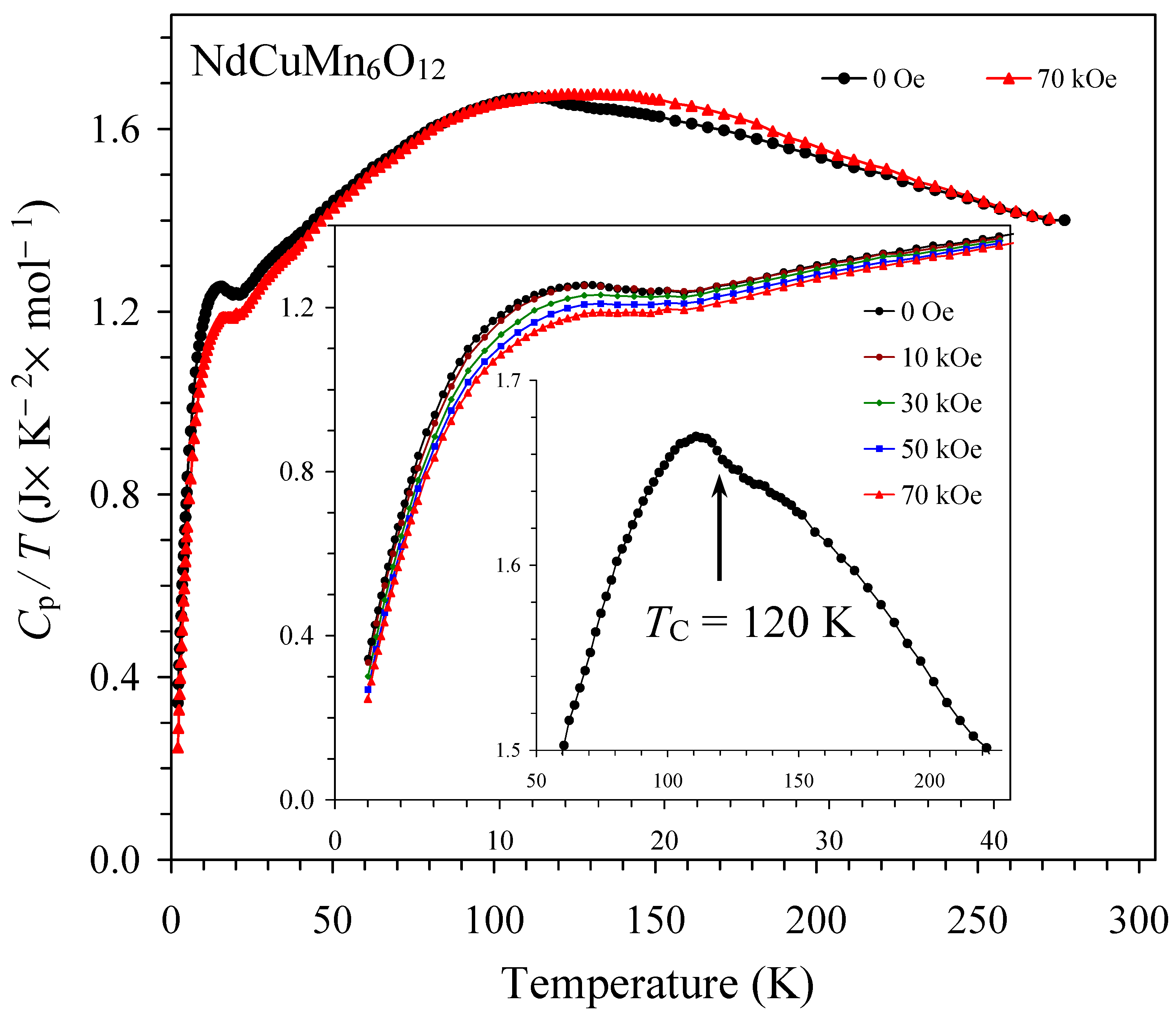
Specific heat measurements (Figure 7 and Figure S5) showed a very weak anomaly at TC = 120 K (the inset of Figure 7), while a stronger anomaly was found near TN2 = 20 K. Specific heat data unambiguously confirmed the presence of the second magnetic transition. Magnetic fields slightly suppressed specific heat anomalies at TN2 and completely smeared anomalies at TC and moved magnetic entropy to much higher temperatures. Such effects (near TC) are typical for FM and ferrimagnetic materials.
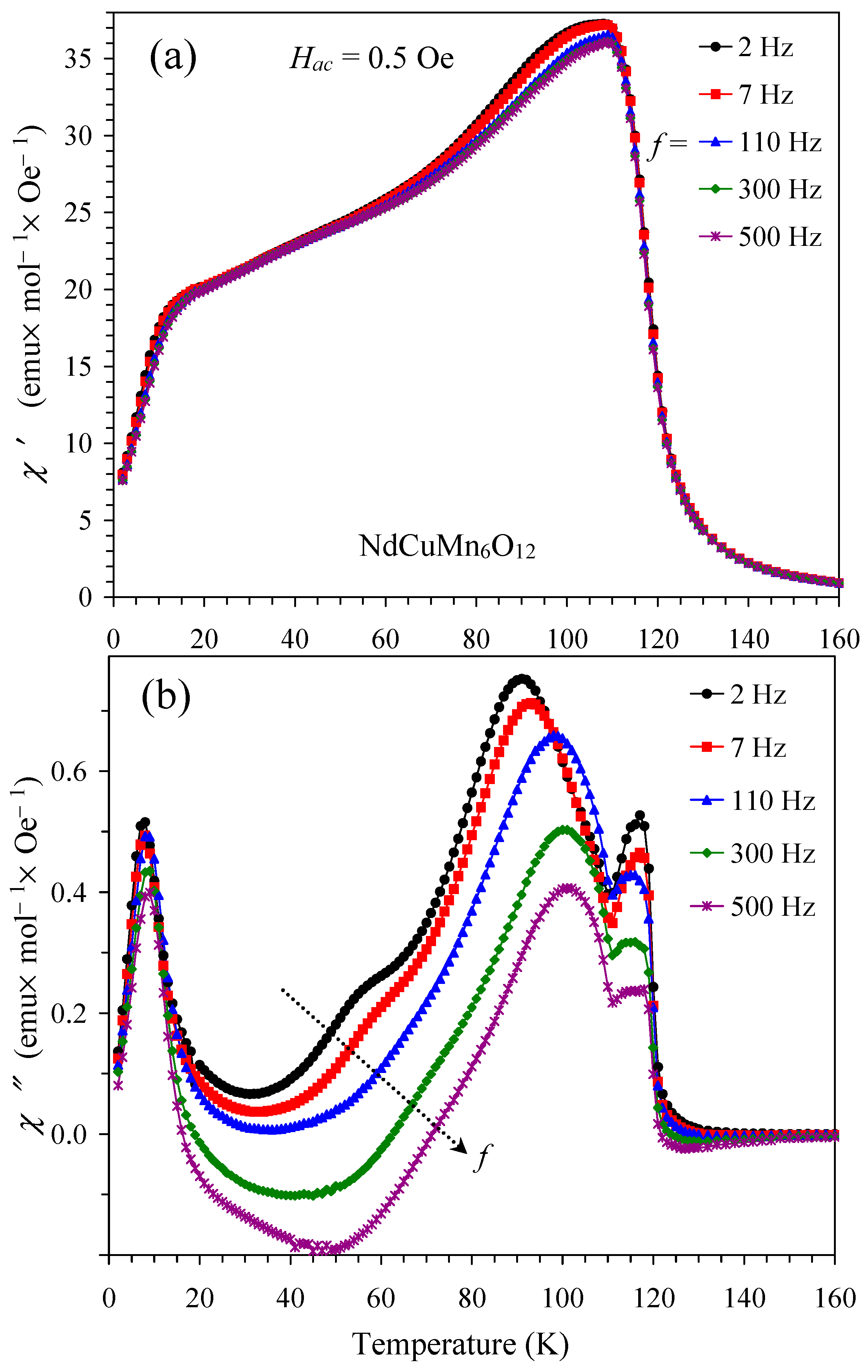
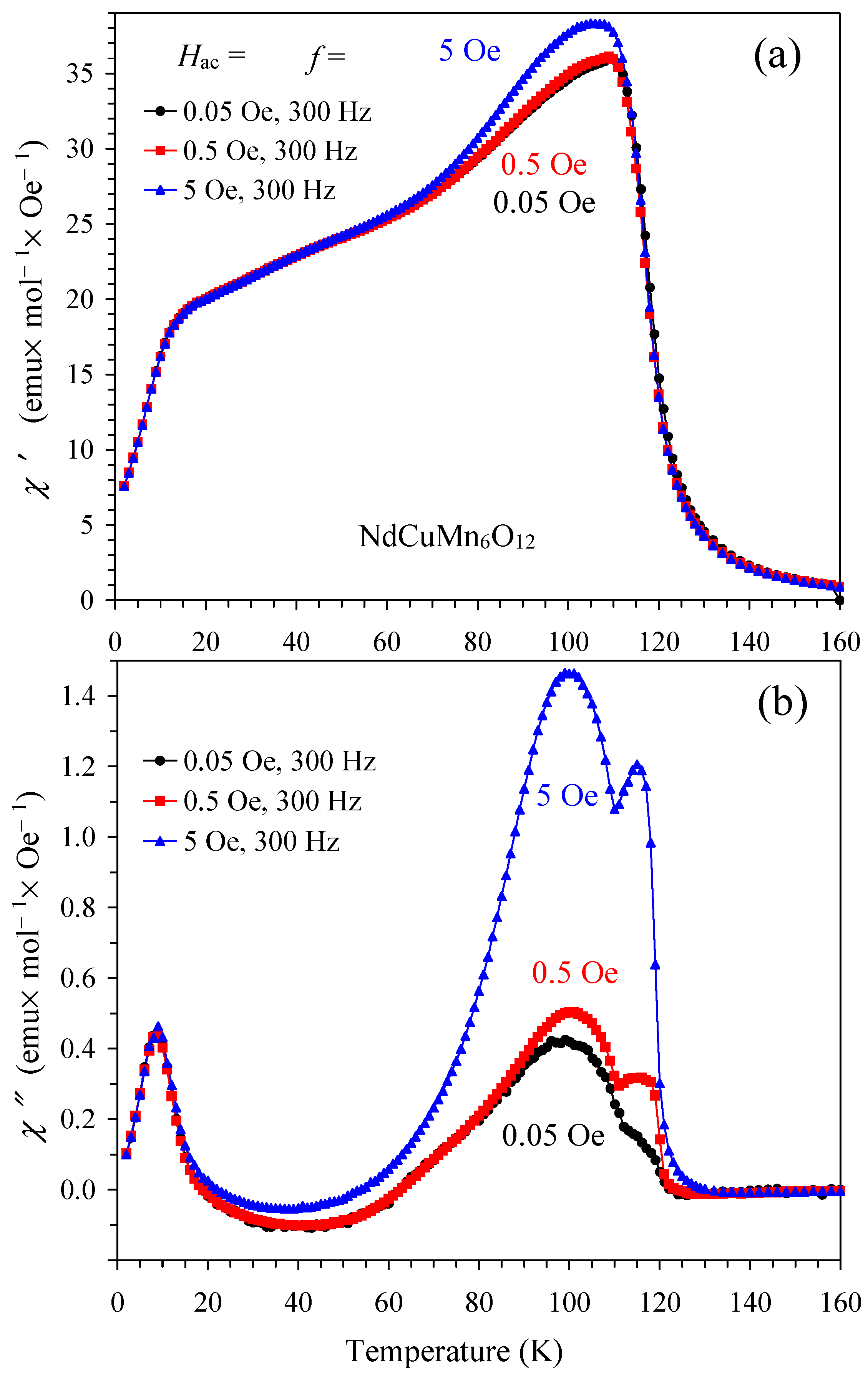
Ac susceptibility measurements were performed to get more information about the magnetic properties of NdCuMn6O12 (Figure 8, Figure 9 and Figure S6). Ac susceptibility curves were measured at different frequencies (Figure 8) and different ac fields (Figure 9). Some frequency dependence was observed on the χ′ versus T curves between about 60 and 110 K, while much stronger frequency dependence was observed on the χ′′ versus T curves between about 20 and 120 K. However, such frequency dependence was not caused by any spin-glass contributions; it was caused by interactions of the ac field with ferrimagnetic domain structures. Non-linear behavior (and the presence of interactions with domain structures) could be more clearly seen from the dependence on the ac field (Figure 9). The χ′ versus T curves showed sharp decreases below about 16 K with the appearance of peaks on the χ′′ versus T curves near 8–9 K. Anomalies below 20 K showed no dependence on the ac field, indicating the linear response. We note that very similar anomalies were observed below about 20 K in other members of the RCuMn6O12 series (for example, with R = Ce, Sm, and Dy [44]) especially on the χ′′ versus T curves. Therefore, their origin could be unrelated to rare-earth elements (Nd in this case) and to the presence of the second magnetic transition in NdCuMn6O12 at TN2.
The synthesis of NdCuMn6O12 was attempted in Ref. [41]. However, because of the presence of large amounts of Mn-containing impurities (NdMn2O5 and Mn2O3), the composition of the main perovskite phase was shifted to the Cu-rich side. As a result, the main perovskite phase remained cubic down to 5 K, and no structural phase transitions were observed. In addition, the magnetic transition temperature was observed at a noticeably higher temperature of 206 K in Ref. [41] (in comparison with 120 K for our sample); our estimation shows that such a transition corresponds to a NdCu1.4Mn5.6O12 composition. Our sample was single-phase, suggesting that the target composition was achieved, and our sample showed a structural transition from Im-3 symmetry (at high temperatures) to R-3 symmetry near 292 K. Such a structural transition was observed at 267 K in PrCuMn6O12 [43], at 297 K in CeCuMn6O12 [44], and at 296 K in BiCuMn6O12 [53,54].
AA′3Mn4O12-type perovskites with the 1:3 ratio of Mn4+/Mn3+ cations at the B sites show CO structural transitions from Im-3 symmetry (at high temperatures) to R-3 symmetry and compressed Mn3+O6 octahedra in the average structure of the R-3 modification, which is sometimes called an orbital disorder phase [23]. Relaxation of compressed Mn3+O6 octahedra occurs through different mechanisms on further cooling [10]. As mentioned in the introduction, AMn7O12 compounds with A = Ca, Sr, and Pb show incommensurately modulated structures, where Mn3+O6 octahedra become locally elongated [10,20]. CdMn7O12 shows a commensurately modulated structure (space group P-3), where a part of Mn3+O6 octahedra restores their typical JT distortions [10,20]. HgMn7O12 shows a polar orthorhombic distortion (space group Pnn2), an additional charge transfer, and the restoration of typical JT distortions of Mn3+O6 octahedra [23]. BiCuMn6O12 shows a unique re-entrant structural transition, where the R-3 modification collapses back to the cubic Im-3 modification on cooling [53,54]. CeCuMn6O12 demonstrated a phase separation below about 80 K [44]. Therefore, the apparent absence of any further structural transitions in NdCuMn6O12 may need a deeper understanding and further detailed structural characterizations at low temperatures, including more sensitive methods such as electron and neutron diffraction.

3. Materials and Methods

NdCuMn6O12 samples were prepared from stoichiometric mixtures of Nd2O3 (Rare Metallic Co., Tokyo, Japan, 99.9%), CuO (Rare Metallic Co., Tokyo, Japan, 99.9%), MnO2 (Alfa Aesar, Ward Hill, MA, USA, 99.99%), and Mn2O3. Single-phase Mn2O3 was prepared from a commercial MnO2 chemical (Rare Metallic Co., Tokyo, Japan, 99.99%) by annealing in air at 923 K for 24 h. The synthesis was performed at 6 GPa and at 1600 K for 2 h in sealed Pt capsules using a belt-type high-pressure (HP) instrument. After annealing at 1600 K, the samples were cooled down to room temperature (RT) by turning off the heating current, and the pressure was slowly released.
Laboratory powder X-ray diffraction (XRPD) data were collected at RT on a MiniFlex600 diffractometer (Rigaku, Tokyo, Japan) using CuKα radiation (2θ range of 10−80°, a step width of 0.02°, and scan speed of 2°/min). Low-temperature laboratory XRPD data were measured on a RIGAKU SmartLab instrument (CuKα1 radiation at 45 kV and 200 mA; 2θ range of 10−110°, a step width of 0.02°, and scan speed of 1°/min) from 5 K to 300 K (Bragg−Brentano geometry was used for all laboratory XRPD). Synchrotron XRPD data were measured on the BL15XU beamline (the former NIMS beamline) of SPring-8 [60] between 3.05° and 59.35° at 0.003° intervals in 2θ with the wavelength of λ = 0.65298 Å from 100 K to 350 K. The sample was placed into an open Lindemann glass capillary tube (inner diameter: 0.1 mm), which was rotated during measurements. The Rietveld analysis of all XRPD data was performed using the RIETAN-2000 program [61].
Magnetic measurements were performed on a SQUID magnetometer (Quantum Design MPMS-XL-7T, San Diego, CA, USA) between 2 K and 350–400 K in applied fields of 100 Oe and 10 kOe under both zero-field-cooled (ZFC) and field-cooled on cooling (FCC) conditions. Magnetic-field dependence was measured at different temperatures between −70 and 70 kOe. Frequency-dependent alternating current (ac) susceptibility measurements were performed on cooling with a MPMS-1T instrument (Quantum Design, San Diego, CA, USA) at zero static dc field and at different frequencies (f) and different applied oscillating magnetic fields (Hac).
Specific heat, Cp, was measured on cooling from 270 K to 2 K at zero magnetic field and 70 kOe and from 40 K to 2 K at H = 10, 30, and 50 kOe by a pulse relaxation method using a commercial calorimeter (Quantum Design PPMS, San Diego, CA, USA). All magnetic and specific heat measurements were performed using pieces of pellets.
Differential scanning calorimetry (DSC) curves of a powder sample (29.40 mg) were recorded on a Mettler Toledo DSC1 STARe system (Columbus, OH, USA) between 173 K and 423 K in open Al capsules with a heating/cooling rate of 10 K/min. Three DSC runs were performed to check the reproducibility.
All the above measurements (except low-temperature laboratory XRPD because such an experiment required a relatively large amount of a sample) were performed using the same batch of the prepared sample.

4. Conclusions

In conclusion, the A-site-ordered quadruple perovskite NdCuMn6O12, with the presence of Mn4+/Mn3+ cations with the 1:3 ratio at the B perovskite sites and therefore resembling CaMn7O12, was prepared by a high-pressure high-temperature method. A first-order structural phase transition from Im-3 symmetry (at high temperatures) to R-3 symmetry was found near TCO = 292 K accompanied by charge ordering and orbital ordering with unusual apically compressed Jahn–Teller distortions of MnO6 octahedra. In comparison with CaMn7O12, no additional structural transitions were found in NdCuMn6O12 within the sensitivity of the used methods, indicating that compressed Jahn–Teller distortions were not relaxed. NdCuMn6O12 shows a ferrimagnetic transition below 120 K, and the second magnetic transition near 20 K was found in NdCuMn6O12.

Supplementary Materials

The following supporting information can be downloaded at: https://www.mdpi.com/article/10.3390/inorganics14070174/s1, Figure S1 and Figure S2: Differential scanning calorimetry (DSC) curves of a different batch of NdCuMn6O12 on (a) heating and (b) cooling. Three DSC runs were performed (and shown) to check the reproducibility. The peaks were broader in comparison with a sample used in the main text. The inset on (b) shows the shape of cubic reflections ((6 8 2) and (10 2 0)) of synchrotron XRD data (at T = 380 K with λ = 0.65298 Å) for this sample; axes: intensity (counts/106) versus 2θ (°); Figure S3: Magnetic properties of NdCuMn6O12. (a) Zero-field-cooled (ZFC: filled curves) and field-cooled on cooling (FCC: empty curves) curves are shown at H = 5 Oe (black curves). A different (compared with the main text) FCC curve at H = 100 Oe is shown in blue. The inset shows differential curves, dχ/dT versus T. (b) The ZFC and FCC dχ/dT versus T curves at H = 10 kOe (red curves); Figure S4: Magnetic properties of NdCuMn6O12: M versus H curves at T = 150, 200, 250, and 300 K; Figure S5: Specific heat data of NdCuMn6O12 (the same batch as used in the main text) in a high-temperature region plotted as Cp versus T (the left-hand axis) and Cp/T versus T (the right-hand axis) at H = 0 Oe on heating (red and pink) and cooling (blue) with a step of 2 K. An H Apiezon grease was used for a better thermal contact between the sample and a sample holder. An addenda contribution was measured with a step of 4 K. Specific heat measurements are in agreement with the DSC measurements (Figure 4) and show a double-peak feature; Figure S6: (a) The χ′ versus T and (b) χ′′ versus T curves of a different batch of NdCuMn6O12 at different frequencies (f = 2, 7, 25, 110, 500 Hz) measured with Hac = 0.5 Oe and Hdc = 0 Oe using MPMS3; Table S1 and Table S2: Numerical data used to plot Figure 2.

Author Contributions

Conceptualization, A.A.B.; methodology, A.A.B.; validation, A.A.B.; formal analysis, A.A.B.; investigation, A.A.B., R.L., L.Z., Y.M. and K.Y.; resources, K.Y.; data curation, A.A.B.; writing—original draft preparation, A.A.B.; writing—review and editing, A.A.B.; supervision, A.A.B. and K.Y.; project administration, A.A.B.; funding acquisition, K.Y. All authors have read and agreed to the published version of the manuscript.

Funding

This work was partially supported by a Grant-in-Aid for Scientific Research (No. JP25K01657) from the Japan Society for the Promotion of Science.

Institutional Review Board Statement

Not applicable.

Informed Consent Statement

Not applicable.

Data Availability Statement

The original contributions presented in this study are included in the article/Supplementary Materials. Further inquiries can be directed to the corresponding author.

Acknowledgments

The synchrotron radiation experiments were conducted at the former NIMS beamline (BL15XU) of SPring-8 with the approval of the former NIMS Synchrotron X-ray Station (proposal numbers: 2016B4504, 2019B4500, and 2020A4501). We thank M. Tanaka and Y. Katsuya for their help at SPring-8. MANA was supported by the World Premier International Research Center Initiative (WPI), MEXT, Japan.

Conflicts of Interest

The authors declare no conflicts of interest.

References

  1. Wollan, E.O.; Koehler, W.C. Neutron diffraction study of the magnetic properties of the series of perovskite-type compounds [(1 −x)La, xCa]MnO3. Phys. Rev. 1955, 100, 545–563. [Google Scholar] [CrossRef]
  2. Goodenough, J.B. Theory of the role of covalence in the perovskite-type manganites [La, M(II)]MnO3. Phys. Rev. 1955, 100, 564–573. [Google Scholar] [CrossRef]
  3. Salamon, M.B.; Jaime, M. The Physics of magnanites: Structure and transport. Rev. Mod. Phys. 2001, 73, 583–628. [Google Scholar] [CrossRef]
  4. Edwards, D.M. Ferromagnetism and electron-phonon coupling in the manganites. Adv. Phys. 2002, 51, 1259–1318. [Google Scholar] [CrossRef]
  5. Coey, J.M.D.; Viret, M.; von Molnar, S. Mixed-valence manganites. Adv. Phys. 2009, 58, 571–697. [Google Scholar] [CrossRef]
  6. Martin, C.; Maignan, A.; Hervieu, M.; Raveau, B. Magnetic phase diagrams of L1−xAxMnO3 manganites (L = Pr,Sm; A = Ca,Sr). Phys. Rev. B 1999, 60, 12191–12199. [Google Scholar]
  7. Vasil’ev, A.N.; Volkova, O.S. New functional materials AC3B4O12 (Review). Low. Temp. Phys. 2007, 33, 895–914. [Google Scholar] [CrossRef]
  8. Long, Y. A-site ordered quadruple perovskite oxides AA’3B4O12. Chin. Phys. B 2016, 25, 078108. [Google Scholar] [CrossRef]
  9. Ding, J.; Zhu, X.H. Research progress on quadruple perovskite oxides. J. Mater. Chem. C 2024, 12, 9510–9561. [Google Scholar] [CrossRef]
  10. Belik, A.A.; Johnson, R.D.; Khalyavin, D.D. The rich physics of A-site-ordered quadruple perovskite manganites AMn7O12. Dalton Trans. 2021, 50, 15458–15472. [Google Scholar] [CrossRef] [PubMed]
  11. Solana-Madruga, E.; Arevalo-Lopez, A.M. High-pressure A-site manganites: Structures and magnetic properties. J. Solid State Chem. 2022, 315, 123470. [Google Scholar] [CrossRef]
  12. Prodi, A.; Gilioli, E.; Gauzzi, A.; Licci, F.; Marezio, M.; Bolzoni, F.; Huang, Q.; Santoro, A.; Lynn, J.W. Charge orbital and spin ordering phenomena in the mixed valence manganite (NaMn3+3)(Mn3+2Mn4+2)O12. Nat. Mater. 2004, 3, 48–52. [Google Scholar] [PubMed]
  13. Prodi, A.; Daoud-Aladine, A.; Gozzo, F.; Schmitt, B.; Lebedev, O.; van Tendeloo, G.; Gilioli, E.; Bolzoni, F.; Aruga-Katori, H.; Takagi, H.; et al. Commensurate structural modulation in the charge- and orbitally ordered phase of the quadruple perovskite (NaMn3)Mn4O12. Phys. Rev. B 2014, 90, 180101. [Google Scholar] [CrossRef]
  14. Bochu, B.; Chenavas, J.; Joubert, J.C.; Marezio, M. High pressure synthesis and crystal structure of a new series of perovskite-like compounds CMn7O12 (C = Na, Ca, Cd, Sr, La, Nd). J. Solid State Chem. 1974, 11, 88–93. [Google Scholar] [CrossRef]
  15. Horowitz, H.S.; Longo, J.M. Phase relations in the Ca-Mn-O system. Mater. Res. Bull. 1978, 13, 1359–1369. [Google Scholar] [CrossRef]
  16. Bochu, B.; Buevoz, J.L.; Chenavas, J.; Collomb, A.; Joubert, J.C.; Marezio, M. Bond lengths in [CaMn3](Mn4)O12: A new Jahn–Teller distortion of Mn3+ octahedral. Solid State Commun. 1980, 36, 133–138. [Google Scholar] [CrossRef]
  17. Johnson, R.D.; Chapon, L.C.; Khalyavin, D.D.; Manuel, P.; Radaelli, P.G.; Martin, C. Giant improper ferroelectricity in the ferroaxial magnet CaMn7O12. Phys. Rev. Lett. 2012, 108, 067201. [Google Scholar] [CrossRef] [PubMed]
  18. Johnson, R.D.; Khalyavin, D.D.; Manuel, P.; Bombardi, A.; Martin, C.; Chapon, L.C.; Radaelli, P.G. Modulated spin helicity stabilized by incommensurate orbital density waves in a quadruple perovskite manganite. Phys. Rev. B 2016, 93, 180403. [Google Scholar] [CrossRef]
  19. Perks, N.J.; Johnson, R.D.; Martin, C.; Chapon, L.C.; Radaelli, P.G. Magneto-orbital helices as a route to coupling magnetism and ferroelectricity in multiferroic CaMn7O12. Nat. Commun. 2012, 3, 1277. [Google Scholar] [CrossRef] [PubMed]
  20. Johnson, R.D.; Khalyavin, D.D.; Manuel, P.; Radaelli, P.G.; Glazkova, I.S.; Terada, N.; Belik, A.A. Magneto-orbital ordering in the divalent A-site quadruple perovskite manganites AMn7O12 (A = Sr, Cd, and Pb). Phys. Rev. B 2017, 96, 054448. [Google Scholar] [CrossRef]
  21. Locherer, T.; Dinnebier, R.; Kremer, R.K.; Greenblatt, M.; Jansen, M. Synthesis and properties of a new quadruple perovskite: A-site-ordered PbMn3Mn4O12. J. Solid State Chem. 2012, 190, 277–284. [Google Scholar] [CrossRef]
  22. Ovsyannikov, S.V.; Abakumov, A.M.; Tsirlin, A.A.; Schnelle, W.; Egoavil, R.; Verbeeck, J.; Van Tendeloo, G.; Glazyrin, K.V.; Hanfland, M.; Dubrovinsky, L. Perovskite-like Mn2O3: A path to new manganites. Angew. Chem. Int. Ed. 2013, 52, 1494–1498. [Google Scholar] [CrossRef]
  23. Chen, W.T.; Wang, C.W.; Wu, H.C.; Chou, F.C.; Yang, H.D.; Simonov, A.; Senn, M.S. Improper ferroelectric polarization in a perovskite driven by intersite charge transfer and ordering. Phys. Rev. B 2018, 97, 144102. [Google Scholar] [CrossRef]
  24. Troyanchuk, I.O.; Balyko, L.V.; Bashkirov, L.A. Crystal structure phase transitions in the perovskites A(Cu1−xMnx)Mn4O12 (A = Na+, Ca2+, Y3+, La3+). Cryst. Res. Technol. 1986, 21, 705–710. [Google Scholar] [CrossRef]
  25. Slawinski, W.; Przenioslo, R.; Sosnowska, I.; Bieringer, M.; Margiolaki, I.; Fitch, A.N.; Suard, E. Phase coexistence in CaCuxMn7−xO12 solid solutions. J. Solid State Chem. 2006, 179, 2443–2451. [Google Scholar]
  26. Slawinski, W.; Przenioslo, R.; Sosnowska, I.; Bieringer, M.; Margiolaki, I.; Fitch, A.N.; Suard, E. Charge ordering in CaCuxMn7−xO12 (x = 0.0 and 0.1) compounds. J. Phys. Condens. Matter 2008, 20, 104239. [Google Scholar]
  27. Slawinski, W.; Przenioslo, R.; Sosnowska, I.; Bieringer, M. Structural and magnetic modulations in CaCuxMn7−xO12. J. Phys. Condens. Matter 2010, 22, 186001. [Google Scholar] [PubMed]
  28. Sławiński, W.; Przeniosło, R.; Sosnowska, I.; Bieringer, M.; Margiolakic, I.; Suard, E. Modulation of atomic positions in CaCuxMn7−xO12 (x ≤ 0.1). Acta Crystallogr. Sec. B 2009, 65, 535–542. [Google Scholar] [CrossRef] [PubMed]
  29. Slawinski, W.; Przenioslo, R.; Sosnowska, I.; Petrícek, V. Helical screw type magnetic structure of the multiferroic CaMn7O12 with low Cu-doping. Acta Crystallogr. Sec. B 2012, 68, 240–249. [Google Scholar]
  30. Glazkova, I.S.; Rusakov, V.S.; Sobolev, A.V.; Matsnev, M.E.; Gapochka, A.M.; Gubaidulina, T.V.; Presniakov, I.A. Probe Mössbauer diagnostics of charge ordering in manganites CaCuxMn7−xO12 (0 ≤ x ≤ 1). J. Exp. Theor. Phys. 2019, 129, 1017–1028. [Google Scholar] [CrossRef]
  31. Chenavas, J.; Joubert, M.; Marezio, J.C.; Bochu, B. The synthesis and crystal structure of CaCu3Mn4O12: A new ferromagnetic-perovskite-like compound. J. Solid State Chem. 1975, 14, 25–32. [Google Scholar] [CrossRef]
  32. Zeng, Z.; Greenblatt, M.; Subramanian, M.A.; Croft, M. Large low-field magnetoresistance in perovskite-type CaCu3Mn4O12 without double exchange. Phys. Rev. Lett. 1999, 82, 3164–3167. [Google Scholar] [CrossRef]
  33. Sánchez-Benítez, J.; Prieto, C.; de Andrés, A.; Alonso, J.A.; Martínez-Lope, M.J.; Casais, M.T. Evidence of two different states in CaCu3Mn4O12 derivatives with colossal magnetoresistance. Phys. Rev. B 2004, 70, 024419. [Google Scholar] [CrossRef]
  34. Zhang, Q.; Bréard, Y.; Guillou, F.; Hardy, V. Investigation of the magnetocaloric effect in double distorted perovskites Ca(Cu3−xMnx)Mn4O12 (1 ≤ x ≤ 2): From standard ferrimagnetism to glassy ferrimagnetism. Phys. Rev. B 2011, 84, 224430. [Google Scholar] [CrossRef]
  35. Volkova, O.; Goodilin, E.; Vasiliev, A.; Khomskii, D.; Tristan, N.; Kerschl, P.; Skourski, Y.; Mueller, K.-H.; Buechner, B. CaCuMn6O12 vs. CaCu2Mn5O12: A comparative study. J. Exp. Theor. Phys. Lett. 2005, 82, 642–645. [Google Scholar] [CrossRef]
  36. Zeng, Z.; Greenblatt, M.; Sunstrom, J.E.; Croft, M.; Khalid, S. Giant magnetoresistance in CaCu3Mn4O12-based oxides with perovskite-type structure. J. Solid State Chem. 1999, 147, 185–198. [Google Scholar] [CrossRef]
  37. Sánchez-Benítez, J.; Alonso, J.A.; Martínez-Lope, M.J.; Casais, M.T.; Martínez, J.L.; de Andrés, A.; Fernández-Díaz, M.T. Preparation, crystal and magnetic structure, and magnetotransport properties of the double perovskite CaCu2.5Mn4.5O12. Chem. Mater. 2003, 15, 2193–2200. [Google Scholar] [CrossRef]
  38. Yamada, I. Novel catalytic properties of quadruple perovskites. Sci. Tech. Adv. Mater. 2017, 18, 541–548. [Google Scholar] [CrossRef] [PubMed]
  39. Samaras, D.; Bochu, B.; Joubert, J.C. Synthesis, composition, and magnetic properties of the ferrimagnetic NdCu3−xMn4+xO12 perovskite-like phases. J. Solid State Chem. 1984, 53, 323–328. [Google Scholar] [CrossRef]
  40. Zhang, Q.; Bréard, Y.; Hardy, V. Spin-glass-like state and reversible room-temperature magnetocaloric effect in double distorted perovskites Nd(Cu3−xMnx)Mn4O12. Inorg. Chem. 2022, 61, 5792–5799. [Google Scholar] [CrossRef] [PubMed]
  41. Retuerto, M.; Martínez-Lope, M.J.; Sánchez-Benítez, J.; García-Hernández, M.; Fernández-Díaz, M.T.; Alonso, J.A. Synthesis, magnetic properties, and neutron diffraction study of the complex perovskites R(Cu3−xMnx)Mn4O12 (R = Pr, Nd and x = 1, 2). J. Appl. Phys. 2010, 108, 083905. [Google Scholar] [CrossRef]
  42. Sánchez-Benítez, J.; Alonso, J.A.; Falcón, H.; Martínez-Lope, M.J.; de Andrés, A.; Fernández-Díaz, M.T. Preparation under high pressures and neutron diffraction study of new ferromagnetic RCu3Mn4O12 (R = Pr, Sm, Eu, Gd, Dy, Ho, Tm, Yb) perovskites. J. Phys. Condens. Matter. 2005, 17, S3063. [Google Scholar] [CrossRef]
  43. Zhang, W.; Yao, L.D.; Yang, L.X.; Liu, Z.X.; Jin, C.Q.; Yu, R.C. Charge ordering in PrCuMn6O12 and its behavior under pressure. J. Appl. Phys. 2010, 107, 023914. [Google Scholar] [CrossRef]
  44. Zhang, L.; Matsushita, Y.; Katsuya, Y.; Tanaka, M.; Yamaura, K.; Belik, A.A. Charge and orbital orders and structural instability in high-pressure quadruple perovskite CeCuMn6O12. J. Phys. Condens. Matter. 2018, 30, 074003. [Google Scholar] [CrossRef] [PubMed]
  45. Sanchez-Benitez, J.; Alonso, J.A.; de Andres, A.; Martinez-Lope, M.J.; Martinez, J.L.; Munoz, A. Peculiar magnetic behavior of the TbCu3Mn4O12 complex perovskite. Chem. Mater. 2005, 17, 5070–5076. [Google Scholar]
  46. Alonso, J.A.; Sánchez-Benítez, J.; de Andrés, A.; Martínez-Lope, M.J.; Casais, M.T.; Martínez, J.L. Enhanced magnetoresistance in the complex perovskite LaCu3Mn4O12. Appl. Phys. Lett. 2003, 83, 2623–2625. [Google Scholar] [CrossRef]
  47. Muñoz, A.; Martínez-Lope, M.J.; Retuerto, M.; Falcón, H.; Alonso, J.A. Ferromagnetic behavior in La(Cu3−xMnx)Mn4O12 (x = 1, 2) perovskites. J. Appl. Phys. 2008, 104, 083911. [Google Scholar] [CrossRef]
  48. Sanchez-Benitez, J.; Alonso, J.A.; Martinez-Lope, M.J.; de Andres, A.; Fernandez-Diaz, M.T. Enhancement of the Curie temperature along the perovskite series RCu3Mn4O12 driven by chemical pressure of R3+ cations (R = rare rarths). Inorg. Chem. 2010, 49, 5679–5685. [Google Scholar] [PubMed]
  49. Sánchez-Benítez, J.; Martínez-Lope, M.J.; Alonso, J.A. Preparation at moderate pressures, crystal and magnetic structure and magnetotransport of the ferrimagnetic CeCu3Mn4O12 perovskite. J. Appl. Phys. 2010, 107, 103904. [Google Scholar] [CrossRef]
  50. Johnson, R.D.; Khalyavin, D.D.; Manuel, P.; Zhang, L.; Yamaura, K.; Belik, A.A. Magnetic structures of the rare-earth quadruple perovskite manganites RMn7O12. Phys. Rev. B 2018, 98, 104423. [Google Scholar] [CrossRef]
  51. Belik, A.A.; Liu, R.; Zhang, L.; Terada, N.; Tanaka, M.; Yamaura, K. Multiple magnetic transitions and complex magnetic behaviour of the perovskite manganite NdMn7O12. J. Solid State Chem. 2022, 309, 122969. [Google Scholar] [CrossRef]
  52. Belik, A.A.; Liu, R.; Yamaura, K. Phase separation phenomena in lightly Cu-doped A-site-ordered quadruple perovskite NdMn7O12. Molecules 2025, 30, 4561. [Google Scholar] [CrossRef] [PubMed]
  53. Belik, A.A.; Matsushita, Y.; Khalyavin, D.D. Reentrant structural transitions and collapse of charge and orbital orders in quadruple perovskites. Angew. Chem. Int. Ed. 2017, 56, 10423. [Google Scholar] [CrossRef] [PubMed]
  54. Belik, A.A.; Matsushita, Y.; Tanaka, M.; Johnson, R.D.; Khalyavin, D.D. A plethora of structural transitions, distortions and modulations in Cu-doped BiMn7O12 quadruple perovskites. J. Mater. Chem. C 2021, 9, 10232–10242. [Google Scholar] [CrossRef]
  55. Brese, N.E.; O’Keeffe, M. Bond-valence parameters for solids. Acta Crystallogr. Sec. B 1991, 47, 192–197. [Google Scholar] [CrossRef]
  56. Attfield, J.P. Charge ordering in transition metal oxides. Solid State Sci. 2006, 8, 861–867. [Google Scholar] [CrossRef]
  57. Alonso, J.A.; Martinez-Lope, M.J.; Casais, M.T.; Fernandez-Diaz, M.T. Evolution of the Jahn-Teller distortion of MnO6 octahedra in RMnO3 perovskites (R = Pr, Nd, Dy, Tb, Ho, Er, Y): A neutron diffraction study. Inorg. Chem. 2000, 39, 917–923. [Google Scholar] [CrossRef] [PubMed]
  58. Sánchez-Benítez, J.; Kayser, P.; Martínez-Lope, M.J.; de la Calle, C.; Retuerto, M.; Fernandez-Díaz, M.T.; Alonso, J.A. High-pressure preparation and characterization of new metastable oxides: The case of NdCu3Mn3MO12 (M= Fe, Cr). J. Phys. Conf. Ser. 2011, 325, 012002. [Google Scholar] [CrossRef]
  59. Kittel, C.; McEuen, P. Introduction to Solid State Physics; John Wiley & Sons, Inc.: New York, NY, USA, 2005. [Google Scholar]
  60. Tanaka, M.; Katsuya, Y.; Matsushita, Y.; Sakata, O. Development of a synchrotron powder diffractometer with a one-dimensional X-ray detector for analysis of advanced materials. J. Ceram. Soc. Jpn. 2013, 121, 287–290. [Google Scholar] [CrossRef]
  61. Izumi, F.; Ikeda, T. A Rietveld-analysis program RIETAN-98 and its applications to zeolites. Mater. Sci. Forum 2000, 321–324, 198–205. [Google Scholar] [CrossRef]
Figure 1. Fragments (between 5° and 35°) of experimental (black crosses), calculated (red line), and difference (blue line at the bottom) synchrotron powder X-ray diffraction patterns of NdCuMn6O12 at (a) T = 100 K in the R-3 phase and (b) T = 350 K in the Im-3 phase. The tick marks show possible Bragg reflection positions. The inset in (b) emphasizes the shape of reflections in the high 2θ region.
Inorganics 14 00174 g001
Figure 2. Temperature dependence of the lattice parameters of NdCuMn6O12 on heating. The left-hand axis shows the rhombohedral (aR) and cubic (aC) lattice parameter. The right-hand axis shows the rhombohedral angle (αR). Black and blue symbols show results from synchrotron powder X-ray diffraction (SXRD) measurements; gray symbols show results from laboratory powder X-ray diffraction (Lab XRD) measurements. The vertical arrow shows the position of the magnetic transition temperature, TC.
Inorganics 14 00174 g002
Figure 3. Temperature dependence of (ac) bond lengths and (d) the (normalized to the R-3 cell) unit cell volume of NdCuMn6O12 on heating determined from synchrotron powder X-ray diffraction measurements. Data for the Im-3 phase are shown in blue. Numbers in (d) show the weight fraction of the cubic (C) Im-3 phase. The Nd-O bond lengths are given in (a), the Mn1/Cu1-O bond lengths for the square-planar site are given in (b), and the Mn-O bond lengths for the octahedral sites are given in (c).
Inorganics 14 00174 g003
Figure 4. Differential scanning calorimetry (DSC) curves of NdCuMn6O12 (29.40 mg) during (a) heating and (b) cooling. Three DSC runs were performed (and shown) to check the reproducibility.
Inorganics 14 00174 g004
Figure 5. Magnetic properties of NdCuMn6O12. Zero-field-cooled (ZFC: filled curves) and field-cooled on cooling (FCC: empty curves) curves are shown at H = 100 Oe (black curves) and H = 10 kOe (red curves; multiplied by 6). The inset gives the inverse FCC χ−1 versus T curve at H = 10 kOe with Curie–Weiss fits (black lines) and fitting parameters in two regions. Vertical arrows emphasize the magnetic transition temperature (TC) and the charge-order transition temperature (TCO).
Inorganics 14 00174 g005
Figure 6. Magnetic properties of NdCuMn6O12: M versus H curves at T = 2, 5, 20, 50, 100, and 150 K. Panel (a) shows the full M versus H curves, panel (b) shows the zoomed-in M versus H curves near the origin.
Inorganics 14 00174 g006
Figure 7. Specific heat data of NdCuMn6O12 plotted as Cp/T versus T at H = 0 Oe (black) and 70 kOe (red). The main inset shows the Cp/T versus T curves at H = 0, 10, 30, 50, and 70 kOe below 40 K. The second inset emphasizes specific heat anomalies near TC at H = 0 Oe.
Inorganics 14 00174 g007
Figure 8. (a) The χ′ versus T and (b) χ′′ versus T curves of NdCuMn6O12 at different frequencies (f = 2, 7, 110, 300, 500 Hz) measured with Hac = 0.5 Oe and Hdc = 0 Oe.
Inorganics 14 00174 g008
Figure 9. (a) The χ′ versus T and (b) χ′′ versus T curves of NdCuMn6O12 at different Hac = 0.05, 0.5, and 5 Oe and one frequency of 300 Hz (under Hdc = 0 Oe).
Inorganics 14 00174 g009
Table 1. Structure parameters of charge-ordered NdCuMn6O12 at selected temperatures from synchrotron X-ray powder diffraction data.
T (K)100150200250270
a (Å)10.48252 (1)10.48518 (1)10.48747 (1)10.48916 (1)10.48927 (1)
c (Å)6.35552 (1)6.35415 (1)6.35544 (1)6.35884 (1)6.36119 (1)
V3)604.8011 (7)604.9781 (6)605.3652 (7)605.8845 (7)606.1211 (8)
B(Nd) (Å2)0.145 (7)0.183 (6)0.237 (7)0.282 (7)0.299 (7)
B(Mn1/Cu1) (Å2)0.390 (8)0.421 (8)0.478 (8)0.555 (9)0.585 (9)
B(Mn2) (Å2)0.147 (9)0.164 (8)0.192 (8)0.232 (9)0.242 (9)
B(Mn3) (Å2)0.136 (16)0.149 (15)0.169 (15)0.204 (16)0.218 (17)
x(O1)0.2180 (2)0.2181 (2)0.2181 (2)0.2181 (3)0.2179 (3)
y(O1)0.2671 (3)0.2672 (2)0.2672 (2)0.2672 (3)0.2671 (3)
z(O1)0.0824 (3)0.0821 (3)0.0819 (3)0.0823 (3)0.0832 (3)
B(O1) (Å2)0.22 (4)0.23 (4)0.26 (4)0.37 (4)0.43 (4)
x(O2)0.3425 (2)0.3423 (2)0.3423 (2)0.3423 (2)0.3423 (2)
y(O2)0.5231 (2)0.5231 (2)0.5231 (2)0.5230 (2)0.5229 (2)
z(O2)0.3442 (4)0.3441 (4)0.3439 (3)0.3440 (4)0.3438 (4)
B(O2) (Å2)0.27 (4)0.26 (4)0.27 (4)0.35 (4)0.39 (4)
Rwp (%)5.545.315.255.465.78
Rp (%)3.583.503.473.573.77
RB (%)3.093.063.073.163.25
Source: Synchrotron powder X-ray diffraction (λ = 0.65298 Å); used d-space range: 0.6595–7.485 Å (measured d-space range: 0.6595–12.273 Å). Crystal system: trigonal. Space group R-3 (No. 148, hexagonal axes), Z = 3. Nd cations occupy the 3a site (0, 0, 0); Mn1/Cu1—9e site (0.5, 0, 0); Mn2—9d site (0.5, 0, 0.5); Mn3—3b site (0, 0, 0.5); O3 and O4—18f site (x, y, z). The occupation factors of the Nd, Mn2, Mn3, O1, and O2 sites are 1; the occupation of the Mn1/Cu1 site is 2/3Mn + 1/3Cu.
Table 2. Structure parameters of charge-disordered NdCuMn6O12 at selected temperatures from synchrotron X-ray powder diffraction data.
T (K)310350
a (Å)7.39512 (1)7.39722 (1)
V3)404.4227 (2)404.7675 (2)
B(Nd) (Å2)0.402 (6)0.429 (5)
B(Mn1/Cu1) (Å2)0.801 (9)0.832 (8)
B(Mn2) (Å2)0.332 (7)0.348 (6)
y(O)0.30559 (18)0.30573 (16)
z(O)0.17458 (20)0.17457 (17)
B(O) (Å2)0.51 (3)0.58 (3)
Rwp (%)6.375.46
Rp (%)4.033.71
RB (%)4.774.13
Source: Synchrotron powder X-ray diffraction (λ = 0.65298 Å); used d-space range: 0.6595–7.485 Å (measured d-space range: 0.6595–12.273 Å). Crystal system: cubic. Space group Im-3 (No. 204), Z = 2. Nd cations occupy the 2a site (0, 0, 0); Mn1/Cu1—6b site (0, 0.5, 0.5); Mn2—8c site (0.25, 0.25, 0.25); O—24g site (0, y, z). The occupation factors of the Nd, Mn2, and O sites are 1; the occupation of the Mn1/Cu1 site is 2/3Mn + 1/3Cu.
Disclaimer/Publisher’s Note: The statements, opinions and data contained in all publications are solely those of the individual author(s) and contributor(s) and not of MDPI and/or the editor(s). MDPI and/or the editor(s) disclaim responsibility for any injury to people or property resulting from any ideas, methods, instructions or products referred to in the content.