


Abstract
This work presents a detailed study of the coordination of Eu(III) with tartrate and oxalate ligands in aqueous solutions. The following techniques were employed: potentiometric titrations, 1D 1H, 13C multinuclear NMR spectroscopy, 2D NMR experiments (COSY, HMQC, HMBC), and UV-Vis spectroscopy. Overall (cumulative) formation constants (logβ) were determined at ionic strengths of 0.1, 0.5, and 1.0, M KNO3 over the temperature range 298–318 K. At 298 K, the oxalate complexes are significantly more stable (logβ = 7.63→15.70 as the ionic strength increases from 0.1 to 1.0 M) than the corresponding tartrate species (logβ = 5.11→8.87). Analysis of the temperature dependence of logβ shows that the Gibbs free energy change comprises both temperature-dependent terms and an approximately temperature-independent covalent contribution, the latter becoming strongly negative values in the tartrate system. The NMR data support a bidentate coordination mode involving deprotonated hydroxyl and carboxylate groups, whereas 17O NMR monitors the mechanism of water exchange within the Eu(III) hydration sphere. In the UV-Vis domain, a distinct blue shift in the absorption band is observed at 0.1 M KNO3, while at 1.0 M KNO3, the band shows a pronounced decrease in intensity, a hypochromic effect. This behavior can be attributed to increased structural distortion and a partial loss of coplanarity within the tartrate coordination environment. By contrast, the oxalate system behaves differently: the spectra, together with the thermodynamic data, support a more covalent Eu–O interaction, consistent with stabilization of Eu(III) by two dicarboxylate ligands adopting distinct coordination modes.
1. Introduction
Rare-earth (RE) ions, and Eu(III) in particular, readily form thermodynamically stable complexes with oxygen-donor ligands. This behavior underpins their use in separations, the development of luminescent coordination materials, and diverse biomedical applications [1,2,3,4]. Systematic studies of Eu(III) complexation with multifunctional carboxylate ligands have shown that incorporating multiple carboxylate groups within a single ligand markedly enhances complex stability [5,6]. Within this ligand family, oxalate and tartrate are of particular interest because their donor sets and stereochemistry define the Eu(III) coordination environment and strongly influence the thermodynamic parameters of the resulting species. The ability of these dicarboxylates to chelate rings provides additional stabilization relative to simple monocarboxylates, making Eu(III)-oxalate and Eu (III)-tartrate systems natural candidates for detailed thermodynamic analysis. Historically, early evidence for the specificity of lanthanide–oxalate interactions came from solubility measurements of Ce(III), Eu(III), Tb(III), and Lu(III) oxalates, which revealed a clear ionic radius dependence and little evidence for polynuclear species [7]. These results were subsequently used to formulate reliable stoichiometric models for lanthanide–oxalate complexes. In later work, stability constants for Eu(III)-oxalate complexes were derived from potentiometric measurements and solvent-extraction data interpreted within the Pitzer framework, demonstrating a pronounced ionic-strength dependence of the formation equilibria [8].
Subsequent precipitation and solubility studies have clarified how aqueous medium parameters influence Eu(III)-oxalate speciation. However, temperature effects and the details of hydration dynamics remain insufficiently characterized [9,10,11]. By contrast, the available data for Eu(III)-tartrate systems are more limited. Literature reports indicate that tartrate coordinates via both carboxylate groups, leading to enhanced complex stability with decreasing lanthanide ionic radius [12]. Recent crystallographic studies have refined the structural picture of Eu(III)-tartrate complexes [13,14], yet their thermodynamic parameters in aqueous solution remain scarce. For such systems, a central question is the balance between enthalpic and entropic contributions. For a range of carboxylate complexes, a favorable entropy contribution associated with the release of coordinated water molecules can compensate for an endothermic enthalpy term, rendering complex formation thermodynamically favorable overall [5,15]. In the case of tartrate, an additional stabilizing contribution arises from the participation of hydroxyl groups in metal coordination [12].
Spectroscopic studies have shown that the number of water molecules directly coordinated to Eu(III) is closely linked to both complex stability and luminescence response [16,17]. Investigations of amino carboxylate ligands have further refined the values of logβ, ∆G°, ∆H°, and ∆S° [18], whereas thermodynamic modeling studies have demonstrated the pronounced ionic-strength dependence of these equilibria in aqueous media [8]. Collectively, these findings support a unified treatment of stoichiometry, hydration, and thermodynamic parameters rather than considering them in isolation. Here, equilibrium constants were determined via potentiometric titration, while nuclear magnetic resonance (NMR) spectroscopy was employed to probe hydration-sphere dynamics and water-exchange processes. A brief account of this system was previously presented as a conference contribution at the 16th Eurasian Conference on Chemical Sciences (EuAsC2S-16, Eurasia 2023) [19]. A full thermodynamic analysis is provided here, complemented by an extended multinuclear NMR study. Comparison with representative 3d transition-metal complexes [20] highlights distinctive features of f-element coordination. Accordingly, we report reliable stability constants and thermodynamic parameters (∆G°, ∆H°, and ∆S°) for Eu(III)-oxalate and Eu(III)-tartrate complexes in aqueous solution and examine the effects of ionic strength and temperature, as well as hydration and water-exchange processes.
2. Results and Discussion
2.1. Potentiometric Analysis and Thermodynamics of Complex Formation
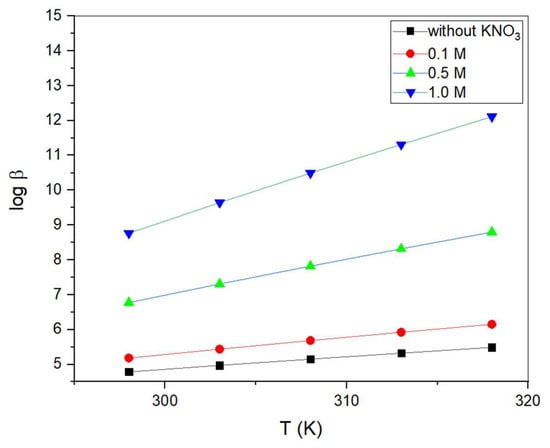
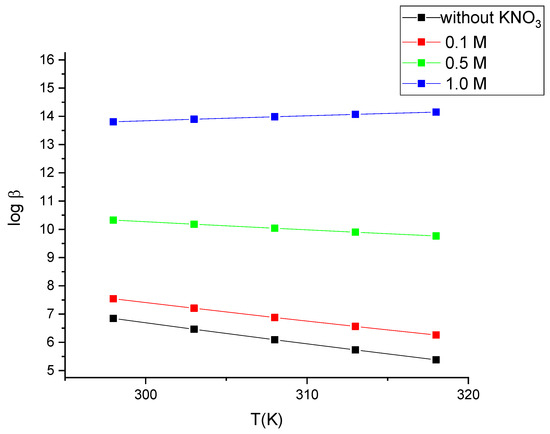
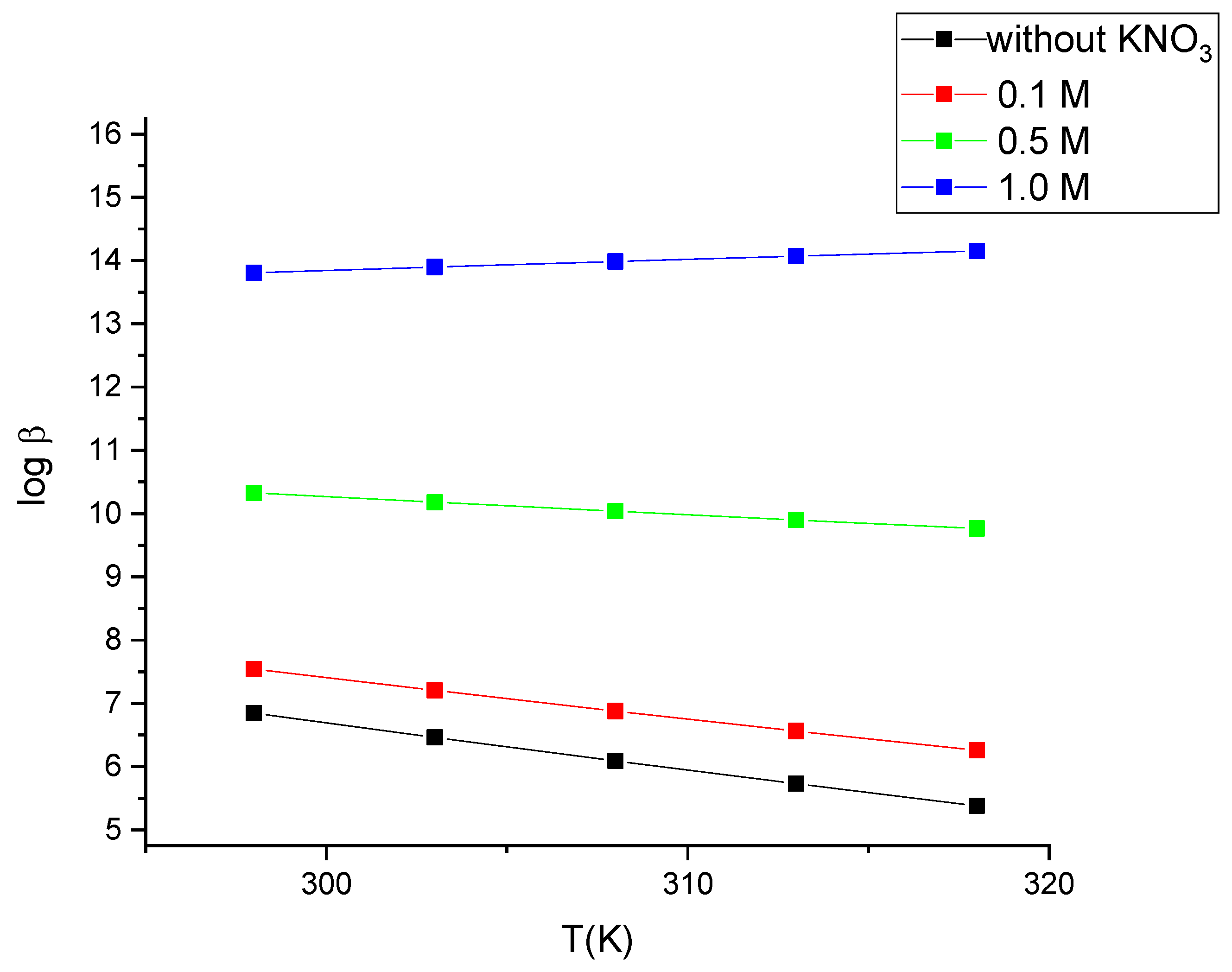
This study examines the complexation of Eu(III) with low-molecular-weight carboxylic acids in aqueous solution. Quantitative parameters of complex formation and stability at different ionic strengths were derived from potentiometric titrations. Overall cumulative formation constants were calculated using the Bjerrum formalism [21], and the corresponding standard thermodynamic functions were derived from the temperature dependence of these constants using the Ulich approach [22]. Eu(III)-tartrate and Eu(III)-oxalate complexes were selected as model systems because they form well-defined chelate structures and exhibit distinct coordination behavior. The ionic-strength effect was investigated in the presence of potassium nitrate (KNO3) as a background electrolyte at 0.1–1.0 mol/L, as well as in solutions without added KNO3. The resulting stability constants (logβ) for Eu(III)-tartrate and Eu(III)-oxalate systems, determined over the 298–318 K range, are summarized in Figure 1 and Figure 2 and reflect the systematic impact of ionic strength on complex stability.
Figure 1.
Temperature dependence of the stability constants (logβ) for Eu (III)-tartrate complexes at different ionic strengths (without added KNO3 and with KNO3 at 0.1, 0.5, and 1.0 M).
Figure 2.
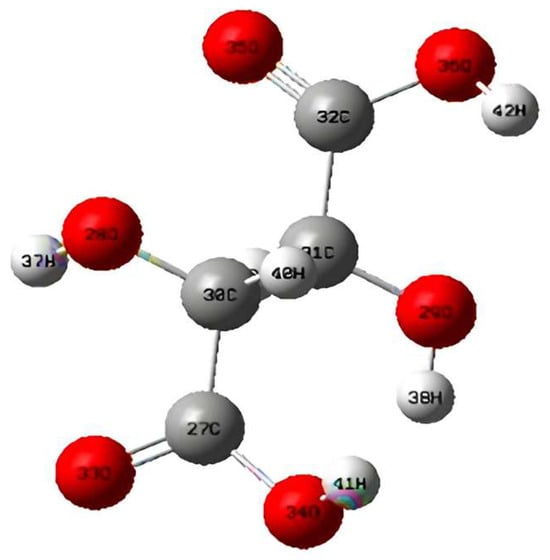
Molecular model of tartaric acid.
As shown in Figure 1, the Eu(III) complexes investigated in this work display relatively high cumulative stability constants, with log β values of approximately 5–13. This behavior is primarily associated with the strong Lewis acidity of Eu(III) and predominantly ionic character of Eu-O interactions typical of trivalent lanthanides. At the same time, the covalent contribution arising from direct overlap between 4f orbitals and ligand donor atoms is expected to be limited, because the 4f shell is strongly localized and effectively shielded by outer electron shells [23].
According to Pearson’s HSAB (hard and soft acids and bases) theory [24], the Eu3+ ion is classified as a hard Lewis acid owing to its high charge density, low polarizability, and inert outer electronic configuration. The tartrate ion (C4H4O62−) is a weak base (logβ = 10.86) with stepwise dissociation behavior. Depending on the pH, the substance can act as an acid (through the deprotonation of hydroxyl groups in alkaline conditions) or as a nucleophile under neutral to mildly acidic conditions. The tartrate ion’s carboxylate structure features carbonyl oxygen atoms with localized lone pairs and delocalized negative charge. Consequently, tartrate is designated as a hard Lewis base due to its low polarizability and high electronegativity.
Within the HSAB (hard and soft acids and bases) framework, Eu(III) can be regarded as a hard Lewis acid and is therefore expected to preferentially coordinate to the oxygen donors of tartrate, primarily through carboxylate groups. Such binding is dominated by largely ionic Eu-O interactions, which account for the high thermodynamic stability of the resulting complexes.
A detailed comparison of the Eu(III)-tartrate and Eu(III)-oxalate systems indicates that the complex stability is governed primarily by the ligand rigidity and charge distribution. Increasing ionic strength results in a systematic increase in stability for both ligands; however, the temperature dependence of the stability constants remains ligand-specific. In Eu(III)-oxalate solutions (Figure 3), increasing the concentration of the background electrolyte produces a pronounced enhancement of complex formation. This behavior can be rationalized by the higher charge density and greater structural rigidity of the compact oxalate anion (C2O42−) compared with the more conformationally flexible tartrate anion (C4H4O62−). Over the temperature range 300–320 K, the stability constants of the oxalate complexes vary only slightly (logβ = 7–15, versus 5–13 for the tartrate system), which indicates a high degree of thermodynamic robustness. Structurally, oxalate acts as a rigid, bidentate dicarboxylate with limited conformational freedom, whereas tartrate contains additional hydroxyl groups that increase rotational flexibility and reduce the effective rigidity of the coordination environment (Figure 2). Consequently, Eu(III)-oxalate complexes are expected to be more stable than the analogous acetate species (CH3COO−), in line with the higher ligand hardness of oxalate within the HSAB concept. This trend is also compatible with the Klopman–Salem considerations, whereby donor-acceptor interactions are influenced by the matching of orbital energies and by the polarizability of the interacting partners.
Figure 3.
Study of the dependence of logβ on temperature for Eu (III)-oxalate complexes at various ionic strengths (without KNO3, and with KNO3 at concentrations of 0.1, 0.5 and 1.0 M).
The energetic parameters of oxalate reinforce this interpretation: its elevated HOMO level (~5.97 eV) and low polarizability indicate a rigid electron-density distribution capable of effective interaction with hard trivalent cations such as Eu(III) [25]. Additional stabilization at increased ionic strength is explained by outer-sphere nitrate coordination, which modifies the hydration environment of Eu(III). Since rare-earth ions in neutral saline media remain strongly hydrated, conductivity measurements were employed to characterize water-exchange dynamics and quantify the associated translational energy parameters (Table 1).
Table 1.
∆rG0 values for translational water-exchange processes, kJ·mol−1 [19].
The data in Table 1 indicate that metal ions exhibit a negative hydration effect, which becomes more pronounced with increasing concentration of the background electrolyte (KNO3). According to Samoilov’s theory, the negative hydration is associated with the translational exchange energy of water molecules, i.e., with the fact that the rate of water exchange in the primary hydration sphere exceeds that in pure water [26]. It has been shown that the enhanced mobility of hydrated molecules is promoted by the presence of ligands. The molecular water-exchange can be presented by the following scheme (1).
[Eu(H2O)8]3+ + H2O ↔ [Eu(H2O)9]3+
This equilibrium indicates that the europium coordination number can vary between 8 and 9, leading to changes in the geometry of its hydration. The presence of KNO3 affects this equilibrium by restructuring the hydration environment and modifying the outer coordination sphere.
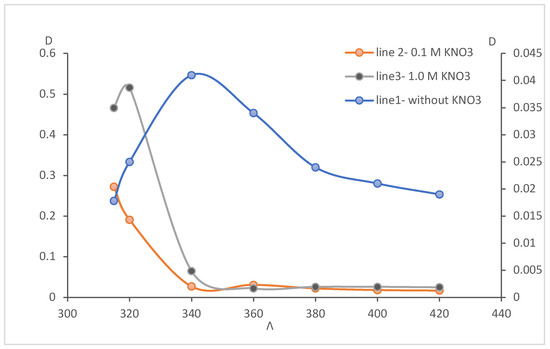
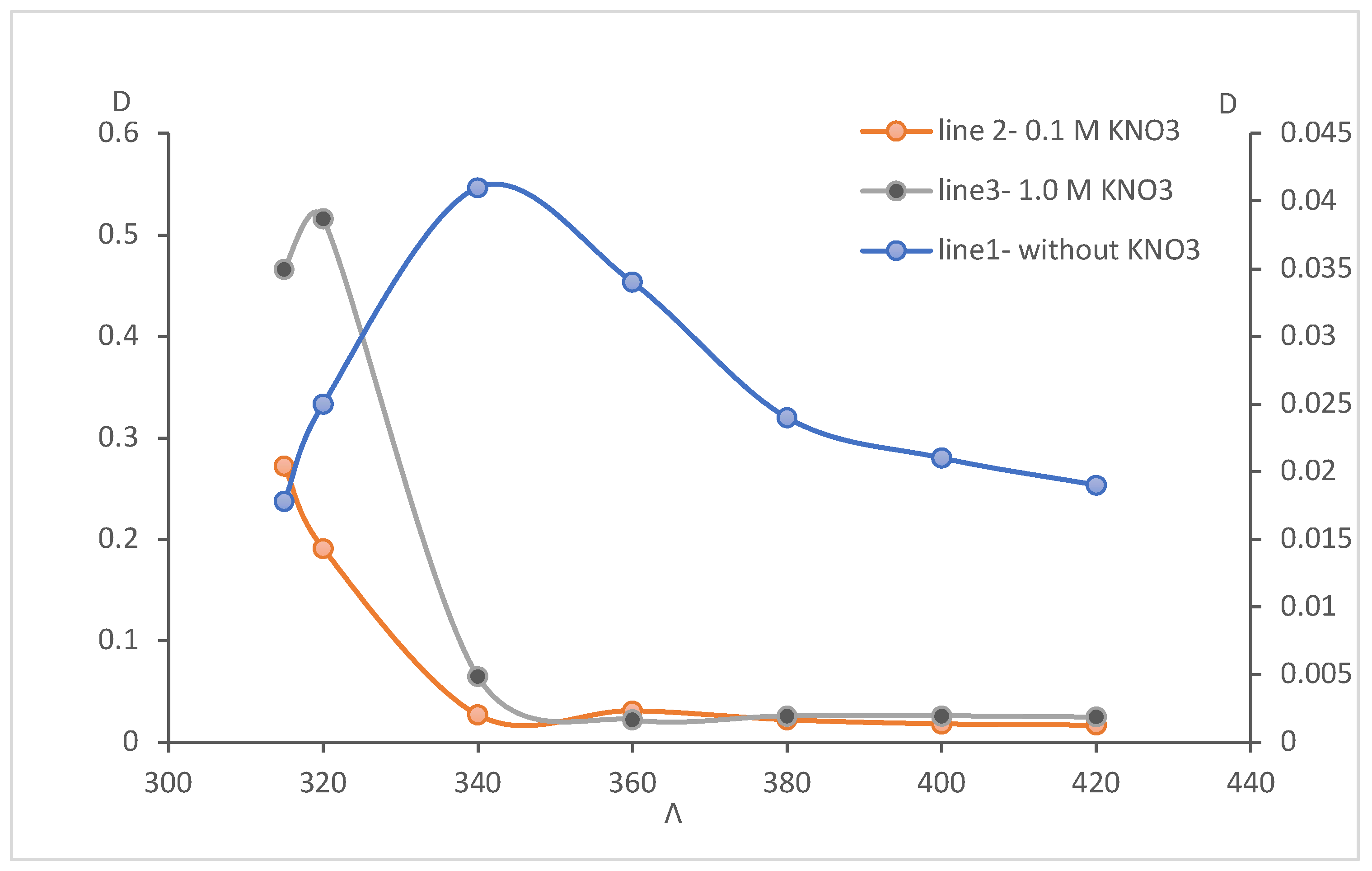
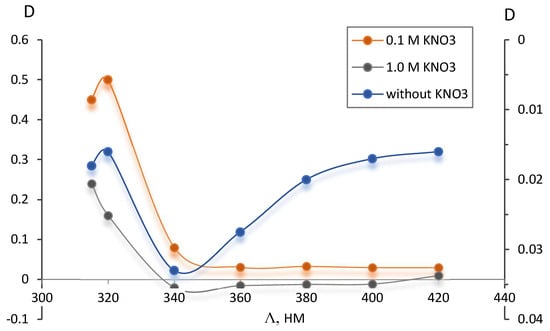
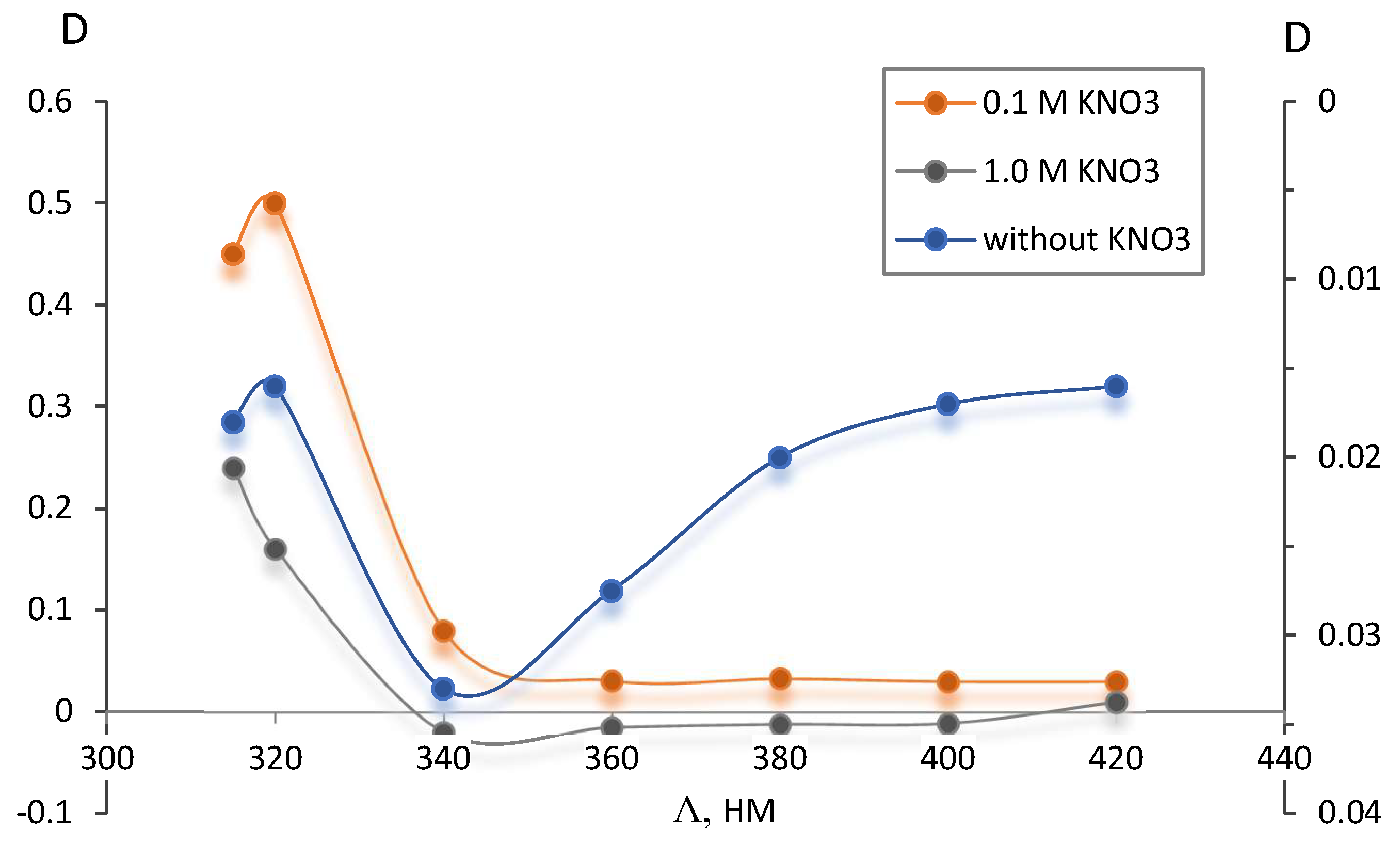
The results obtained in the present study are compared with the literature data presented in [27]. As demonstrated by the authors of the work, the ion of gadolinium (III) exhibits a high rate of water exchange, which is a consequence of its reduced time of residence in the hydrated layer when exposed to the effect of a static electric field. It was also reported that the highest values of the exchange constant are also characteristic of the maximum values of Eu(III) and Sm(III), which is consistent with the characteristics of their free structures. It has been demonstrated that an increase in the concentration of the electrolyte in the solution results in the occurrence of regular changes in the water. The quantity of free water that does not participate in the hydration of ions is increasing, thereby enhancing the hydration capacity of both non-porous and porous groups, as well as complex carbohydrates. The quantitative assessment of this phenomenon is reflected in the change in the signs of the phenomenon of trans-quantum motion, which is negative (see Table 1). Such behavior indicates a fundamental restructuring of the hydrated layers, which is characterized by the absence of ions and molecules of water in the immediate vicinity, as well as an enhancement of electrostatically induced interactions between charged particles. One of the key factors driving these changes is the influence of weakly charged ions, such as potassium (K+) and nitrate (NO3−), on the hydrated structure of the solution. In addition, the complexes under consideration exert a specific effect in the solution: they promote the formation of additional potassium-containing complexes [28], which in turn increases the stability of the complex of Eu(III) via a solvolysis effect. To provide experimental evidence for this process, the dependence of the optical density of aqueous Eu(III) chloride solutions in the absence of supporting electrolyte (I = 0) and in the presence of KNO3 at concentrations of 0.1 M and 1.0 M. A graphical representation of these findings is given in Figure 4.
Figure 4.
Dependence of optical density on wavelength for aqueous Eu(III) chloride solutions without KNO3 and at KNO3 concentrations of 0.1 and 1.0 M.
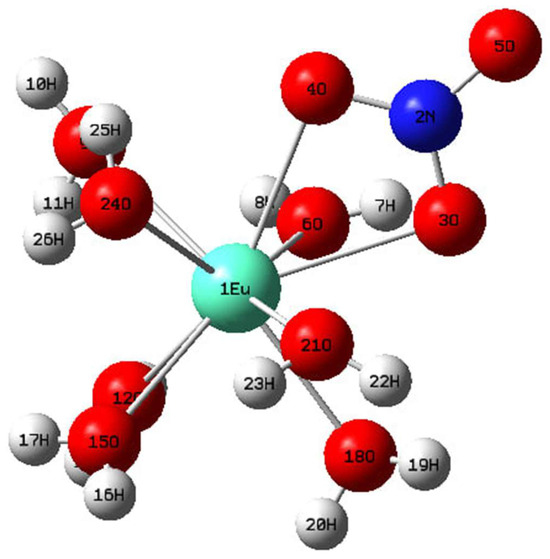
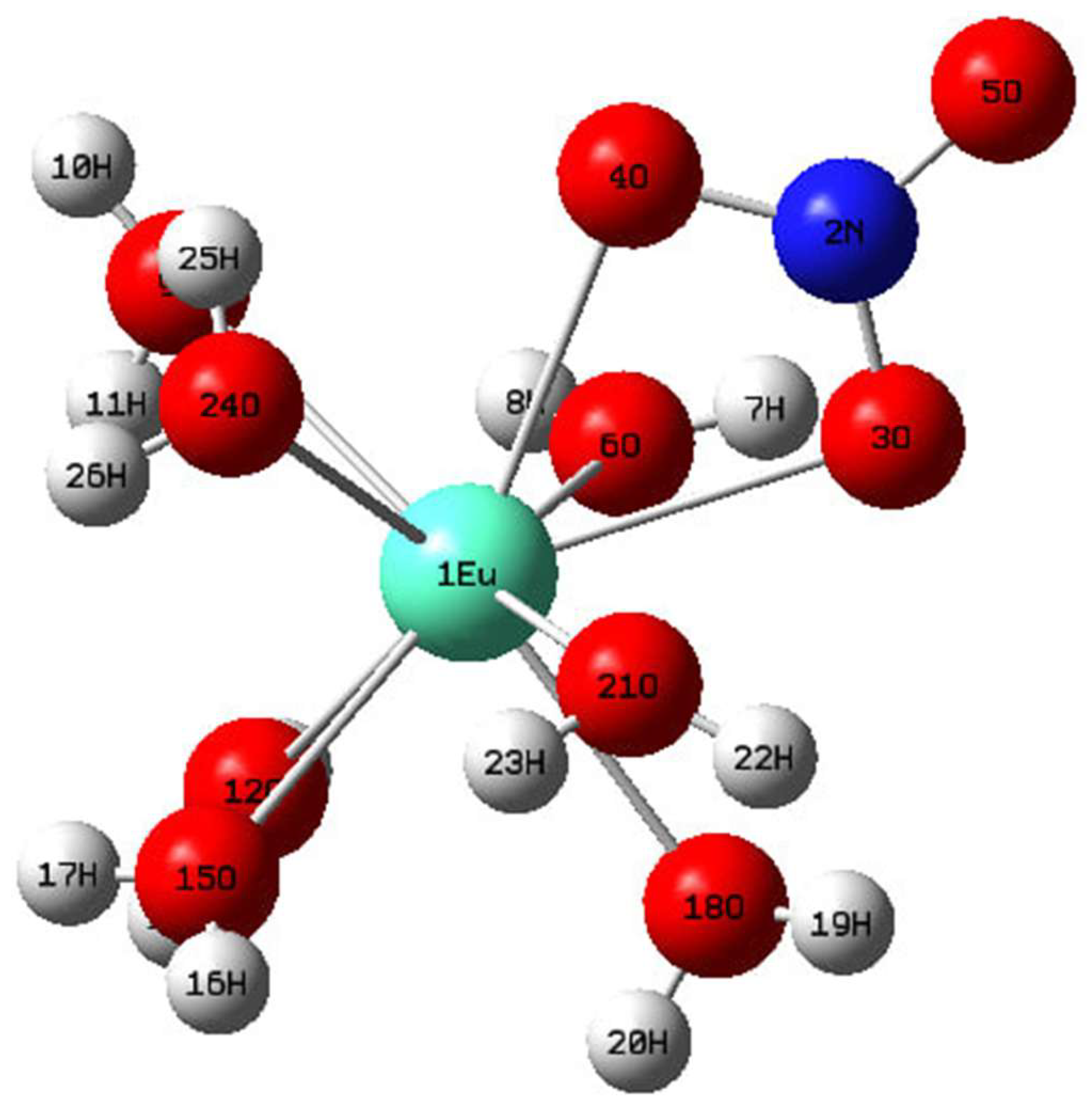
In aqueous solution, Eu3+ exists mainly as [Eu(H2O)n]3+ (n = 8–9) [29], showing an absorption maximum near 343 nm corresponding to the 5D4←7F0 transition. Increasing KNO3 concentration to 0.1 M causes a hypsochromic shift (343→315 nm) and increased intensity, indicating distortion of the hydration geometry of the nine-coordinate aqua complex [30]. Further increase to 1.0 M results in a bathochromic shift (315→320 nm) and hyperchromic effect due to partial coordination of nitrate oxygen atoms with Eu3+, forming hydrated ion pairs {Eu(H2O)nNO3}− (Figure 5).
Figure 5.
Hydrated Eu (III) complex in the presence of background electrolyte (KNO3).
At lower ionic strengths, external-sphere complexes [Eu(H2O)n]3+ (n = 8–9) prevail, where nitrate ions interact electrostatically rather than through direct coordination [31]:
[Eu(H2O)9]3+ + NO3− ↔ {[Eu(H2O)9](NO3)}2+
To comprehensively elucidate the mechanisms of complex formation in the studied systems, the key thermodynamic parameters were calculated (Table 2 and Table 3). The negative Gibbs free energy values confirm the spontaneous nature of the complexation reactions in the EuCl3-H2-tartrate and EuCl3-H2-oxalate systems (Table 2 and Table 3).
Table 2.
Temperature dependence of the Gibbs free energy (−∆rG° ± 0.01 kJ mol−1) in complexation processes in the system EuCL3-L [19].
Table 3.
Temperature dependence of the entropy change (−∆rS°) in the Eu(III)-L system [19].
The data indicate spontaneous complexation (−∆rG° > 0) at all ionic strengths and temperatures studied. Increasing temperature enhances the thermodynamic driving force for coordination, especially in the Eu(III)-oxalate system, reflecting the entropic contribution to stability. The increase in the Gibbs free energy with increasing temperature leads to the destruction of the hydrate environment of the cation and weakening of its bonds with water molecules. As a result, the coordination interaction between the europium ion and oxygen donors of carboxyl groups is facilitated, strengthening the donor-acceptor bonds and leading to redistribution of electron density within the complex.
The data demonstrate that entropy changes (−∆rS°) are predominantly negative, confirming that complexation of Eu(III) with dicarboxylate ligands is enthalpy-driven. The magnitude of -∆rS° decreases with increasing temperature. This indicates partial desolvation and reduced order within the hydration shell.
The data indicate that the standard entropy changes (−∆rS°) are predominantly negative, supporting an enthalpy-driven character of Eu(III) complexation with dicarboxylate ligands. With increasing temperature, the entropic penalty becomes less pronounced, consistent with partial desolvation and a reduction in ordering within the hydration shell.
As shown in Table 3, replacing tartrate by oxalate leads to an increase in the entropy-related parameters over 298–313 K. This trend can be discussed in terms of differences in ligand hardness and structural compactness. Oxalate, with a higher estimated HSAB hardness (ƞ~5.97 eV), forms comparatively strong Eu-O coordination contacts while retaining hydration water less effectively. Consequently, partial dehydration of the coordination domain increases the entropic contribution and favors a more compact inner-sphere arrangement at lower temperatures. With increasing temperature, the effective hardness of oxalate decreases, and the Eu-O interactions become less resistant to competitive solvation effects. Under these conditions, nitrate anions play a more active outer-sphere role, promoting water displacement and thereby reshaping the thermodynamic balance of the system (Table 3). Tartrate behaves differently. Its lower estimated hardness (ƞ~4.8 eV) is consistent with stronger hydration and a more ordered solution microstructure. At the initial stages of coordination, this flexibility facilitates efficient removal of inner-sphere water and supports complex formation at relatively low temperatures. However, the same conformational softness limits the strength of the resulting coordination nodes, which is reflected in a thermodynamic response distinct from that observed for the oxalate-containing system.
2.2. Electrostatic and Non-Electrostatic Contributions to Complex Stabilization
The Gurney method [32,33] was employed to examine the thermodynamic aspects of complex formation in detail. Within this approach, the electrostatic and non-electrostatic components were calculated; the corresponding values are summarized in Table 4 and reflect the thermodynamic characteristics of the processes considered.
Table 4.
Electrostatic and non-electrostatic contributions to the Gibbs free energy at 298.15 K.
It should be noted, however, that despite the predominantly electrostatic nature of the interaction between Eu(III) ions and rigid carboxylate ligands, current views on f-element chemistry allow for a limited covalent component. According to the concept of near-degeneracy-driven covalency, partial overlap of orbitals is possible if the energy levels of the donor orbitals of the ligand and the unfilled f-orbitals of the metal are close in energy [34]. This effect is particularly plausible in the case of symmetric rigid ligands with high donor orbital energies, such as oxalate, and may partially account for its increased thermodynamic stability.
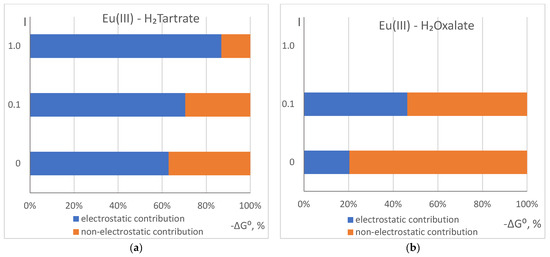
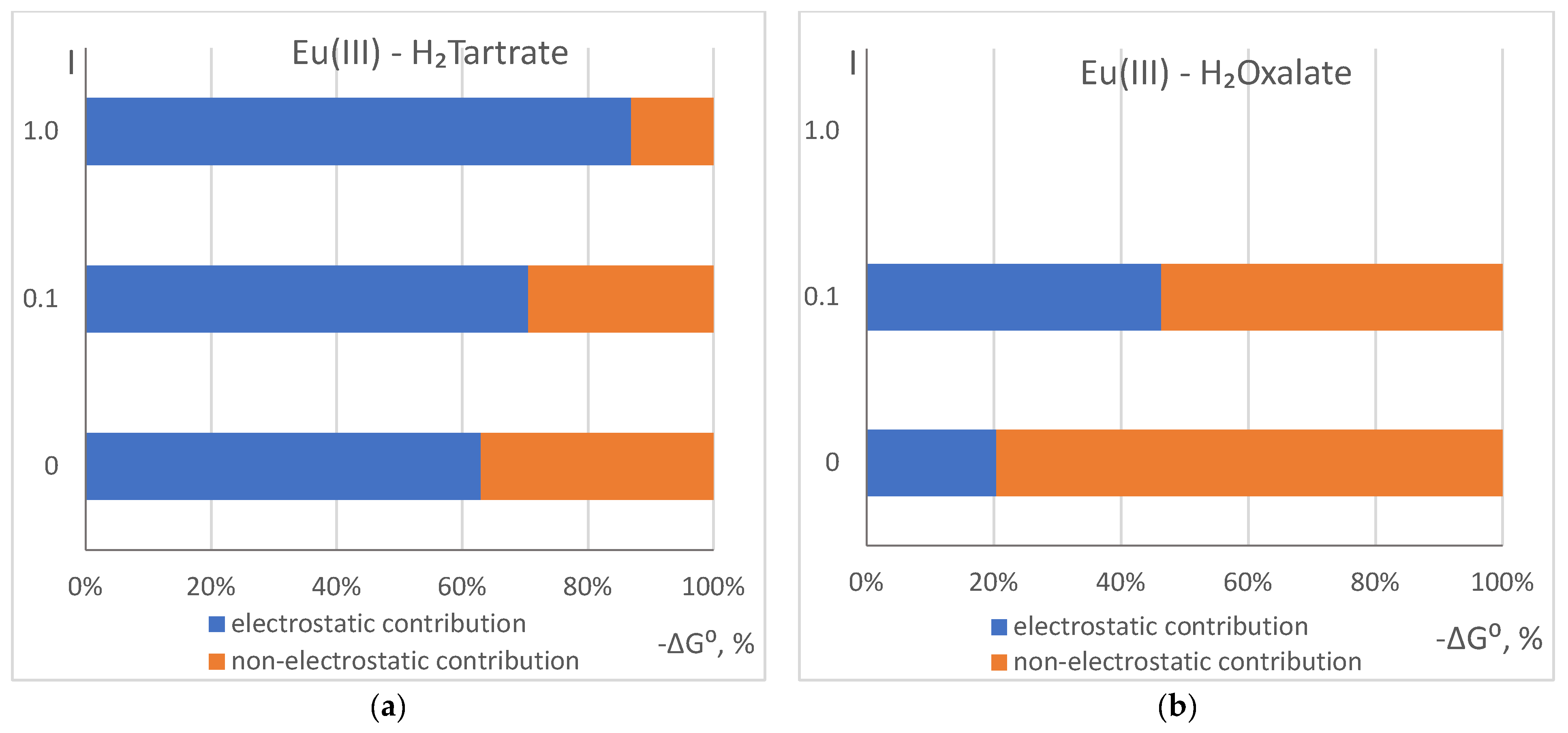
The data show that the electrostatic component dominates in the Eu(III)-tartrate system, increasing from 63% to nearly 87% with rising ionic strength, which confirms the predominance of ion-dipole interactions in complex stabilization. For the Eu(III)-oxalate system, the situation is markedly different: the non-electrostatic term accounts for as much as ~80% of the overall stabilization, which points to a substantial entropic and covalent contribution. Collectively, these estimates suggest that complex formation cannot be rationalized solely in terms of Coulombic interactions; rather, it reflects a superposition of electrostatic forces with near-degeneracy covalent effects in the Eu-O bonding (Figure 6).
Figure 6.
Electrostatic and non-electrostatic components of −∆G° for Eu (III)-tartrate (a) and Eu (III)-oxalate (b) complexes at 298.15 K.
Tartrate complexes clearly demonstrate temperature-independent negative contributions to Gibbs energy, while the electrostatic contribution is positive. This unequivocally indicates the dominant role of electrostatic interactions in forming complexes. It also shows that the ligand coordinates with the metal ion through a deprotonated oxygen atom. In contrast, for oxalate complexes, the high non-electrostatic contribution to ∆G° (up to 79.6%) is attributable not only to entropic and hydration factors but also to partial orbital overlap. As [34] clearly shows, a mechanism of near-degeneracy-driven covalency is possible for f-elements. In this mechanism, the donor orbitals of hard ligands are in energetic resonance with the metal f-shell. This results in additional stabilization of the complex that cannot be explained solely by electrostatic models. The Gurney method clearly and definitively allows for the quantitative separation of interaction types and supports the conclusion regarding the possible partial covalent character of bonding in both cases. This is particularly evident in the oxalate complex, where the non-electrostatic contribution approaches 80%, surpassing the limits of the classical ionic model.
2.3. UV-Visible Spectroscopy of Eu (III) Complexes
To justify the calculations of thermodynamic parameters, the UV-visible (UV-vis) spectroscopic analysis of the complexes of europium with tartrate was carried out (Figure 7).
{[Eu(H2O)9](NO3)}2+ + C4H5O6− ↔ {[Eu(H2O)7(C4H5O6)](NO3)}+ + 2H2O
Figure 7.
Dependence of optical density on wavelength of aqueous solutions of Eu(III) tartrate complexes at different concentrations without KNO3 and at KNO3 concentrations of 0.1 and 1.0 M.
Experimental results indicate that the concentration of complex compounds in aqueous solutions without a background electrolyte is relatively low. The maximum absorption signal was observed at 323 nm. An increase in potassium nitrate concentration produced a hyperchromic effect, which can be attributed to the interaction between the unshared electron pair of the oxygen atoms in the nitrate ion and the π-electron system of the free carboxyl group. Further addition of KNO3 led to a hypsochromic shift accompanied by a decrease in intensity (hypochromic effect). Incorporation of nitrate ions into the hydration shell of the complex disrupts its coplanarity due to enhanced ion-dipole interactions.
The temperature-dependent contribution to the Gibbs energy confirms the coexistence of donor-acceptor and ionic bonding between the oxalate ion and Eu(III). The effect of ionic strength on complexation is ligand dependent. In tartrate complexes, nitrate ions associate with water molecules within the immediate coordination sphere, increasing the rigidity of the hydration shell and thereby stabilizing the entire complex.
In vibrational spectra, the Ln-OH2 bond exhibits an ordered character, in which the first signs of hydration appear as concerted vibrations of Ln-O bonds [35]. Due to the symmetry of the molecular ion, the total dipole moment equals zero. This normal mode depends on only one geometric parameter: the bond length Ln-(OH2) (r). Table 5 presents the main spectral parameters, including bond lengths and water exchange characteristics.
Table 5.
Modified spectral parameters: Ln-OH2 bond distances and force constants (adapted from [35]).
The table above shows the bond length Ln-OH2 for Eu(III) to be δ = 2.425 Å, which provides a direct interaction of europium with deprotonated hydroxyl and carboxyl compounds, indicating a coordination mechanism for metal ion binding in the complex [35].
2.4. 1H and 13C NMR Spectroscopy of Eu (III) Tartrate Complexes
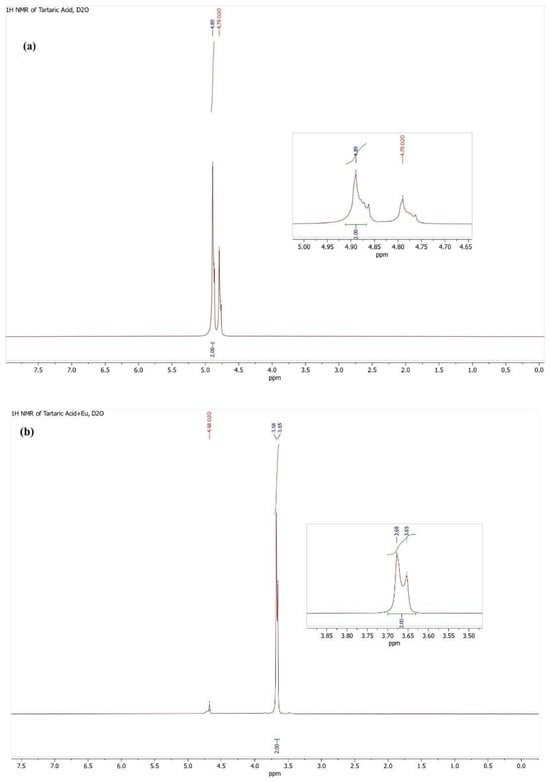
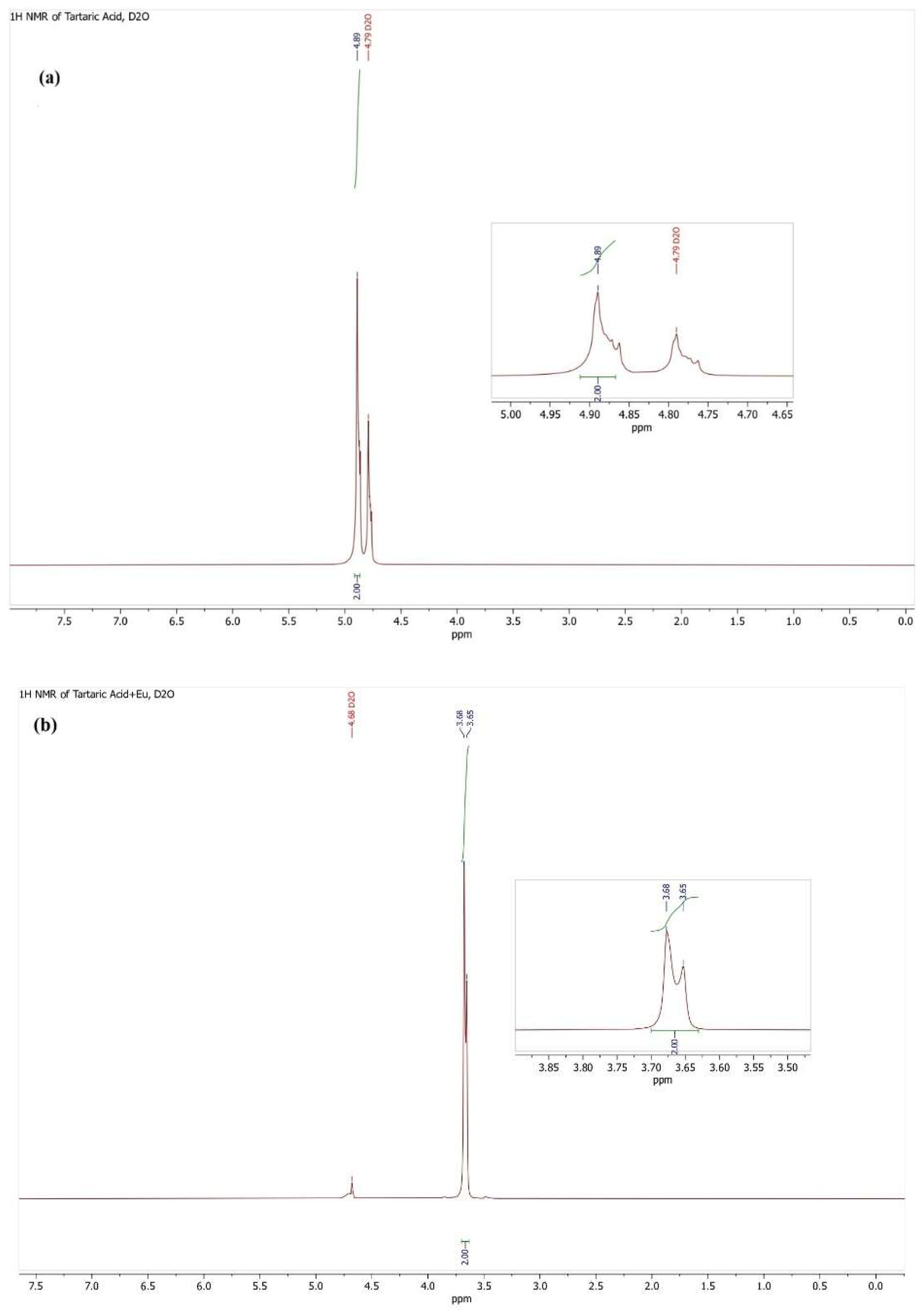
1H and 13C NMR spectroscopy were used to confirm the coordination mechanism of the tartrate ion with the Eu(III) ion. Figure 8a shows the spectrum of pure tartaric acid in D2O: one clear singlet at δ = 4.31 ppm corresponds to equivalent protons due to the molecule’s symmetry. This is a typical pattern for a free ligand not involved in coordination. After the addition of EuCl3 (Figure 8b), a marked change in the spectral pattern is observed: several signals appear in the region δ = 3.49–3.9 ppm. The splitting of signals testifies to the de-equivalence of protons of water molecules caused by their different positions relative to the paramagnetic center Eu(III). The main intense peaks (3.5–3.9 ppm) belong to protons associated with oxygen-containing groups (–OH, –COOH) involved in coordination with Eu(III).
Figure 8.
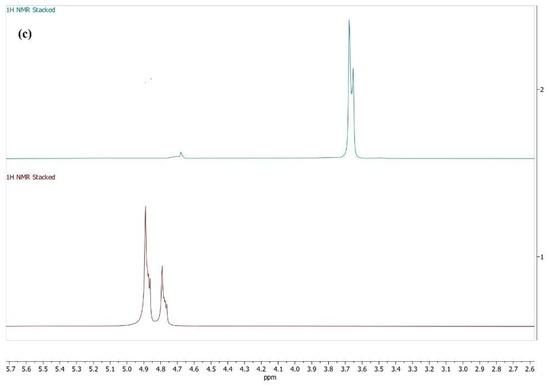
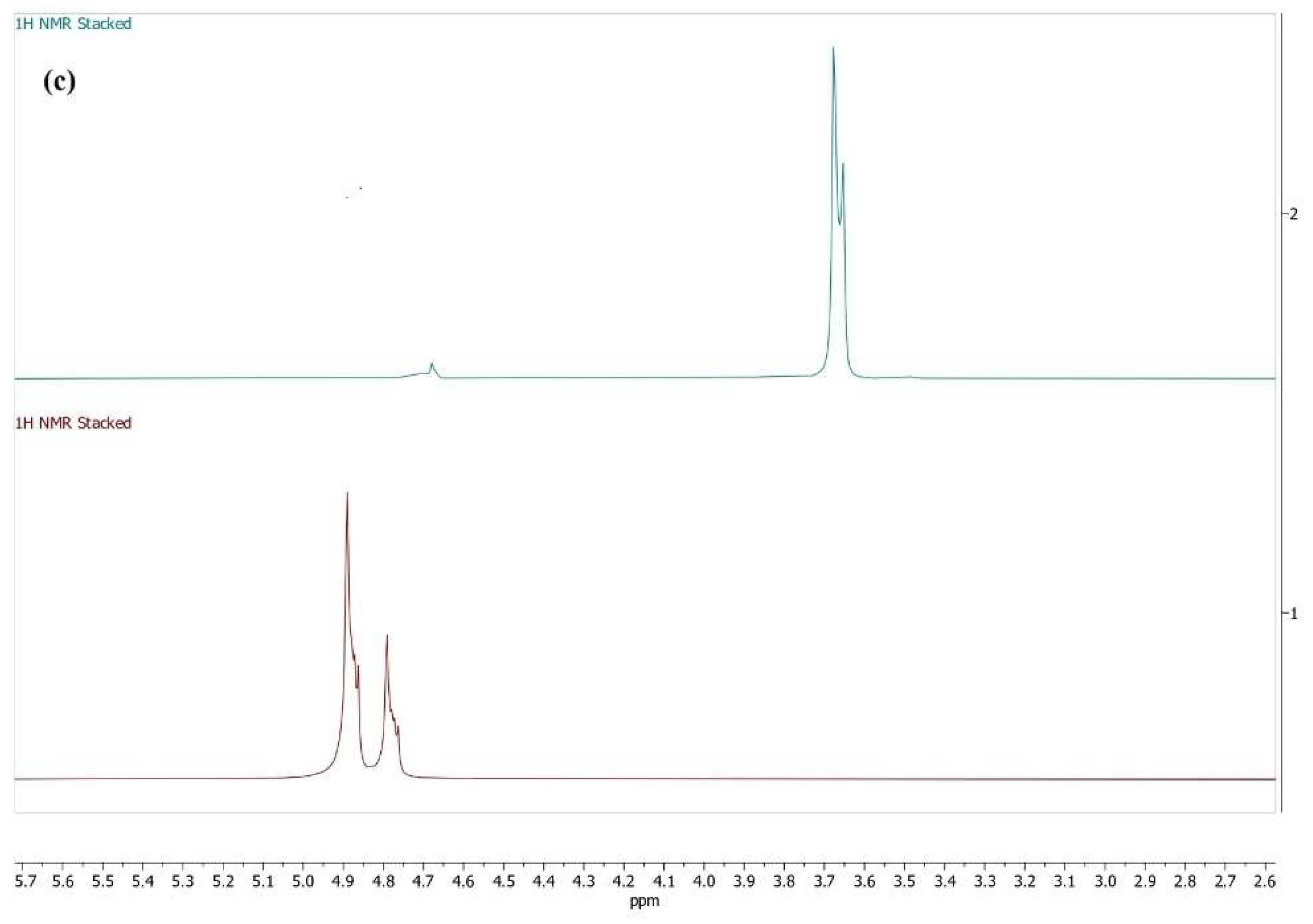
1H NMR spectra: (a) Tartaric acid in D2O. (b) Eu(III)-tartrate complex in D2O. (c) Stacked spectra showing the shift in the signal upon complex formation.
Analysis of sequential 1H NMR spectra (Figure 8c) reveals a distinct shift in the main proton signal: from 4.31 ppm, characteristic of free tartaric acid, to 3.65 ppm after its interaction with Eu(III). Such a change in chemical shift indicates a redistribution of electron density in the ligand structure, which occurs during the formation of a coordination bond. Additional confirmation is provided by the disappearance of multiplicity and a noticeable broadening of the signals, which is typical for the paramagnetic effect of Eu(III) and reflects accelerated relaxation processes in the system. The combination of these spectral features indicates the formation of a stable Eu(III)-tartrate bidentate complex, in which both the carboxyl and hydroxyl groups of the ligand are involved in coordination.
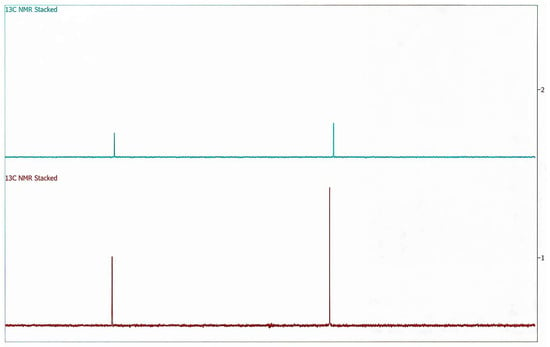
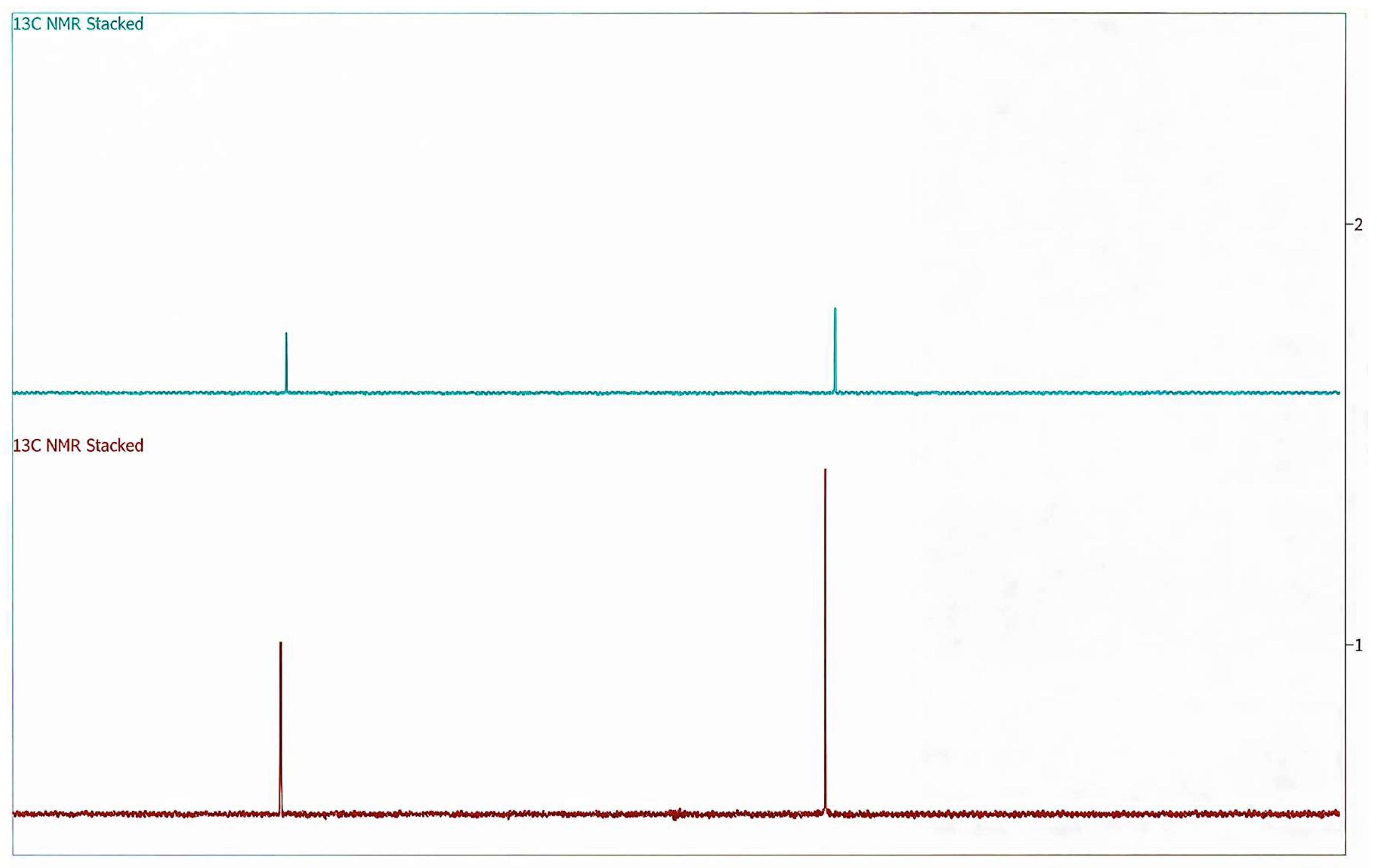
The 13C NMR spectrum (Figure 9) clearly shows two distinct resonances at 69.96 ppm and 173.43 ppm. These are the carbon nuclei of the hydroxyl (C-2/5 and carboxyl (C-1/4) groups of the tartrate ion, respectively. When Eu(III) is coordinated, both resonances shift downfield. The signal at 69.96 ppm reflects the participation of –OH groups in complexation, and the shift in the carboxyl resonance to approximately 175 ppm indicates strong coordination through the carboxyl oxygen atoms. The stacked spectrum clearly shows these spectral variations, which juxtapose the free ligand and the Eu (III)-tartrate complex. The observed chemical shift displacements definitively confirm the redistribution of electron density between the C–O and C=O moieties upon complex formation. This provides unambiguous NMR evidence for the coordination of both hydroxyl and carboxylate groups in the structure of the Eu(III)-tartrate complex.
Figure 9.
Stacked 13C NMR spectrum of tartaric acid and Eu(III)-tartrate complex in D2O, showing coordination-induced carbon shift.
Accordingly, the absence of resolved 13C signal splitting can be rationalized by fast conformational averaging on the NMR timescale together with Eu(III)-induced paramagnetic line broadening, as commonly reported for exchanging paramagnetic systems [36,37].
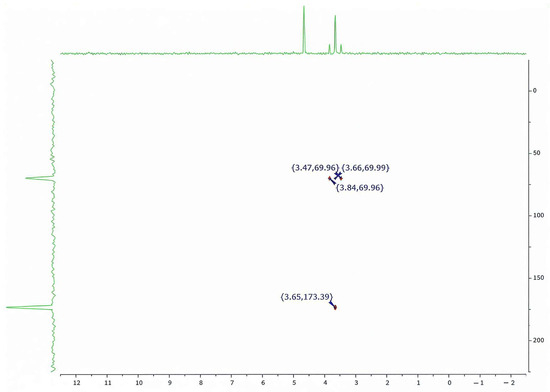
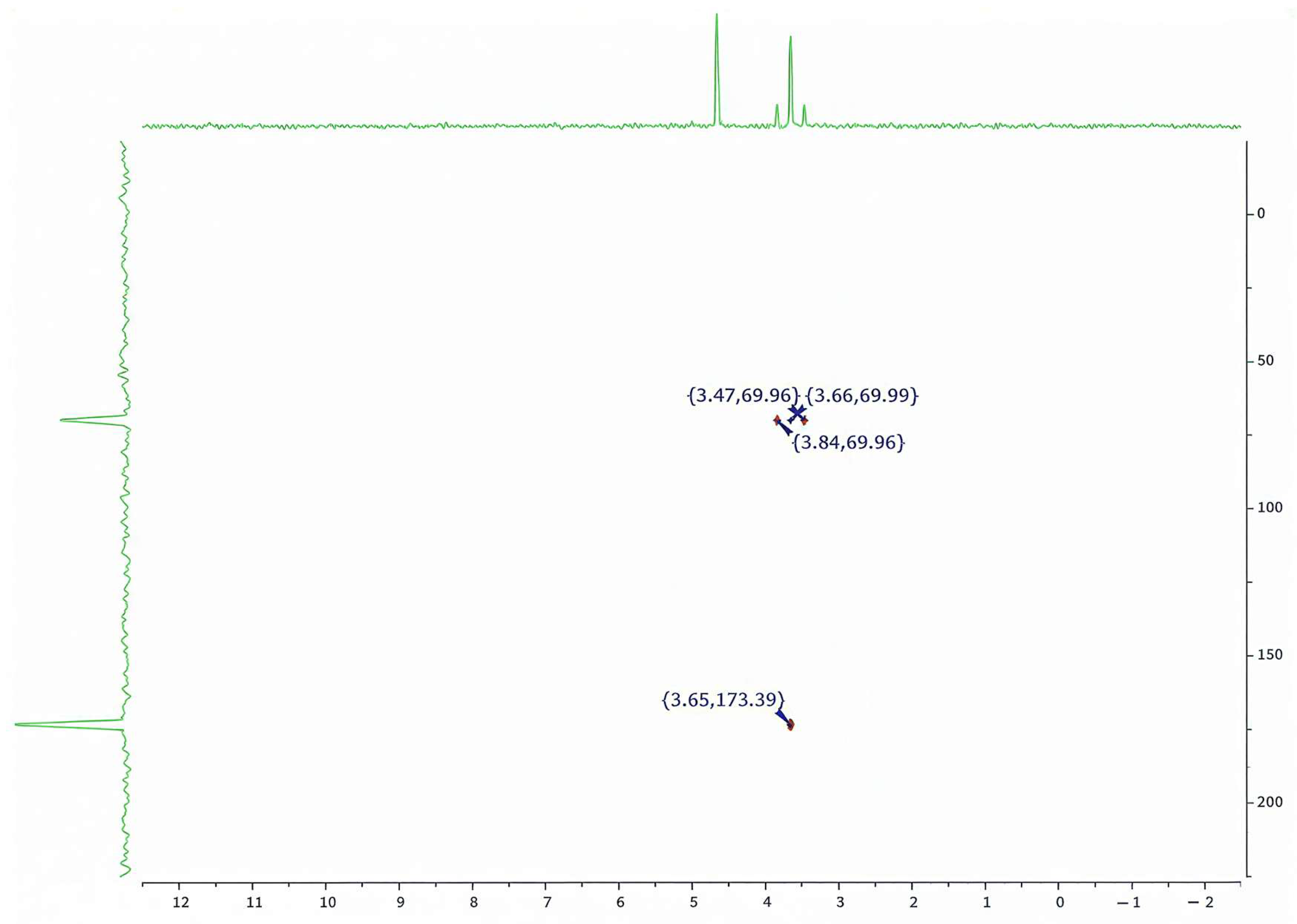
Two-dimensional HMBC spectroscopy (Figure 10) provides clear evidence of interactions between water protons and the carboxyl groups of the ligand. Correlation peaks at (3.65; 173.39 ppm) and (3.47–3.84; 69.96–69.99 ppm) indicate the involvement of water molecules in coordination through C–O and COO− fragments, consistent with the partial participation of hydration molecules within the coordination sphere of the complex.
Figure 10.
HMBC spectrum of Eu (III)-tartrate complex in D2O.
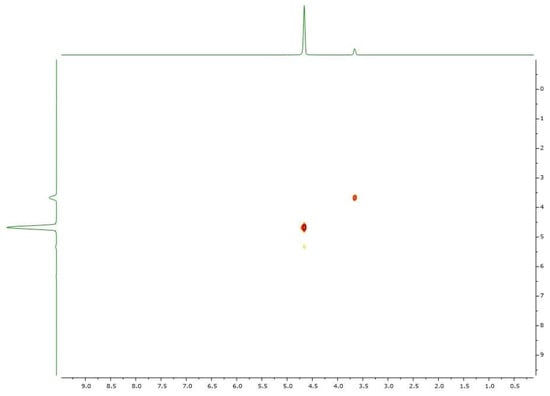
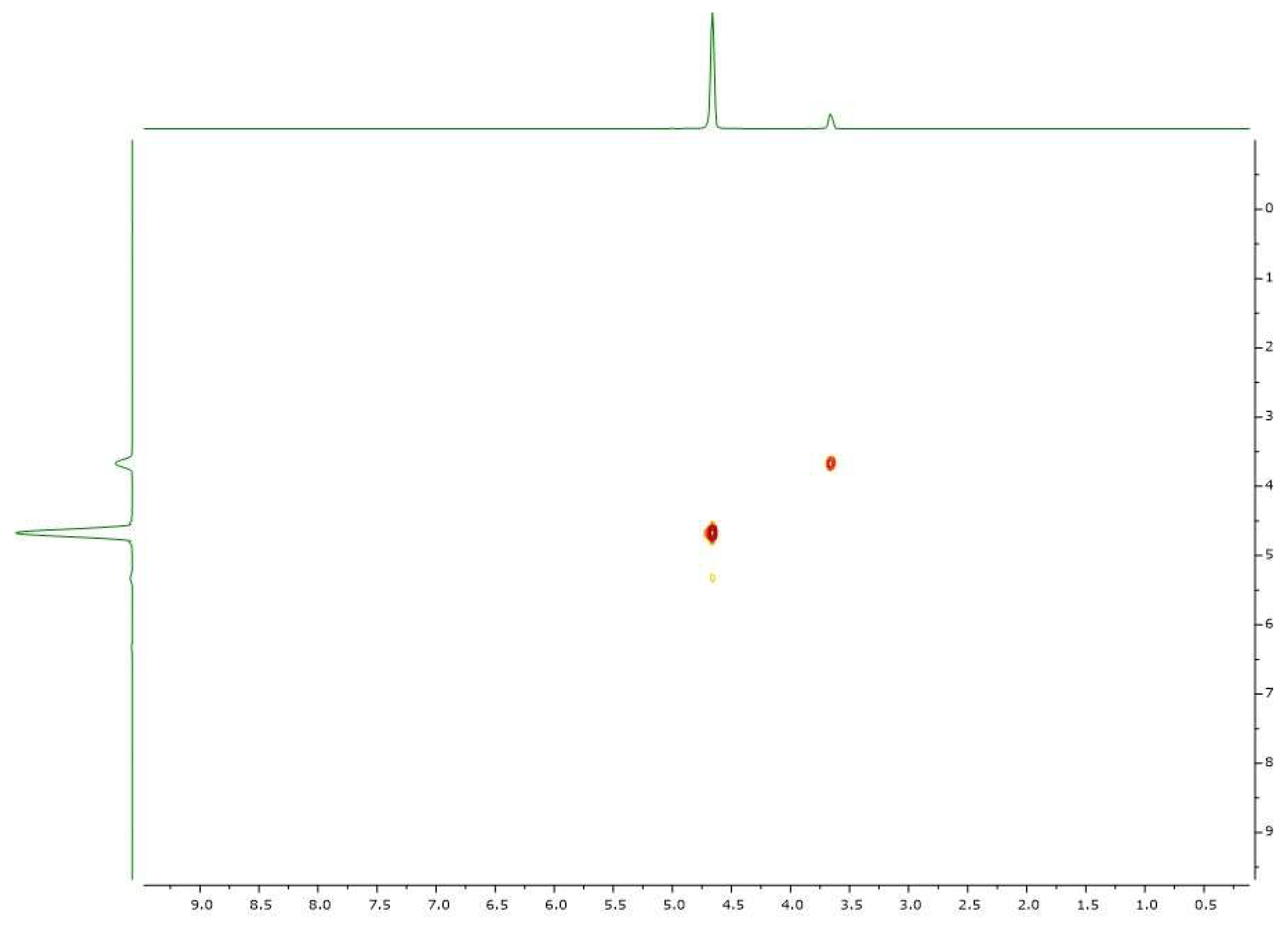
Interpretation of the experimental data was carried out using the Helm-Merbach model [23], which describes the exchange of water molecules in paramagnetic ion complexes through two distinct regimes: (1) a fast exchange for water molecules coordinated directly to the paramagnetic Eu(III) center, resulting in signal broadening, and (2) a slow exchange for outer-sphere water, characterized by sharp resonances. As follows from the results of spectroscopic analysis, the recorded 1H NMR spectra contain a set of resonances in the range of 3.49–3.68 ppm, which reflects the distribution of coordination states of water molecules and ligand protons in the first coordination sphere of Eu(III). The residual HDO signal of the solvent is fixed at 4.68 ppm, while a very weak signal near 6.11 ppm (<0.2% of the main peak) refers to bulk water/trace impurities and was not considered in the quantitative analysis. The observed broadening and small dispersion of the inner sphere signals in the 3.49–3.68 ppm range are consistent with the fast exchange regime described by the Helm-Merbach model. These results are confirmed by HMBC correlation data, which indicates a heterogeneous yet dynamically coupled Eu(III) hydration shell. The COSY spectrum of the Eu(III)-tartrate complex recorded in D2O is shown in Figure 11.
Figure 11.
2D 1H–1H COSY NMR spectrum of the Eu(III)–tartrate complex in D2O, with 1D 1H projections (green).
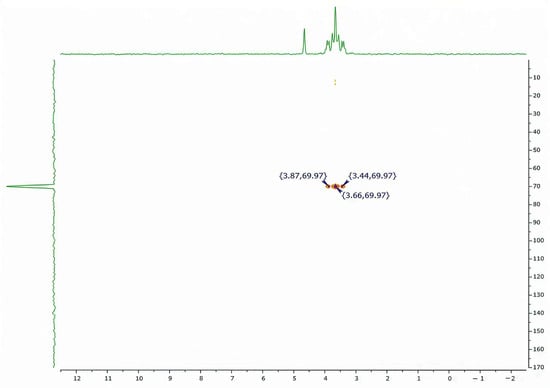
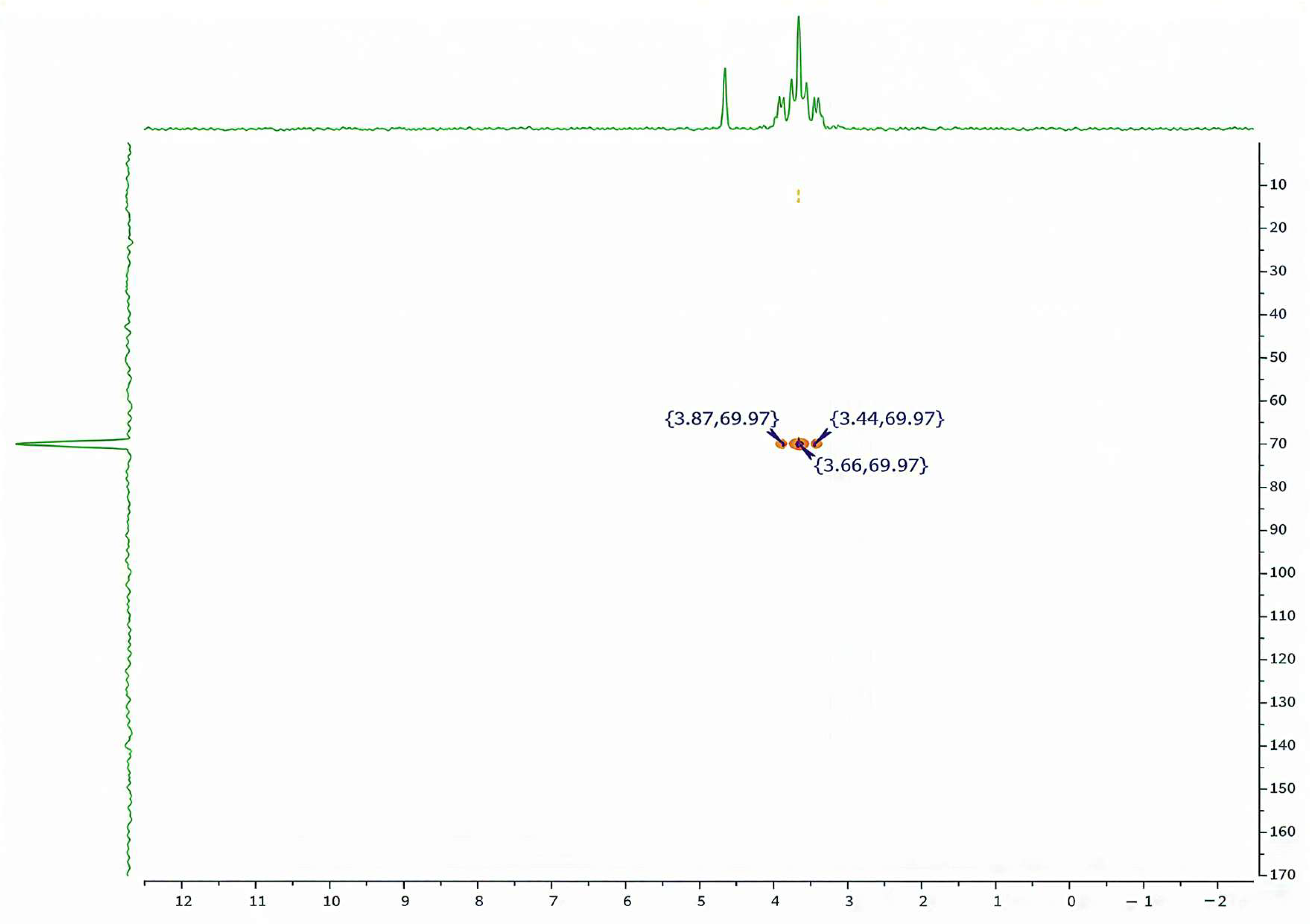
Two-dimensional NMR experiments COSY and HMQC in D2O supplemented the 1D data and confirmed the signal assignments and coordination type in Eu(III)-tartrate solutions. In HMQC, a direct correlation H2/5-C2/5 was recorded at (~3.65; ~70.0 ppm), while HMBC (by comparison) showed a long-range correlation between H2/5 and C(=O) at (~3.65; ~173.4 ppm). COSY demonstrated a scalar coupling between the methine centers H2-H5. These results are consistent with the 1D positions: 1H singlet H2/5 at 3.65 ppm, 13C signals C2/5 at 69.96 ppm, and carbonyl C at 173.43 ppm. The combination of features indicates bidentate coordination of tartrate via COO− with the possible participation of deprotonated OH groups. As shown in Figure 12, the HMQC spectrum of the Eu(III)-tartrate complex in D2O provides the expected 1H-13C correlations, supporting signal assignments in solution.
Figure 12.
HMQC spectrum of Eu (III)-tartrate complex in D2O.
Based on the combination of 1H and 13C NMR data, as well as thermodynamic and spectroscopic results, it can be concluded that the studied Eu(III) complex with tartrate ion retains its structural integrity and is consistent with the proposed coordination model. The signal recorded at 3.65 ppm corresponds to the 3.5–4.5 ppm range, characteristic of protons located near oxygen-containing functional groups (–OH, –COOH). Comparable values reported by A. Lazim et al. [38] for tartaric acid confirm the correctness of the structural comparisons made. Work [39] shows that the methyl protons in chiral (2R, 3R)-dibenzoyl tartrate shift only 0.08 ppm in the spectrum. Such a small shift occurs only because the symmetry of the ligand and its immediate environment changes. In other words, a very small signal (0.08 ppm) already shows that 1H NMR “senses” even subtle changes in the structure of the ligand and in the groups adjacent to the proton. Taken together, the results presented demonstrate that the tartrate ion forms a stable bidentate Eu(III) complex involving deprotonated –OH and –COOH groups, while variations in the geometry of Eu-O bonds determine the characteristics of water exchange processes and the thermodynamic stability of the system.
2.5. The Dynamic Exchange Model and the Influence of Nitrate Ions
Within the dynamic exchange framework, nitrate anions play a special role. They can compete for coordination sites and progressively displace water molecules from the inner sphere of Eu(III), which is reflected in a decrease in the intensity of the corresponding 1H NMR signals and suggests partial replacement of coordinated water by NO3−. The observed effect is consistent with crystallographic data for europium complexes, where Eu-O bond lengths are 2.324–2.585 Å, and O-Eu-O angles are in the range of 63.5–140.6° [38], indicating a predominantly electrostatic nature of interactions and high mobility of the coordination environment. The multiplicity of signals in the 3.5–3.9 ppm region indicates several microstates of the complex with different distributions of water and nitrate; as the temperature increases, the coordination of water weakens, the contribution of NO3− increases, and the shifts in NMR signals confirm the multistage nature of water exchange in the Eu(III) sphere.
3. Materials and Methods
Analytical reagent-grade chemicals were used throughout, including tartaric acid (C4H6O6), oxalic acid (H2C2O4), potassium nitrate (KNO3), and europium(III) chloride (EuCl3) (Sigma-Aldrich, St. Louis, MO, USA). All solutions were prepared using deionized water, and the reagents were used as received without further purification.
Solutions of tartaric acid (0.10 M) and the europium(III)-tartrate complex were prepared in deuterated water (D2O). For the complex sample, the europium(III) concentration was 0.10 M at a ligand-to-metal molar ratio of 1:1. NMR spectra were recorded at 25 °C on a JNM-ECA spectrometer (JEOL Ltd., Akishima, Japan), operating at 399.78 MHz for 1H and 100.53 MHz for 13C. Chemical shifts (δ, ppm) were referenced to residual solvent signals.
Potentiometric titrations were performed to determine the stability constants of europium(III)-carboxylate complexes. The pH was measured using a calibrated pX-150 MI pH meter (NPO “Izmeritelnaya Tehnika IT” LLC, Korolyov, Russia) with standard buffer solutions. Experiments were conducted at ionic strengths (I) of 0.10, 0.50, and 1.00 M KNO3 and at 25–45 °C (ΔT = 5 °C). Potentiometric measurements were performed over the pH range 4.5–7.0, which was used for stability-constant (logβ) evaluation [21,22]. A EuCl3 solution (1.0 × 10⁻⁴ M) was used as the titrant to maintain a 1:1 metal-to-ligand molar ratio during the measurements. Conductivity was monitored using an ANION-4120 conductometer (Infraspak-Analit, Novosibirsk, Russia), calibrated against a 0.001 M KCl standard solution. Each potentiometric titration was carried out in five independent replicates for each system. The stability constants (logβ) are reported as the mean ± standard deviation (SD), where SD was calculated from the scatter of logβ values obtained from the five runs. Uncertainties in the derived thermodynamic parameters (ΔG°, ΔH°, and ΔS°) were obtained by error propagation from the corresponding logβ uncertainties.
UV-Vis absorption spectra were recorded on a ZUZI 4201/20 (Auxilab, Beriáin, Spain) double-beam spectrophotometer using 10 mm quartz cuvettes. Spectra were collected over 315–800 nm to include the nitrate absorption region (315–400 nm) and to enable reliable baseline correction for solvent and background electrolyte. All measurements were performed at a fixed Eu(III) concentration of 1.0 × 10⁻⁴ M, either without added KNO3 or with KNO3 added to achieve ionic strengths of 0.1, 0.5, and 1.0 M. UV-Vis and NMR measurements were performed at pH ≈ 6.8, where complexation is representative while Eu(III) hydrolysis is minimized.
4. Conclusions
In this work, the coordination behavior of Eu(III) toward simple dicarboxylate ligands was examined on a unified thermodynamic and spectroscopic approach. Complexation with tartaric and oxalic acids was shown to yield highly stable Eu(III) species over a broad temperature range, while the negative standard Gibbs free energy changes (∆G° < 0) confirm the spontaneous character of the coordination processes. Changes in the Eu(III) hydration shell suggest a stepwise substitution of bound water by nitrate ions in the coordination environment, leading to reduced hydration and strengthening of metal-ligand interactions. The stabilizing effect of the background electrolyte is consistent with electrostatic screening. Meanwhile, spectral changes in the 315–400 nm range reflect the corresponding structural rearrangements. These include the restoration of the hydration structure at 0.1 M KNO3 and the persistence of outer-sphere complexes at 1.0 M KNO3. Joint analysis of spectrophotometric, conductometric, and NMR data supports a three-stage water-exchange mechanism: rapid interaction of water molecules with the paramagnetic Eu(III) center, slower exchange at diamagnetic sites, and competitive coordination of nitrate ions with partial displacement of water. Ligand rigidity is identified as a key factor governing complex stability and coordination geometry, in agreement with the HSAB concept and the Klopman–Salem orbital interaction model. Taken together, these findings refine the fundamental picture of f-element complexation and may provide a basis for designing selective sorption and concentration schemes for europium and other rare-earth ions.
Author Contributions
Conceptualization, Sh.A., D.B. and S.I.; methodology, Sh.A., D.B. and S.I.; investigation, S.I., D.B. and Z.S.; validation, S.I., D.B. and N.A.; formal analysis, S.I., Sh.A., D.B., G.A., N.A., Z.S., K.A. and L.S.; writing—original draft preparation, S.I., Sh.A. and D.B.; writing—review and editing, S.I. and D.B.; visualization, S.I., D.B., N.A., Z.S., G.A., K.A. and L.S.; project administration, Sh.A. and D.B.; resources, Sh.A. and S.I. All authors have read and agreed to the published version of the manuscript.
Funding
This research received no external funding.
Institutional Review Board Statement
Not applicable.
Data Availability Statement
The original contributions presented in this study are included in the article. Further inquiries can be directed to the corresponding author.
Conflicts of Interest
The authors declare no conflicts of interest.
Abbreviations
The following abbreviations are used in this manuscript:
| 1D | One-dimensional |
| 2D | two-dimensional |
| COSY | Correlation Spectroscopy |
| HMBC | Heteronuclear Multiple Bond Correlation |
| HMQC | Heteronuclear Multiple Quantum Coherence |
| HSAB | Hard and Soft Acids and Bases |
| HOMO | highest occupied molecular orbital |
| I | ionic strength |
| Ln | lanthanide |
| logβ | overall (cumulative) stability constant (formation constant) |
| NMR | Nuclear Magnetic Resonance |
| UV-Vis | Ultraviolet-Visible spectroscopy |
| ΔG° | standard Gibbs free energy change |
| ΔH° | standard enthalpy change |
| ΔS° | standard entropy change |
| ΔrG° | standard Gibbs free energy of reaction |
| ΔrS° | standard entropy of reaction |
References
- Jordan, N.; Kelling, J.; Starke, S.; Brendler, V. A Critical Review of the Solution Chemistry, Solubility, and Thermodynamics of Europium: Recent Advances on the Eu (III) Hydrolysis. Coord. Chem. Rev. 2024, 510, 215702. [Google Scholar] [CrossRef] [Scilit]
- Carneiro Neto, A.N.; Moura, R.T., Jr.; Carlos, L.D.; Malta, O.L.; Sanadar, M.; Melchior, A.; Kraka, E.; Ruggieri, S.; Bettinelli, M.; Piccinelli, F. Dynamics of the Energy Transfer Process in Eu (III) Complexes Containing Polydentate Ligands Based on Pyridine, Quinoline, and Isoquinoline as Chromophoric Antennae. Inorg. Chem. 2022, 61, 17740–17752. [Google Scholar] [CrossRef] [Scilit] [PubMed]
- Lewandowski, E.C.; Arban, C.B.; Deal, M.P.; Batchey, A.L.; Allen, M.J. Europium (II/III) Coordination Chemistry toward Applications. Chem. Commun. 2024, 60, 10655–10671. [Google Scholar] [CrossRef] [Scilit] [PubMed]
- Wheeler, S.; Breen, C.; Li, Y.; Hewitt, S.H.; Robertson, E.; Yates, E.A.; Barsukov, I.L.; Fernig, D.G.; Butler, S.J. Anion Binding to a Cationic Europium(III) Probe Enables the First Real-Time Assay of Heparan Sulfotransferase Activity. Org. Biomol. Chem. 2022, 20, 596–605. [Google Scholar] [CrossRef] [Scilit]
- Friedrich, J. Thermodynamics of Lanthanide Complexation with Polycarboxylates in Aqueous Media. J. Chem. Thermodyn. 2023, 181, 107665. [Google Scholar]
- Froehlich, D.R.; Maiwald, M.M.; Taube, F.; Plank, J.; Panak, P.J. Thermodynamic and Structural Investigation of the Complexation of Trivalent Lanthanides with a Polycarboxylate-Based Concrete Superplasticizer. Dalton Trans. 2017, 46, 4093–4100. [Google Scholar] [CrossRef] [Scilit]
- Grenthe, I. The Solubility and Complex Formation of Lanthanide Oxalates. Acta Chem. Scand. 1969, 23, 2181–2196. [Google Scholar]
- Thakur, P.; Xiong, Y.; Borkowski, M. An Improved Thermodynamic Model for the Complexation of Trivalent Actinides and Lanthanides with Oxalic Acid Valid to High Ionic Strength. Chem. Geol. 2015, 413, 34–43. [Google Scholar] [CrossRef] [Scilit]
- Rodríguez-Ruiz, I.; Teychené, S.; Vitry, Y.; Biscans, B.; Charton, S. Thermodynamic Modeling of Neodymium and Cerium Oxalates Reactive Precipitation in Concentrated Nitric Acid Media. Chem. Eng. Sci. 2018, 192, 260–272. [Google Scholar] [CrossRef] [Scilit]
- Nawab, M. The Role of Ionic Strength on Lanthanide Oxalate Complexation: A Thermodynamic Study. J. Mol. Liq. 2021, 333, 115934. [Google Scholar] [CrossRef] [Scilit]
- Meadows, T.Q. Thermodynamic Study of Neodymium(III) and Europium(III) Oxalate Precipitation. J. Solut. Chem. 2021, 50, 1024–1041. [Google Scholar]
- Zabiszak, M.; Nowak, M.; Hnatejko, Z.; Grajewski, J.; Ogawa, K.; Kaczmarek, M.T.; Jastrzab, R. Thermodynamic and Spectroscopic Studies of the Complexes Formed in Tartaric Acid and Lanthanide (III) Ions Binary Systems. Molecules 2020, 25, 1121. [Google Scholar] [CrossRef] [Scilit] [PubMed]
- Dai, Y.C.; Zhang, S.Y.; Xiao, X.X.; Li, M.J.; Liu, J.C.; Chen, L.J.; Zhao, J.W. A Double-Tartrate-Bridged Deca-Nuclearity Europium-Tungsten Cluster Embedded Selenotungstate and Its Selective Optical Sensing of o-Nitrophenol. Polyoxometalates 2023, 2, 9140041. [Google Scholar] [CrossRef] [Scilit]
- Jiajaroen, S.; Diaz-Torres, R.; Laksee, S.; Chainok, K. Crystal Structure and Spectroscopic Features of an Europium(III) Tartrate Complex. Acta Crystallogr. E Crystallogr. Commun. 2023, 79, 38–43. [Google Scholar] [CrossRef] [Scilit]
- Felmy, A.R.; Bennett, D.A.; Clark, S.B. The Impact of Mixed Solvents on the Complexation Thermodynamics of Eu(III) by Simple Carboxylate and Aminocarboxylate Ligands. OSTI Technical Report. 2017. Available online: https://www.osti.gov/biblio/1364378 (accessed on 1 January 2020).
- Xian, D.; Zhou, W.; Wang, J.; Pan, D.; Li, X.; Li, Y.; Shi, Y.; Wu, W.; Tan, Z.; Liu, C. Multiple Investigations of Aqueous Eu(III)-Oxalate Complexes: The Reduction in Coordination Number and Validation of Spectral Linear Correlation. Dalton Trans. 2021, 50, 9388–9398. [Google Scholar] [CrossRef] [Scilit]
- Thomsen, M.S.; Nawrocki, P.R.; Kofod, N.; Sørensen, T.J. Seven Europium(III) Complexes in Solution-The Importance of Coordinated Water. Eur. J. Inorg. Chem. 2022, 2022, e202200334. [Google Scholar] [CrossRef] [Scilit]
- Friedrich, S.; Sieber, C.; Drobot, B.; Tsushima, S.; Barkleit, A.; Schmeide, K.; Stumpf, T.; Kretzschmar, J. Eu(III) and Cm(III) Complexation by the Aminocarboxylates NTA, EDTA, and EGTA Studied with NMR, TRLFS, and ITC-An Improved Approach to More Robust Thermodynamics. Molecules 2023, 28, 4881. [Google Scholar] [CrossRef] [Scilit]
- Amerkhanova, S.; Shlyapov, R.; Belgibayeva, D.; Issabekova, S. Thermodynamic Features of Lanthanide Complexes in Aqueous Systems. In Proceedings of the 16th Eurasian Conference on Chemical Sciences (EuAsC2S-16), Bangkok, Thailand, 13–15 December 2023; p. 112. [Google Scholar]
- Wang, H.-S.; Zhang, K.; Pan, Z.-Q. Recent Advances in 3d-4f Magnetic Complexes with Several Types of Non-Carboxylate Organic Ligands. Inorg. Chim. Acta 2021, 521, 120318. [Google Scholar] [CrossRef] [Scilit]
- Nelson, S.M. The Determination of Stability Constants: Francis J.C. Rossotti and Hazel Rossotti. McGraw-Hill Book Co. Inc., New York, 1961. pp. 425. 97s. Talanta 1962, 9, 190–191. [Google Scholar] [CrossRef] [Scilit]
- Partington, J.R. Kurzes Lehrbuch der physikalischen Chemie. By H. Ulich. J. Phys. Chem. 1939, 43, 810. [Google Scholar] [CrossRef] [Scilit]
- Helm, L.; Nicolle, G.M.; Merbach, A.E. Water and Proton Exchange Processes on Metal Ions. In Advances in Inorganic Chemistry; Elsevier: Amsterdam, The Netherlands, 2005; Volume 57, pp. 327–379. [Google Scholar] [CrossRef] [Scilit]
- Blumenthal, G. Anorganicum; Mir: Moscow, Russia, 1984; pp. 670–672. [Google Scholar]
- Hati, S.; Datta, D. Hardness: A Concept in Inorganic Chemistry. Some Aspects. Proc. Indian Acad. Sci. Chem. Sci. 1996, 108, 143–158. [Google Scholar] [CrossRef] [Scilit]
- Samoylov, O.Y. Negative Hydration in Aqueous Solutions. J. Phys. Chem. USSR 1957, 31, 567–572. [Google Scholar]
- Micskei, K.; Powell, D.H.; Helm, L.; Brucher, E.; Merbach, A.E. Water Exchange on [Gd(H2O)8]3+ and [Gd(PDTA)H2O)2]− in Aqueous Solution: A Variable-Pressure 17O NMR Study. Magn. Reson. Chem. 1993, 31, 1011–1020. [Google Scholar] [CrossRef] [Scilit]
- Melikhov, I.V. Koncentrirovannye I Nasyshennye Rastvory; Nauka: Moscow, Russia, 2002; p. 456. [Google Scholar]
- Binnemans, K. Interpretation of Europium(III) Spectra. Coord. Chem. Rev. 2015, 295, 1–45. [Google Scholar] [CrossRef] [Scilit]
- Gorller-Walrand, C.; Godemont, J. MCD of the Eu3+ Ion in Aqueous Solution. Analysis of the 5D0,1,2←7F0,1,2 Transitions. J. Chem. Phys. 1977, 67, 3655–3658. [Google Scholar] [CrossRef] [Scilit]
- Van de Voorde, M.; Geboes, B.; Vander Hoogerstraete, T.; Van Hecke, K.; Cardinaels, T.; Binnemans, K. Stability of Europium (II) in Aqueous Nitrate Solutions. Dalton Trans. 2019, 48, 14758–14768. [Google Scholar] [CrossRef] [Scilit]
- Grechin, A.G.; Buschmann, H.-J.; Schollmeyer, E. Solvent Electrostatic and Covalent Effects on Complexation Thermodynamics. J. Solution Chem. 2005, 34, 1095–1107. [Google Scholar] [CrossRef] [Scilit]
- Neidig, M.L.; Clark, D.L.; Martin, R.L. Covalency in f-Element Complexes. Coord. Chem. Rev. 2013, 257, 394–406. [Google Scholar] [CrossRef] [Scilit]
- Blandamer, M.J.; Burgess, J.; Duce, P.P.; Robertson, R.E.; Scott, J.W.M. The Dependence of Acid Dissociation Constants in Water on Temperature as Expressed by the Gurney Equation. Can. J. Chem. 1981, 59, 2845–2847. [Google Scholar] [CrossRef] [Scilit]
- Rudolph, W.; Irmer, G. Hydration of Rare Earth Metal Ions in Aqueous Solution: A Raman Spectroscopy Study. J. Phys. Chem. A 2020, 124, 5678–5689. [Google Scholar]
- Kleckner, I.R.; Foster, M.P. An introduction to NMR-based approaches for measuring protein dynamics. Biochim. Biophys. Acta Proteins Proteom. 2011, 1814, 942–968. [Google Scholar] [CrossRef] [Scilit]
- Harvey, P.; Kuprov, I.; Parker, D. Lanthanide complexes as paramagnetic probes for 19F magnetic resonance. Eur. J. Inorg. Chem. 2012, 2012, 2015–2022. [Google Scholar] [CrossRef] [Scilit]
- Han, M.R.; Li, S.D.; Ma, L.; Yao, B.; Feng, S.S.; Zhu, M.L. Luminescent and Magnetic Bifunctional Coordination Complex Based on a Chiral Tartaric Acid Derivative and Europium. Acta Crystallogr. C 2019, 75, 1220–1227. [Google Scholar] [CrossRef] [Scilit]
- Lazim, A.M.; Hasbullah, A.; Yusoff, S.F.M.; Andarini, M. A Study on Microgel System as a Template for Dispersion and Separation of Chiral Tartaric Acid. J. Sci. Technol. 2012, 4, 1. [Google Scholar]

Disclaimer/Publisher’s Note: The statements, opinions and data contained in all publications are solely those of the individual author(s) and contributor(s) and not of MDPI and/or the editor(s). MDPI and/or the editor(s) disclaim responsibility for any injury to people or property resulting from any ideas, methods, instructions or products referred to in the content. |
© 2026 by the authors. Licensee MDPI, Basel, Switzerland. This article is an open access article distributed under the terms and conditions of the Creative Commons Attribution (CC BY) license.