


Abstract
In this study, avocado seed (AS) waste was used as a feedstock for bacterial cellulose (BC) production. Global avocado consumption continues to rise due to its recognised health benefits, resulting in substantial amounts of waste generated by the avocado processing industry. This work proposes the efficient utilisation of avocado seed residues—rich in fermentable sugars—to enhance the economic viability of BC production while supporting responsible agro-industrial waste management. Hydrolysed avocado seeds were incorporated into a modified Hestrin–Schramm (MHS) medium for BC production using Komagataeibacter xylinus as the bacterial strain. The BC membranes obtained from the modified medium (BC-MHS) exhibited higher production (1.93 g/L) and productivity (0.19 g/L·day) compared with those produced in the standard HS medium (BC-HS). The morphology and nanofibre diameter (11–85 nm) of the resulting BC were not significantly affected; however, BC-MHS showed higher crystallinity (~78%) and a higher degradation temperature (~357 °C) than BC-HS. Conversely, the modified medium slightly reduced the mechanical performance of the BC in terms of elongation at break, tensile strength, and Young’s modulus. Overall, avocado seed waste was successfully transformed into a value-added material, demonstrating its potential for agro-industrial waste valorisation through scalable and sustainable biorefinery processes.
1. Introduction
In biorefinery-based processes, the use of renewable and economically viable feedstocks to obtain value-added products has been identified as a crucial element [1]. Cellulose, the most abundant biopolymer on Earth, is widely recognised as a key sustainable and renewable raw material for industrial applications [2,3]. In recent years, bacterial cellulose (BC) has emerged as a suitable alternative to plant-derived cellulose to meet the growing demand for environmentally friendly and biodegradable products, as BC is easier to process than plant cellulose [4,5]. For instance, producing 80 tonnes of plant-based pulp requires approximately 1 hectare of land and 7 years, whereas the production of 79.2 tonnes of BC can be achieved in about 22 days in a 500 m3 bioreactor [1]. Moreover, BC possesses a micro- to nanoscale fibre structure and a high degree of purity, distinguishing it from plant cellulose, which is associated with lignin and hemicellulose. These components complicate separation and require additional purification steps, resulting in a more complex and costly process [6].
Bacterial cellulose (BC) is regarded as a versatile bio-based polymeric matrix. It is produced through the fermentation of acetic acid bacteria belonging to the genera Acetobacter and Gluconobacter, as well as osmophilic yeasts such as Zygosaccharomyces sp., Saccharomyces sp., and Schizosaccharomyces sp. This biopolymer exhibits a highly organised microcrystalline network structure with a degree of polymerisation of around 8000, which confers porous geometry, high crystallinity, excellent water-holding capacity, and notable mechanical strength [1,7]. As a result, BC has gained prominence in applications such as biomedical materials, biodegradable packaging, pharmaceutical wound-healing agents, sensor devices, and electroconductive materials [7]. However, the high production costs and relatively low yields reported for BC have hindered large-scale manufacturing and limited its commercial deployment [8]. Consequently, identifying low-cost media and suitable carbon sources that are economical, widely available, and do not compete with food production has become a key priority in BC manufacturing [9,10]. In this context, the use of agro-industrial wastes as carbon sources for BC production has recently attracted significant attention, supporting the development of economical and scalable biorefinery processes and the valorisation and sustainable management of industrial residues and by-products [9].
Avocado is a tropical fruit recognised for its high content of bioactive compounds, and consequently, its global consumption has increased markedly in recent years [11,12]. The processed avocado market was estimated to grow from USD 1.7 billion in 2018 to USD 2.7 billion by 2024 [13]. However, the avocado-processing industry generates approximately 2.42 million tonnes of by-products—representing 21–30% of the fresh fruit weight—including peels and seeds. As a result, nearly 1.45 million tonnes of seeds are discarded and released into the environment each year [14]. The inappropriate management of these by-products poses a significant environmental challenge, both due to the large quantities produced and the limited commercially valuable applications currently available for such biowastes [15]. Conversely, avocado seeds have been reported to contain substantial amounts of carbohydrates, proteins, lipids, extractives, and lignin [16], highlighting their potential as a source of valuable compounds for various industrial sectors and positioning them as an important resource within the circular economy framework [17].
To the best of our knowledge, the use of avocado seeds for BC production has not yet been reported. Therefore, the aim of the present study was to produce bacterial cellulose using Komagataeibacter xylinus and avocado (Persea americana Mill.) seed waste as a carbon source. The morphological, physicochemical, mechanical, and thermal properties of the resulting BC were analysed and compared with those of BC produced using a conventional Hestrin–Schramm medium. This proposed approach offers a sustainable strategy for reusing residues from the avocado industry, representing an effective valorisation pathway for this industrial biowaste.
2. Materials and Methods
2.1. Reagents
Sulfuric acid, sodium hydroxide, dinitrosalicylic acid, acetic acid, sucrose, disodium phosphate, citric acid, yeast extract, and peptone used in the culture medium were of analytical grade and purchased from Sigma-Aldrich (Merck KGaA), St. Louis, MO, USA.
2.2. Raw Material and Microorganism
The study used a single batch of Hass avocado seeds (AS) obtained from an agro-exporting company in Trujillo (Peru). The seeds were collected within 24 h after pulp removal from fruits harvested at commercial maturity for export, ensuring uniformity of the biological material. Subsequently, the AS material was dehydrated, milled, and sieved prior to analysis.
Extractives were removed using Soxhlet extraction following the NREL Laboratory Analytical Procedure (NREL/TP-510-42619) [18]. Here, 5 g of milled AS biomass were placed in cellulose thimbles (Whatman™, Cytiva, Maidstone, Kent, UK) and extracted with ethanol (96% purity) at a solid-to-solvent ratio of approximately 1:30 (g:mL). Although the reflux time in Soxhlet extraction may vary depending on the removal rate of the target components, the condenser temperature, and the siphon rate, the extraction of AS was carried out under ethanol reflux (~78 °C) for 24 h at approximately 10 cycles·h−1, ensuring the exhaustive removal of extractives.
The extractive-free material was then dried at 40 °C in a forced-air oven Memmert UF260 PLUS (Memmert GmbH + Co. KG, Schwabach, Bavaria, Germany), for 24 h until constant weight. Finally, the AS was analysed to quantify its carbohydrate and lignin composition, according to the method reported by Sluiter et al. [19] (see Supplementary Materials, “Methods S1.1”).
Komagataeibacter xylinus NCIMB 5346 was obtained from the Spanish Type Culture Collection (CECT, Valencia, Spain) and used as the cellulose-producing microorganism.
2.3. AS Acid Pretreatment
Acid hydrolysis of AS was performed to obtain a medium rich in fermentable sugars for BC production. The pretreatment followed the methodology described by Mejía-Giraldo et al. [19], with minor modifications. A sulfuric acid solution (4.23% v/v) at a liquid-to-solid ratio of approximately 1:8 (mL:g), corresponding to an AS loading of 11% (w/v). The reaction was conducted in a 250 mL Erlenmeyer flask placed in a temperature-controlled water bath (J.P. Selecta S.A., Abrera, Barcelona, Spain) at 100 °C for 1 h. No mechanical agitation was applied; the mixture was manually homogenised before the pretreatment.
The resulting slurry was centrifuged at approximately 19,350× g for 15 min at 15 °C using a centrifuge (Sigma Laborzentrifugen GmbH, Osterode am Harz, Lower Saxony, Germany; model 4-16S). The supernatant was then filtered, and the hydrolysate was neutralised with 2 N sodium hydroxide to approximately pH 7. The neutralised hydrolysate was stored at 4 °C until further use.
The reducing sugars in the acid-hydrolysed AS were quantified using the 3,5-dinitrosalicylic acid (DNS) method [20]. A calibration curve (Abs = 1.2294 × C + 0.0002; R2 = 0.99) was prepared using glucose standards ranging from 0.06 to 1 g/L, where C represents the glucose concentration (g/L). The absorbance (Abs) was measured at 540 nm in a UV–Vis spectrophotometer (Techcomp (Singapore) Pte., Ltd., Singapore; model UV2500) against a distilled-water blank [21].
High-sugar hydrolysates were diluted between 1:20, 1:40, and 1:60 to ensure that the absorbance values fell within the linear range of the calibration curve. All calibration standards were prepared in duplicate, and each analytical batch included a reagent blank for correction. Calibration curves were accepted only when R2 ≥ 0.99, and residuals for individual points were below 5%.
Sugar identification and quantification in the AS hydrolysate were performed using an HPLC system (Agilent 1200, Palo Alto, CA, USA) equipped with a refractive index detector and an Aminex HPX-87H ion-exclusion column (Bio-Rad Laboratories, Inc., Hercules, CA, USA; 300 × 7.8 mm, 9 µm) with a guard column. Samples were filtered (0.22 µm) and injected with a 10 µL injection volume. Elution was carried out with 0.3 g/L sulfuric acid at a flow rate of 0.6 mL/min and 50 °C. The total run time was 30 min.
Identification of sugars and organic acids was based on matching the retention times with analytical standards (Sigma-Aldrich, ≥99.5% purity). Chromatograms were integrated using Agilent ChemStation software (Agilent Technologies, Inc., Santa Clara, CA, USA) with the default integration parameters, applying manual correction only when peak shape required it. Quantification was performed using external calibration curves (ten-point calibration, R2 ≥ 0.999) prepared from individual standards. All concentrations were calculated from peak areas and expressed as mean values of duplicate injections.
The sugar hydrolysis yield of the AS hydrolysate was calculated according to Equation (1).
where
- ;
- ;
- 1.11 for glucan and 1.14 for xylan [22,23].
The total phenolic content of the acid hydrolysate was determined spectrophotometrically using a redox colourimetric reaction with Folin–Ciocalteu reagent as the oxidising agent and gallic acid as the standard (expressed as mg gallic acid/L of acid hydrolysate; mg GA/L AH).
2.4. Bacterial Cellulose Production in AS Hydrolysate
The preculture of K. xylinus NCIMB 5346 was prepared following the procedure described by Gregory et al. [8]. The Hestrin–Schramm (HS) medium consisted of 40 g/L sucrose, 3 g/L disodium phosphate, 1 g/L citric acid, 5 g/L yeast extract, and 5 g/L peptone. The modified Hestrin–Schramm (MHS) medium was formulated using AS acid hydrolysate, containing 51.16 g/L of reducing sugars and supplemented with the same nutrients as HS but without an added carbon source (sucrose).
After medium preparation, the pH was adjusted to 4.5 using a 50% (v/v) acetic acid solution, and the culture media were sterilised at 121 °C for 15 min prior to inoculation.
Fermentation was carried out in 250 mL Erlenmeyer flasks containing 45 mL of fresh medium to which 10% (v/v; 5 mL) of the K. xylinus NCIMB 5346 preculture was added, resulting in a final working volume of 50 mL. Cultures were incubated at 30 °C for 10 days under static conditions in an incubator (Memmert GmbH + Co. KG, Schwabach, Bavaria, Germany; model IF110 plus).
2.5. Bacterial Cellulose Recovery
To remove the residual culture medium, bacterial cells, and other impurities, BC-HS and BC-MHS membranes were first rinsed with purified water and then treated with a 2.5% (w/v) sodium hydroxide solution at 90 °C and 1500 rpm on a magnetic stirring hot plate (IKA-Werke GmbH & Co. KG, Staufen, Germany; model C-MAG HS4) for 1 h [24]. After this treatment, the membranes were washed repeatedly with distilled water until reaching a neutral pH. Finally, BC-HS and BC-MHS membranes were dried at 45 °C in an oven (Memmert GmbH + Co. KG, Schwabach, Germany; model UF260 Plus) for 24 h until a constant weight was obtained.
The yield of BC-HS and BC-MHS membranes was evaluated following the methodology described by Volova et al. [25]. The volumetric yield (Equation (2)) was calculated from the dry weight of the BC membranes after drying in an oven at 45 °C for 24 h. The medium volume used for the calculation was considered to be 50 mL. The BC membrane production performance (Equation (3)) was determined using the BC dry mass, the working volume (50 mL), and the fermentation times (5, 10, 15, and 20 days). Consumed reducing sugar (Equation (4)) was quantified by measuring reducing sugars using the DNS method at the initial point and on days 5, 10, 15, and 20 of fermentation. For the HS medium, the initial reducing sugar value was set at 40 g/L, corresponding to the sucrose concentration in the synthetic HS medium prepared for this study.
where RS corresponds to the reducing sugar quantitated at the initial and the final periods.
2.6. Bacterial Cellulose Characterisation
2.6.1. Scanning Electron Microscopy (SEM)
Morphological changes in the BC membranes were examined using a scanning electron microscope (SEM) (TESCAN ORSAY HOLDING, a.s., Brno, Czech Republic; model VEGA 3 LMU) operated at an accelerating voltage of 20 kV, after coating all samples with a thin gold layer. Wet BC HS and BC MHS membranes were cut into 1 × 1 cm squares and dried at 30 °C on a slide sheet prior to imaging. This drying step was intentionally selected to characterise and study the morphology of the final dried membranes, as this corresponds to the functional state of the material used for comparison and potential applications. Micrographs were acquired at magnifications ranging from 10.0 to 60.0 kx, with a working distance between 9.41 and 14.97 mm [26].
2.6.2. Contact Angle
The surface wettability of BC-HS and BC-MHS membranes surfaces were measurements by static water contact angle using a DSSA25 drop shape analyzer (A. Krüss Optronic GmbH, Hamburg, Germany) equipped with Krüss Advance Software and a digital microscope camera (500×, resolution 640 × 480). A 1.0 ± 0.1 µL droplet of distilled water was deposited on the sample surface using a calibrated micro syringe in the sessile drop configuration. Measurements were conducted under ambient laboratory conditions (22 ± 1 °C; relative humidity ~50%). The contact angle was recorded after droplet deposition, with an acquisition frequency of 2 measurements per second. For each membrane, measurements were taken at three different positions, and the results are reported as mean ± standard deviation.
2.6.3. X-Ray Diffractometry (XRD)
The diffraction patterns used to determine the crystallinity index and crystalline area of the BC-HS and BC-MHS membranes were obtained using an X-ray diffractometer (Rigaku Corporation, Tokyo, Japan; model Miniflex 600) equipped with copper Kα radiation (λ = 1.5406 Å), operating at 40 kV and 20 mA. The scans were recorded in the 2θ range of 5–50° with a scan speed of 2°/min [26].
The crystalline structure of the material was calculated using Equation (5).
where θA and θB correspond to the diffraction angles associated with the selected crystallographic planes. The crystallinity index (CI) was calculated by Equation (6).
2.6.4. Fourier-Transform Infrared Spectroscopy (FTIR)
BC-HS and BC-MHS membranes were characterised by changes in their functional groups using the technique of FTIR-ATR (Thermo Fisher Scientific Inc., Waltham, MA, USA; model Nicolet iS50). The assay was carried out in the range of 4000–600 cm−1, with a resolution of 4 cm−1 [27].
2.6.5. Mechanical Analysis
Mechanical tensile-strain tests were carried out to measure the tensile stress, Young’s modulus, and elongation in BC-HS and BC-MHS membranes using a texture analyser (Stable Micro Systems Ltd., Godalming, UK; model TA.HD Plus) according to the regulations of ASTM D882 standard procedure [27]. At least five samples were tested for statistical means.
2.6.6. Thermogravimetric Analysis (TGA)
TGA was performed by using a thermogravimetric analyser (TA Instruments—Waters LLC, New Castle, DE, USA; model Discovery TGA 5500). Therefore, 2 mg of BC-HS and BC-MHS membranes were heated from 20 to 750 °C at a heating rate of 20 °C/min under a nitrogen atmosphere [27].
2.6.7. Differential Scanning Calorimetry (DSC)
Heat flows associated with thermal transitions were analysed using a differential scanning calorimeter (TA Instruments—Waters LLC, New Castle, DE, USA; model DSC 250). Approximately 2 mg of the BC membrane sample was weighed into an aluminium tray and sealed hermetically. It started with an equilibrium of −50 °C and an initial isotherm of 1.0 min. A first ramp of 10 °C/min up to 200 °C was followed by a second isotherm of 10 min. A second cycle was continued with a ramp of 10 °C/min to 20 °C.
2.7. Statistical Analysis
Analysis of variance (ANOVA) was applied to determine statistically significant variables. The designs were performed using SPSS ver. 17.0 professional edition software with a significance level of 0.05. All experiments were performed in triplicate, and the results are expressed as values plus standard deviation.
3. Results and Discussion
3.1. Feedstocks and Acid Hydrolysate Characterisation
The chemical composition of avocado seeds (AS) was determined as follows (g/100 g dry matter): 61.18 ± 0.56 glucan, 9.26 ± 0.35 xylan, 0.30 ± 0.03 arabinan, 19.14 ± 0.05 lignin, 7.23 ± 0.23 ethanolic extract, and 2.68 ± 0.05 ash. Thus, AS are primarily composed of polysaccharides (~70.74 g/100 g dry AS), which can serve as a valuable raw material to produce high-value industrial products such as BC. The feedstock composition was consistent with the values reported by Del-Castillo-Llamosas et al. [28], Araújo et al. [29], and Domínguez et al. [30], who described the total carbohydrate contents ranging from 64.61% to 79.5% (Table 1). Variations in composition are likely attributable to differences among the analysed cultivars and to environmental factors influencing fruit development, including the climate, production region, and altitude [11].
Table 1.
Chemical composition of avocado seed as g/100 g dry.
HPLC analysis of the acid hydrolysate (see Table S1) revealed the following composition (g/L): 58.60 ± 0.07 glucose, 8.78 ± 0.01 xylose, 0.96 ± 0.11 arabinose, 0.89 ± 0.11 lactic acid, and 0.73 ± 0.08 acetic acid. These results indicate that the acid pretreatment under mild operating conditions achieved a glucose and xylose release yield close to 90%. Hemicellulose-derived monosaccharides (pentoses) are highly unstable in acidic environments and at elevated temperatures, which explains the presence of small amounts of lactic acid (0.89 ± 0.11) and acetic acid (0.73 ± 0.08) in the hydrolysate. During hydrolysis, the conversion of polysaccharides into oligosaccharides and monosaccharides can also lead to sugar degradation, generating organic acids (e.g., formic and acetic acids) and furans (e.g., HMF and furfural) dissolved in the hydrolysate [31]. Additionally, xylose can be converted into furfural through a ring-closing dehydration reaction, whereas ring-opening reactions contribute to the formation of lactic acid and aldehydes from xylose [31].
The total phenolic content measured in the acid hydrolysate was approximately 80.44 ± 1.35 mg GA/L AH, likely resulting from the acid pretreatment step, during which lignin can undergo acid-catalysed degradation and condensation, generating small soluble fragments and insoluble residual solids. Consequently, the soluble fraction of the acid hydrolysate may contain monomeric, dimeric, and oligomeric phenolic compounds derived from lignin, which could exert inhibitory effects on biomass bioconversion and, therefore, require additional treatment [28]. According to the literature, the low-molecular-weight phenolic compounds produced and dissolved in hydrolysates typically include syringic, ferulic, and 4-hydroxybenzoic acids, as well as syringaldehyde, vanillin, and 4-hydroxybenzaldehyde [31].
3.2. Bacterial Cellulose (BC) Production
The production and productivity of the BC membranes obtained in this study are summarised in Table S2 (see Supplementary Materials). Notably, when focusing on day 10 of the fermentation (Table 2), a 0.71-fold increase in the productivity of the BC MHS membrane compared with BC HS was observed, and this difference was statistically significant. This improvement is likely attributable to the higher glucose concentration available in the MHS medium. Glucose has been reported as one of the most effective carbon sources for BC production compared with other monosaccharides, disaccharides, polysaccharides, alcohols, and organic acids [32], and it is known to stimulate cellulose biosynthesis in several bacterial species [33].
Table 2.
Bacterial cellulose production in HS and MHS media on day 10 of fermentation.
BC biosynthesis in K. xylinus proceeds through the polymerisation of glucose into linear β(1→4) glucan chains via four main steps: (1) phosphorylation of glucose by glucokinase; (2) isomerisation of glucose-6-phosphate (Glc-6-P) into glucose-1-phosphate (Glc-1-P) by phosphoglucomutase; (3) synthesis of UDP-glucose by UDP-glucose phosphorylase; and (4) transfer of glucosyl residues from UDP-glucose into β(1→4) glucan chains by cellulose synthase. The resulting chains assemble into ordered microfibrils [34].
Although glucose is an efficient carbon source, its exclusive use may reduce the BC yield due to the formation of gluconic acid. This compound is produced by the oxidation of glucose via PQQ-dependent glucose dehydrogenase (PQQ-GDH), and its accumulation decreases the medium pH, negatively affecting cellulose biosynthesis [35].
Conversely, the presence of acetic acid in the medium can contribute to BC production by feeding the tricarboxylic acid (TCA) cycle, thereby sparing glucose for biosynthetic pathways, including cellulose formation [36]. Part of the acetic acid may also be released back into the medium, helping to modulate the pH [37]. These mechanisms, together with the richer composition of MHS in monosaccharides (glucose and xylose) and organic acids (acetic and lactic acids), may explain the improved performance observed in this medium compared with HS.
The xylose present in MHS may also contribute to cellulose biosynthesis. Xylose can be metabolised through the isomerase pathway, yielding xylulose and subsequently xylulose-5-phosphate, an intermediate of the pentose phosphate pathway (PPP) [38]. This pathway generates NAD(P)H and metabolic precursors required for biosynthetic reactions, including the formation of UDP-glucose, the direct substrate for cellulose polymerisation [39]. Even the partial conversion of xylose into xylulose may therefore increase carbon flux through the PPP, enhancing the reducing power availability and sustaining the metabolic activity, which could contribute to the higher BC productivity observed in MHS.
This interpretation aligns with the kinetic profiles shown in Figure S1a, where sucrose consumption in HS follows a pattern comparable to glucose and xylose utilisation in MHS. However, this similarity does not translate into equivalent production efficiency, as MHS supports a higher BC yield (Figure S1b). As suggested by Amorim et al. [40], sucrose must first be hydrolysed into glucose and fructose before serving as an efficient carbon source for K. hansenii. Once released, these monosaccharides enter central metabolic pathways—such as glycolysis and the pentose phosphate pathway (PPP)—providing the energy and precursors required for cell growth and cellulose biosynthesis. These metabolic adjustments of sucrose breakdown may therefore delay or limit BC production in HS.
Therefore, this highlights the importance of examining the carbon source as a critical factor in bacterial cellulose production, as well as considering collateral parameters—such as pH fluctuations—that are directly affected by the type of substrate employed [40].
The BC production yields obtained in the present study are compared with values reported in the literature, as shown in Table 3. The results show higher yields than those reported by Bilgi et al. [41] and Barshan et al. [42], who used mixtures of carob/white bean and vinasse as carbon sources, respectively. In contrast, studies by Urbina et al. [43], Ye et al. [10], and Dhar et al. [44], employing apple waste/sugarcane mixtures, tobacco waste extract, and sugarcane straw hydrolysate, respectively, reported higher BC production. These variations are commonly attributed to differences in the bacterial strain, medium composition, inoculum volume, and fermentation conditions, including the use of static versus agitated cultivation [45].
Table 3.
Bacterial cellulose production using different carbon sources and fermentation conditions.
The variability in BC productivity reported in Table 3 indicates that geometric factors, such as the air–liquid interface, may influence cellulose formation under static fermentation [46]. In such systems, restricted oxygen availability in the bulk medium promotes bacterial localisation at the interface, where microfibril aggregation and pellicle development occur [8]. Although this parameter was not quantified in the present study—and is not consistently reported across the literature—it is mentioned here solely as a conceptual consideration. Incorporating the air–liquid interfacial area into future analyses could provide a useful framework for comparing the productivity, bacterial cellulose yield, and sugar consumption across different fermentation configurations.
K. xylinus NCIMB 5346 demonstrated the ability to grow and perform efficiently in a medium obtained from the acid hydrolysis of AS without requiring any detoxification step [47]. This behaviour indicates that the inhibitory compounds typically generated during acid hydrolysis—such as furans, phenolics, or weak acids—were either present at non-inhibitory levels or were effectively tolerated by the strain. As a result, the process becomes simpler and more cost-effective, since detoxification is one of the most resource-intensive steps in lignocellulosic bioprocessing [48].
According to Vanhatalo et al. [49], variations in project costs associated with BC production are strongly influenced by differences in the system boundaries and unit operations. Eliminating detoxification reduces the number of required operations, thereby narrowing the process flowsheet and lowering both capital and operational expenditures. Consistently, Dourado et al. [50] estimated the direct capital investment for bacterial cellulose production and reported that approximately 70% of the total cost is attributable to process installation, highlighting the economic relevance of reducing auxiliary equipment and processing stages.
3.3. Bacterial Cellulose (BC) Characterisation
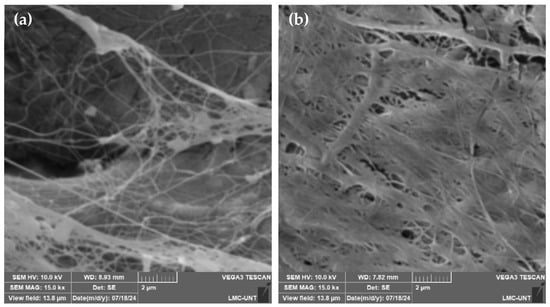
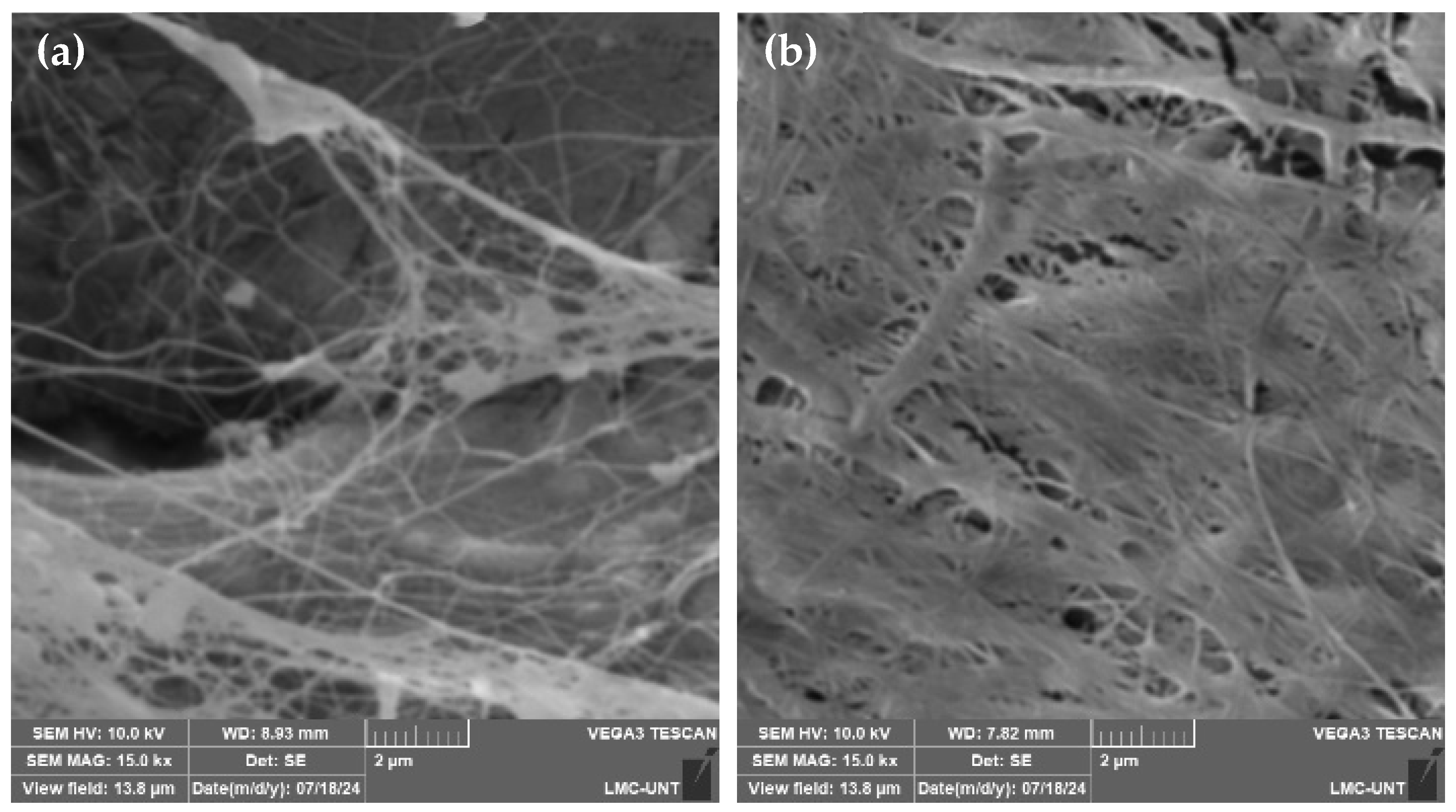
The morphological structure of the dry BC membranes was examined using scanning electron microscopy (SEM). As shown in Figure 1a, BC produced in the standard HS medium (BC-HS) exhibited the characteristic woven nanofibrous network, with fibre diameters ranging from 76 to 87 nm. The BC-HS membrane displayed a porous structure, although less pronounced than that observed for the membrane obtained in the modified MHS medium. In contrast, BC-MHS (Figure 1b) presented a more developed three-dimensional network-like architecture, characterised by a higher degree of fibre entanglement and larger interconnected voids. This morphology is consistent with the random organisation of nanofibres secreted during biosynthesis, which leads to the formation of a highly porous matrix. The nanofibres in BC-MHS exhibited cross-sectional dimensions within the nanometre scale, ranging from 11 to 85 nm, suggesting that the composition of the MHS medium may influence fibril assembly dynamics and promote the formation of thinner, more loosely packed fibres. Such structural differences are likely to affect key functional properties, including water retention, mechanical behaviour, and surface area.
Figure 1.
SEM micrograph: (a) BC-HS membrane at 15 kx and (b) BC-MHS membrane at 15 kx.
The nanofibrous architecture observed in both BC-HS and BC-MHS is closely linked to the functional properties of bacterial cellulose. According to Güzel et al. [51] the arrangement of fine fibres within BC membranes plays a critical role in determining key characteristics such as the tensile strength, elongation, water-retention capacity, and crystallinity. The dense network of interwoven ultrafine fibrils identified in this study aligns well with the values reported in the literature, including those described by He et al. [50] (50–100 nm), Cacicedo et al. [52] (79.5 nm), Avvioglu et al. [53] (30–75 nm), Li et al. [54] (50–100 nm), and Thongwai et al. [55] (50–250 nm). This agreement reinforces that the fibrillar dimensions and network organisation observed in the BC-HS and BC-MHS membranes fall within the expected morphological range for K. xylinus-derived cellulose and are consistent with structures known to influence mechanical and physicochemical performance.
Contact angle analysis provides a quantitative assessment of the wetting behaviour of solid surfaces and is widely used to characterise materials such as cellulose and other polysaccharides [56]. The static contact angle values measured with distilled water on the dry BC membranes were 23.91° ± 0.03 for BC-HS and 22.47° ± 0.31 for BC-MHS (Figure S2). These values indicate that both membranes exhibit hydrophilic surface characteristics, with the BC-MHS membrane showing slightly higher hydrophilicity. Variations in carbon source composition may influence surface properties such as wettability, roughness, and porosity, which in turn can affect the overall behaviour and performance of BC-based materials [57].
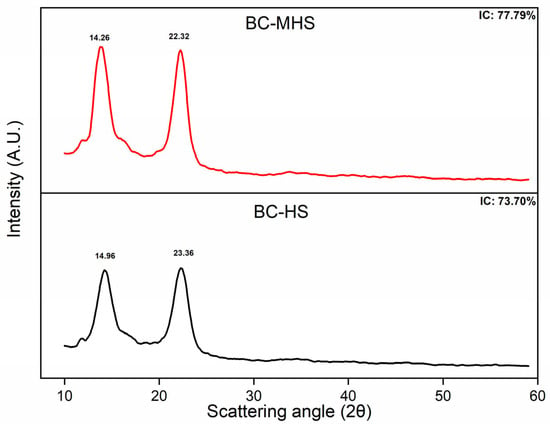
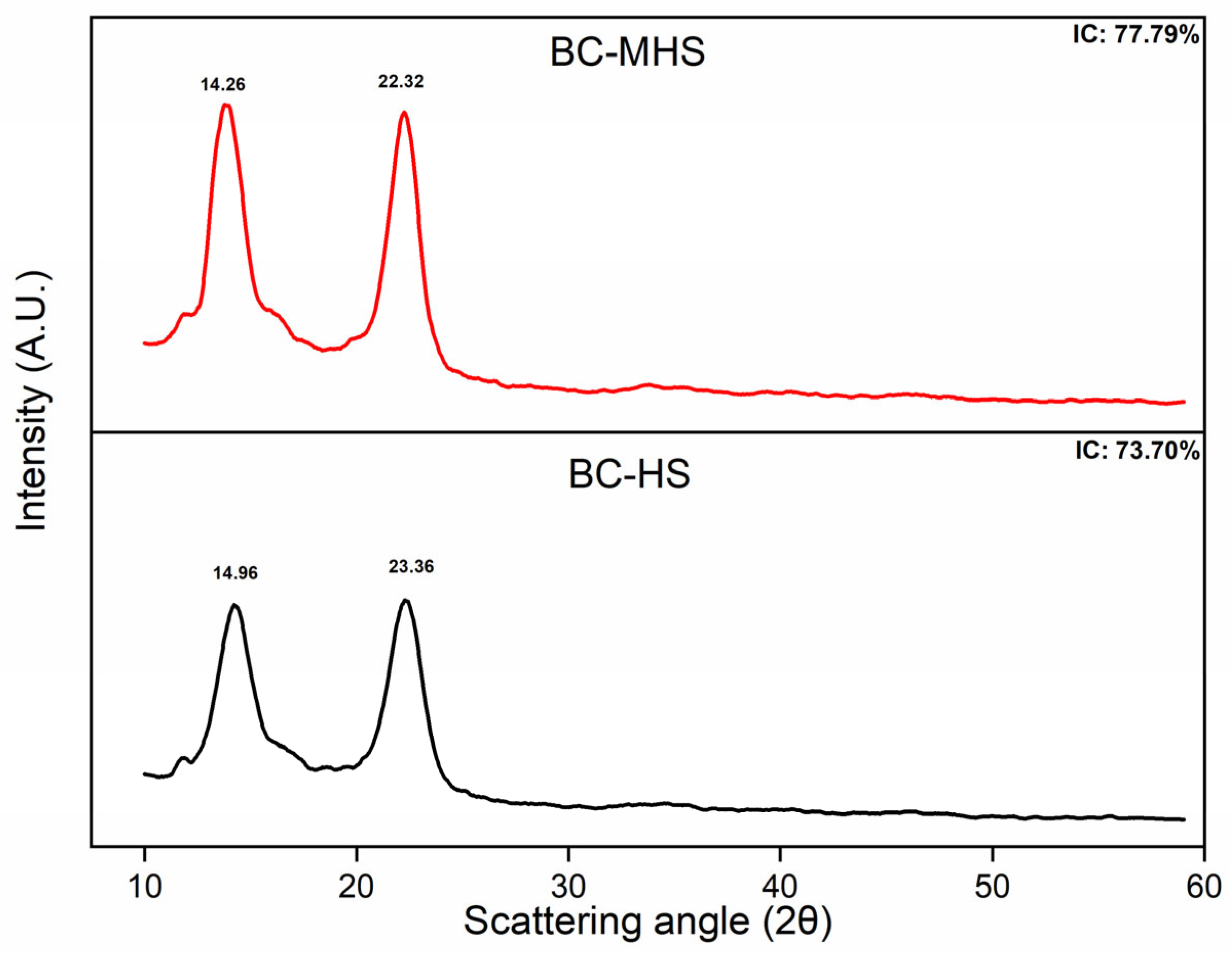
X-ray diffraction (XRD) analysis is widely used to determine the crystalline structure of cellulose membranes [58]. The diffractograms of the BC-HS and BC-MHS membranes (Figure 2) exhibited two characteristic diffraction peaks. For BC-HS, these peaks corresponded to the 110 and 200 planes, whereas for BC-MHS they corresponded to the 111 and 200 planes. The crystallinity of BC is known to be influenced by several factors, including the culture method, carbon source, medium pH, temperature, cultivation time, additives, and drying procedures [58]. In this study, the BC-MHS membrane displayed a slightly higher crystallinity index (~78%) compared with BC-HS (~74%). Despite being produced from different carbon substrates, both membranes showed similar diffraction patterns and relatively high crystallinity values, consistent with those reported in the literature, such as the 77.99% described by Avcioglu et al. [53].
Figure 2.
X-ray diffraction profiles of BC-HS and BC-MHS membranes produced after 10 days of fermentation.
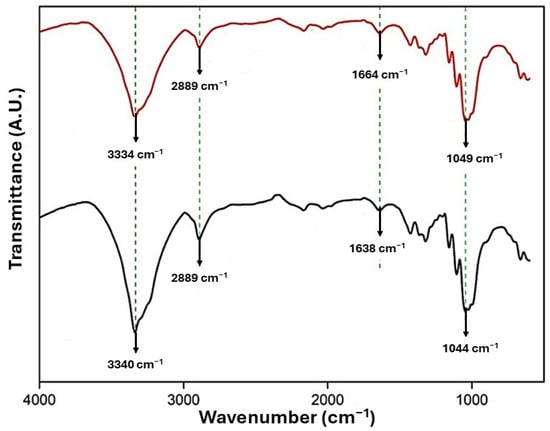
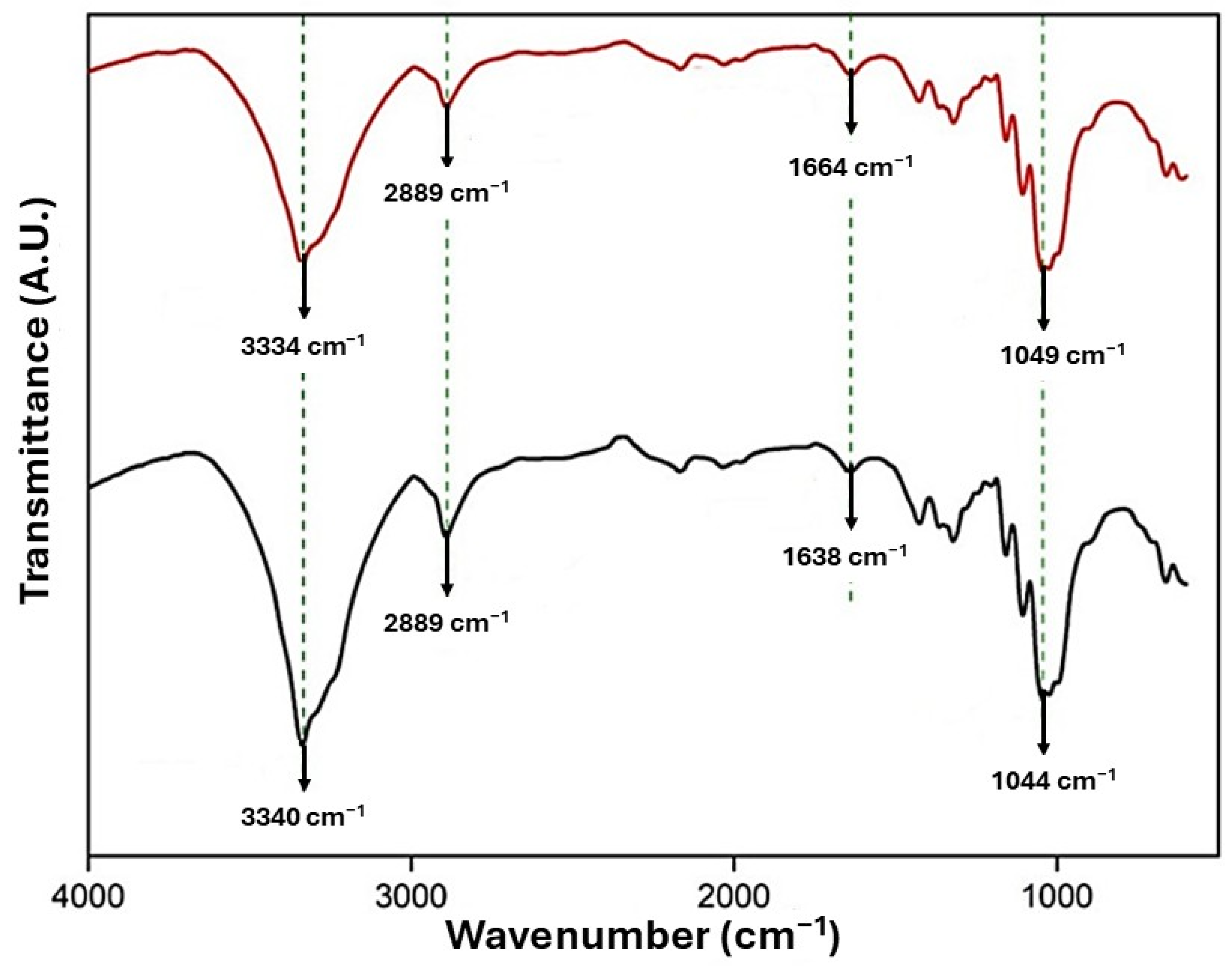
FTIR analysis provides essential information on the absorption bands associated with bond vibrations in the functional groups of biopolymers [59]. Figure 3 shows the FTIR spectra of BC-HS and BC-MHS membranes in the range of 4000–600 cm−1. Both membranes exhibited highly similar spectral profiles, indicating that the carbon source or fermentation medium did not significantly affect the functional groups present in the BC structure. A broad peak was observed at approximately 3340 cm−1 for BC-HS and 3334 cm−1 for BC-MHS, corresponding to the stretching vibrations of intermolecular hydrogen bonds (O–H groups) [26].
Figure 3.
FTIR-ATR analysis of BC-HS and BC-MHS dry membranes produced after 10 days of fermentation.
Both BC-HS and BC-MHS membranes displayed a peak at 2889 cm−1, attributed to the aliphatic –CH stretching vibration characteristic of carbohydrates. The band observed between 1638 cm−1 and 1664 cm−1 is associated with the –OH bending vibration of absorbed water, which may reflect the moisture-retention capacity of the samples [52,53]. The peak located between 1044 cm−1 and 1049 cm−1 corresponds to the C–O–C and C–O–H stretching vibrations of the glucose ring structure [60]. These characteristic bands are consistent with those reported by Ye et al. [10], who analysed morphological and chemical features of BC produced using HS medium and tobacco waste extract as a carbon source.
The mechanical properties of BC membranes are influenced by multiple factors, including culture conditions, bacterial strain, composition of the culture medium, purification procedures, and drying methods [61]. Evaluating these properties is therefore essential for determining their suitability for specific applications. The tensile characteristics of the BC-HS and BC-MHS membranes are presented in Table 4.
Table 4.
Tensile performance parameters of the BC-HS and BC-MHS membranes.
Significant differences were observed between the two membranes—particularly in the elongation, tensile strength, and Young’s modulus—depending on the culture medium used. These results suggest that the HS medium may enhance the development of intramolecular interactions between BC fibres, thereby improving the resistance to rupture [62]. Likewise, the increase in Young’s modulus observed for BC-HS indicates higher rigidity and reduced elastic deformation under load [63].
However, the higher crystallinity index of BC-MHS (~78%) was not accompanied by a corresponding improvement in mechanical performance, as this membrane exhibited reduced tensile strength compared to BC-HS. This apparent discrepancy highlights that crystallinity alone does not determine the mechanical behaviour of BC. Mechanical resistance is also governed by the organisation, continuity, and packing density of the microfibrillar network [64]. In this sense, the richer composition of the MHS medium (glucose, xylose, organic acids) could accelerate cellulose biosynthesis, promoting rapid microfibril formation but leading to looser interfibrillar packing and reduced fibre–fibre cohesion. Such structural features can weaken the stress transfer across the network, resulting in a decrease in tensile strength despite the higher crystalline fraction.
These differences in mechanical behaviour between BC-HS and BC-MHS become even more evident when compared with the values reported in the literature. The results obtained in this study show elongation values higher than those reported by Chen et al. [65] (0.8 ± 0.23%). Likewise, the tensile strength displays improved values compared with those described by Almeida et al. [57] (33.9 ± 0.2 MPa) in comparison with BC-HS membranes, and those reported by Wu et al. [66] (21.64 ± 3.00 MPa) and Xu et al. [67] (6.33 ± 0.39 MPa) with respect to BC MHS membranes. In addition, the Young’s modulus values obtained in this work are higher than those reported by Almeida et al. [57] (1.62 GPa) and Chen et al. [65] (0.00814 GPa) for BC membranes produced in HS and MHS media. Overall, these comparisons indicate that both BC-HS and BC-MHS exhibit mechanical performance within, or above, the upper range typically reported for bacterial cellulose, despite the structural differences arising from the use of distinct carbon sources.
Together, these findings demonstrate that the mechanical performance of BC membranes arises from the interplay between the crystalline fraction [68], the microfibril packing density, and the chemical composition [69].
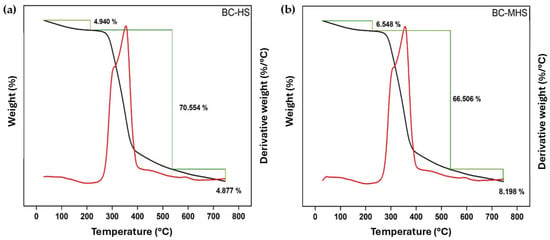
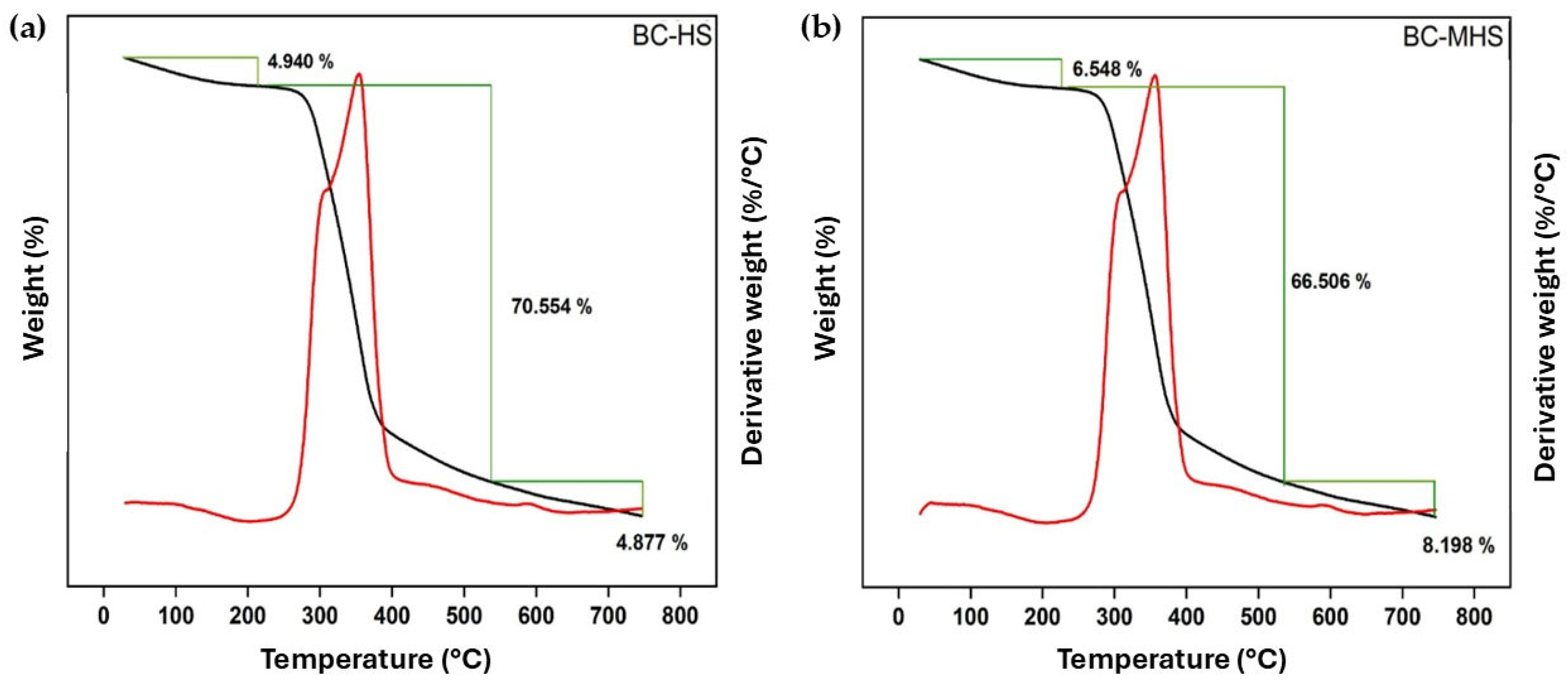
Evaluating the thermal stability of BC membranes is essential for defining appropriate application environments and storage conditions [70]. To this end, thermogravimetric analysis (TGA) was conducted, in which the sample mass is continuously monitored as the temperature increases, providing insight into the phase transitions associated with decomposition and oxidation processes. The thermogravimetric curves of BC-HS and BC-MHS, together with their corresponding derivative thermogravimetric (DTG) profiles, are presented in Figure 4, and the thermal parameters derived from these analyses are summarised in Table 5.
Figure 4.
Thermogravimetric (TGA) and derivative thermogravimetric (DTG) curves for (a) BC-HS and (b) BC-MHS membranes. Black line: TGA; red line: DTG.
Table 5.
TGA and DTG thermal decomposition profiles of BC membranes.
The results show an initial weight loss of approximately 5% for BC-HS and 7% for BC-MHS between 46 °C and 128 °C, which is associated with the removal of volatile compounds and the evaporation of free water bound within the polymeric structure [71]. After this stage, both BC membranes remained thermally stable up to the onset temperature at which pyrolysis of bacterial cellulose begins. The extrapolated onset temperature—defined as the intersection between the baseline of the initial mass and the tangent to the TGA curve at the point of maximum gradient—was slightly higher for BC-MHS (~311 °C) than for BC-HS (~307 °C). Similarly, the maximum decomposition temperatures were ~357 °C for BC-MHS and ~354 °C for BC-HS.
The total weight loss was larger for BC-HS than for BC-MHS membranes, which can be attributed to thermal degradation processes such as depolymerisation, dehydration, cleavage of glucose bonds, and the rearrangement or formation of carbonyl and carboxyl groups within the BC structure [72]. At the end of the thermal process, the residual mass was approximately 20% for BC-MHS and 19% for BC-HS. Temperatures approaching 600 °C have been reported to promote carbon formation due to carbonisation of the remaining biopolymer chains [73]. Overall, the weight-loss profiles observed in this study are consistent with those reported in previous works [53].
The DTG curves, which represent the maximum rate of thermal decomposition, are shown in Figure 4. Both BC-HS and BC-MHS exhibited a maximum decomposition rate at approximately 350 °C (Table 5), indicating that the two membranes possess comparable thermal stability. This observation is consistent with the findings of George et al. [74], who reported that BC remains thermally stable up to around 200 °C, with the initial mass loss corresponding to the evaporation of water associated with the polymeric network. Major decomposition occurs thereafter, becoming more pronounced above 338 °C, as temperatures exceeding 300 °C led to significant degradation of the polymer.
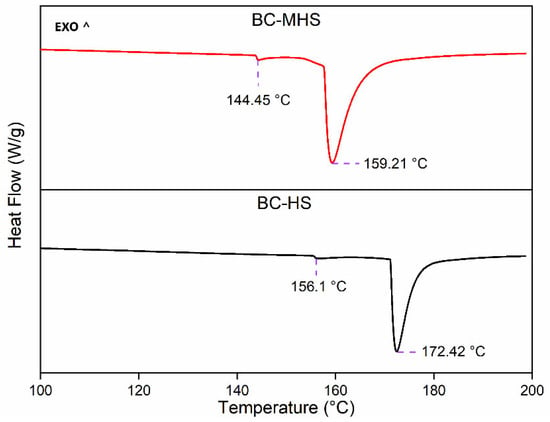
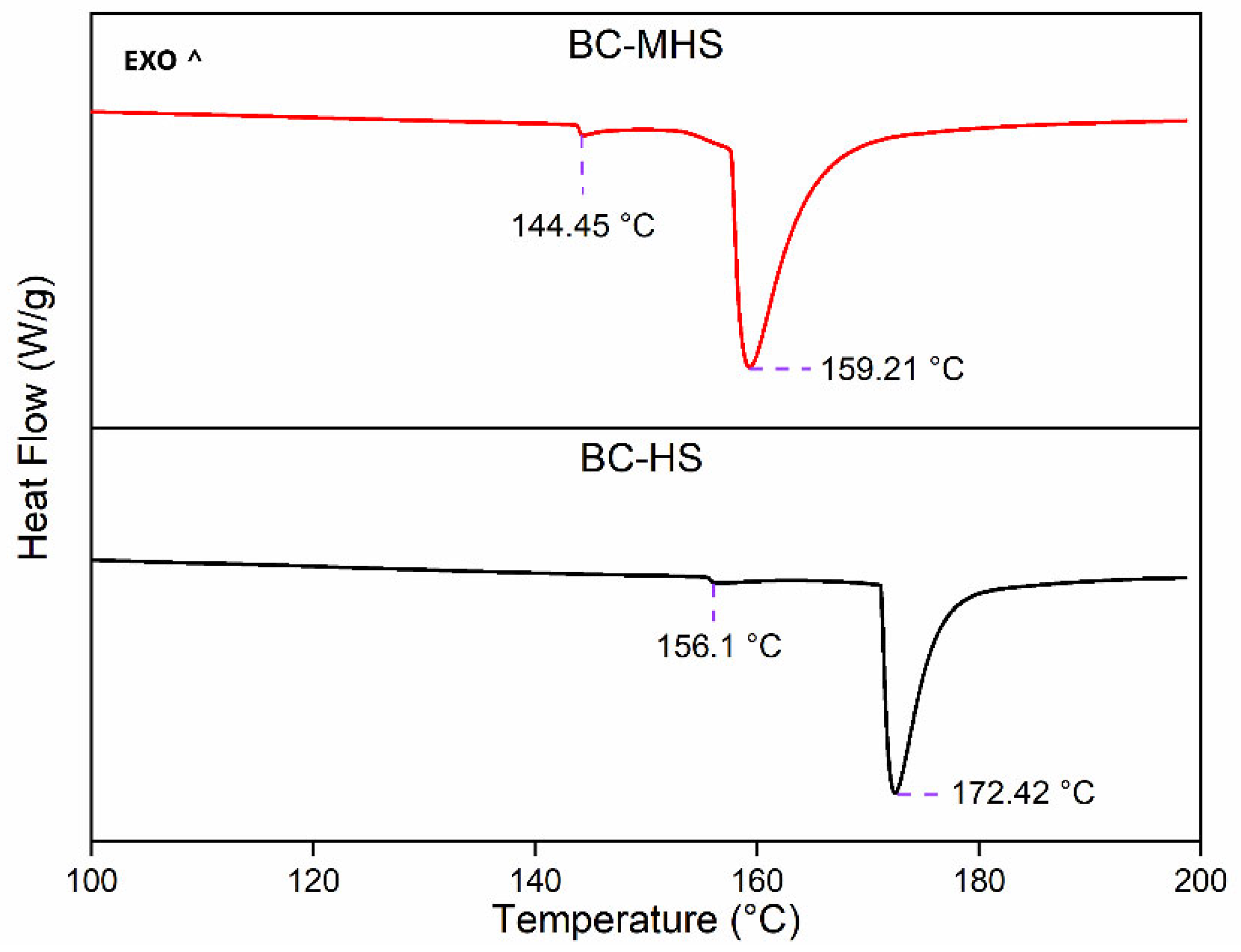
The DSC measures the heat absorbed or released by a material as a function of the temperature or time (for isotherms) [27], and the DSC analysis of the BC-HS and BC-MHS membranes is shown in Figure 5.
Figure 5.
Differential scanning calorimetry (DSC) spectra of BC-HS and BC-MHS dry membranes.
A second-order transition associated with the glass transition temperature (Tg) was observed at 156 °C for the BC-HS membrane, a value higher than that of BC-MHS (144.5 °C). A higher Tg is generally advantageous, as it reflects reduced molecular mobility and limited physical ageing under typical storage conditions. Conversely, a lower Tg denotes greater mobility within the amorphous regions, indicating a less rigid and less densely packed microfibrillar matrix [75]. This increased mobility decreases the stiffness of the interfibrillar domains and contributes to the reduced mechanical strength of the membrane [69]. In this regard, the thermal behaviour observed here is consistent with the mechanical properties measured for the BC-HS and BC-MHS membranes.
Figure 5 also shows the melting temperatures (Tm), which were ~172 °C for the BC-HS membrane and ~160 °C for the BC-MHS membrane. These Tm values are higher than those reported by Calderón-Toledo et al. [71], who described a melting temperature of 125 °C for cellulose produced in HS medium. Variations in melting behaviour may be attributed to differences in the crystallinity, fibre organisation, and the nature of the substrates used during biosynthesis [76].
4. Conclusions
The valorisation of avocado seed (AS) by-products from the avocado industry was successfully achieved by using them as a carbon source for bacterial cellulose (BC) production. A productivity rate of 0.19 g/L·day was achieved through a simple and sustainable process. The morphological, thermal, and mechanical properties of the BC produced using the AS-based medium (MHS medium)—including ~78% crystallinity, a thermal degradation temperature of ~357 °C, an elongation of 0.75%, a tensile strength of ~22 MPa, and a Young’s modulus of ~3 GPa—were comparable to those of BC obtained from the conventional HS medium and other reported carbon sources. This similarity is particularly relevant considering that the MHS medium is derived from lignocellulosic avocado seed residues, which represent a low-cost, abundant, and sustainable carbon source. The use of such agro-industrial by-products can substantially reduce production costs while maintaining material properties comparable to those achieved with the standard HS medium, thereby supporting the development of more economical and environmentally sustainable BC production processes.
In addition, the process described in this study offers several practical advantages, including operational simplicity, high production levels, and ease of implementation. Overall, the results contribute to advancing BC production by valorising agricultural waste streams and promoting an eco-sustainable circular-economy approach within the field of bio-based materials.
Supplementary Materials
The following supporting information can be downloaded at https://www.mdpi.com/article/10.3390/pr14030543/s1; S1. Methods; Table S1. HPLC and CAD conditions for structural carbohydrates; Table S2. Fermentation performance parameters measured during bacterial cellulose production; Figure S1. Kinetics of bacterial cellulose production. (a) Time-course of reducing sugar consumption during 20-day fermentations in HS and MHS media. (b) Corresponding bacterial cellulose productivity profiles; Figure S2. Static water contact angle values for the BC membrane from (a) HS medium and (b) MHS medium.
Author Contributions
Conceptualisation, Funding acquisition, G.B.-J.; Investigation, Writing—original draft, Y.L.A.S.; Investigation, Writing—original draft, A.R.; Conceptualisation, Funding acquisition, Investigation, J.C.A.; Conceptualisation, Methodology, D.A.M.B.; Investigation, Resources, H.A.-Q.; Writing—original draft, A.F.-P.; Methodology, Software, F.J.H.B.; Data curation, Software, C.S.-B.; Software, Data curation, Writing—original draft, review, and editing M.G.M.-A.; Data curation, Writing—original draft, review, and editing, Funding acquisition, F.V. All authors have read and agreed to the published version of the manuscript.
Funding
This research has been financed by the Concytec—World Bank Project “Improvement and Expansion of the Services of the National System of Science, Technology and Technological Innovation” 8682-PE, through its executing unit ProCiencia [Contract No. 006-2018-FONDECYT-BM-IADT-MU]. There was financial support from the Spanish Ministry of Science and Innovation to the project CEL-SENS (TED2021-132164B-C21), as well as the grant to finance research projects for climate change mitigation and adaptation from AGAUR (2023 CLIMA 00075) GreenELECTRO project.
Data Availability Statement
The original contributions presented in this study are included in the article/Supplementary Materials. Further inquiries can be directed to the corresponding authors.
Acknowledgments
The authors want to acknowledge the technical support from the equipment and laboratory technicians in every assay. The authors have reviewed and edited the output and take full responsibility for the content of this publication.
Conflicts of Interest
The authors declare no conflicts of interest.
References
- Singhania, R.R.; Patel, A.K.; Tseng, Y.S.; Kumar, V.; Chen, C.W.; Haldar, D.; Saini, J.K.; Dong, C. Di Developments in Bioprocess for Bacterial Cellulose Production. Bioresour. Technol. 2022, 344, 126343. [Google Scholar] [CrossRef] [Scilit]
- Klemm, D.; Cranston, E.D.; Fischer, D.; Gama, M.; Kedzior, S.A.; Kralisch, D.; Kramer, F.; Kondo, T.; Lindström, T.; Nietzsche, S.; et al. Nanocellulose as a Natural Source for Groundbreaking Applications in Materials Science: Today’s State. Mater. Today 2018, 21, 720–748. [Google Scholar] [CrossRef] [Scilit]
- Zhao, X.; Bhagia, S.; Gomez-Maldonado, D.; Tang, X.; Wasti, S.; Lu, S.; Zhang, S.; Parit, M.; Rencheck, M.L.; Korey, M.; et al. Bioinspired Design toward Nanocellulose-Based Materials. Mater. Today 2023, 66, 409–430. [Google Scholar] [CrossRef] [Scilit]
- Pogorelova, N.; Rogachev, E.; Digel, I.; Chernigova, S.; Nardin, D. Bacterial Cellulose Nanocomposites: Morphology and Mechanical Properties. Materials 2020, 13, 2849. [Google Scholar] [CrossRef] [Scilit]
- Laavanya, D.; Shirkole, S.; Balasubramanian, P. Current Challenges, Applications and Future Perspectives of SCOBY Cellulose of Kombucha Fermentation. J. Clean. Prod. 2021, 295, 126454. [Google Scholar] [CrossRef] [Scilit]
- Behera, B.; Laavanya, D.; Balasubramanian, P. Techno-Economic Feasibility Assessment of Bacterial Cellulose Biofilm Production during the Kombucha Fermentation Process. Bioresour. Technol. 2022, 346, 126659. [Google Scholar] [CrossRef] [Scilit]
- Navya, P.V.; Gayathri, V.; Samanta, D.; Sampath, S. Bacterial Cellulose: A Promising Biopolymer with Interesting Properties and Applications. Int. J. Biol. Macromol. 2022, 220, 435–461. [Google Scholar] [CrossRef] [Scilit] [PubMed]
- Gregory, D.A.; Tripathi, L.; Fricker, A.T.R.; Asare, E.; Orlando, I.; Raghavendran, V.; Roy, I. Bacterial Cellulose: A Smart Biomaterial with Diverse Applications. Mater. Sci. Eng. R Rep. 2021, 145, 100623. [Google Scholar] [CrossRef] [Scilit]
- Riseh, R.S.; Vazvani, M.G.; Hassanisaadi, M.; Thakur, V.K. Agricultural Wastes: A Practical and Potential Source for the Isolation and Preparation of Cellulose and Application in Agriculture and Different Industries. Ind. Crops Prod. 2024, 208, 117904. [Google Scholar] [CrossRef] [Scilit]
- Ye, J.; Zheng, S.; Zhang, Z.; Yang, F.; Ma, K.; Feng, Y.; Zheng, J.; Mao, D.; Yang, X. Bacterial Cellulose Production by Acetobacter xylinum ATCC 23767 Using Tobacco Waste Extract as Culture Medium. Bioresour. Technol. 2019, 274, 518–524. [Google Scholar] [CrossRef] [Scilit] [PubMed]
- Araújo, R.G.; Rodriguez-Jasso, R.M.; Ruiz, H.A.; Pintado, M.M.E.; Aguilar, C.N. Avocado By-Products: Nutritional and Functional Properties. Trends Food Sci. Technol. 2018, 80, 51–60. [Google Scholar] [CrossRef] [Scilit]
- Rodríguez-Martínez, B.; Romaní, A.; Eibes, G.; Garrote, G.; Gullón, B.; del Río, P.G. Potential and Prospects for Utilization of Avocado By-Products in Integrated Biorefineries. Bioresour. Technol. 2022, 364, 128034. [Google Scholar] [CrossRef] [Scilit] [PubMed]
- Ramos-Aguilar, A.L.; Ornelas-Paz, J.; Tapia-Vargas, L.M.; Gardea-Béjar, A.A.; Yahia, E.M.; de Jesús Ornelas-Paz, J.; Ruiz-Cruz, S.; Rios-Velasco, C.; Escalante-Minakata, P. Effect of Cultivar on the Content of Selected Phytochemicals in Avocado Peels. Food Res. Int. 2021, 140, 110024. [Google Scholar] [CrossRef] [Scilit]
- Tesfaye, T.; Ayele, M.; Gibril, M.; Ferede, E.; Limeneh, D.Y.; Kong, F. Beneficiation of Avocado Processing Industry By-Product: A Review on Future Prospect. Curr. Res. Green Sustain. Chem. 2022, 5, 100253. [Google Scholar] [CrossRef] [Scilit]
- Salazar-López, N.J.; Domínguez-Avila, J.A.; Yahia, E.M.; Belmonte-Herrera, B.H.; Wall-Medrano, A.; Montalvo-González, E.; González-Aguilar, G.A. Avocado Fruit and By-Products as Potential Sources of Bioactive Compounds. Food Res. Int. 2020, 138, 109774. [Google Scholar] [CrossRef] [Scilit]
- Barraza-Jáuregui, G.; Siche, R. Avocado Seed Starch: Optimization of the Whiteness Index During the Extraction Process. Agroindustrial Sci. 2021, 11, 81–85. [Google Scholar] [CrossRef] [Scilit]
- Salazar-Irrazabal, M.D.; Ramirez-Tixe, E.E.; Velasquez-Barreto, F.F.; Bello-Pérez, L.A. Avocado Seed Starch: Effect of the Variety on Molecular, Physicochemical, and Digestibility Characteristics. Int. J. Biol. Macromol. 2023, 247, 125746. [Google Scholar] [CrossRef] [Scilit] [PubMed]
- Sluiter, A.; Ruiz, R.; Scarlata, C.; Sluiter, J.; Templeton, D. Determination of Extractives in Biomass; Laboratory Analytical Procedure (LAP); National Renewable Energy Laboratory (NREL): Golden, CO, USA, 2008. Available online: https://docs.nrel.gov/docs/gen/fy08/42619.pdf (accessed on 24 March 2025).
- Mejía-Giraldo LFMartínez Correa, H.A.; Betancourt-Gutiérrez, J.E.; Castrillón-Castaño, C.E. Aprovechamiento del residuo agroindustrial del mango común (Mangifera indica L.) en la obtención de azúcares fermentables. Ing. Cienc. 2007, 3, 41–62. [Google Scholar]
- Khatri, D.; Chhetri, S.B.B. Reducing Sugar, Total Phenolic Content, and Antioxidant Potential of Nepalese Plants. Biomed Res. Int. 2020, 2020, 7296859. [Google Scholar] [CrossRef] [Scilit]
- Somogyi, M. Notes on Sugar Determination. J. Biol. Chem. 1952, 195, 19–23. [Google Scholar] [CrossRef] [Scilit]
- Sluiter, A.; Hames, B.; Ruiz, R.; Scarlata, C.; Sluiter, J.; Templeton, D.; Crocker, D. Determination of Structural Carbohydrates and Lignin in Biomass; Laboratory Analytical Procedure (LAP); National Renewable Energy Laboratory (NREL): Golden, CO, USA, 2011.
- Sun, Y.; Cheng, J. Hydrolysis of Lignocellulosic Materials for Ethanol Production: A Review. Bioresour. Technol. 2002, 83, 1–11. [Google Scholar] [CrossRef] [Scilit] [PubMed]
- Santoso, S.P.; Lin, S.P.; Wang, T.Y.; Ting, Y.; Hsieh, C.W.; Yu, R.C.; Angkawijaya, A.E.; Soetaredjo, F.E.; Hsu, H.Y.; Cheng, K.C. Atmospheric Cold Plasma-Assisted Pineapple Peel Waste Hydrolysate Detoxification for the Production of Bacterial Cellulose. Int. J. Biol. Macromol. 2021, 175, 526–534. [Google Scholar] [CrossRef] [Scilit] [PubMed]
- Volova, T.G.; Prudnikova, S.V.; Sukovatyi, A.G.; Shishatskaya, E.I. Production and Properties of Bacterial Cellulose by the Strain Komagataeibacter xylinus B-12068. Appl. Microbiol. Biotechnol. 2018, 102, 7417–7428. [Google Scholar] [CrossRef] [Scilit]
- Ghozali, M.; Meliana, Y.; Chalid, M. Synthesis and Characterization of Bacterial Cellulose by Acetobacter xylinum Using Liquid Tapioca Waste. Mater. Today Proc. 2021, 44, 2131–2134. [Google Scholar] [CrossRef] [Scilit]
- Mohite, B.V.; Patil, S.V. Physical, Structural, Mechanical and Thermal Characterization of Bacterial Cellulose by G. hansenii NCIM 2529. Carbohydr. Polym. 2014, 106, 132–141. [Google Scholar] [CrossRef] [Scilit]
- Del-Castillo-Llamosas, A.; Eibes, G.; Ferreira-Santos, P.; Pérez-Pérez, A.; Del-Río, P.G.; Gullón, B. Microwave-Assisted Autohydrolysis of Avocado Seed for the Recovery of Antioxidant Phenolics and Glucose. Bioresour. Technol. 2023, 385, 129432. [Google Scholar] [CrossRef] [Scilit]
- Araújo, R.G.; Rodriguez-Jasso, R.M.; Ruiz, H.A.; Govea-Salas, M.; Pintado, M.E.; Aguilar, C.N. Process Optimization of Microwave-Assisted Extraction of Bioactive Molecules from Avocado Seeds. Ind. Crops Prod. 2020, 154, 112623. [Google Scholar] [CrossRef] [Scilit]
- Domínguez, M.P.; Araus, K.; Bonert, P.; Sánchez, F.; San Miguel, G.; Toledo, M. The Avocado and Its Waste: An Approach of Fuel Potential/Application. In Environment, Energy and Climate Change II: Energies from New Resources and the Climate Change; Springer International Publishing: Cham, Switzerland, 2014; pp. 199–223. [Google Scholar]
- Sun, D.; Lv, Z.W.; Rao, J.; Tian, R.; Sun, S.N.; Peng, F. Effects of Hydrothermal Pretreatment on the Dissolution and Structural Evolution of Hemicelluloses and Lignin: A Review. Carbohydr. Polym. 2022, 281, 119050. [Google Scholar] [CrossRef] [Scilit]
- Jonas, R.; Farah, L.F. Production and Application of Microbial Cellulose. Polym. Degrad. Stab. 1998, 59, 101–106. [Google Scholar] [CrossRef] [Scilit]
- Valera, M.J.; Torija, M.J.; Mas, A.; Mateo, E. Cellulose Production and Cellulose Synthase Gene Detection in Acetic Acid Bacteria. Appl. Microbiol. Biotechnol. 2015, 99, 1349–1361. [Google Scholar] [CrossRef] [Scilit] [PubMed]
- Almeida, I.F.; Pereira, T.; Silva, N.H.C.S.; Gomes, F.P.; Silvestre, A.J.D.; Freire, C.S.R.; Sousa Lobo, J.M.; Costa, P.C. Bacterial Cellulose Membranes as Drug Delivery Systems: An in Vivo Skin Compatibility Study. Eur. J. Pharm. Biopharm. 2014, 86, 332–336. [Google Scholar] [CrossRef] [Scilit]
- Lasagni, F.; Cassanelli, S.; Gullo, M. How Carbon Sources Drive Cellulose Synthesis in Two Komagataeibacter xylinus Strains. Sci. Rep. 2024, 14, 20494. [Google Scholar] [CrossRef] [Scilit] [PubMed]
- Li, Y.; Tian, C.; Tian, H.; Zhang, J.; He, X.; Ping, W.; Lei, H. Improvement of Bacterial Cellulose Production by Manipulating the Metabolic Pathways in Which Ethanol and Sodium Citrate Involved. Appl. Microbiol. Biotechnol. 2012, 96, 1479–1487. [Google Scholar] [CrossRef] [Scilit] [PubMed]
- Lynch, K.M.; Zannini, E.; Wilkinson, S.; Daenen, L.; Arendt, E.K. Physiology of Acetic Acid Bacteria and Their Role in Vinegar and Fermented Beverages. Compr. Rev. Food Sci. Food Saf. 2019, 18, 587–625. [Google Scholar] [CrossRef] [Scilit]
- Ishihara, M.; Matsunaga, M.; Hayashi, N.; Tišler, V. Utilization of D-Xylose as Carbon Source for Production of Bacterial Cellulose. Enzym. Microb. Technol. 2002, 31, 986–991. [Google Scholar] [CrossRef] [Scilit]
- Domingues, R.; Bondar, M.; Palolo, I.; Queirós, O.; Dias de Almeida, C.; Cesário, M.T. Xylose Metabolism in Bacteria—Opportunities and Challenges towards Efficient Lignocellulosic Biomass-based Biorefineries. Appl. Sci. 2021, 11, 8112. [Google Scholar] [CrossRef] [Scilit]
- Amorim, J.; Liao, K.; Mandal, A.; Costa, A.F.D.S.; Roumeli, E.; Sarubbo, L.A. Impact of Carbon Source on Bacterial Cellulose Network Architecture and Prolonged Lidocaine Release. Polymers 2024, 16, 3021. [Google Scholar] [CrossRef] [Scilit]
- Bilgi, E.; Bayir, E.; Sendemir-Urkmez, A.; Hames, E.E. Optimization of Bacterial Cellulose Production by Gluconacetobacter xylinus Using Carob and Haricot Bean. Int. J. Biol. Macromol. 2016, 90, 2–10. [Google Scholar] [CrossRef] [Scilit]
- Barshan, S.; Rezazadeh-Bari, M.; Almasi, H.; Amiri, S. Optimization and Characterization of Bacterial Cellulose Produced by Komagatacibacter xylinus PTCC 1734 Using Vinasse as a Cheap Cultivation Medium. Int. J. Biol. Macromol. 2019, 136, 1188–1195. [Google Scholar] [CrossRef] [Scilit]
- Urbina, L.; Hernández-Arriaga, A.M.; Eceiza, A.; Gabilondo, N.; Corcuera, M.A.; Prieto, M.A.; Retegi, A. By-Products of the Cider Production: An Alternative Source of Nutrients to Produce Bacterial Cellulose. Cellulose 2017, 24, 2071–2082. [Google Scholar] [CrossRef] [Scilit]
- Dhar, P.; Etula, J.; Bankar, S.B. In Situ Bioprocessing of Bacterial Cellulose with Graphene: Percolation Network Formation, Kinetic Analysis with Physicochemical and Structural Properties Assessment. ACS Appl. Bio Mater. 2019, 2, 4052–4066. [Google Scholar] [CrossRef] [Scilit]
- Zhou, H.; Wang, J.; Yin, H.; Wang, C.; Zhang, L.; Zhang, X.; Qiao, N.; Yu, D. Bacterial Cellulose Production from Wastewater and the Influence of Its Porosity on the Fluorescence Intensity of Prepared Carbon Dots. Biochem. Eng. J. 2022, 187, 108633. [Google Scholar] [CrossRef] [Scilit]
- Wang, J.; Tavakoli, J.; Tang, Y. Bacterial Cellulose Production, Properties and Applications with Different Culture Methods—A Review. Carbohydr. Polym. 2019, 219, 63–76. [Google Scholar] [CrossRef] [Scilit]
- de Dios Avila, N.; Tirado-Gallegos, J.M.; Rios-Velasco, C.; Esquivel, G.L.; Virgen, M.O.E.; Campos, O.J.C. Compositional, Structural and Physicochemical Properties of Avocado Seeds and Their Potential Agro-Industrial Uses. Cienc. Tecnol. Agropecu. 2023, 24, e2607. [Google Scholar] [CrossRef] [Scilit]
- Jönsson, L.J.; Alriksson, B.; Nilvebrant, N.O. Bioconversion of Lignocellulose: Inhibitors and Detoxification. Biotechnol. Biofuels 2013, 6, 16. [Google Scholar] [CrossRef] [Scilit] [PubMed]
- Vanhatalo, K.M.; Parviainen, K.E.; Dahl, O.P. Techno-economic analysis of simplified microcrystalline cellulose process. BioResources 2014, 9, 4741–4755. [Google Scholar] [CrossRef] [Scilit]
- Dourado, F.; Fontão, A.; Leal, M.; Rodrigues, A.C.; Gama, M. Process Modeling and Techno-Economic Evaluation of an Industrial Bacterial NanoCellulose Fermentation Process. In Bacterial Nanocellulose: From Biotechnology to Bio-Economy; Elsevier: Amsterdam, The Netherlands, 2016; pp. 199–214. ISBN 9780444634665. [Google Scholar]
- Güzel, M.; Akpınar, Ö. Production and Characterization of Bacterial Cellulose from Citrus Peels. Waste Biomass Valorization 2019, 10, 2165–2175. [Google Scholar] [CrossRef] [Scilit]
- Cacicedo, M.L.; Islan, G.A.; Drachemberg, M.F.; Alvarez, V.A.; Bartel, L.C.; Bolzán, A.D.; Castro, G.R. Hybrid Bacterial Cellulose-Pectin Films for Delivery of Bioactive Molecules. New J. Chem. 2018, 42, 7457–7467. [Google Scholar] [CrossRef] [Scilit]
- Avcioglu, N.H.; Birben, M.; Seyis Bilkay, I. Optimization and Physicochemical Characterization of Enhanced Microbial Cellulose Production with a New Kombucha Consortium. Process Biochem. 2021, 108, 60–68. [Google Scholar] [CrossRef] [Scilit]
- Li, Z.; Wang, M.; Wu, B.; Luo, Q.; Liu, X.; Pei, C. All-Natural, Sustainable Laminated Composites from Bacterial Cellulose and Wheat Flour Paste. Int. J. Adhes. Adhes. 2022, 118, 103242. [Google Scholar] [CrossRef] [Scilit]
- Thongwai, N.; Futui, W.; Ladpala, N.; Sirichai, B.; Weechan, A.; Kanklai, J.; Rungsirivanich, P. Characterization of Bacterial Cellulose Produced by Komagataeibacter maltaceti P285 Isolated from Contaminated Honey Wine. Microorganisms 2022, 10, 528. [Google Scholar] [CrossRef] [Scilit] [PubMed]
- Tomé, L.C.; Freire, M.G.; Rebelo, L.P.N.; Silvestre, A.J.D.; Neto, C.P.; Marrucho, I.M.; Freire, C.S.R. Surface Hydrophobization of Bacterial and Vegetable Cellulose Fibers Using Ionic Liquids as Solvent Media and Catalysts. Green Chem. 2011, 13, 2464–2470. [Google Scholar] [CrossRef] [Scilit]
- Almeida, A.P.C.; Saraiva, J.N.; Cavaco, G.; Portela, R.P.; Leal, C.R.; Sobral, R.G.; Almeida, P.L. Crosslinked Bacterial Cellulose Hydrogels for Biomedical Applications. Eur. Polym. J. 2022, 177, 111438. [Google Scholar] [CrossRef] [Scilit]
- Machado, R.T.A.; Meneguin, A.B.; Sábio, R.M.; Franco, D.F.; Antonio, S.G.; Gutierrez, J.; Tercjak, A.; Berretta, A.A.; Ribeiro, S.J.L.; Lazarini, S.C.; et al. Komagataeibacter rhaeticus Grown in Sugarcane Molasses-Supplemented Culture Medium as a Strategy for Enhancing Bacterial Cellulose Production. Ind. Crops Prod. 2018, 122, 637–646. [Google Scholar] [CrossRef] [Scilit]
- Ul-Islam, M.; Ullah, M.W.; Khan, S.; Park, J.K. Production of Bacterial Cellulose from Alternative Cheap and Waste Resources: A Step for Cost Reduction with Positive Environmental Aspects. Korean J. Chem. Eng. 2020, 37, 925–937. [Google Scholar] [CrossRef] [Scilit]
- Revin, V.; Liyaskina, E.; Nazarkina, M.; Bogatyreva, A.; Shchankin, M. Cost-Effective Production of Bacterial Cellulose Using Acidic Food Industry by-Products. Braz. J. Microbiol. 2018, 49, 151–159. [Google Scholar] [CrossRef] [Scilit]
- Gorgieva, S.; Jančič, U.; Cepec, E.; Trček, J. Production Efficiency and Properties of Bacterial Cellulose Membranes in a Novel Grape Pomace Hydrolysate by Komagataeibacter melomenusus AV436T and Komagataeibacter xylinus LMG 1518. Int. J. Biol. Macromol. 2023, 244, 125368. [Google Scholar] [CrossRef] [Scilit]
- Szymańska-Chargot, M.; Chylińska, M.; Cybulska, J.; Kozioł, A.; Pieczywek, P.M.; Zdunek, A. Simultaneous Influence of Pectin and Xyloglucan on Structure and Mechanical Properties of Bacterial Cellulose Composites. Carbohydr. Polym. 2017, 174, 970–979. [Google Scholar] [CrossRef] [Scilit]
- Cazón, P.; Velázquez, G.; Vázquez, M. Characterization of Bacterial Cellulose Films Combined with Chitosan and Polyvinyl Alcohol: Evaluation of Mechanical and Barrier Properties. Carbohydr. Polym. 2019, 216, 72–85. [Google Scholar] [CrossRef] [Scilit] [PubMed]
- Zhong, C. Industrial-Scale Production and Applications of Bacterial Cellulose. Front. Bioeng. Biotechnol. 2020, 8, 605374. [Google Scholar] [CrossRef] [Scilit]
- Chen, S.Q.; Meldrum, O.W.; Liao, Q.; Li, Z.; Cao, X.; Guo, L.; Zhang, S.; Zhu, J.; Li, L. The Influence of Alkaline Treatment on the Mechanical and Structural Properties of Bacterial Cellulose. Carbohydr. Polym. 2021, 271, 118431. [Google Scholar] [CrossRef] [Scilit]
- Wu, M.; Chen, W.; Hu, J.; Tian, D.; Shen, F.; Zeng, Y.; Yang, G.; Zhang, Y.; Deng, S. Valorizing Kitchen Waste through Bacterial Cellulose Production towards a More Sustainable Biorefinery. Sci. Total Environ. 2019, 695, 133898. [Google Scholar] [CrossRef] [Scilit]
- Xu, S.; Xu, S.; Ge, X.; Tan, L.; Liu, T. Low-Cost and Highly Efficient Production of Bacterial Cellulose from Sweet Potato Residues: Optimization, Characterization, and Application. Int. J. Biol. Macromol. 2022, 196, 172–179. [Google Scholar] [CrossRef] [Scilit]
- Eichhorn, S.J.; Young, R.J. The Young’s Modulus of a Microcrystalline Cellulose. Cellulose 2001, 8, 197–207. [Google Scholar] [CrossRef] [Scilit]
- Moon, R.J.; Martini, A.; Nairn, J.; Simonsen, J.; Youngblood, J. Cellulose Nanomaterials Review: Structure, Properties and Nanocomposites. Chem. Soc. Rev. 2011, 40, 3941–3994. [Google Scholar] [CrossRef] [Scilit] [PubMed]
- Czaja, W.K.; Young, D.J.; Kawecki, M.; Brown, R.M. The Future Prospects of Microbial Cellulose in Biomedical Applications. Biomacromolecules 2007, 8, 1–12. [Google Scholar] [CrossRef] [Scilit]
- Calderón-Toledo, S.; Horue, M.; Alvarez, V.A.; Castro, G.R.; Zavaleta, A.I. Isolation and Partial Characterization of Komagataeibacter sp. SU12 and Optimization of Bacterial Cellulose Production Using Mangifera Indica Extracts. J. Chem. Technol. Biotechnol. 2022, 97, 1482–1493. [Google Scholar] [CrossRef] [Scilit]
- Du, R.; Zhao, F.; Peng, Q.; Zhou, Z.; Han, Y. Production and Characterization of Bacterial Cellulose Produced by Gluconacetobacter xylinus Isolated from Chinese Persimmon Vinegar. Carbohydr. Polym. 2018, 194, 200–207. [Google Scholar] [CrossRef] [Scilit]
- Tyagi, N.; Suresh, S. Production of Cellulose from Sugarcane Molasses Using Gluconacetobacter intermedius SNT-1: Optimization & Characterization. J. Clean. Prod. 2016, 112, 71–80. [Google Scholar] [CrossRef] [Scilit]
- George, J.; Ramana, K.V.; Sabapathy, S.N.; Jagannath, J.H.; Bawa, A.S. Characterization of Chemically Treated Bacterial (Acetobacter xylinum) Biopolymer: Some Thermo-Mechanical Properties. Int. J. Biol. Macromol. 2005, 37, 189–194. [Google Scholar] [CrossRef] [Scilit]
- Menard, K.P. Dynamic Mechanical Analysis: A Practical Introduction; CRC Press: Boca Raton, FL, USA, 1999; ISBN 0849386888. [Google Scholar]
- Dórame-Miranda, R.F.; Gámez-Meza, N.; Medina-Juárez, L.; Ezquerra-Brauer, J.M.; Ovando-Martínez, M.; Lizardi-Mendoza, J. Bacterial Cellulose Production by Gluconacetobacter entanii Using Pecan Nutshell as Carbon Source and Its Chemical Functionalization. Carbohydr. Polym. 2019, 207, 91–99. [Google Scholar] [CrossRef] [Scilit] [PubMed]

Disclaimer/Publisher’s Note: The statements, opinions and data contained in all publications are solely those of the individual author(s) and contributor(s) and not of MDPI and/or the editor(s). MDPI and/or the editor(s) disclaim responsibility for any injury to people or property resulting from any ideas, methods, instructions or products referred to in the content. |
© 2026 by the authors. Licensee MDPI, Basel, Switzerland. This article is an open access article distributed under the terms and conditions of the Creative Commons Attribution (CC BY) license.