


Abstract
Recent studies have shown that wood tar exhibits excellent potential as an additive to polymers for food packaging. In this study, we demonstrated that the differential temperature of dry pyrolysis of wood affects the antioxidant and antibacterial activities of the liquid pyrolysis products (LPP). Birch LPP showed, on average, approximately 16% higher reducing power in the ferric-reducing antioxidant power (FRAP) assay and, on average, approximately 29% lower free radical scavenging activity than pine LPP. Thermal characterization suggests a qualitatively similar chemical composition among the tested fractions, with the 500 °C pyrolysis fraction showing the highest thermal resistance (lowest mass loss). Thermal characterization indicated similarities in the qualitative chemical composition of the tested fractions. Analyzed products demonstrated bactericidal activity against human- or plant-pathogenic bacteria and exhibited poor antimicrobial activity towards probiotic bacteria. Specifically, Lactoplantibacillus sp. and L. rhamnosus were, on average, approximately 61% and 45% less affected, respectively, compared to the most sensitive E. coli. We demonstrate apparent, predominantly substrate-driven differences in antibacterial activity, with Gram-negative bacteria being more susceptible to pine products and Gram-positive bacteria being more susceptible to birch products.
1. Introduction
Despite advances in medicine and infectious diseases research, there is still a need to search for novel antibacterial substances due to increasing antibiotic resistance [1], bacteria-related diseases, and high secondary infection rates developing in patients suffering from viral respiratory infections like influenza or COVID-19 [2], as well as other diseases [3,4]. One of the major sources of bacterial infections is food products, which serve as a source of nutrients for microbial growth. Foodborne diseases are caused mainly by bacteria (66%), chemicals (26%), viruses (4%), and parasites (4%), as well as by ingested food toxins produced by bacteria and fungi [5], with Escherichia coli, Salmonella spp., and Campylobacter spp. as one of the major causes [6]. Food products can get contaminated at every step of food production, including food processing and packaging [5]. The World Health Organization has estimated that there are 600 million cases associated with foodborne disease, including over 420,000 deaths and 33 million disability-adjusted life years annually [6].
Wood tar is a product obtained by the dry distillation of wood from various species of coniferous and deciduous plants, mainly pine (Pinus sp.) and birch (Betula sp.) [7]. Tar is a natural, viscous substance with a tarry consistency and a brown-black to yellow-brown color, with a density of 0.9251–1.22 g/cm3. Tar is a product of the dry distillation of wood or bark, conducted in anaerobic conditions in a temperature range of 400–1000 °C. Tar is soluble in non-aqueous solutions of dry spirit, ether, chloroform, and fatty oils. It is miscible in oils and petrolatum. The composition of tar is complex and not fully understood to date. It contains, depending on the species of wood, different compounds at various concentrations, such as diterpenes, sesquiterpenes, phenolic compounds, hydrocarbons, polycyclic aromatic compounds, and cyclic compounds [8,9].
Wood tar has been produced by humans for over 250–260,000 years in Europe [10,11,12]. Humans have commonly used wood tar throughout the ages for various purposes, including as a lubricant, adhesive, sealant, fuel for lamps (in a mixture with alcohol) [13], and as a medicinal treatment for skin diseases, gastrointestinal diseases, and as a component in chewing gum for soothing toothaches [14,15]. Today, wood tar oils, such as those derived from birch or pine, are used in the cosmetic industry and for the conservation of wooden architecture [16,17]. Recently, birch tar oil has been identified as a promising agent for protecting crops against rodents and slugs [18,19]. Moreover, there is evidence that birch tar oil can be used as an additive to polymers for food packaging, increasing their biodegradability and expressing antimicrobial properties [20,21,22]. Studies on the health properties of wood tars have been conducted, for example, for the treatment of common skin diseases [23], as well as on possible toxic effects, including carcinogenicity [24]. However, there is a lack of comprehensive research on the health risks associated with the use and production of wood tar. Pardo et al. reported that water-soluble wood tar aerosols increased inflammatory and oxidative stress responses in mice [25] and caused an increase in apoptotic bronchial epithelial cells under in vitro conditions [23]. Recently, there has been a surge in efforts to discover novel natural substances that can replace synthetic chemicals and food preservatives or enhance the industrial properties of selected materials (e.g., polymers). To efficiently utilize wood tar and other products of wood pyrolysis, it is necessary to further characterize their physical, chemical, and biological properties.
This research aims to evaluate the antioxidant and antimicrobial potential of liquid products derived from the pyrolysis of pine and birch wood (LPP). We assumed that the liquid fractions of wood pyrolysis obtained at different temperatures and on different substrates would have significantly different antimicrobial properties. In addition, we aimed to verify whether bacterial strains belonging to Gram-positive and Gram-negative bacteria exhibit similar or differential sensitivity to the liquid products of pyrolysis from birch and pine wood.
2. Materials and Methods
2.1. Material
LPP were obtained from birch and pine wood via the pyrolysis process carried out in laboratory conditions, as detailed in the work by Bartkowiak et al. [26]. Birch and pine wood were dried at room temperature and then cut mechanically into regular fragments measuring approximately 70 × 30 × 30 mm. The moisture content of the wood was determined using a MA 50.R moisture analyzer (Radwag; Radom, Poland), and was found to be, on average, 12.81% for birch wood and 11.04% for pine wood. The raw material (approximately 2000 g of chipped wood) was placed in an iron, heat-resistant retort (reactor), tightly closed with a lid and screws. Further characterization of the obtained LPP and production method can be found in the work by Bartkowiak et al. [26]. The yield of the liquid product of pyrolysis was determined based on the following formula:
where
YLP—yield of liquid product of pyrolysis [%].
MLP—mass of liquid product of pyrolysis [g].
MW—dry mass of wood (birch or pine) [g].
The liquid product self-separated after a few hours, which made it possible to separate the denser fraction from the liquid product by sedimentation (laboratory separator). Sedimentation was used to separate (fractionate) the liquid product. After the pyrolysis process was completed, the liquid product was quantitatively transferred to a 1000 mL conical glass laboratory separatory funnel. Sedimentation was conducted for 24 h at room temperature. The product separation occurred due to the density difference between the individual fractions of the liquid product. The heavier wood tar settled to the bottom of the separatory funnel. The lighter fraction was a brown-colored but clear liquid, which facilitated the process of separating the individual fractions when draining the tar fraction from the separator. LPP—free of tar—were obtained at different temperatures from birch or pine wood labeled as follows: LPP from pine wood at 450, 500, 550, and 600 °C—P450, P500, P550, and P600. Similarly, birch wood LPP at 450, 500, 550, and 600 °C without tar were marked B450, B500, B550, and B600.
2.2. Biological Material
Bacterial strains used in this study come from the collection of bacterial cultures of the Department of Genetics at the Nicolaus Copernicus University in Toruń: Escherichia coli DH5α, Salmonella typhimurium T98, Lactoplantibacillus sp., Lactobacillus rhamnosus, Pseudomonas corrugata, Pseudomonas brassicacearum; American Type Culture Collection (ATCC): Staphylococcus aureus ATCC 6538P; and Polish Collection of Microorganisms (PCM): Enterococcus faecium PCM 2787, Campylobacter jejuni PCM 2852, Listeria monocytogenes PCM2606, and Pseudomonas aeruginosa PCM 3035. Bacterial strains were stored at −80 °C in glycerol stocks (80%).
2.3. Thermogravimetric Analysis
Thermogravimetric analysis (TGA) was performed using the Netzsch STA 449 F5 Jupiter apparatus (Erich NETZSCH GmbH & Co. Holding KG, Selb, Germany). Samples (33 ± 1 mg) were heated to 700 °C at a rate of 10 °C/min. The analyses were performed in an atmosphere of helium flowing through the furnace space at a rate of 15 mL/min.
2.4. Antioxidant Assay
Antioxidant activity was measured using two assays: DPPH (2,2-diphenyl-1-picrylhydrazyl) and FRAP (Ferric Ion Reducing Antioxidant Power). DPPH analysis was performed according to the method described by Kobus-Cisowska et al. [27]. A 1 mM ethanolic solution of DPPH was used to determine the antioxidant activity of the tested liquid pyrolysis products. 1 mL of a 0.1% ethanolic pitch solution was topped with 2 mL of ethanol, and then 0.25 mL of DPPH solution was added. The mixture was vortexed for 30 s and left in the dark for 20 min. After 20 min, the absorbance of the mixture was measured at a wavelength of λ = 517 nm. The reference sample was 3 mL of methanol and 0.25 mL of DPPH solution. For each sample, DPPH radical scavenging was quantified from the decrease in absorbance of the DPPH control caused by the addition of the test solution. Trolox was used as the calibration standard, and the results were converted to Trolox equivalents using the Trolox calibration curve (R2 = 0.9833). Final antioxidant activity is reported as mM Trolox equivalents (mM Teq). To calculate the IC50, solutions of 100, 10, 1, 0.1, and 0.01% concentrations of the tested pitch in ethanol were used.
The FRAP assay was performed: A 0.1% ethanolic solution of the samples served as the test medium. In the assay, 1 mL of the sample was combined with 0.1 mL of 2 mM FeCl2, followed by the addition of 0.2 mL of ferrozine. After thorough vortexing for 30 s, the mixture was incubated in the dark for 20 min. Absorbance was measured at a wavelength of 562 nm. Trolox was used as a calibration standard (R2 = 0.9958). The results were reported as mM Teq.
2.5. Antibacterial Assay
LPP of birch and pine wood obtained at temperatures of 450, 500, 550, and 600 °C were used to analyze the antibacterial properties. Bacterial strains were inoculated into LB broth medium (NaCl, 10 g; casein peptone, 10 g; yeast extract, 5 g; dH2O, 1 L) and incubated overnight at 37 °C with shaking (180 rpm). Overnight bacterial cultures were diluted with sterile LB broth medium to an optical density (OD600) of 0.2 and inoculated (100 µL) onto LB agar medium using the plate spread method. A sterile filter paper disk (⌀ 0.5 cm) was placed in the middle of the plate and was soaked with 5 µL of sterile dH2O (negative control), 100 mg/mL ampicillin (positive control), and 100% pine or birch wood LPP (P450, P500, P550, and P600, and B450, B500, B550, and B600). The experiment was performed in four iterations for each examined sample of LPP. Plates were incubated overnight at 37 °C, and the diameter of the inhibition zone was measured.
The minimal inhibitory concentration (MIC) was evaluated via the agar dilution method on agar plates containing LPP (either P550 or B500 at 1, 2, 3, 4, and 5%) mixed with LB (human and plant pathogens) or MRS (probiotic bacteria) medium. Overnight cultures of bacteria adjusted to 0.2 OD600 were point-inoculated with an inoculating loop onto agar plates. Plates were incubated overnight at 37 °C. Additional testing was performed at 0.75, 0.5, 0.25, and 0.1% when bacteria were found to be susceptible to the particular concentration, i.e., if bacterial growth was found to be inhibited at 2% LPP and normal growth was noted at 1%, additional concentrations were added (1.25, 1.5, 1.75%) to more accurately pinpoint the effective MIC. The MIC was defined as the lowest concentration of LPP that completely inhibited visible bacterial growth. The minimal biocidal concentration (MBC) was ascertained via the broth dilution–subculturing method with LPP concentrations as mentioned above, mixed with 5 mL of either LB or MRS liquid bacterial cultures (0.2 OD600). Bacterial cultures were grown overnight at 37 °C with shaking (180 rpm), and 100 µL of the overnight cultures were spread on LPP-free LB or MRS agar plates, incubated overnight at 37 °C, and checked for bacterial growth. The MBC was defined as the lowest concentration of LPP that resulted in no visible colony growth after subculturing, corresponding to a reduction of the initial inoculum. The MIC and MBC experiments were performed in four iterations.
2.6. Statistical Analysis
Results of antioxidant and antibacterial assays were analyzed with a one-way analysis of variance (ANOVA) with a Tukey post hoc test in the Past 4.12b software [28]. The threshold for statistical difference was set at p < 0.05. Data obtained from the antibacterial analysis were further analyzed using principal component analysis (PCA) and two-way hierarchical clustering analysis based on measures of the sensitivity of the tested bacteria to LPP, calculated using the Euclidean distance.
3. Results and Discussion
3.1. Pyrolysis
Pyrolysis (destructive distillation, carbonization) is a thermal conversion process, in which wood or another type of biomass is slowly heated either under restricted access to, or in the absence of, air (oxygen). Pyrolysis of wood typically starts at a temperature of 200 °C and, depending on the wood species, it proceeds until a temperature of 450–500 °C is reached [29]. Slow pyrolysis results in the formation of a solid product, i.e., charcoal (biocoal); a liquid product—wood tar/distillates (products, being volatile compounds, undergo condensation); and volatile gases (gases not undergoing condensation). The course of the pyrolysis process, the yields of individual groups of products, as well as the quantitative and qualitative composition of the liquid product and non-condensable gases, are dependent on the process parameters and the wood species or type of biomass [30]. At temperatures ranging from 100 to 200 °C, non-combustible products are formed, such as carbon dioxide and steam, as well as trace amounts of organic compounds. Thermal decomposition of structural components in wood takes place at the following temperature ranges: hemicellulose at 200–260 °C, cellulose at 240–350 °C, and lignin at 280–500 °C, respectively [31].
Birch and pine wood pyrolysis products were obtained as dark brown liquids with an intense, characteristic smoky scent. Depending on the temperature of the pyrolysis process, the yield of the liquid product from the dry distillation of birch wood ranged from 52.77 to 54.11%. The yield of pine wood distillates ranged from 52.99 to 54.83%. The highest yield of liquid product from birch wood was obtained in the pyrolysis process at a temperature of 600 °C. Temperature has a significant influence on the distribution and properties of products. The yield of liquid products from pyrolysis increased with temperature, but only up to a maximum value, typically between 400 and 550 °C, at which the bio-oil yield peaked. For temperatures higher than 600 °C, there is a significant increase in the release of volatile compounds as bio-oils and char are converted into non-condensable gas due to secondary cracking reactions. Rapid heating and cooling of primary vapor is required to enhance liquid product pyrolysis production and minimize secondary reactions, which have a negative impact on liquid yield and quality [32]. Investigations on pyrolysis characterization have primarily been carried out using slow pyrolysis [33]. High-heating-rate pyrolysis of biomass has not been studied as closely, particularly in the high-temperature domain [34]. Changes in temperature and additives have a significant impact on the physicochemical properties of the produced tar [35], as well as the choice of the substrate [15]. Moreover, the technique used to obtain wood tar may also strongly influence the physicochemical properties of the obtained product, including adhesive strength [36]. Hagner et al. [37] utilized birch tar oil (BTO1 and BTO2) in their research, from which BTO1 was obtained during the early phase of the pyrolysis process, when the temperature did not exceed 380 °C, and BTO2 was obtained at the end of the process, when the temperature exceeded 400 °C. It was demonstrated that these two fractions exhibited differential toxicity toward soil organisms. Similar results were obtained in a study on the toxicity of BTO1 and BTO2 towards aquatic organisms [38].
3.2. Thermogravimetric Analysis
The summary of the thermal decomposition process characteristics for each tested sample is presented in Table 1 and Table 2. In the temperature range of 30 to 120 °C, water loss (i.e., the evaporation of water from the sample) was recorded (Table 1). For the tested samples, the percentage ranged from approximately 16% to approximately 29% of the initial sample mass. Within the 30–120 °C temperature range, the maximum peak temperatures for all samples were determined to be between 70 and 77 °C. Additionally, for samples P450 and P550, the peaks were recorded at 83 °C and 79 °C, respectively. In the thermal decomposition region of the tested samples (i.e., 120–750 °C), for all preparations, a peak was determined with an extreme at 140–150 °C and 196–209 °C. Additionally, for samples P500 and P600, a peak maximum was determined at 136 °C and 172 °C, respectively. The recorded changes are related to the thermal decomposition of the tested samples, which proceeds at a low rate. The mass loss in the area of active thermal decomposition (i.e., 120–750 °C) ranges from about 2% to about 9% of the initial mass of the tested samples.
Table 1.
The thermal decomposition process characteristics for pine wood.
Table 2.
The thermal decomposition process characteristics for birch wood.
In the temperature range of 30 to 120 °C, water loss (i.e., the evaporation of water from the sample) was recorded (Table 2). For samples B450, B550, and B600, this represents approximately 26% of the initial sample mass. For sample B500, the loss of water mass reached approximately 8%. In the 30–120 °C temperature range, for samples B450, B550, and B600, the peak extreme temperatures were determined to be 73–75 °C and 80–82 °C. For sample B500, the peak extreme temperature was determined to be 56 °C. For samples B500, B550, and B600, the peak maximum was determined at a temperature of 150–153 °C. The recorded changes are related to the thermal decomposition of the tested samples, which proceeded with low dynamics (low decomposition rate). Moreover, for all tested samples, a maximum was determined at a temperature of 203–215 °C, also with low dynamics of the thermal degradation process. The mass loss in active thermolysis (i.e., 120–750 °C) ranges from about 3% to about 10% of the initial mass of the tested samples.
The tested samples are a fraction of the LPP without wood tar. This fraction was obtained during the pyrolysis process at a temperature lower than the thermal decomposition temperature of the raw material (birch or pine wood). A large part of this fraction is water (from the raw material), in which some products of the pyrolysis process of birch or pine wood are dissolved [39]. The least thermally resistant structural component of wood is hemicellulose. These polysaccharides undergo thermal decomposition in the temperature range of 200–260 °C. However, the thermal degradation temperature of cellulose is 240–350 °C [31]. Products of the thermal decomposition of carbohydrates in wood include acetic acid, furfural, furan, furanone, methanol, other C1–C4 oxygenates (e.g., formaldehyde, hydroxyacetaldehyde, acetone, acetol, lactones, formic acid), C5 and C6-anhydrosugars, levoglucosan, and hydroxymethylfurfural [29]. Thermal characteristics suggest probable qualitative similarities in the chemical composition of the tested fractions, as indicated by the similar temperatures of the maximum peaks recorded during thermogravimetric analysis. Based on the total mass loss value, it was found that the most thermally resistant are the fractions obtained at a pyrolysis temperature of 500 °C (the smallest mass loss in the active thermolysis area).
3.3. Antioxidant Activity
The antioxidant activity of the LPP samples was evaluated using FRAP and DPPH assays, and the results are summarized in Table 3. The FRAP assay showed that sample B550 exhibited the highest antioxidant capacity and differed significantly from all pine wood samples (p < 0.05). Overall, birch LPP displayed significantly higher FRAP values than pine LPP. The lowest FRAP value among birch samples (B450) did not differ considerably from sample P550, which exhibited the highest FRAP value among pine wood products (p > 0.05). In contrast, the DPPH radical scavenging assay revealed a different trend. Pine LPPs P500 and P600 exhibited significantly higher radical scavenging activity compared to sample B500 (p < 0.05). In contrast, the lowest DPPH scavenging activity was observed for samples B500, B550, and P550, with no statistically significant differences between them (p > 0.05). These results indicate that, despite lower reducing power observed in the FRAP assay, selected pine wood tars exhibit high efficiency in scavenging free radicals. The IC50 values obtained from the DPPH assay further supported these observations. Sample P450 showed the lowest IC50 value, indicating the highest scavenging efficiency, whereas higher IC50 values were recorded for other pine wood samples. All birch wood tar samples exhibited IC50 values below 1%, confirming their strong antioxidant potential, although statistically significant differences were observed between individual birch samples (p < 0.05).
Table 3.
Antioxidant activity of the pine and birch wood pyrolysis products.
The observed differences in antioxidant activity can be attributed to both wood species and pyrolysis temperature, which are known to influence the chemical composition of tar products. Previous studies have demonstrated that tar composition strongly depends on the botanical origin of the wood [40], and that LPP contain substantial amounts of phenolic compounds [18]. Moreover, higher phenolic content has been directly associated with increased antioxidant capacity [41]. The discrepancies observed between FRAP and DPPH results suggest that antioxidant behavior is governed not only by the total reducing capacity, but also by the specific structure and reactivity of individual phenolic compounds. Complex mixtures rich in high-molecular-weight or sterically hindered phenolics may exhibit strong reducing power, yet show limited free radical scavenging efficiency [41]. This phenomenon may explain why pine wood samples demonstrated relatively low FRAP values but high DPPH scavenging activity. Additionally, pyrolysis temperature may affect the formation and volatilization of antioxidant-active compounds, resulting in statistically significant differences between samples derived from the same wood species.
3.4. Antibacterial Activity
S. aureus showed the highest susceptibility to birch wood LPP, with B500 and B600 being the most effective products (Table 4). The lowest sensitivity of S. aureus was shown for the B550 sample. Pine wood products were comparable to each other in terms of their efficiency in inhibiting the growth of S. aureus. L. monocytogenes was also sensitive to birch products to a greater extent than pine products (Table 4). B550 was the most effective in inhibiting the growth of L. monocytogenes, and P500 was the least effective, with a difference of over 34% between the two. E. faecium showed the highest susceptibility to P500 and B500 products and the lowest towards P600 and B550. E. coli, among the tested bacteria, was the most sensitive to both types of wood pyrolysis products, with P550 and P600 being the most effective against E. coli, whereas B450 and B550 were the least effective agents. S. typhimurium showed comparable sensitivity towards both wood-type products, with inhibition zone diameters within 15.89–18.06 mm. P550 had the highest activity against S. typhimurium, and B600 had the lowest. P. aeruginosa was most susceptible to the B450 and P600 samples. However, no statistical difference was found between all tested LPP in the case of P. aeruginosa. C. jejuni displayed slight vulnerability to the liquid products of wood pyrolysis. Overall, the birch products were more effective against C. jejuni than the pine products. The minimal inhibitory concentrations (MICs) and minimal bactericidal concentrations (MBCs) for samples P550 and B500 are listed in Table 5. In all cases, the MBC/MIC ratio was ≥4, indicating that the tested LPP have bactericidal properties rather than a bacteriostatic effect. Furthermore, birch LPP exhibited stronger bactericidal activity than pine LPP, as indicated by a lower MBC/MIC ratio. The bactericidal nature (MBC/MIC ≥ 4) of the tested LPP suggests that their antimicrobial action involves irreversible damage to essential cellular structures.
Table 4.
Antibacterial activity of pine and birch wood liquid products of pyrolysis on the tested Gram-negative and Gram-positive bacteria expressed as inhibition zone diameter [mm] (n = 4) ± SD (standard deviation). Different letters indicate statistically significant differences with p < 0.05 (one-way ANOVA with post hoc Tukey) within the row.
Table 5.
Minimal inhibitory concentration (MIC), minimal biocidal concentration (MBC), and MIC/MBC ratio of pine and birch wood liquid products of pyrolysis (LPP) on the tested Gram-negative and Gram-positive bacteria expressed as LPP concentration (%).
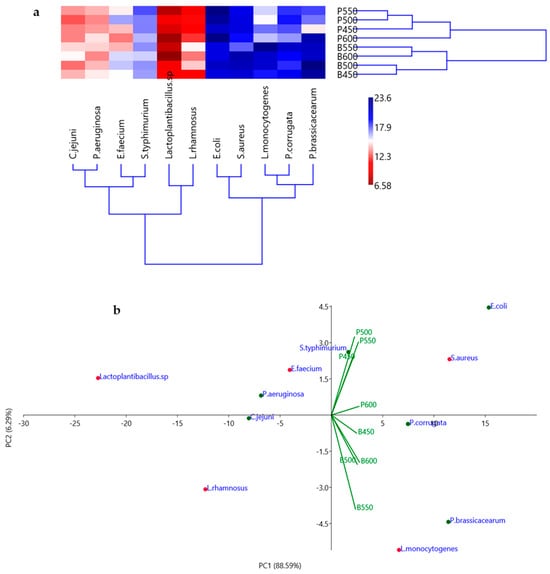
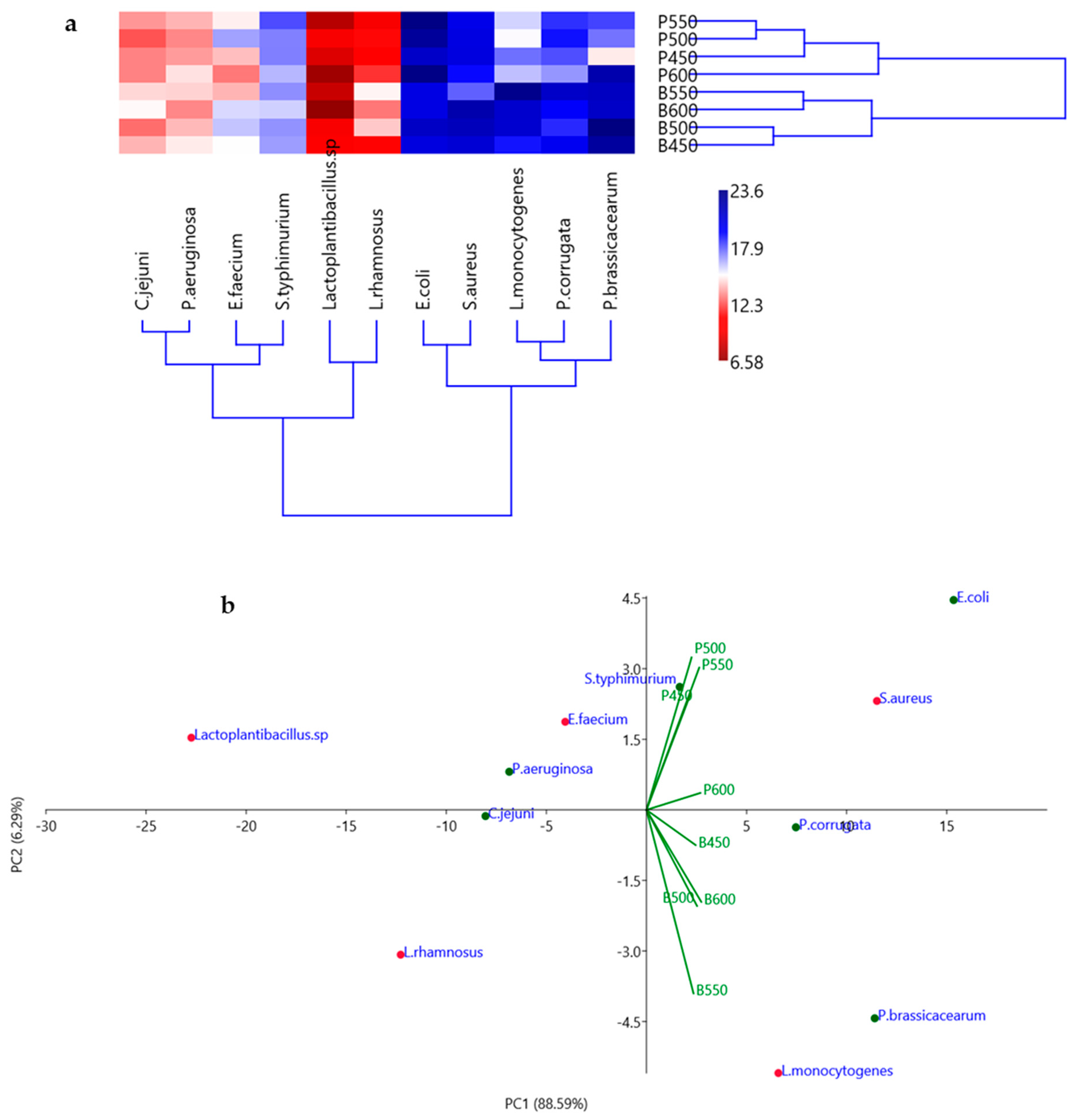
Hierarchical classification analysis clearly distinguished three bacterial response groups based on their sensitivity to pyrolysis products, i.e., first, the least sensitive to LPP containing intestine-associated Lactoplantibacillus sp. and L. rhamnosus; second, somewhat sensitive to LPP (C. jejuni, P. aeruginosa, S. typhimurium, and E. faecium); and third, most sensitive (L. monocytogenes, E. coli, P. corrugata, P. brassicacearum, and S. aureus) to LPP (Figure 1a). The sensitivity of the tested bacterial strains to the pine wood liquid product of pyrolysis can be arranged as follows (descending): E. coli > S. aureus > P. brassicacearum > P. corrugata > L. monocytogenes > S. typhimurium > E. faecium > P. aeruginosa > C. jejuni > L. rhamnosus > Lactoplantibacillus sp. Moreover, plant pathogens (i.e., P. corrugata and P. brassicacearum) showed a distinctive difference in sensitivity when compared to bacteria belonging to the same genus—P. aeruginosa, which showed significantly higher tolerance toward LPP. Two-way clustering analysis showed separation of pine and birch groups, i.e., pine and birch LPP, regardless of the pyrolysis temperature, were grouped by substrate (Figure 1). PCA of the inhibition zone diameters, similarly to classification analysis, confirmed that the wood substrate—birch or pine—was the dominant variable driving group separation, regardless of pyrolysis temperature. The first two principal components explained 94.88% of the total variance (Figure 1b). The first principal component (PC1), which explained 88.59% of total variance, separated samples based on wood substrate (birch vs. pine) regardless of pyrolysis temperature. The second component (PC2; 6.29% of variance) captured bacterial species-specific sensitivity, differentiating strains such as E. coli, L. rhamnosus, and L. monocytogenes based on their distinctive responses to pyrolysis products.
Figure 1.
(a): Two-way hierarchical clustering of the eleven analyzed bacteria. The color histogram shows the proportions of the bands present at every designated band location, ranging from 6.58 to 23.6 (inhibition zone diameter). The hierarchical cluster analysis was applied based on measures of the sensitivity of the tested bacteria to liquid products of wood pyrolysis calculated by the Euclidean distance. (b): Principal component analysis (PC1—LPP substrate, PC2—bacterial species) with a biplot of the LPP in relation to antibacterial activity expressed as mean inhibition zone diameter. Red and green dots indicate Gram-positive and Gram-negative bacteria, respectively.
Gram-positive bacteria possess a relatively thick cell wall, approximately 20–80 nm in thickness, which acts as an outer shell. In contrast, Gram-negative bacteria are characterized by a thin cell wall (<10 nm). However, they have an additional layer of protection in the form of an outer membrane with assorted pores and appendices [42]. Such differences in cell wall structure may be significant due to the differential sensitivity of bacterial strains to chemical compounds with antimicrobial properties, including antibiotics [42,43]. The use of wood tar in pharmaceuticals can be attributed to its potent antimicrobial properties, which are likely linked to the presence of phenolics and possibly other compounds in its composition. It was shown that pine and cedar (Cedrus) tars could inhibit the growth of common human pathogenic bacteria such as E. coli, S. aureus, Staphylococcus pyogenes, Staphylococcus haemolyticus, and S. typhimurium, as well as pathogenic fungi including Candida albicans [44,45]. Birch tar’s antimicrobial activity has been described in more detail than other wood tar types. Wood tar also inhibits the growth of plant pathogens, i.e., Agrobacterium tumefaciens, Xanthomonas campestris, and Pseudomonas syringae [46]. It was demonstrated that different solvents impact the antimicrobial activity of wood tar, as shown in Pinus brutia (L.) wood tar extracts [44].
Results obtained in this study show that the tested Gram-positive bacteria exhibited higher susceptibility to birch wood pyrolysis products. In contrast, Gram-negative bacteria were more sensitive to pine wood products. Although the sensitivity of the tested bacteria was not consistent when results were considered based on cell wall structure (i.e., Gram-positive or Gram-negative bacteria), this may suggest that the displayed differential sensitivity toward the tested products of pyrolysis is more tightly connected to bacterial species and divergence between bacterial species in terms of capacity to metabolize and/or adapt to the presence of antimicrobial compounds in the environment. Another factor contributing to differential sensitivity of bacteria to various antimicrobial agents may be the surface area to volume ratio (SA/V) of the cell wall, which differs between morphological types of bacteria, meaning that lower SA/V can lead to higher tolerance to antimicrobial agents that target elements present in the outer cell wall [47,48]. Interestingly, some bacteria can increase their SA/V to dilute the concentration of antimicrobial substances inside the cell as a form of adaptation [47,48]. However, in the case of LPP, a clear knowledge gap exists regarding the mechanisms bacteria employ to increase their tolerance to wood tar and LPP. Moreover, the temperature of wood pyrolysis significantly affected the susceptibility of more sensitive bacteria (i.e., L. monocytogenes, E. coli, P. brassicacearum, P. corrugata, and S. aureus). In contrast, more resistant bacteria (i.e., C. jejuni, P. aeruginosa, Lactoplantibacillus sp., and E. faecium) seemingly did not show this variation. The two-way hierarchical clustering analysis and PCA further reinforce the distinctive chemical compositions of birch and pine wood pyrolysis products, which is consistent with previous studies that have shown wood type significantly influences the phenolic content and other antimicrobial compounds generated during pyrolysis. Birch pyrolysis products appear to contain a unique set of compounds, making Gram-positive bacteria such as S. aureus and L. monocytogenes particularly vulnerable. This distinction between wood types could suggest a different antimicrobial mechanism at play, which may be related to the specific phenolic compounds produced at different pyrolysis temperatures (e.g., B500, B600) and their interaction with bacterial cell walls or inner cell metabolism.
4. Conclusions
The need for more natural and sustainable methods to combat pathogenic microbes is growing in response to increasing environmental degradation and the rising antibiotic resistance of pathogenic bacteria. LPP (liquid products of pyrolysis) can be successfully incorporated into polymeric structures and shows promise for the production of novel products with antimicrobial and antioxidant qualities. In this study, we demonstrated that pine and birch wood LPP exhibit high differential effectiveness, driven by the type of wood substrate used, with a minor variation in the antimicrobial effect resulting from changes in pyrolysis temperature. Thermogravimetric analysis indicates a similar composition of the tested LPP, which further supports the need to unveil the complex composition of the LPP to fully understand which organic compounds exert the greatest effectiveness against pathogenic bacteria. Therefore, it justifies the need to develop new methods and technologies for obtaining wood pyrolysis products and their analysis, to successfully incorporate these natural products into crucial fields, especially those affected by microbial agents, such as medicine, food packaging, and the pharmaceutical industry.
Supplementary Materials
The following supporting information can be downloaded at: https://www.mdpi.com/article/10.3390/pr14020344/s1, Figures S1–S15: thermograms of tested liquid products of pyrolysis; Table S1: Efficiency of the birch and pine wood pyrolysis process; Table S2: Antioxidant activity of the wood tar samples; Table S3: Antioxidant activity of the tested liquid products of pyrolysis in FRAP assay; Table S4: Antioxidant activity of the tested liquid products of pyrolysis in DPPH assay; Table S5: Inhibition zone diameter of liquid products of pyrolysis in antibacterial assay; Table S6: Mean values of inhibition zone diameter in antibacterial assay—positive control (ampicillin).
Author Contributions
Conceptualization, G.B.D. and M.Z.; Data curation, M.A., T.J., M.B. and J.B.; Formal analysis, G.B.D., M.A. and M.Z.; Funding acquisition, G.B.D. and M.Z.; Investigation, M.A., F.R., M.B. and J.B.; Methodology, G.B.D., T.J. and M.Z.; Project administration, G.B.D. and M.Z.; Supervision, G.B.D. and M.Z.; Validation, M.A. and T.J.; Visualization, M.A. and T.J.; Writing—original draft, G.B.D., M.A., T.J., M.B., Z.K., J.B., G.C. and M.Z.; Writing—review and editing, G.B.D. and M.A. All authors have read and agreed to the published version of the manuscript.
Funding
The research was funded by the Polish Ministry of Science and Education; project “Tar and wood tar—historical materials and use in innovative technologies” under Grant Agreement No. NdS/544557/2021/2022.
Data Availability Statement
The authors declare that the data supporting the findings of this study are available within the paper and its Supplementary Information files. Should any raw data files be needed in another format, they are available from the corresponding author upon reasonable request.
Conflicts of Interest
The authors declare no conflicts of interest.
References
- Frieri, M.; Kumar, K.; Boutin, A. Antibiotic resistance. J. Infect. Public Health 2017, 10, 369–378. [Google Scholar] [CrossRef] [Scilit]
- Shafran, N.; Shafran, I.; Ben-Zvi, H.; Sofer, S.; Sheena, L.; Krause, I.; Shlomai, A.; Goldberg, E.; Sklan, E.H. Secondary bacterial infection in COVID-19 patients is a stronger predictor for death compared to influenza patients. Sci. Rep. 2021, 11, 12703. [Google Scholar] [CrossRef] [Scilit]
- Ziaie, H.; Sadeghian, G. Isolation of bacteria causing secondary bacterial infection in the lesions of cutaneous leishmaniasis. Indian J. Dermatol. 2008, 53, 129. [Google Scholar] [CrossRef] [Scilit]
- Yeboah-Manu, D.; Kpeli, G.S.; Ruf, M.T.; Asan-Ampah, K.; Quenin-Fosu, K.; Owusu-Mireku, E.; Paintsil, A.; Lamptey, I.; Anku, B.; Kwakye-Maclean, C.; et al. Secondary bacterial infections of buruli ulcer lesions before and after chemotherapy with streptomycin and rifampicin. PLoS Negl. Trop. Dis. 2013, 7, e2191. [Google Scholar] [CrossRef] [Scilit] [PubMed]
- Addis, M.; Sisay, D. A review on major food borne bacterial illnesses. J. Trop. Dis. 2015, 3, 176. [Google Scholar]
- Hoffmann, S.; Devleesschauwer, B.; Aspinall, W.; Cooke, R.; Corrigan, T.; Havelaar, A.; Angulo, F.; Gibb, H.; Kirk, M.; Lake, R.; et al. Attribution of global foodborne disease to specific foods: Findings from a World Health Organization structured expert elicitation. PLoS ONE 2017, 12, e0183641. [Google Scholar] [CrossRef] [Scilit] [PubMed]
- Samojlik, T. Tree species used for low-intensity production of charcoal and wood-tar in the 18th-century Białowieża Primeval Forest, Poland. Phytocoenologia 2013, 43, 1–12. [Google Scholar] [CrossRef] [Scilit]
- Dufour, A.; Girods, P.; Masson, E.; Normand, S.; Rogaume, Y.; Zoulalian, A. Comparison of two methods of measuring wood pyrolysis tar. J. Chromatogr. A 2007, 1164, 240–247. [Google Scholar] [CrossRef] [Scilit]
- Fagernäs, L.; Kuoppala, E.; Tiilikkala, K.; Oasmaa, A. Chemical composition of birch wood slow pyrolysis products. Energy Fuels 2012, 26, 1275–1283. [Google Scholar] [CrossRef] [Scilit]
- Mazza, P.P.A.; Martini, F.; Sala, B.; Magi, M.; Colombini, M.P.; Giachi, G.; Landucci, F.; Lemorini, C.; Modugno, F.; Ribechini, E. A new Palaeolithic discovery: Tar-hafted stone tools in a European Mid-Pleistocene bone-bearing bed. J. Archaeol. Sci. 2006, 33, 1310–1318. [Google Scholar] [CrossRef] [Scilit]
- Pawlik, A.F.; Thissen, J. The ‘Palaeolithic prospection in the Inde Valley’ project. EG Quat. Sci. J. 2011, 60, 66–77. [Google Scholar] [CrossRef] [Scilit]
- Schenck, T.; Groom, P. The aceramic production of Betula pubescens (downy birch) bark tar using simple raised structures. A viable Neanderthal technique? Archaeol. Anthr. Sci. 2018, 10, 19–29. [Google Scholar] [CrossRef] [Scilit]
- Bailly, L.; Adam, P.; Charrié, A.; Connan, J. Identification of alkyl guaiacyl dehydroabietates as novel markers of wood tar from Pinaceae in archaeological samples. Org. Geochem. 2016, 100, 80–88. [Google Scholar] [CrossRef] [Scilit]
- Hon, K.L.; Ng, W.G.G.; Kung, J.S.C.; Leung, P.C.; Leung, T.F. Pilot studies on two complementary bath products for atopic dermatitis children: Pine-tar and tea. Medicines 2019, 6, 8. [Google Scholar] [CrossRef] [Scilit]
- Paghdal, K.V.; Schwartz, R.A. Topical tar: Back to the future. J. Am. Acad. Dermatol. 2009, 61, 294–302. [Google Scholar] [CrossRef] [Scilit] [PubMed]
- Lindblad, L.; Fredriksson, N.; Källbom, A. Challenges in pine tar production and practices for sustainable preservation of swedish wooden heritage. In Proceedings of the Earthen And Wood Vernacular Heritage And Climate Change I, Lund, Sweden, 29–30 August 2021; Marwa Dabaieh, Ed.; [Google Scholar]
- Ninich, O.; Et-tahir, A.; Kettani, K.; Ghanmi, M.; Aoujdad, J.; El Antry, S.; Ouajdi, M.; Satrani, B. Plant sources, techniques of production and uses of tar: A review. J. Ethnopharmacol. 2022, 285, 114889. [Google Scholar] [CrossRef] [Scilit] [PubMed]
- Lindqvist, I.; Lindqvist, B.; Tiilikkala, K.; Hagner, M.; Penttinen, O.P.; Pasanen, T.; Setälä, H. Birch tar oil is an effective mollusc repellent: Field and laboratory experiments using Arianta arbustorum (Gastropoda: Helicidae) and Arion lusitanicus (Gastropoda: Arionidae). Agric. Food Sci. 2010, 19, 1–12. [Google Scholar] [CrossRef] [Scilit]
- Orihashi, K.; Kojima, Y.; Terazawa, M. Deterrent effect of rosin and wood tar against barking by the gray-sided vole (Clethrionomys rufocanus bedfordiae). J. For. Res. 2001, 6, 191–196. [Google Scholar] [CrossRef] [Scilit]
- Richert, A.; Malinowski, R.; Ringwelska, M.; Dąbrowska, G.B. Birch tar introduced into polylactide and its influence on the barrier, thermal, functional and biological properties of the film obtained by industrial extrusion. Materials 2022, 15, 7382. [Google Scholar] [CrossRef] [Scilit]
- Richert, A.; Kalwasińska, A.; Brzezinska, M.S.; Dąbrowska, G.B. Biodegradability of novel polylactide and polycaprolactone materials with bacteriostatic properties due to embedded birch tar in different environments. Int. J. Mol. Sci. 2021, 22, 10228. [Google Scholar] [CrossRef] [Scilit]
- Dąbrowska, G.B.; Antoszewski, M.; Szydłowska-Czerniak, A.; Raszkowska-Kaczor, A.; Jędrzejewski, T.; Wrotek, S.; Bartkowiak, M.; Swiontek Brzezinska, M.; Zborowska, M. New biodegradable carboxymethyl cellulose-based films with liquid products of wood pine pyrolysis with antibacterial and antioxidant properties. Materials 2025, 18, 2228. [Google Scholar] [CrossRef] [Scilit]
- Pardo, M.; Li, C.; Fang, Z.; Levin-Zaidman, S.; Dezorella, N.; Czech, H.; Martens, P.; Käfer, U.; Gröger, T.; Rüger, C.P.; et al. Toxicity of water- and organic-soluble wood tar fractions from biomass burning in lung epithelial cells. Chem. Res. Toxicol. 2021, 34, 1588–1603. [Google Scholar] [CrossRef] [Scilit] [PubMed]
- Athanasiou, K.; Lillis, D. Absence of mutagenic and clastogenic action of pine-tar resin in the Salmonella/microsomal and CHO culture systems. Mutat. Res. 1982, 103, 229–232. [Google Scholar] [CrossRef] [Scilit] [PubMed]
- Pardo, M.; Li, C.; He, Q.; Levin-Zaidman, S.; Tsoory, M.; Yu, Q.; Wang, X.; Rudich, Y. Mechanisms of lung toxicity induced by biomass burning aerosols. Part. Fibre Toxicol. 2020, 17, 4. [Google Scholar] [CrossRef] [Scilit]
- Bartkowiak, M.; Rosołowski, S.; Brózdowski, J.; Cofta, G.; Dąbrowska, G.; Zborowska, M. Comparison of the properties of birch bark tar obtained by the double-clay pot method and the laboratory method. Eur. J. Wood Wood Prod. 2025, 83, 102. [Google Scholar] [CrossRef] [Scilit]
- Kobus-Cisowska, J.; Szulc, P.; Szczepaniak, O.; Dziedziński, M.; Szymanowska, D.; Szymandera-Buszka, K.; Goryńska-Goldmann, E.; Gazdecki, M.; Telichowska, A.; Ligaj, M. Variability of Hordeum vulgare L. cultivars in yield, antioxidant potential, and cholinesterase inhibitory activity. Sustainability 2020, 12, 1938. [Google Scholar] [CrossRef] [Scilit]
- Hammer, Ø.; Harper, D.A.T.; Ryan, P.D. PAST: Paleontological statistics software package for education and data analysis. Palaeontol. Electron. 2001, 4, 9. [Google Scholar]
- De Wild, P.; Reith, H.; Heeres, E. Biomass pyrolysis for chemicals. Biofuels 2011, 2, 185–208. [Google Scholar] [CrossRef] [Scilit]
- Fengel, D.; Wegener, G. Wood chemistry, ultrastructure, reactions. Eur. J. Wood Wood Prod. 1984, 42, 314. [Google Scholar] [CrossRef] [Scilit]
- Antal, M.J. Biomass pyrolysis: A review of the literature part 2—Lignocellulose pyrolysis. In Advances in Solar Energy; Böer, K.W., Duffie, J.A., Eds.; Springer: Boston, MA, USA, 1985; Volume 2, pp. 175–255. [Google Scholar]
- Ogemdi, I.K. Combustion of wood by pyrolysis: A review. Int. J. Atmos. Ocean. Sci. 2019, 3, 1–7. [Google Scholar]
- Vamvuka, D.; Kakaras, E.; Kastanaki, E.; Grammelis, P. Pyrolysis characteristics and kinetics of biomass residuals mixtures with lignite☆. Fuel 2003, 82, 1949–1960. [Google Scholar] [CrossRef] [Scilit]
- Commandré, J.M.; Lahmidi, H.; Salvador, S.; Dupassieux, N. Pyrolysis of wood at high temperature: The influence of experimental parameters on gaseous products. Fuel Process. Technol. 2011, 92, 837–844. [Google Scholar] [CrossRef] [Scilit]
- Kozowyk, P.R.B.; Poulis, J.A.; Langejans, G.H.J. Laboratory strength testing of pine wood and birch bark adhesives: A first study of the material properties of pitch. J. Archaeol. Sci. Rep. 2017, 13, 49–59. [Google Scholar] [CrossRef] [Scilit]
- Schmidt, P.; Blessing, M.A.; Koch, T.J.; Nickel, K.G. On the performance of birch tar made with different techniques. Herit. Sci. 2021, 9, 140. [Google Scholar] [CrossRef] [Scilit]
- Hagner, M.; Pasanen, T.; Lindqvist, B.; Lindqvist, I.; Tiilikkala, K.; Penttinen, O.P.; Setälä, H. Effects of birch tar oils on soil organisms and plants. Agric. Food Sci. 2010, 19, 13–23. [Google Scholar] [CrossRef] [Scilit]
- Hagner, M.; Penttinen, O.-P.; Pasanen, T.; Tiilikkala, K.; Setälä, H. Acute toxicity of birch tar oil on aquatic organisms. Agric. Food Sci. 2010, 19, 24–33. [Google Scholar] [CrossRef] [Scilit]
- Vamvuka, D. Bio-oil, solid and gaseous biofuels from biomass pyrolysis processes—An overview. Int. J. Energy Res. 2011, 35, 835–862. [Google Scholar] [CrossRef] [Scilit]
- Regert, M.; Alexandre, V.; Thomas, N.; Lattuati-Derieux, A. Molecular characterisation of birch bark tar by headspace solid-phase microextraction gas chromatography–mass spectrometry: A new way for identifying archaeological glues. J. Chromatogr. A 2006, 1101, 245–253. [Google Scholar] [CrossRef] [Scilit]
- Chen, A.; Liu, X.; Zhang, H.; Wu, H.; Xu, D.; Li, B.; Zhao, C. Influence of pyrolysis temperature on bio-oil produced from hazelnut shells: Physico-chemical properties and antioxidant activity of wood vinegar and tar fraction. J. Renew. Sustain. Energy 2021, 13, 043102. [Google Scholar] [CrossRef] [Scilit]
- Mai-Prochnow, A.; Clauson, M.; Hong, J.; Murphy, A.B. Gram positive and Gram negative bacteria differ in their sensitivity to cold plasma. Sci. Rep. 2016, 6, 38610. [Google Scholar] [CrossRef] [Scilit] [PubMed]
- Berlanga, M.; Montero, M.T.; Hernández-Borrell, J.; Viñas, M. Influence of the cell wall on ciprofloxacin susceptibility in selected wild-type Gram-negative and Gram-positive bacteria. Int. J. Antimicrob. Agents 2004, 23, 627–630. [Google Scholar] [CrossRef] [Scilit] [PubMed]
- Kizil, M.; Kizil, G.; Yavuz, M.; Aytekin, Ç. Antimicrobial activity of the tar obtained from the roots and stems of Pinus brutia. Pharm. Biol. 2002, 40, 135–138. [Google Scholar] [CrossRef] [Scilit]
- Takci, M.; Ucan Turkmen, F.; Sari, M. Effect of cedar (Cedrus libani A. Rich) tar on bacterial growth. J. Microbiol. Biotechnol. Food Sci. 2020, 9, 805–808. [Google Scholar] [CrossRef] [Scilit]
- Richert, A.; Olewnik-Kruszkowska, E.; Dąbrowska, G.B.; Dąbrowski, H.P. The role of birch tar in changing the physicochemical and biocidal properties of polylactide-based films. Int. J. Mol. Sci. 2021, 23, 268. [Google Scholar] [CrossRef] [Scilit]
- Harris, L.K.; Theriot, J.A. Surface area to volume ratio: A natural variable for bacterial morphogenesis. Trends Microbiol. 2018, 26, 815–832. [Google Scholar] [CrossRef] [Scilit]
- Ojkic, N.; Serbanescu, D.; Banerjee, S. Antibiotic resistance via bacterial cell shape-shifting. mBio 2022, 13, e00659-22. [Google Scholar] [CrossRef] [Scilit] [PubMed]

Disclaimer/Publisher’s Note: The statements, opinions and data contained in all publications are solely those of the individual author(s) and contributor(s) and not of MDPI and/or the editor(s). MDPI and/or the editor(s) disclaim responsibility for any injury to people or property resulting from any ideas, methods, instructions or products referred to in the content. |
© 2026 by the authors. Licensee MDPI, Basel, Switzerland. This article is an open access article distributed under the terms and conditions of the Creative Commons Attribution (CC BY) license.