Article

Mechanism of Hydrogen Bonding at Oil–Water Interfaces on Crude Oil Migration Under Nanoconfinement


1
School of Petroleum Engineering, Xi’an Shiyou University, Xi’an 710065, China
2
College of Carbon Neutrality Future Technology, China University of Petroleum, Beijing 102249, China
*
Author to whom correspondence should be addressed.
Processes 2026, 14(2), 343; https://doi.org/10.3390/pr14020343
Submission received: 18 December 2025 / Revised: 9 January 2026 / Accepted: 16 January 2026 / Published: 19 January 2026
(This article belongs to the Section Petroleum and Low-Carbon Energy Process Engineering)

Abstract

Aiming at the unclear mechanisms of fluid migration in nanopore-throat systems within tight oil reservoirs, this study focuses on the microscopic interactions at the oil–water interface in nanoconfined spaces. Based on molecular dynamics simulation, water-flooding models within nanopores of tight oil reservoirs under varying salinity conditions were constructed. The microscopic flow behaviors of oil and water in the pores were investigated, and the mechanism by which interfacial hydrogen bonding influences displacement efficiency under nanoconfinement was elucidated. The results demonstrate that due to the strong hydrogen bonding interactions between acetic acid and water, it is impossible to establish an effective displacement process or form stable displacement pathways within the pores. The extensive hydrogen-bonding network formed by acetic acid molecules at the oil–water interface severely restricts the transport capacity of water. Salinity exerts a nonlinear regulatory effect on hydrogen bonding. High-salinity (246.5 g/L) waterflooding shortens hydrogen bond lengths, enhances local bonding strength, and restricts the expansion of water channels; low-salinity (21.9 g/L) waterflooding mitigates ionic interference, resulting in the highest diffusion capacity of alkanes. The diffusion coefficient increases by 1.4 times compared to that under high-salinity conditions, leading to the highest degree of crude oil mobility. The research findings provide important guidance for enhanced oil recovery in tight oil reservoirs.

1. Introduction

With the continuous advancement of global industrial technology, the demand for and dependence on energy resources have been growing increasingly strong worldwide. As reserves of conventional oil and gas resources decline, tight oil has become one of the most important domains for reserve replacement and production enhancement. Advancing the development technologies for tight oil reservoirs is of great significance for the utilization of oil and gas resources and the sustainable development of energy [1,2]. Tight oil reservoirs are characterized by narrow pore throats and storage spaces dominated by micron-to-nanometer scale pores, exhibiting low porosity and low permeability [3]. Such complex microstructure traps a significant volume of oil and gas, leading to the occurrence of “non-Darcy flow” effects during seepage. This results in challenges such as inefficient mobilization of tight oil and low recovery rates [4,5,6,7]. In nanoconfined environments, the phase behavior of fluids can be altered due to strong wall–molecule interactions and adsorption effects, which directly influence their occurrence state and flow capacity in pores [8,9,10]. Among these interactions, hydrogen bonding is particularly significant, an intermolecular or intramolecular force characterized by directionality and saturation. During waterflooding, nanoconfined spaces may force water molecules to adopt hydrogen-bonding configurations not present in the bulk phase, which can profoundly affect the transport behavior of both injected water and crude oil within nanopores [11,12,13]. In 2007, Kumar et al. [14] systematically defined hydrogen bonding in liquid water by integrating geometric configuration, electronic structure, and energy criteria. Their work elucidated the essential role of hydrogen bonding as the primary intermolecular interaction in water. Through mechanisms including electrostatic attraction, charge transfer, and dynamic network reorganization, hydrogen bonding collectively governs not only the microscopic structure of water but also explains its macroscopic properties. In recent years, theoretical and molecular simulation approaches have been predominantly employed to investigate the mechanisms of hydrogen bonding during fluid transport in nanopores. In 2022, Liu et al. [15,16,17] studied the imbibition-driven oil recovery process in tight sandstone reservoirs and found that salinity can influence this process through two mechanisms: by altering the oil–water interfacial tension and by establishing an osmotic pressure. In 2023, Cai et al. [18] investigated the imbibition–displacement mechanism of fluids within nanochannels following fracturing in tight oil reservoirs. Their study revealed that constituents within the fracturing fluid can form hydrogen bonds with hydroxyl groups on the rock surface. This interaction creates an isolated molecular layer that effectively strips the crude oil. Based on first-principles calculations, Cui et al. [19] investigated the micromechanical mechanisms at the oil/brine/rock interface from the nanoscale. They found that the hydrogen bonds between water and pentanoic acid (a polar crude oil component) are likely the most vulnerable sites at this interface. In 2024, Lu et al. [20] employed molecular dynamics simulations to study the process of CO2-driven residual oil in water cut dead-end nanopores. Their results indicate that hydrogen-bonding interactions between water and rock represent one of the key factors in disrupting the hydrogen-bond network among water molecules and promoting water film rupture. In their study on the influence of molecular adsorption behavior on oil–water interfacial film formation and its microscopic mechanisms, Li et al. [21] found that a greater number of hydrogen bonds formed between surfactant molecules and water molecules, along with shorter bond lengths, leads to stronger intermolecular interactions. In 2025, Zhang X et al. [22] utilized molecular design to develop an interfacial active material featuring multiple hydrogen-bonding sites, which was applied to separate emulsions co-stabilized by asphaltenes and solid particles. By introducing oxygen-containing groups to compete with asphaltenes for hydrogen bonding, they successfully disrupted the stabilized interfacial film. This work demonstrates a pathway to achieve interfacial demulsification through the regulation of hydrogen bonds. Although existing findings have advanced our understanding of fluid interactions in nanopores, there remains a critical knowledge gap regarding the mechanisms by which hydrogen bonding affects crude oil migration under nanoconfinement: (1) Current studies predominantly focus on single crude oil components. However, for actual crude oil mixtures containing a variety of polar and non-polar components, it remains unclear how the interfacial hydrogen bonding network forms, evolves, and ultimately affects oil displacement efficiency. (2) It is known that salinity can affect interfacial behavior, but whether its impact on hydrogen bonding within nanoconfinement spaces is a simple disruption or a complex nonlinear regulation remains unclear, lacking systematic elucidation at the molecular scale.
In response to the unclear fluid transport mechanisms within nanopore throats of tight oil reservoirs as outlined above, this study employs molecular dynamics simulation methods. Using a representative tight oil composition containing multiple components, a water-flooding model within nanoscale pores under varying salinity conditions is constructed. The research aims to perform the following: (1) investigate the microscopic mechanism by which the hydrogen-bonding network, formed by polar components (acetic acid) in crude oil at the oil–water interface, reduces aqueous phase diffusivity and impacts oil displacement efficiency; (2) elucidate the nonlinear modulating effect of salinity on interfacial hydrogen bonding; and (3) reveal the synergistic mechanism governing the “effective transport capacity” of fluids under nanoconfinement, which is jointly determined by bulk fluid properties, interfacial hydrogen-bonding interactions, and the confined pore structure.

2. Materials and Methods

2.1. Construction of Molecular Models

(1)
Quartz Surface Model
In this study, SiO2 was adopted to represent the rock surface. A quartz crystal cell was first cut along the {1 0 0} crystal plane, and the exposed surface was fully hydroxylated to achieve charge neutrality and stability. Atom types were assigned according to the COMPASS III force field: bulk Si and O were assigned as si and o2, respectively; surface hydroxyl groups were assigned as o2h (for oxygen) and h1o (for hydrogen). The charge parameters are directly taken from the built-in charges defined for the si, o, o2, and h1o atomic types in the COMPASS III force field library. This hydroxylated surface was then expanded through supercell construction to create a periodic surface model, finally obtaining a quartz mineral surface with dimensions of 20 A × 81 A .
(2)
Injected Water and Formation Water Models
The parameters for injected water with different salinities and formation water used in this simulation are listed in Table 1. Four salinity levels were set for the injected water, with the number of water molecules kept constant while the concentrations of all ions were reduced by the same factor. Both the injected water and the formation water contain Na+, K+, Mg2+, Ca2+, and Cl (Figure 1). The water boxes were constructed using the Amorphous Cell module in Materials Studio (2023) software.
(3)
Crude Oil Model
The analysis results of the crude oil components in the target block are presented in Table 2. As indicated by the parameters in the table, the asphaltene content in the crude oil is extremely low, classifying it as light crude oil. Therefore, the influence of asphaltenes was not considered in the subsequent simulations.
The chemical composition of crude oil is highly complex, comprising both polar and non-polar components. In this simulation, four distinct components were selected to construct the simulated oil: toluene and acetic acid were chosen as the polar components, while heptane and decane served as the non-polar components. An oil box with dimensions of 60 A × 20 A × 25 A was built according to a specified proportion of these components.

2.2. Molecular Dynamics Simulation

Molecular dynamics (MD) simulation is a powerful computational tool at the atomic scale, which reveals the structural and dynamic behavior of materials by numerically solving Newton’s equations of motion. Its reliability depends critically on the force field employed. Considering both computational accuracy and efficiency, this study adopts the COMPASSIII force field to describe interatomic interactions. This force field is a powerful ab initio force field, parameterized based on first-principles calculations to accurately describe bonded and non-bonded interactions. The total potential energy in the force field consists of two main components: bonded interactions and non-bonded interactions. The potential function of the force field is expressed as follows:
E t o t a l = E b o n d e d + E n o n - b o n d e d = b o n d E b b + a n g l e E θ θ + d i h e d r a l E φ φ +   c r o s s E b b , θ , φ + o u t - o f - p l a n e E χ χ + E e l e + E v d w
E e l e = i > j q i q j r i j
E v d w = ε i j 2 r i j 0 r i j 9 3 r i j 0 r i j 6
where the first five terms represent the potential energy functions for bond stretching, angle bending, torsion, cross terms, and out-of-plane bending, respectively; where b, θ, φ, and χ denote the bond length, bond angle, dihedral angle, and out-of-plane angle, respectively. These terms constitute the bonded interactions. The last two terms correspond to electrostatic interactions and van der Waals interactions, which are the non-bonded interactions. Here, i and j represent different atoms, q is the atomic charge, r is the interatomic distance, and ε is the potential well depth.
COMPASSIII is a widely validated high-precision force field suitable for complex organic–inorganic heterogeneous systems. Its parameters are derived from first-principles calculations and experimental data fitting and have been systematically validated against several well-known databases, demonstrating accurate predictions of molecular geometry, energy, and liquid-state properties [23]. Although direct validation for the specific “quartz–crude oil–water” ternary system is limited, the reliable performance of COMPASSIII in subsystems such as silica surfaces, aqueous ions, alkanes, and organic acids supports its applicability in this study.
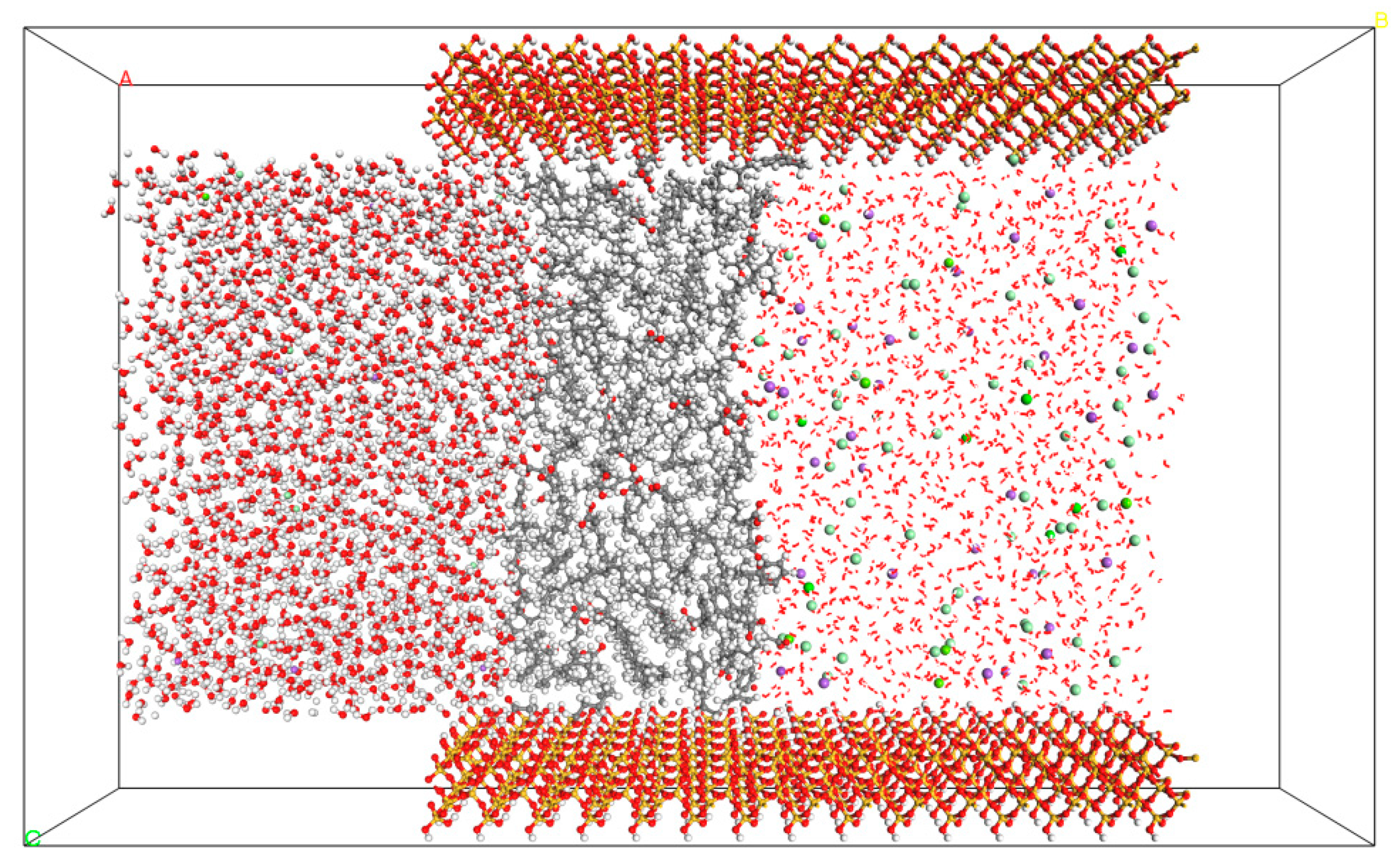
First, the prepared oil box and formation water box were superimposed and placed into the nanopore structure constructed from the quartz surface. The system was then subjected to geometric optimization using the Smart algorithm, which sequentially applies the steepest descent, conjugate gradient, and Newton’s methods. The injected water model was then incorporated into the optimized configuration to form the base model. Geometric optimization was performed again to obtain the energy-minimized configuration. Subsequently, a vacuum layer of 10 A was added on the right side along the z-direction to eliminate interference from periodic boundary effects in subsequent simulations. The final model is illustrated in Figure 2. Subsequently, oil-displacement simulations were performed based on the COMPASSIII force field. A 5000 ps molecular dynamics simulation was conducted in the NVT ensemble (canonical ensemble, constant number of particles, volume, and temperature), with a constant driving force of 20 MPa applied along the z-direction to the injected-water region. A constant external driving force of 20 MPa was applied along the flow direction to overcome the timescale limitations of MD simulations and induce measurable displacement within a feasible computational time. It is emphasized that this magnitude is used to enable comparative analysis between different salinity scenarios, and the primary conclusions regarding the role of interfacial hydrogen bonding are based on relative differences observed under identical driving conditions.
The system temperature was maintained at 298 K using the Nose-Hoover thermostat. A time step of 1 fs was used, and long-range electrostatic and van der Waals interactions were treated with an atom-based cutoff of 12.5 A . During the simulation, atoms in the lower layers of the upper and lower quartz surfaces were fixed. The trajectory of the system was recorded every 100 ps. By analyzing the trajectory data, information such as the mean square displacement, interaction energy, and density distribution of substances within the system was obtained.

3. Results and Discussion

3.1. Microscopic Migration Behavior of Crude Oil Components and Water Molecules

Non-equilibrium molecular dynamics simulations of 5000 ps were performed for all four model systems. Snapshots taken at different time steps reveal that the injected water displaces and breaks up the initially continuous crude oil, forming a connected flow pathway within the quartz nanopore that links up with the formation water. This observation confirms that the applied driving force has overcome the flow resistance, enabling the injected water to enter the pore and push the crude oil forward. However, rather than displacing the oil uniformly like a piston, the water advances along the path of least resistance. Such behavior is commonly observed in flow through porous media and is referred to as “viscous fingering”. Viscous fingering typically occurs when the viscosity of the displacing fluid is much lower than that of the displaced fluid.
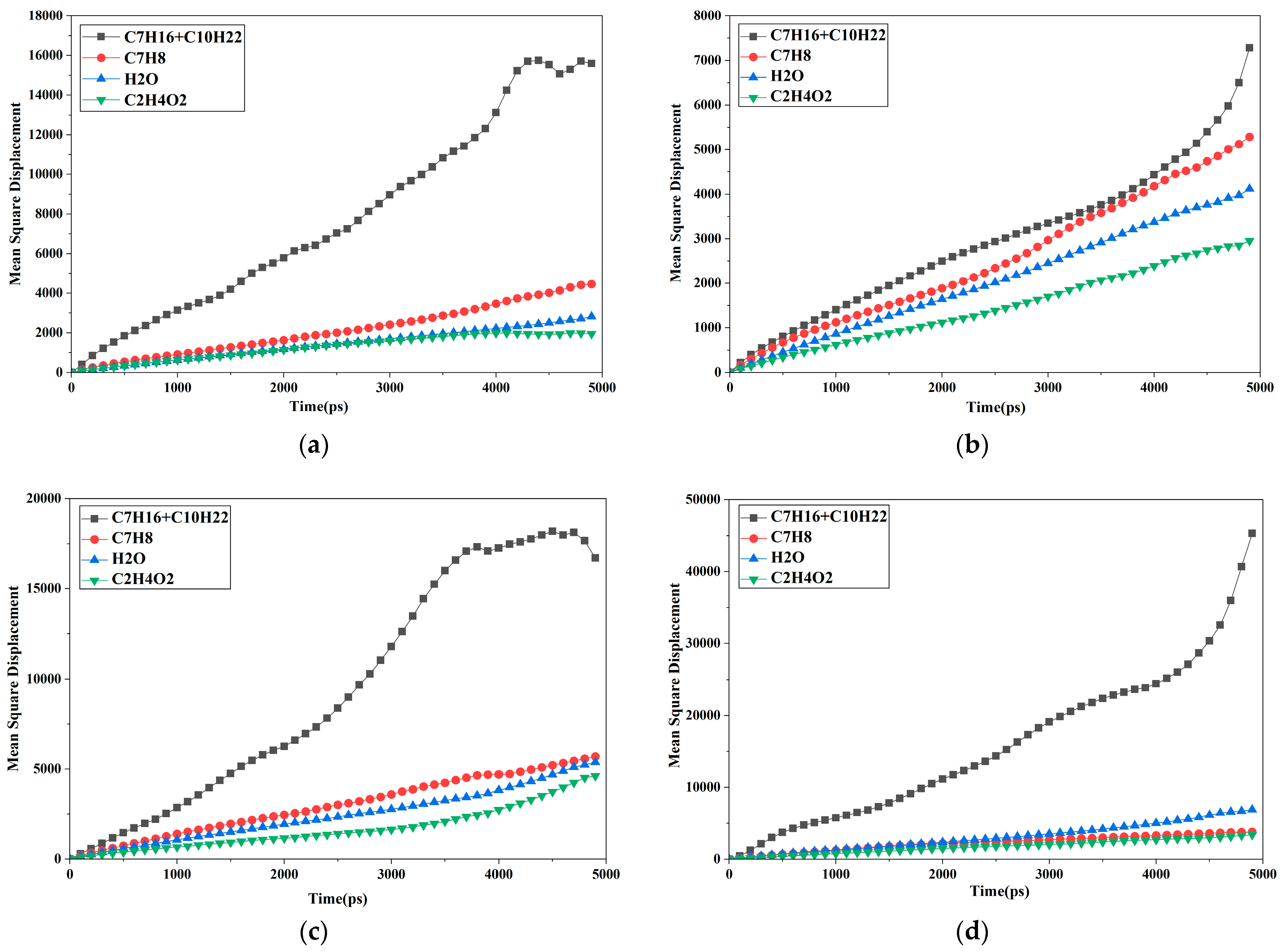
To further analyze the mean square displacement (MSD) of each crude oil component and water molecules in the system, the results are presented in the figure below. From the MSD plots of all experimental groups (Figure 3), the following observations can be made: The MSD of each crude oil component and water molecules increases over time. Among them, the MSD of alkane molecules in crude oil rises much more significantly than that of the other components, even exceeding that of water molecules. At the same time, in the four sets of simulations, as salinity decreases, the MSD of alkane molecules increases substantially, confirming the positive role of low-salinity water flooding in enhancing oil displacement efficiency. The diffusion coefficients calculated for each system generally follow the order: alkanes (heptane, decane) > toluene > water > acetic acid(Table 3). It was found that the diffusion coefficient of water is notably lower than that of the alkane components. Therefore, within quartz nanopores, the transport behavior of fluids is influenced by intermolecular interactions and spatial confinement effects, rather than being determined solely by bulk viscosity.
In molecular simulations and statistical physics, the diffusion coefficient is a core dynamical property parameter. It reflects short-range molecular interactions and quantitatively describes the macroscopic diffusive capacity of particles due to thermal motion in a medium. Its calculation formula is as follows:
D = 1 6 N α l i m t d d t i = 1 N α r i t r i 0 2
where D —diffusion coefficient; N α —number of diffusing atoms in the system; t —time, in ps; r i t —instantaneous displacement of the particle, in A ; r i 0 —original displacement of the particle, in A . Based on Formula (4), the diffusion coefficients of each crude oil component and water molecules can be calculated as follows:

3.2. Formation and Stability of Acetic Acid–Water Hydrogen Bonds at the Oil–Water Interface

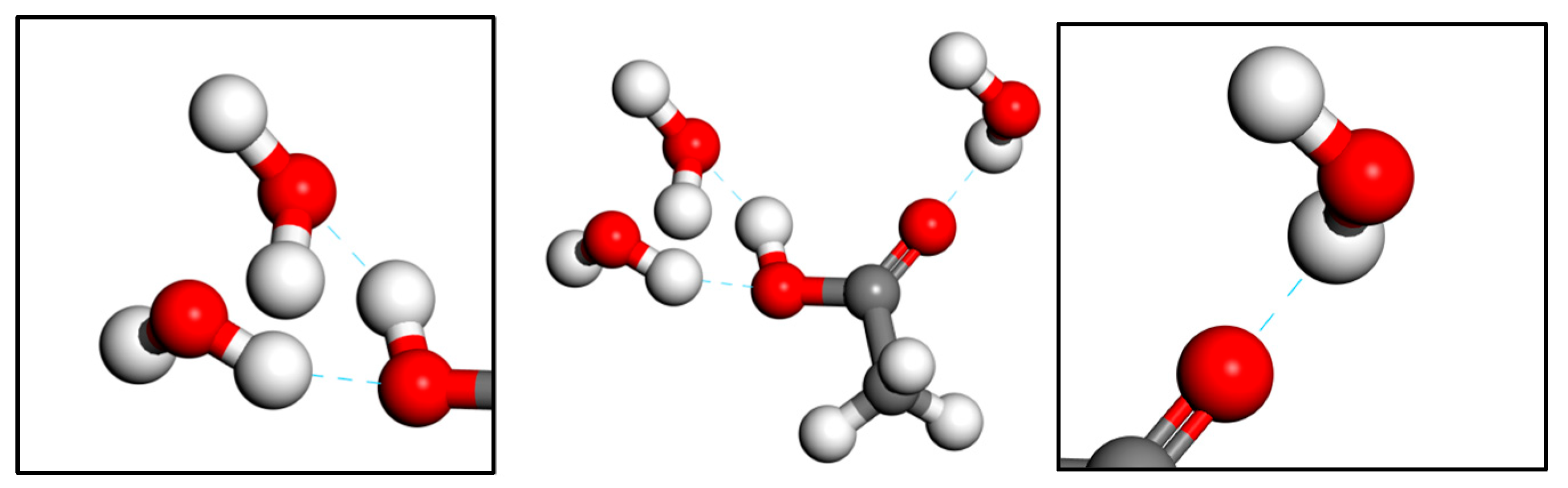
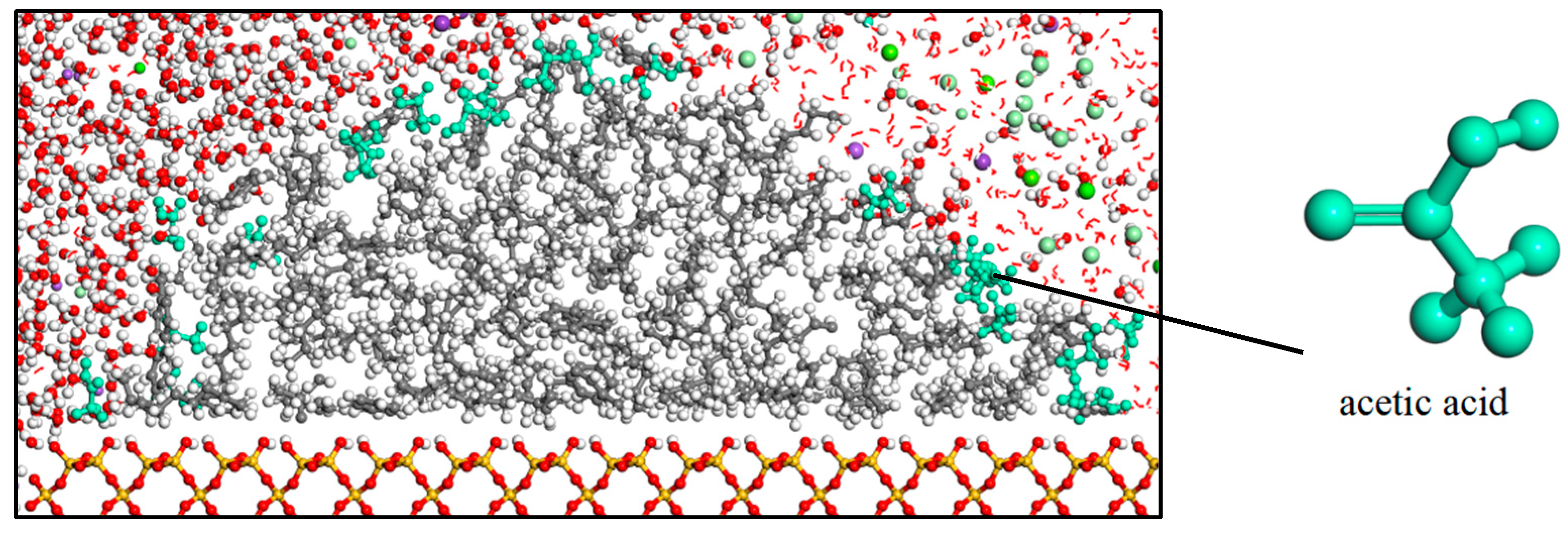
To further investigate the mechanisms underlying these phenomena, the spatial distribution and dynamic interactions of each component within the quartz nanopores were analyzed. The amphiphilic nature of acetic acid, in which the carboxyl group is hydrophilic and the methyl group hydrophobic, leads to its strong enrichment at the oil–water interface (Figure 4). More significantly, an extensive and persistent hydrogen-bonding network forms between the carboxyl groups of acetic acid and the hydroxyl groups of water molecules. On average, each acetic acid molecule forms hydrogen bonds with 3–4 water molecules(Figure 5). This hydrogen-bond network effectively “anchors” the water molecules, substantially increasing the energy barrier for their collective motion and thereby reducing their apparent diffusion capability.
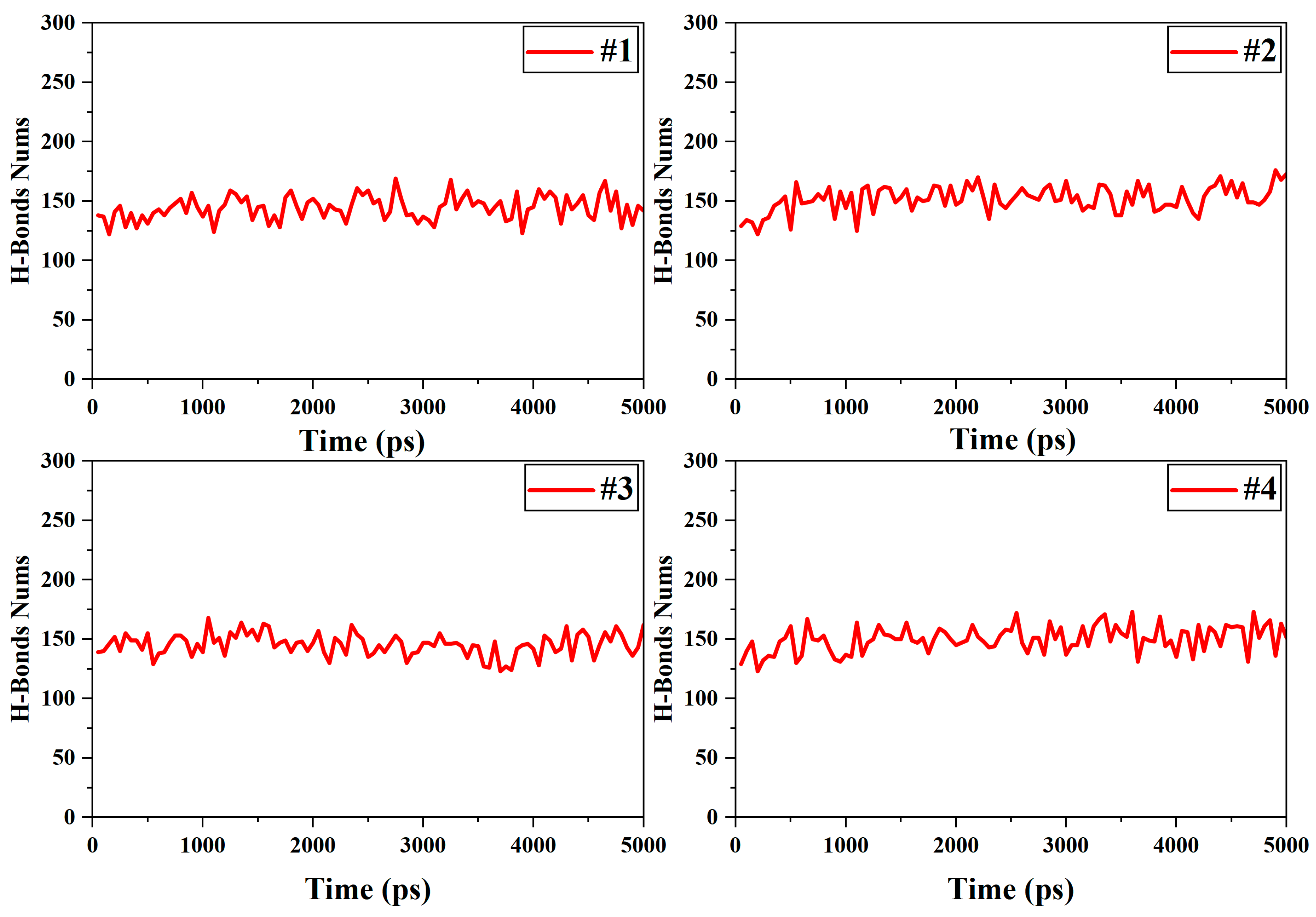
As shown in the time evolution plot of hydrogen bond counts between acetic acid and water molecules (Figure 6), a large number of relatively stable hydrogen bonds are formed between acetic acid and water. Throughout the 5000 ps dynamic simulation, the number of hydrogen bonds in all four models fluctuated within the range of 122–176, with an average value of 148. This persistent hydrogen-bond network effectively restricts the motional freedom of water molecules, providing a molecular-level explanation for the observed anomalous reduction in the diffusion coefficient of water.
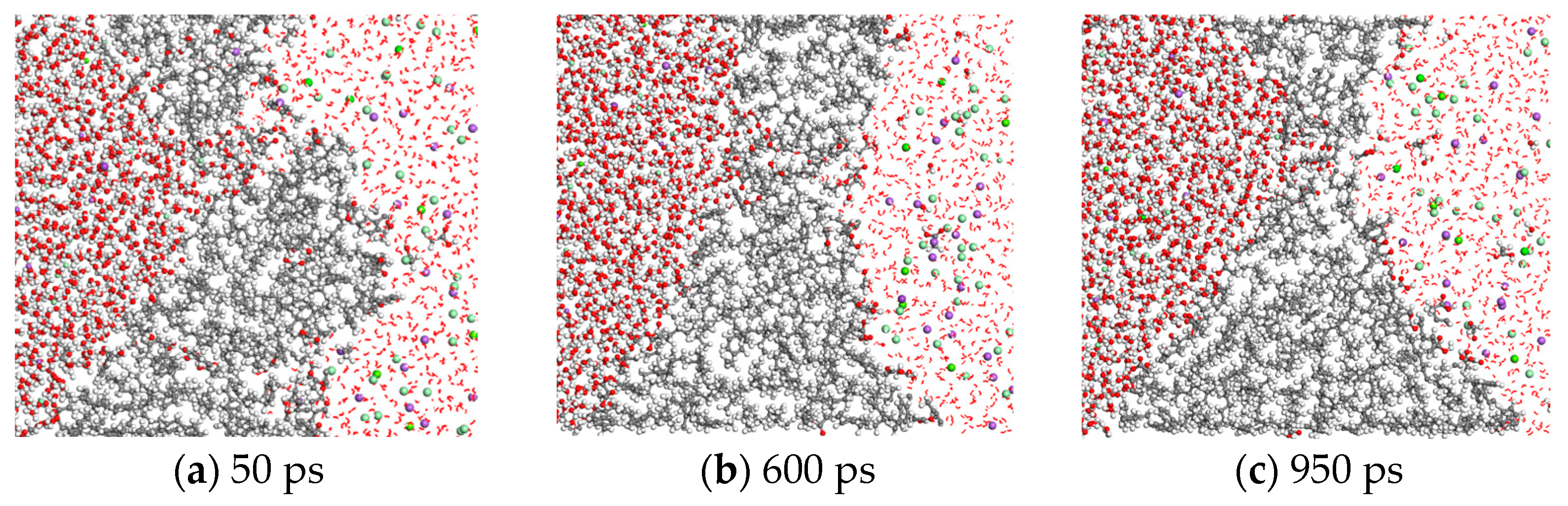
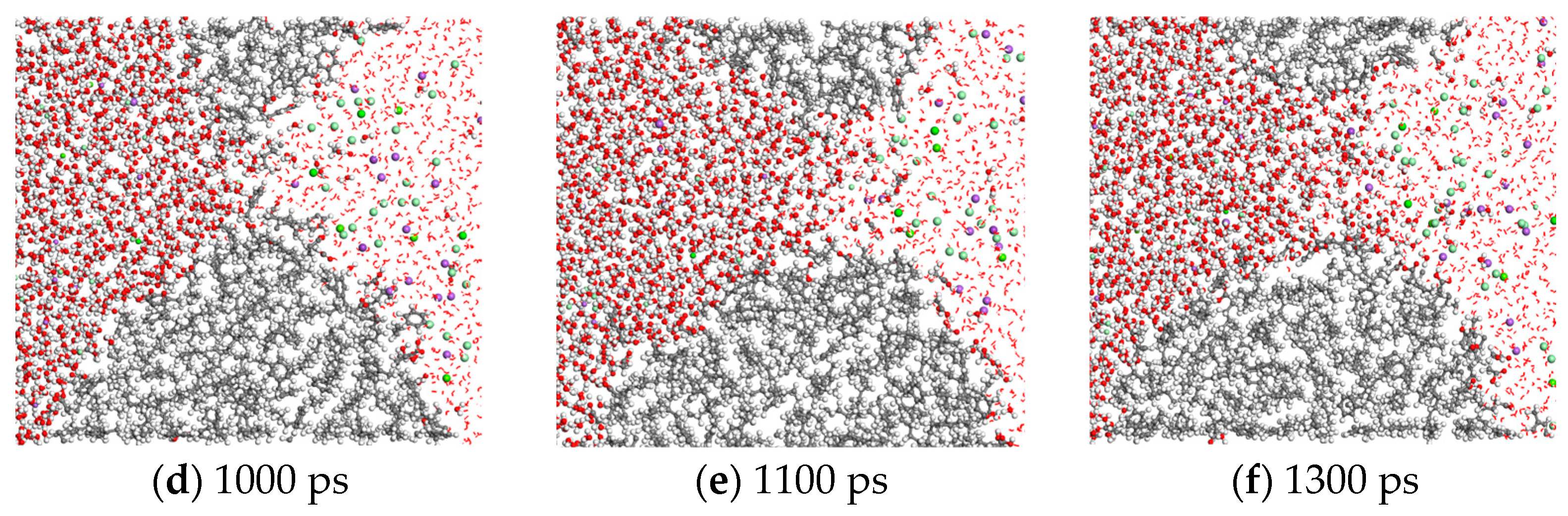
In the non-equilibrium molecular dynamics simulations, the injected water did not displace the crude oil from the pore; instead, it formed a continuous water channel within the pore. This occurs because when the injected water attempts to push the crude oil, its momentum is effectively “cushioned” by the acetic acid–water hydrogen-bond network, making it difficult to transfer efficiently to the oil phase. As shown in the snapshot in Figure 7, this water channel creates a connected pathway from the injection side to the production side inside the pore. The thickness of the water channel is about 20 A and remains stable throughout the simulation. Within the channel region, acetic acid molecules accumulate at the water–oil interface and form a stable network structure with water molecules via hydrogen bonds, thereby maintaining the channel’s integrity. On one hand, this network enables the water channel to resist disturbances from the external driving force, enhancing its stability; on the other hand, it hinders crude oil molecules from entering the channel, thereby confining the oil in the pore. Consequently, due to strong interfacial interactions in nanopores, the injected water preferentially forms a stable water channel rather than displacing the crude oil. From a molecular perspective, the formation of the water channel results from the competition among interfacial interactions. The acetic acid–water hydrogen-bond network stabilizes the channel interface and restricts its lateral expansion by forming a dynamically cross-linked structure.
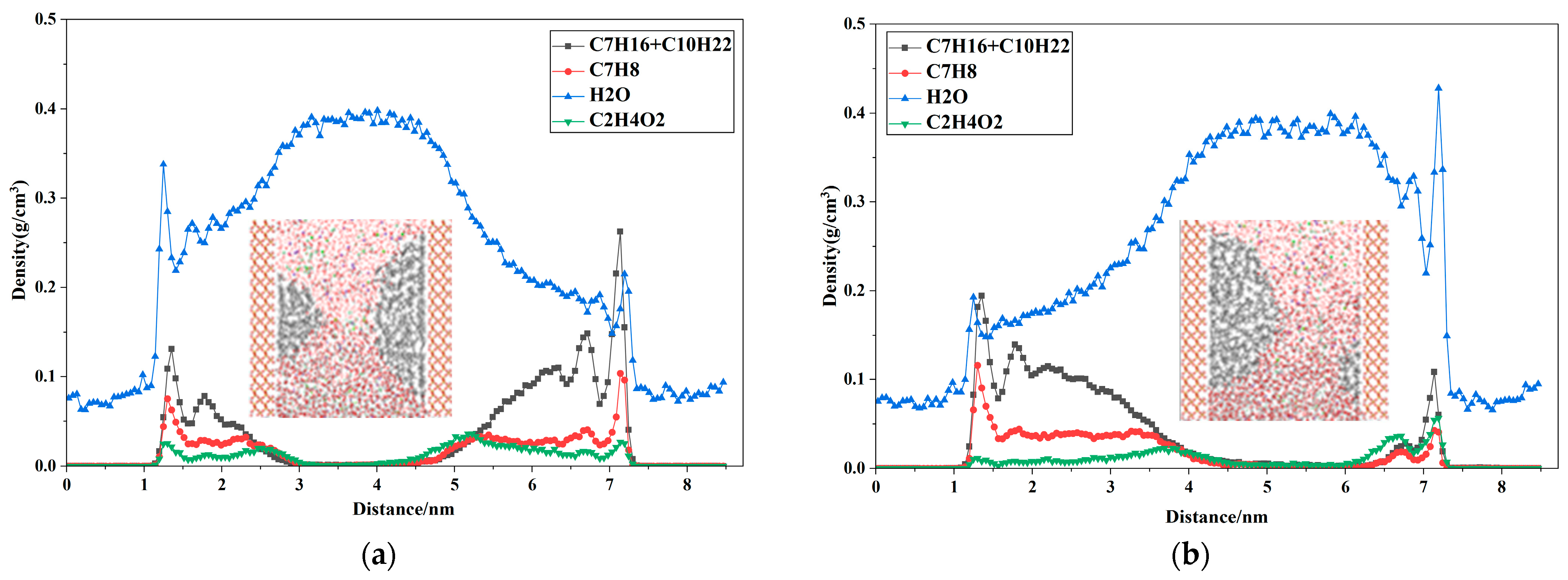
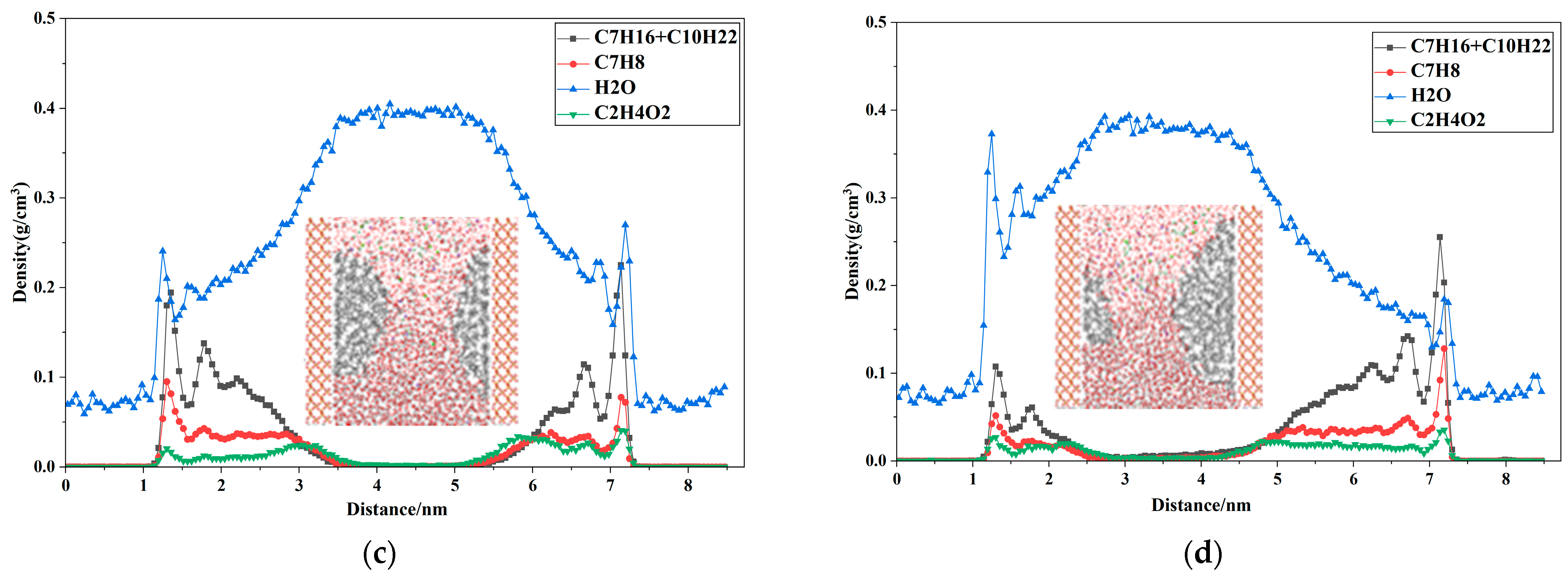
In macroscopic porous media, fluid behavior is primarily governed by body forces such as gravity and pressure gradients, as well as bulk properties like viscosity and density. Interfacial effects are usually neglected or treated as boundary conditions. However, at the nanoscale, the dramatic increase in specific surface area makes interfacial interactions non-negligible. The confined environment of quartz nanopores significantly amplifies these interfacial effects. In the micro-nano slit-pore model used here, the pore dimensions are 78 A × 20 A × 60 A . The calculated specific surface area is 1.33 A −1, meaning that each cubic nanometer of pore volume corresponds to 1.33 A 2 of the internal surface area. This high specific surface area causes the interfacial region to dominate the fluid behavior of the entire system. The acetic acid–water hydrogen-bond interactions at the interface create a dynamic structure inside the pore, which not only restricts the motion of the interfacial water layer but also hinders the flow of water in the center of the channel through viscous coupling, as illustrated in Figure 8. In contrast, non-polar molecules such as heptane and decane interact only weakly with water molecules and other components, thereby retaining higher mobility.
In quartz nanopores, the key factor determining displacement efficiency is not the bulk viscosity of the fluid but rather its “effective transport capacity”. This effective transport capacity emerges from the combined influence of bulk properties, interfacial interactions, and confinement structure. Although water possesses a low bulk viscosity, the intense hydrogen-bonding interactions occurring at the interface substantially reduce its effective transport capacity. In contrast, crude oil is not a homogeneous, high-viscosity medium. Due to the compositional complexity of the crude oil used in the experiments, its lighter polar components can migrate relatively rapidly. This disparity in the transport capacity of different fluids is a crucial reason for the occurrence of viscous fingering and the formation of complex residual oil patterns during the displacement process.

3.3. Influence of Salinity on the Hydrogen-Bonding Effect

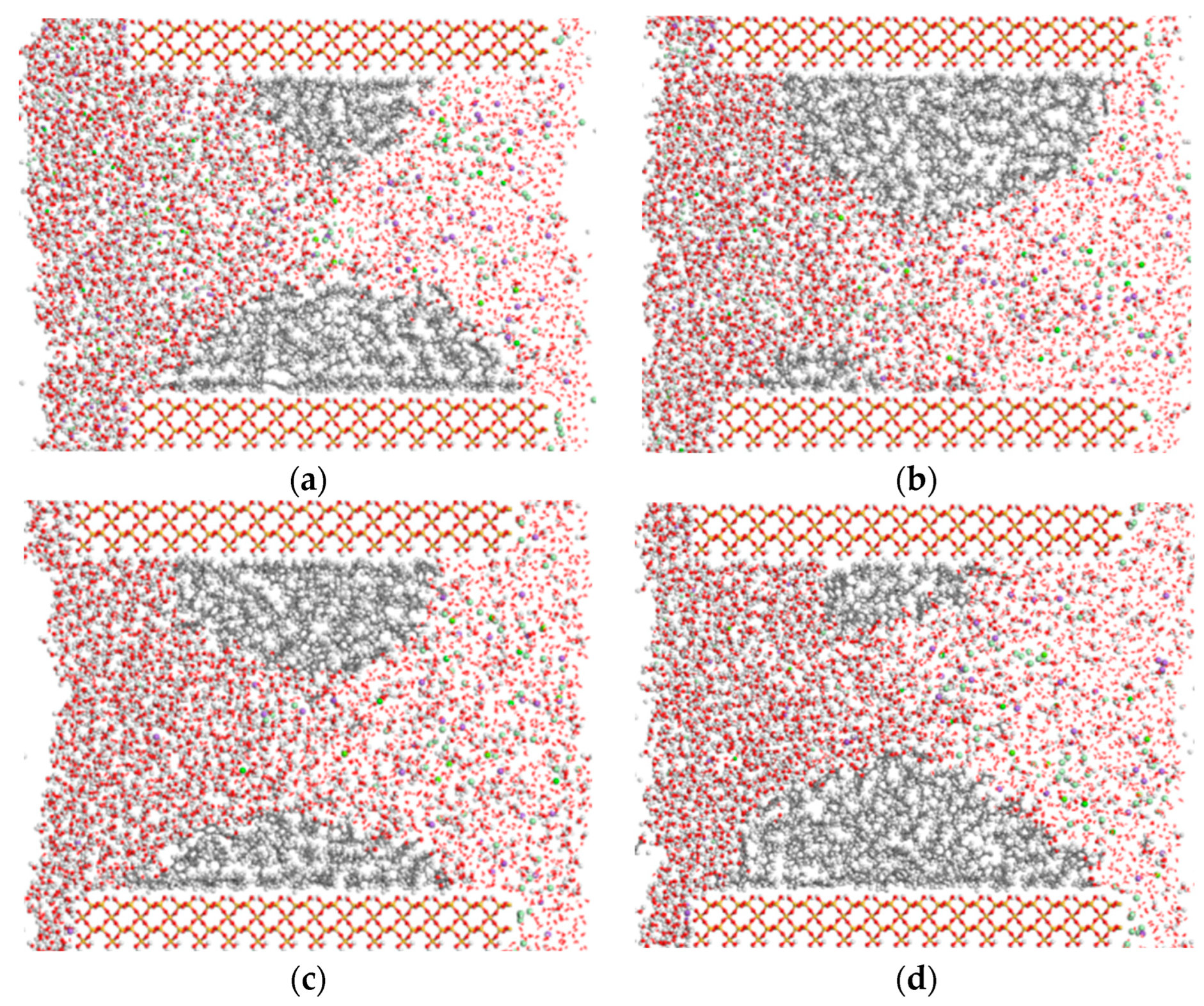
Based on molecular-scale observations and analysis of the non-equilibrium displacement simulations under an external driving force, the heterogeneous fingering at the displacement front arises not only from viscous instability but is also closely related to the differential transport capacities of various components. Fast-moving light alkanes may be produced ahead of the water displacement front or form preferential flow channels. In contrast, the slowly diffusing aqueous phase and the acetic acid “anchored” by it further exacerbate displacement heterogeneity through the formation of a hydrogen-bonding barrier. This can lead to the retention of acetic acid molecules at pore throats, inducing more complex plugging effects. Figure 9 shows the final configurations of the four injection water models with different salinities after 5000 ps of non-equilibrium molecular dynamics simulation. All models exhibit the formation of preferential water channels within the nanopores.
As shown in Table 4, under all salinity conditions, the total interaction energy between acetic acid and water (averaging approximately −551 kcal/mol) is significantly greater in absolute value than the water–water interaction energy (averaging approximately −480 kcal/mol). At high salinity, the enhancement of electrostatic interactions further widens the gap between the acetic acid–water and water–water interaction energies. At the oil–water interface, the energy released by water molecules forming hydrogen bonds with the carboxyl groups of acetic acid is substantially higher than the energy released when they bind with other water molecules. This energy advantage is the fundamental reason why the acetic acid–water hydrogen-bonding network can form an effective dynamic “barrier”, severely restricting the overall transport capacity of the aqueous phase.
As shown in Table 5, the data illustrate the nonlinear modulation of acetic acid–water interactions by salinity. It is noteworthy that the shortest hydrogen-bond distance (1.365 A ) occurs under high-salinity conditions, indicating that the ionic environment enhances local hydrogen-bond strength. The medium salinity group exhibits both the highest maximum number of hydrogen bonds and the largest fluctuation range, which corresponds to the complex water channel observed in the final configuration of this model (Figure 8). A moderate ion concentration appears to promote the dynamic restructuring capability of the hydrogen-bond network. While previous studies have suggested that ions generally disrupt hydrogen-bond networks [24], the data presented here reveal a more complex role of ions under nanoconfinement. In the high-salinity environment, the electrostatic interaction energy of the ionic aqueous phase is −80.094 × 10³ kcal/mol, whereas in the low-salinity case it is −48.272 × 10³ kcal/mol. The much stronger electrostatic interactions under high salinity draw acetic acid and water molecules closer together, forming fewer but stronger hydrogen bonds; for medium-low salinity, ions exert a shielding effect that allows the hydrogen-bond network to maintain considerable strength while achieving greater spatial extension and dynamic reorganization.

4. Conclusions

1. The acetic acid–water hydrogen-bond network at the oil–water interface is a critical factor regulating the confined transport of crude oil. Acetic acid molecules preferentially accumulate at the oil–water interface, where their carboxyl groups form a persistent and stable hydrogen-bond network with water molecules. This network significantly increases the energy barrier for the collective movement of water, leading to a notably lower diffusion coefficient of water compared to that of alkane components. As a result, momentum transfer from the aqueous phase is hindered, making it difficult for the injected water to displace crude oil uniformly.
2. The influence of salinity on the hydrogen-bonding effect exhibits a nonlinear regulatory characteristic rather than simply a disruptive one. High salinity strengthens local hydrogen bonds by drawing acetic acid and water molecules closer through electrostatic interactions. Medium salinity produces the widest fluctuation in the number of hydrogen bonds, indicating the greatest capacity for dynamic network restructuring. Low salinity reduces ionic interference with hydrogen bonds, decreasing the confinement of water and leading to the highest diffusion coefficient of alkanes, which significantly enhances displacement efficiency. Therefore, identifying an optimal salinity level is crucial to engineer the aqueous chemistry and thereby control the microstructure of the flow pathways.
3. Under nanoconfinement, the efficiency of crude oil displacement is determined by the effective transport capacity of the fluids rather than their bulk viscosity. Injected water preferentially forms a stable water channel approximately 20 A thick within the pore, which induces viscous fingering. The combined effects of hydrogen-bonding interactions between polar components in crude oil and water and the high mobility of non-polar components collectively lead to the complex distribution of residual oil.

Author Contributions

Data curation, L.P. and Y.C. (Yueqi Cui); writing—original draft preparation, X.L. and Y.C. (Yuchan Cheng); writing—review and editing, Y.G. and Y.C. (Yuchan Cheng). All authors have read and agreed to the published version of the manuscript.

Funding

This work was supported by the National Natural Science Foundation of China (Grant No. 52374038 and U23B2089) and the Innovation Capability Support Program of Shaanxi (Program No. 2024ZC-KJXX-064).

Data Availability Statement

Raw data and derived data supporting the findings of this study are available from the corresponding author Yuchan Cheng (24211010048@stumail.xsyu.edu.cn) on request.

Conflicts of Interest

The authors declare no conflicts of interest. The authors declare that they have no known competing financial interests or personal relationships that could have appeared to influence the work reported in this paper.

References

  1. Dordzie, G.; Balhoff, M. A grand challenge: Update on improved recovery from tight/shale reservoirs. J. Pet. Technol. 2024, 76, 38–42. [Google Scholar] [CrossRef]
  2. Liu, S.; Qiu, Y.; Liu, T.; Li, X.; Chen, X.; Yang, J.; Ma, X.; Zhao, H.; Wang, Y.; Liu, J. Peeling off mechanism and influencing factors of adhesive oil film in ultra-deep tight reservoir—Insights from molecular dynamics. Chem. Eng. Sci. 2025, 309, 121515. [Google Scholar] [CrossRef]
  3. He, Z.; Ji, X.B.; Xie, A.; Wang, D.X.; Wang, Z.Z.; Tan, Q.; Ma, A.Y.; Abudukelimu, P.; Zhang, Y.J.; Zhao, X.D. Tight sandstone reservoir characteristics and main controlling factors of tight oil enrichment in the second member of Permian Jingjingzigou Formation, Jimsar Sag. Chin. J. Geol. 2025, 60, 33–43. [Google Scholar] [CrossRef]
  4. Ren, J.; Xiao, W.; Cheng, Q.; Song, P.; Bai, X.; Xie, Q.; Pu, W.; Zheng, L. Experimental study on water/CO2 flow of tight oil using HTHP microscopic visualization and NMR technology. Geoenergy Sci. Eng. 2025, 250, 213834. [Google Scholar] [CrossRef]
  5. Wang, W.; Li, T.; Xiao, D.; Wang, B.; Yang, Y.; Zhang, Y.; La, W.; He, J. Geological conditions and controls on accumulation of tight sandstone gas, deep part of the Shengbei sub-sag, Turpan-Hami basin, NW China. Mar. Pet. Geol. 2023, 158, 106513. [Google Scholar] [CrossRef]
  6. Wang, W.; Zheng, K.; Huang, S.; Wang, Q.; Feng, G.; Su, Y.; Li, J. Difference of hydrocarbon generation between argillaceous dolomite and mudstone and its influence on oil source: A case study of the Es4 in the Leijia area, Liaohe depression. Geoenergy Sci. Eng. 2024, 237, 212805. [Google Scholar] [CrossRef]
  7. Wang, W.; Ma, H.; Li, Y.; Yi, Z.; Li, Z.; Yan, Y. Salt-induced coil-globule transition of sulfonate-modified HPAM is affected by the branched chain length. Langmuir 2023, 39, 14969–14976. [Google Scholar] [CrossRef] [PubMed]
  8. Wang, Z.; Zhang, T.; Liu, S.; Ding, K.; Liu, T.; Yao, J.; Sun, H.; Yang, Y.; Zhang, L.; Wang, W.-D.; et al. Unveiling nanoscale fluid miscible behaviors with nanofluidic slim-tube. Energy Environ. Sci. 2024, 17, 9635–9651. [Google Scholar] [CrossRef]
  9. Wang, Z.; Liu, T.; Liu, S.; Jia, C.; Yao, J.; Sun, H.; Yang, Y.; Zhang, L.; Delshad, M.; Sepehrnoori, K.; et al. Adsorption effects on CO2-oil minimum miscibility pressure in tight reservoirs. Energy 2024, 288, 129815. [Google Scholar] [CrossRef]
  10. Jing, W.; Zhang, L.; Li, A.; Liu, T.; Cheng, Y.; Sun, H.; Yang, Y.; Zhu, G.; Yao, J.; Zhong, J. Phase behaviors of gas condensate at pore scale: Direct visualization via microfluidics and in-situ CT scanning. SPE J. 2024, 29, 2566–2577. [Google Scholar] [CrossRef]
  11. Yu, Z.; Li, Z.; Wang, S.; Zhao, Q.; Dong, X.; Li, K.; Yao, Z. Adsorption mechanism of polymers at the oil-water interfacial film and its effect on interfacial stability. Geoenergy Sci. Eng. 2026, 257, 214189. [Google Scholar] [CrossRef]
  12. Xue, M.; Chen, L.; Chen, H.; Fu, L.; Bai, Y.; Lv, W.; Hou, B.; Riazi, M. Hydrogen-bond-modulated flowable weak gel for EOR in ultra-high temperature and ultra-high salinity fracture-cavity ordinary heavy oil reservoirs. Colloids Surf. A Physicochem. Eng. Asp. 2025, 725, 137537. [Google Scholar] [CrossRef]
  13. Zhou, H.; Liu, X.; He, C.; He, L.; Sui, H. Reconfiguration of intermolecular hydrogen bond for viscosity reduction of heavy oil. Chem. Eng. Sci. 2025, 313, 121696. [Google Scholar] [CrossRef]
  14. Kumar, R.; Schmidt, J.R.; Skinner, J.L. Hydrogen bonding definitions and dynamics in liquid water. J. Chem. Phys. 2007, 126, 204107. [Google Scholar] [CrossRef]
  15. Liu, X.; Zhou, D.; Yan, L.; Liu, S.; Liu, Y. On the imbibition model for oil-water replacement of tight sandstone oil reservoirs. Geofluids 2021, 2021, 8846132. [Google Scholar] [CrossRef]
  16. Liu, X.; Yan, L.; Gao, Q.; Liu, Y.; Huang, H.; Liu, S. Effect of salinity on the imbibition recovery process of tight sandstone reservoirs. Processes 2022, 10, 228. [Google Scholar] [CrossRef]
  17. Liu, X.; Zhou, D.S.; Shi, Y.H.; Li, M.; Zhang, Z. A semi-analytical mathematical model for imbibition in tight sandstone reservoirs considering osmotic pressure. Pet. Geol. Recovery Effic. 2018, 25, 93–98. [Google Scholar] [CrossRef]
  18. Cai, Y.Y.; Zhao, W.C.; Ge, J.; Cong, Z.C.; Hu, S.; Gong, Y.T. Molecular Dynamics Simulation of Spontaneous Percolation of Tight Oil after Pressure. Sci. Technol. Eng. 2023, 23, 12064–12071. [Google Scholar] [CrossRef]
  19. Cui, F.; Jin, X.; Xia, J.; Liu, H.; Wu, H.; Wang, F. Micromechanical mechanism of oil/brine/rock interfacial interactions based on first-principles calculations. J. Mol. Liq. 2023, 386, 122502. [Google Scholar] [CrossRef]
  20. Lu, P.; Yan, Z.; Lai, J.; Wang, K. Molecular insight into oil displacement by CO2 flooding in water-cut dead-end nanopores. RSC Adv. 2024, 14, 25385–25392. [Google Scholar] [CrossRef]
  21. Li, J.; Xu, Y.F.; Wang, Z.H. Influencing factors and microscopic mechanisms of oil-water interfacial film formation in shear flow fields. Acta Pet. Sin. 2024, 45, 1244–1256. [Google Scholar] [CrossRef]
  22. Zhang, X.; He, C.; Mostafa, M.Y.M.; Akram, W.; He, L.; Sui, H.; Li, X. Constructing oxygen-based multiple hydrogen bonding sites and delocalized π bonds for efficient oil-water-solid interfacial separation. J. Hazard. Mater. 2025, 490, 137766. [Google Scholar] [CrossRef] [PubMed]
  23. Akkermans, R.L.C.; Spenley, N.A.; Robertson, S.H. COMPASS III: Automated fitting workflows and extension to ionic liquids. Mol. Simul. 2021, 47, 540–551. [Google Scholar] [CrossRef]
  24. Marcus, Y. Effect of ions on the structure of water: Structure making and breaking. Chem. Rev. 2009, 109, 1346–1370. [Google Scholar] [CrossRef]
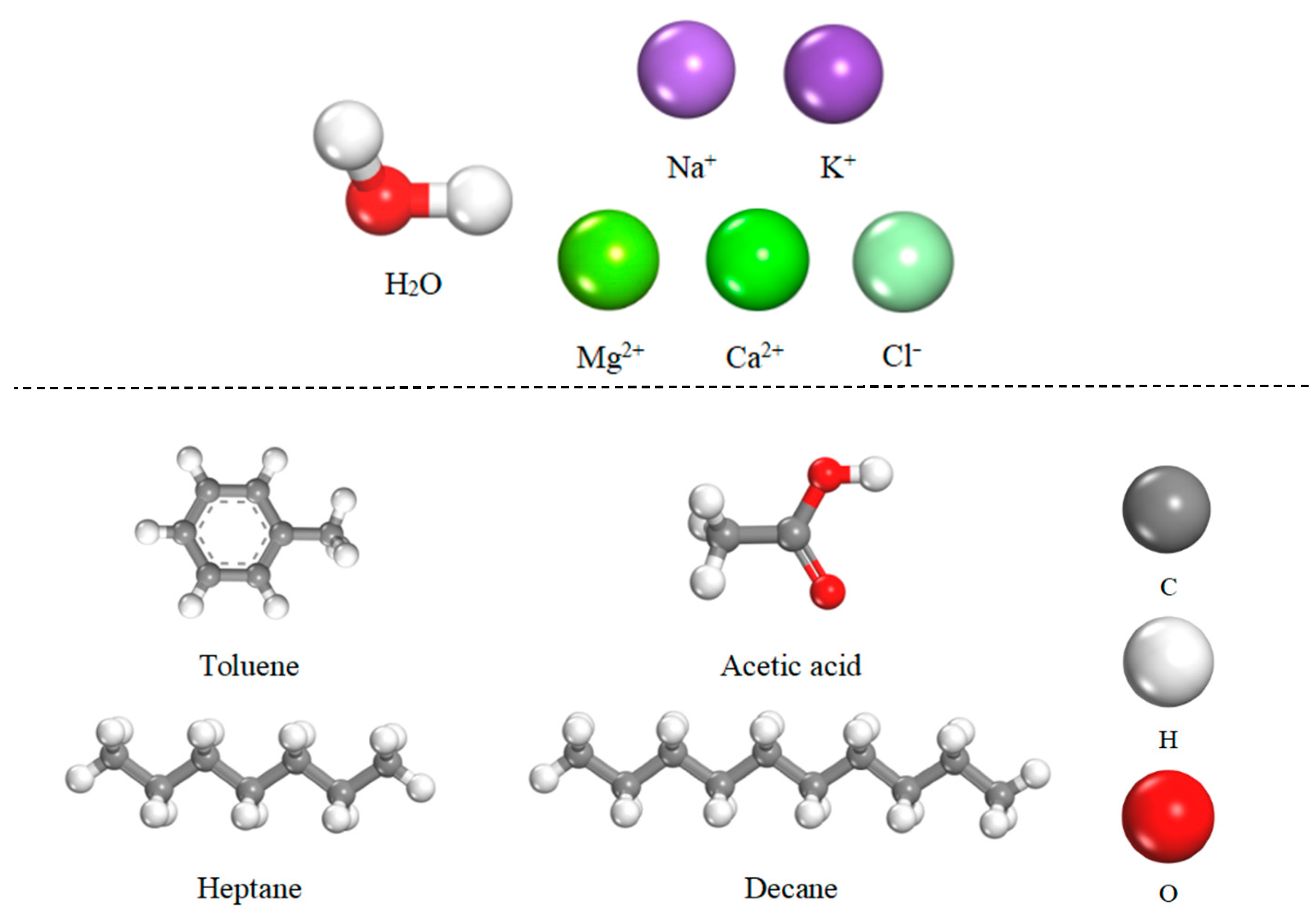
Figure 1. Molecular structures for water molecules, ions, and crude oil molecules.
Processes 14 00343 g001
Figure 2. Initial model configuration.
Processes 14 00343 g002
Figure 3. Mean square displacement of crude oil components (alkane: C7H16+C10H22; toluene: C7H8; acetic acid: C2H4O2) and water molecules under different salinity conditions: (a) #1 high salinity; (b) #2 medium salinity; (c) #3 medium-low salinity; (d) #4 low salinity.
Processes 14 00343 g003
Figure 4. Snapshot of acetic acid molecule distribution at the oil–water interface.
Processes 14 00343 g004
Figure 5. Schematic diagram of acetic acid–water hydrogen bonding.
Processes 14 00343 g005
Figure 6. Time evolution of the number of acetic acid–water hydrogen bonds (#1 high salinity; #2 medium salinity; #3 medium-low salinity; #4 low salinity).
Processes 14 00343 g006
Figure 7. Schematic diagram of water channel formation during the simulation process.
Processes 14 00343 g007aProcesses 14 00343 g007b
Figure 8. Radial density distribution diagram of crude oil components (alkane: C7H16+C10H22; toluene: C7H8; acetic acid: C2H4O2); and water molecules in quartz nanopores: (a) #1 high salinity; (b) #2 medium salinity; (c) #3 medium-low salinity; (d) #4 low salinity.
Processes 14 00343 g008aProcesses 14 00343 g008b
Figure 9. Final configurations of the four model simulations: (a) #1 high salinity; (b) #2 medium salinity; (c) #3 medium-low salinity; (d) #4 low salinity.
Processes 14 00343 g009
Table 1. Basic parameters of injected water and formation water models.
Number Salinity (g/L)Number of Water Molecules and Ions in the Aqueous PhaseWater Box Dimensions ( A )
H2ONa+K+Mg2+Ca2+Cl
#1 (HW)246.516008014181816660 × 20 × 52.93
#2 (MW)140.61600407998360 × 20 × 46.41
#3 (MLW)54.01600152332960 × 20 × 42.16
#4 (LW)21.9160061111160 × 20 × 39.88
SW33.11600101221960 × 20 × 44.83
where “HW” stands for “High-salinity Water”; similarly, “MW” denotes medium-salinity water, “MLW” refers to medium-low salinity water; “LW” indicates low-salinity water; and “SW” represents formation water.
Table 2. Crude oil property parameters.
Viscosity/mPa·sDensity/g·cm−3Acidity/mg·g−1Component Volume Fraction/%
Saturates/%Aromatics/%Resins/%Asphaltenes/%
4.210.8210.43582.1910.736.790.29
Table 3. Diffusion coefficients of crude oil components and water molecules.
NumberMolecular Diffusion Coefficients ( A 2/ps)
Alkanes (Heptane, Decane)TolueneAcetic AcidInjected Water
#10.6890.1800.0390.093
#20.2590.2020.1120.146
#30.6430.1980.1270.154
#41.6500.2960.1080.283
Table 4. Acetic acid–water interaction energy and water–water interaction energy under different salinities.
NumberEAcetic Acid–Water (kcal/mol)EWater–Water (kcal/mol)EAcetic Acid–Water/EWater–Water
#1−589.796 ± 15.3−434.982 ± 10.11.35
#2−561.992 ± 18.6−473.358 ± 9.81.19
#3−535.149 ± 14.8−495.543 ± 11.21.08
#4−521.889 ± 20.1−518.026 ± 10.51.01
Note: Negative values represent an attractive force. A ratio greater than one indicates that the acetic acid–water interaction is dominant.
Table 5. Statistics of hydrogen bond information from each experimental group.
NumberMaximum NumberMinimum NumberMaximum Bond Length ( A )Minimum Bond Length ( A )Maximum Bond AngleMinimum Bond Angle
#11691223.099911.36482179.608890.00097
#21761223.099881.38348179.642590.02183
#31681233.099911.39304179.757890.00211
#41731233.099991.40139179.769590.01118
Disclaimer/Publisher’s Note: The statements, opinions and data contained in all publications are solely those of the individual author(s) and contributor(s) and not of MDPI and/or the editor(s). MDPI and/or the editor(s) disclaim responsibility for any injury to people or property resulting from any ideas, methods, instructions or products referred to in the content.