Article

The Effects of Using Shortwave Infrared Lamp-Drying and Alkali Pretreatment on the Color, Texture, and Volatile Compounds of Gongliao Gelidium amansii Seaweed and Its Jelly Qualities


1
Department of Food Science, National Taiwan Ocean University, Keelung 20224, Taiwan
2
Center of Excellence for the Oceans, National Taiwan Ocean University, Keelung 200024, Taiwan
3
Institute of Food Safety and Risk Management, National Taiwan Ocean University, Keelung 20224, Taiwan
*
Author to whom correspondence should be addressed.
Processes 2026, 14(2), 345; https://doi.org/10.3390/pr14020345
Submission received: 9 December 2025 / Revised: 27 December 2025 / Accepted: 8 January 2026 / Published: 19 January 2026

Abstract

This study investigated the effects of alkaline pretreatment and drying methods on the physicochemical properties of Gelidium amansii and the quality of the resulting agar jelly. Seaweeds with or without alkaline pretreatment were subjected to either sun-drying or shortwave infrared (SWIR) lamp-drying for three or seven cycles to evaluate whether SWIR drying could replace conventional sun-drying by reducing drying time and whether alkaline pretreatment could enhance gel hardness. The results showed that both drying methods effectively reduced moisture content, while the alkaline pretreatment significantly increased the ash content, likely due to the removal of water-soluble components. Marked color improvement was observed after seven cycles of sun-drying or following alkaline pretreatment, with the appearance changing from purplish red to bright golden yellow, which is closer to traditional quality expectations. Although SWIR lamp-drying was more energy-efficient, it resulted in limited color improvement. Volatile compound analysis revealed that deviations from the fresh control increased with the number of sun-drying cycles, whereas alkaline pretreatment and infrared-drying induced more pronounced changes in volatile profiles. Among all of the treatments, Gelidium subjected to seven sun-drying cycles produced jellies with the most favorable texture, indicating enhanced agar gel formation through repeated washing and drying. In contrast, the combination of alkaline pretreatment and infrared-drying restricted agar extraction, likely due to tissue hardening and insufficient light intensity, resulting in weak or negligible gel formation. Overall, both the drying method and alkaline pretreatment significantly influenced the Gelidium quality and agar gel properties; despite being labor-intensive, traditional washing and sun-drying processes remain critical for achieving desirable product quality.

1. Introduction

Global fresh seaweed production has reached approximately 800 million tons, with an estimated total market value of USD 6 billion. Of this amount, nearly USD 5 billion was attributable to seaweed utilized for human consumption in 2019 [1]. Owing to their rich nutritional composition, seaweeds are regarded as a valuable food resource, containing significant levels of proteins, carbohydrates, polyunsaturated fatty acids, minerals, dietary fiber, and a wide range of vitamins [2,3].
Gelidium is a red macroalga belonging to the division Rhodophyta and is widely distributed in subtropical regions, including the Republic of Korea, China, Indonesia, and Morocco. Collectively, these regions account for approximately 85% of the global dry-weight production of Gelidium, estimated at 9,500 tons annually [4]. Among Gelidium species, Gelidium amansii is a principal raw material for agar jelly production in the Gongliao District of New Taipei City, Taiwan. Traditionally, harvested Gelidium undergoes repeated washing and sun-drying, typically for seven processing cycles, to remove undesirable odors, impurities, and purplish-red pigments, resulting in dried seaweed with a bright golden-yellow appearance suitable for long-term storage. Although Gelidium can be harvested between February and May, the limited availability of sunny days during this period in major production regions poses a significant constraint on the conventional solar drying process. Consequently, the development of alternative drying techniques is necessary to replace this labor-intensive and weather-dependent method. Owing to its superior gel strength and agar yield compared with other agarophytes, Gelidium is considered an ideal raw material for the production of high-quality agar [4].
Conventionally processed Gelidium is typically boiled for 1 h to extract agar, followed by filtration and cooling to obtain Gelidium jelly [5]. The physicochemical properties of agar, including yield, gel strength, and gelling temperature, are influenced by multiple factors, such as drying and extraction methods, species, geographic origin, and harvesting season [4,6]. Furthermore, alkali pretreatment has been demonstrated to enhance agar gel strength by increasing the 3,6-anhydrogalactose content while reducing sulfate levels in agar derived from Gelidium species [7], as well as other agarophytes such as Pterocladia [8], Gelidiella [7], and Gracilaria [9].
Conventional sun-drying requires specific environmental conditions, including temperatures exceeding 30 °C, relative humidity below 60%, and adequate air circulation. However, such conditions are highly dependent on weather and cannot be consistently controlled [10]. Short- and medium-wave infrared (SMIR) radiation, with wavelengths ranging from 1 to 4 μm, corresponds to the optimal absorption range of water molecules [11]. This enables infrared energy to penetrate food materials to a certain depth more efficiently and to be converted into heat, thereby significantly shortening drying time compared with conventional drying techniques [12]. Traditional sun-drying processes are inherently time-consuming, weather-dependent, and labor-intensive. These limitations highlight the need for alternative drying technologies, particularly when combined with physicochemical treatments, to improve processing efficiency while preserving the quality attributes of dried seaweeds and their derived jelly products. Previous studies have explored the application of halogen lamp-drying as an alternative to conventional sun-drying for Gelidium during periods of unfavorable weather. Nevertheless, the radiant energy provided by halogen lamps has been reported to be insufficient for effective drying of Gelidium biomass.
In response to these limitations, the present study introduces infrared lamp-drying in combination with alkaline pretreatment as a strategy to enhance moisture removal and disrupt the seaweed cell wall structure. Alkaline pretreatment was conducted using sodium hydroxide immersion followed by water washing to facilitate agar extraction. To date, limited studies have investigated the use of infrared lamp-drying for seaweed processing, and the effects of alkaline soaking treatments on Gelidium remain insufficiently explored. Therefore, this study was designed to evaluate the combined effects of alkaline pretreatment and different drying cycles on the physicochemical properties of dried Gelidium seaweed and the functional characteristics of the extracted agar jelly.

2. Materials and Methods

2.1. Materials

Gelidium amansii (J. V. Lamouroux) was purchased from a local frozen marine food store (868 seafoods, New Taipei City, Taiwan) and the red seaweed was collected from March 2024 to May 2024 when the tide was low in the Gonglian area (121°54′ E and 25°01′ N) of New Taipei City. The seaweed was frozen and kept in an ultra-low-temperature freezer (Model MDF-U32V, SANYO Electric Biomedical Co., Ltd., Osaka, Japan) at −18 °C until use. All chemicals were of analytical grade.

2.2. Dried Gelidium Seaweed Sample Preparation

Fresh Gelidium seaweed (40 g) was washed with 2100 g tap water to remove sand, small rocks, and impure materials attached to it. Then, it was placed on a stainless net (18 × 10 cm2, L × W) for drying in the sun or under an infrared lamp. Alkaline-pretreated seaweed group was soaked in 5% NaOH solution for 10 min first and then washed with tap water to make it neutral, which is modified version of the method described by Meena et al. [7]. Sun-drying for 2 h (the illuminance range was in the range of 35,000 and 50,000 lux) or lamp-drying under 2400 W infrared lamp (No. 5 Work shop, Taichung, Taiwan) for 2 h (the illuminance was in the range of 100 lux) was performed, with a seaweed surface temperature around 60 °C maintained during the drying process. The distance between the lamp and the seaweed was 35 cm; there was also no ventilator. The weight of Gelidium seaweed was recorded every half hour in different drying cycles; these processes are illustrated in Supplementary Figure S1. The weight of washed seaweed was around 50 g. The red seaweed was then washed with water and dried under the sun or infrared lamp again 3 and 7 times for sun-drying and infrared lamp-drying, respectively. Dried seaweeds were kept in freezer until use.

2.3. Moisture Content of Dried Seaweeds and Gelidium Jelly Preparation

Moisture content of seaweeds was measured following the Association of Official Analytical Chemists (AOAC) 984.25 method in a 105 °C oven [13].
Agar was extracted by boiling 2 g sample of dried seaweed in deionized water (250 g) for 75 min. Then, the extracted agar solution was filtered, and the filtrate was cooled at room temperature and then kept in a refrigerator at 4 °C overnight. All eight test groups were tested in triplicate.

2.4. Dried Seaweed Ash Content and Color Analysis

The ash content of the dried seaweed under various durations of washing and drying processes was measured after moisture content measurement according to the standard method described by the AOAC [13]. Dried red seaweed samples were cut with scissors and pulverized to powder with a miller (D3V-10, Yu-Chi Machinery Co., Ltd., Chan Hua, Taiwan).
The dried red seaweed’s color was recorded and expressed using the CIELAB L* (lightness), a* (redness/greenness), b* (yellowness/blueness) color scale with a spectrocolorimeter (TC-1800 MK-II, Tokyo, Japan) following the method of Matheus et al. [14]. Standardization was calibrated with a white tile (X = 79.2, Y = 80.7, Z = 90.7) and black cup before measurement. The dried seaweed powder was put into a quartz sample cup with three replicates for each sample, and triplicate measurements were analyzed for all eight groups. Color difference ∆E was calculated using Equation (1):
∆E = [(∆L*)2 + (∆a*)2 + (∆b*)2]1/2
∆L* = L*sample − L*fresh
∆a* = a*sample − a*fresh
∆b* = b* sample − b*fresh

2.5. Texture Analysis of Gelidium Jelly

The hardness, springiness, and gumminess of the Gelidium jelly was tested following the method described by Kim and Iida [15] after immediately removing it from the refrigerator. A Texture Analyzer RapidTA®+ (Horn Instruments Co., Ltd., Taoyuan City, Taiwan) was equipped with a 1/2” cylinder probe (pretest speed was set at 3.0 mm/s, test speed was set at 1.0 mm/s, and post-test speed was set at 3 mm/s) with a two-cycle compression test. The target distance was set at 15 mm and the trigger force was set at 15 g. The maximum peak force (N) and hardness were analyzed using Tadviser software (Horn Instruments Co., Ltd., version I, Taoyuan City, Taiwan) during first compression. Springiness was calculated and represented by the distance reached until the probe fell from the jelly immediately after compression. Gumminess was calculated and represented by the property of making a semi-solid jelly swallowable. All measurements were performed three times.

2.6. Agar Solution Rheological Measurement

A rheometer (Anton Paar MCR 92, Graz, Austria) was used to evaluate the rheological properties of the filtered extracted agar solution at a temperature range from 90 °C to 10 °C, with a decreasing temperature of 0.1 °C/s. A volume of 0.6 mL of the filtrate of boiling extracted dried seaweed solution was added to the rheometer’s lower plate (which was conditioned at 90 °C). The parallel plate (PP25) was lowered to the solution and extra solution was removed, and the rheological data were collected after thermal equilibrium was approached. The gelation step was conducted at shear strain of 0.5%, and angular frequency was set at 30 rad/s. All measurements were analyzed using the Rheoplus software (version 3.21, Anton-Paar) to obtain storage modulus (G’), loss modulus (G”), and derived parameters [16].

2.7. Volatiles of Dried Gelidium Seaweed

The dried Gelidium seaweed samples (0.25 g) that did/did not undergo alkaline pretreating, washing, and sun-drying or shortwave infrared lamp-drying cycles were cut into pieces. The sample was put into a headspace vial (20 mL), and 6 mL double distilled water was added. Ethyl caprate (2 μL; 1 mg/mL in methanol) as internal standard and 2 g sodium chloride were added. The 20 mL headspace vail was sealed with a Teflon-lined septum and screw cap, and it was kept at 60 °C for 10 min. A 50/30 μm DVB/CAR/PDMS fiber was inserted into the vial for 30 min as part of the absorption process [17]. The fiber was immediately inserted into the GC injector for 3 min vent time in the splitless mode. The injector temperature was set at 230 °C. Volatile compounds were separated and analyzed using a gas chromatograph (Agilent Technologies-6890N GC, Agilent Tech., Santa Clara, CA, USA)/mass spectrometer (Agilent 5973 inert MSD, Agilent Tech., Santa Clara, CA, USA) using a DB-WAX column (30 m × 0.25 mm, film 0.25 μm, Agilent Tech., Santa Clara, CA, USA). Helium was used as carrier gas and the flow rate was set at 1.0 mL/min. Column oven temperature was set at 40 °C for 3 min. Then, oven temperature was increased to 70 °C at a rate of 7 °C/min. The column oven temperature was maintained at 70 °C for 3 min followed by a further increase to 170 °C at a rate of 10 °C/min, and then was increased to 225 °C at a rate of 20 °C/min. The final holding stage was 10 min at 225 °C. Volatile compounds were detected using MSD (scanning range was 50–280 m/z) and electron impact ionization at 70 eV [17].
Volatile compounds were confirmed based on their retention indices (RI), which were calculated using n-alkane (C7–C30 saturated alkanes, Sigma Aldrich, St. Louis, MO, USA), and when there were more than 800 similarity matches to MS spectra library (NIST 17). Semi-quantitative analysis was completed using the relative area of the compounds relative to an internal standard, ethyl caprate.

2.8. Sensory Evaluation

Sensory evaluation of the Gelisium jelly prepared under various alkaline pretreating, washing, and sun-drying or infrared lamp-drying cycles was evaluated by seven trained panelists, recruited from the Department of Food Science, National Taiwan Ocean University. The panel consisted of graduate and undergraduate students (5 females and 2 males at ages between 23 and 18) who had experience in sensory evaluation and agreed to being trained and evaluating the jellies over two periods.
Basic texture and appearance evaluation training was conducted in the first period, following the training instructions described by Kwon et al. [18]. The first training session lasted four weeks, with three days per week and 1 h each day, which was spent evaluating the odor and texture of the jellies with different hardness and springiness qualities, and quantifying the hardness and springiness of jellies for which the hardness and springiness had already been measured with the Texture Analyzer RapidTA®+. The training period was used to assess the Gelidium jelly hardness and the jelly texture with one’s finger or by biting. All nine jelly samples were placed in a white plastic cup with a three-digit random number. Panelists were asked to eat a soda cracker, and drink a sip of water and maintain the water in their mouths for 30 s before testing the next sample. The sample was spat out after each evaluation with biting. Panelists were instructed to rinse their mouths with drinking water before evaluating the next sample.
Gelidium jelly transparency, algal odor, hardness, and springiness were measured using a five-point scale from 1 (extremely cloudy; light odor; extremely soft; poor elasticity) to 5 (extremely transparent; strong odor; extremely hard; good elasticity) according to the method described by Kwon et al. [18]. The first part of the score sheet was for transparency, algal odor, hardness, and springiness using a 5-point scale to avoid confusion and to increase response rate and obtain higher reliabilities for this part of the evaluation. The rest of the jelly sensory evaluation was focused on appearance, aroma, texture, and overall acceptability using a 7-point hedonic scale from 1 (dislike extremely) to 7 (like extremely). The results were analyzed using one-way analysis of variance (ANOVA).

2.9. Statistical Analysis

A one-way ANOVA and Tukey tests were performed using the Statistical Products & Services Solution Statistics 23 (IBM SPSS Statistics version 23.0, Armonk, New York, NY, USA) software package (SPSS Inc., Chicago, IL, USA) at a 5% significance level (p < 0.05). The semi-quantitated contents of volatiles in seaweeds dried using different washing and drying cycles were used as variables for principal component analysis (PCA). Visualized graphs and 2D score plots were generated by MetaboAnalyst 5.0 (http://www.metaboanalyst.ca/, accessed on 6 November 2025). All experiments were conducted in triplicate, and all data are expressed as the mean ± standard deviation (SD).

3. Results and Discussion

3.1. Results of Sun-Drying, Alkaline Pretreatment, Infrared-Drying, and Washing Cycles on the Weight, Moisture, and Ash Content of Gelidium Seaweeds

Following sun-drying, the weight of Gelidium seaweed decreased to approximately 10 g after 1.5 h and remained nearly constant at 2 h, indicating that water evaporation reached a plateau after 1.5 h of sun-drying. A similar trend in weight reduction was observed across all seven washing cycles (Supplementary Figure S1).
The moisture content of Gelidium seaweed subjected to different drying processes and washing cycles is presented in Supplementary Figure S2. The control group consisted of untreated Gelidium seaweed placed on a stainless-steel mesh for 2 h without exposure to the sun or infrared lamp-drying. The moisture content of the dried seaweeds processed under various drying conditions and washing cycles ranged from 9.90% to 16.52%, with no statistically significant differences among these treatments (p > 0.05). In contrast, all of the dried samples exhibited significantly lower moisture contents than the control group (47.85%) (p < 0.05), indicating that the final moisture content of dried Gelidium was not markedly affected by the drying method or washing cycle, consistent with previous findings [6]. Despite the mean moisture contents being comparable, the rate of moisture evaporation differed among the treatments. Sun-drying caused a significantly higher evaporation rate than the other drying methods, whereas alkaline pretreatment combined with sun-drying resulted in a slower moisture removal rate. No significant difference was observed between infrared-drying alone and infrared-drying combined with alkaline pretreatment (Supplementary Figure S3).
The ash content of Gelidium seaweed subjected to the alkaline pretreatment and different drying processes across multiple washing cycles is shown in Figure 1. Previous studies have reported ash contents of Gelidium seaweeds ranging from 5.5% to 24.74%, influenced by species, geographic origin, season, climatic conditions, environmental factors, and drying methods [4,19]. In the present study, the ash content of fresh Gelidium seaweed was 5.5%, which falls within the reported range [4]. A decreasing trend in ash content was observed with increasing washing cycles (Figure 1), likely due to the removal of sodium chloride and other water-soluble minerals during repeated washing [20]. In contrast, seaweeds subjected to alkaline pretreatment exhibited a slight increase in ash content with additional washing cycles, although the differences were not statistically significant (p > 0.05). This effect may be attributed to the removal of proteins, pigments, fibers, and other impurities by the 5% NaOH treatment [21], coupled with the adsorption of sodium ions onto the seaweed matrix, thereby contributing to elevated ash content [20].

3.2. Color of Dried Gelidium Seaweeds with/Without Alkaline Pretreatment and Various Drying Methods and Washing Cycles

The color parameters of dried Gelidium seaweeds subjected to alkaline pretreatment, sun-drying, and seven washing cycles exhibited the highest L* values, as shown in Table 1. In addition, samples subjected to alkaline pretreatment followed by sun-drying and washing for three and seven cycles (NS3 and NS7), as well as those subjected to sun-drying and washing for seven cycles without alkaline pretreatment (S7), displayed the highest b* values. The NS3 and NS7 samples exhibited a more pronounced yellowish coloration compared to S7, which showed uneven purplish-red regions on the dried seaweed surface (Figure 2). In contrast, no significant differences in L* or b* values were observed among the seaweed samples dried using infrared lamps, regardless of whether alkaline pretreatment was performed (Table 1), indicating that infrared-drying was ineffective in converting the red coloration of Gelidium into a golden-yellow appearance.
The visual appearance of fresh and dried Gelidium seaweeds subjected to different pretreatments, drying methods, and washing cycles is presented in Figure 2. Fresh Gelidium seaweed contains phycoerythrobilin, carotenoids, and chlorophyll pigments [4], resulting in a characteristic purplish-red coloration (Figure 2I). Accordingly, fresh and untreated seaweeds exhibited lower L* and b* values and higher a* values compared to the dried samples (Table 1). Upon repeated washing and sun-drying, the chlorophyll and carotenoid contents decreased rapidly [22], leading to a color transition from dark orange-brown after three sun-drying cycles (Figure 2A) to orange-yellow after seven cycles (Figure 2B). Correspondingly, the L*, a*, and b* values of the sun-dried seaweeds increased with the number of washing and sun-drying cycles, with particularly significant increases in L* and b* values observed in samples exposed to seven sun-drying cycles (S7; p < 0.05; Table 1).
Following immersion in 5% NaOH solution, Gelidium seaweed exhibited an immediate color change from purplish red to green (Figure 2G,H). The a* values of the alkaline-pretreated samples subjected to infrared-drying for three and seven cycles (NL3 and NL7) were negative, indicating a greenish hue (Table 1). This phenomenon is likely attributable to the highly alkaline conditions (pH > 12), which induce denaturation and precipitation of phycoerythrobilin pigments [23]. Nevertheless, chlorophyll pigments appeared to be retained in the Gelidium seaweeds after three and seven cycles of infrared-drying and washing (Figure 2G,H).
Although shortwave infrared lamp-drying effectively reduced the moisture content of seaweeds to below 17% within 2 h (Supplementary Figure S2), the infrared energy was insufficient to denature chlorophyll pigments when compared to sun-drying under high solar irradiance (35,000–50,000 lux) for 2 h (Figure 2C,D). This observation was further supported by the persistence of purplish coloration in Gelidium seaweeds subjected to three and seven cycles of infrared-drying and washing (Figure 2E,F). No notable visual differences were observed between infrared-dried samples processed for three and seven cycles (Figure 2E,F).
In contrast, a distinct golden-yellow coloration was observed in the alkaline-pretreated seaweeds subjected to sun-drying and washing for three and seven cycles (NS3 and NS7), while this effect was less pronounced in non-alkaline sun-dried samples (S3 and S7). Consistently, NS3 and NS7 exhibited the highest b* values among all dried seaweed samples (Table 1). These results indicate that solar irradiation during sun-drying exerts a substantial photobleaching effect on chlorophyll pigments within a 2 h exposure period (Figure 2A,D). However, the alkaline pretreatment played a more dominant role in pigment denaturation, particularly for phycoerythrobilin, than solar irradiation alone. In comparison, infrared-drying showed minimal impact on chlorophyll degradation in Gelidium seaweeds.

3.3. Volatile Compounds of Dried Gelidium Seaweeds

A total of forty-five volatile compounds were identified by GC–SPME analysis in the dried Gelidium seaweeds subjected to different washing and drying cycles, with or without alkaline pretreatment (Table 2). These volatile compounds comprised 25 aldehydes, 9 ketones, 9 alcohols, 1 furan, and 1 alkane, exceeding the 25 volatile compounds previously reported for dried Gelidium seaweeds by Sung et al. [6]. This difference may be attributed to the use of a polar DB-WAX capillary column in the present study, as opposed to the nonpolar DB-5 column employed previously, which facilitated improved separation and detection of polar compounds, particularly alcohols.
The total number of identified volatile compounds varied among samples and followed a descending order: S7 (37 compounds), S3 (28 compounds), fresh control (F; 26 compounds), NS3 (24 compounds), L3 (20 compounds), L7 (16 compounds), and NS7 (10 compounds). Overall, alkaline pretreatment resulted in a reduction in the number of volatile compounds detected in the dried seaweeds. This reduction may be associated with reactions between volatile precursors and sodium hydroxide under highly alkaline conditions, which likely suppressed the formation of volatile compounds, particularly those derived from lipid oxidation.
Among all of the analyzed samples, nonanal, 2-octenal, 1-octen-3-ol, and 2-nonenal were consistently detected across all of the dried Gelidium seaweeds. Straight- and branched-chain aldehydes have been reported to contribute green and floral odor characteristics [24], while 1-octen-3-ol is commonly associated with fishy and green aromas. Aldehydes are primarily generated through the oxidative degradation of unsaturated fatty acids or via lipoxygenase-mediated pathways [25]. Owing to their generally low odor thresholds, aldehydes play a dominant role in shaping the aroma profile of dried seaweeds [26].
Hexanal, characterized by fishy, green, and floral notes, was detected at the highest concentration in the fresh control sample, followed by the S3 group (Table 2). Its concentration increased again in the S7 sample, likely due to prolonged sun exposure enhancing lipid oxidation and promoting further degradation of unsaturated fatty acids. In contrast, hexanal concentrations were significantly reduced in alkaline-pretreated samples and were not detected in samples subjected to alkaline soaking followed by infrared-drying (NL3 and NL7). This observation suggests that the relatively low illuminance of shortwave infrared lamps was insufficient to induce substantial lipid oxidation.
Other lipid-derived aldehydes, including 2-heptenal, nonanal, 2-octenal, and dodecanal, exhibited trends similar to those of hexanal, with decreased concentrations in S3 followed by increased levels in S7. Additionally, 2-nonenal, 2,6-nonadienal, and 2,4-decadienal were detected in most of the dried seaweed samples and are recognized as key contributors to cucumber-like, lipid, and characteristic seaweed aromas. Octanal, decanal, undecanal, and 2,4-nonadienal were predominantly detected in S7 and NS7 samples and may represent key odor-active compounds responsible for soap-like, lemon, tangerine peel, oily, coriander, and watermelon notes. These aldehydes likely account for the favorable sensory characteristics of Gelidium jelly prepared from seaweeds subjected to seven washing and sun-drying cycles followed by 1 h of agar extraction, as the original seaweed, green, and oily odors are reduced or masked, thereby enhancing overall acceptability.
Ketone compounds identified in dried Gelidium seaweeds are primarily generated through lipid oxidation, amino acid degradation, and Maillard reactions. β-Cyclocitral, α-ionone, and β-ionone were detected and are known to originate from oxidative cleavage of carotenoids, such as α- and β-carotene, imparting floral and woody aromas [27]. β-Ionone was identified as an important odor contributor in fresh Gelidium seaweed (Supplementary Table S1); however, it was not detected in the S7 and NS7 samples (Supplementary Tables S3 and S5), possibly due to thermal or photodegradation during prolonged sun-drying. In addition, 1-octen-3-one, formed via autoxidation of unsaturated fatty acids and characterized by grassy, mushroom, and earthy aromas [27], was detected only in the control, S3, and S7 samples.
Alcohol compounds in seaweeds are mainly produced through secondary hydroperoxide decomposition of fatty acids. Although alcohols generally possess relatively high odor thresholds and are therefore not considered primary contributors to seaweed aroma [28], 1-octen-3-ol exhibits a comparatively low odor threshold and imparts grassy and mushroom-like notes. Accordingly, 1-octen-3-ol was detected in all of the dried seaweed samples.
A furan derivative, 2-pentylfuran, was exclusively detected in the S7 sample. This compound, which exhibits buttery and mung bean-like aromas, is reportedly formed through lipoxygenase-catalyzed oxidation of linoleic acid [29]. Furans have also been reported to enhance crab-like flavor characteristics, potentially contributing to the distinctive aroma profile of extensively sun-dried Gelidium seaweeds.
Table 2. Concentrations and odor of volatile compounds in Gelidium seaweed.
Concentrations (mg/L)
CompoundFreshS3S7NS3NS7L3L7NL3NL7Odor (Odor Reference)
Hexanal609.33357.58541.0078.4758.3327.8022.88--grass, tallow, fat (a)
1-Octen-3-one123.87246.41190.62-- ---mushroom, metal (a)
2-Heptenal, (Z)-101.19475.06785.2080.54-14.49---fatty (c)
3-Octanone, 2-methyl-105.4929.8846.42--27.28---unknown
5-Hepten-2-one, 6-methyl-100.4640.4531.2831.33-21.18---unknown
Nonanal238.78211.26355.73136.3879.4824.7039.7076.8257.22fat, citrus, green (a)
2-Octenal, (E)-533.22599.27541.6693.8067.4464.4541.2940.9536.15green, nut, fat (a)
1-Octen-3-ol338.03676.58384.87220.3826.1873.2549.46119.3098.32mushroom (a)
1-Hexanol, 2-ethyl-96.75---23.21----unknown
2-Nonenal, (E)-398.18454.99377.0779.6231.6960.6741.5438.7339.98orris, fat, cucumber (a)
cis-4-Decenal128.21126.58100.4039.09-17.45---green, must (a)
1-Octanol107.66123.45178.6980.41-13.31-35.8828.80moss, nut, mushroom (a)
2,6-Nonadienal, (E,Z)-119.29115.3665.6421.71-22.1015.93--cucumber, wax, green (a)
β-Cyclocitral244.50338.19189.05144.13-42.9722.6487.1270.65mint (a)
1-Menthol47.71--------peppermint (a)
Dodecanal35.9448.3756.9719.57-----fatty, green (b)
2,4-Decadienal62.39203.77114.7522.4727.0012.5810.06--seaweed (a)
2,6-Nonadien-1-ol39.43--------unknown
2,4-Decadienal, (E,E)-119.51329.40279.7162.93-15.4811.06--seaweed (a)
Tridecanal236.57297.17124.2996.498.9523.7212.17--flower, sweet, must (a)
α-Ionone276.36243.0257.69145.83-41.7423.47148.38121.47wood, violet (a)
Tetradecanal24.9427.9928.59------fatty, green (b)
β-Ionone130.1953.98-23.56-27.6214.33113.1792.83seaweed, violet, flower, raspberry (a)
Pentadecanal192.7073.8332.5225.9716.0635.9123.27--fresh (a)
cis-9-Hexadecenal22.00--------unknown
2,4-Di-tert-butylphenol11.4611.7910.249.7432.31-5.45--unknown
3-Octen-2-one, (E)--230.39196.1776.68-----unknown
2,4-Heptadienal-50.1327.38------fried (a)
2,4-Heptadienal, (E,E)--77.5972.94------nut, fat (a)
2,4-Nonadienal, (E,E)--110.38219.9335.27-----geranium, pungent (a)
2,4-Undecadienal, (E,E)--28.4619.75------unknown
1H-Pyrrole-2,5-dione, 3-ethyl-4-methyl--23.51-------unknown
Furan, 2-pentyl---119.33------green bean, butter (a)
Octanal--264.08------fat, soap, lemon, green (a)
5-Ethylcyclopent-1-enecarboxaldehyde--71.90------unknown
Decanal--67.4919.57-----soap, orange peel, tallow (a)
Undecanal--29.4228.80-----citrusy, pungent, cilantro (b)
2,4-Nonadienal--50.97------watermelon (a)
2-Undecanone, 6,10-dimethyl---26.14------unknown
2-Undecenal--20.65------sweet (a)
1-Dodecanol--18.77---8.81--oily, citrusy (b)
1-Tetradecanol--11.34--3.86---coconut
2-Decanone---68.39---45.3442.48orange, peach, floral, fatty (d)
Levomenthol---19.93---14.6618.54menthol (a)
Heptadecane----42.3529.0834.18--alkane (a)
a: Flavornet and Human Odor Space. http://www.flavornet.org/flavornet.html, accessed on 6 November 2025; b: Quynh, 2016 [30]; c: Xu et al., 2023 [31]; d: Sommer et al., 2022 [32].

3.4. Principal Component Analysis of Gelidium Seaweed Volatiles

The semi-quantitative amounts of volatile compounds identified in nine processed Gelidium seaweed samples (Supplementary Tables S2–S10) were used as variables for a principal component analysis (PCA), and the results are presented in Figure 3. The first two principal components (PC1 and PC2) together accounted for 73% of the total variance. Triplicate samples from each treatment clustered closely and were clearly separated into nine distinct groups, indicating good reproducibility and effective discrimination among processing conditions.
The fresh seaweed (control) samples were located in the upper right quadrant of the PCA score plot, whereas samples subjected to sun-drying and washing for three and seven cycles (S3 and S7) were positioned in the lower right quadrant (Figure 3). Several volatile aldehydes, including hexanal, 2-nonenal, pentadecanal, and cis-9-hexadecenal, were closely associated with the fresh seaweed group and thus likely contributed to its characteristic aroma profile (Table 2). The increasing distance from the fresh seaweed group observed with additional washing and drying cycles indicates that repeated washing and sun-drying progressively altered the aroma composition of the dried Gelidium seaweeds. Correspondingly, the concentrations of these aldehydes decreased following processing. In addition, alcohols such as 2-ethyl-1-hexanol, 1-menthol, and 2,6-nonadien-1-ol were not detected after sun-drying (Table 2).
The samples subjected to alkaline pretreatment and infrared lamp-drying were positioned further to the left side of the PCA score plot, indicating greater divergence from the fresh seaweed group. This shift was particularly pronounced for the NL3 and NL7 samples (Figure 3), demonstrating that alkaline pretreatment in combination with infrared-drying exerted a substantial impact on the volatile profiles and aroma characteristics of dried Gelidium seaweeds.

3.5. Effects of Alkaline Pretreating, Washing, Sun-Drying, and Infrared-Drying Cycles on the Gelidium Jelly’s Appearance

The appearance of Gelidium jelly prepared from dried seaweeds subjected to different washing cycles, drying processes, and alkaline pretreatments is shown in Figure 4. Among the physical properties evaluated, jelly color and gel formability were considered the most critical quality attributes. As shown in Figure 4G,H, liquid solutions rather than gels were obtained from dried Gelidium seaweeds that had undergone alkaline pretreatment followed by washing and infrared-drying for three and seven cycles. This observation indicates that these treatments failed to produce agar gels after 75 min of boiling extraction, in contrast to the other samples. The resulting solutions exhibited a light green coloration, suggesting that chlorophyll pigments were not degraded and remained in the extracted solutions.
In contrast, jellies prepared from samples subjected to sun-drying for three cycles (S3) and infrared-drying for three and seven cycles (L3 and L7), as well as from fresh seaweed (control), exhibited a pink–orange coloration (Figure 4A,E,F,I). This coloration may be attributed to insufficient solar or infrared irradiance to induce degradation of phycoerythrobilin pigments in the seaweed, resulting in the retention of reddish pigments and the formation of lightly orange-colored jellies.
When Gelidium seaweeds were exposed to sufficiently high solar spectral irradiance to induce photobleaching of chlorophyll pigments, or when phycoerythrobilin was denatured through alkaline pretreatment in combination with sun-drying, the resulting Gelidium jellies exhibited a distinct golden coloration (Figure 4C,D). These results demonstrate that both pigment degradation pathways—solar-induced photobleaching and alkaline-induced pigment denaturation—play critical roles in determining the final color and gel-forming properties of Gelidium jelly.

3.6. Texture Analysis of Alkaline-Pretreated, Washed, Sun-Dried, and Infrared-Dried Gelidium Seaweed Jellies

The textural properties of Gelidium jelly, including hardness, springiness, and gumminess, are summarized in Table 3. The S7 sample exhibited higher values for all three parameters compared with the S3 sample, indicating that additional washing and sun-drying cycles enhanced the structural integrity of the jelly matrix. In contrast, the hardness, springiness, and gumminess of the NS7 sample were lower than those of S7, although the differences were not statistically significant (p > 0.05). This result suggests that a reduced amount of agar was extracted from the NS7 seaweed.
The reduced textural properties observed in NS7 may be attributed to the alkaline pretreatment, which has been reported to increase the rigidity of seaweed tissue, thereby hindering the release of agar during the extraction process [21]. Furthermore, the jellies prepared from infrared-dried seaweed samples exhibited consistently lower hardness values than those obtained from the sun-dried samples. This effect may be associated with the substantially lower illuminance of infrared lamps, approximately 1/500 of that of sunlight, as well as the absence of ultraviolet radiation, which may limit the disruption of seaweed cell walls and membranes [33].
Notably, the samples subjected to alkaline pretreatment followed by infrared-drying for three and seven cycles (NL3 and NL7) failed to form gels after 75 min of boiling extraction and subsequent cooling (Figure 4). This inability to form jelly is likely due to the combined effects of increased tissue rigidity induced by alkaline pretreatment and insufficient infrared irradiance to effectively disrupt seaweed cellular structures, thereby limiting agar release during extraction (Table 3).

3.7. Rheological Analysis of Gelidium Boiling Extraction Solutions

The gelation behavior of agar extract solutions obtained from Gelidium seaweeds subjected to alkaline pretreatment followed by infrared-drying was unstable, preventing reliable evaluation of changes in storage modulus (G′) and loss modulus (G″) during the cooling process. Consequently, the formation of helical aggregates and the corresponding sol–gel transition temperature range (90 °C to 10 °C) could not be clearly identified for these samples (Figure 5 and Figure 6). In general, hardening observed at approximately 20 °C is associated with the aggregation of agar helices, which leads to a marked increase in G′, particularly within the temperature range of 40 °C to 30 °C. Consistently, a sharp increase in storage modulus was observed between 20 °C and 30 °C for samples capable of gel formation.
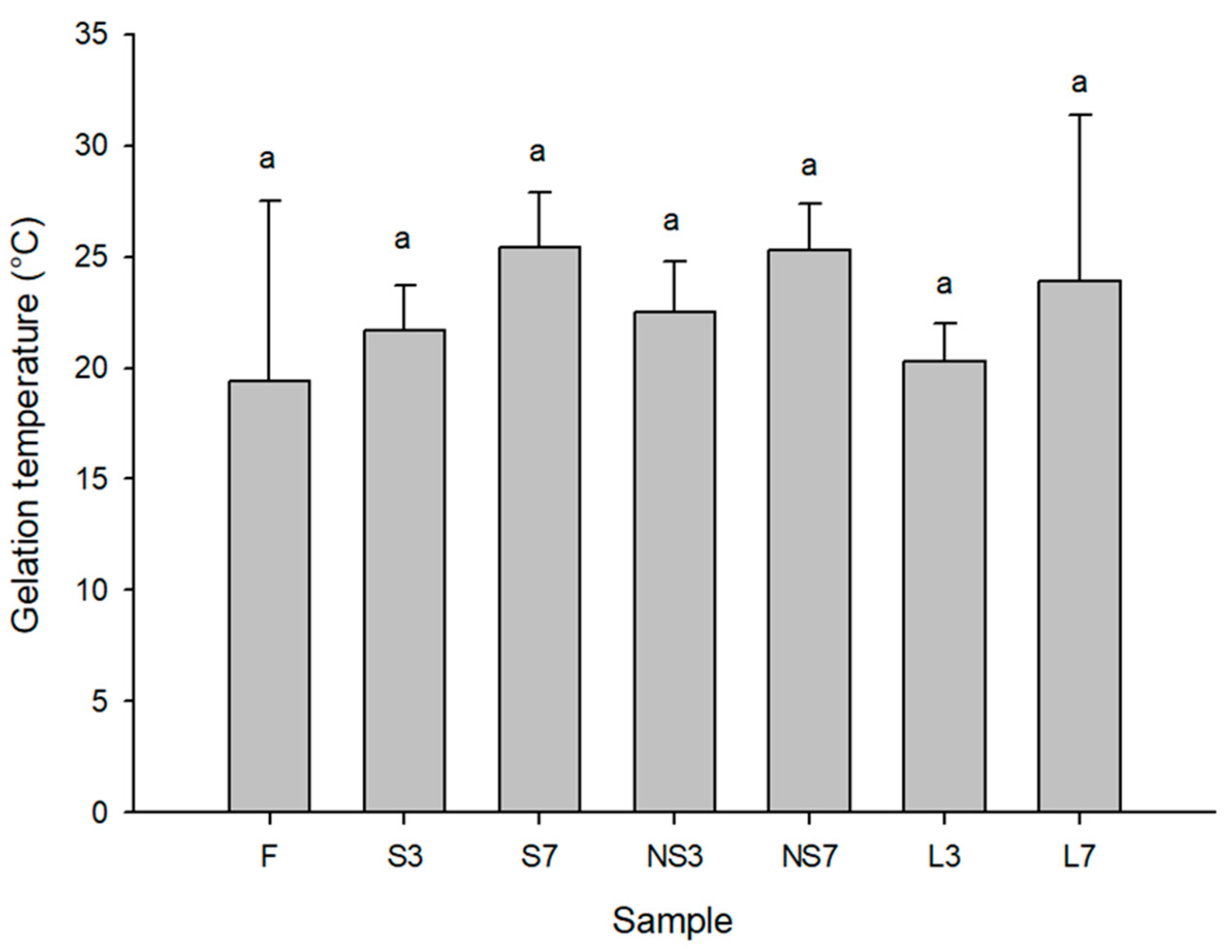
The storage modulus (G′) was used as an indicator of gel rigidity for comparison among samples. When G′ exceeded G″, the system was considered to exhibit viscoelastic solid behavior, indicative of gel formation in Gelidium jelly. The gelation temperatures of Gelidium jellies are presented in Figure 6. In contrast to other samples, the agar networks of NL3 and NL7 exhibited unstable and non-equilibrium behavior under applied stress, suggesting structural deformation during dynamic frequency sweep measurements. This instability indicates that the extract solutions of NL3 and NL7 failed to establish stable gel networks during cooling, which is consistent with their liquid-like appearance observed macroscopically (Figure 4). In comparison, all other samples formed tenuous, weak gel-like networks.
Although no statistically significant differences in gelation temperatures were observed among samples (p > 0.05), jellies prepared from seaweeds subjected to seven washing and drying cycles consistently exhibited higher gelation temperatures than those processed for three cycles, which were in turn higher than those of the fresh control (Figure 6). This trend may be attributed to repeated washing and drying processes enhancing agarose purity in the extracted solutions, thereby promoting the formation of additional sol–gel junction zones and elevating gelation temperatures.
The jellies prepared from fresh untreated seaweeds (F) and from samples S3, NS3, and L3 displayed characteristics of weak gels, as evidenced by the release of water upon tilting of the containers (Figure 4). In contrast, samples S7, NS7, and L7 exhibited substantially higher increases in dynamic moduli during frequency sweep measurements (Figure 5), indicating stronger gel network development. Furthermore, differences in the slope of G′ increase within the temperature range of 20 °C to 40 °C support variations in bonding interactions within the gel networks. Steeper slopes corresponded to more solid-like behavior during cooling, reflecting enhanced network rigidity in Gelidium jellies subjected to extended washing and drying cycles.

3.8. Sensory Evaluation of Gelidium Jellies

The sensory evaluation results of the Gelidium jellies produced under nine different processing conditions are presented in Table 4. Transparency, algal odor, hardness, and springiness were assessed using a five-point hedonic scale, with hardness and springiness evaluated by tactile perception through finger contact. In addition, appearance, aroma, texture, and overall acceptability were evaluated using a seven-point hedonic scale.
No significant differences were observed among samples with respect to transparency or algal odor (Table 4), although jellies prepared from seaweeds subjected to seven washing and sun-drying cycles, with or without alkaline pretreatment (S7 and NS7), exhibited lower algal odor scores than the other samples. This finding suggests that repeated washing combined with sun-drying effectively reduced characteristic seaweed odor. In contrast, shortwave infrared-drying did not demonstrate a comparable effect on odor reduction.
The hardness of Gelidium jellies prepared using the S7 and NS7 treatments was greater than that of the jellies prepared from fresh seaweed extracts (F) and those obtained from infrared-dried samples (L3, L7, NL3, and NL7). This trend was consistent with the instrumental texture profile analysis measured using RapidTA+. Correspondingly, the S7 and NS7 samples received the highest texture hedonic scores among all of the groups, indicating that Gelidium jelly with moderately higher hardness was preferred by the panelists.
The appearance score of the NL7 sample was relatively low, primarily due to its light green coloration, whereas the S7 sample exhibited a higher appearance score owing to its light yellow color. The aroma score of the fresh extracted jelly (F) was the lowest among all of the samples, reflecting the presence of a strong and unacceptable seaweed odor.
Overall acceptability scores were highest for the S7 sample, followed by the NS7 sample. In contrast, Gelidium jellies prepared from seaweeds subjected to alkaline pretreatment combined with shortwave infrared-drying (NL3 and NL7) exhibited the lowest overall acceptability. These results indicate that repeated washing and sun-drying are critical processing steps for improving the sensory quality and consumer acceptance of Gelidium jelly.

4. Conclusions

The results demonstrated that both sun-drying and shortwave infrared lamp-drying effectively reduced the moisture content of Gelidium seaweeds, while alkaline pretreatment significantly increased ash content, likely due to the removal of water-soluble components such as phycoerythrobilin and the retention of chlorophyll and carotenoid pigments. Marked improvements in color were observed after seven washing and sun-drying cycles or following alkaline pretreatment, with the appearance transitioning from purplish-red—associated with phycoerythrobilin, chlorophyll, and carotenoids—to a bright golden-yellow hue dominated by carotenoids, which more closely aligned with traditional quality expectations. Although shortwave infrared lamp-drying offered advantages in drying efficiency and energy conservation, it induced minimal pigment degradation and limited color change under the applied conditions, whereas repeated washing combined with high solar irradiance during sun-drying effectively degraded chlorophyll pigments. Volatile compound analysis revealed that deviations from the fresh control increased with the number of sun-drying cycles, while alkaline pretreatment and infrared-drying produced more pronounced alterations in aroma profiles. Among all treatments, Gelidium subjected to seven washing and sun-drying cycles exhibited the most favorable jelly texture, indicating enhanced agar gel formation through repeated cleaning and drying. In contrast, the combination of alkaline pretreatment and infrared-drying restricted agar release, likely due to increased tissue rigidity and insufficient light intensity, resulting in weak or unstable gel formation. Overall, both drying method and alkaline pretreatment significantly influenced the physicochemical properties of Gelidium and the quality of the resulting agar jelly; despite being labor-intensive, traditional washing and sun-drying remain critical for removing phycoerythrobilin, degrading chlorophyll, and producing agar with desirable golden coloration and reduced seaweed odor, while future process optimization may focus on enhancing infrared lamp intensity or employing full-spectrum lighting to balance drying efficiency with product quality and support the sustainable development of the Gelidium processing industry.

Supplementary Materials

The following supporting information can be downloaded at https://www.mdpi.com/article/10.3390/pr14020345/s1, Table S1. Volatile compounds of Fresh Gelidium seaweed; Table S2. Volatile compounds of Gelidium seaweed treated with sun exposure three times; Table S3. Volatile compounds of Gelidium seaweed treated with sun exposure seven times; Table S4. Volatile compounds of Gelidium seaweed treated with alkali and exposed to sunlight three times; Table S5. Volatile compounds of Gelidium seaweed treated with alkali and exposed to sunlight seven times; Table S6. Volatile compounds of Gelidium seaweed treated with infrared lamp light three times; Table S7. Volatile compounds of Gelidium seaweed treated with infrared lamp light seven times; Table S8. Volatile compounds of Gelidium seaweed treated with alkali and infrared lamp light three times; Table S9. Volatile compounds of Gelidium seaweed treated with alkali and infrared lamp light seven times; Figure S1. Weight changes during the washing and drying process of Gelidium seaweed; Figure S2. Moisture of Gelidium seaweed. F (control): Fresh and untreated Gelidium seaweed; Figure S3. Weight changes every half hour during the washing and drying process of Gelidium seaweed.

Author Contributions

Conceptualization, W.-C.S., S.-T.W. and H.-T.V.L.; methodology, S.-T.W., H.-T.V.L. and L.-A.C.; formal analysis, L.-A.C.; writing—original draft preparation, S.-T.W. and H.-T.V.L.; writing—review and editing, W.-C.S.; investigation, W.-C.S. and H.-T.V.L.; resources, W.-C.S. All authors have read and agreed to the published version of the manuscript.

Funding

This project was supported by the National Science and Technology Council, R.O.C. (NSTC 113-2221-E-019-005-MY2).

Informed Consent Statement

All methods in this experiment followed the Human Subjects Research Act. Ingredients used for preparing jelly were all food-grade. Therefore, the sensory training and evaluation for jelly was classified as causing no harm or risk. Informed consent was obtained from seven panelists, who consumed jelly for sensory studies. Therefore, the sensory training and tests did not require ethical approval from the Department of Food Science, National Taiwan Ocean University. Subjects received an information sheet before joining sensory training. They were asked to read the detailed information and signed the informed consent statement. And the panelists were able to withdraw from the training and sensory evaluation at any time if they were not comfortable. Written informed consent was obtained from the seven panelists before submitting this manuscript.

Data Availability Statement

The results presented in this study are available on request from the corresponding author.

Conflicts of Interest

The authors declare no conflict of interest.

References

  1. Deepika, C.; Ravishankar, G.A.; Rao, A.R. Potential products from macroalgae. In An Overview. Sustainable Global Resources of Seaweeds Volume 1: Bioresources, Cultivation, Trade and Multifarious Applications; Springer: Cham, Switzerland, 2022; pp. 17–44. [Google Scholar]
  2. Robertson, R.C.; Mateo, M.R.G.; O’Grady, M.N.; Guihéneuf, F.; Stengel, D.B.; Ross, R.P.; Fitzgerald, G.F.; Kerry, J.P.; Stanton, C. An assessment of the techno-functional and sensory properties of yoghurt fortified with a lipid extract from the microalga Pavlova lutheri. Innov. Food Sci. Emerg. Technol. 2016, 37, 237–246. [Google Scholar] [CrossRef]
  3. Leandro, A.; Pereira, L.; Gonçalves, A.M. Diverse applications of marine macroalgae. Mar. Drugs 2019, 18, 17. [Google Scholar] [CrossRef]
  4. Meinita, M.D.N.; Harwanto, D.; Hannan, M.A.; Jeong, G.T.; Moon, I.S.; Choi, J.S. A concise review of the potential utilization based on bioactivity and pharmacological properties of the genus Gelidium (Gelidiales, Rhodophyta). J. Appl. Phycol. 2023, 35, 1499–1523. [Google Scholar] [CrossRef]
  5. Hurler, J.; Engesland, A.; Kermany, B.P.; Škalko-Basnet, N. Improved texture analysis for hydrogel characterization: Gel cohesiveness, adhesiveness, and hardness. J. Appl. Polym. Sci. 2012, 125, 180–188. [Google Scholar] [CrossRef]
  6. Sung, W.C.; Lin, H.T.V.; Liao, W.C.; Fang, M. Effects of Halogen Lamp and Traditional Sun Drying on the Volatile Compounds, Color Parameters and Gel Texture of Gongliao Gelidium Seaweed. Foods 2023, 12, 4508. [Google Scholar] [CrossRef] [PubMed]
  7. Meena, R.; Prasad, K.; Siddhanta, A.K. Preparation of superior quality products from two Indian agarophytes. J. Appl. Phycol. 2011, 23, 183–189. [Google Scholar] [CrossRef]
  8. Lemus, A.; Bird, K.; Kapraun, D.F.; Koehn, F. Agar yield, quality and standing crop biomass of Gelidium serrulatum, Gelidium floridanum and Pterocladia capillacea in Venezuela. Food Hydrocoll. 1991, 5, 469–479. [Google Scholar] [CrossRef]
  9. Yarnpakdee, S.; Benjakul, S.; Kingwascharapong, P. Physico-chemical and gel properties of agar from Gracilaria tenuistipitata from the lake of Songkhla, Thailand. Food Hydrocoll. 2015, 51, 217–226. [Google Scholar] [CrossRef]
  10. Ahmed, N.; Singh, J.; Chauhan, H.; Anjum, P.G.A.; Kour, H. Different drying methods: Their applications and recent advances. Int. J. Food Nutr. Saf. 2013, 4, 34–42. [Google Scholar]
  11. Chen, Q.; Bi, J.; Wu, X.; Yi, J.; Zhou, L.; Zhou, Y. Drying kinetics and quality attributes of jujube (Zizyphus jujuba Miller) slices dried by hot-air and short-and medium-wave infrared radiation. LWT-Food Sci. Technol. 2015, 64, 759–766. [Google Scholar] [CrossRef]
  12. Huang, D.; Yang, P.; Tang, X.; Luo, L.; Sunden, B. Application of infrared radiation in the drying of food products. Trends Food Sci. Technol. 2021, 110, 765–777. [Google Scholar] [CrossRef]
  13. Association of Official Analytical Chemists (AOAC). Official Methods of Analysis, 21st ed.; AOAC International: Gaithersburg, MD, USA, 2019. [Google Scholar]
  14. Matheus, J.; Alegria, M.J.; Nunes, M.C.; Raymundo, A. Algae-boosted chickpea hummus: Improving nutrition and texture with seaweeds and microalgae. Foods 2024, 13, 2178. [Google Scholar] [CrossRef]
  15. Kim, D.S.; Iida, F. Texture characteristics of sea buckthorn (Hippophae rhamnoides) jelly for the elderly based on the gelling agent. Foods 2022, 11, 1892. [Google Scholar] [CrossRef]
  16. Garrido, J.I.; Lozano, J.E.; Genovese, D.B. Effect of formulation variables on rheology, texture, colour, and acceptability of apple jelly: Modelling and optimization. LWT-Food Sci. Technol. 2015, 62, 325–332. [Google Scholar] [CrossRef]
  17. Yamamoto, M.; Baldermann, S.; Yoshikawa, K.; Fujita, A.; Mase, N.; Watanabe, N. Determination of volatile compounds in four commercial samples of Japanese green algae using solid phase microextraction gas chromatography mass spectrometry. Sci. World 2014, 2014, 289780. [Google Scholar] [CrossRef]
  18. Kwon, Y.; Ryu, J.; Ju, S. Sensory attributes of buckwheat jelly (Memilmuk) with mung bean starch added to improve texture and taste. Foods 2021, 10, 2860. [Google Scholar] [CrossRef] [PubMed]
  19. Paiva, L.; Lima, E.; Neto, A.I.; Marcone, M.; Baptista, J. Nutritional and functional bioactivity value of selected Azorean macroalgae: Ulva compressa, Ulva rigida, Gelidium microdon, and Pterocladiella capillacea. J. Food Sci. 2017, 82, 1757–1764. [Google Scholar] [CrossRef]
  20. Setyaningsih, D.; Hidayat, A.; Aryanti, E.Y.V.; Muna, N. Alkaline pre-treatment of Gelidium latifolium and Caulerpa racemosa for bioethanol production. IOP Conf. Ser. Earth Environ. Sci. 2019, 309, 12005. [Google Scholar] [CrossRef]
  21. Xiao, Q.; Wang, X.; Zhang, J.; Zhang, Y.; Chen, J.; Chen, F.; Xiao, A. Pretreatment techniques and green extraction technologies for agar from Gracilaria lemaneiformis. Mar. Drugs 2021, 19, 617. [Google Scholar] [CrossRef]
  22. Li, H.; Yu, X.; Jin, Y.; Zhang, W.; Liu, Y. Development of an eco-friendly agar extraction technique from the red seaweed Gracilaria lemaneiformis. Bioresour. Technol. 2008, 99, 3301–3305. [Google Scholar] [CrossRef] [PubMed]
  23. Munier, M.; Jubeau, S.; Wijaya, A.; Morancais, M.; Dumay, J.; Marchal, L.; Jaouen, P.; Fleurence, J. Physicochemical factors affecting the stability of two pigments: R-phycoerythrin of Grateloupia turuturu and B-phycoerythrin of Porphyridium cruentum. Food Chem. 2014, 150, 400–407. [Google Scholar] [CrossRef] [PubMed]
  24. Sánchez-García, F.; Mirzayeva, A.; Roldán, A.; Castro, R.; Palacios, V.; García-Barroso, C.; Durán-Guerrero, E. Evolution of volatile compounds and sensory characteristics of edible green seaweed (Ulva rigida) during storage at different temperatures. J. Sci. Food Agric. 2019, 99, 5475–5482. [Google Scholar] [CrossRef]
  25. Le Pape, M.A.; Grua-Priol, J.; Prost, C.; Demaimay, M. Optimization of dynamic headspace extraction of the edible red algae Palmaria palmata and identification of the volatile components. J. Agric. Food Chem. 2004, 52, 550–556. [Google Scholar] [CrossRef]
  26. Giri, A.; Osako, K.; Ohshima, T. Identification and characterisation of headspace volatiles of fish miso, a Japanese fish meat based fermented paste, with special emphasis on effect of fish species and meat washing. Food Chem. 2010, 120, 621–631. [Google Scholar] [CrossRef]
  27. Urlass, S.; Wu, Y.; Nguyen, T.T.; Winberg, P.; Turner, M.S.; Smyth, H. Unravelling the aroma and flavour of algae for future food applications. Trends Food Sci. Technol. 2023, 138, 370–381. [Google Scholar] [CrossRef]
  28. Reineccius, G. Flavor Chemistry and Technology, 2nd ed.; CRC Press: Boca Raton, FL, USA, 2005. [Google Scholar]
  29. Gu, S.Q.; Wang, X.C.; Tao, N.P.; Wu, N. Characterization of volatile compounds in different edible parts of steamed Chinese mitten crab (Eriocheir sinensis). Food Res. Int. 2013, 54, 81–92. [Google Scholar] [CrossRef]
  30. Quynh, C.T.T. Study on the aroma model of Vietnamese coriander leaves (Polygonum odoratum). Vietnam. J. Sci. Technol. 2016, 54, 73. [Google Scholar] [CrossRef]
  31. Xu, L.; Wang, J.; Tian, A.; Wang, S.; Zhao, K.; Zhang, R.; Wu, X.; Liu, Y.; Liu, X.; Chen, K.; et al. Characteristic volatiles fingerprints in olive vegetable stored at different conditions by HS-GC-IMS. Food Chem. X 2023, 18, 100707. [Google Scholar] [CrossRef]
  32. Sommer, S.; Lang, L.M.; Drummond, L.; Buchhaupt, M.; Fraatz, M.A.; Zorn, H. Odor characteristics of novel non-canonical terpenes. Molecules 2022, 27, 3827. [Google Scholar] [CrossRef] [PubMed]
  33. Hollósy, F. Effects of ultraviolet radiation on plant cells. Micron 2002, 33, 179–197. [Google Scholar] [CrossRef]
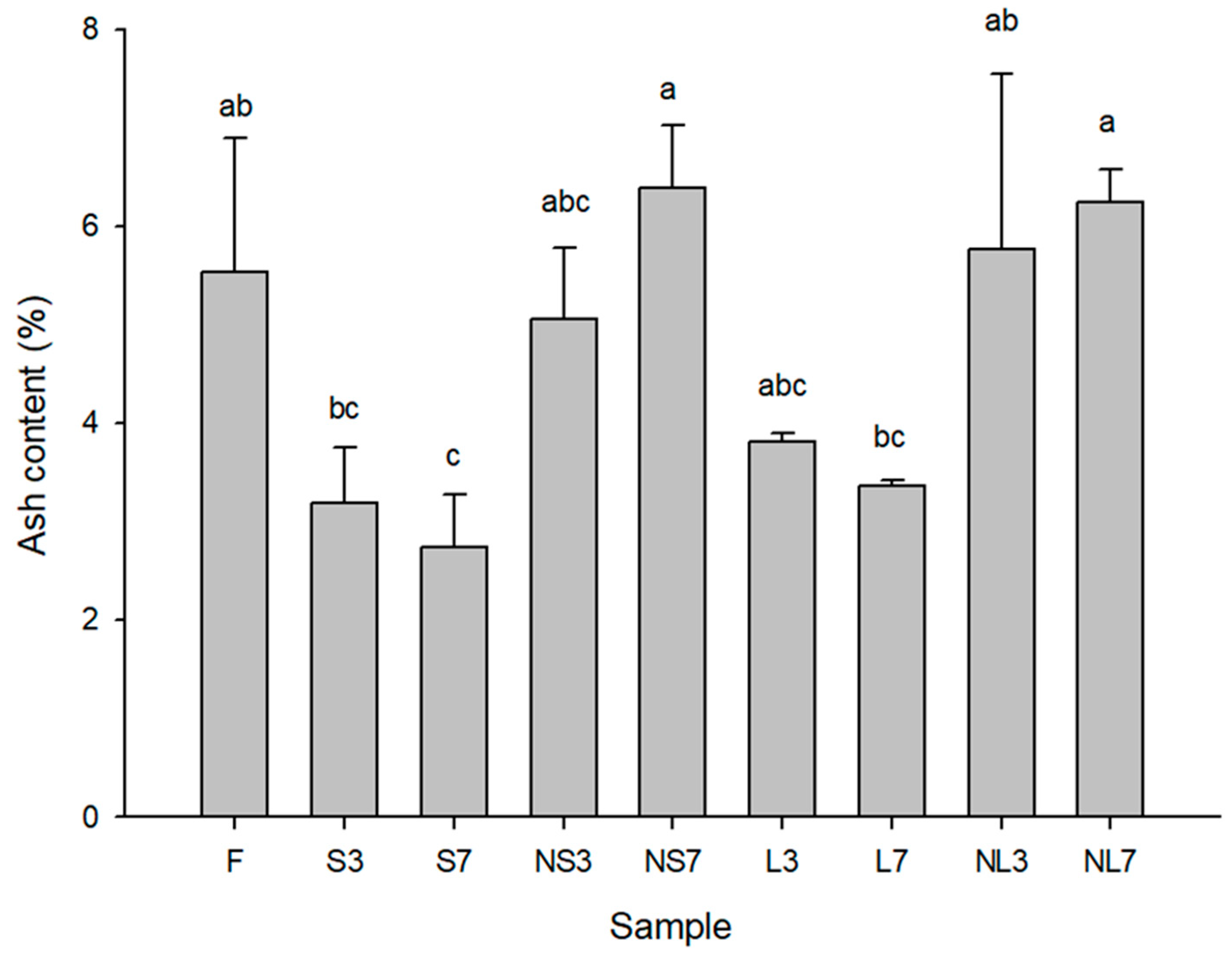
Figure 1. Ash content of Gelidium seaweed. F (control): Fresh and untreated Gelidium seaweed; S3: Gelidium seaweed treated with sun exposure three times; S7: Gelidium seaweed treated with sun exposure seven times; NS3: Gelidium seaweed treated with alkaline and sun exposure three times; NS7: Gelidium seaweed treated with alkaline and sun exposure seven times; L3: Gelidium seaweed treated with infrared lamp light three times; L7: Gelidium seaweed treated with infrared lamp light seven times; NL3: Gelidium seaweed treated with alkaline and infrared lamp light three times; NL7: Gelidium seaweed treated with alkaline and infrared lamp light seven times. Different letters indicate significant differences between different samples (n = 3, p < 0.05).
Processes 14 00345 g001
Figure 2. Appearance of Gelidium seaweed. (A) S3, (B) S7, (C) NS3, (D) NS7, (E) L3, (F) L7, (G) NL3, (H) NL7, (I) F. F (control): Fresh and untreated Gelidium seaweed; S3: Gelidium seaweed treated with sun exposure three times; S7: Gelidium seaweed treated with sun exposure seven times; NS3: Gelidium seaweed treated with alkaline and sun exposure three times; NS7: Gelidium seaweed treated with alkaline and sun exposure seven times; L3: Gelidium seaweed treated with infrared lamp light three times; L7: Gelidium seaweed treated with infrared lamp light seven times; NL3: Gelidium seaweed treated with alkaline and infrared lamp light three times; NL7: Gelidium seaweed treated with alkaline and infrared lamp light seven times.
Processes 14 00345 g002
Figure 3. Score plot of volatile compounds in Gelidium seaweed. F (control): Fresh and untreated Gelidium seaweed; S3: Gelidium seaweed treated with sun exposure three times; S7: Gelidium seaweed treated with sun exposure seven times; NS3: Gelidium seaweed treated with alkaline and sun exposure three times; NS7: Gelidium seaweed treated with alkaline and sun exposure seven times; L3: Gelidium seaweed treated with infrared lamp light three times; L7: Gelidium seaweed treated with infrared lamp light seven times; NL3: Gelidium seaweed treated with alkaline and infrared lamp light three times; NL7: Gelidium seaweed treated with alkaline and infrared lamp light seven times.
Processes 14 00345 g003
Figure 4. Appearance of Gelidium seaweed gel. (A) S3, (B) S7, (C) NS3, (D) NS7, (E) L3, (F) L7, (G) NL3, (H) NL7, (I) F. F (control): Fresh and untreated Gelidium seaweed; S3: Gelidium seaweed treated with sun exposure three times; S7: Gelidium seaweed treated with sun exposure seven times; NS3: Gelidium seaweed treated with alkaline and sun exposure three times; NS7: Gelidium seaweed treated with alkaline and sun exposure seven times; L3: Gelidium seaweed treated with infrared lamp light three times; L7: Gelidium seaweed treated with infrared lamp light seven times; NL3: Gelidium seaweed treated with alkaline and infrared lamp light three times; NL7: Gelidium seaweed treated with alkaline and infrared lamp light seven times.
Processes 14 00345 g004
Figure 5. Changes in the storage modulus and loss modulus of Gelidium seaweed gel during the cooling process. (A) F, (B) S3, (C) S7, (D) NS3, (E) NS7, (F) L3, (G) L7. F (control): Fresh and untreated Gelidium seaweed; S3: Gelidium seaweed treated with sun exposure three times; S7: Gelidium seaweed treated with sun exposure seven times; NS3: Gelidium seaweed treated with alkaline and sun exposure three times; NS7: Gelidium seaweed treated with alkaline and sun exposure seven times; L3: Gelidium seaweed treated with infrared lamp light three times; L7: Gelidium seaweed treated with infrared lamp light seven times.
Processes 14 00345 g005
Figure 6. Gelation temperature of Gelidium seaweed gel. F (control): Fresh and untreated Gelidium seaweed; S3: Gelidium seaweed treated with sun exposure three times; S7: Gelidium seaweed treated with sun exposure seven times; NS3: Gelidium seaweed treated with alkaline and sun exposure three times; NS7: Gelidium seaweed treated with alkaline and sun exposure seven times; L3: Gelidium seaweed treated with infrared lamp light three times; L7: Gelidium seaweed treated with infrared lamp light seven times. Different letters indicate significant differences between different samples (n = 3, p < 0.05).
Processes 14 00345 g006
Table 1. Color parameters of Gelidium seaweed.
L*a*b*ΔE#
F16.79 ± 1.90 d3.89 ± 0.77 ab5.79 ± 1.30 b-
S329.88 ± 2.30 c5.93 ± 1.22 a11.42 ± 1.36 b14.46 ± 1.92 b
S750.15 ± 3.90 b6.33 ± 0.89 a26.32 ± 2.11 a39.28 ± 5.10 a
NS347.86 ± 4.29 b−0.39 ± 1.06 d26.55 ± 2.87 a37.64 ± 5.66 a
NS761.84 ± 3.47 a0.25 ± 0.53 cd31.25 ± 2.03 a51.89 ± 5.92 a
L321.60 ± 0.64 cd2.55 ± 0.54 bc5.63 ± 1.34 b5.61 ± 2.72 b
L720.92 ± 4.26 cd2.76 ± 0.21 bc5.49 ± 2.52 b6.59 ± 4.09 b
NL321.06 ± 3.27 cd−3.39 ± 1.14 e5.57 ± 1.15 b9.17 ± 3.07 b
NL724.07 ± 2.46 cd−4.34 ± 0.34 e6.70 ± 0.83 b11.30 ± 3.31 b
Expressed as mean ± standard deviation (n = 3). Values followed by a different letter within each column are significantly different (p < 0.05). F (control): Fresh and untreated Gelidium seaweed; S3: Gelidium seaweed treated with sun exposure three times; S7: Gelidium seaweed treated with sun exposure seven times; NS3: Gelidium seaweed treated with alkaline and sun exposure three times; NS7: Gelidium seaweed treated with alkaline and sun exposure seven times; L3: Gelidium seaweed treated with infrared lamp light three times; L7: Gelidium seaweed treated with infrared lamp light seven times; NL3: Gelidium seaweed treated with alkaline and infrared lamp light three times; NL7: Gelidium seaweed treated with alkaline and infrared lamp light seven times.
Table 3. Texture analysis of Gelidium seaweed gel.
Hardness (N)SpringinessGumminess (N)
F0.37 ± 0.12 cd0.42 ± 0.10 b0.16 ± 0.09 c
S30.61 ± 0.11 abc0.69 ± 0.05 ab0.40 ± 0.10 abc
S71.08 ± 0.22 a0.84 ± 0.07 a0.82 ± 0.21 a
NS30.56 ± 0.28 abc0.57 ± 0.19 ab0.33 ± 0.24 bc
NS70.95 ± 0.21 ab0.77 ± 0.06 a0.66 ± 0.18 ab
L30.59 ± 0.01 abc0.64 ± 0.02 ab0.36 ± 0.01 abc
L70.49 ± 0.30 bcd0.54 ± 0.20 ab0.30 ± 0.24 bc
NL30.00 ± 0.00 d0.00 ± 0.00 c0.00 ± 0.00 c
NL70.00 ± 0.00 d0.00 ± 0.00 c0.00 ± 0.00 c
Expressed as mean ± standard deviation (n = 3). Values followed by different letters within each column are significantly different (p < 0.05). F (control): Fresh and untreated Gelidium seaweed; S3: Gelidium seaweed treated with sun exposure three times; S7: Gelidium seaweed treated with sun exposure seven times; NS3: Gelidium seaweed treated with alkaline and sun exposure three times; NS7: Gelidium seaweed treated with alkaline and sun exposure seven times; L3: Gelidium seaweed treated with infrared lamp light three times; L7: Gelidium seaweed treated with infrared lamp light seven times; NL3: Gelidium seaweed treated with alkaline and infrared lamp light three times; NL7: Gelidium seaweed treated with alkaline and infrared lamp light seven times.
Table 4. The sensory evaluation of different groups of Gelidium gels.
TransparencyAlgal OdorHardnessSpringinessAppearanceAromaTextureOverall
Acceptability
F3.57 ± 1.51 a3.14 ± 1.35 a1.43 ± 1.13 cd1.57 ± 1.51 a4.29 ± 1.25 ab2.71 ± 1.11 b2.14 ± 1.07 c3.00 ± 0.82 ab
S33.57 ± 0.98 a2.57 ± 1.13 a2.71 ± 1.11 bc2.29 ± 1.25 a4.29 ± 1.60 ab4.14 ± 1.77 ab3.86 ± 1.57 abc3.57 ± 0.79 ab
S74.29 ± 1.11 a2.00 ± 1.29 a4.57 ± 0.53 a3.29 ± 1.50 a5.86 ± 0.90 a5.43 ± 1.27 a5.14 ± 1.21 a5.14 ± 1.21 a
NS34.00 ± 1.15 a2.43 ± 0.98 a2.71 ± 0.95 bc3.14 ± 1.35 a4.29 ± 0.49 ab4.14 ± 0.90 ab4.57 ± 1.13 ab4.29 ± 1.98 ab
NS74.43 ± 1.51 a2.00 ± 1.00 a3.14 ± 1.35 ab3.71 ± 1.38 a5.14 ± 1.57 ab3.57 ± 1.72 ab5.14 ± 1.77 a4.71 ± 1.80 ab
L33.71 ± 1.25 a2.86 ± 1.21 a1.43 ± 0.53 cd1.86 ± 0.69 a3.43 ± 1.13 ab3.86 ± 1.77 ab3.14 ± 1.35 abc3.00 ± 1.29 ab
L73.14 ± 0.69 a2.43 ± 1.13 a1.43 ± 1.13 cd1.71 ± 1.50 a3.43 ± 1.62 ab3.29 ± 1.25 ab2.29 ± 1.11 c2.86 ± 1.35 ab
NL33.57 ± 1.27 a3.43 ± 1.40 a1.00 ± 0.00 d1.86 ± 1.57 a3.57 ± 2.07 ab3.00 ± 1.63 ab2.43 ± 1.27 bc2.57 ± 1.13 b
NL73.57 ± 1.62 a2.71 ± 1.25 a1.00 ± 0.00 d1.57 ± 1.51 a3.14 ± 1.68 b3.43 ± 1.90 ab2.29 ± 1.25 c2.71 ± 1.25 b
Expressed as mean ± standard deviation (n = 7). Values followed by different letters within each column are significantly different (p < 0.05). F (control): Fresh and untreated Gelidium seaweed; S3: Gelidium seaweed treated with sun exposure three times; S7: Gelidium seaweed treated with sun exposure seven times; NS3: Gelidium seaweed treated with alkaline and sun exposure three times; NS7: Gelidium seaweed treated with alkaline and sun exposure seven times; L3: Gelidium seaweed treated with infrared lamp light three times; L7: Gelidium seaweed treated with infrared lamp light seven times; NL3: Gelidium seaweed treated with alkaline and infrared lamp light three times; NL7: Gelidium seaweed treated with alkaline and infrared lamp light seven times. A 5-point scale was used for transparency, algal odor, hardness and springiness: 1 = extremely cloudy and 5 = extremely transparent, 1 = light odor and 5 = strong odor, 1 = extremely soft and 5 = extremely hard, 1 = poor elasticity and 5 = good elasticity. A 7-point hedonic test was used for appearance, aroma, texture, and overall acceptability: 1 = dislike extremely and 7 = like extremely.
Disclaimer/Publisher’s Note: The statements, opinions and data contained in all publications are solely those of the individual author(s) and contributor(s) and not of MDPI and/or the editor(s). MDPI and/or the editor(s) disclaim responsibility for any injury to people or property resulting from any ideas, methods, instructions or products referred to in the content.