


Abstract
Tectonic deformation can reorganize adsorption-related pores, matrix pore space, and pore-throat-fracture networks, but how these functional domains jointly govern fluid mobility and permeability stability under stress remains unclear where deformation intensity and coal rank covary. We investigated the B4 coal seam along the Qujiang-Shangzhuang-Yuancun transect in the western Pingxiang-Leping Depression Belt using a combination of field-emission scanning electron microscopy (FE-SEM), low-pressure CO2 adsorption, low-temperature N2 adsorption, mercury intrusion porosimetry (MIP), nuclear magnetic resonance (NMR), methane adsorption, and N2 gas-permeability stress-sensitivity tests. Along the transect, coal-body structure changed from primary-structure and cataclastic coal to granulated and mylonitic coal within a regional context of increasing coal rank, decreasing volatile-matter content, and fewer open fractures. Despite comparable Langmuir volumes (16.29–19.96 cm3 g−1), transport-related properties differed markedly. Qujiang samples contained 23.48–30.04% of their method-accessible pore volume in the >100 nm interval and had movable-fluid saturations of 44.7–53.1%. Shangzhuang samples exhibited irreversible N2 gas-permeability damage of 98.63–99.99%, whereas the Yuancun sample contained abundant method-accessible pore volume across all operational size intervals but had a movable-fluid saturation of only 19.21%. Thus, accessible pore volume does not necessarily correspond to connected, stress-stable transport pathways. Favorable coalbed methane intervals require sufficient adsorption-storage space combined with connected, mechanically stable pore-throat-fracture networks.
1. Introduction
Coalbed methane (CBM) is an important unconventional natural gas resource whose accumulation and sustained production depend on coal-seam thickness, burial depth, gas content, coal rank, tectonic preservation, and reservoir petrophysical properties [1,2,3]. Coal-body structure provides a geological link among postdepositional deformation, pore-system evolution, methane occurrence, and reservoir deliverability. Tectonic stresses can induce brittle fracturing, shear displacement, granulation, and mylonitization, progressively transforming primary-structure coal into cataclastic, granulated, and mylonitic coal. Moderate brittle deformation may create fracture surfaces and improve local pore connectivity, whereas intense compression and shearing may constrict pore throats, reduce fracture continuity, and destabilize preferential flow pathways [4,5,6,7,8,9]. Meanwhile, these structural effects are commonly superimposed on variations in coal rank, maceral composition, and mineral matter.
Coal pore systems span multiple scales and contain functionally distinct domains that contribute differently to methane storage and transport. Low-pressure CO2 adsorption provides model-derived pore-size and pore-volume information for adsorption-accessible pores with equivalent widths < 2 nm, whereas low-temperature N2 adsorption characterizes the approximately 2–100 nm interval. Mercury intrusion porosimetry (MIP) constrains mercury-accessible larger pore throats and fracture-related voids, and nuclear magnetic resonance (NMR) provides information on fluid-accessible pore space and relative fluid mobility [4,10,11,12,13,14,15,16,17,18,19]. Field-emission scanning electron microscopy (FE-SEM) complements these measurements by showing micrometer-scale pore and fracture morphologies at the magnifications used here. Because these techniques differ in measurement principle, operational size range, and sensitivity to pore geometry and connectivity, their outputs are complementary rather than geometrically interchangeable. Recent studies have therefore combined gas adsorption, NMR, MIP, and SEM to characterize different components of multiscale coal pore-fracture systems [20,21]. In this study, pore-volume data derived from the measured CO2 and N2 adsorption isotherms were integrated with mercury-accessible pore-throat volumes obtained by MIP and assigned to nonoverlapping operational size intervals. This framework was used only to compare method-accessible pore-space allocation among samples and does not represent direct nanoscale imaging or a geometric reconstruction of the complete pore network [16,17,18,19,22].
Recent studies have increasingly moved beyond reservoir assessments based on individual surface-area or pore-volume parameters toward integrated analyses of multiscale pore assemblages and methane storage-transport relationships [23,24,25,26,27,28]. Pores < 2 nm generally provide the principal adsorption sites because of their high specific surface areas and overlapping adsorption-potential fields. Pores of 2–100 nm may accommodate free methane and contribute to matrix-scale transfer toward larger pore throats. Connected cleats, fractures, and associated large pore throats provide the principal pathways for pressure-driven methane flow. Strongly deformed, high-rank coal may therefore retain abundant adsorption space while lacking sufficiently connected and stable transport pathways [4,8,18,28,29,30,31,32]. Previous studies have commonly discussed coal rank, tectonic deformation, or individual pore attributes separately. Consequently, how variations in coal-body structure and coal rank are associated with changes in multiscale pore architecture, pore-throat stability, and fluid mobility along a representative tectonic deformation gradient remains poorly understood.
The B4 coal seam of the Leping Formation in the western Pingxiang-Leping Depression Belt has experienced pronounced postdepositional tectonic modification. Spatial variations in coal-body structure, coal rank and quality, cleat-microfracture development, and pore-system architecture provide a representative object for examining methane storage and transport along a combined deformation-rank gradient. This study presents new measurements from six coal samples and integrates macroscopic characterization of coal-body structures, cleat and microfracture observations, CO2 and N2 adsorption analyses, MIP, NMR-derived fluid-mobility parameters, methane adsorption measurements, and gas-permeability stress-sensitivity tests. Published regional coal-rank and proximate-analysis data serve solely as geological context and are not treated as sample-specific measurements. The objectives were to (i) characterize spatial variations in coal-body structure and pore-fracture connectivity; (ii) assess the relationships among coal-body structure, regional coal rank, operational pore domains, methane adsorption capacity, fluid mobility, and gas-flow behavior; and (iii) develop a comparative reservoir-evaluation framework that differentiates method-accessible pore space from connected transport pathways that remain stable under stress. Because deformation intensity and coal rank covary spatially along the transect, the results are interpreted in terms of their associations and combined controls, without assigning all observed pore-system variations exclusively to tectonic deformation.
2. Geological Setting
The Pingxiang-Leping Depression Belt in central Jiangxi Province is one of the principal Late Paleozoic coal-bearing basins in South China. Its regional structural framework is characterized by a reversed S-shaped pattern defined by NE-, E-W-, and NNE-trending structures and records polyphase deformation associated with successive tectonic events. During the Mesozoic, Yanshanian tectonism strongly reworked the original depositional architecture and preexisting structures. Basement folds are generally tight and strike NEE-NE, whereas folds within the sedimentary cover predominantly strike NE. Deformation is more intense in the western part of the belt and comparatively weaker in the Gao’an-Fengcheng sector of the eastern area. Faults generally parallel the axial traces of folds in the sedimentary cover and are dominated by thrust and oblique-slip thrust faults [33,34,35]. Repeated tectonic overprinting preserved the coal-bearing strata mainly within remnant synclines, with coal seams occurring predominantly along the synclinal limbs.
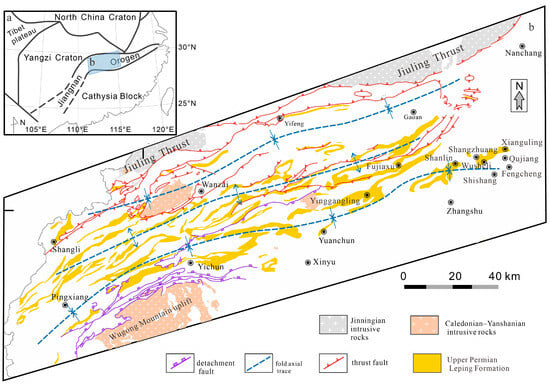
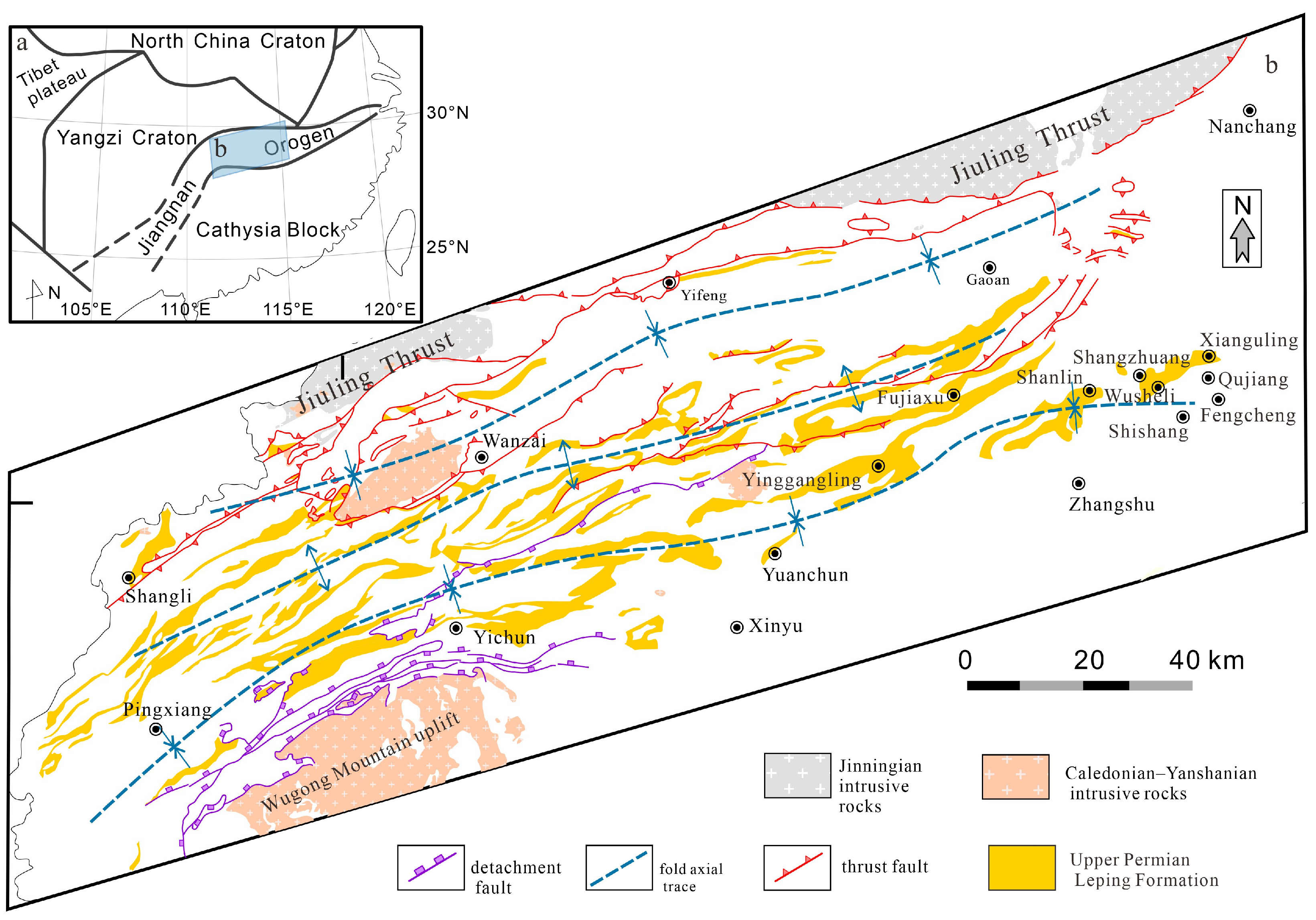
The Leping Formation is distributed over more than 9000 km2 in the western Pingxiang-Leping Depression Belt (Figure 1). The B4 coal seam within the Laoshan Member is laterally continuous and constitutes a principal target horizon for regional CBM exploration. Seam thickness generally ranges from 1.56 to 2.71 m, and burial depth ranges from approximately 500 to 1800 m. High-gas-content coal mines are concentrated in the Qujiang-Yuancun sector. Borehole measurements indicate that gas content in the B4 seam generally exceeds 8 m3 t−1 and reaches 35.67 m3 t−1, indicating favorable CBM resource potential in this study area [36,37,38,39].
Figure 1.
Simplified regional geological map of the study area (a,b).
3. Samples and Experimental Methods
3.1. Samples and Coal-Body Structures
Six representative coal samples were collected from underground working faces at the Qujiang and Shangzhuang coal mines in the Fengcheng area and from cores recovered from Yuancan-1 Well in the Yuancun area. Sampling targeted fresh B4-seam material exhibiting the characteristic macroscopic coal-body structure at each site; visibly weathered material and samples disturbed by mining or core handling were avoided wherever possible. The Qujiang and Shangzhuang samples were obtained at depths of 995.20 and 852.50 m, respectively. In the Yuancan-1 Well, samples were collected from the B4 coal seam at depths of 855.70–857.90 m. QJ1 and QJ2 represent mainly primary-structure to locally cataclastic coal, SZ1 and SZ2 represent cataclastic coal, YC1 represents granulated coal, and YC2 represents mylonitic coal. Subsamples used for different measurements were taken from the corresponding parent material to ensure compatibility among the multiproxy results. QJ1, QJ2, SZ1, SZ2, and YC1 were subjected to the principal multiproxy analytical program. YC2 was analyzed using CO2 and N2 adsorption and FE-SEM. Its powdery to fine-grained mylonitic fabric precluded preparation of a mechanically intact and effectively sealable cylindrical core for the N2 permeability stress-sensitivity test. Because mylonitic coal occurs only locally within strongly deformed zones, YC2 was used as a supplementary sample for pore-structure characterization and was not included in the high-pressure methane adsorption program. The selected samples documented the characteristic coal-body structures at their respective sampling sites and provided a consistent basis for comparison along the investigated transect. Classification as primary-structure, cataclastic, granulated, or mylonitic coal was based on coal-body integrity, preservation of primary bedding, fragmentation, and shear-fabric development. Table 1 summarizes the sampling information, coal-body structures, regional coal-rank and coal-quality context, and sample-specific analytical coverage.
Table 1.
Sample characteristics, regional coal-rank context, and analytical program.
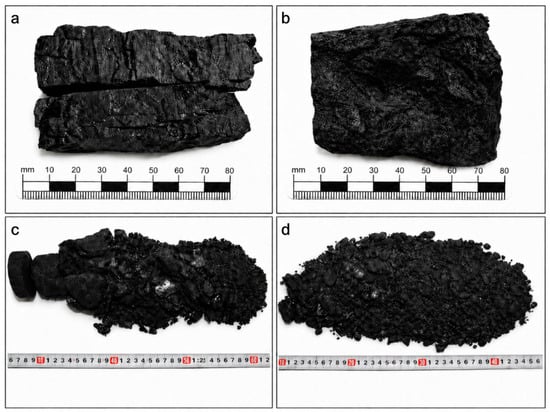
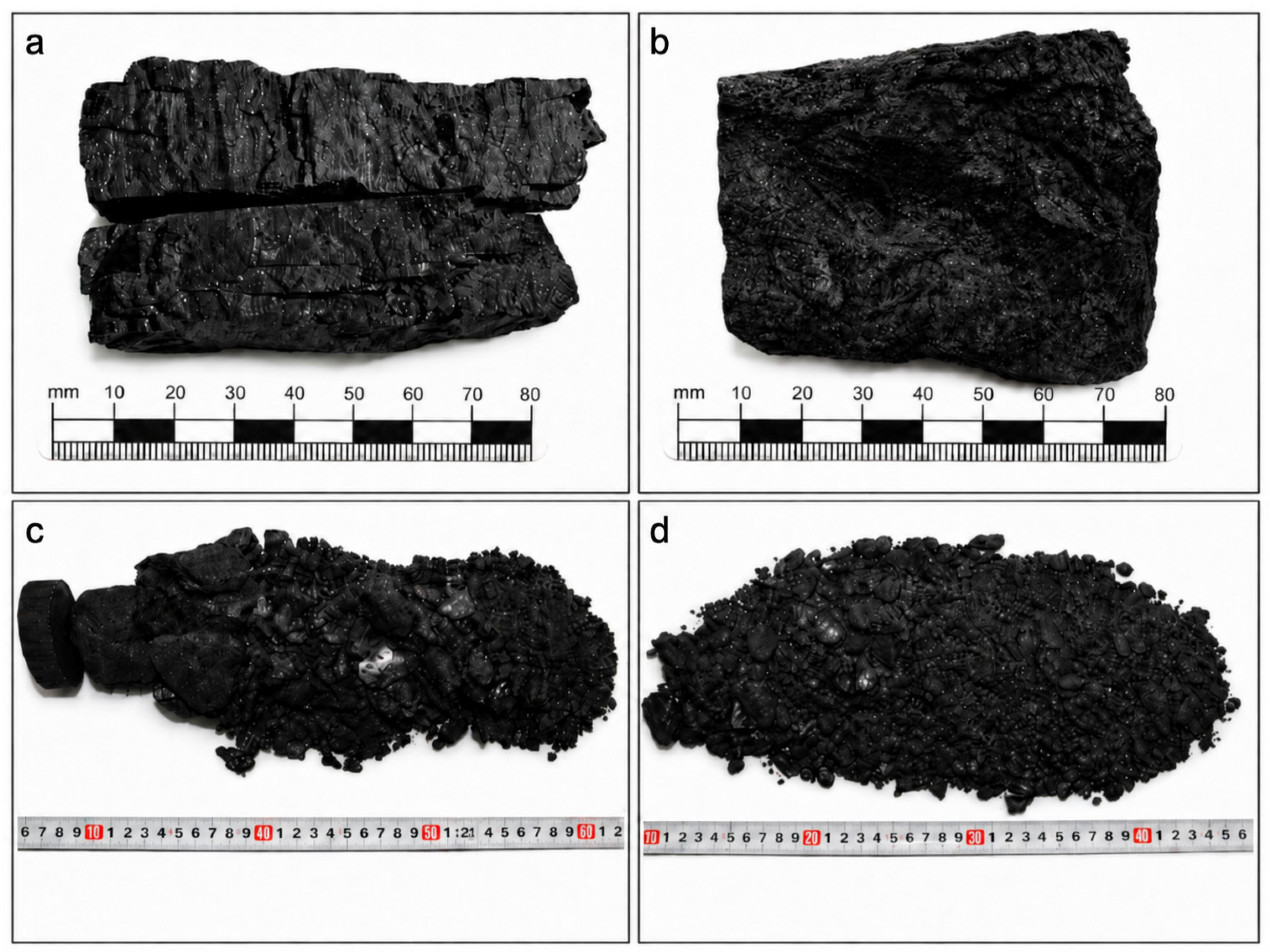
The investigated samples defined a representative westward increase in tectonic deformation intensity, accompanied by a change in coal-body structure from primary-structure and cataclastic coal to granulated and mylonitic coal. At Qujiang, the seam was dominated by bedded to blocky primary-structure coal with well-preserved bedding and a coherent fabric. Locally, fractures intersected bedding at high to oblique angles (Figure 2a), indicating relatively weak tectonic modification. The Shangzhuang coal was dominated by relatively large blocky fragments but was less coherent; fractures and shear surfaces subdivided the coal into irregular blocks, and local developed slickensides and stepped shear surfaces supported its classification as cataclastic coal (Figure 2b). In the Yuancun area, the sampled seam interval showed stronger compressional and shear deformation. The coal-body structure was dominated by granulated coal, locally grading into mylonitized coal. In the Yuancan-1 Well, YC1 consisted of blocky coal fragments and granular aggregates and was therefore classified as granulated coal (Figure 2c); whereas, the underlying YC2 was powdery to fine grained, and its original bedding and blocky fabric had been almost completely obliterated, consistent with mylonitic coal (Figure 2d). Because the Yuancun samples were both more strongly deformed and of higher rank than the Fengcheng samples, their pore characteristics were interpreted in terms of combined controls rather than deformation alone.
Figure 2.
Macroscopic characteristics of representative coal-body structures in the B4 coal seam. (a) Primary-structure coal from Qujiang; (b) cataclastic coal from Shangzhuang; (c) granulated coal from Yuancun; (d) mylonitic coal from Yuancun.
Published regional data provide geological context for the newly analyzed samples. In the Jianxin Coal Mine in the eastern part of the study area, the B4 coal seam is dominated by dull and semidull coal, whereas progressively brighter lithotypes, particularly semibright coal, become more prevalent westward through Qujiang, Shangzhuang, and Yuancun. Maximum vitrinite reflectance (Ro,max) in the Fengcheng area generally ranges from 1.27 to 1.81%, indicating medium- to high-rank coal, whereas Yuancun values range from 3.19 to 4.76%, and an average of approximately 4.00%, consistent with an anthracite rank [30,33]. Published proximate analyses show that B4 coal from the Fengcheng area contains 0.44–4.63% moisture, 10.09–38.00% ash, and 15.96–25.60% volatile matter in the Fengcheng area and 0.68–4.41% moisture, approximately 24.70% average ash, and 3.84–7.91% volatile matter in Yuancun [34,36,39]. Published data indicate that coal rank increases from the Fengcheng area to Yuancun, accompanied by a marked decrease in volatile-matter content and general increases in moisture and ash. These values represent regional literature-derived ranges rather than direct measurements of the six specimens analyzed in this study, and sample-specific ultimate-analysis data are unavailable. They are therefore used solely to define the geological context. Accordingly, the observed variations in pore architecture, methane adsorption capacity, fluid mobility, and permeability behavior are interpreted in the context of the combined spatial changes in coal-body structure, coal rank, and coal quality.
3.2. Experimental Methods
The analytical methods were assigned complementary roles. Low-pressure CO2 adsorption was used to derive DFT-derived pore volumes and specific surface areas for adsorption-accessible pores < 2 nm [10,14]. Low-temperature N2 adsorption provided the Brunauer-Emmett-Teller (BET) specific surface area, pore volume, and Barrett-Joyner-Halenda (BJH) pore-size distributions for an approximately 2–100 nm interval [10,11,12,14]. MIP characterized mercury-accessible pore throats and fracture-related voids in the >100 nm operational interval [13]. NMR quantified total porosity and bound- and movable-fluid components [15]. Methane adsorption yielded the Langmuir volume (VL) and pressure (PL), and measured excess adsorption was converted to density-corrected absolute adsorption at high pressures [40,41,42,43,44,45]. N2 gas-permeability stress-sensitivity tests quantified permeability reduction, recovery, and irreversible damage during stepwise loading and unloading under varying net confining pressure [46,47,48,49,50,51,52,53]. FE-SEM was used only for qualitative interpretation of pore and fracture morphologies at the micrometer scales indicated by the image scale bars; it was not used to determine sub-100 nm pore-size distributions or pore volumes.
Samples for CO2 and N2 adsorption analyses were crushed and sieved to 0.28–0.45 mm. Approximately 3 g of each sample was dried at 90 °C for 8 h to constant mass and then vacuum-degassed at 110 °C for 10 h. Samples for MIP were prepared as cylindrical plugs approximately 25.4 mm in diameter and 20 mm in length, with a mass of approximately 13 g, and were dried at 105 °C for 12 h to constant mass. Cylindrical cores for permeability measurements were cut using a diamond-wire saw and machined to approximately 25.4 mm in diameter and 50 mm in length. Specimens for FE-SEM observation were sputter-coated with Au before analysis.
Low-pressure CO2 and low-temperature N2 adsorption measurements were conducted using an ASAP 2460 surface area and porosity analyzer (Micromeritics Instrument Corporation, Norcross, GA, USA) in accordance with GB/T 19587-2017 [54]. CO2 adsorption was measured at 273 K over P/P0 = 0.0001–0.03, whereas N2 adsorption was measured at 77 K over P/P0 = 0.01–0.995. Free-space volumes were determined using helium. Equivalent pore-width distributions, cumulative pore volumes, and specific surface areas assigned to the <2 nm interval were derived from the measured CO2 isotherms using the DFT routine supplied with the instrument software. BET specific surface areas were calculated over P/P0 = 0.05–0.35, and pore-size distributions for the 2–100 nm interval were derived from the N2 desorption branch using the BJH model. Accordingly, the reported sub-100 nm parameters represent adsorption-model-derived equivalent pore properties based on measured isotherms rather than direct imaging measurements of individual pores.
Fractal dimensions were derived from the N2 adsorption data using the Frenkel-Halsey-Hill (FHH) model. The relationship is expressed by Equation (1). When the relative pressure is within a lower range (P/P0 < 0.5), the surface-fractal dimension D1 and the parameter A can be expressed as Equation (2). When the relative pressure is high (P/P0 > 0.5), the relationship between the pore-structure fractal dimension D2 and the parameter A can be expressed as Equation (3).
In these equations, V is the equilibrium adsorption volume (cm3 g−1), Vm is the monolayer adsorption volume (cm3 g−1), P is the equilibrium gas pressure (MPa), P0 is the saturated vapor pressure (MPa), A is the slope obtained from the linear fit between ln(V/Vm) and ln[ln(P0/P)], and C is the intercept.
NMR measurements were performed using a MacroMR12-150H-I low-field NMR core analyzer (Suzhou Niumag Analytical Instrument Co., Ltd., Suzhou, China) in accordance with SY/T 6490-2014 [55]. After vacuum evacuation for 8 h, the cores were saturated with synthetic brine at 10 MPa for 48 h. The brine had a salinity of 3000 mg L−1 and comprised NaCl, CaCl2, and MgCl2·6H2O in a mass ratio of 7:0.6:0.4. The saturated cores were then centrifuged at 12,000 rpm for 60 min. The T2 cutoff was determined using the cumulative-porosity matching method. The cumulative porosity remaining after centrifugation, representing the bound-fluid porosity, was located on the cumulative T2 distribution of the fully saturated sample, and the corresponding relaxation time was defined as T2 cutoff. Signals with T2 ≤ T2 cutoff and T2 > T2 cutoff were assigned to the bound-fluid and movable-fluid components, respectively.
Methane adsorption isotherms were measured gravimetrically using an IsoSORP HP II Static high-pressure gravimetric sorption analyzer (Rubotherm GmbH, Bochum, Germany) in accordance with GB/T 35210.2-2020 [56]. Isotherms for all samples were obtained at 35 °C and fitted using the Langmuir model. Additional high-pressure adsorption measurements for QJ1 and SZ1 were conducted at 35 °C, 45 °C, and 55 °C at pressures up to approximately 30 MPa. Each pressure step was considered equilibrated when the balance signal satisfied the instrument’s stability criterion.
Permeability stress-sensitivity tests were performed using an LDY-50-180 core-flow apparatus (Haian Huada Petroleum Instruments Co., Ltd., Haian, Jiangsu, China), with N2 as the flowing medium at 29 °C, in accordance with SY/T 5358-2010 [57]. A constant pressure differential was maintained while confining pressure was increased stepwise and subsequently decreased in reverse order. Steady state was considered to have been reached when the flow-rate variation remained below 0.1% for 30 min. Gas permeability was calculated from the steady-state flow data. The dimensionless permeability and irreversible permeability damage rate were calculated as follows:
where Ki is the permeability at a given net confining pressure, K0 is the permeability at the initial net confining pressure, and Kr is the recovered permeability measured after the loading-unloading cycle when the net confining pressure returned to its initial value.
Pore and fracture morphologies were examined using a Regulus 8220 field-emission scanning electron microscope (Hitachi High-Tech Corporation, Tokyo, Japan) in accordance with SY/T 5162-2014 [58]. The accelerating voltage was 5 kV, and the working distance was approximately 8 mm. The FE-SEM images were interpreted qualitatively only at the scales indicated by their scale bars and were not used to quantify pore-size distributions or pore volumes.
Mercury intrusion porosimetry was performed using an AutoPore IV 9505 mercury intrusion porosimeter (Micromeritics Instrument Corporation, Norcross, GA, USA) in accordance with GB/T 29171-2023 over an applied-pressure range of 0.0137–200.67 MPa [59]. The equilibration time at each pressure step was at least 30 s and was extended to 60 s for samples with permeabilities below 0.001 μm2. Equivalent pore-throat diameters were calculated from the intrusion pressure using the Washburn equation. Accordingly, the MIP-derived pore volumes represent mercury-accessible pore-throat volumes within the corresponding operational size intervals.
4. Results
4.1. Cleat and Microfracture Characteristics
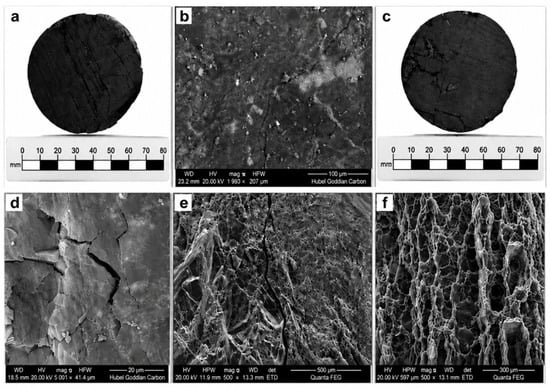
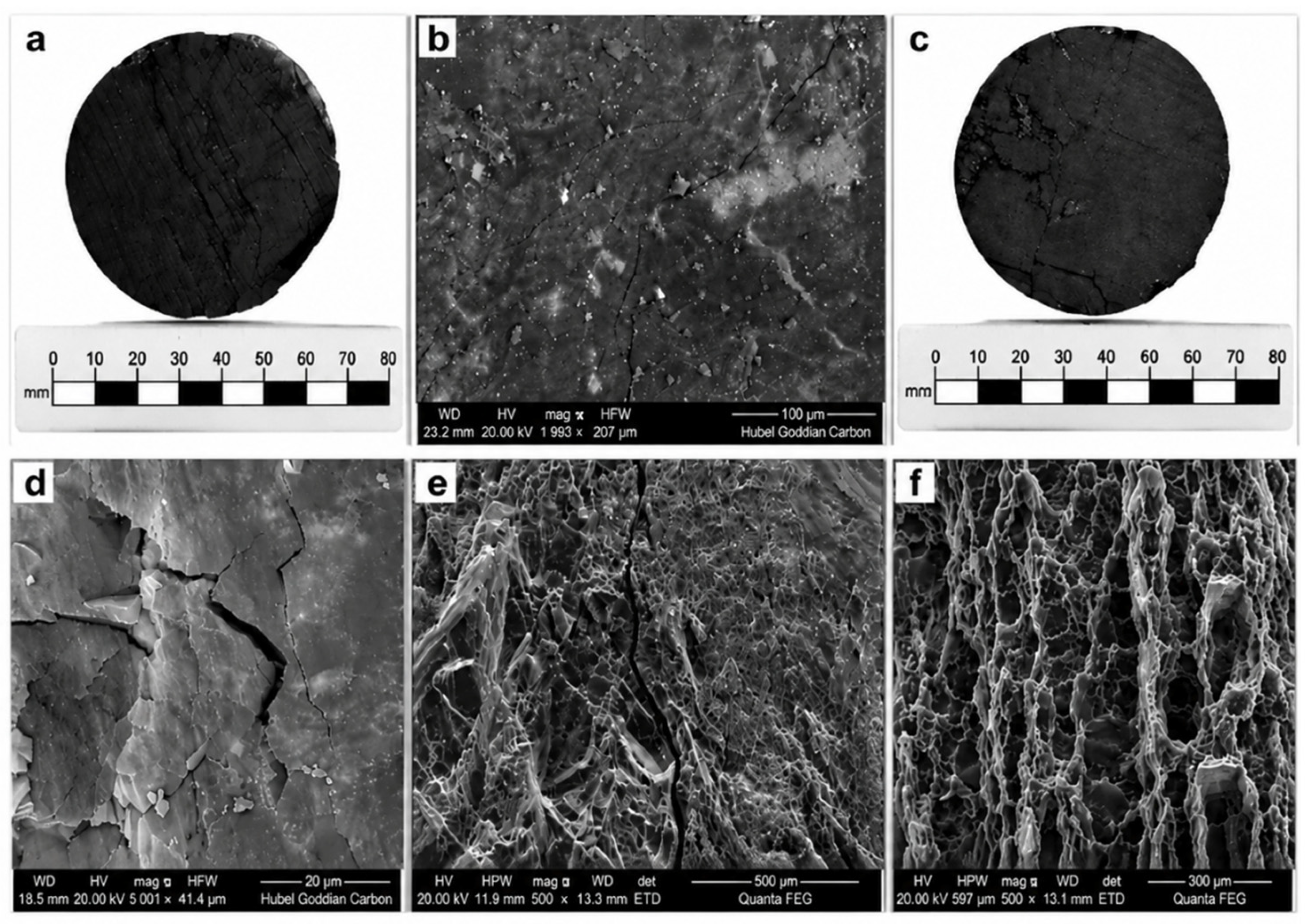
Macroscopic observations of core surfaces and FE-SEM images showed that cleats and fractures were most extensively developed in the Qujiang samples, where they had comparatively consistent orientations and good continuity. At the micrometer scale represented by the FE-SEM images, open fractures had sharp margins and little or no visible mineral infilling (Figure 3a,b). The Shangzhuang samples contained fewer and less continuous fractures, some of which were partly filled with clay minerals, thereby reducing their effective apertures (Figure 3c,d). In the Yuancun samples, bedding-parallel fractures occurred locally along interfaces between vitrinite-rich and argillaceous layers, but open fractures were generally scarce. Narrow, discontinuous compression-related fractures and cleavage-like microstructures predominated (Figure 3e,f). Along the Qujiang-Shangzhuang-Yuancun transect, visible open fractures decreased in abundance and continuity westward, while compressional and ductile-deformation fabrics became more pronounced.
Figure 3.
Representative macroscopic cleats and micrometer-scale fracture textures in the B4 coal seam. (a) Well-developed cleats and fractures on a Qujiang core surface; (b) open microfractures in Qujiang coal; (c) discontinuous fractures on a Shangzhuang core surface; (d) a Shangzhuang microfracture partly filled with clay minerals; (e) an interlayer fracture along a vitrinite-argillaceous interface in Yuancun coal; (f) a compression-related fracture in Yuancun coal.
4.2. Micrometer-Scale Pore Types Observed by FE-SEM
FE-SEM imaging revealed marked variations in pore genesis, morphology, and size among the B4 coal samples. Based on genesis and morphology, the visible pores were classified into four categories: primary pores, coalification-related pores, mineral-related pores, and tectonically induced secondary pores. Primary pores are represented mainly by relict plant-cell lumina, whereas coalification-related pores consist predominantly of gas pores generated during coalification. Mineral-related pores are chiefly moldic pores produced by mineral dissolution or grain detachment. Tectonically induced secondary pores include breccia pores, fracture pores, and interparticle voids.
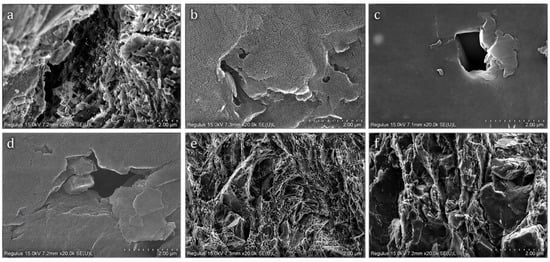
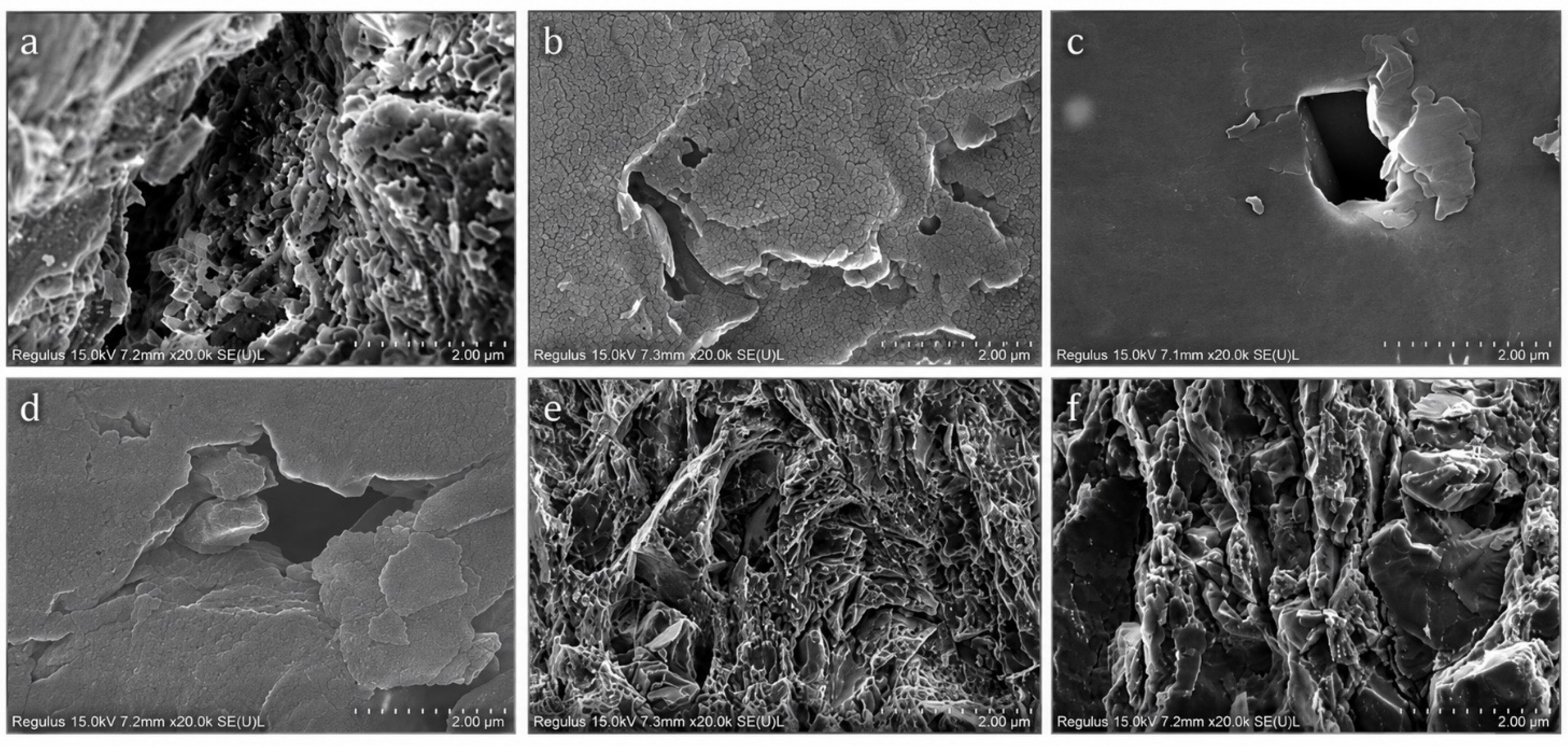
Relict plant-cell lumina commonly occur as irregular tubular or honeycomb-like voids bounded by relatively well-preserved cell walls (Figure 4a). Gas pores are developed mainly within vitrinite and occur as isolated voids or localized clusters with subcircular, elliptical, or irregular embayment-like morphologies (Figure 4b). Moldic pores typically have well-defined outlines and comparatively regular shapes that locally preserve the external morphology of former mineral grains (Figure 4c). Breccia pores, fracture pores, and interparticle voids are concentrated along fragment boundaries, bedding interfaces, and mechanically weak zones (Figure 4d–f). Matrix-hosted primary, coalification-related, and mineral-related pores contribute mainly to methane adsorption and localized storage but are commonly isolated or weakly connected. By contrast, breccia pores, fracture pores, and interparticle voids preferentially occur along fragment boundaries and mechanically weak interfaces. Where interconnected, these secondary pores may improve pore-throat connectivity and contribute to gas transport.
Figure 4.
Representative micrometer-scale pore morphologies classified by genesis and observed by FE-SEM in the B4 coal seam. (a) Relict plant-cell lumen pores; (b) coalification-related gas pores; (c) moldic pores formed by mineral dissolution or detachment; (d) breccia pores along fragmented-particle boundaries or mechanically weak surfaces; (e) breccia and interparticle pores generated by granulation; (f) interparticle voids.
4.3. Method-Derived Pore-Size Distributions and Operational Pore-Volume Integration
For comparative purposes, the method-accessible pore space was grouped into four operational size intervals: <2, 2–10, 10–100, and >100 nm. In this framework, pore size denotes the equivalent pore width or diameter derived using the corresponding analytical model. Pore volumes for the <2 nm interval were derived from DFT analysis of the measured CO2 adsorption isotherms, those for the 2–10 and 10–100 nm intervals were derived from BJH analysis of the measured N2 adsorption data, and those for the >100 nm interval were obtained by MIP and represent mercury-accessible pore-throat space. All pore volumes were normalized to dry sample mass and assigned to nonoverlapping intervals before integration. The integrated values were used to compare the distribution of method-accessible pore space among the coal samples; they do not represent direct FE-SEM measurements of sub-100 nm pores or a geometric reconstruction of the complete pore network.
The operationally integrated pore volume (Vop) was calculated as the sum of the dry-mass-normalized pore volumes within four non-overlapping pore-size intervals:
where V<2 is the CO2 adsorption-derived DFT pore volume for pores < 2 nm; V2–10 and V10–100 are the N2 adsorption-derived pore volumes for the 2–10 nm and 10–100 nm intervals, respectively; and V>100 is the MIP-derived pore volume for the >100 nm pore-throat interval.
The pore-volume fraction (Fi) of each interval was calculated as:
where Vi is the dry-mass-normalized pore volume of a given operational size interval and Vop is the sum of the four component volumes. Accordingly, Fi represents the relative contribution of that interval to the operationally integrated pore volume.
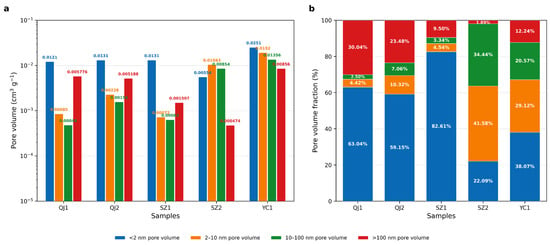
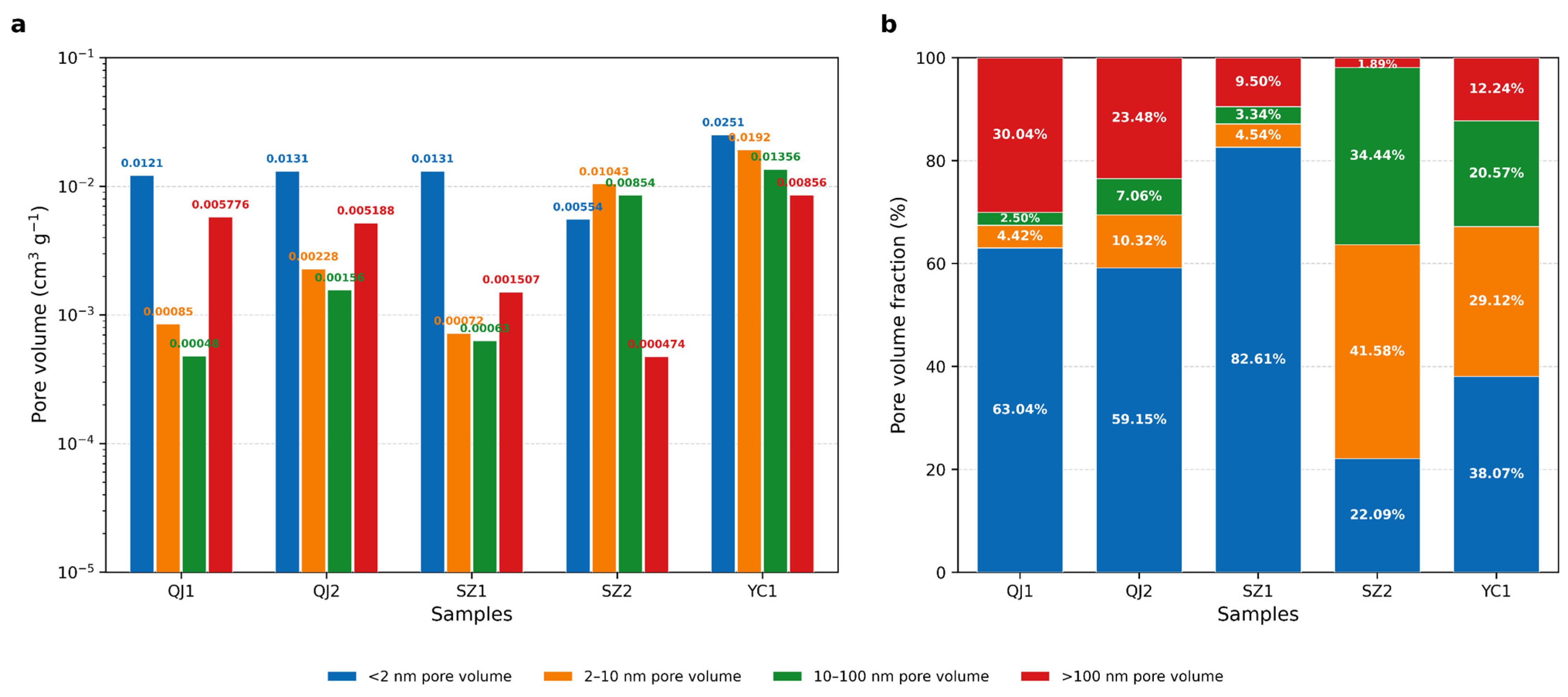
The experimental data showed that pore-volume allocation differed markedly among the investigated samples (Figure 5). In QJ1 and QJ2, pores < 2 nm constituted the dominant fraction, accounting for 63.04% and 59.15% of the integrated pore volume, respectively, whereas pores > 100 nm contributed 30.04% and 23.48%. SZ1 had the highest proportion of <2 nm pores (82.61%); however, their absolute pore volume was only 0.0131 cm3 g−1, and pores > 100 nm accounted for 9.50%. Thus, the predominance of <2 nm pores in SZ1 partly reflected the limited development of larger pore domains rather than an exceptionally large adsorption-related pore volume. In SZ2, pores of 2–10 and 10–100 nm contributed 41.58% and 34.44%, respectively, yielding a combined proportion of 76.02%, whereas pores > 100 nm accounted for only 1.89%. By contrast, YC1 contained comparatively large absolute pore volumes across all measured size intervals, including the largest <2 nm pore volume (0.0251 cm3 g−1), indicating abundant multiscale pore space among the samples subjected to the full operational integration.
Figure 5.
Operationally integrated pore volumes and pore-volume fractions within four size intervals in the B4 coal seam. (a) Dry-mass-normalized pore volume within each interval; (b) pore-volume fraction within the integrated pore volume.
4.4. Adsorption-Derived Characteristics of Pores < 100 nm
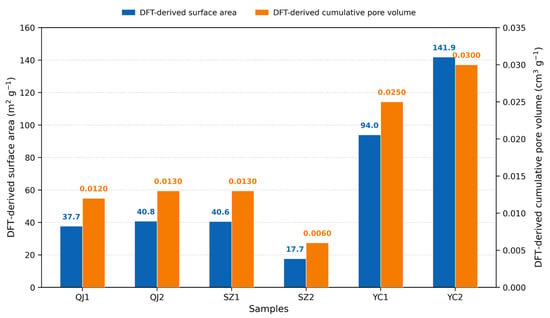
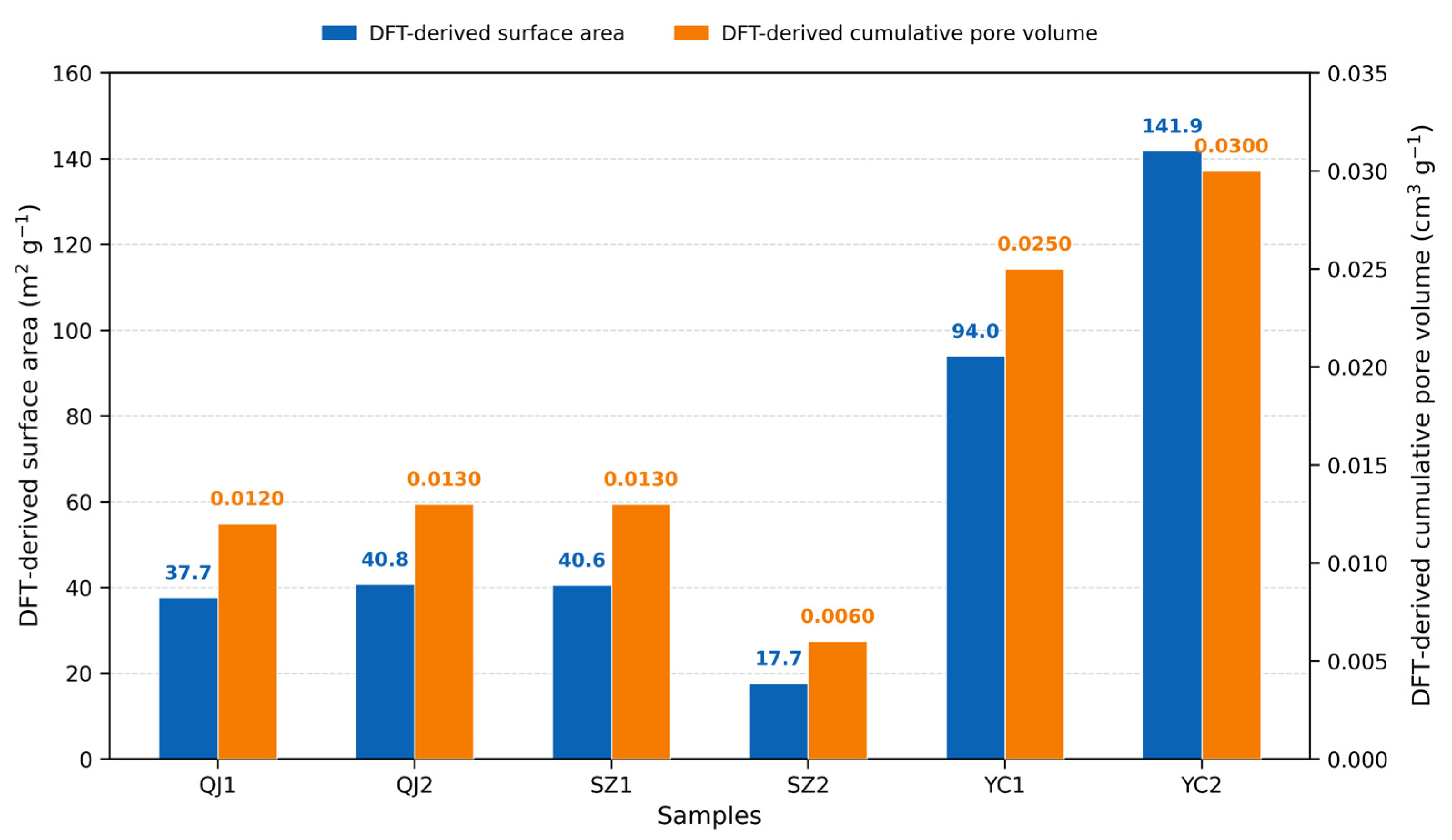
Low-pressure CO2 adsorption showed that YC1 and YC2 from Yuancun had substantially greater DFT-derived pore volumes and specific surface areas within the <2 nm pore domain than the Qujiang and Shangzhuang samples (Figure 6). YC2 had the largest DFT-derived pore volume and specific surface area, at 0.0300 cm3 g−1 and 141.90 m2 g−1, respectively, followed by YC1, at 0.0251 cm3 g−1 and 119.50 m2 g−1. By comparison, the DFT-derived pore volumes of the Qujiang and Shangzhuang samples ranged from 0.00943 to 0.01313 cm3 g−1, with corresponding specific surface areas of 38.05–56.34 m2 g−1. These results indicate that CO2-accessible pore space within the <2 nm domain is more extensively developed in the Yuancun samples.
Figure 6.
DFT-derived specific surface area and cumulative pore volume for adsorption-accessible pores < 2 nm based on CO2 adsorption.
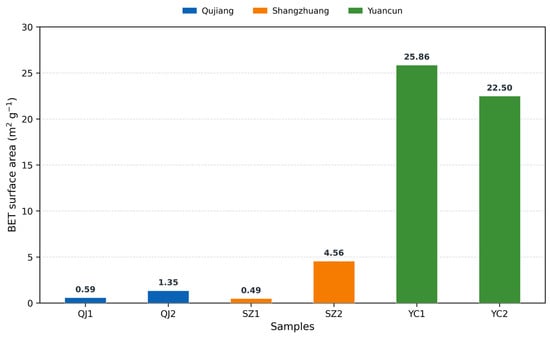
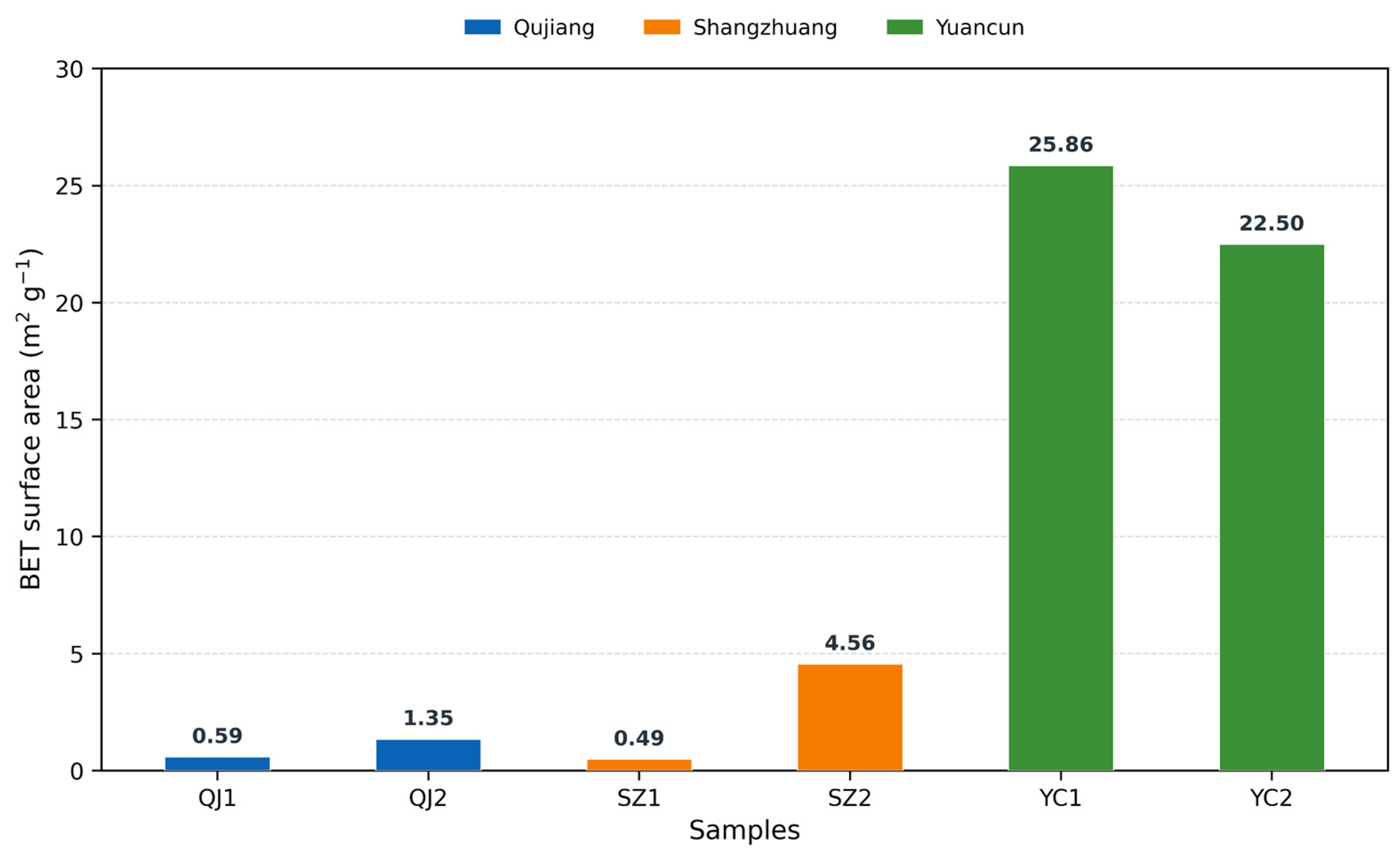
Low-temperature N2 adsorption primarily characterized the adsorption-accessible 2–100 nm pore domain. YC1 and YC2 had BET specific surface areas of 25.86 m2 g−1 and 22.50 m2 g−1, respectively, substantially greater than those of the other samples (Figure 7). QJ1, QJ2, and SZ1 had much lower BET specific surface areas, ranging from 0.49 to 1.35 m2 g−1, whereas SZ2 had an intermediate value of 4.56 m2 g−1. The intersample variation in BET specific surface area therefore differed from that in the DFT-derived specific surface area of the <2 nm pore domain, indicating that the two pore domains were not developed synchronously.
Figure 7.
BET specific surface areas derived from low-temperature N2 adsorption.
The fractal dimensions and their corresponding coefficients of determination (R2) are summarized in Table 2. Except for SZ2, all samples have D2 values greater than D1, showing a consistent increase in the FHH fractal dimension from the low- to high-relative-pressure interval. The Yuancun samples have comparatively high D2 values, indicating relatively complex pore structures in the high-relative-pressure interval. SZ2 has a relatively high D1 value that slightly exceeds its D2 value. Its high D1 is consistent with a comparatively rough and heterogeneous pore surface in the low-relative-pressure interval. Together with the predominance of 2–10 nm and 10–100 nm pores, the slightly lower D2 suggests that the pore structure represented by the high-relative-pressure interval is comparatively less complex.
Table 2.
Fractal dimensions from FHH fractal analysis of the N2 adsorption data.
4.5. Pore-Throat Connectivity and Fluid Mobility
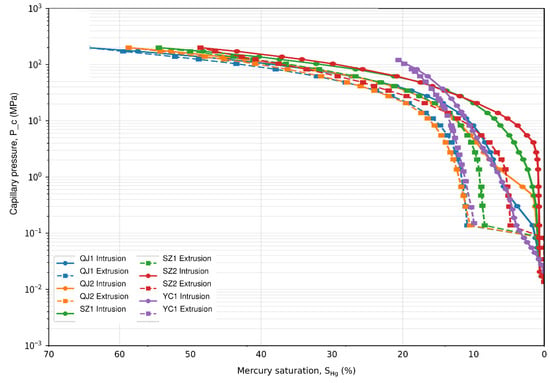
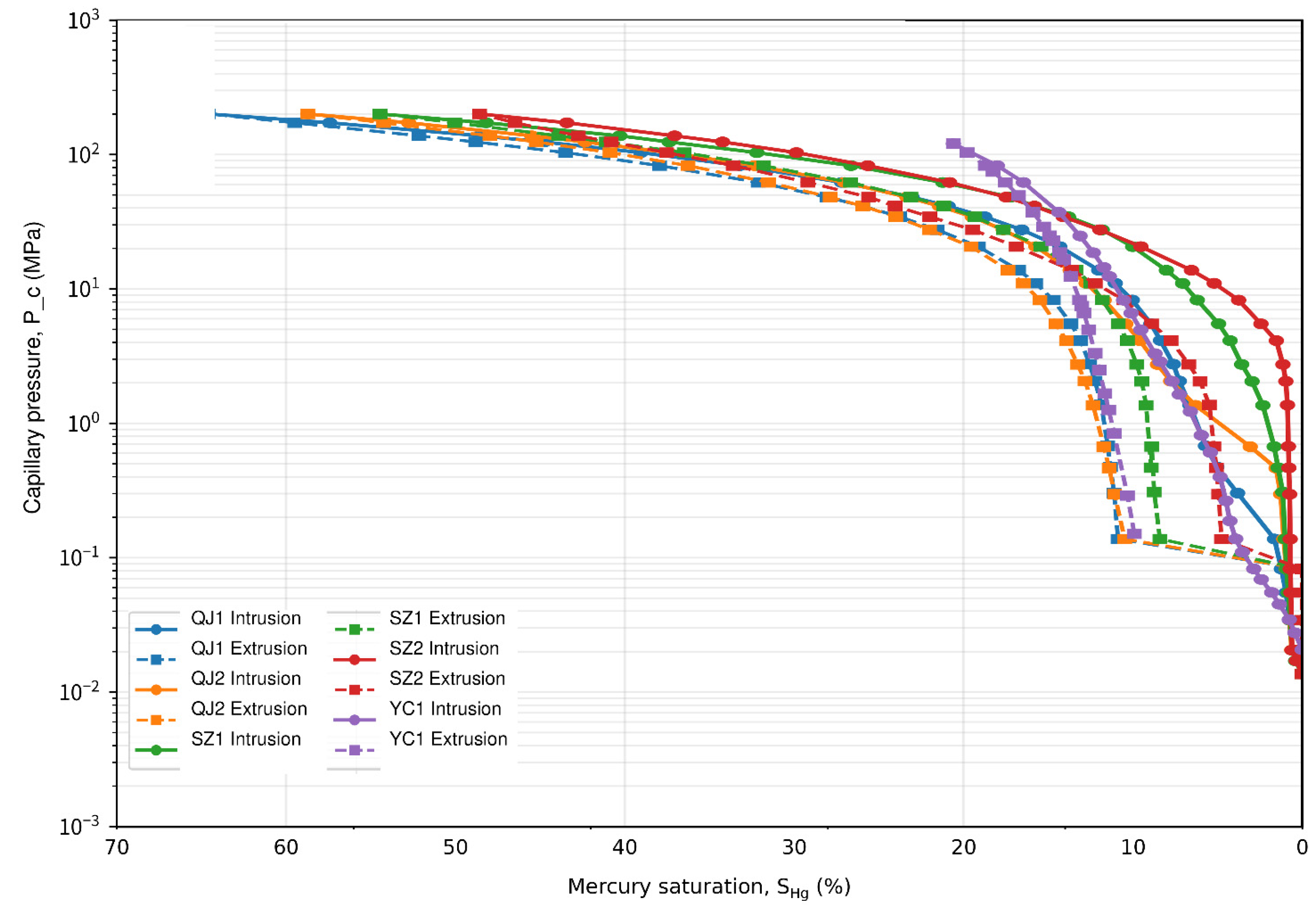
Mercury intrusion porosimetry showed that pore volumes within the >100 nm interval were 0.00578 cm3 g−1, 0.00519 cm3 g−1, 0.00151 cm3 g−1, 0.00047 cm3 g−1, and 0.00807 cm3 g−1 for QJ1, QJ2, SZ1, SZ2, and YC1, respectively. Thus, YC1 had the largest MIP-derived pore volume within this interval, whereas SZ2 had the smallest. However, the maximum mercury saturation was highest in the Qujiang samples and lowest in YC1, at only 20.59% (Figure 8). This contrast indicates that the volume of mercury-accessible pores > 100 nm does not vary consistently with the overall degree of mercury saturation.
Figure 8.
Mercury intrusion-extrusion capillary-pressure curves for B4 coal samples from the study area.
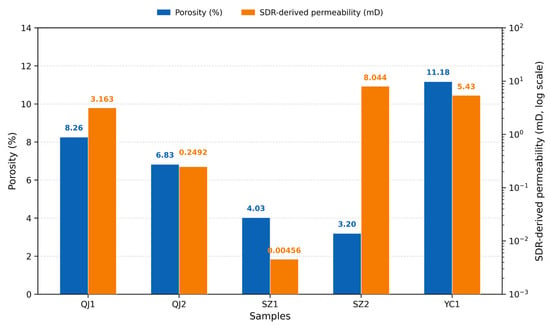
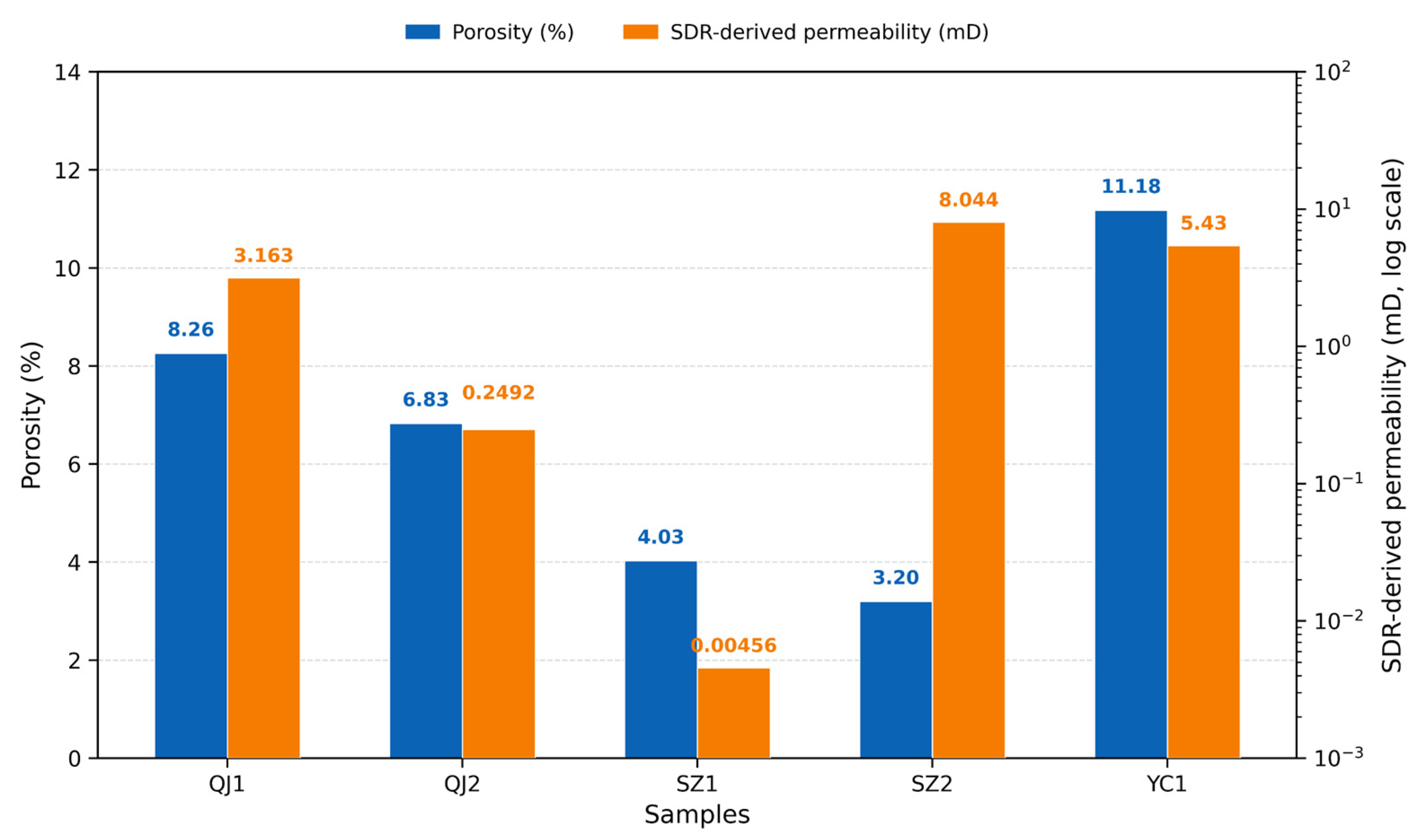
YC1 had the highest MIP porosity, followed by QJ1, QJ2, SZ1, and SZ2. By contrast, the MIP-derived permeability estimates decreased in the order SZ2 > YC1 > QJ1 > QJ2 > SZ1 (Figure 9). The absence of a monotonic relationship among MIP porosity, >100 nm pore volume, and MIP-derived permeability indicates that the abundance of mercury-accessible large pores alone does not determine effective transport potential. Pore-throat connectivity, effective aperture, tortuosity, and preferential flow pathways are also important.
Figure 9.
MIP-derived porosity and model-derived permeability.
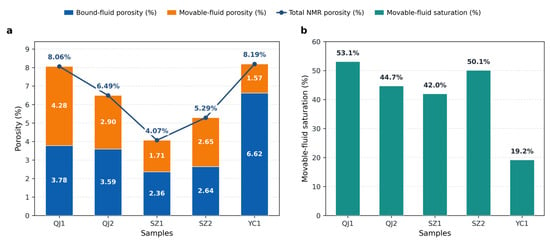
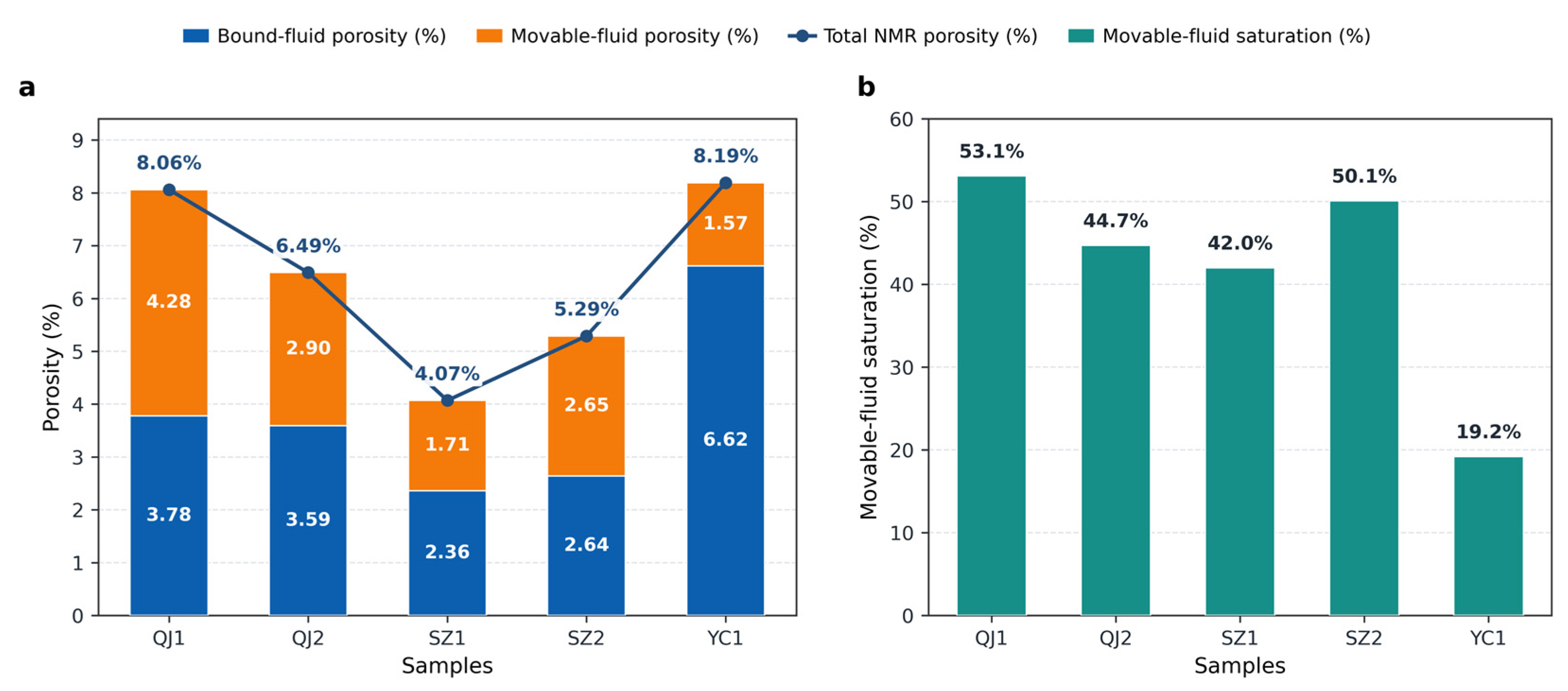
NMR measurements further characterized fluid-accessible and movable pore space (Figure 10). QJ1 and QJ2 from Qujiang had total NMR porosities of 8.06% and 6.49%, respectively, with corresponding movable-fluid saturations of 53.10% and 44.68%. Among the Shangzhuang samples, SZ1 had the lowest total NMR porosity, at 4.07%, whereas SZ2 had a total NMR porosity of 5.29% and a movable-fluid saturation of 50.10%. YC1 from Yuancun had the highest total NMR porosity of 8.19%, comprising 6.62% for bound-fluid porosity and 1.57% for movable-fluid porosity. Nevertheless, its movable-fluid saturation was only 19.21%, indicating that most of its NMR-accessible pore space was occupied by bound fluid under the experimental conditions.
Figure 10.
NMR-derived porosity partitioning and movable-fluid saturation. (a) Bound-fluid porosity, movable-fluid porosity, and total NMR porosity; (b) movable-fluid saturation.
The combined MIP and NMR results showed that pore-volume development, fluid accessibility, and fluid mobility did not vary consistently among the samples. In Qujiang, QJ1 contained a relatively high proportion of >100 nm pores and had a high NMR-derived movable-fluid saturation, indicating comparatively favorable large-pore development and fluid mobility. Although QJ2 contained a lower proportion of >100 nm pores than QJ1, its pore-size distribution was more balanced. In Shangzhuang, SZ1 contained measurable >100 nm pore volume but had limited NMR-derived movable-fluid pore space, indicating restricted fluid mobility despite the presence of larger pores. SZ2 had the smallest >100 nm pore volume but a relatively high MIP model-derived permeability, suggesting that its estimated permeability was strongly influenced by a limited proportion of relatively conductive pore throats. In Yuancun, YC1 combined a high MIP porosity with abundant multiscale pore space but had the lowest NMR-derived movable-fluid saturation, indicating that most of its NMR-accessible pore space retained bound fluid under the experimental conditions.
4.6. Methane Adsorption and High-Pressure Density Correction
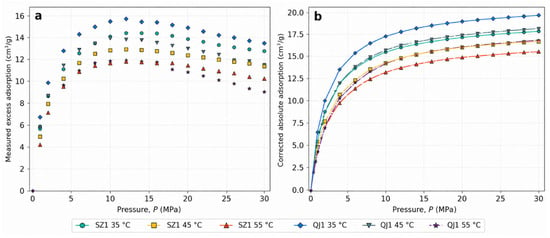
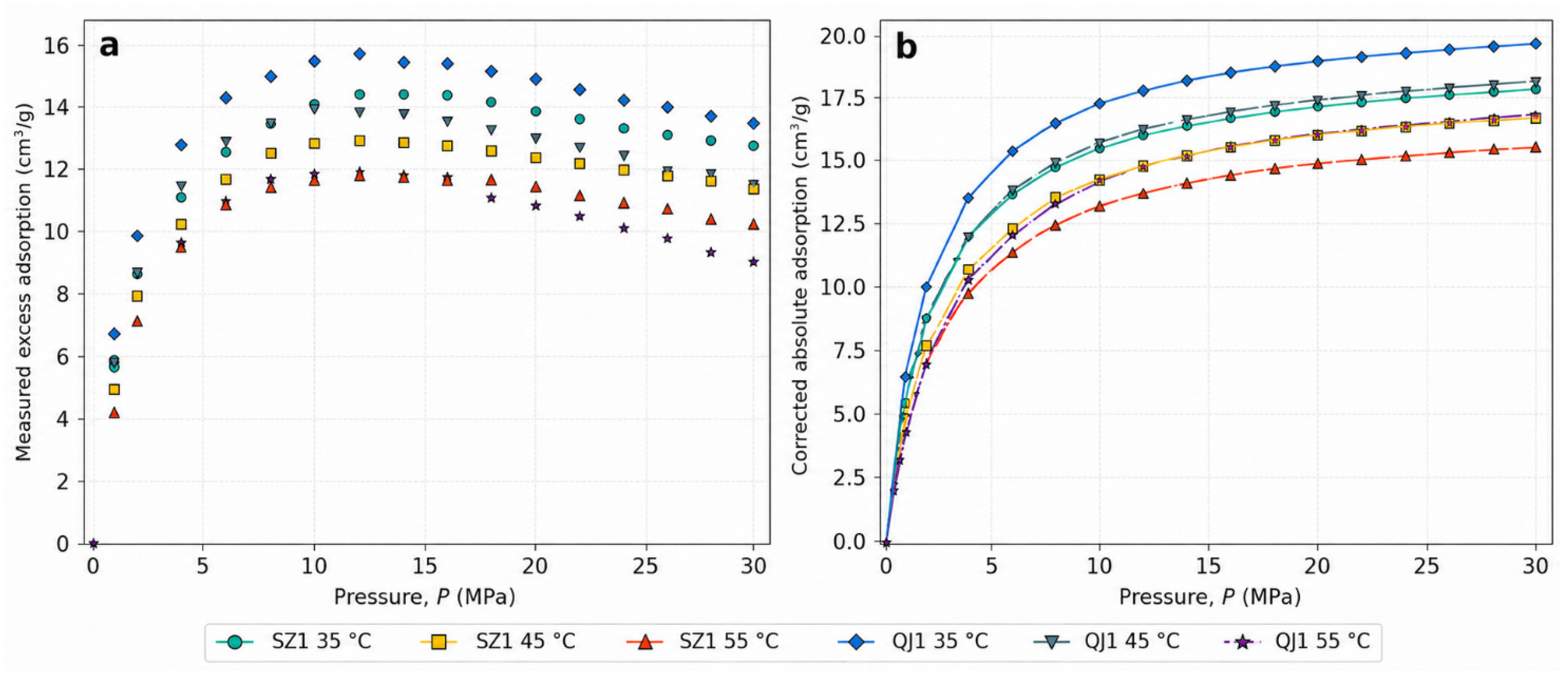
Under the experimental conditions, methane adsorption increased steeply at low pressure and progressively approached saturation at intermediate to high pressures, exhibiting Langmuir-type behavior. At 35 °C, Langmuir volume (VL) ranged from 16.29 cm3 g−1 to 19.96 cm3 g−1, whereas Langmuir pressure (PL) ranged from 1.59 MPa to 2.40 MPa, indicating broadly comparable methane adsorption capacities among the investigated samples.
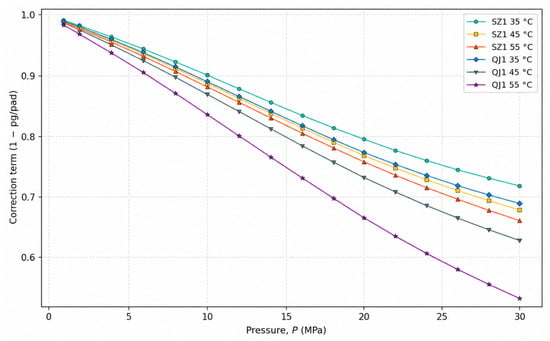
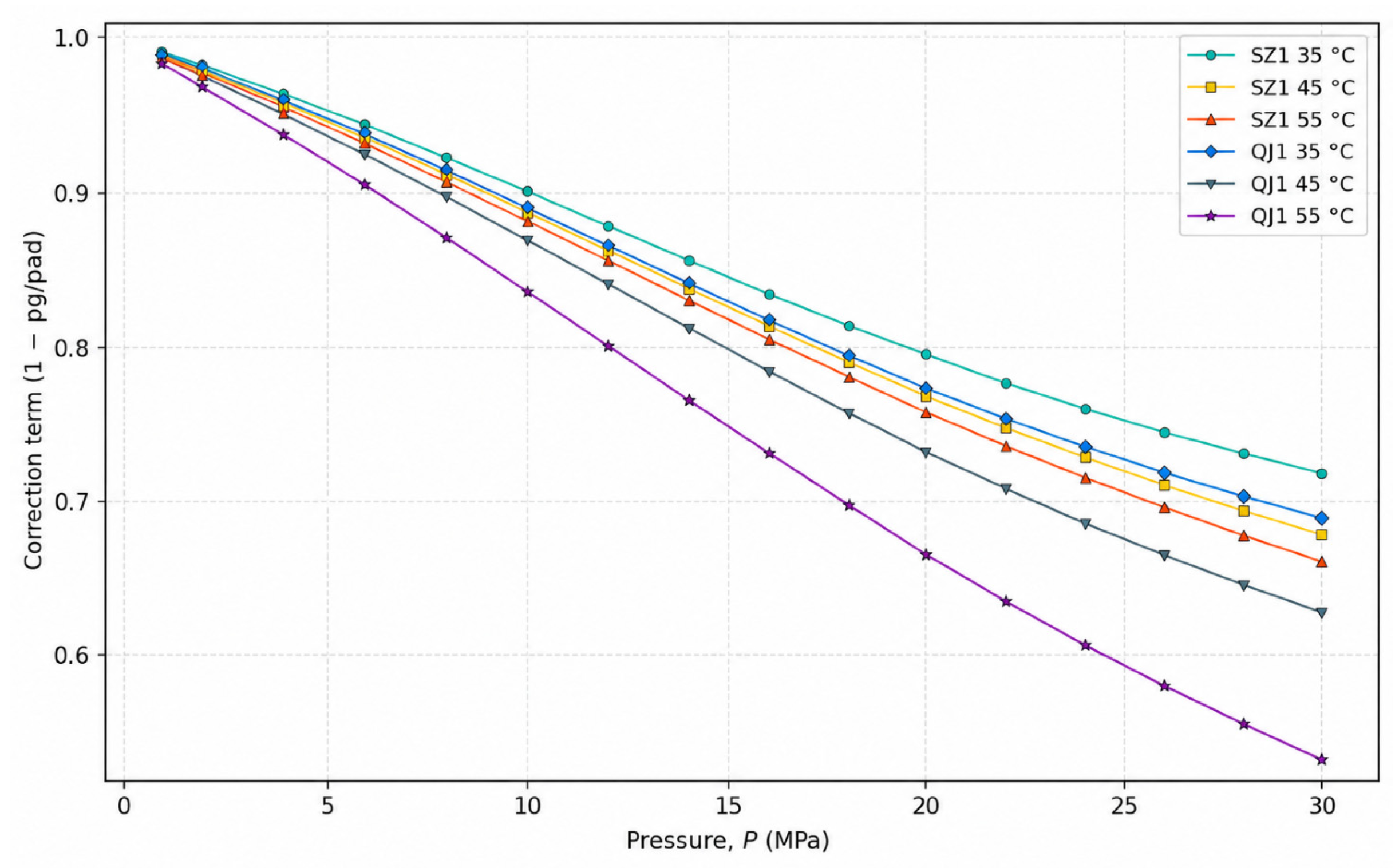
High-pressure adsorption measurements for QJ1 and SZ1 showed that excess methane adsorption initially increased, reached a maximum, and then declined as pressure continued to rise (Figure 11a). This rollover reflects the rapid increase in bulk-phase methane density under high-pressure conditions; at a given pressure, bulk-phase density decreases with increasing temperature. Accordingly, the excess adsorption isotherms were fitted using a density-corrected Langmuir model (Equation 8). The resulting density correction factor decreased continuously with increasing pressure (Figure 12).
where Va is the excess adsorption amount (cm3 g−1), VL is the Langmuir volume (cm3 g−1), P is pressure (MPa), PL is the Langmuir pressure (MPa), ρg is the bulk-phase methane density (g cm−3), ρad is the adsorbed-phase methane density (g cm−3), and (1 − ρg/ρad) is the density correction factor.
Figure 11.
Excess methane adsorption and density-corrected absolute adsorption at different temperatures. (a) Measured excess adsorption as a function of pressure; (b) density-corrected absolute adsorption as a function of pressure.
Figure 12.
Methane adsorption density correction factor as a function of pressure at different temperatures.
Density-corrected absolute adsorption increased progressively and approached saturation with increasing pressure (Figure 11b). Therefore, the decline in excess adsorption beyond its maximum at high pressure does not indicate an actual reduction in methane retained in the adsorbed phase. Reliable prediction of methane adsorption in deep coal reservoirs must account for both the pressure-dependent density of bulk-phase methane and the finite volume occupied by the adsorbed phase.
4.7. Permeability Stress Sensitivity
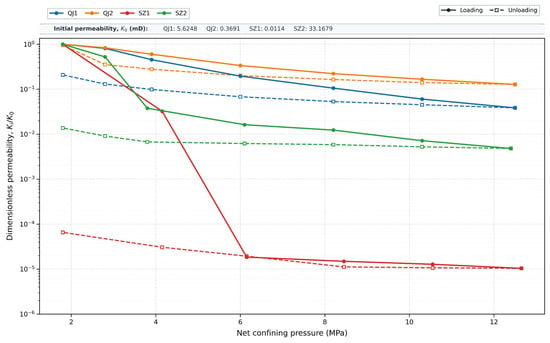
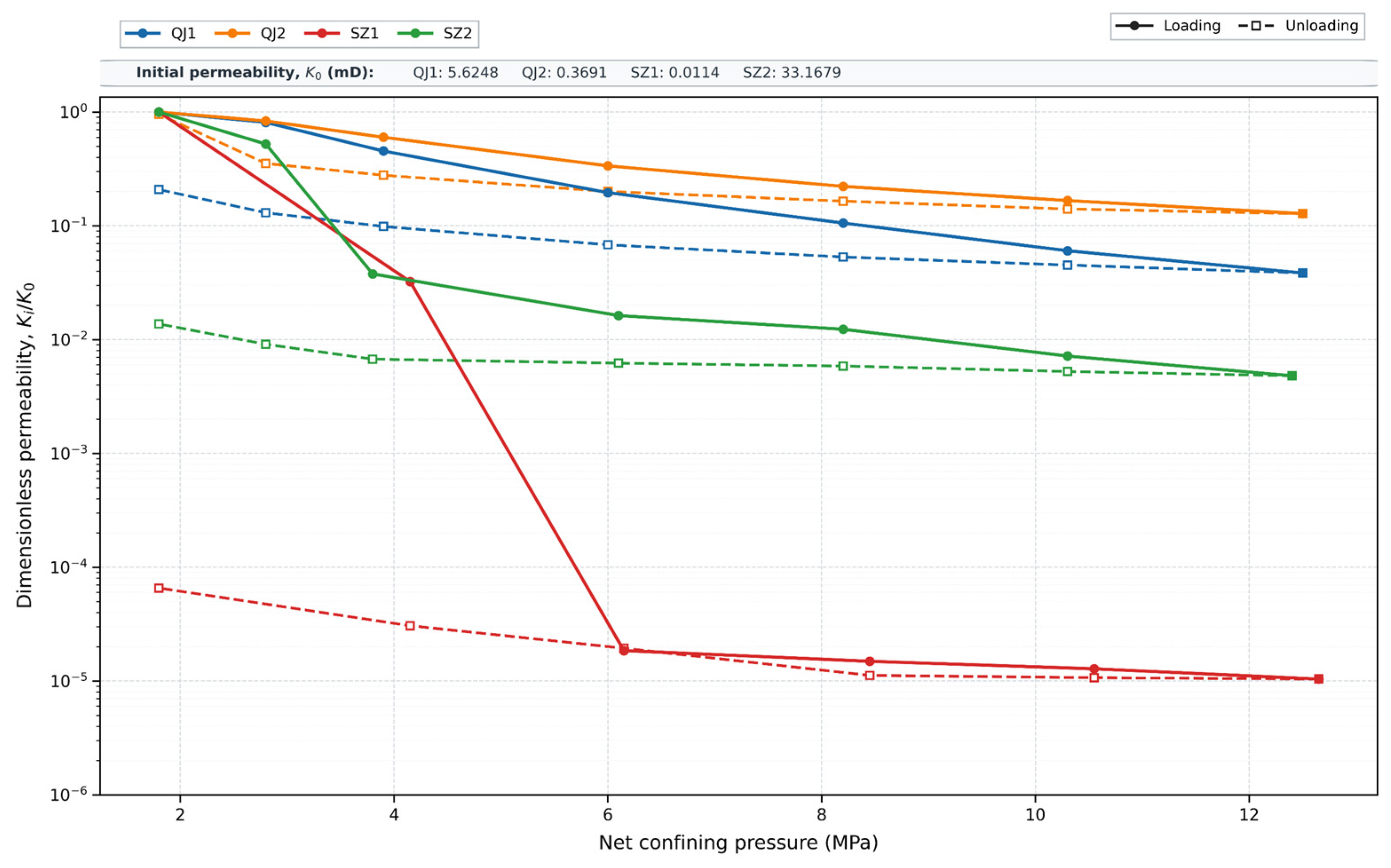
N2 permeability stress-sensitivity tests on the Qujiang and Shangzhuang samples showed that measured gas permeability decreased markedly with increasing net confining pressure and recovered only partially during unloading (Figure 13). The initial N2 permeabilities of QJ1, QJ2, SZ1, and SZ2 were 5.6248, 0.3691, 0.0114, and 33.1679 mD, respectively. SZ2 exhibited the highest initial permeability, whereas SZ1 had the lowest. QJ2 exhibited an irreversible permeability damage rate of 50.41%, the lowest among the tested samples, indicating the greatest relative permeability recovery. The irreversible permeability damage rate of QJ1 was 79.18%, whereas substantially higher values of 98.63% and 99.99% were recorded for SZ1 and SZ2, respectively. Compared with the Qujiang samples, the Shangzhuang samples exhibited a sharper decrease in dimensionless permeability during the early loading stage and maintained low values during subsequent loading and unloading. This response indicates that the gas-flow pathways in the Shangzhuang samples are strongly sensitive to stress-induced closure and show little recovery after unloading.
Figure 13.
Dimensionless N2 permeability of the tested coal samples during loading and unloading under varying net confining pressure. The initial permeability, represents the measured permeability at the lowest net confining pressure during loading.
5. Discussion
5.1. Combined Controls of Tectonic Modification, Coal Rank, and Coal Quality on Pore Systems
The Qujiang, Shangzhuang, and Yuancun samples define a deformation-intensity sequence from primary-structure and cataclastic coal to granulated and mylonitic coal. Along the investigated transect, coal-body structure changes progressively from layered and coherent to fractured, granulated, and locally pulverized. Previous studies have shown that moderate brittle deformation can generate particle boundaries and fracture surfaces that enhance fluid-flow connectivity, whereas intense compression and shearing may narrow fractures and pore throats, increase tortuosity, and promote fine-particle or mineral infilling, thereby reducing pathway continuity [4,5,22,30,60]. The cleat, microfracture, and FE-SEM observations in this study are broadly consistent with this mechanical progression. Relict plant-cell lumina and coalification-related gas pores mainly provide matrix-hosted adsorption and storage space and are commonly isolated or weakly connected. In contrast, breccia pores, fracture pores, and interparticle voids occur preferentially along mechanically weak interfaces and can contribute to fluid transport when interconnected. The Qujiang samples retain comparatively abundant and continuous open fractures, whereas fractures in the Shangzhuang samples are less continuous and locally mineral-filled. The Yuancun samples are characterized by intense fragmentation and compressional-shear fabrics but contain relatively few open and interconnected fractures. These observations suggest that progressive coal-body fragmentation is not necessarily accompanied by improved fracture connectivity.
Variations in coal rank and coal quality are superimposed on this tectonic gradient. Published regional data indicate that the Yuancun coal is of higher rank and generally has lower volatile-matter and higher ash contents than the Fengcheng coal. The Yuancun samples contain abundant <2 nm pores with high specific surface areas, a feature broadly consistent with matrix-pore development during progressive coalification. The regional tendency toward higher ash contents also suggests that mineral occupation and pore-throat infilling may locally reduce effective pore space. Together with compaction and fine-particle blockage associated with intense deformation, these factors may contribute to the low NMR-derived movable-fluid saturation of YC1. By comparison, the Qujiang samples do not have the largest adsorption-related pore volumes but retain more abundant open fractures and exhibit higher NMR-derived fluid mobility. The observed reservoir differences are therefore interpreted as the combined result of tectonic modification, regional coal-rank variation, coal composition, and mineral matter [17,27,28,40,41,61,62]. Accordingly, pore-system variations along the transect are interpreted in terms of the combined influence of coal rank and tectonic deformation, while comparisons among the Qujiang and Shangzhuang samples provide additional constraints on structural effects under broadly comparable regional coal-rank conditions.
5.2. Differential Reorganization of Multiscale Pore Systems and Contrasting Methane Storage-Transport Characteristics
According to previous studies, pores < 2 nm have high specific surface areas and strong adsorption potential fields and therefore constitute the principal methane-adsorption domain. Pores of 2–100 nm mainly represent intermediate matrix pore space that contributes to methane storage and diffusion and facilitates methane transfer from adsorption-dominated pores toward larger transport pathways. Connected pores and pore throats >100 nm, together with cleat-fracture networks, form the principal pathways for gas flow [3,18,21,23,24,25,26,28,31]. Along the investigated Qujiang-Shangzhuang-Yuancun transect, these functional pore domains differ markedly in their relative development and fluid accessibility, while the associated gas-flow pathways exhibit contrasting stress stability. These differences produce distinct combinations of methane storage and transport among the investigated samples.
An integrated comparison of pore-size distribution, NMR-derived movable-fluid saturation, and N2 permeability reveals contrasting configurations of storage space and transport pathways among the investigated samples. The Qujiang samples contain relatively abundant <2 nm adsorption-related pores and >100 nm pore space, together with relatively high NMR-derived movable-fluid saturations. These characteristics indicate a comparatively favorable balance between methane storage space and fluid mobility. Among the tested samples, QJ2 exhibits the lowest irreversible permeability damage rate, indicating the greatest relative stability and recoverability of its gas-flow pathways during loading and unloading. The pore systems of the Shangzhuang samples are more heterogeneous. SZ1 has the highest proportion of <2 nm pores but relatively low NMR-derived movable-fluid porosity and the lowest initial N2 permeability of 0.0012 mD, indicating that its pore system is dominated by adsorption-storage space, with limited effective gas-flow capacity. SZ2 is dominated by 2–100 nm pores and has the smallest >100 nm pore volume, yet it exhibits the highest initial N2 permeability of 8.0439 mD. This mismatch between pore-size composition and permeability suggests that gas flow may depend primarily on a limited number of preferential fractures or critical pore throats. However, the irreversible permeability damage rate of SZ2 reaches 98.63%, indicating that these preferential pathways are highly sensitive to stress-induced closure. YC1 has relatively large pore volumes across all investigated pore-size intervals, indicating abundant storage space. However, its NMR-derived movable-fluid saturation is only 19.21%, suggesting that most of its NMR-accessible pore space retains bound fluid and contributes little to fluid mobility under the experimental conditions.
Although the coal samples have broadly comparable Langmuir volumes, their NMR-derived movable-fluid saturations and N2 permeability responses differ markedly. This indicates that the development of adsorption- and storage-related pore space alone does not determine the connectivity or stress stability of effective gas-transport pathways. Therefore, evaluations of coal-seam storage and transport performance in the study area should integrate pore volume and pore-size distribution, pore-throat-fracture connectivity, fluid mobility, and permeability stability under stress.
5.3. Permeability Stress Sensitivity and Flow-Pathway Stability
Integrated pore-fracture characterization and NMR studies have shown that reservoir flow capacity is jointly controlled by connected macropores and fractures, pore-throat architecture, and fluid-accessible pore space [20,21,31]. As net confining pressure increases, the coal matrix is progressively compacted, fractures close, and pore throats contract, thereby reducing the number and connectivity of effective transport pathways. Under reservoir conditions, coal-matrix strain induced by methane adsorption may further alter the effective apertures of pore throats and fractures [25,26,32,46,47,48,49,50,51,52,53,63,64]. The N2 permeability stress-sensitivity experiments conducted in this study document marked permeability loss and incomplete recovery during loading and unloading, consistent with stress-induced closure and irreversible modification of effective gas-transport pathways in the Qujiang and Shangzhuang samples.
Although the Shangzhuang sample SZ2 has the smallest pore volume in the >100 nm interval among the tested samples, it exhibits the highest initial N2 permeability at the lowest net confining pressure, reaching 33.1679 mD. This mismatch between pore-size composition and initial permeability suggests that gas flow in SZ2 may be concentrated within a limited number of preferential fractures or critical pore throats. As net confining pressure increases, these localized preferential pathways close rapidly during the initial loading stage, resulting in a sharp decrease in permeability. Permeability recovery during unloading is limited, and the irreversible permeability damage rate reaches 98.99%. SZ1 has the lowest initial N2 permeability, at 0.0114 mD, and an irreversible permeability damage rate of 98.63%, indicating poor initial connectivity and extremely low stress stability of its effective gas-transport pathways. The contrasting initial permeabilities of SZ1 and SZ2, together with their similarly high irreversible damage rates, demonstrate that initial permeability magnitude does not directly indicate the stability of gas-flow pathways under stress. In contrast, QJ2 has an initial N2 permeability of 0.3691 mD but exhibits the greatest relative permeability recovery during unloading. Its irreversible permeability damage rate is the lowest among the tested samples, at 50.41%. Combined with the relatively balanced pore-size distribution of QJ2, this response is consistent with a less localized and more recoverable gas-transport network within the experimental stress range.
Under reservoir conditions, permeability is additionally influenced by matrix swelling during methane adsorption, matrix shrinkage during desorption, water saturation, gas-slippage effects, and the in situ stress history. The N2 permeability experiments in this study therefore provide a controlled comparison of permeability response and gas-flow-pathway stability under changing net confining pressure, while extrapolation to in situ methane transport requires consideration of these additional reservoir processes.
5.4. Implications for Favorable CBM Reservoir Evaluation
CBM reservoir evaluation commonly considers parameters such as coal-seam thickness, burial depth, gas content, coal rank, total porosity, and initial permeability. Although these parameters provide essential information on reservoir occurrence, storage potential, and initial flow capacity, they do not fully characterize the accessibility, connectivity, and stress stability of effective gas-transport pathways. The results of this study show that high porosity, high methane adsorption capacity, or high initial permeability alone does not ensure coordinated methane storage and sustained transport. Therefore, evaluation of favorable intervals in the B4 coal seam along the investigated transect should integrate adsorption-related and intermediate matrix pore space with pore-throat-fracture connectivity, fluid mobility, and permeability stability under stress. Such an integrated approach can identify intervals that combine sufficient methane-storage space with connected and mechanically stable transport pathways.
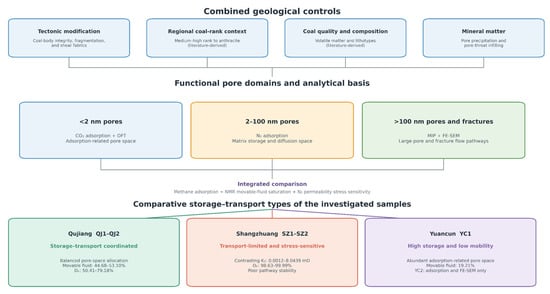
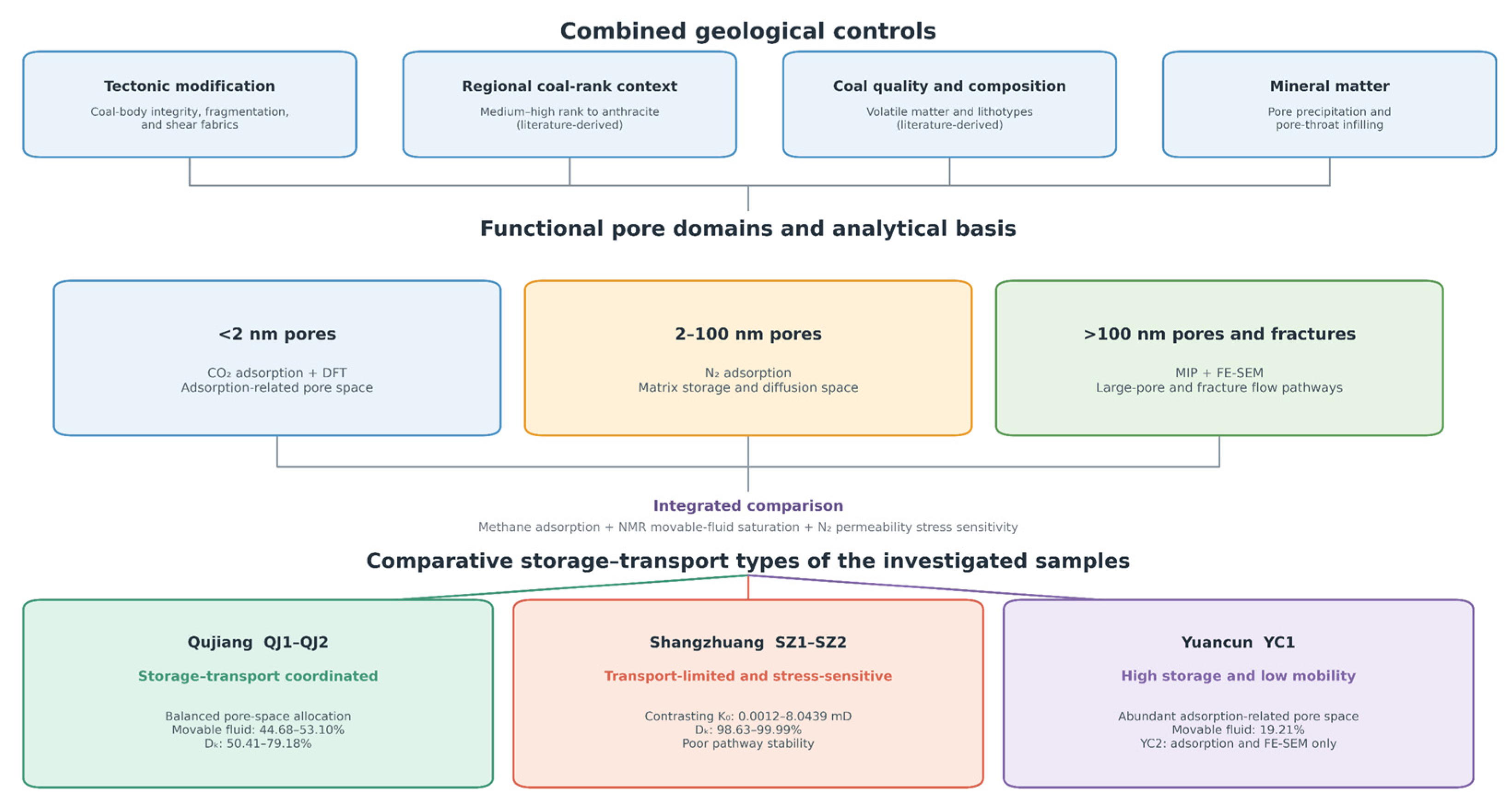
The conceptual model for the investigated transect integrates tectonic modification, coal-body structure, regional coal-rank and coal-quality variations, mineral matter, functional pore-space allocation, and methane storage-transport characteristics (Figure 14). The operationally integrated pore-volume distributions derived from CO2 adsorption, N2 adsorption, and MIP measurements provide a basis for comparing pore-space allocation among different size intervals. Within this framework, pores < 2 nm are treated primarily as adsorption-related pore space, pores of 2–100 nm as intermediate matrix storage and diffusion space, and connected pores and pore throats >100 nm, together with cleat-fracture networks, as the principal gas-flow pathways. These pore-space characteristics are evaluated together with NMR-derived movable-fluid parameters and N2 permeability stress-sensitivity results to assess fluid mobility and the stability of effective transport pathways. These operational pore-size domains provide a comparative representation of method-accessible pore-space allocation among the investigated samples rather than a direct geometric reconstruction of the complete pore network.
Figure 14.
Conceptual model linking combined geological controls to multiscale pore-system reorganization and contrasting methane storage-transport characteristics along the Qujiang-Shangzhuang-Yuancun transect.
Based on these indicators, the storage-transport characteristics of the investigated samples can be grouped into three preliminary types. The Qujiang samples represent a relatively storage-transport-coordinated type, characterized by a comparatively balanced distribution of pore space among different size intervals, movable-fluid saturations of 44.68–53.10%, and greater permeability recovery than the Shangzhuang samples. These characteristics indicate a relatively favorable combination of adsorption-storage space, fluid mobility, and gas-flow-pathway stability. The Shangzhuang samples represent a transport-limited and stress-sensitive type, although their initial gas-flow capacities differ. SZ1 has the lowest initial permeability, whereas SZ2 has the highest among the tested samples. Nevertheless, both samples exhibit severe irreversible permeability damage, reaching 98.63% for SZ1 and 99.99% for SZ2, indicating that their effective gas-transport pathways are highly sensitive to stress-induced closure and show very limited recovery during unloading. Their transport limitation therefore reflects either poor initial flow capacity or severe instability of initially conductive pathways under stress. YC1 from Yuancun can be provisionally classified as a high-storage and low-mobility type. It contains relatively large pore volumes across all operational size intervals but has a movable-fluid saturation of only 19.21%, indicating that much of its NMR-accessible pore space retains bound fluid. This three-type classification provides a comparative framework for the sampled coal-body structures and their measured storage-transport characteristics. Broader application of the framework requires testing with additional independent samples, sample-specific coal-rank and compositional data, and field-scale gas-production or permeability observations.
6. Conclusions
- (1)
- Along the Qujiang-Shangzhuang-Yuancun transect, the coal-body structure of the B4 coal seam changes progressively from primary-structure and cataclastic coals to granulated and mylonitic coals, recording a relative deformation sequence from brittle fracturing to intense fragmentation, compaction, and ductile shearing. With increasing deformation intensity, coal-body integrity and the preservation of primary bedding decrease, accompanied by an overall reduction in the abundance and continuity of open fractures. These structural variations coincide with regional increases in coal rank, decreases in volatile-matter content, and changes in coal quality and composition. The observed differences in the multiscale pore system are therefore interpreted as the combined effects of tectonic modification and regional coal-rank and coal-quality variations.
- (2)
- The coal samples have broadly comparable Langmuir volumes of 16.29–19.96 cm3 g−1. The high-pressure adsorption results for QJ1 and SZ1 indicate that the decrease in excess adsorption after reaching its maximum is mainly associated with the rapid increase in bulk-phase methane density. The development of <2 nm adsorption-related pores, 2–100 nm intermediate matrix pores, and >100 nm pore space and fracture-related flow pathways varies non-synchronously among the samples. Moreover, pore volume and total porosity alone do not adequately characterize fluid accessibility or the connectivity and stress stability of effective transport pathways. Consequently, methane adsorption-storage space and effective transport pathways show differential reorganization along the investigated transect.
- (3)
- The storage-transport characteristics of the investigated samples define three preliminary types. The Qujiang samples represent a relatively storage-transport-coordinated type, characterized by a comparatively balanced pore-space distribution, relatively high movable-fluid saturations of 44.68–53.10%, and greater permeability recoverability than the Shangzhuang samples. The Shangzhuang samples represent a transport-limited and stress-sensitive type, with markedly contrasting initial permeabilities but similarly high irreversible permeability damage rates of 98.63–99.99%. YC1 from Yuancun provisionally represents a high-storage and low-mobility type. Although it contains relatively large pore volumes across all operational size intervals, its movable-fluid saturation is only 19.21%, indicating that abundant pore space does not necessarily correspond to high fluid mobility.
- (4)
- The integrated methane storage-transport performance of a CBM reservoir requires evaluation beyond total porosity, the degree of coal-body fragmentation, methane adsorption capacity, or initial permeability alone. Identification of favorable intervals in the study area should integrate adsorption-related and intermediate matrix pore space, pore-throat-fracture connectivity, NMR-derived fluid mobility, initial gas permeability, and permeability stability under stress. Priority should therefore be given to intervals that combine sufficient methane-storage space with accessible, connected, and stress-stable gas-transport pathways.
Author Contributions
Conceptualization, S.Z.; methodology, S.Z.; validation, S.Z.; investigation, S.Z.; formal analysis, R.K.; data curation, X.Q. and F.X.; writing—original draft preparation, S.Z. and Y.Z.; writing—review and editing, S.Z. and S.L.; project administration, S.Z.; funding acquisition, S.Z. All authors have read and agreed to the published version of the manuscript.
Funding
This research was funded by the Project of the Jiangxi Province Key Laboratory of Exploration and Development of Critical Mineral Resources (grant number GJKC2024ZZ04); the Jiangxi Provincial Key Research and Development Program (grant number 20252BCF320031); Geological Survey Project of the Jiangxi Bureau of Geology (grant number 2026DKL20); the Science and Technology Research Project of the Jiangxi Bureau of Geology (grant number 2025JXDZKJKY02).
Data Availability Statement
The data presented in this study are available upon request from the corresponding author.
Conflicts of Interest
The authors declare no conflicts of interest.
References
- Moore, T.A. Coalbed methane: A review. Int. J. Coal Geol. 2012, 101, 36–81. [Google Scholar] [CrossRef] [Scilit]
- Zhao, J.; Tang, D.; Xu, H.; Lv, Y.; Tao, S. High production indexes and the key factors in coalbed methane production: A case in the Hancheng block, southeastern Ordos Basin, China. J. Nat. Gas Sci. Eng. 2015, 26, 55–67. [Google Scholar] [CrossRef] [Scilit]
- Mou, P.; Pan, J.; Niu, Q.; Wang, Z.; Li, Y.; Song, D. Coal Pores: Methods, Types, and Characteristics. Energy Fuels 2021, 35, 7467–7484. [Google Scholar] [CrossRef] [Scilit]
- Huang, H.; Zhou, W.; Tong, C.; Wen, Z.; Zhang, Q. Pore and Chemical Structure Variation of Tectonically Deformed Coal and Their Influences on Methane Adsorption. Gas Sci. Eng. 2025, 140, 205658. [Google Scholar] [CrossRef] [Scilit]
- Yang, H.; Bi, W.Y.; Zhang, Y.G.; Yu, J.K.; Yan, J.W.; Lei, D.J.; Ma, Z.N. Effect of Tectonic Coal Structure on Methane Adsorption. J. Environ. Chem. Eng. 2021, 9, 106294. [Google Scholar] [CrossRef] [Scilit]
- Ju, Y.; Jiang, B.; Hou, Q.; Wang, G.; Fang, A. Structural evolution of nano-scale pores of tectonic coals in southern North China and its mechanism. Acta Geol. Sin. 2005, 79, 269–285. [Google Scholar]
- Sun, J.; Han, S.; Liu, S.; Lin, J.; Li, F.; Liu, G.; Shi, P.; Teng, H. Key Controlling Factors of Deep Coalbed Methane Reservoir Characteristics in Yan’an Block, Ordos Basin: Based on Multi-Scale Pore Structure Characterization and Fluid Mobility Research. Processes 2025, 13, 2382. [Google Scholar] [CrossRef] [Scilit]
- Zhang, J.; Huang, H.; Zhou, W.; Sun, L.; Huang, Z. Study on Pore Structure of Tectonically Deformed Coals by Carbon Dioxide Adsorption and Nitrogen Adsorption Methods. Energies 2025, 18, 887. [Google Scholar] [CrossRef] [Scilit]
- Li, H.; Lin, H.; Lv, H.; Yu, D.; Guo, W.; Fang, X.; Duan, Z.; Wang, A. Geological Structure Control on Pore Structure of Coal Reservoirs: A Case Study in Erdaoling Mining Area, Inner Mongolia, NW China. Energies 2025, 18, 4942. [Google Scholar] [CrossRef] [Scilit]
- Sing, K.S.W.; Everett, D.H.; Haul, R.A.W.; Moscou, L.; Pierotti, R.A.; Rouquérol, J.; Siemieniewska, T. Reporting physisorption data for gas/solid systems with special reference to the determination of surface area and porosity. Pure Appl. Chem. 1985, 57, 603–619. [Google Scholar] [CrossRef] [Scilit]
- Brunauer, S.; Emmett, P.H.; Teller, E. Adsorption of gases in multimolecular layers. J. Am. Chem. Soc. 1938, 60, 309–319. [Google Scholar] [CrossRef] [Scilit]
- Barrett, E.P.; Joyner, L.G.; Halenda, P.P. The determination of pore volume and area distributions in porous substances. I. Computations from nitrogen isotherms. J. Am. Chem. Soc. 1951, 73, 373–380. [Google Scholar] [CrossRef] [Scilit]
- Washburn, E.W. Note on a method of determining the distribution of pore sizes in a porous material. Proc. Natl. Acad. Sci. USA 1921, 7, 115–116. [Google Scholar] [CrossRef] [Scilit] [PubMed]
- Rouquerol, F.; Rouquerol, J.; Sing, K.S.W.; Llewellyn, P.; Maurin, G. Adsorption by Powders and Porous Solids: Principles, Methodology and Applications, 2nd ed.; Academic Press: Oxford, UK, 2014. [Google Scholar]
- Yao, Y.; Liu, D.; Che, Y.; Tang, D.; Tang, S.; Huang, W. Petrophysical characterization of coals by low-field nuclear magnetic resonance (NMR). Fuel 2010, 89, 1371–1380. [Google Scholar] [CrossRef] [Scilit]
- Clarkson, C.R.; Solano, N.; Bustin, R.M.; Bustin, A.M.M.; Chalmers, G.R.L.; He, L.; Melnichenko, Y.B.; Radliński, A.P.; Blach, T.P. Pore structure characterization of North American shale gas reservoirs using USANS/SANS, gas adsorption, and mercury intrusion. Fuel 2013, 103, 606–616. [Google Scholar] [CrossRef] [Scilit]
- Wang, T.; Deng, Z.; Hu, H.; Ding, R.; Tian, F.; Zhang, T.; Ma, Z.; Wang, D. Pore Structure of Deep Coal of Different Ranks and Its Effect on Coalbed Methane Adsorption. Int. J. Hydrogen Energy 2024, 59, 144–158. [Google Scholar] [CrossRef] [Scilit]
- Zhang, Q.; Tang, S.; Zhang, S.; Xi, Z.; Xin, D.; Jia, T.; Yang, X.; Zhang, K.; Li, J.; Wang, Z. Methane Adsorption Capacity of Deep Buried Coal Seam Based on Full-Scale Pore Structure. Nat. Resour. Res. 2025, 34, 1481–1505. [Google Scholar] [CrossRef] [Scilit]
- Kumar, S.; Chandra, D.; Hazra, B.; Vishal, V.; Ranjith, P.G.; Das, A.; Ahuja, M.; Ghosh, S. Integration of Fluid-Invasive, Scattering, and Imaging Methods in Resolving Pore Structures in Coal and Shale. Fuel 2025, 395, 135185. [Google Scholar] [CrossRef] [Scilit]
- Lu, X.; Liu, L.; Zhou, L.; Imani, G.; Liu, Z.; Wu, H.; Sun, H.; Fang, H. Research on the Multiscale Microscopic Pore Structure of a Coalbed Methane Reservoir. Energies 2024, 17, 1081. [Google Scholar] [CrossRef] [Scilit]
- Leng, K.; Guan, B.; Jiang, C.; Liu, W. Integrated Analysis of Pore and Fracture Networks in Deep Coal Seams: Implications for Enhanced Reservoir Stimulation. Energies 2025, 18, 3235. [Google Scholar] [CrossRef] [Scilit]
- Salmachi, A.; Zeinijahromi, A.; Algarni, M.S.; Abahussain, N.A.; Alqahtani, S.A.; Badalyan, A.; Rezaee, M.; Rajabi, M. Experimental Study of the Impact of CO2 Injection on the Pore Structure of Coal: A Case Study from the Bowen Basin, Australia. Int. J. Coal Geol. 2023, 275, 104314. [Google Scholar] [CrossRef] [Scilit]
- Li, Q.; Liu, D.; Cai, Y.; Zhou, Y.; Yin, T. Investigation on the Methane Adsorption Capacity in Coals: Considerations from Nanopores by Multifractal Analysis. Energy Fuels 2021, 35, 6633–6643. [Google Scholar] [CrossRef] [Scilit]
- Hao, M.; Wei, C.; Zhang, H. Adsorption and Diffusion of Methane in Coal Slit Pores: Insights into the Molecular Level. Energy Fuels 2022, 36, 880–886. [Google Scholar] [CrossRef] [Scilit]
- Wang, H.; Xiang, J.; Deng, X. Molecular Simulation of the Pore Structure and Adsorption Properties of Coal under Compression Stress. Energy Fuels 2023, 37, 1887–1895. [Google Scholar] [CrossRef] [Scilit]
- Yang, R.; Zhang, H.; Zhang, J.; Wang, F.; Li, M.; Yin, T.; Wen, S.; Han, Y. Effects of Nanopore Structure Heterogeneity of Coal Samples on Adsorption Ability and Porosity-Permeability Variation. Energy Fuels 2023, 37, 2721–2734. [Google Scholar] [CrossRef] [Scilit]
- Li, Q.; Zhang, R.; Cai, Y.; Yin, T.; Qiu, F.; Xu, S. CH4 Adsorption Capacity of Coalbed Methane Reservoirs Induced by Microscopic Differences in Pore Structure. Unconv. Resour. 2024, 4, 100097. [Google Scholar] [CrossRef] [Scilit]
- Xu, Q.; Wang, R.; Wang, Z.; Zhao, Y.; Miao, Q.; Zhang, Z.; Bai, X.; Feng, X. Nanoscale Pore Structure in Anthracite Coals and Its Effect on Methane Adsorption Capacity. Front. Earth Sci. 2024, 12, 1413069. [Google Scholar] [CrossRef] [Scilit]
- Fan, J.J.; Ju, Y.W.; Hou, Q.L.; Tan, J.Q.; Wei, M.M. Pore structure characteristics of different metamorphic-deformed coal reservoirs and its restriction on recovery of coalbed methane. Earth Sci. Front. 2010, 17, 325–335. [Google Scholar]
- Song, X.X.; Tang, Y.G.; Li, W.; Zeng, F.G.; Xiang, J.H. Pore structure in tectonically deformed coals by small-angle X-ray scattering. J. China Coal Soc. 2014, 39, 719–724. [Google Scholar]
- Ren, W.; Zhou, H.; Zhong, J.; Xue, D.; Wang, C.; Liu, Z. A Multi-Scale Fractal Approach for Coal Permeability Estimation via MIP and NMR Methods. Energies 2022, 15, 2807. [Google Scholar] [CrossRef] [Scilit]
- Tan, L.; Meng, Z.; Wang, Y. Laboratory Investigation on Stress-Permeability of Different Rank Coals and Its Sensitivity Evaluation. Energies 2026, 19, 1681. [Google Scholar] [CrossRef] [Scilit]
- Jiangxi Bureau of Geology and Mineral Exploration and Development. Geology of Jiangxi Province; Geological Publishing House: Beijing, China, 2013; pp. 831–835. [Google Scholar]
- Li, W.H.; Gong, S.L. Characteristics of Permian Coal-Bearing Basins and Coal Accumulation Patterns in South China; Jiangxi Science and Technology Press: Nanchang, China, 1999; pp. 246–254. [Google Scholar]
- Xu, D.R.; Wang, L.; Wang, Z.L.; Wu, J.; Wu, C.J. Tectonic-sedimentary characteristics of the Ping (Pingxiang)-Le (Leping) Depression in Jiangxi Province and its implications for coal resource prospecting. Geotecton. Metallog. 2011, 35, 513–524. [Google Scholar]
- Xiao, F.Q.; Xia, W.P.; Xiao, W.D.; Zou, Y.J.; Zhang, S.L.; Chen, F.G.; Qi, X.; Huang, X.Y. Geological conditions and exploration prospects of CBM in the B4 coal seam of the Permian Leping Formation in the Fengcheng mining area, Jiangxi Province. J. East China Univ. Technol. (Nat. Sci.) 2025, 48, 142–154. [Google Scholar]
- Zhang, S.L.; Luo, Y.; Hu, Q.X.; Xiao, F.Q. Analysis of reservoir-forming conditions of shale gas of the North-type Leping Formation in Yichun, Jiangxi Province. J. East China Univ. Technol. (Nat. Sci.) 2019, 42, 360–367. [Google Scholar]
- Sang, S.X.; Fan, B.H.; Qin, Y. Conditions of sealing and accumulation in coal-bed gas. Oil Gas Geol. 1999, 20, 104–107. [Google Scholar]
- Zou, Y.J.; Qi, X.; Xiao, F.Q.; Zhang, S.L. Distribution characteristics and exploration direction of coal resources in Jiangxi Province. J. East China Univ. Technol. (Nat. Sci.) 2023, 46, 376–386. [Google Scholar]
- Crosdale, P.J.; Beamish, B.B.; Valix, M. Coalbed methane sorption related to coal composition. Int. J. Coal Geol. 1998, 35, 147–158. [Google Scholar] [CrossRef] [Scilit]
- Clarkson, C.R.; Bustin, R.M. Binary gas adsorption/desorption isotherms: Effect of moisture and coal composition upon carbon dioxide selectivity over methane. Int. J. Coal Geol. 2000, 42, 241–271. [Google Scholar] [CrossRef] [Scilit]
- Pini, R.; Ottiger, S.; Burlini, L.; Storti, G.; Mazzotti, M. Sorption of carbon dioxide, methane and nitrogen in dry coals at high pressure and moderate temperature. Int. J. Greenh. Gas Control 2010, 4, 90–101. [Google Scholar] [CrossRef] [Scilit]
- Ottiger, S.; Pini, R.; Storti, G.; Mazzotti, M. Competitive adsorption equilibria of CO2 and CH4 on a dry coal. Adsorption 2008, 14, 539–556. [Google Scholar] [CrossRef] [Scilit]
- Busch, A.; Gensterblum, Y.; Krooss, B.M.; Siemons, N. Investigation of high-pressure selective adsorption/desorption behaviour of CO2 and CH4 on coals: An experimental study. Int. J. Coal Geol. 2006, 66, 53–68. [Google Scholar] [CrossRef] [Scilit]
- Clarkson, C.R.; Bustin, R.M. The effect of pore structure and gas pressure upon the transport properties of coal: A laboratory and modeling study. 1. Isotherms and pore volume distributions. Fuel 1999, 78, 1333–1344. [Google Scholar] [CrossRef] [Scilit]
- Pan, Z.; Connell, L.D. Modelling permeability for coal reservoirs: A review of analytical models and testing data. Int. J. Coal Geol. 2012, 92, 1–44. [Google Scholar] [CrossRef] [Scilit]
- Seidle, J.P.; Jeansonne, M.W.; Erickson, D.J. Application of matchstick geometry to stress-dependent permeability in coals. In Proceedings of the SPE Rocky Mountain Regional Meeting, Casper, WY, USA, 18–21 May 1992. [Google Scholar]
- Levine, J.R. Model study of the influence of matrix shrinkage on absolute permeability of coal bed reservoirs. Geol. Soc. Lond. Spec. Publ. 1996, 109, 197–212. [Google Scholar] [CrossRef] [Scilit]
- Shi, J.Q.; Durucan, S. Drawdown induced changes in permeability of coalbeds: A new interpretation of the reservoir response to primary recovery. Transp. Porous Media 2004, 56, 1–16. [Google Scholar] [CrossRef] [Scilit]
- Connell, L.D.; Lu, M.; Pan, Z. An analytical coal permeability model for tri-axial strain and stress conditions. Int. J. Coal Geol. 2010, 84, 103–114. [Google Scholar] [CrossRef] [Scilit]
- Chen, D.; Pan, Z.; Ye, Z. Dependence of gas shale fracture permeability on effective stress and reservoir pressure: Model match and insights. Fuel 2015, 139, 383–392. [Google Scholar] [CrossRef] [Scilit]
- Ji, X.F. Development Characteristics of Nanopores in Coal and Their Controlling Mechanism on Gas Migration. Ph.D. Dissertation, Henan Polytechnic University, Jiaozuo, China, 2018. [Google Scholar]
- Ye, J.P.; Shi, B.S.; Zhang, C.C. Coal reservoir permeability and its controlled factors in China. J. China Coal Soc. 1999, 24, 118–122. [Google Scholar]
- GB/T 19587-2017; Determination of the Specific Surface Area of Solids by Gas Adsorption Using the Bet Method. Standardization Administration of the People’s Republic of China: Beijing, China, 2017.
- SY/T 6490-2014; Specification for Measurement of rock NMR Parameter in Laboratory. Petroleum Industry Press: Beijing, China, 2014.
- GB/T 35210.2-2020; Determination Methods of Methane Isothermal Adsorption of Shale—Part 2: Gravimetric Method. Standardization Administration of the People’s Republic of China: Beijing, China, 2020.
- SY/T 5358-2010; Formation Damage Evaluation by Flow Test. Petroleum Industry Press: Beijing, China, 2010.
- SY/T 5162-2014; Analytical Method of Rock Sample by Scanning Electron Microscope. Petroleum Industry Press: Beijing, China, 2014.
- GB/T 29171-2023; Rock Capillary Pressure Measurement. Standardization Administration of the People’s Republic of China: Beijing, China, 2023.
- Mastalerz, M.; Drobniak, A.; Rupp, J. Meso- and micropore characteristics of coal lithotypes: Implications for CO2 adsorption. Energy Fuels 2008, 22, 4049–4061. [Google Scholar] [CrossRef] [Scilit]
- Chalmers, G.R.L.; Bustin, R.M. Lower Cretaceous gas shales in northeastern British Columbia, Part I: Geological controls on methane sorption capacity. Bull. Can. Pet. Geol. 2008, 56, 1–21. [Google Scholar] [CrossRef] [Scilit]
- Gamson, P.D.; Beamish, B.B.; Johnson, D.P. Coal microstructure and micropermeability and their effects on natural gas recovery. Fuel 1993, 72, 87–99. [Google Scholar] [CrossRef] [Scilit]
- Jia, T.; Zhang, S.; Tang, S.; Xin, D.; Zhang, S.; Wang, B.; Zhang, Q.; Zhang, K.; Lin, D.; Yang, W. Density and Volume of Adsorbed Methane in Key Applications for In-Situ Gas Content: Insights from Molecular Simulation. Chem. Eng. J. 2024, 490, 151809. [Google Scholar] [CrossRef] [Scilit]
- Cheng, X.; Cheng, Y.; Wang, C.; Tang, C.; Li, B.; Li, J.; Yang, J. Calculation Methods on Methane Adsorption Phase Density in Coal: A Critical Review and New Insights. Chem. Eng. J. 2023, 472, 144778. [Google Scholar] [CrossRef] [Scilit]

Disclaimer/Publisher’s Note: The statements, opinions and data contained in all publications are solely those of the individual author(s) and contributor(s) and not of MDPI and/or the editor(s). MDPI and/or the editor(s) disclaim responsibility for any injury to people or property resulting from any ideas, methods, instructions or products referred to in the content. |
© 2026 by the authors. Licensee MDPI, Basel, Switzerland. This article is an open access article distributed under the terms and conditions of the Creative Commons Attribution (CC BY) license.