


Abstract
This paper investigates the uncertain multi-product batch scheduling problem (UMBSP) with two conflicting objectives: fuzzy minimum makespan and maximum mean customer satisfaction level. A customer satisfaction criterion associated with flexible due dates is introduced to characterize the imprecise and flexible nature of scheduling information in practical manufacturing environments. To solve the multi-objective UMBSP, a novel discrete multi-objective multi-population backtracking search algorithm (MOMPBSA) is proposed. The improved discrete backtracking search algorithm integrates different evolutionary mechanisms into multiple populations to achieve a better balance between convergence accuracy and convergence speed. In addition, effective heuristic rules are employed to generate high-quality initial solutions and enhance search efficiency. Furthermore, problem-specific local search strategies are developed to further improve the accuracy and diversity of the obtained non-dominated solutions. Extensive computational experiments and simulation results demonstrate that the proposed improvement strategies significantly enhance the performance of MOMPBSA. Moreover, the ablation study demonstrates that all the proposed strategies contribute to improving the quality of the obtained Pareto solutions. Compared with two representative multi-objective scheduling optimization algorithms, the proposed MOMPBSA obtains approximate solutions in only two small-scale examples and the best solutions in all other examples, and its advantage becomes more pronounced as the instance scale increases, which verifies its effectiveness and superiority.
1. Introduction
Multi-product batch plants are widely used in chemical and process industries due to their flexibility in manufacturing diversified products with different production requirements. Compared with continuous production processes, batch plants provide requirements. Compared with continuous production processes, batch plants provide greater adaptability for small-volume and multi-variety production. However, this flexibility also increases scheduling complexity because multiple products must share limited processing resources, including equipment, materials, and utilities. Therefore, effective scheduling strategies are essential for improving resource utilization and ensuring timely product delivery [1,2]. Batch production scheduling aims to determine appropriate production sequences and resource assignments under given production requirements and operational constraints. Due to the involvement of discrete decision variables, such as unit assignment and order sequencing, batch scheduling problems usually have large combinatorial search spaces and are considered NP-hard problems [3]. Therefore, considerable research has focused on developing efficient optimization approaches for batch scheduling.
A limited number of studies focused on deterministic batch scheduling problems. Mathematical programming methods were developed to describe production constraints and optimize scheduling decisions for multi-product batch plants. Novara et al. established an efficient constraint programming model that copes with large-scale scheduling problems in multiproduct multistage batch plants [4]. Lee and Maravelias proposed two novel discrete-time mixed-integer programming models for simultaneous batching and scheduling in multipurpose batch plants with storage constraints [5]. Cunha et al. proposed a new formulation for a multi-stage, multilevel batch scheduling problem, appearing to have great potential to solve real industrial cases [6]. The characteristic of mathematical programming methods is to conduct a full search of the solution space, which makes them unsuitable for scheduling problems with excessively large solution spaces. With increasing problem complexity, intelligent algorithms have been widely applied because of their global search capability and flexibility in handling complex constraints. Genetic algorithms (GAs) have been applied to multi-product batch scheduling by incorporating heuristic rules and problem-specific encoding strategies [3]. Liu et al. Developed an adaptive knowledge-based multi-objective evolutionary algorithm for hybrid flow shop scheduling problems with multiple parallel batch processing stages [7]. Rule-based methods were developed for multi-stage multi-product batch plants with parallel units [8]. Subsequently, improved evolutionary algorithms and hybrid optimization methods have been investigated for large-scale batch scheduling problems [2,9]. Yan and Gu have developed a novel discrete multi-objective evolutionary algorithm combined with an improved differential evolution algorithm and memetic algorithm to address the Bi-objective no-wait multiproduct multistage product scheduling problem [10]. Intelligent algorithms have received more attention because they can obtain good-quality solutions in a reasonable time due to their random search strategy.
Practical batch manufacturing environments often involve uncertain processing conditions and flexible customer requirements. In many cases, accurate probability distributions of uncertain parameters are difficult to obtain, which limits the applicability of stochastic programming. Fuzzy programming provides an alternative by representing uncertain information through fuzzy numbers and membership functions. Considering fuzzy processing times in scheduling optimization, He et al. proposed a Q-learning-based hyper-heuristic evolutionary algorithm, while Yang et al. Proposed a novel end-to-end deep reinforcement learning framework [11,12]. Xu and Gu investigated uncertain scheduling with intermediate storage constraints, and subsequent studies further considered fuzzy processing times and flexible due dates using evolutionary optimization approaches [13,14,15]. Although fuzzy programming has improved the capability of handling uncertainty in batch scheduling, existing studies mainly focus on single-objective optimization, such as minimizing fuzzy completion time or improving delivery satisfaction. In practical manufacturing environments, however, production efficiency and customer satisfaction often need to be considered simultaneously. Therefore, extending uncertain batch scheduling from single-objective to multi-objective optimization is of practical importance.
Among population-based metaheuristic algorithms, the backtracking search algorithm (BSA) has attracted attention because of its simple structure, effective exploration capability, and limited number of control parameters [16]. Lin et al. developed a backtracking search hyper-heuristic for distributed assembly flow-shop scheduling, while Vitayasak et al. proposed a modified BSA for stochastic optimization problems [17,18]. Subsequent studies further enhanced BSA through ensemble strategies and mutation mechanisms [19,20]. Yan et al. extended BSA to fuzzy multi-product batch scheduling by developing discrete evolutionary operators for unit assignment and order sequencing [21]. However, all the previous studies considered only the minimization of fuzzy completion time, and research on multi-objective optimization problems is still lacking. The extension of discrete BSA to multi-objective uncertain batch scheduling has not been sufficiently investigated. Thus, developing an effective BSA to solve UMBSP with fuzzy minimum makespan and maximum mean customer satisfaction level remains a challenge.
Multi-objective evolutionary algorithms (MOEAs) provide an effective framework for handling conflicting scheduling objectives by generating a set of Pareto-optimal solutions rather than a single solution. Their development has been systematically reviewed in terms of Pareto-based, decomposition-based, and hybrid evolutionary frameworks [22,23]. Various Pareto-based evolutionary algorithms have also been successfully applied to multi-objective flow-shop, job-shop, task-assignment, and other scheduling problems [24,25,26,27,28,29]. Nevertheless, most existing evolutionary operators are designed as general-purpose search mechanisms and may not fully exploit the specific characteristics of UMBSP, particularly the coupled decisions of unit assignment and order sequencing.
We have achieved some results before. We proposed a BSA for the fuzzy multi-product batch scheduling [21] and a hybrid multi-objective evolutionary algorithm for the bi-objective no-wait multiproduct multistage product scheduling problem [10]. However, the former addressed single-objective problems, while the latter assumed the processing time is fixed. These studies reveal two main research gaps. First, uncertain multi-product batch scheduling still lacks sufficient investigation of the simultaneous optimization of production efficiency and customer satisfaction under uncertain processing times and flexible due dates. Second, existing BSA-based and multi-objective evolutionary approaches do not directly provide a problem-oriented search framework for discrete UMBSP. In particular, the discrete solution structure and the complementary search requirements of multi-objective optimization need to be considered simultaneously.
To address these gaps, this study develops a bi-objective fuzzy optimization model for uncertain multi-product batch production scheduling and proposes a hybrid discrete multi-population multi-objective backtracking search algorithm (MOMPBSA). The model simultaneously minimizes the maximum fuzzy completion time and maximizes the average customer satisfaction degree. MOMPBSA incorporates problem-specific heuristic initialization, complementary evolutionary mechanisms, discrete evolutionary operators, and local search to solve the resulting discrete multi-objective scheduling problem.
The main contributions of this study are summarized as follows:
(1) A bi-objective fuzzy optimization model is developed for the uncertain multi-product batch scheduling problem. Different from existing studies that mainly focus on single-objective optimization, the proposed model simultaneously considers production efficiency and customer satisfaction under uncertain manufacturing conditions. Specifically, fuzzy processing times are used to represent uncertain production duration, while flexible due dates are introduced to characterize customer delivery preferences. The proposed model provides a more practical representation of decision-making requirements in real batch production environments.
(2) A discrete multi-population multi-objective backtracking search algorithm (MOMPBSA) is developed to solve the proposed complex scheduling problem. Considering the conflicting requirements of convergence performance and population diversity in multi-objective optimization, two complementary subpopulations with different evolutionary mechanisms are designed. The convergence-oriented population employs an improved discrete backtracking search strategy guided by high-quality solutions to accelerate convergence, while the diversity-oriented population adopts a different evolutionary mechanism to preserve population diversity and avoid premature convergence. Furthermore, an information exchange mechanism is introduced to enhance cooperation between the two subpopulations.
(3) Several problem-specific optimization strategies are designed to improve the solution quality of MOMPBSA. A heuristic-based initialization strategy is developed by combining machine assignment rules and order sequencing rules to generate high-quality initial solutions while maintaining diversity. In addition, discrete mutation and crossover operators are designed according to the encoding characteristics of UMBSP, and an improved order sequence crossover strategy is introduced to enhance the exploration capability of the algorithm. A problem-specific local search strategy is further incorporated to improve the accuracy of the obtained Pareto solutions.
The remainder of this paper is organized as follows. Section 2 presents the problem description and mathematical formulation of the proposed bi-objective UMBSP model. Section 3 introduces the proposed MOMPBSA in detail. Section 4 provides computational experiments and comparisons with other multi-objective optimization algorithms. Finally, conclusions and future research directions are presented in Section 5.
2. Multi-Objective Multi-Product Batch Production Scheduling Problem in Uncertain Environments
2.1. Problem Assumption
The uncertain multi-product batch scheduling problem (UMBSP) is characterized as follows:
(1) A set of product orders i ∈ I must be processed through |S| processing stages. Each order can be assigned to one of several unrelated parallel machines j ∈ Js at each stage.
(2) Each product has only one order, and product batches cannot be split or merged during the |S| processing stages.
(3) Unlimited intermediate storage capacity is available for all storage units at each processing stage.
(4) Each machine can process only one order at a time, and preemption is not allowed.
(5) Processing times are represented by triangular fuzzy numbers, and flexible due dates are described by fuzzy membership functions.
(6) Sequence-dependent transfer time, unit setup time, order release time, and initial machine availability time are not considered in the scheduling model.
2.2. Order Expectations Customer Satisfaction Indicators
The uncertain processing time of the order i on equipment j is represented by a triangular fuzzy number as , where represents the most probable processing time of order i on the equipment j, while , represents the optimistic and pessimistic processing times, respectively. Based on fuzzy arithmetic operations, when the processing time of each order is represented by a triangular fuzzy number, the maximum completion time of all orders can also be expressed as a triangular fuzzy number [11].
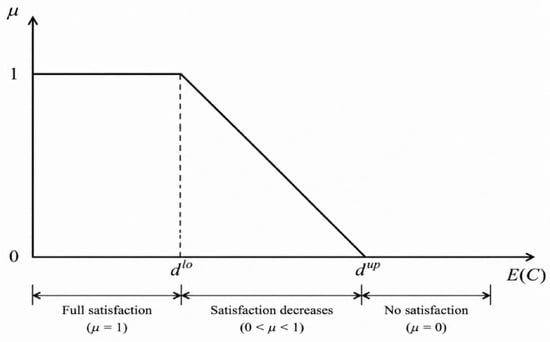
The flexible due date of order i is described using a threshold-based membership function, which reflects the customer’s preference regarding the delivery time. Here, dlo denotes the preferred delivery time that provides the highest customer satisfaction, and dup represents the maximum acceptable delivery time. The expected satisfaction degree (ESD) of order i is defined as shown in the Equations (1) and (2) [15]. In Equation (1), is the expected value of the fuzzy completion time and . ESDi represents the degree to which the expected completion time satisfies the flexible due date requirement . An example of customer expected satisfaction is presented in Figure 1. The average expected satisfaction degree of all orders ESDavg is calculated using Equation (2).
Figure 1.
The diagram of .
2.3. Fuzzy Bi-Objective Multi-Product Batch Production Scheduling Model
Based on the aforementioned problem characteristics and the order-based multi-product batch scheduling mixed-integer model with unlimited intermediate storage proposed by Liu [4], a fuzzy bi-objective mathematical model for the uncertain multi-product batch scheduling problem (UMBSP) is formulated as follows.
Equations (3) and (4) define the two objective functions of the proposed model, namely the minimization of the fuzzy maximum completion time and the maximization of the average expected satisfaction degree. Equation (5) ensures that each order is assigned to exactly one processing unit at each stage. Equation (6) determines the completion time of each order at the first processing stage according to the selected machine. Equation (7) represents the precedence relationship between consecutive processing stages of each order. Equations (8) and (9) together define the time-sequencing restrictions for two successive orders assigned to an identical machine, which enforces the non-overlapping condition for order processing.
Based on the arithmetic operations of triangular fuzzy numbers and the defuzzification method, the fuzzy programming model presented in Equations (3)–(9) can be transformed into an equivalent recursive formulation shown in Equations (10)–(13).
If s = 1, i = 1, j ∈ Js, then
If s = 1, i > 1, j ∈ Js, then
If s > 1, i = 1, j ∈ Js, then
If s > 1, i > 1, j ∈ Js, then
3. Hybrid Discrete Multi-Population Multi-Objective Backtracking Search Algorithm
After defuzzification, the proposed fuzzy bi-objective optimization model is transformed into a deterministic multi-objective optimization problem. The two objectives, i.e., production efficiency and customer satisfaction, exhibit conflicting characteristics, resulting in a complex Pareto search space. Moreover, different scheduling solutions may have similar objective values, which increases the difficulty of maintaining population diversity during the evolutionary process. Therefore, an effective optimization algorithm should achieve a balance between convergence performance and diversity preservation.
To address this issue, a hybrid discrete multi-population multi-objective backtracking search algorithm (MOMPBSA) is proposed for solving the investigated UMBSP. Two parallel subpopulations with complementary evolutionary mechanisms are developed. The first subpopulation adopts a convergence-oriented discrete backtracking search strategy with optimal individual guidance to accelerate the search process, while the second subpopulation employs a diversity-oriented mechanism to reduce premature convergence. Furthermore, an information exchange mechanism between the two populations is introduced to improve the cooperation between exploration and exploitation. The detailed encoding strategy, initialization method, and evolutionary mechanisms are presented in the following sections.
3.1. Solution Encoding
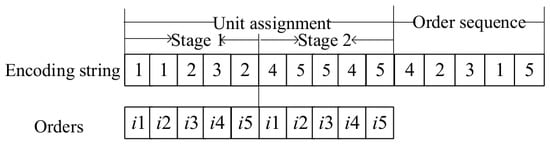
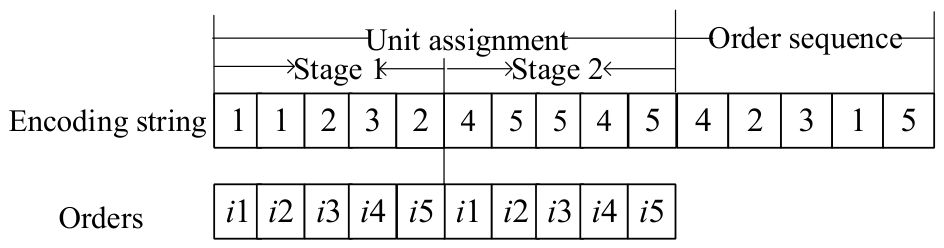
The UMBSP contains two major discrete decisions, including unit assignment and order sequencing. Therefore, a two-part chromosome encoding scheme is adopted in MOMPBSA, where the first part represents unit assignment information and the second part represents order sequence information. The machine assignment part determines the processing unit selected for each order at each stage. The order sequence part determines the processing priority of orders assigned to the same unit. Through this encoding strategy, the machine allocation and sequencing decisions can be independently manipulated during the evolutionary process.
During decoding, the chromosome is converted into a feasible scheduling scheme. At the first processing stage (s = 1), the order sequence is directly obtained from the order sequence segment. For the subsequent stages (s > 1), the processing sequence of orders assigned to each unit is determined according to the ascending order of their completion times at the previous stage while satisfying process precedence constraints.
In this study, when scheduling orders on machines at the current stage, the processing sequence is determined by sorting the completion times of orders at the previous stage in ascending order according to the First-Come, First-Served (FCFS) rule. It should be noted that the fuzzy start time of an order at stage s(s ≥ 2) is greater than or equal to the fuzzy completion time of the order in the stage s − 1.
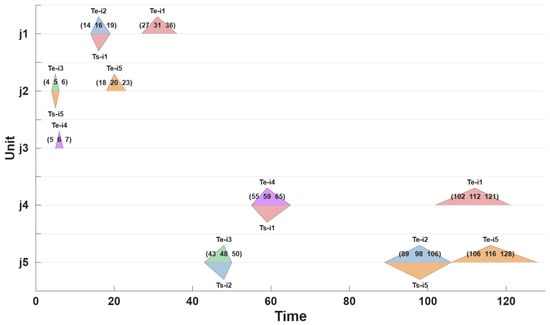
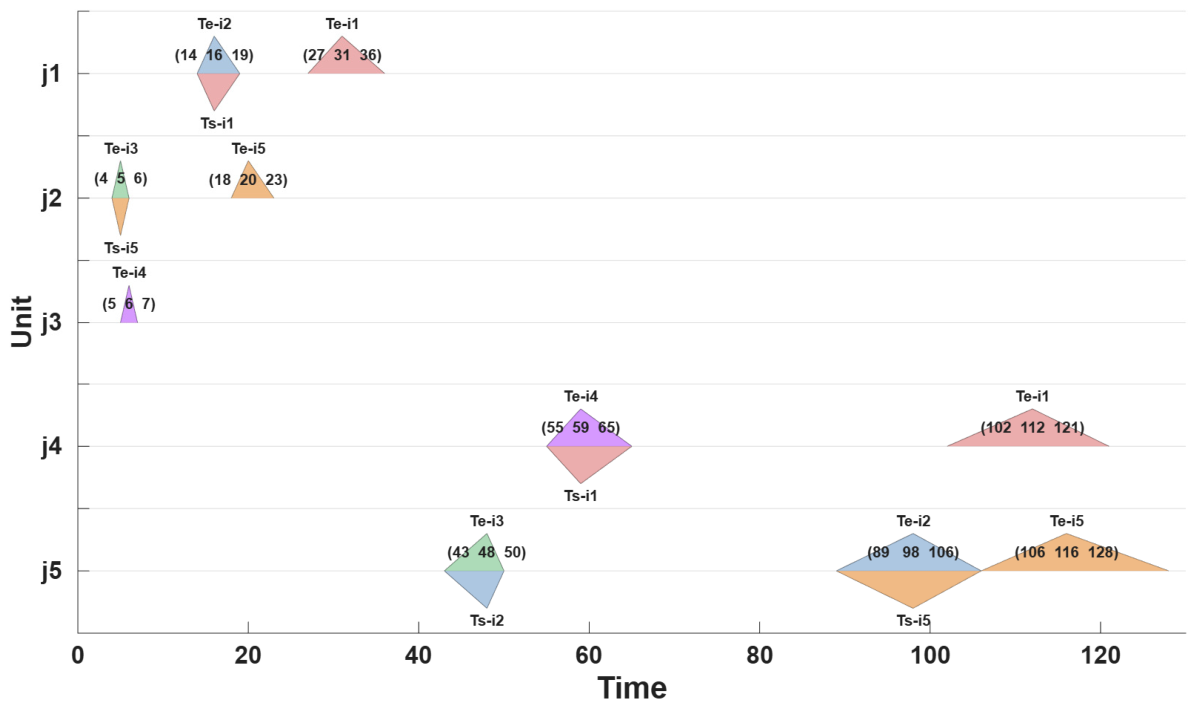
Figure 2 illustrates an example of the decoding process for an unlimited intermediate storage batch production scheduling problem with 5 orders, 2 stages, and 5 machines. The processing time information of the example orders is provided in Table 1. Based on the chromosome in Figure 2, at stage s = 1, orders i1 and i2 are assigned to machine j1, orders i3 and i5 to machine j2, and order i4 to machine j3. The corresponding processing sequences are i2, i1 on j1, i3, i5 on j2. At stage s = 2, orders i1 and i4 are assigned to machine j4, and orders i2, i3, i5 are assigned to machine j5. The processing sequences are determined according to the completion times of the previous stage, resulting in i4, i1 on j4 and i3, i2, i5. The decoded scheduling result is presented in the fuzzy Gantt chart in Figure 3, where each order has a unique color.
Figure 2.
An example of the encoding scheme.
Table 1.
Fuzzy processing data of orders for case 1.
Figure 3.
Fuzzy Gatt of NIS batch scheduling.
3.2. Population Initialized
Before the optimization process begins, an initial population with PS individuals is generated to provide candidate solutions for evolutionary search. Six high-quality individuals are generated according to the heuristic rules described in Equations (14)–(18), while the remaining individuals are randomly generated. This hybrid initialization strategy improves the quality of initial solutions while preserving population diversity.
The heuristic rules in Equations (14)–(18) can be divided into two categories: unit assignment heuristics for each processing stage and order sequencing heuristics for the first processing stage. Two heuristic rules are designed for unit assignment (Equations (14) and (15)), and three heuristic rules are developed for order sequencing at the first stage (Equations (16)–(18)). By combining these heuristic rules, six different high-quality individuals can be generated for the initial population.
- (1)
- unit selection rules
Two heuristic rules are developed for machine assignment. The first rule (Equation (14)) selects the machine with the shortest fuzzy processing time for each order, aiming to reduce the local processing burden. The second rule (Equation (15)) selects the machine with the earliest fuzzy completion time, considering the influence of machine availability on the overall scheduling performance.
- (2)
- Order sequencing rules at the first processing stage
The order sequencing strategy includes three heuristic rules. The first rule, as shown in Equation (16), sorts orders in ascending order according to the latest acceptable delivery times required by customers to determine the processing sequence. The second rule, shown in Equation (17), determines the order sequence by sorting the preferred completion times associated with the highest customer satisfaction in ascending order. The third rule, shown in Equation (18), calculates the average fuzzy flow time of each order at the final processing stage |S|, denoted as . Orders are sorted in descending order according to determine the sequence at the first processing stage. These three rules are designed from different perspectives, including customer due-date requirements, customer satisfaction, and production flow efficiency.
3.3. Improved Multi-Population Multi-Objective Backtracking Algorithm
To balance convergence and diversity, an improved multi-population multi-objective backtracking search algorithm (MOMPBSA) is proposed. The MOMPBSA consists of two subpopulations with different evolutionary strategies, denoted as B_1 and B_2, respectively. Subpopulation B_1 employs an enhanced backtracking search mechanism guided by the global best individual to accelerate convergence. Subpopulation B_2 adopts a simplified evolutionary strategy to preserve parent information and improve evolutionary efficiency. Information exchange between the two subpopulations is introduced to maintain population diversity. The evolutionary mechanisms of the two subpopulations are described below.
In subpopulation B_1, offspring individuals are generated through discrete mutation and crossover operations. The discrete mutation operation is formulated as:
where, a, b are randomly generated numbers within the interval (0,1). Different mutation operators are selected according to the relationship between a and b. represents the historical individual corresponding to , which is generated using the historical-population update mechanism of the original BSA [16]. represents an individual selected from subpopulation B_2. The symbol “⊕” represents different discrete mutation operations designed for the unit selection subproblem and the order sequence subproblem.
The discrete mutation operation for unit assignment is formulated as:
where, δ represents the unit arrangement information generated by the discrete mutation operation. For the order sequence encoding, the OX5 operator [30] is adopted to perform the mutation operation.
The discrete crossover operation of subpopulation B_1 is formulated as:
where, Achγ is an individual γ randomly selected from the external archive AS; In the population B_1, Achγ can improve the convergence performance. The introduction of individuals from subpopulation B_2 increases information exchange and improves the diversity of B_1. and are two different individuals selected from subpopulation and a, b are randomly generated numbers within the interval (0, 1). According to the comparison between a, b, and the crossover probability, different crossover operators are selected.
The symbol “⊗” in Equation (21) represents the different discrete crossover operations for unit selection. The symbol “⊙” represents discrete cross intercept operation and F is the crossover probability parameters which has different meanings in different encoding segments.
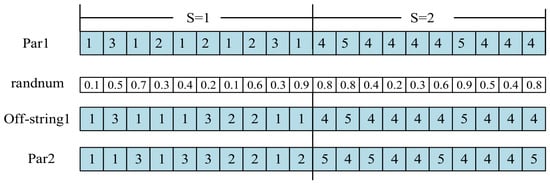
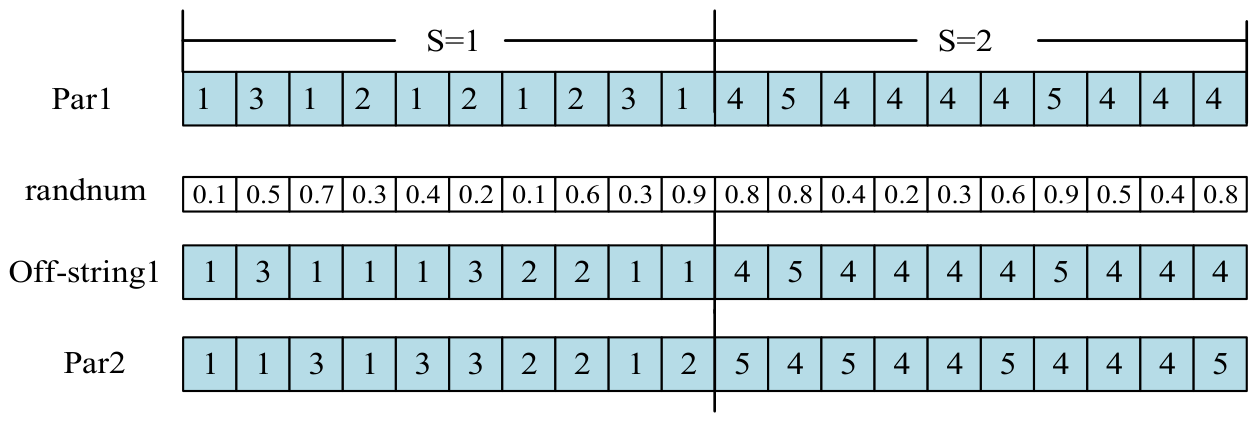
Figure 4 illustrates the discrete crossover operation for unit assignment. For an individual with 10 orders, 2 processing stages, and 5 units, the unit assignment encoding is represented by two parent individuals, “Par1” and “Par2”. The random number vector “randnum” is generated within the interval [0, 1], and its length equals the number of encoding elements. During crossover, if the corresponding value of randnum is smaller than F, the offspring inherits the unit assignment information from “Par1”; otherwise, the information is copied from “Par2”. The resulting offspring is obtained by combining the selected encoding segments.
Figure 4.
An example of discrete crossover operation for unit assignment.
For the order sequence encoding, the proposed MOMPBSA improves the exchange operation introduced by Vitayasak et al. [18]. Although the original exchange operation is simple and easy to implement, its search diversity is limited because the starting position of the exchanged segment is fixed. When the evolution of the guiding parent individual stagnates, offspring generated from the same segment may become similar, resulting in population diversity degradation.
To overcome this limitation, the starting position of the exchanged segment is randomly determined in the proposed method. Specifically, the recognition process can start from any position of the parent individual, where the starting position is generated as a random integer within the feasible range. This modification increases the diversity of offspring individuals and reduces the risk of premature convergence.
After performing the crossover operations for unit assignment and order sequence encoding, the complete offspring individual is obtained by combining the unit assignment segment and order sequence segment. The parent individual is then updated according to Algorithm 1.
Different from subpopulation B_1, subpopulation B_2 adopts a simplified evolutionary strategy that removes the separate mutation and crossover procedures in the original backtracking search algorithm. Instead, offspring individuals are directly generated through a discrete crossover operation. This strategy reduces redundant evolutionary steps and preserves more useful information from parent individuals.
The simplified evolutionary operation is formulated as:
where “⊗” represents different discrete crossover operators designed for the unit assignment and order sequence subproblems. For unit assignment encoding, the two-stage crossover (TSC) operation is adopted to generate feasible offspring individuals. For order sequence encoding, the position-based crossover (PBX) operator [31] is employed.
The PBX operator maintains the feasibility of order sequences through position-based information inheritance. Specifically, several discontinuous positions are randomly selected from one parent individual, and the corresponding genes are copied to the same positions of the offspring. The remaining positions are filled with non-duplicated genes from the other parent according to their original order.
In Equation (23), Q(t) is the individuals or historical information . is a individual different from selected from subpopulation B_2. and are selected with equal probability. The generated offspring replaces the parent individual according to the update procedure in Algorithm 1. Algorithm 1 updates individuals based on Pareto dominance. If the offspring dominates the parent individual, the parent is replaced by the offspring. If the offspring and parent are nondominated with respect to each other, the offspring is retained according to the external archive strategy.
The two subpopulations adopt different evolutionary mechanisms. Subpopulation B_1 improves convergence by utilizing global optimal information, whereas subpopulation B_2 enhances exploration by preserving individual diversity without direct dependence on the global best solution. In addition, information exchange between the two subpopulations allows complementary search behaviors and improves the overall optimization performance of MOMPBSA.
| Algorithm 1 Updating process of individual |
| Input: , |
| Output: |
| If |
| Else if is nondominated with and a ≤ 0.5|a ∈ rand(0,1) |
| End If |
3.4. Local Search Algorithm
To further improve the optimization performance, a local search strategy is applied to the non-dominated solutions obtained by MOMPBSA. In the studied infinite intermediate storage batch production scheduling problem, randomly changing the order sequence or unit assignment may generate invalid neighborhood solutions with unchanged objective values. Therefore, problem-specific local search operators are designed to enhance the exploitation capability of non-dominated solutions.
The local search operators are described as follows:
- (1)
- Order exchange operation
Two different orders i and i′ assigned to the same unit j(j ∈ Js, s = 1) are selected. The positions of orders i and i′ in the sequence are exchanged to generate a new neighborhood solution.
- (2)
- Order insertion operation
An order i assigned to unit j(j ∈ Js, s = 1) is inserted into another position of the same unit j. This operation changes the order sequence of unit j at the first stage.
- (3)
- Cross-unit order exchange operation
Two units j and j′ with at least two assigned orders are selected. Two pairs of orders are randomly selected from the two units, and their unit assignment information and order sequence information are exchanged.
- (4)
- Cross-unit order insertion operation
An order i assigned to unit j is moved to another unit j′. The order position on the new unit is determined according to the fuzzy completion time of orders processed on unit j′.
- (5)
- Feasibility-preserving insertion operation
For a unit j″ with |Ij″| orders, the gaps between consecutive orders are denoted as ρ. A gap is randomly selected for inserting order i. If the selected position satisfies the feasibility condition, order i is directly inserted. Otherwise, the processing relationship between adjacent orders is checked. If the two orders are assigned to different units at stage |S|,order i is inserted into the selected position; otherwise, the order positions are adjusted to maintain feasibility.
3.5. Improved Hybrid Multi-Population Multi-Objective Backtracking Search Algorithm
Based on the description in Section 3.1, Section 3.2, Section 3.3 and Section 3.4, the specific process of the proposed MOMPBSA optimization infinite waiting multi-objective batch production scheduling problem is shown in Algorithm 2.
| Algorithm 2 MOMPBSA |
| Input: sets AS, LA, hisB_1, hisB_2; parameters PS, F, Maxgen, K, NA |
| Output: external archive AS |
| Generate initial individuals and divide them into two subpopulations B_1 and B_2 |
| Generate six heuristic individuals according to Equations (11)–(14) for each subpopulation. |
| Evaluate all individuals and update the external archive AS using Algorithm 1. |
| While the stopping criterion is not satisfied: |
| Update historical populations hisB_1 and hisB_2 |
| For each individual in B_1: |
| Perform discrete mutation and crossover operations. |
| Evaluate offspring solutions and update individuals using Algorithm 1. |
| End For |
| Execute the discrete mutation operation shown in Equation (15) to generate mutation individual |
| For each individual in B_2: |
| Perform the simplified evolutionary operation. |
| Evaluate offspring solutions and update individuals using Algorithm 1. |
| End For |
| Add newly generated solutions to LA |
| Apply a local search operator to solutions in LA |
| Update external archive AS |
| End While |
4. Numerical Experiment
4.1. Experimental Data Preparation
To evaluate the optimization performance of MOMPBSA, 25 test instances with different scales are randomly generated. The problem size is determined by three characteristics: the number of orders |I| the maximum number of processing stages |S|, and the number of available units at each stage |Js|.
The generated instances include five levels of order numbers, i.e., |I| = {10,15,20,25,30}, and five levels of processing stages, i.e., |S| = {2,3,4,5,6}. According to the problem scale, the test instances are divided into small-scale and large-scale groups. For small-scale instances, |I| = {10,15,20,25} and |S| = {2,3}. For large-scale instances, |I| = {10,15,20,25,30} and |S| = {3,4,5,6}. The number of available units at each stage is randomly selected from |Js| ∈ {2,3,4}(s = 1,2,…,|S|).
The notation o-s-j is adopted to represent each test instance, where o, s and j denote the number of orders, processing stages, and total available units, respectively. For example, ‘o10s2j5’ represents an instance with 10 orders, 2 processing stages, and 5 available units.
The fuzzy processing time of each order is represented by a triangular fuzzy number. The most likely processing time is randomly generated from a uniform distribution within [1, 50]. The shortest processing time of the order t1 is a random number evenly distributed in [δ1t1, t1], δ1 < 1, and the longest processing time is located in [t1, δ2t1], δ2 > 1.
In this study, the parameters δ1 = 0.9 and δ2 = 1.2 are adopted to determine the range of fuzzy processing times.
The due date of each order is generated based on the minimum fuzzy processing time required to complete all processing stages. First, the minimum processing time of order i is calculated as:
Generate the due date of each order according to Equation (24).
where randint represents a random integer within a specified interval, T is the delay factor, and R controls the due-date range. The parameter settings are consistent with previous studies and are adjusted according to different experimental requirements.
The expected value represents the minimum fuzzy processing time and is obtained by the equation according to the parameter τi. The value of the parameter τi is set differently in different experiments.
Two performance metrics, hypervolume value (HV) and unary multiplicative epsilon indicator (ε), are adopted to evaluate the quality of obtained Pareto solutions. In the non-dominated solution set, we adopt and 1 − ESD to unify the optimization direction.
For HV, all objectives are normalized to the range [0, 1], with ideal point (0, 0) and nadir point (1, 1). Following Minella et al. [32] and Shao et al. [33], the reference point is set to 1.2 times the nadir point, namely (1.2, 1.2). This reference point lies outside the nadir point and is dominated by all normalized solutions. Accordingly, the theoretical upper bound of HV is 1.2 × 1.2 = 1.44. A larger HV value implies better overall performance of the Pareto set.
For the multiplicative epsilon indicator ε, it measures the minimum distance between the approximated and reference Pareto fronts. The reference Pareto front for ε is constructed by merging all non-dominated solutions obtained from all compared algorithms and extracting the global non-dominated subset. To avoid division by zero in its multiplicative form, the normalized objectives are shifted to [1,2] by adding 1. The value of ε is calculated by Equation (25) [33].
where zi(x) represents the normalized α-th objective value of a solution within the interval of [1,2]. R denotes the reference Pareto front, and Q is the approximated Pareto front. A smaller ε means the Pareto front is closer to the reference Pareto front, and a value of 1 indicates an ideal match.
4.2. Algorithm Parameters Setting
All algorithms are implemented in MATLAB R2022b and executed on a computer with a 3.4 GHz Core processor and 4.0 GB RAM. Three important parameters of MOMPBSA, including the scaling factor F, population size PS, and maximum iteration number Maxgen, are determined through an orthogonal experimental design.
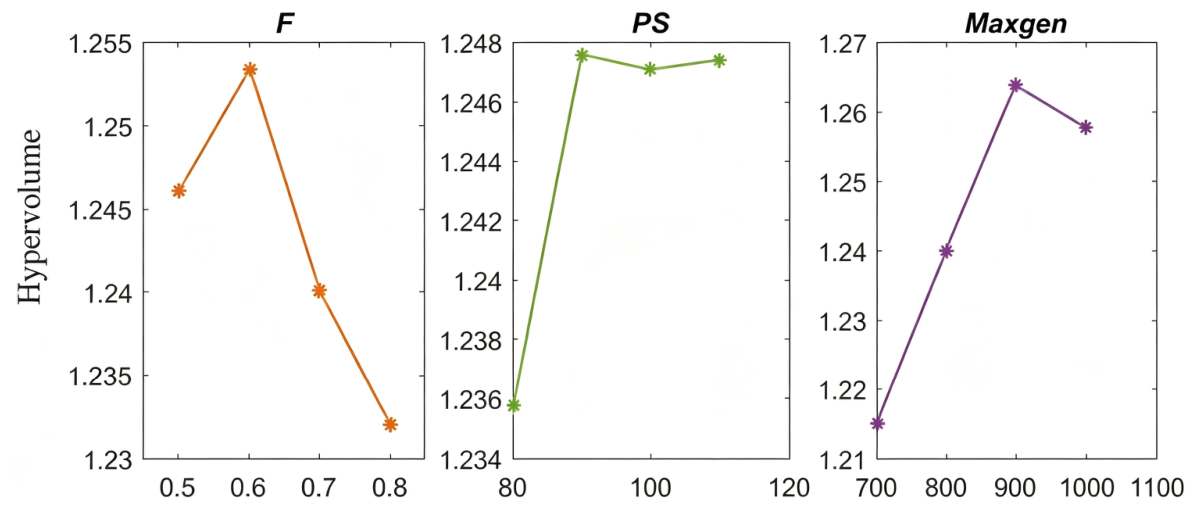
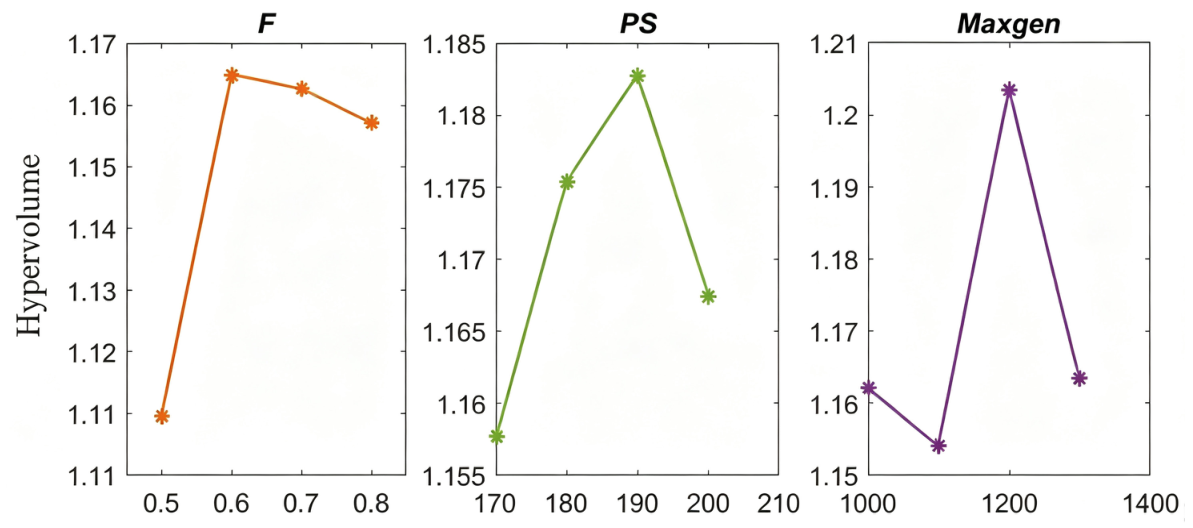
To analyze the influence of these parameters on algorithm performance, an orthogonal array L16(34) is adopted. Four levels are assigned to each parameter. The crossover probability factor is set as {0.5,0.6,0.7,0.8} for different problem scales. Since larger-scale problems require a larger search space, different levels of PS and Maxgen are adopted for small-scale and large-scale instances. For small-scale instances, the levels of PS and Maxgen are set as {80,90,100,110} and {700,800,900,1000}, respectively. For large-scale instances, the corresponding levels are set as {170,180,190,200} and {1000,1100,1200,1300}. Each parameter combination is independently executed 20 times, and the average HV value is used for parameter analysis.
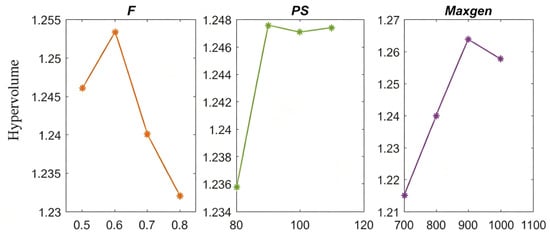
For the small-scale instance o20s3j7, the range analysis results of the L16(34) orthogonal experiment are presented in Table 2. The results show that Maxgen has the greatest influence on algorithm performance, followed by F and PS. According to the parameter-level trends shown in Figure 5, the optimal parameter combination is obtained as F = 0.6, PS = 90, Maxgen = 900.
Table 2.
Range analysis results of the L16(34) orthogonal experiment for instance o20s3j7.
Figure 5.
Factor level trend of influence of parameters on algorithm performance for small size instances.
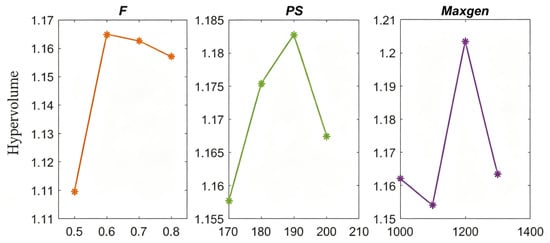
For the large-scale instance o30s6j20, the orthogonal experiment results are presented in Table 3. Similar to the small-scale case, Maxgen has the largest influence, while PS and F have relatively smaller effects. According to Figure 6, the optimal parameter combination is determined as F = 0.6, PS = 190, Maxgen = 1200.
Table 3.
Range analysis results of the L16(34) orthogonal experiment for instance o30s6j20.
Figure 6.
Factor level trend of influence of parameters on algorithm performance for large size instances.
Therefore, the parameters of MOMPBSA are set according to the problem scale. For small-scale instances, F = 0.6, PS = 90, Maxgen = 900 are adopted. For large-scale instances, F = 0.6, PS = 190, Maxgen = 1200 are used in subsequent experiments.
4.3. Performance Analysis of Algorithm Improvement Strategies
The effectiveness of the three improvement strategies in MOMPBSA, including heuristic initialization, cooperative evolution of two subpopulations, and local search operation, is evaluated through an ablation study. These strategies aim to improve the convergence and diversity of Pareto solutions for the multi-objective fuzzy batch production scheduling problem.
Four variants of MOMPBSA are developed by removing or replacing different improvement strategies. MOMPBSA1 removes the heuristic initialization strategy, where all initial individuals are randomly generated. MOMPBSA2 replaces the evolutionary strategy of both subpopulations with the strategy of B_1. MOMPBSA3 replaces the evolutionary strategy of both subpopulations with the strategy of B_2. MOMPBSA4 removes the local search operation.
MOMPBSA and its four variants are tested on eight instances with different scales. To ensure a fair comparison, all algorithms use the same parameter settings and are independently executed 20 times. The average values of hypervolume HV and the multiplicative epsilon indicator ε obtained from the 20 runs are presented in Table 4 and Table 5. The best results for each instance are highlighted in bold.
Table 4.
Results of hypervolume HV for the variants of MOMPBSA.
Table 5.
Results of multiplicative epsilon ε for the variants of MOMPBSA.
As shown in Table 4 and Table 5, MOMPBSA achieves the best overall performance in terms of both optimization indicators. The ranking of the five algorithms is consistent for the two indicators: MOMPBSA > MOMPBSA1 > MOMPBSA4 > MOMPBSA3 > MOMPBSA2.
This result demonstrates that the combination of heuristic initialization, cooperative evolution, and local search effectively improves the quality of the obtained Pareto solutions.
Specifically, MOMPBSA achieves an average HV value of 1.2472, which is higher than 1.1629 obtained by MOMPBSA1. Meanwhile, MOMPBSA obtains a lower average ε value (1.1094) than MOMPBSA1 (1.1714). These results indicate that the heuristic initialization strategy provides higher-quality initial solutions and improves both convergence and diversity of the evolutionary process.
Among all variants, MOMPBSA2 shows the poorest performance, indicating that subpopulation B_2 plays a critical role in the proposed algorithm. By preserving historical information and exchanging information among individuals, enhances population diversity and reduces the probability of premature convergence. The comparison between MOMPBSA and MOMPBSA3 further confirms the necessity of maintaining different evolutionary strategies for the two subpopulations.
In addition, MOMPBSA4 performs worse than MOMPBSA, demonstrating the effectiveness of the local search operation. The local search mechanism further improves the exploitation capability by refining non-dominated solutions and enhancing the quality of the estimated Pareto front.
The performance improvement mainly benefits from the proposed multi-population evolutionary framework. The two subpopulations adopt different evolutionary strategies to balance convergence and diversity, while the heuristic initialization improves the quality of the initial population and the local search operation enhances solution refinement. Combined with the ablation study, these results verify the effectiveness of the proposed improvement strategies and the overall MOMPBSA framework.
4.4. Algorithm Performance Analysis
Due to the specific characteristics of the studied multi-objective fuzzy multi-product multi-stage batch production scheduling problem, including fuzzy processing times, multi-stage unit assignment, and order sequencing decisions, few existing algorithms can be directly applied without problem-specific modifications. Therefore, two representative multi-objective evolutionary algorithms, NSGA-II and SPEA-II, are selected as benchmark algorithms to evaluate the optimization performance of MOMPBSA [34,35].
NSGA-II and SPEA-II are classical Pareto-based multi-objective evolutionary algorithms and have been widely used as benchmark methods for multi-objective optimization problems. Compared with problem-specific algorithms, these two algorithms provide reliable baselines because their evolutionary mechanisms are independent of the characteristics of the studied scheduling problem. Although other advanced multi-objective algorithms have been developed in recent years, directly applying them to the studied problem requires redesigning encoding schemes, variation operators, and constraint-handling strategies, which may introduce additional algorithm-dependent factors and affect the fairness of comparison.
To ensure a fair comparison, NSGA-II and SPEA-II adopt the same solution encoding and decoding procedures as MOMPBSA. In addition, MOMPBSA4 has been introduced in the comparative experiment, which retains the multi-population framework of MOMPBSA while removing the local-search component entirely. The crossover operators designed for the two encoding segments in MOMPBSA are applied to the comparison algorithms. The mutation operation is implemented by randomly selecting one local search operator from the proposed local search strategy. In addition, the number of evolutionary individuals, population size, termination criterion, and computational environment are identical for all algorithms.
The total number of evolutionary individuals used in each iteration of the MOMPBSA and MOMPBSA4 is TN, where TN = 2 × PS. For fairness, the population size of NSGA-II is also set to TN = 2 × PS. For test cases of different scales, the stopping criteria for the three algorithms are the same maximum number of iteration stops. The crossover and mutation probabilities for NSGA-II (0.8 and 0.1) and SPEA-II (0.7 and 0.3) are manually determined via a one-factor-at-a-time tuning strategy. All comparative experiments were conducted in the same computing environment. The delivery date parameter for the test case, (T, R) is set to (0.4, 1.2) and τi = 1.2.
Three performance indicators are employed to evaluate the optimization results: hypervolume HV, multiplicative epsilon indicator ε and coverage metric C(A, B). The coverage metric is further adopted to compare the dominance relationship between different Pareto solution sets.
Table 6 presents the comparison results of NSGA-II, SPEA-II, MOMPBSA, and MOMPBSA4 on small-scale instances. Each value represents the average result of 20 independent runs. It can be observed that MOMPBSA achieves the best overall performance on all instances except the smallest instance o10s2j5, among the four algorithms, and MOMPBSA4 performs the best on instance o10s2j5.
Table 6.
Simulation results of HV and ε for the compared algorithms on small-scale problem.
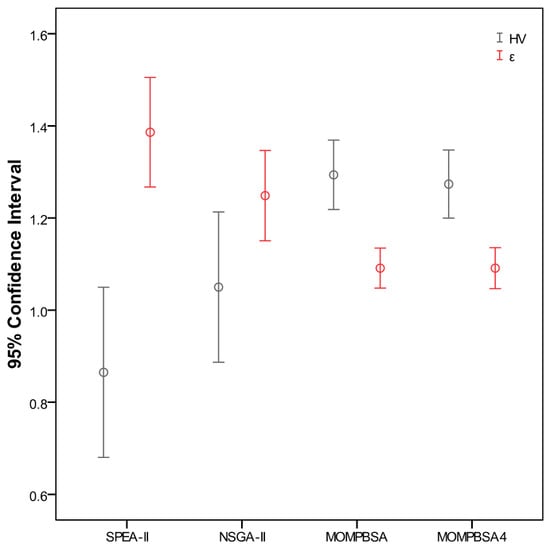
For HV, MOMPBSA4 obtains an average value of 1.2725, which is higher than NSGA-II (1.0513), and SPEA-II (0.8651), while MOMPBSA (1.2924) is higher than MOMPBSA4 (1.2725). This result indicates that MOMPBSA can obtain Pareto solutions with better convergence and diversity. For ε, MOMPBSA achieves the lowest average value of 1.0875, compared with 1.2488 for NSGA-II, 1.3863 for SPEA-II, and 1.0931 for MOMPBSA4, demonstrating better convergence performance toward the reference Pareto front.
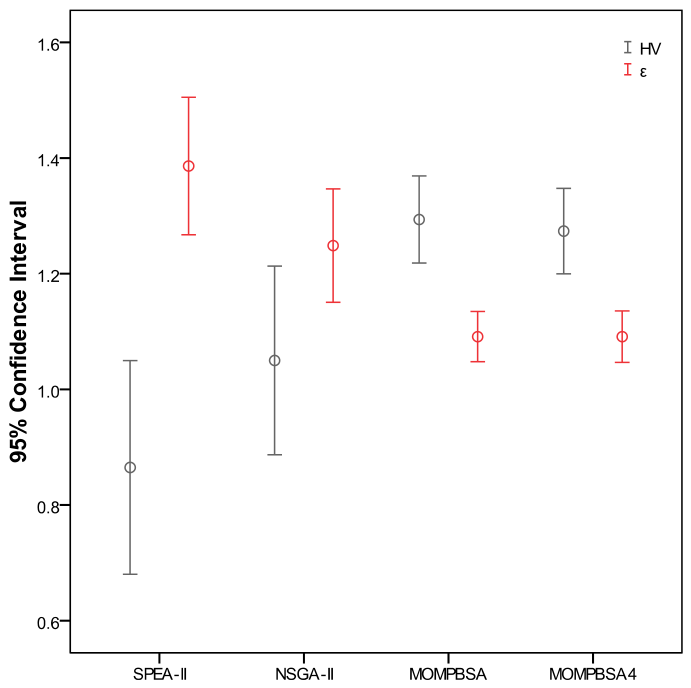
The superiority of MOMPBSA is further verified by the 95% confidence interval analysis shown in Figure 7. As observed from Figure 7, MOMPBSA and MOMPBSA 4 substantially outperform NSGA-II and SPEA-II for both HV and ε indicators. MOMPBSA achieves slightly better HV results than MOMPBSA4, whereas their performance in terms of ε is comparable. This finding agrees with Table 6, where the difference between their mean ε values is merely 0.0056.
Figure 7.
Mean plot with 95% confidence interval of all comparson algorithms over HV and ε for small-scale instances.
Table 7 presents the coverage metric values of the Pareto fronts obtained by the four algorithms for small-scale instances. The coverage metric provides a direct comparison of the dominance relationship between different Pareto solution sets. For instance o10s3j8, the three algorithms obtain identical Pareto fronts, resulting in coverage values equal to 1 among all comparisons. For instance o10s2j5, MOMPBSA and NSGA-II obtain identical Pareto fronts, while the Pareto front generated by SPEA-II is inferior to those obtained by the two algorithms. For the remaining small-scale instances, the values of C(C, B) and C(C, A) indicate that the Pareto solutions obtained by MOMPBSA dominate or cover the solutions obtained by NSGA-II and SPEA-II. These results further demonstrate that MOMPBSA can generate higher-quality Pareto solutions compared with the benchmark algorithms.
Table 7.
Coverage metric values for small-scale instances.
Table 8 presents the comparison results of NSGA-II, SPEA-II, MOMPBSA, and MOMPBSA4 on large-scale instances. Compared with the small-scale instances, the optimization difficulty increases significantly due to the enlarged solution space and the increased number of scheduling decisions. As shown in Table 8, among the four compared algorithms, MOMPBSA consistently achieves the best performance across all instances, except for the ε metric on instance o30s5j6.
Table 8.
Simulation results of HV and ε for the compared algorithms on large-scale problem.
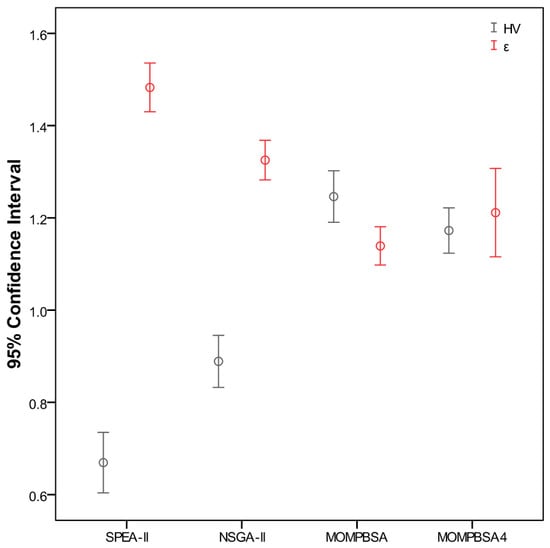
For the HV indicator, MOMPBSA obtains an average value of 1.2462, which is higher than NSGA-II (0.8890), SPEA-II (0.6693), and MOMPBSA4 (1.1725). This indicates that MOMPBSA can obtain Pareto solutions with better convergence and distribution characteristics when solving large-scale scheduling problems. Meanwhile, the average ε indicator of MOMPBSA is 1.1391, which is lower than those of NSGA-II (1.3253), SPEA-II (1.4829), and MOMPBSA4 (1.2113), demonstrating that MOMPBSA provides solutions closer to the reference Pareto front.
Compared with the results of small-scale instances, the performance advantage of MOMPBSA becomes more significant as the problem size increases. This improvement can be attributed to the cooperative evolution mechanism of the two subpopulations. The exploitation-oriented subpopulation improves convergence toward promising regions, while the diversity-oriented subpopulation maintains exploration capability in the enlarged search space. In addition, the local search mechanism further enhances the ability to refine non-dominated solutions.
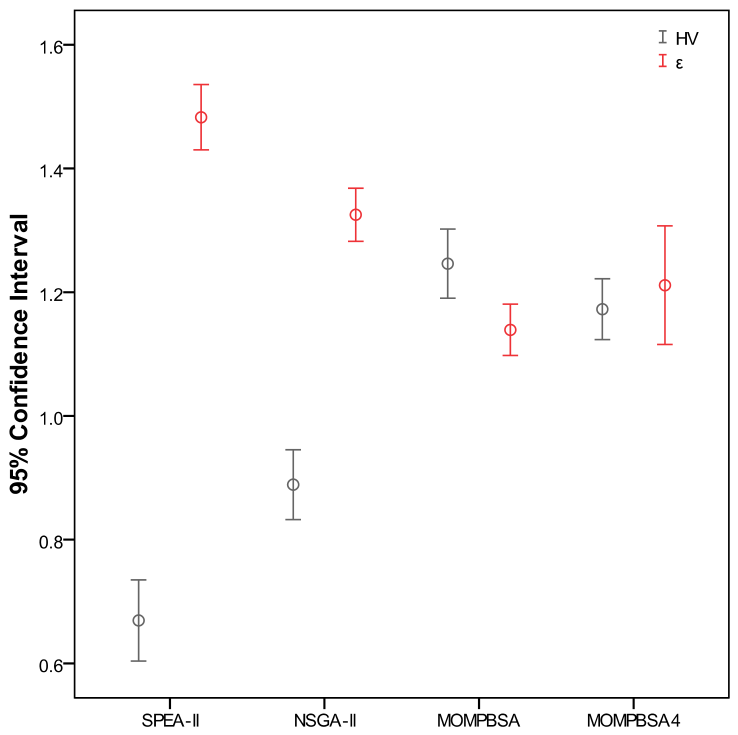
The 95% confidence intervals of the HV and ε for large-scale instances are shown in Figure 8. The confidence interval of MOMPBSA for HV is clearly separated from those of the other three algorithms. For ε, its confidence interval is distinctly separated from those of NSGA-II and SPEA-II. Partial overlap can only be observed between MOMPBSA and MOMPBSA4 on ε, yet MOMPBSA exhibits smaller variation intervals, which means better robustness and stability when solving complex scheduling problems.
Figure 8.
Mean plot with 95% confidence interval of all comparson algorithms over HV and ε for large-scale instances.
Table 9 presents the coverage metric results for large-scale instances. Compared with HV and multiplicative epsilon indicator ε, the coverage metric provides a direct comparison of the dominance relationship between the Pareto solution sets generated by different algorithms. The results show that MOMPBSA achieves stronger coverage performance against NSGA-II and SPEA-II in all large-scale instances. For example, in instance o30s3j10, the values of C(A, C) and C(C, B) indicate that the Pareto solutions obtained by MOMPBSA can dominate most solutions generated by NSGA-II and SPEA-II. Similar trends are observed for other large-scale instances.
Table 9.
Coverage metric values for large-scale instances.
Overall, the comparison results demonstrate that MOMPBSA outperforms NSGA-II and SPEA-II on both small-scale and large-scale instances. The superiority of MOMPBSA is verified from three perspectives: the HV indicator confirms the improvement of Pareto front quality, the multiplicative epsilon indicator demonstrates better convergence capability, and the coverage metric verifies the dominance relationship between different Pareto solution sets.
5. Conclusions
This paper investigates a multi-objective fuzzy batch production scheduling problem with flexible order due dates. Given the conflicting objectives of minimizing the maximum fuzzy completion time and maximizing average customer satisfaction, we formulate the problem as a complex multi-objective discrete optimization problem that includes fuzzy processing times, multi-stage unit assignment, and order sequencing decisions.
To solve this problem, an improved multi-population multi-objective backtracking search algorithm (MOMPBSA) is proposed. The proposed algorithm integrates heuristic initialization, cooperative evolution of two subpopulations, and problem-specific local search. Two subpopulations adopt different evolutionary strategies to balance convergence and diversity. In addition, discrete mutation and crossover operators are designed according to the characteristics of the scheduling problem to improve the search capability of the algorithm.
The effectiveness of the proposed improvement strategies is verified through an ablation study. The results demonstrate that heuristic initialization, cooperative multi-population evolution, and local search operations all contribute to improving the quality of the obtained Pareto solutions. Furthermore, MOMPBSA is compared with two representative multi-objective evolutionary algorithms, NSGA-II and SPEA-II, on instances with different scales. The comparison results based on hypervolume, multiplicative epsilon indicator, and coverage metric show that MOMPBSA obtains better Pareto solution quality and stronger optimization robustness.
In future research, more practical constraints, such as dynamic production environments, machine availability uncertainty, and real-time scheduling requirements, can be considered to further improve the applicability of the proposed method.
Author Contributions
Conceptualization, X.Y.; methodology, X.Y.; validation, X.Y.; formal analysis, X.Y.; investigation, X.Y.; resources, X.Y.; data curation, X.Y.; writing—original draft preparation, X.Y.; writing—review and editing, X.Y. and Q.F.; visualization, X.Y.; supervision, X.Y.; project administration, X.Y. All authors have read and agreed to the published version of the manuscript.
Funding
This research was funded by Ningbo Municipal Science and Technology Bureau, grant number 2024J235 and 20251JCGY010476.
Data Availability Statement
The data presented in this study are available on request from the corresponding author. The data are not publicly available due to the nature of this research.
Conflicts of Interest
The authors declare no conflicts of interest. The funders had no role in the design of the study; in the collection, analyses, or interpretation of data; in the writing of the manuscript; or in the decision to publish the results.
References
- Verbiest, F.; Pinto-Varela, T.; Cornelissens, T.; Springael, J.; Barbosa-Povoa, A. Decomposition approaches for the design and scheduling of multiproduct multistage batch plants with parallel lines. Comput. Chem. Eng. 2019, 127, 111–126. [Google Scholar] [CrossRef] [Scilit]
- Han, Y.; Gu, X. Cooperative hybrid evolutionary algorithm for large scale multi-stage multi-product batch plants scheduling problem. Neurocomputing 2021, 419, 80–96. [Google Scholar] [CrossRef] [Scilit]
- He, Y.; Hui, C.W. Genetic algorithm for large-size multi-stage batch plant scheduling. Chem. Eng. Sci. 2007, 62, 1504–1523. [Google Scholar] [CrossRef] [Scilit]
- Novara, F.M.; Novas, J.M.; Henning, G.P. A novel constraint programming model for large-scale scheduling problems in multiproduct multistage batch plants: Limited resources and campaign-based operation. Comput. Chem. Eng. 2016, 93, 101–117. [Google Scholar] [CrossRef] [Scilit]
- Lee, H.; Maravelias, C.T. Mixed-integer programming models for simultaneous batching and scheduling in multipurpose batch plants. Comput. Chem. Eng. 2017, 106, 621–644. [Google Scholar] [CrossRef] [Scilit]
- Cunha, A.L.; Santos, M.O.; Pinto-Varela, T.; Barbosa-Póvoa, A. A new formulation for a multi-stage, multilevel batch scheduling problem. Comput. Ind. Eng. 2026, 212, 111708. [Google Scholar] [CrossRef] [Scilit]
- Liu, F.; Li, X.; Lu, C.; Gong, W. Adaptive Knowledge-Based Multi-Objective Evolutionary Algorithm for Hybrid Flow Shop Scheduling Problems with Multiple Parallel Batch Processing Stages. Swarm Evol. Comput. 2025, 95, 101929. [Google Scholar] [CrossRef] [Scilit]
- Shi, B.; Qian, X.; Sun, S.; Yan, L. Rule-based scheduling of multi-stage multi-product batch plants with parallel units. Chin. J. Chem. Eng. 2017, 25, 1022–1036. [Google Scholar] [CrossRef] [Scilit]
- Zhang, Y.; Gu, X. Biogeography-based optimization algorithm for large-scale multistage batch plant scheduling. Expert Syst. Appl. 2020, 162, 113776. [Google Scholar] [CrossRef] [Scilit]
- Yan, X.; Gu, X. Bi-objective no-wait multiproduct multistage product scheduling problem with flexible due dates based on MOIDE- MA. Comput. Oper. Res. 2022, 137, 105543. [Google Scholar] [CrossRef] [Scilit]
- He, Y.; Yuan, Q.; Lin, J.; Gan, M. A reinforcement learning-based hyper-heuristic evolutionary algorithm for distributed heterogeneous fuzzy flexible job shop scheduling. Expert Syst. Appl. 2026, 330, 133086. [Google Scholar] [CrossRef] [Scilit]
- Yang, W.J.; Wang, Z.; Wang, G.C. Optimizing fuzzy job shop scheduling using graph neural networks and deep reinforcement learning. Eng. Appl. Artif. Intell. 2026, 174, 114506. [Google Scholar] [CrossRef] [Scilit]
- Xu, Z.H.; Gu, X.S. Earliness and tardiness flow shop scheduling problems under uncertainty with finite intermediate storage. Control Theory Appl. 2006, 23, 480–486. [Google Scholar]
- Palacios, J.J.; González-Rodríguez, I.; Vela, C.R.; Puente, J. Satisfying flexible due dates in fuzzy job shop by means of hybrid evolutionary algorithms. Integr. Comput.-Aided Eng. 2019, 26, 65–84. [Google Scholar] [CrossRef] [Scilit]
- Vela, C.R.; Afşar, S.; Palacios, J.J.; González-Rodríguez, I.; Puente, J. Evolutionary tabu search for flexible due-date satisfaction in fuzzy job shop scheduling. Comput. Oper. Res. 2020, 119, 104931. [Google Scholar] [CrossRef] [Scilit]
- Civicioglu, P. Backtracking search optimization algorithm for numerical optimization problems. Appl. Math. Comput. 2013, 219, 8121–8144. [Google Scholar] [CrossRef] [Scilit]
- Lin, J.; Wang, Z.J.; Li, X. A backtracking search hyper-heuristic for the distributed assembly flow-shop scheduling problem. Swarm Evol. Comput. 2017, 36, 124–135. [Google Scholar] [CrossRef] [Scilit]
- Vitayasak, S.; Pongcharoen, P.; Hicks, C. A tool for solving stochastic dynamic facility layout problems with stochastic demand using either a genetic algorithm or modified backtracking search algorithm. Int. J. Prod. Econ. 2017, 190, 146–157. [Google Scholar] [CrossRef] [Scilit]
- Rahati, A.; Mirkazehi Rigi, E.; Idoumghar, L.; Brévilliers, M. Ensembles strategies for backtracking search algorithm with application to engineering design optimization problems. Appl. Soft Comput. 2022, 121, 108717. [Google Scholar] [CrossRef] [Scilit]
- Debnath, S.; Debbarma, S.; Nama, S.; Saha, A.K.; Tejani, G.G.; Mousavirad, S.J. Backtracking search algorithm with mutation strategy for engineering optimization. Int. J. Comput. Intell. Syst. 2025, 18, 278. [Google Scholar] [CrossRef] [Scilit]
- Yan, X.; Han, Y.; Gu, X. An improved discrete backtracking searching algorithm for fuzzy multiproduct multistage scheduling problem. Neurocomputing 2020, 398, 153–165. [Google Scholar] [CrossRef] [Scilit]
- Pătrăușanu, A.; Florea, A.; Neghină, M.; Dicoiu, A.; Chiș, R. A systematic review of multi-objective evolutionary algorithms optimization frameworks. Processes 2024, 12, 869. [Google Scholar] [CrossRef] [Scilit]
- Hanne, T.; Moghaddam, M.J. A review of the evolution of multi-objective evolutionary algorithms. Comput. Mater. Contin. 2025, 85, 4203–4236. [Google Scholar] [CrossRef] [Scilit]
- Chiang, T.C.; Cheng, H.C.; Fu, L.C. NNMA: An effective memetic algorithm for solving multiobjective permutation flow shop scheduling problems. Expert Syst. Appl. 2011, 38, 5986–5999. [Google Scholar] [CrossRef] [Scilit]
- Gong, G.; Deng, Q.; Chiong, R.; Gong, X.; Huang, H. An effective memetic algorithm for multi-objective job-shop scheduling. Knowl.-Based Syst. 2019, 182, 104840. [Google Scholar] [CrossRef] [Scilit]
- Li, Z.C.; Qian, B.; Hu, R.; Chang, L.L.; Yang, J.B. An elitist nondominated sorting hybrid algorithm for multi-objective flexible job-shop scheduling problem with sequence-dependent setups. Knowl.-Based Syst. 2019, 173, 83–112. [Google Scholar] [CrossRef] [Scilit]
- Gu, X.L.; Huang, M.; Liang, X. A discrete particle swarm optimization algorithm with adaptive inertia weight for solving multiobjective flexible job-shop scheduling problem. IEEE Access 2020, 8, 33125–33136. [Google Scholar] [CrossRef] [Scilit]
- Dong, J.-S.; Pan, Q.-K.; Miao, Z.-H.; Sang, H.-Y.; Gao, L. An effective multi-objective evolutionary algorithm for multiple spraying robots task assignment problem. Swarm Evol. Comput. 2024, 87, 101558. [Google Scholar] [CrossRef] [Scilit]
- Yuan, Y.; Zhang, Q.; Wang, Y. A cooperative co-evolution algorithm for fuzzy prefabricated components production scheduling. Comput. Ind. Eng. 2025, 210, 111543. [Google Scholar] [CrossRef] [Scilit]
- Deep, K.; Mebrahtu, H. New variations of order crossover for travelling salesman problem. Int. J. Comb. Optim. Probl. Inform. 2011, 2, 2–13. [Google Scholar]
- Ak, B.; Koc, E. A guide for genetic algorithm based on parallel machine scheduling and flexible job-shop scheduling. Procedia Soc. Behav. Sci. 2012, 62, 817–823. [Google Scholar] [CrossRef] [Scilit][Green Version]
- Minella, G.; Ruiz, R.; Ciavotta, M. A Review and Evaluation of Multiobjective Algorithms for the Flowshop Scheduling Problem. Inf. J. Comput. 2008, 20, 451–471. [Google Scholar] [CrossRef] [Scilit]
- Shao, Z.; Pi, D.; Shao, W. A novel multi-objective discrete water wave optimization for solving multi-objective blocking flow-shop scheduling problem. Knowl.-Based Syst. 2019, 165, 110–131. [Google Scholar] [CrossRef] [Scilit]
- Deb, K.; Pratap, A.; Agarwal, S.; Meyarivan, T. A fast and elitist multiobjective genetic algorithm: NSGA-II. IEEE Trans. Evol. Comput. 2002, 6, 182–197. [Google Scholar] [CrossRef] [Scilit]
- Zitzler, E.; Laumanns, M.; Thiele, L. SPEA2: Improving the Strength Pareto Evolutionary Algorithm; TIK Report 103; Computer Engineering and Networks Laboratory, Swiss Federal Institute of Technology (ETH): Zurich, Switzerland, 2001. [Google Scholar] [CrossRef] [Scilit]

Disclaimer/Publisher’s Note: The statements, opinions and data contained in all publications are solely those of the individual author(s) and contributor(s) and not of MDPI and/or the editor(s). MDPI and/or the editor(s) disclaim responsibility for any injury to people or property resulting from any ideas, methods, instructions or products referred to in the content. |
© 2026 by the authors. Licensee MDPI, Basel, Switzerland. This article is an open access article distributed under the terms and conditions of the Creative Commons Attribution (CC BY) license.