Review

Data-Driven Prediction of Li-Ion Battery Thermal Behavior: Advances and Applications in Thermal Management

by
Weijia Qian
1,
Wenda Fang
2,
Yongjun Tian
3,4,*,
Guangwu Dai
3,4,
Tao Yan
3,4,
Siheng Yang
5 and
Ping Wang
1
1
Institute for Energy Research, Jiangsu University, Zhenjiang 212013, China
2
School of Energy and Power Engineering, Jiangsu University, Zhenjiang 212013, China
3
TCATARC Automotive Test Center (Changzhou) Company Limited, Changzhou 213000, China
4
Jiangsu Provincial Engineering Technology Research Center for Integrated Photovoltaic, Energy Storage, Charging, and Testing, Changzhou 213000, China
5
School of Energy Engineering, Zhejiang University, Hangzhou 310013, China
*
Author to whom correspondence should be addressed.
Processes 2025, 13(9), 2769; https://doi.org/10.3390/pr13092769
Submission received: 12 August 2025 / Revised: 25 August 2025 / Accepted: 28 August 2025 / Published: 29 August 2025
(This article belongs to the Section Energy Systems)

Abstract

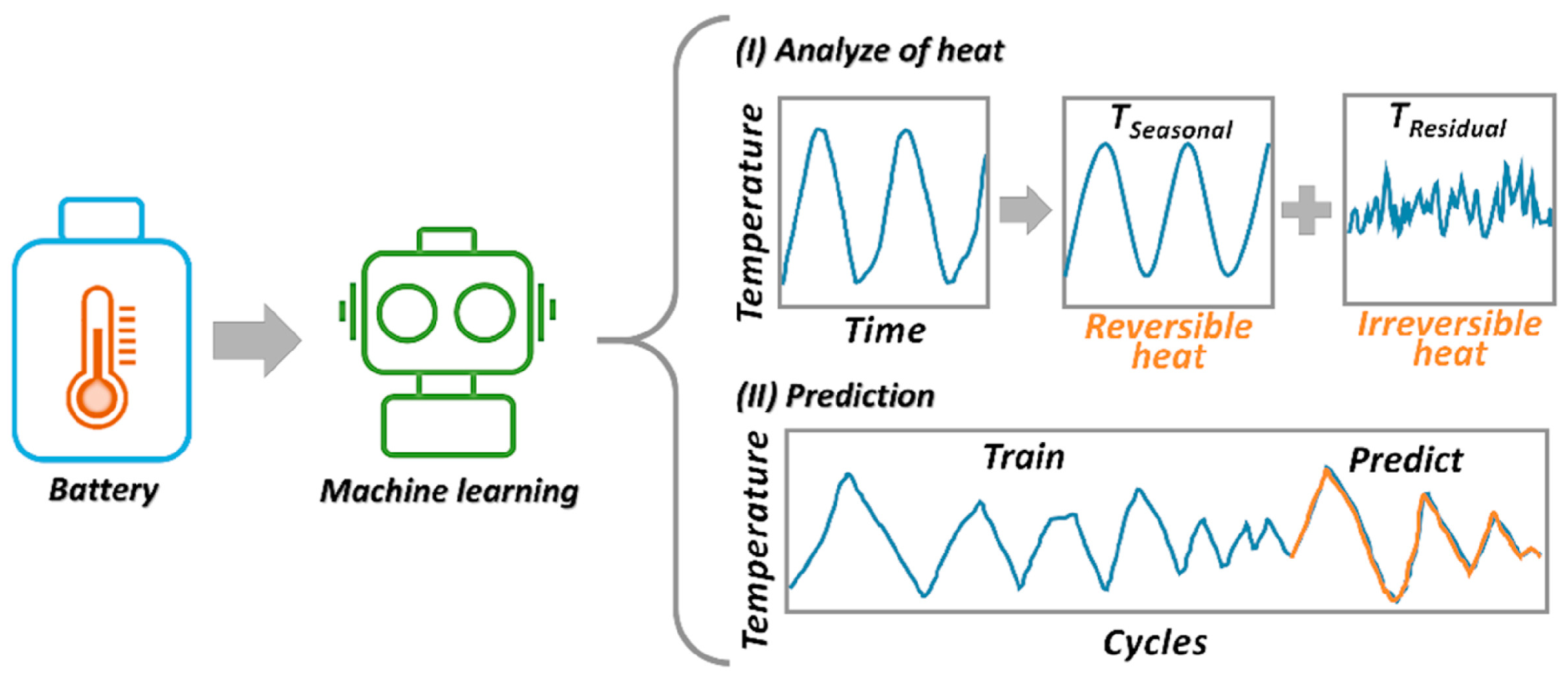
Lithium-ion batteries (LIBs) are critical for various applications, and effective thermal management is important for their safety, performance, and lifespan. Traditional physics-based modeling of battery thermal behavior is computationally complex and requires detailed parameters. Using data-driven modeling to predict thermal characteristics of batteries offers a promising alternative. This review comprehensively examines the utilization of data-driven methods in predicting LIB thermal behavior and designing battery thermal management systems. It explores commonly used data-driven techniques and focuses on their applications in predicting heat generation, temperature distribution, and cooling performance. Specific data-driven models for battery thermal prediction are presented, with a comparative analysis of their strengths and weaknesses. The review concludes that data-driven models can effectively predict battery thermal behavior, offering computational efficiency compared to physics-based simulations. Future research directions include hybrid data-driven/physical modeling, ensemble modeling, and incorporating explainable artificial intelligence techniques to enhance model interpretability. These advancements will lead to more accurate and interpretable models, contributing to the safe and efficient applications of LIB systems.
Keywords: lithium-ion battery; data-driven modeling; machine learning; heat-generation rate; temperature prediction; battery thermal management system lithium-ion battery; data-driven modeling; machine learning; heat-generation rate; temperature prediction; battery thermal management system