


Abstract
Accurate prediction of the remaining useful life (RUL) of lithium-ion batteries is essential for prognostics and health management. However, standard Gaussian processes (GPs) face challenges in scalability and capturing complex global degradation trends, while deep learning models often lack principled uncertainty quantification. To bridge this gap, this study proposes a novel deep mixed-effect Gaussian process (DME-GP) model, which decomposes the predictive function into a global multi-layer perceptron (MLP)-based feature mapping component and a sample-specific local GP component under the mixed-effect paradigm. This hybrid architecture synergistically captures intricate global patterns and provides probabilistic uncertainty estimates. The model’s performance was rigorously validated on a real-world battery RUL dataset. Quantitative results demonstrate its superior accuracy, achieving a reduction in root mean square error (RMSE) by up to 63.41% and in mean absolute error (MAE) by up to 62.63% compared to a standard GP baseline. The proposed DME-GP framework provides a robust and reliable data-driven solution for advancing battery health monitoring systems.
Keywords:
remaining useful life; lithium-ion batteries; Gaussian process; uncertainty quantification; deep mixed-effect Gaussian process model; multi-layer perceptron MSC:
93D09
1. Introduction
Owing to their high energy density, long cycle life, low self-discharge rate, and absence of memory effect, lithium-ion batteries have become the predominant energy storage solution for electric vehicles, grid energy storage systems, portable electronic devices, and aerospace equipment [1,2,3]. However, during repeated charge–discharge cycles, lithium-ion batteries suffer from irreversible aging mechanisms including lithium plating, electrode material degradation, and electrolyte decomposition, which lead to continuous capacity fade and power attenuation [4].
Such aging behavior will eventually trigger battery failure, posing severe safety hazards and reducing the reliability of the entire energy supply system [5]. To ensure the operational safety, optimize maintenance strategies, and extend the service life of lithium-ion battery systems, accurate prediction of the remaining useful life (RUL) has become the core task of battery prognostics and health management (PHM), which has also turned into a research hotspot in the field of energy storage engineering [6,7,8]. Consequently, a large number of RUL prediction methods for lithium-ion batteries have been proposed in the existing literature, which can be broadly classified into two categories: model-based approaches and data-driven approaches [9,10].
Model-based approaches mainly rely on the physical and electrochemical mechanisms of batteries to construct predictive models, including empirical models [11], equivalent circuit models (ECMs) [12], and electrochemical models [13]. Empirical models characterize battery degradation under specific operating conditions (cycling numbers, temperatures, discharge rates) through experimental data fitting, but their strong dependence on experimental conditions leads to poor generalization in complex scenarios [14]. ECMs simulate the internal electrochemical characteristics of batteries via resistors and capacitors, and realize RUL prediction by monitoring parameter changes, yet the model parameters will drift with battery aging and temperature variation, resulting in reduced prediction accuracy [15]. Electrochemical models reveal the internal state evolution based on lithium-ion migration and reaction kinetics, which have high theoretical precision, but their complex parameter calibration and huge computational complexity make online application difficult throughout the battery life cycle [16]. In general, model-based methods require in-depth insight into the intricate electrochemical mechanisms of batteries, which brings great challenges to model establishment and practical deployment. In contrast, data-driven methods break through the limitations of mechanism modeling by directly learning degradation rules from massive historical battery data, showing higher prediction accuracy and practicality [17]. These methods have gradually become a focus of significant research for lithium-ion battery state estimation and RUL prediction in recent years [18,19]. Data-driven methods can be further divided into traditional statistical methods and machine learning methods.
Statistical methods predict RUL by relying heavily on mathematical principles, but their applicability is often limited due to stringent requirements on data quality and volume, coupled with high computational complexity [20]. Machine learning, recognized for its powerful data-driven modeling capability, has become a prevalent tool in numerous research domains [21,22,23]. It leverages large amounts of historical data to automatically extract informative features and establish complex nonlinear mappings, thereby significantly improving the accuracy and generalizability of RUL estimation. Dong et al. [24] proposed a support vector regression–particle filter (SVR-PF) method for battery health monitoring, which establishes an RUL prediction model by dynamically updating the particle probability distribution until the battery reaches its end-of-life. A naive Bayes approach was also proposed for forecasting the RUL under various operating conditions. Gaussian processes (GPs), grounded in the Bayesian framework, naturally provide probabilistic predictions that quantify the uncertainty associated with the model outputs [25]. Richardson et al. [26] elaborated on the principles of GPs, which are fundamentally defined by their mean and covariance functions. Compared to SVM methods, GPs infer the kernel function hyperparameters directly from data, which can simplify the modeling process [27,28]. Tagade et al. [29] proposed a stacking algorithm that combines multiple individual GPs to enhance the model’s flexibility and predictive performance.
Although GPs demonstrate strong modeling capabilities and intrinsic advantages in uncertainty quantification for battery RUL prediction [30,31], they face inherent limitations in practical applications. Specifically, standard GPs, constrained by simple constant or linear mean functions, often fail to capture the complex, non-stationary global degradation trends prevalent in battery aging. Moreover, their conventional kernel functions may have limited representational power for high-dimensional, coupled battery feature data [32,33]. More notably, the cubic computational complexity derived from dense covariance matrix operations severely restricts the scalability of standard GPs in large-scale battery dataset scenarios, hindering their online deployment in practical health monitoring systems.
To overcome these limitations, deep learning methods have gained significant prominence [34,35,36,37,38]. As a classical deep learning architecture, multi-layer perceptrons (MLPs) implement hierarchical feature learning by mapping input variables layer-by-layer through nonlinear neuron combinations and activation functions, which significantly strengthens the nonlinear fitting capability and enables effective modeling of high-dimensional, complex coupled battery degradation data [39,40,41]. However, pure deep learning models represented by MLPs suffer from a critical drawback: they lack principled probabilistic uncertainty quantification [42,43,44,45], and their point predictions cannot provide reliable confidence intervals, which compromises the safety and credibility of RUL estimation results for lithium-ion batteries.
To address the dual challenges of inadequate nonlinear fitting capability in standard GPs and the lack of principled uncertainty quantification in pure deep learning models, this study proposes a deep mixed-effect Gaussian process (DME-GP) model. This hybrid framework synergistically integrates deep learning and GPs under a mixed-effects paradigm. In this hybrid architecture, the MLP is constructed as the global shared component to capture complex nonlinear degradation trends, while a sample-specific GP serves as the local component to characterize individual heterogeneity, which synergistically breaks the limitations of standard GPs and pure deep learning models. Simultaneously, the GP component retains the inherent probabilistic modeling mechanism and realizes accurate quantification of prediction uncertainty, which synergistically compensates for the absence of uncertainty estimation in pure deep learning models. This integrated design ultimately enhances the accuracy, robustness and reliability of remaining useful life estimation for lithium-ion batteries.
Compared with standard GPs, pure deep neural networks (DNNs), existing deep kernel learning (DKL) and conventional hybrid GP–DNN frameworks, the DME-GP model delivers unique novelty via the mixed-effect paradigm, as shown in Table 1. Standard GPs fail to capture complex global degradation trends and suffer from cubic computational complexity, while pure DNNs lack principled uncertainty quantification. DKL optimizes GP kernels through deep learning but retains a single global GP structure, incapable of modeling sample-specific battery heterogeneity. Traditional hybrid GP–DNN models adopt a serial integration mode, without the mixed-effect decomposition to decouple global shared trends and local sample disturbances. In contrast, the DME-GP decomposes the predictive function into a global MLP component and a sample-specific local GP component. This decomposition synergistically enables high-precision nonlinear fitting, principled uncertainty quantification, and linear-order computational complexity, thereby breaking through the bottlenecks of all aforementioned frameworks. Notably, while the present work optimizes model parameters via maximum likelihood estimation and the Adam algorithm, advanced meta-heuristic optimizers including the artificial lemming algorithm (ALA) [46,47] and improved sparrow search algorithm (ISSA) [48,49]—which have been validated to effectively boost predictive performance in degradation forecasting—can be explored in future work to further refine hyperparameter configuration. Additionally, beyond the baseline models compared herein, state-of-the-art RUL prediction architectures such as QHDBO-BiTCN-BiGRU [50] and HO-BiGRU-Transformer [51] have demonstrated promising performance in time-series battery health forecasting; cross-comparisons with these advanced models will be conducted in subsequent research to comprehensively validate the superiority and generalizability of the proposed DME-GP framework.
Table 1.
Comparison of the proposed DME-GP with representative existing frameworks.
2. Standard GP Model
In the standard GP model, suppose there are input factor combinations, each with dimensions, denoted as , where . The corresponding input responses are . The model is commonly given by
Here, is the predicted output and is the mean of the prediction. refers to a static Gaussian noise term with mean 0 and variance , . The covariance between any two points, and , is characterized by the function , as detailed in
where is a non-negative parameter representing the importance of the input factor , and denotes the input factor of the input . quantifies the distance between the and input values in the direction of factor .
The covariance matrix is a symmetric positive definite matrix of size , defined as , where denotes the correlation matrix.
Assuming the GP model parameters and are known, by combining the linear unbiased estimation and the minimum mean squared error prediction criterion, the best current unbiased estimate of the response at any arbitrary input point can be obtained as
Here, denotes the predicted mean value, and 1 refers to an n-dimensional vector comprising ones. constitutes an n-dimensional mean vector, and represents the residual vector. denotes the covariance between the input and the known inputs , where .
The model hyperparameters are determined by minimizing the negative log-likelihood, following the principle of maximum likelihood estimation. The formulation of the log-likelihood function is provided in
By minimizing Equation (4), the estimated values and can be obtained. The model’s predictive response and predictive variance at any arbitrary input are given by
By substituting and , the predicted response at can be obtained.
3. DME-GP Model
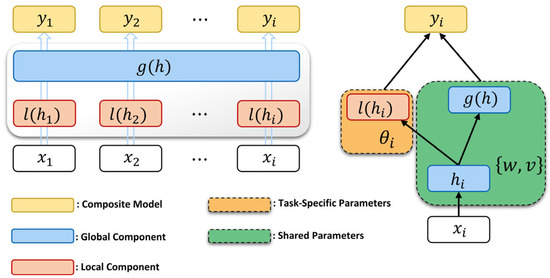
The proposed DME-GP model is developed to overcome the inherent limitations of the standard GP model elaborated in the previous section, including poor scalability to large-scale datasets, insufficient capacity to capture complex global nonlinear patterns, and excessive computational overhead caused by high-dimensional covariance matrix operations. This model seamlessly inherits the uncertainty quantification property of the standard GP while integrating deep representation learning to enhance model expressiveness. The overall architecture of the DME-GP is illustrated in Figure 1.
Figure 1.
Architecture of the DME-GP model.
3.1. Model Formulation and Component Interpretation
Based on the mixed-effect decomposition paradigm, the predictive function for the -th independent sample is decomposed into two additive and mutually independent components, which perfectly extends the standard GP modeling framework:
This decomposition serves as the core theoretical basis of the DME-GP model. The global component is later parameterized by a MLP as a function of a deep feature representation ; the local component is modeled as a zero-mean sample-specific GP, forming the mixed-effect structure The physical meaning and modeling mechanism of the two components are strictly interpreted as follows:
Global component : As a shared mapping function across all samples, it is responsible for extracting the universal global trend and consistent nonlinear relationship embedded in the high-dimensional feature space. Different from the constant mean function of the standard GP, this component is parameterized by a MLP, which can learn hierarchical feature representations and fit complex global patterns that cannot be captured by shallow kernel functions. This design effectively compensates for the limitation of the standard GP in global feature modeling.
Local component : A sample-specific function that characterizes the individual heterogeneity, local fluctuations and random disturbances unique to the -th sample, which cannot be explained by the global component. This component is modeled by a sample-adaptive GP with zero mean, which retains the probabilistic uncertainty quantification capability of the standard GP and realizes personalized fitting for each independent sample.
By integrating the two components, the DME-GP model for the -th static sample is defined as a GP with a deep mean function and a sample-specific kernel:
where denotes the global mean function output by the MLP, represents the feature embedding learned by the shared deep encoder, and is the sample-specific kernel function with hyperparameter .
Owing to the independence of samples, the joint distribution of all samples presents a block-diagonal covariance structure that eliminates cross-sample correlation:
where is the covariance matrix of the -th sample, and all off-diagonal blocks are zero matrices. This structural design is the key to reducing computational complexity.
3.2. Detailed Derivation of Computational Complexity Reduction
The standard GP model requires constructing a full covariance matrix for all samples, and its core inference operations (matrix inversion and determinant calculation) lead to a cubic computational complexity .
This complexity originates from the need to invert the dense global covariance matrix, which makes the model computationally infeasible as the number of samples increases. The DME-GP model realizes a fundamental complexity reduction to linear order through the block-diagonal covariance structure, and the detailed derivation process is as follows:
Structural decomposition: The block-diagonal structure decomposes the full covariance matrix into independent small matrices , each corresponding to a single sample. For static independent samples, the size of each small matrix is fixed and bounded, that is, the dimension of is a constant .
Independent inference: The inference operation of each sample is performed independently on its corresponding small matrix, and the complexity of a single small matrix inversion is , which is a constant due to the bounded .
Total complexity summation: The total computational complexity of the DME-GP model is the sum of the complexity of all samples:
3.3. Scalability for Large-Scale Datasets and Computational Cost Reduction
The linear computational complexity endows the DME-GP model with excellent scalability for large-scale static datasets, and the computational cost is reduced through four core mechanisms:
Elimination of full covariance matrix inversion: The model abandons the dense global covariance matrix of the standard GP, and only needs to process small sample-specific covariance matrices, which reduces the number of matrix operations by orders of magnitude.
Linear memory consumption: The memory usage of the model is proportional to the number of samples instead of , which avoids the memory bottleneck of the standard GP in large-scale scenarios and can be deployed on conventional computing hardware.
Parallel computing compatibility: The independence of sample-specific covariance blocks enables full parallelization of training and inference, which can further reduce the computing time by using multi-core processors or distributed computing frameworks.
Efficient deep learning optimization: The global MLP component is optimized by stochastic gradient descent algorithms (e.g., Adam), which avoids the repeated matrix operations required by the standard GP and improves the training efficiency of the global model.
3.4. Parameter Learning and Predictive Inference
3.4.1. Learning Objective
Consistent with the maximum likelihood estimation criterion of the standard GP, the DME-GP model optimizes the global deep network parameters and sample-specific kernel hyperparameters by maximizing the marginal log-likelihood of all independent samples:
The marginal log-likelihood of a single sample is derived from the Gaussian distribution assumption, which is completely compatible with the standard GP log-likelihood form:
where is the global mean output of the -th sample, and is the determinant of the sample-specific covariance matrix.
3.4.2. Parameter Gradient
The gradients of the log-likelihood with respect to model parameters are calculated by the chain rule, which ensures the stability of parameter optimization:
where represents the log-likelihood of the -th sample.
3.4.3. Predictive Inference
For a new unseen static test sample , the predictive distribution of the DME-GP model follows a Gaussian distribution, and the predictive mean and variance are:
where is the feature embedding of the test sample, and is the covariance vector between the test sample and the training sample. This predictive formula completely inherits the uncertainty quantification capability of the standard GP and adapts to static feature inputs.
4. Results
To address the inherent defects of standard GPs and MLP models, the implementation of the DME-GP model follows a systematic pipeline. Standard GPs are limited by inflexible constant mean functions, cubic computational complexity and insufficient capability to capture global battery degradation trends, while MLPs lack principled probabilistic uncertainty quantification and only provide point predictions. Synthetic functions are deliberately selected based on the degradation characteristics of lithium-ion batteries for controlled validation: the one-dimensional composite function with non-stationary oscillations is adopted to simulate the nonlinear and non-stationary global degradation trends of batteries, so as to test the model’s fundamental fitting ability for complex nonlinear patterns; the four-dimensional coupled function is used to mimic the multi-feature coupling characteristics of battery degradation data, aiming to verify the model’s generalization performance in high-dimensional feature spaces. Both synthetic functions eliminate the interference of real-world noise and sensor drift, which facilitates the evaluation of the model’s intrinsic predictive performance. Subsequently, three hierarchical validation cases are designed to comprehensively verify the model performance: Case Study 1 (analysis of one-dimensional function) verifies the basic nonlinear fitting capability of the DME-GP; Case Study 2 (analysis of multidimensional function analysis) validates its generalization in high-dimensional feature scenarios; Case Study 3 (analysis of battery RUL dataset) tests its robustness and practicality in industrial battery health monitoring applications. The overall procedure for building the proposed DME-GP model comprises the following stages:
Data preprocessing and partitioning: The raw dataset is cleaned, normalized and split into independent training and test sets to ensure data quality and unbiased model evaluation.
Model initialization: The DME-GP architecture is constructed following the mixed-effect decomposition paradigm, where a MLP is deployed to parameterize the global deep mean function, and a sample-specific local GP component is configured simultaneously to inherit the probabilistic modeling property of standard GPs.
Model training and parameter optimization: The global mean function parameters and sample-specific kernel hyperparameters are iteratively optimized under the maximum marginal log-likelihood criterion consistent with the model formulation.
Testing and performance evaluation: The root mean square error (RMSE) and mean absolute error (MAE) are adopted to quantitatively quantify the prediction accuracy, robustness and reliability of the model.
4.1. Case Study 1: Analysis of One-Dimensional Function
Initially, a one-dimensional synthetic function is used to demonstrate the predictive capability of the proposed DME-GP model. In this example, the performance of the DME-GP model is benchmarked against a standard GP. Both models are fitted to the data generated from the synthetic function, and their predictive accuracy is quantitatively compared using the RMSE and MAE metrics. A one-dimensional composite function, incorporating exponential decay, high-frequency oscillations, and nonlinear trends, is specifically chosen to evaluate the models’ ability to capture complex, non-stationary patterns. This function is defined by
Here, the input variable is defined on the domain . This formulation establishes a one-dimensional synthetic regression dataset, where the scalar serves as the input feature and the computed is the target response. The complexity of the function provides a controlled benchmark to evaluate the model’s capacity to fit intricate, composite patterns isolated from real-world data noise. First, the Latin hypercube sampling (LHS) method is employed to ensure a uniform distribution of input points. Training samples (n_train) are drawn from the domain of to form the training dataset for model fitting. Subsequently, an independent set of 100 test points is sampled from the same interval to evaluate the model’s generalization error. To account for the variability induced by sampling, the entire procedure—including the resampling of both training and test sets—is independently repeated 20 times. This allows for the computation of robust, averaged performance metrics. The mean values of the 20 RMSE and MAE are then calculated and reported as the model’s RMSE and MAE, as summarized in Table 2.
Table 2.
Comparison of Model Performance on the One-Dimensional Function with Varying Training Set Sizes.
The DME-GP model yields consistently lower absolute RMSE and MAE values compared to the standard GP model across all training set sizes, demonstrating its superior predictive accuracy. Furthermore, increasing the size of the training dataset leads to a continuous reduction in prediction errors for both models, verifying the positive correlation between sample size and model performance. Notably, the RMSE and MAE ratios show a slight upward trend at n_train = 100 relative to n_train = 60 and n_train = 80. This phenomenon is attributed to error saturation of the DME-GP model and performance catch-up of the standard GP baseline: The DME-GP model has approached the theoretical lower bound of prediction error for the one-dimensional synthetic function at n_train = 60 and n_train = 80, resulting in a diminishing marginal gain in error reduction as the training set size further increases to 100; The standard GP model, with weaker representational capacity at small sample sizes, exhibits a more significant improvement in predictive performance as the training set expands to 100, leading to a narrowed error gap between the two models. It should be emphasized that the absolute prediction errors of the DME-GP model still decrease monotonically with increasing training samples, confirming the continuous optimization of model performance. The overall downward trend in the error ratios and their persistence below 40% across all experiments further underscore the superior and persistent error-reduction capability of the proposed DME-GP model. These results reflect the robust performance of the DME-GP model across different training set sizes.
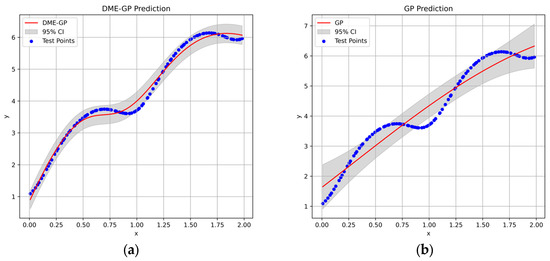
When n_train = 20, the proposed DME-GP model achieves an RMSE of 0.1413 and an MAE of 0.1198. In comparison, the standard GP model yields an RMSE of 0.3593 and an MAE of 0.3196. This corresponds to a reduction in RMSE and MAE by 60.67% and 62.52%, respectively, highlighting the superior predictive accuracy of the DME-GP model over the standard GP model. Additionally, Figure 2 visualizes the fitting results from one randomly selected trial, comparing the predictions of the DME-GP and the standard GP model.
Figure 2.
Comparison of predictive performance and uncertainty between the DME-GP and GP models. (a) Predictive performance and uncertainty be of the DME-GP; (b) Predictive performance and uncertainty be of the GP.
The predicted values (red curves) for the test points (blue dots) are presented for the DME-GP and GP models. The associated predictive uncertainty is quantified by the ±1 standard deviation interval centered on the model predictions. Notably, the DME-GP’s prediction curve closely aligns with the test points. Moreover, it exhibits a narrower and more stable predictive band, which indicates a more precise and reliable estimate of uncertainty. In contrast, the standard GP model only captures the global trend and fails to resolve the local characteristics. This comparative analysis demonstrates the mechanism behind the DME-GP’s superior performance. By employing a DNN as a flexible mean function, the model collaborates with the kernel to enhance overall representational capacity. This allows it to effectively capture the high-frequency oscillations and non-stationary characteristics present in the synthetic function. However, the standard GP model, constrained by the strong smoothness prior inherent in the RBF kernel, can only fit the global trend and fails to capture local details. Therefore, the DME-GP model exhibits superior fitting performance and generalization capability compared to the standard GP, as quantitatively and qualitatively validated above.
4.2. Case Study 2: Analysis of Multidimensional Function Analysis
To further validate the generalization capability of the DME-GP model, particularly in higher-dimensional input spaces, the analysis is extended to a four-dimensional function. The predictive performance of the DME-GP model is benchmarked against the standard GP model. Both models are fitted to the generated data, and their predictive accuracy is compared using the RMSE and MAE metrics. A four-dimensional explicit function featuring exponential growth, coupled trigonometric oscillations, and Gaussian decay is constructed for this purpose. This function is defined by
The input variables are defined on the domain . This constitutes a four-dimensional synthetic regression dataset. The input feature vector is the quadruple , and the target is the corresponding function value . The designed multivariate nonlinear interactions generate complex responses, creating a testbed specifically for evaluating model performance in capturing high-dimensional, nonlinear couplings under controlled conditions. First, the LHS method is employed to ensure uniform coverage of the input space. Experimental points are sampled from the four-dimensional space for model fitting. Subsequently, an independent set of 100 test points is sampled from the same domain to evaluate the model’s prediction error. This entire procedure is independently repeated 20 times, with the training and test sets resampled in each run. This accounts for the variability induced by sampling, yielding robust, averaged performance metrics. The mean RMSE and MAE values are calculated in Table 3.
Table 3.
Comparison of prediction errors under different training set sizes for the multivariate explicit function fitting task.
The DME-GP model consistently achieves lower prediction errors, thereby demonstrating its superior accuracy compared to the standard GP. Furthermore, increasing the size of the training dataset enhances the prediction accuracy. The RMSE and MAE ratios indicate that the error reduction effect of the proposed model is significantly better than that of the GP model. These results collectively demonstrate the robustness of the DME-GP model, not only in handling high-dimensional input but also in maintaining its performance advantage as the amount of training data varies.
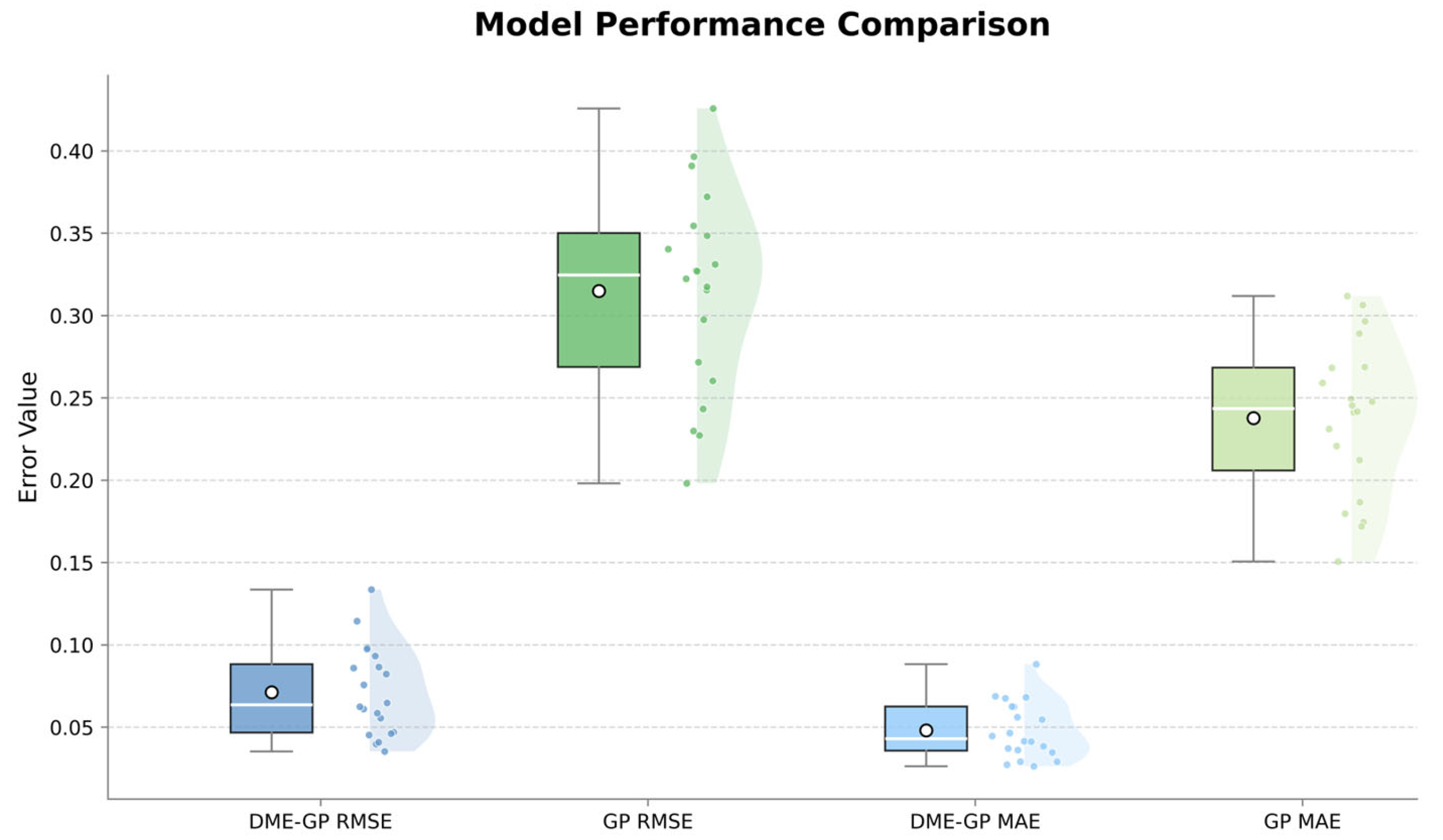
When n_train = 20, the proposed DME-GP model achieves an RMSE of 0.0712 and an MAE of 0.0481. In comparison, the standard GP model yields an RMSE of 0.3149 and an MAE of 0.2377. The RMSE and MAE of the proposed model are reduced by 77.39% and 79.76%, respectively.
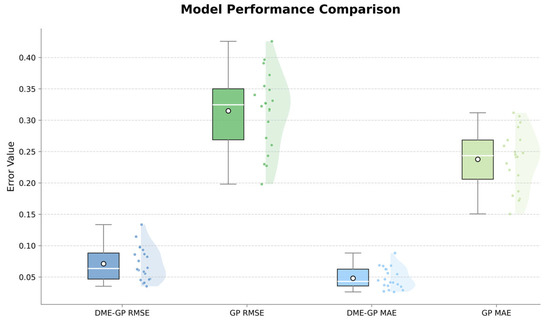
Furthermore, Figure 3 presents the distributions of prediction errors via combined box and violin plots, providing a comprehensive visual comparison. The proposed DME-GP model demonstrates substantially lower median errors for both RMSE and MAE. Quantitatively, its interquartile ranges (IQRs) for RMSE and MAE are 0.0415 and 0.0268, respectively, which are markedly narrower than those of the standard GP model (0.0813 and 0.0626). This indicates superior precision and lower outcome variability. Moreover, the violin plots demonstrate that the DME-GP’s errors exhibit a tall, narrow density profile concentrated near zero, signifying high-accuracy, stable predictions. In contrast, the standard GP shows a shorter, wider distribution spread over higher error values, confirming its greater prediction dispersion and instability. Collectively, these visualizations provide strong evidence that the DME-GP model achieves not only higher accuracy but also significantly improved robustness and reliability.
Figure 3.
Comparison of error distributions between the DME-GP and GP models.
4.3. Case Study 3: Analysis of Battery RUL Dataset
To validate the real-world performance of the DME-GP model, a case study is conducted using experimental data from 2.8 Ah Nickel Manganese Cobalt–Lithium Cobalt Oxide (NMC-LCO) 18,650 batteries. The experiment was conducted at 25 °C under a constant current–constant voltage (CC-CV) charging protocol at a C/2 rate and a discharge rate of 1.5 C, with 1000 charge–discharge cycles. The experimental data are sourced from the Hawaii Natural Energy Institute [52].
For this real-world battery RUL prediction task, the prediction objective is to accurately estimate the remaining number of charge–discharge cycles until the battery reaches its End of Life (EOL), defined as the cycle at which the capacity fades to 80% of the initial rated capacity. The RUL at a given point is therefore calculated as:
where denotes the cycle number at which the battery reaches its EOL threshold, and represents the current cycle count. The prediction encompasses both point estimation of the RUL and principled quantification of predictive uncertainty to ensure the reliability of battery health management (BHM).
The RUL prediction and DME-GP model deployment in this case are based on three rational assumptions of battery degradation behavior, which are highly consistent with the model’s mixed-effect structure: first, the capacity degradation of NMC-LCO batteries presents an irreversible nonlinear global trend during cyclic operation, which is the common degradation pattern shared by all battery samples; second, each individual battery cell exhibits sample-specific heterogeneity and local random fluctuations in the degradation trajectory, which cannot be fully depicted by the global degradation trend; third, the overall battery degradation process satisfies the additive decomposition characteristic, which can be separated into a global shared trend component and a local sample-specific disturbance component, conforming to the DME-GP model formulation.
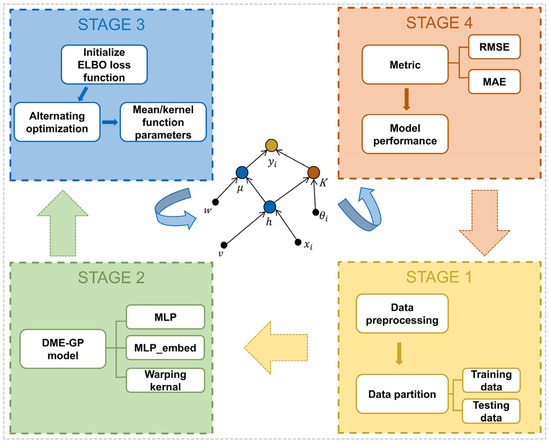
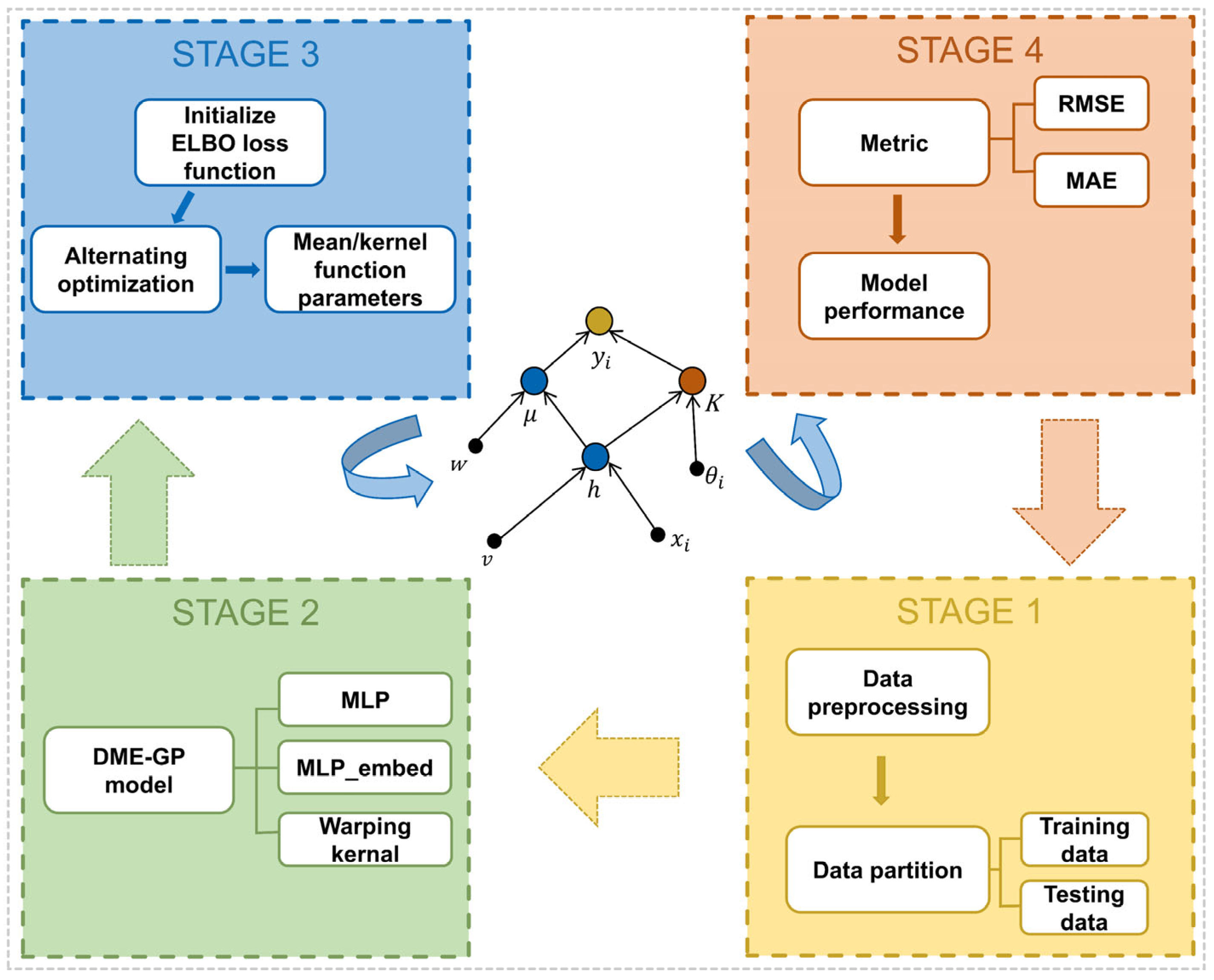
In practical battery health monitoring scenarios, the measured data are inevitably disturbed by environmental noise, sensor drift and occasional missing features, which pose critical challenges to the robust deployment of prediction models. The target variable is the battery’s RUL, predicted from seven influencing factors: discharge time (), charging time (), maximum discharge voltage (), minimum charge voltage (), time for voltage drop between 3.6–3.4 V (), duration at 4.15 V () and constant current time (). The complete workflow for RUL prediction is illustrated in Figure 4.
Figure 4.
The complete workflow for RUL prediction of lithium-ion batteries.
Prior to modeling, targeted preprocessing is implemented to address the practical deployment challenges of noise interference and missing data. First, outliers caused by sensor noise and measurement errors are removed via a combined Z-score and IQR criterion to enhance noise robustness. Then, 1000 samples are drawn via LHS to ensure uniform coverage of the feature space, which effectively alleviates the adverse effects of occasional missing data by maintaining the integrity of the feature distribution. The data is then split into an 80:20 training–test ratio. Finally, the features are normalized to eliminate dimensional discrepancies and converted to tensor format for model computation.
The DME-GP and standard GP models are benchmarked on this real-world task, with a focus on evaluating their performance in the presence of practical noise and data heterogeneity. The models are trained on the training set and evaluated on the test set. To mitigate random bias due to the large sample size and data noise, this process is independently repeated 20 times, with both sets resampled in each iteration. The mean values of the 20 RMSE and MAE results are then calculated and reported as the model’s RMSE and MAE, as revealed in Table 4.
Table 4.
Comparison of prediction errors under different training set sizes for the real battery case fitting task.
The results in Table 3 confirm that the proposed DME-GP model achieves consistently lower absolute RMSE and MAE than the standard GP model across all training set sizes, demonstrating its superior predictive accuracy for real-world battery RUL prediction. It can be observed that the RMSE and MAE ratios at n_train = 200 are notably higher than those at 250, 300, 350, 400 and 450. This phenomenon is attributed to the inherent heterogeneity of battery degradation data and the differential small-sample fitting capabilities of the two models: At a small training sample size of 200, the standard GP is limited by its kernel-based fitting mechanism and fails to effectively capture the global degradation trends and individual heterogeneity inherent in real battery datasets, resulting in drastically elevated prediction errors. As the training set size increases from 200 to 450, the kernel function of the standard GP is gradually activated with sufficient data support, and its prediction error decreases rapidly; meanwhile, the DME-GP model maintains a more rapid error decline rate by virtue of the deep neural network-based global feature learning and sample-specific Gaussian process fitting. The continuous reduction in the error ratios indicates that the performance advantage of the DME-GP model becomes increasingly prominent as the sample size expands, which further verifies the effectiveness of the hybrid architecture in handling real-world battery degradation data.
Notably, the absolute prediction errors of the DME-GP model decrease monotonically with the increase in training samples, and the error ratios remain below 65% across all experimental groups, confirming the robust and reliable prediction performance of the proposed model. Moreover, as the training set size increases from 200 to 300 samples, the prediction errors of both models are substantially reduced. However, a key divergence occurs when the training set size exceeds 300: the DME-GP’s error continues to decrease, whereas the standard GP’s error increases. This suggests that the GP model is more susceptible to the influence of noise or local fluctuations in the data and cannot effectively capture local features, thereby affecting the overall fitting performance. In contrast, the DME-GP’s flexible deep mean function enables it to leverage additional data to refine its predictions consistently. The overall downward trend in the ratio of DME-GP error to GP error further underscores the sustained and marked accuracy advantage of the proposed model across all training set sizes.
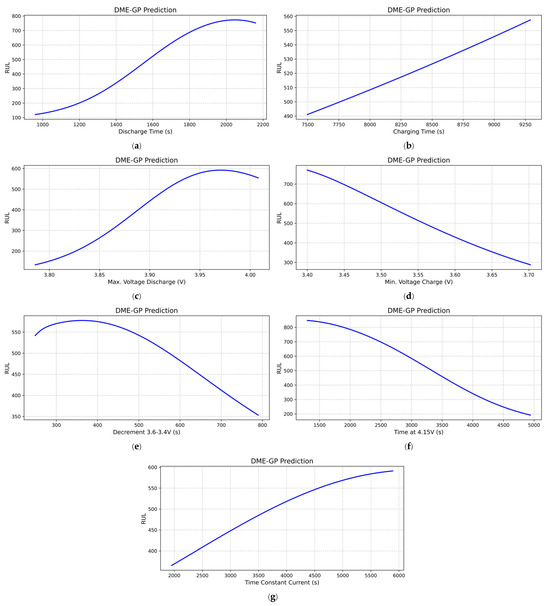
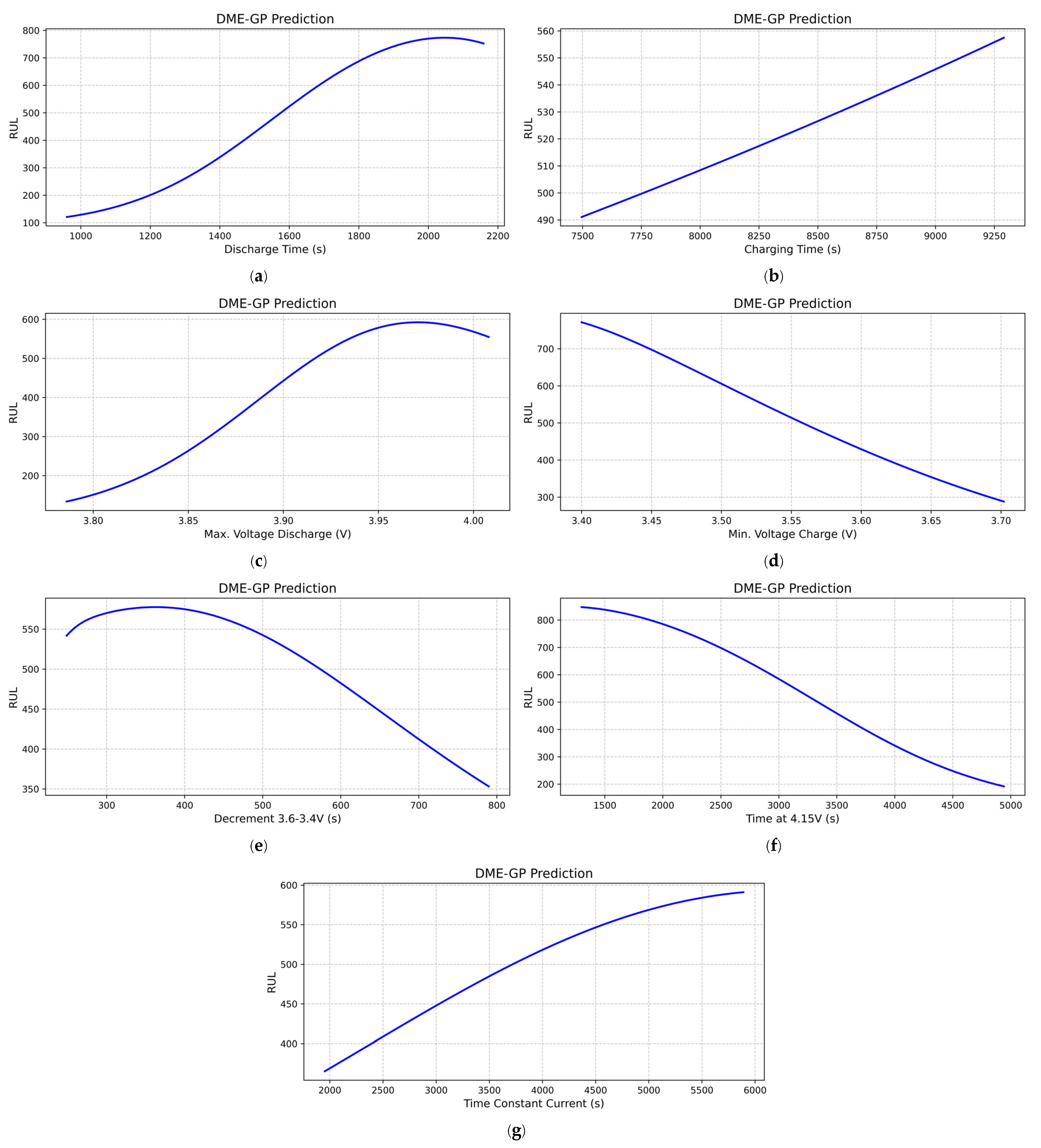
To isolate the individual effect of each feature, a partial dependence analysis was conducted. In this analysis, the value of one predictor was varied across its range while all other features were fixed at their mean values. For each feature, 1000 points were uniformly sampled along its value range. The trained DME-GP model was then applied to these samples to predict the corresponding RUL, thereby generating partial dependence plots that visualize the relationship between RUL and each individual feature, as presented in Figure 5.
Figure 5.
Partial dependence plots of the DME-GP model, showing the relationship between predicted RUL and individual input features. (a) Discharge time (); (b) Charging time (); (c) Maximum discharge voltage (); (d) Minimum charge voltage (); (e) Time for voltage drop between 3.63.4 V (); (f) Duration at 4.15 V (); (g) Constant current time ().
Panel (a) reveals a non-monotonic relationship between discharge time and RUL. The predicted RUL initially increases, peaks at approximately 2000 s, and subsequently declines as discharge time extends to 2200 s. A clear positive correlation is observed in (b), indicating that the battery RUL increases monotonically with charging time. The relationship in (c) exhibits a distinct threshold effect. The predicted RUL increases as the maximum discharge voltage rises to approximately 3.95 V, beyond which it begins to decrease. (d) demonstrates a negative correlation between the minimum charge voltage and the predicted RUL. Similar to (c), panel (e) indicates a threshold behavior near 350 s. The predicted RUL increases gradually with the voltage drop time until this point, after which it undergoes a rapid decline. (f) shows that the predicted RUL decreases with increasing duration at 4.15 V, with the rate of decline accelerating at higher durations. Finally, panel (g) indicates a positive correlation between the constant current time constant and the predicted RUL.
In summary, this study establishes the superior predictive accuracy and robustness of the proposed DME-GP model over the standard GP, based on comprehensive quantitative metrics (RMSE, MAE) and visualization analyses. This enhanced performance can be attributed to the effective hybrid architecture of the DME-GP model, which integrates deep learning with GP. Specifically, the deep mean function provides the high flexibility required to capture complex global trends and local structures. Concurrently, the GP component delivers principled uncertainty quantification. This synergy endows the model with enhanced generalization capability. Consequently, the DME-GP framework yields more reliable and stable RUL predictions, demonstrating its significant potential for improving the accuracy and trustworthiness of battery health management systems.
5. Discussion
This study presents a novel DME-GP model for RUL prediction of lithium-ion batteries. The proposed framework synergistically integrates a MLP as a global, shared feature extractor with sample-specific GPs under a mixed-effects paradigm. This architecture is designed to overcome two principal limitations in existing methods: the standard GP’s inability to capture complex global degradation trends and its prohibitive computational cost, alongside the lack of principled uncertainty quantification inherent in purely deep learning-based approaches. Consequently, the DME-GP model offers a data-driven solution that balances high predictive accuracy, significantly reduced computational overhead, and reliable probabilistic inference, which is critical for practical battery PHM.
The efficacy of the proposed model is rigorously validated through a hierarchical experimental design. Compared to a standard GP baseline, it achieved reductions in RMSE and MAE of up to 92.69% and 93.80% on a one-dimensional non-stationary function, and 90.61% and 91.13% on a four-dimensional coupled function, respectively. More importantly, on a real-world NMC-LCO battery dataset, the model maintained a substantial performance advantage, with maximum RMSE and MAE reductions of 63.41% and 62.63%. A key contributor to its practicality is the block-diagonal covariance structure induced by the mixed-effect formulation, which reduces the computational complexity from the cubic of a standard GP to a scalable linear , addressing a major bottleneck for large-scale applications.
Notwithstanding these promising results, the current study has certain limitations that point to future research directions. The validation was conducted primarily on an NMC-LCO battery dataset under fixed laboratory conditions (25 °C, CC-CV protocol). Thus, the model’s generalizability to other battery chemistries and more complex, dynamic real-world operating conditions warrants further investigation. Additionally, the parameter optimization relies on maximum likelihood estimation with the Adam algorithm, which, while effective, may encounter local optima when dealing with the high-dimensional hyperparameter space of the combined DNN-GP architecture, potentially affecting the final model performance. Finally, the present work focuses on static feature-based prediction; an extension to fully exploit the temporal correlations in sequential battery degradation data remains an open and necessary step for capturing the dynamics of battery aging.
To address these limitations and enhance the model’s utility, several avenues for future work are envisioned. First, exploring advanced meta-heuristic techniques, such as the artificial lemming algorithm or improved sparrow search algorithm, could more effectively navigate the hyperparameter space, potentially yielding better and more stable convergence. Second, extending the framework to handle temporal sequences by incorporating recurrent neural networks or attention-based architectures as the global feature mapping component would be a logical progression to model time-varying degradation patterns directly. Third, comprehensive validation across diverse battery types and dynamic cycling conditions is essential to establish robustness, followed by integration efforts for real-time deployment within BMS. Such efforts are crucial to transition the method from a promising proof-of-concept to a practical, trustworthy tool for battery PHM.
Author Contributions
Conceptualization, J.S.; Methodology, J.S.; Software, J.S.; Validation, J.S.; Formal analysis, J.S.; Investigation, J.S.; Resources, Z.F.; Data curation, J.S.; Writing—original draft, J.S.; Writing—review & editing, J.S.; Visualization, J.S.; Supervision, Z.F.; Project administration, Z.F. All authors have read and agreed to the published version of the manuscript.
Funding
This research received no external funding.
Data Availability Statement
The original contributions presented in this study are included in the article. Further inquiries can be directed to the corresponding author.
Conflicts of Interest
The authors declare no conflicts of interest.
Abbreviations
The following abbreviations are used in this manuscript:
| RUL | Remaining Useful Life |
| PHM | Prognostics and Health Management |
| DME-GP | Deep Mixed-Effect Gaussian Process |
| DNN | Deep Neural Network |
| GP | Gaussian Process |
| DKL | Deep Kernel Learning |
| MLP | Multi-layer Perceptron |
| RMSE | Root Mean Square Error |
| MAE | Mean Absolute Error |
| ECM | Equivalent Circuit Model |
| SVR-PF | Support Vector Regression–Particle Filter |
| RBF | Radial Basis Function |
| LHS | Latin Hypercube Sampling |
| IQRs | Interquartile Ranges |
| NMC-LCO | Nickel Manganese Cobalt–Lithium Cobalt Oxide |
| CC-CV | Constant Current–Constant Voltage |
| EOL | End of Life |
| BMS | Battery Management Systems |
| ALA | Artificial Lemming Algorithm |
| ISSA | Improved Sparrow Search Algorithm |
References
- Li, M.; Lu, J.V.; Chen, Z.; Amine, K. 30 Years of Lithium-Ion Batteries. Adv. Mater. 2018, 30, 1800561. [Google Scholar] [CrossRef] [Scilit]
- Han, X.; Lu, L.; Zheng, Y.; Feng, X.; Li, Z.; Li, J.; Ouyang, M. A review on the key issues of the lithium-ion battery degradation among the whole life cycle. eTransportation 2019, 1, 100005. [Google Scholar] [CrossRef] [Scilit]
- Gandoman, F.H.; Jaguemont, J.; Goutam, S.; Gopalakrishnan, R.; Firouz, Y.; Kalogiannis, T.; Omar, N.; Van Mierlo, J. Concept of Reliability and Safety Assessment of Lithium-Ion Batteries in Electric Vehicles: Basics, Progress, and Challenges. Appl. Energy 2019, 251, 113343. [Google Scholar] [CrossRef] [Scilit]
- Bera, C.; Gupta, R.K.; Mandal, R.; Kumar, A. Physically Interpretable and Experimentally Validated Uncertainty-Aware Causal Fusion Network for Real-Time Fault Diagnosis and Risk Quantification in Lithium-Ion Batteries for Electric Vehicles. J. Energy Storage 2026, 153, 121054. [Google Scholar] [CrossRef] [Scilit]
- Yu, Q.; Wang, C.; Li, J.; Xiong, R.; Pecht, M. Challenges and Outlook for Lithium-Ion Battery Fault Diagnosis Methods from the Laboratory to Real World Applications. eTransportation 2023, 17, 100254. [Google Scholar] [CrossRef] [Scilit]
- Zou, Y.; Zhao, S.; Liu, Y.; Li, Z.; Song, X.; Ding, G. The transfer prediction method of bearing remain use life based on dynamic benchmark. IEEE Trans. Instrum. Meas. 2021, 70, 2516211. [Google Scholar] [CrossRef] [Scilit]
- Cattaneo, L.; Polenghi, A.; Macchi, M. A framework to integrate novelty detection and remaining useful life prediction in Industry 4.0-based manufacturing systems. Int. J. Comput. Integr. Manuf. 2022, 35, 388–408. [Google Scholar] [CrossRef] [Scilit]
- Mo, Y.; Li, L.; Huang, B.; Li, X. Few-shot RUL estimation based on model-agnostic meta-learning. J. Intell. Manuf. 2023, 34, 2359–2372. [Google Scholar] [CrossRef] [Scilit]
- Lai, X.; Yi, W.; Cui, Y.; Qin, C.; Han, X.; Sun, T.; Zhou, L.; Zheng, Y. Capacity Estimation of Lithium-Ion Cells by Combining Model-Based and Data-Driven Methods Based on a Sequential Extended Kalman Filter. Energy 2021, 216, 119233. [Google Scholar] [CrossRef] [Scilit]
- Zhao, Z.; Kou, F.; Yang, T.; Fu, X. Fractional-Order-Model-Based State-of-Charge Fusion Estimation for Multi-Chemistry Lithium-Ion Batteries. J. Power Sources 2026, 666, 239186. [Google Scholar] [CrossRef] [Scilit]
- Collath, N.; Tepe, B.; Englberger, S.; Jossen, A.; Hesse, H. Aging Aware Operation of Lithium-Ion Battery Energy Storage Systems: A Review. J. Energy Storage 2022, 55, 105634. [Google Scholar] [CrossRef] [Scilit]
- Tran, M.K.; Mevawala, A.; Panchal, S.; Raahemifar, K.; Fowler, M.; Fraser, R. Effect of Integrating the Hysteresis Component to the Equivalent Circuit Model of Lithium-Ion Battery for Dynamic and Non-Dynamic Applications. J. Energy Storage 2020, 32, 101785. [Google Scholar] [CrossRef] [Scilit]
- Deshpande, V.S.; McMeeking, R.M. Models for the Interplay of Mechanics, Electrochemistry, Thermodynamics, and Kinetics in Lithium-Ion Batteries. Appl. Mech. Rev. 2023, 75, 010801. [Google Scholar] [CrossRef] [Scilit]
- Tian, Y.; He, J.; Peng, Z.; Guan, Y.; Wu, L. Lithium-Ion Battery Degradation and Capacity Prediction Model Considering Causal Feature. IEEE Trans. Transp. Electrif. 2022, 8, 3630–3647. [Google Scholar] [CrossRef] [Scilit]
- Zhang, C.; Allafi, W.; Dinh, Q.; Ascencio, P.; Marco, J. Online Estimation of Battery Equivalent Circuit Model Parameters and State of Charge Using Decoupled Least Squares Technique. Energy 2018, 142, 678–688. [Google Scholar] [CrossRef] [Scilit]
- Tian, N.; Fang, H.; Wang, Y. Real-time optimal lithium-ion battery charging based on explicit model predictive control. IEEE Trans. Ind. Inform. 2020, 17, 1318–1330. [Google Scholar] [CrossRef] [Scilit]
- Su, L.; Wu, M.; Li, Z.; Zhang, J. Cycle life prediction of lithium-ion batteries based on data-driven methods. eTransportation 2021, 10, 100137. [Google Scholar] [CrossRef] [Scilit]
- Gao, Z.; Wang, X.; Guo, X.; Cui, Z. Interactive data-model hybrid method based on unscented Kalman filter and bidirectional long short-term memory network with self-attention for lithium-ion battery remaining useful life prediction. J. Energy Storage 2026, 153, 120840. [Google Scholar] [CrossRef] [Scilit]
- Cheng, H.; Zhang, L. A physics-informed deep learning framework for remaining useful life prediction of lithium-ion batteries with feature subset construction. Energy 2026, 346, 140288. [Google Scholar] [CrossRef] [Scilit]
- Berecibar, M.; Gandiaga, I.; Villarreal, I.; Omar, N.; Van Mierlo, J.; Van den Bossche, P. Critical review of state of health estimation methods of Li-ion batteries for real applications. Renew. Sust. Energ. Rev. 2016, 56, 572–587. [Google Scholar] [CrossRef] [Scilit]
- Gu, H.; Zhang, Y. Efficient and Interpretable Machine Learning for Student Academic Outcome Prediction. Mathematics 2026, 14, 626. [Google Scholar] [CrossRef] [Scilit]
- Wu, Y.; Li, G.; He, L.; Zhao, J.; Zhang, R.; Cao, X. A Hybrid Coal Flow-Centric Predictive Model for Mining–Transportation Coordination Based on an LSTM–Transformer. Mathematics 2026, 14, 634. [Google Scholar] [CrossRef] [Scilit]
- Phan, D.T.; Truong, H.V.A.; Ahn, K.K. A Long Short-Term Memory with Deep Q-Learning and Bayesian Optimization Control Framework for Robust Position Regulation of Uncertain Electro-Hydraulic Actuators. Mathematics 2026, 14, 640. [Google Scholar] [CrossRef] [Scilit]
- Dong, H.; Jin, X.; Lou, Y.; Wang, C. Lithium-ion battery state of health monitoring and remaining useful life prediction based on support vector regression-particle filter. J. Power Sources 2014, 271, 114–123. [Google Scholar] [CrossRef] [Scilit]
- Li, X.; Yuan, C.; Li, X.; Wang, Z. State of health estimation for Li-Ion battery using incremental capacity analysis and Gaussian process regression. Energy 2020, 190, 116467. [Google Scholar] [CrossRef] [Scilit]
- Richardson, R.R.; Osborne, M.A.; Howey, D.A. Gaussian process regression for forecasting battery state of health. J. Power Sources 2017, 357, 209–219. [Google Scholar] [CrossRef] [Scilit]
- Yang, D.; Zhang, X.; Pan, R.; Wang, Y.; Chen, Z. A novel Gaussian process regression model for state-of-health estimation of lithium-ion battery using charging curve. J. Power Sources 2018, 384, 387–395. [Google Scholar]
- Fu, L.; Jiang, B.; Zhu, J.; Wei, X.; Dai, H. Early Remaining Useful Life Prediction for Lithium-Ion Batteries Using a Gaussian Process Regression Model Based on Degradation Pattern Recognition. Batteries 2025, 11, 221. [Google Scholar] [CrossRef] [Scilit]
- Tagade, P.; Hariharan, K.S.; Ramachandran, S.; Khandelwal, A.; Naha, A.; Kolake, S.M.; Han, S.H. Deep Gaussian process regression for lithium-ion battery health prognosis and degradation mode diagnosis. J. Power Sources 2020, 445, 227281. [Google Scholar] [CrossRef] [Scilit]
- Li, X.; Yuan, C.; Wang, Z. Multi-time-scale framework for prognostic health condition of lithium battery using modified Gaussian process regression and nonlinear regression. J. Power Sources 2020, 467, 228358. [Google Scholar] [CrossRef] [Scilit]
- Buchanan, S.; Crawford, C. Probabilistic lithium-ion battery state-of-health prediction using convolutional neural networks and Gaussian process regression. J. Energy Storage 2024, 76, 109799. [Google Scholar] [CrossRef] [Scilit]
- Liu, H.; Ong, Y.S.; Shen, X.; Cai, J. When Gaussian process meets big data: A review of scalable GPs. IEEE Trans. Neural Netw. Learn. Syst. 2020, 31, 4405–4423. [Google Scholar] [CrossRef] [Scilit] [PubMed]
- Liu, J.; Srikantha, P. Kernel Structure Design for Data-Driven Probabilistic Load Flow Studies. IEEE Trans. Smart Grid 2022, 13, 2679–2689. [Google Scholar] [CrossRef] [Scilit]
- Zhao, X.; Wang, L.; Zhang, Y.; Han, X.; Deveci, M.; Parmar, M. A review of convolutional neural networks in computer vision. Artif. Intell. Rev. 2024, 57, 99. [Google Scholar] [CrossRef] [Scilit]
- Li, X.; Yu, D.; Vilsen, S.B.; Subramanian, V.R.; Stroe, D.I. Robust remaining useful lifetime prediction for lithium-ion batteries with dual gaussian process regression-based ensemble strategies on limited sample data. IEEE Trans. Transp. Electrif. 2024, 11, 6279–6290. [Google Scholar] [CrossRef] [Scilit]
- Liu, L.; Sun, W.; Yue, C.; Zhu, Y.; Xia, W. Remaining Useful Life Estimation of Lithium-Ion Batteries Based on Small Sample Models. Energies 2024, 17, 4932. [Google Scholar] [CrossRef] [Scilit]
- Zhang, W.; Jia, J.; Pang, X.; Wen, J.; Shi, Y.; Zeng, J. An Improved Transformer Model for Remaining Useful Life Prediction of Lithium-Ion Batteries under Random Charging and Discharging. Electronics 2024, 13, 1423. [Google Scholar] [CrossRef] [Scilit]
- Luo, X.; Song, Y.; Bu, W.; Liang, H.; Zheng, M. A Joint Prediction of the State of Health and Remaining Useful Life of Lithium-Ion Batteries Based on Gaussian Process Regression and Long Short-Term Memory. Processes 2025, 13, 239. [Google Scholar] [CrossRef] [Scilit]
- Chen, D.; Hong, W.; Zhou, X. Transformer network for remaining useful life prediction of lithium-ion batteries. IEEE Access 2022, 10, 19621–19628. [Google Scholar] [CrossRef] [Scilit]
- Zhang, Y.; Gou, B. A Multimetric Feature Alignment Domain Adaptation Method with MLP for State-of-Health Estimation of Lithium-Ion Batteries. IEEE Trans. Transp. Electrif. 2026, 12, 1056–1068. [Google Scholar] [CrossRef] [Scilit]
- Sen, A.; Pratishtha, A.; Patel, P.; Jani, R.; Brahmbhatt, S.; Karelia, N.; Shukla, V.; Panda, K.; Panchal, S.; Fowler, M.; et al. Enhanced Surface Temperature Estimation of Li-Ion Batteries Using Optimized Random Forest Model for Battery Thermal Management Systems. J. Energy Storage 2026, 147, 120276. [Google Scholar] [CrossRef] [Scilit]
- Abbaszadeh Shahri, A.; Shan, C.; Larsson, S. A Novel Approach to Uncertainty Quantification in Groundwater Table Modeling by Automated Predictive Deep Learning. Nat. Resour. Res. 2022, 31, 1351–1373. [Google Scholar] [CrossRef] [Scilit]
- Gawlikowski, J.; Tassi, C.R.N.; Ali, M.; Lee, J.; Humt, M.; Feng, J.; Kruspe, A.; Triebel, R.; Jung, P.; Roscher, R.; et al. A survey of uncertainty in deep neural networks. Artif. Intell. Rev. 2023, 56, 1513–1589. [Google Scholar] [CrossRef] [Scilit]
- Franchi, G.; Bursuc, A.; Aldea, E.; Dubuisson, S.; Bloch, I. Encoding the latent posterior of bayesian neural networks for uncertainty quantification. IEEE Trans. Pattern Anal. Mach. Intell. 2023, 46, 2027–2040. [Google Scholar] [CrossRef] [Scilit] [PubMed]
- Sun, C.; Lu, T.; Li, Q.; Liu, Y.; Yang, W.; Xie, J. Predicting the Future Capacity and Remaining Useful Life of Lithium-Ion Batteries Based on Deep Transfer Learning. Batteries 2024, 10, 303. [Google Scholar] [CrossRef] [Scilit]
- Quan, R.; Li, W.; Cheng, G.; Liu, J.; Zheng, L.; Huang, X. Interpretable Degradation Forecasting of Fuel Cells Under Steady, Quasi-Dynamic and Dynamic Conditions: An ALA Optimized TimesNet Model Based on ICEEMDAN Decomposition. Int. J. Green Energy 2026, 1–32. [Google Scholar] [CrossRef] [Scilit]
- Xiao, Y.; Cui, H.; Khurma, R.A.; Castillo, P.A. Artificial lemming algorithm: A novel bionic meta-heuristic technique for solving real-world engineering optimization problems. Artif. Intell. Rev. 2025, 58, 84. [Google Scholar] [CrossRef] [Scilit]
- Gao, B.; Shen, W.; Guan, H.; Zheng, L.; Zhang, W. Research on Multistrategy Improved Evolutionary Sparrow Search Algorithm and Its Application. IEEE Access 2022, 10, 62520–62534. [Google Scholar] [CrossRef] [Scilit]
- Yue, Y.; Cao, L.; Lu, D.; Hu, Z.; Xu, M.; Wang, S.; Li, B.; Ding, H. Review and Empirical Analysis of Sparrow Search Algorithm. Artif. Intell. Rev. 2023, 56, 10867–10919. [Google Scholar] [CrossRef] [Scilit]
- Quan, R.; Zhou, Y.; Li, W.; Wan, H. A Hybrid Data-Driven Approach for SOH Estimation of Lithium-Ion Batteries Based on Health Index Extraction and QHDBO-BiTCN-BiGRU. J. Energy Storage 2025, 125, 116788. [Google Scholar] [CrossRef] [Scilit]
- Quan, R.; Cheng, G.; Guan, X.; Zhang, G.; Quan, J. A HO-BiGRU-Transformer based PEMFC degradation prediction method under different current conditions. Renew. Energy 2025, 256, 124132. [Google Scholar] [CrossRef] [Scilit]
- Kaggle Dataset: Battery Remaining Useful Life (RUL). Available online: https://www.kaggle.com/datasets/ignaciovinuales/battery-remaining-useful-life-rul (accessed on 31 December 2022).

Disclaimer/Publisher’s Note: The statements, opinions and data contained in all publications are solely those of the individual author(s) and contributor(s) and not of MDPI and/or the editor(s). MDPI and/or the editor(s) disclaim responsibility for any injury to people or property resulting from any ideas, methods, instructions or products referred to in the content. |
© 2026 by the authors. Licensee MDPI, Basel, Switzerland. This article is an open access article distributed under the terms and conditions of the Creative Commons Attribution (CC BY) license.