


Abstract
Engineering computer graphics education frequently exhibits a gap between procedural CAD software (e.g., CATIA 2022) training and the strategic engineering reasoning required by industrial practice. This paper documents a holistic redesign of two advanced CAD courses. The study is framed within the Scholarship of Teaching and Learning (SoTL) tradition as a practitioner-led reflective case study. The redesign integrates four pedagogical mechanisms within an enterprise-CAD context: authentic problem-based learning, dual-layered asynchronous video scaffolding, software-agnostic heuristics (including pre-modelling cognitive mapping), and cognitive apprenticeship. The analysis triangulates three institutional data sources: quantitative Course Experience Survey indicators, qualitative student response themes, and twelve consecutive years of cohort-level academic performance records (2013–2024). The 2022 intervention iteration coincided with a marked elevation in academic performance. Grades reached approximately two standard deviations above the historical baseline. Concurrently, qualitative themes highlighted perceived industrial relevance and platform-portable confidence. However, performance in the post-intervention iterations (2023 and 2024) partially regressed. While scores remained above the historical mean, they did not sustain the 2022 peak. This pattern indicates partial sustainment, rather than evidence of a stable or definitive sustained pedagogical effect. This case is reported as descriptive rather than inferential. While the observed patterns align strongly with theoretical predictions, they do not establish definitive causal effects. Ultimately, the primary contribution of this study lies in documenting the integrated operationalization of these four mechanisms. Furthermore, it highlights longitudinal pedagogical sustainability as a critical, under-examined dimension that single-iteration evidence systematically obscures.
1. Introduction
In modern engineering and industrial manufacturing, advanced 3D Computer-Aided Design (CAD) software, such as CATIA, plays a critical role in the full-lifecycle development of products. Consequently, tertiary engineering curricula bear the responsibility of cultivating graduates who are highly proficient in these digital tools and possess strong industrial work-readiness. However, the transition from fundamental 2D engineering drawing to complex 3D parametric modeling presents significant cognitive challenges for students.
While modern CAD platforms provide robust toolsets, traditional instructional methods frequently reduce learning to procedural memorization rather than fostering strategic engineering design. A prevalent issue in this context is the disconnection between command execution and design rationale. For instance, students may readily master the specific software function required to generate a reference plane; however, they often lack the conceptual understanding of why such a datum is necessary for parametric dependencies. Consequently, when confronted with authentic industrial tasks that necessitate the translation of 2D orthographic technical drawings into 3D models, students frequently encounter cognitive bottlenecks. They struggle to formulate a coherent modeling strategy, unable to determine when or how to appropriately apply relevant software functions. This deficiency highlights a critical gap in CAD education: the phenomenon where students are equipped with mechanical software skills but remain constrained by a lack of underlying engineering intent.
- What is already known.
- ▪
- CAD pedagogy research has established that procedural CAD competence is largely cognitive rather than motoric (Hamade et al., 2007; Hamade et al., 2009). Furthermore, strategic and constraint-based knowledge—not software syntax—underwrites transfer between platforms (Camba et al., 2016; Garikano et al., 2018; Lang et al., 1991; Wiebe, 2009). Studies also show that authentic problem-based learning (PBL) enhances student autonomy and aligns coursework with industrial workflows (Balan et al., 2019; Berselli et al., 2020; Fernandes et al., 2020). Additionally, asynchronous video scaffolding combined with self-assessment can mitigate the extraneous cognitive load imposed by complex enterprise software (Çeken & Taşkın, 2022; Meyer et al., 2019; Pando Cerra et al., 2022). Therefore, the individual evidentiary base for each of these pedagogical commitments is substantial.
- What is insufficiently addressed.
- ▪
- Three gaps remain in existing literature. First, prior empirical studies predominantly examine one pedagogical mechanism at a time (e.g., strategic knowledge, video scaffolding, or PBL). They rarely investigate their concurrent integration. Second, documented redesigns are mostly situated in introductory CAD modules. They are rarely examined in advanced, final-year courses where transitioning to enterprise-level platforms (e.g., CATIA) is the primary challenge. Third, the longitudinal durability of these pedagogical innovations is rarely examined empirically, as most reports rely on single-iteration data.
- What this case adds.
- ▪
- This study contributes a documented configuration of four theoretically grounded mechanisms implemented concurrently within an advanced enterprise-CAD context. Furthermore, we utilize twelve consecutive years of cohort-level institutional data (2013–2024). This longitudinal dataset allows the immediate post-intervention iteration to be evaluated against a seven-year baseline and two subsequent iterations. The contribution is strictly descriptive. It documents how the four mechanisms can be operationalized in concert, identifies the longitudinal patterns of student performance, and examines what the observed partial sustainment reveals about pedagogical innovations over time.
2. Literature Review and Theoretical Framework
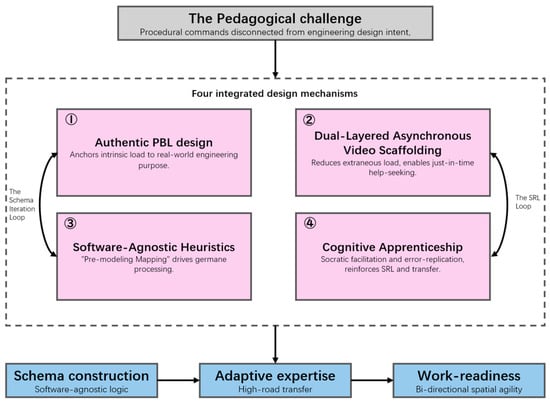
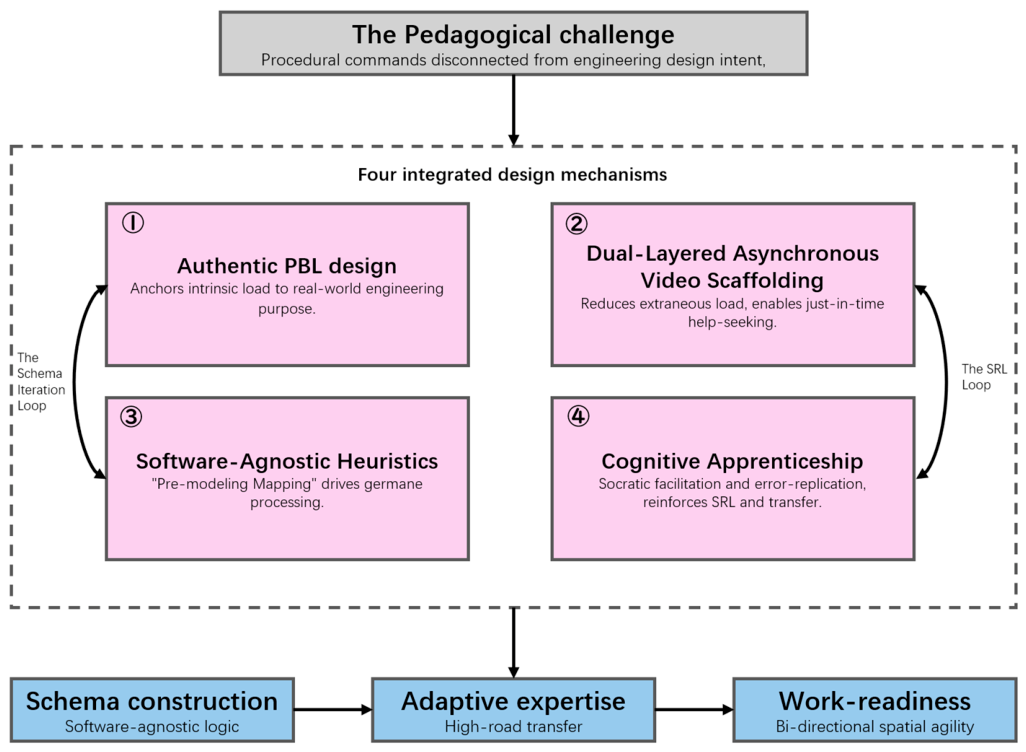
To frame the present case account, four bodies of scholarly work are drawn together: research on authentic problem-based learning (PBL), Cognitive Load Theory (CLT) coupled with Self-Regulated Learning (SRL), the literature on transfer of learning and strategic CAD knowledge, and research on cognitive apprenticeship in software-intensive engineering instruction. This literature is not reviewed sequentially as parallel topics. They are integrated within a single framework (Figure 1) in which each body of evidence underwrites one specific design mechanism implemented in the curriculum redesign described in Section 3.
Figure 1.
The theoretical design framework guiding the curriculum redesign. Arrows represent theorized cognitive pathways and pedagogical alignments predicted by the integrated literature reviewed in Section 2; they do not depict empirically tested causal effects. The framework served as a design heuristic for the 2022 intervention and as an analytical lens for the present reflective account.
The framework rests on a long-standing distinction between declarative and procedural knowledge in CAD learning (Lang et al., 1991). Declarative knowledge concerns software-specific syntax, such as which icon executes a command. However, procedural or strategic knowledge concerns the planning of feature dependencies, constraint hierarchies, and modelling sequences. Empirical work shows that procedural CAD competence is largely cognitive, not motoric (Hamade et al., 2007; Hamade et al., 2009). Therefore, overemphasizing declarative syntax is counterproductive. It produces graduates who operate on one platform fluently but struggle to migrate to another (Garikano et al., 2018; Wiebe, 2009). The four mechanisms in Figure 1 target this strategic dimension of CAD expertise.
2.1. Authentic PBL Design: Industrial-Artefact Tasks as Motivational Anchor
Authentic learning environments are increasingly viewed as a pedagogical imperative in engineering education. The development of contemporary graduate attributes—particularly complex problem-solving and adaptive cognition—has been linked empirically to the integration of open-ended, practice-oriented activities (Gutiérrez Ortiz et al., 2020). Within CAD pedagogy, problem-based learning (PBL) effectively addresses the limitations of decontextualized exercises. Balan reported that open-ended group projects enhanced student autonomy (Balan et al., 2019). These projects also align coursework with the nonlinear workflows of industrial design. Specifically, Fernandes documented a PBL implementation integrating CAD/CAE/CAM with positive outcomes in self-learning (Fernandes et al., 2020). Berselli reported similar gains using advanced CAD/CAE tools (Berselli et al., 2020).
These findings collectively support the use of complex, full-lifecycle industrial artefacts as the central instructional anchor of a CAD course. Such anchoring also aligns with multidimensional conceptualizations of work-readiness, which view it not as a narrow technical capability but as a composite of cognitive, dispositional, and identity-formation outcomes (Peersia et al., 2024).
Therefore, the present design treats industrial-artefact tasks as the curriculum’s motivational anchor (Mechanism 1 in Figure 1). Examples include mechanical pistons, planetary gearboxes, and consumer-electronics assemblies. Following Balan and Fernandes, these authentic artefacts elicit deeper procedural engagement than out-of-context geometric exercises (Balan et al., 2019; Fernandes et al., 2020). Within Cognitive Load Theory, this anchoring serves a specific function. It converts unstructured intrinsic load into purposeful intrinsic load. Consequently, it provides the motivational ground on which the remaining three mechanisms operate.
2.2. Asynchronous Video Scaffolding: Managing Extraneous Load and Enabling Self-Regulated Learning
Authentic CAD tasks introduce substantial intrinsic complexity. Learning to operate complex computer programs has long been recognized as cognitively demanding (Chandler & Sweller, 1996). Enterprise-level CAD software intensifies this demand. Learners must simultaneously navigate dense graphical user interfaces, interpret 2D orthographic drawings, and perform 3D mental simulations (Çeken & Taşkın, 2022). Cognitive Load Theory provides a vocabulary for these phenomena. It distinguishes between intrinsic load (inherent task complexity), extraneous load (unnecessary effort imposed by instructional format), and germane load (effort dedicated to schema construction) (Ouwehand et al., 2025). Without instructional support, the divided attention required by CAD modelling generates a severe extraneous load. This load displaces germane processing, thereby producing the procedural bottlenecks documented in empirical CAD-learning curves (Hamade et al., 2009).
Asynchronous video scaffolding has been shown to mitigate this displacement. Worked-example videos that visualize expert operational processes systematically reduce the trial-and-error navigation cost imposed by complex software interfaces (Çeken & Taşkın, 2022; Meyer et al., 2019). Pando Cerra reported empirical learning gains from integrating interactive self-assessment tools with CAD video resources in a controlled study of first-year mechanical engineering students (Pando Cerra et al., 2022). The efficacy of such scaffolding, however, depends on Self-Regulated Learning behaviors (Zimmerman, 2002): goal setting, performance monitoring, and strategic help-seeking (Puustinen & Pulkkinen, 2001). When asynchronous video resources are made available alongside open-ended PBL tasks, learners typically access specific segments now of procedural impasse—a pattern that operationalizes the performance-control phase of the SRL cycle.
The present curriculum design implements a dual-layered video resource informed by these findings. It pairs comprehensive macro-lecture recordings with short, micro-modular tutorial videos targeted at specific component tasks. The micro-modular layer is intended to enable just-in-time access during PBL work. This preserves learner autonomy while significantly reducing extraneous load, constituting Mechanism 2 in Figure 1.
2.3. Software-Agnostic Heuristics: Pre-Modelling Cognitive Mapping for Transfer
Reducing extraneous load alone does not guarantee that students develop transferable expertise. Research on procedural CAD knowledge consistently shows that surface-level, syntax-bound learning impedes migration between CAD platforms (Lang et al., 1991; Wiebe, 2009). Effective skill migration occurs instead at the semantic level of constraint-based, feature-driven strategy (Besharati-Foumani et al., 2020; Wiebe, 2009). Several scholars argue that this strategic dimension must be made explicit in instruction (Bodein et al., 2014; Wiebe et al., 2003). It cannot be left for students to infer from mere exposure to a single software interface. Garikano demonstrated empirically that the scaffolded planning of modelling strategies improved both the robustness and reusability of student CAD models (Garikano et al., 2018). Similarly, Camba, Contero, and Company showed that explicit modelling strategies produce more reusable parametric designs across platforms (Camba et al., 2016). Furthermore, the company provided rubric-level guidance for evaluating this strategic quality in modelling work (Company et al., 2015).
Drawing this work together, transfer-oriented CAD pedagogy focuses on cultivating “high-road” rather than “low-road” transfer (Perkins & Salomon, 1992). High-road transfer requires a mindful abstraction of constraint-based principles independent of any interface. It opposes the reflexive reproduction of memorized command sequences. Mechanism 3 in Figure 1 operationalizes this orientation through a pre-modelling cognitive mapping practice. In this practice, students draft a handwritten “workflow tree” before ever opening the software. The handwritten draft externalizes strategic intent before the GUI imposes its specific syntax. Consequently, it builds a representational scheme that can be readily re-applied when students encounter different CAD platforms. This practice extends the explicit-strategy traditions of Branoff, Bodein, and Garikano (Bodein et al., 2014; Branoff et al., 2001; Garikano et al., 2018). It achieves this by relocating the strategic articulation entirely outside the digital environment.
2.4. Cognitive Apprenticeship: Socratic Facilitation and Diagnostic Error Replication
Authentic learning is not produced by complex tasks alone. It also requires structured reflective interaction with more knowledgeable others (Turns et al., 2020). The cognitive apprenticeship tradition formalizes this requirement. It characterizes effective skill instruction as a process of modelling, coaching, scaffolding, and progressive fading by an expert who reasons aloud (Collins et al., 1989). Specifically in CAD instruction, this orientation fundamentally shifts the tutor’s role. The tutor acts as a Socratic facilitator who prompts students to verbalize their modelling rationale. They no longer act as a procedural problem-solver who corrects errors directly by taking control of the keyboard.
Two specific pedagogical strategies arise from this tradition and are deployed in the present design. First, the design uses multi-path demonstrations to explicitly show how alternative feature sequences can yield the same final geometry. This works against the novice misconception of a singular “correct” command sequence. Consequently, it supports schema flexibility, which is consistent with the strategy-diversity findings of Camba (Camba et al., 2016). Second, the design implements diagnostic error replication. Here, the tutor reproduces the student’s specific error within an isolated workspace and articulates why it occurred topologically. This converts the encounter from a quick procedural fix into a deep conceptual demonstration. By foregrounding the topological reason for failure, this practice strongly supports schema construction. Constraint-based modelling research identifies this schema construction as the fundamental substrate of robust parametric design (Bodein et al., 2014; Garikano et al., 2018).
Mechanism 4 in Figure 1 implements this orientation through comprehensive tutor training in Socratic guidance and diagnostic error replication. It establishes a deliberate institutional norm that actively suppresses the common practice of tutors taking physical control of a student’s workspace. The intended effect of this approach is the development of independent troubleshooting heuristics rather than dependent procedural recall.
2.5. Comparative Landscape: Positioning the Present Case in International CAD Pedagogy Research
The four mechanisms discussed above are individually grounded in established literature. However, their integration within a single advanced enterprise-CAD course represents a less commonly documented configuration. Three broader strands of international CAD pedagogy research provide a comparative context for the present case study.
First, North American research on constraint-based modelling pedagogy has predominantly addressed introductory engineering graphics courses (Branoff et al., 2001; Wiebe et al., 2003). This strand focuses on how dynamic, constraint-aware tasks can replace static drafting exercises early in the curriculum. Second, European research has heavily emphasized modelling strategy and assessment rubric development for parametric CAD (Camba et al., 2016; Company et al., 2015). This work pays sustained attention to design reusability and comprehensive quality assessment. A parallel Spanish research line has closely examined strategic-knowledge scaffolding and self-assessment integration (Garikano et al., 2018; Pando Cerra et al., 2022). Third, a more recent wave of empirical PBL implementations in CAD curricula has emerged (Berselli et al., 2020; Fernandes et al., 2020; Gelmez & Arkan, 2021). These studies report positive learner outcomes when project-based delivery is explicitly combined with self-regulated and assessment-aware components.
Three specific observations follow from this comparative landscape, which constitute the sharply delineated research gaps this study addresses.
- Lack of Concurrent Integration: Prior work tends to address one instructional mechanism at a time rather than examining their concurrent integration.
- Contextual Gap in Advanced Transitions: Most documented redesigns are situated in introductory CAD courses rather than advanced, enterprise-level platform transitions.
- Absence of Longitudinal Sustainability Data: Prior reports typically rely on single post-intervention cohorts. Therefore, they cannot empirically examine whether an intervention’s first-iteration signal sustains, attenuates, or dissipates over time.
The present case account directly addresses these three observations. It extends prior work by attempting the concurrent integration of all four mechanisms within an advanced platform-transition context. It also leverages twelve consecutive iterations of institutional data to empirically examine the partial-sustainment question. Therefore, this case does not aim to confirm a single existing approach. Instead, it serves as a documented configuration of integrated approaches, whose comparative effectiveness invites systematic future investigation across multiple sites.
3. Methodology: A Case Study Approach
3.1. Research Context and Participants
This study is structured as a practitioner-led reflective case study (Stake, 1995; Yin, 2014). It is conducted within the Scholarship of Teaching and Learning (SoTL) tradition (Felten, 2013). It is not a quasi-experimental trial. Therefore, no claims of causal attribution are made. Instead, the study documents a deliberately redesigned iteration of two advanced CAD courses. It draws on twelve consecutive years of routinely collected institutional data (2013–2024) and aggregated student feedback. These data sources characterize the teaching context and record longitudinal patterns in student perception and academic performance.
The reflective case study format was chosen for three specific reasons. First, the redesign was an act of disciplined teaching practice, not a pre-specified intervention trial. Consequently, the available data comes from routine institutional quality assurance processes rather than experimental protocols. Second, the unit of analysis involves two related courses sharing a single coordinator within one institution. This scenario is best treated as a particular case to be understood in depth (Stake, 1995), rather than a population sample. Third, the study aligns with Felten’s principles of good SoTL practice (Felten, 2013). These principles include inquiry focus, contextual grounding, and partnership with students, which provide the normative frame for this account.
Accordingly, the research questions guiding this study are framed descriptively rather than inferentially:
RQ1: How was the redesigned curriculum operationalized across the four integrated pedagogical mechanisms (authentic PBL, video scaffolding, software-agnostic heuristics, and cognitive apprenticeship)?
RQ2: What longitudinal patterns of student perception (via Course Experience Surveys) and cohort-level academic performance (via 12 years of grade records) accompanied the redesign?
RQ3: What potentially transferable pedagogical lessons, particularly regarding the sustainability of the redesign, can be drawn for other software-intensive engineering courses?
3.2. Course Context and Participants
This case study is situated within two final-year, Honours-level CAD courses (referred to here as Course A and Course B) at a major Australian metropolitan university. Although they have distinct enrolments, the courses share a single coordinator, a common teaching team, a unified pedagogical philosophy, and a common criterion-referenced assessment framework. Consequently, they are treated jointly as a single case on this account. Both courses are electives within the Mechanical, Manufacturing, and Aerospace Engineering programs. They contribute significantly to students’ Weighted Average Mark. Their placement renders them high-stakes academic components and critical bridges to industrial design practice.
Both courses use CATIA as the primary CAD environment. They have no formal prerequisite CAD coursework; the only requirement is foundational engineering graphics. Nevertheless, many students enter with self-taught experience in introductory platforms (most commonly SolidWorks 2024). This heterogeneous, self-taught background is a defining feature of the cohort. It directly motivated the software-agnostic transfer mechanism detailed in Section 3.3.
Twelve consecutive iterations are referenced in this account, spanning the 2013–2024 academic years. For analytical clarity, these are divided into four analytical phases plus one excluded iteration:
Analytical baseline (2013–2019): Seven iterations preceding both the COVID-19 disruption and the present redesign. These serve as the historical reference period.
Excluded iteration (2020): A single iteration heavily disrupted by the pandemic. Cohort-level mean grades departed from the baseline by approximately 3.5 standard deviations, while High Distinction rates deviated by 8.7 standard deviations. This reflects documented pandemic-period grade inflation. Therefore, it cannot serve as a comparable measurement condition. It is reported transparently in Section 4 but excluded from baseline comparisons.
Immediate pre-intervention (2021): The final iteration immediately preceding the redesign.
Intervention (2022): The redesigned iteration central to this account.
Post-intervention continuation (2023–2024): Two iterations during which the new curriculum was sustained. These test the durability of the intervention-associated patterns.
Enrolment across the two courses averaged approximately 110 to 130 students annually, subject to natural year-to-year fluctuations in cohort size. Crucially, these consecutive iterations are not treated as controlled comparison groups. They differ across multiple confounding dimensions. These include post-pandemic learning conditions and natural variations in student engagement. Additionally, enrolment is elective, meaning students possess heterogeneous prior CAD backgrounds. Therefore, this juxtaposition establishes a descriptive context for the redesign, rather than proving definitive causal effects.
The courses were delivered in four-hour weekly laboratory blocks. Instead of a rigid lecture-tutorial split, the teaching team adopted an agile delivery model. The balance between conceptual instruction and hands-on practice was calibrated weekly based on topic complexity. In pre-redesign iterations, student feedback and staff observations consistently highlighted high extraneous cognitive load. Students experienced severe procedural frustration when transitioning from self-taught basic CAD to enterprise-level CATIA. These recurring observations motivated the holistic redesign implemented in 2022.
3.3. Pedagogical Interventions
3.3.1. Design Philosophy and Targeted Cognitive Bottlenecks
The redesign was guided by the principle of constructive alignment (Biggs, 1996). This principle requires a deliberate calibration of learning outcomes, instructional activities, and assessment criteria. Each component must reinforce the same target competency. Within this framework, the redesign addressed four prevalent cognitive bottlenecks in CAD acquisition. These bottlenecks were frequently observed in pre-redesign cohorts. Furthermore, the literature identifies them as common challenges in parametric CAD instruction (Camba et al., 2016; Garikano et al., 2018; Hamade et al., 2007). Table 1 summarizes these targeted bottlenecks.
Table 1.
Four cognitive bottlenecks targeted by the curriculum redesign.
Pre-redesign instruction addressed these bottlenecks reactively as they arose during student work. In contrast, the redesign treated them as anticipated curricular targets. It reorganized four pedagogical mechanisms to address these bottlenecks proactively and concurrently. These mechanisms are detailed below.
3.3.2. Authentic PBL Design: From Orthographic Drawings to Parametric Assemblies
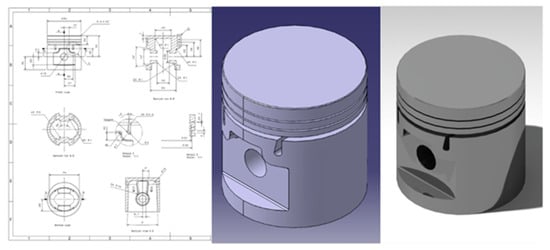
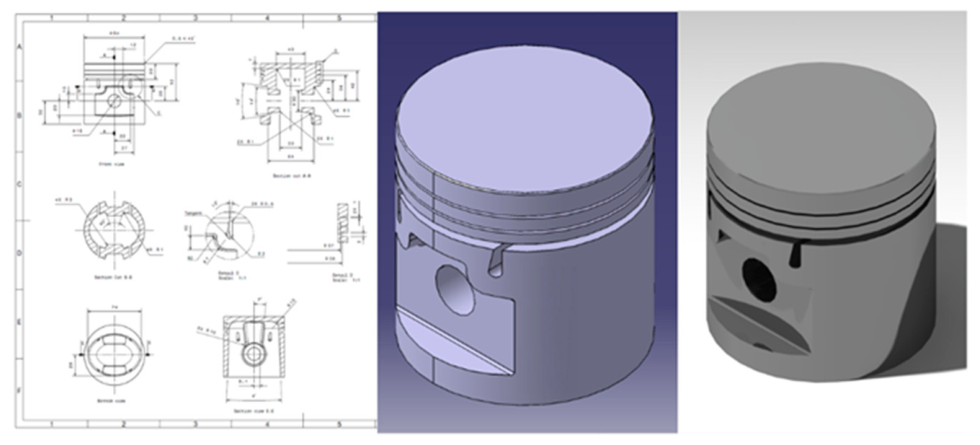
To bridge the gap between theoretical instruction and industrial application, the curriculum implemented a rigorous PBL framework. Rather than relying on simplified geometric exercises, students modelled complex, real-world products. These ranged from mechanical assemblies (e.g., pistons and planetary gearboxes) to consumer electronics (e.g., headphones and shavers). Figure 2 illustrates a typical PBL task involving this transition from 2D to 3D.
Figure 2.
An authentic PBL task: Transitioning from a 2D orthographic drawing to the final 3D parametric model of a complex piston.
Progressively scaffolded tutorials prepared students for the cognitive demands of these comprehensive tasks. These tutorials utilized “micro-industrial” components, such as smartphone enclosures and aerospace stringers. These low-stakes, authentic tasks allowed students to internalize fundamental parametric logic before tackling high-stakes assemblies. Crucially, these exercises also provided the primary context for the asynchronous video scaffolding.
Furthermore, the instructional team intentionally cultivated “psychological safety” within the laboratory. By adopting a peer-collaborator dynamic, tutors actively dismantled affective barriers. This non-judgmental atmosphere empowered students to freely articulate foundational uncertainties. Instructors addressed these fundamental queries immediately. This prevented early procedural misunderstandings from compounding into systemic modelling failures.
Following the preparatory phase, students engaged with the primary PBL tasks. The primary inputs were complex 2D orthographic assembly drawings. To overcome initial spatial visualization barriers, the team provided macroscopic demonstrations of the fully assembled components. This enabled learners to construct a holistic 3D cognitive schema prior to detailed part design. The mandated output required students to deliver complete, fully constrained 3D parametric models.
As outlined in Table 1, these PBL tasks were strategically engineered to expose specific cognitive bottlenecks. By embedding these technical pitfalls directly into the projects, the intervention required a critical transition. Students moved from mechanical “button-pushing” to deep engineering problem-solving. Ultimately, this approach cultivated bi-directional spatial agility. Learners developed the fluency to rapidly build 3D models from 2D blueprints and, conversely, extract standard drawings from 3D assemblies. This fluency directly bridges academic instruction and modern engineering workflows.
3.3.3. Dual-Layered Asynchronous Video Scaffolding and Error-Based Examples
To systematically manage cognitive load, the instructional team deployed a dual-layered asynchronous video scaffolding strategy. The first layer consisted of full-length lecture recordings. These continuous sessions ensured the conceptual coherence of foundational parametric modelling concepts. The second layer utilized a micro-modular approach to support practical tutorials. Short, dedicated videos were generated for each specific “micro-industrial” model. This granularity empowered students to engage in self-regulated learning. Upon encountering a procedural impasse, learners could immediately access precise, just-in-time scaffolding without navigating irrelevant content.
Crucially, tutors were briefed to adopt an explicit non-hierarchical posture during laboratory sessions. Students were encouraged to raise procedurally elementary questions without prior peer consultation. The goal was to surface foundational misconceptions before they propagated into downstream modelling errors. This adjustment was directly motivated by recurring pre-redesign instances. In previous cohorts, novice uncertainty about basic CATIA navigation often went unspoken until it compounded into systemic geometry failures.
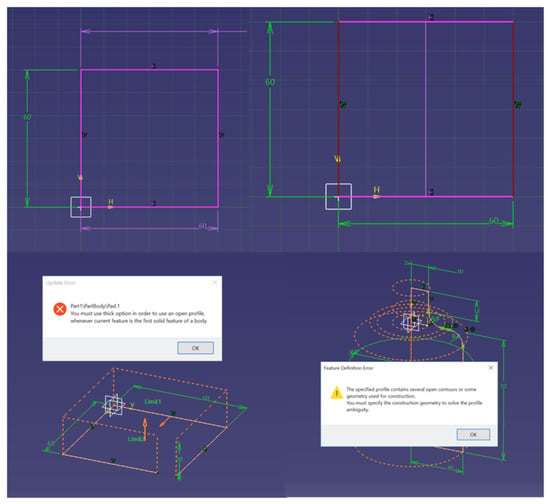
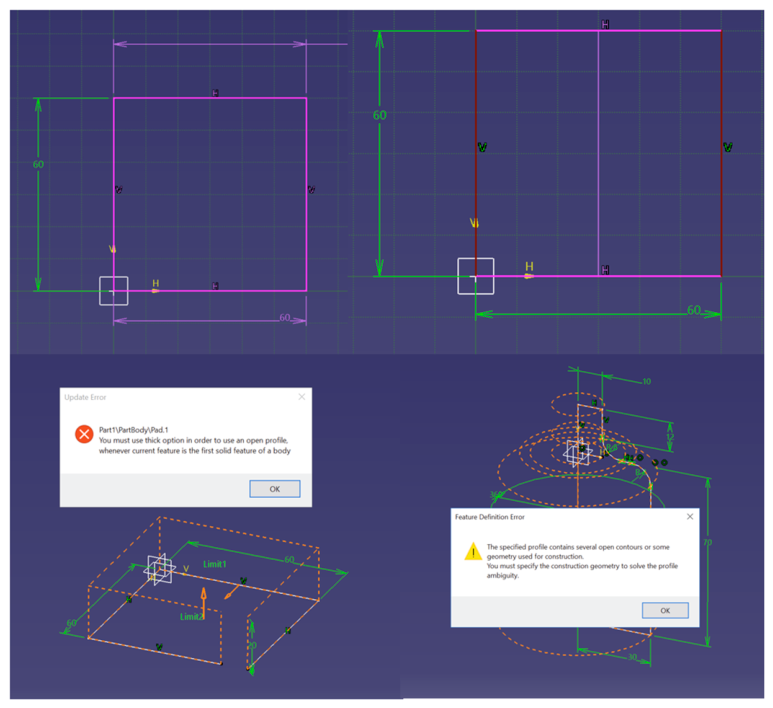
Furthermore, the videos deliberately showcased common novice errors and their cascading topological consequences. For example, instructors intentionally simulated under-constrained and over-constrained sketches as shown in Figure 3. This visualized how mismanaging Degrees of Freedom (DOF) causes assembly failures during subsequent parameter modifications. By explicitly demonstrating these failures, the scaffolding transitioned students from passive observers to analytical troubleshooters. Instructors articulated exactly why specific approaches were fundamentally flawed. This proactive exposure was intended to support students’ comprehension of parametric dependencies and robust design methodologies.
Figure 3.
An example of the diagnostic error replication strategy: demonstrating an over-constrained sketch and its resulting topological conflicts to cultivate students’ troubleshooting heuristics.
3.3.4. Facilitating Cognitive Transfer and Software-Agnostic Heuristics
Crucially, this mechanism leverages students’ heterogeneous, predominantly self-taught prior experience with introductory platforms like SolidWorks (as noted in Section 3.2). Rather than treating this prior knowledge as irrelevant or interface-specific baggage, the redesign actively converted it into a transferable scheme. To accelerate the acquisition of enterprise-level CATIA, the instructor verbally facilitated “semantic mapping” during lectures. This strategy explicitly emphasized the universal commonalities of parametric modeling, such as transitioning from 2D constrained profiles to 3D volumetric features. Simultaneously, it actively diminished the importance of superficial interface disparities (e.g., different icons). By distinguishing between software-specific syntax and universal semantics, students realized that core engineering logic remains constant across platforms.
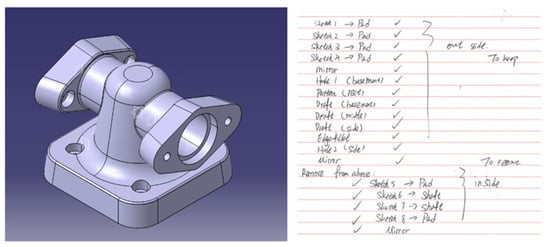
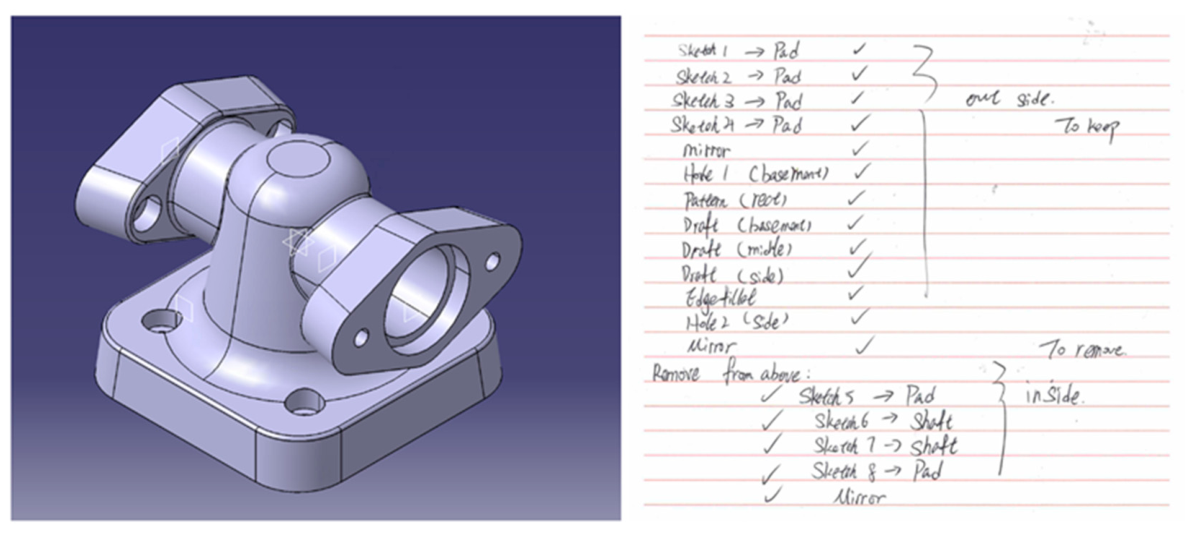
To operationalize this software-agnostic philosophy, the curriculum introduced “pre-modeling cognitive mapping.” By emphasizing this practice, the practice required students to abstract their existing CAD logic before engaging with the new CATIA interface. Prior to initiating any interaction with the software, students mentally deconstructed complex industrial geometries into discrete feature chunks. Subsequently, they manually drafted an anticipated “workflow tree” on paper as shown in Figure 4. This handwritten outline required learners to logically sequence operations. It also required them to plan parametric dependencies and anticipate topological conflicts before executing a single digital command.
Figure 4.
A student’s handwritten “workflow tree,” illustrating the analog practice of pre-modeling cognitive mapping and software-agnostic procedural planning.
This analog practice of conceptual scripting was a central operational element of the redesign. By constructing a theoretical sequence independent of the digital environment, students were guided to internalize a tool-independent algorithmic strategy. The intended outcome is the development of platform-agnostic competence: graduates positioned not merely as proficient operators of a single software version but as engineers capable of adapting to alternative digital design environments.
3.3.5. Teaching Team Alignment and Cognitive Apprenticeship
To ensure consistent delivery across all laboratory sessions, the instructional team underwent continuous mentoring. A critical component was the implementation of iterative weekly pedagogical debriefings. During these sessions, the team reflected on instructional dynamics and outlined upcoming cognitive objectives. Furthermore, tutor hesitation can inadvertently amplify novice anxiety. To prevent this, all tutors were mandated to independently execute and troubleshoot the complex PBL assemblies prior to student engagement.
The pedagogical framework fundamentally redefined the tutor’s role. It transitioned them from procedural problem-solvers to cognitive facilitators. When addressing student impasses, tutors were strictly prohibited from taking physical control of the student’s keyboard. Instead, they employed Socratic guidance. They prompted students to verbally deconstruct their intended workflows and independently identify logical flaws.
If demonstrating a specific software function was unavoidable, tutors utilized an isolated digital workspace. This practice preserved the students’ absolute ownership of their original model. Crucially, the teaching team utilized a “diagnostic error replication” strategy. Rather than dictating the correct sequence, tutors intentionally reproduced the student’s specific error in the isolated window. They explicitly dissected the topological reasons for the failure and extrapolated potential pitfalls arising from similar misconceptions. This approach provided a deep conceptual rationalization. Consequently, students did not merely receive a superficial procedural fix. Instead, they internalized the underlying engineering rationale necessary for independent troubleshooting in future industrial contexts.
3.4. Data Sources and Analytical Procedure
This case study triangulates three routinely collected institutional data sources. To maintain methodological transparency, the lead author’s retrospective design narrative is explicitly distinguished from these primary data sources and is not subjected to formal coding.
Source 1: CES Quantitative Indicators. The university’s central evaluation office independently administers the Course Experience Survey (CES). This study reports two cohort-level indices: the Good Teaching Scale (GTS) and the Overall Satisfaction Index (OSI). Both descend from the Course Experience Questionnaire (CEQ), originally developed and psychometrically validated by Ramsden and refined through subsequent validation work (Ramsden, 1991; Wilson et al., 1997). The institutional CES is therefore an externally validated instrument whose construction predates and is independent of this study; no instrument design or validation work was undertaken by the authors. The institution releases only aggregated cohort-level percentages to protect anonymity. Because individual scores and standard deviations are withheld, no inferential statistics were computed. Consequently, these indicators are analyzed purely as descriptive institutional snapshots.
Source 2: CES Open-ended Responses. The CES invites anonymous free-text feedback regarding course strengths and weaknesses. For the 2022 intervention, these aggregated excerpts underwent reflexive thematic analysis (Braun & Clarke, 2006). To guarantee analytical trustworthiness, we explicitly report counterevidence and ambivalent student framings alongside dominant themes in Section 4.
Source 3: Longitudinal Academic Performance Records (2013–2024). Institutional grade records (mean grade and High Distinction rate) were extracted for 12 consecutive iterations (2013–2024). To analyze this longitudinal data, indicators were aggregated using N-weighted averaging per year. The 2013–2019 period served as the analytical baseline; weighted means and between-year standard deviations of the baseline indicators were computed (combined baseline mean grade = 69.65, between-year SD = 3.62; combined baseline HD rate = 28.74%, between-year SD = 4.61 percentage points). The 2020 pandemic iteration was excluded as an outlier. Performance in subsequent iterations (2021–2024) was then converted into z-scores relative to this baseline reference. These z-scores provide a descriptive metric of departure from historical norms, rather than inferential proofs of causality.
Triangulation Strategy. The three data sources are interpreted collectively. The analysis explicitly flags convergence, such as qualitative themes aligning with grade elevations. It also examines divergences between self-reported satisfaction and objective performance. Following Denzin, this triangulation does not seek absolute causal proof through mere agreement (Denzin, 1978). Instead, it provides a disciplined examination of multiple independent evidentiary streams to deepen the overall understanding of the case.
4. Results
This section presents findings from the three primary data sources outlined in Section 3.4. Section 4.1 reports quantitative perception indicators from the Course Experience Survey (CES). Section 4.2 details themes derived from open-ended student responses. Section 4.3 analyzes longitudinal patterns in cohort-level academic performance. Finally, Section 4.4 integrates these three sources, explicitly examining their convergences and divergences.
4.1. Quantitative Student Perception: CES Indicators
Table 2 reports the two institutional CES indices for the immediate pre-intervention iteration (2021) and the redesigned iteration (2022). The Good Teaching Scale (GTS) rose from 81.9% to 99.0%. The Overall Satisfaction Index (OSI) increased from 79.2% to a perfect 100.0%. As established in Section 3.4, the lack of individual-level data precludes inferential statistics. Consequently, these indicators are presented purely as descriptive institutional snapshots.
Table 2.
Cohort-level CES indicators for the 2021 and 2022 iterations (combined across both case courses).
Several caveats accompany these figures. First, both indices are cohort-aggregated percentages lacking variance estimates. Additionally, the 2021 and 2022 cohorts differ across multiple contextual dimensions. Second, the absolute level reached in 2022 (100% OSI) is uncommon in historical CES data. This likely reflects the smaller post-pandemic cohort size and the elective, self-selected nature of the course. Third, subjective satisfaction with teaching does not directly equate to objective skill acquisition. Therefore, these figures must be interpreted alongside qualitative themes and objective performance data. They are reported here to document the institutional record of student perception, rather than to claim definitive causal efficacy of the redesign.
4.2. Qualitative Feedback: Attainment of Work-Readiness and Adaptive Expertise
Open-ended responses from the 2022 iteration underwent thematic analysis. This analysis identified three dominant themes regarding course efficacy, alongside a fourth theme highlighting areas for improvement.
Theme 1: Perceived industrial relevance and employability. A consistent thread concerned early-career employability. Students reported that modelling complete industrial artefacts provided a presentable employment portfolio. Consequently, they felt confident claiming enterprise-level CAD competence. This framing was distinctly forward-looking. Students positioned the course as a professional capability acquired for industry, rather than mere academic content.
Theme 2: Practical utility and operational fluency. A second theme highlighted the practical functionality of the acquired workflows. Students viewed their new modelling competence as directly usable, contrasting it with decontextualized geometric knowledge. While Theme 1 concerned external professional framing (e.g., resumes), Theme 2 emphasized students’ internal sense of operational fluency.
Theme 3: Software-agnostic confidence. A third theme captured platform portability. Students entering with self-taught SolidWorks reported a shift in their own cognitive approach. They viewed CATIA not as an isolated skillset, but as a different interface operating on shared parametric logic. This qualitative finding directly validates the design intent of the pre-modelling cognitive mapping.
Theme 4: Gaps in supporting resources. A minority theme identified shortfalls in auxiliary materials. Students noted that specific component-task videos were insufficiently developed. They also reported inconsistent tutor responsiveness on certain elementary procedural issues. Crucially, this feedback was actionable rather than evaluative. Students identified specific resource gaps and suggested additions, without rejecting the broader pedagogical redesign.
The teaching team treated this feedback formatively. They produced and revised the requested supplementary resources for the 2023 iteration. This responsiveness demonstrates the iterative, design-based nature of the curriculum. The 2022 redesign was not a static intervention. Instead, it initiated an ongoing improvement cycle using student feedback as actionable data. This longitudinal sustainability is explored further in Section 4.4.
4.3. Longitudinal Academic Performance (2013–2024)
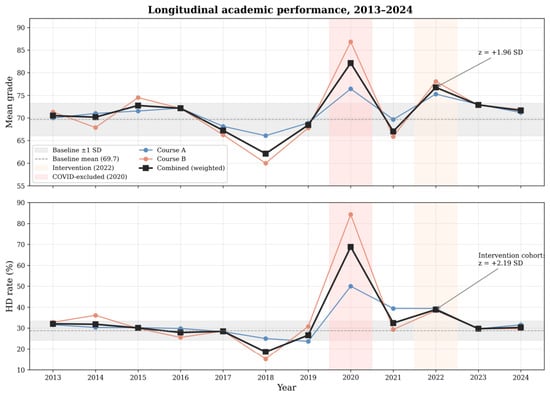
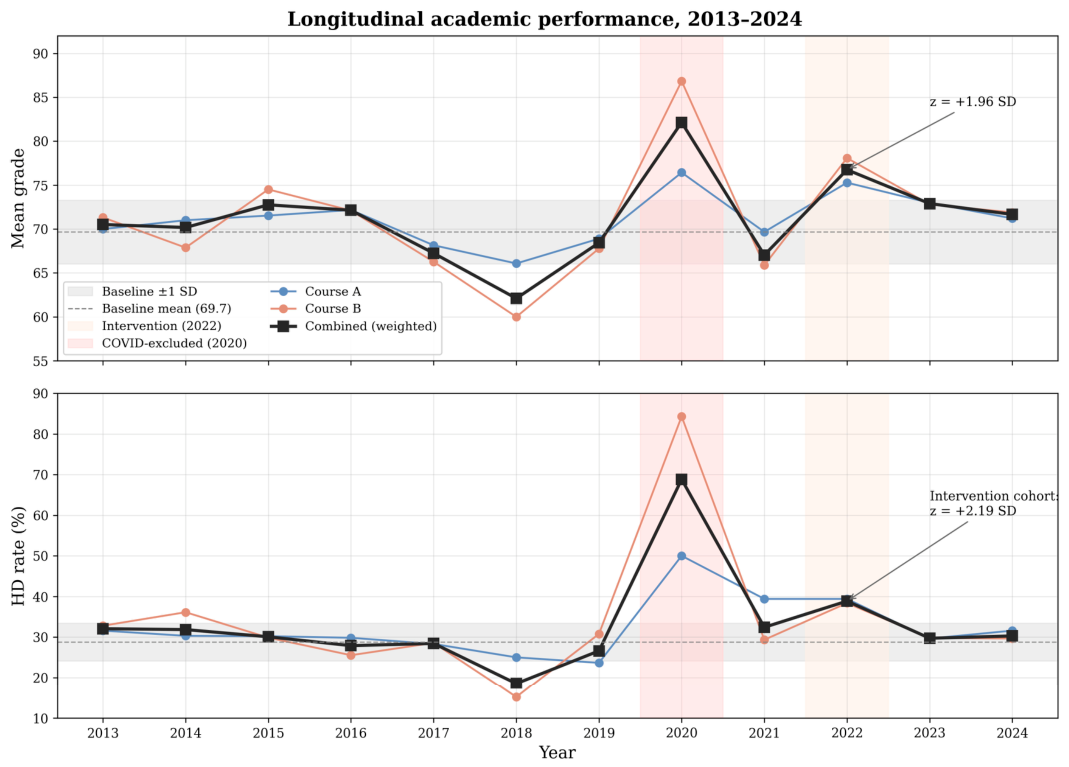
Figure 5 presents cohort-level academic performance across twelve consecutive iterations. It tracks two indicators: cohort mean grade and High Distinction (HD) rate. Both indicators reference the 2013–2019 analytical baseline (N = 836; mean grade = 69.65, SD = 3.62; HD rate = 28.74%, SD = 4.61%). The 2020 iteration remains visible for transparency but is excluded from the baseline.
Figure 5.
Longitudinal academic performance across twelve cohorts (2013–2024). The top panel displays cohort-level mean grades; the bottom panel shows High Distinction rates. The grey band represents the 2013–2019 analytical baseline (mean ± 1 SD). The 2020 COVID-19 iteration is shown but excluded from the baseline due to documented disruptions. The shaded vertical band marks the 2022 intervention. Departures from the baseline are expressed as z-scores. This figure is purely descriptive; it implies no causal effect.
Three distinct patterns warrant analysis. First, the 2013–2019 baseline exhibits narrow year-to-year variation (mean grade: 62.10–72.75; HD rate: 18.52–32.05%). The immediate pre-intervention iteration (2021) sat slightly below the baseline mean (z = −0.72) but slightly above the baseline HD rate (z = +0.79). This historical stabilization reflects the recurring symptoms of high extraneous cognitive load and procedural frustration. These symptoms directly motivated the 2022 redesign.
Second, the 2022 redesigned iteration shows a distinct elevation in both indicators. The combined mean grade reached 76.75 (z = +1.96). The HD rate reached 38.85% (z = +2.19). These departures substantially exceed natural baseline variation. Notably, they remain lower than the 2020 pandemic anomaly. This confirms the 2020 data as a non-comparable measurement condition.
Third, post-intervention iterations (2023–2024) show partial regression toward the baseline. The combined mean grade adjusted to 72.90 in 2023 (z = +0.90) and 71.67 in 2024 (z = +0.56). The HD rate settled at 29.70% in 2023 (z = +0.21) and 30.27% in 2024 (z = +0.33). Both indicators remained consistently above the baseline mean (positive z-scores) but did not sustain the 2022 peak. This partial attenuation is reported transparently here. Section 5 further examines this phenomenon in the context of intervention sustainability.
Crucially, this 12-year pattern does not establish a definitive causal relationship. As established in Section 3.2, cohorts differ across multiple confounding dimensions. These include post-pandemic learning conditions, cohort size, and self-selected enrolment. Any of these variables could plausibly influence year-to-year variation. Therefore, these data provide a descriptive longitudinal context, not an isolated effect estimation.
4.4. Triangulated Reading: Convergence and Divergence
Synthesizing the three data sources reveals a complex picture. We observe clear convergence between student perception and academic performance in 2022. However, a longitudinal divergence emerges regarding post-2022 sustainability.
Convergence: 2022 perception and performance. Qualitative themes from 2022—particularly perceived industrial relevance and software-agnostic confidence—align with the 2022 performance elevation (Figure 5). Students reported acquiring usable, enterprise-level capabilities. Concurrently, cohort-level grades sat approximately two standard deviations above the baseline. This alignment does not definitively prove causality. However, it confirms that subjective satisfaction and objective performance moved in the same positive direction during the intervention year.
Divergence: Post-2022 sustainability. The 2022 CES indicators (99% GTS, 100% OSI) represent extreme upper-bound values. Viewed in isolation, they suggest a permanent transformation of the student experience. However, the longitudinal performance data reveal a divergence. The 2022 grade elevation was not fully sustained. Both indicators partially regressed toward the baseline in 2023–2024, although they remained above the historical mean. This divergence is highly informative rather than discrediting. It indicates that immediate post-redesign satisfaction and durable performance signatures are distinct phenomena. Exceptional satisfaction in one iteration does not automatically guarantee sustained grade elevations across subsequent cohorts.
A note on the formative loop. The minority qualitative theme gaps in supporting resources highlight a third pattern. The teaching team actively addressed these gaps in subsequent iterations. This documents an active, formative feedback loop. The redesign was not a static intervention, but an iteratively refined curriculum. While the data cannot definitively link this responsiveness to the maintained above-baseline performance in 2023–2024, the existence of this continuous improvement cycle is evident.
5. Discussion
This case study documents a holistic redesign of two advanced CAD courses. The redesign targeted the persistent gap between procedural command execution and engineering design intent. Across the three triangulated data sources, a central pattern emerges. The 2022 iteration coincided with a marked elevation in student perception and academic performance. However, the 2023–2024 iterations showed only partial sustainment. This demonstrates a temporary peak rather than evidence of a stable or definitive sustained pedagogical effect. This section interprets this pattern, examines pedagogical sustainability, and explicitly answers the three research questions.
5.1. Reading the Findings Against the Literature
The case findings should be read against the gaps identified in Section 2.5. The redesigned 2022 iteration coincided with cohort-level academic performance approximately two standard deviations above the 2013–2019 baseline. Concurrently, qualitative themes highlighted perceived industrial relevance, workflow internalization, and platform-portable confidence. These triangulated findings align directionally rather than confirmatory with three existing empirical traditions in CAD pedagogy.
First, the students’ focus on employability validates recent work-readiness literature. Peersia et al. conceptualize work-readiness as a composite of technical capability, professional self-presentation, and identity formation (Peersia et al., 2024). Our qualitative data reflects this exact multidimensional shift. Students did not merely report learning CATIA syntax. Instead, they confidently positioned themselves as enterprise-CAD competent for future employers. This identity-formation outcome is precisely what authentic PBL pedagogies aim to produce (Balan et al., 2019; Berselli et al., 2020; Fernandes et al., 2020).
Second, the emergence of software-agnostic confidence supports the strategic-knowledge tradition (Camba et al., 2016; Garikano et al., 2018; Lang et al., 1991; Wiebe, 2009). Students with prior SolidWorks experience stopped viewing CATIA as an isolated hurdle. Instead, they recognized it as a different interface operating on a shared parametric logic. This cognitive shift is the theorized outcome of explicit strategic instruction. The pre-modelling cognitive mapping practice successfully operationalized this theory. By relocating workflow planning to a paper-based activity, students externalized their strategic intent before the software GUI could impose its specific syntax.
Third, the formative responsiveness loop aligns with the principles of constructive alignment and the Scholarship of Teaching and Learning (SoTL) (Biggs, 1996; Felten, 2013; Gelmez & Arkan, 2021). The teaching team actively addressed 2022 resource gaps in subsequent iterations. Therefore, the 2022 redesign was not a static, rigidly evaluated intervention. It functioned as the catalyst for an ongoing, design-based pedagogical improvement cycle.
Crucially, the convergence of these findings with prior literature is directional, not confirmatory. The data does not prove absolute causality. However, they establish that the observed student outcomes are entirely consistent with the predictions of our integrated theoretical framework (Figure 1).
5.2. The Sustainability Question
The longitudinal data revealed a partial attenuation of the 2022 performance elevation. In 2023 and 2024, both academic indicators remained above the 2013–2019 baseline mean (z-scores between +0.2 and +0.9). However, neither sustained the 2022 peak (z = +1.96 for mean grade, +2.19 for HD rate). Rather than minimizing this regression, we must address it directly. This pattern raises a critical question often ignored by single-cohort intervention studies: what happens to a pedagogical redesign after its initial implementation phase?
Three non-mutually exclusive interpretations explain this pattern. First, the 2022 elevation likely reflects specific cohort characteristics alongside the redesign. The 2022 group was a small, self-selected, post-pandemic cohort experiencing a highly novel curriculum. This “novelty effect” cannot be ruled out as a contributing factor.
Second, the data likely reflects “implementation-fidelity decay” (Gelmez & Arkan, 2021). The redesign’s most resource-intensive components—specifically Socratic facilitation and diagnostic error replication depend heavily on rigorous tutor training and weekly debriefings. Maintaining this intensity across subsequent iterations is inherently challenging. Tutor turnover, shifting workloads, and routine delivery naturally degrade initial implementation fidelity over time.
Third, despite this attenuation, the 2023–2024 cohorts did not return to the pre-redesign baseline. Both indicators remained consistently above the historical mean. This suggests a residual, sustained curricular effect, clearly distinct from the initial 2022 implementation peak.
While this case study cannot definitively adjudicate between these interpretations, it yields a crucial methodological insight. Pedagogical innovation reports based on a single post-intervention iteration may systematically overestimate long-term effects. Longitudinal continuation data—even at a descriptive level—fundamentally alter the evaluative narrative. For SoTL practice in engineering education, the critical question is not whether a redesign produces an immediate, isolated grade elevation. Instead, the question is whether pedagogical innovation can be sustained as institutional practice despite inevitable changes in teaching teams, cohort compositions, and external conditions.
5.3. Limitations
This case study has several limitations that contextualize its findings.
Single-site, practitioner-led design. This study examines two related courses managed by a single coordinator at one institution. An embedded practitioner-researcher implemented and observed the interventions. Consequently, these findings cannot automatically generalize to other institutional contexts, different CAD platforms, or alternative teaching team configurations.
Aggregated data constraints. All primary data sources are cohort aggregated. The institution released CES indicators purely as percentages, withholding individual scores and standard deviations to protect anonymity. Similarly, academic records lack student-level score breakdowns. This aggregation precludes inferential statistics and effect-size estimations, necessitating a strictly descriptive analysis.
Qualitative data retention. The 2022 open-ended responses were thematically analyzed upon receipt but were not retained as a raw corpus for re-analysis. Therefore, the reported themes reflect the lead author’s documented interpretation without accompanying verbatim quotations. Readers should weigh the qualitative findings with this constraint in mind.
Longitudinal confounding variables. As established in Section 3.2, the twelve iterations differ across multiple dimensions beyond the pedagogical redesign itself (e.g., cohort size, post-pandemic conditions, and self-selected enrolment). Therefore, the longitudinal patterns in Figure 5 provide descriptive context rather than quasi-experimental effect estimation.
Lack of independent outcome measures. Academic performance records rely on summative grades issued by the teaching team via institutional rubrics. They are not outputs of independent, externally validated learning-outcome instruments. While standard for practitioner-led SoTL research, cohort-level grades are not strictly equivalent to standardized competence measurements.
Absence of post-graduation tracking. The study lacks systematic post-graduation follow-up data. The employability theme captures students’ projected professional confidence at course completion. It does not verify actual downstream employment outcomes.
5.4. Implications for Practice (Actionable Guidelines)
This case study yields four actionable guidelines for educators redesigning software-intensive engineering courses:
Leverage heterogeneous prior experience. Students often take advanced courses with self-taught, introductory CAD skills (e.g., SolidWorks). Educators should actively leverage this rather than treating it as a deficit. Explicit “semantic mapping” converts this prior familiarity into a cognitive bridge to complex, enterprise-level platforms like CATIA.
Externalize modelling strategies before software interaction. “Pre-modelling cognitive mapping” forces students to abstract their design intent. Drafting handwritten workflow trees before opening the software promotes deep strategic knowledge (Bodein et al., 2014; Garikano et al., 2018). Crucially, this is a highly effective, zero-cost intervention requiring no infrastructure investment.
Train tutors for diagnostic error replication. Tutors must transition from procedural problem-solvers to cognitive facilitators. This requires rigorous training and iterative weekly debriefings. Practitioners must anticipate this significant human-resource investment. Furthermore, as our data suggests, this component remains highly vulnerable to attenuation as tutor teams turn over.
Design for longitudinal sustainability. Single-iteration evidence often overstates sustained pedagogical effects. Educators must design curriculum implementations with subsequent iterations in mind. This requires structured tutor onboarding, continuous resource maintenance, and institutionalizing practices so they survive beyond the initial coordinator’s personal drive.
These guidelines offer transferable strategies rather than a rigid template. Successful application requires deliberate adaptation to local institutional and disciplinary contexts.
5.5. Future Research
This case study identifies several critical directions for future pedagogical investigation.
Independent post-graduation follow-up. Anecdotal reports suggest graduates successfully leveraged course portfolios in early-career job interviews. They frequently cite the curriculum as highly formative for industrial readiness. However, these informal reports lie outside our formal dataset. Future research should implement structured graduate surveys, employer feedback tracking, or longitudinal alumni studies to formally measure this industrial transfer.
Multi-site comparative implementation. Addressing the single-site limitation requires coordinated, multi-site implementations of the four pedagogical mechanisms. Expanding this framework across diverse institutional and disciplinary contexts would clearly identify which curriculum components transfer readily and which remain context-dependent.
Sub-cohort analysis with student-level data. The current reliance on aggregated data restricts analysis to cohort-level patterns. Future studies must secure student-level data to enable granular sub-cohort analyses. Specifically, disaggregating performance by prior CAD background would reveal how the redesign affects students with differing baseline software experience. This would directly test the cognitive-transfer theories underlying Mechanism 3 (Perkins & Salomon, 1992; Wiebe, 2009).
Longitudinal sustainability modelling. The grade attenuation observed in 2023–2024 demands a systematic study of intervention sustainability. Researchers must rigorously investigate the institutional and human-resource conditions that cause design-based pedagogical innovations to endure, decay, or vanish across iterations.
Counter-balanced assessment design. Finally, relying on internal summative grades remains a structural constraint. Future work should introduce externally marked or independently anchored assessment instruments alongside routine assessments (Camba et al., 2016). This methodology would robustly isolate objective skill acquisition from subjective instructional satisfaction.
5.6. Explicit Answers to the Three Research Questions
Following the descriptive nature of this study, the three guiding research questions are explicitly answered below.
RQ1: How was the redesigned curriculum operationalized?
- Answered by Section 3.3 (Table 1; Figure 2, Figure 3 and Figure 4). The operationalization was achieved through concrete, replicable instructional practices. Authentic PBL utilized macro-mechanical assemblies (Figure 2). Video scaffolding employed a dual-layered structure. Software-agnostic heuristics were operationalized through handwritten workflow trees (Figure 4). Finally, cognitive apprenticeship was enacted via Socratic facilitation and diagnostic error replication (Figure 3).
RQ2: What longitudinal patterns accompanied the redesign?
- Answered by Section 4.1 and Section 4.3 (Table 2; Figure 5). The evidence reveals a distinct two-phase pattern. Initially, the 2022 redesign coincided with a marked spike in perception (GTS reaching 99.0%) and academic performance (mean grade z = +1.96). Subsequently, the 2023–2024 iterations demonstrated partial sustainment. Mean grades remained above baseline (z = +0.90 and +0.56) but failed to maintain the 2022 peak.
RQ3: What transferable lessons regarding sustainability can be drawn?
- Addressed interpretively in Section 5.2 and Section 5.4, anchored in Section 4.3’s longitudinal data. The evidence yields a critical lesson for SoTL practitioners: single-iteration spikes systematically obscure long-term realities. The partial sustainment observed here demonstrates that pedagogical redesigns are highly vulnerable to implementation decay (e.g., tutor turnover). Therefore, the ultimate challenge is not merely designing an effective intervention but engineering its longitudinal institutional sustainability.
5.7. Concluding Remarks
This case study demonstrates that four pedagogical mechanisms—authentic PBL design, dual-layered asynchronous video scaffolding, software-agnostic heuristics, and cognitive apprenticeship—can be successfully integrated within an advanced enterprise-CAD course. The immediate post-implementation cohort exhibited perception and performance patterns consistent with our integrated theoretical framework. However, longitudinal data reveals that the durability of these patterns across subsequent iterations is partial rather than complete.
Consequently, the primary contribution of this study is not a claim of universal generalizability. Instead, it provides a transparent, documented account of how to operate these four mechanisms in concert. By analyzing twelve course iterations, this study highlights the critical conditions required to sustain such pedagogical redesigns as durable institutional practices, rather than isolated experimental peaks.
6. Conclusions
This study details a holistic redesign of two advanced CAD courses within an Australian university. Framed as a practitioner-led reflective case study, the redesign integrated four pedagogical mechanisms: authentic problem-based learning, dual-layered asynchronous video scaffolding, software-agnostic heuristics, and cognitive apprenticeship. These mechanisms were implemented in concert. They specifically supported students transitioning from heterogeneous, self-taught introductory CAD backgrounds to enterprise-level CATIA.
The analysis yielded three core findings. First, the 2022 intervention iteration coincided with a marked elevation in academic performance. Grades reached approximately two standard deviations above the seven-year baseline. This quantitative spike aligned with qualitative themes of perceived industrial relevance and platform-portable confidence. Second, iterations in 2023 and 2024 exhibited a partial regression toward the historical baseline. While scores remained elevated, they did not sustain the initial peak. This indicates partial sustainment of the 2022 elevation, rather than evidence of a stable or definitive sustained pedagogical effect. Third, the study documented a formative responsiveness loop, demonstrating how student feedback was treated as actionable input for subsequent iterations.
Crucially, this case study does not claim universal, causal generalizability. The available data does not support such sweeping inferences. Instead, the 12-year longitudinal pattern highlights a critical methodological blind spot. Single-iteration evidence systematically obscures the sustainability question. It fails to capture whether a pedagogical redesign is successfully embedded as an institutional practice or naturally attenuates alongside cohort and teaching-team turnover.
Therefore, the primary contribution of this study is threefold. It provides a documented configuration of four theoretically grounded mechanisms operationalized in concert. It offers a robust longitudinal evidentiary base, extending well beyond the typical single-cohort window of SoTL reports. Finally, it explicitly examines the conditions under which curriculum redesigns endure, decay, or vanish. These insights provide transferable pedagogical considerations rather than a rigid model. Adapting this framework to other institutional contexts or CAD platforms will invite necessary, localized empirical investigations in future research.
Author Contributions
Conceptualization, Y.Z. and J.L.; methodology, Y.Z.; CATIA drawings, Y.Z. and J.L.; validation, Y.Z.; formal analysis, J.L.; writing—original draft preparation, J.L. and Y.Z.; writing—review and editing, Y. Z. and C.G.; visualization, J.L.; supervision, Y.Z. All authors have read and agreed to the published version of the manuscript.
Funding
This research received no external funding.
Institutional Review Board Statement
Not applicable.
Informed Consent Statement
Not applicable.
Data Availability Statement
The data are available from the lead author upon reasonable requests.
Conflicts of Interest
The authors declare no conflicts of interest.
References
- Balan, L., Yuen, T., & Mehrtash, M. (2019). Problem-based learning strategy for CAD software using free-choice and open-ended group projects. Procedia Manufacturing, 32, 339–347. [Google Scholar] [CrossRef] [Scilit]
- Berselli, G., Bilancia, P., & Luzi, L. (2020). Project-based learning of advanced CAD/CAE tools in engineering education. International Journal on Interactive Design and Manufacturing (IJIDeM), 14(3), 1071–1083. [Google Scholar] [CrossRef] [Scilit]
- Besharati-Foumani, H., Lohtander, M., & Varis, J. (2020). Fundamentals and new achievements in feature-based modeling, a review. Procedia Manufacturing, 51, 998–1004. [Google Scholar] [CrossRef] [Scilit]
- Biggs, J. (1996). Enhancing teaching through constructive alignment. Higher Education, 32(3), 347–364. [Google Scholar] [CrossRef] [Scilit]
- Bodein, Y., Rose, B., & Caillaud, E. (2014). Explicit reference modeling methodology in parametric CAD system. Computers in Industry, 65(1), 136–147. [Google Scholar] [CrossRef] [Scilit]
- Branoff, T. J., Hartman, N. W., & Wiebe, E. N. (2001, June 24–27). Constraint-based, three-dimensional solid modeling in an introductory engineering graphics course: Re-examining the curriculum. 2001 American Society for Engineering Education Annual Conference & Exposition, Albuquerque, NM, USA. [Google Scholar]
- Braun, V., & Clarke, V. (2006). Using thematic analysis in psychology. Qualitative Research in Psychology, 3(2), 77–101. [Google Scholar] [CrossRef] [Scilit]
- Camba, J. D., Contero, M., & Company, P. (2016). Parametric CAD modeling: An analysis of strategies for design reusability. Computer-Aided Design, 74, 18–31. [Google Scholar] [CrossRef] [Scilit]
- Chandler, P., & Sweller, J. (1996). Cognitive load while learning to use a computer program. Applied Cognitive Psychology, 10(2), 151–170. [Google Scholar] [CrossRef] [Scilit]
- Collins, A., Brown, J. S., & Newman, S. E. (1989). Cognitive apprenticeship: Teaching the crafts of reading, writing, and mathematics. In L. B. Resnick (Ed.), Knowing, learning, and instruction: Essays in honor of robert glaser (pp. 453–494). Lawrence Erlbaum Associates. [Google Scholar]
- Company, P., Contero, M., Otey, J., & Plumed, R. (2015). Approach for developing coordinated rubrics to convey quality criteria in MCAD training. Computer-Aided Design, 63, 101–117. [Google Scholar] [CrossRef] [Scilit]
- Çeken, B., & Taşkın, N. (2022). Multimedia learning principles in different learning environments: A systematic review. Smart Learning Environments, 9(1), 19. [Google Scholar] [CrossRef] [Scilit]
- Denzin, N. K. (1978). The research act: A theoretical introduction to sociological methods (2nd ed.). McGraw-Hill. [Google Scholar]
- Felten, P. (2013). Principles of good practice in SoTL. Teaching & Learning Inquiry-the Issotl Journal, 1(1), 121–125. [Google Scholar] [CrossRef] [Scilit]
- Fernandes, F. A. O., Fuchter Júnior, N., Daleffe, A., Fritzen, D., & Alves de Sousa, R. J. (2020). Integrating CAD/CAE/CAM in engineering curricula: A project-based learning approach. Education Sciences, 10(5), 125. [Google Scholar] [CrossRef] [Scilit]
- Garikano, X., Garmendia, M., Manso, A. P., & Solaberrieta, E. (2018). Strategic knowledge-based approach for CAD modelling learning. International Journal of Technology and Design Education, 29(4), 947–959. [Google Scholar] [CrossRef] [Scilit]
- Gelmez, K., & Arkan, S. (2021). Aligning a CAD course constructively: Telling-to-peer and writing-to-peer activities for efficient use of CAD in design curricula. International Journal of Technology and Design Education, 32(3), 1813–1835. [Google Scholar] [CrossRef] [Scilit]
- Gutiérrez Ortiz, F. J., Fitzpatrick, J. J., & Byrne, E. P. (2020). Development of contemporary engineering graduate attributes through open-ended problems and activities. European Journal of Engineering Education, 46(3), 441–456. [Google Scholar] [CrossRef] [Scilit]
- Hamade, R. F., Artail, H. A., & Jaber, M. Y. (2007). Evaluating the learning process of mechanical CAD students. Computers & Education, 49(3), 640–661. [Google Scholar] [CrossRef] [Scilit]
- Hamade, R. F., Jaber, M. Y., & Sikström, S. (2009). Analyzing CAD competence with univariate and multivariate learning curve models. Computers & Industrial Engineering, 56(4), 1510–1518. [Google Scholar] [CrossRef] [Scilit]
- Lang, G. T., Eberts, R. E., Gabel, M. G., & Barash, M. M. (1991). Extracting and using procedural knowledge in a CAD task. IEEE Transactions on Engineering Management, 38(3), 257–268. [Google Scholar] [CrossRef] [Scilit]
- Meyer, O. A., Omdahl, M. K., & Makransky, G. (2019). Investigating the effect of pre-training when learning through immersive virtual reality and video: A media and methods experiment. Computers & Education, 140, 103603. [Google Scholar] [CrossRef] [Scilit]
- Ouwehand, K., Paas, F., Tricot, A., & Lespiau, F. (2025). Cognitive load theory: Emerging trends and innovations. Education Sciences, 15(4), 458. [Google Scholar] [CrossRef] [Scilit]
- Pando Cerra, P., Fernández Álvarez, H., Busto Parra, B., & Castaño Busón, S. (2022). Boosting computer-aided design pedagogy using interactive self-assessmentgraphical tools. Computer Applications in Engineering Education, 31(1), 26–46. [Google Scholar] [CrossRef] [Scilit]
- Peersia, K., Rappa, N. A., & Perry, L. B. (2024). Work readiness: Definitions and conceptualisations. Higher Education Research & Development, 43(8), 1830–1845. [Google Scholar] [CrossRef] [Scilit]
- Perkins, D. N., & Salomon, G. (1992). Transfer of Learning. In T. Husén, & T. N. Postlethwaite (Eds.), International encyclopedia of education (2nd ed., pp. 6452–6457). Pergamon Press. [Google Scholar]
- Puustinen, M., & Pulkkinen, L. (2001). Models of self-regulated learning: A review. Scandinavian Journal of Educational Research, 45(3), 269–286. [Google Scholar] [CrossRef] [Scilit]
- Ramsden, P. (1991). A performance indicator of teaching quality in higher education: The course experience questionnaire. Studies in Higher Education, 16, 129–150. [Google Scholar] [CrossRef] [Scilit]
- Stake, R. E. (1995). The art of case study research. Sage. [Google Scholar]
- Turns, J. A., Mejia, K. Z., & Atman, C. J. (2020, June 22–26). Reflection in engineering education: Advancing conversations. ASEE Conference Proceedings, Montreal, QC, Canada. [Google Scholar]
- Wiebe, E. N. (2009). Transfer of learning between 3D modeling systems. The Engineering Design Graphics Journal, 67(3), 15–28. [Google Scholar] [CrossRef] [Scilit]
- Wiebe, E. N., Branoff, T. J., & Hartman, N. W. (2003, June 22–25). Integrating constraint-based CAD into an introductory engineering graphics course: Activities and grading strategies. 2003 ASEE Annual Conference & Exposition, Nashville, TN, USA. [Google Scholar]
- Wilson, K. L., Lizzio, A., & Ramsden, P. (1997). The development, validation and application of the course experience questionnaire. Studies in Higher Education, 22, 33–53. [Google Scholar] [CrossRef] [Scilit]
- Yin, R. K. (2014). Case study research: Design and methods (5th ed.). Sage. [Google Scholar]
- Zimmerman, B. J. (2002). Becoming a self-regulated learner: An overview. Theory into Practice, 41(2), 64–70. [Google Scholar] [CrossRef] [Scilit] [PubMed]

Disclaimer/Publisher’s Note: The statements, opinions and data contained in all publications are solely those of the individual author(s) and contributor(s) and not of MDPI and/or the editor(s). MDPI and/or the editor(s) disclaim responsibility for any injury to people or property resulting from any ideas, methods, instructions or products referred to in the content. |
© 2026 by the authors. Licensee MDPI, Basel, Switzerland. This article is an open access article distributed under the terms and conditions of the Creative Commons Attribution (CC BY) license.