Personalising Learning for Gifted and Twice-Exceptional Students: Leveraging Generative Artificial Intelligence for Strengths-Based, Neuroaffirming Education


Abstract
1. Introduction
2. Theoretical Synthesis
2.1. Conceptual Framing
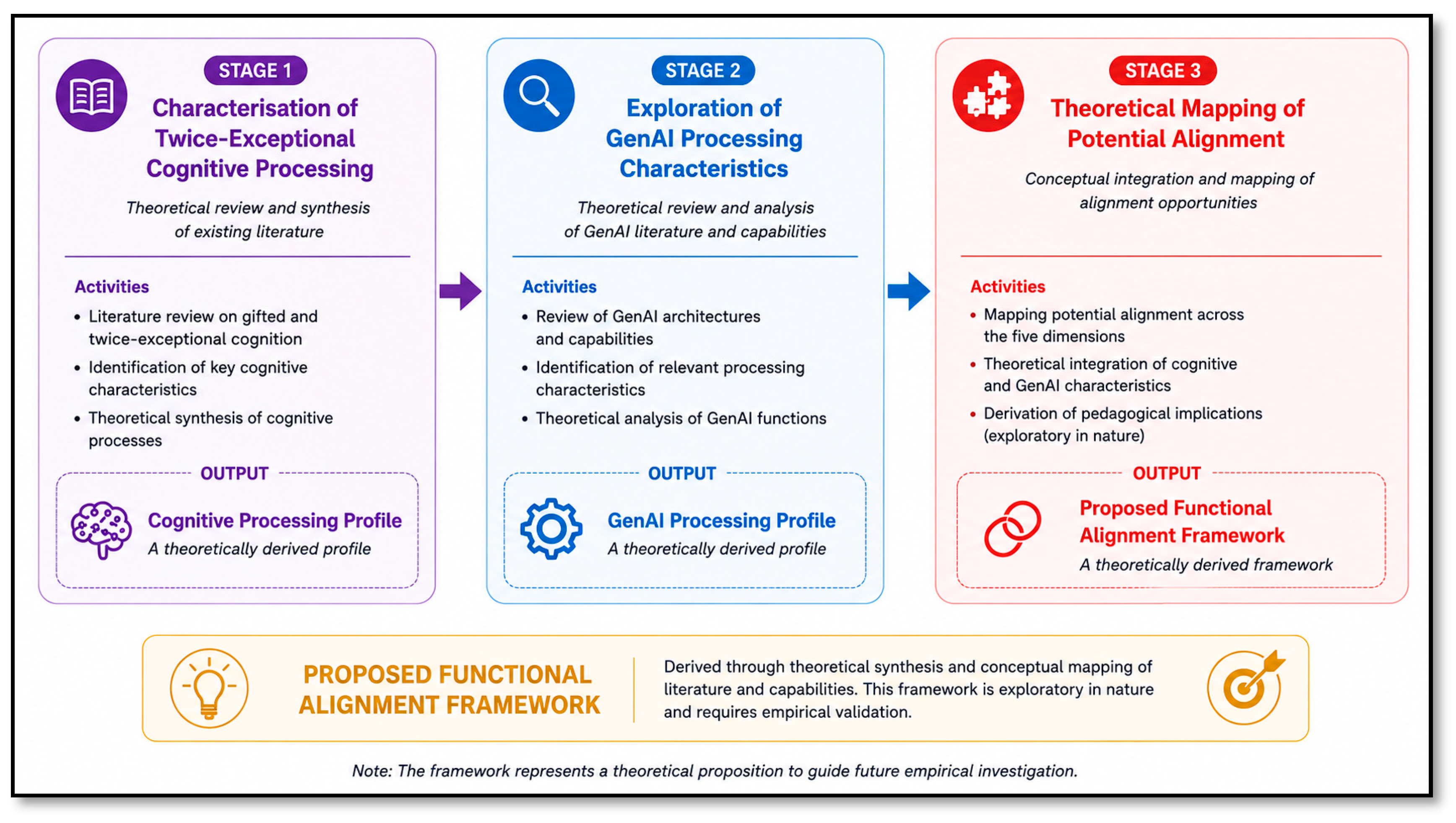
2.2. Analytical Process
2.3. Scope and Limitations
2.4. Use of Generative AI in Article Preparation
2.5. Ethical Considerations
3. Functional Alignment: A Conceptual Framework
3.1. Cognitive Characteristics of Gifted and Twice-Exceptional Learners
3.2. Some Processing Patterns of Generative Artificial Intelligence
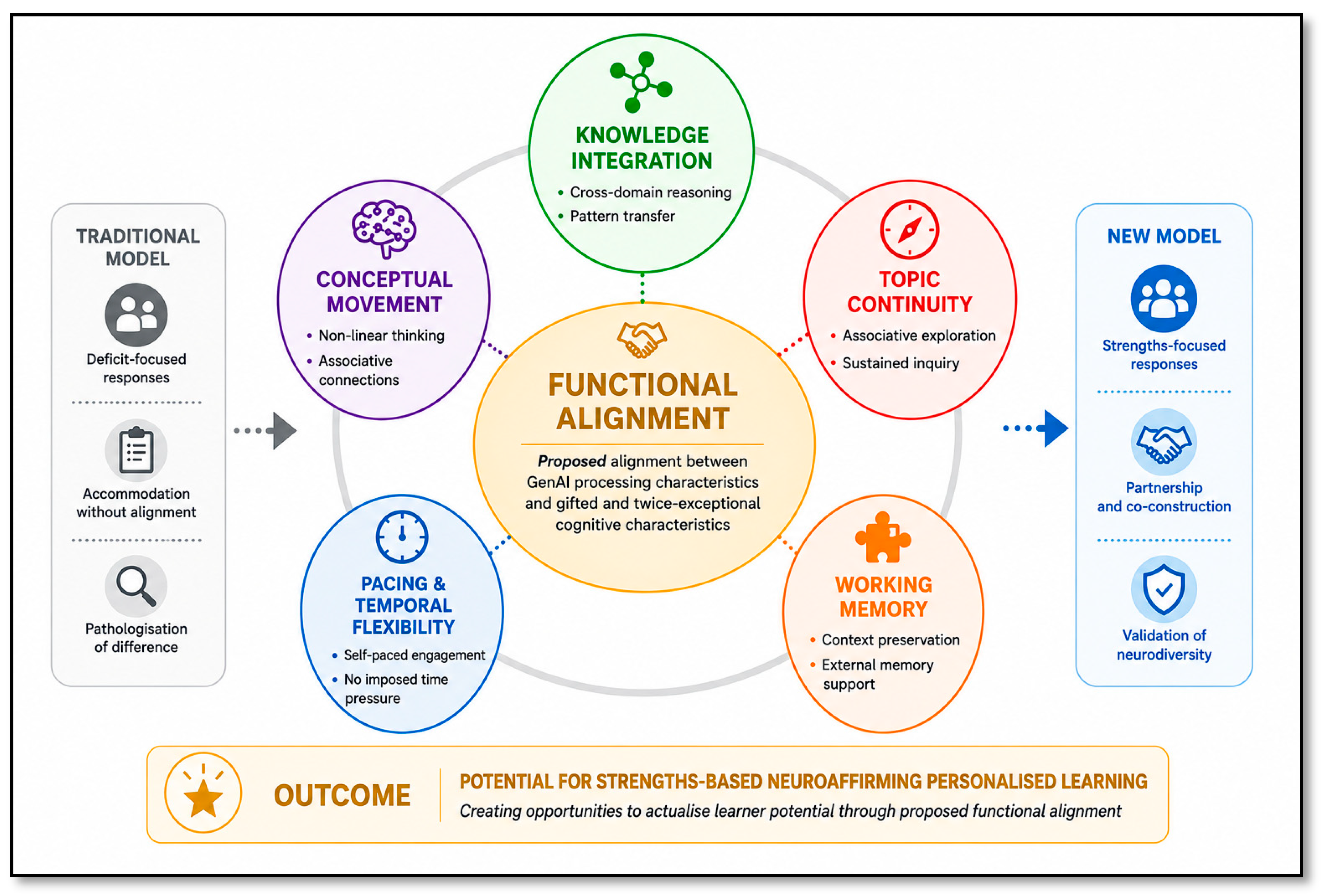
3.3. The Functional Alignment Thesis
4. Discussion
4.1. GenAI as a Mediating Platform for Personalised Learning
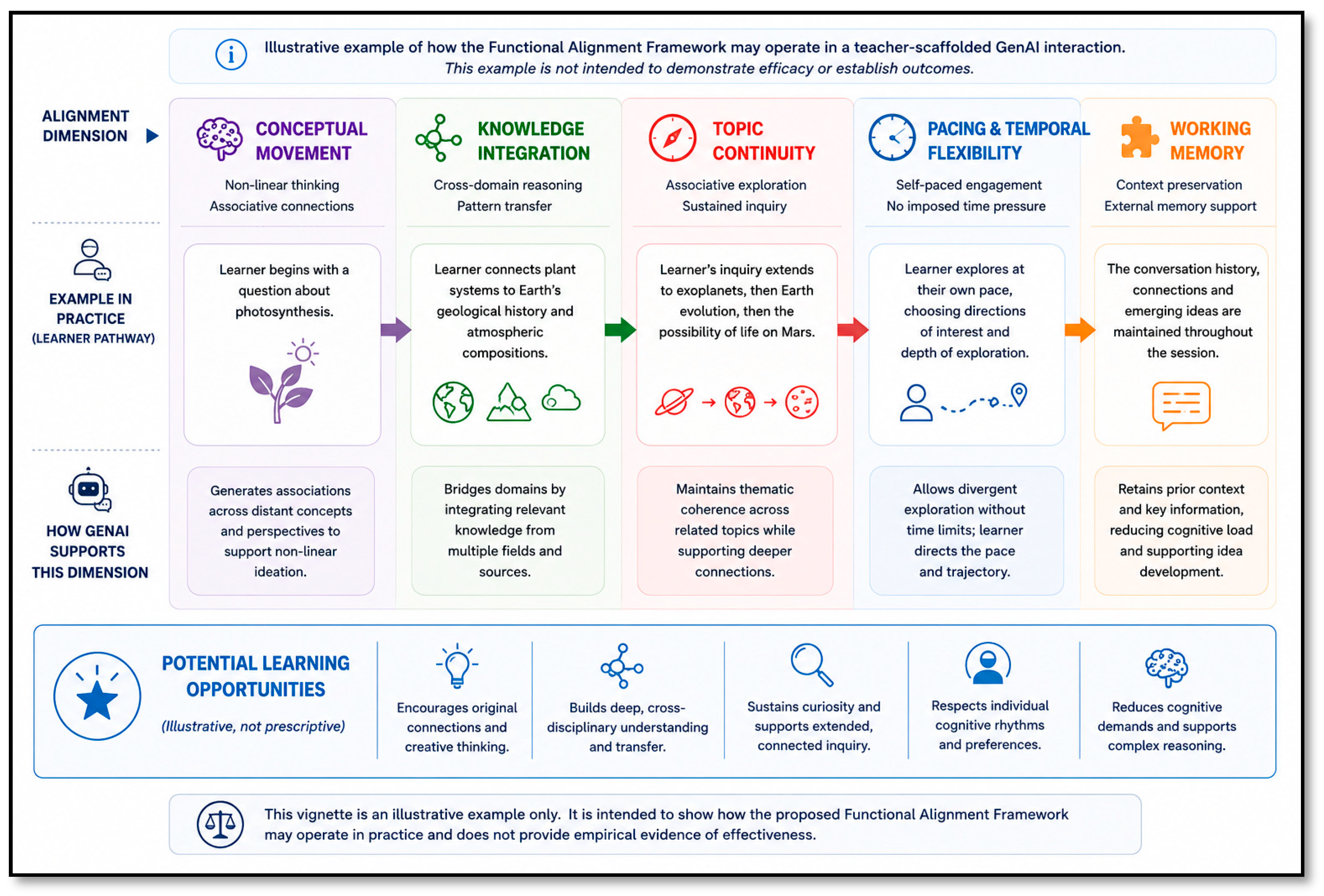
- A Grade 8 student with ADHD and ASD has exceptional problem-solving skills and a passionate interest in science, yet their associative, non-linear thinking consistently moves beyond what current pedagogical approaches can accommodate.
- During a biology unit on photosynthesis, the student’s teacher designs a GenAI-mediated learning experience aligned with the unit, inviting the student to explore photosynthesis using their own questions as the starting point. The student opens a GenAI conversation with a question: “If photosynthesis converts light energy into chemical energy, could a similar process work under a different star’s light spectrum, like a red dwarf?” Starting from curriculum knowledge but immediately extending it into astrophysics, a conceptual movement characteristic of twice-exceptional reasoning is made. GenAI directly engages with the question before the student pivots to whether plants on other planets could photosynthesise differently given different atmospheric conditions; this is topic continuity in action, with GenAI following the associative leap without redirection.
- The student then asks how early Earth’s atmosphere changed as photosynthesis evolved, connecting exoplanet thinking back to Earth’s own evolutionary history through cross-domain pattern recognition. The student draws the whole chain together into questions about terraforming Mars, which is knowledge integration across biology, atmospheric science, planetary geology, and aerospace engineering, the kind of systems-level synthesis that conventional single-subject instruction rarely accommodates. The student is able to pursue each idea at their own pace, with GenAI maintaining the full conversation so no thinking is lost, supporting external working memory.
- Reviewing the conversation log, the teacher finds a depth of conceptual understanding embedded within a systems-level exploration that written classwork would likely never have demonstrated. The teacher invites the student to share their findings with the class, positioning their work as an example of sophisticated scientific reasoning.
4.2. Teacher Capability, GenAI Fluency, and Professional Learning
4.3. Disrupting Barriers and Reconceptualising Educational Futures
4.4. Critical Considerations: Equity, Ethics, and Implementation
4.5. Future Research Directions
5. Conclusions
Author Contributions
Funding
Institutional Review Board Statement
Informed Consent Statement
Data Availability Statement
Acknowledgments
Conflicts of Interest
Abbreviations
| GenAI | Generative Artificial Intelligence |
| ITE | Initial Teacher Education |
| LLM | Large Language Model |
| LLMs | Large Language Models |
| PD | Professional development |
References
- Arantes, J. A. (2023). Personalization in Australian K-12 classrooms: How might digital teaching and learning tools produce intangible consequences for teachers’ workplace conditions? Australian Educational Researcher, 50(3), 863–880. [Google Scholar] [CrossRef] [PubMed]
- Assouline, S. G., Foley-Nicpon, M., & Huber, D. H. (2006). The impact of vulnerabilities and strengths on the academic experiences of twice-exceptional students: A message to school counselors. Professional School Counseling, 10(1), 14–24. [Google Scholar] [CrossRef]
- Assouline, S. G., Foley-Nicpon, M., & Whiteman, C. (2010). Cognitive and psychosocial characteristics of gifted students with written language disability. Gifted Child Quarterly, 54(2), 102–115. [Google Scholar] [CrossRef]
- Baldwin, L., Baum, S. M., Pereles, D., & Hughes, C. (2015). Twice-exceptional learners: The journey toward a shared vision. Gifted Child Today, 38(4), 206–214. [Google Scholar] [CrossRef]
- Barber, C., & Mueller, C. T. (2011). Social and self-perceptions of adolescents identified as gifted, learning disabled, and twice-exceptional. Roeper Review, 33(2), 109–120. [Google Scholar] [CrossRef]
- Baum, S. M., & Olenchak, R. (2021). Twice-exceptional students: Ameliorating an educational dilemma. In J. L. Nyberg, & J. A. Manzone (Eds.), Creating equitable services for the gifted: Protocols for identification, implementation, and evaluation (pp. 20–38). IGI Global. [Google Scholar] [CrossRef]
- Baum, S. M., Schader, R. M., & Hébert, T. P. (2014). Through a different lens: Reflecting on a strengths-based, talent-focused approach for twice-exceptional learners. Gifted Child Quarterly, 58(4), 311–327. [Google Scholar] [CrossRef]
- Bechard, A. (2019). Teacher preparation for twice-exceptional students: Learning from the educational experiences of teachers, parents, and twice-exceptional students. AILACTE Journal, 16, 25–43. [Google Scholar]
- Brossi, L., Castillo, A. M., & Cortesi, S. (2023). Student-centred requirements for the ethics of AI in education. In W. Holmes, & K. Porayska-Pomsta (Eds.), The ethics of artificial intelligence in education practices, challenges, and debates (pp. 91–112). Routledge. [Google Scholar]
- Brown, T. B., Mann, B., Subbiah, M., Kaplan, J., Dhariwal, P., Neelakantan, A., Shyam, P., Sastry, G., Askell, A., Agarwal, S., Herbert-Voss, A., Krueger, G., Henighan, T., Child, R., Ramesh, A., Ziegler, D. M., Wu, J., Winter, C., Hesse, C., … Amodei, D. (2020). Language models are few-shot learners. Advances in Neural Information Processing Systems, 33, 1–75. [Google Scholar] [CrossRef]
- Brulles, D., & Naglieri, J. A. (2021). A social justice approach to developing equity and diversity in gifted programming. In Creating equitable services for the gifted: Protocols for identification, implementation, and evaluation (pp. 103–119). IGI Global Scientific Publishing. [Google Scholar] [CrossRef]
- Callahan, C. M., Moon, T. R., & Oh, S. (2017). Describing the status of programs for the gifted: A call for action. Journal for the Education of the Gifted, 40(1), 20–49. [Google Scholar] [CrossRef]
- Chapman, R. (2021). Neurodiversity and the social ecology of mental functions. Perspectives on Psychological Science, 16(6), 1360–1372. [Google Scholar] [CrossRef] [PubMed]
- Cross, T. L., Coleman, l. J., & Terhaar-Yonkers, M. (2014). The social cognition of gifted adolescents in schools: Managing the stigma of giftedness. Journal for the Education of the Gifted, 37(1), 30–39. [Google Scholar] [CrossRef]
- Dawson, D., Schleiger, E., Horton, J., McLaughlin, J., Robinson, C., Quezada, G., Scowcroft, J., & Hajkowicz, S. (2019). Artificial intelligence: Australia’s ethics framework. Available online: https://apo.org.au/node/229596 (accessed on 25 February 2026).
- Debeer, D., Vanbecelaere, S., Van Den Noortgate, W., Reynvoet, B., & Depaepe, F. (2021). The effect of adaptivity in digital learning technologies. Modelling learning efficiency using data from an educational game. British Journal of Educational Technology, 52(5), 1881–1897. [Google Scholar] [CrossRef]
- Dwyer, P. (2022). The neurodiversity approach(es): What are they and what do they mean for researchers? Article Human Development, 66(2), 73–92. [Google Scholar] [CrossRef] [PubMed]
- Fatma, H., Mishra, H., & Katiyar, K. (2024). Neural networks and neurodiversity. In K. Malik, H. Sadawarti, M. Sharma, U. Gupta, & P. Tiwari (Eds.), Computational techniques in neuroscience (pp. 42–66). CRC Press. [Google Scholar]
- Foley-Nicpon, M., & Assouline, S. G. (2015). Counseling considerations for the twice-exceptional client. Journal of Counseling and Development, 93(2), 202–211. [Google Scholar] [CrossRef]
- Foley-Nicpon, M., Assouline, S. G., & Colangelo, N. (2013). Twice-exceptional learners: Who needs to know what? Gifted Child Quarterly, 57(3), 169–180. [Google Scholar] [CrossRef]
- Foley-Nicpon, M., & Candler, M. M. (2018). Psychological interventions for twice-exceptional youth. In S. Pfeiffer, D. Shaunessy-Dedrick, & M. Foley-Nicpon (Eds.), APA handbook of giftedness and talent (pp. 545–558). American Psychological Association. [Google Scholar]
- Foley-Nicpon, M., & Kim, J. Y. C. (2018). Identifying and providing evidence-based services for twice-exceptional students. In S. I. Pfeiffer (Ed.), Handbook of giftedness in children: Psychoeducational theory, research, and best practices (pp. 349–362). Springer International Publishing. [Google Scholar] [CrossRef]
- Foley-Nicpon, M., & Teriba, A. (2022). Policy considerations for twice-exceptional students. Gifted Child Today, 45(4), 212–219. [Google Scholar] [CrossRef]
- Fung, L. K. (2021). Neurodiversity: The new diversity. In L. K. Fung (Ed.), Neurodiversity: From phenomenology to neurobiology and enhancing technologies. American Psychiatric Association Publishing. [Google Scholar]
- Gallardo, R., & Whitacre, B. (2024). An unexpected digital divide? A look at internet speeds and socioeconomic groups. Telecommunications Policy, 48(6), 102777. [Google Scholar] [CrossRef]
- Gerlich, M. (2025). AI tools in society: Impacts on cognitive offloading and the future of critical thinking. Societies, 15(1), 6. [Google Scholar] [CrossRef]
- Gilger, J. W., & Hynd, G. W. (2008). Neurodevelopmental variation as a framework for thinking about the twice exceptional. Roeper Review, 30(4), 214–228. [Google Scholar] [CrossRef]
- Gilman, B. J., Lovecky, D. V., Kearney, K., Peters, D. B., Wasserman, J. D., Silverman, L. K., Postma, M. G., Robinson, N. M., Amend, E. R., Ryder-Schoeck, M., Hedges Curry, P., Lyon, S. K., Rogers, K. B., Collins, L. E., Charlebois, G. M., Harsin, C. M., & Rimm, S. B. (2013). Critical issues in the identification of gifted students with co-existing disabilities: The twice-exceptional. SAGE Open, 3(3), 1–16. [Google Scholar] [CrossRef]
- Guilford, J. P. (1968). Creativity, intelligence and their educational implications (1st ed.). R. R. Knapp. [Google Scholar]
- Gupta, M. (2025). Different types of attention mechanism for LLMs explained. Medium. Available online: https://medium.com/data-science-in-your-pocket/different-types-of-attention-mechanism-for-llms-explained-09d1884b0399 (accessed on 1 March 2026).
- Gyarmathy, É., & Senior, J. (2018). The inclusion of multiple exceptional gifted students in talent development programmes: Interaction synthesis of both provision form and content. Gifted Education International, 34(1), 47–63. [Google Scholar] [CrossRef]
- Hamilton, L. G., & Petty, S. (2023). Compassionate pedagogy for neurodiversity in higher education: A conceptual analysis. Frontiers in Psychology, 14(2023), 1093290. [Google Scholar] [CrossRef] [PubMed]
- Holmes, W., & Porayska-Pomsta, K. (Eds.). (2023). The ethics of artificial intelligence in education practices, challenges, and debates. Routledge. [Google Scholar]
- Ivicevic, L. (2017). The prevalence of twice exceptional students in the GAT academic programs: The near miss phenomena. Edith Cowan University. Available online: https://ro.ecu.edu.au/theses/2005 (accessed on 25 May 2025).
- James, L. (2024). Empowering individuals with ADHD and Dyslexia: How GenAI transforms education and work. Medium. Available online: https://leejames23.medium.com/empowering-individuals-with-adhd-and-dyslexia-how-genai-transforms-education-and-work-9c0a3b68c388 (accessed on 25 June 2025).
- Jones, E. K., & Orchard, V. (2024). Neurodiversity and disability: What is at stake? Medical Humanities, 50(3), 456–465. [Google Scholar] [CrossRef] [PubMed]
- King, S. (2022). The education context for twice-exceptional students: An overview of issues in special and gifted education. Neurobiology of Learning and Memory, 193, 107659. [Google Scholar] [CrossRef] [PubMed]
- Kiss, P., & Quinn, J. (2025). Cultivating a prosperous future: AI in gifted education (august editorial). World Talent Web Newsletter, 37, 2–5. [Google Scholar]
- Laird, E., Dwyer, M., & Grant-Chapman, H. (2023). Threats to student privacy and equity in the age of AI (Report). Center for Democracy & Technology. Available online: https://cdt.org/wp-content/uploads/2023/09/091923-CDT-Off-Task-web.pdf (accessed on 26 April 2024).
- Larkey, S. (2023). How to use AI to support neurodiverse students: A beginners guide for school & home. Available online: https://suelarkey.com.au/supporting-neurodiverse-students-with-ai/ (accessed on 2 May 2024).
- Lawson, A. P., White, J., & Williams, J. (2025). Building bridges for twice-exceptional students: A case study in a secondary school. Education Sciences, 15(9), 1260. [Google Scholar] [CrossRef]
- Lemke, C., Bloomfield, M., & Herfurth, F. N. (2024). Unveiling neuronormative bias: Exposing an unconscious bias in generative AI and their impact on neurodivergent people. NeuroConverse, 1(1), 8. [Google Scholar] [CrossRef]
- Lodge, J., & Loble, L. (2026). Artificial intelligence, cognitive offloading and implications for education (Report). University of Technology, Sydney. [Google Scholar] [CrossRef]
- Maddocks, D. L. S. (2020). Cognitive and achievement characteristics of students from a national sample identified as potentially twice exceptional (gifted with a learning disability). Gifted Child Quarterly, 64(1), 3–18. [Google Scholar] [CrossRef]
- Medlicott, C. (2023). How will AI transform education for neurodiverse students. AYOA. Available online: https://www.ayoa.com/ourblog/how-will-ai-transform-education-for-neurodiverse-students/ (accessed on 3 November 2025).
- Moraiti, I., & Drigas, A. (2023). AI tools like ChatGPT for people with neurodevelopmental disorders. International Journal of Online and Biomedical Engineering, 19(16), 145–155. [Google Scholar] [CrossRef]
- Munro, J. (2002). Understanding and identifying gifted learning disabled students. Australian Journal of Learning Disabilities, 7(2), 20–31. [Google Scholar] [CrossRef]
- Munro, J. (2019). Identifying gifted learning in the regular classroom: Seeking intuitive theories. In S. R. Smith (Ed.), Springer international handbook of giftedness & talent development in the Asia-Pacific (pp. 487–508). Springer Publishing. [Google Scholar]
- Munro, J. (2024). Leading improvement for gifted and talented students. ACER Press. [Google Scholar]
- Munro, J. (2025, February 17). A learning-based approach to differentiating educational provision for gifted students. Teacher Magazine. Available online: https://www.teachermagazine.com/au_en/articles/a-learning-based-approach-to-differentiating-educational-provision-for-gifted-students (accessed on 2 May 2026).
- Nielsen, M. E. (2002). Gifted students with learning disabilities: Recommendations for identification and programming, exceptionality. Exceptionality, 10(2), 93–111. [Google Scholar] [CrossRef] [PubMed]
- Özer, M. (2024). Is artificial intelligence hallucinating? Turkish Journal of Psychiatry, 35(4), 333–335. [Google Scholar] [CrossRef] [PubMed]
- Park, S., Foley-Nicpon, M., Choate, A., & Bolenbaugh, M. (2018). “Nothing fits exactly”: Experiences of Asian American parents of twice-exceptional children. Gifted Child Quarterly, 62(3), 306–319. [Google Scholar] [CrossRef]
- Pfeiffer, S. I. (2012). Gifted students with coexisting disabilities: The twice exceptional. In S. I. Pfeiffer (Ed.), Serving the gifted: Evidence-Based clinical and psychoeducational practice (pp. 119–136). Routledge. [Google Scholar]
- Piske, F. H. R., Collins, K. H., & Arnstein, K. B. (2022). Critical issues in servicing twice exceptional students: Socially, emotionally, and culturally framing learning exceptionalities. In F. H. R. Piske, K. H. Collins, & K. B. Arnstein (Eds.), Critical issues in servicing twice exceptional students: Socially, emotionally, and culturally framing learning exceptionalities. Springer International Publishing. [Google Scholar] [CrossRef]
- Reis, S. M., Baum, S. M., & Burke, E. (2014). An operational definition of twice-exceptional learners: Implications and applications. Gifted Child Quarterly, 58(3), 217–230. [Google Scholar] [CrossRef]
- Reis, S. M., Renzulli, S. J., & Renzulli, J. S. (2021). Enrichment and gifted education pedagogy to develop talents, gifts, and creative productivity. Education Sciences, 11(10), 615. [Google Scholar] [CrossRef]
- Rizzo, L., Pinnelli, S., & Minnaert, A. (2025). Twice-exceptional students: A systematic review to outline the distinctive characteristics through a multidimensional lens. Frontiers in Education, 10(2025), 1696805. [Google Scholar] [CrossRef]
- Ronksley-Pavia, M. (2010). Curriculum differentiation: A practical approach. Mindscape, 30(2), 4–11. [Google Scholar]
- Ronksley-Pavia, M. (2015). A model of twice-exceptionality: Explaining and defining the apparent paradoxical combination of disability and giftedness in childhood. Journal for the Education of the Gifted, 38(3), 318–340. [Google Scholar] [CrossRef]
- Ronksley-Pavia, M. (2016). The lived experiences of twice exceptional children: Narratives of disability and giftedness. Griffith University. Available online: https://research-repository.griffith.edu.au/items/20c81dc4-d782-5c9a-8cc2-1f07550af6d5 (accessed on 25 May 2017).
- Ronksley-Pavia, M. (2019). Personalised learning: Disability and gifted learners. In D. Pendergast, & K. Main (Eds.), Teaching primary years: Rethinking curriculum, pedagogy and assessment (pp. 422–442). Allen & Unwin. [Google Scholar]
- Ronksley-Pavia, M. (2020). Twice-exceptionality in Australia: Prevalence estimates. Australasian Journal of Gifted Education, 29(2), 17–29. [Google Scholar] [CrossRef]
- Ronksley-Pavia, M. (2023). The fallacy of using the national assessment program–literacy and numeracy (NAPLAN) data to identify Australian high-potential gifted students. Education Sciences, 13(4), 421. [Google Scholar] [CrossRef]
- Ronksley-Pavia, M. (2024a). Curriculum in special school contexts: A collaged framework for personalised, individual student learning. Curriculum Journal, 35(1), 56–72. [Google Scholar] [CrossRef]
- Ronksley-Pavia, M. (2024b). The additional burden of auditory processing skill “deficits” for a young person with multiple exceptionalities: A case study of a twice-exceptional student. Roeper Review, 46(2), 140–159. [Google Scholar] [CrossRef]
- Ronksley-Pavia, M. (2025a, May 23–24). Generative artificial intelligence-enhanced pedagogical approaches for gifted learners [Conference Presentation]. Queensland Association for Gifted and Talented Children (QAGTC) State Conference, Keynote Address Brisbane, Queensland, Australia. [Google Scholar]
- Ronksley-Pavia, M. (2025b, October 20–23). Generative AI applications in gifted education: New frontiers for supporting gifted and twice-exceptional learners [Online Conference Keynote Presentation]. 3rd World Giftedness Center International Conference, On Educating the Gifted in the Era of Prosperous Artificial Intelligence (AI), Hamdan bin Rashid Al Maktoum Foundation for Medical and Educational Sciences, Virtually. [Google Scholar]
- Ronksley-Pavia, M., & Clark, C. (2025). Compounded disadvantage: Issues in addressing the educational requirements of twice-exceptional students in schools. Education Sciences, 15(12), 1593. [Google Scholar] [CrossRef]
- Ronksley-Pavia, M., & Grootenboer, P. (2016). Insights into disability and giftedness: Narrative methodologies in interviewing young people identified as twice exceptional. In R. Dwyer, E. Emerald, & D. Davis (Eds.), Narrative research in practice: Stories from the field (pp. 183–207). Springer. [Google Scholar] [CrossRef]
- Ronksley-Pavia, M., Grootenboer, P., & Pendergast, D. (2019). Privileging the voices of twice-exceptional children: An exploration of lived experiences and stigma narratives. Journal for the Education of the Gifted, 42(1), 4–34. [Google Scholar] [CrossRef]
- Ronksley-Pavia, M., & Hanley, J. (2022). Strength-based approaches for supporting twice-exceptional learners: A systematic literature review. In C. Kuo, H. Yu, W. Chen, & Y. Chen (Eds.), Proceedings of the 17th Asia Pacific conference on giftedness, theme: Embracing diversity, blooming talents (pp. 53–65). Department of Special Education, National Taiwan Normal University. [Google Scholar]
- Ronksley-Pavia, M., & Neumann, M. M. (2022). Transformational educational leadership in gifted education: Facilitating online learning experiences to engage gifted students. Education Sciences, 12(2), 99. [Google Scholar] [CrossRef]
- Ronksley-Pavia, M., Nguyen, L., Wheeley, E., Rose, J., Neumann, M. M., Bigum, C., & Neumann, D. L. (2025a). A scoping literature review of generative artificial intelligence for supporting neurodivergent school students. Computers and Education: Artificial Intelligence, 9, 100437. [Google Scholar] [CrossRef]
- Ronksley-Pavia, M., & Pendergast, D. (2021). Countering the paradox of twice exceptional students: Counter narratives of parenting children with both high ability and dis-ability. In M. Wolff Lundholt, & K. Lueg (Eds.), Routledge handbook of counter narratives (pp. 238–254). Routledge. [Google Scholar]
- Ronksley-Pavia, M., & Ronksley-Pavia, S. (2023). The role of primary health care providers in supporting a gifted child. Australian Journal of General Practice (The Royal Australian College of General Practitioners), 52(8), 522–527. [Google Scholar] [CrossRef] [PubMed]
- Ronksley-Pavia, M., Ronksley-Pavia, S., & Bigum, C. (2025b). Experimenting with generative AI to create personalized learning experiences for twice-exceptional and multi-exceptional neurodivergent students. Journal of Advanced Academics, 36(4), 601–639. [Google Scholar] [CrossRef]
- Rosqvist, H. B., Chown, N., & Stenning, A. (2021). Neurodiversity studies: A new critical paradigm. Taylor & Francis Group. [Google Scholar]
- Runco, M. A., & Acar, S. (2019). Divergent thinking. In J. C. Kaufman, & R. J. Sternberg (Eds.), The Cambridge handbook of creativity (2nd ed., pp. 224–254). Cambridge University Press. [Google Scholar] [CrossRef]
- Salomon, G., & Perkins, D. N. (1989). Rocky roads to transfer: Rethinking mechanism of a neglected phenomenon. Educational Psychologist, 24(2), 113–142. [Google Scholar] [CrossRef] [PubMed]
- Seung, Y., & Basham, J. D. (2026). Cognitive offloading in the age of generative AI: What does it mean for students with learning disabilities? Learning Disability Quarterly. Online first. [CrossRef]
- Shukla, P., Bui, P., Levy, S. S., Kowalski, M., Baigelenov, A., & Parsons, P. (2025). De-skilling, cognitive offloading, and misplaced responsibilities: Potential ironies of AI-assisted design. In Proceedings of the extended abstracts of the CHI conference on human factors in computing systems (pp. 1–7). ACM. [Google Scholar] [CrossRef]
- Siegle, D. (2024). Using artificial intelligence (AI) technology to support the three legs of talent development. Gifted Child Today, 47(3), 221–227. [Google Scholar] [CrossRef]
- Siegle, D., Hook, T. S., & Wright, K. J. (2024). Confronting the gordian knot: Disentangling gifted education’s major issues. Gifted Child Quarterly, 68(3), 175–188. [Google Scholar] [CrossRef]
- Silverman, L. K. (2005). The Two-edged sword of compensation: How the gifted cope with learning disabilities. Gifted Education International, 25(2), 115–130. [Google Scholar] [CrossRef]
- Silverman, L. K. (2017). The construct of asynchronous development. In L. A. Corn, & L. M. Henderson (Eds.), Charting a new course in gifted education (ebook). Routledge. [Google Scholar]
- Silverman, L. K. (2024). The overlooked role of modalities in multi-exceptional children. Roeper Review, 46(2), 90–102. [Google Scholar] [CrossRef]
- Suárez, D., & García-Mariñoso, B. (2025). On the verge of a digital divide in the use of generative AI? Telecommunications Policy, 49, 102997. [Google Scholar] [CrossRef]
- Townend, G., Pendergast, D., & Garvis, S. (2014). Academic self-concept in twice-exceptional students: What the literature tells us. TalentEd, 28(1–2), 75–89. [Google Scholar]
- Zhao, G., Sheng, H., Wang, Y., Cai, X., & Long, T. (2025). Generative artificial intelligence amplifies the role of critical thinking skills and reduces reliance on prior knowledge while promoting in-depth learning. Education Sciences, 15(5), 554. [Google Scholar] [CrossRef]


| Cognitive Dimension | Gifted and Twice-Exceptional Learners | GenAI Processing | Pedagogical Implication |
|---|---|---|---|
| Conceptual Movement | Non-linear, associative thinking; rapid connections across ideas | Associative processing through attention mechanisms; simultaneous activation of related concepts | GenAI can engage with associative thinking patterns, responding to conceptual connections |
| Knowledge Integration | Cross-domain pattern recognition; transfer of principles across contexts | Integration of knowledge across domains; recognition of structural similarities | GenAI can support cross-domain thinking without disciplinary constraints |
| Topic Continuity | No issues with discontinuity; conceptual leaping; lateral exploration | Tolerance for non-linear conversational flow; no “stay on task” directive | GenAI engages with topic shifts as acceptable exploration |
| Pacing and Temporal Flexibility | Asynchronous profile: rapid insights in some areas, slower processing in others; need for self-paced engagement | Removes time pressure; available when learner is ready; maintains conversation across time | GenAI eliminates pacing mismatches between capability/potential and processing speed |
| Working Memory | Complex reasoning may be constrained by working memory capacity; struggle to hold multiple elements while manipulating them | Acts as external memory scaffold; maintains context and prior information | GenAI can compensate for working memory limitations without reducing cognitive complexity |
Disclaimer/Publisher’s Note: The statements, opinions and data contained in all publications are solely those of the individual author(s) and contributor(s) and not of MDPI and/or the editor(s). MDPI and/or the editor(s) disclaim responsibility for any injury to people or property resulting from any ideas, methods, instructions or products referred to in the content. |
© 2026 by the authors. Licensee MDPI, Basel, Switzerland. This article is an open access article distributed under the terms and conditions of the Creative Commons Attribution (CC BY) license.
Share and Cite
Ronksley-Pavia, M.; Munro, J. Personalising Learning for Gifted and Twice-Exceptional Students: Leveraging Generative Artificial Intelligence for Strengths-Based, Neuroaffirming Education. Educ. Sci. 2026, 16, 990. https://doi.org/10.3390/educsci16070990
Ronksley-Pavia M, Munro J. Personalising Learning for Gifted and Twice-Exceptional Students: Leveraging Generative Artificial Intelligence for Strengths-Based, Neuroaffirming Education. Education Sciences. 2026; 16(7):990. https://doi.org/10.3390/educsci16070990
Chicago/Turabian StyleRonksley-Pavia, Michelle, and John Munro. 2026. "Personalising Learning for Gifted and Twice-Exceptional Students: Leveraging Generative Artificial Intelligence for Strengths-Based, Neuroaffirming Education" Education Sciences 16, no. 7: 990. https://doi.org/10.3390/educsci16070990
APA StyleRonksley-Pavia, M., & Munro, J. (2026). Personalising Learning for Gifted and Twice-Exceptional Students: Leveraging Generative Artificial Intelligence for Strengths-Based, Neuroaffirming Education. Education Sciences, 16(7), 990. https://doi.org/10.3390/educsci16070990