Preparing Future Teachers for Inclusive Education: An Analysis of Curricular Deficits and Competency Perceptions in Romania

Abstract
1. Introduction
2. Global Perspectives and Best Practice Models
2.1. The Multi-Dimensional Architecture of Teacher Competencies for Inclusive Education
2.2. Comparative Pedagogical Models and the Shift Toward Transformative Professional Learning
2.3. National Characteristics and Financing Systems
3. Research on the Degree of Competence/Training in the SEND Field of Student Teachers
3.1. Research Objectives
3.2. Research Methodology and Sample
3.2.1. Systematic Content Analysis (Addressing Objective 1)
- Corpus Selection: The unit of analysis was defined as the “learning outcomes” and “content themes” sections within the mandatory curricula for the psycho-pedagogical module (30 ECTS for Level I, 30 ECTS for Level II).
- Keyword Coding (Quantitative): A primary scan was conducted for explicit terms: ‘Special Educational Needs (SEN)’, ‘inclusion’, ‘differentiated instruction’, ‘Universal Design for Learning (UDL)’.
- Depth Rating (Qualitative): To address the research questions, identified themes were rated on a Competency Depth Scale (0–2) to distinguish between theoretical awareness and practical application (see Table 3).
3.2.2. Research Instrument (Addressing Objectives 2 and 3)
3.2.3. Sample
3.2.4. Data Analysis and Statistical Controls
3.3. Results
3.3.1. Results for Objective 1: Curriculum Analysis
3.3.2. Results for Objective 2: Student Perceptions and Competence
3.3.3. Strategies for Improving Student Teachers’ Competencies for Inclusive Education
- Practical aspects:
- -
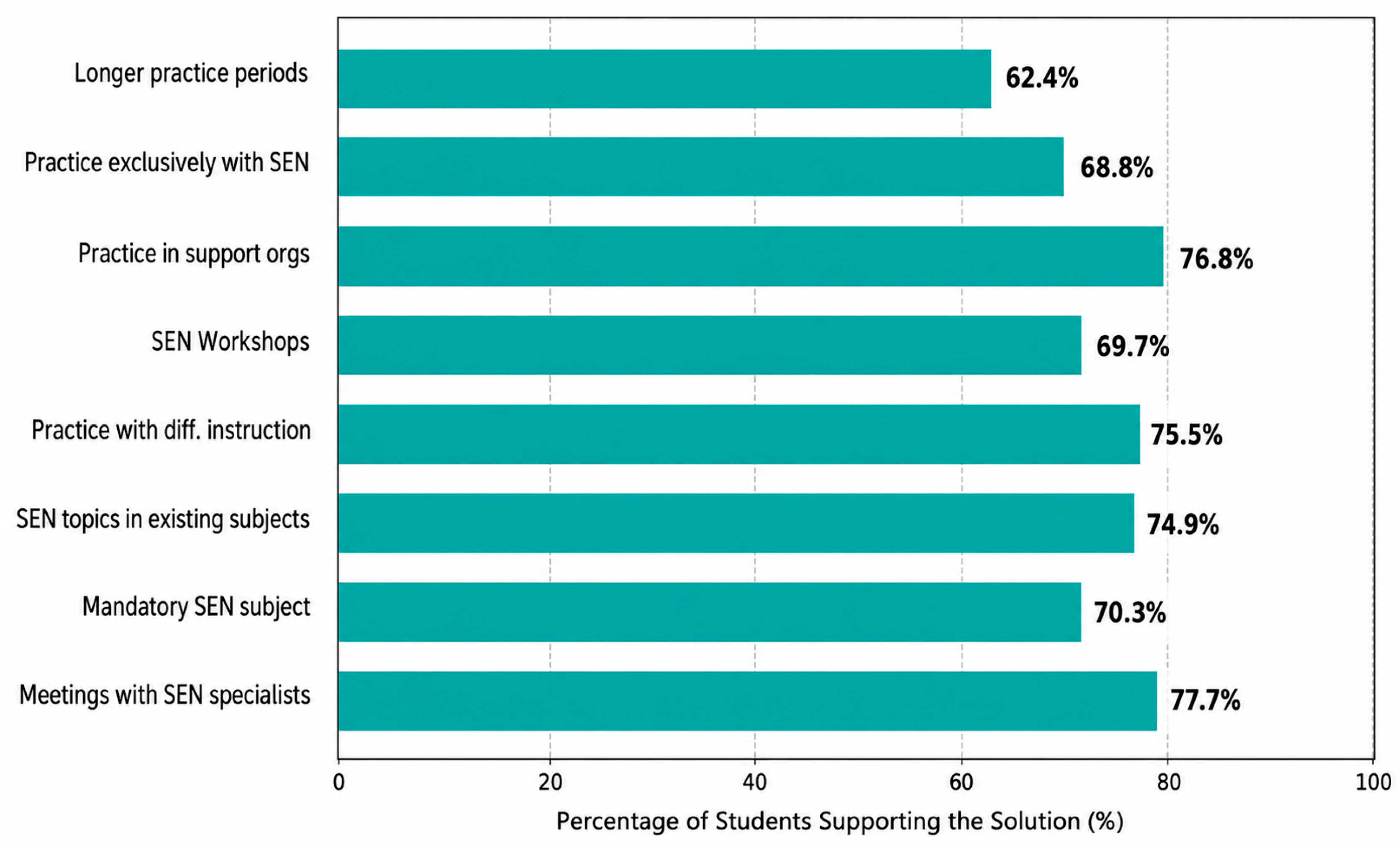
- Increase internships and direct interactions with students with SEN, including case studies and workshops.
- Curriculum:
- -
- Add courses on differentiated instruction, integrate SEN themes into existing programs, and deepen knowledge of SEN types.
- Methods and tools:
- -
- Improve diagnostic and assessment skills, adapt curricula, and personalize learning.
- Resources and technology:
- -
- Use educational tech and create needs-based resources.
- Collaboration:
- -
- Meet with SEN specialists, learn parent communication, and form multidisciplinary teams.
4. Discussion
5. Limitations
6. Conclusions
Author Contributions
Funding
Institutional Review Board Statement
Informed Consent Statement
Data Availability Statement
Conflicts of Interest
Abbreviations
| ADA | Americans with Disabilities Act |
| ADD | Attention Deficit Disorder |
| ADHD | Attention Deficit Hyperactivity Disorder |
| ANCOVA | Analysis of Covariance |
| ANOVA | Analysis of Variance |
| CBTE | Competency-Based Teacher Education |
| CRPD | Convention on the Rights of Persons with Disabilities |
| DSA | Disabled Students’ Allowance |
| EASNIE | European Agency for Special Needs and Inclusive Education |
| EASIE | European Agency Statistics on Inclusive Education |
| EHC | Education, Health and Care (Plan) |
| EU | European Union |
| GDP | Gross Domestic Product |
| ICF | International Classification of Functioning, Disability and Health |
| ISCED | International Standard Classification of Education |
| OECD | Organization for Economic Co-operation and Development |
| SDG 4 | Sustainable Development Goal 4 |
| SEN | Special Educational Needs |
| SEND | Special Educational Needs and Disability |
| UK | United Kingdom |
| UNESCO | United Nations Educational, Scientific, and Cultural Organization |
| UTS | University of Technology Sydney |
Appendix A. Short Questionnaire on Student Teachers’ Perceptions of Competence for Differentiated Instruction
Appendix A.1. Introductory Note
Appendix A.1.1. Expectations and General Perception
- Q1. As a future teacher, do you think you will have students with Special Educational Needs (SEN)?(Select one.)
- Q2. How important is the issue of students with SEN for you as a future teacher?
- Q3. To what extent do you consider that your initial teacher education program has prepared you to work with students with SEN?
Appendix A.1.2. Self-Perceived Competencies (Knowledge, Skills, Attitudes)
- Response scale for Q4–Q12:
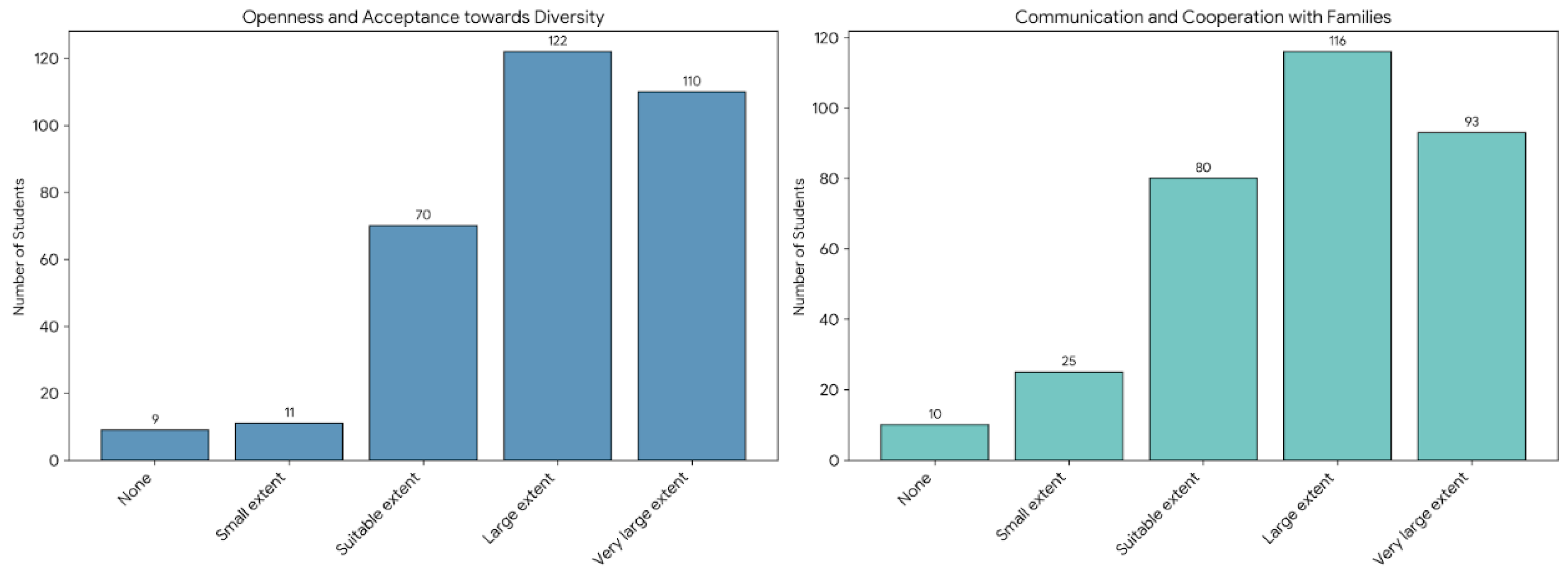
- Q4. I know what Special Educational Needs (SEN) mean.Q5. I know what differentiated instruction means.Q6. I can design differentiated instructional activities for students with diverse learning needs.Q7. I can adapt teaching strategies to the different needs of students.Q8. I can assess individual academic progress inclusively.Q9. I feel confident using digital tools to support differentiated instruction.Q10. I feel capable of managing teaching and learning situations in a diverse classroom.Q11. I know how to communicate and cooperate with families of students with SEN.Q12. I know how to communicate and cooperate with other teachers and school staff in the best interest of students with SEN.
Appendix A.1.3. Improvement Needs and Suggestions
- Q13. Overall, how would you rate your need for additional training on SEN and differentiated instruction?
- Q14. How effective do you think the following measures would be for improving initial teacher education programs regarding SEN?
- Q15. Please mention one concrete suggestion for improving initial teacher education programs in relation to SEN and differentiated instruction.(Open-ended.)
Appendix B. ANCOVA Results for Specific Pedagogical Competencies (Differentiated Instruction)
| Source | Type III Sum of Squares (SS) | df | Mean Square (MS) | F | p-Value | Partial Eta Squared (η2p) |
| Corrected model | 12.45 | 2 | 6.22 | 4.15 | 0.016 | 0.025 |
| Intercept | 845.20 | 1 | 845.20 | 563.10 | <0.001 | 0.635 |
| Age (covariate) | 1.85 | 1 | 1.85 | 1.23 | 0.268 | 0.004 |
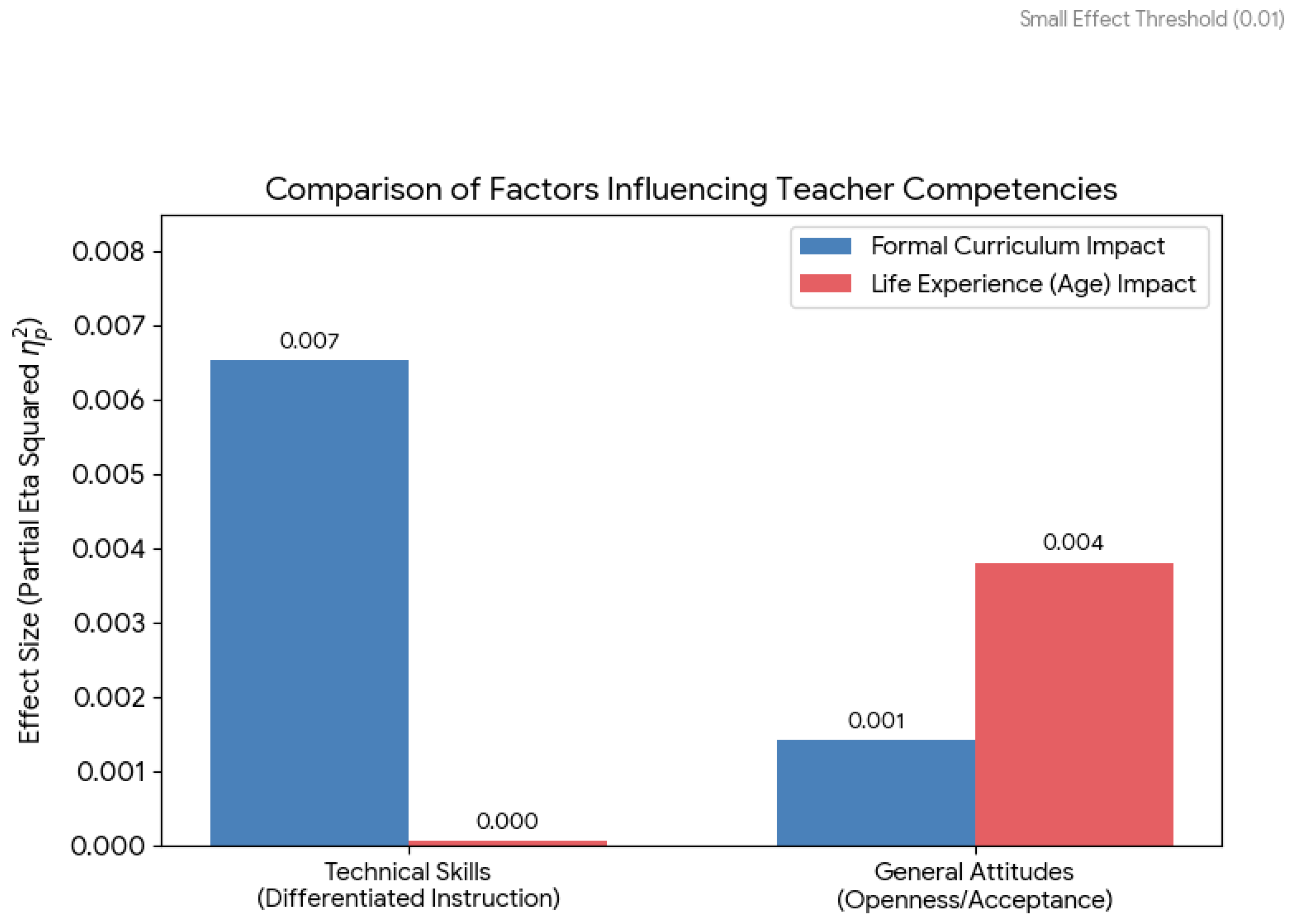
| Training level | 6.15 | 1 | 6.15 | 4.10 | 0.043 | 0.013 |
| Error | 486.30 | 324 | 1.50 | |||
| Total | 1345.80 | 327 | ||||
| Note: R2 = 0.025 (adjusted R2 = 0.019). The effect of the formal training level is statistically significant (p < 0.05), but the effect size is small (η2p = 0.013), indicating a limited practical impact on technical skills. SS = Sum of Squares; MS = Mean Square; η2p = partial eta squared. R2 = 0.025. p < 0.05. | ||||||
Appendix C. ANCOVA Results for General Adaptive Attributes (Openness to Diversity)
| Source | Type III Sum of Squares (SS) | df | Mean Square (MS) | F | p-Value | Partial Eta Squared (η2p) |
| Corrected model | 28.60 | 2 | 14.30 | 11.20 | <0.001 | 0.065 |
| Intercept | 912.40 | 1 | 912.40 | 715.60 | <0.001 | 0.688 |
| Age (covariate) | 24.15 | 1 | 24.15 | 18.94 | <0.001 | 0.055 |
| Training level | 1.95 | 1 | 1.95 | 1.52 | 0.218 | 0.005 |
| Error | 413.20 | 324 | 1.27 | |||
| Total | 1356.15 | 327 | ||||
| Note: R2 = 0.065 (adjusted R2 = 0.059). Age (representing life experience) is the dominant predictor for general inclusive attitudes (p < 0.001), while the formal Training Level does not show a significant unique contribution when controlling for age. SS = Sum of Squares; MS = Mean Square; η2p = partial eta squared. R2 = 0.059. p < 0.05. | ||||||
Appendix D. Simple Regression Model for the Question: Do You Believe That You Will Have Pupils with SEN in Your Classroom
| Variable | Coefficient | Std. Error | t-Statistic | Prob. |
| Year of study | 0.019077 | 0.007973 | 2.392646 | 0.0173 |
| C | 0.978104 | 0.017719 | 55.20077 | 0.0000 |
| R-squared | 0.017310 | |||
| Adjusted R-squared | 0.014286 | |||
| S.E. of regression | 0.190095 | |||
| Sum squared resid | 11.74420 | |||
| Log likelihood | 79.90630 | |||
| F-statistic | 5.724756 | |||
| Prob(F-statistic) | 0.017295 | |||
| Mean dependent var | 1.012232 | |||
| S.D. dependent var | 0.191467 | |||
| Akaike info criterion | −0.476491 | |||
| Schwarz criterion | −0.453311 | |||
| Hannan–Quinn criterion | −0.467242 | |||
| Durbin–Watson stat | 1.855848 |
Appendix E. Statistical Model with Dependent Variable Skills in Using Digital Tools in Specific Teaching Activities and Independent Variable Age Range
| Variable | Coefficient | Std. Error | t-Statistic | Prob. |
| Year of study | −0.066078 | 0.037922 | −1.742458 | 0.0824 |
| C | 2.889219 | 0.095804 | 30.15756 | 0.0000 |
| R-squared | 0.009256 | |||
| Adjusted R-squared | 0.006207 | |||
| S.E. of regression | 0.838110 | |||
| Sum squared resid | 228.2893 | |||
| Log likelihood | −405.2398 | |||
| F-statistic | 3.036162 | |||
| Prob(F-statistic) | 0.082374 | |||
| Mean dependent var | 2.743119 | |||
| S.D. dependent var | 0.840724 | |||
| Akaike info criterion | 2.490763 | |||
| Schwarz criterion | 2.513943 | |||
| Hannan–Quinn criterion | 2.500012 | |||
| Durbin–Watson stat | 2.131417 |
References
- Aucoin, A., Porter, G. L., & Baker-Korotkov, K. (2020). New Brunswick’s journey to inclusive education. Prospects, 49, 1–16. [Google Scholar]
- Blomberg Kjellström, K., Magnusson, P., & Östlund, D. (2026). Teachers’ digital text competencies in inclusive education: A scoping review. Frontiers in Education, 11, 1742636. [Google Scholar] [CrossRef]
- Boghian, I., & Cojocariu, V.-M. (2025). Initial teacher training for inclusive education and gamification. In I. Boghian, & G. Mareş (Eds.), Gamification and inclusion. Challenges of 21st-century education (pp. 85–108). Springer. [Google Scholar]
- Brookfield, S. D. (2017). Becoming a critically reflective teacher (2nd ed.). Jossey-Bass. [Google Scholar]
- Creswell, J. W., & Creswell, J. D. (2018). Research design: Qualitative, quantitative, and mixed methods approaches (5th ed.). SAGE. [Google Scholar]
- Department of Education. (2024). Special educational needs and disability: An analysis and summary of data sources. UK Government. Available online: https://assets.publishing.service.gov.uk/media/66bdc2de3effd5b79ba490fd/Special_educational_needs_and_disability_analysis_and_summary_of_data_sources_Aug24.pdf (accessed on 10 February 2026).
- Dignath, C., Rimm-Kaufman, S., van Ewijk, R., & Kunter, M. (2022). Teachers’ beliefs about inclusive education and insights on what contributes to those beliefs: A meta-analytical study. Educational Psychology Review, 34, 2609–2660. [Google Scholar] [CrossRef]
- Edupedu. (2025). Din peste 900 de absolvenți de masterat didactic raportați în ultimii trei ani, doar 90 au intrat prin concurs în învățământ. Available online: https://www.edupedu.ro/din-peste-900-de-absolventi-de-masterat-didactic-raportati-in-ultimii-trei-ani-doar-90-au-intrat-prin-concurs-in-invatamant/ (accessed on 25 May 2025).
- Elster, J. (1992). Local justice: How institutions allocate scarce goods and necessary burdens. Russell Sage Foundation. [Google Scholar]
- European Agency for Development in Special Needs Education. (2012). Profile of inclusive teachers. European Agency for Development in Special Needs Education. [Google Scholar]
- European Agency for Special Needs and Inclusive Education. (2018). Evidence of the link between inclusive education and social inclusion: A review of the literature (S. Symeonidou, Ed.). European Agency for Special Needs and Inclusive Education. [Google Scholar]
- European Agency for Special Needs and Inclusive Education. (2022). EASNIE position on inclusive education systems (2nd ed.). European Agency for Special Needs and Inclusive Education. Available online: https://www.european-agency.org/about-us/who-we-are/agency-position-inclusive-education-systems (accessed on 10 March 2026).
- Eurostat. (2025). Disability statistics—Access to education and training. Statistics Explained. European Commission. Available online: https://ec.europa.eu/eurostat/statistics-explained/index.php?title=Disability_statistics_-_access_to_education_and_training (accessed on 22 April 2026).
- Florian, L. (2012). Preparing teachers to work in diverse classrooms: Key lessons for the professional development of teacher educators from Scotland’s Inclusive Practice Project. Journal of Teacher Education, 63(4), 275–285. [Google Scholar] [CrossRef]
- Florian, L. (2014). What counts as evidence of inclusive education? European Journal of Special Needs Education, 29(3), 286–294. [Google Scholar] [CrossRef]
- Florian, L. (2015). Inclusive pedagogy: A transformative approach to individual differences. Scottish Educational Review, 47(1), 5–14. [Google Scholar] [CrossRef]
- Florian, L. (2019). On the necessary co-existence of special and inclusive education. International Journal of Inclusive Education, 23(7–8), 691–704. [Google Scholar] [CrossRef]
- Florian, L., & Black-Hawkins, K. (2011). Exploring inclusive pedagogy. British Educational Research Journal, 37(5), 813–828. [Google Scholar] [CrossRef]
- Florian, L., & Spratt, J. (2013). Enacting inclusion: A framework for interrogating inclusive practice. European Journal of Special Needs Education, 28(2), 119–135. [Google Scholar] [CrossRef]
- Forget, M. (2022). Beyond emotional intelligence competencies: Exploring the complex importance. Journal of Professional Capital and Community, 5(1), 92–114. [Google Scholar]
- Forlin, C. (2010). Teacher education for inclusion. In C. Forlin (Ed.), Confronting obstacles to inclusion: International responses to developing inclusive education (pp. 173–188). Routledge. [Google Scholar]
- Goldthwait-Fowles, H. (n.d.). Teacher’s corner: How universal design for learning supports inclusive learning practices. American English at the State, U.S. Department of State. Available online: https://americanenglish.state.gov/resources/teachers-corner-how-universal-design-learning-supports-inclusive-learning-practices (accessed on 16 April 2025).
- Gwosć, C., Schirmer, H., Mandl, S., & Menz, C. (2024). EUROSTUDENT 8 synopsis of indicators 2021–2024: Social and economic conditions of student life in Europe. Institute for Advanced Studies. [Google Scholar]
- Hansen, J. H., Jensen, C. R., Molbæk, M., & Schmidt, M. C. S. (2021). Cross-professional collaboration and inclusive school development in Denmark. International Journal of Inclusive Education, 25(1), 48–62. [Google Scholar] [CrossRef]
- Hardy, I., & Woodcock, S. (2015). Inclusive education policies: Discourses of difference, diversity and deficit. International Journal of Inclusive Education, 19(2), 141–164. [Google Scholar] [CrossRef]
- Hick, P. (2008). Reframing psychology for inclusive learning within social justice agendas. In Psychology for inclusive education (pp. 177–188). Routledge. [Google Scholar]
- Hutchinson, N. L., & Specht, J. (2019). Inclusion of learners with exceptionalities in Canadian schools: A practical handbook for teachers (6th ed.). Pearson Canada. [Google Scholar]
- Iceland Ministry of Education, Science and Culture. (2021). Education policy 2030. Available online: https://www.government.is/library/01-Ministries/Education-Science-and-Culture/Education%20Policy%202030.pdf (accessed on 22 April 2026).
- Inclusive Schools Network. (2026). The role of universal design for learning in inclusive schools. Available online: https://inclusiveschools.org/resource/the-role-of-universal-design-for-learning-in-inclusive-schools/ (accessed on 16 April 2025).
- Kefallinou, A., Symeonidou, S., & Meijer, C. J. (2020). Understanding the value of inclusive education and its implementation: A literature review. PROSPECTS, 49, 135–152. [Google Scholar] [CrossRef]
- Klibthong, S., & Agbenyega, J. S. (2018). Exploring professional knowing, being and becoming through Inclusive Pedagogical Approach in Action (IPAA) framework. Australian Journal of Teacher Education, 43(3), 109–123. [Google Scholar] [CrossRef]
- Krippendorff, K. (2018). Content analysis: An introduction to its methodology (4th ed.). SAGE. [Google Scholar]
- Kushwaha, R. K., & Singh, C. (2023). Building teacher capacity for inclusive education: A professional development model using technology and UDL. International Journal of Religion Education and Law, 2(2), 97–104. [Google Scholar] [CrossRef]
- Loreman, T. (2010). Essential inclusive education-related outcomes for preservice teachers. International Journal of Inclusive Education, 14(2), 195–209. [Google Scholar]
- Lowrey, K. A., Hollingshead, A., Howery, K., & Bishop, J. B. (2017). More than one way: Stories of UDL and inclusive classrooms. Research and Practice for Persons with Severe Disabilities, 42(4), 225–242. [Google Scholar] [CrossRef]
- Mărgărițoiu, A. (2025). Reflective dimensions and approaches of inclusive pedagogy. Jus et Civitas—A Journal of Social and Legal Studies, 75(2), 16–21. [Google Scholar] [CrossRef]
- Meijer, C. J. W. (1999). Financing of special needs education: A seventeen-country study of the relationship between financing of special needs education and inclusion. European Agency for Development in Special Needs Education. Available online: https://www.european-agency.org/sites/default/files/financing-of-special-needs-education_Financing-EN.pdf (accessed on 10 March 2026).
- Meijer, C. J. W., & Watkins, A. (2019). Financing special needs and inclusive education—From Salamanca to the present. International Journal of Inclusive Education, 23(7–8), 705–721. [Google Scholar] [CrossRef]
- Mendoza, M., & Heymann, J. (2024). Implementation of inclusive education: A systematic review of studies of inclusive education interventions in low- and lower-middle-income countries. International Journal of Disability, Development and Education, 71(3), 299–316. [Google Scholar] [CrossRef]
- Murray, D. M. (1998). Design and analysis of group-randomized trials (Vol. 29). Oxford University Press. [Google Scholar]
- Myklebust, J. O. (2006). Class placement and competence attainment among students with special educational needs. British Journal of Special Education, 33(2), 76–81. [Google Scholar] [CrossRef]
- Myklebust, J. O. (2007). Diverging paths in upper secondary education: Competence attainment among students with special educational needs. International Journal of Inclusive Education, 11(2), 215–231. [Google Scholar] [CrossRef]
- Myklebust, J. O., & Båtevik, F. O. (2005). Economic independence for adolescents with special educational needs. European Journal of Special Needs Education, 20(3), 271–286. [Google Scholar] [CrossRef]
- Myklebust, J. O., & Båtevik, F. O. (2014). Economic independence among former students with special educational needs: Changes and continuities from their late twenties to their mid-thirties. European Journal of Special Needs Education, 29(3), 387–401. [Google Scholar] [CrossRef]
- National Audit Office. (2024). Support for children and young people with special educational needs. National Audit Office. Available online: https://www.nao.org.uk/reports/support-for-children-and-young-people-with-special-educational-needs/ (accessed on 22 April 2026).
- Navas-Bonilla, C. R., Guerra-Arango, J. A., Oviedo-Guado, D. A., & Murillo-Noriega, D. E. (2025). Inclusive education through technology: A systematic review of types, tools, and characteristics. Frontiers in Education, 10, 1527851. [Google Scholar] [CrossRef]
- OECD. (2023). Equity and inclusion in education: Finding strength through diversity. OECD Publishing. [Google Scholar] [CrossRef]
- Ontario Ministry of Education. (2014). Equity and inclusive education in Ontario schools: Guidelines for policy development and implementation. Ontario Ministry of Education. Available online: https://www2.yrdsb.ca/sites/default/files/migrate/files/inclusiveguide.pdf (accessed on 10 March 2026).
- Page, M. J., McKenzie, J. E., Bossuyt, P. M., Boutron, I., Hoffmann, T. C., Mulrow, C. D., Shamseer, L., Tetzlaff, J. M., Akl, E. A., Brennan, S. E., Chou, R., Glanville, J., Grimshaw, J. M., Hróbjartsson, A., Lalu, M. M., Li, T., Loder, E. W., Mayo-Wilson, E., McDonald, S., … Moher, D. (2021). The PRISMA 2020 statement: An updated guideline for reporting systematic reviews. BMJ, 372, n71. [Google Scholar] [CrossRef] [PubMed]
- Potolea, D. (2002). Conceptualizarea curriculumului. In Pedagogie. Fundamentări teoretice și demersuri aplicative (E. Păun, & D. Potolea, Coord.; pp. 69–85). Editura Polirom. [Google Scholar]
- Puiu, A. D., & Goga, M. (2021). Teacher and school principal perspectives about happiness in primary school—The Romanian experience. International Journal of Educational Policy Research and Review, 8(3), 100–107. [Google Scholar]
- Riddell, S., Harris, N., Weedon, E., & Davidge, G. (2019). Educational equity and additional support needs in Scotland. Scottish Educational Review, 51(1–2), 5–23. [Google Scholar]
- Savolainen, H., Engelbrecht, P., Nel, M., & Malinen, O. (2012). Understanding teachers’ attitudes and self-efficacy in inclusive education: Implications for pre-service and in-service teacher education. European Journal of Special Needs Education, 27(1), 51–68. [Google Scholar]
- Scottish Government. (2004). Education (additional support for learning) (Scotland) act 2004. Available online: https://www.legislation.gov.uk/asp/2004/4/contents (accessed on 9 March 2026).
- Sharma, U., Loreman, T., & Forlin, C. (2012). Measuring teacher efficacy to implement inclusive practices. Journal of Research in Special Educational Needs, 12(1), 12–21. [Google Scholar] [CrossRef]
- Sharma, U., & Mullick, J. (2020). Bridging the gaps between theory and practice of inclusive teacher education. In U. Sharma, & S. Salend (Eds.), Oxford encyclopedia of inclusive and special education. Oxford University Press. Online first 27 October 2020. [Google Scholar]
- Sharma, U., & Sokal, L. (2015). Can teachers’ self-reported efficacy, concerns, and attitudes toward inclusion scores predict their actual inclusive classroom practices? Australasian Journal of Special Education, 40(1), 21–38. [Google Scholar] [CrossRef]
- Song, J., Sharma, U., & Choi, H. (2019). Impact of teacher education on pre-service regular school teachers’ attitudes, intentions, concerns and self-efficacy about inclusive education in South Korea. Teaching and Teacher Education, 86, 102901. [Google Scholar] [CrossRef]
- Stevens, G. V. (1998). On the inverse of the covariance matrix in portfolio analysis. The Journal of Finance, 53(5), 1821–1827. [Google Scholar] [CrossRef]
- Struyven, K., & De Meyst, M. (2010). Competence-based teacher education: Illusion or reality? An assessment of the implementation status in Flanders from teachers’ and students’ points of view. Teaching and Teacher Education, 26(8), 1495–1510. [Google Scholar] [CrossRef]
- Szumski, G., Smogorzewska, J., & Karwowski, M. (2017). Academic achievement of students without special educational needs in inclusive classrooms: A meta-analysis. Educational Research Review, 21, 33–54. [Google Scholar] [CrossRef]
- Șerbănescu, L., & Popescu, T. (2014). Motivation for the teaching career. Procedia—Social and Behavioral Sciences, 127, 691–695. [Google Scholar] [CrossRef]
- Takala, M., Sutela, K., Ojala, S., & Saarinen, M. (2023). Teaching practice in the training of special education teachers in Finland. European Journal of Special Needs Education, 38(6), 835–849. [Google Scholar] [CrossRef]
- Tang, H., D’Angelo, C., Ebersold, S., & Watkins, A. (2023). Supporting all educators to take part in teacher professional learning for inclusion. Trends in Higher Education, 2(2), 320–331. [Google Scholar] [CrossRef]
- UNESCO. (2017). A guide for ensuring inclusion and equity in education. UNESCO Publishing. [Google Scholar]
- UNESCO. (2020a). Global education monitoring report 2020: Inclusion and education—All means all. UNESCO. [Google Scholar]
- UNESCO. (2020b). Inclusive teaching: Preparing all teachers to teach all students. Global Education Monitoring Report. In ternational Task Force on Teachers for Education 2030. UNESCO. [Google Scholar]
- UNICEF. (2021). Quality inclusive education in Romania: A case study of systemic reform. UNICEF Regional Office for Europe and Central Asia. Available online: https://clearinghouse.unicef.org/sites/ch/files/ch/teams-ECARO-Planning-ECA%20Knowledge%20at%20UNICEF-Romania%20Case%20Study1-2.0.pdf (accessed on 8 March 2026).
- UNICEF. (2024). Inclusive education toolkit for teachers in mainstream schools in Romania. UNICEF Romania. Available online: https://www.unicef.org/romania/media/13116/file/UNICEF%20Romania%20Inclusive%20Education%20Toolkit.pdf (accessed on 8 March 2026).
- Van der Klink, M., Kools, Q., Avissar, G., White, S., & Sakata, T. (2017). Professional development of teacher educators: What do they do? Findings from an explorative international study. Professional Development in Education, 43(2), 163–178. [Google Scholar] [CrossRef]
- van Steen, T., & Wilson, C. (2020). Individual and cultural factors in teachers’ attitudes towards inclusion: A meta-analysis. Teaching and Teacher Education, 95, 103127. [Google Scholar] [CrossRef]
- Voltz, D. L. (2003). Collaborative infusion: An emerging approach to teacher preparation for inclusive education. Action in Teacher Education, 25(1), 5–13. [Google Scholar] [CrossRef]
- Walton, E., & Rusznyak, L. (2020). Cumulative knowledge-building for inclusive education in initial teacher education. European Journal of Teacher Education, 43(1), 18–37. [Google Scholar] [CrossRef]
- Woodcock, S., Sharma, U., Subban, P., & Hitches, E. (2022). Teacher self-efficacy and inclusive education practices: Rethinking teachers’ engagement with inclusive practices. Teaching and Teacher Education, 117, 103802. [Google Scholar] [CrossRef]
- Zou, Y., & Huang, X. (2022). On evidence-based teaching practice reform in the United States. International and Comparative Education, 44(9), 76–83. [Google Scholar]




| Country | Rate of Early School Leaving Among Persons with Disabilities |
|---|---|
| Finland | 15.4% |
| Sweden | 11.2% |
| Iceland | 16.8% |
| Denmark | 14.5% |
| Romania | 61.6% |
| Model | Allocation Mechanism | Advantages | Risks/Disadvantages |
|---|---|---|---|
| Input | Based on the number of students with a diagnosis (per capita) | Resources follow the student; targeted funds | Incentivizes “label hunting” for funds; favors segregation (Elster, 1992) |
| Throughput | Based on services, region, or total enrollment | Flexibility encourages inter-school collaboration | Funds might not reach the specific student due to a lack of individual accountability |
| Output | Based on results or reduced referrals to special schools | Performance-oriented; efficiency | May penalize schools with high-need students; risk of excluding “low performers” |
| Depth Level | Indicator | Criteria for Coding | Example of Finding (Evidence) |
|---|---|---|---|
| Level 0 | Absent | The inclusive dimension is not mentioned explicitly. | Subject: “classroom management” No mention of managing diverse behaviors or SEN specificities. |
| Level 1 | Theoretical awareness | The concept is mentioned as a definition, principle, or legislation. | Subject: “educational psychology” Outcome: “Defining the concept of SEN.” Critique: Students learn what SEN are, but not how to address them. |
| Level 2 | Operational competence | The curriculum requires the design of instruments, adaptation of lessons, or application of methods. | Subject: “didactics” Outcome: “Designing a lesson plan adapted for students with learning disabilities.” Status: Rarely found in the core curriculum. |
| Age Group | Of Interest to Me as a Future Teacher (%) | Relevant for Education Policy in EU Countries (%) | Important, Because There Are Many People with SEN (%) |
|---|---|---|---|
| 20–24 years old | 77.1% | 21.5% | 1.4% |
| 25–34 years old | 74.4% | 23.3% | 2.3% |
| 35–44 years old | 68.7% | 28.4% | 3.0% |
| Over 45 years old | 65.8% | 27.4% | 6.8% |
| Age Group | To a Very Small Extent | To a Small Extent | To the Right Extent | To a Large Extent | To a Very Large Extent |
|---|---|---|---|---|---|
| 20–24 Years Old | 16.7% | 16.7% | 31.2% | 20.1% | 15.3% |
| 25–34 Years Old | 7.0% | 32.6% | 23.3% | 11.6% | 25.6% |
| 35–44 Years Old | 9.0% | 22.4% | 31.3% | 16.4% | 20.9% |
| Over 45 Years Old | 11.0% | 27.4% | 30.1% | 16.4% | 15.1% |
| Total | 12.5% | 17.4% | 30% | 22.3% | 17. 7% |
Disclaimer/Publisher’s Note: The statements, opinions and data contained in all publications are solely those of the individual author(s) and contributor(s) and not of MDPI and/or the editor(s). MDPI and/or the editor(s) disclaim responsibility for any injury to people or property resulting from any ideas, methods, instructions or products referred to in the content. |
© 2026 by the authors. Licensee MDPI, Basel, Switzerland. This article is an open access article distributed under the terms and conditions of the Creative Commons Attribution (CC BY) license.
Share and Cite
Richiteanu-Nastase, E.-R.; Dumitru, D.; Staiculescu, C. Preparing Future Teachers for Inclusive Education: An Analysis of Curricular Deficits and Competency Perceptions in Romania. Educ. Sci. 2026, 16, 991. https://doi.org/10.3390/educsci16070991
Richiteanu-Nastase E-R, Dumitru D, Staiculescu C. Preparing Future Teachers for Inclusive Education: An Analysis of Curricular Deficits and Competency Perceptions in Romania. Education Sciences. 2026; 16(7):991. https://doi.org/10.3390/educsci16070991
Chicago/Turabian StyleRichiteanu-Nastase, Elena-Ramona, Daniela Dumitru, and Camelia Staiculescu. 2026. "Preparing Future Teachers for Inclusive Education: An Analysis of Curricular Deficits and Competency Perceptions in Romania" Education Sciences 16, no. 7: 991. https://doi.org/10.3390/educsci16070991
APA StyleRichiteanu-Nastase, E.-R., Dumitru, D., & Staiculescu, C. (2026). Preparing Future Teachers for Inclusive Education: An Analysis of Curricular Deficits and Competency Perceptions in Romania. Education Sciences, 16(7), 991. https://doi.org/10.3390/educsci16070991