


Abstract
One-semester exchange programs place students in university courses within compressed, credit-bearing mobility timelines. This qualitative case study examines how eight Korean undergraduate exchange students described academic learning and adjustment during a one-semester exchange at a U.S. university. Drawing on online written interviews, the study analyzes students’ reported classroom experiences rather than formal course design or enacted instructional practice. The analysis focuses on how students navigated unfamiliar classroom expectations at the level of reported classroom practice. The findings show that participation became visible as academic work when students prepared texts, engaged in discussions, managed language risk, and judged what counted as an appropriate contribution. Feedback and academic help-seeking served as interpretive resources through peer review, instructor clarification, writing tools, and efforts to turn uncertainty into next steps. Across the accounts, adjustment appeared as selective and uneven additions to students’ academic strategies, most visible in discussion, peer feedback, open-ended writing, instructor clarification, and resource assembly. This study contributes to higher education and international student mobility research by showing how temporary exchange students made classroom expectations workable through targeted strategy additions rather than through a shift from one national learning culture to another. It offers implications for participation scaffolding, feedback design, and pre-departure preparation.
1. Introduction
Semester-long exchange programs place students in classrooms where academic routines may not be familiar. Exchange students move not only across national borders, but also across classroom practices. They may need to learn how to join discussions, respond to feedback, complete writing tasks, ask for clarification, and judge what counts as an appropriate academic contribution in the host institution. These processes are often discussed through broad concepts such as academic adjustment, intercultural learning, language learning, or development of study-abroad programs. In practice, they are experienced through specific classroom encounters.
Research on international students has shown that academic experiences abroad are shaped by language, prior educational experiences, classroom interaction, disciplinary norms, and institutional support (Andrade, 2006; Gu & Schweisfurth, 2015; Ryan, 2011). Scholars have also cautioned against deficit-oriented explanations that portray East Asian or Confucian-heritage students as passive, silent, or dependent on memorization (Biggs, 1996; Clark & Gieve, 2006; Ryan & Louie, 2007). Silence, hesitation, or difficulty participating may reflect not a lack of ability or motivation, but the work of navigating unfamiliar classroom expectations, language demands, and participation norms (Cheng, 2000; Morita, 2004). In this sense, academic adjustment is understood here as students’ efforts to interpret and respond to unfamiliar academic expectations in specific classroom situations.
Although international student mobility has been widely studied, including a substantial body of study-abroad research on undergraduate mobility, program duration, intercultural learning, language learning, and student development, much of the existing literature has focused on degree-seeking students, first-year transition, program-level outcomes, or longer-term forms of academic and sociocultural adjustment. Recent studies on Asian and international students in U.S. higher education have examined academic adaptation, transition, mental wellness, and racialized positioning (Koo et al., 2021; Krsmanovic, 2022; Li et al., 2018; Yao & George Mwangi, 2022). Recent reviews also show that international student mobility, study abroad, and short-term mobility programs are well-established areas of scholarship with extensive research on participation, outcomes, and broader impacts (Gümüş et al., 2020; Luo, 2023; Roy et al., 2019). Against this broad body of literature, the present study focuses on a more specific analytical issue: how temporary exchange students make course-level classroom expectations meaningful and workable within a compressed, credit-bearing academic timeline.
Research on short-term study abroad has also examined program duration and learning outcomes, including language development, intercultural sensitivity, global-mindedness, intercultural competence, and broader student outcomes (Engle & Engle, 2004; Kehl & Morris, 2007; Medina-López-Portillo, 2004; Nguyen, 2017; Roy et al., 2019). The present study builds on this work by shifting the level of analysis from overall outcomes to students’ reported encounters with specific classroom expectations. One-semester exchange therefore occupies an important in-between position: it is short relative to full-degree study, yet long enough for students to encounter multiple courses, assignments, discussions, feedback events, and academic help-seeking opportunities. In the Korean higher education context, short-term credit exchange has been identified as an important component of university internationalization and student mobility, with Korean universities maintaining credit-exchange partnerships that enable students to study at overseas partner institutions for a limited period while remaining connected to their home degree programs (Song & Kim, 2022). This institutional structure makes one-semester exchange academically consequential rather than merely experiential or cultural.
Building on the literature, this study focuses on short-term academic learning. It does not compare Korean and U.S. higher education as fixed or hierarchical systems. In this study, “Korean exchange students” refers to a shared educational and mobility pathway rather than to fixed national learning characteristics. The study treats this group as a bounded case of undergraduates educated in a non-U.S. higher education context who temporarily entered U.S. classrooms for one semester. This framing allows the analysis to focus on how participants made sense of unfamiliar academic demands and selectively developed strategies for participation, feedback use, help-seeking, and coursework. This study does not claim that one-semester exchange programs or study-abroad experiences are under-studied as general phenomena. Instead, it examines academic adjustment through students’ reported encounters with course-level classroom expectations. By focusing on participation, feedback, academic help-seeking, writing, and resource assembly, the analysis shows how broad challenges commonly associated with study abroad became actionable in specific academic situations. In doing so, it conceptualizes short-term academic learning as selective and uneven additions to students’ academic strategies rather than as a general process of adaptation, transition, or intercultural development. The study asks how Korean undergraduate exchange students described their encounters with reported classroom practices during a one-semester exchange at a U.S. university. These accounts matter because they show how students interpreted academic expectations in situations they remembered as difficult, useful, or unfamiliar.
The analysis focuses on participation, feedback, and academic help-seeking because these were the areas in which participants most clearly described uncertainty, strategy use, and reflection. Participation is treated not as speaking more often, but as a form of academic work that students have to interpret and engage with (Morita, 2004). Feedback is treated not only as correction, but as a resource students may learn to use when revising, clarifying, and making decisions about future work (Carless & Boud, 2018; D. J. Nicol & Macfarlane-Dick, 2006). Academic help-seeking is treated as a task-related practice through which students try to make unclear expectations more manageable. Together, these practices show how academic expectations became visible and usable during exchange.
The study conceptualizes academic adjustment as a process of making unfamiliar classroom expectations meaningful and workable. This framing does not assume that students abandon prior learning habits or adopt a new academic style wholesale. Students may retain familiar ways of studying while adding strategies for discussion, revision, help-seeking, peer feedback, open-ended interpretation, and resource assembly. In this study, those selective additions are conceptualized as repertoire expansion. This framing treats study-abroad learning as situated and partial, not as a simple transformation from one national learning culture to another (Kinginger, 2009; Paige et al., 2009; Vande Berg et al., 2012). The study does not claim to capture enacted classroom practices as instructional facts. It foregrounds students’ accounts of classroom practices as sites of meaning-making. Students’ accounts are treated not as transparent descriptions of teaching, but as evidence of how classroom expectations became interpretable, negotiable, or difficult within specific learning encounters.
1.1. Purpose of Study and Research Questions
Drawing on written interview responses from eight Korean undergraduate exchange students, this study asks:
- How do Korean exchange students describe their academic learning experiences in U.S. university classrooms?
- How do participation and feedback practices shape their classroom learning during exchange?
- How do students describe adjusting their learning strategies as they navigate unfamiliar reported classroom practices?
RQ1 is descriptive in scope and establishes the experiential baseline. RQ2 and RQ3 focus more directly on participation, feedback, and learning strategy adjustment.
The study contributes to research on international student mobility and higher education learning by refining existing understandings of exchange student academic adjustment at the level of classroom practice. Rather than treating academic difficulty as a sign of cultural or linguistic deficiency, the analysis shows how participants described adding strategies for participation, feedback use, clarification, writing, and resource assembly when familiar routines became less workable. By focusing on a one-semester, credit-bearing exchange pathway, the study extends existing research on international student adjustment by showing how temporary exchange students make specific classroom expectations workable within a compressed academic timeline. This conceptual and practice-level contribution shows how familiar categories in the study-abroad literature, such as adjustment, participation, feedback, and academic challenge, became organized through students’ selective and uneven additions to their academic strategies. This focus speaks to higher education teaching and learning by showing how course-level scaffolding, feedback design, and exchange-program preparation can make academic expectations more visible and workable for short-term visiting students.
1.2. International Student Mobility and Academic Learning
International student mobility has often been examined in relation to intercultural learning, language learning, identity development, and adaptation to new educational settings (Byram, 1997; Deardorff, 2006; Jackson, 2015; Kinginger, 2009; Paige et al., 2009; Vande Berg et al., 2012). Language learning has been a major strand of study-abroad research, with prior work examining how program design, interaction, immersion, and duration shape second-language development during study abroad (Engle & Engle, 2004; Kinginger, 2009; Tseng et al., 2024). This body of literature shows that study abroad involves more than entry into a new national context. Students encounter new relationships, institutional expectations, language-mediated learning demands, and forms of academic work. Their experiences are shaped by linguistic ability, prior educational experiences, disciplinary expectations, classroom interaction, and access to institutional resources (Andrade, 2006; Arkoudis & Tran, 2010; Gu & Schweisfurth, 2015; Ryan, 2011).
Recent research has further expanded our understanding of Asian and international students’ experiences in U.S. higher education. For example, Li et al. (2018) examined East Asian international students’ academic adaptation at a U.S. university and identified challenges, feelings, strategies, suggestions, and self-reflections as key domains of adjustment. Krsmanovic (2022) showed that international undergraduates’ academic transition into American higher education involves navigating unfamiliar educational and cultural settings, while Koo et al. (2021) examined mental wellness among Korean international graduate students. Yao and George Mwangi (2022) also showed how Asian international students in the United States may be positioned through racialized and economic logics. More recently, Zou and Fu (2025) found that international students’ academic acculturation in U.S. universities is shaped by peer networks, advising, and field-specific challenges, highlighting the importance of discipline-specific support and concrete academic settings. These studies provide important context for understanding Asian and international students’ experiences in U.S. higher education, but they focus largely on degree-seeking students, graduate students, first-year transition, mental wellness, racialized positioning, or broad academic adaptation rather than on undergraduate exchange students’ one-semester encounters with course-level expectations.
Academic adjustment is often treated as one dimension of broader adaptation. The term is useful, but it can become too broad when it includes language confidence, social belonging, cultural adaptation, academic performance, and institutional integration at the same time. This study uses academic adjustment more narrowly. It focuses on how students described making sense of unfamiliar academic demands in reported classroom contexts, including participation, feedback, clarification, writing tasks, and coursework expectations. This narrower use aligns with research showing that academic adaptation involves learning how to work with unfamiliar teaching practices, assessment expectations, academic support systems, field-specific expectations, language-mediated coursework demands, and independent study demands, rather than only adjusting socially or linguistically (Ahrari et al., 2019; Hussain & Shen, 2019; Li et al., 2018; Zou & Fu, 2025).
Academic learning is used here as a broad descriptive term for participants’ engagement with academic tasks, interactions, and expectations during exchange. Academic adjustment is used as an analytical term for moments when students described modifying or extending their strategies in response to unfamiliar academic demands. This distinction matters in short-term exchange because academic learning is compressed into a limited period. Students must quickly interpret expectations and decide how to respond. The study therefore foregrounds how academic learning became visible in students’ descriptions of concrete classroom situations.
Studies of exchange students in other cross-system contexts also suggest that temporary mobility involves practical academic negotiation. For instance, Silalahi and Sitorus (2021) examined Indonesian students who participated in a semester-long exchange at a Taiwanese university and reported difficulties related to technology use, cultural adjustment, and unfamiliar academic environments. Such work shows that exchange students’ learning abroad involves more than cultural exposure. However, existing exchange-student studies often focus on general adjustment, speaking anxiety, or overall academic and social experience rather than on how students describe making specific classroom expectations workable. The present study extends this work by examining a bounded Korean outbound pathway to a U.S. host institution and by focusing specifically on how students described participation, feedback use, academic help-seeking, writing, and resource assembly.
1.3. Classroom Participation Beyond Deficit Views
A recurring issue in research on international students is how to interpret participation. Earlier discussions of East Asian and Confucian-heritage students sometimes framed hesitation, silence, or deference as evidence of passive learning, memorization, or limited classroom engagement (Biggs, 1996; Watkins & Biggs, 2001). Later research has challenged this interpretation by showing that silence and participation are situated phenomena shaped by classroom norms, language conditions, disciplinary expectations, interactional risk, and power relations (Cheng, 2000; Clark & Gieve, 2006; Grimshaw, 2007; Heng, 2018; Jin & Cortazzi, 2006; Morita, 2004; Ryan & Louie, 2007; Tran, 2011). Recent work also cautions that deficit and culturalist assumptions can continue to shape how Asian international students are positioned in U.S. higher education, especially when responsibility for adjustment is placed primarily on students rather than on institutional practices and expectations (Yu, 2025).
Participation in higher education is not reducible to speaking frequently. It can involve asking questions, responding to instructors, joining discussion, presenting ideas, preparing written work, and contributing to peer interaction. For multilingual students, participation is often tied to timing, confidence, comprehension, and judgment. Students may understand course content but hesitate because they are unsure when to speak, how to phrase a response, or whether their contribution fits the expectations of the setting (Leki, 2001; Morita, 2004). Participation is also connected to positioning and identity, as students negotiate whether they can speak as legitimate contributors within an academic community (Kettle, 2005; Norton, 2000; Wenger, 1998). This study treats participation as a form of academic work rather than as a fixed student trait. The question is not whether Korean exchange students are more or less participatory by nature. The question is how participants described participation in the classroom situations they recalled, what made it difficult or manageable, and how participation became part of their academic learning during exchange.
1.4. Feedback, Academic Help-Seeking, and Learning Strategy Adjustment
Feedback is another important site of academic learning. In higher education, feedback is often discussed as a means of helping students recognize the gap between current and expected work (Hattie & Timperley, 2007; D. J. Nicol & Macfarlane-Dick, 2006; Sadler, 1989). More recent research has emphasized that feedback does not function automatically. Students need to interpret, evaluate, and act on feedback if it is to become useful for learning (Carless & Boud, 2018; Molloy et al., 2020; Winstone et al., 2017). This shift from feedback transmission to feedback use is especially relevant when students encounter unfamiliar academic expectations.
For exchange students, feedback may be available but difficult to use. Students may not know how directly to ask for clarification, how to respond to peer comments, or how to convert suggestions into revision strategies. Feedback can therefore be understood not only as information about performance, but also as a resource for learning how academic work is judged and improved (Boud & Molloy, 2013; Evans, 2013; Hyland & Hyland, 2006).
Peer feedback is especially relevant because it requires students to interpret criteria, evaluate others’ work, and make their own work available for response. Studies on peer review suggest that students can develop stronger understandings of academic quality by reading peers’ work, identifying claims and evidence, and offering comments on structure and clarity (Liu & Carless, 2006; D. Nicol et al., 2014; Topping, 1998). Peer review may also be unfamiliar for students who are not used to sharing unfinished work or commenting on others’ writing.
This study connects feedback to academic help-seeking. Academic help-seeking refers here to students’ task-related efforts to make academic expectations clearer or more manageable through instructor clarification, office-hour communication, peer response, writing tools, or other academic resources. It does not refer to general social support or everyday adjustment. Feedback and academic help-seeking are conceptually linked because both involve interpretation and action. Feedback can show students how work is judged or improved; help-seeking can help them clarify what a task requires and decide what to do next.
This reasoning also connects to research on self-regulated learning. Students develop strategies through cycles of planning, monitoring, response, and revision (Panadero, 2017; Pintrich, 2000; Winne & Hadwin, 1998; Zimmerman, 2002). In short-term exchange, strategy adjustment may include preparing differently for discussion, using feedback to revise writing, asking instructors for clarification, or changing how one approaches open-ended assignments. The study therefore treats learning strategy adjustment as a situated response to classroom expectations described in participants’ accounts, not as a fixed learning style. Feedback use and help-seeking became analytically relevant when participants described using them to interpret unfamiliar expectations and modify how they approached academic tasks.
1.5. Conceptual Framework: Academic Adjustment as Repertoire Expansion
Research on study abroad often uses concepts such as adaptation, transition, or transformation to explain student learning. These concepts are useful, but they can imply a more coherent movement than short-term exchange often allows. They may also suggest that successful adjustment requires students to move from one academic culture into another or to replace prior learning habits with new ones. Such interpretations risk overstating what one-semester mobility can show and may reinforce binary contrasts between national education systems.
This study uses a more bounded framework. It conceptualizes academic adjustment as a process through which students made unfamiliar classroom expectations understandable and workable. Students entered exchange with prior academic routines: ways of studying, preparing for class, completing assignments, participating, and responding to instructors. During exchange, they encountered course-level practices that sometimes organized academic work differently, including discussion-based participation, open-ended writing, peer review, instructor clarification, iterative feedback, and revision.
When familiar routines did not align easily with these practices, students sometimes described academic disorientation. Academic disorientation is used here in a narrow sense. It does not mean generalized culture shock. It refers to moments when students were unsure how to act in relation to a classroom task or expectation, such as joining a discussion, interpreting an open-ended assignment, responding to peer comments, revising writing, or seeking clarification from an instructor.
These moments did not automatically lead to adjustment. They became analytically important when students described attempts to respond through new or modified strategies. The study uses repertoire expansion to describe these selective additions. Repertoire expansion refers to the selective broadening of students’ available academic strategies in response to unfamiliar classroom expectations. It includes additional ways of participating, interpreting assignments, using feedback, seeking clarification, revising writing, and assembling resources for academic work.
In this study, repertoire expansion is used as a mid-level analytical concept rather than as a general theory of study-abroad learning. The concept brings together research on international students’ academic adjustment (Ahrari et al., 2019; Li et al., 2018; Zou & Fu, 2025), participation and feedback (Carless & Boud, 2018; Morita, 2004), and study-abroad learning as situated and context-mediated (Kinginger, 2009; Vande Berg et al., 2012). It is intended to capture patterns observed within this bounded case, not to propose a universal model of academic development.
Figure 1 was developed from the conceptual framework and the literature reviewed above. It is a heuristic synthesis rather than a tested causal model. The components draw on research on international students’ academic adjustment, participation in second-language academic communities, feedback literacy, self-regulated learning, and study-abroad learning as situated and context-mediated. Prior academic routines and academic adjustment are informed by scholarship on international student learning and adaptation; participation and classroom expectations draw on work on participation and positioning in academic communities; feedback and help-seeking draw on feedback literacy and academic support research; and learning strategy adjustment draws on self-regulated learning. The figure therefore summarizes the analytical logic used in this study: participants entered exchange with prior academic routines, encountered classroom practices that were sometimes unfamiliar, experienced academic disorientation in specific tasks, and described selective additions to their academic strategies.
Figure 1.
Conceptual framework of academic adjustment as patterned but uneven repertoire expansion.
Figure 1 summarizes this analytical logic. The framework begins with students’ prior academic routines and traces how these routines were challenged by classroom practices described in participants’ accounts, including discussion, presentations, peer review, feedback, writing tasks, and instructor clarification. The analysis then examines how students described academic disorientation, learning strategy adjustment, and selective additions to their academic repertoires. The framework is used as a heuristic device, not a deterministic sequence. It supports the research questions by linking students’ descriptions of academic learning to participation, feedback, strategy adjustment, and repertoire expansion.
2. Materials and Methods
2.1. Research Design and Case Context
This study used a qualitative case study design to examine how Korean undergraduate exchange students described academic learning during a one-semester exchange at a U.S. university. A case study approach was appropriate because the study focused on a bounded group of students who participated in the same exchange pathway, moving from the same Korean sending institution to the same U.S. host institution for one semester of undergraduate coursework (Stake, 1995; Merriam & Tisdell, 2016; Yin, 2018).
The case focused on Korean outbound exchange students’ reported academic learning experiences within this shared exchange pathway. The purpose was not statistical or representational generalization, but analytical depth within a bounded context. The inclusion of eight participants allowed for cross-case comparison while preserving attention to individual variation across reported classroom practices. Data sufficiency was considered in relation to the study’s analytical purpose: to examine how participants described academic expectations, uncertainty, feedback, help-seeking, and strategy adjustment across a shared exchange context.
The case was also bounded by the institutional structure of the exchange pathway. Participants were undergraduate students from the same Korean sending institution who studied at the same U.S. host institution for one semester while remaining enrolled at their home university. Coursework completed at the host institution could be connected to participants’ home-degree progress through institutional credit-recognition procedures. The study therefore treats the exchange not as an informal cultural experience, but as a credit-bearing academic mobility pathway in which students temporarily entered U.S. classrooms while maintaining their academic affiliation with the Korean sending institution. This shared pathway provided a common institutional and mobility context, although participants’ course enrollments and academic experiences varied across disciplines and terms.
The unit of analysis was students’ retrospective accounts of reported classroom practices and academic adjustment. The study did not aim to evaluate courses, instructors, formal course design, or institutional practices. Participants’ accounts were analyzed as evidence of how they interpreted classroom expectations and described their own responses to them.
Several contextual features shaped interpretation. Participants completed exchange at different points in time and enrolled in different courses. Several were in English- or translation-related fields, which made writing, literature, discussion, peer feedback, and language-mediated participation especially visible in the data. All participants were female Korean undergraduates. Gender was not treated as an analytic variable, and the all-female sample reflected the composition of the participating cohort rather than an intentional sampling decision.
2.2. Participants and Recruitment
All twelve eligible students in the exchange pathway were invited to participate voluntarily. Eight students submitted written responses, resulting in a response rate of eight out of twelve. Invitations were sent to eligible students who had completed the exchange pathway by the time of data collection. Participation was voluntary, and students were informed that choosing not to participate would have no academic, programmatic, or personal consequences.
None of the participants had taken courses taught by any member of the research team. The research team had no role in grading participants’ coursework, selecting students for exchange, or evaluating their academic performance. These conditions were important because the first author had limited informal mentoring contact with some students during their exchange period.
Participants are referred to by participant IDs, P1 through P8. Identifying information was removed or generalized before analysis. Majors and host university course areas are reported broadly to reduce identifiability. Table 1 summarizes participants’ exchange terms, majors, and host university course areas.
Table 1.
Participant majors and host university course areas.
2.3. Data Sources and Written Interview Protocol
The primary data source was a one-time online written interview. In this study, online written interview refers to a structured set of open-ended written questions administered online. The term interview is used because participants provided narrative, reflective responses to open-ended prompts rather than selecting from fixed response options. The format did not involve a synchronous oral interview, and no audio or video recording was used. Data were collected once in February 2026, after all participants had completed their exchange semester. The broader protocol included questions on preparation, mobility, social integration, academic engagement, online communication, cultural immersion, reflection, and advice for future students. The present article is an independent analysis focused on participants’ academic learning experiences. It draws on protocol items related to academic challenges, learning approaches, classroom disorientation, participation, feedback, academic help-seeking, and post-exchange reflection.
The written format was appropriate for the study’s focus on retrospective meaning-making and reflective interpretation. Written qualitative responses can allow participants time to organize experiences, formulate examples, and describe sensitive or complex academic situations in their own words (Meho, 2006; Braun et al., 2021). In this study, the format allowed participants to reflect on recurring academic situations across courses, including discussion, feedback, help-seeking, writing tasks, and changes in learning approach. Although response length and detail varied across participants, several responses provided narrative examples of academic challenges, classroom participation, feedback use, academic help-seeking, resource use, and learning strategy adjustment. The analysis therefore focuses on how participants narrated and interpreted academic expectations in hindsight.
For this analysis, protocol items were aligned with the theoretical framework in four areas: reported classroom practices and academic disorientation, participation and feedback, learning strategy adjustment and repertoire expansion, and practical reflection on preparation and academic help-seeking. Appendix A presents the protocol areas most relevant to this article and their alignment with the research questions and theoretical framework. This alignment was used to maintain consistency between the study’s research questions, data source, coding focus, and claims about academic adjustment.
Follow-up clarity checks were conducted when needed to clarify meaning, translation, or organization of responses. These checks were used to confirm participants’ intended meanings after the written responses had been submitted. They were not used to direct participants toward particular answers, introduce new analytic categories, or generate additional themes. Participants were also debriefed after participation.
Transcript course lists and publicly available course descriptions were reviewed only as contextual information. Course descriptions were obtained from the host institution’s undergraduate catalog and used to understand recurring course areas relevant to participation, feedback, help-seeking, and learning strategy adjustment. They were not treated as evidence of enacted classroom practice, instructor intention, grading criteria, or formal course design. A summary of reviewed course areas is provided in Appendix B.
2.4. Data Analysis
Data analysis followed a thematic analysis approach, combining deductive attention to the theoretical framework with inductive attention to patterns in participants’ written accounts (Braun & Clarke, 2006, 2019). The analysis focused on how participants described reported classroom practices, uncertainty, participation, feedback, academic help-seeking, and learning strategy adjustment.
All qualitative coding and memoing were conducted in Excel. Three members of the research team independently carried out initial open coding of the written responses, noting both deductive codes informed by the conceptual framework and inductive codes emerging from the data. The three coders then compared their code lists and coded excerpts in a shared spreadsheet, discussed overlaps and differences, and refined code definitions until a common working codebook was agreed upon. In subsequent rounds of coding, data segments were rechecked against this working codebook and grouped into broader analytic categories. When interpretive disagreements occurred, they were discussed in team meetings until consensus was reached among the researchers; no code or theme was retained solely on the basis of one researcher’s judgment once themes were being finalized. This collaborative procedure supported analytic consistency and strengthened the trustworthiness of the thematic analysis.
The analysis proceeded in four stages. First, the research team read the written responses in full and wrote analytic memos on recurring experiences, course contexts, and notable episodes. Second, initial codes were generated to capture meaningful features of the data, including discussion participation, language-related hesitation, academic challenge, background knowledge, instructor clarification, peer feedback, writing strategy, preparation strategy, learning approach change, resource use, and academic help-seeking.
Third, related codes were grouped into broader categories. Codes related to discussion, presentation, speaking hesitation, background knowledge, and confidence were grouped under participation as visible academic work. Codes related to peer review, instructor meetings, clarification, writing tools, feedback checklists, and revision were grouped under feedback and academic help-seeking as interpretive resources. Codes related to changes in preparation, participation, revision, help-seeking, open-ended interpretation, and resource assembly were grouped under selective adjustment and repertoire expansion.
Fourth, categories were reviewed in relation to the research questions and theoretical framework. Code meanings, theme boundaries, excerpt selection, and limiting cases were discussed across the research team until interpretive agreement was reached. This process resulted in three themes:
- Participation as visible academic work;
- Feedback and academic help-seeking as interpretive resources;
- Selective adjustment as patterned but uneven repertoire expansion.
Theme development was not based primarily on frequency. Because the study aimed to understand how academic expectations became meaningful and workable, themes were developed based on analytic relevance to the research questions. Limiting cases, including accounts of minimal academic difficulty, stress without substantial learning approach change, and help-seeking without academic success, were retained to prevent the analysis from presenting adjustment as uniform or inevitable. The theoretical framework guided the analysis but did not rigidly predetermine the coding.
2.5. Translation, Trustworthiness, and Researcher Positionality
Participants responded in Korean or English, depending on the language in which they felt most comfortable. Korean responses were translated into English for analysis and reporting. AI-assisted translation tools were used only to support initial translation at the pre-analytic stage. They did not generate analytic categories, interpretations, or manuscript text. The research team retained responsibility for translation accuracy by checking all translated excerpts against the original Korean responses before analysis and reporting. Final excerpt wording was checked against the Korean originals to preserve participants’ intended meanings before inclusion in the manuscript.
Trustworthiness was strengthened in five ways. First, the study provides contextual detail about the bounded case, participants, data sources, and course areas, supporting readers’ assessment of transferability (Lincoln & Guba, 1985; Tracy, 2010). Second, the analysis remained aligned with the study’s unit of analysis: participants’ reported classroom experiences and retrospective meaning-making. Third, three researchers participated in collaborative coding, working codebook refinement, and consensus-based discussion of theme boundaries and excerpt selection. Fourth, the research team cross-checked translations, excerpt selection, and interpretation. Fifth, the analysis addressed limiting evidence, including accounts of little academic difficulty, stress without substantial strategy change, and help-seeking that did not lead to academic success.
Researcher positionality was considered part of the research context. Although the first author had limited informal mentoring contact with some participants during their exchange period, no participants had taken courses taught by any member of the research team. The research team was not involved in grading participants’ coursework, selecting students for exchange, or evaluating their academic performance. These conditions reduced, but did not eliminate, the possibility that participants might perceive a relationship between the researchers and their academic standing. The analysis therefore focused on both difficulty and limiting cases of minimal or uneven adjustment.
Participation was voluntary. Before participation, students were reminded that they could decline to answer any question and withdraw from the study. These rights, along with potential risks, confidentiality protections, and data handling procedures, were stated in the informed consent form. Responses were stored securely, identifying information was removed or generalized, and participant IDs were used throughout the manuscript. The study was reviewed by the Institutional Review Board of Eastern New Mexico University and determined to be exempt under protocol number 2526035. Informed consent was obtained from all participants.
2.6. Methodological Boundaries
The study’s methodological boundaries define its unit of analysis. It examines students’ retrospective written accounts of academic expectations, uncertainty, feedback, academic help-seeking, and strategy adjustment. It does not evaluate courses, instructors, institutional policies, or enacted classroom practices. Course descriptions and transcript course lists were used only to contextualize participants’ accounts, not to infer teaching practices, grading expectations, or course-level implementation.
These boundaries informed analytic restraint in the Results and Discussion sections. Claims are limited to how participants described and interpreted academic expectations within a bounded exchange context. This allows the study to examine reported classroom practices as sites of student meaning-making without treating participants’ accounts as direct evidence of formal or enacted instructional practice.
3. Results
The results show how participants described academic learning through specific reported classroom practices rather than through a single experience of adjustment. Participation, feedback, and academic help-seeking became visible when students narrated moments of preparation, uncertainty, clarification, revision, and selective strategy change. These patterns were shared across the cases, but they were not uniform. Some participants described substantial academic difficulty and visible adjustment, while others reported limited academic challenge, situational stress, or a modest change in learning approach. Because the exchange lasted one semester, these accounts show early and selective strategy development rather than fully stabilized academic change across multiple terms. Table 2 provides an overview of the analytic themes, participant coverage, and limiting or contrasting cases.
Table 2.
Overview of analytic themes and participant coverage.
3.1. Participation as Visible Academic Work
Participants described participation as visible academic work rather than as simple willingness to speak. Across the accounts, participation required textual preparation, background knowledge, language negotiation, timing, and judgment about what counted as an appropriate contribution. Students did not describe participation as a fixed personal trait. They described it as something made difficult or manageable by specific classroom expectations.
Several participants connected participation to preparation and background knowledge. P1 described a discussion-based literature course in which she had to prepare literary texts before class and then discuss them orally:
“The most difficult class was a literature course conducted in a discussion format. We had to study the literary work before class and then discuss it. Because there were no additional materials such as PowerPoint slides, even studying the literary texts properly was not easy. Since I was not fluent in spoken English, actively participating in discussion was also difficult” (P1).
P1’s account shows that participation began before speaking. It depended on reading the literary text, understanding it without additional materials, and engaging in oral discussion in English. Her difficulty was not only linguistic. It also involved uncertainty about how to prepare for a course where discussion relied on prior reading and real-time interpretation.
P2 described a related difficulty in a literature and cultural studies course. She reported that discussion assumed “a lot of background knowledge about American history and concepts” that many classmates appeared to have already learned. To participate, P2 had to interpret texts, understand cultural and historical references, and judge how to contribute when some background knowledge seemed already shared by other students.
Other participants emphasized the language and timing risks of speaking in class. P5 reported that she could often understand lectures but did not actively answer or ask questions unless she was “directly asked.” P8, who usually liked speaking actively, worried that her “limited language ability would delay the class.” These accounts complicate a simple interpretation of silence as passivity. Participants described hesitation as connected to pace, language risk, timing, and concern for how their contributions would affect the class.
Participation also required adjustment in courses where students were expected to share interpretations rather than listen passively. P6 described her previous approach as “passive,” but said that it was “not enough to keep up” in a course requiring students to read poems or fiction and share responses. Understanding the text was not enough. Students also had to prepare an interpretation and make it available to others. Across these accounts, participation required students to coordinate reading, background knowledge, language, timing, and judgment in unfamiliar classroom situations. These accounts show participation as an interpretive academic practice: participants first had to understand what counted as a relevant contribution before they could decide how to prepare, and whether to speak or remain silent. Participation therefore became visible not simply as oral performance, but as students’ work of interpreting classroom expectations and judging how to act within them.
3.2. Feedback and Academic Help-Seeking as Interpretive Resources
Participants reported using feedback and academic help-seeking to turn uncertainty into next steps. These resources did not automatically resolve difficulty. They helped students interpret what was expected, identify features of stronger academic work, and decide how to proceed. Feedback and help-seeking appeared in three main forms: structured peer review, instructor clarification, and resource assembly.
Structured peer review was most visible in P7’s account. In a writing course, she initially found it uncomfortable to share unfinished work and difficult to comment on classmates’ writing in English. She described the challenge as “adapting to repeated peer feedback activities in a writing class,” explaining that she had been used to seeing writing as “an assignment that I completed alone and submitted.” At [the U.S. host university], however, “students read each other’s writing and exchanged specific feedback every week, and that process itself was central to the class” (P7). To make the task manageable, she created a feedback checklist organized around “claim, evidence, paragraph structure, specificity of examples, and connection to the conclusion.” She also tried to avoid general judgments such as “good” or “bad” and instead focused on actionable suggestions about clarity, evidence, and persuasion. The checklist helped her name features of academic quality that she could look for in others’ writing and use in her own revision.
Instructor clarification also helped students make academic expectations more navigable. P2 sought one-on-one meetings with the professor and joined a Zoom session to ask additional questions about the final exam. These meetings did not remove the difficulty of the course. They helped her identify what she did not understand and decide how to continue.
P3 described a different form of academic help-seeking. Rather than emphasizing direct interpersonal support, she described assembling resources to manage an unfamiliar writing task. In a macroeconomics course, she had to write a five-page paper in English. She explained that the challenge was “writing an English paper on macroeconomics” and that she “had to find macroeconomic terms and cases and write a five-page English paper” (P3). She also noted that she studied “APA and MLA formats” in an English writing class and matched the assignment to “the format of an American paper” (P3). She used Korean-language materials to understand disciplinary concepts, English writing tools to draft the paper, and prior knowledge of APA and MLA formats to organize the assignment. This account is treated as resource assembly because P3 coordinated conceptual, linguistic, technological, and formatting resources to make the task manageable.
This account is not treated as evidence of technology-supported learning in general. What matters analytically is that P3 coordinated multiple resources to interpret task demands and produce academic work. Her account extends help-seeking beyond asking instructors or peers. It shows that academic help-seeking can also involve combining resources that help students make unfamiliar assignments workable.
This pattern was not uniformly successful. P1 sought external study materials after struggling in a discussion-based literature course but still failed the course and described regret. Her account shows help-seeking without academic success, preventing an overly smooth interpretation of adjustment. Seeking resources could make classroom expectations more understandable, but it did not guarantee academic success.
The one-semester duration shaped how feedback and help-seeking could be used. Several accounts suggested that participants were still learning how to interpret peer comments, instructor clarification, and available resources by the time courses ended. The limited duration of the exchange meant that students could begin to experiment with new feedback and help-seeking strategies but had relatively little time to stabilize these strategies across multiple assignments or later coursework. Feedback and help-seeking therefore appeared as early forms of strategy development rather than fully settled academic practices.
3.3. Selective Adjustment as Patterned but Uneven Repertoire Expansion
Participants described adjustment as selective rather than total. Some reported adding strategies for discussion, presentation, peer feedback, open-ended writing, clarification, and resource use. Others described only modest or situational change. Repertoire expansion therefore appeared as a patterned but uneven process.
Several accounts showed students adding new strategies for interpreting classroom expectations. P2 described becoming more comfortable with multiple perspectives after previously focusing on finding the “correct” response in discussion. This statement is treated as one participant’s retrospective interpretation, not as a general comparison between Korean and U.S. education systems. Analytically, it shows that P2 added a strategy for approaching discussion by treating interpretation and difference in opinion as legitimate parts of classroom learning.
P5 described a related shift in learning practices from exam-oriented study toward discussion and presentation. She said that before exchange she mainly studied for exams and tried to understand fixed answers accurately, but during exchange she came to see “organizing and persuading with my thoughts” as part of learning. P5 did not describe abandoning prior study habits. She described expanding what counted as learning to include preparing ideas, organizing claims, and presenting them persuasively.
P7 also described writing as becoming more interactive through peer feedback. She had previously been used to “studying alone and submitting a finished product,” but during exchange experienced learning as “deeper through interaction” as she revised her writing through peer feedback. Writing was no longer described only as individual production. It became a process shaped by peer response, criteria, and revision.
P3’s account adds another form of repertoire expansion. Her adjustment did not appear primarily through increased classroom speech or peer interaction. It appeared through resource assembly. She contrasted her prior approach with the kinds of assignments she encountered during exchange: “At [my home university], I tried to memorize almost all course content and submit perfect exam answers with fixed correct responses. At [the U.S. host university], however, rather than preparing for memorization-based exams, there were many assignments that asked me to think for myself” (P3). By combining Korean-language materials, English writing tools, and prior knowledge of citation formats, she developed a way to manage an unfamiliar writing task in English. This case shows that repertoire expansion was not limited to visible participation. It could also involve identifying, coordinating, and using resources for academic production.
These accounts do not show that students abandoned prior academic routines or became entirely different kinds of learners. They show selective additions: new ways of engaging in discussion, preparing ideas, responding to feedback, revising writing, seeking clarification, and assembling resources.
Limiting cases kept this interpretation bounded. P4 reported that her coursework was not especially difficult and identified writing a long paper as the main challenge. She stated, “It was not very difficult, but if I had to choose, writing a long paper was bothersome,” adding that she did not experience many academic challenges because the courses she took were lower-level courses (P4). In response to whether her learning approach changed, she also stated, “It did not change much” (P4). Her account suggests that repertoire expansion was less visible when course demands did not strongly disrupt prior routines. P8 described stress around speaking-oriented classes, explaining that although she usually liked speaking actively, she worried that her “limited language ability would delay the class.” In the same response set, P8 reported that her learning approach had not changed substantially. Her case shows that academic stress and repertoire expansion should not be treated as the same thing. P1’s account also showed that help-seeking did not necessarily produce academic success.
These limiting cases clarify the unevenness of repertoire expansion. The pattern was visible in repeated accounts of discussion, peer feedback, open-ended writing, instructor clarification, and resource use. The unevenness appeared in the degree to which these practices disrupted familiar routines and led to reported strategy change. These cases show repertoire expansion as selective and uneven: participants added strategies where unfamiliar classroom demands disrupted familiar routines, but exposure, stress, or help-seeking did not automatically produce transformation or academic success.
4. Discussion
This study examined how Korean undergraduate exchange students described academic learning across reported classroom practices during a one-semester exchange at a U.S. university. The findings suggest that academic adjustment in this bounded case was not best understood as a general movement from one national learning culture to another. It became visible in specific academic situations: preparing for discussion, interpreting feedback, asking for clarification, responding to peer review, managing open-ended writing tasks, and assembling resources for coursework. The findings do not suggest that these challenges are entirely new or unique to exchange students. Rather, they refine existing knowledge by showing how familiar study-abroad challenges became actionable through students’ practice-level responses to course expectations. This focus is important because the case concerns a credit-bearing, time-limited exchange pathway in which students had to make host university coursework workable within a shorter adjustment period than is typically available to degree-seeking students.
The study’s main contribution is to frame academic adjustment as selective and uneven repertoire expansion. Participants did not describe replacing prior academic routines with entirely new ones. They described adding, modifying, or selectively activating strategies when familiar routines did not fully work in reported classroom contexts. This interpretation frames academic adjustment as practical and situated, while avoiding a deficit view of students who hesitated, struggled, or adapted unevenly.
4.1. Academic Adjustment as Interpretive Work
The findings of this analysis extend research on international student adjustment by showing academic adjustment as interpretive work. Participants described working out what particular classroom practices required: how to prepare for discussion, how to respond when background knowledge was assumed, how to comment on peers’ writing, how to ask for clarification, and how to use available resources when a task was unclear.
This interpretation aligns with research that views international students’ academic experiences as shaped by classroom interaction, disciplinary contexts, language conditions, and institutional arrangements rather than by individual deficits alone (Arkoudis & Tran, 2010; Heng, 2018; Ryan, 2011). Academic difficulty became meaningful at the level of practice. Discussion required background knowledge and timing. Peer review required criteria for judgment. Open-ended writing required genre, citation, and argumentation strategies. Instructor clarification required students to recognize uncertainty and make it discussable.
This point also supports critiques of deficit-oriented interpretations of East Asian or Confucian-heritage learners (Biggs, 1996; Cheng, 2000; Clark & Gieve, 2006; Morita, 2004; Ryan & Louie, 2007). Participants’ hesitation in discussion did not indicate lack of interest, passivity, or inability. It reflected the work of judging classroom cues, language risk, background knowledge, and the expected form of contribution. The contribution of this study does not simply lie in repeating that international students face challenges. It lies in specifying how academic difficulty became actionable through preparation, clarification, feedback use, revision, and resource assembly.
4.2. Participation, Feedback, and Academic Help-Seeking as Sites of Learning
The findings of this analysis show that participation, feedback, and academic help-seeking were not only individual behaviors. They were practices where students learned what counted as academic engagement. Participation made expectations visible through discussion, presentation, interpretation, and timing. Feedback and help-seeking made expectations negotiable through peer response, instructor clarification, revision, and resource use.
This finding contributes to work on participation in second-language academic communities (Leki, 2001; Morita, 2004). Participants described participation as a practice that required preparation, language judgment, background knowledge, and awareness of what counted as a relevant contribution. This interpretation helps avoid reading limited oral participation as passivity. It shows participation as a situated academic practice that students had to learn how to engage in.
The feedback findings extend feedback literacy research by showing how feedback became usable when students could translate it into action. Feedback literacy emphasizes that students must understand, evaluate, and act on feedback rather than simply receive it (Carless & Boud, 2018; Winstone et al., 2017). In this study, peer review became more usable when students identified criteria such as claims, evidence, paragraph structure, examples, and connection to the conclusion. Instructor clarification and resource assembly served related functions because they helped students connect uncertainty to possible next steps.
This interpretation links feedback literacy to academic help-seeking. Both involved making academic expectations clearer and more actionable. Feedback helped students see how work might be judged or improved. Help-seeking helped them clarify what a task required and how to proceed.
4.3. Repertoire Expansion Rather than Transformation
The findings of this analysis show that repertoire expansion emerged through selective additions to participants’ academic strategies. These included preparing for discussion, interpreting multiple perspectives, organizing presentations, responding to peer feedback, revising writing, seeking clarification, and assembling resources. Rather than indicating a generalized shift in learning culture, these changes were tied to specific classroom demands encountered during the exchange.
These patterns highlight that adjustment was practical and task-specific. Participants described adding or modifying strategies when familiar routines did not fully work in particular academic situations. This interpretation emphasizes academic adjustment as situated and incremental rather than as a uniform or transformative process.
This lens connects to, but differs from, self-regulated learning research. Self-regulated learning models emphasize planning, monitoring, response, and revision (Panadero, 2017; Pintrich, 2000; Winne & Hadwin, 1998; Zimmerman, 2002). Repertoire expansion foregrounds where those strategic adjustments became necessary in this case: reported encounters with discussion, peer review, feedback, open-ended writing, and clarification. The concept does not replace self-regulated learning. It situates strategy adjustment within the classroom practices that made familiar routines insufficient or less transferable.
The limiting cases strengthen this interpretation. P3 showed that repertoire expansion could occur through resource assembly rather than increased classroom speech. P4 showed that expansion was less visible when coursework did not strongly disrupt prior routines. P8 showed that academic stress did not necessarily lead to substantial strategy change. P1 showed that help-seeking did not guarantee academic success. These cases keep repertoire expansion from becoming a smooth transformation narrative.
The phrase “patterned but uneven” is central to the study’s argument. The pattern appeared in repeated accounts of participation, feedback, writing, clarification, and resource use. The unevenness appeared in the different degrees to which participants described disruption, strategy change, or academic success. This interpretation aligns with research that treats learning abroad as situated, uneven, and mediated by context (Kinginger, 2009; Paige et al., 2009; Vande Berg et al., 2012). It also helps avoid an overgeneralized contrast between Korean and U.S. higher education. The practices discussed here are not presented as unique to U.S. classrooms; students may encounter similar demands in their home university as well. What mattered in this study was how these demands became newly visible and consequential within a compressed, credit-bearing exchange semester.
Rather than representing a national learning type, this case highlights how students in a short-term, credit-bearing exchange context interpreted academic difficulty and selectively expanded their strategies. The value of this case lies in making visible how students responded to unfamiliar classroom expectations within a limited timeframe.
4.4. Implications for Higher Education Practice
The practical implications follow from participants’ reported difficulties with discussion, peer feedback, clarification, and open-ended writing. They are not presented as general best practices for all exchange students. They are ways of making academic expectations more visible and workable in short-term exchange contexts.
First, instructors in discussion- or writing-intensive courses can make participation expectations explicit. This may include explaining what counts as an acceptable contribution, offering low-stakes entry points, allowing preparation time before discussion, and giving examples of how students might respond to texts or peers. Second, peer feedback can be structured through checklists, exemplars, or guiding questions. The findings of this study suggest that peer review becomes more usable when academic features such as claims, evidence, paragraph structure, specificity of examples, and connection to the conclusion are made explicit. Third, sending and host institutions can prepare short-term exchange students for academic help-seeking before or early in the exchange semester. Preparation could include how to use office hours, how to ask for clarification, how to respond to feedback, how to approach open-ended assignments, and how to access writing support. This kind of preparation does not lower academic expectations. It helps students understand how to work with those expectations.
For one-semester exchange students, these forms of support are especially important because the period for recognizing expectations, experimenting with strategies, and stabilizing new academic practices is limited. Pre-departure preparation can therefore move beyond general cultural orientation by introducing students to concrete academic practices they may encounter abroad, such as discussion-based participation, peer review, office-hour communication, open-ended writing, and feedback use. Host institutions can also support temporary exchange students by making these expectations visible early in the semester, before students have lost opportunities to apply feedback or adjust strategies across assignments.
4.5. Limitations and Future Research
Several limitations define the scope of this study and point to directions for future research. First, the study is based on a small qualitative case of eight Korean undergraduate exchange students within one exchange pathway at one U.S. host institution. Its purpose was analytical depth within a bounded case rather than statistical representativeness. Future research could examine whether similar patterns of repertoire expansion appear across larger samples, different institutions, and other mobility contexts.
Second, the composition of the sample shaped what became visible in the findings. All participants were female Korean undergraduates, and several were in English- or translation-related fields. These trajectories made writing-intensive and language-mediated participation especially visible in the data. As a result, the findings may be more directly transferable to exchange students in similar language- and humanities-oriented fields than to those in STEM or other disciplines where classroom practices, assessment regimes, and participation expectations may differ. Future studies should include more varied genders, disciplines, language backgrounds, and course formats.
Third, participants completed exchange between 2022 and 2025, a period when post-pandemic instructional shifts and hybrid formats remained part of the higher education landscape. Recent research has shown that COVID-19 affected international students educationally, financially, socioculturally, and psychologically, suggesting that post-pandemic mobility should be interpreted with attention to changing instructional and institutional conditions (Wang & Liu, 2024). Differences in cohort timing and course formats may therefore have shaped how participation, feedback, and academic help-seeking were organized and remembered. Future research could examine whether similar patterns appear across post-pandemic, hybrid, fully in-person, and other instructional conditions.
Fourth, the study relied on online written interviews and retrospective accounts. Although this format supported reflection, it did not provide real-time classroom interaction or the depth of probing available in synchronous interviews. Future studies could combine written interviews with oral interviews, classroom observations, reflective journals, student writing, instructor interviews, or course-material analysis.
Fifth, the analysis focuses on reported classroom practices rather than enacted teaching practices. The study does not evaluate courses, instructors, institutional policies, or enacted classroom practices. Course descriptions and transcript course lists were used only as contextual information and were not used to infer teaching practices, grading expectations, instructor intention, or course-level implementation. Future research could compare students’ reported experiences with formal and enacted course practices.
Finally, the pattern identified here should be understood as specific to this bounded case rather than as a universal model of study-abroad learning. The findings show how participants described selective and uneven strategy adjustment in this case, not how all exchange students experience academic adjustment. Future research could test, refine, or complicate repertoire expansion across different national, institutional, disciplinary, and programmatic contexts.
5. Conclusions
This study examined how eight Korean undergraduate exchange students described academic learning during a one-semester exchange at a U.S. university. Focusing on reported classroom experiences, it analyzed how participation, feedback, academic help-seeking, and learning strategy adjustment became meaningful in unfamiliar academic contexts. The findings suggest that academic adjustment in this bounded case was better understood as selective and uneven repertoire expansion across reported classroom practices than as a general movement from one national learning culture to another. Rather than presenting one-semester exchange as a new phenomenon, the study contributes a practice-level account of how temporary exchange students interpreted and responded to course-level expectations within a compressed academic timeline.
Participants’ accounts showed how students made unfamiliar academic expectations workable through preparation, feedback use, clarification, writing, and resource assembly. Because the exchange lasted one semester, these findings should be understood as evidence of early and selective strategy development rather than fully stabilized academic change.
These findings underscore the importance of making participation, feedback, and help-seeking practices explicit for short-term exchange students. Future research can examine whether similar patterns appear across different sending countries, host institutions, disciplines, genders, and exchange-program formats.
Author Contributions
Conceptualization, J.W.; methodology, J.W.; validation, J.W., H.M. and H.K.; formal analysis, J.W., H.M. and H.K.; investigation, J.W.; resources, J.W.; data curation, J.W.; writing—original draft preparation, J.W.; writing—review and editing, J.W., H.M. and H.K.; visualization, J.W.; supervision, J.W.; project administration, J.W. All authors have read and agreed to the published version of the manuscript.
Funding
This research received no external funding.
Institutional Review Board Statement
The research protocol was reviewed and approved by the Institutional Review Board of Eastern New Mexico University (Protocol #2526035). The study was classified as exempt, with approval granted on 17 February 2026, and approval valid through 17 February 2027.
Informed Consent Statement
Informed consent was obtained from all participants involved in the study.
Data Availability Statement
The data presented in this study are not publicly available due to privacy and confidentiality considerations involving human participants. Requests to access the data may be directed to the corresponding author, subject to ethical and institutional restrictions.
Conflicts of Interest
The authors declare no conflict of interest.
Appendix A. Alignment Between Research Questions, Theoretical Framework, and Written Interview Protocol
| Research Question/Analytic Focus | Theoretical Framework Element | Relevant Written Interview Items |
| RQ1. Academic learning experiences in U.S. university classrooms | Reported classroom practices; academic disorientation |
|
| RQ2. Participation and feedback practices | Participation; feedback; academic help-seeking; learning strategy adjustment |
|
| RQ3. Learning strategy adjustment | Learning strategy adjustment; repertoire expansion |
|
| Practical implications | Repertoire expansion; future academic preparation |
|
| Note: The written interview protocol was broader than the present article. Items in this appendix were used only when participants’ responses addressed academic learning, participation, feedback, academic help-seeking, learning strategy adjustment, or repertoire expansion. | ||
Appendix B. Host University Course Areas Reviewed for Contextual Information
| Course Area | Publicly Stated Course Focus | Relevance to This Study |
| Composition | Academic reading and writing, draft workshops, revision, and editing | Writing; peer review; feedback; revision |
| Literature | Literary genres, literary elements, Latina/o/x authors, Chicano/a life and experiences | Reading; interpretation; background knowledge; discussion |
| Public speaking/communication | Audience analysis, reasoning, evidence, delivery, prepared and impromptu speeches | Oral participation; presentation; speaking confidence |
| Academic English | Academic writing, reading, listening, note-taking, discussion strategies, and presentation skills | Language-mediated participation; academic adjustment |
| Social science/economics | Social inequality, national/global economies, and policy systems | Concept-based reasoning; open-ended interpretation |
| Bilingual/ESL education | Bilingual and ESL education; bilingualism at individual and societal levels | Language-related academic reflection |
| Note: Course descriptions were summarized from the host institution’s publicly available undergraduate catalog and reviewed only as contextual information. They were not treated as evidence of enacted classroom practice, instructor intention, grading criteria, or formal course design. | ||
References
- Ahrari, S., Krauss, S. E., Suandi, T., Abdullah, H., Sahimi, A. H. A., Olutokunbo, A. S., & Dahalan, D. (2019). A stranger in a strange land: Experiences of adjustment among international postgraduate students in Malaysia. Issues in Educational Research, 29(3), 611–632. [Google Scholar]
- Andrade, M. S. (2006). International students in English-speaking universities: Adjustment factors. Journal of Research in International Education, 5(2), 131–154. [Google Scholar] [CrossRef] [Scilit]
- Arkoudis, S., & Tran, L. T. (2010). Writing blah, blah, blah: Lecturers’ approaches and challenges in supporting international students. International Journal of Teaching and Learning in Higher Education, 22(2), 169–178. [Google Scholar]
- Biggs, J. (1996). Western misperceptions of the confucian-heritage learning culture. In D. A. Watkins, & J. B. Biggs (Eds.), The Chinese learner: Cultural, psychological and contextual influences (pp. 45–67). Comparative Education Research Centre. [Google Scholar]
- Boud, D., & Molloy, E. (2013). Rethinking models of feedback for learning: The challenge of design. Assessment & Evaluation in Higher Education, 38(6), 698–712. [Google Scholar] [CrossRef] [Scilit]
- Braun, V., & Clarke, V. (2006). Using thematic analysis in psychology. Qualitative Research in Psychology, 3(2), 77–101. [Google Scholar] [CrossRef] [Scilit]
- Braun, V., & Clarke, V. (2019). Reflecting on reflexive thematic analysis. Qualitative Research in Sport, Exercise and Health, 11(4), 589–597. [Google Scholar] [CrossRef] [Scilit]
- Braun, V., Clarke, V., Boulton, E., Davey, L., & McEvoy, C. (2021). The online survey as a qualitative research tool. International Journal of Social Research Methodology, 24(6), 641–654. [Google Scholar] [CrossRef] [Scilit]
- Byram, M. (1997). Teaching and assessing intercultural communicative competence. Multilingual Matters. [Google Scholar]
- Carless, D., & Boud, D. (2018). The development of student feedback literacy: Enabling uptake of feedback. Assessment & Evaluation in Higher Education, 43(8), 1315–1325. [Google Scholar] [CrossRef] [Scilit]
- Cheng, X. (2000). Asian students’ reticence revisited. System, 28(3), 435–446. [Google Scholar] [CrossRef] [Scilit]
- Clark, R., & Gieve, S. N. (2006). On the discursive construction of “the Chinese learner”. Language, Culture and Curriculum, 19(1), 54–73. [Google Scholar] [CrossRef] [Scilit]
- Deardorff, D. K. (2006). Identification and assessment of intercultural competence as a student outcome of internationalization. Journal of Studies in International Education, 10(3), 241–266. [Google Scholar] [CrossRef] [Scilit]
- Engle, L., & Engle, J. (2004). Assessing language acquisition and intercultural sensitivity development in relation to study abroad program design. Frontiers: The Interdisciplinary Journal of Study Abroad, 10(1), 219–236. [Google Scholar] [CrossRef] [Scilit]
- Evans, C. (2013). Making sense of assessment feedback in higher education. Review of Educational Research, 83(1), 70–120. [Google Scholar] [CrossRef] [Scilit]
- Grimshaw, T. (2007). Problematizing the construct of “the Chinese learner”: Insights from ethnographic research. Educational Studies, 33(3), 299–311. [Google Scholar] [CrossRef] [Scilit]
- Gu, Q., & Schweisfurth, M. (2015). Transnational connections, competences and identities: Experiences of Chinese international students after their return “home”. British Educational Research Journal, 41(6), 947–970. [Google Scholar] [CrossRef] [Scilit]
- Gümüş, S., Gök, E., & Esen, M. (2020). A review of research on international student mobility: Science mapping the existing knowledge base. Journal of Studies in International Education, 24(5), 495–517. [Google Scholar] [CrossRef] [Scilit]
- Hattie, J., & Timperley, H. (2007). The power of feedback. Review of Educational Research, 77(1), 81–112. [Google Scholar] [CrossRef] [Scilit]
- Heng, T. T. (2018). Different is not deficient: Contradicting stereotypes of Chinese international students in US higher education. Studies in Higher Education, 43(1), 22–36. [Google Scholar] [CrossRef] [Scilit]
- Hussain, M., & Shen, H. (2019). A study on academic adaptation of international students in China. Higher Education Studies, 9(4), 80–91. [Google Scholar] [CrossRef] [Scilit]
- Hyland, K., & Hyland, F. (2006). Feedback on second language students’ writing. Language Teaching, 39(2), 83–101. [Google Scholar] [CrossRef] [Scilit]
- Jackson, J. (2015). Becoming interculturally competent: Theory to practice in international education. International Journal of Intercultural Relations, 48, 91–107. [Google Scholar] [CrossRef] [Scilit]
- Jin, L., & Cortazzi, M. (2006). Changing practices in Chinese cultures of learning. Language, Culture and Curriculum, 19(1), 5–20. [Google Scholar] [CrossRef] [Scilit]
- Kehl, K., & Morris, J. (2007). Differences in global-mindedness between short-term and semester-long study abroad participants at selected private universities. Frontiers: The Interdisciplinary Journal of Study Abroad, 15(1), 67–79. [Google Scholar] [CrossRef] [Scilit]
- Kettle, M. (2005). Agency as discursive practice: From “nobody” to “somebody” as an international student in Australia. Asia Pacific Journal of Education, 25(1), 45–60. [Google Scholar] [CrossRef] [Scilit]
- Kinginger, C. (2009). Language learning and study abroad: A critical reading of research. Palgrave Macmillan. [Google Scholar]
- Koo, K., Kim, Y. W., Lee, J., & Nyunt, G. (2021). “It’s my fault”: Exploring experiences and mental wellness among Korean international graduate students. Journal of International Students, 11(4), 790–811. [Google Scholar] [CrossRef] [Scilit]
- Krsmanovic, M. (2022). Encountering American higher education: First-year academic transition of international undergraduate students in the United States. Journal of Global Education and Research, 6(2), 148–165. [Google Scholar] [CrossRef] [Scilit]
- Leki, I. (2001). “A narrow thinking system”: Nonnative-English-speaking students in group projects across the curriculum. TESOL Quarterly, 35(1), 39–67. [Google Scholar] [CrossRef] [Scilit]
- Li, J., Wang, Y., Liu, X., Xu, Y., & Cui, T. (2018). Academic adaptation among international students from East Asian countries: A consensual qualitative research. Journal of International Students, 8(1), 194–214. [Google Scholar] [CrossRef] [Scilit]
- Lincoln, Y. S., & Guba, E. G. (1985). Naturalistic inquiry. Sage. [Google Scholar]
- Liu, N. F., & Carless, D. (2006). Peer feedback: The learning element of peer assessment. Teaching in Higher Education, 11(3), 279–290. [Google Scholar] [CrossRef] [Scilit]
- Luo, Y. (2023). International student mobility and its broad impact on destination countries: A review and agenda for future research. Industry and Higher Education, 37(5), 701–715. [Google Scholar] [CrossRef] [Scilit]
- Medina-López-Portillo, A. (2004). Intercultural learning assessment: The link between program duration and the development of intercultural sensitivity. Frontiers: The Interdisciplinary Journal of Study Abroad, 10(1), 179–199. [Google Scholar] [CrossRef] [Scilit]
- Meho, L. I. (2006). E-mail interviewing in qualitative research: A methodological discussion. Journal of the American Society for Information Science and Technology, 57(10), 1284–1295. [Google Scholar] [CrossRef] [Scilit]
- Merriam, S. B., & Tisdell, E. J. (2016). Qualitative research: A guide to design and implementation (4th ed.). Jossey-Bass. [Google Scholar]
- Molloy, E., Boud, D., & Henderson, M. (2020). Developing a learning-centred framework for feedback literacy. Assessment & Evaluation in Higher Education, 45(4), 527–540. [Google Scholar] [CrossRef] [Scilit]
- Morita, N. (2004). Negotiating participation and identity in second language academic communities. TESOL Quarterly, 38(4), 573–603. [Google Scholar] [CrossRef] [Scilit]
- Nguyen, A. (2017). Intercultural competence in short-term study abroad. Frontiers: The Interdisciplinary Journal of Study Abroad, 29(2), 109–127. [Google Scholar] [CrossRef] [Scilit]
- Nicol, D., Thomson, A., & Breslin, C. (2014). Rethinking feedback practices in higher education: A peer review perspective. Assessment & Evaluation in Higher Education, 39(1), 102–122. [Google Scholar] [CrossRef] [Scilit]
- Nicol, D. J., & Macfarlane-Dick, D. (2006). Formative assessment and self-regulated learning: A model and seven principles of good feedback practice. Studies in Higher Education, 31(2), 199–218. [Google Scholar] [CrossRef] [Scilit]
- Norton, B. (2000). Identity and language learning: Gender, ethnicity and educational change. Longman. [Google Scholar]
- Paige, R. M., Fry, G. W., Stallman, E. M., Josić, J., & Jon, J.-E. (2009). Study abroad for global engagement: The long-term impact of mobility experiences. Intercultural Education, 20, S29–S44. [Google Scholar] [CrossRef] [Scilit]
- Panadero, E. (2017). A review of self-regulated learning: Six models and four directions for research. Frontiers in Psychology, 8, 422. [Google Scholar] [CrossRef] [Scilit] [PubMed]
- Pintrich, P. R. (2000). The role of goal orientation in self-regulated learning. In M. Boekaerts, P. R. Pintrich, & M. Zeidner (Eds.), Handbook of self-regulation (pp. 451–502). Academic Press. [Google Scholar] [CrossRef] [Scilit]
- Roy, A., Newman, A., Ellenberger, T., & Pyman, A. (2019). Outcomes of international student mobility programs: A systematic review and agenda for future research. Studies in Higher Education, 44(9), 1630–1644. [Google Scholar] [CrossRef] [Scilit]
- Ryan, J. (2011). Teaching and learning for international students: Towards a transcultural approach. Teachers and Teaching, 17(6), 631–648. [Google Scholar] [CrossRef] [Scilit]
- Ryan, J., & Louie, K. (2007). False dichotomy? “Western” and “Confucian” concepts of scholarship and learning. Educational Philosophy and Theory, 39(4), 404–417. [Google Scholar] [CrossRef] [Scilit]
- Sadler, D. R. (1989). Formative assessment and the design of instructional systems. Instructional Science, 18(2), 119–144. [Google Scholar] [CrossRef] [Scilit]
- Silalahi, W. P., & Sitorus, F. R. (2021). From frustration to enlightenment: Experiences of student exchange program awardees in Taiwan. F1000Research, 10, 468. [Google Scholar] [CrossRef] [Scilit] [PubMed]
- Song, I., & Kim, Y. (2022). Short-term exchange programs in Korean universities: International student mobility stratified by university mission. International Journal of Chinese Education, 11(3), 2212585X221133502. [Google Scholar] [CrossRef] [Scilit]
- Stake, R. E. (1995). The art of case study research. Sage. [Google Scholar]
- Topping, K. J. (1998). Peer assessment between students in colleges and universities. Review of Educational Research, 68(3), 249–276. [Google Scholar] [CrossRef] [Scilit] [PubMed]
- Tracy, S. J. (2010). Qualitative quality: Eight “big-tent” criteria for excellent qualitative research. Qualitative Inquiry, 16(10), 837–851. [Google Scholar] [CrossRef] [Scilit]
- Tran, L. T. (2011). Committed, face-value, hybrid or mutual adaptation? The experiences of international students in Australian higher education. Educational Review, 63(1), 79–94. [Google Scholar] [CrossRef] [Scilit]
- Tseng, W.-T., Liu, Y.-T., Hsu, Y.-T., & Chu, H.-C. (2024). Revisiting the effectiveness of study abroad language programs: A multi-level meta-analysis. Language Teaching Research, 28(1), 156–200. [Google Scholar] [CrossRef] [Scilit]
- Vande Berg, M., Paige, R. M., & Lou, K. H. (Eds.). (2012). Student learning abroad: What our students are learning, what they’re not, and what we can do about it. Stylus. [Google Scholar]
- Wang, Y., & Liu, J. (2024). The impact of COVID-19 on international students: A qualitative synthesis. British Journal of Educational Studies, 72(6), 805–829. [Google Scholar] [CrossRef] [Scilit]
- Watkins, D. A., & Biggs, J. B. (Eds.). (2001). Teaching the Chinese learner: Psychological and pedagogical perspectives. Comparative Education Research Centre. [Google Scholar]
- Wenger, E. (1998). Communities of practice: Learning, meaning, and identity. Cambridge University Press. [Google Scholar]
- Winne, P. H., & Hadwin, A. F. (1998). Studying as self-regulated learning. In D. J. Hacker, J. Dunlosky, & A. C. Graesser (Eds.), Metacognition in educational theory and practice (pp. 277–304). Lawrence Erlbaum Associates. [Google Scholar]
- Winstone, N. E., Nash, R. A., Parker, M., & Rowntree, J. (2017). Supporting learners’ agentic engagement with feedback: A systematic review and a taxonomy of recipience processes. Educational Psychologist, 52(1), 17–37. [Google Scholar] [CrossRef] [Scilit]
- Yao, C. W., & George Mwangi, C. A. (2022). Yellow peril and cash cows: The social positioning of Asian international students in the USA. Higher Education, 84(5), 1027–1044. [Google Scholar] [CrossRef] [Scilit] [PubMed]
- Yin, R. K. (2018). Case study research and applications: Design and methods (6th ed.). Sage. [Google Scholar]
- Yu, J. (2025). #YouAreWelcomeHere? The two faces of American higher education toward Chinese international students. Asia Pacific Education Review. [Google Scholar] [CrossRef] [Scilit]
- Zimmerman, B. J. (2002). Becoming a self-regulated learner: An overview. Theory Into Practice, 41(2), 64–70. [Google Scholar] [CrossRef] [Scilit] [PubMed]
- Zou, Y., & Fu, S. (2025). Navigating academic acculturation among international students: Peer network, advising, and field-specific challenges in STEM and non-STEM fields. Journal of International Students, 15(8), 161–184. [Google Scholar]
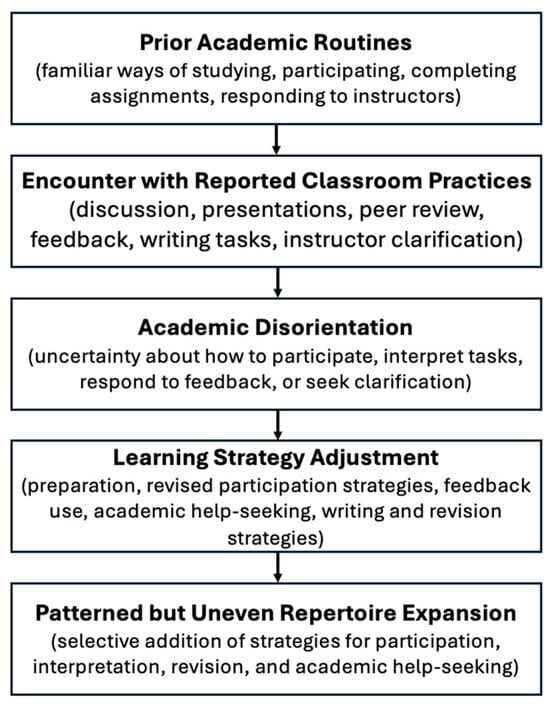
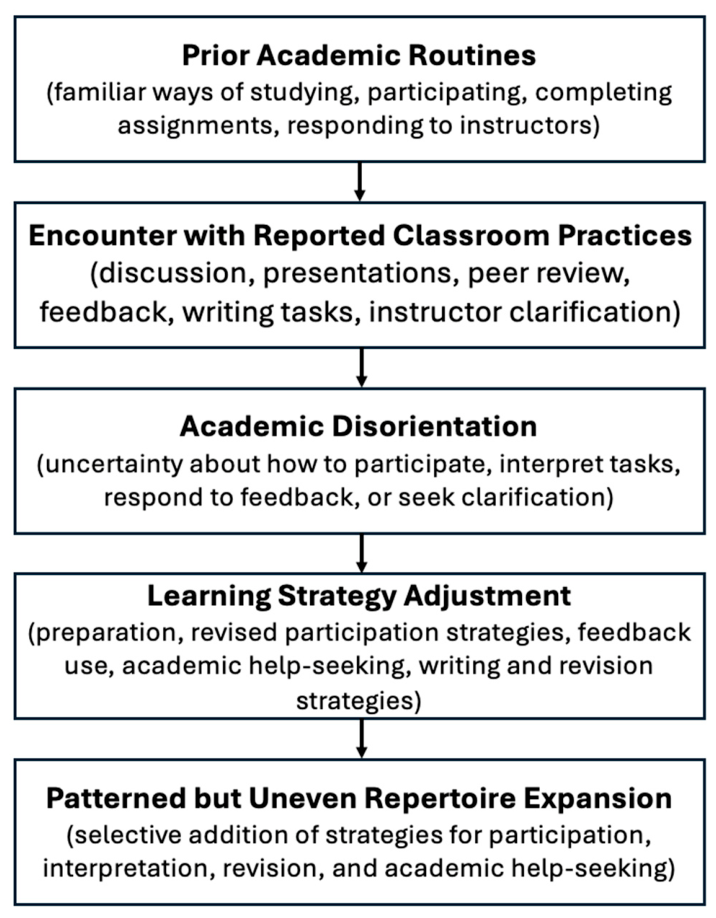

Disclaimer/Publisher’s Note: The statements, opinions and data contained in all publications are solely those of the individual author(s) and contributor(s) and not of MDPI and/or the editor(s). MDPI and/or the editor(s) disclaim responsibility for any injury to people or property resulting from any ideas, methods, instructions or products referred to in the content. |
© 2026 by the authors. Licensee MDPI, Basel, Switzerland. This article is an open access article distributed under the terms and conditions of the Creative Commons Attribution (CC BY) license.