


Abstract
This conceptual paper proposes Math-CEFR, a reference framework for describing postsecondary mathematical readiness in the context of remedial and gateway placement. Single-score placement tests frequently misclassify students and offer little guidance for instruction. Drawing on the architecture of the Common European Framework of Reference for Languages (CEFR), Math-CEFR separates global decision bands (M0–M5) from a multi-dimensional diagnostic profile covering procedural fluency, conceptual understanding, structural awareness, and transfer. The framework treats readiness as non-linear and pathway-sensitive, distinguishing two common course pathways in postsecondary mathematics: a quantitative reasoning/statistics route and an algebra-to-calculus route. It is accompanied by illustrative descriptors, task-family specifications, and an alignment and local standard-setting protocol. Because no validity evidence yet exists, transparency and defensibility are design goals whose attainment depends on the validation agenda outlined here—they are not established properties of the framework. Math-CEFR is offered as a structural proposal intended to make placement interpretations more transparent and future empirical evaluation feasible, rather than as a finished testing instrument.
1. Introduction
High rates of placement into remedial mathematics underscore the need for more informative ways to describe and interpret incoming students’ mathematical readiness. In the United States, national transcript studies indicate that roughly two thirds of students entering public two-year institutions, and about 40% of those entering public four-year institutions, take at least one remedial course, with mathematics the most common subject (National Center for Education Statistics, n.d.). The proportion is higher in open-access institutions, where estimates suggest that 50–60% of community college students are referred to developmental mathematics (Bailey et al., 2015; Scott-Clayton, 2012). Similar pressures appear internationally: foundation-year and bridging programs—for example, in the Gulf region—place large shares of incoming students into preparatory mathematics and face comparable difficulties in aligning placement evidence with course expectations (Khan & Yushau, 2011; Qatar University, n.d.). When remediation affects such large shares of students, the costs of imprecise placement are amplified.
Accurate placement remains a persistent and consequential challenge. Placement is often based on a single test score optimized for efficiency rather than diagnostic interpretability, contributing to under-placement and over-placement (Scott-Clayton, 2012; Scott-Clayton et al., 2014). Substantial shares of students placed into remediation could succeed in college-level coursework, while some who place above remediation thresholds still lack critical foundations (Scott-Clayton, 2012). These patterns reflect a deeper measurement problem: mathematical proficiency is multi-stranded rather than reducible to computational performance alone (Hiebert & Lefevre, 1986; National Research Council, 2001), yet single-score placements collapse this multi-dimensionality into one number. What is frequently missing is a shared, criterion-referenced way to communicate what students can actually do—and what support they need—across key domains of readiness.
Language education has addressed a similar interpretability challenge through the Common European Framework of Reference for Languages (CEFR), which combines clearly defined levels with “can-do” descriptors and guidance for aligning curricula and assessments (Council of Europe, 2001, 2018). It is important to be clear from the outset that, from the CEFR, Math-CEFR borrows its architecture—criterion-referenced bands, descriptor systems, profile-based reporting, and a linking culture—not its construct. Language proficiency and mathematical readiness are fundamentally different: mathematics exhibits strong prerequisite dependencies, domain-specific symbol systems, and pathway-dependent entry demands that have no direct analogue in communicative language use. A mathematics adaptation must therefore avoid assuming a single linear progression and instead support profile-based interpretations that can capture uneven development.
Building on mathematics education research and the CEFR architecture, this paper specifies Math-CEFR through three core design commitments. We state them fully here and refer back to them in subsequent sections:
- Criterion-referenced decision bands, not test scores. Global levels (M0–M5) are reporting and decision bands supported by task-linked descriptors rather than outputs of a single universal test.
- Non-linearity through profiles. Readiness is reported across four dimensions—procedural fluency (PF), conceptual understanding (CU), structural awareness (SA), and transfer (TR)—so that uneven competence is visible rather than hidden behind a single number.
- Pathway sensitivity. Descriptor emphasis and decision rules are interpreted relative to distinct course pathways—at minimum a quantitative reasoning/statistics route (hereafter QR/Stats) and an algebra-to-calculus route (hereafter Alg → Calc)—within an explicit local alignment and standard-setting protocol.
Math-CEFR is not proposed as a new assessment instrument or a universal learning progression. It is a placement-focused reference framework that brings together descriptors, profiles, pathways, and documented decision procedures into a coherent interpretive system. Throughout the paper we use this terminology: global levels are called decision bands, and the two pathway modules are abbreviated QR/Stats and Alg → Calc after first use.
The remainder of the paper is organized as follows. Section 2 describes the design methodology, including the criteria used to select and compare source frameworks. Section 3 reviews large-scale reporting frameworks, placement tools, and recent placement-reform evidence, and derives design requirements. Section 4 defines scope, construct boundaries, and intended uses. Section 5 specifies the framework structure (bands, profiles, pathways), including a worked scoring example. Section 6 presents the descriptor bank and task families. Section 7 details the alignment and local standard-setting protocol. Section 8 addresses governance, fairness, and a validation agenda. Section 9 discusses implications and limitations, and Section 10 concludes.
2. Materials and Methods
This study uses a conceptual, design-oriented approach to specify a reference framework analogous in function—but not in construct—to the CEFR. The development process comprises four steps. We make the selection and synthesis criteria for each step explicit so that readers can evaluate the choices we made.
Step 1: Requirements synthesis. We drew on two bodies of literature. From the developmental mathematics placement literature, we included empirical work on placement accuracy, multiple-measures reform, co-requisite remediation, and equity consequences, selecting studies that reported placement-relevant outcomes in postsecondary open-access settings (Bailey et al., 2015; Cullinan et al., 2018; Denley, 2016; Logue et al., 2016, 2019; Ngo & Cullinan, 2022; Scott-Clayton, 2012; Scott-Clayton et al., 2014). From the proficiency-framework literature, we included frameworks that (a) describe mathematics or numeracy proficiency through levels and qualitative descriptors, (b) are publicly documented, and (c) have been used to support decisions about learners or systems. The frameworks compared are PISA, NAEP, PIAAC, CASAS, ACSF, the New Zealand adult numeracy progressions, the UNESCO Global Proficiency Framework, and Metsämuuronen’s Common Framework for Mathematics. We compared them on six attributes—purpose, sector, level structure, descriptor style, link to assessment, and treatment of uneven profiles—summarized in Table 1.
Table 1.
Contrastive positioning of existing proficiency/reporting frameworks relevant to Math-CEFR design.
Step 2: Framework specification. The four profile dimensions were derived from converging strands of mathematics education research. The multi-stranded view of proficiency in Adding It Up (National Research Council, 2001) and the conceptual/procedural knowledge distinction (Hiebert & Lefevre, 1986) motivate PF and CU. Research on structure sense and the reification of mathematical objects (Hoch & Dreyfus, 2004, 2006; Linchevski & Livneh, 1999; Novotná & Hoch, 2008; Sfard, 1991) motivates SA as a construct distinguishable from general conceptual understanding. Research on transfer (Bransford & Schwartz, 1999; Lobato, 2006) motivates TR. The number of global bands (six) is a pragmatic design choice, discussed and justified in Section 5.1.
Step 3: Illustrative descriptor generation and proposed descriptor-bank development. In this manuscript, the descriptors and task-family examples were generated by the author as provisional design illustrations, drawing on the requirements synthesis in Step 1, the profile dimensions specified in Step 2, and the pathway distinctions developed in Section 5 and Section 6. They were not produced through a completed systematic descriptor-development study, external expert-panel review, empirical scaling, or rater-calibration process. Their function is therefore illustrative: they show how a Math-CEFR descriptor bank could be structured, tagged, and interpreted, rather than establishing a finalized or validated bank. The proposed procedure for future descriptor-bank development is different and would require drafting descriptor records using the common format in Table 6, subjecting them to structured expert review against gateway and remedial entry expectations, revising them through moderation and response-process evidence, and subsequently testing their reliability, validity, and fairness as outlined in Section 8.3.
Step 4: Implementation protocol design. The protocol specifies how institutions can align local curricula and assessments to the framework through coverage mapping, evidence specification, local standard setting, and documentation (Section 7), and how implementations can be monitored over time (Section 8).
Because this manuscript is conceptual, it does not report empirical validation results, nor does it claim that the illustrative descriptors or the M0–M5 decision bands have been systematically reviewed, calibrated, or validated. Its deliverables are design artifacts—the architecture (bands, profiles, pathway modules), provisional illustrative descriptors and task-family specifications, and an implementable alignment protocol—intended to make subsequent expert review, empirical validation, and fairness evaluation feasible. The validation agenda follows the argument-based approach to validity (American Educational Research Association et al., 2014; Kane, 2013; Pellegrino et al., 2001), in which interpretation and use claims are stated explicitly and then evaluated against evidence.
3. Background and Rationale
3.1. Large-Scale Proficiency Frameworks (PISA/NAEP) and Limits for Placement
Large-scale assessment frameworks such as the Programme for International Student Assessment (PISA) and the National Assessment of Educational Progress (NAEP) represent influential efforts to operationalize and report mathematical proficiency at scale. However, their design purposes distinguish them fundamentally from frameworks intended for individualized placement decisions.
PISA assesses the mathematical literacy of 15-year-old students and reports results on a proficiency scale with level descriptors intended for cross-national comparison (OECD, 2019; Stacey, 2011). It is optimized for population-level reporting rather than individual diagnosis: matrix sampling and plausible values support robust system inference but limit individual-level classification (Adams & Wu, 2002; OECD, 2019). Similarly, NAEP reports scale scores through NCES and achievement levels defined by the National Assessment Governing Board (National Assessment Governing Board, 2022; National Center for Education Statistics, n.d.); students respond to only a subset of items, and results are aggregated for group reporting (Haertel, 2013). NAEP’s achievement levels—particularly “Proficient”—have been widely debated and are often misinterpreted as grade-level expectations (Haertel, 2013; Loveless, 2016; National Academies of Sciences, Engineering, and Medicine, 2017). Both systems are explicitly designed for population-level inference, not high-stakes decisions about individual learners (Koretz, 2008; Linn, 2000), and their reporting categories lack the diagnostic granularity needed to guide remediation (Leeds & Mokher, 2020).
3.2. Postsecondary Placement Tools and the Reform Evidence
Placement into remedial or gateway mathematics commonly relies on standardized tests (e.g., ACCUPLACER), adaptive systems (e.g., ALEKS), or locally developed examinations. A substantial body of research demonstrates that single-test placement frequently misclassifies students, placing many into remedial courses despite a high probability of success in college-level mathematics (Bailey et al., 2015; Scott-Clayton, 2012; Scott-Clayton et al., 2014). Adaptive systems can improve diagnostic precision, but their predictive validity varies with implementation conditions (Cantos et al., 2014; Hoch & Dreyfus, 2004), and in-house tests often lack rigorous psychometric validation (Leeds & Mokher, 2020).
The placement-reform evidence base has advanced considerably over the past decade, and three findings are particularly relevant to the design of Math-CEFR. First, multiple-measures placement—incorporating high school GPA and prior coursework alongside or instead of test scores—improves placement accuracy and student outcomes. Statewide research in California showed that cumulative high school GPA is the most consistently useful predictor of gateway course performance (Leeds & Mokher, 2020), and a randomized study across community colleges found that multiple-measures placement increased gateway course completion (Ngo & Cullinan, 2022; Ngo & Kwon, 2015). Second, co-requisite remediation outperforms traditional prerequisite remediation: a randomized controlled trial at the City University of New York found that students assigned to college-level statistics with co-requisite support passed at higher rates than those assigned to traditional remedial algebra, and seven-year follow-up data show higher degree completion and wage gains (Douglas et al., 2023; Logue et al., 2016, 2019). Third, comprehensive reform can narrow equity gaps: following Florida’s Senate Bill 1720, which allowed most students to bypass developmental education, cohorts were more likely to enroll in and pass introductory college-level courses, with Black and Hispanic students experiencing the largest gains (Park-Gaghan et al., 2020). Syntheses of this decade of reform converge on a set of principles—broadening access to college-level courses, providing targeted support, and using multiple sources of evidence for placement (Bailey et al., 2015; Bransford & Schwartz, 1999).
These reforms, however, remain fragmented and context-dependent. They tell institutions which inputs to use (GPA, coursework, tests) and which structures help (co-requisites, pathways), but they do not provide a shared, criterion-referenced language for stating what an incoming student can do and what support a chosen pathway requires. Math-CEFR is designed to precisely supply this missing interpretive layer, complementing—not replacing—multiple-measures and co-requisite reforms.
3.3. Design Requirements for a Placement-Relevant Framework
Taken together, this research indicates that effective placement requires interpretable performance descriptors, evidence-based decision rules, and the capacity to represent uneven profiles. A placement-relevant framework should therefore (R1) support multi-dimensional reporting; (R2) articulate criteria through task-linked descriptors; (R3) align with different mathematics pathways; (R4) anticipate local standard setting and validation consistent with professional testing standards (American Educational Research Association et al., 2014); (R5) remain instructionally actionable; and (R6) include fairness and consequences monitoring (Linn, 2000; National Academies of Sciences, Engineering, and Medicine, 2017). The CEFR provides a mature example of how such interpretability can be achieved at scale in another domain.
Math-CEFR does not claim to be a universal learning progression. Its design is nevertheless compatible with learning-progression perspectives that emphasize qualitative shifts in meaning-making, non-linearity, and the role of task design in revealing development (Bransford & Schwartz, 1999; Lobato, 2006). In particular, the framework draws on two bodies of research that together motivate structural awareness as a distinct dimension.
The first is Sfard’s theory of reification (Sfard, 1991), which characterizes mathematical development as a repeated cycle in which operational conceptions (processes performed on objects) gradually solidify into structural conceptions (the results of those processes become objects in their own right). Under this account, an expression like 3(x + 2) begins as a set of instructions (“multiply”) and only later becomes a manipulable entity whose form can be compared to other forms. The transition is neither automatic nor uniform across content areas. That is why students may demonstrate strong procedural fluency while still treating algebraic expressions purely as action sequences rather than as objects with exploitable structure.
The second body of research is the structure-sense program initiated by Linchevski and Livneh (1999) and extended by Hoch and Dreyfus (2004, 2006). Linchevski and Livneh showed that students’ ability to perceive and use numerical structure (e.g., recognizing that 97 + 38 − 37 can be simplified by cancellation rather than sequential computation) predicts their later success with analogous algebraic structures. Hoch and Dreyfus (2004) found that even high-achieving secondary students often fail to see structural similarities between expressions that differ only in surface form (e.g., recognizing (x + 1)2 − 1 as a difference in squares), and in a subsequent study (Hoch & Dreyfus, 2006) demonstrated that students with strong manipulation skills do not necessarily possess structure sense—the two are empirically separable. Novotná and Hoch (2008) extended this finding to show that structure sense in school algebra correlates with, but is not identical to, structural reasoning in abstract algebra, suggesting a construct with developmental continuity. Taken together, these studies establish that perceiving and exploiting algebraic structure is (a) distinguishable from procedural manipulation, (b) observable and codable from student work, and (c) predictive of success with increasingly complex mathematical objects. These properties make it suitable as a profile dimension in a placement framework.
3.4. From CEFR to a Math-CEFR Adaptation
The CEFR, developed under the auspices of the Council of Europe, operationalizes language proficiency through six levels (A1–C2) expressed through empirically scaled “can-do” descriptors (Council of Europe, 2001; North, 2000). The framework achieved broad uptake because it balances standardization with flexibility and is accompanied by guidance on linking assessments to its levels (Figueras, 2012; Green, 2014; Little, 2011). The 2018 Companion Volume further extended its descriptor sets (Council of Europe, 2018).
For mathematics, the value of the CEFR lies in four transferable architectural features:
- Criterion-referenced levels defined by observable performance expectations (Council of Europe, 2001; North, 2000);
- Descriptor systems written in functional “can-do” terms (Figueras, 2012; North, 2014);
- Profile-based interpretation that makes uneven development visible (Council of Europe, 2018; Little, 2011);
- A culture of linking and validation (Green, 2014; Kane, 2013).
At the same time, the CEFR literature cautions that adopting a framework does not guarantee comparability: descriptor interpretation can drift, alignment claims vary in quality, and level labels can invite over-simplified gatekeeping if used without safeguards (Hulstijn, 2007; Kane, 2013; Weir, 2005). A mathematics adaptation should treat the CEFR as a design model to be filled with mathematics-specific descriptors, local standard setting, and explicit fairness monitoring.
3.5. Related Mathematics/Numeracy Reference Frameworks
Several initiatives provide precedents for CEFR-like work in mathematics and numeracy. Metsämuuronen’s Common Framework for Mathematics explicitly uses the CEFR as a reference point for a criterion-referenced standards framework (Metsämuuronen, 2018); its strength is its clear articulation of the descriptor-clarity problem, but it is not placement-oriented and lacks a profile model. PIAAC reports adult numeracy on a proficiency scale with qualitative level descriptions (OECD, 2013) but is designed for population monitoring, not individual placement. CASAS provides mathematics skill level descriptors used for adult education placement (CASAS, 2018), though it targets adult basic education rather than postsecondary gateway mathematics. The Australian Core Skills Framework defines five numeracy levels with rich performance variables (Commonwealth of Australia, 2012; Department of Employment and Workplace Relations, 2025), and New Zealand’s Learning Progressions for Adult Numeracy underpin a national diagnostic tool (Ako Aotearoa, n.d.; Tertiary Education Commission, 2024); both focus on foundation skills rather than university mathematics readiness. The UNESCO Global Proficiency Framework supports global benchmarking for Grades 1–9 (UNESCO Institute for Statistics et al., 2020) but is a school-sector monitoring framework. Table 1 summarizes these frameworks contrastively, highlighting their purposes, level structures, assessment links, contexts of use, and the limitations that motivate the Math-CEFR adaptation.
Math-CEFR adopts four strong features that recur across these frameworks: descriptor-centered interpretability, a clear level structure, explicit attention to context and task demands, and a linking orientation. Its contribution is to reconfigure these ideas for postsecondary remedial and gateway placement by (a) separating a global band from a multi-dimensional profile, (b) embedding pathway sensitivity into descriptor design, and (c) specifying an implementable alignment and local standard-setting protocol.
4. Scope, Construct Boundaries, and Intended Uses
4.1. Intended Decisions, Stakeholders, and Use Cases
Math-CEFR is a common reference framework for describing mathematical proficiency for placement and related instructional decisions in postsecondary settings that enroll large numbers of students needing additional mathematics support. Primary decisions include (i) placement into levels of preparatory mathematics, (ii) placement into distinct course pathways (QR/Stats versus Alg → Calc), and (iii) identification of targeted support needs within a placement level. Intended stakeholders include placement coordinators, mathematics faculty, program leaders, academic advisors, testing units, and students themselves, for whom placement outcomes should be interpretable and actionable. Secondary use cases include curriculum mapping, staff calibration, and institutional monitoring.
4.2. Construct Boundaries and Content Scope
The framework targets placement-relevant readiness rather than comprehensive coverage of school mathematics. Content is organized through task families that commonly function as prerequisites: number and operations with rational numbers; proportional reasoning and rates; algebraic expressions and linear equations/inequalities; functions and representations; and data, variability, and basic statistical reasoning. Advanced topics typically not required for initial placement decisions (e.g., trigonometric identities, formal proof in geometry) are outside the primary scope.
The exclusion of trigonometry deserves brief justification, since it may be contested for STEM-bound placement. In most placement systems, trigonometry functions as a course-internal topic of precalculus rather than as an entry gate to the first placement decision; students who need trigonometric readiness are typically already placed at the top of the Alg → Calc sequence, where course-level prerequisites (not initial placement bands) govern progression. Institutions whose gateway structure does place trigonometry at the entry decision may extend the descriptor bank accordingly, documenting the extension in the local alignment dossier (Section 7).
4.3. Interpretation and Use Claims (and Assumptions)
Math-CEFR rests on three intended interpretation/use claims that must be supported by evidence as institutions implement and study the framework (Pellegrino et al., 2001). Claim 1 (interpretation): given documented evidence aligned to the descriptor bank, a global band summarizes prerequisite-relevant performance across required task families. Claim 2 (diagnosis): the profile across PF/CU/SA/TR identifies actionable strengths and support needs. Claim 3 (pathway use): pathway-tagged evidence supports differentiated advising between QR/Stats and Alg → Calc routes. Each claim carries assumptions—descriptor interpretability, scoring consistency, and adequate evidence coverage—that the validation agenda (Section 8.3) is designed to test.
4.4. Anticipated Risks and Mitigation Strategies
A Math-CEFR adaptation faces four predictable risks. First, global bands may be reified as fixed learner identities; mitigation requires profile-first reporting. Second, the band system may be used primarily for gatekeeping rather than support; mitigation requires embedding co-requisite options into pathway decisions and monitoring consequences. Third, interpretations may drift across institutions; mitigation requires alignment dossiers, versioning, and moderation. Fourth, placement evidence may be vulnerable to coaching or construct-irrelevant variance; mitigation includes retesting rules, multiple measures, and decision-consistency checks. These are design requirements built into the framework, not afterthoughts.
5. Math-CEFR Framework Structure (Bands, Profiles, and Pathways)
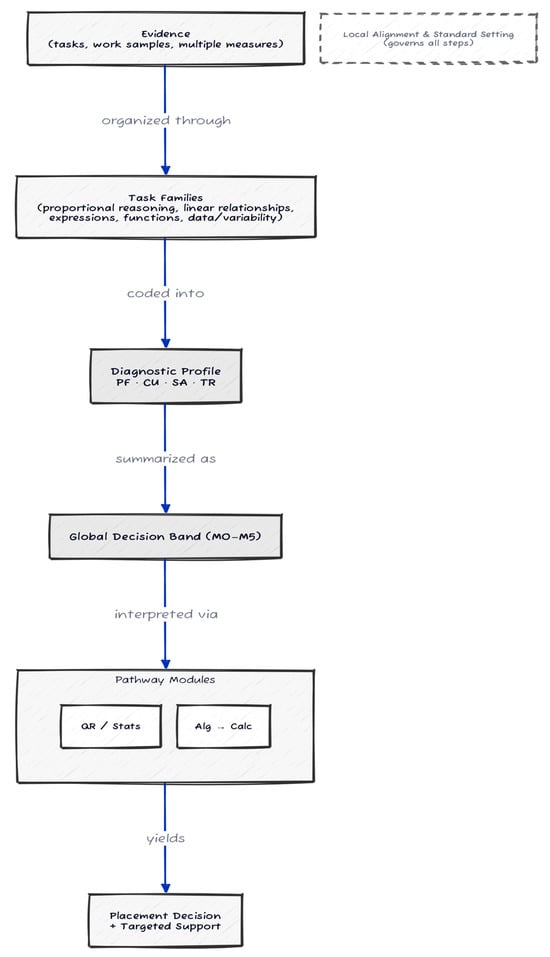
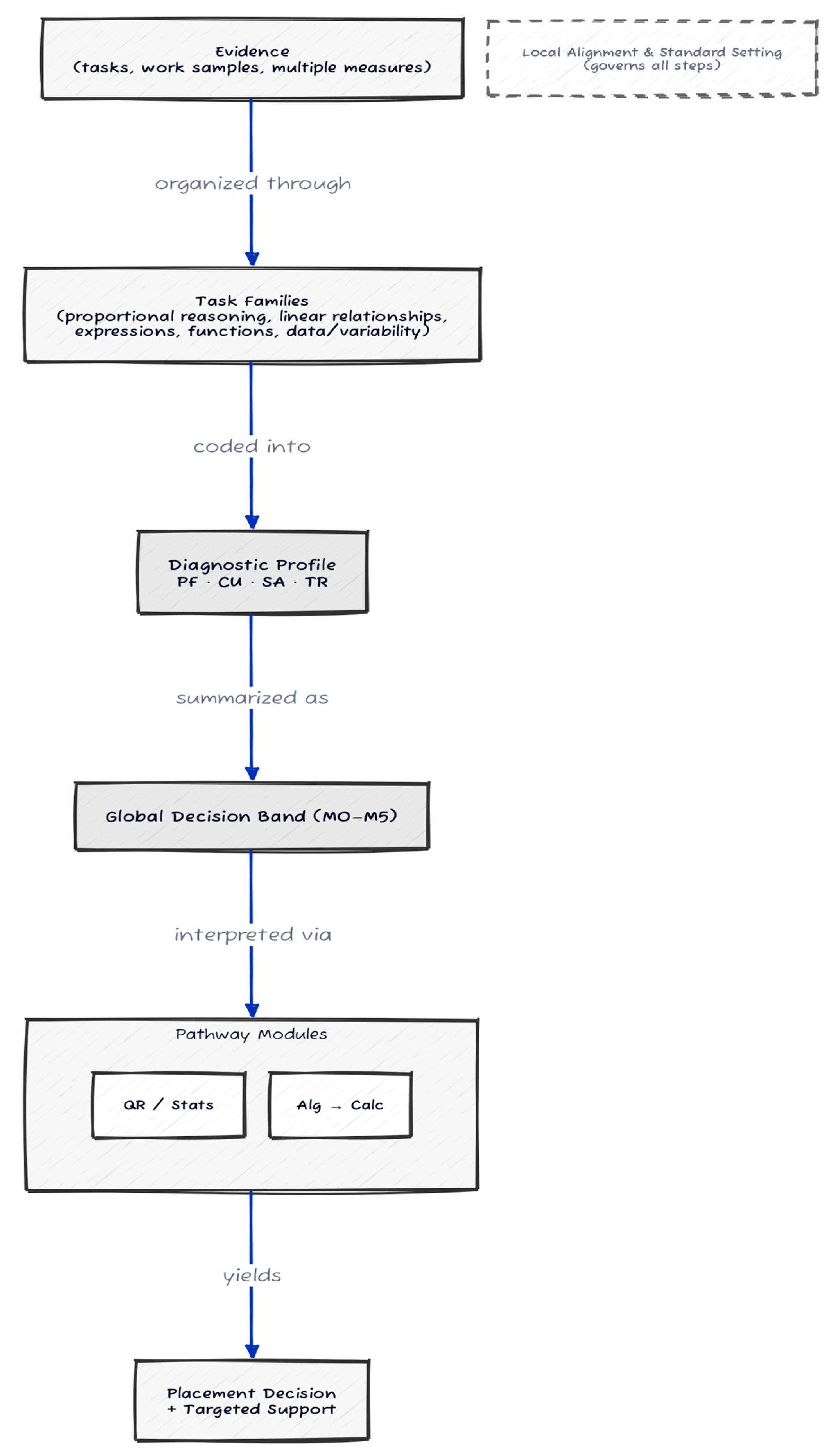
Figure 1 provides a simplified overview of the Math-CEFR architecture. Evidence (placement tasks and multiple measures) is organized through task families; performance is coded into four profile dimensions; the profile and a global band are reported together; both are interpreted through pathway modules to yield a placement decision with targeted support. A local alignment and standard-setting layer governs every step.
Figure 1.
Simplified architecture of the Math-CEFR framework.
5.1. Rationale for the M0–M5 Decision Bands
The M0–M5 labels are reporting and decision bands—not psychometrically calibrated scale points—intended to support interpretable placement communication while preserving the framework’s profile-first intent. Why six bands? The answer is simply pragmatic, and we acknowledge that the number is a design choice subject to local adaptation, not a property of the construct. Six bands are proposed because placement systems typically need to distinguish, at minimum: a pre-foundational group needing intensive support (M0); two foundational groups whose support needs differ in intensity (M1–M2); a gateway-ready group (M3); and one or two groups whose evidence supports advanced or accelerated placement (M4–M5). Six bands also mirror the CEFR’s architecture, which eases communication with stakeholders already familiar with A1–C2 conventions. Institutions whose course structures require fewer or more distinctions may merge or split bands locally, provided the definitions are documented in the alignment dossier (Section 7).
In local implementations, band boundaries can be derived from prerequisite structure by
- i.
- Selecting representative gateway-entry task families;
- ii.
- Mapping prerequisite dependencies among them (e.g., rational-number fluency feeds proportional reasoning; equivalence and rewriting feed equation solving);
- iii.
- Clustering tasks by prerequisite depth, representational coordination demands, and expected independence.
Under this logic, adjacent provisional decision bands reflect shifts from scaffolded routine performance (M0–M1), to reliable core prerequisites with partial justification (M2), to pathway-viable independent performance (M3), to robust structural reasoning (M4), to flexible performance on unfamiliar, complex tasks (M5). Future validation and local standard setting are needed before any operational cut points can be justified (Section 7.3).
Within Math-CEFR, the global band is a compact summary for reporting and broad decisions, whereas the profile (PF, CU, SA, TR) is the primary diagnostic output used to interpret uneven development and plan support.
Construct boundary note (PF/CU/SA/TR): The four dimensions are intended to be distinguishable in coding even though they co-occur in authentic work. PF concerns accuracy and efficiency of procedures—whether a student can execute a method correctly and fluently. CU concerns meanings of quantities, representations, and properties—why procedures work and when they apply (Hiebert & Lefevre, 1986; National Research Council, 2001). SA concerns perceiving and exploiting algebraic structure: recognizing equivalence classes, choosing productive forms, and rewriting purposefully. The key empirical warrant for treating SA as separable from PF is Hoch and Dreyfus’s (2006) finding that students who manipulate expressions accurately (high PF) often cannot identify when two expressions share a common structure or select a rewriting that serves a given purpose—structure sense and manipulation skill are statistically independent in their data. The theoretical warrant comes from Sfard’s (1991) reification framework: SA captures the degree to which a student treats symbolic forms as objects with properties rather than as instructions to be executed. TR concerns selecting or adapting methods under changes in context, representation, or framing (Bransford & Schwartz, 1999; Lobato, 2006). Operationally: a correct answer produced by rehearsed steps indicates PF; a property-based explanation supports CU; a strategic rewrite chosen to reveal equivalence supports SA; a justified method choice in a non-routine framing supports TR.
5.2. Evidence Requirements and Minimum Coverage Rules
To make band assignment workable without implying a single linear scale, Math-CEFR uses minimum coverage rules rather than a composite score. A minimum viable implementation requires evidence from (a) at least three task families spanning both numeric/proportional and algebra/function reasoning, and (b) at least two dimensions beyond PF. Institutions may operationalize evidence through selected-response items, constructed responses, work samples, or interviews, provided tasks are mapped to descriptor clusters and scored against stated quality criteria.
When evidence is sparse or uneven, institutions report a provisional band with a confidence note (“Mx (limited evidence)”) rather than an overconfident classification. To make this mechanism operational, provisional levels should be resolved by the designated placement coordinator (or an authorized advisor working under the placement policy), normally before the student’s course registration deadline and at latest within the institution’s add/drop window, by collecting the targeted supplemental evidence specified in Step 5 below. The resolving authority and time frame must be stated in the local alignment dossier.
Minimal operational decision procedure (evidence → profile → global band).
- Step 1 (tag evidence): Map each task to descriptor records (Table 6), including band target, dimension, task family, and pathway tag.
- Step 2 (score): Score responses against descriptor quality criteria.
- Step 3 (form the profile): Aggregate within each dimension to classify PF/CU/SA/TR as emerging, developing, or strong.
- Step 4 (assign the band): Apply the minimum coverage rules and select the highest band for which evidence consistently meets descriptor expectations.
- Step 5 (handle limited evidence): When evidence is sparse or contradictory, report “Mx (limited evidence)” and trigger one supplemental task targeting the missing family/dimension.
- Step 6 (pathway recommendation): Interpret the band through pathway-tagged evidence and the profile.
5.3. Pathway Modules
Pathway modules address the fact that “readiness” is not a single target. The global band remains a shared reporting unit, but descriptor emphasis and decision rules differ by pathway: function interpretation, symbolic structure, and equation solving are weighted more heavily for Alg → Calc advising, while proportional reasoning in context, data interpretation, and modeling with rates are weighted more heavily for QR/Stats advising. Two students with similar global bands may therefore receive different pathway recommendations—consistent with how the CEFR supports domain profiles rather than universal readiness certificates.
5.4. Construct Map
In Table 2, filled circles (●) indicate that a dimension is typically foregrounded when interpreting evidence within a task family; open circles (○) indicate a secondary role.
Table 2.
Illustrative construct map for Math-CEFR (task families by dimension and pathway emphasis).
5.5. Global Band Descriptors (M0–M5)
Table 3 presents provisional global band descriptors. Consistent with the CEFR’s principle of positive, observable description, all decision bands—including M0—are formulated in “can-do” terms. Limiting conditions are expressed as scaffolding requirements and scope boundaries rather than as deficits or failures.
Table 3.
Provisional global band descriptors for Math-CEFR (M0–M5) as illustrative reporting/decision bands.
The descriptors in Table 3 should therefore be read as provisional reporting-language examples rather than as calibrated scale levels. Their boundaries, labels, and wording require future expert review, local standard setting, and empirical validation before being used for operational placement decisions.
5.6. Worked Example: From Evidence to Profile, Band, and Pathway
Consider an incoming student for whom an institution collects evidence from four sources: a proportional reasoning set, an algebra/linear equation set, a function interpretation task, and a data interpretation task. The student completes routine equation solving accurately but shows inconsistent interpretation of slope in context; rewrites simple expressions when prompted but rarely spontaneously; and interprets basic graphs but struggles to justify conclusions about variability. Table 4 shows an illustrative evidence-to-decision mapping; it demonstrates how the framework could make reasoning transparent, not that the proposed bands are calibrated or predictively valid.
Table 4.
Illustrative evidence-to-decision mapping for the worked example (showing transparency rather than precision claims).
5.7. Worked Scoring Example: Coding One Response Across Dimensions
The operational distinction between CU and SA (and between SA and TR in non-routine rewriting tasks) will be among the hardest parts of rater calibration. To make this concrete, we extend the worked example with a single-response scoring illustration. Consider the task from Table 7: “Rewrite 2(x + 3) + 5x in an equivalent form that makes it easy to see the total increase when x increases by 1. Explain why your form helps.”
Suppose a student writes: “2(x + 3) + 5x = 2x + 6 + 5x = 7x + 6. I expanded and collected like terms. If x goes up by 1, the answer goes up by 7, because the 7x term adds another 7. The +6 stays the same.”
A calibrated rater would code this response as follows. PF: strong (this item)—the expansion and collection are executed accurately. SA: strong (this item)—the rewriting is purposeful: the student selects the form 7x + 6 explicitly because it exposes the rate structure, not merely because it simplifies the expression. That purposeful connection to structure is the defining marker of SA. CU: developing-to-strong (this item)—the student connects the coefficient to a unit change in x and distinguishes the constant term, showing meaning-making about covariation; a fully strong CU code would additionally require interpreting the expression in a quantified context (e.g., cost per unit). TR: not elicited (this item)—the task remains within the rehearsed task family; a TR code would require evidence from a task with a changed framing or representation.
The contrast case is equally instructive. A student who writes “2x + 6 + 5x = 7x + 6” with the explanation “I used the distributive law and combined like terms” demonstrates PF and partial CU (procedure-referenced justification) but provides insufficient evidence of SA in this framework, because the rewriting is not connected to the purpose of revealing structure. This pair of codings illustrates the operational rule used throughout the descriptor bank: SA is credited only when a transformation is selected and explained relative to a structural purpose; CU is credited when meanings of quantities and properties are articulated; mechanical correctness alone is credited to PF.
6. Descriptor Bank and Task Families
The core deliverable of the proposed Math-CEFR framework is the specification of how a descriptor bank would define each global band through clusters of “can-do” statements tagged to a dimension and, where relevant, a pathway module. In the present manuscript, however, the descriptor tables are illustrative and author-generated; they are not presented as a complete descriptor bank. Descriptors are intended to be observable, task-linked, and portable. Each descriptor follows a common template: Given [task family/context], the learner can [action] with [quality criteria], using [representations/tools], with [degree of scaffolding], and can [justify/explain] to the extent specified. Table 5 provides a provisional illustrative excerpt for early bands (M0–M2), and Table 6 specifies the descriptor record format. The present paper provides an excerpt and a specification, not a complete, expert-reviewed, or empirically validated bank.
Table 5.
Provisional illustrative descriptor excerpt (M0–M2) across four profile dimensions.
Table 6.
Descriptor record format.
6.1. Relationship with Existing Descriptor-Based Frameworks
Like the CEFR, descriptors are positive, interpretable performance statements (Council of Europe, 2001; North, 2000). Like the ACSF, they attend explicitly to task complexity, context, and degree of support (Commonwealth of Australia, 2012). Like CASAS and the New Zealand progressions, they are designed for placement-related decisions in adult and tertiary-adjacent contexts (Ako Aotearoa, n.d.; CASAS, 2018; Tertiary Education Commission, 2024). Math-CEFR adapts these ideas for postsecondary placement by tagging descriptors to the PF/CU/SA/TR profile and embedding pathway sensitivity.
What distinguishes Math-CEFR from these predecessors is not the individual components but their integration. Existing frameworks typically offer either holistic band descriptions (CEFR) or fine-grained skill checklists (CASAS, ACSF), but not both, within a single system. Math-CEFR attempts to combine the communicative utility of global bands with the diagnostic specificity of dimension-tagged descriptors, while adding an explicit alignment protocol that connects the descriptor system to local institutional decisions. Whether this integration succeeds in practice is an empirical question that the validation agenda (Section 8.3) is designed to address.
6.2. Descriptor Tagging Schema and Record Template
Each illustrative descriptor is presented as a structured record tagged by (a) provisional decision band, (b) dimension, (c) task family, and (d) pathway relevance, with optional tags for typical context and support/complexity conditions. Table 6 summarizes the proposed record format.
6.3. Quality Criteria and Progression Signals
The provisional decision bands differentiate not only what tasks learners attempt but how well they perform them. Key progression signals include independence (scaffolded → independent), representation coordination (single → coordinated forms), justification (procedural narration → property-based explanation), structural use (prompted rewriting → purposeful transformation), and transfer (near transfer → adaptation across contexts). These signals are reported as a profile rather than treated as a single hierarchy.
To illustrate: At M1, a student may solve a linear equation correctly when the format is familiar (PF adequate) but require scaffolding to explain why the balancing method preserves equality (CU emerging). At M3, the same student is expected to solve independently, explain the underlying property, recognize when an equation is equivalent to a simpler form (SA developing), and adapt the method when the equation appears in a word-problem context (TR developing). The profile captures which of these quality dimensions are present and which remain fragile, rather than collapsing all of them into a single pass/fail judgment.
6.4. Task Family Specifications (Illustrative)
Math-CEFR organizes evidence around recognizable task families rather than a single curriculum sequence, anticipating mixed evidence formats. Its distinctive feature is connecting task families to minimum coverage rules, profile reporting, and pathway modules. Table 7 provides illustrative task-family specifications rather than validated assessment items.
Table 7.
Illustrative task family specifications with dimension and pathway tags.
Note on the proportional reasoning item in Table 7: the recipe task (3 cups for 5 servings → 12 servings) deliberately yields a non-integer answer (7.2 cups, or 7 1/5 cups). This is intentional: the item functions as a fraction-handling probe, distinguishing students who can carry a non-integer rate through a context from those who round prematurely or force whole-number answers. Item writers adapting these examples should preserve this design feature or document an alternative rationale.
7. Local Alignment and Standard Setting
Because Math-CEFR is a reference framework rather than a single test, its use depends on an explicit alignment and standard-setting protocol implementable with existing evidence sources. The protocol has four stages: (1) outcome mapping; (2) evidence specification; (3) local standard setting; and (4) documentation and review. Table 8 provides a checklist.
Table 8.
Local alignment and standard-setting checklist (minimum documentation).
7.1. Alignment Workflow
Institutions first specify the placement decisions to be supported, then identify the prerequisite-critical task families and dimensions for each decision, and finally map these requirements to descriptor clusters at candidate bands. This workflow is analogous to CEFR test linking and UNESCO GPF alignment (Council of Europe, 2001; UNESCO Institute for Statistics et al., 2020; Weir, 2005), with the adaptation that coverage is specified by dimension tags and pathway modules as well as content.
In practice, the alignment workflow begins with a backward-design question: what must a student be able to do, understand, and recognize to succeed in the target course? For an introductory statistics course, the answer might emphasize proportional reasoning in context, interpretation of graphical displays, and basic modeling with rates—weighted toward CU and TR. For a college algebra course leading to calculus, the answer might emphasize symbolic manipulation, equation solving, and function notation—weighted toward PF and SA. The alignment dossier records these decisions transparently, so that when placement outcomes are later evaluated, the rationale behind each decision rule is recoverable.
7.2. Evidence Specification and Scoring
Evidence may include selected-response items, constructed responses, performance tasks, work samples, and interviews, each mapped to descriptor records and scored against explicit quality criteria. When institutions use external tools (e.g., ACCUPLACER, ALEKS), alignment proceeds through permitted score reports, diagnostic domains, and locally developed supplemental tasks targeting under-sampled descriptor clusters. Rubrics for constructed responses mirror descriptor quality criteria, supporting consistent judgment across raters.
7.3. Local Standard Setting and Decision Rules
Institutions may use modified Angoff, Bookmark, or body-of-work methods, provided the method and panel rationale are documented (American Educational Research Association et al., 2014; Linn, 2000; Weir, 2005). Decision rules follow the evidence-to-decision flow of Section 5.2: profile aggregation, band assignment under minimum coverage rules, and pathway recommendation. Where cut scores are used, institutions should conduct decision-consistency checks and state explicitly how multiple measures may override or corroborate test-based classifications (Leeds & Mokher, 2020; Tertiary Education Commission, 2024). Illustrative decision rule options are provided in Appendix A (Table A1).
7.4. Documentation, Moderation, and Alignment Claims
Any institutional claim that “our placement is aligned to Math-CEFR” should be accompanied by an alignment dossier documenting coverage, evidence sources, scoring, and decision rules in an auditable form. Moderation activities (cross-instructor calibration, borderline case review) prevent drift. A minimum dossier specification is provided in Appendix A (Table A2).
8. Governance, Fairness, and a Validation Agenda
8.1. Governance Model
A minimum governance model includes versioning of provisional descriptor banks with a public change log, scheduled review cycles, and moderation practices intended to stabilize interpretation. These mechanisms parallel the way CEFR descriptors have been expanded over time (Council of Europe, 2018), while recognizing that Math-CEFR descriptors require future validation before operational claims can be made.
Concretely, governance involves three layers. First, a descriptor maintenance cycle: the provisional descriptor bank is treated as a living document, with proposed revisions subjected to expert review (mathematics faculty, assessment specialists, and student-facing advisors) before adoption. Second, a moderation layer: institutions using Math-CEFR conduct periodic cross-rater calibration exercises in which borderline student responses are independently coded and discrepancies discussed until provisional consensus criteria emerge. This mirrors the standardization workshops used in CEFR linking projects (Council of Europe, 2001, 2018; Weir, 2005). Third, a versioning protocol: each revision of the descriptor bank or decision rules receives a version number, and alignment dossiers reference the specific version against which alignment was established. Without versioning, descriptor drift can erode comparability silently—a risk the CEFR community encountered when the 2001 descriptors were supplemented by the 2018 Companion Volume (Council of Europe, 2018).
8.2. Fairness and Outcomes Monitoring
Because placement is high-stakes, implementation should include routine monitoring of outcomes and equity-relevant patterns: distributional indicators (who is placed where), success indicators (how students perform after placement), and diagnostic indicators (which profile weaknesses are prevalent and whether supports address them) (American Educational Research Association et al., 2014; Logue et al., 2019; Scott-Clayton, 2012). A minimum viable indicator set is provided in Appendix A (Table A3).
Placement frameworks can unintentionally reproduce inequalities when students have had very different opportunities to learn mathematics before entering college. For this reason, Math-CEFR builds fairness checks into the design rather than treating them as an optional add-on. First, profile-first reporting reduces the risk that one low score becomes a broad label of deficiency. A student who reasons well with proportions but is less secure with symbolic manipulation can be seen more accurately and advised toward QR/Stats or toward Alg → Calc with targeted support, rather than being sent automatically to generic remediation. Second, the access-oriented decision rule options in Table A1, especially Option B, reflect a clear lesson from placement reform: when appropriate support is available, students are often better served by entering college-level coursework with co-requisite support than by being routed away from it (Douglas et al., 2023; Logue et al., 2016; Park-Gaghan et al., 2020). Third, the monitoring indicators in Table A3 require institutions to examine placement distributions, override rates, and outcomes by demographic subgroup and to document what they do when disparities appear. These safeguards cannot by themselves prove that implementation is equitable; that requires outcome evidence over time. They do, however, make inequitable patterns visible and open to challenge, whereas single-score systems often leave such patterns hidden.
8.3. Validation Agenda
Although this paper is conceptual, Math-CEFR is designed so that validation can begin in practical and cumulative ways. The approach follows argument-based validation (Pellegrino et al., 2001) and the professional standards for validity evidence (American Educational Research Association et al., 2014). Table 9 presents the agenda by evidence type. It begins with content and response-process evidence, which can be collected without large datasets. It then moves to studies of internal structure and relations to outcomes. Table A4 in Appendix A links the interpretation and use claims from Section 4.3 to the relevant evidence types and supporting artifacts.
Table 9.
Future validation agenda organized by evidence type.
Two features of this agenda are especially important. First, the earliest studies are feasible. Subject-matter experts can review the descriptors, and students can complete think-aloud tasks, even with modest samples at one institution. These studies can therefore serve as immediate next steps, not distant goals. Second, each evidence type targets a specific threat to the framework’s interpretation and use. Content evidence asks whether the descriptors represent the intended construct. Response-process evidence asks whether tasks elicit the reasoning they are meant to capture. Internal-structure evidence asks whether the four dimensions are empirically distinguishable. Relations-to-outcomes evidence asks whether classifications predict success in the intended course pathways. In this way, validation becomes cumulative rather than ad hoc. Each study adds to a coherent evidentiary argument (Pellegrino et al., 2001).
9. Discussion
9.1. Implications for Placement Practice
Math-CEFR reframes placement as an interpretable classification problem rather than a single-score sorting exercise. Institutions can implement the framework incrementally by first building an outcome-to-descriptor coverage map, then adding a small set of supplemental tasks to ensure minimum coverage, and finally documenting decision rules and standard-setting procedures. Profile reporting also supports more targeted co-requisite planning by helping institutions avoid uniform remediation when students need different kinds of support. Pathway advising becomes a central output as well. Instead of using placement tests mainly to exclude students from algebra-intensive routes, institutions can use profiles to identify the supports that would make a chosen pathway viable. This approach is consistent with access-oriented reforms (Bailey et al., 2015; Logue et al., 2016; Park-Gaghan et al., 2020).
The framework also addresses a communication gap that current systems leave open. When an advisor tells a student “you placed into developmental math,” the student learns nothing about what they can already do or what specific gaps need attention. A Math-CEFR profile (e.g., “M2 overall; PF strong, CU developing, SA emerging, TR limited evidence”) provides a starting point for a substantive conversation: the student’s procedural skills are solid, but they need support in connecting procedures to meanings and in recognizing structural patterns. This kind of information is actionable for both the student and the instructor, and it aligns with the co-requisite model’s emphasis on targeted support rather than blanket repetition of content already mastered (Douglas et al., 2023; Logue et al., 2016).
For institutions already using multiple-measures placement, Math-CEFR offers a principled interpretive layer. High school GPA, prior coursework, and test scores can each be mapped to descriptor clusters and used as evidence toward profile construction, rather than combined into an opaque composite. The framework does not replace multiple-measures systems; it provides a shared language for interpreting what those measures collectively reveal about readiness (Leeds & Mokher, 2020; Ngo & Kwon, 2015).
9.2. Minimal Conditions for a Legitimate “Math-CEFR-Aligned” Claim
A predictable failure mode is that institutions adopt the M0–M5 labels without the governance apparatus, lending a veneer of standardization to conventional cut-score gatekeeping. We therefore state explicitly what minimal conditions constitute a legitimate “Math-CEFR-aligned” claim, and what claims institutions must not make without supporting documentation.
At minimum, a legitimate alignment claim requires: (1) a published coverage map linking course entry requirements to provisional descriptor clusters with dimension and task-family tags; (2) an evidence specification demonstrating that decision-band assignment draws on at least three task families and at least two non-PF dimensions (Section 5.2); (3) a documented standard-setting record (method, panel composition, cut-score rationale); (4) explicit decision rules, including handling of “Mx (limited evidence)” and multiple-measures overrides; and (5) an active fairness and outcomes monitoring plan (Table A3).
Conversely, institutions must not (a) relabel existing single-test cut scores with M0–M5 labels in the absence of a dossier; (b) report global bands without the accompanying profile; (c) advertise Math-CEFR alignment as evidence of predictive validity, which only local outcome studies can establish; or (d) use band labels as fixed learner designations in transcripts or advising language. These conditions convert the alignment dossier from good practice into the constitutive requirement of the alignment claim itself.
9.3. Limitations
The proposal has several limitations that should be acknowledged candidly. First and most fundamentally, the paper presents no empirical evidence that Math-CEFR classifications improve placement accuracy or student outcomes. The framework is a specification intended to make future validation possible; until such studies are conducted, its claimed advantages over single-score systems remain theoretical.
Second, local implementations will inevitably vary, and the degree of comparability across institutions depends entirely on the quality and transparency of alignment dossiers. Weak documentation could recreate the opacity of current cut-score practices under a new label—precisely the failure mode discussed in Section 9.2. Third, developing rubrics, training raters to distinguish reliably among PF, CU, SA, and TR, and sustaining governance over time requires institutional capacity that is uneven across the sector. Community colleges with heavy teaching loads and limited assessment infrastructure may find the full protocol burdensome, even in its minimum viable form.
Fourth, level labels risk reification: once a student is designated “M1,” that label may follow them through advising interactions in ways that function as fixed identity markers rather than provisional descriptions of current readiness. This must be actively mitigated through profile-first reporting, time-limited validity of classifications, and institutional policies that prohibit recording band labels on permanent transcripts. Fifth, alignment to proprietary placement tools (e.g., ACCUPLACER, ALEKS) may be constrained by limited access to item-level data, reinforcing the need for locally controlled supplemental evidence. Finally, the framework’s current scope—postsecondary remedial and gateway placement—means that its applicability to K–12 settings, graduate-level mathematics, or non-Western educational contexts has not been considered and should not be assumed.
9.4. Research and Implementation Agenda
A practical agenda treats adoption as a staged program rather than a single implementation event. Stage 1 refines the descriptor bank through expert review (involving mathematics faculty, assessment specialists, and developmental education coordinators) and small-scale response-process studies in which students think aloud while engaging with descriptor-linked tasks. The goal is to verify that descriptors are interpretable, that task families elicit the intended dimensions, and that raters can achieve acceptable inter-rater reliability on profile coding.
Stage 2 implements minimum coverage evidence packs and documented standard setting at one or more pilot institutions, generating alignment dossiers and initial monitoring reports. At this stage, the key research questions are whether the minimum coverage rules are operationally feasible (i.e., whether institutions can assemble evidence across three task families and two non-PF dimensions within existing placement windows) and whether the governance protocol is sustainable without excessive burden.
Stage 3 links Math-CEFR classifications to course outcomes (gateway course completion, persistence, and GPA) and evaluates consequences, including whether profile-guided supports reduce under- and over-placement for particular demographic groups. This stage also examines whether the framework’s access-oriented decision rules produce better outcomes than conventional cut-score gatekeeping—a question that can only be answered with consequential validity evidence (American Educational Research Association et al., 2014; Kane, 2013). Multi-institution collaboration is encouraged throughout, both to increase statistical power and to test the framework’s portability across different institutional contexts and student populations.
10. Conclusions
This paper proposes Math-CEFR, a CEFR-inspired reference framework for describing postsecondary mathematical readiness in ways intended to be more interpretable than single placement scores. The framework combines global decision bands (M0–M5) with a multi-dimensional diagnostic profile (PF, CU, SA, TR) and pathway-sensitive interpretation, accompanied by an alignment and documentation protocol that makes the basis for placement decisions explicit and auditable.
The framework’s contribution is structural rather than empirical: it does not demonstrate that its classifications improve outcomes, but it provides a principled architecture within which future validation can be conducted. By separating the reporting layer (provisional decision bands and profiles) from the decision layer (pathway-specific rules and standard-setting records), Math-CEFR allows institutions to adopt the interpretive benefits of criterion-referenced description while retaining local control over cut-point decisions. The alignment dossier converts what is typically an implicit, undocumented process into an explicit, reviewable one.
Next steps include multi-institution expert review of the descriptor bank, response-process studies of descriptor interpretability, inter-rater reliability studies for profile coding, and linking studies examining how Math-CEFR classifications relate to gateway course outcomes and equity-relevant indicators. We hope that by making the framework’s assumptions, constructs, and decision procedures transparent, this paper invites the kind of critical scrutiny and empirical testing that placement systems have too often avoided.
Funding
This research received no external funding.
Institutional Review Board Statement
Not applicable.
Informed Consent Statement
Not applicable.
Data Availability Statement
No new data were created or analyzed in this study.
Acknowledgments
The author sincerely thanks the two referees for their thoughtful and insightful suggestions, which helped clarify the manuscript’s argument, strengthen its presentation, and improve the overall quality of the paper. The author would like to acknowledge the support of the Qatar National Library. During the preparation of this manuscript, the author used generative AI tools to assist with language editing and formatting. The author has reviewed and edited all content and takes full responsibility for the integrity and accuracy of the publication.
Conflicts of Interest
The author declares no conflicts of interest.
Appendix A. Implementation Tables
This appendix provides detailed implementation tables referenced in the main text. These tables elaborate on the decision rules, alignment dossier contents, monitoring indicators, and claim-to-evidence mapping introduced in Section 7 and Section 8.
Table A1.
Illustrative decision rule options for Math-CEFR placement.
Table A2.
Minimum contents of a Math-CEFR alignment dossier.
Table A3.
Minimum viable monitoring indicators for Math-CEFR implementation.
Table A4.
Mapping of interpretation/use claims to future validity evidence types and supporting artifacts.
References
- Adams, R., & Wu, M. (2002). PISA 2000 technical report. OECD. [Google Scholar]
- Ako Aotearoa. (n.d.). Learning progressions for adult numeracy. Ako Aotearoa Knowledge Centre. [Google Scholar]
- American Educational Research Association, American Psychological Association & National Council on Measurement in Education. (2014). Standards for educational and psychological testing. American Educational Research Association. [Google Scholar]
- Bailey, T. R., Jaggars, S. S., & Jenkins, D. (2015). Redesigning America’s community colleges: A clearer path to student success. Harvard University Press. [Google Scholar]
- Bransford, J. D., & Schwartz, D. L. (1999). Rethinking transfer: A simple proposal with multiple implications. In A. Iran-Nejad, & P. D. Pearson (Eds.), Review of research in education (Vol. 24, pp. 61–100). American Educational Research Association. [Google Scholar]
- Cantos, C., Rhodes, A., & Tran, H. (2014). A statistical analysis of mathematics placement scores. Portland State University. [Google Scholar]
- CASAS. (2018). Math skill level descriptors for ABE/ASE: GOALS/GOALS 2. Comprehensive Adult Student Assessment Systems. [Google Scholar]
- Commonwealth of Australia. (2012). Australian core skills framework. Department of Industry, Innovation, Science, Research and Tertiary Education. [Google Scholar]
- Council of Europe. (2001). Common European framework of reference for languages: Learning, teaching, assessment. Cambridge University Press. [Google Scholar]
- Council of Europe. (2018). Common European framework of reference for languages: Learning, teaching, assessment—Companion volume with new descriptors. Council of Europe. [Google Scholar]
- Cullinan, D., Barnett, E. A., Ratledge, A., Welbeck, R., Belfield, C., & Lopez, A. (2018). Toward better college course placement: A guide to launching a multiple measures assessment system. MDRC/CCRC. [Google Scholar]
- Denley, T. (2016). Corequisite remediation. Complete College America. [Google Scholar]
- Department of Employment and Workplace Relations. (2025). Australian core skills framework (ACSF). Australian Government. [Google Scholar]
- Douglas, D., Logue, A. W., & Watanabe-Rose, M. (2023). The long-term impacts of corequisite mathematics remediation with statistics: Degree completion and wage outcomes. Educational Researcher, 52, 3–14. [Google Scholar]
- Embretson, S., & Reise, S. (2000). Item response theory for psychologists. Lawrence Erlbaum. [Google Scholar]
- Figueras, N. (2012). The impact of the CEFR. ELT Journal, 66, 477–485. [Google Scholar] [CrossRef] [Scilit]
- Green, A. (2014). Exploring language assessment and testing: Language in action. Routledge. [Google Scholar]
- Haertel, E. (2013). The NAEP achievement levels: Validity issues and their implications. Educational Researcher, 42, 111–121. [Google Scholar]
- Hiebert, J., & Lefevre, P. (1986). Conceptual and procedural knowledge in mathematics: An introductory analysis. In J. Hiebert (Ed.), Conceptual and procedural knowledge: The case of mathematics (pp. 1–27). Lawrence Erlbaum. [Google Scholar]
- Hoch, M., & Dreyfus, T. (2004). Structure sense in high school algebra: The effect of brackets. In Proceedings of the 28th conference of the international group for the psychology of mathematics education (Vol. 3, pp. 49–56). PME. [Google Scholar]
- Hoch, M., & Dreyfus, T. (2006). Structure sense versus manipulation skills: An unexpected result. In J. Novotná, H. Moraová, M. Krátká, & N. Stehlíková (Eds.), Proceedings of the 30th conference of the international group for the psychology of mathematics education (Vol. 3, pp. 305–312). PME. [Google Scholar]
- Hulstijn, J. H. (2007). The shaky ground beneath the CEFR: Quantitative and qualitative dimensions of language proficiency. Modern Language Journal, 91, 663–667. [Google Scholar] [CrossRef] [Scilit]
- Kane, M. T. (2013). Validating the interpretations and uses of test scores. Journal of Educational Measurement, 50, 1–73. [Google Scholar] [CrossRef] [Scilit]
- Khan, M. A., & Yushau, B. (2011). Analysis of foundation year mathematics curricula: Comparing international trends with King Fahd University of Petroleum & Minerals. In Proceedings of volcanic delta 2011. University of Auckland. [Google Scholar]
- Koretz, D. (2008). Measuring up: What educational testing really tells us. Harvard University Press. [Google Scholar]
- Leeds, D., & Mokher, C. (2020). Improving indicators of college readiness: Methods for optimally placing students into multiple levels of postsecondary coursework. Educational Evaluation and Policy Analysis, 42, 87–109. [Google Scholar]
- Linchevski, L., & Livneh, D. (1999). Structure sense: The relationship between algebraic and numerical contexts. Educational Studies in Mathematics, 40, 173–196. [Google Scholar] [CrossRef] [Scilit]
- Linn, R. L. (2000). Assessments and accountability. Educational Researcher, 29, 4–16. [Google Scholar] [CrossRef] [Scilit]
- Little, D. (2011). The Common European Framework of Reference for Languages: A research agenda. Language Teaching, 44, 381–393. [Google Scholar] [CrossRef] [Scilit]
- Lobato, J. (2006). Alternative perspectives on the transfer of learning: History, issues, and challenges for future research. Journal of the Learning Sciences, 15, 431–449. [Google Scholar] [CrossRef] [Scilit]
- Logue, A. W., Douglas, D., & Watanabe-Rose, M. (2019). Corequisite mathematics remediation: Results over time and in different contexts. Educational Evaluation and Policy Analysis, 41, 294–315. [Google Scholar] [CrossRef] [Scilit]
- Logue, A. W., Watanabe-Rose, M., & Douglas, D. (2016). Should students assessed as needing remedial mathematics take college-level quantitative courses instead? A randomized controlled trial. Educational Evaluation and Policy Analysis, 38, 578–598. [Google Scholar] [CrossRef] [Scilit]
- Loveless, T. (2016, June 13). The NAEP proficiency myth. Brookings. [Google Scholar]
- Metsämuuronen, J. (2018). Common framework for mathematics: Discussions of possibilities to develop a set of general standards for assessing proficiency in mathematics. International Electronic Journal of Mathematics Education, 13, 13–39. [Google Scholar] [CrossRef] [Scilit]
- National Academies of Sciences Engineering and Medicine. (2017). Evaluation of the achievement levels for mathematics and reading on the national assessment of educational progress. The National Academies Press. [Google Scholar]
- National Assessment Governing Board. (2022). NAEP achievement levels: Understanding what students can do in mathematics and reading. NAGB. [Google Scholar]
- National Center for Education Statistics. (n.d.). Scale scores and NAEP achievement levels: Understanding results. The Nation’s Report Card. [Google Scholar]
- National Research Council. (2001). Adding it up: Helping children learn mathematics. National Academy Press. [Google Scholar]
- Ngo, F., & Cullinan, D. (2022). Multiple measures assessment and placement promotes community college student success. MDRC. [Google Scholar]
- Ngo, F., & Kwon, W. W. (2015). Using multiple measures to make math placement decisions: Implications for access and success in community colleges. Research in Higher Education, 56, 442–470. [Google Scholar]
- North, B. (2000). The development of a common framework scale of language proficiency. Peter Lang. [Google Scholar]
- North, B. (2014). The CEFR in practice. Cambridge University Press. [Google Scholar]
- Novotná, J., & Hoch, M. (2008). How structure sense for algebraic expressions or equations is related to structure sense for abstract algebra. Mathematics Education Research Journal, 20, 93–104. [Google Scholar] [CrossRef] [Scilit]
- OECD. (2013). Technical report of the survey of adult skills (PIAAC). OECD Publishing. [Google Scholar]
- OECD. (2019). PISA 2018 results (volume I): What students know and can do. OECD Publishing. [Google Scholar]
- Park-Gaghan, T. J., Hu, S., & Bertrand Jones, T. (2020). What happened following comprehensive developmental education reform in the Sunshine State? The impact of Florida’s developmental education reform on introductory college-level course completion. Educational Researcher, 49, 656–666. [Google Scholar]
- Pellegrino, J. W., Chudowsky, N., & Glaser, R. (Eds.). (2001). Knowing what students know: The science and design of educational assessment. National Academy Press. [Google Scholar]
- Qatar University. (n.d.). QU-PLACER math test. Qatar University Testing Center. [Google Scholar]
- Scott-Clayton, J. (2012). Do high-stakes placement exams predict college success? (CCRC working paper No. 41). Community College Research Center, Teachers College, Columbia University.
- Scott-Clayton, J., Crosta, P. M., & Belfield, C. R. (2014). Improving the targeting of treatment: Evidence from college remediation. Educational Evaluation and Policy Analysis, 36, 371–393. [Google Scholar]
- Sfard, A. (1991). On the dual nature of mathematical conceptions: Reflections on processes and objects as different sides of the same coin. Educational Studies in Mathematics, 22, 1–36. [Google Scholar] [CrossRef] [Scilit]
- Stacey, K. (2011). The PISA view of mathematical literacy in Indonesia. Journal of Mathematics Education, 2, 95–126. [Google Scholar] [CrossRef] [Scilit]
- Tertiary Education Commission. (2024). Guidelines for using the Literacy and Numeracy for Adults Assessment Tool (LNAAT). New Zealand Government. [Google Scholar]
- UNESCO Institute for Statistics, USAID, World Bank, FCDO, ACER & Partners. (2020). Global proficiency framework for mathematics: Grades 1 to 9. UNESCO Institute for Statistics. [Google Scholar]
- Weir, C. J. (2005). Language testing and validation: An evidence-based approach. Palgrave Macmillan. [Google Scholar]

Disclaimer/Publisher’s Note: The statements, opinions and data contained in all publications are solely those of the individual author(s) and contributor(s) and not of MDPI and/or the editor(s). MDPI and/or the editor(s) disclaim responsibility for any injury to people or property resulting from any ideas, methods, instructions or products referred to in the content. |
© 2026 by the author. Licensee MDPI, Basel, Switzerland. This article is an open access article distributed under the terms and conditions of the Creative Commons Attribution (CC BY) license.