


Abstract
Artificial intelligence (AI)-mediated tools have rapidly penetrated student life and become a valuable resource for seeking help with academic assignments/tasks, psychological problems, and social interactions. This study aims to investigate the levels and associations of AI-help-seeking behavior (AI-HSB), anxiety, stress, and depression among university students in the United Arab Emirates (UAE). In addition, it examines the factors associated with AI-HSB based on the selected demographic (gender, marital status, age, academic year, employment status, major, and nationality), as well as anxiety, stress, and depression. This study employed a descriptive cross-sectional design among 433 university students, who were recruited via an online Google Form between 1 October 2025 and 10 December 2025. The study utilized validated Arabic versions of the AI-HSB scale and the anxiety, stress, and depression scale. Descriptive statistics, Pearson correlation, and predictive analyses were conducted using SPSS v 25. Results indicated that students reported moderate reliance on AI-HSB despite moderate to severe levels of psychological distress, with particular emphasis on anxiety. The AI-HSB was positively associated with anxiety, stress, and depression amongst the participants. Furthermore, both depression and the students’ academic year emerged as the only significant predictors of AI-HSB, explaining a modest but meaningful proportion of variance with an exact percentage of 18.1%. AI tools may partially circumvent stigma by offering privacy and anonymity; however, cultural expectations around interpersonal support, trust, and authority may simultaneously limit students’ willingness to rely on non-human agents for emotional care.
1. Introduction
There is no doubt that the rapid developments in knowledge and technology, along with global crises and pandemics, have placed significant pressure on societies across all age groups. Psychological distress, such as depression and anxiety disorders, is widespread and affects people across all countries (Al-Dassean & Murad, 2024). According to estimates by the World Health Organization (WHO), more than 615 million people worldwide suffer from depressive and anxiety disorders, costing the global economy about one trillion dollars each year (WHO, 2017).
University students worldwide may experience psychological distress during their university journey due to academic pressure, financial concerns, and multiple duties and responsibilities (Roy et al., 2025). It refers to a negative emotion characterized by several symptoms, such as anxiety, stress, and depression, that affect students’ mental and physical well-being (Mirzaei-Alavijeh et al., 2025). The prevalence of anxiety, stress, and depression among them exceeds 20–30% in multi-country syntheses (Asif et al., 2020). Unfortunately, many university students still do not seek help to manage their psychological distress from specific psychological training centers.
Artificial intelligence (AI)-mediated tools such as ChatGPT and Chatbots have rapidly penetrated student life and become a valuable resource for seeking help with academic assignments, tasks, and social interactions (Vieriu & Petrea, 2025). University students are the most frequent users of AI tools, mainly for academic purposes. For example, a recent study conducted in the United Arab Emirates (UAE) found that approximately 85% of undergraduates had used the ChatGPT AI tool, particularly among students with a lower GPA (Sallam et al., 2024). In parallel, UAE undergraduates demonstrated moderate-to-high eHealth literacy with gender/discipline differences, and those with higher literacy tended to use AI tools for health information (Alam et al., 2025). For non-academic purposes and especially in mental health, students may rely on AI tools for help-seeking behavior (HSB) by asking these tools how to prevent or treat psychological problems instead of asking a professional or an expert in the field. Thus, this study hypothesized that the higher feelings of depression, anxiety, or stress among undergraduate university students, the higher reliance on AI tools (hypothesis one).
Evidence on AI-HSB for mental health support is promising but mixed. These tools hold promise as adjuncts to traditional counseling, particularly among undergraduate students experiencing psychological distress. Despite growing acceptance of AI tools, concerns regarding data privacy, bias, and lack of human empathy remain (Albikawi et al., 2025; Das & Gavade, 2024). Multi-institutional surveys indicated high adoption of AI-HSB driven by psychosocial factors (Sallam et al., 2024). However, there are many concerns regarding real-world governance and safety, including inconsistent crisis responses, over-reliance, and misinformation that promote policy activity and guidance emphasizing that AI-HSB is not a substitute for professional care (Romanishyn et al., 2025). Mental health help-seeking is shaped by stigma, especially among youth, which includes cultural/familial expectations, confidentiality concerns, and increased appeal of anonymous on-demand digital supports (Daniel et al., 2025; Al-Hashemi et al., 2025). Identifying how much students rely on AI-HSB is essential for addressing major psychological problems such as anxiety, stress, and depression. However, anxiety, stress, and depression continue to be rampant among undergraduates and are associated with negative issues (Limone & Toto, 2022). While there has been a tremendous increase in the use of AI-related academic support services, there is still a concern about how university students’ use of AI-related mental support services may be associated with their psychological distress symptoms (AlMaskari et al., 2025). This study hypothesized that there is an association between AI-HSB and psychological problems, including anxiety, stress, and depression (hypothesis two).
Severity of mental symptoms and self-stigma were found to be the main predictors of HSB (Nguyen et al., 2025). A systematic review study based on AI-HSB found that AI applications can predict early detection and treatment of mental disorders (Olawade et al., 2024), while in another study, they found that the higher the use of mental health applications, the higher the HSB and psychological distress among the general population (Fritz et al., 2025). Interestingly, a previous study shows that the younger the age, the more prone he/she is to AI adoption (Aras et al., 2026). However, it is not clear whether undergraduate university students rely on AI applications and tools to seek treatment for their psychological symptoms and distress. Thus, this study hypothesized that demographic factors, as well as anxiety, stress, and depression, are predictors of AI-HSB (hypothesis three).
Study Aims
It is widely known that undergraduate students in the UAE have different cultural norms and social attitudes toward mental health. Thus, this study aims to investigate the levels of AI-HSB, anxiety, stress, and depression among university students in the UAE. It also examines the association between AI-HSB, anxiety, stress, and depression among university students in the UAE. In addition, it explores the predictors of AI-HSB based on several demographic factors, including gender, marital status, age, academic year, employment status, major, and nationality, as well as anxiety, stress, and depression.
2. Materials and Methods
2.1. Design
This study used a descriptive cross-sectional design following the STROBE guidelines.
2.2. Participants
The researchers selected university students to represent the study population. Students nowadays use AI tools as a valuable resource in their studies. The students at Ajman University (AU), Ajman, UAE, were selected to represent the study sample. This university was chosen because it is easily accessible for researchers and includes nine different faculties. The inclusion criteria comprised any students enrolled at AU, of any nationality, pursuing a BSc degree, and using at least one AI-help-seeking tool. The exclusion criteria included postgraduate students, individuals who had never used AI tools, and those who did not agree to participate.
2.3. Procedure
To begin with, the researchers created an online Google Form that included a consent form, demographic information, the AI-HSB tool, and the Depression, Anxiety, Stress Scale (DASS-21). This Form was circulated after obtaining ethical approval from the ethics committee at AU (approval no: H-F-H-23-Sep). The researchers depend on G*Power software version 3.1.9.7 to determine the required sample size, using the independent sample t-test with two-tailed alpha levels of 0.05, a medium effect size (d = 0.45), and a statistical power of 0.80. It was found that 154 participants were sufficient. The researchers invited students to conveniently participate in the study and asked them to circulate it among their colleagues at the same university via WhatsApp groups and the university’s email. In addition, we visited every department secretary and requested them to snowball the form among academic staff, who could then distribute it to their university students. To prevent duplication or completion of the form by individuals outside AU, students were requested to enter their ID numbers or their university email addresses. Data collection started on 1 October 2025 and ended on 10 December 2025, gathering a total of 433 undergraduate students.
2.4. Tools
2.4.1. Demographic and General Information
The researchers gathered information on the use of AI tools as well as participants’ demographic data, including gender (male vs. female), marital status (single, married, divorced/widowed), age by year (18–20, 21–23, ≥24), academic year (freshman, sophomore, junior, senior), employment status (yes, no), major (humanities and sciences, business, medical, information technology, architecture/art, and engineering), and nationality of undergraduate students (UAE, Middle East, Gulf Area, South and East Asia).
2.4.2. AI-Help-Seeking Behavior Tool
The researchers referred to several previous studies to modify and adapt a new scale to measure AI-help-seeking behavior among students. The first study measured professional psychological help and consisted of 10 items (Picco et al., 2016). The second study measured general help-seeking and contained 11 items (Wilson et al., 2005). The third study measured orientation to seeking professional help and contained 29 items (Fischer & Turner, 1970). After extensive revision of these scales, as well as consideration of the theoretical framework regarding AI help-seeking, a total of 13 items emerged. It assessed how often students used AI tools to address mental health issues in their lives, including depressed mood, stress, and anxiety, as well as the extent to which they trust such systems for psychological distress treatment (i.e., If I were experiencing a serious psychological crisis, would I be sure that an AI-based help-seeking tool would be useful?). The researchers adopt a four-point Likert-type scale, ranging from strongly agree to strongly disagree, where higher scores represent greater dependence on AI for seeking psychological help. Items numbers 9 and 10 are rated in reverse order. Cut-off points are as follows: from 1 to 1.99, mild reliance on AI-HSB; from 2 to 2.99, moderate reliance on AI-HSB; and from 3 to 4, severe reliance on AI-HSB. However, we translated and back-translated the items from English to Arabic to ensure that all university students could easily understand them. The psychometric properties of the AI-help-seeking behavior scale are currently under publication elsewhere. The Cronbach’s alpha for the AI-HSB scale was 0.86.
2.4.3. Depression, Anxiety, and Stress Scale (DASS)
This is a global scale measuring three major psychological distresses (anxiety, stress, and depression), which was developed by Lovibond and Lovibond (1995). The brief DASS version consists of 21 items categorized into three constructs: anxiety, stress, and depression, with 7 items for each. This scale has been translated into several languages, including Chinese (Jiang et al., 2024) and Arabic (Al-Dassean & Murad, 2024). Thus, the researchers used both the Arabic and English versions in this study. However, items were measured using a four-point Likert scale, ranging from did not apply to me at all to applied to me very much. The total score ranges from 0 to 63, categorized into five levels (normal, mild, moderate, severe, and extremely severe). The cutoff scores are represented by the previous paper (Lovibond & Lovibond, 1995). The DASS demonstrated excellent internal consistency reliability of 0.87, 0.87, and 0.90 for anxiety, stress, and depression, respectively.
2.5. Statistical Methods
After downloading the Excel sheet from Google Forms, we transferred the data to SPSS version 25 for analysis. The researchers began checking data for normality and outliers, followed by running descriptive statistics (i.e., means, standard deviations, frequencies, and percentages). For correlation coefficients, the researchers used the Pearson correlation coefficient (r). For prediction, the researchers conducted a linear regression analysis (stepwise method). All statistical tests were set at a significance level of p ≤ 0.05.
2.6. Ethical Approval
Ethical approval was obtained from the ethics committee at AU (No: H-F-H-23-Sep) in the year 2025. The Google Form began with a clear consent form section asking students to indicate their approval to participate by selecting yes or no. If participants answered no, they were automatically exited from the survey. All necessary information and details were provided to students, explaining the purpose of the study, emphasizing anonymity and voluntary participation, and clarifying that all data would be used solely for research purposes and securely stored in a drive accessible only to the researcher. Moreover, the study adhered to the Declaration of Helsinki (World Medical Association, 2013) guidelines.
3. Results
3.1. Demographic
The total number of respondents to the survey was 433 university students. Of these, five students declined to participate, and another five students were rejected during the data cleaning procedures, leaving the sample size at 423. A total of seven participants were excluded because they did not use AI tools. The final analytic sample was 416 university students.
The demographic sample showed a noticeable imbalance (Table 1). Almost two-thirds of our sample were female students (69.2%), and the majority of them reported no current employment. In early adulthood, the marriage rates were generally low; thus, more than 90% of the participants were single. Regarding age categories, over 60% of the sample fell within the 18–20-year age range. Approximately half of the participants were freshmen students (49.3%), followed by sophomore students (23.1%). Students enrolled in humanities and sciences constituted the largest proportion of respondents (26.4%), followed by medical students (22.7%). Geographically, our undergraduate students are from diverse nations. Among them, 33.4% were from the UAE, (29.8%) from Middle Eastern countries, followed by South and East Asia (i.e., India and Pakistan) with a percentage of (26.4%).
Table 1.
Demographic characteristics (n = 433).
3.2. Levels of AI Help-Seeking, Anxiety, Stress, and Depression
Results in Table 2 indicated that university students rely on AI-HSB at a moderate level, and the mean score was (2.20 ± 0.55). Surprisingly, anxiety levels among university students were at a severe level, whereas depression and stress levels were at moderate levels.
Table 2.
Perceived levels of the selected variables (n = 416).
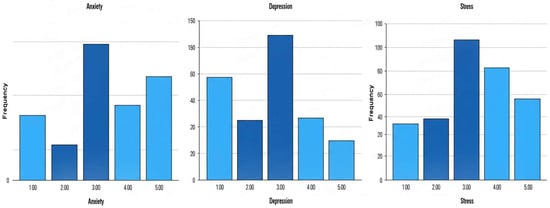
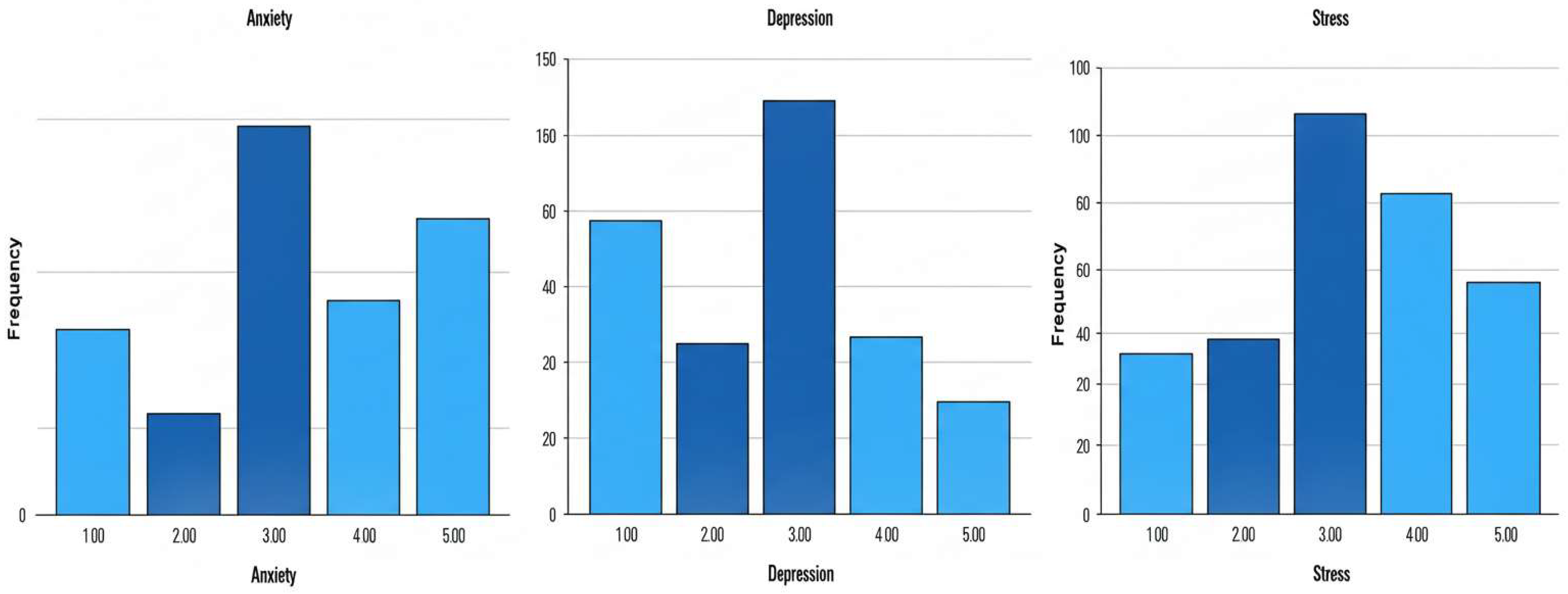
A more in-depth examination based on cut-off points revealed that extremely severe anxiety was the most prevalent category among university students, affecting 190 participants (45.7%), followed by the category of severe anxiety reported by 74 students (17.8%). That implies 264 (63.5%) university students had severe and extremely severe anxiety. Regarding the prevalence of depression levels, moderate levels were identified among 145 participants (34.9%), while the combined categories of severe and extremely severe depression were described by 122 students (29.4%). In terms of the prevalence of stress levels, the total number of university students who suffered from severe and extremely severe stress combined was 150 (36%); 100 students (24.0%) were classified as suffering from severe stress, and 50 students (12.0%) were categorized as having extremely severe stress levels. Figure 1 illustrates the prevalence of anxiety, stress, and depression among university students according to the respective cut-off points.
Figure 1.
Prevalence of anxiety, stress, and depression levels among undergraduates.
3.3. Correlation Coefficient Between Main Variables
Results revealed in Table 3 that AI-HSB was positively associated with anxiety, stress, and depression. Anxiety was significantly associated with both stress and depression. Finally, stress was positively associated with depression among university students.
Table 3.
Correlation coefficients between AI-HSB and other variables (n = 416).
3.4. Predictors of AI-Help-Seeking Behavior
The study determined that the AI-HSB was the dependent variable, while all demographic factors, as well as psychological distress (anxiety, stress, and depression), were considered as independent variables. Linear regression analysis (stepwise method) was applied, and Table 4 presents the results.
Table 4.
Predictors of AI help-seeking behavior (n = 416).
Results showed that the total explained variance was 18.1%, accounted for by two predictors, which are depression and academic year. Depression accounted for 16.7% of the variance in AI-HSB, while academic year accounted for only 1.3%. Other variables did not show significant effects.
4. Discussion
The current study investigated AI-HSB and its relationship with anxiety, stress, and depression among university students in the UAE. Several findings emerged: First, students reported only moderate reliance on AI-HSB despite moderate to severe levels of psychological distress, with particular emphasis on anxiety. Secondly, AI-HSB was positively correlated with anxiety, stress, and depression amongst the participants. Finally, both depression and the students’ academic year emerged as the only significant predictors of AI-HSB, explaining a modest but meaningful proportion of variance. These findings provide nuanced insight into how students engage with AI when dealing with psychological distress, which will be discussed in the following sections.
One of the most unexpected findings in the current study is the exceptionally high prevalence of anxiety amongst the participants, with nearly two-thirds reporting severe or extremely severe anxiety levels. This corresponds to previous evidence that suggests a growing regional and global trend that anxiety has become the most prominent form of psychological distress among university students, particularly in the post-pandemic era (Roy et al., 2025; Alfuqaha et al., 2025). Academic uncertainty, financial concerns, competitive learning environments, and ongoing global instability, especially in the surrounding region, may disproportionately affect these younger undergraduates who constituted the majority of the current sample. However, students reported only moderate usage in AI-HSB whilst coping with this increased level of distress. This suggests that AI tools, although used aplenty by undergraduate and graduate students alike, have not yet become a primary tool for mental health support. This finding is consistent with research indicating that students may perceive AI mental health tools as useful for information or reassurance but insufficient for addressing deeper emotional needs (AlMaskari et al., 2025). With the current group of participants, cultural factors should also be addressed when discussing this finding. Most participants were from the GCC region, the surrounding Middle East region, parts of South and East Asia, such as India, and Africa, such as Sudan. These geographical locations are predominantly followers of Islam, which could affect the participants’ willingness and trust towards AI when it comes to personal and mental health issues (Andrade et al., 2022). Concerns related to emotional authenticity, accuracy, privacy, and fear of over-reliance may also limit students’ willingness to depend on AI for psychological support, as well as readiness for learning and development (Carter et al., 2025; Alfuqaha et al., 2023).
The positive associations between AI-HSB and anxiety, stress, and depression indicate that students experiencing increased psychological distress are more likely to turn to AI tools. This pattern supports the hypothesis that AI-HSB may function as a compensatory or exploratory coping mechanism when distress increases (Zhai et al., 2024). Mental health is still emerging in the region and still carries quite a bit of stigma, especially when it comes to males. Turning to AI would be a solution to this, since the university students can simply use their phones and not have to express their own concerns or let anyone know that they are seeking help. This would save face for the individual and family within the cultural context. Similar associations of use of AI and digital technologies have shown that as increased symptom severity presents itself, greater engagement with online or automated support systems is used (Albikawi et al., 2025). The direction of this relationship cannot be established due to the cross-sectional design. It remains unclear whether the increase in psychological distress actually motivates AI-HSB or whether reliance on AI tools may, in some cases, reinforce psychological distress through maladaptive reassurance-seeking or inaccurate feedback. The fact that students use AI for everyday needs and throughout their studies, where students heavily rely on AI, could overimpose their need to use AI for mental health concerns as well (Huang et al., 2024). However, the results showed moderate correlation between AI-HSB and psychological distress, suggesting that it is meaningfully embedded within students’ broader help-seeking behavior rather than being neutral or incidental behavior. Again, the cultural sensitivity towards mental health issues within the region could also lead to the students’ heavier reliance on AI in this context (Klimova & Pikhart, 2025). However, the risk factors and underlying causes of anxiety, depression, and stress among university students, mainly in the Middle East, are related to decreased levels of resilience and hardiness (Aladwan et al., 2024; Aqtam et al., 2025). While in the UAE and the Gulf region, family expectations and migration-related stressors are considered the risk factors of anxiety, depression, and stress (Salgado et al., 2024).
As shown in the stepwise linear regression analysis, depression emerged as the strongest predictor of AI-HSB, accounting for the majority of the explained variance in the final model. This is consistent with established help-seeking frameworks that have well-documented depressive symptoms, such as low motivation, social withdrawal, hopelessness, and reduced energy, which are barriers to traditional, face-to-face mental health support (Limone & Toto, 2022). In this context, these AI tools may be perceived by the university students as low-effort, non-judgmental, and, more importantly, keeping anonymity to reduce perceived stigma in the socio-cultural context. Because of these perceived benefits, AI tools become particularly appealing to students experiencing depressive symptoms who believe they cannot speak or act out publicly or within the family unit (Lai et al., 2025). Similar patterns have been reported in studies examining digital and AI-based mental health support services, where higher depressive symptomatology has been associated with increased engagement with these mediums (Cruz-Gonzalez et al., 2025; Feng et al., 2025).
Although anxiety and stress were significantly correlated with AI-HSB at the bivariate level, they were not significant predictors in the regression model. This suggests that shared variance among psychological distress variables may weaken their independent predictive effects. One explanation is that anxiety and stress tend to elicit more immediate and externalized coping strategies, such as reassurance-seeking from peers, professors, and family members, avoidance behaviors, or problem-focused coping styles, whereas depression is more strongly associated with solitary, ruminative, and passive coping styles (Aljaffer et al., 2025; Støre et al., 2025). These coping styles may, in fact, align more closely with using AI-mediated support tools, which require minimal interpersonal interaction and complete anonymity (Volpato et al., 2025). A previous study suggests that depression is more strongly linked to indirect or passive help-seeking methods than anxiety (Limone & Toto, 2022).
The participants’ academic year also emerged as a significant, though weak, predictor of AI-HSB in the regression model. This suggests that students’ reliance on AI tools for mental health support may increase modestly as they progress through university. Senior (4th year) students often experience increased academic demands, career-related uncertainty, and increased stress, which may lead to increased openness to alternative forms of support (Roy et al., 2025; Almulla et al., 2025). Interestingly, no increase in students attending the university’s counseling center has been documented with regard to higher-level students, which could mean that even though there is a student counseling center on campus, students may still want to keep anonymity by using AI on their phones or computers when it comes to mental health support. Additionally, prolonged exposure to AI across academic years may enhance familiarity, perceived usefulness, and trust, thus decreasing psychological and attitudinal barriers towards AI-help seeking (Sallam et al., 2024; Nurtanto et al., 2025). However, the relatively small proportion of variance explained by academic year indicates that academic progression alone plays a limited role in shaping AI-HSB. Instead, the regressing findings reinforce the central importance of emotional factors, particularly depressive symptoms, influencing students’ engagement with AI mental health support. It could be that both of these factors play a role in the students’ engagement with AI mental health support, as it has been well-documented that university students have an increased level of depression when compared to the general population globally (Basha et al., 2025). Regarding other demographic factors in our study, none of them predicted AI-HSB, while previous studies found that women and younger individuals had higher levels of AI adoption (Russo et al., 2025). This may be related to a larger proportion of female undergraduate students and a similar age group in our sample.
Limitations
This study has limitations. First: Depending on the cross-sectional design may restrict the ability to investigate the causal relationship between AI-HSB and psychological distress variables; thus, experimental studies among university students are recommended. Second: Relying on self-reported measures and the imbalance between demographic variables in the sample may raise the level of bias; hence, qualitative studies and balanced demographics are recommended to enhance the robustness of future findings. Third: Using a single institute and a convenience sample method can limit generalization. Future studies should consider these recommendations in AI-HSB to expand the full understanding of this newly discovered topic. Fourth: Other important variables were not included in this study, such as digital literacy, attitudes towards seeking professional help, social support, and awareness of campus services. Future studies should consider these variables with AI-HSB.
5. Conclusions
The UAE context is critical for interpreting these findings. As mentioned above, mental health stigma remains a significant barrier, within the UAE and the surrounding regions, to formal mental health help-seeking behaviors, particularly amongst youth (Al-Hashemi et al., 2025). AI tools may partially circumvent stigma by offering privacy and anonymity; however, cultural expectations around interpersonal support, trust, and authority may simultaneously limit students’ willingness to rely on non-human agents for emotional care. This tension may explain why AI-HSB remains moderate despite high psychological distress levels. This is especially true of males within the region, where there is essentially a male-dominated society in which males are seen, consciously or unconsciously, as breadwinners, strong, and lacking weakness. Future studies are recommended to tackle the quality of life with AI, prior knowledge of mental health, perception of AI’s usefulness for emotional versus academic issues, and the influence of peer groups. Our practical implications include creating guidelines on the use of AI for mental health among universities and integrating these findings into their awareness campaigns.
Author Contributions
Conceptualization, O.A.A., K.M. and R.M.A.; methodology, O.A.A.; software, K.M.; validation, O.A.A., K.M. and R.M.A.; formal analysis, O.A.A.; investigation O.A.A.; resources, R.M.A.; data curation, O.A.A.; writing—original draft preparation, O.A.A., K.M. and R.M.A.; writing—review and editing, O.A.A., K.M. and R.M.A.; visualization, O.A.A.; supervision, O.A.A.; project administration, K.M.; funding acquisition, R.M.A. All authors have read and agreed to the published version of the manuscript.
Funding
This research received no external funding.
Institutional Review Board Statement
The study was conducted in accordance with the Declaration of Helsinki and approved by the Ethics Committee of Ajman University (approval no: H-F-H-23-Sep, approval date: 25 September 2025).
Informed Consent Statement
Informed consent was obtained from all subjects involved in the study.
Data Availability Statement
The data that support the findings of this study are available from the corresponding author upon reasonable request. The data are not publicly available due to privacy and ethical restrictions in accordance with Ajman University’s ethics committee policies.
Acknowledgments
The authors extend their gratitude to all university students who participated in this study. Furthermore, our gratitude also goes to Ajman University, UAE, for covering the publication fees.
Conflicts of Interest
The authors declare no conflicts of interest.
Abbreviations
The following abbreviations are used in this manuscript:
| AI | Artificial Intelligence |
| AI-HSB | Artificial Intelligence-help-seeking behavior |
| UAE | United Arab Emirates |
References
- Aladwan, D. A., Al-Masarwah, U. M., Barakat, R. O., & Alfuqaha, O. A. (2024). Predictors of mindfulness among Jordanian university students. Dirasat: Human and Social Sciences, 52(2), 95–106. [Google Scholar] [CrossRef] [Scilit]
- Alam, Z., Abdullahi, A. S., Alnuaimi, S. N. S., Al Shaka, H. A., Alderei, S. S. S., Alhemeiri, A. A. A., Khorzom, H., Almaskari, H. J. M., Almaamari, K. A., Al Seiari, K., Al Saadi, M., Al Shamsi, N., Al Zaabi, O., Altamimi, S., & Rahma, A. T. (2025). eHealth literacy and attitudes towards use of artificial intelligence among university students in the United Arab Emirates, a cross-sectional study. Frontiers in Digital Health, 7, 1574263. [Google Scholar] [CrossRef] [Scilit]
- Albikawi, Z., Abuadas, M., & Rayani, A. M. (2025). Nursing students’ perceptions of AI-driven mental health support and its relationship with anxiety, depression, and seeking professional psychological help: Transitioning from traditional counseling to digital support. Healthcare, 13(9), 1089. [Google Scholar] [CrossRef] [Scilit]
- Al-Dassean, K. A., & Murad, O. S. (2024). Factor structure and psychometric properties of the Jordanian version of the depression anxiety stress scale (DASS-21). Neuropsychopharmacology Reports, 44(2), 447–456. [Google Scholar] [CrossRef] [Scilit] [PubMed]
- Alfuqaha, O. A., Barakat, R., Al-Masarwah, U. M., Aladwan, D., & Baniamer, A. (2025). Predictors of psychological burnout among Jordanian university students: Multicenter cross-sectional study. Education Sciences, 15(2), 184. [Google Scholar] [CrossRef] [Scilit]
- Alfuqaha, O. A., Shunnar, O. F., Khalil, R. A., Alhalaiqa, F. N., Thaher, Y. A., Al-Masarwah, U. M., & Al Amad, T. Z. (2023). Work alienation influences nurses’ readiness for professional development and willingness to learn: A cross-sectional correlation study. PLoS ONE, 18(5), e0284963. [Google Scholar] [CrossRef] [Scilit] [PubMed]
- Al-Hashemi, T., Al-Mahrouqi, T., Al-Huseini, S., Al Salmi, M., Al Nuumani, R., Al Balushi, F., Al Saadi, A. K., AlKalbani, M., Jose, S., & Al-Adawi, S. (2025). Mental health stigma and help-seeking behaviors among primary healthcare physicians in Oman. International Journal of Environmental Research and Public Health, 22(7), 983. [Google Scholar] [CrossRef] [Scilit]
- Aljaffer, M. A., Almazam, A. A., Alzahrani, F. G., Alsultan, F. M., Alrasheed, A. M., Almousa, R. M., & Alsuhaibani, A. I. (2025). The relationship between coping strategies, stress, and anxiety among King Saud University medical students. Journal of Family Medicine and Primary Care, 14(4), 1169–1173. [Google Scholar] [CrossRef] [Scilit]
- AlMaskari, A. M., Al-Mahrouqi, T., Al Lawati, A., Al Aufi, H., Al Riyami, Q., & Al-Sinawi, H. (2025). Students’ perceptions of AI mental health chatbots: An exploratory qualitative study at Sultan Qaboos University. BMJ Open, 15(10), e103893. [Google Scholar] [CrossRef] [Scilit]
- Almulla, M. O., Alismail, A. M., & Daraghmeh, H. (2025). Exploring academic motivation across university years: A mixed-methods study at King Faisal University. BMC Psychology, 13(1), 1113. [Google Scholar] [CrossRef] [Scilit]
- Andrade, G., Bedewy, D., Elamin, A. B. A., Abdelmonem, K. Y. A., Teir, H. J., & Alqaderi, N. (2022). Attitudes towards mental health problems in a sample of United Arab Emirates’ residents. Middle East Current Psychiatry, 29(1), 88. [Google Scholar] [CrossRef] [Scilit]
- Aqtam, I., Ayed, A., Alfuqaha, O. A., & Shouli, M. (2025). Stress and resilience of nursing students in clinical training during political violence: A Palestinian perspective. PLoS ONE, 20(6), e0325278. [Google Scholar] [CrossRef] [Scilit] [PubMed]
- Aras, S., Drakos, C., Manimangalam, V., Nasir, M. A., Burns, C., Smith, D., & Equils, O. (2026). Influencing public acceptance of artificial intelligence (AI) in healthcare delivery. Frontiers in Digital Health, 7, 1664345. [Google Scholar] [CrossRef] [Scilit]
- Asif, S., Mudassar, A., Shahzad, T. Z., Raouf, M., & Pervaiz, T. (2020). Frequency of depression, anxiety and stress among university students. Pakistan Journal of Medical Sciences, 36(5), 971–976. [Google Scholar] [CrossRef] [Scilit]
- Basha, S. E., Gull, M., Alquqa, E. K., Mahmoud, K., & Harhash, A. (2025). The role of AI in university students’ mental health: A bibliometric review. Discover Social Science and Health, 5(1), 131. [Google Scholar] [CrossRef] [Scilit]
- Carter, J. W., Scott, J. T., & Barrett, J. D. (2025). The emotional cost of AI chatbots in education: Who benefits and who struggles? Computers in Human Behavior: Artificial Humans, 5, 100181. [Google Scholar] [CrossRef] [Scilit]
- Cruz-Gonzalez, P., He, A. W., Lam, E. P., Ng, I. M. C., Li, M. W., Hou, R., Chan, J. N., Sahni, Y., Vinas Guasch, N., Miller, T., Lau, B. W., & Sánchez Vidaña, D. I. (2025). Artificial intelligence in mental health care: A systematic review of diagnosis, monitoring, and intervention applications. Psychological Medicine, 55, e18. [Google Scholar] [CrossRef] [Scilit] [PubMed]
- Daniel, S., Volcko, L., Bassi, E., Hews-Girard, J., Bright, K., Barker, M., Norman, L., Pintson, K., Henry, G., Soufi, S., Omorotionmwan, C. E., Fersovitch, M., Stamp, L., Moskovic, K., Johnson, D. W., & Dimitropoulos, G. (2025). Exploring youth perspectives on digital mental health platforms: Qualitative descriptive study. JMIR Human Factors, 12, e69907. [Google Scholar] [CrossRef] [Scilit]
- Das, K. P., & Gavade, P. (2024). A review on the efficacy of artificial intelligence for managing anxiety disorders. Frontiers in Artificial Intelligence, 7, 1435895. [Google Scholar] [CrossRef] [Scilit] [PubMed]
- Feng, Y., Hang, Y., Wu, W., Song, X., Xiao, X., Dong, F., & Qiao, Z. (2025). Effectiveness of AI-driven conversational agents in improving mental health among young people: Systematic review and meta-analysis. Journal of Medical Internet Research, 27, e69639. [Google Scholar] [CrossRef] [Scilit]
- Fischer, E. H., & Turner, J. L. (1970). Orientations to seeking professional help: Development and research utility of an attitude scale. Journal of Consulting and Clinical Psychology, 35(1), 79–90. [Google Scholar] [CrossRef] [Scilit]
- Fritz, B., Eppelmann, L., Edelmann, A., Rohrmann, S., & Wessa, M. (2025). How mental health status and attitudes toward mental health shape AI acceptance in psychosocial care: A cross-sectional analysis. BMC Psychology, 13(1), 617. [Google Scholar] [CrossRef] [Scilit]
- Huang, S., Lai, X., Ke, L., Li, Y., Wang, H., Zhao, X., Dai, X., & Wang, Y. (2024). AI technology panic—Is AI dependence bad for mental health? A cross-lagged panel model and the mediating roles of motivations for AI use among adolescents. Psychology Research and Behavior Management, 17, 1087–1102. [Google Scholar] [CrossRef] [Scilit]
- Jiang, J., Chen, J., Lin, Z., Tang, X., & Hu, Z. (2024). Validation and psychometric properties of the Depression Anxiety Stress Scale for Youth in Chinese adolescents. Frontiers in Psychology, 15, 1466426. [Google Scholar] [CrossRef] [Scilit] [PubMed]
- Klimova, B., & Pikhart, M. (2025). Exploring the effects of artificial intelligence on student and academic well-being in higher education: A mini-review. Frontiers in Psychology, 16, 1498132. [Google Scholar] [CrossRef] [Scilit] [PubMed]
- Lai, L., Pan, Y., Xu, R., & Jiang, Y. (2025). Depression and the use of conversational AI for companionship among college students: The mediating role of loneliness and the moderating effects of gender and mind perception. Frontiers in Public Health, 13, 1580826. [Google Scholar] [CrossRef] [Scilit] [PubMed]
- Limone, P., & Toto, G. A. (2022). Factors that predispose undergraduates to mental issues: A cumulative literature review for future research perspectives. Frontiers in Public Health, 10, 831349. [Google Scholar] [CrossRef] [Scilit]
- Lovibond, P. F., & Lovibond, S. H. (1995). The structure of negative emotional states: Comparison of the Depression Anxiety Stress Scales (DASS) with the Beck Depression and Anxiety Inventories. Behaviour Research and Therapy, 33(3), 335–343. [Google Scholar] [CrossRef] [Scilit]
- Mirzaei-Alavijeh, M., Najafi, F., Veis, R. G., Moradinazar, M., Farasati, F., & Jalilian, F. (2025). Psychological distress and its association with gender, socioeconomic status, education and health conditions. Scientific Reports, 15(1), 29142. [Google Scholar] [CrossRef] [Scilit]
- Nguyen, H., Conway, M. L., Murphy, D., Brady, A., & Hennessy, E. (2025). Predictors of help-seeking intention among young people: A common-sense model based study. Children and Youth Services Review, 178, 108549. [Google Scholar] [CrossRef] [Scilit]
- Nurtanto, M., Nawanksari, S., Sutrisno, V. L. P., Syahrudin, H., Kholifah, N., Rohmantoro, D., Utami, I. S., Mutohhari, F., & Hamid, M. A. (2025). Determinants of behavioral intentions and their impact on student performance in the use of AI technology in higher education in Indonesia: A SEM-PLS analysis based on TPB, UTAUT, and TAM frameworks. Social Sciences & Humanities Open, 11, 101638. [Google Scholar] [CrossRef] [Scilit]
- Olawade, D. B., Wada, O. Z., Odetayo, A., David-Olawade, A. C., Asaolu, F., & Eberhardt, J. (2024). Enhancing mental health with Artificial Intelligence: Current trends and future prospects. Journal of Medicine, Surgery, and Public Health 3, 100099. [Google Scholar] [CrossRef] [Scilit]
- Picco, L., Abdin, E., Chong, S. A., Pang, S., Shafie, S., Chua, B. Y., Vaingankar, J. A., Ong, L. P., Tay, J., & Subramaniam, M. (2016). Attitudes toward seeking professional psychological help: Factor structure and socio-demographic predictors. Frontiers in Psychology, 7, 547. [Google Scholar] [CrossRef] [Scilit]
- Romanishyn, A., Malytska, O., & Goncharuk, V. (2025). AI-driven disinformation: Policy recommendations for democratic resilience. Frontiers in Artificial Intelligence, 8, 1569115. [Google Scholar] [CrossRef] [Scilit]
- Roy, S., Biswas, A. K., & Sharma, M. (2025). Stress, anxiety, and depression as psychological distress among college and undergraduate students: A scoping review of reviews guided by the socio-ecological model. Healthcare, 13(16), 1948. [Google Scholar] [CrossRef] [Scilit] [PubMed]
- Russo, C., Romano, L., Clemente, D., Iacovone, L., Gladwin, T. E., & Panno, A. (2025). Gender differences in artificial intelligence: The role of artificial intelligence anxiety. Frontiers in Psychology, 16, 1559457. [Google Scholar] [CrossRef] [Scilit]
- Salgado, A. B., Salgado, J. J. R. C. M., Mathew, S. M., Razak, A. A., Hussain, S., & Fatima, W. (2024). Mental health and resilience of migrant university students in the United Arab Emirates. New Emirates Medical Journal, 5(1), e02506882322935. [Google Scholar] [CrossRef] [Scilit]
- Sallam, M., Elsayed, W., Al-Shorbagy, M., Barakat, M., El Khatib, S., Ghach, W., Alwan, N., Hallit, S., & Malaeb, D. (2024). ChatGPT usage and attitudes are driven by perceptions of usefulness, ease of use, risks, and psycho-social impact: A study among university students in the UAE. Frontiers in Education, 9, 1414758. [Google Scholar] [CrossRef] [Scilit]
- Støre, S. J., Hassler, S., Persson, L., & Beckman, L. (2025). Children and adolescents’ views on coping with stress and aversive feelings—A thematic analysis. BMC Public Health, 25(1), 2625. [Google Scholar] [CrossRef] [Scilit]
- Vieriu, A. M., & Petrea, G. (2025). The impact of artificial intelligence (AI) on students’ academic development. Education Sciences, 15(3), 343. [Google Scholar] [CrossRef] [Scilit]
- Volpato, R., DeBruine, L., & Stumpf, S. (2025). Trusting emotional support from generative artificial intelligence: A conceptual review. Computers in Human Behavior: Artificial Humans, 5, 100195. [Google Scholar] [CrossRef] [Scilit]
- WHO. (2017). World health statistics 2017: Monitoring health for the SDGs, sustainable development goals. WHO. [Google Scholar]
- Wilson, C. J., Deane, F. P., Ciarrochi, J., & Rickwood, D. (2005). General help seeking questionnaire (GHSQ) [Database record]. APA PsycTests. [Google Scholar] [CrossRef] [Scilit]
- World Medical Association. (2013). World Medical Association Declaration of Helsinki: Ethical principles for medical research involving human subjects. JAMA, 310(20), 2191–2194. [Google Scholar] [CrossRef] [Scilit] [PubMed]
- Zhai, C., Wibowo, S., & Li, L. D. (2024). The effects of over-reliance on AI dialogue systems on students’ cognitive abilities: A systematic review. Smart Learning Environments, 11(1), 28. [Google Scholar] [CrossRef] [Scilit]

Disclaimer/Publisher’s Note: The statements, opinions and data contained in all publications are solely those of the individual author(s) and contributor(s) and not of MDPI and/or the editor(s). MDPI and/or the editor(s) disclaim responsibility for any injury to people or property resulting from any ideas, methods, instructions or products referred to in the content. |
© 2026 by the authors. Licensee MDPI, Basel, Switzerland. This article is an open access article distributed under the terms and conditions of the Creative Commons Attribution (CC BY) license.