


Abstract
This study investigated the developmental cascade from social–emotional competence (SEC) to early mathematical skills via executive function (EF), specifically examining the moderating role of math anxiety (MA) as a resource dampener and gender heterogeneity. Participants included 765 Chinese preschoolers (mean age = 61.08 months; range: 48–82 months). Results indicated that working memory was the most robust EF predictor of mathematical performance. While SEC facilitates EF as a foundational platform, MA functions as a resource dampener, disrupting the neurobiological efficiency of both social–emotional and cognitive resources. Crucially, multi-group analyses revealed gender-specific patterns: the developmental cascade was robust in boys but highly susceptible to anxiety interference in girls. These findings establish that early mathematical development is an inherently socio-emotional process. The results emphasize the urgency of early anxiety-reduction interventions, particularly for girls, to ensure that foundational developmental assets are successfully translated into mathematical achievement.
1. Exploring the Relationship Between Social–Emotional Competence and Early Mathematical Skills: The Mediating Role of Executive Function and the Moderating Effect of Math Anxiety in Preschoolers
Early mathematical skills are robust predictors of long-term academic success and socio-economic outcomes (Jordan et al., 2009; Michel et al., 2020). Traditionally, research has identified Executive Function (EF)—the top-down cognitive processes required for goal-directed behavior—as the primary “cognitive engine” driving numerical development (Bull & Scerif, 2001). However, emerging perspectives suggest that mathematical success is not an isolated cognitive endeavor but is deeply embedded within a child’s socio-emotional and affective context (Blair & Raver, 2015; Graziano et al., 2007). Indeed, the “Developmental Cascade” framework posits that social–emotional competence (SEC) provides the regulatory platform for cognitive processes (Masten & Cicchetti, 2010; Oakes, 2023). Children who effectively manage emotions and social interactions are better positioned to preserve and deploy cognitive resources for complex tasks (Blair & Raver, 2015; Schmitt et al., 2021). Despite this theoretical synergy, empirical evidence exploring the specific pathways through which SEC and EF jointly contribute to preschool math performance remains limited (Casanova et al., 2025). Specifically, it remains unclear which EF sub-components are most critical at this stage and how SEC facilitates their operation (Taylor et al., 2015; Ten Braak et al., 2022).
Furthermore, the “cognitive engine” is susceptible to internal interference from math anxiety (MA) (Suárez-Pellicioni et al., 2016). Once considered a concern only for older students, math-related apprehension is now known to manifest as early as age four or five (Harari et al., 2013; Barroso et al., 2021). From a neurobiological perspective, this “cognitive engine” is highly sensitive to a child’s affective state. Rather than simply “consuming” cognitive capacity, MA acts as a resource dampener by interfering with the functional integrity of the prefrontal cortex (PFC), the primary hub for EF (Liston et al., 2009). This interference can decouple a child’s foundational cognitive potential from their actual mathematical output, making the PFC a critical site where social–emotional and cognitive factors interact. This interference may also vary by gender, as boys and girls encounter divergent socialization processes despite equivalent cognitive potential (Szczygiel, 2020; Hartley & Sutton, 2013).
Building on these gaps, the current study investigates the hierarchical relationships between SEC, EF sub-components, and math skills through a moderated mediation framework. We specifically examine whether MA interferes with this developmental cascade and explore gender heterogeneity within these pathways. Ultimately, this research informs integrated interventions providing both cognitive scaffolding and affective support to secure the developmental foundations of numeracy (Sarama & Clements, 2021; Clements et al., 2023; Magalhães et al., 2020).
2. EF as a Foundation for Early Mathematical Development
Early mathematical skills are among the most robust predictors of long-term academic success, socio-economic status, and even health outcomes in adulthood (Jordan et al., 2009; Michel et al., 2020). A burgeoning body of research has identified EF—a set of top-down cognitive processes—as the “cognitive engine” driving this development (Bull & Scerif, 2001; Miller-Cotto et al., 2025). While EF is generally conceptualized as a triad consisting of working memory, inhibitory control, and cognitive flexibility, its specific contributions to early numeracy remain a subject of intense investigation (Casanova et al., 2025; Schmitt et al., 2021; Diamond, 2013).
Working Memory is frequently highlighted as the primary driver, as preschool mathematics requires children to hold numerical information (e.g., counting sequences) while simultaneously manipulating quantities or applying rules (Peng et al., 2016). Furthermore, some researchers propose that during the transition from informal to formal mathematical reasoning, inhibitory control becomes paramount, particularly in suppressing irrelevant perceptual cues (e.g., physical size vs. numerical quantity) during number conservation tasks (Rosenberg-Lee, 2021; Zhu et al., 2025). Meanwhile, cognitive flexibility—the ability to shift between different rules or mental sets—has been increasingly recognized for its contribution to mathematical success, as it enables children to switch nimbly between various problem-solving strategies or mathematical representations (Magalhães et al., 2020).
Despite these insights, empirical findings on the relative importance of EF sub-components remain inconsistent. For instance, while some research underscores the role of IC, others suggest working memory is a more robust and unique predictor of mathematical achievement (Ten Braak et al., 2022). These discrepancies fuel an ongoing “unitary vs. diversified” debate (Younger et al., 2023) and highlight a gap in identifying the most influential cognitive precursors. The current study addresses this research gap by first conducting a preliminary analysis to empirically compare the relative predictive power of inhibitory control, working memory, and cognitive flexibility within our sample. By clarifying which specific sub-component demonstrates the strongest association with both mathematical skills and SEC, we establish a data-driven foundation for our subsequent moderated mediation model, ensuring the investigated developmental cascade is rooted in the most relevant cognitive mechanisms.
3. SEC as a Scaffolding for Early Developmental Cascades
While cognitive factors are undeniably essential, learning is inherently situated within a complex social and emotional context, making SEC a vital yet distinct contributor to school readiness. Far from being a separate domain, SEC—encompassing self-awareness, self-management, and interpersonal skills—acts as a fundamental scaffolding for academic engagement (Anthony et al., 2020). At the behavioral level, this association is evidenced by the psychological stability and social confidence that social–emotional assets provide. Children with higher SEC are better equipped to navigate the social demands of classroom interactions and, crucially, possess the resilience to persist when confronted with mathematical frustration or challenging numerical tasks (Schmitt et al., 2021).
Moving beyond mere behavioral engagement, the impact of SEC is deeply rooted in the child’s neurobiological regulatory architecture. The PFC is uniquely sensitive to a child’s emotional state and sense of social relatedness (Diamond, 2013). Consequently, SEC serves as the foundational bedrock and behavioral platform that enables EF to function at their optimal level. When a child enjoys a state of social–emotional well-being, the PFC is better positioned to mobilize and deploy cognitive resources for complex tasks. In contrast, a lack of social–emotional support sets the stage for EF impairment, as the PFC cannot subserve cognitive processes effectively under conditions of emotional distress (Friedman & Robbins, 2022).
Integrating these behavioral and neuro-cognitive perspectives leads to the “developmental cascade” framework, which posits that development in one domain can have cumulative, spreading effects on other domains over time (Masten & Cicchetti, 2010; Oakes, 2023). Rather than viewing cognitive and social–emotional skills in isolation, this framework suggests a hierarchical chain of influence where SEC promotes mathematical achievement specifically by facilitating and “unlocking” the child’s cognitive engine. In this hierarchical model, social–emotional well-being serves as the developmental precursor that supports the efficiency of EF, which in turn acts as the direct conduit for numerical learning. Despite the theoretical elegance of this cascade, empirical evidence explicitly testing the indirect link from SEC to mathematical skills through the mediation of EF remains scarce in the preschool years (Masten & Cicchetti, 2010; Wolf & McCoy, 2019). Investigating this integrative mechanism is essential to determine whether social–emotional interventions can provide a powerful indirect route to strengthening the very cognitive foundations of early mathematics.
4. MA as a Dampener of the Cognitive–Affective Learning Process
The developmental benefits of cognitive and social–emotional assets may be compromised by negative affective factors, specifically MA. Once considered a phenomenon exclusive to formal schooling, emerging evidence suggests that math-related tension and fear can manifest as early as age four or five (Ramirez et al., 2018; Barroso et al., 2021).
While earlier psychological models, such as Processing Efficiency Theory (PET) (Eysenck et al., 2007), suggested that MA “consumes” working memory capacity with task-irrelevant worries, modern neuroscience identifies a more tenable mechanism: physiological stress responses directly interfere with the PFC, the primary hub subserving EF. MA acts as a powerful resource dampener; even relatively mild stress can increase dopamine levels in the PFC to suboptimal points that impair EF performance (Cerqueira et al., 2007). Furthermore, anxiety disrupts the functional communication between the PFC and other brain regions required for numerical reasoning (Liston et al., 2009). Consequently, MA may not only have a direct negative impact on performance but also serves as a moderator that disrupts the efficiency of the developmental cascade. Specifically, for children with high anxiety, the positive link from SEC and EF to math skills may be weakened or even “blocked,” as high MA acts as an emotional barrier that prevents children from mobilizing their full “cognitive toolkit.” This effectively decouples a child’s foundational assets from their actual mathematical output (Harari et al., 2013; Ramirez et al., 2018). Understanding how MA neurobiologically interferes with this translation is crucial for explaining why some highly capable children underperform in quantitative domains.
5. Gender Heterogeneity as a Context for Divergent Mathematical Pathways
Gender differences in mathematics remain a focal point of educational inquiry. While boys and girls typically demonstrate equivalent cognitive and EF capacities in early childhood, they may encounter divergent developmental pathways due to gender socialization. International research indicates that girls often report higher levels of MA and may be more sensitive to evaluative pressure or interpersonal feedback (Devine et al., 2012).
Such differences could be exacerbated by early-emerging stereotypes that view math as a masculine domain, leading to gender-specific patterns of emotional interference (Hartley & Sutton, 2013). For instance, girls might be more susceptible to the dampening effects of anxiety, whereas boys might show more resilience to such affective factors. Whether the indirect link from SEC to mathematical skills, mediated by EF, operates universally across gender groups or exhibits distinct “vulnerability profiles” is a question of both theoretical importance and practical urgency. Exploring these gender-specific patterns is essential for designing targeted, gender-sensitive interventions that ensure all children can leverage their cognitive and emotional resources for mathematical success (Fang et al., 2024).
6. The Present Study
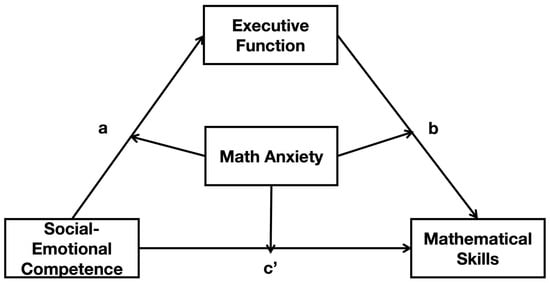
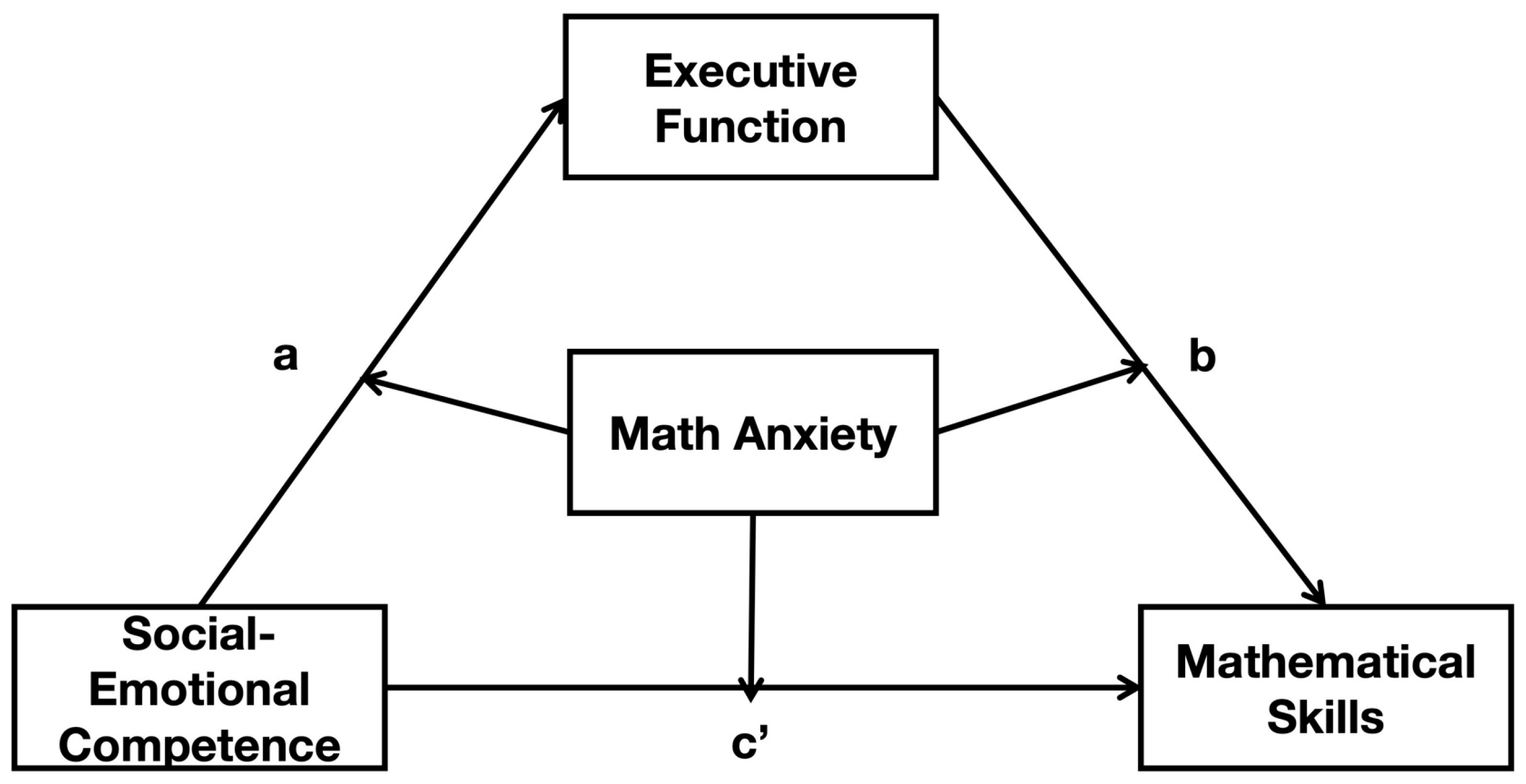
To address the gaps identified in the existing literature, the current study adopts an integrative socio-cognitive framework to investigate the “cognitive engine” and the “affective barriers” that shape early mathematical development. Moving beyond simple correlational accounts, we utilize a moderated mediation approach to delineate the complex interplay between SEC, EF, and MA. Specifically, the study is designed to achieve three primary objectives: (a) to determine the relative predictive utility of distinct EF sub-components (inhibitory control, cognitive flexibility, and working memory) for both SEC and mathematical skills; (b) to validate a developmental cascade wherein SEC promotes mathematical achievement via the mediation of EF; and (c) to ascertain the extent to which MA acts as a “resource dampener,” disrupting both the direct and indirect associations within this cascade (see Figure 1 for the conceptual model). In essence, these objectives aim to dissect how social–emotional resources provide a behavioral platform to facilitate this developmental process, while recognizing the potential for MA to disrupt the chain of influence. Furthermore, by exploring these mechanisms across gender contexts, we aim to provide a more nuanced map of the diverse pathways leading to early mathematical success. Specifically, this study seeks to address the following research questions:
Figure 1.
Conceptual model of hypothesized moderated mediation. Note: Paths a and b denote the indirect relationship via the mediator; c′ denotes the direct effect.
RQ1: Which specific sub-component of EF—inhibitory control, cognitive flexibility, or working memory—exhibits the most robust association with SEC and mathematical skills among preschool children?
RQ2: To what extent does EF serve as the facilitated pathway between SEC and early mathematical skills, and how does MA act as a resource dampener within this developmental cascade?
RQ3: Do the moderated mediation mechanisms remain structurally consistent across gender groups, or do gender-specific patterns emerge in the way MA interferes with these developmental pathways?
7. Method
7.1. Participants
A total of 765 preschoolers were recruited from seven public kindergartens in Wenzhou, Zhejiang Province, China. A multistage cluster sampling method was employed to ensure a representative distribution of age groups. Within each kindergarten, six classes were randomly selected, including two classes each from the junior (K1), middle (K2), and senior (K3) levels. Approximately 18 to 19 children were sampled from each selected class. The participants had a mean age of 61.08 months (SD = 11.14 months; range: 48–82 months). In terms of gender distribution, the sample consisted of 393 boys (51.4%) and 372 girls (48.6%). All children were of Han Chinese ethnicity and had no known history of developmental or learning disabilities. Prior to data collection, the study received approval from the Institutional Review Board (IRB) of Shaanxi Normal University. Written informed consent was obtained from the parents or legal guardians of all participating children, and verbal assent was secured from the children themselves before the assessments.
7.2. Measures
7.2.1. Mathematical Skills
Children’s mathematical skills were assessed using Part A (Number) of the Research-based Early Mathematics Assessment Short Form (REMA Short Form) (Dong et al., 2021). Part A specifically focuses on numerical knowledge and contains 50 items covering nine distinct learning trajectories. These trajectories include: (1) Counting, evaluating verbal correspondence, cardinality, and counting strategies; (2) Comparing Number, assessing the ability to order and sequence numerals or sets; (3) Subitizing, measuring the rapid recognition of small collections; (4) Composing Numbers, focusing on part–part–whole relationships; (5) Numeral Recognition; (6) Adding/Subtracting, evaluating fluency with basic arithmetic combinations and counting-based operations; (7) Multiplying/Dividing, assessing understanding of repeated addition and equal group sharing; (8) Fractions, involving the identification of unit and non-unit fractions; and (9) Classification and Data Analysis, focusing on the ability to understand and gather data. The assessment was administered individually to each child by trained researchers. In the current study, the REMA Part A demonstrated excellent internal consistency, with a Cronbach’s alpha coefficient of 0.944.
7.2.2. Executive Function
Participants’ EF applied to numerical content were investigated with two tasks: backward digit span and the Five Digits Test. These tasks were similar to those used to assess EF with nonnumerical content.
Backward Digit Span. Participants’ working memory in numerical contexts was assessed using the backward digit span (hereinafter referred to as numerical working memory), which consisted of 12 items (Hilbert et al., 2014). Participants were verbally presented with a series of digits and instructed to repeat them verbally in reverse order (e.g., hear “3-9-2” and answer “2-9-3”). Span increased with trials, and participants completed two attempts for each span. The span of the last effort solved correctly was used in the analyses. The internal consistency for this measure was adequate (Cronbach’s α = 0.716).
Five Digits Test.The Five Digits Test (Sedó, 2007) was used to assess participants’ inhibitory control and cognitive flexibility in numerical contexts. This task comprises four conditions: reading (i.e., naming digits), counting (i.e., counting asterisks), choosing (i.e., counting how many digits there are but the quantity does not match the magnitude represented by the digit), and switching (i.e., alternate between reading and counting digits, cued by a thickened border, shown in a quantity that does not match the magnitude they represent). Each condition was shown as one booklet page with 25 stimuli. To ensure that the tasks were developmentally appropriate and to mitigate potential floor effects, each condition was preceded by standardized practice trials. Researchers provided corrective feedback during practice to ensure every child fully understood the specific rules (e.g., switching between value and quantity) before formal testing commenced. In the current study, scores were calculated based on the mean of all items. Specifically, an inhibitory control score was derived from the mean of all items in the choosing condition (Cronbach’s α = 0.985), and a cognitive flexibility score was derived from the mean of all items in the switching condition (Cronbach’s α = 0.988). The global EF score was calculated as the mean of all items across the working memory, inhibitory control, and cognitive flexibility tasks (Cronbach’s α = 0.987).
7.2.3. Social–Emotional Competence
Children’s SEC was evaluated using the teacher-report version of the Social Skills Improvement System Social–Emotional Learning Edition (SSIS SEL-T) (Anthony et al., 2020). This standardized instrument is designed for students aged 3–18 years and comprises 58 items rated on a 4-point Likert-type scale. While the full measure includes 51 items assessing SEL skills and 7 items regarding academic competence, the current study focused on the five core SEL domains: (1) Self-Awareness (7 items; e.g., “Asks adults for help”), which captures the ability to recognize emotions and their influence on behavior; (2) Self-Management (15 items; e.g., “Uses appropriate language when upset”), assessing the capacity to regulate cognitions and behaviors; (3) Social Awareness (7 items; e.g., “Tries to comfort others”), measuring empathy and understanding of social norms; (4) Relationship Skills (13 items), evaluating the ability to sustain positive interpersonal connections; and (5) Responsible Decision-Making (8 items), reflecting the capacity to make ethical and responsible choices.
To ensure linguistic and cultural equivalence within the Chinese educational context, a rigorous forward–backward translation procedure was performed by bilingual experts, followed by discrepancy reconciliation and pilot testing. In accordance with the scoring protocol, a global SEC composite score was derived by averaging the five subscales. In the present sample, the global measure demonstrated excellent internal consistency (Cronbach’s α = 0.923).
7.2.4. Math Anxiety
Children’s MA was assessed using the Scale for Early Math Anxiety (SEMA; Wu et al., 2012; Suinn, 1972), specifically the Chinese adapted version (EMAS). This instrument is tailored for young children and comprises 20 items divided into two primary dimensions: (1) Math Task Anxiety (10 items), which evaluates nervousness during specific numerical operations (e.g., “How do you write the number four hundred and eighty-two?”), and (2) Math Situational Anxiety (10 items), which measures emotional responses to math-related social or classroom contexts (e.g., “You are about to take a math test”).
To facilitate comprehension for preschoolers, the scale utilizes a 5-point facial emoji rating system, ranging from 1 (not nervous at all) to 5 (very, very nervous). Following administration by trained researchers, a composite score was derived by averaging all items, with higher values indicating greater math-related apprehension. In the current study, the internal consistency of the scale was excellent (Cronbach’s α = 0.858).
7.3. Procedure
Data collection followed a multi-method design involving researcher-administered child assessments and teacher-reported ratings. The assessment team consisted of 10 trained researchers. To ensure high procedural consistency, all researchers completed an intensive 20 h standardized training program that included theoretical mastery of the tools, role-playing, and pilot testing with children not included in the final sample. Inter-rater reliability (IRR) was established through double-coding a random selection of 15% of the sessions, with a senior researcher serving as the gold standard, yielding an excellent Cohen’s κ > 0.90 across all measures.
Researchers conducted individual assessments in quiet areas near classrooms. Logistically, researchers entered kindergartens in small groups but worked one-on-one with children to minimize distractions. We actively consulted with lead teachers to align testing schedules with the children’s routines and to ensure that assessments occurred when children were most alert and comfortable. To ensure ethical compliance, researchers collaborated with teachers to introduce the study and obtained verbal assent from each child, emphasizing that participation was voluntary. The assessment battery, delivered in Mandarin, included tests of EF (Backward Digit Span, Five Digits Test), mathematical skills (REMA Short Form Part A), and MA (EMAS).
To overcome potential developmental limitations such as short attention spans in 5-year-olds, researchers utilized game-like instructions and provided small stickers as encouragement after each sub-task. In addition to the scheduled 5 min breaks between tasks, researchers closely monitored children for signs of fatigue or loss of interest; if a child appeared significantly distracted, the session was temporarily paused or paced according to the child’s individual needs. Sessions lasted approximately 25–35 min per child.
Concurrently, lead teachers evaluated children’s SEC using the SSIS-SEL form. Teachers completed the questionnaires independently within one week based on their routine observations of the children. All materials were distributed and returned in sealed envelopes to maintain participant confidentiality and anonymity.
7.4. Data Analysis
Preliminary analyses examined the distributions and intercorrelations of the study variables. To address RQ1, hierarchical regression analyses were performed to determine the relative predictive power of inhibitory control, cognitive flexibility, and working memory. These analyses identified which specific EF component exhibited the strongest association with SEC and mathematical skills after controlling for children’s age and gender.
To test the core mechanism (RQ2), we employed the PROCESS macro for SPSS 26.0 (Model 59). A moderated mediation model was constructed to examine whether EF mediated the link between SEC and early mathematical skills, and whether MA moderated the direct and indirect pathways within this developmental cascade. Continuous variables were mean-centered to mitigate multicollinearity, and a bootstrapping procedure with 5000 resamples was used to estimate 95% confidence intervals (CIs).
Finally, to investigate gender heterogeneity (RQ3), multi-group moderated mediation analyses were conducted. This step compared the structural pathways between boys and girls to determine whether the interfering role of MA on the cognitive–affective cascade remained consistent or varied across gender contexts.
8. Results
8.1. Preliminary Analyses
Table 1 presents the descriptive statistics and intercorrelations among the study variables. Mathematical skills (MATH) were positively correlated with EF (r = 0.47, p < 0.01) and SEC (r = 0.17, p < 0.01) and negatively correlated with MA (r = −0.20, p < 0.01). Furthermore, as expected, a significant negative association was observed between MA and EF (r = −0.10, p < 0.01). Additionally, a positive association was found between SEC and EF (r = 0.18, p < 0.01).
Table 1.
Descriptive Statistics and Pearson Correlations Among Study Variables (N = 765).
As shown in Table 2, independent samples t-tests revealed significant gender differences across several domains. Boys exhibited significantly higher scores in MATH (t(763) = 2.75, p = 0.006, d = 0.199) compared to girls, while girls scored significantly higher in SEC than boys (t(763) = −7.33, p < 0.001, d = −0.526). No significant gender difference was observed for EF (p = 0.802).
Table 2.
Gender Differences in Study Variables among Preschool Children (N = 765).
Critically, significant gender differences were found in MA (t(763) = 3.99, p < 0.001, Cohen’s d = 0.29), with girls (M = 2.69, SD = 0.74) reporting higher anxiety levels than boys (M = 2.47, SD = 0.79). To further explore the nature of this difference, a distribution analysis was conducted. Results showed that among children in the “High MA” category (defined as 1 SD above the mean), girls (n = 74) significantly outnumbered boys (n = 32).
8.2. Predictive Contributions of EF Sub-Components to Mathematical Skills and SEC
Hierarchical regression analyses were conducted to identify which EF component most robustly predicted the outcomes (Table 3 and Table 4). After controlling for age and gender, the addition of EF components explained an additional 19.1% of the variance in MATH (ΔR2 = 0.191, p < 0.001). Specifically, working memory emerged as the strongest predictor of MATH (β = 0.432, p < 0.001), followed by inhibitory control (β = 0.083, p = 0.010).
Table 3.
Hierarchical Regression Analysis Predicting Mathematical Skills (N = 765).
Table 4.
Hierarchical Regression Analysis Predicting Social–Emotional Competence (N = 765).
Regarding SEC, EF sub-components accounted for an additional 4.2% of the variance (ΔR2 = 0.042, p < 0.001). Both working memory (β = 0.159, p < 0.001) and inhibitory control (β = 0.094, p = 0.027) significantly predicted SEC, whereas cognitive flexibility did not show a significant independent contribution to either outcome. Based on these findings, the composite EF score was utilized for subsequent mediation models.
8.3. Analysis of the Moderated Mediation Mechanism and the Interfering Role of MA
The hypothesized moderated mediation model (PROCESS Model 59) was tested to examine the developmental cascade from SEC to MATH via EF, and the potential interfering role of MA (Table 5 and Table 6). Results indicated that EF served as a robust mediator in the relationship between SEC and MATH. As shown in Table 6, the indirect effects remained statistically significant across all levels of MA, with 95% bootstrap confidence intervals entirely excluding zero. This confirms that EF acts as a critical cognitive conduit, translating social–emotional resources into mathematical achievement.
Table 5.
Regression Results for the Saturated Moderated Mediation Model (N = 765).
Table 6.
Conditional Direct and Indirect Effects at Different Levels of Math Anxiety (N = 765).
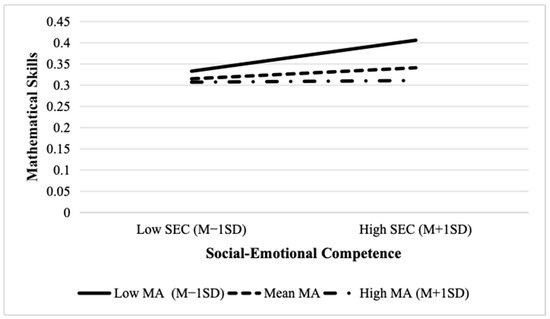
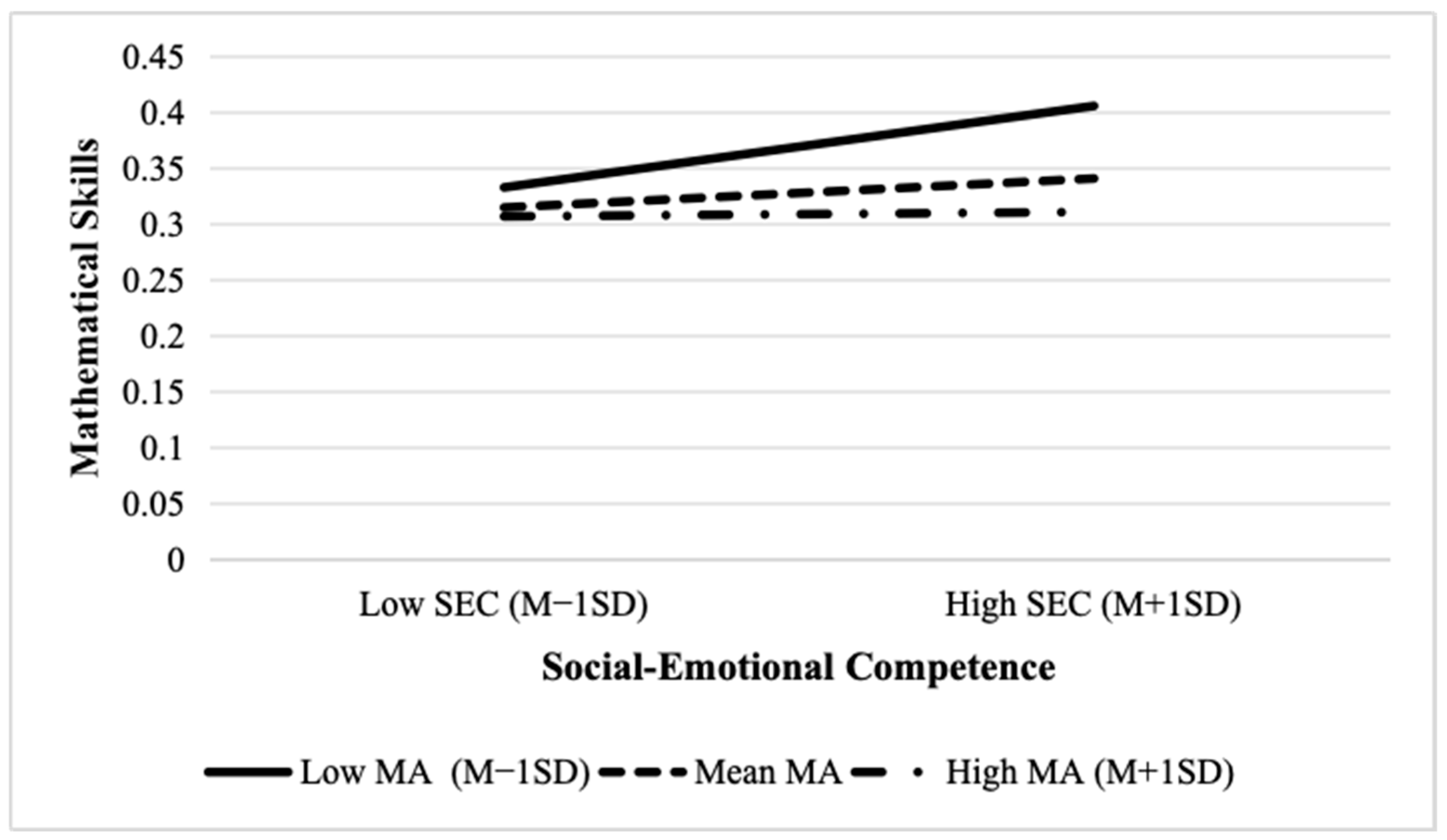
Crucially, MA was found to significantly moderate the direct pathways predicting mathematical success. Regarding the direct link from SEC to MATH, the interaction between SEC and MA was significant (B = −0.06, p = 0.006). Simple slope analysis (Figure 2) illustrated an “interference effect”: SEC was a strong positive predictor of math skills for children with low MA (Effect = 0.10, p < 0.001), but this contribution vanished for children with high anxiety (Effect = 0.01, p = 0.815).
Figure 2.
Moderating effects of math anxiety on the pathways from social–emotional competence to mathematical skills.
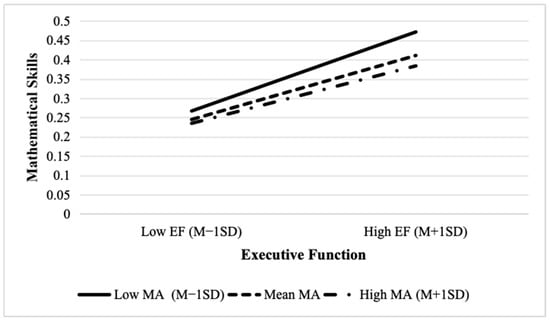
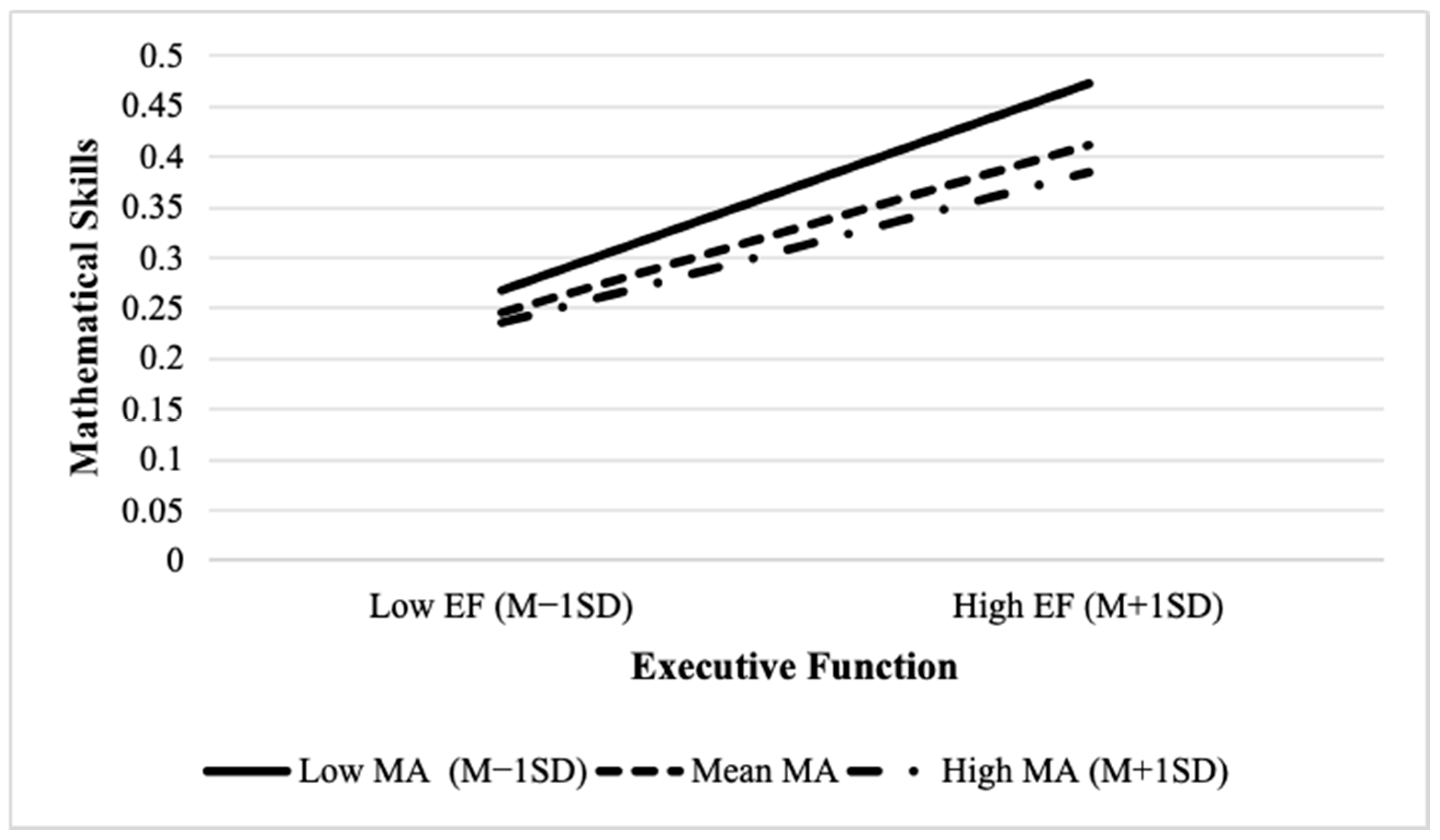
Furthermore, simple slope analysis (Figure 3) illustrated that MA significantly moderated the path from EF to MATH (B = −0.10, p = 0.030). While the predictive power of EF on MATH remained significant across all levels of anxiety, its contribution was significantly dampened as anxiety intensified, decreasing from 0.57 at low MA to 0.41 at high MA.
Figure 3.
Moderating effects of math anxiety on the pathways from executive function to mathematical skills.
8.4. Gender Heterogeneity in the Moderated Mediation Pathways
Multi-group analyses (Table 7) revealed distinct mechanisms for boys and girls. For boys, the mediation path (SEC → EF → MATH) was robust and stable, and notably, MA did not significantly moderate any pathways within the model (all ps > 0.05).
Table 7.
Moderated Mediation Results for Boys and Girls Separately (N = 765).
In contrast, for girls, the model exhibited high sensitivity to MA. While the direct effects of SEC, EF, and MA on MATH were all significant (ps < 0.001), the SEC × MA interaction on MATH was uniquely significant in the female subsample (B = −0.13, p < 0.001). This indicates that for girls, the ability to translate social–emotional and cognitive resources into mathematical success is heavily constrained by their levels of math-related anxiety.
9. Discussion
The present study investigated the intricate interplay among SEC, EF, and mathematical skills in Chinese preschoolers, focusing on how MA interferes with this developmental cascade. Through a moderated mediation framework, our findings reveal three primary insights: (1) EF as the strongest determinant of mathematical success, with working memory being the most robust predictor; (2) SEC serves as a foundational platform for EF, while MA acts as a powerful resource dampener that disrupts this cascade; and (3) these interference effects are gender-specific, with girls exhibiting a disproportionate vulnerability. These results offer a nuanced map of the cognitive–affective pathways to early numeracy.
9.1. EF as a Cognitive Conduit: The Primacy of Working Memory
A central finding of this study is the confirmation of the developmental cascade, in which SEC facilitates mathematical achievement by providing the foundational support necessary for the optimal operation of EF. Crucially, our results show that EF serve as the strongest determinant of math performance, far eclipsing the direct effects of SEC or MA. This suggests that the observed indirect relationship reflects a deeper neurobiological interplay: SEC provides the essential behavioral platform and bedrock for higher-order cognitive processes to operate effectively (Schmitt et al., 2021). Rather than EF serving as a mere passive conduit, SEC sets the stage for EF to function at their capable level by ensuring a state of social–emotional well-being (Diamond, 2013; Denham & Bassett, 2020). In this hierarchical framework, SEC facilitates the “cognitive engine” specifically by “unlocking” the child’s internal resources for academic engagement (Blair & Raver, 2015).
Among EF sub-components, working memory emerged as the primary driver. Unlike older children who rely on automatized arithmetic facts, preschoolers engage in effortful computation that places substantial demands on working memory (Peng et al., 2016). In the context of early Chinese mathematical education—which often involves multi-step counting and mental manipulation—working memory plays a more central role than inhibitory control or cognitive flexibility (Ten Braak et al., 2022; Roell et al., 2019). Furthermore, we identify a bidirectional relation between these constructs. While SEC enables the efficient deployment of EF, the cognitive inhibition component of EF also plays a critical role in reducing stress by inhibiting ruminating task-irrelevant worries (Lieberman et al., 2007). Specifically, better self-management and social awareness enable children to perceive math challenges as manageable activities rather than emotional threats, providing the resilience needed to persist when confronted with mathematical frustration. Children with stronger cognitive control are better positioned for math and are also more resilient; EF allow them to regulate emotional impulses and navigate social demands, thereby preserving the “cognitive bandwidth” necessary for mathematical academic success (Diamond, 2013; Michel et al., 2020).
9.2. MA as a Cognitive Dampener: Disrupting the Developmental Cascade
Crucially, this developmental cascade is not uniform but is contingent upon a child’s affective state. Our findings provide compelling evidence for the “cognitive dampening hypothesis,” identifying MA as a powerful resource dampener that disrupts the efficient deployment of developmental resources. We found that while SEC and EF are powerful predictors under conditions of low anxiety, their positive contributions are significantly diminished as MA intensifies. This supports the growing consensus that math-related apprehension manifests much earlier than previously assumed, appearing as early as age four (Harari et al., 2013; Barroso et al., 2021).
Importantly, the mechanism underlying this dampening is physiological interference with the PFC. Modern neuroscience indicates that when a child experiences math-related stress, neurotransmitters like dopamine in the PFC increase to suboptimal levels, which impairs the “cognitive engine” regardless of its actual capacity (Cerqueira et al., 2007; Friedman & Robbins, 2022). Furthermore, anxiety disrupts the functional communication between the PFC and other brain regions required for numerical tasks (Liston et al., 2009; Zhang et al., 2022). In this context, MA acts as a “gatekeeper” where emotional distress effectively decouples a child’s foundational cognitive potential from actual achievement (Blair, 2002; Barroso et al., 2021; Fang et al., 2024). Our results extend this by showing that MA creates an emotional barrier that prevents internal resources from being successfully translated into mathematical success. This demonstrates that affective factors can fundamentally alter learning trajectories even before formal schooling begins (Casanova et al., 2025; Zhu et al., 2025).
9.3. Gender Heterogeneity: Differential Vulnerability to MA
The multi-group analysis revealed a striking pattern of gender heterogeneity in these developmental pathways. For boys, the cascade from SEC to mathematical skills via EF remained robust and stable, showing relative resilience to the moderating effects of MA. In stark contrast, girls exhibited high sensitivity to math-related affect. Their ability to leverage social–emotional and cognitive strengths for mathematical learning was heavily constrained by their anxiety levels, even though foundational cognitive capacities were equivalent across genders. This is consistent with Szczygiel (2020), who observed that the negative link between anxiety and achievement often emerges more prominently in young female students, suggesting that the PFC-based “cognitive engine” in girls may be more easily disrupted by affective interference.
It is important to note that this gender-specific vulnerability may be driven by the higher prevalence of intense MA among girls rather than a fundamental difference in neurobiological mechanisms. As suggested by our distribution data, nearly 70% of the high-anxiety group consisted of girls. Consequently, the observed dampening effect of MA on the SEC-EF-Math cascade in girls likely reflects the fact that more girls reached the critical levels of physiological stress necessary to interfere with PFC functioning (Friedman & Robbins, 2022; Zhang et al., 2022). While MA acts as a resource dampener for any child regardless of gender, its practical impact in the current sample was disproportionately concentrated in the female group.
This gender-specific vulnerability likely reflects early socialization processes and the internalization of gender-math stereotypes (Hartley & Sutton, 2013). Furthermore, girls’ higher baseline SEC may paradoxically create a unique psychological vulnerability; children who are more socially attuned and cooperative might be particularly sensitive to evaluative pressure or interpersonal feedback during mathematical activities. Consequently, for girls, MA acts as a more powerful “dampener” or “gatekeeper,” preventing the successful translation of internal resources into academic output. This decoupling of potential from performance highlights an urgent need for gender-sensitive affective support alongside cognitive scaffolding in early numeracy programs (Miller-Cotto et al., 2025).
It is crucial to interpret these dynamics within the specific Chinese cultural context, where gender stereotypes may operate differently than in Western settings. While Chinese culture traditionally emphasizes effort over innate ability (Stevenson & Stigler, 1994), recent evidence suggests that Western-style stereotypes regarding math aptitude are increasingly prevalent in urban Chinese educational environments (Zhang et al., 2022). Our findings suggest that in such contexts, these stereotypes may manifest not as overt performance gaps—as evidenced by the marginal differences in actual math scores between boys and girls—but rather as differential susceptibility to anxiety’s undermining effects. In the Chinese “saving face” culture, the emotional cost of facing math-related challenges may be higher for girls who perceive a conflict between their self-identity as capable learners and burgeoning societal stereotypes (Szczygiel, 2020; Sundararajan, 2015). Thus, MA does not necessarily reflect a lack of skill, but rather an emotional barrier that disproportionately hinders girls from mobilizing their full cognitive toolkit, effectively blocking the translation of the foundational assets provided by their social–emotional well-being into mathematical success.
9.4. Implications and Limitations
The present study offers several theoretical and practical implications. First, our findings support an integrated socio-cognitive model of early development, where positive emotional factors (like social–emotional well-being), negative emotional factors (MA), and EF interact dynamically. This emphasizes that early developmental pathways are not uniform but are contingent upon a child’s emotional relationship with mathematics. Second, the results underscore the urgency of early MA interventions, particularly for girls, suggesting that educators should address emotional barriers through strategies like cultivating growth mindsets. Third, given the identified cascade from SEC to mathematics via EF, curricula that deliberately integrate social–emotional learning with mathematical content could be particularly effective. Finally, providing working memory supports, such as visual manipulatives, may help children overcome the cognitive interference caused by high anxiety and ensure that their cognitive potential is successfully translated into mathematical achievement.
Despite these contributions, several limitations warrant consideration. First, the sample consisted exclusively of urban Han Chinese preschoolers, necessitating replication in diverse cultural settings to determine the generalizability of the observed gender-specific effects. Second, while our EF measure was psychometrically robust, the use of numerically based tasks may have introduced construct overlap with mathematical skills; future research should incorporate non-numerical assessments to better parse domain-general from domain-specific processes. Third, this study did not account for broader ecological moderators, such as parental MA or classroom emotional climate, which likely influence the developmental cascade. Fourth, relying solely on teacher reports for SEC may introduce subjective biases; thus, future studies should incorporate multi-informant data, such as parent reports or direct observations, to ensure robust triangulation. Finally, while we focused on the interfering role of anxiety, future investigations should explore protective factors, such as mathematical self-efficacy or supportive teacher–child relationships, which may buffer against negative impacts and help children unlock their full cognitive potential.
10. Conclusions
This study establishes MA as a powerful resource dampener in the developmental cascade from SEC, through EF, to early mathematical skills. While working memory acts as the critical link, MA significantly disrupts the translation of these developmental assets into mathematical achievement. Critically, girls exhibit heightened vulnerability to this interference despite equivalent cognitive capacity. These findings challenge the assumption that preschoolers are immune to MA, showing that emotional barriers can hinder mathematical performance before formal schooling begins. Educators must recognize that early math is an inherently socio-emotional process. Understanding these gender-specific pathways provides a critical window for intervention. By addressing MA and fostering positive identities in the earliest years, we can alter long-term STEM trajectories and ensure that small changes in a child’s emotional relationship with mathematics yield substantial dividends for their future competence.
Author Contributions
Conceptualization, M.F. and D.M.-C.; methodology, M.F.; software, M.F.; validation, M.F. and D.M.-C.; formal analysis, M.F.; investigation, M.F.; resources, M.F. and D.M.-C.; data curation, M.F.; writing—original draft preparation, M.F.; writing—review and editing, M.F. and D.M.-C.; visualization, M.F.; supervision, D.M.-C.; project administration, M.F. All authors have read and agreed to the published version of the manuscript.
Funding
This research received no external funding.
Institutional Review Board Statement
The study was conducted in accordance with the Declaration of Helsinki, and approved by the Institutional Review Board of Jilin International Studies University (protocol code [JWXSKY2023A016] and date of approval: [18 March 2023]).
Informed Consent Statement
Informed consent was obtained from all subjects involved in the study. Specifically, written informed consent was obtained from the parents or legal guardians of all participating children, and verbal assent was secured from the children themselves prior to the assessments.
Data Availability Statement
The datasets supporting the reported results are not publicly available due to privacy and ethical restrictions concerning research involving young children. The data presented in this study are available on reasonable request from the corresponding author.
Conflicts of Interest
The authors declare no conflict of interest.
References
- Anthony, C. J., Elliott, S. N., DiPerna, J. C., & Lei, P. W. (2020). The SSIS SEL brief scales–student form: Initial development and validation. School Psychology, 35(4), 277. [Google Scholar] [CrossRef] [Scilit]
- Barroso, C., Ganley, C. M., McGraw, A. L., Geer, E. A., Hart, S. A., & Daucourt, M. C. (2021). A meta-analysis of the relation between math anxiety and math achievement. Psychological Bulletin, 147(2), 134. [Google Scholar] [CrossRef] [Scilit]
- Blair, C. (2002). School readiness: Integrating cognition and emotion in a neurobiological conceptualization of children’s functioning at school entry. American Psychologist, 57(2), 111. [Google Scholar] [CrossRef]
- Blair, C., & Raver, C. C. (2015). School readiness and self-regulation: A developmental psychobiological approach. Annual Review of Psychology, 66(1), 711–731. [Google Scholar] [CrossRef] [Scilit]
- Bull, R., & Scerif, G. (2001). Executive functioning as a predictor of children’s mathematics ability: Inhibition, switching, and working memory. Developmental Neuropsychology, 19(3), 273–293. [Google Scholar] [CrossRef] [Scilit]
- Casanova, A., Rodríguez, C., Ferreira, R. A., & Miranda, I. (2025). Exploring the association between inhibitory control and mathematical performance in early childhood: A systematic review. Applied Neuropsychology: Child, 14, 1–23. [Google Scholar] [CrossRef] [Scilit] [PubMed]
- Cerqueira, J. J., Mailliet, F., Almeida, O. F., Jay, T. M., & Sousa, N. (2007). The prefrontal cortex as a key target of the maladaptive response to stress. Journal of Neuroscience, 27(11), 2781–2787. [Google Scholar] [CrossRef] [Scilit]
- Clements, D. H., Sarama, J., Layzer, C., & Unlu, F. (2023). Implementation of a scale-up model in early childhood: Long-term impacts on mathematics achievement. Journal for Research in Mathematics Education, 54(1), 64–88. [Google Scholar] [CrossRef] [Scilit]
- Denham, S. A., & Bassett, H. H. (2020). “You hit me! That’s not nice and it makes me sad!!”: Relations of young children’s social information processing and early school success. Early Child Development and Care, 190(6), 791–805. [Google Scholar] [CrossRef] [Scilit] [PubMed]
- Devine, A., Fawcett, K., Szűcs, D., & Dowker, A. (2012). Gender differences in mathematics anxiety and the relation to mathematics performance while controlling for test anxiety. Behavioral and Brain Functions, 8(1), 33. [Google Scholar] [CrossRef] [Scilit]
- Diamond, A. (2013). Executive functions. Annual Review of Psychology, 64(1), 135–168. [Google Scholar] [CrossRef] [Scilit]
- Dong, Y., Clements, D. H., Day-Hess, C. A., Sarama, J., & Dumas, D. (2021). Measuring early childhood mathematical cognition: Validating and equating two forms of the research-based early mathematics Assessment. Journal of Psychoeducational Assessment, 39(8), 983–998. [Google Scholar] [CrossRef] [Scilit]
- Eysenck, M. W., Derakshan, N., Santos, R., & Calvo, M. G. (2007). Anxiety and cognitive performance: Attentional control theory. Emotion, 7(2), 336. [Google Scholar] [CrossRef] [Scilit] [PubMed]
- Fang, M., Huang, R., & Geng, Z. (2024). Exploring the relationship between executive function and social competence of preschoolers: A moderated mediation model. Early Child Development and Care, 194(9–10), 1078–1092. [Google Scholar] [CrossRef] [Scilit]
- Friedman, N. P., & Robbins, T. W. (2022). The role of prefrontal cortex in cognitive control and executive function. Neuropsychopharmacology, 47(1), 72–89. [Google Scholar] [CrossRef] [Scilit]
- Graziano, P. A., Reavis, R. D., Keane, S. P., & Calkins, S. D. (2007). The role of emotion regulation in children’s early academic success. Journal of School Psychology, 45(1), 3–19. [Google Scholar] [CrossRef] [Scilit] [PubMed]
- Harari, R. R., Vukovic, R. K., & Bailey, S. P. (2013). Mathematics anxiety in young children: An exploratory study. The Journal of Experimental Education, 81(4), 538–555. [Google Scholar] [CrossRef] [Scilit]
- Hartley, B. L., & Sutton, R. M. (2013). A stereotype threat account of boys’ academic underachievement. Child Development, 84(5), 1716–1733. [Google Scholar] [CrossRef] [Scilit]
- Hilbert, S., Nakagawa, T. T., Puci, P., Zech, A., & Bühner, M. (2014). The digit span backwards task. European Journal of Psychological Assessment, 31(3), 174–180. [Google Scholar] [CrossRef] [Scilit]
- Jordan, N. C., Kaplan, D., Ramineni, C., & Locuniak, M. N. (2009). Early math matters: Kindergarten number competence and later mathematics outcomes. Developmental Psychology, 45(3), 850. [Google Scholar] [CrossRef] [Scilit]
- Lieberman, M. D., Eisenberger, N. I., Crockett, M. J., Tom, S. M., Pfeifer, J. H., & Way, B. M. (2007). Putting feelings into words: Affect labeling disrupts amygdala activity. Psychological Science, 18(5), 421–428. [Google Scholar] [CrossRef] [Scilit]
- Liston, C., McEwen, B. S., & Casey, B. J. (2009). Psychosocial stress reversibly disrupts prefrontal processing. Proceedings of the National Academy of Sciences of the United States of America, 106(22), 912–917. [Google Scholar] [CrossRef] [Scilit]
- Magalhães, S., Carneiro, L., Limpo, T., & Filipe, M. (2020). Executive functions predict literacy and mathematics achievements: The unique contribution of cognitive flexibility in grades 2, 4, and 6. Child Neuropsychology, 26(7), 934–952. [Google Scholar] [CrossRef] [Scilit]
- Masten, A. S., & Cicchetti, D. (2010). Developmental cascades. Development and Psychopathology, 22(3), 491–495. [Google Scholar] [CrossRef] [Scilit]
- Michel, E., Molitor, S., & Schneider, W. (2020). Executive functions and fine motor skills in kindergarten as predictors of arithmetic skills in elementary school. Developmental Neuropsychology, 45(6), 367–379. [Google Scholar] [CrossRef] [Scilit] [PubMed]
- Miller-Cotto, D., Ribner, A., Ahmed, S., Ellis, A., & Czerwiński, S. (2025). Examining ethnic/racial measurement invariance in fourth-grade executive function: A registered report of data from the Early Childhood Longitudinal Study—Kindergarten. Journal of Educational Psychology, 18(1), 1–11. [Google Scholar] [CrossRef] [Scilit]
- Oakes, L. M. (2023). Understanding developmental cascades and experience: Diversity matters. Infancy, 28(3), 492–506. [Google Scholar] [CrossRef] [Scilit] [PubMed]
- Peng, P., Namkung, J., Barnes, M., & Sun, C. (2016). A meta-analysis of mathematics and working memory: Moderating effects of working memory domain, type of mathematics skill, and sample characteristics. Journal of Educational Psychology, 108(4), 455. [Google Scholar] [CrossRef] [Scilit]
- Ramirez, G., Shaw, S. T., & Maloney, E. A. (2018). Math anxiety: Past research, promising interventions, and a new interpretation framework. Educational Psychologist, 53(3), 145–164. [Google Scholar] [CrossRef] [Scilit]
- Roell, M., Viarouge, A., Houdé, O., & Borst, G. (2019). Inhibition of the whole number bias in decimal number comparison: A developmental negative priming study. Journal of Experimental Child Psychology, 177, 240–247. [Google Scholar] [CrossRef] [Scilit]
- Rosenberg-Lee, M. (2021). Probing the neural basis of rational numbers: The role of inhibitory control and magnitude representations. In Heterogeneous contributions to numerical cognition (pp. 143–180). Academic Press. [Google Scholar] [CrossRef] [Scilit]
- Sarama, J., & Clements, D. H. (2021). Long-range impact of a scale-up model on mathematics teaching and learning: Persistence, sustainability, and diffusion. Journal of Cognitive Education and Psychology, 20(2), 112–122. [Google Scholar] [CrossRef] [Scilit]
- Schmitt, S. A., Finders, J. K., Duncan, R. J., Korucu, I., Bryant, L. M., Purpura, D. J., & Elicker, J. G. (2021). Examining transactional relations between behavioral self-regulation and social-emotional functioning during the transition to kindergarten. Developmental Psychology, 57(12), 2093. [Google Scholar] [CrossRef] [Scilit]
- Sedó, M. A. (2007). Five-digit test. TEA Ediciones. [Google Scholar]
- Stevenson, H., & Stigler, J. W. (1994). Learning gap: Why our schools are failing and what we can learn from Japanese and Chinese educ. Simon and Schuster. [Google Scholar]
- Suárez-Pellicioni, M., Núñez-Peña, M. I., & Colomé, À. (2016). Math anxiety: A review of its cognitive consequences, psychophysiological correlates, and brain bases. Cognitive, Affective, & Behavioral Neuroscience, 16(1), 3–22. [Google Scholar] [CrossRef] [Scilit]
- Suinn, R. M. (1972). Mathematics anxiety rating scale. Rocky Mountain Behavioral Science Institute. [Google Scholar]
- Sundararajan, L. (2015). Understanding emotion in Chinese culture. Springer International Publishing. [Google Scholar] [CrossRef] [Scilit]
- Szczygiel, M. (2020). Gender, general anxiety, math anxiety and math achievement in early school-age children. Issues in Educational Research, 30(3), 1126–1142. [Google Scholar]
- Taylor, S. J., Barker, L. A., Heavey, L., & McHale, S. (2015). The longitudinal development of social and executive functions in late adolescence and early adulthood. Frontiers in Behavioral Neuroscience, 9, 252. [Google Scholar] [CrossRef] [Scilit]
- Ten Braak, D., Lenes, R., Purpura, D. J., Schmitt, S. A., & Størksen, I. (2022). Why do early mathematics skills predict later mathematics and reading achievement? The role of executive function. Journal of Experimental Child Psychology, 214, 105306. [Google Scholar] [CrossRef] [Scilit]
- Wolf, S., & McCoy, D. C. (2019). The role of executive function and social-emotional skills in the development of literacy and numeracy during preschool: A cross-lagged longitudinal study. Developmental Science, 22(4), e12800. [Google Scholar] [CrossRef] [Scilit]
- Wu, S. S., Barth, M., Amin, H., Malcarne, V., & Menon, V. (2012). Math anxiety in second and third graders and its relation to mathematics achievement. Frontiers in Psychology, 3, 162. [Google Scholar] [CrossRef] [Scilit] [PubMed]
- Younger, J. W., O’Laughlin, K. D., Anguera, J. A., Bunge, S. A., Ferrer, E. E., Hoeft, F., McCandliss, B. D., Mishra, J., Rosenberg-Lee, M., Gazzaley, A., & Uncapher, M. R. (2023). Better together: Novel methods for measuring and model development of executive function diversity while account for unity. Frontiers in Human Neuroscience, 17, 1195013. [Google Scholar] [CrossRef] [Scilit] [PubMed]
- Zhang, Y., Tolmie, A., & Gordon, R. (2022). The relationship between working memory and arithmetic in primary school children: A meta-analysis. Brain Sciences, 13(1), 22. [Google Scholar] [CrossRef] [Scilit] [PubMed]
- Zhu, X., Tang, Y., Lu, J., Song, M., Yang, C., & Zhao, X. (2025). Inhibitory control and mathematical ability in elementary school children: A preregistered meta-analysis. Educational Psychology Review, 37(1), 1. [Google Scholar] [CrossRef] [Scilit]

Disclaimer/Publisher’s Note: The statements, opinions and data contained in all publications are solely those of the individual author(s) and contributor(s) and not of MDPI and/or the editor(s). MDPI and/or the editor(s) disclaim responsibility for any injury to people or property resulting from any ideas, methods, instructions or products referred to in the content. |
© 2026 by the authors. Licensee MDPI, Basel, Switzerland. This article is an open access article distributed under the terms and conditions of the Creative Commons Attribution (CC BY) license.