


Abstract
Students attending tracks in mainstream schools with low achievement levels, special needs classes in mainstream schools, or classes in special needs schools, and/or with migration backgrounds are disadvantaged in the school-to-work transition. Their chances of finding an apprenticeship and the level of their person–job fit are lowered. Migration background was differentiated into four clusters characterized by the dimensions high/low warmth and high/low competence according to the Stereotype Content Model. Teacher support can potentially have remedial effects. Data was collected using student questionnaires and student achievement tests. Stepwise multilevel regression analyses using a sample of 1388 ninth graders in Switzerland showed that for students attending classes with low achievement levels and with migration backgrounds, the chances for a direct transition to VET and to establish a high person–job fit are reduced. Further, teacher support can improve the chances in the labor market for those students whose nationality is stereotyped as warm. Teacher support can also improve the person–job fit for students of nationalities stereotyped as warm and competent. Therefore, teacher support can reduce disadvantages in the school-to-work transition only for students whose nationalities are stereotyped as warm.
1. Introduction
In the school-to-work transition, students with migration backgrounds are confronted with disadvantages. They have a higher risk of not finding an education that qualifies them for upper secondary education and of not finding a job (Hupka-Brunner et al., 2012; Imdorf, 2014). A successful school-to-work transition is indicated by (a) the high probability of a direct transition to work and (b) the extent to which the chosen job fits their competencies and interests (Neuenschwander et al., 2012). The risk of an unsuccessful school-to-work transition is increased for students who attend a track in a mainstream school with low achievement levels (briefly: mainstream classes) or special needs classes in mainstream schools (Förderschulklasse) or classes in special needs schools (Sonderschulklasse) (briefly: special education classes; Sahli Lozano et al., 2023; Lippens et al., 2023; Schwitter et al., 2025). To sum up, these students are called students in classes with low achievement levels. These classes include students with lower achievement levels and/or social-emotional difficulties. These classes indicate a socialization context that can endanger the school-to-work transition (Sahli Lozano, 2012). Students in these classes are at risk of not graduating at the upper secondary education level and of not successfully transitioning to work (OECD, 2023). In line with the concept of intersectionality, the accumulation of specific challenges reduces the chances for a successful school-to-work transition (Samaluk, 2025). Students belong to multiple groups in terms of migration background, low socio-economic status (SES), gender (female), and school type (special education classes). Students who belong to several groups with disadvantages can accumulate risks, or they have one dominant group membership that determines the risk for disadvantages (intersectionality). Thus, it is important to disentangle the effects of the various group memberships to understand the disadvantages in the school-to-work transition.
Teachers in lower secondary education can try to reduce disadvantages by supporting the school-to-work transition of students from classes with low achievement levels (Pool Maag, 2016). Prior research showed that teachers can support students’ school-to-work transition to improve their chances of finding a job that fits their competencies and interests, although the effects are mediocre (Neuenschwander & Hofmann, 2021; Driesel-Lange et al., 2018). However, no studies examined whether students from classes with low achievement levels who belong to specific groups of nationalities have a higher probability of not transitioning successfully to Vocational Education and Training (VET) compared to students from classes with low achievement levels without migration backgrounds. Much research compares students with migration backgrounds with students without migration backgrounds without considering the huge heterogeneity of the migrant population. Knowledge about subgroups of students with migration backgrounds helps to identify groups of students whose risk of not transitioning to VET is increased. This group needs preventive measures. Evidence is also missing on whether teacher support can reduce the disadvantages of students from classes with low achievement levels with specific nationalities. Knowledge about such groups helps to sensitize others to educational inequality and to work out strategies to help students with migration backgrounds in the school-to-work transition. Thus, the following research question arises: Can teacher support reduce the negative effects of different migrant groups of students from classes with low achievement levels in the school-to-work transition? Evidence allows us to work out policy strategies to increase educational equality in the school-to-work transition.
1.1. School-to-Work Transition: Direct Transition and Perceived Person–Job Fit
The research question will be examined for the case of Switzerland. Switzerland is an interesting country to study this question because about 45% of adolescents choose a profession and directly move on to dual VET after lower secondary education in the 9th grade of compulsory school (Babel & Lagana, 2016). For students from classes with low achievement levels, VET is the only option for getting a qualifying upper secondary education (Pool Maag, 2016). At the beginning of VET, adolescents are on average between 15 and 16 years old. They work in a company three or four days a week and attend a vocational school for the remaining days of the working week. Apprentices interpret the transition to VET as starting to work (Neuenschwander et al., 2012). VET is accredited as a formalized work and educational setting at the upper secondary level (Stalder & Nägele, 2011). Adolescents with an upper secondary education diploma have a much lower risk of unemployment than those without one (Scharenberg et al., 2014). In the labor market (i.e., market for apprenticeship vacancies), students in 9th grade apply for an apprenticeship (job) and are evaluated by a supervisor to get the job (Neuenschwander et al., 2012).
Prior research showed that students benefit from a job that fits their competencies and needs, because a high person–job fit corresponds to higher motivation and achievement, higher job satisfaction, and lower risk of unemployment (Kristof-Brown et al., 2018). However, young people with lower socioeconomic status (SES) are more likely to report lower person–job fit (Hu et al., 2020). As low SES is often associated with a migration background, similar processes for students with migration backgrounds can be assumed. Young people with low SES and migration backgrounds expect fewer job opportunities, are less persistent with desired job goals, and perceive that they have less time for job seeking (Hu et al., 2020). Thus, they are more likely to focus on obtaining a job quickly at the cost of person–job fit.
Person–job fit can be directly evaluated by asking students (subjective evaluation; Kristof-Brown et al., 2018). The present analysis focuses on the perceived person–job fit that is assessed for students in the school-to-work transition. Person–job fit includes interest and personality dimensions. Students evaluate the person–job fit of the chosen profession before starting VET based on the knowledge they developed to choose the profession. Perceived person–job fit correlates with the perceived person–job fit one year after starting VET (r = 0.30; Neuenschwander & Hofmann, 2022). A high perceived person–job fit is an important condition for positive development in adolescence (Eccles & Roeser, 2009; Kristof-Brown et al., 2018).
1.2. Stereotypes About Nationality Clusters
Many studies that have demonstrated the relationship between migration backgrounds and the risks in the school-to-work transition have analyzed migration backgrounds as a dichotomous variable: those with migration backgrounds versus those without. However, the group of students with migration backgrounds is diverse, and their risk of discrimination varies by nationality (Verkuyten & Martinovic, 2012).
In line with the Stereotype Content Model (SCM), warmth and competence are two dimensions of stereotype content that can be used to group nationalities (Fiske et al., 2002; Cuddy et al., 2009). Warmth is characterized by friendliness and sincerity, while competence includes capability and confidence. Using these dimensions, prior research often found four clusters into which nationalities can be grouped based on how they are stereotypically perceived: (1) high in competence and warmth, (2) medium in competence and low in warmth, (3) low in competence and warmth, and (4) low in competence and high in warmth (Asbrock, 2010; Binggeli et al., 2014; Neuenschwander et al., 2024). Cuddy et al. (2009) describe warmth as the motivation to help and not to harm others, and competence as the capability to harm or help others. Persons with nationalities that are perceived as competent and cold (cluster 2) are interpreted as hostile.
SCM explains beliefs and behavioral tendencies between groups (Cuddy et al., 2007). In society, groups that are positively stereotyped on warmth and/or competence are facilitated (e.g., inclusion, support), while those groups that are negatively stereotyped as cold and/or incompetent are harmed (e.g., exclusion, discrimination). Supervisors in companies, as members of society, are influenced by such prevailing stereotype content. Consequently, it is likely that these stereotypes are reflected in their beliefs towards students and affect their recruiting behavior. Using this extended approach of migration backgrounds, little is known about the extent to which subgroups of students with migration backgrounds are at a higher risk of not transitioning to VET and not establishing a high person–job fit. For example, a nationality from clusters 2 or 4 could be stereotypically considered cold (Cuddy et al., 2009). Such stereotypes could lead to less benevolent attitudes of supervisors in companies toward students of these nationalities. Consequently, students with these nationalities have a higher risk in the school-to-work transition.
Cultural norms determine stereotypes of nationalities (Crandall et al., 2002) and thus differ by country. Consequently, the effects of stereotypes of nationalities should be investigated for each country separately. Two Swiss studies have investigated stereotypes toward immigrant groups based on the SCM (Binggeli et al., 2014; Neuenschwander et al., 2024) and have led to similar results. Neuenschwander et al. (2024) included university students who rated the competence and warmth of 70 predominant nationalities in Switzerland based on the SCM. The stereotype ratings of the foreign nationalities were grouped into four clusters. In line with Cuddy et al. (2007), nationalities in cluster 1 were stereotyped as high in competence and warmth, and the cluster included nationalities such as Italy, Germany, and Spain. Nationalities in cluster 2, including Turkey, Kosovo, and Macedonia, were stereotyped as low in warmth and medium in competence. Nationalities in cluster 3, including Albania, Syria, and Eritrea, were stereotyped as low in warmth and competence. Nationalities in cluster 4, including Sri Lanka, Portugal, and Thailand, were stereotyped as high in warmth and low in competence (Neuenschwander & Garrote, 2024).
Findings show that teachers can activate stereotypes about students that influence their beliefs and behaviors toward those students. For example, prior research showed that teacher expectations about students’ achievement are biased by stereotypes about students’ nationality clusters (Neuenschwander & Garrote, 2024). For students with the same achievement level in mathematics and school language, their expectations about student achievement are increased or lowered. In addition, expectations are self-fulfilling (Wang et al., 2018). Lower teacher expectations can lead to lower student achievement (Neuenschwander & Niederbacher, 2021). Thus, teacher stereotypes can reproduce social inequalities.
1.3. Teacher Support in School-to-Work Transition
Teachers in Swiss schools have the task to support students’ school-to-work transition by law. They initiate students’ career decisions and provide emotional and informational support in finding a profession and a job (Wong et al., 2020; Zhang et al., 2016). They can support students within and outside the classroom to find a job that fits their competencies and interests (Neuenschwander & Hofmann, 2021). The effects of teacher support on career decisions vary by student age and country (Zhang et al., 2016). However, few studies have examined the transition from lower secondary school to VET. To the best of our knowledge, no studies have examined the effects of teacher support on school-to-work transitions for students from classes with low achievement levels.
Prior research showed that teacher support can reduce the effects of social capital on reading (Radulovic et al., 2022). Teachers giving special help to students with migration backgrounds can compensate for a part of their disadvantage in learning competencies. We assume a similar process for the labor market. Teachers may contribute to reducing the lower chances of students with migration backgrounds by intensively supporting students’ school-to-work transition. Thus, students with migration backgrounds are assumed to receive more teacher support in career preparation than students without migration backgrounds, because students with migration backgrounds have less knowledge about this transition and need more help managing it. For example, teachers can encourage students to check job vacancies and to apply for open apprenticeships. They can indicate professions that fit students’ competencies and interests, they can support students’ job applications, or prepare them for a job interview. This support helps students to explore their career goals, to apply strategies on how to obtain information about professions, and to adjust to possible job offers. This helps students find a profession that fits their competencies and interests (Neuenschwander & Hofmann, 2021).
In line with SCM, the assumption is that outgroups such as students with migration backgrounds are disadvantaged by supervisors in a company in the labor market compared to students without migration backgrounds. Students’ foreign names or low competencies in the school language may motivate supervisors to reject an application at an early stage (Imdorf, 2014). The SCM also assumes that the warmth dimension affects students’ disadvantages more strongly than the competence dimension (Cuddy et al., 2008). Thus, students in clusters stereotyped as cold (i.e., clusters 2 and 3) are more likely to be rejected, while students in clusters stereotyped as warm (i.e., clusters 1 and 4) are more likely to be welcomed. Consequently, teacher support aimed at reducing educational inequality in the school-to-work transition can effectively help students in clusters 1 and 4, because they need advice and are welcomed in companies. In contrast, teacher support for students in clusters 2 and 3 does not increase their chances in the school-to-work transition because these students are stereotyped as cold and are rejected. The stereotype content of ‘competence’ does not affect students’ chances of a direct transition to VET and getting a job with high person–job fit (Neuenschwander & Garrote, 2024). Thus, the assumption is that teacher support effectively helps students from classes with low achievement levels in clusters 1 and 4 in the school-to-work transition process, but it does not help students in clusters 2 and 3.
1.4. Control Variables
School-to-work transitions are also influenced by several variables that should be controlled for a clear interpretation of the findings.
First, prior research showed interactions between the effects of migration and SES in the labor market (intersectionality; Samaluk, 2025). Some students with migration backgrounds have a lower SES and few social and economic resources and, thus, have fewer chances of transitioning to the labor market (Hupka-Brunner et al., 2012). For testing the effects of nationality in the school-to-work transition, it is important to control for SES.
Second, the school-to-work transition varies by gender: male students tend to move to VET while female students tend to move to an intermediate year (Neuenschwander et al., 2012). Therefore, gender should be controlled.
Third, the school-to-work transition can be influenced by student achievement in mathematics and reading (Hupka-Brunner et al., 2012). Students with migration backgrounds tend to have lower achievement levels than students without migration backgrounds (OECD, 2023). Therefore, it is important to control for achievement in mathematics and reading.
Fourth, students from classes with low achievement levels are in mainstream schools and special needs schools (Fasching, 2014), which influences the chances of a successful school-to-work transition. Students with migration backgrounds attend special needs schools more often than students without migration backgrounds (SKBF, 2023). Therefore, school type should also be controlled for.
1.5. Hypotheses
To summarize the above arguments, the following hypotheses will be tested:
H1.
Students from classes with low achievement levels and with migration backgrounds receive more teacher support in career decisions than students from classes with low achievement levels without migration backgrounds.
H2.
Students from classes with low achievement levels and with migration backgrounds are at a higher risk (H2a) of not directly transitioning to VET and (H2b) of lower perceived person–job fit compared to students from classes with low achievement levels without migration backgrounds.
H3.
Teacher support improves the chances of students from classes with low achievement levels for (H3a) direct transition and (H3b) for a higher perceived person–job fit.
H4.
Teacher support improves the chances of students from classes with low achievement levels with nationalities stereotyped as warm (H4a) in achieving a direct transition and (H4b) for a higher perceived person–job fit (moderations).
The analyses include the control variables, mathematics achievement and reading, gender, SES, and school type.
2. Materials and Methods
2.1. Data and Sample
The hypotheses were tested using data from the project Trail (Transition in die Lehre—transition to apprenticeship). All schools of the defined population were systematically identified, then randomly chosen and contacted. All special needs schools and special needs classes in mainstream schools in German and French-speaking Switzerland were contacted, except for special needs schools for adolescents with sensory and physical disabilities, students with very low intellectual abilities, and students who were unable to read, based on teacher evaluations.
Seventh, eighth, and tenth graders, classes including both students with basic and expanded demands, and classes with less than three participating students were excluded from the analyses (n = 116 students were excluded). The resulting sample consists of 1388 ninth graders (mean age: 15.56 years; female: 44.5%; migration background [dual or foreign citizenship]: 51.8%, 162 classes). In total, 86.4% of the students attended a mainstream class, 5.5% attended a special needs class in mainstream schools, and 8.1% attended a class in a special needs school. The students originate from the German-speaking (79.3%) and the French-speaking (20.8%) parts of Switzerland. The students were surveyed in two cohorts, the first in the 2022/23 school year (23.4%) and the second in the 2023/24 school year (76.6%). The desired target sample size could not be achieved in the 2022/23 school year. It was therefore necessary to add an additional data collection in the following school year, 2023/24, with a second cohort of students who met the same requirements. Students in cohort 2 were contacted earlier in the school year with revised letters. Therefore, the willingness of teachers and students to participate in the study was higher.
To test whether there are statistically significant differences in the included variables between the two cohorts, χ2 tests and univariate analyses of variances (ANOVAs) were conducted. There were no statistically significant differences between the two cohorts in gender (χ2 = 1.35, df = 1, p = 0.246, φ = −0.03), cluster 1 (χ2 = 1.33, df = 1, p = 0.249, φ = 0.03), cluster 2 (χ2 = 0.95, df = 1, p = 0.331, φ = 0.03), cluster 3 (χ2 = 0.65, df = 1, p = 0.419, φ = −0.02), having a qualifying follow-up solution (χ2 = 0.30, df = 1, p = 0.583, φ = 0.02), mathematics achievement (F = 1.39, df = 1, 1116, p = 0.239, η2 = 0.001), reading comprehension (F = 3.56, df = 1, 1286, p = 0.060, η2 = 0.003), HISEI (F = 0.48, df = 1, 1231, p = 0.489, η2 = 0.000), cluster 1 × teacher support (F = 3.14, df = 1, 1273, p = 0.077, η2 = 0.002) and person–job fit (F = 0.64, df = 1, 1120, p = 0.424, η2 = 0.001). There were statistically significant differences between the two cohorts in language region (χ2 = 52.98, df = 1, p ≤ 0.001, φ = −0.20), school type (χ2 = 48.66, df = 1, p ≤ 0.001, φ = −0.19), cluster 4 (χ2 = 4.74, df = 1, p = 0.030, φ = −0.06), basic reading skills (F = 17.18, df = 1, 1281, p ≤ 0.001, η2 = 0.001), perceived teacher support (F = 5.01, df = 1301, p = 0.025, η2 = 0.004), cluster 2 × teacher support (F = 3.88, df = 1, 1273, p = 0.049, η2 = 0.003), cluster 3 × teacher support (F = 4.39, df = 1, 1273, p = 0.036, η2 = 0.003) and cluster 4 × teacher support (F = 4.32, df = 1, 1273, p = 0.038, η2 = 0.003). However, the effect sizes (φ and η2) are small. Additionally, cohort and language region were included in the analyses as control variables.
2.2. Instruments
The students reported whether they had a qualifying follow-up solution after 9th grade using one item. They were asked to answer the question “Have you signed an apprenticeship contract?” with the response options 1 = yes, 2 = no, but I have received confirmation, or 3 = no. The responses were dummy-coded into a new variable as 0 (no qualifying follow-up solution, n = 411, i.e., 31.5% of valid values) and 1 (qualifying follow-up solution or no, but received confirmation, n = 894, i.e., 68.5% of valid values).
The students reported perceived person–job fit by responding to five items on a 6-point Likert scale from 1 (strongly disagree) to 6 (strongly agree). A sample item was “This job is the best solution for me at the moment.” The items were adopted from Neuenschwander and Hofmann (2022) and Neuenschwander and Frank (2009) (M = 5.15, SD = 0.83, Ω = 0.87).
Perceived teacher support was assessed with eight items (e.g., “My teachers helped me find apprenticeship vacancies”). The scale was developed in-house. The response categories ranged from 1 (strongly disagree) to 6 (strongly agree). Between 1275 and 1305, students completed the items (factor: missing values n = 85, i.e., 6.1%; M = 4.50, SD = 1.03, Ω = 0.86).
Student nationalities were grouped into four clusters and the reference category of Switzerland. The 203 students belonging to cluster 1 originated mainly from Italy (3.2%), Germany (2.5%), and Spain (0.8%). The 226 students belonging to cluster 2 originated mainly from Kosovo (3.2%), Macedonia (1.3%), and Turkey (1.2%). The 63 students belonging to cluster 3 originated mainly from Syria (1.2%), Eritrea (0.9%), and Albania (0.3%). The 151 students belonging to cluster 4 originated mainly from Portugal (6.4%), Sri Lanka (0.9%), and Thailand (0.3%). In total, 641 students belonged to the reference category of Switzerland (cluster 5). For 104 students, the migration background data was missing. The clusters were dummy-coded.
To consider students’ social backgrounds, we used the highest values of parents’ International Socio-Economic Index of occupational status (HISEI; Ganzeboom & Treiman, 2010) based on students’ information about their parents’ jobs (M = 46.65, SD = 20.85, Min. = 14.64, Max. = 88.96). Whenever only one parent’s job was available, that score was used. HISEI was coded as missing only when both parents’ ISEI scores were unavailable.
To include school type and the gender of the students, two dichotomous variables were created (1 = mainstream classes, 2 = special education classes, i.e., special needs classes in mainstream schools and classes in special needs schools; 1 = male, 2 = female).
To assess students’ mathematics achievements, the ERT JE (Holzer et al., 2017) and the Basis-Math-G 6+ (Moser Opitz et al., 2021) were used. Both tests are curriculum-validated standardized tests consisting of items on calculus, fractions, and tasks embedded in texts. Since the level of difficulty of the ERT JE test was too high for students in special education classes, they solved only exercises from the Basis-Math-G 6+. In total, 1109 students completed the mathematics test (M = 25.50, SD = 11.20, Min. = 0, Max. = 49) and 169 students completed the Basis-Math-G 6+ (M = 27.75, SD = 15.36, Min. = 0, Max. = 54). The reliabilities for the ERT JE and the Basis-Math-G 6+ were good (ERT JE: Spearman–Brown split-half-reliability, r = 0.85, and Spearman–Brown even-odd, r = 0.95; Basis-Math-G 6+: Spearman–Brown split-half-reliability, r = 0.91, and Spearman–Brown even-odd, r = 0.98).
To assess students’ reading achievements, the reading test battery for Grades 8–9 (Bäuerlein et al., 2012) with the subtests basic reading skills (N = 1288, M = 52.39, SD = 13.80, Min. = 0, Max. = 97) and reading comprehension (N = 1288, M = 8.04, SD = 3.46, Min. = 0, Max. = 18) was used. It is a curriculum-validated standardized paper–pencil test. The subtest basic reading skills consists of short sentences that need to be assessed as correct or incorrect. The subtest reading comprehension consists of a text and questions about the content of the text that need to be answered. Reliabilities of the subtest reading comprehension were good (Spearman–Brown split-half-reliability, r = 0.65, and Spearman–Brown even-odd, r = 0.72).
Based on item–response theory (IRT; Yen & Fitzpatrick, 2006) using the R package TAM (CRAN), weighted likelihood values (Warm, 1989) were calculated for mathematics, basic reading skills, and reading comprehension. Using anchor items and IRT, the scores from the two tests in mathematics, basic reading skills, and reading comprehension were transformed into a scale including all students.
All instruments were adapted into the French language by the Institute de recherche et de documentation pédagogique IRDP Neuchâtel (Switzerland).
2.3. Procedure
Data collection took place between May and June, i.e., about two to three months before the start of VET. Thus, most students could look back on their intense application process, and they knew their future pathway. The students filled out the questionnaire and completed the mathematics and reading tests at school. To address students with special educational needs, the teachers chose the setting for data collection, i.e., whether all instruments were administered on the same day or whether they were administered on up to four days. Trained members of the research team collected the data in classrooms. All four assessments were conducted in a group setting, in small groups, or with individual students to fit students’ needs.
The study was conducted in line with the guidelines of the affiliated university’s research ethics board. All project documents and questionnaires were reviewed by this board and met the ethical standards. Informed consent was obtained from parents, students, and teachers. The surveyed students and teachers explicitly and voluntarily agreed to participate.
2.4. Analytical Procedure
Percentages of missing data ranged from 0.0% to 19.5%. Data were assumed to be missing at random (Little & Rubin, 2020). Therefore, the missing values were imputed ten times using Mplus 8 (Muthén & Muthén, 2017).
The four clusters of nationalities were dummy-coded with the reference group of students without migration backgrounds. All variables were z-standardized. The data were structured hierarchically, as students are nested within different classes. Thus, standard errors were controlled for the multilevel structure by including type = complex (Muthén & Muthén, 2017). Moderator variables were created using the DEFINE command in Mplus. A reduced AIC compared with another model indicates a better fit of the model to the data. If AIC is reduced after adding the moderator variables, the fit of the model is improved.
3. Results
3.1. Bivariate Correlations
Bivariate Pearson correlations among the study variables were estimated using SPSS version 29 (Table A1). Having a qualifying follow-up solution was negatively correlated with language region (r = −0.29, p ≤ 0.001), cluster 3 (r = −0.14, p ≤ 0.001), cluster 4 (r = −0.10, p ≤ 0.001), and school type (r = −0.07, p < 0.05). Positive and statistically significant correlations were found for cluster 5 (r = 0.17, p ≤ 0.001), perceived teacher support (r = 0.12, p ≤ 0.001), and reading comprehension (r = 0.07, p < 0.01).
Perceived person–job fit was negatively correlated with language region (r = −0.11, p ≤ 0.001), cluster 3 (r = −0.08, p < 0.01), and cluster 4 (r = −0.08, p < 0.01). Positive correlations were found with cluster 5 (r = 0.16, p ≤ 0.001), perceived teacher support (r = 0.09, p < 0.01), and having a qualifying follow-up solution (r = 0.25, p ≤ 0.001).
3.2. Differences in Teacher Support
To determine whether there were any significant differences in perceived teacher support between the five clusters, an analysis of variance (ANOVA) was conducted. Differences among the clusters were significant (F = 2.41, df = 4, 1270, p = 0.047). Bonferroni post hoc tests revealed a significant difference between cluster 2 and the reference category (cluster 5 = Switzerland; ΔM = 0.23, SD = 0.08, p = 0.038). These results show that the perceived level of teacher support was significantly higher in cluster 2 than among students without a migration background (cluster 5). Hypothesis 1 is therefore partly supported.
To determine whether there were any significant differences in perceived teacher support between the two school types, mainstream classes vs. special education classes, another analysis of variance (ANOVA) was calculated. The mean for perceived teacher support was higher in special education classes (M = 4.53) than in mainstream classes (M = 4.50), but the difference was not statistically significant (F = 0.09, df = 1, 1301, p = 0.759).
3.3. Testing Effects on Direct Transition with a Multilevel Logistic Model
To test hypotheses H2a, H3a, and H4a, a stepwise multilevel logistic model was calculated (Table 1). In the first step, only the control variables, mathematics achievement, basic reading skills, reading comprehension, cohort, language region, school type, and gender, were included in the analysis. In the second step, the variables perceived teacher support, HISEI, and Clusters 1–4 were added to the model.

Table 1.
Results of the multilevel logistic model.
The results show that students belonging to one of the four clusters were disadvantaged and, compared to students without a migration background, were less likely to have a qualifying follow-up solution (cluster 1: β = −0.11, p ≤ 0.001; cluster 2: β = −0.11, p ≤ 0.001; cluster 3: β = −0.15, p ≤ 0.001; cluster 4: β = −0.13, p ≤ 0.001; H2a supported). Perceived teacher support had a significant effect on the likelihood of a direct transition to VET (β = 0.10, p < 0.01; H3a supported).
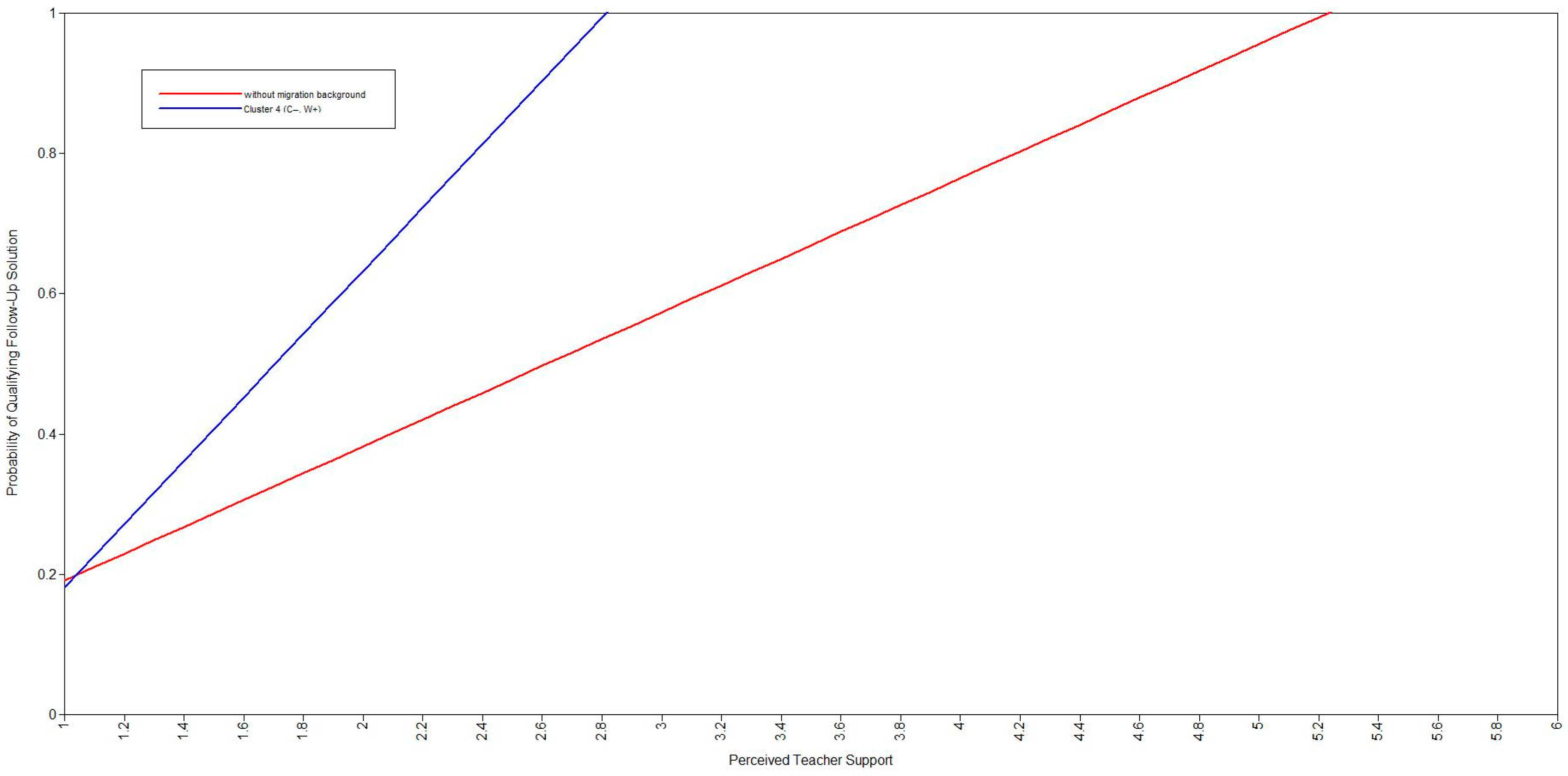
In the third step, four moderator variables (clusters 1–4 × perceived teacher support) were added to the model. Cluster 5 (Switzerland, i.e., no migration background) served as the reference category. In line with Hypothesis 4a, the results show that perceived teacher support increased the chances of students from cluster 1 (β = 0.07, p < 0.05) and cluster 4 (β = 0.12, p ≤ 0.001), which are characterized by high warmth, of finding a qualifying follow-up solution compared to students without a migration background (significant moderations; Hypothesis 4a supported). The AIC was reduced after adding the moderator variables, indicating a better fit of the model to the data. The moderations are presented in Figure 1 and Figure 2.
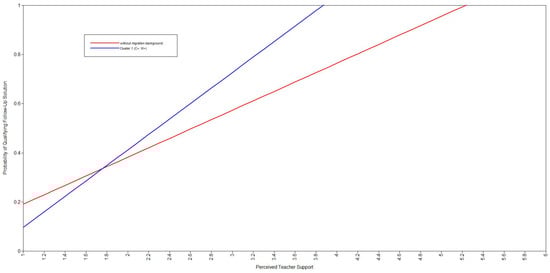
Figure 1.
Moderation effect of cluster 1 × teacher support on probability of direct transition to VET (qualifying follow-up solution).
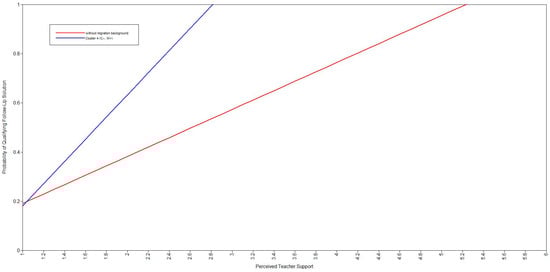
Figure 2.
Moderation effect of cluster 4 × teacher support on probability of direct transition to VET (qualifying follow-up solution).
3.4. Testing Effects on Person–Job Fit with a Linear Multilevel Model
To test hypotheses H2b, H3b, and H4b, a stepwise linear multilevel model was calculated. The results are shown in Table 2. First, only the control variables were included in the model; second, the variables of interest were added to the model; and third, the four moderator variables were added to the model. The variable person–job fit was included as a latent variable consisting of five items.
Table 2.
Results of the linear multilevel model.
The results show that students belonging to all four clusters were disadvantaged and, compared with students without a migration background, reported a lower person–job fit (cluster 1: β = −0.10, p ≤ 0.001; cluster 2: β = −0.13, p ≤ 0.001; cluster 3: β = −0.14, p ≤ 0.001; cluster 4: β = −0.16, p ≤ 0.001; H2b supported). Perceived teacher support had a significant effect on person–job fit (β = 0.10, p < 0.01; H3b supported).
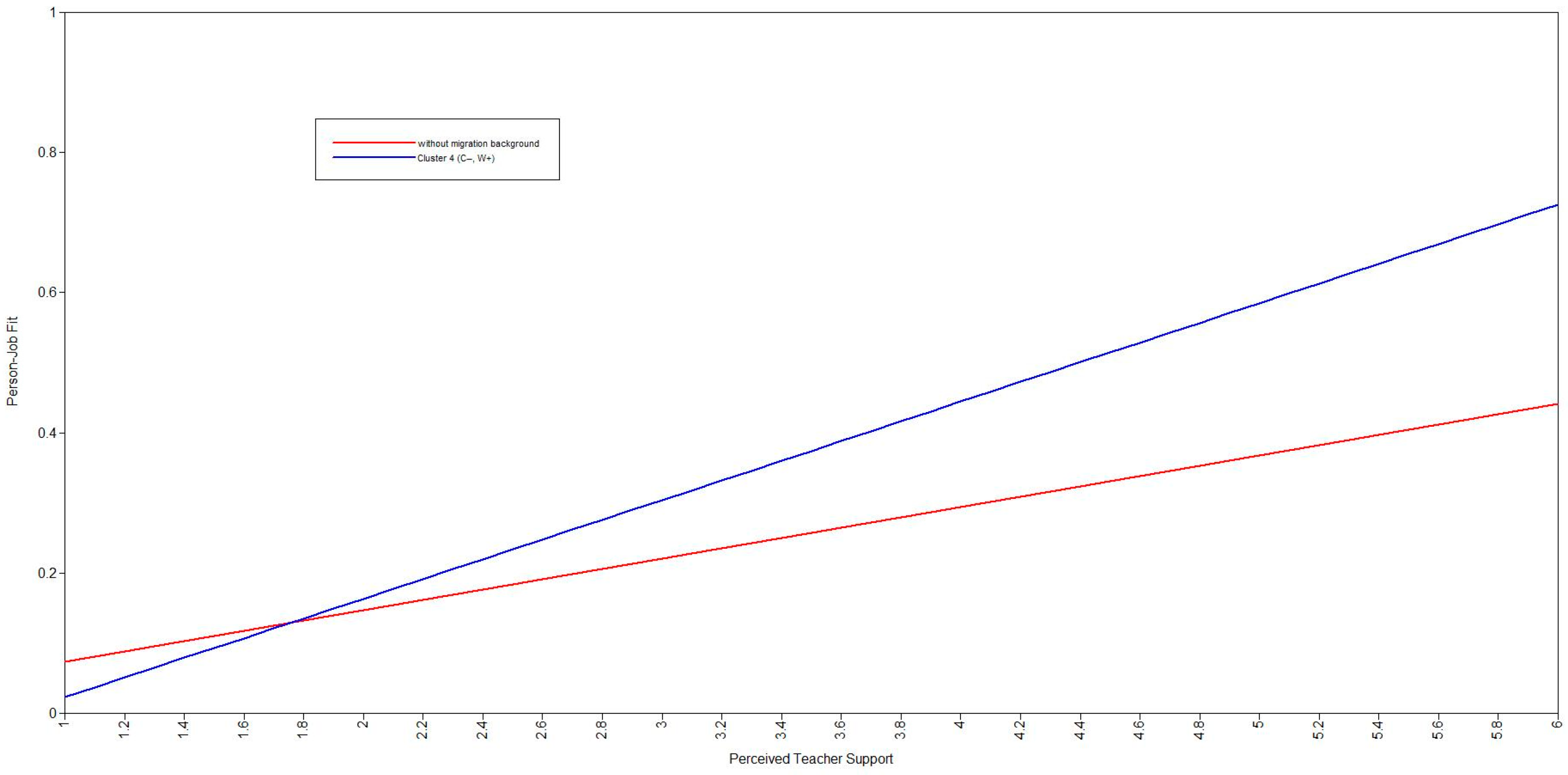
The results also show that perceived teacher support could reduce disadvantages in cluster 4 (β = 0.09, p < 0.05; significant moderation) but not in any of the other clusters (non-significant moderations). Hypothesis 4b was only partly supported. The AIC was reduced after adding the moderator variables, indicating a better fit of the model to the data. The moderation is presented in Figure 3.
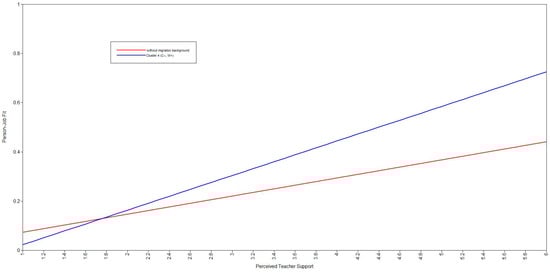
Figure 3.
Moderation effect of cluster 4 × teacher support on person–job fit.
4. Discussion
In line with prior research and our hypotheses, findings show that students from classes with low achievement levels and with migration backgrounds have lower chances of direct transition to VET and of establishing a high person–job fit (Hupka-Brunner et al., 2012; Imdorf, 2014). However, a new finding shows that teacher support in career decisions can improve students’ chances of getting an apprenticeship if gatekeepers, such as supervisors, stereotype students’ nationality as warm. In line with SCM, students with a nationality stereotyped as warm are supported. Teacher support improves their chances in the school-to-work transition compared to students without a migration background (Cuddy et al., 2009). Thus, teacher support can reduce educational disadvantages for specific groups of students with nationalities stereotyped as warm.
However, if students’ nationalities are stereotyped as being cold, gatekeepers such as supervisors reject them, although they receive much teacher support. An impressive example includes students in cluster 2 whose nationalities are stereotyped as low in warmth and medium in competence (e.g., Turkey, Kosovo, and Macedonia). These students report receiving the most teacher support, because they might intensively ask for support. However, this intense support does not improve their chances of directly transitioning to VET. Supervisors might reject them because they are stereotyped as hostile (Cuddy et al., 2007). Cuddy et al. (2007) assume that stereotypes determine negative emotions that hinder supervisors from hiring students with these nationalities. Similar processes might be true for students with nationalities in cluster 3. They are stereotyped as incompetent and cold (Cuddy et al., 2009). Therefore, supervisors in companies might not view them as valid candidates for apprenticeship vacancies. In consequence, students with migration backgrounds might not be able to choose some professions, and the range of possible professional options is limited. Teacher support cannot counterbalance these negative stereotypical beliefs. To be stereotyped as hostile is a strong disadvantage in the labor market that cannot be reduced by teacher support. Possibly, a more effective strategy to reduce the disadvantages of migrant groups is to sensitize supervisors to the negative effects of stereotypes (Neuenschwander et al., 2021). Supervisors could miss qualified apprentices because of their stereotypes. This is especially important in domains with skills shortages (e.g., nursing).
Teacher support can also increase perceived person–job fit for students from classes with low achievement levels and with nationalities stereotyped as being warm and incompetent. The effect was not found for students from classes with low achievement levels and with nationalities stereotyped as warm and competent (cluster 1). Students in cluster 1 are less disadvantaged compared to students in clusters 2–4 (Neuenschwander & Garrote, 2024). The correlation between competence and status is high (Neuenschwander et al., 2024), and thus, students in cluster 1 may prefer a high-status apprenticeship even though it does not fit their interests and competencies. In contrast, warmth is associated with interest and personality aspects that refer to person–job fit (Cuddy et al., 2007). Thus, students from classes with low achievement levels with nationalities stereotyped as high in warmth and low in competencies (e.g., Sri Lanka, Portugal, and Thailand) and with much teacher support may transition to a job with a higher person–job fit.
Considering the perspective of intersectionality, it is important to control for variables that predict the probability of a direct transition to VET. Findings show lower chances of a direct transition for students in French-speaking Switzerland. In French-speaking Switzerland, there is a higher unemployment rate and fewer open apprenticeships compared to German-speaking Switzerland (SKBF, 2023). This may lower the students’ chances of getting an apprenticeship. Findings show that students from special education classes have lower chances of obtaining an apprenticeship. This is in line with Pool Maag (2016), who described various challenges of this group in the labor market, such as supervisors’ stereotypes, a higher level of emotional and behavioral problems, and lower achievement levels. Findings indicate that females have a smaller chance of a direct transition. This finding was often reported in prior studies (SKBF, 2023) and may indicate a tendency for females to stay in school compared to moving to VET.
4.1. Limitations
One limitation is the research design. All variables were measured cross-sectionally and, thus, no causal implications may be taken. However, students’ indications of their future apprenticeship highly correspond to the apprenticeship that they start, and the correlation between the perceived person–job fit in 9th grade and the perceived person–job fit in VET is high and significant (Neuenschwander & Hofmann, 2022). Therefore, the assessments are sufficiently valid.
Second, only instrumental teacher support was measured. Other aspects of teacher support, such as emotional, informational, and appraisal teacher support, could have shown other findings (Zhang et al., 2016). Another study focusing on students who are unlikely to meet the requirements for transitioning to upper secondary education found that different types of direct and indirect support have an impact on students’ transition (Sundelin & Lundahl, 2023). Findings indicate that instrumental teacher support in career preparation effectively supports students with nationalities from clusters 1 and 4.
Third, findings for students from classes with low achievement levels may not be generalized to the entire student population. Intersectionality discussions stress specific conditions of students with combinations of risks and disadvantages (Samaluk, 2025). Students in mainstream schools with low achievement levels or in special needs schools with migration backgrounds can benefit from teacher support even more because they need much more assistance than teachers can offer. Thus, it would be interesting to examine whether similar findings can be found for students in mainstream schools with expanded or high demands. Students from classes with low achievement levels are at risk of not transitioning to VET, and thus, these findings have strong practical relevance.
Fourth, student achievement was measured using curriculum-validated tests. In contrast, supervisors in companies consider student grades in schools because they are easily accessible, although the grades have limited information about students’ academic competencies. In this study, grades were not assessed and could not be controlled.
4.2. Conclusions
Findings show that teacher support can reduce disadvantages for specific groups of students from classes with low achievement levels and with migration backgrounds in the school-to-work transition. The findings also show that it is relevant and meaningful to examine the effects of migration background in a more differentiated way compared to a dichotomous variable (migration background yes or no), as we find various effects for different nationality clusters. Our target group and the sample are characterized by a high migration rate, which makes the grouping into various clusters important (Neuenschwander & Garrote, 2024).
It is vital that teachers give special attention and support to students with multiple risks because additional support can help them move to VET and find a job that fits their interests and competencies. Teacher activities in classrooms, such as helping students to find open job offers, encouragement after a declined application, helping students to improve their applications, or preparing students for job interviews, can improve the chances of students from classes with low achievement levels in moving to VET (Neuenschwander & Hofmann, 2021). Such individual-centered strategies can be complemented with school-level activities such as developing concepts for how schools can support students’ school-to-work transition (Driesel-Lange & Klein, 2025). These concepts can focus on the team of teachers, school management, personal network, or other areas. However, a challenge remains as to how to address supervisors’ stereotypes and negative emotions in the labor market to reduce the disadvantages of students with nationalities stereotyped as hostile. Supervisors’ beliefs and behaviors are not measured in this analysis and thus should receive more attention in future research. A partly successful approach to reducing discrimination in the labor market was to ask for anonymized applications (Krause et al., 2012). Another approach is that supervisors can be sensitized to the negative effects of biased expectations toward those students (Neuenschwander et al., 2021). It seems to be crucial that supervisors receive training on how to recruit employees, avoiding discrimination. In addition, teachers should be informed in teacher education and continuing teacher education about these findings and receive advice on how to effectively support students’ career decisions and reduce stereotype effects in the labor market.
Author Contributions
M.P.N. acquired funding, was responsible for administration of the study. He initiated and chaired the data analysis and drafted the theory and discussion sections. He guided and revised the method and result sections. S.M. did the data analysis, drafted the method and result sections, and revised the theory and discussion sections. All authors have read and agreed to the published version of the manuscript.
Funding
This research was funded by the Swiss State Secretariat for Education, Research, and Innovation, grant number 1315002478.
Institutional Review Board Statement
The study was conducted in accordance with the Declaration of Helsinki and approved by the Institutional Ethics Committee of the Pädagogische Hochschule FHNW (protocol code No 070220231, 2 October 2023).
Informed Consent Statement
Informed consent was obtained from all subjects involved in the study.
Data Availability Statement
Data is available www.swissubase.ch Trail project No 20176.
Acknowledgments
Authors wish to thank Ariana Garrote, Manuel Carli and Manon Bach for organizing the data collection.
Conflicts of Interest
The authors declare no conflicts of interest. The funders had no role in the design of the study; in the collection, analyses, or interpretation of data; in the writing of the manuscript; or in the decision to publish the results.
Appendix A
Table A1.
Bivariate correlations.
Table A1.
Bivariate correlations.
| 1 | 2 | 3 | 4 | 5 | 6 | 7 | 8 | 9 | 10 | 11 | 12 | 13 | 14 | 15 | 16 | |
|---|---|---|---|---|---|---|---|---|---|---|---|---|---|---|---|---|
| 1. language region | -- | |||||||||||||||
| 2. Cluster 1 | 0.01 | -- | ||||||||||||||
| 3. Cluster 2 | −0.07 * | −0.20 *** | -- | |||||||||||||
| 4. Cluster 3 | 0.09 *** | −0.10 *** | −0.11 *** | -- | ||||||||||||
| 5. Cluster 4 | 0.14 *** | −0.16 *** | −0.17 *** | −0.08 ** | -- | |||||||||||
| 6. Cluster 5 (CH) | −0.08 ** | −0.43 *** | −0.46 *** | −0.23 *** | −0.36 *** | -- | ||||||||||
| 7. gender | 0.02 | −0.03 | −0.01 | 0.01 | 0.02 | 0.02 | -- | |||||||||
| 8. school type | 0.01 | 0.02 | −0.05 | 0.06 * | 0.04 | −0.03 | −0.08 ** | -- | ||||||||
| 9. perceived teacher support | −0.20 *** | −0.02 | 0.08 ** | −0.00 | 0.03 | −0.06 * | 0.06 * | 0.01 | -- | |||||||
| 10. highest ISEI | −0.07 * | 0.07 ** | −0.08 ** | −0.10 *** | −0.17 *** | 0.16 *** | −0.05 | −0.07 * | 0.00 | -- | ||||||
| 11. reading comprehension | 0.00 | −0.02 | −0.14 *** | −0.13 *** | −0.06 * | 0.21 *** | 0.05 | −0.15 *** | −0.09 *** | 0.18 *** | -- | |||||
| 12. basic reading skills | 0.01 | 0.00 | −0.07 * | −0.08 ** | −0.04 | 0.11 *** | 0.11 *** | −0.21 *** | −0.06* | 0.10 *** | 0.41 *** | -- | ||||
| 13. mathematics achievement | 0.00 | −0.01 | −0.04 | −0.05 | −0.04 | 0.09 ** | −0.28 *** | −0.18 *** | −0.10 *** | 0.13 *** | 0.39 *** | 0.29 *** | -- | |||
| 14. qualifying follow-up solution | −0.29 *** | −0.05 | −0.02 | −0.14 *** | −0.10 *** | 0.17 *** | −0.05 | −0.07 * | 0.12 *** | 0.03 | 0.07 ** | 0.02 | 0.03 | -- | ||
| 15. person–job fit | −0.11 *** | −0.06 | −0.04 | −0.08 ** | −0.08 ** | 0.16 *** | −0.01 | −0.04 | 0.09 ** | 0.04 | 0.04 | 0.03 | 0.05 | 0.25 *** | -- | |
| 16. cohort | −0.20 *** | 0.03 | 0.03 | −0.02 | −0.06 * | 0.01 | −0.03 | −0.19 *** | 0.06 * | 0.02 | 0.05 | 0.07 * | 0.04 | 0.02 | 0.02 | -- |
Note. N = 958–1388. * p < 0.05 (two-tailed), ** p < 0.01 (two-tailed), *** p ≤ 0.001 (two-tailed).
References
- Asbrock, F. (2010). Stereotypes of social groups in Germany in terms of warmth and competence. Social Psychology, 41(2), 76–81. [Google Scholar] [CrossRef]
- Babel, J., & Lagana, F. (2016). Der übergang am ende der obligatorischen schule [The transition at the end of compulsory school]. Bundesamt für Statistik. [Google Scholar]
- Bäuerlein, K., Lenhard, W., & Schneider, W. (2012). Lesen 8–9. Lesetestbatterie für die klassenstufen 8-9. Verfahren zur erfassung der basalen lesekompetenz und des textverständnisses [Reading 8–9. Readingtest battery for grades 8–9. Test to measure basic reading competences and text apprehension]. Hogrefe. [Google Scholar]
- Binggeli, S., Krings, F., & Sczesny, S. (2014). Stereotype content associated with immigrant groups in Switzerland. Swiss Journal of Psychology, 73(3), 123–133. [Google Scholar] [CrossRef]
- Crandall, C. S., Eshleman, A., & O’Brien, L. (2002). Social norms and the expression and suppression of prejudice. Journal of Personality and Social Psychology, 82(3), 359–378. [Google Scholar] [CrossRef]
- Cuddy, A. J. C., Fiske, S. T., & Glick, P. (2007). The BIAS map: Behaviors from intergroup affect and stereotypes. Journal of Personality and Social Psychology, 92(4), 631–648. [Google Scholar] [CrossRef]
- Cuddy, A. J. C., Fiske, S. T., & Glick, P. (2008). Warmth and competence as universal dimensions of social perception: The stereotype content model and the BIAS map. Advances in Experimental Social Psychology, 40, 61–149. [Google Scholar] [CrossRef]
- Cuddy, A. J. C., Fiske, S. T., Kwan, V. S. Y., Glick, P., Demoulin, S., Leyens, J.-P., Bond, M. H., Croizet, J.-C., Ellemers, N., Sleebos, E., Htun, T. T., Kim, H.-J., Maio, G., Perry, J., Petkova, K., Todorov, V., Bailón, R. R., Morales, E., Moya, M., … Ziegler, R. (2009). Stereotype content model across cultures. British Journal of Social Psychology, 48, 1–33. [Google Scholar] [CrossRef]
- Driesel-Lange, K., & Klein, J. (2025). Career guidance in schools from european and international perspectives. In R. Schröder, C. Nägele, M. Rosalska, A. Wawrzonek, & S. Romero-Rodriguez (Eds.), Career guidance in schools from European and international perspectives: Rethinking career guidance in times of uncertainty and transformation (pp. 11–18). Career Lead. [Google Scholar] [CrossRef]
- Driesel-Lange, K., Ohlemann, S., & Morgenstern, I. (2018). Fördern Lehrpersonen den Berufswahlprozess Jugendlicher? [Do teachers promote the career decision process of adolescents?]. Zeitschrift für Soziologie der Erziehung und Sozialisation, 38(4), 343–360. [Google Scholar]
- Eccles, J. S., & Roeser, R. W. (2009). Schools, academic motivation, and stage-environment fit. In R. M. Lerner, & L. Steinberg (Eds.), Handbook of adolescent psychology (3rd ed., pp. 404–434). John Wiley & Sons. [Google Scholar]
- Fasching, H. (2014). Vocational education and training and transitions into the labour market of persons with intellectual disabilities. European Journal of Special Needs Education, 29(4), 505–520. [Google Scholar] [CrossRef]
- Fiske, S. T., Cuddy, A. J. C., Glick, P., & Xu, J. (2002). A model of (often mixed) stereotype content. Journal of Personality and Social Psychology, 82(6), 878–902. [Google Scholar] [CrossRef] [PubMed]
- Ganzeboom, H., & Treiman, D. (2010). International stratification and mobility file: Conversion tools. Department of Social Research Methodology. Available online: http://www.harryganzeboom.nl/ismf/index.htm (accessed on 22 March 2026).
- Holzer, N., Lenart, F., & Schaupp, H. (2017). ERT JE. Eggenberger rechentest für jugendliche und erwachsene [Eggenberger math test for adolescents and adults]. Hogrefe. [Google Scholar]
- Hu, S., Hood, M., Creed, P. A., & Shen, X. (2020). The relationship between family socioeconomic status and career outcomes: A life history perspective. Journal of Career Development, 49(3), 600–615. [Google Scholar] [CrossRef]
- Hupka-Brunner, S., Meyer, T., Stalder, B. E., Keller, A. C., & Bergman, M. M. (2012). Übergänge im spannungsfeld zwischen sozialer herkunft, leistung und strukturen des bildungssystems [Transitions between social origin, achievement and structures in educational system]. In M. M. Bergman, S. Hupka-Brunner, T. Meyer, & R. Samuel (Eds.), Bildung–arbeit–erwachsenwerden [Education–work–becoming adult] (pp. 203–220). Springer. [Google Scholar] [CrossRef]
- Imdorf, C. (2014). Die bedeutung von schulqualifikationen, nationaler herkunft und geschlecht beim übergang von der schule in die betriebliche berufsausbildung [The significance of educational qualifications, national origin and gender in the transition from school to in-company vocational training]. In M. P. Neuenschwander (Ed.), Selektion in schule und arbeitsmarkt [Selection in school and labor market] (pp. 41–62). Rüegger. [Google Scholar]
- Krause, A., Rinne, U., Zimmermann, K. F., Böschen, I., & Alt, R. (2012). Pilotprojekt „anonymisierte Bewerbungsverfahren“ [Pilot study «anonymized job application»]: Bd. I ZA research report no. 44. Available online: https://docs.iza.org/report_pdfs/iza_report_44.pdf (accessed on 22 March 2026).
- Kristof-Brown, A., Li, C. S., & Schneider, B. (2018). Fitting in and doing good: A review of person-environment fit and organizational citizenship behavior research. In P. M. Podsakoff, S. B. Mackenzie, & N. P. Podsakoff (Eds.), The Oxford handbook of organizational citizenship behavior (pp. 353–370). Oxford University Press. [Google Scholar] [CrossRef]
- Lippens, L., Vermeiren, S., & Baert, S. (2023). The state of hiring discrimination: A meta-analysis of (almost) all recent correspondence experiments. European Economic Review, 151, 104315. [Google Scholar] [CrossRef]
- Little, R. J. A., & Rubin, D. B. (2020). Statistical analysis with missing data (3rd ed.). Wiley. [Google Scholar]
- Moser Opitz, E., Labhart, D., Grob, U., & Prediger, S. (2021). Basis-math-G 6+. Gruppentest zur basisdiagnostik mathematik für das vierte quartal der 6. Klasse und das erste quartal der 7. Klasse [Bais math G 6+. Grouptest for basis diagnosis mathematics for the fourth quartal of 6th grade and the first quaratl of 7th grade]. Hogrefe. [Google Scholar]
- Muthén, L. K., & Muthén, B. O. (2017). Mplus user’s guide (8th ed.). Muthén & Muthén. [Google Scholar]
- Neuenschwander, M. P., & Frank, N. (2009). Familie-Schule-Beruf (FASE B)—Dokumentation der schülerbefragung 2008 (forschungsbericht) [Family-school-job (FASE B)—Documentation of the students survey 2008]. Pädagogische Hochschule Nordwestschweiz, Zentrum Lernen und Sozialisation. [Google Scholar]
- Neuenschwander, M. P., & Garrote, A. (2024). Biased teacher expectations of students with migration backgrounds: Analysis with nationality stereotype clusters. Zeitschrift für Bildungsforschung, 15, 277–292. [Google Scholar] [CrossRef]
- Neuenschwander, M. P., Garrote, A., & Huttasch, M. (2024). Grouping nationalities based on students’ estimation of stereotype contents in Switzerland. Journal of International Migration and Integration, 25, 1715–1732. [Google Scholar] [CrossRef]
- Neuenschwander, M. P., Gerber, M., Frank, N., & Rottermann, B. (2012). Schule und beruf: Wege in die erwerbstätigkeit [School and job: Pathways to employment]. VS Verlag für Sozialwissenschaften. [Google Scholar]
- Neuenschwander, M. P., & Hofmann, J. (2021). Effekte schulischer berufswahlaktivitäten auf die berufliche selbstwirksamkeit von jugendlichen beim übergang in die berufliche grundbildung [The effects of school-based career guidance activities on young people’s career self-efficacy during the transition to initial vocational training]. Schweizerische Zeitschrift für Bildungswissenschaften, 43, 325–336. [Google Scholar] [CrossRef]
- Neuenschwander, M. P., & Hofmann, J. (2022). Career decision, work adjustment, and person–job fit of adolescents: Moderating effects of parental support. Journal of Career Development, 49(1), 76–89. [Google Scholar] [CrossRef] [PubMed]
- Neuenschwander, M. P., Mayland, C., Niederbacher, E., & Garrote, A. (2021). Modifying biased teacher expectations in mathematics and German: A teacher intervention study. Learning and Individual Differences, 87, 101995. [Google Scholar] [CrossRef]
- Neuenschwander, M. P., & Niederbacher, E. (2021). Disparitäten in anstrengungsbereitschaft und leistung nach SES, familiensprache und geschlecht: Folgen von sozialisation oder von diskriminierung durch verzerrte lehrpersonenerwartungen [Disparities in effort and achievement related to SES, family language and gender: Consequences of socialisation or of discrimination through biased teacher expectancies]. Zeitschrift für Soziologe der Sozialisation und Erziehung, 41(4), 449–466. [Google Scholar] [CrossRef]
- OECD. (2023). PISA 2022 ergebnisse (band I): Lernstände und bildungsgerechtigkeit [Results (volume 1): Learning outcomes and educational equity]. wbv Media. [Google Scholar] [CrossRef]
- Pool Maag, S. (2016). Herausforderungen im übergang schule beruf: Forschungsbefunde zur beruflichen integration von jugendlichen mit benachteiligungen in der Schweiz [Challenges in the school-to-work transition: Research findings about the professional integration of adolescents with risks in Switzerland]. Schweizerische Zeitschrift für Bildungswissenschaften, 38(3), 591–609. [Google Scholar]
- Radulovic, M., Radulovic, L., & Stancic, M. (2022). Can teacher support reduce inequalities in education? Re-examining the relationship between cultural capital and achievement. British Journal of Sociology of Education, 43(7), 1012–1031. [Google Scholar] [CrossRef]
- Sahli Lozano, C. (2012). Schulische selektion und berufliche integration. Theorien, positionen und ergebnisse einer längsschnittstudie zu den wirkungen integrativer und separativer schulformen auf ausbildungszugänge und -wege [Scolastic selection and professional integration. Theories, positions and findings of a longitudinal study about effects of integrative and separative schooling on access to professional training and pathways]. Universität Freiburg (CH). [Google Scholar]
- Sahli Lozano, C., Setz, F., Wüthrich, S., & Wicki, M. (2023). Integrative förderung für lernende mit besonderem bildungsbedarf–inter- und intrakantonale heterogenität bezüglich zielgruppe und umsetzung [Integrative education for learners with special education needs–inter- and intracantonal heterogeneity with regard to target group and implementation]. Schweizerische Zeitschrift für Bildungswissenschaften, 45(3), 320–334. [Google Scholar] [CrossRef]
- Samaluk, B. (2025). Intersectional inequalities in (trans)national education-to-work transitions: The case of becoming welfare professionals. International Journal of Lifelong Education, 44(6), 678–693. [Google Scholar] [CrossRef]
- Scharenberg, K., Rudin, M., Müller, B., Meyer, T., & Hupka-Brunner, S. (2014). Ausbildungsverläufe von der obligatorischen schule ins junge erwachsenenalter: Die ersten zehn jahre. Ergebnisübersicht der Schweizer längsschnittstudie TREE, Teil I [Educational pathways from compulsory school to young adulthood: The first ten years. Review of findings of the Swiss longitudinal study TREE–part I]. Universität Basel. [Google Scholar]
- Schwitter, N., Chatzitheochari, S., & Liebe, U. (2025). Disability discrimination in hiring: A systematic review. Research in Social Stratification and Mobility, 98, 101069. [Google Scholar] [CrossRef]
- SKBF. (2023). Bildungsbericht 2023 [Educational report 2023]. Schweizerische Koordinationsstelle für Bildungsforschung. [Google Scholar]
- Stalder, B. E., & Nägele, C. (2011). Vocational education and training in Switzerland: Organisation, development and challenges for the future. In M. Bergman, S. Hupka-Brunner, A. C. Keller, T. Meyer, & B. E. Stalder (Eds.), Youth transitions in Switzerland: Results from the TREE panel study (pp. 18–39). Seismo Verlag. [Google Scholar]
- Sundelin, A., & Lundahl, L. (2023). Managing critical transitions: Career support to young people risking ineligibility for upper secondary education. European Educational Research Journal, 22(4), 572–591. [Google Scholar] [CrossRef]
- Verkuyten, M., & Martinovic, B. (2012). Immigrants’ national identification: Meanings, determinants, and consequences. Social Issues and Policy Review, 6(1), 82–112. [Google Scholar] [CrossRef]
- Wang, S., Rubie-Davies, C. M., & Meissel, K. (2018). A systematic review of the teacher expectation literature over the past 30 years. Educational Research and Evaluation, 24(3–5), 124–179. [Google Scholar] [CrossRef]
- Warm, T. A. (1989). Weighted likelihood estimation of ability in the item response theory. Psychometrika, 54, 427–450. [Google Scholar] [CrossRef]
- Wong, L. P. W., Yuen, M., & Chen, G. (2020). Career-related teacher support: A review of roles that teachers play in supporting students’ career planning. Journal of Psychologists and Counsellors in Schools, 31, 130–141. [Google Scholar] [CrossRef]
- Yen, W. M., & Fitzpatrick, A. R. (2006). Item response theory. In R. L. Brennan (Ed.), Educational measurement (4th ed., pp. 111–153). Praeger. [Google Scholar]
- Zhang, J., Yuen, M., & Chen, G. (2016). Teacher support for career development: An integrative review and research agenda. Career Development International, 23(2), 122–144. [Google Scholar] [CrossRef]
Disclaimer/Publisher’s Note: The statements, opinions and data contained in all publications are solely those of the individual author(s) and contributor(s) and not of MDPI and/or the editor(s). MDPI and/or the editor(s) disclaim responsibility for any injury to people or property resulting from any ideas, methods, instructions or products referred to in the content. |
© 2026 by the authors. Licensee MDPI, Basel, Switzerland. This article is an open access article distributed under the terms and conditions of the Creative Commons Attribution (CC BY) license.