


Abstract
Digital behaviour in higher education must be approached not only as a psychological phenomenon but also as a pedagogical issue with direct implications for academic wellbeing and learning processes. The present study evaluates an integrated model that links frequency of online activity, problematic Internet use, nomophobia, and phubbing among university students. A quantitative-transversal methodology was applied. A structural equation model was specified using partial least squares (PLS-SEM) in order to analyse the combined direct and indirect effects between the constructs studied. The sample comprised 1922 Spanish university students. The instrument was made up of four scales designed to assess the frequency and type of Internet use, problematic Internet use, nomophobia, and phubbing. The results support the four hypotheses established via the model to explain the relationships between the variables. The explanatory power of the model around the construct of phubbing stood out, and nomophobia was determined to have a partial mediating role between problematic Internet use and phubbing. Guidance is discussed for the design of interventions to address the issues these phenomena cause.
1. Introduction
1.1. Background
In higher education, students’ pervasive connectivity and smartphone-mediated engagement have become a growing concern because they can erode attention, participation, and academic wellbeing, as well as the quality of face-to-face interactions that underpin collaborative learning. Digital technologies now permeate nearly all aspects of university life, reshaping how students access information, communicate with peers and educators, organise coursework, and participate in learning activities. Smartphones in particular have become ubiquitous academic companions. Students depend on them for navigating institutional platforms, coordinating group projects, and managing deadlines, but also for social networking and entertainment (Duradoni et al., 2023; Pérez-Juárez et al., 2023). This continuous connection blurs the boundaries between study-related and leisure activities and places new demands on self-regulation (Wang et al., 2022). As several authors argue (Dagani et al., 2025; Truzoli et al., 2019), digital behaviour in higher education must therefore be approached not only as a psychological phenomenon but also as a pedagogical issue with direct implications for attention, motivation, collaborative learning, and classroom climate.
Recent educational research has emphasised that understanding students’ digital habits requires moving beyond simplistic indicators such as screen time or number of log-ins. A more meaningful distinction would be between intensive and problematic use. Intensive behaviour often reflects the legitimate digital workload associated with contemporary coursework, whereas Problematic Internet Use (PIU) arises when online activity becomes difficult to control or begins to interfere with academic responsibilities and emotional wellbeing (Caplan, 2007; Kuss & Lopez-Fernandez, 2016). The literature consistently links PIU to attentional difficulties, procrastination, poorer academic performance, and higher stress among university students, suggesting that its impact extends into core learning processes (Moreno-Guerrero et al., 2020; Truzoli et al., 2019).
Beyond general Internet use, two smartphone-specific phenomena—nomophobia and phubbing—have become increasingly important in higher education contexts. Nomophobia, conceptualised as the anxiety or discomfort people experience when they are unable to access or use their smartphones, is associated with higher cognitive load and difficulties sustaining attention during learning tasks (Cheever et al., 2014; Rodríguez-García et al., 2020). Phubbing (from phone-snubbing) is when people do not pay attention to face-to-face interactions and instead engage with their phones. Research shows that it undermines interpersonal communication, reduces social presence, and disrupts collaborative activities, which are central to constructivist and active learning approaches (Pérez-Juárez et al., 2023; Roberts & David, 2016). Importantly, nomophobia and phubbing represent two specific manifestations of smartphone-based dependence that tend to emerge after broader patterns of problematic Internet use, suggesting a sequential progression in students’ digital behaviour (Duradoni et al., 2023; Elhai et al., 2021).
Despite rapid growth in research on PIU, nomophobia, and phubbing, empirical evidence remains scarce and fragmented, and these constructs have largely been examined separately. For example, studies have focused exclusively on PIU and psychological distress, or analysed only a subset of relationships, such as PIU and nomophobia or nomophobia and academic stress (Davey et al., 2018; Elhai et al., 2018). Although these contributions are valuable, they provide only partial insights into how online activity evolves into smartphone-specific emotional and behavioural patterns. In higher education, where attention, presence, and peer interaction are at the core of learning, the absence of an integrated perspective makes it difficult to understand how digital habits translate into classroom-level outcomes (Moreno-Guerrero et al., 2020; Muñoz-Carril et al., 2025a).
This gap is particularly noteworthy; while a substantial body of research explains each phenomenon separately, far fewer studies have examined how they unfold sequentially within a unified model and from an explicitly educational perspective. Understanding the progression—from frequent online activity to problematic Internet use, to anxious attachment to the smartphone, and finally to disruptions in face-to-face communication—is crucial to explaining why some students experience recurring challenges in attention, participation, and collaborative work.
The present study addresses this gap by proposing an integrated, education-centred model that links the frequency of online activity (FRE), problematic Internet use (PIU), nomophobia, and phubbing in university students. The model assumes that frequent engagement in online activities can set the stage for more dysregulated patterns of Internet use, which may in turn heighten students’ emotional dependence on their smartphones and increase the likelihood of phone-related interruptions during face-to-face interactions. By examining these constructs together, the study aims to improve our understanding of the pattern of associations between students’ everyday digital habits and smartphone-related emotional and behavioural tendencies in academic settings. This knowledge is essential for informing strategies that support students’ self-regulation, promote healthier digital practices, and foster more engaging learning environments. The next section outlines the theoretical rationale supporting each of the relationships in the proposed model.
1.2. The Present Study: Research Model, Constructs and Hypotheses
Considering the aspects described above, the proposed research model is based on the premise that the frequency of internet activities (FRE) is associated with greater problematic Internet use (PIU), and that this maladaptive use is in turn linked to specific forms of psychological dependency on smartphones such as nomophobia and phubbing, which may interfere with wellbeing and the quality of interpersonal relationships in the university context. In addition, nomophobia is assumed to act as an additional proximal antecedent of phubbing behaviours.
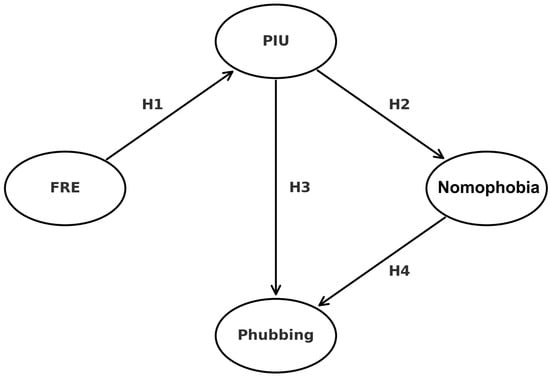
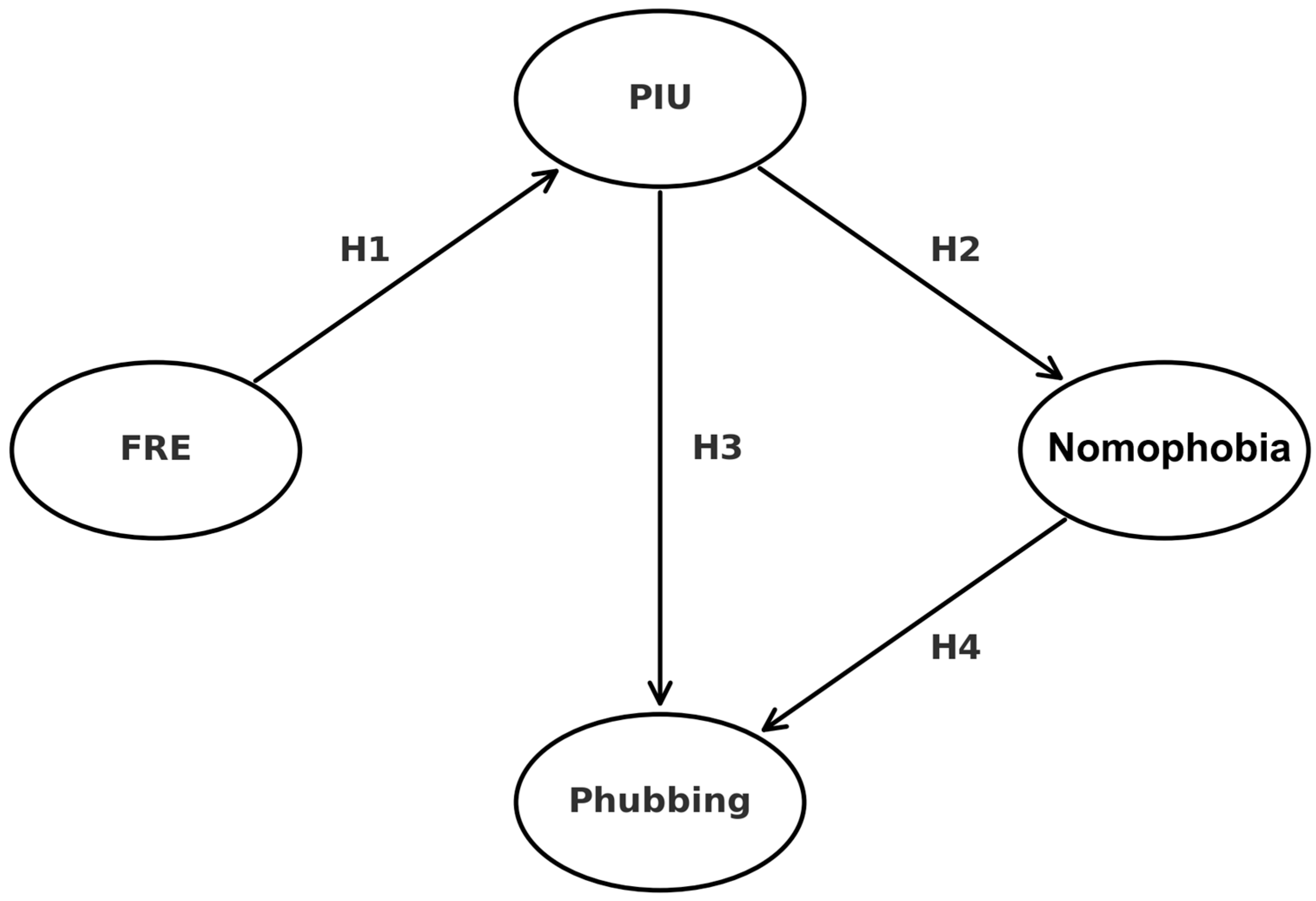
Figure 1 shows a graphical representation of the proposed structural model, indicating the hypothesised paths between the four constructs (frequency of Internet use, problematic Internet use, nomophobia, and phubbing) and the suggested mediating relationships.
Figure 1.
Research model with hypothesised paths.
The proposed model includes four direct hypotheses (H1–H4) corresponding to the structural paths shown in Figure 1. In addition, the model suggests a set of indirect effects that are theoretically meaningful in higher education contexts: (a) PIU is expected to mediate the association between frequency of online activity and nomophobia (FRE → PIU → Nomophobia), and between frequency of online activity and phubbing (FRE → PIU → Phubbing); (b) nomophobia is expected to partially mediate the relationship between PIU and phubbing (PIU → Nomophobia → Phubbing), above and beyond the direct effect of PIU on phubbing (H3); and (c) serial mediation is expected whereby FRE is associated with phubbing through PIU and nomophobia (FRE → PIU → Nomophobia → Phubbing). These indirect paths are examined in the mediation analysis section.
The construct, frequency of Internet activity (FRE), refers to the intensity of university students’ online activity in their day-to-day lives. This may include using social networks, instant messaging, consuming audiovisual content, and playing videogames. The scientific literature has shown that certain profiles of intensive use of social networks and other digital services are associated with less favourable indicators of academic and psychosocial adjustment in the university student population (Antoniadou, 2025). Although greater frequency of use is not necessarily a problematic pattern, it does represent a context that may be conducive to maladaptive use, where there are difficulties with self-regulation or where the technology is the main coping strategy.
Problematic Internet use (PIU) is a pattern of excessive maladaptive use, associated with a loss of control, interference with academic or social obligations, and significant unease or distress when one cannot go online (Caplan, 2007; Kuss & Lopez-Fernandez, 2016). This pattern is usually linked to Internet use focused on emotional regulation, avoidance of offline problems, or compulsively seeking social connection, which can worsen the dependency and make it difficult to disconnect. Evidence gathered over recent years suggests that PIU functions as a central node in the relationship between the intensity of digital technology use and various negative consequences at the psychological, academic, and relational level (Lu et al., 2025; Sánchez-Fernández et al., 2023).
Nomophobia becomes particularly important in this context. This is the excessive fear or anxiety of being unable to access one’s smartphone or the services it provides (e.g., the Internet, social networks, or messaging). Recent reviews have reported significant studies on nomophobia within adolescent and university populations, indicating a high prevalence and a relationship with stress, anxiety, sleep-related problems, and difficulties with academic performance (Moreno-Guerrero et al., 2020; Rodríguez-García et al., 2020). These studies have consistently highlighted that being unable to contact or be contacted, and the feeling of being disconnected from one’s social network are key triggers of nomophobic anxiety.
On a behavioural level, the concept of phubbing becomes important. This refers to behaviour where someone ignores or neglects people who are actually present in a face-to-face interaction and instead pays attention to a smartphone (Muñoz-Carril et al., 2025a). Structural studies have shown that phubbing is positively related to various forms of technological addiction (e.g., addiction to mobile phones, the Internet, or social networks), such that it can be understood as an observable manifestation of smartphones being prioritised over personal interaction (Karadağ et al., 2015). In addition, recent studies in university populations have indicated that a high prevalence of phubbing is associated with greater intensity of smartphone use, more problems sleeping, and other indicators of psychosocial discomfort.
Based on this conceptual model, the specific relationships between the constructs and the study hypotheses are presented below.
1.2.1. Intensity of Online Activities as a Precursor to Problematic Internet Use
Various studies have indicated that an increase in frequency and time spent on online activities is associated with greater likelihood of developing problematic patterns of Internet use, especially when that use is aimed at emotional regulation or at avoiding offline problems (Caplan, 2007; Kuss & Lopez-Fernandez, 2016). In the university setting, the ready availability of mobile devices and the constant connectivity encourage patterns of use that can, in certain cases, lead to dependency and loss of control, especially when smartphones are the main form of leisure, socialisation, and coping with stress.
The studies examining profiles of social network use—and use of other digital platforms—show that groups who are online more frequently exhibit less favourable indicators of academic fit and psychosocial wellbeing (Antoniadou, 2025). Although frequency of use alone is not sufficient criteria for defining PIU, it is an important precursor, in other words, a risk factor that increases the likelihood of developing maladaptive patterns when combined with other factors such as self-control issues (Li et al., 2021) or impulsivity traits (Sánchez-Fernández et al., 2023).
Considering these aspects, the following hypothesis is suggested:
Hypothesis 1 (H1).
Higher frequency of activities on the Internet (FRE) in higher education students will positively and significantly influence problematic Internet use (PIU).
1.2.2. From Problematic Internet Use to Nomophobic Smartphone Dependency
Recent research has shown that PIU is usually accompanied by strong emotional and functional attachment to smartphones, which become the main way of accessing the Internet, social networks, and various digital services (Kuss & Lopez-Fernandez, 2016). From this premise, not having a smartphone available or not being able to go online may be experienced as a loss of control or as social isolation, which encourages the appearance of anxiety and unease, responses that are characteristic of nomophobia.
In addition, systematic reviews such as Rodríguez-García et al. (2020), have demonstrated that nomophobia is particularly prevalent in adolescents and in university students, and is related to indicators of psychosocial unease, stress, and academic problems. At the same time, studies such as Moreno-Guerrero et al. (2020) showed moderate levels of nomophobia in student teachers, with particular impact on anxiety when they were unable to instantly get online. This evidence suggests that when Internet use acquires problematic traits, device dependency or a need for constant online connection may intensify anxiety about being disconnected, consolidating nomophobic patterns.
From this perspective, it seems reasonable to hypothesise that PIU will be a positive predictor of nomophobia in university students:
Hypothesis 2 (H2).
Problematic Internet use (PIU) in university students will have a positive, significant effect on nomophobia.
1.2.3. Problematic Internet Use and Its Relationship to Phubbing
Phubbing is a behaviour that incorporates components of dependency and compulsiveness in device use that become visible in face-to-face interactions. From a conceptual point of view, Karadağ et al. (2015) considered phubbing to be the cumulative result of various forms of digital “addiction” (to the Internet, social networks, or online games) and showed that these addictions explained a substantial proportion of the variance of phubbing behaviour.
Consistent with this view, various studies have documented phubbing as being particularly common in the young and university populations, and as being positively related to indicators of problematic Internet and smartphone use. Barbed-Castrejón et al. (2024) reported a high prevalence of phubbing in students aged 12 to 21 years old and a positive correlation with problematic Internet use.
In this framework, PIU can be considered a notable risk factor that is strongly related to phubbing behaviours. The greater the use of the Internet in the student’s life and the harder they find it to regulate that, the greater the likelihood that attention will shift to the device during face-to-face interactions.
Based on this, problematic Internet use is suggested to be positively related to a tendency to engage in phubbing:
Hypothesis 3 (H3).
University students’ problematic Internet use (PIU) will positively and significantly influence phubbing.
1.2.4. Nomophobia as a Precursor of Phubbing
In addition to the direct connection between PIU and phubbing, it is also worth considering the specific role of nomophobia as a psychological mechanism that may encourage people to resort to their smartphones during face-to-face interactions. Anxiety about not being connected, being unable to access information, or not responding immediately to messages and notifications may translate into paying constant attention to the device even in social contexts, increasing the likelihood of interrupting or neglecting face-to-face communication.
Recent studies have shown that nomophobia and phubbing tend to occur together and that both phenomena are associated with indicators of unease, excessive smartphone use, and problems sleeping. For example, Guerra Ayala et al. (2024) showed that nomophobia and phubbing were moderately related and that both predicted deficient sleep patterns in university students. In addition, reviews about nomophobia have highlighted that the need for constant connection and difficulty tolerating not being online are core elements of the construct (Rodríguez-García et al., 2020), which fits with the tendency to repeatedly check one’s smartphone during social interactions.
In line with this, the suggestion is that nomophobia will specifically contribute to explaining phubbing behaviours, beyond the direct effect of PIU, leading to the following hypothesis:
Hypothesis 4 (H4).
The level of nomophobia exhibited by university students will positively and significantly predict phubbing.
2. Materials and Methods
The study applied a quantitative methodology, with a non-experimental, transversal ex post facto design, using a survey as the main data collection method (McMillan & Schumacher, 2005).
2.1. Participants and Sociodemographic Characteristics
The sample comprised 1922 university students who were doing various bachelor’s degree, double degree, and master’s courses at a public university in the north of Spain. Most of the students (88.1%, n = 1694) were studying for bachelors’ degrees, followed by those doing a double degree (7%, n = 134), and masters’ (4.9%, n = 94).
Three-quarters (76.2%; n = 1464) of the students identified as women, 23.3% (n = 449) identified as men, while 0.5% (n = 9) indicated other gender identities.
The mean age of the participants was 21.28 years old (SD = 4.21).
Just over a third of the students (38%; n = 730) were in their first year, 22.9% (n = 441) in their second, 16.4% (n = 315) their third, 16.2% (n = 312) in their fourth, 1.6% (n = 30) in their fifth year (on double degrees), and 4.9% (n = 94) were on master’s courses.
Mean academic performance, assessed via their course grade point average on a scale of 0–10, was 7.19 (SD = 1.27).
Lastly, looking at the daily frequency of Internet connection for non-academic purposes, 31.8% of the students (n = 611) reported being online for four hours or more each day, 26.8% (n = 516) reported between two-and-a-half and three hours, 23.7% (n = 455) between three and four hours, 14.2% (n = 272) between one and two hours, and just 3.5% (n = 68) reported being online for less than one hour a day.
2.2. Instrument
The questionnaire used in this study included an initial block of sociodemographic variables and four scales for evaluating the frequency and types of activities students engaged in on the Internet, problematic Internet use, nomophobia, and phubbing. The items used in the PLS-SEM model in the study were selected based on a combination of theoretical-conceptual criteria (representativeness of key dimensions of each construct) and psychometric criteria (adequate formative weight and reflective loadings). The items retained, and their original numbering, along with descriptive statistics, are shown in Table 1.
Table 1.
Descriptive statistics for the items making up the questionnaire constructs.
The frequency of Internet activities was assessed using an adaptation by Muñoz-Carril et al. (2025b) of the ESTUDES survey, from the national drugs plan, selecting five common digital activities in students’ day-to-day lives (use of social networks to view content, streaming video, online videogaming, Internet shopping, and use of music platforms; items FRE3, FRE10, FRE6, FRE8, and FRE9). Responses were on a five-point ordinal scale (0 = never; 4 = very often). These indicators are treated as a formative construct, such that each activity contributes in a specific way to defining the overall level of involvement in online activities.
Problematic Internet use was measured using the Cuestionario de Experiencias Relacionadas con Internet (CERI) [Internet-related Experiences Questionnaire] from Beranuy et al. (2009), which was an adaptation of the Problematic Internet Use Questionnaire (PRI) by De Gracia Blanco et al. (2002), based on criteria for substance abuse and pathological gambling. CERI has 10 items using a four-point Likert-type response format (1 = almost never; 4 = almost always), which evaluate aspects such as loss of control, interference with other activities, negative effects, and strong desire to go online. In this study, in line with the formative approach adopted for PIU, four items were included (PIU2, PIU4, PIU5, and PIU7) that together represent behavioural, emotional, and cognitive components of maladaptive Internet use. These indicators were selected based on the conceptual importance and on their positive and significant formative weighting in the model.
Although PIU and nomophobia are conceptually related, they capture different phenomena; specifically, PIU refers to a maladaptive pattern of Internet use involving behavioural interference, emotional coping, and cognitive centrality, whereas nomophobia specifically reflects anxiety or discomfort associated with being unable to access one’s smartphone or connect online. Accordingly, PIU is modelled as an antecedent of nomophobia in the proposed structural model.
Nomophobia was evaluated using the Nomophobia Questionnaire (NMP-Q) from Yildirim and Correia (2015), through the version adapted and validated in Spanish by León-Mejía et al. (2021). The scale has 20 items, with responses given on 7-point Likert scales (1 = completely disagree; 7 = completely agree). Items were retained in the PLS-SEM model with the highest reflective loadings, ensuring the convergent validity of the construct. The specific selected items are shown in Table 1.
Phubbing was assessed with the Phubbing Scale, created by Karadağ et al. (2015) and adapted to the Spanish context by Blanca and Bendayan (2018). The original scale had 10 items, each with five response options (1 = never; 5 = always), with higher scores indicating greater frequency of phubbing behaviours. A subset of four items (Phu1, Phu2, Phu4 and Phu8) was selected for the structural equations model, chosen for theoretical-conceptual importance—capturing both interfering use of mobiles in face-to-face interactions and feelings of emptiness without the device—and for demonstrating stable, high reflective loadings in the analysis. This selection allowed a synthetic indicator of phubbing that was psychometrically sound and consistent with the previous literature in the university population.
2.3. Data Collection and Analysis
The questionnaire was administered both online and in-person at eight sites belonging to a public university in the north-west of Spain: the Faculty of Business Administration and Management, the Labour Relations School, the Engineering Polytechnic, the Veterinary School, the Science Faculty, the Humanities Faculty, the Teacher Training School, and the Education Sciences Department.
Data analysis initially consisted of calculating descriptive statistics (frequencies, percentages, means, and standard deviations) to characterise the sample and provide an overview of the study variables. Next, the proposed model was tested using partial least squares structural equation modelling (PLS-SEM) with SmartPLS 4.1.1.6. In line with PLS-SEM terminology, we refer to the model variables as constructs that are estimated from their manifest indicators (items) as construct scores/composites (reflective or formative), rather than as directly observed single variables. This approach is appropriate for explanatory models that combine reflective and formative measurement, and for simultaneously estimating direct and indirect effects among constructs. Following standard reporting guidelines, the analysis proceeded in two stages (Hair et al., 2022). First, the measurement model was assessed. For reflective constructs (nomophobia and phubbing), indicator loadings, internal consistency (Cronbach’s alpha, rho_A, composite reliability), convergent validity (AVE), and discriminant validity (Fornell–Larcker and HTMT) were examined. For formative constructs (FRE and PIU), internal consistency indices were not used; instead, multicollinearity for indicators was checked via VIF and indicator relevance was assessed through formative weights and their significance. Second, the structural model was evaluated by estimating path coefficients and their significance via nonparametric bootstrapping (5000 resamples), as well as examining effect sizes (f2), explained variance (R2), model fit (SRMR), and predictive relevance (Q2) for the endogenous constructs.
All phases of the study complied with the principles of educational research and current data-protection legislation. The questionnaire included an information page that explained the study’s aims, that participation was voluntary, and that data was anonymous and confidential. In addition, participants were advised that there were no right or wrong answers and they were encouraged to answer honestly according to their own experience and views. The study protocol was assessed and approved by the university’s ethics committee (code USC 28/2025).
3. Results
In order to test the proposed model and hypotheses, a PLS-SEM analysis was performed using Smart PLS 4.1.1.6 software (Ringle et al., 2024). Following the usual recommendations for this type of analysis, a two-stage process was undertaken. First, the measurement model was evaluated, then the structural model (Hair et al., 2017, 2019; Sarstedt et al., 2021).
3.1. Measurement Model
The model included reflective constructs (nomophobia and phubbing) and formative constructs (FRE and PIU), hence different evaluation criteria were applied according to the type of measurement (Hair et al., 2019).
3.1.1. Reflective Constructs
For the reflective constructs, the nomophobia and phubbing scales’ internal consistency and convergent validity were analysed. As Table 2 shows, Cronbach’s alpha and Dijkstra–Henseler’s rho_A were well above the minimum recommended value of 0.70 (Hair et al., 2019; O’Dwyer & Bernauer, 2014). More specifically, the nomophobia construct produced an alpha of 0.95 and rho_A of 0.96, whereas phubbing gave scores of α = 0.77 and rho_A = 0.78. The values for composite reliability (rho_C) were also high (Nomophobia rho_C = 0.96; Phubbing rho_C = 0.85), meeting the usual criteria for rho_C ≥ 0.70 (Bagozzi & Yi, 1989).
Table 2.
Reliability and convergent validity of the reflective constructs.
The values in relation to average variance extracted (AVE) were adequate (0.62 for nomophobia and 0.59 for phubbing) as they were above the 0.50 threshold usually indicating convergent validity (Hair et al., 2017).
To determine acceptable levels of factor loadings, the criteria from Hair et al. (2019) were applied. These indicate that loadings should be equal to or greater than 0.708. As Table 2 shows, the values in this study were above this threshold.
Discriminant validity between Nomophobia and Phubbing was assessed using the Fornell–Larcker criterion and the HTMT index (heterotrait–monotrait ratio). In the Fornell–Larcker matrix, the square root of each construct’s AVE was greater than the correlation between the two (√AVE_Nomophobia = 0.79; √AVE_Phubbing = 0.77; correlation Nomophobia–Phubbing = 0.55), supporting discrimination between them (Fornell & Larcker, 1981). In addition, the value of HTMT was 0.59, clearly below the recommended limit of 0.85 for establishing discriminant validity (Henseler et al., 2015; Rasoolimanesh, 2022). The results indicate that the reflective scales have suitable psychometric properties for use in the structural model.
3.1.2. Formative Constructs
For the formative constructs, FRE (frequency of Internet activities) and PIU (problematic Internet use), the use of classic internal consistency indices (Cronbach’s alpha, composite reliability, and AVE) is not appropriate because these indices are based on the premise that items are interchangeable reflective manifestations of an underlying latent trait. In formative measurement, indicators capture distinct facets that jointly form the construct; therefore, evaluation focuses on the absence of problematic multicollinearity among indicators (e.g., VIF) and the statistical significance and substantive contribution of each indicator, assessed via formative weights (Hair et al., 2017, 2019).
The values of the variance inflation factor (VIF) for the formative indicators were low in all cases. Specifically, for FRE the outer VIF values were FRE3 = 1.042, FRE6 = 1.095, FRE8 = 1.105, FRE9 = 1.042, and FRE10 = 1.050; for PIU they were PIU2 = 1.247, PIU4 = 1.249, PIU5 = 1.213, and PIU7 = 1.202. Across both constructs, all VIF values were far below the conservative threshold of 5, suggesting that multicollinearity problems in the external model can be discounted (Hair et al., 2019).
Regarding indicator relevance, the formative weights for the frequency of Internet activities (FRE) were positive and mostly significant in the bootstrapping analysis with 5000 resamples. The items about using social networks to view others’ content (FRE3), watching video on demand (FRE10), playing online videogames (FRE6), and using music platforms (FRE9) exhibited significant weights (β between 0.23 and 0.67; p < 0.05), indicating that these activities made a substantial contribution to the overall index of frequency of use. Item FRE8 (online shopping) exhibited a positive weight, but it was not significant (β = 0.15; t = 1.61; p = 0.108). Nonetheless, it was kept in the model due to its conceptual importance for reflecting the variety of day-to-day digital activities, without negatively affecting the model’s overall indices.
In relation to problematic Internet use (PIU), the four selected indicators—behavioural interference (stopping other activities to be online; PIU2), emotional coping (using the Internet to avoid problems; PIU4), cognitive centrality of Internet use (PIU5), and symptoms when abstaining (feeling agitated or concerned when not online; PIU7)—exhibited positive, significant formative weights (β between 0.18 and 0.49; t ≥ 4.82; p < 0.001). The results support the conceptualisation of problematic Internet use as a maladaptive, multidimensional pattern in which behavioural, emotional, and cognitive components come together.
Following confirmation of the measurement model’s psychometric criteria and its suitability, a structural model was evaluated to test the hypotheses put forward in this study.
3.2. Structural Model
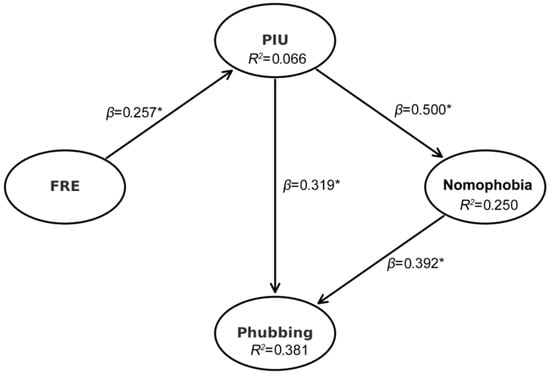
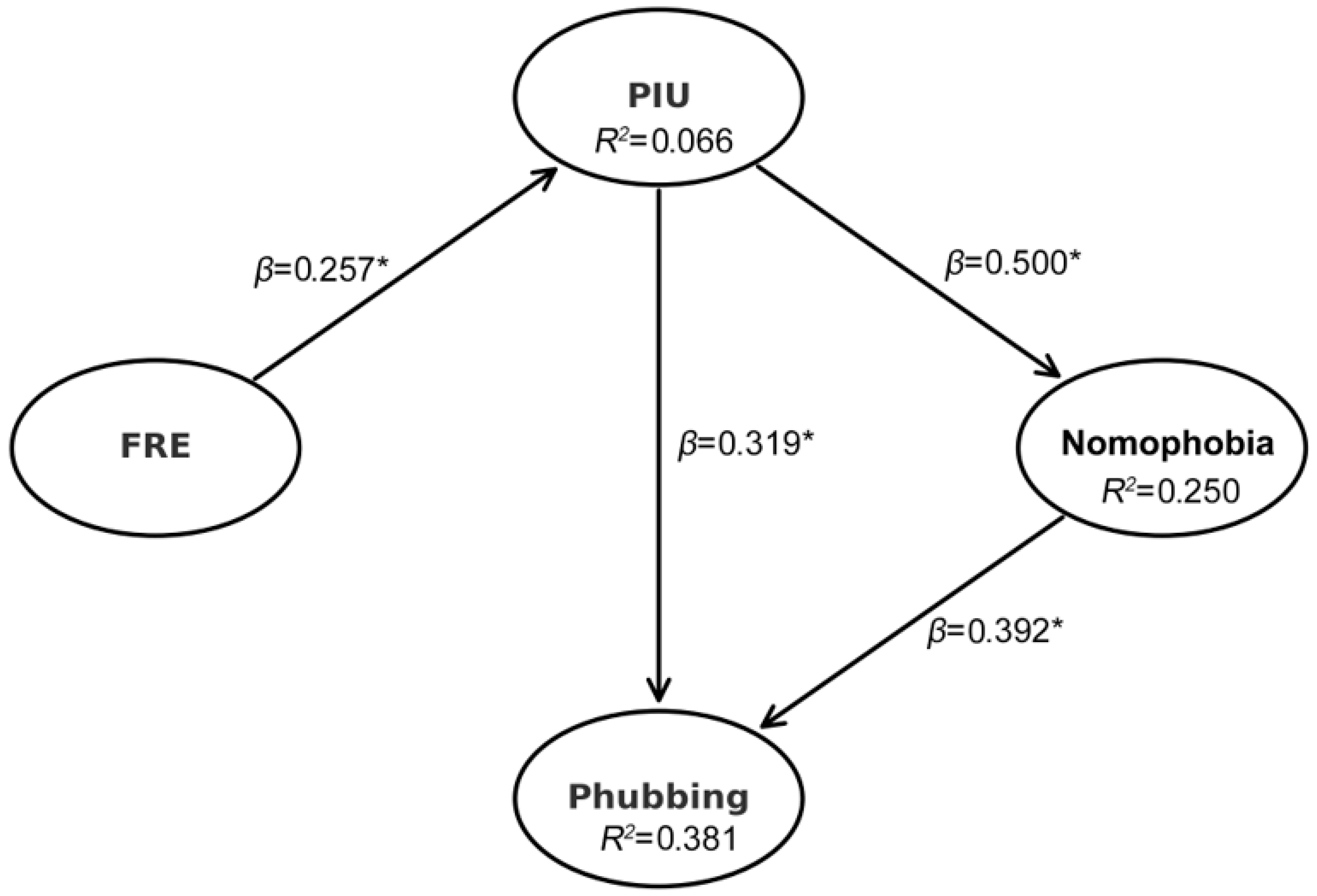
Evaluation of the structural model aimed to test the proposed hypotheses and assess the model’s overall quality. First, the direct relationships between the constructs were analysed, considering the magnitude and direction of the path coefficients (β), along with the effect sizes (f2). The results are shown in Table 3. Following that, the variance explained (R2) of the endogenous variables was examined, shown in Figure 2 along with the standardised coefficients corresponding to the four hypotheses underlying the model. Lastly, global model fit was inspected using the fit measures reported in PLS-SEM (SRMR for the saturated and estimated model, complemented by NFI and the discrepancy measures d_ULS and d_G), and predictive relevance was assessed via Stone–Geisser’s Q2, following established guidelines (Hair et al., 2019; Henseler et al., 2016; Sarstedt et al., 2021).
Table 3.
Path coefficients of the structural model and hypothesis tests.
Figure 2.
Final estimated structural model (PLS-SEM) with standardised path coefficients (β) and explained variance (R2) for endogenous constructs. Note: * p < 0.001 for all paths (bootstrapping, 5000 resamples).
All of the postulated direct relationships were positive and statistically significant (p < 0.001), supporting hypotheses H1–H4 (Table 3). Looking at magnitudes, the frequency of Internet activities exhibited a small influence on problematic use (H1; β = 0.257), while PIU exhibited a larger influence in the model on nomophobia (H2; β = 0.500) and a moderate influence on phubbing (H3; β = 0.319). Nomophobia was in turn positively and significantly associated with phubbing (H4; β = 0.392). These results confirm the central role of problematic Internet use as an antecedent of nomophobia and phubbing, and nomophobia as a key aspect contributing to explaining the appearance of behaviours involving neglecting people who are present in-person.
Figure 2 gives a graphical summary of the final structural model, showing the standardised β coefficients in each path and the values of R2 for the endogenous variables. As the figure shows, the model explained 6.6% of the variance in PIU (R2 = 0.066), 25.0% of the variance in nomophobia (R2 = 0.250), and 38.1% of the variance in phubbing (R2 = 0.381). Although the percentage of variance explained in PIU is modest, the values of R2 for nomophobia, and especially for phubbing, indicate a moderate level of explanatory accuracy, consistent with the multifactorial nature of these phenomena in educational contexts.
Looking at global model fit, the SRMR was 0.079 for the saturated model and 0.080 for the estimated model, both within the commonly used ≤0.08 benchmark for approximate fit in PLS path models. Overall, these fit results are compatible with an acceptable level of approximate model fit for the proposed model in an applied PLS-SEM context. In addition, the normed fit index (NFI) was 0.734 (saturated) and 0.732 (estimated). For completeness, the discrepancy measures are also reported (d_ULS = 2.168 saturated; 2.257 estimated; d_G = 0.660 saturated; 0.665 estimated). These fit measures are reported following PLS-SEM recommendations (Henseler et al., 2016; Hair et al., 2019).
The predictive relevance of the endogenous variables was assessed using Stone-Geisser’s Q2 statistic. The values were Q2 = 0.06 for PIU, Q2 = 0.04 for nomophobia, and Q2 = 0.05 for phubbing, all above zero, indicating that the model demonstrates predictive capacity for the dependent variables (Hair et al., 2022).
Beyond the direct relationships and the overall indicators of fit and predictive ability, it is also important to examine the indirect effects in the model in order to more accurately understand the mechanisms by which frequency of Internet activities, problematic use, and nomophobia are linked to phubbing behaviours.
3.3. Indirect Effects and Mediation
To examine these indirect effects and possible mediation processes between the model constructs, specific effects were estimated via bootstrapping with 5000 resamples, in line with the current recommendations for mediation analysis in the context of PLS-SEM (Hair et al., 2019). The results are shown in Table 4.
Table 4.
Indirect effects of the model and mediation analysis.
It should be noted that “mediation” here refers to an indirect (statistical) pathway in which the association between two constructs can be partly accounted for through an intervening construct (the mediator). Thus, stating that “PIU mediates the relationship between FRE and nomophobia” means that students who report higher online activity frequency also tend to report higher problematic Internet use, and problematic Internet use is in turn associated with higher nomophobia. In other words, part of the FRE–nomophobia association is consistent with an indirect link via PIU (see Table 4).
Problematic Internet use (PIU) mediated the relationship between the frequency of Internet activities (FRE) and nomophobia. The indirect effect FRE → PIU → Nomophobia was positive and significant (β = 0.129; t = 9.87; p < 0.001), indicating that university students who engaged more frequently in online activities tended to present higher levels of nomophobia, mainly to the extent that they demonstrated problematic patterns of use. In other words, greater engagement in online activities is associated with higher anxiety about being disconnected to the extent that it is linked to maladaptive Internet use.
Frequency of Internet activity (FRE) exhibited significant indirect effects on phubbing via PIU and via nomophobia. On the one hand, the path FRE → PIU → Phubbing was significant (β = 0.082; t = 8.11; p < 0.001), suggesting that greater frequency of Internet activities is associated with increased phubbing by elevating problematic use. On the other hand, there was also an indirect effect in the chain FRE → PIU → Nomophobia → Phubbing (β = 0.050; t = 9.00; p < 0.001), demonstrating that part of the association between the frequency of Internet activity on phubbing occurs through a sequential process: greater engagement in Internet activity → greater problematic use → greater nomophobia → higher likelihood of phubbing.
The role of nomophobia as a mediator between problematic use and phubbing was also analysed. In addition to the direct effect of PIU on phubbing (β = 0.319; t = 13.27; p < 0.001), the indirect effect, PIU → Nomophobia → Phubbing, was also significant (β = 0.196; t = 17.64; p < 0.001). The total effect of PIU on Phubbing was β = 0.516, which is consistent with partial mediation. Problematic Internet use is associated with the likelihood of engaging in phubbing both directly and indirectly by increasing levels of nomophobia.
4. Discussion
The objective of this study was to design and validate a preliminary model that would give us a better understanding of the interactions between four variables (frequency of Internet activities, problematic Internet use, nomophobia, and phubbing) that have been widely studied individually (e.g., Pérez-Juárez et al., 2023) or through bivariate analysis—examining the direct association between two variables (e.g., Karaduman et al., 2024)—but rarely examined together with an integrative approach. This study therefore provides added value by proposing and testing a model that not only brings together constructs that have usually been addressed separately, but which also offers a more complete picture of the direct and indirect relationships between them.
The proposed model allowed the four suggested hypotheses to be tested. This let us examine whether nomophobia and phubbing could be accounted for by the central construct, problematic Internet use (PIU), and whether frequency of Internet activity (FRE) was associated with this maladaptive pattern of digital engagement. Taken as a whole, the results are consistent with a tiered dynamic in which frequency of activity on the Internet is related to greater problematic use (Antoniadou, 2025), which increases nomophobia (Moreno-Guerrero et al., 2020), and is ultimately associated with phubbing behaviours (Mento et al., 2025). From this perspective, problematic Internet use is a central element in the network of relationships the study analysed, while nomophobia was a key aspect in understanding why certain forms of intensive Internet use are associated with ignoring people who are actually present in favour of using a smartphone (Guerra Ayala et al., 2024; Rodríguez-García et al., 2020).
Two key ideas are worth emphasising from these interpretations. Firstly, in terms of the model’s explanatory ability, the pattern of the results is consistent with the complex idiosyncrasy of socio-educational processes. This means that although the percentage of variance explained in PIU is relatively modest, this is not unexpected given the nature of the variable and the fact that this behaviour usually depends on multiple (personal and contextual) factors. In contrast, the model’s explanation for the nomophobia variable reflects an acceptable level of accuracy and suggests that the antecedent variables play an important role in shaping this partial mediator construct. It is particularly worth noting that the model explained 38.1% of the variance in phubbing. The validity of the model was supported by the most widely consolidated standard methodologies in PLS-SEM (Hair et al., 2017, 2019, 2022; Henseler et al., 2015; Rasoolimanesh, 2022). This indicates that, taken together, the results of the study support the preliminary consistency of the proposed model, showing that while it is necessarily incomplete—given the multifactorial nature of the phenomenon—it is a meaningful step towards a more comprehensive understanding of the relationships between these variables.
Secondly, there was a notable finding in the (partial) mediating role of nomophobia between PIU and phubbing. This suggests that nomophobia may function as a psychosocial mechanism linking PIU to phubbing, in addition to the direct association between the two. Identifying this dual, direct and indirect, path provides a deeper understanding of the phenomenon and underscores the importance of incorporating nomophobia as a central element in the model (Duradoni et al., 2023; Elhai et al., 2021), capturing underlying processes that enrich both the theoretical interpretation and the practical implications of the study. It is therefore important to consider both paths in socio-educational intervention and prevention by designing mixed programmes that consider both direct and indirect routes of influence. In other words, the partial mediation the study identified indicates that the psychosocial maladjustment associated with phubbing comes not only from compulsive behaviours or misuse of the Internet, but also from the fear associated with being without a mobile phone. This emphasises the need for comprehensive interventions that address that fear-phobia. Such actions may have a notable potential impact on university students’ academic quality of life and their learning outcomes (Antoniadou, 2025); therefore, this phenomenon and its educational implications should also be examined from a pedagogical perspective (Dagani et al., 2025; Moreno-Guerrero et al., 2020).
In terms of implications for future research, creating this model is an important contribution, as it allows us to move from fragmented approaches towards a more comprehensive, dynamic understanding of the phenomenon, facilitating new theoretical interpretations and steering prospective studies towards more robust multivariate analysis. Future research should extend this preliminary model by considering additional predictors of PIU and by testing more complex explanatory structures (e.g., multiple mediation) between FRE and PIU. Studies also need to consider contextual and personal variables in the structural equation; examples include FOMO (Elhai et al., 2021), personality traits (Erzen et al., 2021), self-regulation skills and wellbeing (Davey et al., 2018), and motivation and state affect (Duradoni et al., 2023).
There are several limitations of this study that need to be acknowledged. Given the cross-sectional, non-experimental ex post facto design, the proposed ordering of paths should be interpreted as theoretically grounded rather than as evidence of temporal precedence or causality. Reciprocal or bidirectional relationships between PIU, nomophobia, and phubbing are still plausible and should be tested in longitudinal or experimental research. In addition, the sample was drawn from a single public university and was not probabilistic, which restricts generalizability to other institutional and cultural contexts. Exclusive reliance on self-report measures may also have introduced common-method variance and social desirability bias. Finally, although several sociodemographic and academic descriptors were collected, they were not included as covariates in the structural model; therefore, the reported associations may be partially influenced by unmeasured or uncontrolled confounding factors.
Nevertheless, the findings do suggest actionable, valuable implications for higher education. Given that PIU emerged as a central antecedent of both nomophobia and phubbing (directly and indirectly), preventive efforts may benefit from targeting maladaptive Internet use patterns through digital wellbeing programmes, self-regulation and time-management training, and awareness initiatives addressing fear of disconnection and smartphone reliance.
Beyond these general digital wellbeing initiatives, the intervention literature provides emerging evidence that aligns with the mechanisms highlighted in our model. For instance, a light-touch smartphone-delivered e-health package that combines behavioural self-management components with mindfulness-informed strategies has been associated with reductions in self-reported problematic smartphone use among undergraduates (Kent et al., 2021). Similarly, a brief single-session mindfulness intervention among college students was associated with lower problematic smartphone use, with effects statistically accounted for through improved self-control (Liu et al., 2022). More broadly, a network meta-analysis of interventions for internet addiction in college students suggests that multicomponent (“comprehensive”) approaches and other structured formats often rank among the more effective options for reducing internet-addiction symptoms (Zhang et al., 2024). Taken as a whole, these findings support the feasibility of campus-based actions that combine self-regulation training, mindfulness/attention strategies, and structured behaviour-change techniques, while explicitly addressing fear of disconnection and norms surrounding smartphone use in learning and interpersonal contexts.
At the institutional level, these efforts can be complemented by incorporating evidence-informed guidelines for device use in learning settings and promoting norms for face-to-face interaction, which may help mitigate phubbing and support academic engagement.
Author Contributions
Conceptualization, P.-C.M.-C.; Data curation, P.-C.M.-C., I.M.B., I.E. and M.-L.P.-F.; Formal analysis, P.-C.M.-C.; Funding acquisition, P.-C.M.-C.; Investigation, P.-C.M.-C. and I.E.; Methodology, P.-C.M.-C.; Project administration, P.-C.M.-C.; Resources, P.-C.M.-C., I.M.B. and I.E.; Software, P.-C.M.-C.; Supervision, P.-C.M.-C.; Validation, P.-C.M.-C.; Visualization, P.-C.M.-C.; Writing—original draft, P.-C.M.-C., I.M.B., I.E. and M.-L.P.-F.; Writing—review & editing, P.-C.M.-C., I.M.B., I.E. and M.-L.P.-F. All authors have read and agreed to the published version of the manuscript.
Funding
This research was funded by the Lugo City Council under the project “II Estudio Epidemiológico sobre Adicciones sin Sustancia (Uso y Abuso de las TIC) y Consumos de Sustancias Psicoactivas en la Población Universitaria del Campus de Lugo”, carried out within the municipal “+porTI” programme and supported by a grant awarded by the Spanish Government Delegation for the National Plan on Drugs (Ref. 2025-CP022).
Institutional Review Board Statement
The study was conducted in accordance with the Declaration of Helsinki and approved by the Research Ethics Committee of the University of Santiago de Compostela under protocol USC 28/2025, dated 3 April 2025.
Informed Consent Statement
Informed consent was obtained from all participants involved in the study.
Data Availability Statement
The data presented in this study are available on request from the corresponding author.
Conflicts of Interest
The authors declare no conflicts of interest.
Abbreviations
The following abbreviations are used in this manuscript:
| AVE | Average Variance Extracted |
| FOMO | Fear of Missing Out |
| FRE | Online Activity Frequency |
| PIU | Problematic Internet Use |
| PLS-SEM | Partial Least Squares Structural Equation Modelling |
| SRMR | Standardised Root Mean Square Residual |
| VIF | Variance Inflation Factor |
References
- Antoniadou, S. (2025). Patterns of social network site use among university students: A latent profile analysis of academic and psychosocial outcomes. Adolescents, 5(4), 64. [Google Scholar] [CrossRef] [Scilit]
- Bagozzi, R. P., & Yi, Y. (1989). On the use of structural equation models in experimental designs. Journal of Marketing Research, 26(3), 271–284. [Google Scholar] [CrossRef] [Scilit]
- Barbed-Castrejón, N., Navaridas-Nalva, F., Mason, O., & Ortuño-Sierra, J. (2024). Prevalence of phubbing behaviour in school and university students in Spain. Frontiers in Psychology, 15, 1396863. [Google Scholar] [CrossRef] [Scilit]
- Beranuy, M., Chamarro, A., Graner, C., & Carbonell, X. (2009). Validación de dos escalas breves para evaluar la adicción a Internet y el abuso de móvil. Psicothema, 21(3), 480–485. [Google Scholar]
- Blanca, M. J., & Bendayan, R. (2018). Spanish version of the Phubbing Scale: Internet addiction, Facebook intrusion, and fear of missing out as correlates. Psicothema, 30(4), 449–454. [Google Scholar] [CrossRef] [Scilit]
- Caplan, S. E. (2007). Relations among loneliness, social anxiety, and problematic internet use. CyberPsychology & Behavior, 10(2), 234–242. [Google Scholar] [CrossRef] [Scilit] [PubMed]
- Cheever, N. A., Rosen, L. D., Carrier, L. M., & Chavez, A. (2014). Out of sight is not out of mind: The impact of restricting wireless mobile device use on anxiety levels among low, moderate and high users. Computers in Human Behavior, 37, 290–297. [Google Scholar] [CrossRef] [Scilit]
- Dagani, J., Buizza, C., Ferrari, C., Rainieri, G., & Ghilardi, A. (2025). Exploring the links among risky substance use, problematic internet use, and academic outcomes in university freshmen: The role of mediating factors. European Journal of Investigation in Health, Psychology and Education, 15(6), 105. [Google Scholar] [CrossRef] [Scilit]
- Davey, S., Davey, A., Raghav, S. K., Singh, J. V., Singh, N., Blachnio, A., & Przepiórkaa, A. (2018). Predictors and consequences of “Phubbing” among adolescents and youth in India: An impact evaluation study. Journal of Family & Community Medicine, 25(1), 35–42. [Google Scholar] [CrossRef] [Scilit]
- De Gracia Blanco, M., Anglada, M. V., Pérez, M. J. F., & Arbonès, M. M. (2002). Problemas conductuales relacionados con el uso de Internet: Un estudio exploratorio. Anales de Psicología, 18(2), 273–292. [Google Scholar]
- Duradoni, M., Raimondi, T., Buttà, F., & Guazzini, A. (2023). Moving beyond an addiction framework for phubbing: Unraveling the influence of intrinsic motivation, boredom, and online vigilance. Human Behavior and Emerging Technologies, 2023, 6653652. [Google Scholar] [CrossRef] [Scilit]
- Elhai, J. D., Levine, J. C., Alghraibeh, A. M., Alafnan, A. A., Aldraiweesh, A. A., & Hall, B. J. (2018). Fear of missing out: Testing relationships with negative affectivity, online social engagement, and problematic smartphone use. Computers in Human Behavior, 89, 289–290. [Google Scholar] [CrossRef] [Scilit]
- Elhai, J. D., Yang, H., & Montag, C. (2021). Fear of missing out (FOMO): Overview, theoretical underpinnings, and literature review on relations with severity of negative affectivity and problematic technology use. Revista Brasileira de Psiquiatria, 43(2), 203–209. [Google Scholar] [CrossRef] [Scilit] [PubMed]
- Erzen, E., Odaci, H., & Yeniçeri, İ. (2021). Phubbing: Which personality traits are prone to phubbing? Social Science Computer Review, 39(1), 56–69. [Google Scholar] [CrossRef] [Scilit]
- Fornell, C., & Larcker, D. F. (1981). Evaluating structural equation models with unobservable variables and measurement error. Journal of Marketing Research, 18(1), 39–50. [Google Scholar] [CrossRef] [Scilit]
- Guerra Ayala, M. J., Alegre de la Rosa, O. M., Chambi Catacora, M. A. del P., Vargas Onofre, E., Cari Checa, E., & Díaz Flores, D. (2024). Nomophobia, phubbing, and deficient sleep patterns in college students. Frontiers in Education, 9, 1421162. [Google Scholar] [CrossRef] [Scilit]
- Hair, J. F., Hult, G. T. M., Ringle, C. M., & Sarstedt, M. (2017). A primer on partial least squares structural equation modeling (PLS-SEM) (2nd ed.). Sage. [Google Scholar]
- Hair, J. F., Hult, G. T. M., Ringle, C. M., & Sarstedt, M. (2022). A primer on partial least squares structural equation modeling (PLS-SEM) (3rd ed.). Sage Publishing. [Google Scholar]
- Hair, J. F., Risher, J. J., Sarstedt, M., & Ringle, C. M. (2019). When to use and how to report the results of PLS-SEM. European Business Review, 31(1), 2–24. [Google Scholar] [CrossRef] [Scilit]
- Henseler, J., Hubona, G., & Ray, P. A. (2016). Using PLS path modeling in new technology research: Updated guidelines. Industrial Management & Data Systems, 116(1), 2–20. [Google Scholar] [CrossRef] [Scilit]
- Henseler, J., Ringle, C. M., & Sarstedt, M. (2015). A new criterion for assessing discriminant validity in variance-based structural equation modeling. Journal of the Academy of Marketing Science, 43(1), 115–135. [Google Scholar] [CrossRef] [Scilit]
- Karadağ, E., Tosuntaş, Ş. B., Erzen, E., Duru, P., Bostan, N., Mizrak Şahin, B., Çulha, İ., & Babadağ, B. (2015). Determinants of phubbing, which is the sum of many virtual addictions: A structural equation model. Journal of Behavioral Addictions, 4(2), 60–74. [Google Scholar] [CrossRef] [Scilit]
- Karaduman, S., Basak, T., Sim-Sim, M. M. S. F., Aaberg, V., & Bule, M. J. (2024). Nomophobia and phubbing levels of nursing students: A multicenter study. CIN: Computers, Informatics, Nursing, 42(8), 601–607. [Google Scholar] [CrossRef] [Scilit] [PubMed]
- Kent, S., Masterson, C., Ali, R., Parsons, C. E., & Bewick, B. M. (2021). Digital intervention for problematic smartphone use. International Journal of Environmental Research and Public Health, 18(24), 13165. [Google Scholar] [CrossRef] [Scilit] [PubMed]
- Kuss, D. J., & Lopez-Fernandez, O. (2016). Internet addiction and problematic Internet use: A systematic review of clinical research. World Journal of Psychiatry, 6(1), 143–176. [Google Scholar] [CrossRef] [Scilit] [PubMed]
- León-Mejía, A., Calvete, E., Patino-Alonso, C., Machimbarrena, J. M., & González-Cabrera, J. (2021). Cuestionario de nomofobia (NMP-Q): Estructura factorial y puntos de corte para la versión española. Adicciones, 33(2), 137–148. [Google Scholar] [CrossRef] [Scilit]
- Li, S., Ren, P., Chiu, M. M., Wang, C., & Lei, H. (2021). The relationship between self-control and Internet addiction among students: A meta-analysis. Frontiers in Psychology, 12, 735755. [Google Scholar] [CrossRef] [Scilit]
- Liu, F., Zhang, Z., Liu, S., & Feng, Z. (2022). Effectiveness of brief mindfulness intervention for college students’ problematic smartphone use: The mediating role of self-control. PLoS ONE, 17(12), e0279621. [Google Scholar] [CrossRef] [Scilit]
- Lu, Y., Lu, Y., Tian, Y., Gan, Y., Chen, X., & Li, X. (2025). Internet addiction and mental health: A cross-sectional study and mediation analysis in medical students with a psychiatric major. Frontiers in Psychiatry, 16, 1625824. [Google Scholar] [CrossRef] [Scilit]
- McMillan, J., & Schumacher, S. (2005). Investigación educativa. Pearson Addison Wesley. [Google Scholar]
- Mento, C., Silvestri, M. C., Lombardo, C., Rizzo, A., Turiaco, F., Muscatello, M. R. A., & Presaghi, F. (2025). Phubbing and phubber behavior: A new perspective in clinical psychological assessment. AIMS Public Health, 12(3), 716–734. [Google Scholar] [CrossRef] [Scilit]
- Moreno-Guerrero, A. J., López-Belmonte, J., Romero-Rodríguez, J. M., & Rodríguez-García, A. M. (2020). Nomophobia: Impact of cell phone use and time to rest among teacher students. Heliyon, 6(5), e04084. [Google Scholar] [CrossRef] [Scilit]
- Muñoz-Carril, P. C., Bargiela, I. M., Estévez, I., & Bonilla-del-Río, M. (2025a). Analysis of phubbing among university students: A study of its prevalence, incidence factors and predictors. European Journal of Investigation in Health, Psychology and Education, 15(10), 201. [Google Scholar] [CrossRef] [Scilit]
- Muñoz-Carril, P. C., Sarceda Gorgoso, C., Bonilla-del-Río, M., García-Ruiz, R., Navarro Patón, R., Mecías Calvo, M., Carvalho da Silva, B., Dias Pinheiro, A. C., Puentes Puente, A., Santamaría Queiruga, O., Dans Álvarez de Sotomayor, I., Abal Alonso, N., Mosquera Bargiela, I., Souto Seijo, A., Barreira Cerqueiras, E. M., Estévez Blanco, I., Fuentes Abeledo, E. J., López Gómez, S., Villar Varela, M., … Rial Gómez, P. (2025b). II Estudio epidemiológico sobre adicciones sin sustancia (uso y abuso de las TIC) y consumos de sustancias psicoactivas en la población universitaria del campus de Lugo. Concello de Lugo. [Google Scholar]
- O’Dwyer, L. M., & Bernauer, J. A. (2014). Quantitative research for the qualitative researcher. Sage Publications. [Google Scholar] [CrossRef] [Scilit]
- Pérez-Juárez, M. Á., González-Ortega, D., & Aguiar-Pérez, J. M. (2023). Digital distractions from the point of view of higher education students. Sustainability, 15(7), 6044. [Google Scholar] [CrossRef] [Scilit]
- Rasoolimanesh, S. M. (2022). Discriminant validity assessment in PLS-SEM: A comprehensive composite-based approach. Data Analysis Perspectives Journal, 3(2), 1–8. [Google Scholar]
- Ringle, C. M., Wende, S., & Becker, J.-M. (2024). SmartPLS (Version 4) [Computer software]. SmartPLS. Available online: https://www.smartpls.com (accessed on 10 November 2025).
- Roberts, J. A., & David, M. E. (2016). My life has become a major distraction from my cell phone: Partner phubbing and relationship satisfaction among romantic partners. Computers in Human Behavior, 54, 134–141. [Google Scholar] [CrossRef] [Scilit]
- Rodríguez-García, A. M., Moreno-Guerrero, A. J., & López-Belmonte, J. (2020). Nomophobia: An individual’s growing fear of being without a smartphone—A systematic literature review. International Journal of Environmental Research and Public Health, 17(2), 580. [Google Scholar] [CrossRef] [Scilit]
- Sarstedt, M., Ringle, C. M., & Hair, J. F. (2021). Partial least squares structural equation modeling. In C. Homburg, M. Klarmann, & A. Vomberg (Eds.), Handbook of market research (pp. 587–632). Springer. [Google Scholar] [CrossRef] [Scilit]
- Sánchez-Fernández, M., Borda Mas, M., & Mora-Merchán, J. A. (2023). Problematic internet use by university students and associated predictive factors: A systematic review. Computers in Human Behavior, 139, 107532. [Google Scholar] [CrossRef] [Scilit]
- Truzoli, R., Viganò, C., Galmozzi, P. G., & Reed, P. (2019). Problematic Internet use and study motivation in higher education. Journal of Computer Assisted Learning, 36(4), 480–486. [Google Scholar] [CrossRef] [Scilit]
- Wang, C.-H., Salisbury-Glennon, J. D., Dai, Y., Lee, S., & Dong, J. (2022). Empowering college students to decrease digital distraction through the use of self-regulated learning strategies. Contemporary Educational Technology, 14(4), ep388. [Google Scholar] [CrossRef] [Scilit]
- Yildirim, C., & Correia, A.-P. (2015). Exploring the dimensions of nomophobia: Development and validation of a self-reported questionnaire. Computers in Human Behavior, 49, 130–137. [Google Scholar] [CrossRef] [Scilit]
- Zhang, M., Meng, S.-Q., Hasan, A. J., Han, Y., Han, S., Li, B., Tong, W.-X., & Zhang, Y. (2024). Network meta-analysis of the effectiveness of different interventions for internet addiction in college students. Journal of Affective Disorders, 363, 26–38. [Google Scholar] [CrossRef] [Scilit]

Disclaimer/Publisher’s Note: The statements, opinions and data contained in all publications are solely those of the individual author(s) and contributor(s) and not of MDPI and/or the editor(s). MDPI and/or the editor(s) disclaim responsibility for any injury to people or property resulting from any ideas, methods, instructions or products referred to in the content. |
© 2026 by the authors. Licensee MDPI, Basel, Switzerland. This article is an open access article distributed under the terms and conditions of the Creative Commons Attribution (CC BY) license.