


Abstract
In response to the complexity and uncertainty in assessing the safety and economic impacts of the Changed Product Rule (CPR) in civil aviation products’ airworthiness certification, this paper constructs a comprehensive evaluation model based on a cost–benefit analysis framework. In previous research, studies on aircraft modification costs have consistently been conducted from the perspective of design organizations, focusing on modeling and optimizing the one-time engineering costs of the modifications themselves or remaining confined to the level of safety performance without addressing the calculation of economic value. The model proposed in this paper considers the entire aircraft service lifecycle and uniformly quantifies potential impacts into monetary terms for comparison. The model encompasses safety improvements, cost estimation, and discounted cash flow analysis, aiming to provide decision-makers with quantitative tools for determining the applicability of the “impracticality exception” standard. This ensures that modifications to aviation products balance safety with economic viability. Through case studies involving fuel tank access panel design changes and Auxiliary Power Unit (APU) inlet duct fire protection requirements, the effectiveness and practicality of the model are validated, offering an empirical foundation for future policy formulation and industry regulation. Nevertheless, the parameters in the model depend on historical data, and appropriate parameters must be carefully selected. Although the model has taken into account the entire lifecycle of the aircraft, it is still based on static assumptions and fails to consider the impact of the rapid development of the aviation industry over time. Ongoing model refinement, international data collection, and integration of non-economic factors remain key directions for future research.
1. Introduction
In the civil aviation sector, technological advancements are rapid, and market demands continuously evolve. Together, they drive ongoing improvements in aircraft design and performance. Consequently, the emergence of derivative models has become very common. Taking the Boeing 737 series as an example, the 737-100 received its Federal Aviation Administration (FAA) type certification on 15 December 1967, followed by a series of derivatives such as the 737-200, -300, -700, and -800. By 9 March 2017, when the 737 MAX 8 was certified by the FAA, this evolution had spanned over 50 years.
When determining the applicable airworthiness standards—i.e., the certification basis—for these derivative models, the Change Product Rules (CPR) under FAR/CCAR 21.101 [1] are typically applied.
According to FAR 21.101 [1] and its corresponding CCAR 21.101 [2], the airworthiness regulations of China and the United States remain largely consistent in terms of the conditions under which applicants are permitted to adopt earlier amendment versions. Both frameworks take into account the substantive nature of safety contributions and the practical feasibility of complying with new requirements. Furthermore, as illustrated in Appendix A of AC 21.101-1B [3], major aviation regulatory authorities such as the FAA, European Union Aviation Safety Agency (EASA), Agência Nacional de Aviação Civil (ANAC), and Transport Canada Civil Aviation (TCCA) have jointly adopted harmonized standards for change classification through international collaboration. This context demonstrates that a broad consensus has been formed internationally regarding key certification processes. Grounded in this international harmonization framework, the model proposed in this paper is capable of accommodating and adapting to this set of classification and compliance methodologies shared by multiple countries, thereby ensuring the efficient fulfillment of common requirements across different jurisdictions in complex multinational modification projects.
These rules serve as a critical framework for ensuring aviation safety while fostering technological innovation, requiring a delicate balance between safety and economic considerations.
In the classification system under FAR Part 21, design changes to aviation products are categorized into three classes based on their scope and depth of impact [1]. First, according to FAR §21.93, all changes are classified as either “major changes” or “minor changes”, with the fundamental criterion being whether they have an “appreciable effect” on the airworthiness characteristics of the product. Beyond this, if a change, coupled with modifications to design, power, and other parameters, is “so extensive” that it requires an almost complete re-investigation of compliance, it is defined as a “substantial change” under FAR §21.19, necessitating an application for an entirely new type certificate. For changes that are “major” but do not reach the level of “substantial”, further evaluation is required under AC 21.101-1B to determine whether they constitute “significant changes”, with the key criterion being whether the change significantly affects the product’s safety level or the manner of compliance with the regulations.
This study focuses on an in-depth analysis of the evaluation of the “impracticality exception” clause in the certification of “significant changes”. According to FAR §21.101(b)(3), designs deemed “significant changes” generally must comply with the latest airworthiness standards for the altered portions; however, this provision allows for an exemption if full compliance with the latest standards is demonstrated to be “impractical” and safety can be assured through alternative means. This mechanism seeks a balance between safety enhancement and technical feasibility and forms the core regulatory context and focus of this research.
Aviation authorities worldwide have conducted years of research on CPR. Based on practical experience, they have issued airworthiness guidance documents and advisory circulars [3,4,5], providing a principled framework for determining certification bases, assessing whether modifications qualify as “significant changes,” and evaluating the applicability of the latest regulations.
However, these guidelines primarily focus on general principles and leave considerable room for interpretation regarding specific criteria for determining “no substantial contribution to safety levels” and “impracticability of applying the latest regulations.” This ambiguity often leads to inconsistencies in understanding and implementation during actual operations. For example, Appendix B of Reference [4] outlines a decision-making process but lacks quantitative analysis algorithms for evaluating safety benefits.
Following the B737 MAX crashes, the long-standing CPR employed by FAA faced criticism from global regulators and academia [6]. Studies highlighted several flaws in the rule: its overly narrow review scope allowed manufacturers to classify critical systems like Maneuvering Characteristics Augmentation System (MCAS) as minor changes, thereby evading the scrutiny required for new aircraft models; the “impractical” clause was abused, exempting changes that warranted in-depth evaluation from review; and the cumulative effect of multiple minor design alterations, which gradually changed the aircraft’s handling characteristics, was not adequately recognized [7]. Collectively, these loopholes led to safety risks in the MCAS system, cockpit alerts, and rudder control systems being overlooked during certification, ultimately resulting in tragedy.
In response, the U.S. Congress passed the Aircraft Certification, Safety, and Accountability Act in 2020 [8], requiring the FAA to comprehensively revise the “changed product rule” within two years and introduce an “integrated aircraft system” assessment along with minimum safety standards for cockpit alert systems. However, the FAA failed to meet this deadline. Consequently, in the FAA Reauthorization Act of 2024 [9], Congress extended the revision deadline by three years and strengthened oversight of the “impractical” exception clause. The act mandates that relevant applications must undergo public consultation and requires the FAA to report annually to Congress on exception approvals, thereby enhancing transparency and accountability to fortify the aviation safety certification framework.
Regarding impractical issues, Wright proposed several amendments, such as expanding the scope of review to “areas related to changes,” optimizing the impracticality exception clause by adopting systematic safety assessment principles, and establishing minimum safety standards to prevent the accumulation of design deviations. These measures aim to strike a balance between aviation safety and industry costs, thereby preventing similar tragedies from recurring. In its report [10], the FAA retained the statement: “The Level of Effort evaluation method is based on the General Aviation Manufacturers Association (GAMA) Impracticality Evaluation Method [11]”, though no better quantitative method has been developed so far. Linling [12] proposed the safety case approach to assess the impact of regulatory legislation on safety but did not quantify the balance between safety and economic considerations.
Cost–Benefit Analysis (CBA) is an effective approach. CBA is a systematic economic evaluation method used to compare the total costs and benefits of a project or decision to determine its economic feasibility. Its core objective is to assess whether resource allocation is reasonable by quantifying costs and benefits, thereby providing decision-makers with a scientific basis.
The main components of CBA include the following: identifying and quantifying all relevant costs and benefits; discounting future costs and benefits to present value using a discount rate; calculating key metrics such as net present value (NPV), benefit–cost ratio (BCR), or internal rate of return (IRR) to determine whether a project is worth implementing [13].
CBA is widely applied in public policy, infrastructure development, environmental protection, healthcare, and other fields. In aviation legislation, for example: The European Union compared aviation industry compliance costs with emission reduction benefits and found that, despite increased costs for airlines, the global climate benefits far outweighed the local economic burden. As a result, the EU decided to include aviation in its Emissions Trading System (ETS), requiring airlines to purchase carbon allowances [14]. The FAA, when regulating commercial drone operations, evaluated training and licensing costs against the economic benefits of industry innovation. It concluded that flexible regulations could unlock an annual economic potential of $82 billion, leading to the formulation of relevant regulatory laws [15]. In aviation security, the EU weighed supply chain losses due to cargo delays against the risks of undetected explosives, ultimately mandating 100% screening for all-cargo flights and prioritizing high-risk routes [16]. The U.S. TSA, after the 9/11 attacks, gradually implemented full-body scanners and CT-based baggage screening systems. Although each unit costs hundreds of thousands of dollars, the benefits of preventing even a single attack could justify the long-term investment [17].
However, in the field of CPR of civil aviation products, while economic considerations are mentioned, there remains a lack of practical and actionable methodologies.
In the field of aircraft modification cost research, Birkler and Large were among the first to propose a cost estimation method for aircraft structural modifications [18]; Kapitanova et al. established an evaluation standard system for transport aircraft modifications based on cost indicators [19]; while the study by Della Vecchia et al. integrated modification cost modeling directly into the aircraft design process [20]. These models provide valuable analytical frameworks and references for understanding the economics of modification engineering. However, they all adopt the perspective of design organizations, focusing on modeling and optimizing the one-time engineering costs of the modifications themselves. The limitation of this perspective lies in its failure to account for the operational impacts resulting from the implementation of modification measures over the entire aircraft service life—such as enhanced safety and reliability (e.g., safety benefits from compliance with stricter airworthiness regulations like CPR)—including potential extended maintenance intervals, reduced flight delays due to improved operational reliability, and other long-term operational benefits and cost changes. Consequently, it becomes impossible to comprehensively assess the full lifecycle value of modification investments.
Previous research often treated modification cost analysis and safety benefit evaluation as two separate processes. This “cost-safety” separation paradigm makes it difficult to directly and quantitatively determine whether a modification requirement is “impractical” due to excessive costs. In contrast, the model proposed in this study innovatively integrates safety benefits and modification costs into a unified evaluation framework. By introducing a discount rate to reflect the time value of money over the full lifecycle and incorporating fleet size parameters to capture the effects of scale in operations, the model enables a quantitative comparison of safety benefits and implementation costs on the same benchmark. This integrated approach provides a solid decision-making basis for directly and objectively determining the economic feasibility of modification plans—that is, whether they constitute “impracticality.”
2. Quantitative Model for Assessing Impracticality in Derivative Type Certification
2.1. Modeling Fundamentals
2.1.1. Cost–Benefit Analysis
Applying Cost–Benefit Analysis (CBA) in the certification of aviation derivatives must break through the traditional analytical framework. That framework tends to emphasize economic costs while neglecting safety value. Wright explicitly stated in his research on CPR that CBA in CPR evaluation should focus on “marginal safety benefits” rather than simply calculating economic costs. This perspective provides a key theoretical basis for balancing aviation safety and industrial efficiency [21]. From the perspective of industry regulatory practice, the latest FAR 25-153 amendment, which revises provision FAR 25.791, also adheres to the same principle, and this case serves as a concrete embodiment of that principle within the regulatory framework. The regulatory revision eliminates the outdated mandatory requirement for “manual on/off switches,” allowing “No Smoking” signs to remain continuously illuminated. This significantly reduces the burden on businesses without compromising the core safety standard (i.e., the full-flight cabin smoking ban). Manufacturers are no longer required to install switch devices, streamlining both production and certification processes, while operators gain more flexible operational choices [22]. When assessing the applicability of regulations to derivative model aircraft, it requires incorporating the long-term risk reduction benefits brought by safety improvements as a core measurement dimension. By comparing compliance costs with the reduction in potential accident losses, it ensures that regulatory revisions neither excessively increase corporate burdens nor sacrifice critical safety standards, further validating the universality of the marginal safety priority CBA logic in industry regulation.
The core challenge of CBA in the aviation field lies in the quantification of safety benefits, as safety improvements often manifest as risk avoidance, which is difficult to measure directly in monetary terms. This paper addresses this issue through the monetization of accident losses method, which involves statistically modeling data from historical accidents—such as compensation for casualties, aircraft destruction costs, ground facility losses, and industry reputation damage—and converting them into measurable safety benefit values. This enhances the objectivity and operability of CBA evaluation results.
2.1.2. Risk Probability Assessment
Risk probability assessment is a critical step in predicting potential safety hazards of aviation derivatives, and its methodology must align with the aviation industry’s tradition of “data-based, similarity-inclusive” evaluation. Research by Linling et al. [12] proposes using the “historical accident data + similar model analogy” method to estimate accident rates, which conforms to industry practices in aviation safety assessment. This method extracts historical fault data from the same series of aircraft and incorporates risk corrections based on design differences between derivatives and the original models, effectively improving the accuracy of accident rate estimation. This approach has also been recognized in industry guidance documents. The FAA AC 21.101B explicitly recommends this methodology in the certification of derivative aircraft, emphasizing the prioritization of operational data from models with the same design platform, similar power systems, or comparable aerodynamic layouts. It also requires separate analogical analysis of risks associated with modified components (such as avionics systems and structural parts), forming a complete evaluation chain of baseline data and differential correction [3].
The difficulty of risk probability assessment in the aviation field lies in its high dependence on the quality and comparability of historical data. When dealing with aircraft incorporating new technologies, limitations may arise due to the lack of sufficiently similar reference models. To address this, this study, when applying this method, will prioritize the selection of models with high similarity in flight principles, complexity, and key systems for analogy (e.g., risk comparison between new flight control software and mature software of the same architecture) and make necessary corrections for data discrepancies.
2.1.3. Techno-Economic Evaluation in Aircraft Development
The techno-economic evaluation of aviation derivatives must transcend the limitations of cost accounting in the R&D phase and extend to the entire lifecycle dimension. Takahashi pointed out in his 2013 research that the techno-economic evaluation of aircraft modifications must cover the entire lifecycle (R&D-operation-retirement). It should account not only for modification design and testing certification costs in the R&D phase but also include maintenance costs and fuel efficiency improvement benefits in the operation phase, as well as dismantling and recycling costs in the retirement phase. This forms a comprehensive assessment of the economic feasibility of modification projects [23]. This framework breaks the misconception in traditional evaluations of emphasizing upfront investment while neglecting long-term benefits. It is particularly applicable to aviation derivatives, as such aircraft models typically require long-term operation based on the original models, and cost–benefit differences in the operation phase significantly impact the overall value of the project.
The challenge of techno-economic evaluation in the aviation field lies in the interconnectedness and dynamic nature of data across all lifecycle stages. Design decisions in the R&D phase may impact maintenance costs in the operation phase, while changes in the market environment can alter operational revenue expectations. Through cost–benefit calculations across the entire lifecycle dimension, this paper accurately aligns with the operational characteristics of derivative models, resolving the issue of compartmentalized stages in traditional evaluations. This provides a scientific basis for judging the long-term rationality of “impractical exceptions”.
2.2. Quantitative Model Construction
2.2.1. Model Framework
“Safety level” is the primary concern in airworthiness certification. Aviation authorities tend to adopt stricter standards to ensure safety, yet this may render aircraft unable to obtain certification due to technical or purely economic constraints. Therefore, airworthiness certification must balance the “acceptability” (from a safety perspective) and “feasibility” (from technical and economic perspectives) of airworthiness standards.
Safety is enhanced through the application of new amendments to airworthiness standards. However, this enhancement does not always correlate proportionally with the economic investment made. There exists an equilibrium point between cost expenditure and safety improvement. Exceeding this point by relentlessly pursuing higher safety levels leads to disproportionate cost escalation, making the implementation of new amendments unfeasible beyond this threshold.
As stipulated in FAR/CCAR 21.101, determining whether to incorporate the latest regulations into the certification basis requires evaluating their “impracticality,” i.e., assessing their “feasibility.” To this end, a comprehensive quantitative “cost-benefit” model must be established for analysis.
To compare the safety improvement brought by new airworthiness requirements in specific amendments with the industry’s total costs, thereby assessing the economic feasibility of these requirements, it is necessary to establish a general methodology for determining the benefits of airworthiness requirements. This methodology should translate safety level indicators as input values into the final economic benefits of airworthiness requirements.
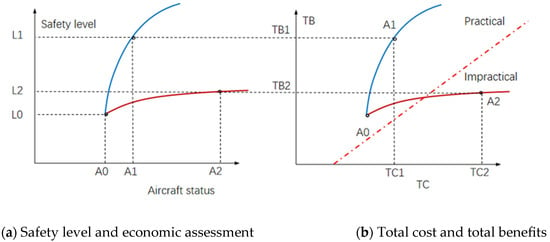
The basic approach is illustrated in Figure 1. As shown in Figure 1a, the baseline condition of an aircraft is A0. Assuming design improvements to comply with two different new amendment requirements would result in states A1 and A2, corresponding to safety levels increasing from L0 to L1 and L2, respectively.
Figure 1.
The economic assessment model applicable to the latest revised airworthiness standards.
Figure 1b presents the economic analysis results. For both A1 and A2 states, the total benefits (TB1 and TB2) gained from improved safety levels and the corresponding total costs (TC1 and TC2) are shown. The figure further indicates a red dash-dotted line serving as the threshold for determining “impracticality.” Generally, only when the total benefits from safety improvement are significantly less than the total costs incurred can compliance with the corresponding amendment requirements be considered impractical-represented by the area below the red dash-dotted line.
Therefore, state A2 falls below the red line (TB2 << TC2), indicating the total benefits TB2 are significantly less than the total costs TC2, making compliance with the corresponding amendment requirements impractical. State A1 remains above the line, demonstrating that compliance with the corresponding amendment is not impractical. This graphical representation visually demonstrates the critical balance between safety improvements and economic feasibility in airworthiness regulation compliance.
It should be noted that due to the complexity of cost–benefit assessments, the specific threshold value for determining impracticality generally requires negotiation between the aviation authority and applicants based on the calculated total benefits and total costs. The following sections will detail the calculation methods for total benefits and total costs.
In existing research, the cost assessment model proposed by Kapitanova et al. [19] primarily focuses on direct expenses related to aircraft modifications, such as design changes, material procurement, and installation—essentially explicit costs. However, it fails to establish a connection with the benefits derived from safety improvements, resulting in a cost analysis that lacks support from safety value considerations. On the other hand, the safety model developed by Linling et al. [12] can evaluate the extent of accident rate reduction through probabilistic methods, yet its assessment outcomes remain confined to safety performance and cannot be translated into economic value or directly compared with implementation costs. As such, it falls short of providing clear quantitative evidence for certification decision-making. Both types of models suffer from the limitation of a single evaluation dimension, making them inadequate to meet the requirements of CPR for comprehensive benefit assessment.
To address these shortcomings, the comprehensive assessment model proposed in this study offers two significant advantages: First, the model integrates the TB converted from safety improvements and the TC incurred by implementing new regulations into a unified analytical framework. By calculating the benefit–cost ratio (BCR = TB/TC), it provides a direct and actionable quantitative indicator for determining “impracticality”. When BCR < 1, it indicates that the safety benefits brought by the new regulations are significantly lower than the associated economic burden, thereby offering clear decision-making support for applying the “impracticality exception”. Second, the model strictly adheres to CPR’s requirement for full lifecycle assessment. It not only covers direct costs in the design, testing, and certification phases but also incorporates long-term factors such as fleet operation, maintenance, training, and potential accident losses. By applying discount analysis to standardize future costs and benefits to a present value baseline, the model aligns more closely with the long-cycle, high-investment nature of aviation products, significantly enhancing its practicality and decision-support capability in type certification processes.
The construction and application of this quantitative model adhere to clearly defined boundary conditions. In terms of regulatory framework, the model strictly follows airworthiness regulations such as FAR 21.101 and CCAR 21.101, aiming to provide a quantifiable tool for interpreting the vague clause of “impracticality” therein. The model primarily targets transport-category civil aircraft (e.g., B737, A320 series and their derivatives) and is designed to assess decision-making scenarios where the introduction of the latest airworthiness requirements must be evaluated following a “significant” design change.
The model employs monetary value as a unified quantitative unit. By converting the avoided costs of casualty compensation, property damage, and other losses resulting from safety improvements into TB, and accounting for the incremental costs of design, testing, manufacturing, and operations as TC, it enables a direct comparison of benefits and costs on the same dimension. This facilitates an intuitive judgment of economic feasibility. If only physical indicators such as “percentage reduction in accident rate” are used, while they can reflect safety performance, they fail to address the critical certification question of whether the corresponding economic cost is justified.
It should be noted that the current version of the model focuses on economic quantification and does not systematically incorporate non-economic factors such as public trust, brand reputation, and social stability. Although these factors are difficult to monetize, they significantly influence final decision-making. Therefore, in practical certification processes, the results of this model are recommended to serve as a robust decision support tool rather than the sole basis. They can be combined with methods such as expert questionnaires to assess public risk acceptance, and future enhancements could introduce multi-criteria decision-making tools like the Analytic Hierarchy Process (AHP) to build a more comprehensive and robust judgment framework.
2.2.2. The Calculation Method for Total Benefits (TB)
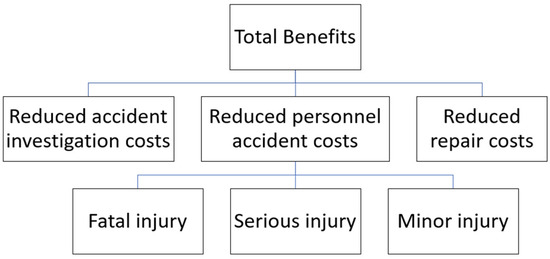
By considering factors such as aircraft service time, fleet size, and historical accident data, the application of new amendments is evaluated for their effectiveness in reducing accident frequency, thereby saving costs associated with accident investigations and airframe repairs. Additionally, by classifying injury severity levels (e.g., severe, moderate, minor) and applying statistical life value estimates, the reduction in casualties is translated into economic benefits. This forms the total benefits, the composition of which is illustrated in Figure 2.
Figure 2.
The composition of total benefits.
Assuming all type certifications affected by the new certification basis (within the next ten years) are approved in the first year and enter production in the second year, generally, the expected service cycle s of this type will exceed its production cycle m.
The affected fleet size in the i-th year after certification based on the new amendment is calculated by the following formulas:
where m represents the expected production cycle (years); s denotes the expected service cycle (years); u indicates the annual delivery volume; Ni represents the total number of aircraft in service during year i.
Ni = (i − 1) × u (1 < i ≤ m),
Ni = m × u (m < i ≤ s),
Ni = m × u − (i − s − 1) × u (s < i ≤ s + m),
Assuming the historical accident rate associated with the specific certification basis for this aircraft type is r, and the expected accident rate after implementing the new amendment is w, the projected number of accidents in year i after the airworthiness requirement takes effect (Ri) and the change in accident count (∆Ri) can be calculated as follows:
where f represent annual flights per aircraft.
Ri = w × Ni × f,
ΔRi = (r − w) × Ni × f.
The expected benefits of the new airworthiness requirements stem from the improved safety level resulting from the implementation of the new certification basis. The benefits from avoiding a single accident (Bd) and the reduced loss per accident (Bc) can be calculated. Assuming the historical number of accidents is p, the specific formulas are as follows:
where ai, bi, ci represent the economic values of fatalities, severe injuries, and minor injuries, respectively; Δx, Δy, Δz denote the expected reduction rates of fatalities, severe injuries, and minor injuries, respectively; d indicates expected airframe repair costs; e represents expected accident investigation expenses; Δd signifies reduced airframe repair costs; Δe reflects reduced accident investigation expenditures.
Bc = aiΔx + biΔy + ciΔz + Δd + Δe,
Bd = aix + biy + ciz + d + e,
The values of these economic parameters may be determined based on national conditions and specific company circumstances, or international benchmarks, referencing compensation amounts from historical aviation accidents in specific countries (see literature [24,25,26] for detailed methodologies).
Due to variations in currency value across different years, assessing economic value must account for the effects of inflation and capital appreciation in economics. A discount rate k% is introduced to represent the ratio used to convert future limited period expected returns into present value. After considering the discount rate, the present value Bi of the benefits generated by the newly assessed basis in year i can be calculated as follows:
Bi = (ΔRi × Bd + Ri × Bc) × (1 − k%)i.
Assuming the aircraft model continues to operate for n years, the total benefit TB can be obtained as follows:
TB = ƩBi.
It should be noted that the accident rate and the change rates of various injury types in the above formula can be estimated based on historical data from the same or similar aircraft models. For example, the historical accident rate r associated with the specific certification basis for this aircraft model is as follows:
where q represents the total historical flight hours of the aircraft model, and p is the number of historical accidents within the corresponding time period. If statistical data for this specific model is unavailable, data from similar aircraft models may be used for estimation.
r = p/q,
In the calculation of TB, the estimation of the accident rate r refers to the historical flight hours-to-accidents statistic method proposed by Birkler [18], where r = p/q (Equation (10)). This method, based on large-scale historical data, yields objective and reproducible results, thereby enhancing the model’s credibility. To accurately assess cross-year benefits, the model incorporates a discount rate k% (Equation (8)), which converts expected benefits over a finite future period into present value, accounting for the time value of money. Additionally, the model considers dynamic changes in fleet size (Equations (1)–(3)), projecting the number of affected aircraft each year based on expected production cycles, service life, and annual delivery rates. This makes the benefit estimation more aligned with actual operations. The above improvements are systematically integrated into a formalized equation system, which not only refines the logical chain of benefit calculation but also enhances the model’s applicability and accuracy in complex certification scenarios.
2.2.3. The Calculation Method for Total Cost (TC)
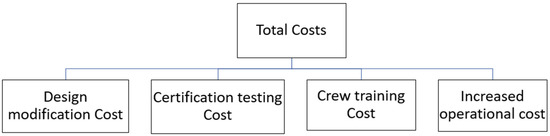
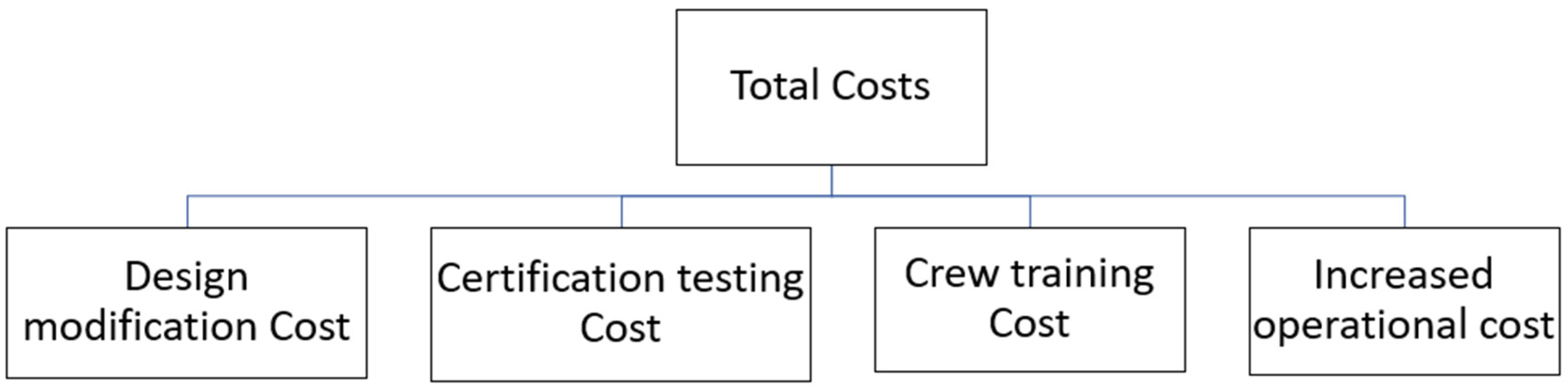
Applying new amendments to derivative aircraft models incurs significant economic costs, including design modifications, manufacturing and certification expenses, crew training costs, and the resulting increase in direct operating costs, as illustrated in Figure 3. These costs must be assessed based on the design changes influenced by the new amendments, which form part of the industry’s R&D efforts. Similarly, financial metrics such as net present value (NPV) and internal rate of return (IRR) should be applied to discount future costs over the entire R&D and operational lifecycle to their present value, enabling comparison with current benefits.
Figure 3.
The composition of total costs.
Applying new amendments to derivative models incurs significant economic costs. To systematically quantify these costs, this paper develops a TC model. Unlike previous studies that primarily focus on design and manufacturing costs, this model specifically supplements key cost items from the entire process perspective of airworthiness certification, including certification, training, and operation.
The TC can be expressed by the following formula:
TC = C1 + C2 + C3 + C4,
C1 (Design Modification Cost) is a direct cost conventionally considered by aircraft manufacturers in model changes. Its estimation method follows the core approach of Kapitanova et al. [19], which breaks down total costs by project phases for evaluation. Furthermore, it refines this approach to align with the characteristics of cost structure in the design phase, simplifying the complex cost model into a direct estimation formula composed of design labor hours and material costs.
C1 = Td × Chour + Cmaterial,
Here, Td is the design man-hours, Chour is the cost per man-hour, and Cmaterial is the material cost. This cost item has been relatively well discussed in existing literature (e.g., Birkler et al. [18]).
In contrast, C2 to C4 are innovative cost considerations introduced by this model to better align with airworthiness certification practices:
C2 (Certification Testing Cost): This cost item not only includes routine testing expenses but also specifically covers losses due to potential certification delays (e.g., aircraft grounding losses) caused by prolonged CPR approval cycles. Its formula is:
where Ntest is the number of tests, Ctest is the cost per test, and Cdelay is the certification delay loss. This calculation framework references the certification process outlined in FAA AC 21.101-1B. Early studies, such as Boger’s [27] cost model, did not include “certification delay loss”, a factor crucial for CPR assessment.
C2 = Ntest × Ctest + Cdelay,
C3 (Crew Training Cost): The additional training costs required to adapt to the operation of the aircraft after design changes. This is an important derivative cost in airworthiness certification to ensure operational safety:
where Ncrew is the number of crew members, Ttraining is the training duration, and Ctraining is the training cost per unit time.
C3 = Ncrew × Ttraining × Ctraining,
C4 (Increased Operational Cost): Considering that CPR assessment needs to cover the entire lifecycle of the aircraft, this model discounts the annual increase in operational costs due to design changes to reflect the time value of money. This is another cost factor specific to CPR:
where ΔCoper is the annual increase in operational cost per aircraft, Ni is the number of aircraft in service in the i-th year (see Formulas (1)–(3)), k% is the discount rate, and n is the evaluation period and is included under the summation operator. Calculating the single-aircraft operating cost is a highly complex and systematic endeavor, encompassing multiple dimensions such as fuel consumption, insurance expenses, ground handling and administrative expenditures, scheduled maintenance and unscheduled repairs, among others. These factors are interrelated and dynamic in nature. Due to the involvement of numerous specialized parameters, assumptions, and industry-specific models, the detailed calculation methodology falls outside the scope of this paper. However, to assist readers in further research, we have provided a list of references and materials at the end of the paper for in-depth consultation and reference.
In summary, by introducing innovative cost items such as C2 (including certification delay loss) and C4 (including multi-year discounting), this model addresses the shortcomings of traditional cost analysis in CPR assessment, providing a more comprehensive and practical economic quantification basis for certification decisions.
For specific cost accounting values, please refer to references [12,18,19,20,21,23,27,28,29,30] or tailor the approach based on each company’s actual circumstances.
2.3. Issues and Countermeasures
This model fills a theoretical gap in the evaluation methodology for CPR in civil aviation products, providing a scientific and systematic analytical framework for airworthiness certification practices. It contributes to ensuring the rationality and fairness of certification decisions. However, practical challenges remain, particularly in data collection, which requires attention to the following aspects:
- Data scarcity and quality. The limited availability of domestic aviation safety and economic data poses a significant challenge for model construction. To address this, a localized data collection mechanism should be established through collaboration with airlines, manufacturers, regulatory agencies, and other stakeholders to ensure data accuracy and timeliness.
- Subjectivity in economic valuation. The assessment of economic value for life and health involves inherent subjectivity, with significant variations across countries and regions. A tailored valuation framework should be developed, incorporating domestic factors.
- High sensitivity of key parameters. Key outputs such as TB are highly sensitive to critical parameters like the baseline accident rate r and the expected accident rate w. These parameters inherently carry uncertainties—for instance, a mere 10% fluctuation in the accident rate r may be amplified through the cascading effects of Equations (4), (5), (8) and (9), leading to over 20% variation in TB. Such high sensitivity implies that inaccurate parameter estimates could result in misjudgments regarding the “impracticality” criterion, posing potential safety or economic risks. To address this, it is recommended to refer to Boger [27] by defining reasonable distribution ranges for core parameters and conducting systematic sensitivity analysis. This would help identify key driving factors and quantify decision-related risks, thereby providing decision-makers with robust references.
- Static assumptions of the model. The model currently relies on static assumptions and does not fully account for the impacts of technological advancements and market changes on costs and benefits over the evaluation period. For example, the design modification cost C1 in TC, which depends on material and process expenses, typically decreases over time due to technological iterations and economies of scale. A static model may thus overestimate long-term costs, potentially misclassifying a feasible solution as “impractical”. Moreover, emerging technologies may achieve higher safety benefits at lower costs, shifting the cost–benefit equilibrium. Future iterations of the model should evolve from static to dynamic by incorporating time variables. This includes integrating factors such as technological learning curves and material price trends into cost forecasts, as well as considering the potential of new safety technologies in benefit assessments. Such enhancements would align the model more closely with the rapidly evolving reality of the aviation industry.
3. Model Application and Case Studies
This chapter will demonstrate the application effectiveness of the constructed safety and economic assessment model for “impractical” issues through specific case analyses. Two representative cases—“Fuel Tank Access Cover Design Modification” and “APU Intake Duct Fire Protection Requirements”—are selected to detail the model’s practical application. Empirical research is used to validate the model’s practicality and effectiveness, while an in-depth exploration is conducted on the complexity of design modifications and their comprehensive impact on both safety and economics. It should be noted that the data cited in the case studies of this paper are for illustrative purposes only, aiming to clearly demonstrate the methodological framework and applicable scenarios of the proposed model. When applying the model to specific practical problems, users must collect and input corresponding real-world data based on actual conditions to ensure the accuracy and validity of the computational results.
3.1. Design Modification of a Certain Aircraft’s Fuel Tank Access Cover
3.1.1. Background Description
This case scenario references the example of “fuselage extended by 20 feet with landing gear modification” from FAA AC 21.101-1B Appendix E §3.1 [3], with specific parameters adjusted based on actual operational data of the B737NG model, for which the family is shown in Figure 4. This aircraft involves a modification to an in-production model (such as the B737 NG), whose original certification basis was Amendment 25-120 (2007) and did not include Amendment 25-146 (2018, which added new fuel tank explosion prevention requirements). Therefore, an assessment is required to determine whether the “impracticality exception” applies.
Figure 4.
Fuselage lengthening (with the B737NG series as an example).
During the modification process of a certain aircraft model, a 20-foot fuselage extension is planned to increase passenger capacity and maximum takeoff weight. To accommodate the higher design weight, enhanced braking requirements, and reduced runway load, the applicant has redesigned the landing gear from a dual-wheel to a quadruple-wheel configuration. Additionally, localized reinforcements will be applied to the wings at the fuselage junction points, as well as at the engine and landing gear attachment structures. This aircraft model was originally certified under Part 25. However, following an aviation accident where runway debris penetrated a fuel tank access panel, causing fuel leakage and subsequent fire—resulting in fatalities and aircraft loss—the FAA issued Amendment 25-146. This amendment mandates that all aviation fuel tank access panels must meet two critical safety criteria: Enhanced penetration resistance through optimized design or improved layout to withstand foreign object impacts; Fireproof performance to ensure flight safety. Although the current access panel design does not fully comply with the latest amendment requirements, and the altered debris dispersion pattern and impact loads from the modified landing gear may affect the wings, the applicant argues that the overall reinforced wing structure provides sufficient protection against foreign object strikes. Therefore, they deem it unnecessary to modify the wing access panels or fuel tank covers, as a redesign would be impractical.
3.1.2. Total Benefit (TB) Analysis
Example values for some of the parameters required to calculate TB are provided in Table 1. Under the applicant’s production plan, over 2000 aircraft of this model will be manufactured, with each aircraft averaging five flights per day. Based on this schedule, the operational fleet size (Ni) for the i-th year can be calculated.
Ni = (i − 1) × 200 (1 < i ≤ 10),
Ni = 2000 (10 < i ≤ 30),
Ni = 2000 − (i − 30 − 1) × 200 (30 < i ≤ 40),
Table 1.
Example Values of TB Model Parameters for case 3.1.
Historical operational data for large jet aircraft (2 × 10⁸ flight cycles) indicates that only two related incidents have occurred: one resulting in a fatality rate exceeding 10%, and the other causing only injuries. While the strengthened wing structure and existing protective measures under the current design have improved overall safety, they do not address the specific issue of the access cover design. Therefore, if the current design is maintained (i.e., without targeted improvements), the accident rate is not expected to decrease significantly relative to historical levels, nor is there evidence to suggest it would spontaneously deviate from historical records. Based on this, it is reasonable to set the baseline accident rate (r) at 10−8. Following the implementation of targeted design modifications to the access cover, the new accident rate (w) is expected to be significantly lower than the aforementioned baseline value r. Here we take 20% of r as an example. Using Equations (4) and (5), the expected annual accident count (Ri) and its reduction (∆Ri) after certification compliance can be derived.
By analyzing historical accident compensation and investigation costs, the benefit of preventing a single accident (Bd) and the loss-reduction benefit per avoided accident (Bc) can be quantified.
Incorporating an economic discount rate (k%) over the operational lifespan, the present value of annual benefits (Bi) in the i-th year is calculated via Equation (8). The cumulative sum of Bi across all years yields the total benefit (TB) of the design modification. Given the extremely low expected probability of accidents (w), the value of Ri is considerably smaller than ΔRi. Thus, the contribution of the Ri × Bc term to the total benefit is negligible and is therefore reasonably neglected.
ΔRi = (r − w) × Ni × f = 1.2 × 10⁻⁵ × Ni
The case mentions two accidents: one resulting in 10% fatalities and the other involving only injuries. With an average seating capacity of 150 passengers for the B737NG series aircraft, and assuming a serious-to-minor injury ratio of 1:2, the estimated numbers of casualties and injuries can be derived. Aircraft maintenance costs and accident investigation expenses are estimated based on industry standards.
x = 7.5, y = 2.5, z = 5, d = 10,000,000 USD, e = 500,000 USD,
Bd = aix + biy + ciz + d + e = 117,050,000 USD
Bi = ΔRi × Bd × (1 − k%)i = 1404.6 × Ni × (0.9)i
TB = ∑Bi = 406.8 × ∑[Ni × (0.9)i] ≈ 14,192,250 USD
Implementation of the latest amendment is projected to deliver substantial safety benefits, particularly in mitigating litigation risks, accident investigation costs, and reputational damages. The analysis demonstrates that the modified design will generate significant value. TB is quantitatively large.
3.1.3. Total Cost (TC) Analysis
For modifications to in-production aircraft models, full compliance with the amended requirements would entail relatively minor design changes, resulting in limited modification costs. These include expenses related to redesigned access panels, associated testing and certification, material and labor costs.
Given the difficulty in obtaining specific data, the numerical values used in the calculation are provided for reference only. Based on general industry practices, C1 is estimated at 250,000 USD, C2 at 100,000 USD, and C4 at 50,000 USD. Since only structural modifications are involved without changes to operational procedures, the crew training cost C3 is zero. Consequently, TC is calculated to be 400,000 USD.
The analysis shows that TB >> TC (BCR = 35.5), indicating that complying with the latest amendment and improving the hatch design will significantly reduce risk. Therefore, meeting the updated regulatory requirements allows the applicant to achieve a higher safety level at minimal cost. Thus, applying the new amendment is justified.
3.2. Fire Protection Requirements for APU Air Intake Duct in a Certain Aircraft Model
3.2.1. Background Description
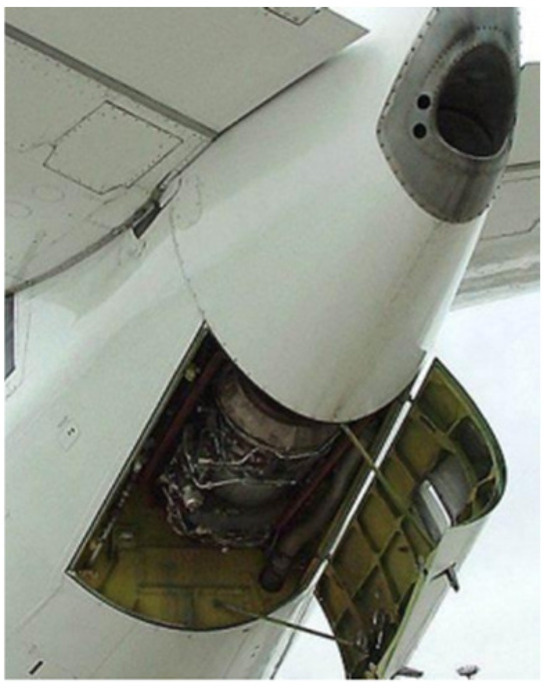
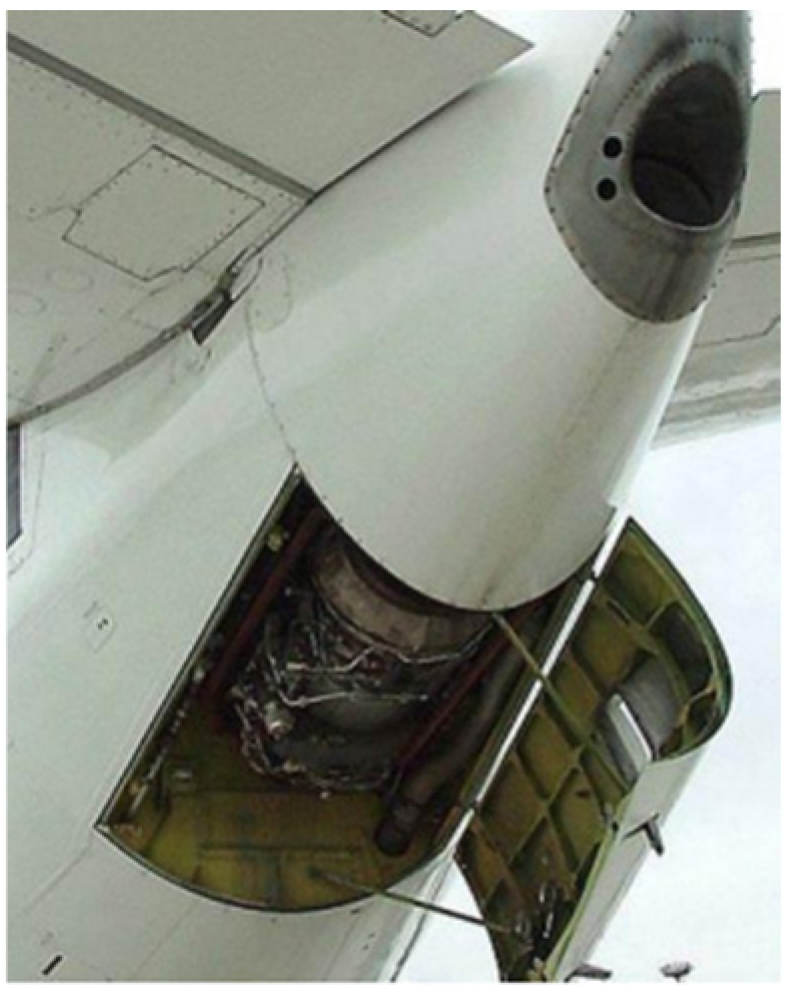
This case is based on the fire protection standards for APU intakes stipulated in FAR Part 25 Amendment 25-46 (1978), whose configuration is illustrated in Figure 5, and which introduced stricter requirements for the Boeing 747-8 aircraft. The B747-8 was developed from the B747-400 and is equipped with General Electric GEnx engines. According to the amendment’s update 25.1103(b)(2): “Fire resistant if it is in any fire zone for which a fire-extinguishing system is required, except that ducts for auxiliary power units must be fireproof within the auxiliary power unit fire zone.” This mandates that structural components must withstand fire-related heat at least as effectively as steel and contain fire propagation. A fully fireproof intake duct means that the entire APU intake system, including all seals, firewalls, and the APU engine interface structure, must meet fireproof standards. The objective of this requirement is to ensure that materials and components within fire zones can contain or block fires, prevent flames from spreading to non-fire zones, and provide sufficient time for the crew or the aircraft’s fire protection system to take appropriate action in case of a fire. Based on the FAA Aviation Safety Database (2013–2023), only one APU intake fire incident occurred in the A320neo series, with no casualties, resulting in an accident rate of r = 5 × 10⁻¹⁵ per aircraft hour. Although some rubber seals failed to meet fireproof standards in testing and needed to be replaced, the overall APU system has demonstrated strong fire containment capabilities.
Figure 5.
B747-8 Auxiliary Power Unit (APU).
3.2.2. Total Benefit (TB) Analysis
Example values for some of the parameters required to calculate TB are provided in Table 2. The purpose of the amendment is to prevent the spread of fire from the air intake to the APU compartment or vice versa, thereby mitigating associated hazards. However, the APU is not the aircraft’s primary power unit and mainly operates during ground taxiing and engine starting and is only utilized during flight phases in emergency situations (such as main engine failure). Passengers have evacuation opportunities in the event of a fire. A fire originating from the air intake would likely only result in injuries. Historical records indicate that this aircraft model, as well as similarly designed models, have experienced only two APU fire incidents during service, neither of which resulted in injuries.
Table 2.
Example Values of TB Model Parameters for case 3.2.
Even if the requirement for fireproof sealing at every location is not fully met, the integrated fire protection system is sufficient to control the risk of fire spread and maintain protection for critical flight control components near the APU fire zone. The actual probability of such an incident is extremely low, meaning both r and w are close to zero. Here, we set the value of w to 20% of r for reference. Consequently, the expected number of accidents (Ri) and the incremental change in risk (∆Ri), as calculated by Equations (4) and (5), are minimal.
Ni = (i − 1) × 15 (1 < i ≤ 10),
Ni = 150 (5 < i ≤ 20),
Ni = 150 − (i − 25 − 1) × 10 (20 < i ≤ 30),
ΔRi = (r − w) × Ni × f = 4 × 10⁻⁵ × Ni
Furthermore, when calculating the benefit of preventing a single accident (Bd) and the reduced-loss benefit from avoiding an accident (Bc), the impact is limited due to the relatively low severity of injuries and aircraft damage in such scenarios. The cost savings from reduced aircraft damage, accident investigation expenses, and additional compensation for injuries are minor, resulting in negligible overall benefits. Based on historical data, such incidents have resulted in no casualties, therefore the value of casualties is zero; airframe maintenance costs are derived from APU fire repair cost analyses; accident investigation expenses are estimated based on historical accident investigation costs.
Bd = aix + biy + ciz + d + e = 0 + 0 + 0 + 5,000,000 + 500,000 = 5,500,000 USD
Bi = ΔRi × Bd × (1 − k%)i = 220 × Ni × (0.9)i
TB = ∑Bi = 220 × ∑[Ni × (0.9)i] ≈ 152,923 USD
In summary, the total benefit (TB) of further modifying the design to comply with the latest amendment is marginal.
3.2.3. Total Cost (TC) Analysis
To meet the fire protection requirements for all sections of the intake system, the aircraft design would require complex modifications, involving multiple design iterations. This would lead to significant costs in design improvements, manufacturing, certification, and uncertainties in returning to service. Furthermore, it could result in additional costs due to delivery delays, negatively impacting customer profitability.
Additionally, the increase in direct operating costs must be considered. The modified seals may have potential long-term durability issues, leading to higher maintenance costs. Economic analysis indicates that a full upgrade would incur substantial direct costs. In conclusion, the Total Cost (TC) of implementing these design changes is considerable.
Due to the difficulty in obtaining accurate data, the calculations for C1 and C2 are estimated values and are for reference only. Based on general industry conditions, C1 is estimated at $600,000, and C2 at $500,000. The modification only involves the replacement of seals and does not affect the unit’s operational procedures; therefore, C3 is 0. At this point, TC is already a very large value, and further increasing C4 will not affect the conclusion. Additionally, since data for C4 is difficult to obtain, C4 is tentatively assigned a value of 0. Therefore, the TC is 1,100,000 USD.
Modeling results indicate TB << TC (BCR = 0.139), demonstrating that the safety benefits achieved by modifying the APU intake duct to comply with the latest amendment would be marginal, while requiring disproportionately high design modification costs. Therefore, implementing this revised amendment is deemed impractical.
3.3. Summary
The analysis demonstrates that this model effectively balances safety and economic considerations when evaluating design changes under the CPR framework, validating its practicality and flexibility. Not only does it help identify the actual safety contribution of proposed design modifications and quantify implementation costs—providing critical decision-making support for airworthiness authorities and manufacturers—but it also reveals scenarios where full compliance with the latest regulatory requirements may not be justified. This offers empirical evidence supporting the flexible application of CPR.
4. Conclusions and Future Outlook
This study conducted an in-depth exploration of the safety and economic impacts regarding “impractical” issues in the CPR of civil aviation products. A comprehensive evaluation model was established and validated through two specific case applications: “fuel tank access cover design modifications” and “APU intake duct fire protection requirements.” The results demonstrate the model’s effectiveness and practical utility.
Section 3.1, as a typical example of a significant change, demonstrates how the model quantitatively analyzes the rationality and necessity of mandating the implementation of a new amendment. The model analysis reveals that although the historical probability of related accidents is low, the consequences are extremely severe once they occur. The cost–benefit analysis shows that the TB significantly exceeds the TC (BCR = 35.5). This proves that for all in-production transport category aircraft (such as the B737 NG, A320neo, and other series), complying with this amendment can achieve a substantial safety improvement at a limited modification cost, supporting the comprehensive implementation of the new regulation in such scenarios.
Section 3.2 also constitutes a significant change, but the model analysis leads to a different conclusion. Historical data indicate that the probability of such fire incidents is low and their consequences are limited. Further upgrading the fire protection standards would yield minimal safety benefits, while comprehensive design changes would result in high costs and delivery delays. The model calculation shows that the TC significantly exceeds the TB (BCR = 0.139), thereby providing an objective basis for invoking the “impracticality exception”.
The findings indicate that
- The balance between security and economy. When evaluating the applicability of CPR, it is essential to balance the necessity of safety improvements with practical considerations of economic feasibility. Through quantitative analysis using the model, it becomes possible to more accurately determine which modifications would yield “no substantial contribution to safety levels” or be deemed “impractical” under the latest regulations—thereby providing data-driven guidance for certification decisions.
- The practical value of the model. The empirical case analysis demonstrates the practical value of the cost–benefit model in guiding real-world decision-making. It not only helps the industry understand the relationship between modification costs and safety benefits, but also provides regulatory authorities with scientific decision-making basis, thereby promoting optimal resource allocation and risk management.
- The formulation of future certification policies and standards. The model and methodology proposed in this research can also provide robust support for the revision of airworthiness standards. Although such revisions may involve more aircraft types and design modifications, the fundamental cost–benefit analysis model remains consistent and applicable.
The study further reveals that complying with the latest regulatory requirements typically enhances safety significantly. However, the associated economic burden may prove excessive for the industry. This is particularly true when implementing large-scale retrofits on in-service aircraft. Consequently, establishing quantified criteria for determining “impracticality” becomes critically important, as it provides a scientific basis for cost–benefit equilibrium during airworthiness certification processes.
It should be noted that certain outstanding issues remain worthy of further investigation.
- Dynamic optimization of the model. With technological advancements and the evolution of the aviation industry, the model should undergo continuous iterations and upgrades to adapt to emerging safety technologies, evolving cost structures, and shifting market trends. Future work should focus on dynamic model refinement to ensure its long-term applicability.
- The refinement and internationalization of data. The data collection mechanism should be enhanced, particularly in acquiring sensitive data, by pursuing cross-enterprise and international collaboration to establish a benchmark database jointly recognized by global aviation authorities. This will improve the model’s transnational applicability and data comprehensiveness, thereby providing stronger support for global aviation safety policies.
- The integration of non-economic factors. Future research should focus on better integrating non-economic values—such as human health, environmental impact, public trust, and social responsibility—into cost–benefit analyses to enhance the comprehensiveness and social acceptability of assessments.
Author Contributions
Conceptualization, P.K. and H.L.; methodology, P.K.; formal analysis, P.K. and H.L.; investigation, P.K., H.L. and Y.Z.; resources, H.L.; data curation, P.K. and Y.Z.; writing—original draft preparation, P.K. and Y.Z.; writing—review and editing, P.K. and H.L.; visualization, Y.Z.; supervision, P.K.; project administration, H.L.; funding acquisition, H.L. All authors have read and agreed to the published version of the manuscript.
Funding
This research received no external funding.
Data Availability Statement
The original contributions presented in the study are included in the article, further inquiries can be directed to the corresponding author.
Conflicts of Interest
The authors declare no conflict of interest.
Abbreviations
| Acronym | Definition |
| CPR | Changed Product Rule |
| FAA | Federal Aviation Administration |
| CAAC | Civil Aviation Administration of China |
| EASA | European Union Aviation Safety Agency |
| ANAC | Agência Nacional de Aviação Civil |
| TCCA | Transport Canada Civil Aviation |
| MCAS | Maneuvering Characteristics Augmentation System |
| GAMA | General Aviation Manufacturers Association |
| CBA | Cost–Benefit Analysis |
| APU | Auxiliary Power Unit |
References
- Federal Aviation Administration (FAA). Title 14, Code of Federal Regulations, Part 21—Certification Procedures for Products and Parts; U.S. Government Publishing Office: Washington, DC, USA, 2023.
- Civil Aviation Administration of China (CAAC). China Civil Aviation Regulations Part 21: Certification Procedures for Civil Aviation Products and Parts; CCAR-21-R4; Civil Aviation Administration of China: Beijing, China, 2017.
- AC 21.101-1B; Establishing the Certification Basis of Changed Aeronautical Products. Federal Aviation Administration: Washington, DC, USA, 2016.
- AC-21-AA-2014-36; Establishing the Certification Basis of Changed Aeronautical Products. Civil Aviation Administration of China: Beijing, China, 2014.
- European Union Aviation Safety Agency. GM 21.A.101 Establishing the Certification Basis of Changed Aeronautical Products; European Union Aviation Safety Agency: Cologne, Germany, 2024. [Google Scholar]
- Yin, S.J.; Zhang, L.; Chen, Y. The ‘Three Characteristics’ Concept and Model Analysis of Airworthiness Certification. J. Nanjing Univ. Aeronaut. Astronaut. 2022, 54, 843–850. [Google Scholar]
- House of Representatives; Committee on Transportation and Infrastructure. Final Committee Report: The Design, Development, and Certification of the Boeing 737 MAX. In Proceedings of the 116th Congress, First Session, Washington, DC, USA, 15 May 2019; U.S. Government Publishing Office: Washington, DC, USA, 2020. [Google Scholar]
- Aircraft Certification, Safety, and Accountability Act, § 117. In United States Statutes at Large; United States Government Publishing Office: Washington, DC, USA, 2020; Volume 134, pp. 2309, 2335.
- Federal Aviation Administration (FAA) Reauthorization Act of 2024, Pub. L. No. 118-63, § 344(c). In United States Statutes at Large; United States Government Publishing Office: Washington, DC, USA, 2024; Volume 138.
- Federal Aviation Administration (FAA). Changed Product Rule Aviation Rulemaking Committee Final Report; Federal Aviation Administration: Washington, DC, USA, 2024.
- International Authorities Working Group (IAWG). Changed Product Rule Recommendations; Federal Aviation Administration, Aircraft Certification Service: Washington, DC, USA, 2022.
- Linling, S.; Wenjin, Z.; Kelly, T. Do Safety Cases Have a Role in Aircraft Certification? Procedia Eng. 2011, 17, 358–368. [Google Scholar] [CrossRef] [Scilit]
- Boardman, A.E.; Greenberg, D.H.; Vining, A.R.; Weimer, D.L. Cost-Benefit Analysis: Concepts and Practice, 5th ed.; Cambridge University Press: Cambridge, UK, 2018. [Google Scholar]
- CE Delft. Economic Benefits of Including Aviation in the EU ETS; European Commission: Brussels, Belgium, 2012. [Google Scholar]
- Federal Aviation Administration (FAA). Economic Analysis of Small Unmanned Aircraft Regulations; Federal Aviation Administration: Washington, DC, USA, 2016.
- European Commission (EC). Impact Assessment of EU Air Cargo Security Measures; Directorate-General for Mobility and Transport: Brussels, Belgium, 2012. [Google Scholar]
- Stewart, M.G.; Mueller, J. Terrorism Risks and Cost-Benefit Analysis of Aviation Security. Risk Anal. 2013, 33, 893–908. [Google Scholar] [CrossRef] [Scilit] [PubMed]
- Birkler, J.L.; Large, J.P. A Method for Estimating the Cost of Aircraft Structural Modification; Report R-2565-AF; RAND Project Air Force: Santa Monica, CA, USA, 1981. [Google Scholar]
- Kapitanova, L.V.; Kirnosov, D.S.; Riabkov, V.I. Criterion Basis for Assessment of Transport Aircrafts Modifications by Cost Indicators. High Technol. Mech. Eng. 2023, 26, 39–45. [Google Scholar] [CrossRef] [Scilit]
- Della Vecchia, P.; Mandorino, M.; Nicolosi, F. Retrofitting Cost Modeling in Aircraft Design. Aerospace 2022, 9, 349. [Google Scholar] [CrossRef] [Scilit]
- Wright, R. Tipping Back the Scales: Reworking the Changed Product Rule to Make Derivative Aircraft Safer. Loyola Univ. Chic. Law J. 2024, 56, 1. Available online: https://lawecommons.luc.edu/luclj/vol56/iss1/5 (accessed on 1 January 2026).
- Modernization of Passenger Information Requirements Relating to ‘No Smoking’ Sign Illumination, 89 FR 68094. 2024. To Be Codified at 14 C.F.R. pts. 25, 91, 121, 125. Available online: https://www.federalregister.gov/d/2024-18602 (accessed on 14 January 2026).
- Takahashi, T.T. Regulatory Changes to Enable the Development of More Efficient Transport Category Aircraft. J. Aircr. 2013, 50, 1. [Google Scholar] [CrossRef] [Scilit]
- Wang, N. Research on the International Aviation Accident Personal Injury Compensation System. Master’s Thesis, Yangzhou University, Yangzhou, China, 2023. [Google Scholar]
- Dong, N.Q. Civil Aviation Accident Compensation: Institutional Review and Improvement Path. Law Sci. Mag. 2018, 39, 73–84. [Google Scholar] [CrossRef]
- National Development and Reform Commission (NDRC); Ministry of Finance of China (MOF). Notice on Reissuing Administrative Service Fee Standards for Civil Aviation System and Related Issues; No. FaGaiJiaGe [2011] 3214; NDRC: Beijing, China, 2011. [Google Scholar]
- Boger, D.C.; Liao, S.S. Aircraft Modifications Cost Analysis Volume 1 Overview of the Study; AD-A220 764; Naval Postgraduate School: Monterey, CA, USA, 1990. [Google Scholar]
- García-Fornieles, J.M.; Fan, I.-S.; Perez, A.; Wainwright, C.; Sehdev, K. A Work Breakdown Structure that Integrates Different Views in Aircraft Modification Projects. Concurr. Eng. 2003, 11, 39–50. [Google Scholar] [CrossRef] [Scilit]
- Baily, S.; Gilbertson, R. Aircraft Modification Management Evaluation; Report ADA09458; ARINC Research Corporation: Annapolis, MD, USA, 1980. [Google Scholar]
- Lee, M.; Li, L.K.B.; Song, W. Analysis of direct operating cost of wide-body passenger aircraft: A parametric study based on Hong Kong. Chin. J. Aeronaut. 2019, 32, 1222–1243. [Google Scholar] [CrossRef] [Scilit]
- Revised Departmental Guidance on Valuation of a Statistical Life in Economic Analysis. Available online: https://www.transportation.gov/office-policy/transportation-policy/revised-departmental-guidance-on-valuation-of-a-statistical-life-in-economic-analysis (accessed on 1 January 2026).
- Treatment of the Value of Preventing Fatalities and Injuries in Preparing Economic Analyses. Available online: https://www.transportation.gov/policy/transportation-policy/economy (accessed on 1 January 2026).



Disclaimer/Publisher’s Note: The statements, opinions and data contained in all publications are solely those of the individual author(s) and contributor(s) and not of MDPI and/or the editor(s). MDPI and/or the editor(s) disclaim responsibility for any injury to people or property resulting from any ideas, methods, instructions or products referred to in the content. |
© 2026 by the authors. Licensee MDPI, Basel, Switzerland. This article is an open access article distributed under the terms and conditions of the Creative Commons Attribution (CC BY) license.