Article

Can Microbial Consortium Applications Affect Yield and Quality of Conventionally Managed Processing Tomato?

by
Giovanna Marta Fusco
1,†,
Andrea Burato
2,†,
Alfonso Pentangelo
2,
Mariateresa Cardarelli
3,
Rosalinda Nicastro
1,
Petronia Carillo
1 and
Mario Parisi
2,*
1
Department of Environmental, Biological and Pharmaceutical Sciences and Technologies, University of Campania “Luigi Vanvitelli”, Via Vivaldi 43, 81100 Caserta, Italy
2
CREA Research Centre for Vegetable and Ornamental Crops, Via Cavalleggeri 25, 84098 Pontecagnano Faiano, Italy
3
Department of Agriculture and Forest Sciences, University of Tuscia, Via San Camillo de Lellis snc, 01100 Viterbo, Italy
*
Author to whom correspondence should be addressed.
These authors contributed equally to this work.
Plants 2023, 12(1), 14; https://doi.org/10.3390/plants12010014

Submission received: 3 November 2022 / Revised: 3 December 2022 / Accepted: 15 December 2022 / Published: 20 December 2022
(This article belongs to the Special Issue Biostimulants as Growth Promoting and Stress Protecting Compounds)

Abstract

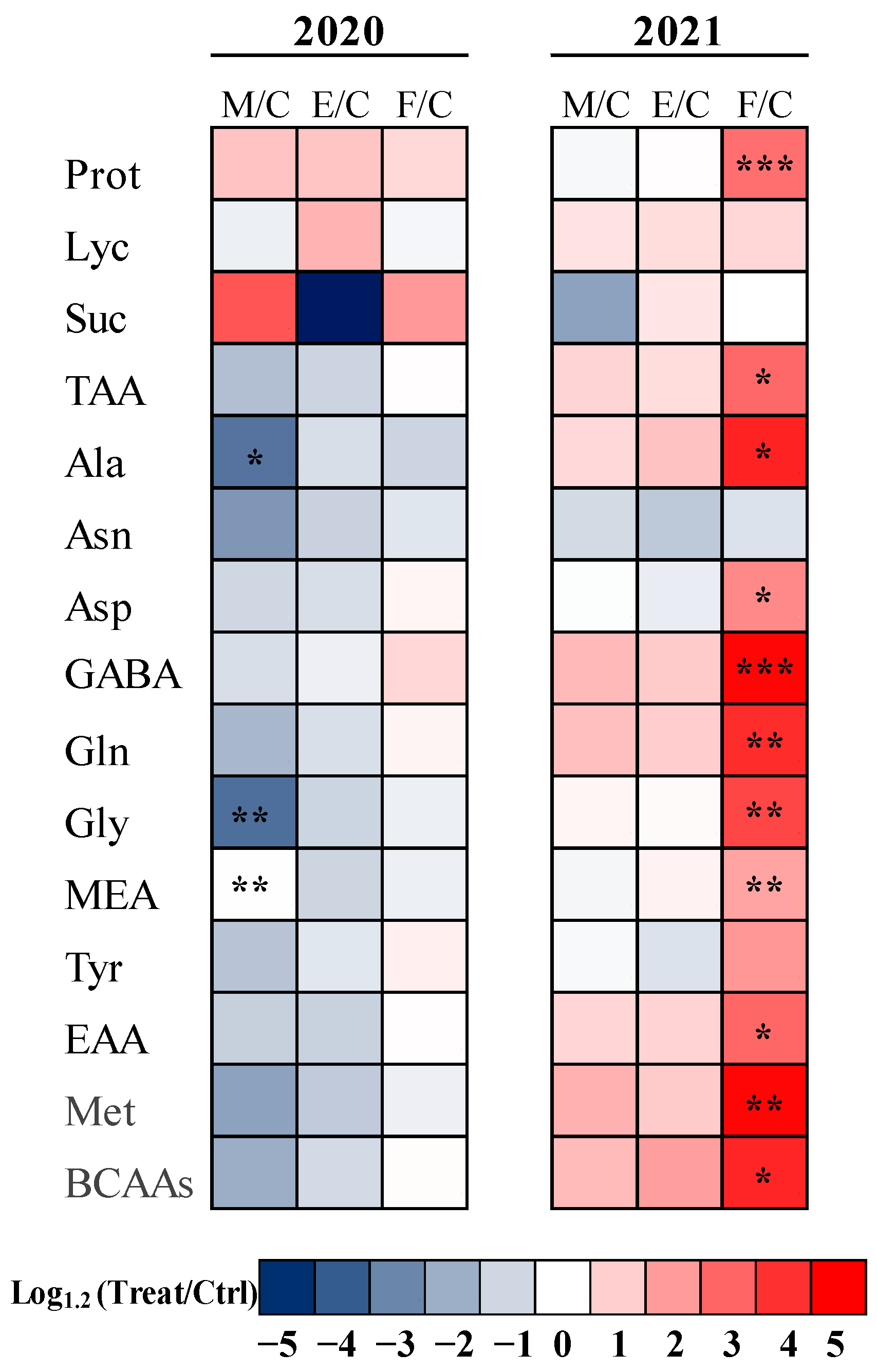
Three commercial microbial-based biostimulants containing fungi (arbuscular mycorrhizae and Trichoderma spp.) and other microrganisms (plant growth-promoting bacteria and yeasts) were applied on a processing tomato crop in a two-year field experiment in southern Italy. The effects of the growing season and the microorganism-based treatments on the yield, technological traits and functional quality of the tomato fruits were assessed. The year of cultivation affected yield (with a lower fruit weight, higher marketable to total yield ratio and higher percentage of total defective fruits in 2020) and technological components (higher dry matter, titratable acidity, total soluble solids content in 2020). During the first year of the trial, the consortia-based treatments enhanced the soluble solids content (+10.02%) compared to the untreated tomato plants. The sucrose and lycopene content were affected both by the microbial treatments and the growing season (greater values found in 2021 with respect to 2020). The year factor also significantly affected the metabolite content, except for tyrosine, essential (EAA) and branched-chain amino acids (BCAAs). Over the two years of the field trial, FID-consortium enhanced the content of proteins (+53.71%), alanine (+16.55%), aspartic acid (+31.13%), γ-aminobutyric acid (GABA) (+76.51%), glutamine (+55.17%), glycine (+28.13%), monoethanolamine (MEA) (+19.57%), total amino acids (TAA) (+33.55), EAA (+32.56%) and BCAAs (+45.10%) compared to the control. Our findings highlighted the valuable effect of the FID microbial inoculant in boosting several primary metabolites (proteins and amino acids) in the fruits of the processing tomato crop grown under southern Italian environmental conditions, although no effect on the yield and its components was appreciated.
Keywords: Solanum lycopersicum; mycorrhizae; Trichoderma; plant growth-promoting bacteria; biostimulants; fruit quality Solanum lycopersicum; mycorrhizae; Trichoderma; plant growth-promoting bacteria; biostimulants; fruit quality